Author: Clara Bennett

  • 22 Modern Victorian Living Room Design Ideas to Inspire You

    22 Modern Victorian Living Room Design Ideas to Inspire You

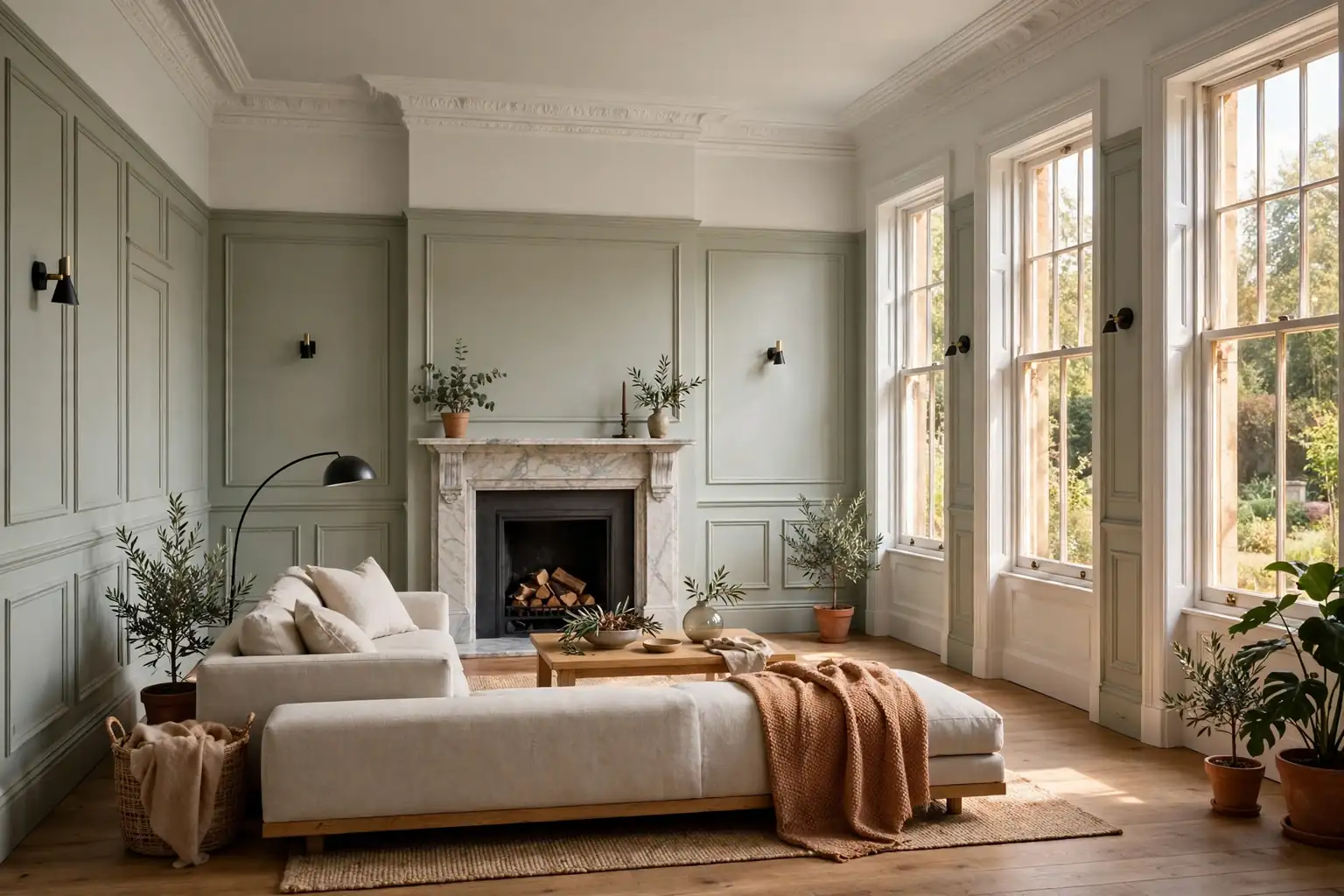
    A Victorian living room already has a head start: tall ceilings, deep windows, a fireplace, and mouldings that newer rooms often lack. The trick is to let those features do the talking and keep everything else quieter, with low furniture, plain fabrics, and a calm colour base. These 22 modern Victorian living room design ideas show how to pair ornate details with modern comfort, from painted panelling and glass tables to brass accents and bay window seats. Start with the room you have, keep the details worth keeping, and change one layer at a time. For small room layout help, the zoning advice in these cozy apartment living room ideas pairs well with the Victorian layouts below.

    Key Takeaways

    • Keep the Victorian bones: mouldings, fireplaces, sash windows and ceiling roses are the room’s best features, so clean and repair them before adding anything new.
    • Let modern pieces sit low and plain, so ornate walls and ceilings stay the focus instead of competing with bulky furniture.
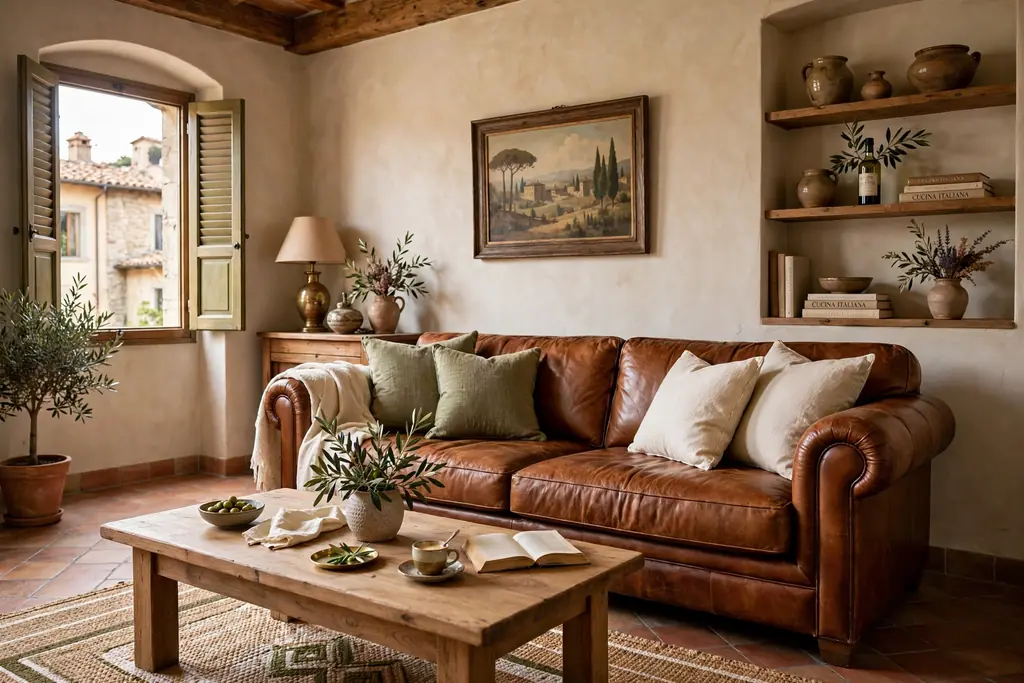
    • Use one calm base colour on walls and large furniture, then add depth with velvet, brass, glass, wood and plants.
    • Layer light at several heights, with picture lights, floor lamps and table lamps, rather than relying on one central light.
    • Give the fireplace a clear role, whether as a seating focus, an art wall, or a quiet corner, instead of letting it fight with the television.
    • Choose a few Victorian details to repeat, such as brass, arch shapes or dark wood, and leave the rest of the room simple.

    1. Paint the Panelling One Calm Colour
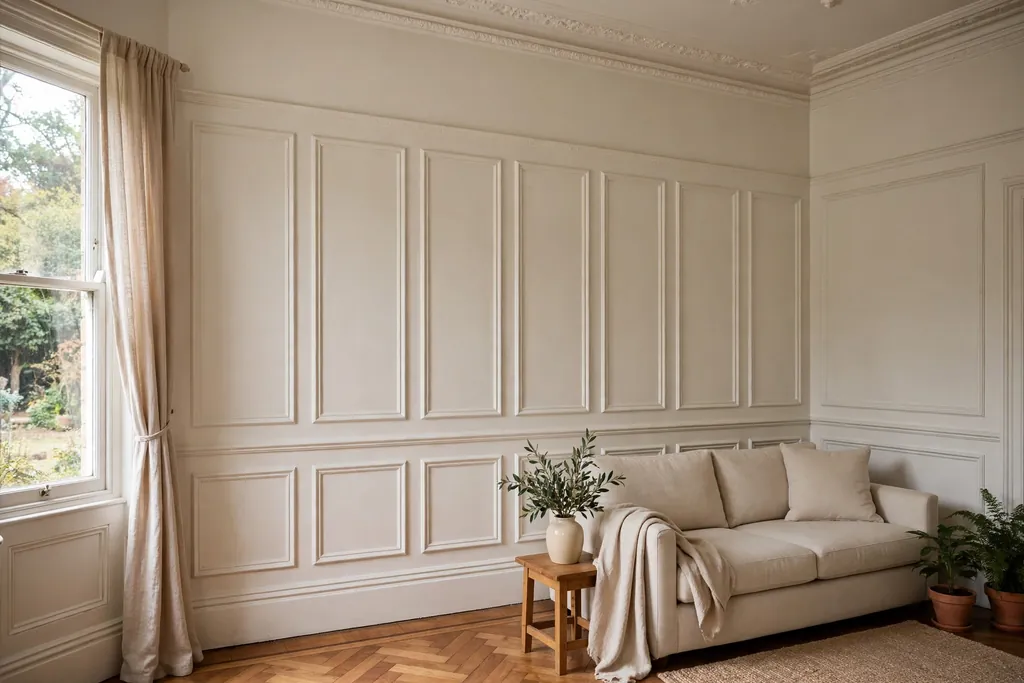
    Victorian living room wall with painted panelling in a calm warm white, with a plain sofa beside it.

    Paint wall panelling, skirting and the picture rail in a single calm colour, such as warm white, pale greige or soft sage, so the mouldings read as texture rather than as a busy pattern. One colour lets the shadows in the panelling do the work, and it gives modern furniture a quiet background. This suits a room where dark wood panelling feels heavy, but removing it would lose the Victorian character.

    Use a washable paint finish that suits the room’s use, and keep the ceiling a shade lighter so the room still feels tall. Test the colour on one panel in daylight and lamplight before painting the whole wall, since mouldings change how a colour looks. If you rent, the same calm base can come from large curtains, a pale rug and light furniture, without painting at all.

    2. Keep the Ceiling Rose and Fit a Simple Pendant
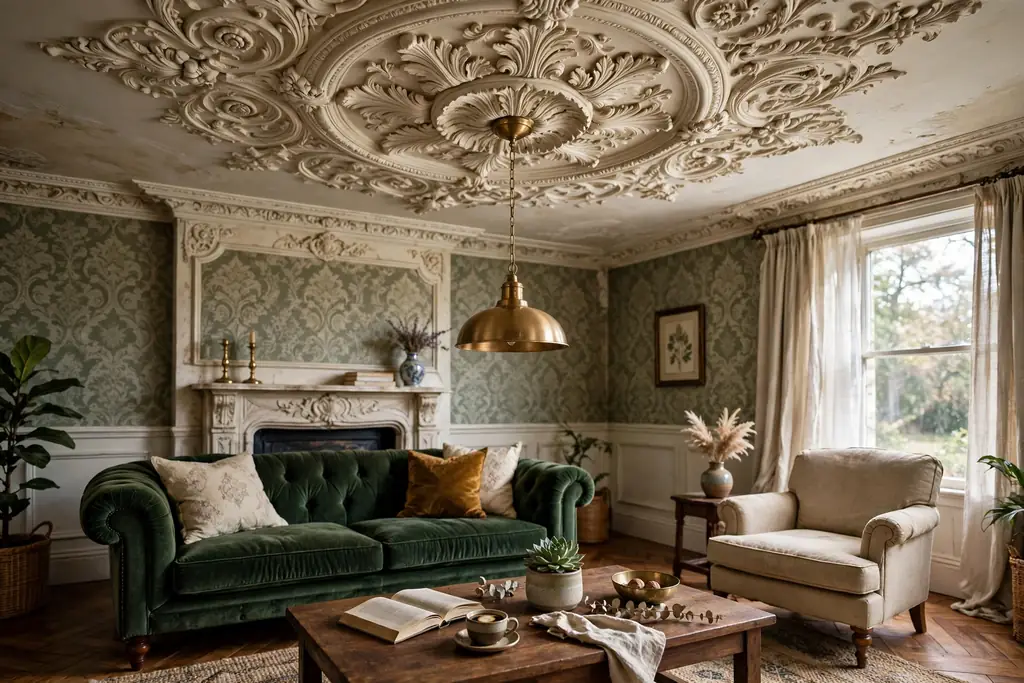
    Ornate Victorian ceiling rose with a simple brass pendant hanging over a coffee table.

    Keep the original ceiling rose and hang a simple modern pendant from it, rather than replacing the rose with a plain ceiling fitting. A slim pendant in brass, black metal or clear glass hangs low enough to light a coffee table, while the rose above keeps the Victorian detail in view. This suits rooms with high ceilings, where a pendant can hang at a comfortable height without crowding the room.

    Choose a pendant with a warm bulb and a dimmer, so the light can shift from bright daytime use to a soft evening glow. Keep the cord plain and the shade simple, since an ornate chandelier plus an ornate rose can make the ceiling feel crowded. If the rose is damaged, a plaster repair is usually cheaper and more in keeping than removing it.

    3. Dress Sash Windows With Sheer Linen
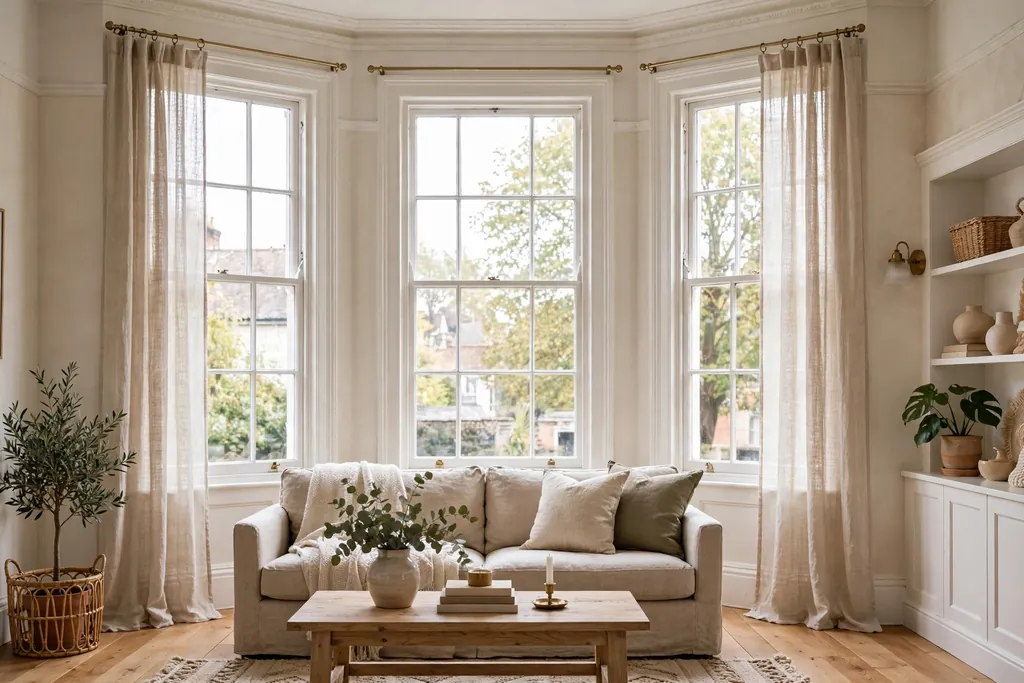
    Tall Victorian sash windows dressed with sheer linen panels in a bright living room.

    Dress original sash windows with sheer linen panels that soften daylight without hiding the window frame or the view. Sheer linen keeps the tall Victorian proportions visible, gives privacy in the daytime, and moves gently when the window is open. This suits rooms where heavy curtains would darken the space or hide the best feature of the wall.

    Hang the rod close to the ceiling and wider than the frame, so the panels stack on the wall when open. Add a plain roller blind behind the linen if you need full privacy at night, rather than a second heavy curtain layer. Keep the linen in a pale neutral, and wash it as advised on the label, since window fabric collects dust.

    4. Let the Marble Fireplace Stay the Focus
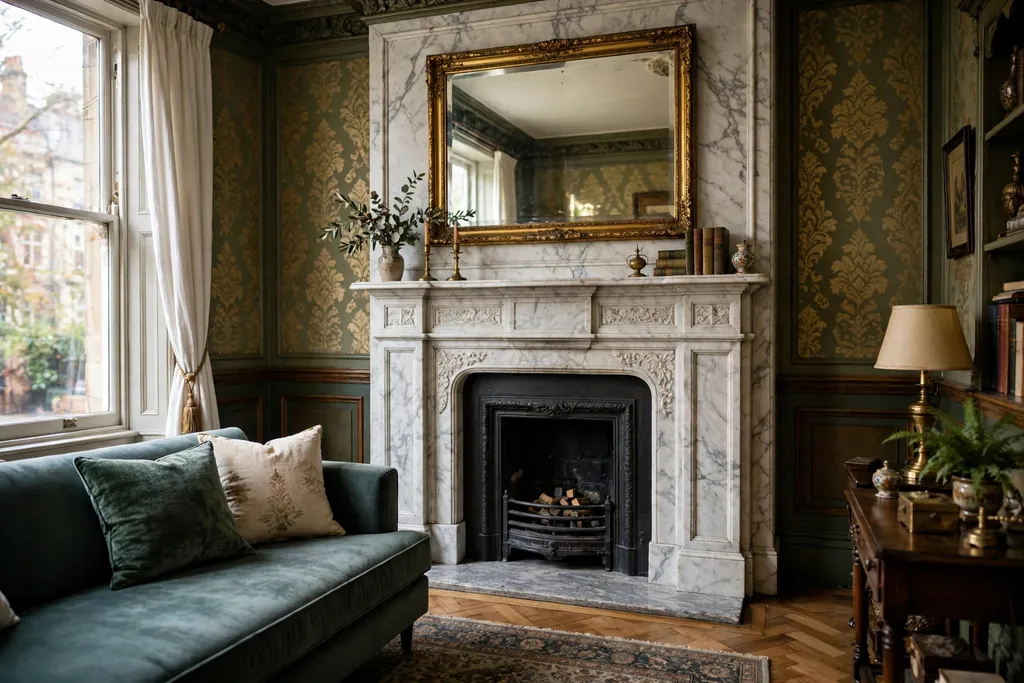
    Marble fireplace surround in a Victorian living room with one mirror above the mantel and a low sofa.

    Keep a marble fireplace surround as the room’s focus, and style it with restraint: one mirror or one piece of art above it, two simple objects on the mantel, and a clear hearth. Marble already has colour and pattern, so it needs little help, and a calm surround lets a modern sofa sit well beside it. This suits rooms where the fireplace is in good condition but the rest of the room has been changed over time.

    Clean the marble with a method suited to stone, and avoid harsh cleaners that can mark it. Keep the fire opening clear and safe, and use a simple fire screen if the fireplace is still in use. If the fireplace is no longer used, a row of candles in glass holders or a stack of logs in the opening gives it a quiet purpose without a fake fire effect.

    5. Choose a Low Modern Sofa for High Rooms
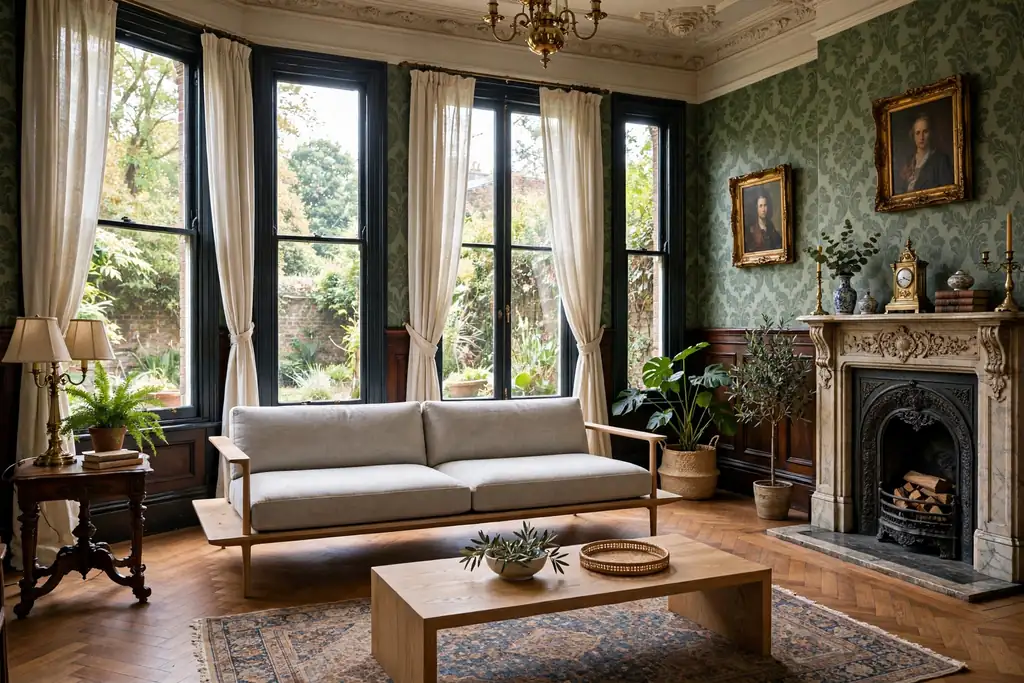
    Low modern sofa with slim arms and raised legs in a Victorian living room with tall windows.

    Choose a low modern sofa with slim arms and raised legs, so the seating sits below the dado rail and leaves the wall panelling and windows in view. A low profile stops the sofa from cutting the room in half visually, which matters in a Victorian room where the walls are the main decoration. This suits a room with tall ceilings and ornate walls, where a deep, high-backed sofa would hide too much.

    Pick a plain fabric in a calm colour, such as oatmeal, pale grey or soft green, and add texture with cushions rather than with a patterned sofa. Measure the sofa against the fireplace wall first, and leave room to walk past both ends. For more seating guidance in a tight room, see these cozy apartment living room ideas.

    6. Pair Curved Lounge Chairs With the Fireplace
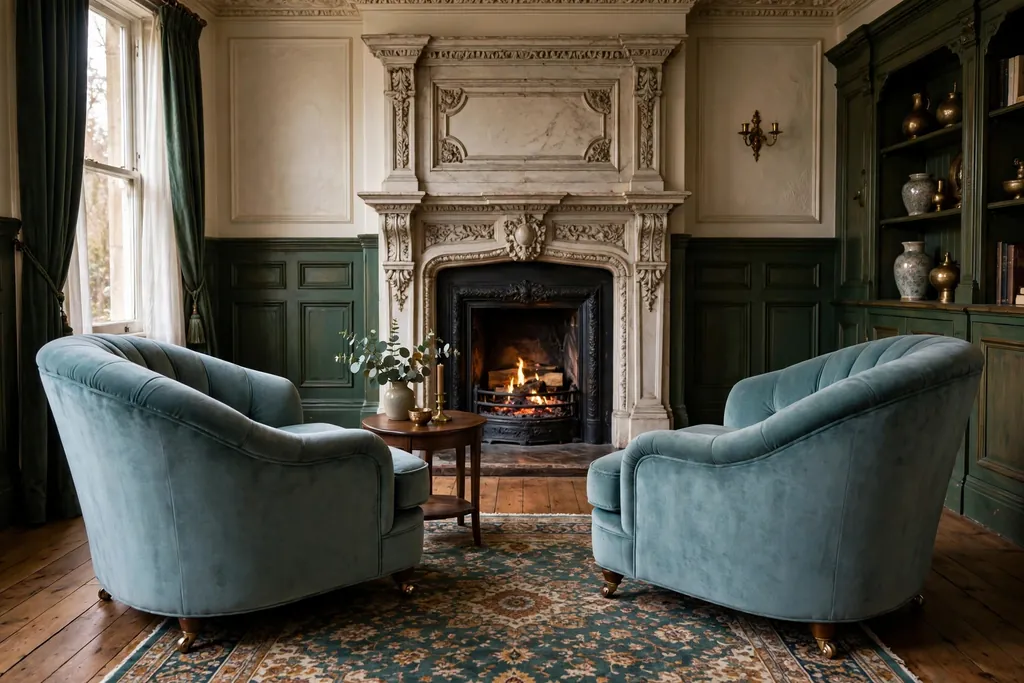
    Two curved lounge chairs angled toward a Victorian fireplace with a small side table between them.

    Place two curved lounge chairs opposite the fireplace, angled slightly toward each other, to make a conversation spot that does not need a television to anchor it. Curved chairs soften the straight lines of panelling and bookcases, and their smaller footprint suits a Victorian room better than a second large sofa. This suits a room used for talking, reading and relaxing, rather than as a media room.

    Choose chairs with a plain fabric and a slim leg, so they do not compete with the fireplace surround. Leave enough space between the chairs and the hearth for safe use if the fire is lit, and add a small side table between them for drinks. If the room is small, one curved chair plus a footstool gives most of the same comfort with less floor space used.

    7. Use a Glass Coffee Table to Show the Floor
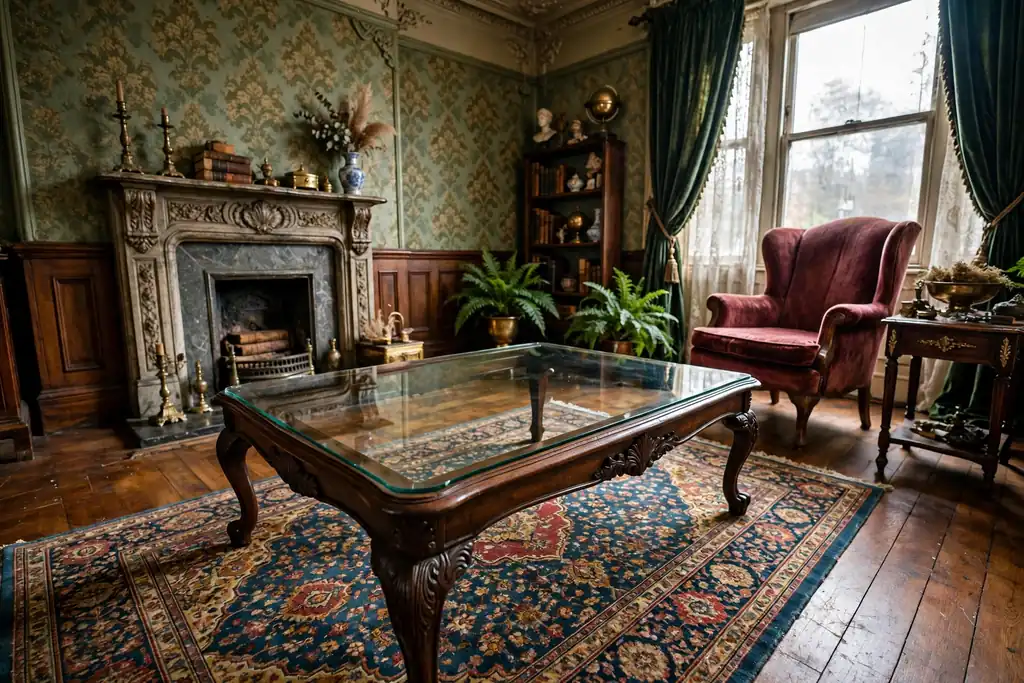
    Glass topped coffee table in a Victorian living room showing a patterned rug and wood floor beneath it.

    Use a glass-topped coffee table in the center of the seating group, so the rug, the wood floor and the fireplace hearth stay visible through it. Glass keeps the middle of the room feeling open, which helps in a Victorian room where the furniture and the mouldings already add plenty of visual weight. This suits rooms with a patterned rug or a handsome wood floor that a solid wood table would hide.

    Choose a table with rounded corners and a slim metal frame, and keep the top to a tray, one book and a small plant, so the glass stays useful rather than cluttered. Check the table height against the sofa seat height, so it is comfortable to reach from a seated position. Wipe the glass weekly, since glass shows dust and fingerprints faster than wood.

    8. Build Bookcases Into the Fireplace Alcoves
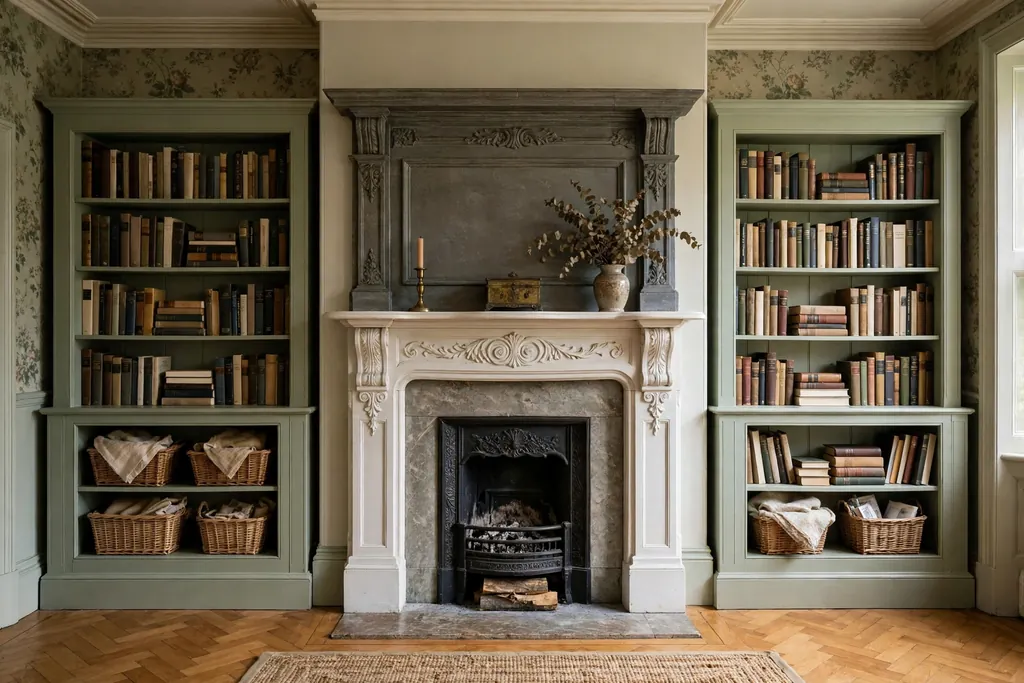
    Painted bookcases built into the alcoves beside a Victorian fireplace, with books and baskets.

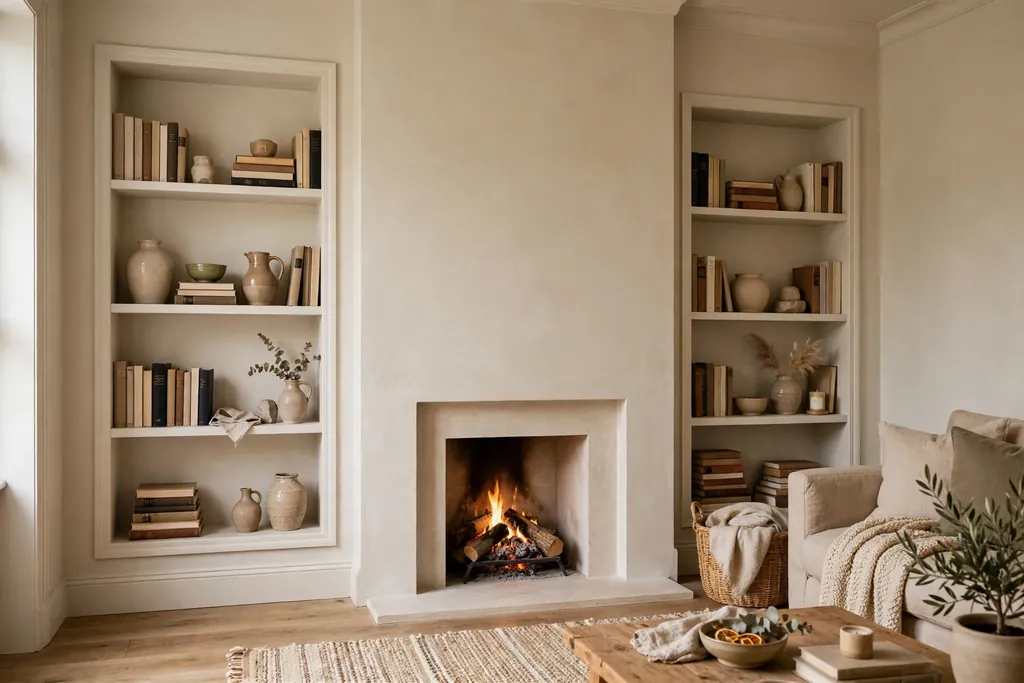
    Fit bookcases into the alcoves on either side of the fireplace, painted the same colour as the wall panelling, so storage looks built in rather than added on. Alcove bookcases use wall space that often sits empty, frame the fireplace, and give books, baskets and a few display pieces a home. This suits a room that needs storage but cannot spare floor space for a freestanding bookcase.

    Keep heavy books low, everyday items at hand height, and lighter display pieces up high, and leave some open space on each shelf so the wall does not look packed. Use closed baskets on one shelf for remotes, chargers and small items. Anchor tall bookcases to the wall following the maker instructions, especially in a home with children or pets.

    9. Hang Modern Art in a Gilt Frame
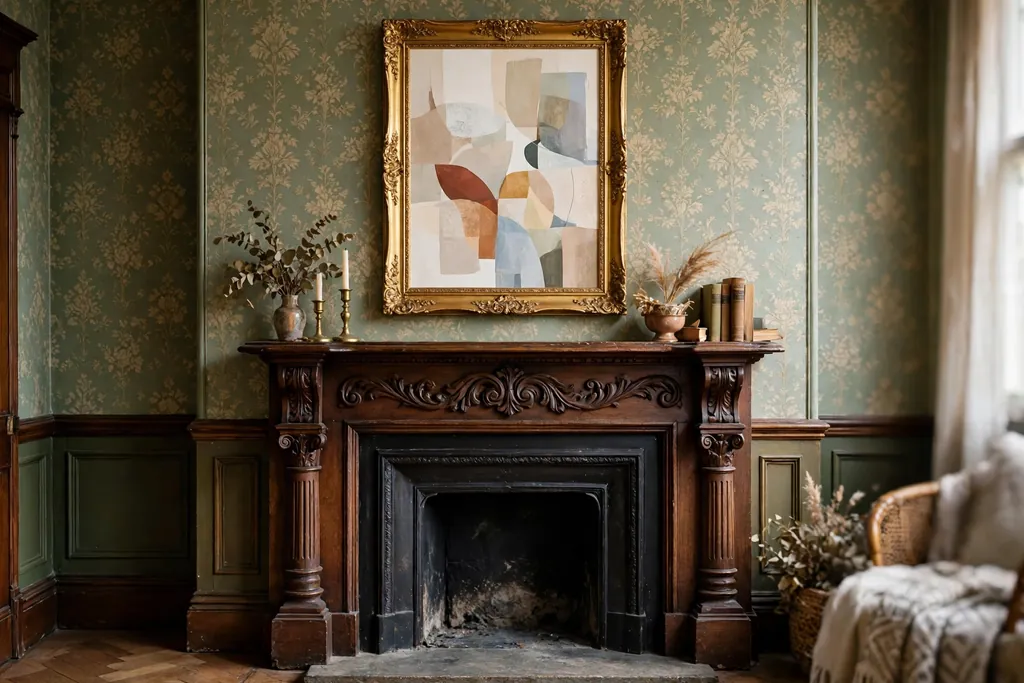
    Modern abstract print in a gilt frame above a Victorian fireplace mantel.

    Hang one modern abstract print in a traditional gilt frame above the fireplace or on the main sofa wall, so old and new meet in a single object. The gilt frame links the art to the Victorian room, while the modern print stops the wall from feeling like a period room. This suits a room that feels too formal, or where the owner likes modern art but does not want to strip out the Victorian details.

    Hang the center of the frame at eye level when seated or standing, depending on whether it sits above a mantel or on a plain wall. Keep the rest of that wall plain, so the framed print has room to breathe. Use picture hanging fixings rated for the frame weight, and check the art in daylight and lamplight before fixing it in place.

    10. Add an Arched Mirror Over a Slim Console
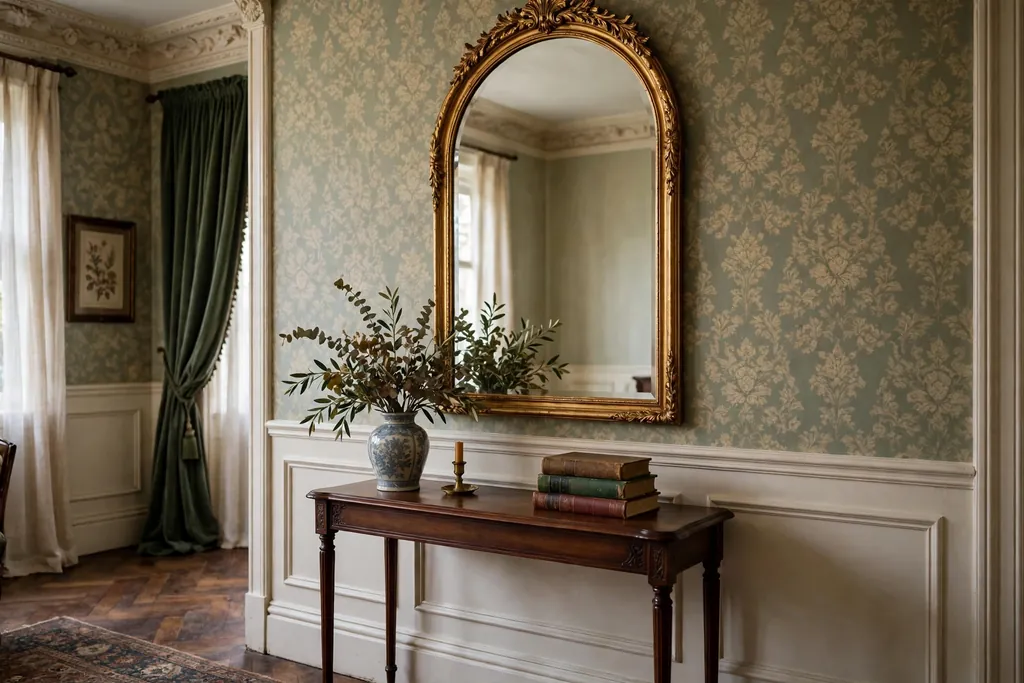
    Arched mirror over a slim console table in a Victorian living room with a vase and books.

    Place an arched mirror over a slim console table on a plain wall, echoing the arch shapes found in Victorian windows and doorways. The arch softens the straight lines of panelling, and the mirror bounces daylight deeper into the room. A slim console keeps the arrangement light, since a deep cabinet would crowd the wall and block the walkway.

    Choose a mirror large enough to reflect something pleasant, such as a window or a plant, rather than a blank wall or clutter. Keep the console top to one vase, one stack of books and a small dish for keys, so the mirror stays the focus. Fix the mirror with hardware suited to its weight, and check for glare at different times of day before settling on its position.

    11. Lay a Patterned Rug Under Plain Furniture
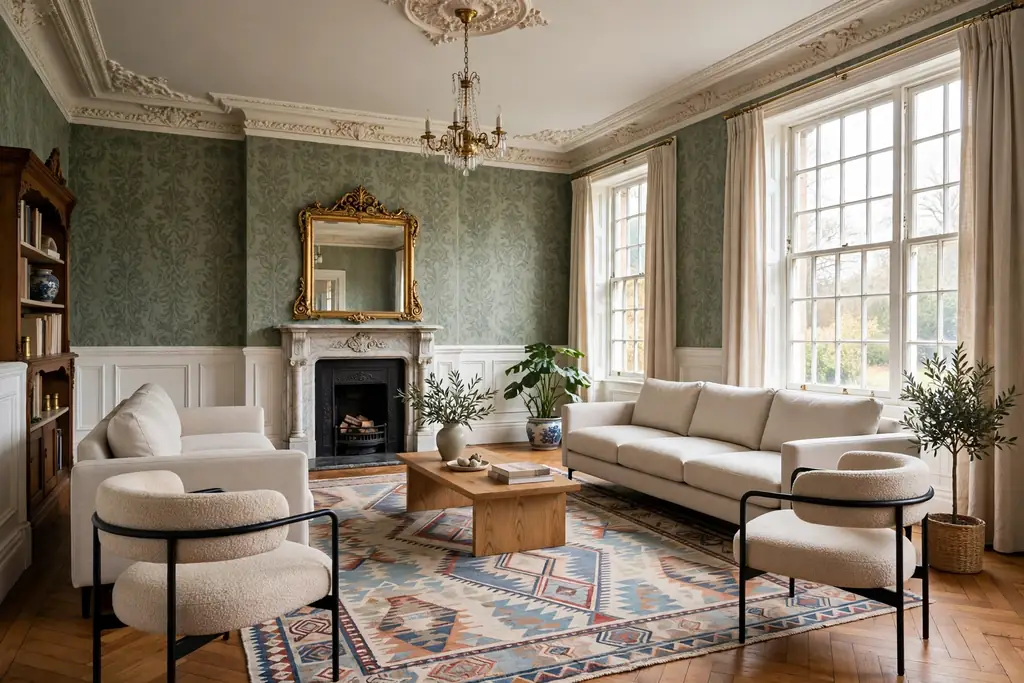
    Patterned rug under plain modern sofas and chairs in a Victorian living room.

    Lay a patterned rug under plain modern furniture, so the pattern sits on the floor where it can be changed, rather than on a sofa that is hard to replace. A traditional pattern, such as a Persian style rug or a simple geometric design, links the room to its Victorian roots, while plain sofas and chairs keep the seating group calm. This suits a room with plain wood floors that need warmth and a clear seating zone.

    Choose a rug large enough to sit under the front legs of the sofa and chairs, so the seating group reads as one unit. Use a rug pad underneath to stop sliding and to protect the floor. If the room is small, a rug in muted colours gives the pattern without making the floor feel busy, and the layered rug advice in these aesthetic farmhouse living room ideas works just as well here for texture underfoot.

    12. Layer Picture Lights, Floor Lamps and Table Lamps
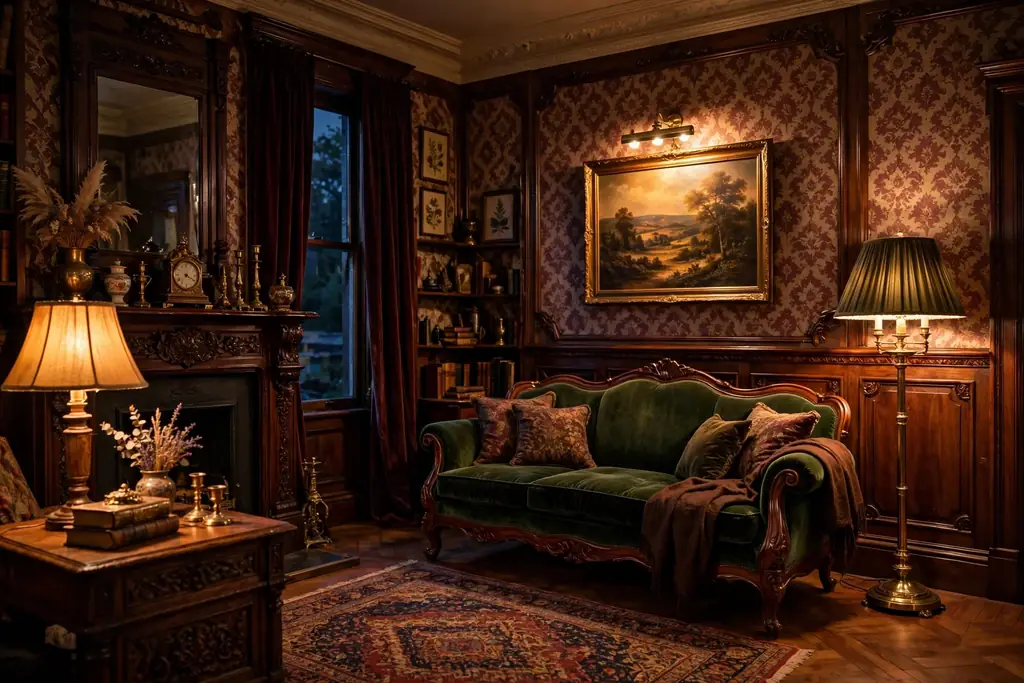
    Victorian living room in the evening lit by a picture light, a floor lamp, and a table lamp.

    Layer three kinds of light: picture lights over art or the fireplace, a floor lamp beside the main seat, and a table lamp on a console or side table. Victorian rooms were built for layered light, with wall sconces and lamps rather than one harsh ceiling light, and that approach still works with modern fittings. This suits a room used from morning to evening, since each layer can switch on and off as needed.

    Put the brightest light where you read, keep the picture lights warm in tone, and use dimmers where you can, so the evening mood stays soft. Keep lamp shades plain in linen or cotton, so the light itself, not the shade pattern, does the work. Avoid relying on a single overhead light after dark, which tends to flatten ornate mouldings instead of showing their shadows.

    13. Hang Curtains From Ceiling Height
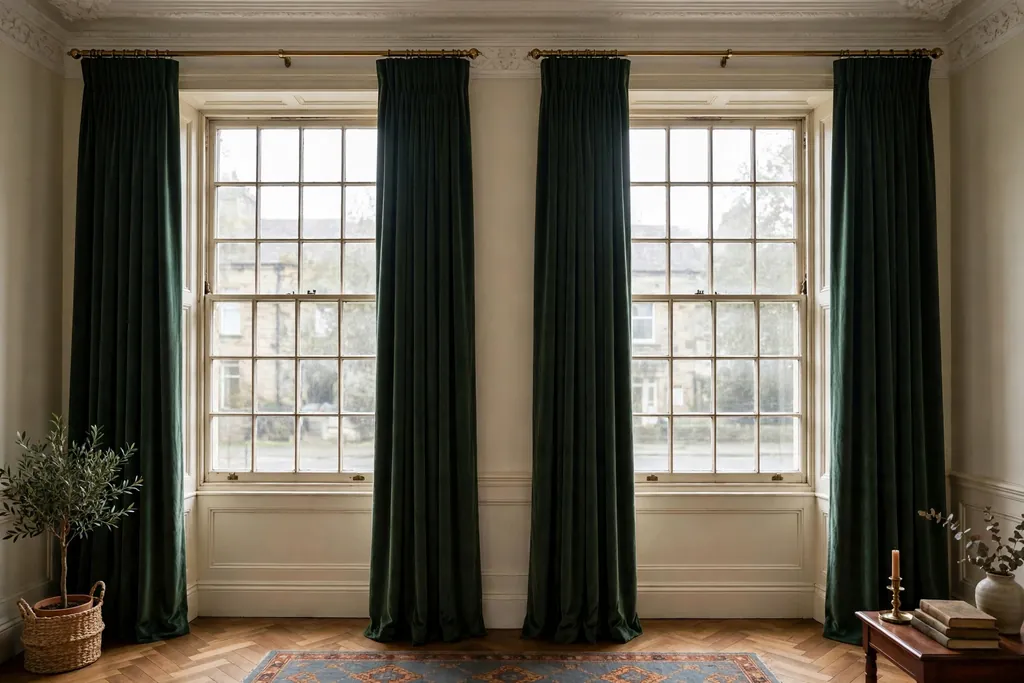
    Full length curtains hung close to the ceiling framing tall Victorian sash windows.

    Hang full length curtains from close to the ceiling, even if the window starts lower, so the eye reads the full height of the Victorian room. Tall curtains make the window look larger and the ceiling feel higher, and they frame the sash window rather than cutting it in half. This suits rooms with high ceilings where a short curtain would leave an awkward gap of wall above the window.

    Choose a plain fabric in a colour close to the wall, such as warm white, pale grey or soft sage, so the curtains blend in rather than forming a strong band of colour. Let the panels fall to just above the floor, and extend the rod past the frame so the panels stack on the wall when open. Keep the fabric light enough to draw easily each day.

    14. Keep the Tiled Hearth and Calm the Rest
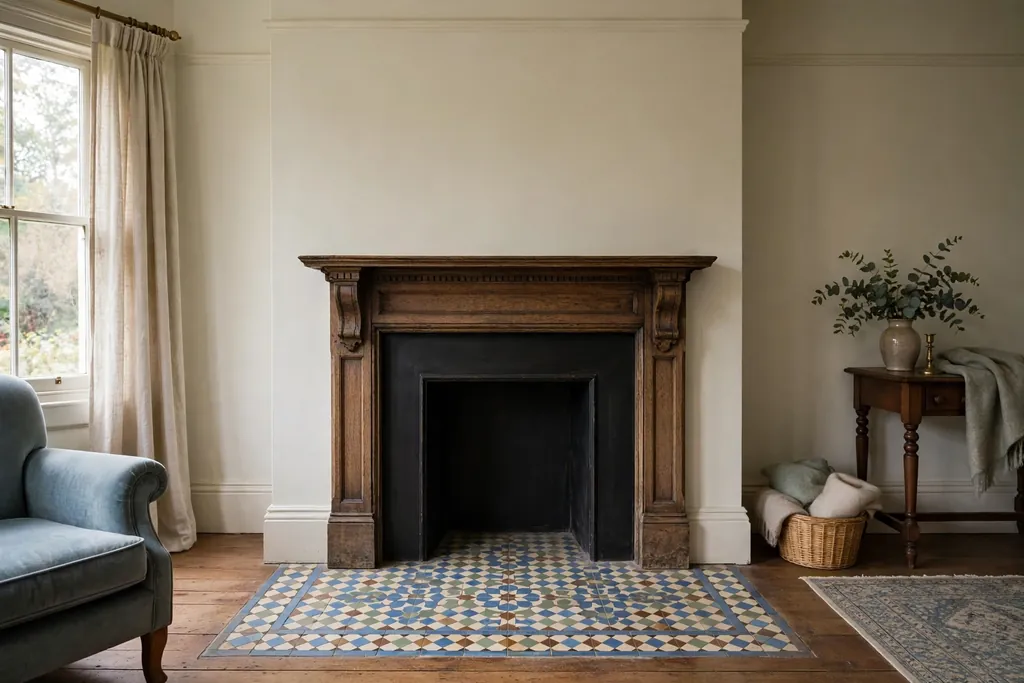
    Original tiled fireplace hearth with a pattern in a calm Victorian living room with plain walls.

    Keep an original tiled fireplace hearth, with its pattern and colour intact, and keep the rest of the fireplace wall calm in a plain paint colour. The hearth becomes a small, honest piece of Victorian pattern at floor level, while plain walls and a simple mantel stop the room from feeling like a museum. This suits rooms where the tiles are in good condition but the rest of the room needs a modern, quieter base.

    Clean the tiles with a method suited to their glaze, and repair any loose tiles before they crack further. Keep the hearth clear of rugs and furniture, so the pattern stays visible and the fire area stays safe. If the tile colour is strong, repeat one colour from it in a cushion or a vase elsewhere in the room, so the hearth feels linked to the rest of the space.

    15. Arrange Seating Around the Fireplace, Not the Television
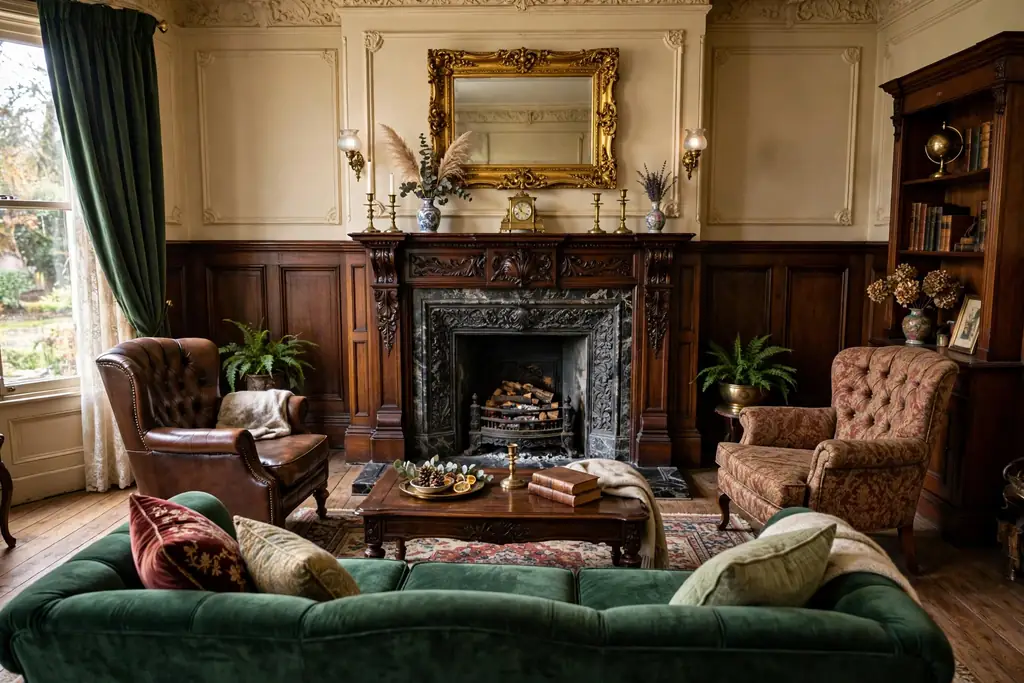
    Seating arranged to face a Victorian fireplace, with a sofa opposite and chairs angled in from the sides.

    Arrange the main seating to face the fireplace and each other, with the television on a side wall or inside a cabinet, rather than letting the screen dominate the Victorian room. A fireplace facing layout suits conversation and reading, and it keeps the ornate surround as the room’s natural focal point. This suits a home where the living room is used more for talking and relaxing than for long television sessions.

    Place the sofa opposite the fireplace, with chairs angled in from the sides, and leave a clear walkway behind the seating. If a television is needed in the room, mount it on a side wall at a comfortable viewing height, or hide it behind panelled doors when not in use. Test the layout for a week before fixing any cables, since moving a sofa is easier than moving a wall socket.

    16. Add Brass Accents in Small, Repeated Doses
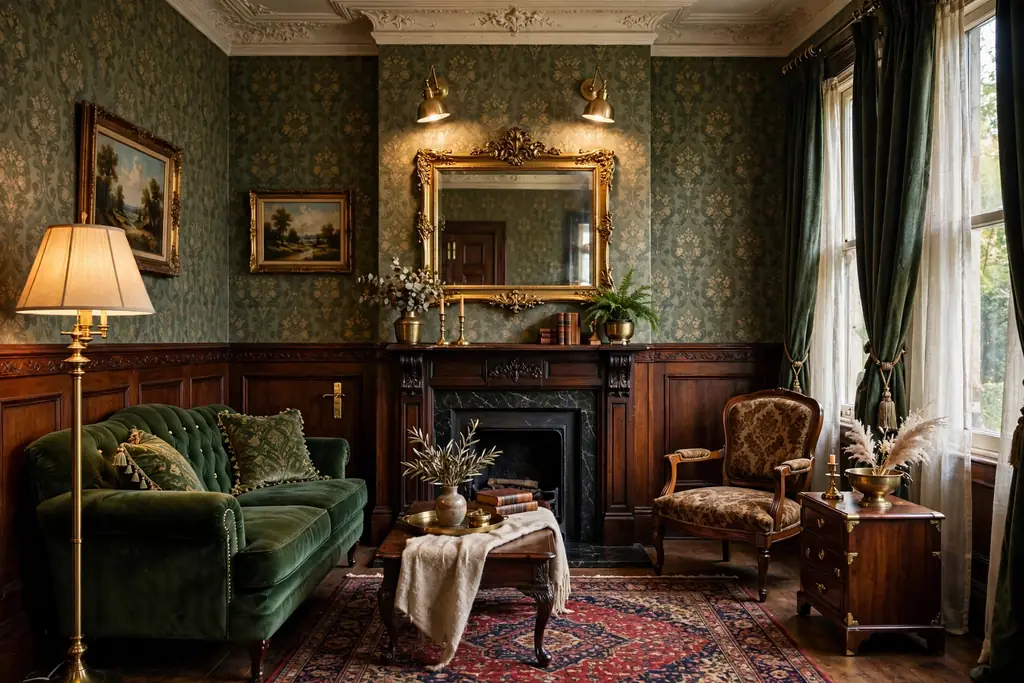
    Victorian living room with brass accents: a brass floor lamp, brass picture lights, and a brass framed mirror.

    Add brass in small, repeated doses: a brass floor lamp, brass picture light fittings, brass handles on a console, and one brass framed mirror. Brass links modern furniture to Victorian metalwork, such as door handles and fire tools, without needing a brass sofa or a brass table. This suits a room that feels too cool in tone, since warm metal adds warmth without a strong colour.

    Keep the brass finish consistent, such as brushed brass throughout, rather than mixing polished, aged and brushed finishes in one room. Limit brass to three or four items, so it reads as a thread through the room rather than as a theme. Wipe brass with a soft cloth as advised by the maker, and avoid harsh cleaners that can strip the finish.

    17. Paint One Bookcase Interior a Deep Colour
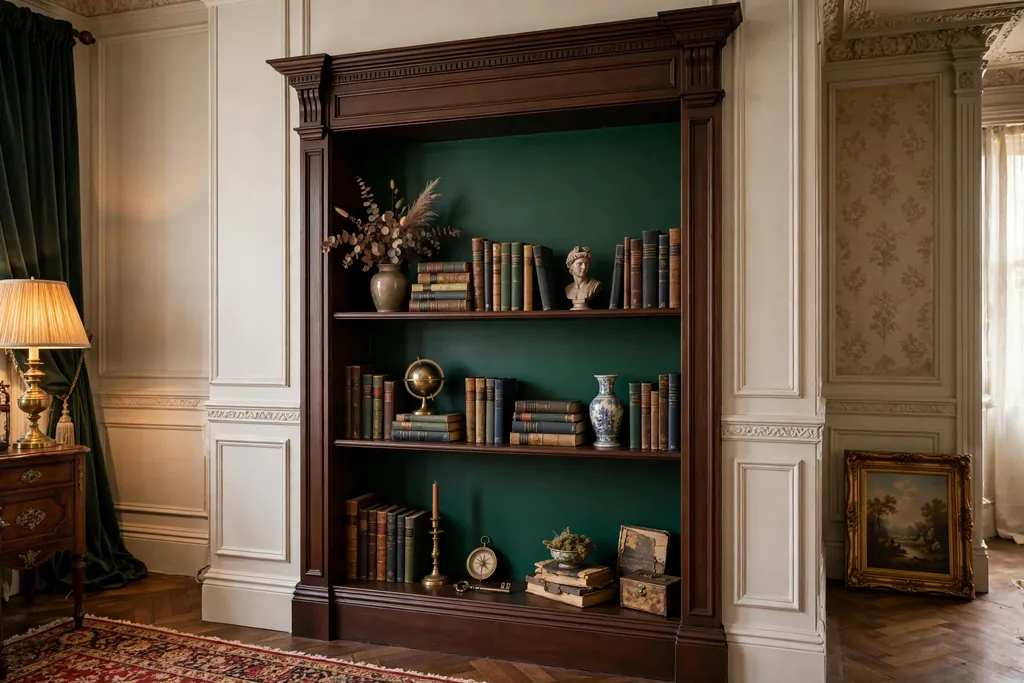
    Alcove bookcase with a deep green painted interior back panel, books, and display pieces.

    Paint the inside back panel of one alcove bookcase in a deep colour, such as dark green, navy or charcoal, while the rest of the bookcase stays the wall colour. The deep interior gives books and display pieces a dark background that makes them stand out, and it adds Victorian depth without painting a whole wall dark. This suits a room that needs one strong note of colour but would feel closed in with a dark feature wall.

    Keep the deep colour to one bookcase, not both alcoves, so the fireplace wall stays balanced. Repeat the same deep colour in one cushion or one throw elsewhere in the room, so the bookcase does not look isolated. Test the colour inside the bookcase in lamplight, since a deep colour looks darker in a recess than it does on a paint chart.

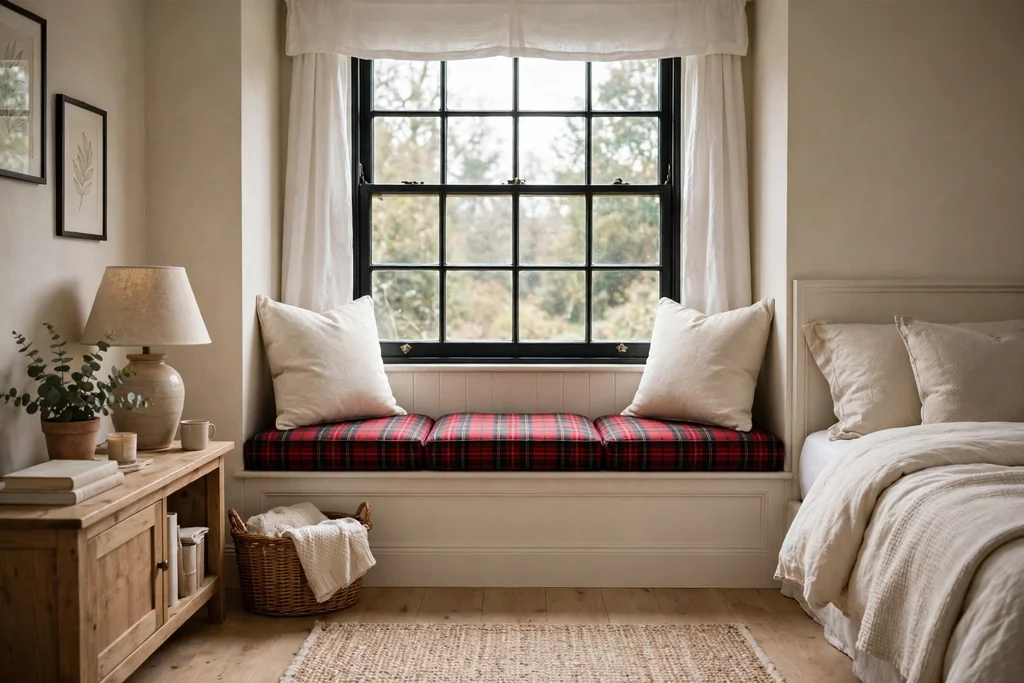
    18. Turn the Bay Window Into a Reading Bench
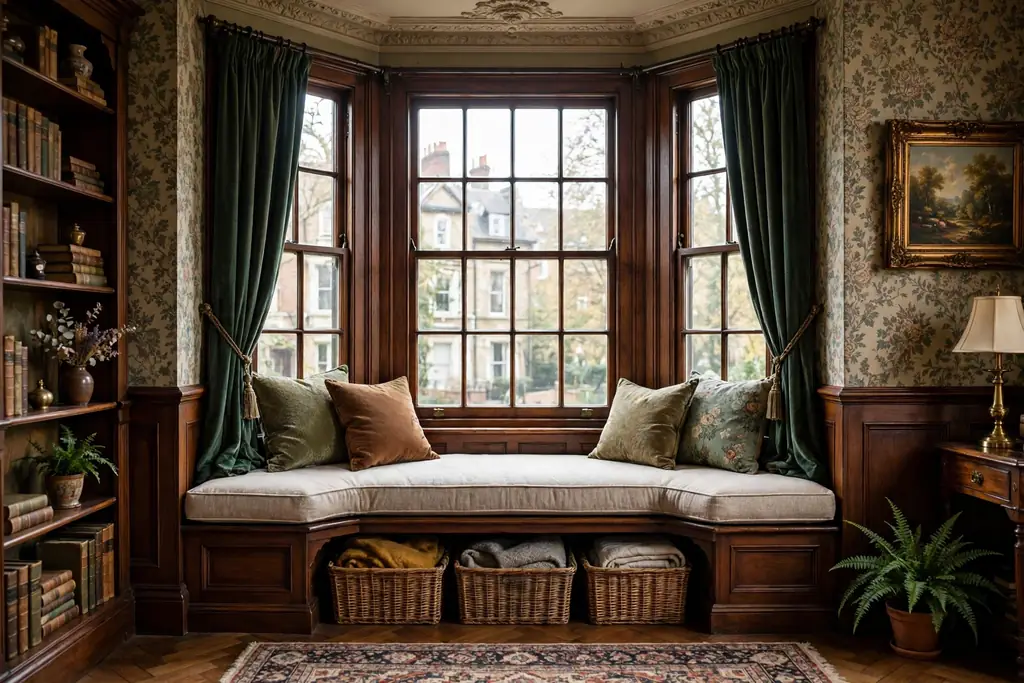
    Bay window reading bench with a firm cushion and storage baskets underneath in a Victorian living room.

    Turn a Victorian bay window into a reading bench with a firm cushion in a washable cover, storage baskets underneath, and a small wall light or a floor lamp beside it. A bay seat uses a stretch of wall that often sits empty, gives the room an extra seat, and makes the most of the best daylight in the room. This suits a living room with a bay that has space below the window, or a room that needs one more seat without another armchair.

    Build the bench from a low bench or a pair of sturdy cabinets, rather than a fixed structure, if you rent. Keep the cushion firm enough to sit on for an hour, and keep the baskets for books, throws or shoes, labelled if they hold different items. For zoning and storage ideas that pair well with a window seat, see these studio apartment decorating ideas.

    19. Grow Tall Plants Beside the Windows
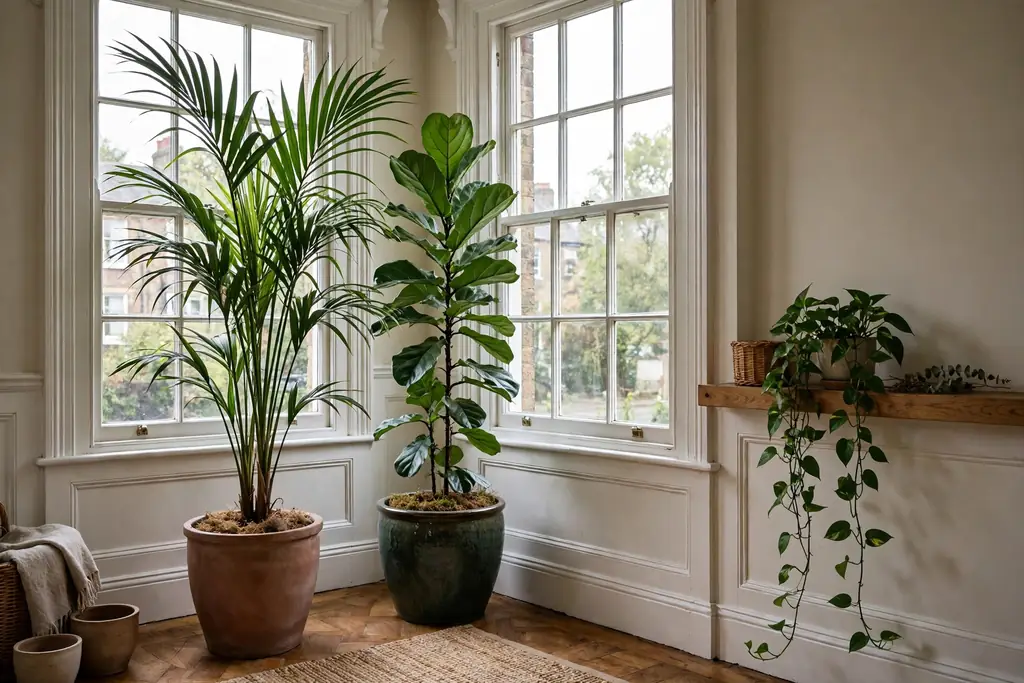
    Tall plants in large pots beside Victorian sash windows, with a trailing plant on a shelf.

    Place tall plants in large pots beside the sash windows, with a trailing plant on a shelf and a small plant on the coffee table, so green sits at three heights in the room. Plants soften hard marble, dark wood and brass, and they suit the tall proportions of a Victorian room better than a row of small pots on one surface. This suits a room that feels too formal, since plants make it feel lived in at once.

    Match each plant to the light it will actually get, and use saucers under pots on wood floors. Keep plants clear of the fireplace hearth and the walkway, so leaves do not get knocked or scorched. Start with three or four plants rather than a dozen, so watering stays manageable, and group plants that need similar watering together.

    20. Hide Media Behind Panelled Cabinet Doors
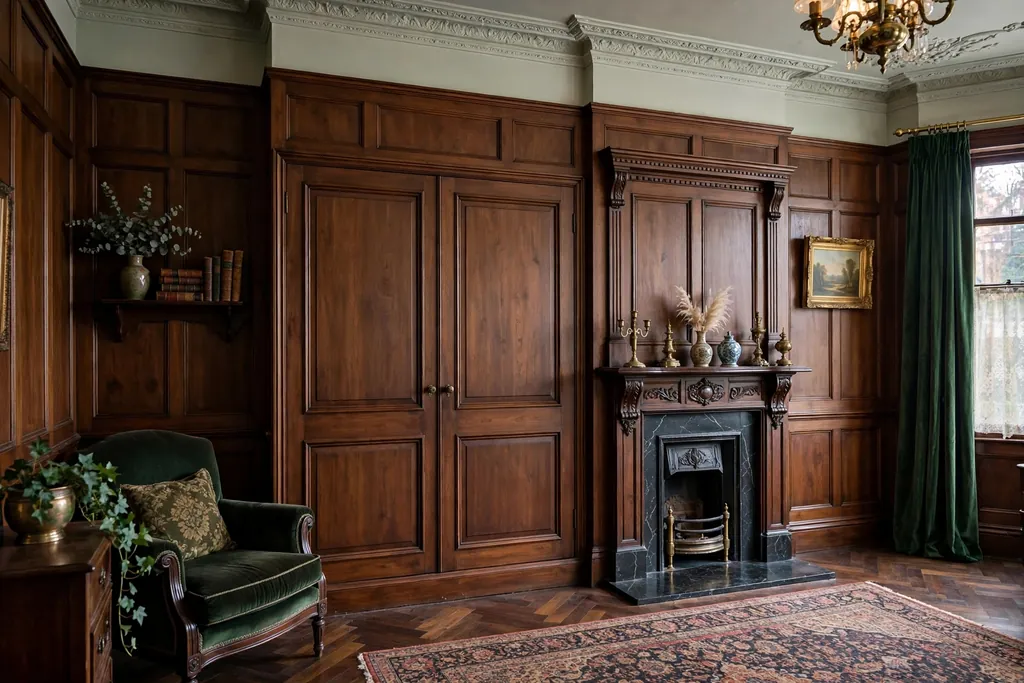
    Panelled cabinet doors matching wall panelling hiding a television in a Victorian living room.

    Hide the television and media boxes behind panelled cabinet doors that match the wall panelling, so the media wall reads as architecture when the screen is off. Panelled doors keep the Victorian wall treatment continuous, and they remove the black rectangle of a screen from the room’s main view. This suits a room where a television is wanted but the fireplace should stay the focus.

    Choose doors with a simple panel profile that matches the existing panelling, and fit them with soft close hinges so they shut quietly. Keep ventilation holes or a mesh panel at the back of the cabinet, since media boxes need airflow, and run cables through the back rather than across the wall. Test the viewing angle from the main sofa before fixing the cabinet in place.

    21. Make a Reading Corner With a Task Lamp
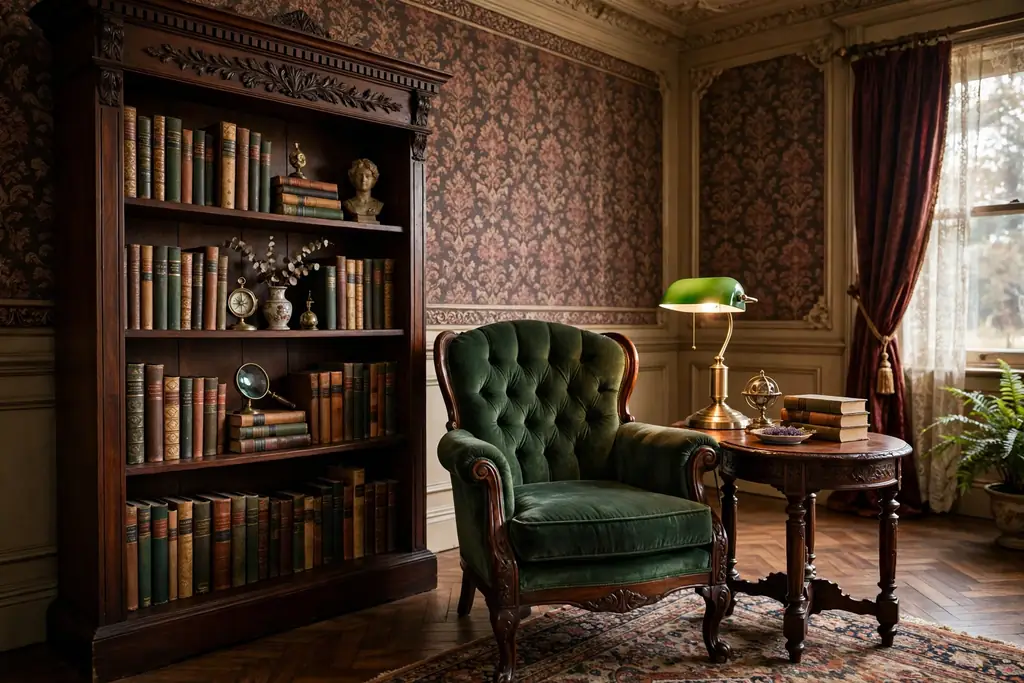
    Reading corner with a lounge chair, a small side table, and a task lamp beside a bookcase.

    Make a reading corner in one quiet corner of the room, with a comfortable lounge chair, a small side table, and a task lamp aimed at the page. A dedicated reading corner gives the Victorian room a second use beyond the main seating group, and it suits a corner by a window or beside a bookcase. This differs from the bay seat in Idea 18, which is built into the window, since this corner is a freestanding chair and lamp that can move.

    Choose a chair with a seat depth that lets you sit upright comfortably, and place the lamp behind the chair shoulder so light falls on the page without glare. Add a basket beside the chair for the current book and a throw, so the corner is ready to use without fetching items from another room. Keep the corner clear of the main walkway, so it feels like a retreat rather than a passage.

    22. Use a Storage Ottoman for a Tidy Victorian Room
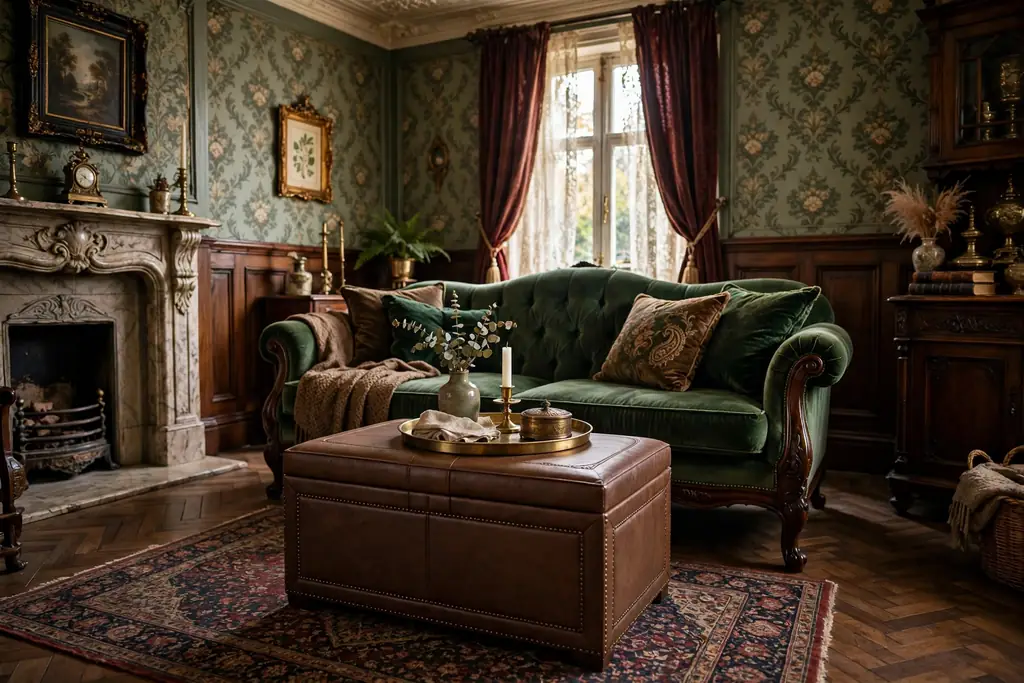
    Storage ottoman with a firm lid and a tray in front of a sofa in a Victorian living room.

    Use a storage ottoman in front of the sofa, with a firm lid that works as a footrest and a tray on top for drinks, to hide throws, magazines and remote controls in one piece. Victorian rooms can look cluttered fast, since mouldings, art and plants already add detail, so closed storage in the seating group keeps the room calm. This suits a small Victorian living room, where a coffee table plus a separate storage box would crowd the floor.

    Choose an ottoman in a plain fabric that matches the sofa or the rug, and check that the lid opens without hitting the sofa cushions. Keep only items you reach for often inside it, since a storage seat filled with things you never use becomes a box you never open. If the room is very tight, a smaller ottoman that slides under a console when not in use gives most of the same benefit.

    Conclusion

    A modern Victorian living room works when the old details and the new furniture each have a clear job. Let the mouldings, the fireplace and the tall windows carry the character, and let low, plain furniture, calm colour and layered light carry the comfort. Start with one wall or one corner, such as painted panelling or a bay seat, live with it for a week, and then add the next layer. The room should still feel Victorian when you walk in, and still feel easy to live in when you sit down. For more small room layout and storage help, the ideas in these cozy apartment living room ideas and studio apartment decorating ideas pair well with the Victorian rooms above.

    Keep this list handy for your next free weekend at home, and build the room one layer at a time: panelling and light first, seating second, and brass, plants and art to finish.

    FAQs

    How do I make a Victorian living room feel modern without removing the mouldings?

    Keep the mouldings and paint them in one calm colour, so they read as texture rather than as a busy pattern. Then add low, plain modern furniture, a glass or slim wood coffee table, and plain fabrics, so the ornate walls stay the focus. Modern art in a traditional frame and brass accents in small doses link old and new without stripping the room. Avoid adding ornate furniture on top of ornate walls, since that combination is what makes a Victorian room feel dated rather than current.

    What sofa works best in a modern Victorian living room?

    A low sofa with slim arms, raised legs and a plain fabric works best, since it sits below the dado rail and leaves the wall panelling and windows in view. Choose a calm colour, such as oatmeal, pale grey or soft green, and add texture with cushions rather than with a patterned sofa. Measure the sofa against the fireplace wall first, and leave room to walk past both ends. A deep, high-backed sofa can hide too much of the wall detail and make a tall room feel lower than it is.

    Can I put a television in a Victorian living room without ruining the look?

    Yes. Arrange the main seating to face the fireplace, and place the television on a side wall or behind panelled cabinet doors that match the wall panelling, so the screen is not the room’s focal point. Keep cables hidden through the cabinet or along the wall in a cover painted to match the wall. Test the viewing angle from the main sofa before fixing anything, and keep the fireplace wall clear, so the room still reads as Victorian when the television is off.

    What colours suit a modern Victorian living room?

    Start with a calm base, such as warm white, pale greige or soft sage on walls and large furniture, then add depth with one deep colour, such as dark green or navy, in a bookcase interior, a cushion or a throw. Brass, dark wood and marble add warmth without a strong colour, and plants add green at several heights. Keep strong colour to a few items you can move, so the room stays calm and the Victorian details stay visible.

    How do I light a Victorian living room with high ceilings?

    Layer light at several heights instead of relying on one central light. Keep the ceiling rose with a simple pendant, add picture lights over art or the fireplace, a floor lamp beside the main seat, and a table lamp on a console. Use warm bulbs and dimmers where you can, so the evening mood stays soft and the mouldings show their shadows. Check each lamp position at different times of day, since tall windows change the daylight in the room through the afternoon.

    Is a patterned rug right for a modern Victorian living room?

    Yes, if the rest of the seating group stays plain. A traditional or simple geometric rug links the room to its Victorian roots and gives the floor warmth and a clear seating zone, while plain sofas and chairs keep the room calm. Choose a rug large enough to sit under the front legs of the sofa and chairs, use a rug pad underneath, and keep strong pattern to the floor, not to the sofa as well. In a small room, a muted version of the pattern gives the same effect without making the floor feel busy.
  • 23 Irish Living Room Ideas to Bring More Personality Home

    23 Irish Living Room Ideas to Bring More Personality Home

    An Irish living room feels personal when it mixes warmth, texture, and a few pieces with a story, rather than copying one look from a shop window. Think of a deep green sofa beside a real fire, a wool throw for cold evenings, and art that reminds you of a place you love. These 23 Irish living room ideas cover color, seating, fireplaces, storage, lighting, and small coastal and country details, so you can pick the ones that fit your room and budget. For help grounding the seating group, these living room rug ideas show how size and placement change the feel of a room.

    Key Takeaways

    • Let one strong piece lead, such as an emerald sofa, a fireplace, or a stone wall, and keep the rest of the room calm around it.
    • Use texture for warmth: wool, tweed, linen, Aran knit, wood, and stone do more work than extra color.
    • Keep Irish details to a few well chosen pieces, so the room reads as personal, not as a set.
    • Layer light at more than one height, with lamps and candles beside the fire, for dark evenings.
    • Repeat a small palette of green, cream, peat brown, and warm wood through cushions, rugs, and art.
    • Add one personal layer, such as family photos, books, or music, since personality comes from what you actually use and love.

    1. Anchor the Room with a Deep Emerald Sofa

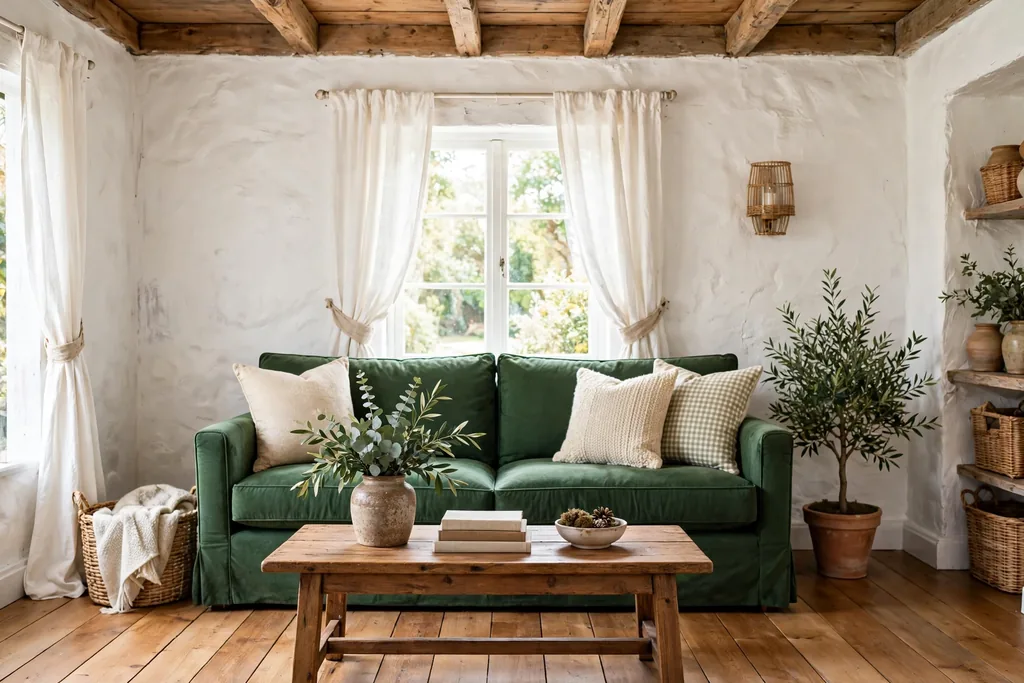
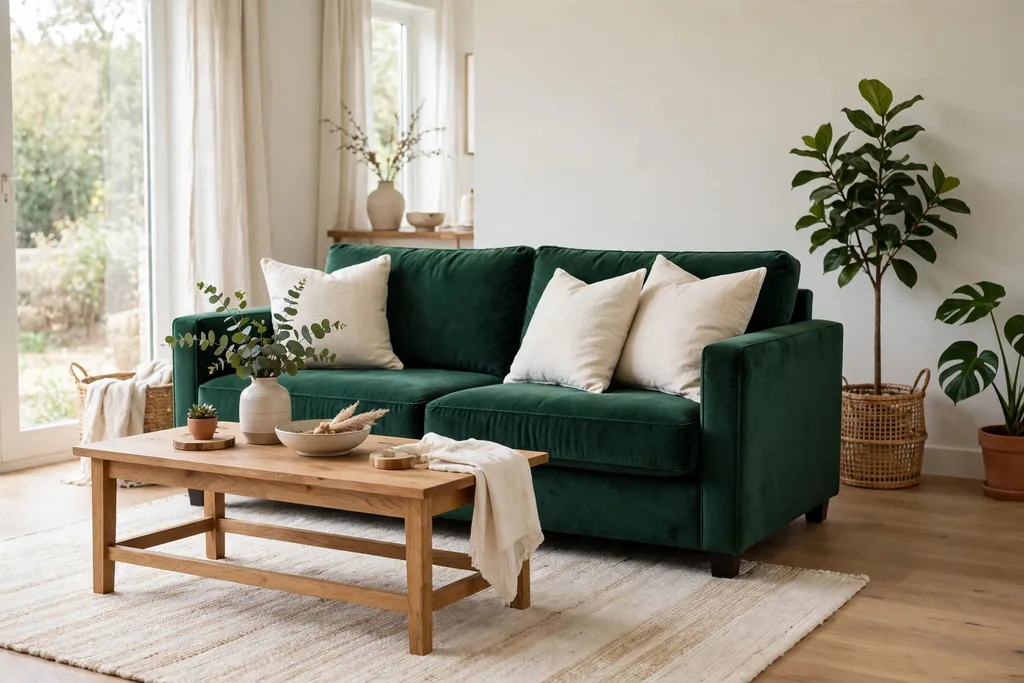
    Deep emerald sofa with cream cushions and a wood coffee table.

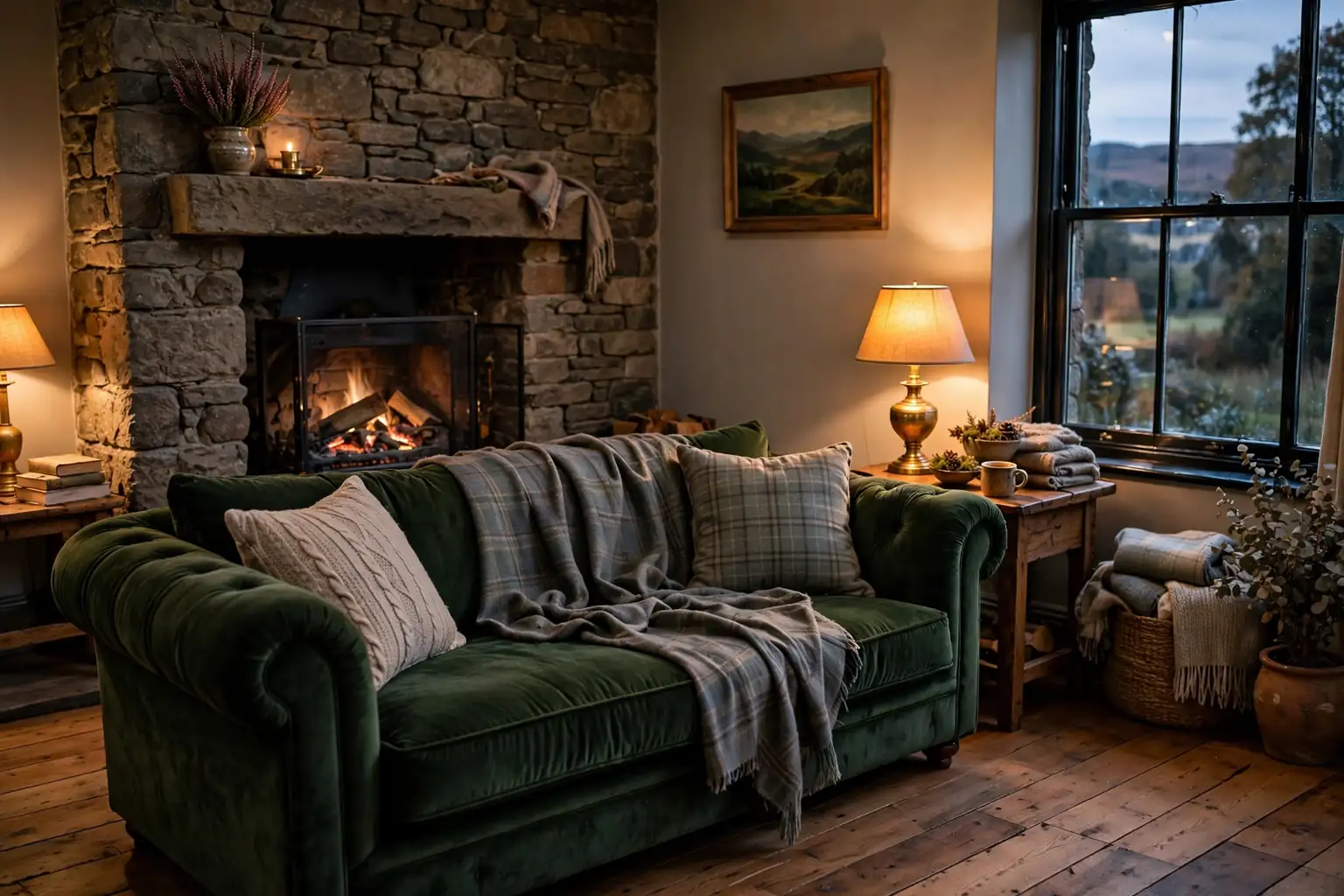
    A deep emerald sofa is the simplest way to give an Irish living room a clear identity, because the color carries the whole scheme without needing a themed room. Choose a plain emerald fabric, not a patterned one, and pair it with cream cushions, a wood coffee table, and a pale rug, so the green stays rich rather than loud. The sofa then works as both the main seat and the main color in the room.

    Keep the walls pale, in warm white or soft cream, so the dark sofa does not close the room in. Add one warm accent, such as a rust or mustard cushion, and keep other colors quiet. Emerald shows dust and pet hair less than a pale sofa, but it still benefits from washable cushion covers in a room used every day.

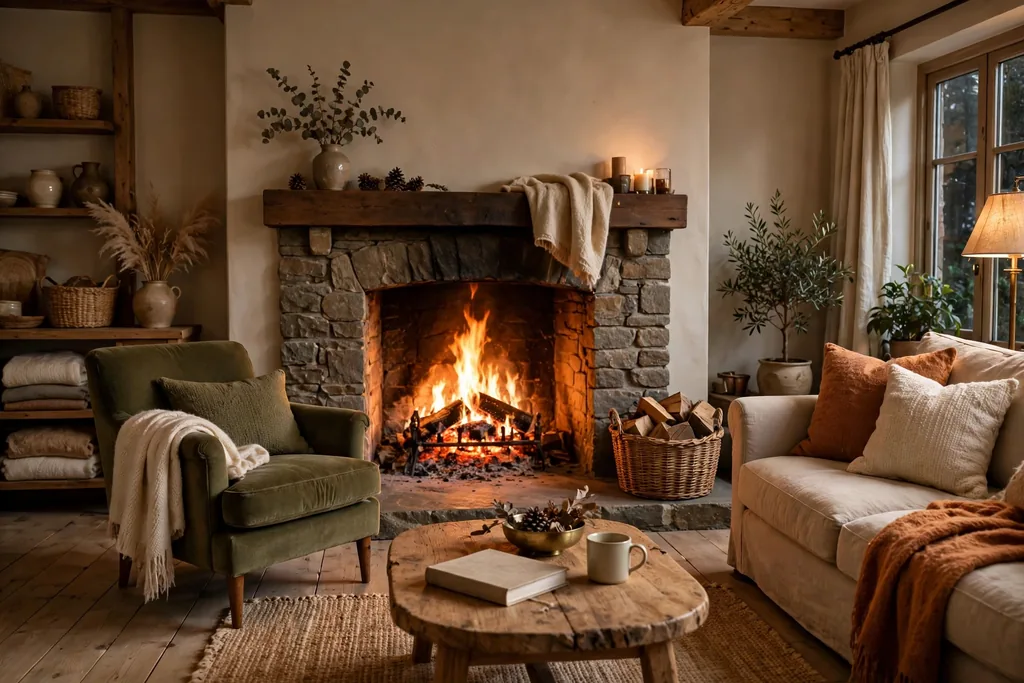
    2. Make a Peat Fire or Stove the Evening Center

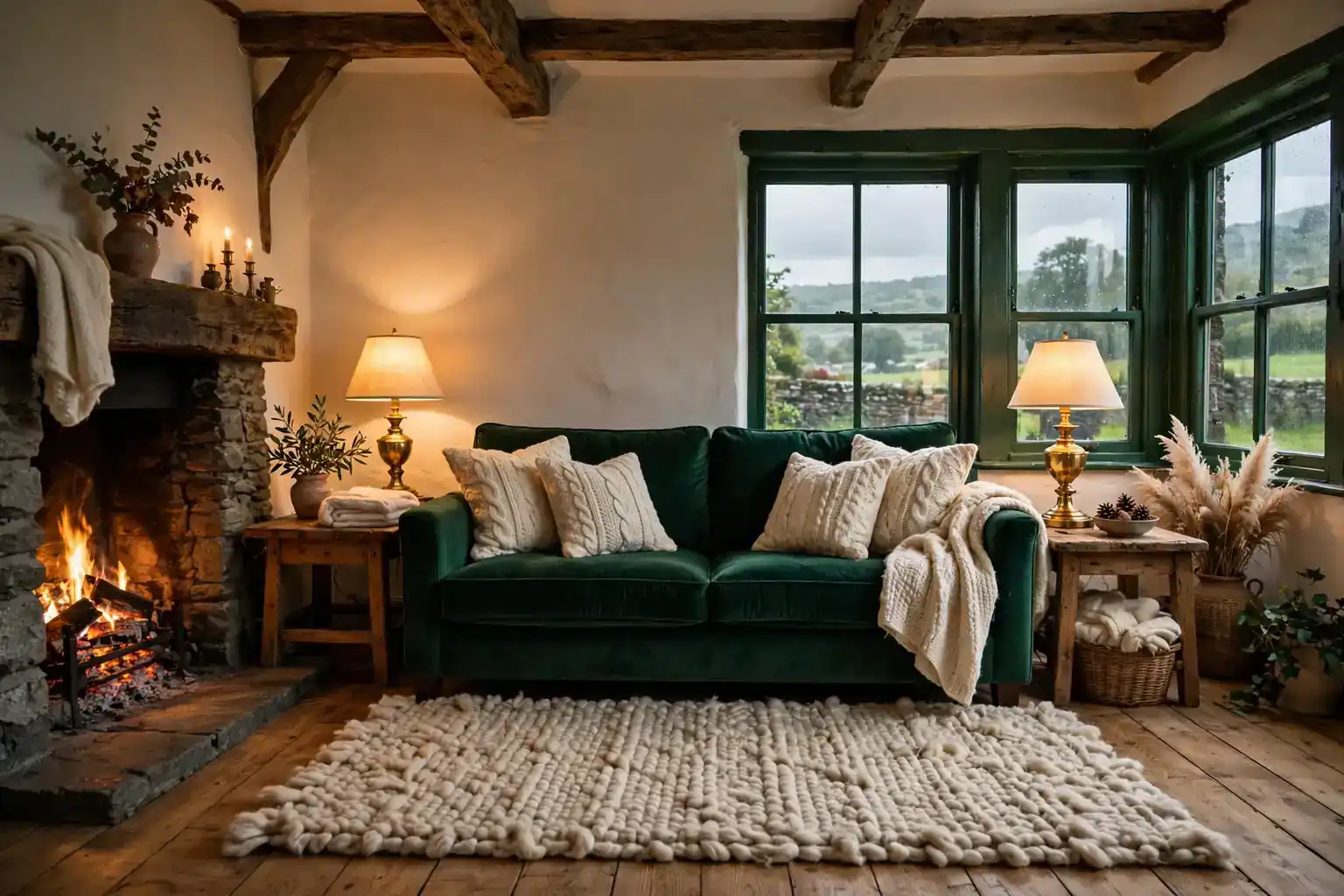
    Living room fireplace with a lit fire and seating arranged around it.

    A peat fire, or a stove that burns peat style fuel where that is allowed, gives an Irish living room a scent, a glow, and a natural gathering point. Arrange the main sofa facing the fire, or at a right angle to it, with a chair on the other side, so conversation faces the hearth rather than the television. Keep a basket of fuel, a fire guard where needed, and a small log store beside the hearth.

    If you have no working chimney, a freestanding stove with a proper flue, or an electric stove effect fire, gives a similar focus without building work. Keep throws, cushions, and paper clear of the opening, and follow the maker guidance for safe clearances. A simple mantel, with one mirror or one print and a pair of candlesticks, lets the fire itself stay the star.

    3. Brighten the Room with Whitewashed Walls

    Living room with whitewashed walls and warm wood floors.

    Whitewashed walls suit an Irish cottage living room because they bounce light around a small or north facing room while keeping a soft, handmade feel. Use a warm white, not a cold blue white, and leave the texture of plaster or old stone visible where you can, rather than covering it with a flat, perfect finish. The pale walls then make wood beams, a dark sofa, and wool textures stand out.

    Pair whitewashed walls with warm wood floors and a rug in cream or muted green, so the room does not feel bare. If the room is large, whitewash three walls and keep one in a deeper tone, such as moss or peat brown, to hold the seating group together. Touch up marks with the same wash, since a patch in a different white shows at once.

    4. Drape an Aran Knit Throw Over the Sofa Arm

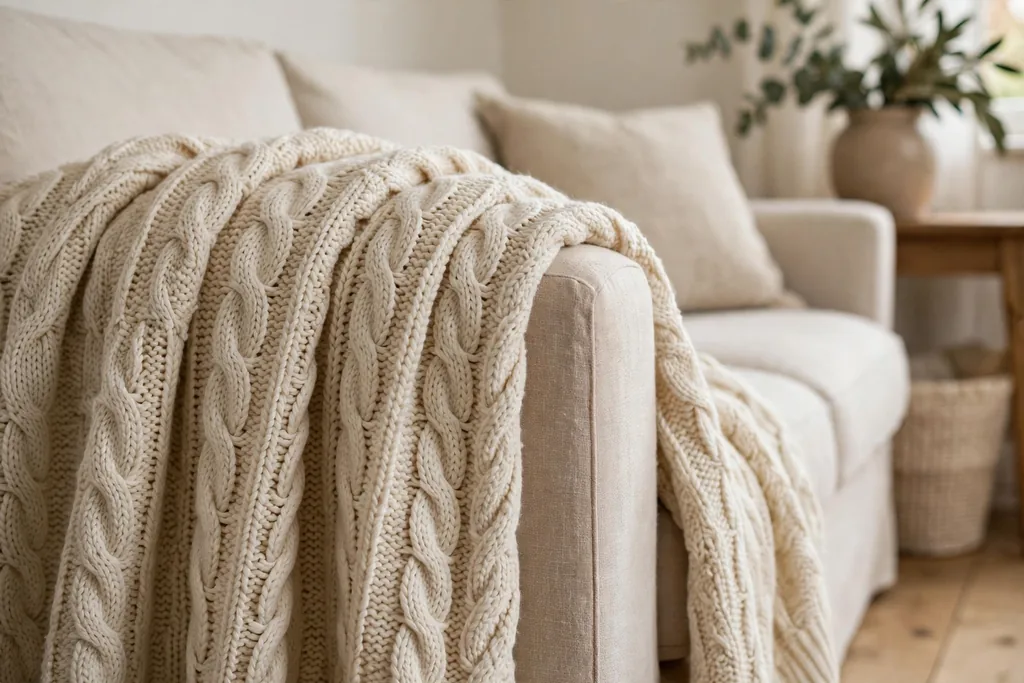
    Cream Aran knit throw with a cable pattern draped over a sofa arm.

    An Aran knit throw brings Irish craft into the room in the most usable way possible: it is there to be used on cold evenings, not just looked at. Choose a cream or oatmeal Aran knit with a cable pattern, and drape it over one sofa arm or fold it across the back, rather than spreading it over the whole sofa. One throw is enough, since the knit pattern is already detailed.

    Pair the Aran throw with plain cushions in cream or soft green, so the knit stays the main texture. Keep a second throw in a basket nearby for guests, and wash the Aran throw as its care label directs, since wool knits hold their shape best when dried flat. This is a good first Irish detail if you rent, since it needs no paint, drilling, or new furniture.

    5. Add a Donegal Tweed Armchair for Texture

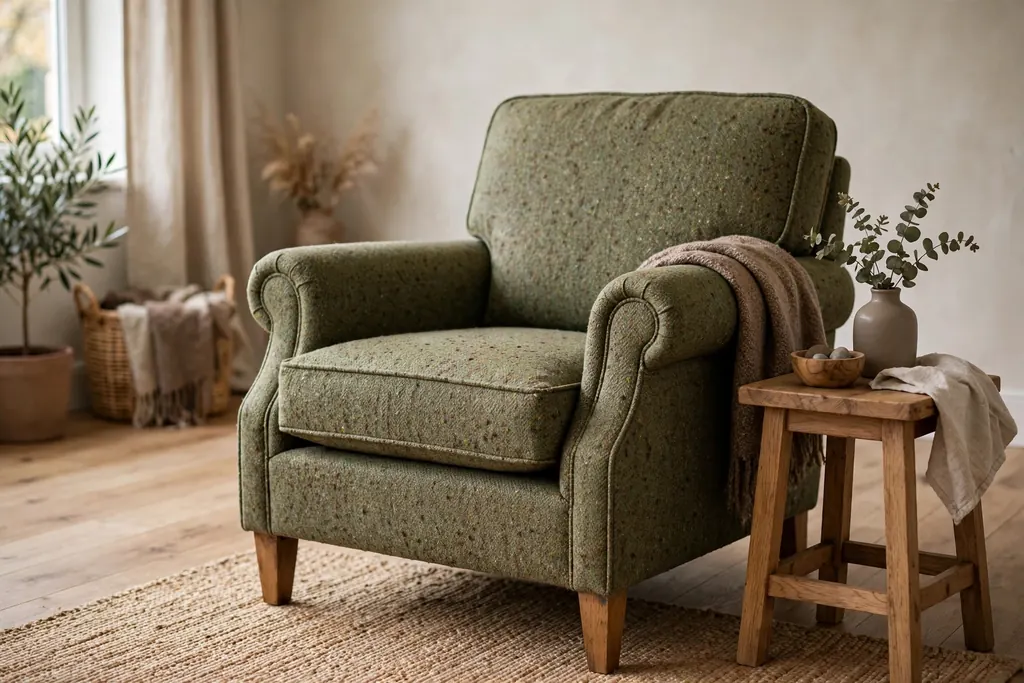
    Donegal tweed armchair in muted green and brown flecks beside a side table.

    A Donegal tweed armchair adds flecked color and a sturdy, lived in texture that a plain fabric chair cannot match. Choose tweed in a muted mix, such as green, brown, and cream flecks, and place the chair at an angle to the sofa with a small side table, so it forms a reading corner rather than sitting in a row. The chair then gives the room a heritage piece without a full tweed suite.

    Keep the rest of the seating plain, so the tweed does not compete with another strong pattern. A plain cushion in one color pulled from the tweed, such as moss or rust, ties the chair to the sofa. Tweed is hard wearing, which suits a chair used daily, but keep it out of strong direct sun, since the flecked colors can fade unevenly over time.

    6. Lay a Thick Wool Rug Over a Wood Floor

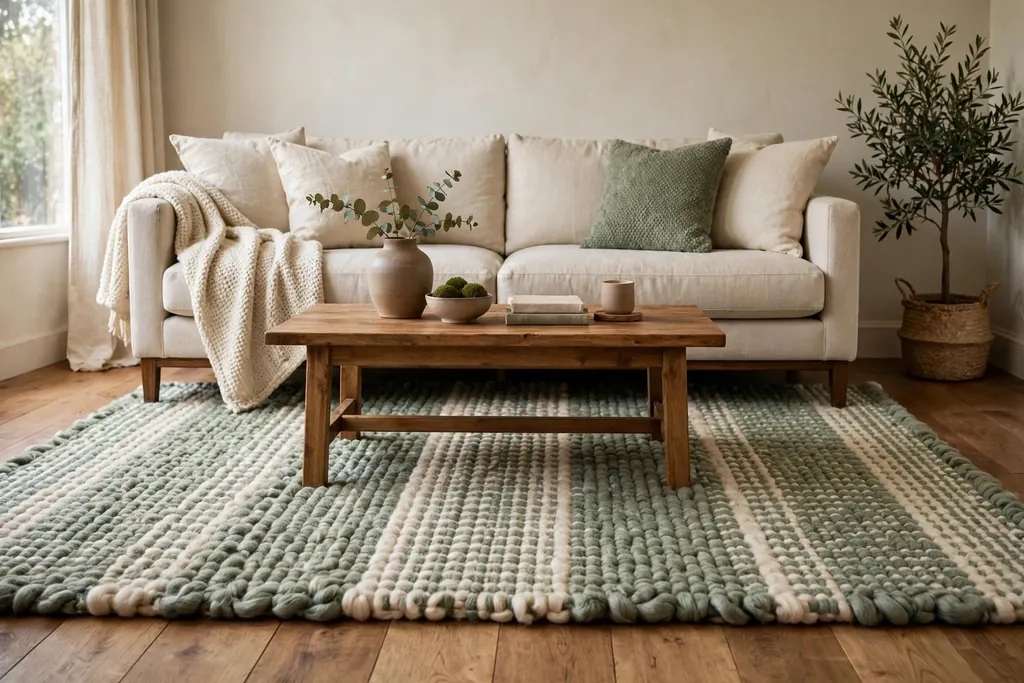
    Thick wool rug in muted green and cream over a wood floor.

    A thick wool rug over a wood floor gives an Irish living room warmth underfoot and a clear seating zone, which matters in a room with bare boards. Choose a rug large enough for the front legs of the sofa and chairs to rest on it, with a pattern in muted green, cream, and rust, or a plain rug in a warm neutral if the cushions already carry pattern. Wool handles daily wear well and feels soft in bare feet.

    Keep the rug low enough that doors and chairs slide over it without catching, and use a rug pad underneath on a polished floor, so the rug does not slip. Vacuum regularly without a beater bar on a high pile, and blot spills at once rather than rubbing them. A wool rug also helps a room with hard floors feel quieter, since it softens sound as well as cold.

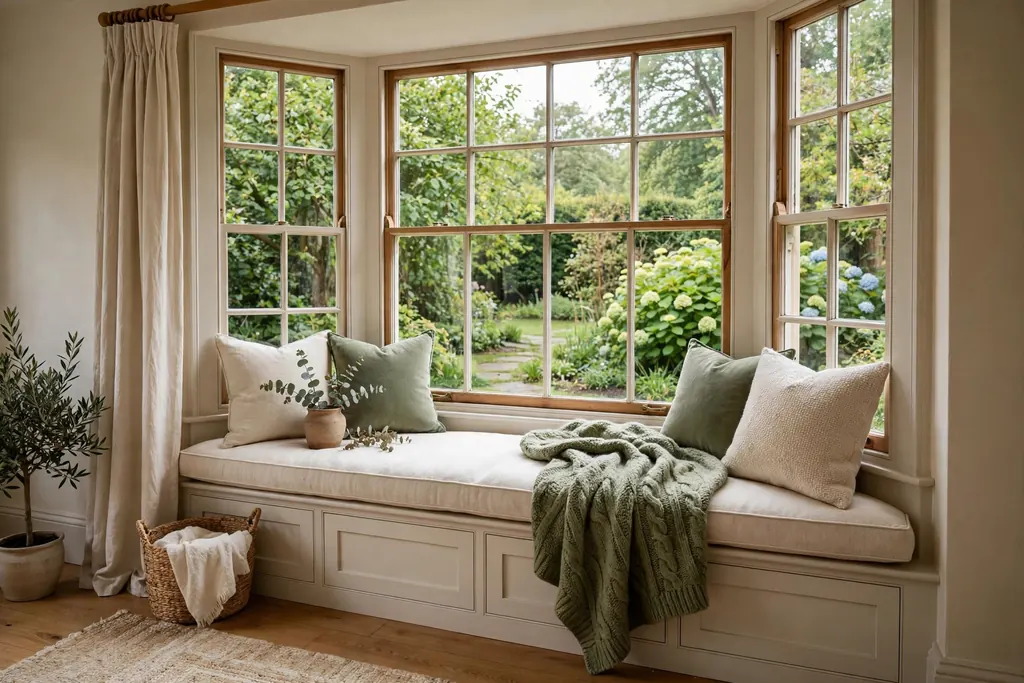
    7. Build a Bay Window Seat for Reading and Watching the Weather

    Bay window seat with a thick cushion and a wool throw.

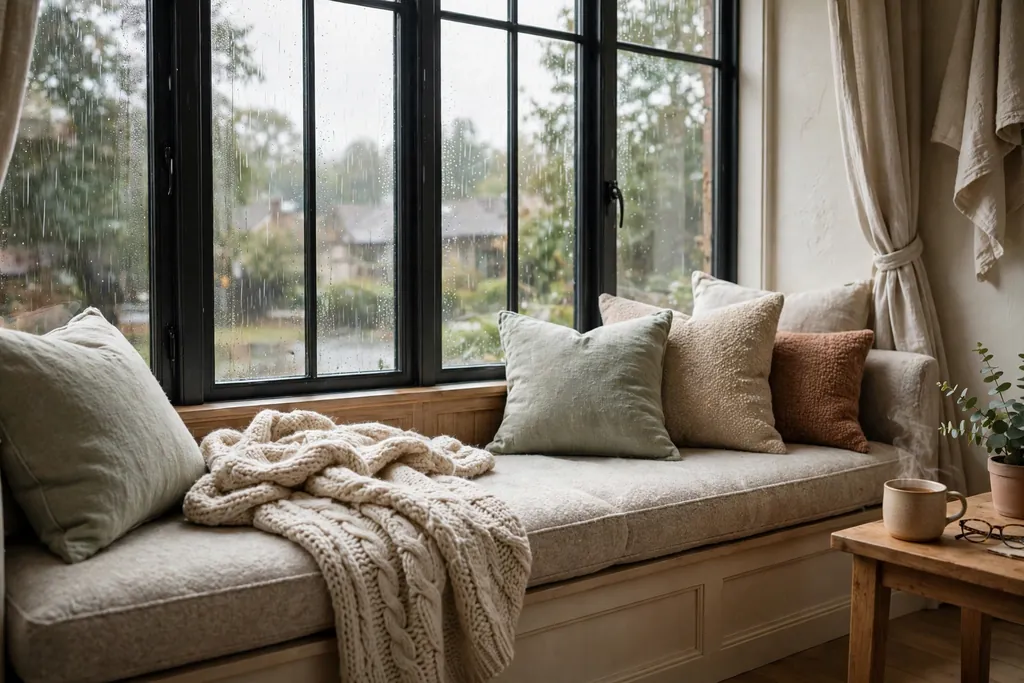
    A bay window seat turns a window into the best seat in an Irish living room, a place to read, watch rain, and look out at the garden. Fit a bench across the bay with a thick cushion in a washable fabric, add back cushions in cream and green, and keep a wool throw and a small shelf of books within reach. The seat then works for one reader, or for two people sharing a quiet hour.

    Use the space under the bench for storage, with lift up lids or drawers for blankets, games, and spare cushions, so the seat stays clear. Dress the window with a sheer panel for daytime privacy and a heavier curtain for night, so the seat stays usable after dark. If the window is drafty, add a draft strip and a thick cushion, since a cold seat will go unused no matter how pretty it looks.

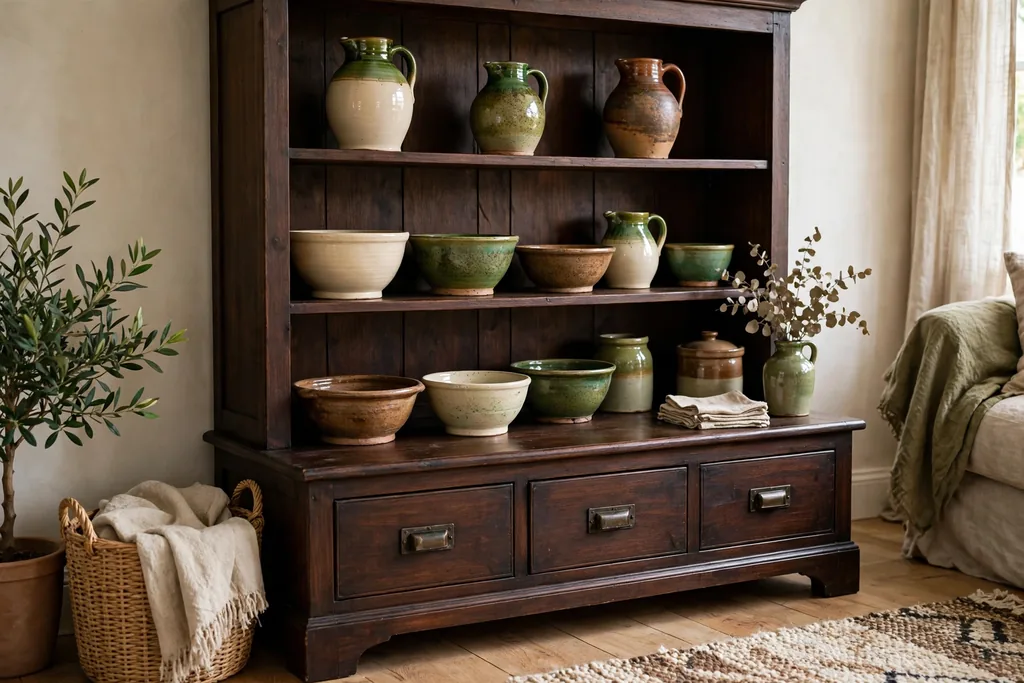
    8. Style a Dark Wood Dresser with Irish Pottery

    Dark wood dresser with shelves of Irish pottery and bowls.

    A dark wood dresser gives an Irish living room storage and display in one piece, and it suits pottery, books, and family pieces far better than a plain cabinet. Place the dresser against a wall near the dining end of the room, or beside the fireplace, and fill the shelves with a small group of Irish pottery, jugs, and bowls in cream, green, and earth tones, leaving space between pieces so each one can be seen.

    Keep the dresser top mostly clear, with one jug of dried flowers or a candle group, and store everyday items in the drawers and cupboards below. Group pottery by color, not by size alone, and step back to check the shelves from the sofa, since a dresser that looks good from across the room matters more than one that looks good close up. Dust the shelves weekly, since open display collects dust fast in a room with a fire.

    9. Hang Irish Landscape Prints Above the Sofa

    Living room wall with framed Irish landscape prints above a sofa.

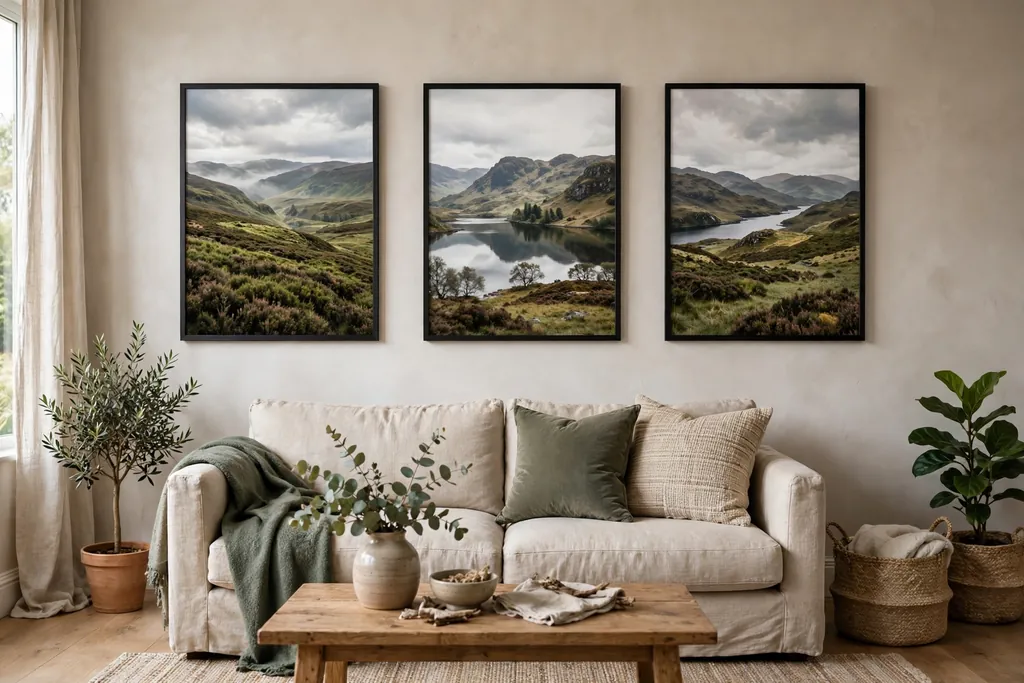
    Framed prints of the Irish coast, hills, or countryside give a living room personality that is specific, not generic, because the places in the pictures mean something to the people who live there. Hang two or three prints above the sofa, in matching wood frames, with the center of the group at eye level when seated, and keep the outer edges inside the width of the sofa. A single large landscape print also works, if the wall is wide enough.

    Choose prints in soft, muted colors that repeat the room palette, such as sea green, slate, and cream, rather than bright, high contrast images that fight with the sofa. Mix a coastal scene with a hill or field scene for variety, and keep the frames simple, since ornate frames can make a small wall feel busy. If you have your own photos from Ireland, print one large and frame it well, since a personal photo carries more meaning than a bought print.
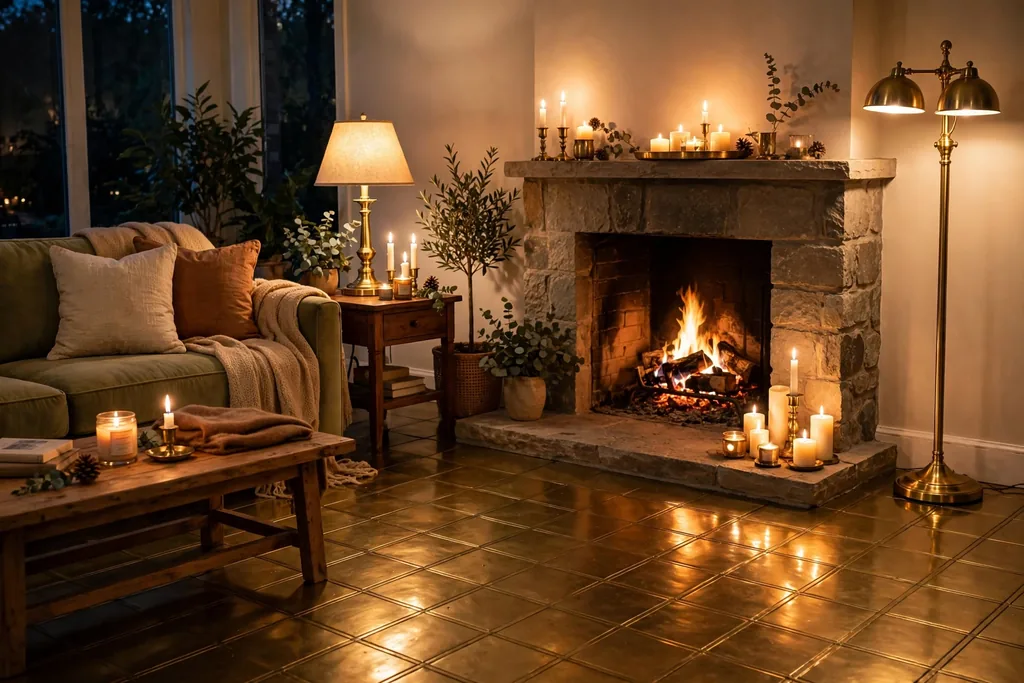
    10. Layer Brass Lamps and Candlelight for Dark Evenings

    Living room in the evening with brass lamps and candles.

    Brass lamps and candlelight suit an Irish living room because they warm the room on dark evenings in a way a single ceiling light cannot. Place a brass floor lamp beside the sofa, a brass table lamp on a side table, and a group of candles on the mantel or coffee table, and use warm bulbs throughout. The mix of heights, floor, table, and mantel, makes the room feel layered rather than flat.

    Keep candle groups on a tray, away from curtains, throws, and paper, and never leave them burning in an empty room. Use dimmers or low wattage bulbs in the lamps, so the evening light stays soft, and keep one brighter lamp by the reading chair for books and crafts. Brass needs only a soft cloth now and then, and a little tarnish suits an older room better than a mirror polish.

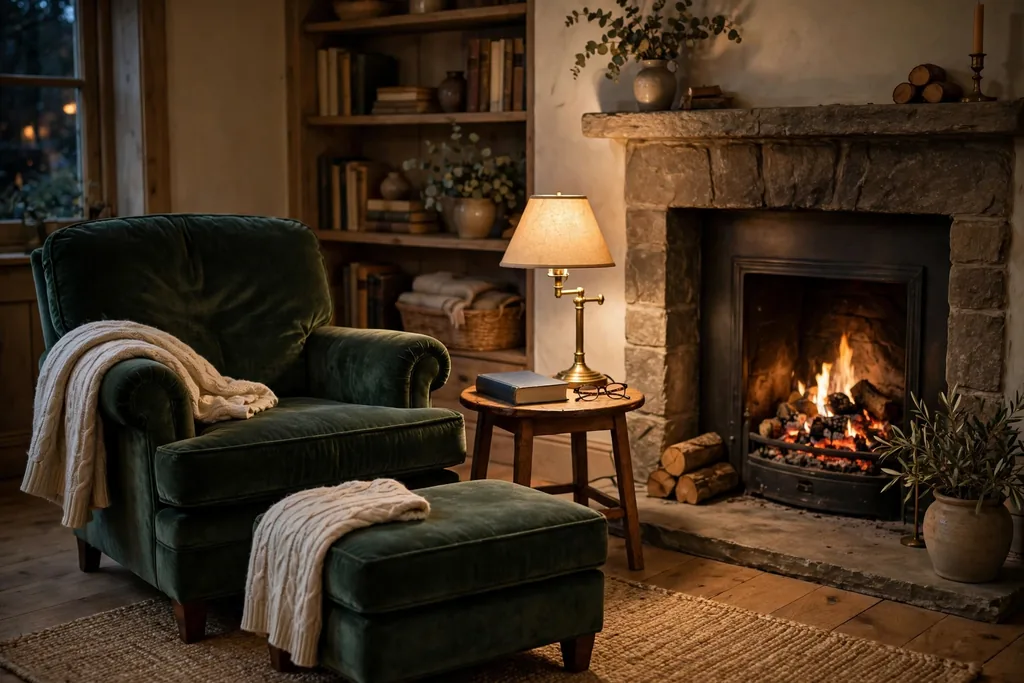
    11. Create a Fireside Reading Chair with a Footstool

    Deep fireside reading chair with a footstool beside a side table.

    A deep fireside reading chair with a footstool and a reading lamp is the Irish living room at its most welcoming, a seat made for long evenings. Place the chair beside the fire, angled toward it, with a small side table for a book, a mug, and glasses, and a footstool that can be pushed aside when the room needs more floor space. The chair should be deep enough to curl up in, with arms at a height that supports a book.

    Choose a chair fabric that suits daily use, such as wool, tweed, or a washable plain fabric, and add one cushion in a color pulled from the room, not a new color. Keep a basket of books or magazines beside the chair, so reading does not need a trip to another room. If the chair faces the television as well as the fire, angle it between the two, so neither view needs a twisted neck.

    12. Bring Back the Settle Bench Beside the Fire

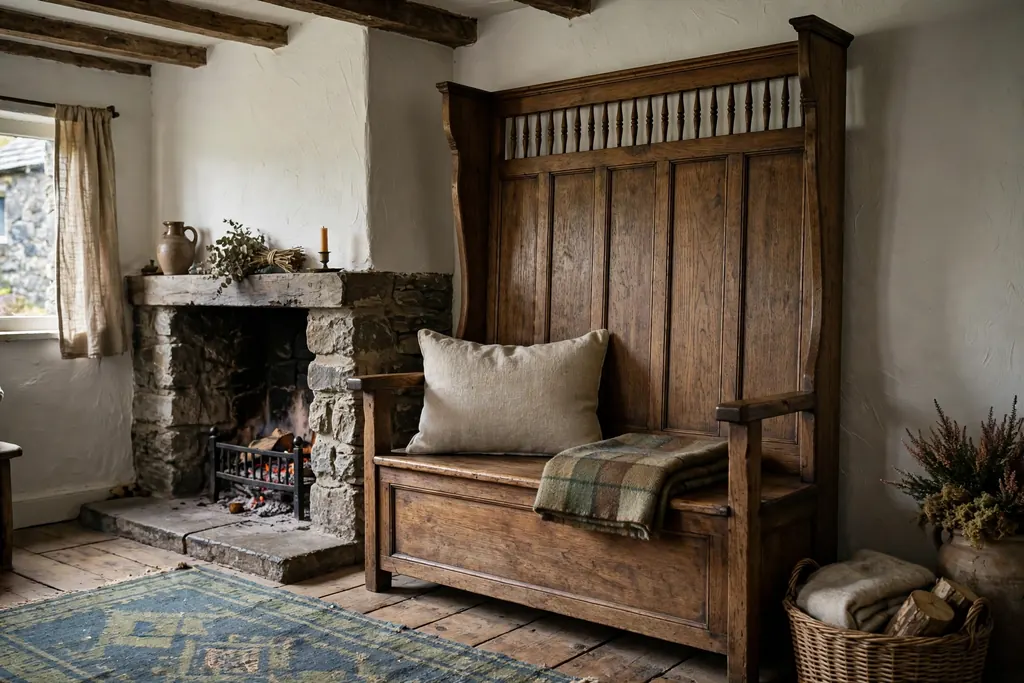
    Tall backed wooden settle bench beside a fireplace.

    A settle bench, the tall backed wooden bench once common in Irish farmhouses, gives a living room a piece of history and a practical extra seat. Place it against a wall beside the fire, or at a right angle to the hearth, with a cushion on the seat and a folded throw over the back, so it invites sitting rather than standing as a museum piece. The high back also cuts drafts from a door behind it.

    Use the settle for overflow seating when guests visit, and keep the seat clear of bags and clutter, so it stays usable. A settle in dark wood suits a cottage room, while a painted settle in cream or soft green suits a brighter room. Check the seat height before you buy, since old settles can sit low, and add a cushion if the seat feels hard after half an hour.

    13. Dress Windows with Natural Linen Curtains

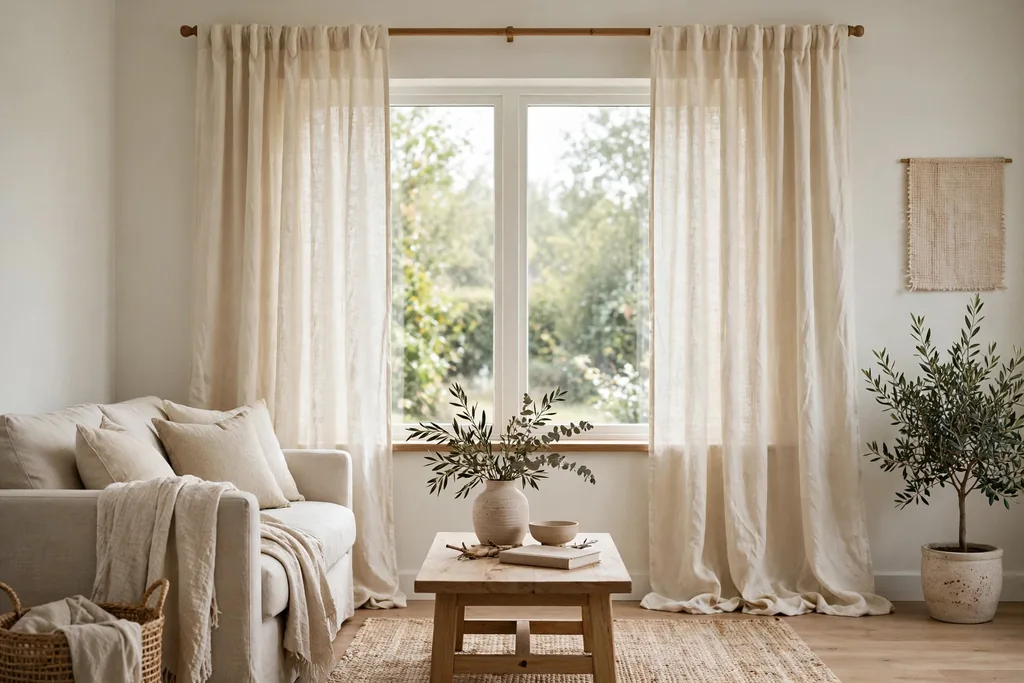
    Living room window dressed with natural linen curtains.

    Natural linen curtains soften an Irish living room without blocking the light it needs, which matters in a room that can feel dark in winter. Hang the rod close to the ceiling and let linen panels in cream, oatmeal, or soft sage fall to the floor, with a sheer panel underneath for daytime privacy. The linen texture suits wood, wool, and stone far better than a shiny synthetic fabric.

    Keep the curtains plain, so they do not compete with a patterned rug or tweed chair, and choose a washable linen blend if the curtains will be handled often. Let the panels stack to the sides of the window by day, so the full window stays open to light, and close them at night for warmth and privacy. If the window is small, a single linen panel on each side still frames it well.

    14. Leave One Wall of Exposed Stone on Show

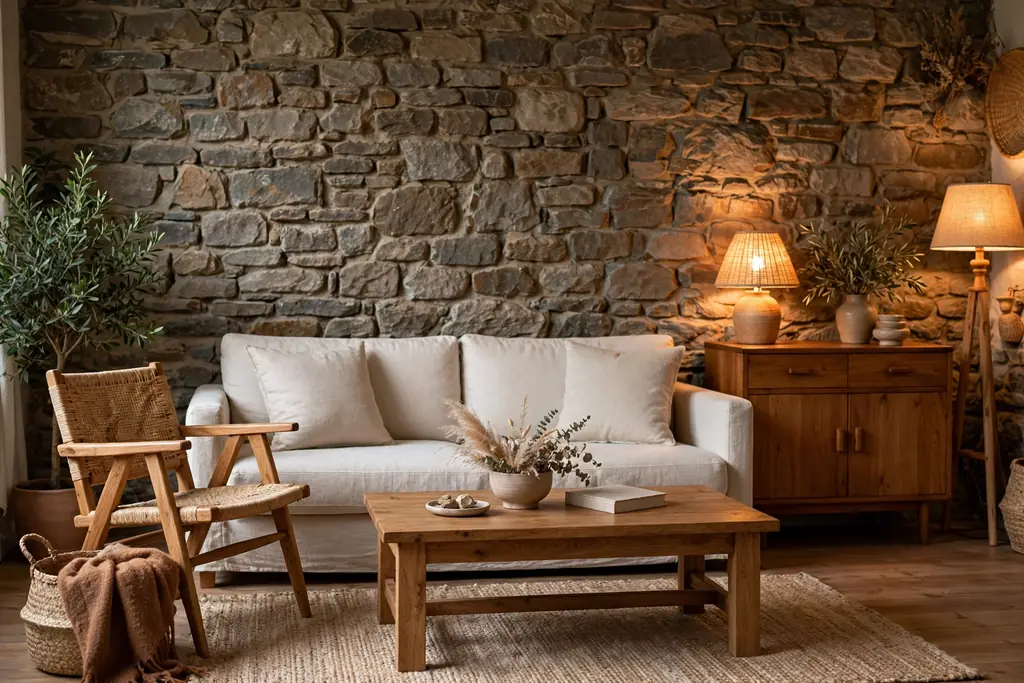
    Living room with an exposed stone wall behind a plain sofa.

    An exposed stone wall gives an Irish living room a texture no paint can copy, and it suits a cottage, a converted barn, or a house with old stone under plaster. Leave one wall bare, or strip back plaster on one wall only, and keep the furniture in front of it simple, such as a plain sofa or a wood bench, so the stone stays visible. The rough surface then becomes the room feature, with no art needed on that wall.

    Keep the rest of the walls pale and plain, so the stone wall does not make the room feel heavy, and use warm lamps to bring out the stone color in the evening. Seal dusty stone if it sheds, and check for damp before you strip plaster, since a damp wall needs fixing first. If your home has no stone, a stone fireplace surround or a stone hearth gives a similar texture on a smaller scale.

    15. Plan a Moss, Peat, and Cream Palette

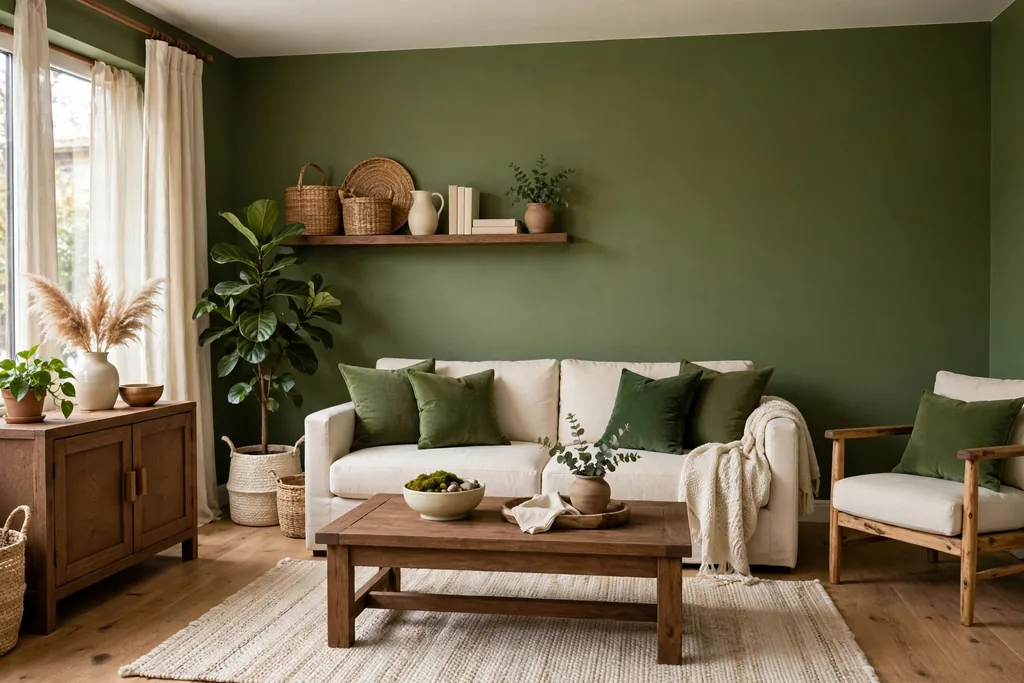
    Living room in moss green, peat brown, and cream.

    A palette of moss green, peat brown, and cream gives an Irish living room a clear plan to follow when choosing cushions, rugs, and art, without fixing every piece in advance. Use cream on the walls and the largest sofa, moss on cushions and one chair, and peat brown on wood, leather, and the rug border, so each color has a job. The palette then links old and new pieces, even if they were bought years apart.

    Test the palette in daylight and lamplight before you commit, since moss can look grey in a north facing room and peat brown can look red under warm bulbs. Keep one color out of each small group, so the room does not repeat the same three colors in every corner. If you want a lift, add one rust cushion or one brass lamp, and keep it as the only warm accent.

    16. Fill the Room with Wildflowers, Herbs, and Houseplants

    Living room with a jug of wildflowers and houseplants.

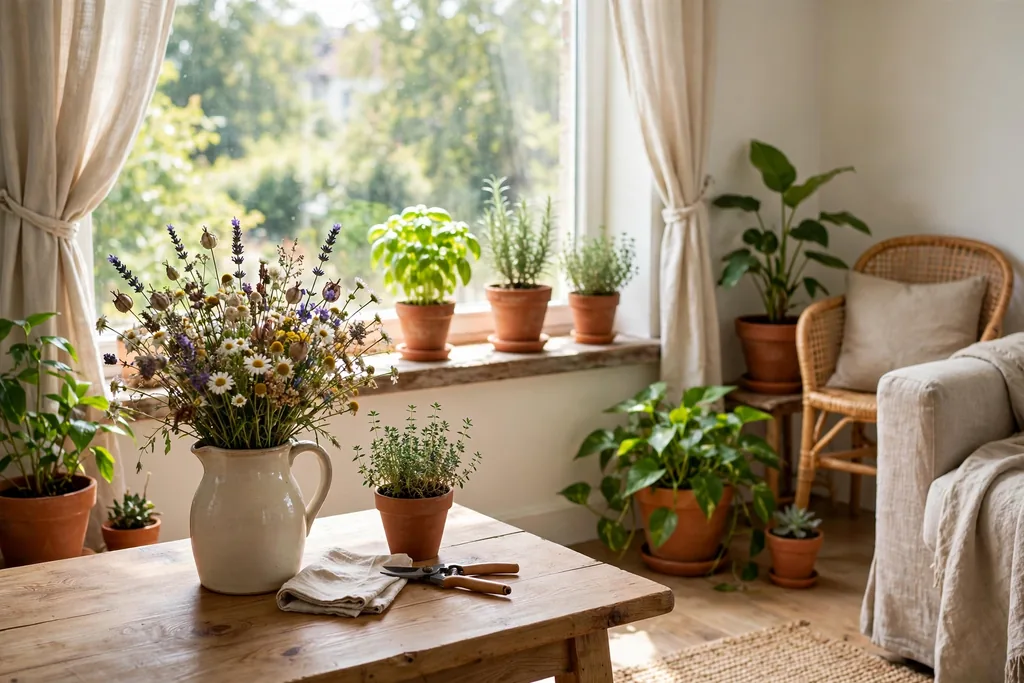
    Wildflowers in a jug, potted herbs on a windowsill, and a few houseplants give an Irish living room a fresh, lived in feel that changes with the seasons. Place a tall plant in a corner, a trailing plant on a shelf, and a small pot on the coffee table, in cream, terracotta, or rattan pots, so the plant group looks planned. A jug of wildflowers or garden stems on the dresser adds color without a bought bouquet.

    Choose plants that suit your light and watering habits, and check that each plant is safe for pets before placing it at sofa height. Keep plants out of the direct heat of the fire, and wipe large leaves now and then, since dust from a fire settles fast. If you have little light, a few good quality dried stems and one hardy plant still give the room a green note.

    17. Make a Heritage Wall of Family Photos and Keepsakes

    Wall of framed family photos above a small shelf.

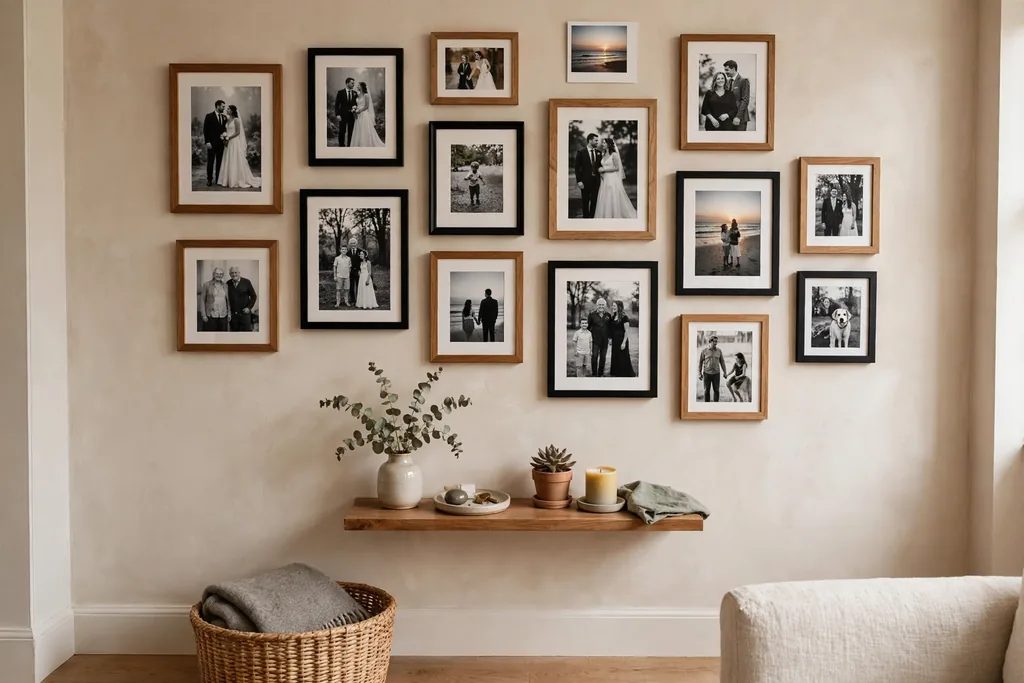
    A heritage wall of family photos, old postcards, and small keepsakes gives an Irish living room the kind of personality no shop can sell, because the pictures belong to your family. Hang a group of framed photos on one wall, in matching frames, with a mix of old black and white prints and newer color photos, and leave space to add to the wall over time. A small shelf below the frames holds a keepsake or two, such as a small clock or a piece of pottery.

    Keep the frames to one or two colors, such as black and wood, so the wall looks grouped rather than scattered, and hang the center of the group at eye level. Scan old photos before framing them, so the originals stay safe, and keep the wall out of strong direct sun, since light fades prints. If the wall feels crowded, remove one frame at a time until the group breathes again.

    18. Set Aside a Music Corner for Sessions and Listening

    Music corner with a guitar on a stand and two chairs.

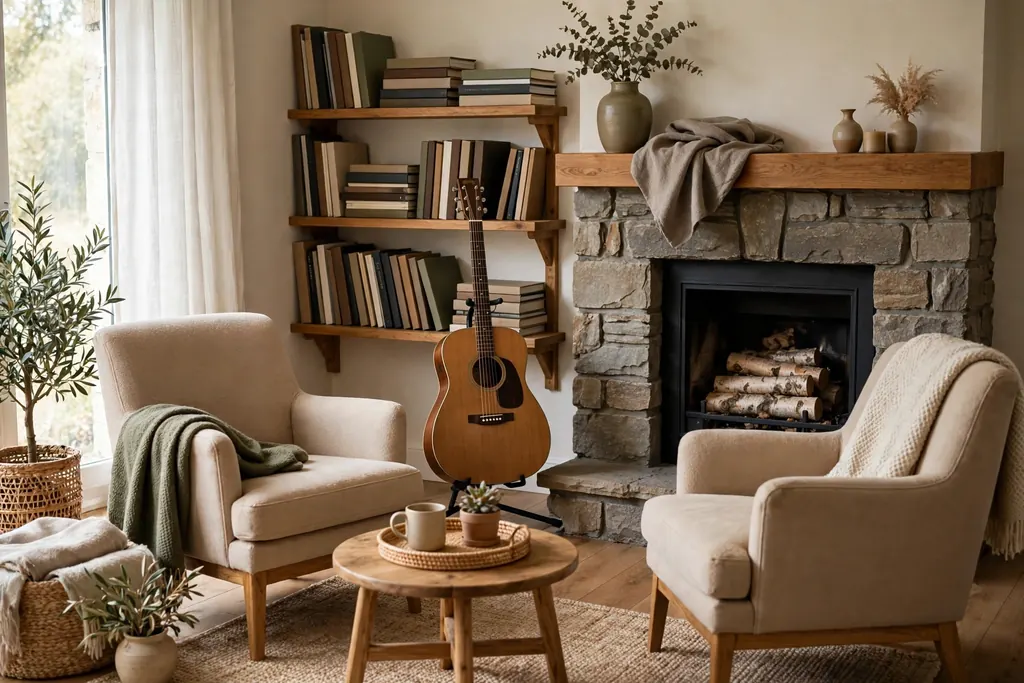
    A music corner, with a guitar on a stand, a fiddle case on a shelf, or a record player on a sideboard, gives an Irish living room a reason to gather that is not the television. Place the corner near the fire, with two chairs angled toward each other, a small table for drinks, and a shelf for songbooks or records, so a session can start without moving furniture. The corner then feels like part of the room, not a stage.

    Keep instruments on stands or wall hooks where they are safe from knocks and from the heat of the fire, and store sheet music in a basket or on a shelf, not in a pile on the floor. If no one in the house plays, a record player and a shelf of records give a similar listening corner, with the same two chairs and table. Keep the corner clear of clutter, so sitting down to play or listen takes seconds, not a tidy up first.

    19. Style a Tea Sideboard for Everyday Hospitality

    Low sideboard with a tea tray, teapot, and cups.

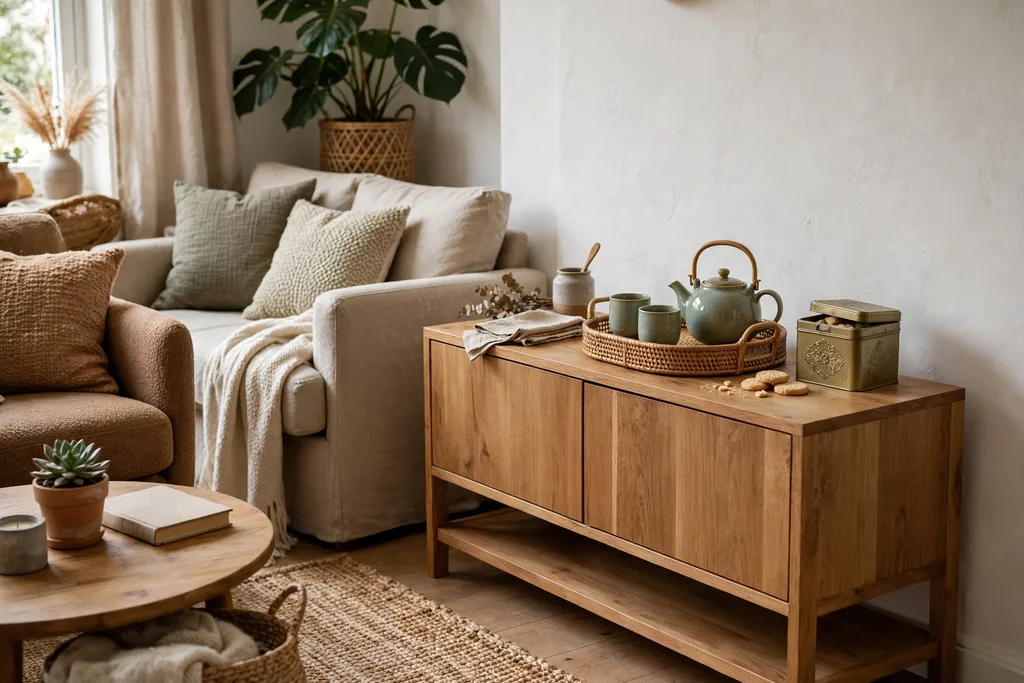
    A tea sideboard, with a teapot, cups, and a biscuit tin ready to use, fits the Irish habit of putting the kettle on when someone calls. Place a low sideboard or a small table near the seating group, with a tray holding the teapot and cups, a tin for biscuits, and a small vase, so tea can be served without a trip to the kitchen for every item. The sideboard then becomes a hospitality station, not just storage.

    Keep the cups you actually use on the tray, and store spares inside the sideboard, so the top stays clear enough to set down a pot. Use a wipe clean tray, since tea spills happen, and keep a folded tea towel on the sideboard for drips. If space is tight, a butler tray table that folds away gives the same tea station in a smaller footprint.

    20. Tile the Hearth with a Patterned Tile Surround

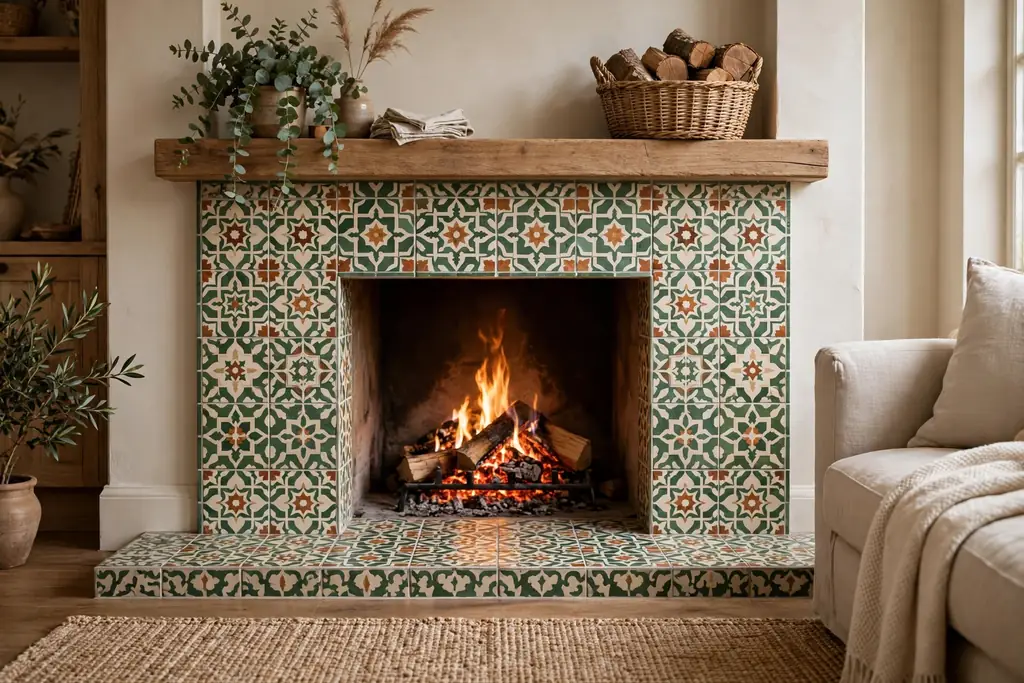
    Fireplace hearth with patterned tiles in green, cream, and rust.

    A patterned tile hearth or fireplace surround adds color and craft to an Irish living room in a small, hard wearing area. Choose tiles in a muted pattern, such as a simple geometric or floral repeat in green, cream, and rust, and tile the hearth and the fireplace cheeks, keeping the mantel and the wall above plain. The pattern then frames the fire without taking over the room.

    Keep the tile pattern to one design, and use plain tiles for the rest of the surround if the pattern feels strong at full size. Tiles handle heat, ash, and spills better than paint or wood near a fire, and they wipe clean with a damp cloth. If you rent, a tile effect hearth rug or a freestanding tile panel gives a similar look without fixing tiles to the wall.

    21. Use Woven Baskets for Throws, Logs, and Everyday Storage

    Living room with woven baskets beside a sofa and fireplace.

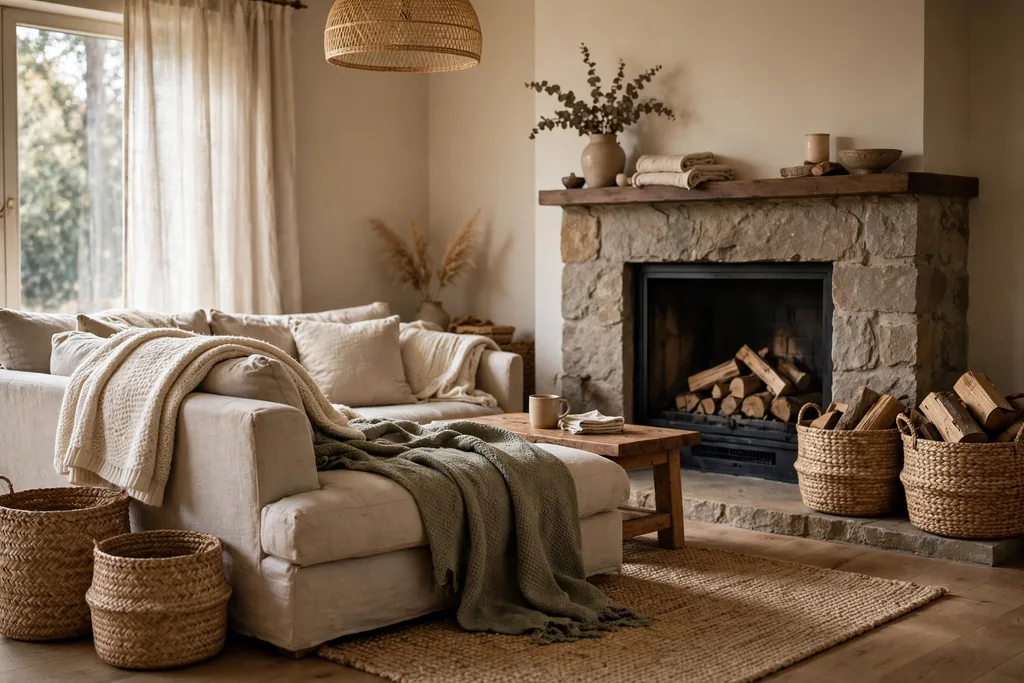
    Woven baskets give an Irish living room storage that looks like part of the room, not like a plastic box pushed into a corner. Place a large basket beside the fire for logs, a medium basket beside the sofa for throws, and a small basket by the door for dog leads, gloves, or magazines, in seagrass, willow, or wicker, so the baskets share one natural material. The baskets then tidy the room while adding texture.

    Keep one basket empty on purpose, so there is always a place to put a throw or a toy without starting a new pile. Line a log basket if it sheds bark, and keep baskets out of damp spots, since natural fibers hold moisture. If a basket starts to look worn, move it to a less visible spot and bring a newer one to the sofa, so the room always has one basket in good shape.

    22. Add Coastal Touches from the West of Ireland

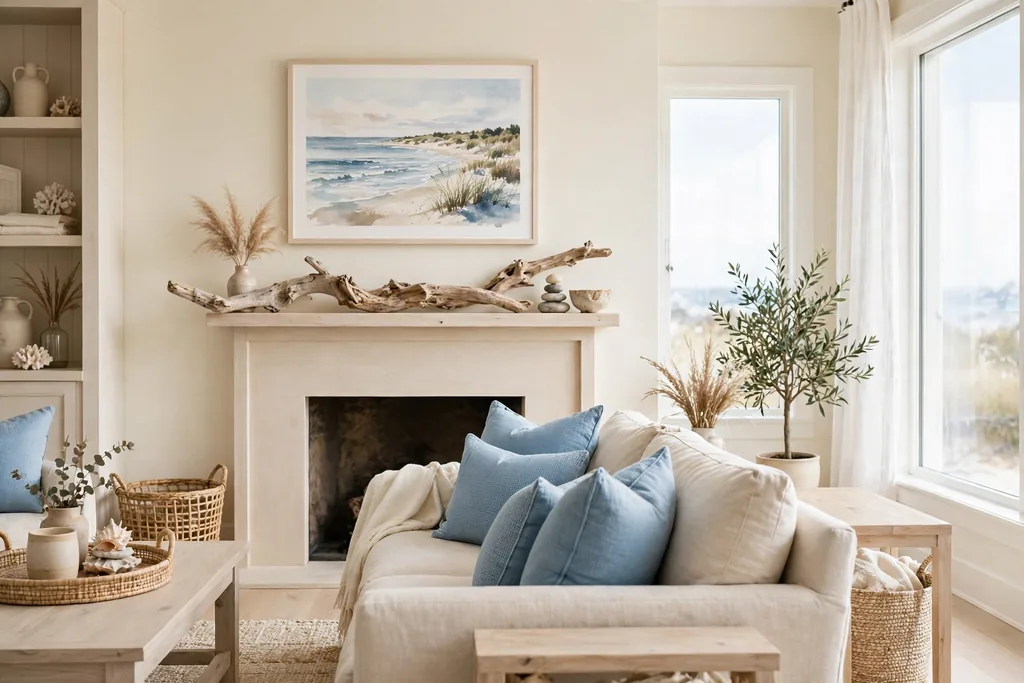
    Bright living room with sea blue cushions and a coastal print.

    Coastal touches, such as sea blue cushions, a piece of driftwood on the mantel, and a print of the Atlantic coast, give an Irish living room a lighter, seaside feel that suits a bright room. Use sea blue and slate as accents only, on two cushions and one throw, with cream walls and pale wood, so the room stays calm rather than turning into a beach theme. A single driftwood piece or a shell in a bowl is enough, since too many coastal props quickly feel staged.

    Pair coastal accents with the same natural materials as the rest of the room, wool, linen, and wood, so the coastal corner links to the cottage details beside it. Keep the coastal color out of the fireplace area, where warm browns and firelight lead, and let it live near the window, where daylight suits blue best. If you live inland, one coastal print still works, as long as the rest of the room stays Irish in palette and texture.

    23. Keep Cottage Scale Furniture in a Small Irish Room

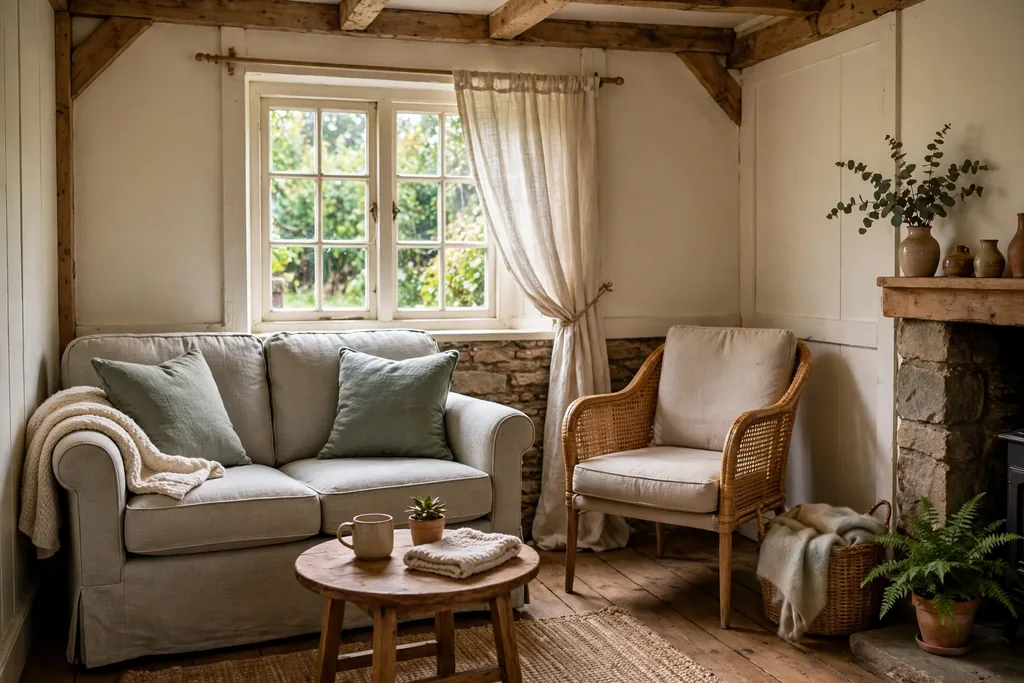
    Small cottage living room with a two seat sofa and a round table.

    Small Irish rooms, in cottages and older houses, need furniture at cottage scale: a two seat sofa, a slim armchair, and a small round table, rather than a large sectional that fills the floor. Measure the room and the doorways first, then choose a sofa that leaves a clear walking route on at least one side, with legs that show floor underneath, so the room feels larger. A round coffee table also helps, since it leaves no sharp corners in a tight walking route.

    Use multifunction pieces, such as a window seat with storage, a settle that seats two, and a sideboard that serves tea, so each piece earns its floor space. Keep large pieces against walls and small pieces in the middle, and use a rug that fits the seating group, not the whole floor, so bare boards show at the edges. For a softer sofa color to pair with the greens and browns here, see these grey couch living room ideas.

    Conclusion

    An Irish living room with real personality comes from a few strong choices, not from filling every surface: a deep green sofa or a stone wall, wool and tweed you actually use, firelight and brass lamps in the evening, and one personal layer, such as photos, books, or music. Start with the piece that matters most to you, whether that is the fireplace, the window seat, or the dresser, and build the rest of the room around it in cream, moss, and warm wood. Small moves, a throw, a rug, a print, let you test the look before a larger change, such as a new sofa or a tiled hearth.

    Save this list for your next free hour in the living room, and work through it in order: palette and sofa first, then fireplace and rug, then lighting and storage, and finally the photos, plants, and tea sideboard that finish the room. Pin the ideas you like best, so you can find them again when you are ready to paint, shop, or rearrange.

    FAQs

    How do I add Irish style without making the room look themed?

    Limit Irish details to a few pieces, such as an Aran throw, a tweed chair, and one landscape print, in muted colors, and keep the sofa, curtains, and rug plain. A room full of shamrocks, flags, and novelty items reads as a theme, while a few well chosen pieces in green, cream, and wood read as personal. If you already own a strong Irish piece, pair it with plain oatmeal or grey, and keep other patterns out of the same view.

    What colors suit an Irish living room best?

    Cream and warm white work well on walls, with moss green, peat brown, and soft slate as the main accents, plus one warm lift, such as rust or brass. This palette suits both cottage rooms and modern rooms, since it comes from landscape, wool, and wood rather than from bright paint. Keep deep color on cushions, one chair, or one sofa, and keep the walls and rug pale, so the room stays light in winter.

    Can an Irish living room work in a modern flat with no fireplace?

    Yes. The look comes from palette, texture, and lighting as much as from a fire. Use a deep green or grey sofa, wool and tweed layers, a patterned rug, and layered warm lamps, and add one heritage piece, such as an Aran throw or a landscape print. A simple electric stove effect fire, or a candle group on a low console, can give a focal point without a chimney.

    Which fabrics suit an Irish living room best?

    Wool, tweed, linen, and cotton suit the look and the climate, since they add warmth and texture. Use wool for throws and rugs, tweed for a chair or cushions, linen for curtains and lighter cushions, and cotton for washable covers in a room used daily. Keep one fabric plain for every patterned one, and choose washable covers for cushions in a room with pets or children.

    How do I keep an Irish living room light in winter?

    Keep walls pale, use mirrors opposite a window where one fits, and dress windows with sheer panels under heavier curtains, so daylight reaches the room by day and the curtains close at night. Add lamps at more than one height with warm bulbs, and keep the rug and sofa in light or mid tones, saving deep color for cushions and one chair. Clear surfaces also help, since clutter absorbs light.

    Should I mix Irish style with other styles in the same room?

    Yes, if you link the pieces with color and material. An Irish throw or tweed chair sits well beside pale wood, a plain modern sofa, or a coastal style table, as long as one palette and one wood tone run through the room. Keep the heritage pieces to a few, and let plain, modern pieces carry the larger shapes, so the mix looks planned rather than crowded.


  • 33 Italian Living Room Ideas to Refresh Your Space

    33 Italian Living Room Ideas to Refresh Your Space

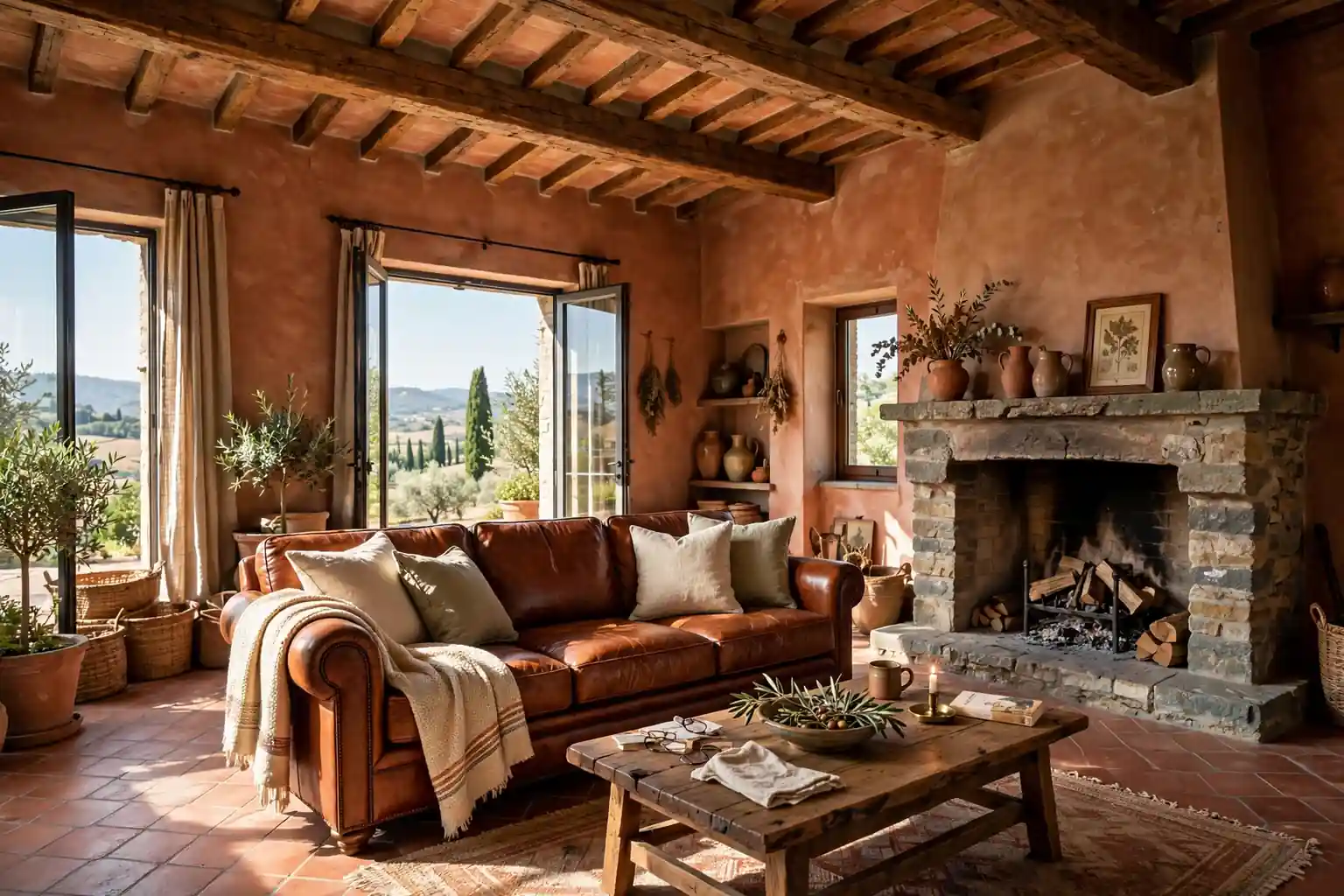
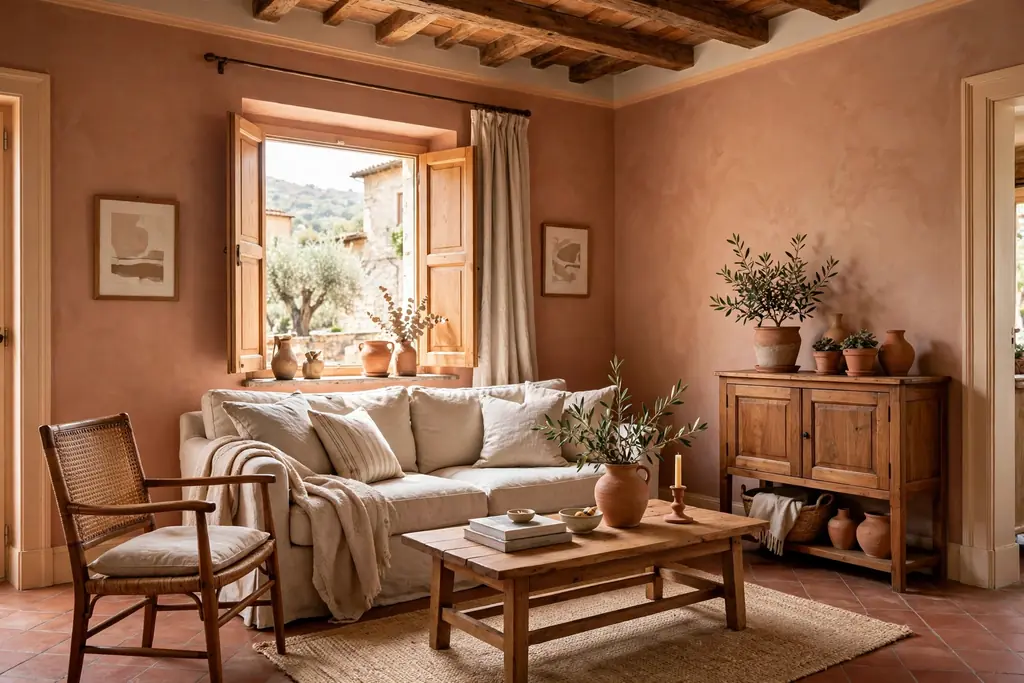
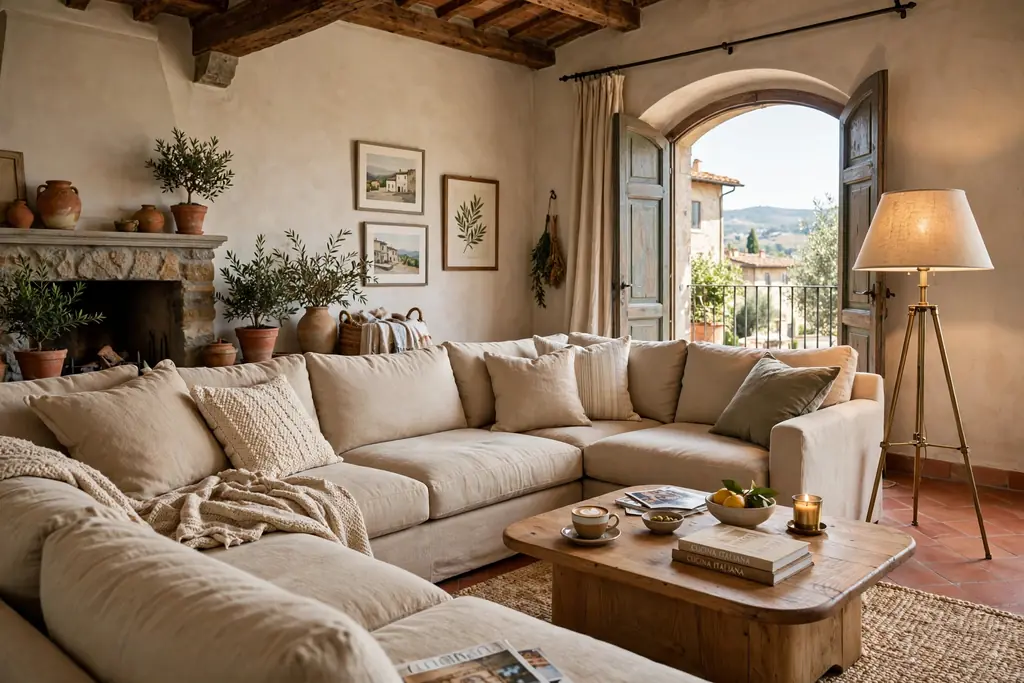
    An Italian living room feels welcoming before it feels decorated. Warm plaster walls, worn wood, a stone fireplace, and a table set for people to sit around all point to the same idea: a room made for long conversations, good food, and everyday comfort. These 33 Italian living room ideas cover walls, floors, seating, lighting, and small details, so you can borrow one idea or build a whole room from them. Start with the bones of the room, then add seating and light, and finish with plants and pottery that make it feel lived in.

    Key Takeaways

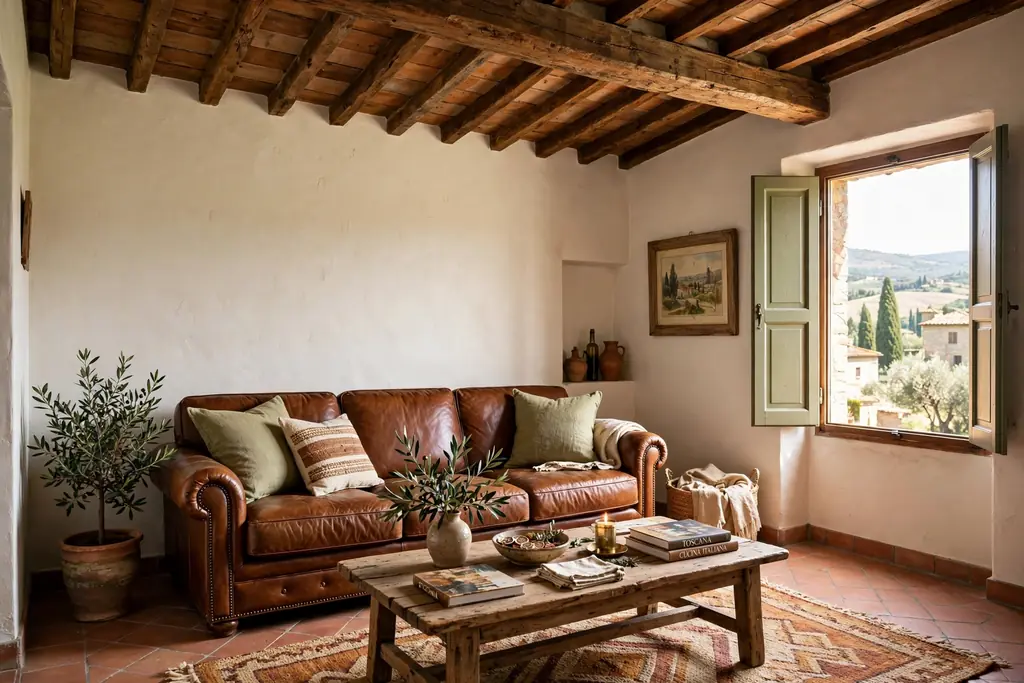
    • Start with warm, natural materials: plaster, terracotta, wood, stone, leather, and linen set the Italian tone before any decoration is added.
    • Keep one calm palette of warm whites, terracotta, olive, and walnut, and repeat it in the rug, cushions, and pottery.
    • Give the room a clear gathering point, such as a fireplace, a coffee table, or a shared table, and arrange seating to face it.
    • Mix old and new pieces: a worn wood table or an antique credenza sits well beside a simple modern lamp or a plain linen sofa.
    • Use plants, pottery, and candlelight for warmth, and keep surfaces mostly clear so the room stays calm and easy to use.
    • Choose pieces that suit daily life first, with washable linen, sturdy wood, and storage that hides clutter.

    1. Terracotta Limewash Walls

    Italian living room with soft terracotta limewash walls and warm white trim.

    Wash the walls in a soft terracotta limewash to give the room its warm base. Limewash has a cloudy, hand finished look that plain paint rarely gives, and it suits both old houses and newer rooms that feel too flat. Choose a muted terracotta rather than a bright orange, and test a patch in daylight and lamplight before you commit.

    Keep the ceiling and trim in warm white so the walls stay the main color, and let wood, leather, and linen carry the rest of the palette. If a full room feels like too much, wash one wall behind the sofa and keep the others in warm white. The effect is still warm, and the room is easier to change later.

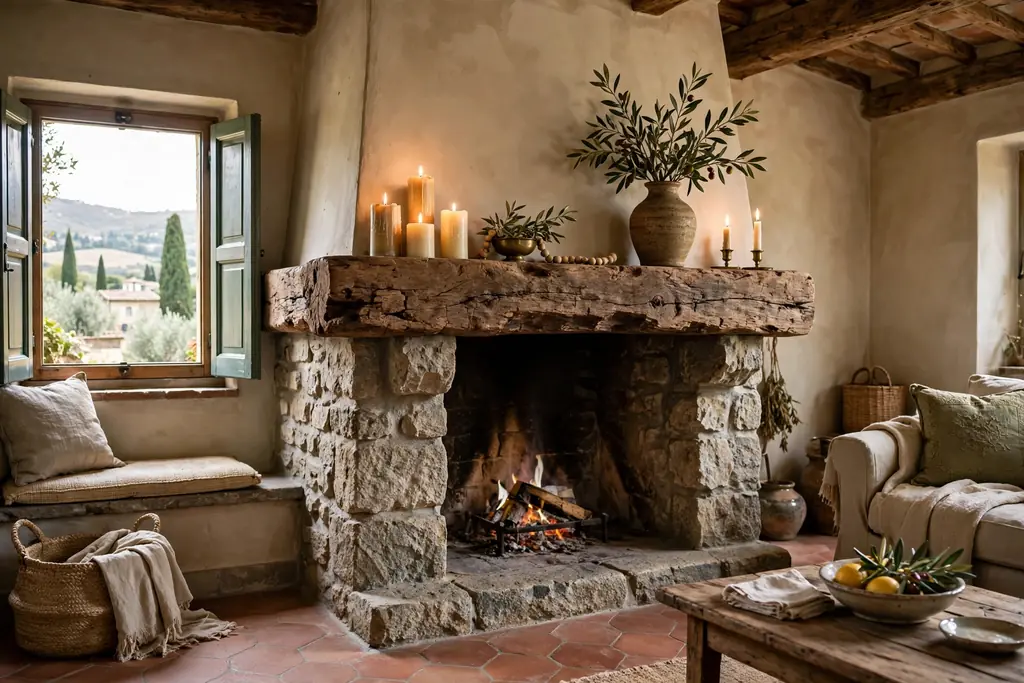
    2. Stone Fireplace with a Thick Wood Mantel

    Stone fireplace with a thick wood mantel in an Italian living room.

    Make a stone fireplace the center of the room, with a thick, rough wood mantel above it. Stone gives weight and age to the room, while the wood mantel softens it and gives you a shelf for candles, a vase, or a framed print. This suits a room where conversation matters more than a television, since chairs naturally turn toward the fire.

    Keep the hearth clear and safe, with no rug or fabric too close to the opening, and choose a low pile rug for the seating group in front of it. If your home has no working fireplace, a stone surround around an electric insert, or even a simple stone clad wall, gives a similar focal point without major building work.

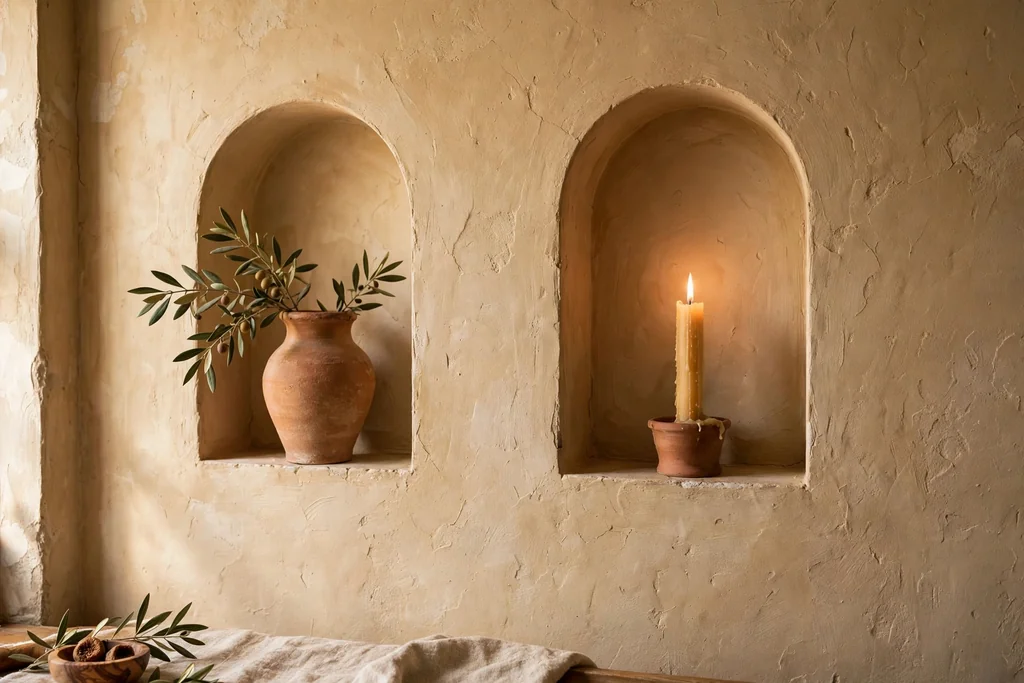
    3. Arched Wall Niches for Display

    Italian living room wall with arched niches holding a vase and a candle.

    Cut the hard lines of a rectangular room with arched wall niches, or suggest the same shape with arched shelving and arched mirrors. An arch is a classic Italian shape, and a niche gives pottery, a candle, or a small plant a place of its own instead of a crowded shelf. Paint the inside of the niche a shade deeper than the wall so the shape reads clearly.

    Use niches sparingly, one or two in a room, so they feel special rather than busy. A single arched niche beside a fireplace, with one terracotta vase and a candle, often works better than a whole wall of small arches. Keep the display simple and leave empty space around each object.

    4. Exposed Wood Ceiling Beams

    Italian living room with exposed wood ceiling beams and warm white walls.

    Leave ceiling beams exposed, or add slim wood beams to a plain ceiling, to bring warmth overhead. Dark walnut beams suit a rustic room, while pale oak beams keep a smaller room feeling light. Beams draw the eye up and make a plain ceiling feel like part of the design, not just a surface above it.

    Check the ceiling height first, since beams in a very low room can feel heavy. In a low room, use fewer, slimmer beams in a pale wood, and keep the ceiling itself in warm white. Painted beams in a soft cream are another option when dark wood would close the room in.

    5. Terracotta Tile Floors Softened with a Wool Rug

    Italian living room with terracotta tile floors and a large wool rug.

    Lay terracotta tiles, or choose a terracotta look tile, for a floor that feels warm underfoot and ages well. Terracotta suits kitchens and living rooms alike, and it pairs naturally with wood furniture and linen upholstery. A large wool rug over the tiles softens the seating area and keeps feet warm in winter.

    Size the rug to the seating group, with the front legs of the sofa and chairs resting on it, as explained in these living room rug ideas. Choose a rug in cream, rust, or a muted pattern, and keep a border of tile showing around it so the floor still reads as terracotta. A low pile rug is easier to clean in a busy family room.

    6. Majolica Tile Border as a Floor Rug

    Italian living room floor with a hand painted majolica tile border around a seating area.

    Use a border of hand painted majolica style tiles to mark the seating area, like a rug made of tile. A blue and white or green and cream border around a plain tile or wood floor gives a strong Italian detail without covering the floor. This works well in a room where a rug would slide, stain, or hide a floor worth showing.

    Keep the border simple and even, with the same tile repeated around the edge, and let the center stay plain. If real tile work is not practical, a printed tile look rug in a majolica pattern gives a similar effect and can be moved. Either way, keep furniture inside the border so the seating group reads as one zone.

    7. Cognac Leather Sofa as the Anchor

    Italian living room anchored by a cognac leather sofa with olive cushions.

    Anchor the room with a cognac leather sofa, a piece that grows more comfortable and better looking with use. Leather suits a family room because spills wipe off, and the warm brown tone sits well with terracotta walls, wood floors, and cream linen. Choose a simple shape with deep seats, since a fussy frame fights the relaxed Italian feel.

    Pair the sofa with cushions in olive, cream, and rust, and a wool throw for cooler evenings. Keep the rest of the seating simpler, such as plain wood chairs or a linen armchair, so the leather stays the main statement. Condition the leather as the maker directs, and keep it out of harsh direct sun.

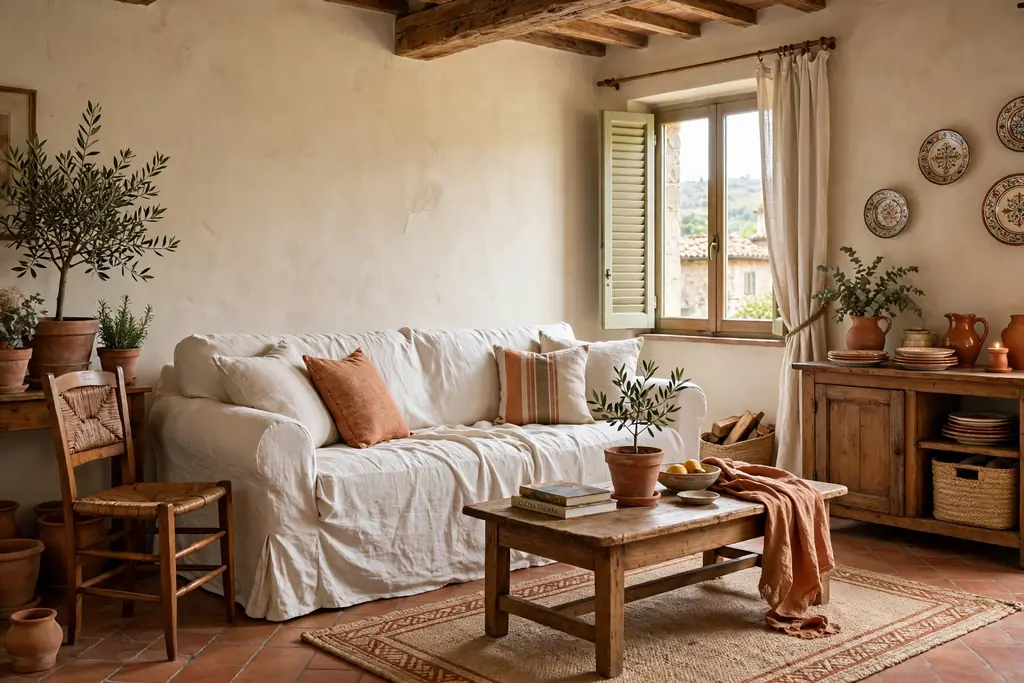
    8. Relaxed Linen Slipcovered Sofa

    Relaxed linen slipcovered sofa in warm white in an Italian living room.

    Choose a linen slipcovered sofa for a softer, more casual Italian look. Slipcovers can be removed and washed, which makes linen practical for homes with children, pets, or frequent guests. The slightly wrinkled, relaxed drape is part of the appeal, so do not chase a pressed, formal finish.

    Pick a warm white, oatmeal, or pale sage linen, and add cushions in terracotta and olive for color. A slipcovered sofa pairs well with a wood coffee table and a wool rug, and it suits a room where comfort matters more than a sharp tailored line. Keep a spare slipcover if the sofa gets daily use, so one can wash while the other is on.

    9. Olive Velvet Armchairs by the Fire

    Pair of olive velvet armchairs beside a fireplace in an Italian living room.

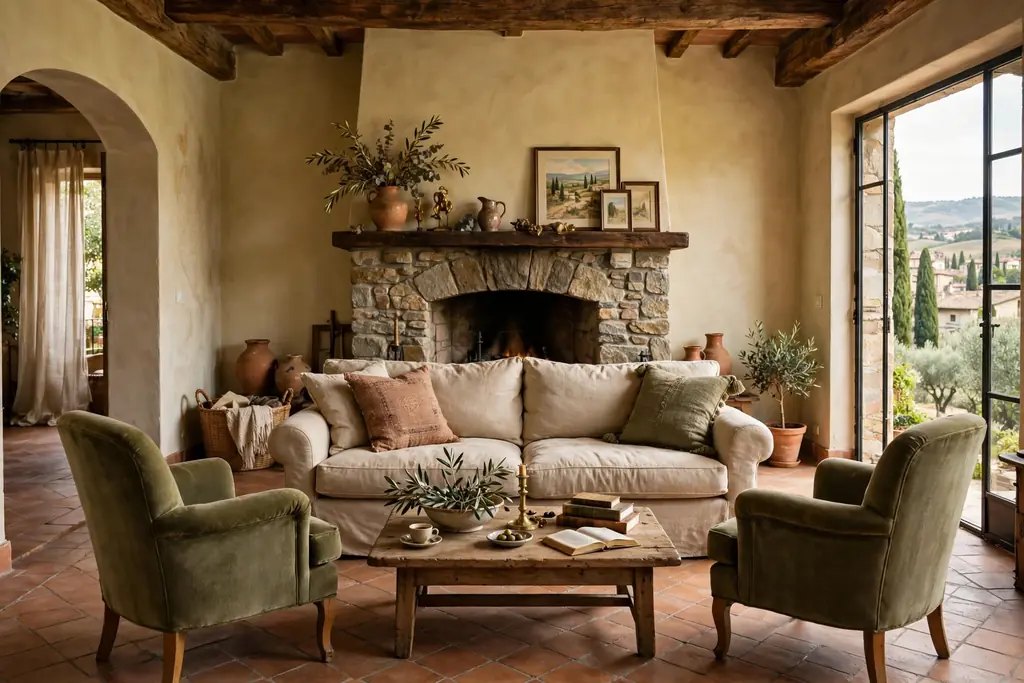
    Place a pair of olive velvet armchairs by the fireplace for a seating spot that feels rich without being formal. Velvet catches light in a way linen does not, and olive is a calm green that links the room to plants and to the countryside palette. Two chairs facing each other, or angled toward the fire, invite conversation.

    Keep the chair frames simple, in dark wood or brass legs, and add a small side table between them for cups and books. If velvet feels too warm for summer, swap the cushions for linen ones and keep the velvet chairs for the cooler months. A single velvet chair also works in a smaller room beside a reading lamp.

    10. Woven Rattan Lounge Chair in a Sunny Corner

    Woven rattan lounge chair in a sunny corner of an Italian living room.

    Set a woven rattan lounge chair in the sunniest corner of the room for a light, coastal Italian feel. Rattan suits a room with whitewashed walls, linen curtains, and a terracotta pot, and it reads as relaxed rather than rustic. Add a thick cushion in cream or striped linen so the chair is comfortable for a long sit.

    Keep the rattan chair away from damp spots and very harsh sun, which can dry the weave over time. A small side table and a basket for books complete the corner, and the chair can move to a terrace in summer if the weave is suited to outdoor use. Check the maker guidance before leaving it outside.

    11. Reclaimed Wood Coffee Table

    Reclaimed wood coffee table in front of a sofa in an Italian living room.

    Center the seating group on a reclaimed wood coffee table with visible grain, knots, and a worn edge. A thick plank top on simple legs feels handmade and sturdy, and it gives the room a piece with a past. This table suits both a leather sofa and a linen sofa, since wood links the two styles.

    Keep the tabletop mostly clear, with one tray, a candle, and a small stack of books, so it stays useful for cups and plates. Choose a table height that matches the sofa seat, and leave enough room to walk around it easily. If the wood is rough, sand the top smooth and seal it so cups and glasses sit safely.

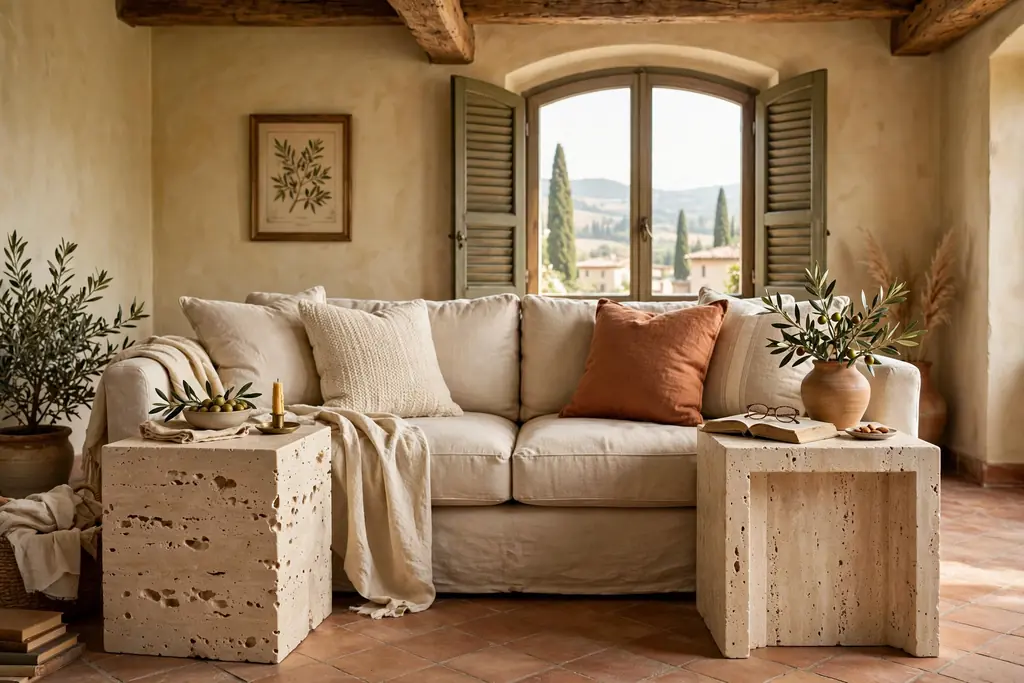
    12. Travertine Side Tables

    Travertine side tables beside a sofa in an Italian living room.

    Add travertine side tables beside the sofa and chairs for a stone detail at a smaller scale than a fireplace. Travertine has a soft, pitted surface in warm cream and beige tones, and a small round or square table in this stone feels both natural and refined. It suits a room that already has wood and leather, since stone adds a cool contrast.

    Use one travertine table as a lamp stand and another as a cup table, and keep the tops clear except for one object each. Travertine stains more easily than sealed wood, so wipe spills quickly and use coasters for drinks. A sealed finish, applied as the maker directs, helps protect the surface in daily use.

    13. Marble Topped Console Behind the Sofa

    Marble topped console behind a sofa in an Italian living room.

    Place a marble topped console behind a sofa that floats in the middle of the room. The console gives the back of the sofa a finished edge, holds a lamp and a few books, and creates a surface for a vase or a framed print. White or cream marble with soft grey veins keeps the look calm, while the wood or iron base below adds warmth.

    Keep the console narrow, so it does not eat into the walkway behind the sofa, and anchor it to the wall or floor if children or pets could pull on it. A console in this spot also works as a soft divider in an open plan room, marking where the living zone ends without a wall.

    14. Open Wood Shelves for Ceramics and Books

    Open wood shelves with ceramics and books in an Italian living room.

    Hang open wood shelves on one wall for ceramics, books, and a few plants, and keep the display loose rather than packed. Open shelves suit an Italian room because they show the handmade pieces that give the room character, such as bowls, jugs, and old books with worn covers. Use thick wood shelves with simple brackets in iron or wood.

    Edit the shelves hard: one row of books, a stack of bowls, a plant, and empty space between groups. If the shelves look crowded, remove a third of the objects and see how the wall breathes. Dust open shelves weekly, and keep everyday items low and within reach, with display pieces higher up.

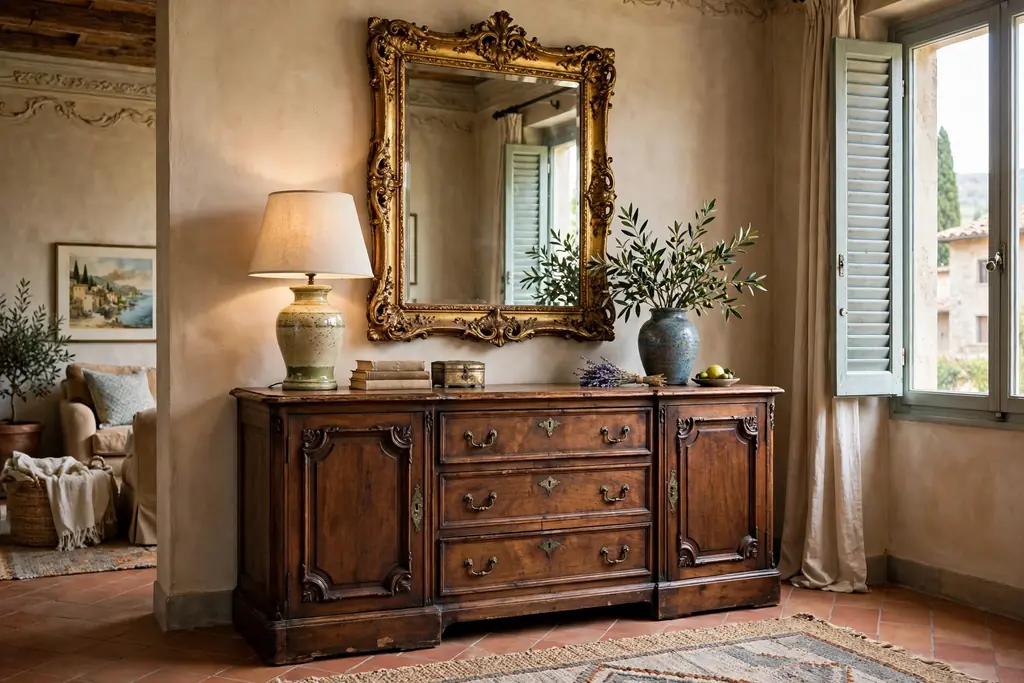
    15. Antique Walnut Credenza for Storage

    Antique walnut credenza under a mirror in an Italian living room.

    Use an antique or antique style walnut credenza to hide the clutter that open shelves cannot hold. A credenza with doors keeps board games, chargers, and spare throws out of sight, while its wood tone and aged hardware add warmth to the wall. Place it under a mirror or a framed print so it reads as furniture, not just storage.

    Keep the top of the credenza mostly clear, with a lamp at one end and a vase or a stack of books at the other. If the credenza is a genuine antique, check that doors and drawers close well and that the piece is stable on your floor. A credenza also serves as a serving surface when guests gather, which suits a room built for hospitality.

    16. Glass Front Cabinet for Murano Glass

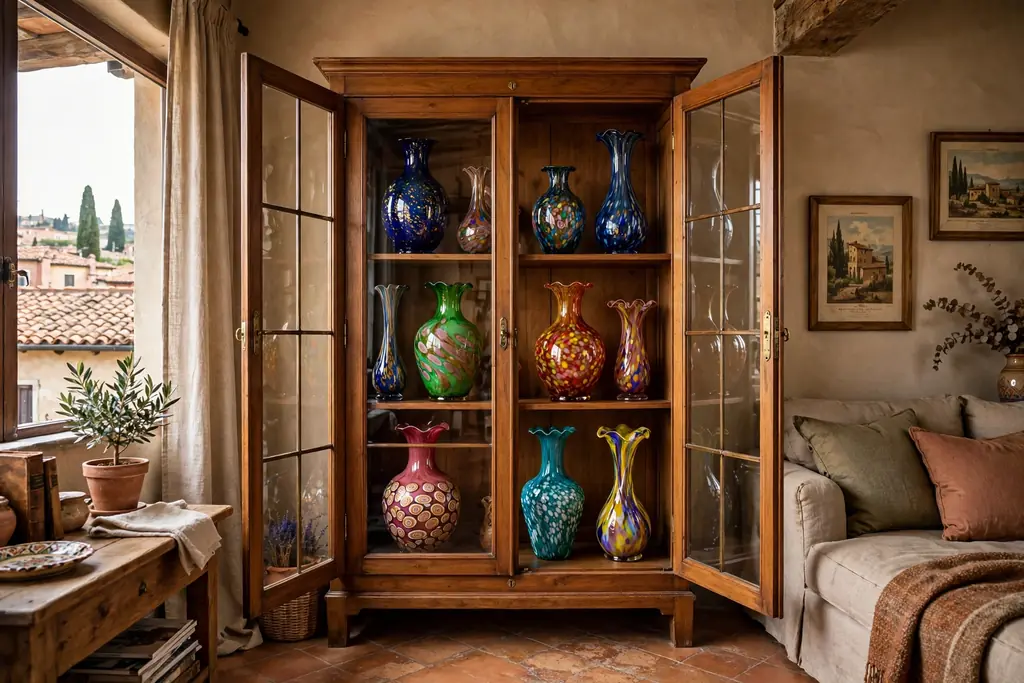
    Glass front cabinet displaying colorful Murano glass in an Italian living room.

    Show Murano glass in a glass front cabinet, where color and light can do their work without dust settling on every piece. A cabinet with wood frames and clear glass doors suits an Italian room far better than a fully open shelf for delicate glass. Place the cabinet where daylight or a lamp can pass through the glass, so the colors glow.

    Group the glass by color family, such as blues together and ambers together, and leave space between pieces so each one is visible. Keep the cabinet doors closed in a dusty room, and clean the glass with a soft cloth. One or two strong pieces in the cabinet often look better than a crowded shelf of small ones.

    17. Wrought Iron Chandelier over the Seating Area

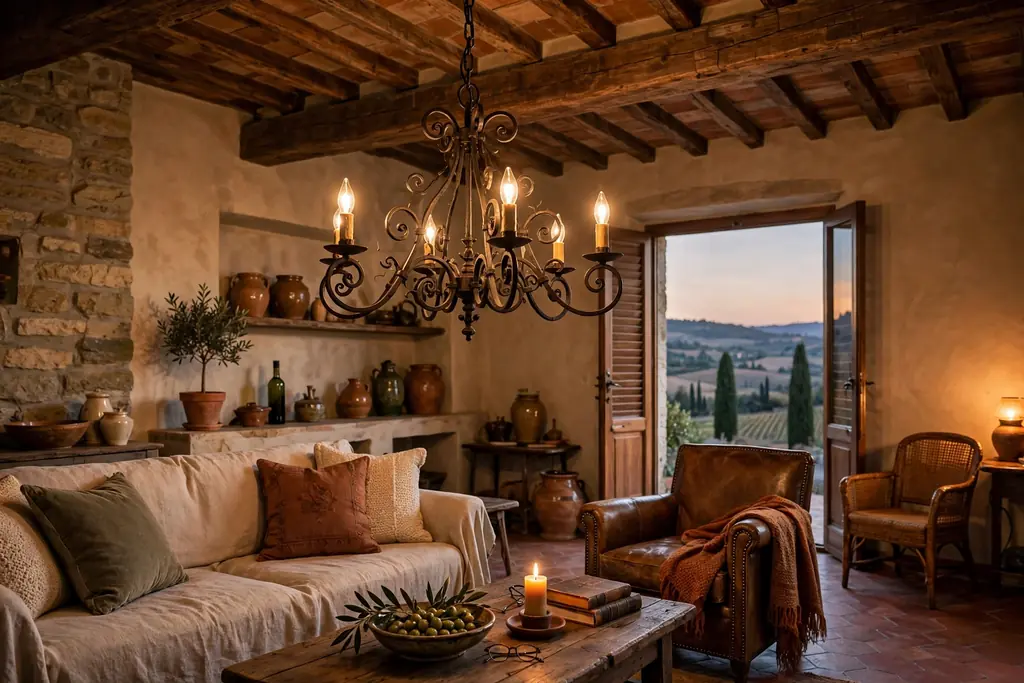
    Wrought iron chandelier over a seating area in an Italian living room.

    Hang a wrought iron chandelier over the seating area for a fixture that feels handmade and old. Iron suits a room with wood beams, stone, and terracotta, and a simple ring or candle style chandelier gives warm light without a fussy crystal look. Use warm bulbs and a dimmer, where one is already fitted, so the light can shift from bright to soft in the evening.

    Hang the chandelier high enough to walk under safely, and center it over the coffee table rather than the middle of the room if the seating group sits off center. If the ceiling is low, choose a flush or semi flush iron fixture in the same style, so the room keeps the iron detail without losing headroom.

    18. Murano Glass Table Lamps for Soft Evening Light

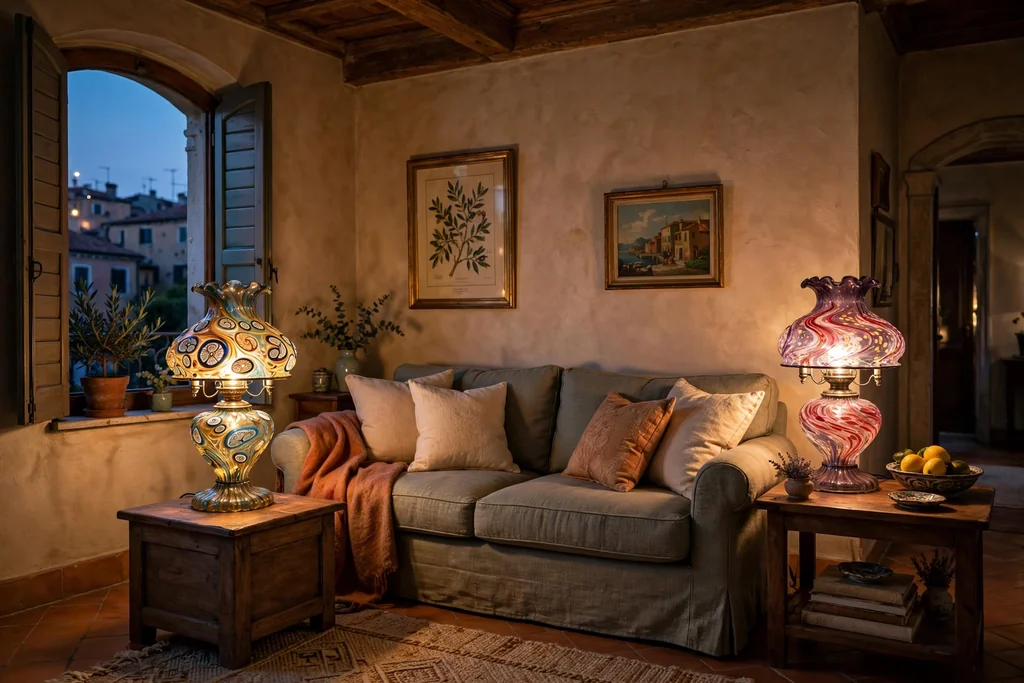
    Murano glass table lamps glowing on side tables in an Italian living room.

    Add Murano glass table lamps on side tables and the console for soft evening light in color. A lamp in amber, green, or soft blue glass glows when lit, and the base itself is a decoration by day. Murano lamps suit a room where the main ceiling light feels too harsh for evenings, since they give pools of warm light at seat height.

    Use matching lamps on either side of a sofa for balance, or one strong lamp beside a reading chair. Keep the shade simple, in cream linen, so the glass base stays the focus. Choose a bulb tone that matches the other lamps in the room, so the evening light feels even rather than mixed.

    19. Potted Olive Tree in a Terracotta Pot

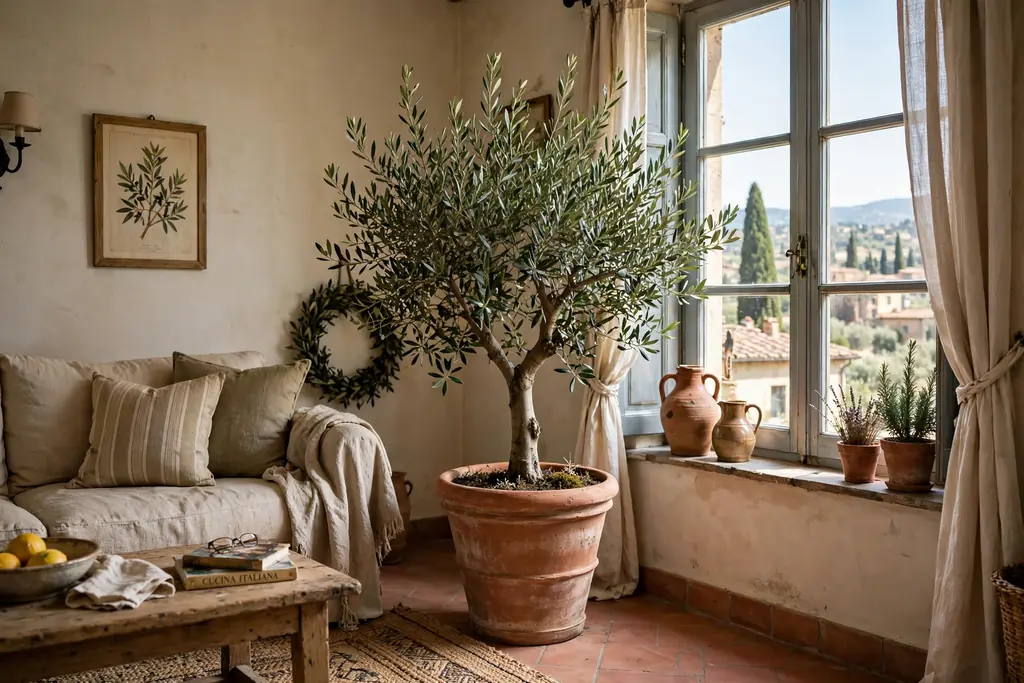
    Potted olive tree in a large terracotta pot beside a bright window.

    Grow a potted olive tree in a large terracotta pot for the single plant that most clearly says Italy. The silvery green leaves suit warm walls and wood floors, and the terracotta pot links the plant to the floor and to the pottery on the shelves. Place the tree near a bright window, where it gets the light it needs.

    Water only when the top soil feels dry, and use a pot with drainage holes so roots do not sit in water. Turn the pot a quarter turn each week so growth stays even, and prune lightly to keep the shape open. In a cold climate, keep the tree indoors through winter and move it to a sheltered terrace only in warm months, following local guidance for your variety.

    20. Sunny Windowsill Herb Pots

    Small herb pots in terracotta on a sunny windowsill in an Italian living room.

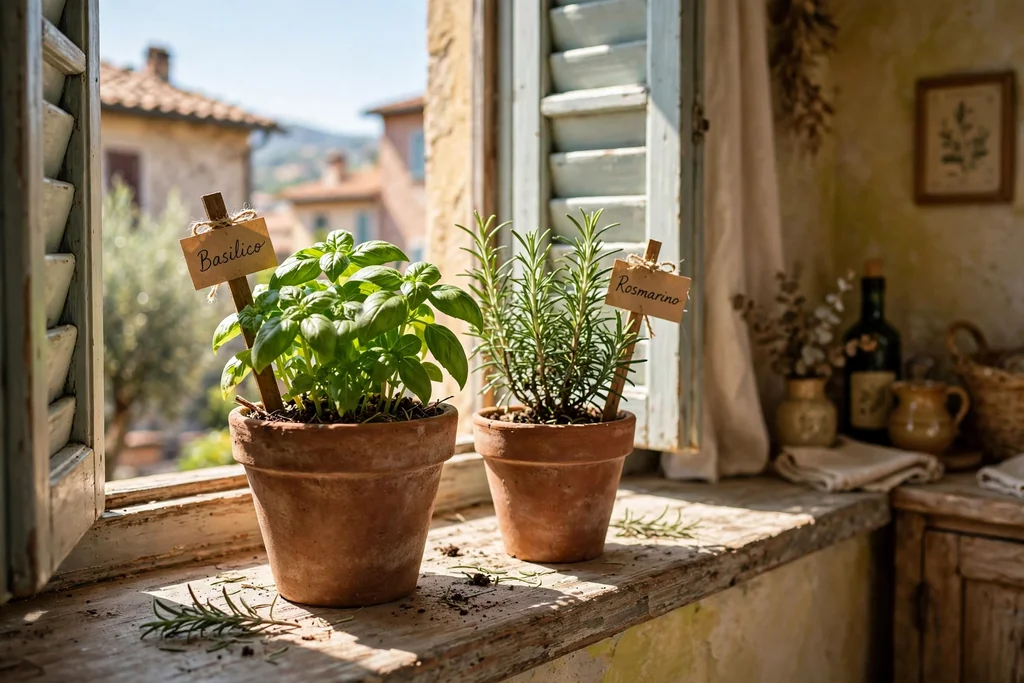
    Line a sunny windowsill with small herb pots in terracotta, for a living detail that also serves the kitchen. Basil, rosemary, and parsley grow well on a bright sill, and their scent suits a room used for cooking and eating. Small pots are easier to care for than one large planter, and a single herb can be replaced without disturbing the rest.

    Use pots with drainage and saucers to protect the sill, and water each herb as its own needs require, since rosemary likes drier soil than basil. Snip herbs often to keep plants bushy, and rotate pots so all sides get light. If the sill is narrow, use a slim tray to hold the pots together and catch water.

    21. Terracotta Pottery Collection on a Low Bench

    Terracotta pottery collection on a low wood bench in an Italian living room.

    Gather terracotta pottery on a low wood bench, with pots, jugs, and bowls in different sizes but one warm clay tone. A bench keeps the collection at a height where it can be seen and enjoyed, and it works as extra seating or a surface for a tray when guests visit. Group pots in odd numbers, such as three or five, with the tallest at the back.

    Leave empty space on the bench so the group does not look like a shop shelf, and vary the shapes: a tall jug, a wide bowl, and a small pot together read as a collection. If the bench sits near a door, keep it clear of the walking route, and anchor it if it could tip. A few pots can hold dried stems, while the rest stay empty to show the clay.

    22. Hand Painted Ceramic Plates on the Wall

    Hand painted ceramic plates hung on a warm plaster wall in an Italian living room.

    Hang hand painted ceramic plates on one wall as art that also tells a story of place. Plates in blue and white, or in green and ochre, suit a warm plaster wall, and a group of five or seven plates in mixed sizes feels collected rather than matched. Use plate hangers rated for the weight of each plate, and hang the group with even spacing.

    Keep the plate wall to one area, such as above a credenza or beside a fireplace, so it stays a feature rather than spreading across the room. If you use plates you also eat from, hang only the ones you are happy to keep on the wall, and keep everyday plates in the kitchen. Photograph the layout on the floor first, then hang from the center outward.

    23. Framed Italian Countryside Prints

    Framed Italian countryside prints above a sofa in an Italian living room.

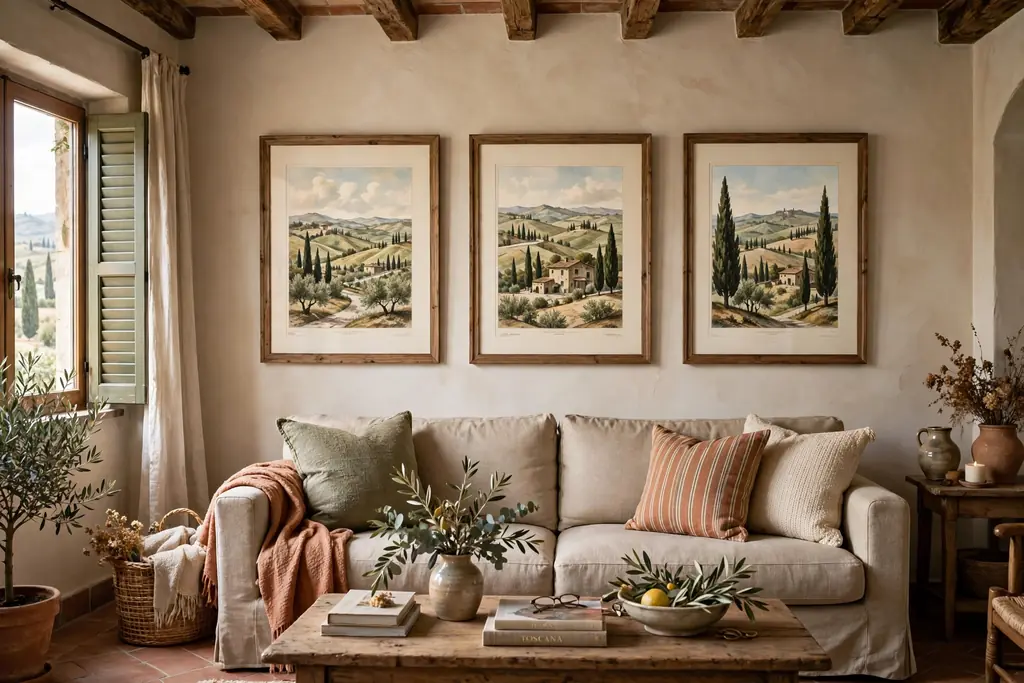
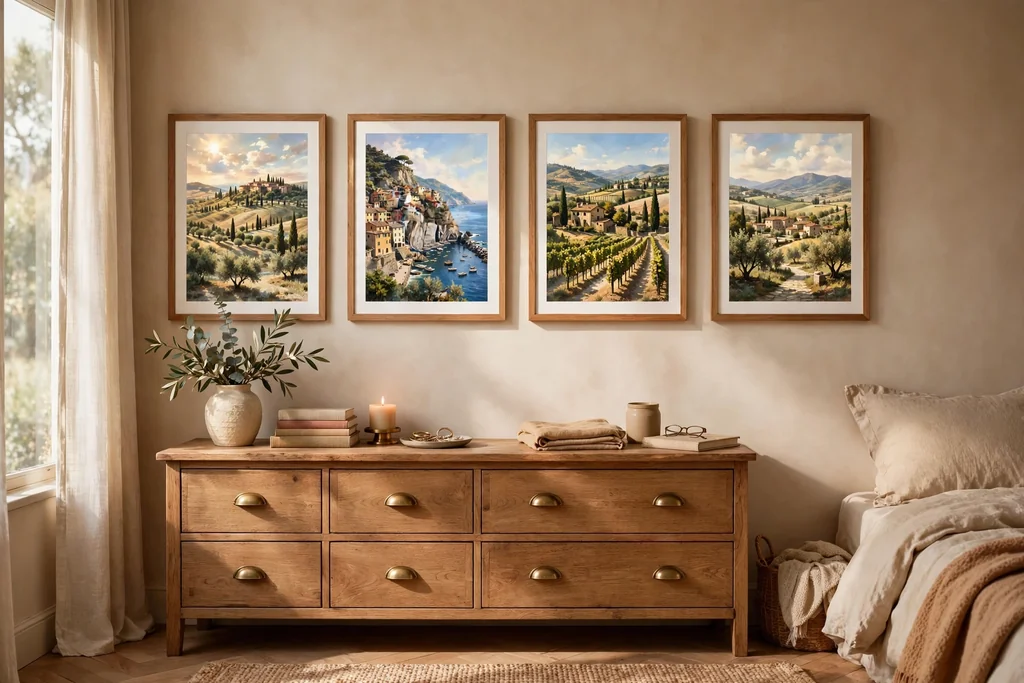
    Hang framed Italian countryside prints, such as hills, cypress trees, and stone farmhouses, in simple wood frames. Prints suit a room where real art feels too formal or too costly, and a set of three in a row above a sofa gives the wall a calm rhythm. Choose prints in muted greens, ochres, and warm whites that echo the room palette.

    Hang the center of the group at eye level from a standing position, and keep the frame style consistent across the set. If the sofa wall is large, use larger prints or add a fourth frame, rather than hanging small prints that get lost. A single large print above a fireplace also works, with a candle or a vase on the mantel below it.

    24. Striped Linen Curtains in Warm Neutrals

    Striped linen curtains in warm neutrals at a window in an Italian living room.

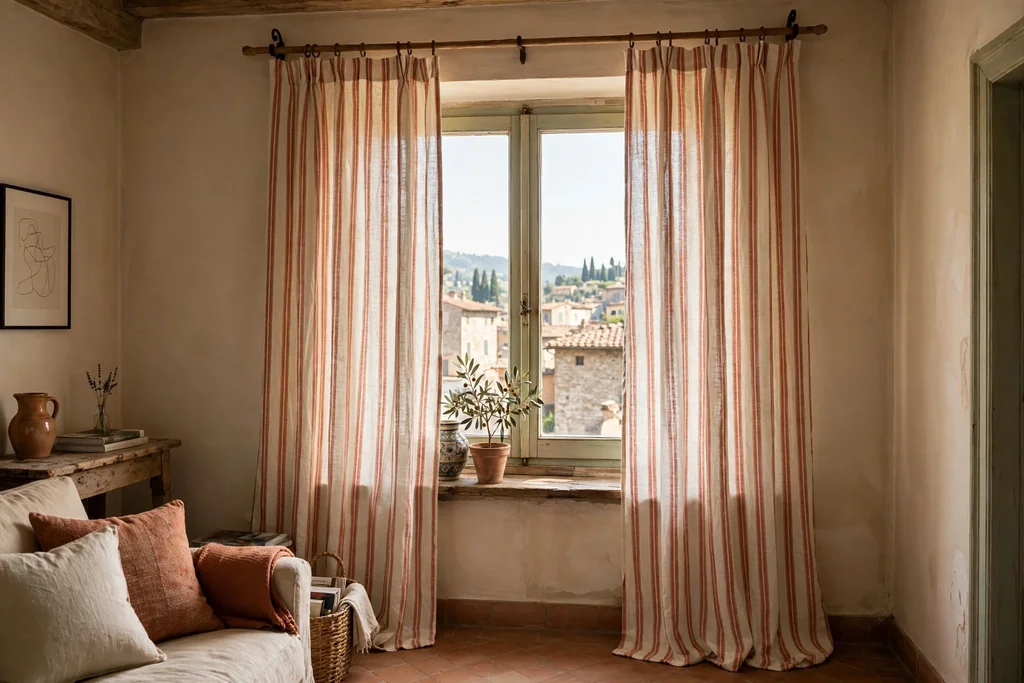
    Dress the windows in striped linen curtains in warm neutrals, such as cream with a soft rust or olive stripe. Stripes feel relaxed and coastal, and linen filters light in a way heavy drapes do not. Hang the rod high and wide, so the curtains frame the window and let in as much daylight as possible when open.

    Choose a washable linen or linen blend if the curtains will be handled often, and let them fall to just above the floor so they do not pool in dust. A sheer linen panel under the stripe, used alone by day, gives privacy without blocking light. Keep the curtain color tied to the rug or a cushion, so the window treatment feels part of the room.

    25. Layered Wool Throws and Woven Cushions

    Sofa layered with wool throws and woven cushions in an Italian living room.

    Layer wool throws and woven cushions on the sofa and chairs for warmth you can reach for, not just look at. A chunky wool throw in cream or rust, folded over one sofa arm, plus cushions in woven cotton, linen, and wool, gives the seating a soft, lived in feel. Mix textures rather than patterns: a knit, a weave, and a plain linen together.

    Keep the cushion count low, three or four on a standard sofa, so seating stays comfortable and the sofa does not look dressed for display. Choose washable covers where possible, and store a spare throw in a basket nearby for guests. In summer, swap the wool throw for a light cotton one and keep the woven cushions.

    26. Conversation Circle Facing the Fireplace

    Conversation circle of sofa and chairs facing a fireplace in an Italian living room.

    Arrange the seating in a circle or a U shape facing the fireplace, so conversation, not a screen, is the center of the room. Place the sofa opposite the fire, with two chairs angled inward on either side, and the coffee table in the middle. This layout suits a room used for talking, reading, and long evenings with friends.

    Leave enough space to walk around the chairs and to pull one out without blocking the route to the door. If the room also holds a television, place it on a side wall or on a stand that can turn, so it does not dominate the fireplace group. A rug under the whole group, as in the rug sizing advice in these living room rug ideas, ties the circle together.

    27. Reading Corner with a Floor Lamp and Basket

    Reading corner with an armchair, floor lamp, and basket in an Italian living room.

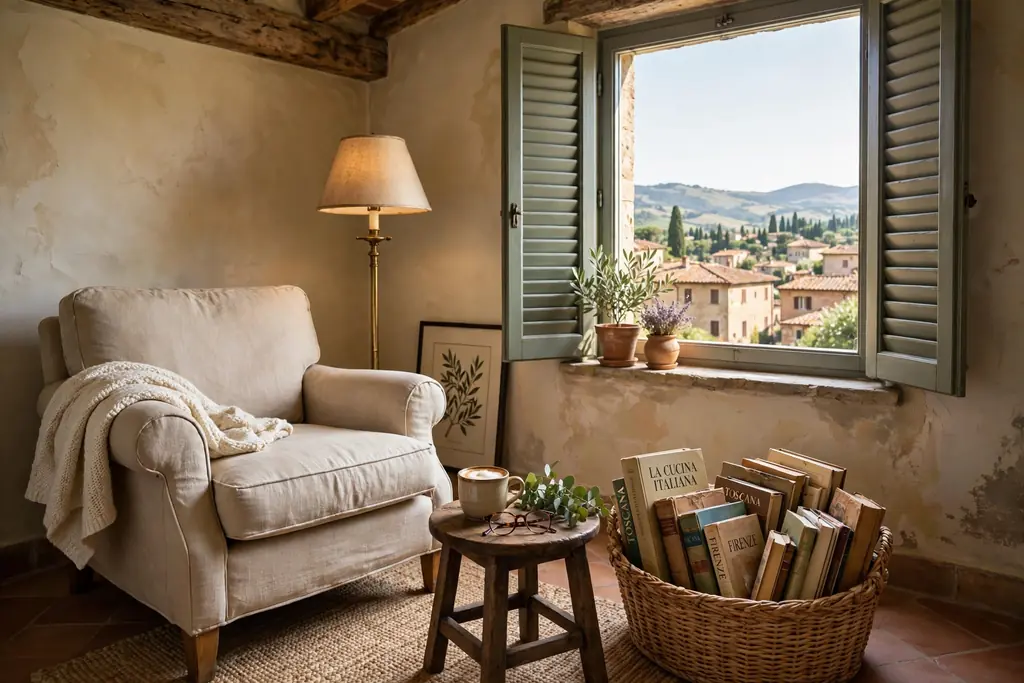
    Build a reading corner with one comfortable chair, a floor lamp, and a basket for books and a throw. A corner by a window or beside a bookshelf works well, since daylight serves by day and the lamp serves in the evening. Choose a chair with arms at a height that supports a book, and a lamp that shines over the shoulder, not into the eyes.

    Keep the corner simple: a chair, a lamp, a small table for a cup, and a basket. If the basket holds the current books and a throw, the corner stays tidy and inviting. A reading corner also gives a large living room a second use, so one person can read while others talk by the fire.

    28. Aperitivo Bar Cart for Evening Gatherings

    Aperitivo bar cart with glasses and a tray in a corner of an Italian living room.

    Keep an aperitivo bar cart in a corner of the living room for evening gatherings. A wood or brass cart with two tiers holds glasses, a bottle or two, sparkling water, and small bowls for olives and nuts, and it can roll to the seating group when guests arrive. This suits a room built for hospitality, since drinks stay near the conversation.

    Stock the cart lightly, with only what you use, so it does not become a crowded shelf. Keep a tray on the top tier to corral small items, and store extra glasses below. If children use the room, keep the cart in a spot where it can be moved aside, and store bottles out of reach when not in use.

    29. Long Shared Table Joining Living and Dining

    Long shared wood table joining living and dining zones in an Italian living room.

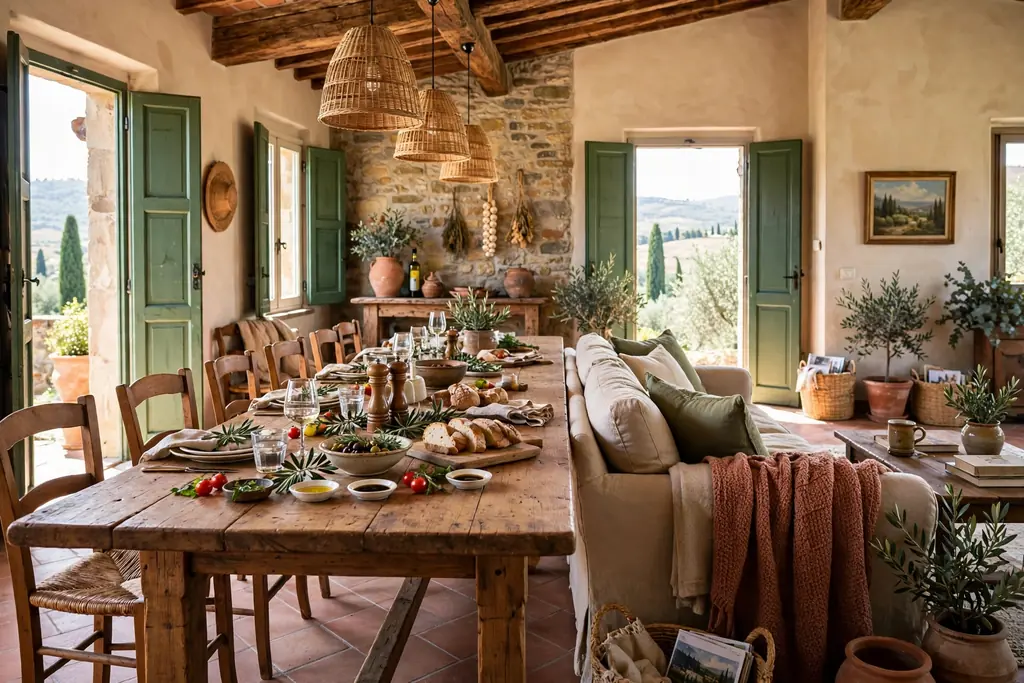
    Use a long shared table to join the living and dining zones in an open plan room. A wood farmhouse table, placed where the sofa zone meets the dining zone, serves meals, games, and work, and it gives the room a social center larger than a coffee table. This layout suits a household that eats, talks, and hosts in one space.

    Keep the table clear between meals, with only a vase or a candle as a centerpiece, so the room does not feel like a dining room all day. For more layout help in a combined room, see these small living room dining room combo ideas. Choose chairs that tuck under the table, and leave a clear walking route on at least one side.

    30. Indoor Outdoor Loggia Opening to a Terrace

    Living room opening through wide doors to a terrace with terracotta tiles and plants.

    Open the living room to a terrace with wide doors, sheer curtains, and matching materials inside and out, for a loggia feel. Terracotta tiles that run from inside to outside, plus a wood bench and potted plants on both sides of the doors, blur the line between room and terrace. This suits a home with a garden or a balcony, where summer living moves outdoors.

    Keep the indoor rug and cushions in materials that handle a little outdoor dust, and use doors that can stay open safely on warm days. A sheer curtain softens the opening and gives privacy without blocking light. If the terrace is small, one chair and a pot outside are enough to suggest the loggia, without crowding the indoor room.

    31. Compact Italian Style for a Small Living Room

    Compact Italian living room with a small linen sofa, round wood table, and terracotta pot.

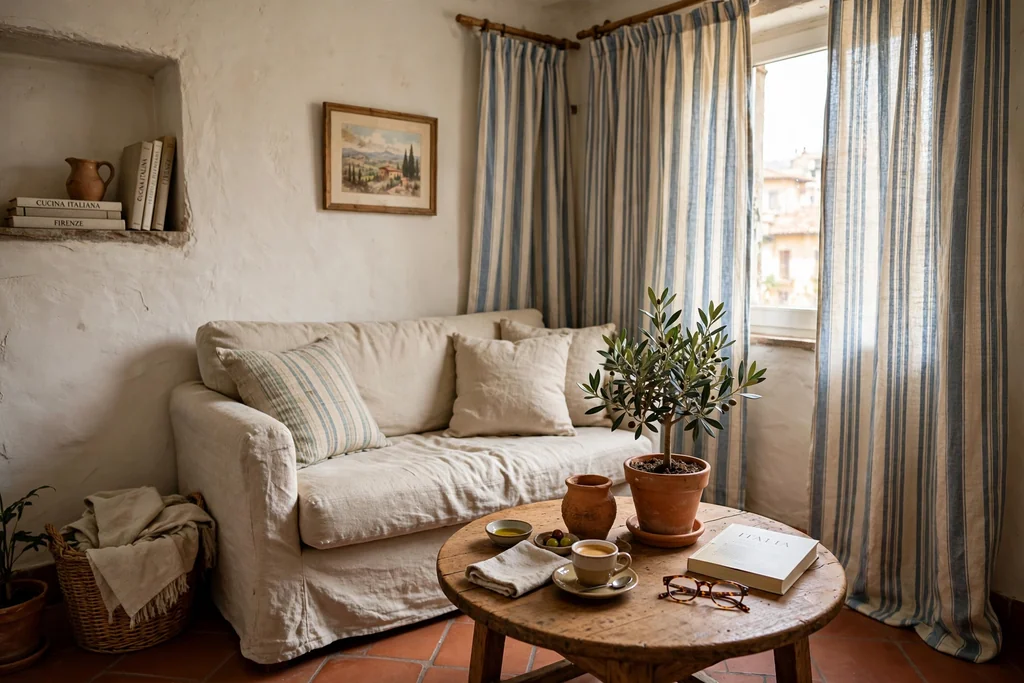
    Bring Italian style to a small living room by choosing fewer, better pieces in warm materials. A small linen sofa, a round wood coffee table, one terracotta pot, and a striped curtain can carry the whole look, without filling the floor. Pale plaster walls and a mirror opposite the window help the room feel larger, while warm wood keeps it from feeling bare.

    Avoid a large sectional or a heavy credenza in a small room, and use wall shelves instead of floor standing storage. Keep the palette to warm white, one wood tone, and one accent, such as olive or rust, so the small space reads as calm. Measure every piece against the walking routes before you buy, since a small room forgives no wasted inches.

    32. Large Family Sectional in Warm Natural Fabric

    Large family sectional in warm natural fabric in an Italian living room.

    Choose a large family sectional in a warm natural fabric, such as cotton linen in oatmeal or stone, for a household that gathers in one room. A sectional seats more people than a sofa and chairs, and its corner shape suits a room where children, guests, and pets share the seating. Pick a fabric with removable, washable covers, since a family sectional gets daily use.

    Place the sectional to face the fireplace or the main window, with the coffee table in the middle and a floor lamp at the open end. Keep cushions in a mix of plain and woven textures, and add a wool throw for cooler evenings. If the room is small, choose a sectional with a chaise on one side only, so the open side keeps a clear walking route.

    33. Candlelit Evening Layer with Lanterns and Low Light

    Candlelit Italian living room in the evening with lanterns and low lamplight.

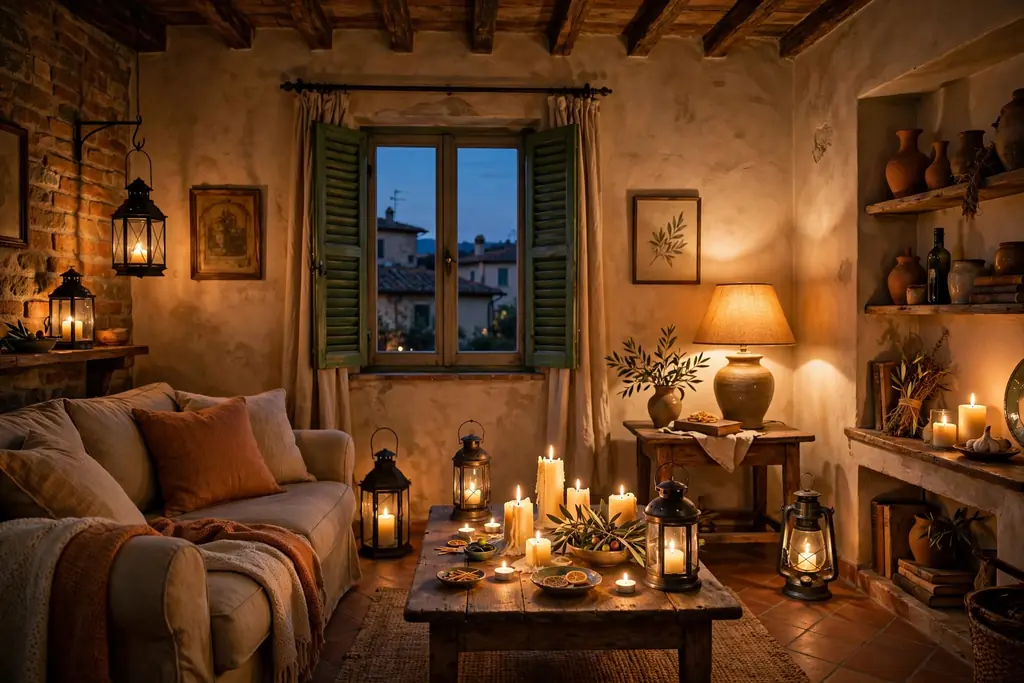
    Finish the room with a candlelit evening layer: lanterns on the mantel and floor, candles on the coffee table, and lamps turned low. Candlelight suits an Italian living room because it flatters plaster, wood, and stone, and it signals that the evening is for rest and conversation. Use lanterns with glass panels to shield flames from drafts and curious hands.

    Place candles where they will not be knocked over, away from curtains and low throws, and never leave them burning unattended. Battery candles in lanterns give a similar glow in a room with children or pets, and they can stay on longer without worry. Turn the main ceiling light off, let the lamps and candles carry the evening, and the room will feel warmer at once.

    Conclusion

    An Italian living room works when warm materials, a clear gathering point, and simple, sturdy furniture come together. You do not need every idea on this list to get the feel: start with warm walls or floors, add seating you can sink into, then layer light, plants, and pottery until the room invites people to stay. Keep the palette calm, the surfaces mostly clear, and the layout open to conversation, and the room will feel Italian in spirit, not just in style.

    Work through the list one room at a time, and test each change in daylight and lamplight before you commit. For rug sizing in the seating group, revisit these living room rug ideas, and for a room that also holds a dining table, the zoning help in these small living room dining room combo ideas pairs well with the shared table idea above. Save this list, pick the three ideas that fit your room today, and build from there.

    FAQs

    How do I get an Italian living room look without a full renovation?

    Start with the surfaces and textiles you can change easily: warm white or terracotta limewash paint, linen curtains, a wool rug, and cushions in olive and rust. Add a terracotta pot with an olive tree or herbs, a wood coffee table, and warm lamps, and the room will read as Italian even if the walls, floors, and fireplace stay as they are. Save structural changes, such as stone cladding or beams, for later, after you know which palette you love living with.

    What colors work best in an Italian living room?

    Warm whites, cream, terracotta, olive, walnut brown, and soft ochre form the core palette, with blue and white majolica as an accent. Keep the larger pieces, such as the sofa and rug, in the calmer tones, and use stronger terracotta or olive in cushions, pottery, and art. A calm base with two or three warm accents keeps the room feeling collected, not busy, and it makes seasonal swaps easy.

    Can an Italian living room work in a small apartment?

    Yes, if you choose fewer pieces and keep the palette calm. A small linen sofa, a round wood table, wall shelves instead of a large credenza, and one terracotta pot can carry the style without crowding the floor. Pale walls, a mirror opposite the window, and curtains hung high and wide help the room feel larger, while warm wood and woven textures keep it from feeling bare.

    Is leather or linen better for an Italian style sofa?

    Both suit the style, and the choice depends on daily use. Leather, especially cognac leather, wipes clean, ages well, and anchors a room with warmth, which suits families and pets. Linen slipcovers feel softer and more casual, and they can be removed and washed, which suits a relaxed room or a home where covers need frequent cleaning. Many rooms pair one with the other, such as a leather sofa with linen armchairs.

    How do I care for terracotta pots and tiles in a living room?

    Use pots with drainage holes and saucers, water only when the top soil feels dry, and wipe spills from tiles quickly. Terracotta is porous, so seal tiles and pots as the maker directs if they will see frequent water, and keep pots off wood floors on a tray or a stand. Dust pottery with a soft cloth, and bring tender plants indoors before cold weather, following guidance for your plant variety and local climate.

    What lighting suits an Italian living room in the evening?

    Layered, warm light suits the style best: a dimmable ceiling fixture or chandelier for general light, table lamps at seat height for reading and conversation, and candles or lanterns for a soft evening glow. Keep the bulb tone warm and consistent across lamps, so the room does not mix cool and warm light. Turn the main light low or off in the evening, and let lamps and candles carry the room, which flatters plaster, wood, and stone.


  • 14 Scottish Living Room Ideas That Feel Both Cozy and Current

    14 Scottish Living Room Ideas That Feel Both Cozy and Current

    A Scottish living room has a particular kind of comfort: warm light, soft wool, solid wood, and a chair placed where you can watch rain on the window. It does not need a castle or a full tartan scheme to feel Scottish. These 14 Scottish living room ideas take the familiar parts, muted tartan, stone, tweed, and deep green, and pair them with plain sofas, calm walls, and clean lines, so the room feels current as well as cozy. Pick the ideas that suit your room, your light, and the way you actually sit in it. For help sizing the rug that grounds the seating group, see these living room rug ideas.

    Key Takeaways

    • Keep tartan muted and limited: one throw, one or two cushions, or one chair, with plain fabrics doing the rest of the work.
    • Let one strong feature lead, such as a fireplace, a panelled wall, or a deep green sofa, and keep the rest of the room calm.
    • Layer wool, tweed, linen, and sheepskin for warmth, rather than relying on one heavy fabric everywhere.
    • Use warm, low lighting at more than one height, since Scottish rooms often need to feel welcoming on dark evenings.
    • Repeat a small palette of heather, slate, moss, oatmeal, and warm wood so old and new pieces sit together.
    • Pair heritage pieces with clean modern lines, so the room reads as current, not as a period set.

    1. A Muted Tartan Throw Over a Plain Sofa

    Plain oatmeal sofa with a muted green tartan throw draped over one arm.

    A muted tartan throw is the easiest Scottish detail to live with, because it adds pattern and history without taking over the room. Choose a tartan in softened tones, such as muted green, navy, rust, or grey, and lay it over a plain sofa in cream, oatmeal, or grey. The plain sofa keeps the tartan from competing with other patterns, and the throw can be folded, draped, or removed in seconds.

    Keep the rest of the pattern quiet. If the throw is checked, use plain cushions in one color pulled from the tartan, and a plain rug under the coffee table. A bright, large scale tartan on every cushion and curtain can tire quickly, while one well chosen throw keeps the Scottish note clear. Wash or air the throw regularly, since wool throws collect dust and pet hair.

    2. A Stone Fireplace as the Room’s Warm Center

    Living room with a stone fireplace and seating arranged around it.

    A stone fireplace gives a Scottish living room its natural center, and it suits both a cottage and a modern home. The rough texture of stone contrasts well with soft sofas and wool throws, and a fire, real or electric, draws seating toward it on cold evenings. Arrange the main sofa facing the fireplace, or at a right angle to it, with a coffee table between the two.

    Keep the mantel simple: one mirror or one framed print, a pair of candlesticks, and little else. A crowded mantel fights with the stone, while a clear mantel lets the texture speak. Keep throws, cushions, and paper clear of the fire opening, and follow the fire maker’s guidance for safe clearances. In a home without a working fire, a stone surround with a simple electric insert gives a similar focus.

    3. A Deep Green or Moss Sofa with Wooden Legs

    Deep green sofa with wooden legs and cream cushions.

    A deep green sofa brings the Scottish hills indoors in a way that still suits a modern room. Moss, forest, or sage green all sit well with warm wood, cream walls, and brass or black metal details. Wooden legs, rather than a skirt to the floor, keep the sofa looking light, and they link it to a wooden coffee table or side table nearby.

    Balance the dark sofa with light around it. Pale walls, a light rug, and cream or oatmeal cushions stop the green from making the room feel heavy, especially in a room with limited daylight. Add one warm accent, such as a rust cushion or a wooden lamp base, so the green does not sit alone. A green sofa also hides everyday marks better than a pale sofa, which helps in a room used daily.

    4. Wool, Tweed, and Chunky Knit Layers

    Sofa layered with a wool throw, tweed cushions, and a chunky knit blanket.

    Wool, tweed, and chunky knit are the fabrics that make a Scottish room feel warm before the heating comes on. Use them in layers: a wool throw over the sofa arm, a tweed cushion or two, a chunky knit blanket on a chair, and a thick rug underfoot. Each layer adds texture, so the room feels rich even when the color palette stays calm.

    Mix the textures rather than matching them exactly. A smooth wool throw, a nubby tweed cushion, and a soft knit blanket give the eye more to enjoy than three pieces in the same weave. Keep the colors in one family, such as oatmeal, moss, rust, and slate, so the layers look collected rather than random. Store spare throws in a basket by the sofa, so they are easy to reach on a cold evening and easy to put away.

    5. Dark Wood Panelling on One Wall

    Living room with a dark wood panelled feature wall behind a sofa.

    Dark wood panelling on one wall adds depth and a sense of history, without the weight of panelling every wall. Choose the wall behind the sofa or the fireplace wall, and keep the other walls in a pale, warm white. The contrast lets the wood read as a feature, and the pale walls keep the room from feeling dark.

    Painted panelling is a softer option than bare dark wood. A deep green, slate, or navy painted panel wall gives the same structure with less heaviness, and it suits a room that already has dark furniture. Keep the panels simple, with clean vertical or square shapes, rather than ornate moulding, so the wall sits well with modern furniture. Hang little on the panelled wall, since the wood itself is the decoration.

    6. A Window Seat for Reading and Watching the Weather

    Window seat with a thick cushion, wool throw, and cushions beside a large window.

    A window seat turns a Scottish view, and Scottish weather, into part of the room. Build or place a low bench under a window, add a thick seat cushion, and pile on a wool throw and two or three cushions. The seat becomes a reading spot, a place for morning coffee, and a perch for watching rain, snow, or low evening light.

    Add storage under the seat if you can, for books, board games, or spare blankets, so the window corner stays useful as well as pretty. Keep the cushions in washable covers, since a window seat collects condensation and dust more than a sofa does. If the window is draughty, add a heavy curtain that can be drawn at night, and keep a small lamp or a candle lantern nearby for evening reading.

    7. Highland Landscape Prints in Simple Frames

    Living room wall with framed Highland landscape prints above a sofa.

    Highland landscape prints bring Scotland into the room without a single tartan cushion. Choose prints of hills, lochs, glens, or coastal scenes in muted tones, and hang them in simple frames, black, dark wood, or plain oak. The simple frames keep the focus on the landscape, and they suit both traditional and modern furniture.

    Hang one large print above the sofa or the fireplace, or a small group of two or three prints on one wall, with even spacing and the center at eye level from a standing position. Keep the rest of the wall plain, so the prints have room to breathe. If the room already has a patterned rug or a tartan throw, choose prints in quiet colors, so the walls do not compete with the textiles.

    8. Low, Layered Lighting for Long Evenings

    Living room in the evening with warm light from a floor lamp and a table lamp.

    Low, layered lighting matters more in a Scottish living room than in most rooms, because winter evenings are long and daylight can be scarce. Use three levels of light: a floor lamp beside the main chair, a table lamp on a side table or sideboard, and a small lamp or candlelight on the mantel or coffee table. Together they give a warm pool of light where people actually sit.

    Choose warm bulbs for every lamp, so the room glows rather than glares, and put the main ceiling light on a dimmer if one is already fitted, so it can stay low in the evening. Keep lamp shades in cream, linen, or pale tones, which soften the light and suit wool and wood nearby. Avoid a single bright ceiling light as the only evening source, since it flattens the textures that make the room feel cozy.

    9. Built-In Alcove Shelves for Books and Ceramics

    Built-in alcove shelves beside a fireplace holding books and ceramics.

    Built-in alcove shelves on either side of a fireplace turn awkward gaps into the most useful part of a Scottish living room. Paint the shelves the same color as the wall, so they read as part of the room, and fill them with books, a few ceramics, and one or two framed photos. The shelves give the fireplace wall a finished, collected look without a large cabinet.

    Keep the shelves edited. Group books by height, leave some open space on each shelf, and keep heavy books low, where they are easier to reach. A shelf packed edge to edge looks like storage, while a shelf with breathing room looks like display. If the shelves hold family items you do not want on show, add a basket or a lidded box to one or two shelves, and keep the rest open.

    10. Oak, Stone, and Sheepskin in Natural Tones

    Living room with an oak coffee table, a stone hearth, and a sheepskin over a chair.

    Oak, stone, and sheepskin give a Scottish living room a natural base that never looks themed. An oak coffee table, a stone hearth or windowsill, and a sheepskin draped over a chair arm or a bench add warmth through material, not through pattern. The natural tones, pale oak, grey stone, and cream sheepskin, suit almost any wall color.

    Repeat each material once or twice, rather than using it only once. Oak on the coffee table and one side table, stone on the hearth and a small plinth, sheepskin on a chair and folded over a bench, and the room feels planned. Keep the finishes matte or lightly oiled, since high gloss fights with the soft, lived in feel of wool and linen. Brush sheepskin now and then, and keep it out of strong direct sun, so it stays soft.

    11. A Fireside Armchair with a Footstool

    Deep fireside armchair with a footstool beside a side table and lamp.

    A fireside armchair with a footstool is the Scottish living room at its most inviting: one deep chair, angled toward the fire or the window, with a place to put your feet up. Choose a chair with a high back and deep seat, in tweed, wool, or leather, and add a footstool in the same fabric or a plain ottoman that can also hold a tray. The pair creates a reading corner inside the larger room.

    Place a small side table beside the chair for a book, a mug, and a lamp, so the corner works on its own without a trip across the room. Keep the chair away from draughts where possible, and angle it slightly, rather than square to the wall, so it feels placed for sitting, not for display. A footstool that doubles as extra seating earns its floor space when guests arrive.

    12. A Heather, Slate, and Oatmeal Palette

    Living room in heather, slate, and oatmeal tones with a pale sofa.

    A palette of heather, slate, and oatmeal gives a Scottish room color without loudness. Heather brings a soft purple grey, slate adds a cool blue grey, and oatmeal warms both with a pale neutral. Use oatmeal on the largest pieces, such as the sofa and curtains, slate on a rug or a chair, and heather on cushions, a throw, or a vase.

    Test the colors in your own light before committing to a large piece. Heather can look pink in warm lamplight and grey in daylight, and slate can turn cold in a north facing room. Add warm wood and warm white lamps to balance the cool tones, and keep one metal finish, such as brass or black, repeated on lamps and frames. The palette works in both a cottage and a flat, since it relies on tone rather than on period details.

    13. A Patterned Wool Rug Over a Wooden Floor

    Patterned wool rug over a wooden floor under a sofa and coffee table.

    A patterned wool rug over a wooden floor is a classic Scottish combination, and it works because the two materials balance each other. The wood gives a hard, warm base, while the wool rug adds pattern, color, and softness underfoot. Choose a rug with a traditional pattern in muted tones, such as a faded Persian style, a simple geometric, or a tartan inspired check, and keep the rest of the pattern in the room quiet. For more rug sizing and placement ideas, see these living room rug ideas.

    Size the rug to the seating group, so the front legs of the sofa and chairs rest on it, and leave a border of bare wood around the edges. A rug that is too small floats in the middle of the room, while a rug that covers the whole floor hides the wood entirely. Use a rug pad underneath, so the rug stays in place on a smooth floor, and vacuum it regularly, since wool rugs hold dust.

    14. Heritage Pieces Paired with Clean Modern Lines

    Living room pairing a tweed chair and tartan throw with a plain modern sofa.

    The current half of this list comes from pairing heritage pieces with clean modern lines. Keep the Scottish pieces you love, a tartan throw, a tweed chair, a stone fireplace, or a wooden dresser, and set them beside a plain sofa, a slim coffee table, and simple curtains. The modern pieces give the heritage pieces room to stand out, and the heritage pieces stop the modern room from feeling bare.

    Limit the heritage count in any one view. One tartan throw, one tweed chair, and one landscape print are enough for a single seating group, with plain fabrics and simple shapes doing the rest. Repeat one color or one wood tone across old and new, so the pairing looks deliberate rather than accidental. This approach suits a small flat as well as a cottage, and it suits an open plan room, where the living area must sit beside a dining table without clashing, as shown in these small living room dining room combo ideas.

    Conclusion

    A Scottish living room that feels both cozy and current comes down to restraint: one tartan, one strong feature, a small palette, and warm light. Start with the piece that matters most to you, whether that is a fireplace, a deep green sofa, or a window seat, and build the rest of the room around it in plain fabrics and natural materials. Small moves, a wool throw, a layered lamp, a patterned rug, let you test the look before a larger change, such as panelling or a new sofa. For a softer sofa color to pair with the deep greens and slate tones here, see these grey couch living room ideas.

    Save this list for your next free hour in the living room, and work through it in order: palette and sofa first, then fireplace and rug, then lighting and shelves, and finally the throw, cushions, and prints that finish the room. Pin the ideas you like best, so you can find them again when you are ready to shop, paint, or rearrange.

    FAQs

    What colors make a Scottish living room feel cozy without looking dark?

    Use a pale base, such as oatmeal or warm white, on the sofa and walls, then add deep color in smaller amounts: moss green, slate, heather, or muted rust on cushions, a throw, or one chair. Warm wood and warm lamplight balance the cooler tones, and a light rug keeps the floor from feeling heavy. The room feels cozy from texture and light, not from painting every wall dark.

    How do I use tartan without making the room look themed?

    Limit tartan to one or two pieces, such as a throw and one cushion, in muted tones, and keep the sofa, curtains, and rug plain. A large scale, bright tartan on every surface reads as a theme, while one softened check reads as a nod to Scotland. If you already own a strong tartan piece, pair it with plain oatmeal or grey, and keep other patterns out of the same view.

    Can a Scottish living room work in a modern flat with no fireplace?

    Yes. The look comes from palette, texture, and lighting as much as from a fireplace. Use a deep green or grey sofa, wool and tweed layers, a patterned rug, and layered warm lamps, and add one heritage piece, such as a tartan throw or a landscape print. A simple electric fire or a candle group on a low console can give a focal point without a chimney.

    Which fabrics suit a Scottish living room best?

    Wool, tweed, linen, and sheepskin suit the look and the climate, since they add warmth and texture. Use wool for throws and rugs, tweed for a chair or cushions, linen for curtains and lighter cushions, and sheepskin as a single accent on a chair or bench. Choose washable covers for cushions in a room used daily, and keep one fabric plain for every patterned one.

    How do I keep a Scottish living room light in winter?

    Keep walls pale, use mirrors opposite a window where one fits, and dress windows with sheer panels under heavier curtains, so daylight reaches the room by day and the curtains close at night. Add lamps at more than one height with warm bulbs, and keep the rug and sofa in light or mid tones, saving deep color for cushions and one chair. Clear surfaces also help, since clutter absorbs light.

    Should I mix Scottish style with other styles in the same room?

    Yes, if you link the pieces with color and material. A Scottish throw or tweed chair sits well beside Scandinavian style pale wood, a modern plain sofa, or a farmhouse style wooden table, as long as one palette and one wood tone run through the room. Keep the heritage pieces to a few, and let plain, modern pieces carry the larger shapes, so the mix looks planned rather than crowded.


  • 29 Swedish Living Room Ideas for a Welcoming, Lived-In Look

    29 Swedish Living Room Ideas for a Welcoming, Lived-In Look

    A Swedish living room earns its welcome from light, wood, and soft layers, not from a long list of decorations. Pale walls bounce daylight, wood floors stay visible, and linen, wool, and sheepskin add warmth you can feel when you sit down. The lived in part matters too: books left on a shelf, a basket for throws, and a chair placed where the light is best. These 29 Swedish living room ideas cover walls, floors, seating, storage, light, and small folk details, so you can pick the changes that fit your room. Start with light and one comfortable seat, then add texture and storage where daily life actually needs them.

    Key Takeaways

    • Keep the base pale and calm: warm white walls, pale wood floors, and a light sofa give every later layer room to show.
    • Add warmth through touch, not color alone: linen, wool, sheepskin, and woven baskets make a pale room feel lived in.
    • Use light at more than one level: daylight by day, plus lamps and candles in the evening, keeps a Swedish room soft after dark.
    • Choose furniture that works daily: a low sofa, a sturdy coffee table, and storage baskets beat pieces that only look good in a photo.
    • Repeat one or two accents, such as blue and white or a small red note, rather than adding a new color in every corner.
    • Leave space to live: clear floors, a free table surface, and shelves with gaps keep the room calm and easy to tidy.

    1. Paint the Walls Warm White

    Swedish living room with warm white walls, a pale wood floor, and a light linen sofa.

    Paint the walls a warm white rather than a cold blue white, so daylight feels soft instead of stark. Warm white suits pale wood, linen, and grey, and it lets art and plants stand out without a strong wall color behind them. This is the simplest base for a Swedish living room, and it suits both small rooms and open plan spaces.

    Test two or three warm white samples on the wall and check them in morning light and evening lamplight before painting the whole room. Keep the ceiling and trim in a matching warm white so the room reads as one calm space. If you rent and cannot paint, large linen curtains and a pale rug can soften a cooler wall color in a similar way.

    2. Let Pale Wood Floors Show

    Pale wood floor visible around a rug in a bright Swedish living room.

    Leave as much pale wood floor visible as you can, rather than covering it wall to wall. A wood floor in oak, birch, or pine is a core part of the Swedish look, and it keeps a light room feeling natural and grounded. Place rugs only where seating or walking needs softness, and leave a clear border of wood around them.

    Clean wood floors with a method suited to their finish, and use felt pads under chair and table legs to limit scratches. If your floor is dark, a large pale rug and pale furniture can still give the room a Swedish feel, but the floor itself will read as a stronger anchor. Keep the floor clear of extra small furniture so the wood can do its quiet work.

    3. Choose a Low Light Linen Sofa

    Low light linen sofa with plain cushions in a Swedish living room.

    Choose a low sofa in light linen, in natural, oatmeal, or pale grey, as the main seat in the room. A low back and slim arms keep the sofa from blocking light, and linen wrinkles in a way that suits a lived in room rather than fighting it. A two or three seat sofa, sized to the wall or rug zone, works better than an oversized sectional in most Swedish rooms.

    Pick washable or removable covers where you can, since a light sofa sees daily use. Keep the cushions simple, in plain linen or a soft stripe, and let throws and one accent color add interest. If you already own a darker sofa, a light slipcover is a lower cost way to test the look, as shown in these ideas for a grey couch living room.

    4. Drape a Sheepskin Over a Chair

    Armchair with a cream sheepskin draped over it in a Swedish living room.

    Drape a sheepskin over an armchair, a dining chair pulled into the living room, or a bench by the window. Sheepskin adds instant warmth to a wooden chair, and it is a classic Swedish touch that costs far less than new furniture. The soft texture also breaks up a room full of smooth wood and linen.

    Use a real or good quality faux sheepskin in cream or natural grey, and shake it outside now and then to keep it fresh. Keep it on the chair you actually sit in, not on a chair kept only for show, so it stays part of daily life. In warm months, fold it over the chair back instead of removing it, so the room keeps its soft layer.

    5. Layer Wool Throws Within Reach

    Sofa arm with a folded wool throw and a basket of throws beside it.

    Keep two wool throws within reach of the sofa, one folded over an arm and one in a basket beside it. Wool throws in cream, grey, or a soft stripe suit a Swedish room, and they turn a pale sofa into a seat people actually settle into. A throw also protects a light sofa arm from daily wear.

    Choose throws you can wash, and vary the weave rather than the color: one smooth wool throw and one chunky knit throw give more interest than two identical pieces. Fold, rather than draping loosely, so the sofa still looks tidy when no one is sitting there. A basket for the spare throw keeps the second layer close without piling it on the seat.

    6. Lay a Flatweave Wool Rug

    Flatweave wool rug under a sofa and chairs in a Swedish living room.

    Lay a flatweave wool rug under the seating group, large enough for the front legs of the sofa and chairs to rest on it. A flatweave rug in cream, grey, or a soft stripe keeps the floor feeling light, and its low pile is easy to vacuum and to move chairs across. This is the rug style most often seen in Swedish rooms, where the floor itself stays part of the look.

    Measure the seating zone before buying, and tape the rug outline on the floor to check walking routes and door swings. For more help with size and placement, see these living room rug ideas. Keep the rug pattern simple if cushions or art already carry pattern, and use a rug pad underneath on a smooth wood floor.

    7. Hang Sheer Linen Curtains to the Floor

    Tall window with sheer linen curtains falling to the floor in a Swedish living room.

    Hang sheer linen curtains from close to the ceiling to the floor, so daylight filters in softly and the window feels taller. Sheer linen suits a Swedish room because it gives privacy in the daytime without shutting out light, which matters in rooms that need every bit of sun they can get. White, cream, or pale grey linen works best.

    Use a simple rod in wood or black metal, and let the curtains fall straight rather than pooling heavily on the floor. Add a heavier linen pair at the sides only if the room gets cold drafts or needs evening privacy. Wash the sheers now and then, since pale linen shows dust faster than a darker curtain.

    8. Group Candles on a Tray

    Candles grouped on a tray on a coffee table in a Swedish living room.

    Group candles on a tray on the coffee table, windowsill, or side table, and light them in the evening for a warm, low glow. Candlelight is a daily habit in many Swedish homes, especially in darker months, and a tray keeps wax, matches, and holders in one tidy place. Plain white or cream candles in simple holders suit the look best.

    Use sturdy holders that cannot tip easily, keep candles clear of curtains, throws, and paper, and never leave them burning in an empty room. Battery candles give a similar glow where real flames are not practical, such as a shelf near books. A tray also makes it easy to move the whole group when you need the table surface for food or work.

    9. Make a Tile Stove or Wood Burner the Corner Focus

    Tiled stove corner with seating turned toward it in a Swedish living room.

    Make a tiled stove, a simple wood burner, or a plain fireplace the focus of one corner, with seating turned toward it. The traditional Swedish kakelugn, a tall tiled stove, warms a room slowly and gives it a clear heart, while a modern wood burner gives a similar focal point in a plainer shape. Either way, the fire corner invites people to sit and stay.

    Keep the hearth area clear, use a heat safe rug distance, and store firewood in a neat basket or log holder rather than a loose pile. If you have no working fire, a plain mantel with candles, a mirror, and a stack of books can give the same sense of a gathered corner. Keep throws and cushions clear of the fire opening for safety.

    10. Add a Painted Gustavian Armchair

    Painted Gustavian armchair in soft grey beside a small side table.

    Add a painted Gustavian armchair, in soft grey, cream, or pale blue grey, as a second seat beside the sofa. Gustavian chairs have a light, carved frame and a simple upholstered seat, and they bring a Swedish historic note without making the room feel formal. One chair is enough in most rooms, since a full set can feel like a museum display.

    Pair the chair with a small side table and a lamp, so it becomes a real reading seat rather than a display piece. Check secondhand shops and auction listings for a painted chair with good joints, since an old frame often suits this look better than a new copy. Keep the chair cushion in plain linen so the painted frame stays the detail.

    11. Pick a Pale Wood Coffee Table

    Pale wood coffee table with a tray and a book in a Swedish living room.

    Pick a pale wood coffee table in oak, birch, or whitewashed pine, with a simple rectangular or round top. A pale table keeps the center of the room light, and a plain top leaves room for a tray, a book, and a cup without looking crowded. Round tables suit small rooms and rooms where people walk past the seating group often.

    Keep the table top mostly clear, with one tray to gather small items, and store magazines and remotes in a basket or drawer if the table has one. Choose a table height close to the sofa seat height, so cups and books are easy to reach. Wipe the top after use, since pale wood shows rings and marks more readily than dark wood.

    12. Use Open Wall Shelves for Books and Ceramics

    Open wall shelves with books and plain ceramics in a Swedish living room.

    Fit one or two runs of open wall shelves in pale wood or painted white, and use them for books, ceramics, and a few plants. Open shelves suit a Swedish living room because they keep storage visible and easy to reach, and they let a collection of plain ceramics add quiet color. Keep the shelves on one wall, rather than spreading them around the room.

    Group books by height, leave gaps between groups, and put heavier items low and lighter ceramics higher. Anchor shelves into studs or with fixings suited to your wall type, and check the weight rating before loading them with books. For a tidy method that works on any open shelf, the grouping advice in these cozy apartment living room ideas helps: start with the largest pieces, vary the shapes, and leave visible gaps.

    13. Hang a Simple Gallery Wall in Matching Frames

    Gallery wall in matching frames above a sofa in a Swedish living room.

    Hang a simple gallery wall above the sofa or along one wall, using matching frames in black, white, or pale wood. A Swedish gallery wall usually mixes prints, photos, and simple art, but keeps the frames consistent so the group reads as calm rather than busy. Hang the center of the group at eye level when seated, and keep the outer edges inside the width of the sofa.

    Start with three or four pieces and add over time, rather than filling the wall in one go. Use art with pale backgrounds and soft colors, such as landscapes, botanical prints, or family photos in muted tones. Picture ledges are a renter friendly option, since they let you lean frames and swap them without new holes each time.

    14. Set a Reading Chair by the Window

    Reading chair by a bright window with a floor lamp and small table.

    Set a comfortable armchair by the window, angled slightly toward the room, with a floor lamp behind one shoulder and a small table beside it. The window end of a living room is a natural reading spot, with daylight by day and a view to rest the eyes on. A chair here also makes use of a corner that often stays empty.

    Add a basket for the current book and a throw, and keep the table surface clear for a cup. If the chair sits in direct sun, choose a fabric that fades slowly, or move the chair a step back from the glass. Angle the chair toward the room so the corner feels part of the living space, not cut off from it.

    15. Store Throws and Magazines in Woven Baskets

    Woven baskets beside a sofa holding throws and magazines.

    Store throws, magazines, and toys in woven baskets in seagrass, rattan, or willow, placed beside the sofa and under a side table. Baskets suit a Swedish room because they add natural texture and hide everyday clutter without a closed cabinet. One large basket for throws and one smaller basket for magazines are usually enough.

    Choose baskets with handles so they can be carried to the laundry or tidied quickly, and line a basket used for magazines with a plain cloth if the weave snags paper. Keep one basket empty on purpose, as a quick tidy basket for a ten minute reset before guests arrive. Label nothing, since the contents should be plain to see and easy to put back.

    16. Add a Light Wood Side Table and Lamp

    Light wood side table with a ceramic lamp beside a sofa.

    Add a light wood side table beside the sofa, with a table lamp in ceramic, wood, or plain linen shade. A side table gives every seat a place for a cup and a book, and a lamp at seat height adds the low light that makes a pale room feel warm in the evening. Choose a table just tall enough to reach easily from the sofa.

    Keep the lamp shade in white or cream so the light stays soft, and use a warm white bulb rather than a cool one. Clear the table to one lamp and one small item, such as a book or a small plant, so it stays useful rather than becoming another display shelf. A table with a lower shelf can hold a book or a basket underneath.

    17. Repeat Blue and White Through the Room

    Swedish living room with blue and white cushions, a vase, and a print.

    Repeat blue and white through the room in cushions, ceramics, and art, as a quiet nod to Swedish folk patterns and coastal homes. A soft Swedish blue, rather than a bright navy, keeps the room calm, and white keeps the blue from feeling heavy. Use the blue in three places, such as a cushion, a vase, and a print, so it reads as a plan.

    Keep other colors muted while blue leads, and let wood and linen do the rest of the work. A blue and white striped cushion, a blue glazed vase, and a simple blue print are enough; adding blue curtains, a blue rug, and blue chairs at once will crowd the scheme. Wash blue cushion covers separately the first time, since darker dyes can run.

    18. Add One Small Red Note

    Pale Swedish living room with a small red folk horse and red candle on a table.

    Add one small red note, such as a red candle, a folk horse, a red cushion trim, or a red book spine on a shelf. A touch of falun red, the deep red used on Swedish cottages, gives a pale room a warm focal point without changing the whole scheme. The key is restraint: one red object, repeated at most once more in a smaller form, such as a red thread in a throw.

    Place the red note where the eye lands naturally, such as the coffee table tray or the mantel, rather than hiding it in a corner. If red feels too strong, try a muted brick red first, and live with it for a week before adding a second piece. Keep the rest of the room pale so the red can carry its small job.

    19. Use Ticking Stripe Cushions

    Sofa with blue and white ticking stripe cushions among plain linen cushions.

    Use ticking stripe cushions in blue and white, grey and white, or red and white on the sofa and chairs. Ticking stripes, the narrow stripes once used on mattress fabric, suit Swedish rooms because they add pattern without a bold print, and they mix well with plain linen. Two striped cushions among plain ones are enough for most sofas.

    Mix stripe widths rather than matching every cushion exactly, and keep the stripe colors drawn from the room, such as the blue accent or the wood tone. Choose removable covers so stripes can be washed, since light striped fabric shows marks. A striped cushion also suits a wooden chair, where it softens a hard seat without hiding the frame.

    20. Bring in Birch Branches and Natural Wood

    Tall vase of birch branches in a corner of a Swedish living room.

    Bring in birch branches in a tall vase, a birch log side table, or a simple piece of driftwood on a shelf. Natural wood and branches add a Swedish forest note to a pale room, and they cost little compared with new furniture. A tall vase of birch stems suits an empty corner, while a small branch arrangement suits a mantel or shelf.

    Keep natural pieces dry and clear of the fire, and check stems for loose bark before placing them near light fabric. Replace branches when they dry out and shed, and keep one natural piece per area rather than filling every surface with wood. A birch bark candle holder or a wood slice coaster set can carry the same idea in a smaller form.

    21. Grow Plants on the Windowsill

    Windowsill with potted plants in cream and terracotta pots.

    Grow plants on the windowsill and at two other heights, such as a tall floor plant in a corner and a trailing plant on a shelf. Plants suit a Swedish living room because they add green life to a pale scheme, and a windowsill row of herbs or small pots feels lived in rather than staged. Match each plant to the light it will actually get.

    Use pots in cream, terracotta, or rattan, and put saucers under pots on wood sills and floors. Start with three or four plants rather than a dozen, so watering stays manageable, and group plants that need similar water together. Check that each plant is safe for pets and children before placing it at sofa height.

    22. Divide an Open Room With a Low Bookcase

    Low bookcase dividing a living zone in an open plan Swedish room.

    Divide an open plan room with a low bookcase, placed with its back to the sofa or across the room, so the living zone has a boundary without a wall. A low bookcase keeps light moving across the room, adds storage on both sides, and gives the sofa a sense of backing. This suits a studio or an open living and dining space.

    Keep the bookcase low enough to see over when seated, and anchor it to the floor or wall if it is tall enough to tip. Put books and baskets on the lower shelves and lighter display pieces up high, and leave a clear walking route around at least one end. A low bookcase also works as a TV bench in a small room, with books and baskets below the screen.

    23. Set a Fika Tray for Coffee Breaks

    Coffee tray with a pot, cups, and biscuits on a coffee table.

    Set a fika tray on the coffee table or a side table, holding a small pot, two cups, and a plate for biscuits. Fika, the Swedish coffee break, is a daily pause rather than a formal event, and a ready tray makes it easy to sit down with a guest or take a quiet break alone. Keep the tray simple, in wood or plain ceramic, so it fits the room.

    Store the tray items together in a cupboard near the seating area, so setting the tray takes a minute rather than a search through the kitchen. Use cups you like to hold, not cups kept only for guests, since fika works best as a daily habit. Clear the tray after the break, so the coffee table stays free for the next use.

    24. Hang a Woven Pendant Light

    Woven rattan pendant light hanging over a coffee table in a Swedish living room.

    Hang a woven pendant light in rattan, bamboo, or paper over the coffee table or in a corner, for soft light and natural texture at ceiling height. A woven shade diffuses light gently, which suits a pale room in the evening, and its shape adds interest without a strong color. Hang it high enough to see under when seated, and clear of head height in walkways.

    Use a warm white bulb inside the shade, and dust the weave now and then, since woven shades collect dust faster than a plain shade. One woven pendant is usually enough; pair it with floor and table lamps rather than hanging several pendants in one small room. Check the shade size against the table below, so the light feels in proportion.

    25. Use a Low Media Bench in Pale Wood

    Low pale wood media bench under a television in a Swedish living room.

    Use a low media bench in pale wood or painted white under the television, with closed baskets or doors for cables and media items. A low bench keeps the TV wall calm, and its pale finish matches the rest of a Swedish room better than a tall dark cabinet. Keep the bench length close to the TV width, so the wall reads as balanced.

    Hide cables in a channel or behind the bench, and keep the top clear except for one plant or a small stack of books. Store remotes and game controls in a basket or drawer, so the bench top stays free. If you do not want a TV as the focus, place the bench under a mirror or art instead, and use it as a display and storage piece.

    26. Mix Knit Cushions With Linen

    Sofa with chunky knit cushions mixed with plain linen cushions.

    Mix knit cushions with linen cushions on the sofa, using one or two chunky knit covers in cream or grey among plain linen ones. Knit adds a cozy texture that linen alone cannot give, and the mix suits a Swedish room in colder months, when soft layers matter most. Keep the knit colors pale, so the sofa stays light.

    Choose knit covers that can be washed or spot cleaned, since knit traps dust and crumbs more than smooth linen. Rotate knit cushions with plain ones by season if you like: knit in winter, all linen in summer, with the spare covers stored in a basket. A knit throw over the sofa arm can carry the same texture if you prefer plain cushions.

    27. Use a Secondhand Wood Chest as a Table

    Secondhand pine chest used as a coffee table with a tray on top.

    Use a secondhand wood chest, in pine or painted white, as a coffee table or as storage beside the sofa. An old chest suits a Swedish lived in room because it carries marks of use, holds blankets or games inside, and gives the room a piece with a past. A chest with a flat lid works as a table, while a domed lid suits storage beside a chair.

    Check the hinges, lid stay, and interior smell before buying, and clean the inside before storing blankets in it. Keep the top clear except for a tray, so the chest can still serve as a table, and use felt pads under its feet on a wood floor. If the chest is painted, touch up chips with a matching paint rather than repainting the whole piece at once.

    28. Paint One Wall in Pale Paneling

    Swedish living room wall in pale painted beadboard paneling behind a sofa.

    Paint one wall, or the lower half of one wall, in pale beadboard or tongue and groove paneling in warm white or pale grey. Paneling adds texture to a plain wall without a strong color, and it suits a Swedish cottage look, especially behind a sofa or around a fireplace wall. Keep the paneling to one wall, so the room stays light.

    Fit the panels straight and paint them after fitting, so joints and nail holes disappear under the paint. Keep art and shelves simple on a paneled wall, since the panels already give the eye texture to follow. If full paneling feels like too much work, a paneled radiator cover or a paneled cupboard door can give a smaller taste of the same detail.

    29. Layer Lamps for Evening Light

    Swedish living room in the evening lit by a floor lamp, table lamp, and candles.

    Layer lamps for evening light: a floor lamp behind the sofa or chair, a table lamp beside the seat, and a small lamp or candle glow on a shelf. Three levels of light make a pale Swedish room feel warm after dark, while a single ceiling light can make the same room feel flat and harsh. Put the brightest light where you read, and keep the overall level soft.

    Use dimmable bulbs or smart plugs where you can, so the room can shift from bright daytime light to a calm evening mood without rewiring. Keep lamp shades in white or cream, and use warm white bulbs through the room so the light color stays consistent. Turn on the low lamps first in the evening, and add the brighter task lamp only where you need it.

    Conclusion

    A Swedish living room that feels welcoming and lived in starts with light, pale wood, and soft layers, then adds only the details daily life actually uses. Paint the walls warm white, let the wood floor show, choose a sofa you want to sit on, and add wool, sheepskin, and baskets within reach. Repeat one accent color, keep storage simple, and layer lamps and candles for the evening. Try one or two ideas this weekend, such as sheer curtains and a candle tray, live with them for a week, and add the next layer only when the room asks for it. If an idea here helped your space, save this post to your Swedish decor board on Pinterest so you can find it when you are ready for the next change.

    Frequently Asked Questions

    What colors define a Swedish living room?

    Warm white walls, pale wood floors, and a light sofa form the base, with soft grey, cream, and natural linen as supporting tones. Add one accent, such as Swedish blue or a small red note, in two or three places, and keep other colors muted so the room stays calm. The goal is a pale room with warmth from wood and texture, not a white room with no color at all.

    How do I keep a pale Swedish living room from feeling cold?

    Add warmth through touch and light, not through darker paint. Wool throws, a sheepskin, a flatweave wool rug, and woven baskets soften a pale room, while lamps at three levels and candles add warm evening light. Wood furniture, plants, and a basket of logs or books also keep the room from feeling bare. If the room still feels cold, add one warm cushion color, such as rust or mustard, in a small amount.

    What sofa works best in a Swedish living room?

    A low sofa in light linen, in natural, oatmeal, or pale grey, with slim arms and removable covers, suits most Swedish rooms. Size it to the wall or rug zone, leaving clear walking routes on at least two sides, and keep the cushions plain so throws and one accent color can add interest. A slipcover over an existing darker sofa is a good low cost way to test the look before buying a new sofa.

    Can I get a Swedish look in a small living room?

    Yes, and a small room often suits the Swedish approach well, since it favors light colors, low furniture, and storage that uses walls and baskets. Use sheer curtains, a pale rug sized to the seating group, a low sofa, and one tall shelf run rather than several small cabinets. Keep floors clear, use a low bookcase as a divider only if the room is open plan, and add plants and lamps at different heights rather than filling every surface.

    What is the difference between Swedish and general Scandinavian decor?

    Scandinavian decor is a broad family covering Denmark, Norway, Sweden, Finland, and Iceland, with shared traits such as light wood, pale colors, and simple forms. Swedish decor within that family leans toward Gustavian painted furniture, folk details such as blue and white patterns and a small red accent, tiled stoves, and a strong candlelight habit. In practice, most rooms mix traits from across the region, so use the Swedish details you like and leave the rest out.

    How do I add Swedish style without buying all new furniture?

    Start with light and texture, which cost less than new furniture. Paint one wall warm white if you can, add sheer linen curtains, a flatweave rug, wool throws, and a sheepskin over an existing chair. Swap cushion covers for linen and ticking stripes, add candles on a tray, and tidy clutter into woven baskets. Paint an existing wood chair or chest in soft grey or cream for a Gustavian note, and add plants and lamps before replacing any large piece.


  • 22 Irish Bedroom Ideas for a Cozy Seasonal Update

    22 Irish Bedroom Ideas for a Cozy Seasonal Update

    An Irish bedroom update works best when it starts with warmth you can feel: wool on the bed, wood underfoot, and soft light in the evening. These 22 Irish bedroom ideas bring that feeling together, one layer at a time. You will find deep green walls and cream linen, Aran knit texture, cottage panelled walls, and quiet corners for reading on rainy days. Start with the bed, then add one seasonal layer, such as a heavier throw or thicker curtains, and keep the rest simple so the room stays calm and easy to sleep in. For storage that keeps spare blankets close without clutter, see these bedroom storage ideas.

    Key Takeaways

    • Build the room around warmth and texture: wool, linen, wood, and woven baskets do most of the work.
    • Keep the palette small: cream, deep green, soft grey, and natural wood, with one muted check or tartan as the accent.
    • Change the bed first for a seasonal update, then curtains, rugs, and light, in that order.
    • Mix one or two heritage style details, such as an Aran throw or a knot pattern cushion, with plain bedding so the room stays calm.
    • Give spare blankets and off season bedding one clear home, such as baskets or a bench, so swaps stay quick.
    • Use warm, low evening light and heavier curtains to help the room feel settled as days get shorter.

    1. Cream Linen Bedding with an Aran Knit Throw

    Bed with cream linen bedding and a cable knit Aran throw folded across the foot.

    Cream linen bedding gives an Irish bedroom a soft, lived in base that suits both summer and winter. The pale color keeps a small room bright, while the natural texture of linen stops the bed from looking flat or new. A plain cream duvet also lets one stronger detail, such as a green cushion or a wood headboard, stand out without competing for attention.

    Fold an Aran style knit throw across the lower third of the bed for the Irish note in this idea. The cable knit pattern adds depth at once, and a wool or wool blend throw gives real warmth on cold nights. Keep the rest of the bed simple: two sleeping pillows, one or two plain cushions, and no extra layers piled at the foot. Shake the throw out weekly and store a spare in a basket nearby, so the bed stays neat.

    2. A Deep Green Accent Wall Behind the Bed

    Bedroom with a deep green accent wall behind a wood bed with cream bedding.

    A deep green wall behind the bed anchors the room and gives cream bedding a clear contrast. Green suits an Irish bedroom because it links to moss, fields, and the muted tones used in older cottages, but it stays calm when kept to one wall. Paint only the headboard wall, and leave the other walls cream or warm white, so the room does not feel dark.

    Test the shade in daylight and evening light before you commit, since deep green can read darker on a large wall than on a small sample. Pair it with a wood or woven headboard, brass lamps, and cream bedding to keep the balance warm. If you rent or prefer a reversible change, use the same idea in a smaller way: a deep green painted panel behind the bed, or a green fabric headboard, gives a similar focal point with less paint.

    3. A Natural Wood Bed Frame with a Woven Headboard

    Natural wood bed frame with a woven headboard and cream linen bedding.

    A natural wood bed frame with a woven headboard brings a cottage feel to the room without pattern or color doing all the work. The wood warms cream walls, and the woven texture adds interest at the head of the bed, where the eye rests first. This suits a room with wood floors or a wood dresser, since the shared material ties the pieces together.

    Keep bedding plain so the headboard can be seen: cream linen, one green cushion, and a folded throw are enough. Dust the weave with a soft brush now and then, and keep the frame clear of hanging clothes so the texture stays visible. If a full woven headboard feels too rustic, a wood frame with a simple padded headboard in oatmeal linen gives a similar warm base with a softer edge.

    4. A Muted Tartan Throw in Green and Cream

    Bed with a muted green and cream tartan throw folded across the foot.

    A muted tartan throw in green and cream adds pattern to an Irish bedroom without bright color taking over the room. The check reads as traditional and seasonal, and the muted tones sit well beside cream bedding, wood furniture, and deep green walls. Fold it in a wide band across the foot of the bed, or drape it over one corner, so the pattern is visible but not covering the whole bed.

    Choose a wool or brushed cotton throw in a scale that suits the bed: a large check works on a double or king bed, while a smaller check suits a single bed or a chair. Keep other patterns to a minimum when you use tartan, and repeat the green once elsewhere, such as a cushion cover or a curtain tieback. Wash the throw on its own first, and store it folded in a basket when the season turns.

    5. A Stone Fireplace Nook with a Simple Mantel Dressing

    Bedroom stone fireplace nook with a simple mantel and candles.

    A stone fireplace nook, real or suggested with a simple surround, gives a bedroom a cottage focal point beyond the bed. The stone texture adds age and weight to the room, and a plain mantel keeps the look calm: one candle group, a small framed print, and a vase of dried foliage are enough. This suits a bedroom with an old fireplace breast, or a corner where a freestanding stove style heater already sits.

    Keep the mantel dressing low and grouped to one side, so the mirror or art above it stays the focus. If the fireplace is not in use, place candles or a basket of logs inside the opening for a finished look, and keep fabric and bedding clear of any heat source. Check that any candles sit on a stable tray and are never left burning while you sleep, since a bedroom fireplace should add atmosphere, not risk.

    6. A Window Seat with Storage for Wool Blankets

    Bedroom window seat with a cushion and storage baskets beneath.

    A window seat with storage beneath it gives a bedroom a reading spot and a blanket store in one piece. Use the seat for spare wool throws and off season bedding, and keep the cushion in a washable cover, since window seats collect sun and dust. This suits a bedroom with a wide window and a wall long enough for a low bench, and it suits rainy day reading in particular.

    Keep the seat top clear apart from the cushion and one small pillow, so it stays an invitation to sit rather than a shelf. A small wall hook or a narrow shelf beside the seat holds a book and a cup, so the seat itself stays free. If a built seat is not possible, a low storage bench under the window gives most of the same benefit, and it can move with you if you change rooms.

    7. Layered Wool Rugs Over a Wood Floor

    Bedroom with layered wool rugs over a wood floor beside a bed.

    Layered wool rugs over a wood floor warm a bedroom from the ground up and soften the sound of the room. Start with a large flat weave rug under the lower two thirds of the bed, then add a smaller, thicker wool rug beside the bed where your feet land first. The two layers add depth without a busy pattern, and wool handles daily wear well in a bedroom.

    Keep both rugs inside the same palette, such as cream and soft grey, or cream with a muted green border, so the floor reads as one planned layer. Leave a small gap between the rug edge and the nightstand so the rug lies flat, and use a rug pad on smooth wood to reduce slipping. Vacuum both rugs weekly, and rotate the smaller rug each season so wear stays even.

    8. Cream Tongue and Groove Panelled Walls

    Bedroom with cream tongue and groove panelled walls and a wood bed.

    Cream tongue and groove panelling gives bedroom walls a cottage structure that paint alone cannot give. The vertical boards add texture and a handmade feel, and cream keeps the room bright, which matters in a north facing room or a room with one small window. Panelling works well on the headboard wall, or on the lower half of all four walls, with plain plaster above.

    Keep the rest of the room simple when you add panelling, since the boards already give the walls plenty of interest. Plain bedding, a wood frame, and one framed print suit the panelled wall best, and busy wallpaper beside it can make the room feel crowded. If full panelling is too large a job, a single panelled headboard wall, made from boards fixed to battens, gives a similar effect in a weekend.

    9. Brass Bedside Lamps and Candlelight Glow

    Bedroom in the evening with brass bedside lamps and candles glowing.

    Brass bedside lamps add warm metal to a cream and green bedroom and give evening light a soft, golden tone. The brass links to older cottage fittings without needing a full period scheme, and it suits both wood and painted furniture. Choose lamps with a plain shade in cream or oatmeal, so the light stays warm and the lamp shape stays simple.

    In the evening, turn off the overhead light and use the bedside lamps plus a candle group on the dresser for a low, settled glow. Keep candles on a stable tray, away from curtains and bedding, and use flameless candles if you want the glow without a live flame near fabric. A small brass tray under the candle group keeps wax off the dresser and ties the metal finish to the lamps.

    10. Irish Landscape and Wildflower Prints

    Bedroom wall with framed landscape and wildflower prints above a dresser.

    Framed prints of Irish landscapes and wildflowers bring the outdoors into the bedroom without a themed or novelty look. Choose one large landscape above the dresser or two smaller wildflower studies above a nightstand, and keep the frames matching, such as natural wood or simple black. The green and cream tones in the prints should echo the bedding, so the wall feels linked to the bed.

    Hang prints at eye level when standing, and keep the glass secure, especially above a bed or a chair. If you swap prints seasonally, keep the frames and positions unchanged, so no new holes are needed and the swap takes minutes. A landscape in muted green and grey suits winter, while a brighter wildflower study suits spring, and both store flat when not in use.

    11. Open Shelves with Pottery, Books, and Greenery

    Bedroom open shelves holding pottery

    Open shelves on one bedroom wall hold pottery, books, and a small plant, and they give a cottage room a lived in, collected feel. The shelves use wall space that a headboard or wardrobe leaves empty, and they suit items you use or enjoy daily, rather than storage overflow. Keep each shelf to one group: books on one, pottery and a plant on another, and a framed photo on a third.

    Fix shelves into studs or with fixings rated for the load, and keep heavy pottery low and light items high, so the shelves stay stable. Leave one shelf partly empty, since a full wall of shelves above a bed or dresser can feel heavy. Dust the shelves weekly, since open shelves near a bed collect lint, and rotate one or two items each season so the display stays fresh.

    12. Chunky Knit and Linen Cushions in Soft Tones

    Bed with chunky knit and linen cushions in cream and sage tones.

    Chunky knit cushions mixed with plain linen cushions give the bed texture you can see and feel at once. The knit adds the same cable detail as an Aran throw, while linen keeps the group from looking heavy, and soft tones such as cream, oatmeal, and sage keep the bed calm. Two or three cushions are enough: one knit, one linen, and one in a muted green or check if you want a third.

    Choose zip covers so you can wash the linen and air the knit covers, and store spare covers flat when the season ends. Keep the cushion group to the top of the bed only, and move the whole group to a chair or bench at night, so getting into bed stays quick. If you have to move a stack of cushions to sleep, you have too many, and one larger knit cushion often looks calmer than several small ones.

    13. A Dark Wood Dresser with a Ceramic Lamp

    Dark wood bedroom dresser with a ceramic lamp and a tray on top.

    A dark wood dresser anchors a cream and green bedroom and gives folded clothes, accessories, and a lamp one clear home. The dark wood adds contrast against pale walls, and its top can hold a ceramic lamp, a tray, and one small vase, which keeps the surface useful rather than crowded. Place it on the longest clear wall, away from the door swing, so drawers open fully.

    Sort drawers by type, such as tops in one, bottoms in another, and sleepwear in a third, and use small boxes inside so folded stacks stay upright. Keep the dresser top to three groups at most: light, a tray, and one decor piece. A ceramic lamp in cream or soft green suits the dresser well, since the handmade feel of ceramic sits naturally beside dark wood and wool.

    14. Heavy Wool Curtains Over Sheer Panels

    Bedroom window with heavy wool curtains over sheer panels.

    Heavy wool curtains over sheer panels give a bedroom two layers for light and warmth, which suits changeable Irish weather. The sheer panel gives privacy in daylight while still letting light through, and the wool curtain closes at night for warmth and a settled look. This combination also helps with draughty windows, since a heavier curtain adds a layer between the room and the glass.

    Hang the panels high and wide, so the window looks larger and the curtains can stack clear of the glass in the day. Choose wool or a wool blend in cream, soft grey, or muted green, and keep the sheer plain white or ivory. Keep curtain fabric clear of radiators and portable heaters, and wash or air the sheer panels each season so they stay bright.

    15. Dried Heather and Foliage in a Stoneware Vase

    Stoneware vase with dried heather and foliage on a bedroom dresser.

    A stoneware vase of dried heather and foliage on the dresser adds a quiet Irish note without fresh flowers to replace each week. The muted purple and green of heather suits a cream and green bedroom, and the stoneware texture links to pottery elsewhere in the room. Keep the stems in one or two natural tones, so the arrangement stays calm rather than busy.

    Trim stems to a height that clears any mirror or shelf above the dresser, and leave clear space around the vase for daily items. If dried stems shed or bother anyone with dust sensitivity, use a faux stem you can wipe clean, or swap in a small bowl of pinecones for the same natural note at a lower height. A plain foliage arrangement can stay up through several seasons, with the heather swapped in autumn for a seasonal lift.

    16. Woven Baskets Under the Bed for Spare Bedding

    Woven baskets under a bed holding folded wool throws.

    Woven baskets under the bed turn the space beneath the frame into tidy storage for spare wool throws and off season bedding. The baskets hide the contents while adding natural texture at floor level, and they pull out easily when you need an extra layer at night. This suits a room with no spare closet, and it suits seasonal swaps, since each basket can hold one season’s set.

    Sort each basket by use, such as spare bedding in one and off season throws in another, so you can find one item without emptying the bed base. Measure the clearance under the bed frame first, and leave a small gap so baskets slide out without catching the rug. For more ways to give every item a home, see these bedroom storage ideas, and label each basket if two people share the room.

    17. A Reading Chair with a Sheepskin Drape

    Bedroom reading chair with a sheepskin drape and a floor lamp.

    A reading chair with a sheepskin drape gives a bedroom a quiet corner for rainy evenings that is not the bed. Set one comfortable chair in a corner with a small side table and a floor lamp, then drape the sheepskin over the chair back or seat for warmth and soft texture. The pale, fluffy texture suits a cream and green room, and it makes a plain chair look inviting at once.

    Keep the chair clear so it stays an invitation rather than a clothes pile, and keep the side table to a book and a cup, so the corner stays calm. In a tight room, a floor cushion beside a low shelf gives a similar reading spot in less space, with the sheepskin folded on the shelf when not in use. Brush the sheepskin now and then, and air it outside on a dry day to keep it fresh.

    18. Muted Check Curtains in Green and Cream

    Bedroom window with muted green and cream check curtains.

    Muted check curtains in green and cream bring pattern to the window without the stronger contrast of a tartan throw on the bed. The small check reads as traditional and homely, and it links the window to bedding and cushions in the same tones. This suits a bedroom where the bed is already plain, since the window can carry the pattern instead.

    Choose a check scale that suits the window: a small check works on a narrow window, while a larger check suits a wide window or a pair of full length panels. Keep other patterns in the room to a minimum when you use check curtains, and repeat the green once on the bed, such as a cushion cover, so the room feels linked. Hang the curtains to the floor if the wall allows, since a short curtain can make a window look unfinished.

    19. A Large Mirror to Brighten a North Facing Room

    Bright bedroom with a large framed mirror reflecting daylight.

    A large mirror on the wall opposite or beside a window helps a north facing bedroom feel brighter, since it reflects daylight across the room and across the bed. The mirror also gives you a full view when dressing, without a separate standing mirror taking up floor space. This suits a small bedroom, or a room where the bed sits close to a dark wall.

    Choose a simple wood or brass frame that matches other finishes in the room, and fix a large mirror firmly to the wall with fixings rated for its weight. Keep the area in front of the mirror clear, so the reflection shows bedding or a plain wall, not clutter. If a full mirror feels too bright or too formal, a mirror with a plain wood frame and a slightly aged finish gives a softer, cottage feel.

    20. A Bench at the Foot of the Bed with Folded Wool

    Bench at the foot of a bed with folded wool throws stacked on top.

    A bench at the foot of the bed gives you a seat for dressing, a place to lay out tomorrow’s clothes, and a display spot for folded wool throws. The bench also marks the end of the bed zone, which helps a large room feel planned, and folded wool on top adds color and texture at once. This suits a bedroom with clear walking space at the sides of the bed.

    Store only light, soft items inside if the bench has storage, such as spare pillowcases and one extra throw, so it stays easy to open. Fold two or three throws in a neat stack on top, in cream and green, and keep the rest of the top clear. In a short room, a narrow bench or a single ottoman does the same job in less depth, with one folded throw on top instead of a stack.

    21. A Seasonal Bedding Swap for Summer and Winter

    Bed with layered winter bedding

    A seasonal bedding swap is the simplest way to keep an Irish bedroom cozy all year without buying new furniture. In summer, use cream linen sheets and a light cotton cover, with the wool throw folded at the foot for cool nights. In winter, swap in a heavier duvet, a wool blanket layer, and the Aran throw on top, so the bed itself does the seasonal work.

    Store each season’s set together in one labelled basket or bag, washed and fully dry, so the swap takes minutes rather than a full afternoon. Change one or two cushion covers with the bedding, such as linen in summer and knit in winter, and leave curtains and rugs unchanged unless the room feels cold. For a wider seasonal plan that starts in the bedroom and moves outward, see these fall bedroom decor ideas.

    22. Small Celtic Knot Accents on Cushions and Throws

    Bed with a cushion and throw featuring a small Celtic knot pattern.

    Small Celtic knot accents on one cushion cover or one throw edge give an Irish bedroom a clear heritage detail without a themed look. The knot pattern works best in small doses: one cushion, one throw border, or one framed textile, while the rest of the bedding stays plain. Keep the knot in a tone already in the room, such as deep green on cream, or cream on sage, so it reads as a detail rather than a slogan.

    Pair the knot accent with plain linen and wood, and avoid adding more patterned pieces beside it, since two strong patterns can compete. A knot cushion on the bed and a plain throw on the chair balance each other well, and both pieces store easily when you want a plainer look. If you prefer a subtler version, a knot pattern in the same color as the fabric, rather than a contrast color, gives texture you notice up close.

    Conclusion

    A cozy Irish bedroom comes down to a few warm choices repeated well: cream linen on the bed, wool where you need warmth, wood and stone for texture, and deep green used in small, planned doses. Start with the bed and one accent wall, add storage for spare blankets so seasonal swaps stay quick, and finish with low evening light and one or two heritage details, such as an Aran throw or a knot cushion. Work through this list in order, one idea at a time, and live with each change for a week before you add the next one, so the room grows into a look you enjoy living with rather than a set of pieces bought at once. For wardrobes and dressing storage that sit well beside a cottage bedroom, see these bedroom wardrobe ideas.

    Save this list for your next seasonal refresh, and start with the change that fixes your biggest daily frustration: a warmer bed, a brighter corner, or a clearer home for spare blankets.

    FAQs

    What colors work best for an Irish bedroom?

    Cream, deep green, soft grey, and natural wood work best, with one muted check or tartan as the accent. Keep the main palette to two or three colors, plus one metal finish such as brass, and test paint and fabric samples in daylight and evening light before a large change, since warm bulbs deepen green shades at night.

    How can I make an Irish bedroom cozy without making it dark?

    Use cream as the main color and keep deep green to one wall, one throw, or one set of cushions, rather than all four walls. Add a large mirror to reflect daylight, keep sheer panels open in the day, and use warm bedside lamps in the evening, so the room feels warm without losing light.

    What is the easiest Irish bedroom idea to try first?

    Start with the bed. Cream linen bedding plus one Aran style knit throw changes how the whole room reads, and both pieces store easily when the season ends. It is low cost, reversible in minutes, and shows you which textures you actually enjoy living with before you change walls, curtains, or rugs.

    Can renters use these Irish bedroom ideas?

    Yes, most of them need no fixed changes. Bedding, throws, cushions, rugs with pads, baskets, mirrors on removable fixings, and print swaps inside existing frames all come out again without marks. Check your lease before drilling or painting, and keep original fittings if you swap any hardware so you can restore the room later.

    How do I update an Irish bedroom for each season?

    Swap bedding and cushion covers first, then add or remove one layer, such as a wool throw in winter or a light cotton cover in summer. Keep curtains, rugs, and art mostly unchanged, and store each season’s set together, washed and dry, so the swap takes minutes. A basket of spare blankets beside the bed makes cold nights easy to handle without a full room change.

    How do I keep an Irish bedroom calm instead of overly themed?

    Limit heritage patterns to one or two pieces, such as a tartan throw or a knot cushion, and let color and texture do the rest. Wool, linen, wood, stone, and brass all read as Irish cottage style without printed slogans or bright green everywhere. Keep surfaces mostly clear, lighting low and warm, and the room stays restful enough for sleep.


  • 24 Italian Bedroom Ideas to Make Small Spaces Work Harder

    24 Italian Bedroom Ideas to Make Small Spaces Work Harder

    Italian bedrooms feel warm and lived in, even when the room is small. The look comes from sun warmed color, honest materials such as wood, linen, and terracotta, and furniture that earns its floor space. These 24 Italian bedroom ideas use that approach for tight rooms: plaster look walls, low walnut beds, arched headboards, and storage tucked into benches, niches, and trunks. Each idea is simple to picture and easy to try in stages. Start with the change that fixes your biggest daily frustration, whether that is storage, light, or a bare wall.

    Key Takeaways

    • Keep the palette warm and limited: cream, terracotta, olive, and walnut, repeated across bedding, walls, and furniture.
    • Choose furniture that does two jobs, such as a bench with storage, a trunk as a side table, or a headboard with a shelf.
    • Use vertical space: wall sconces, high hung linen curtains, and shelves above the bed free up floor space.
    • Let one Italian detail lead, such as an arch, a plaster wall, or a terracotta accent, and keep the rest of the room calm.
    • Layer warm light from bedside lamps, sconces, and candles in safe holders, and keep bright overhead light for tasks only.
    • Measure the wall, the door swing, and the space in front of drawers and doors before you choose a piece.

    1. A Warm Plaster Look Accent Wall Behind the Bed

    Bedroom wall with a warm cream plaster look finish behind a bed with cream bedding.

    A warm plaster look wall behind the bed gives a small Italian bedroom instant character without new furniture. The soft, uneven finish in cream or pale terracotta catches light during the day and looks calm at night, so the bed wall feels finished even when the rest of the room is plain. This suits a room with flat white walls that need warmth, and it works behind any bed frame.

    Keep the other walls plain, so the plaster wall stays the focus, and center the finish on the bed rather than on the room. Use paint with a matte, textured finish made for interior walls, and test a sample in daylight and evening light first, since warm bulbs can deepen a pale tone. If you rent, a textured removable wallpaper in a plaster look gives a similar effect with less change.

    2. A Low Walnut Bed Frame

    Low walnut bed frame with cream bedding in a small Italian style bedroom.

    A low walnut bed frame grounds a small bedroom in the warm wood tones of Italian farmhouse style. The dark wood adds richness against cream walls, while the low profile keeps the room feeling open and makes a low ceiling less noticeable. This suits a main bedroom where the bed is the largest piece and needs to look planned rather than bulky.

    Pair the frame with plain cream or white bedding, so the wood stays the clear accent, and keep one throw in terracotta or olive folded across the lower half. Check the clearance under the frame if you plan to use rolling storage boxes beneath it, and leave walking space on both sides. Dust the wood with a soft cloth, and keep the headboard wall clear of clutter so the frame reads as the room anchor.

    3. An Arched Headboard

    Arched wooden headboard behind a bed with cream and terracotta bedding.

    An arched headboard brings the curved doorways and windows of Italian homes into a small bedroom with one piece. The arch softens a boxy room, draws the eye up, and gives the bed a clear center without a full wall treatment. This suits a room with plain walls, where a rectangular headboard would blend in and add little interest.

    Choose an arch in wood, rattan, or upholstered linen, in a tone already in the room, so it links to the bedding and furniture. Keep bedside tables low and simple, so the arch keeps its shape against the wall. If a new headboard is not practical, paint an arch shape on the wall behind the bed in a warm tone one shade deeper than the wall, and hang the bed against it.

    4. A Black Wrought Iron Bed Frame

    Black wrought iron bed frame with white bedding beside a wooden nightstand.

    A black wrought iron bed frame gives a small bedroom a classic Italian villa feel while taking up little visual space. The open frame lets the wall color show through, so the bed feels lighter than a solid wood frame of the same size, and the simple curves suit both rustic and more formal rooms. This suits a room that needs character without bulk.

    Keep bedding simple, with white or cream sheets and one patterned cushion, so the ironwork stays visible. Pair the frame with a wooden nightstand or a terracotta lamp base to warm the black metal. Check that the frame is stable on your floor type, and use felt pads under the feet if the floor is hard, so the frame does not mark it when the bed moves.

    5. Terracotta and Cream Bedding Layers

    Bed with cream bedding layers and a terracotta throw folded across the lower half.

    Terracotta and cream bedding layers are the fastest way to give a plain bedroom an Italian feel. Build the bed in thin layers: cream sheets, a duvet in white or cream, and a terracotta throw or blanket folded across the lower half. The warm accent reads as Mediterranean without needing patterned bedding, and layers let you adjust warmth during the night. For more layering guidance, see these elegant bedroom ideas.

    Fold the top sheet back over the duvet and smooth the throw fold each morning, so the bed looks made with little effort. Keep cushions to two or three, in cream and one terracotta tone, so making the bed stays quick. Wash bedding in matching sets and keep a spare set folded nearby, so a fresh bed is a quick swap rather than a chore.

    6. Floor Length Linen Curtains in a Natural Tone

    Floor length natural linen curtains hung high and wide at a small bedroom window.

    Floor length linen curtains in a natural tone soften an Italian bedroom and make a small window look larger. Hang the panels high, near the ceiling, and wide, beyond the window frame, so the window reads as taller and the panels stack on the wall rather than over the glass. Linen falls in soft folds and suits the relaxed feel of the rest of the room. For more hanging tips, see these bedroom curtain ideas.

    Choose a plain linen look in cream, oat, or pale sage, in a color close to the walls, so the window treatment links to the room rather than competing with it. Let the panels just brush the floor, since pooling fabric collects dust and can trip you in a small room. Open the panels fully during the day so the room gets full daylight, and close them at night for privacy.

    7. Built In Niche Shelves Beside the Bed

    Recessed wall niche shelves beside a bed holding a book and a small plant.

    Built in niche shelves, set into the wall beside the bed, give books and a lamp a home with no floor space used. The recessed shape echoes the alcoves found in old Italian homes, and it keeps the bedside clear in a room where a full nightstand will not fit. This suits a bed pushed against a wall, or a narrow gap between the bed and a door.

    Keep each niche to one group of items, such as a book and a small plant in one, and a glass of water in another, so the niches read as display rather than storage overflow. Add a small light inside the niche if the room is dark, and keep the weight light, since niche shelves sit close to pillows. If a built in niche is not possible, a shallow wall shelf at the same spot gives most of the same benefit.

    8. A Rustic Wood Nightstand with a Drawer

    Rustic wood nightstand with a drawer and a lamp beside a bed.

    A rustic wood nightstand with a drawer hides chargers, notebooks, and small personal items while its wood top holds a lamp and a glass of water. The drawer keeps the surface clear at night, which matters in a small room where the bedside is the last view before sleep. This suits a bedroom where open shelves would look busy.

    Keep only daily items in the drawer, and move anything you reach for less than once a week elsewhere. Use a small tray on top for a glass of water and glasses, so small items do not spread across the wood. If two people share the room, give each side the same nightstand, so neither side becomes the dumping ground, and keep both tops mostly clear.

    9. Wall Sconces Instead of Table Lamps

    Matching wall sconces beside a bed above clear nightstands.

    Wall sconces beside the bed free the nightstand completely, which is a real gain in a small Italian bedroom. A sconce gives reading light at the right height without a lamp base taking up surface space, and a pair of matching sconces frames the bed like a picture. This suits a bed with narrow nightstands, or a bed pushed into a corner where a lamp will not fit.

    Mount each sconce at a height you can reach while sitting up, and choose a warm bulb so the light matches the room palette. If wiring a new sconce is not practical, a plug in wall light gives the same freed surface with less work. Keep the sconce shade simple, in linen or metal, and keep bulb color consistent across the room.

    10. A Small Painted Dresser in Sage or Cream

    Small painted sage dresser with drawers and a small vase on top.

    A small painted dresser in sage or cream gives folded clothes a home and adds the soft painted furniture look of Italian country homes. The painted finish lightens a dark wood room, and a compact dresser fits a short wall that a wide wardrobe cannot. This suits a bedroom with folded clothes but no closet, or a guest room that needs one solid storage piece.

    Sort drawers by type, such as tops in one, bottoms in another, and sleepwear in a third, and use small boxes or dividers inside so folded stacks stay upright. Keep the dresser top to three groups at most: light, a tray, and one decor piece, such as a small vase. If the dresser feels heavy in a small room, choose one with legs, since visible floor beneath it makes the piece look lighter.

    11. Open Wooden Shelves for Books and Ceramics

    Open wooden wall shelves holding books, ceramics, and a small plant.

    Open wooden shelves on one bedroom wall show books, ceramics, and a small plant, and they use wall space that a dresser leaves empty. The warm wood suits Italian style, and a short run of shelves above a dresser or beside the bed adds display without a new piece of furniture. This suits a room that needs personality but has no floor space for a bookcase.

    Limit each shelf to one group of items, such as books on one and ceramics on another, so the wall reads as display rather than storage overflow. Keep heavy items low and light items high, and fix shelves into studs or with fixings rated for the load. Dust the shelves weekly, since open shelves near a bed collect lint fast, and leave one shelf partly empty for items you add later.

    12. A Patterned Rug in Terracotta and Cream

    Patterned rug in terracotta and cream under the lower half of a bed.

    A patterned rug in terracotta and cream anchors the bed and warms a plain floor in one step. Place the rug under the lower two thirds of the bed, extending out on both sides, so your feet land on something soft and the bed links to the rest of the room. A rug that is too small makes the bed look as if it is floating, so measure for a clear border on each side first.

    Choose a low pile rug that doors and drawers can clear, and use a rug pad on smooth floors to reduce slipping. Keep the pattern in the room palette, with terracotta, cream, and one quiet accent, so it grounds the room without competing with the bedding. In a very small room, one runner on the side you use most gives the same soft first step for less cost and less cleaning.

    13. An Olive Branch in a Ceramic Vase

    Terracotta vase with olive branches on a bedroom dresser.

    An olive branch in a ceramic vase is the simplest Italian detail in this list, and it needs almost no space. Place one vase on the dresser or nightstand, with a few olive stems or simple green branches, for a living detail that needs no pattern. One vase reads as calm, while small items spread across every surface can make a small room feel cluttered.

    Choose a vase in terracotta or cream, tall and narrow for a dresser, short and wide for a nightstand, and trim stems to a height that clears any mirror or shelf above. Change the water every few days if the stems are fresh, and keep the vase away from the bed edge, where it could be knocked at night. If fresh stems are hard to keep, a good quality faux stem you can wipe clean gives the same shape with less care.

    14. Framed Italian Landscape Prints

    Matching framed Italian landscape prints hung in a row above a dresser.

    Framed Italian landscape prints, such as hills, coastlines, or village streets, give a plain bedroom wall a clear focus without a full wall treatment. Choose three pieces in similar sizes, and hang them in matching wood frames at eye level on one wall, centered on the bed or dresser. Matching frames make different images look like a set, which is calmer than a mix of frame styles scattered around the room.

    Leave breathing room between frames, and use secure fixings suited to the wall and the weight. Avoid hanging heavy frames directly above pillows where fixings could fail, and keep the largest piece at the center of the group. If you prefer a quieter wall, use one large print above the bed and leave the other walls plain, so the art stays the focus.

    15. Louvered Shutter Style Wardrobe Doors

    Wardrobe with louvered shutter style doors in cream in a bedroom.

    Louvered shutter style wardrobe doors bring a Mediterranean feel to a bedroom closet while letting air move behind the doors. The slatted wood suits Italian style, and the doors read as lighter than solid panels, which helps a large wardrobe feel less dominant in a small room. This suits a bedroom with a built in closet that needs a fresh front, or a freestanding wardrobe you want to soften.

    Keep the wardrobe color close to the wall color, or paint the doors in cream or sage, so a large unit does not dominate the room. Add a light inside if the wardrobe is deep, so the back of each shelf stays usable. Leave one shelf partly empty at the start, so new clothes have a place without pushing older items onto the bed, and dust the slats with a soft brush now and then.

    16. A Storage Bench at the Foot of the Bed

    Storage bench at the foot of a bed with a folded terracotta throw on top.

    A storage bench at the foot of the bed gives you a seat for dressing, a place to lay out tomorrow’s clothes, and hidden storage for spare blankets inside. The bench also marks the end of the bed zone, which helps a room feel planned. Choose a bench that leaves walking space at the sides, and measure the gap to the opposite wall before you buy. For more storage pieces that do two jobs, see these bedroom storage ideas.

    Store only light, soft items inside, such as throws and spare pillowcases, so the bench stays easy to open. Fold one throw over the bench top for a finished look, and keep the rest of the top clear. In a short room, a narrow bench or a single ottoman does the same job in less depth, and a bench in wood or woven fabric suits the Italian palette.

    17. A Hanging Pendant Over Each Nightstand

    Hanging pendant lights over nightstands on both sides of a bed.

    A hanging pendant over each nightstand gives focused bedside light while leaving the whole nightstand surface free. The pendant hangs from the ceiling on a cord, so it suits a room with no wall space for a sconce and no surface space for a lamp. A pair of pendants in brass, ceramic, or woven rattan frames the bed and adds a warm detail overhead.

    Hang each pendant at the same height, just above the nightstand and clear of pillows, so the light falls on the surface rather than in your eyes when you sit up. Choose a warm bulb and a shade that directs light down, and keep the cord tidy against the ceiling. If you rent, a plug in pendant with a ceiling hook gives a similar result with less wiring work.

    18. A Woven Throw in Earthy Stripes

    Bed with a woven throw in earthy terracotta, cream, and olive stripes.

    A woven throw in earthy stripes, in terracotta, cream, and olive, adds Italian warmth to the bed without a new piece of furniture. Drape it across the lower half of the bed during the day, and use it as an extra layer at night. The woven texture suits linen bedding and wood furniture, and a striped throw links the bed to a rug or curtains in the same tones.

    Keep the throw to one per bed, so making the bed stays quick, and choose a washable weave if the room gets dust or pets. Fold the throw neatly each morning, and store it in the storage bench or a basket when you need the bed clear. If the room already has a patterned rug, choose a throw with a quieter stripe, so the two patterns do not compete.

    19. A Small Reading Corner with a Leather Chair

    Small bedroom reading corner with a leather chair, side table, and lamp by a window.

    A small reading corner with a leather chair gives a bedroom a second use that stays quiet, even in a tight room. Set one comfortable chair near the window, with a cushion, a small side table, and a reading lamp, and angle it slightly toward the room so it does not look pushed away. A worn leather chair suits Italian style and ages well with use.

    Keep the corner in the same palette as the bed, with one throw in a shared color to link the two areas, and keep the chair clear of clothes and bags so it stays an invitation to sit. Leave a clear path to the bed, and choose a lamp that lights the book without shining across the room at night. If a full chair will not fit, a floor cushion beside a low shelf works in the same spot.

    20. An Arched Mirror Leaning by the Bed

    Arched mirror leaning against a bedroom wall beside a bed.

    An arched mirror leaning against the wall beside the bed bounces daylight deeper into a small room and repeats the arch shape of the headboard or windows. The tall shape makes the wall feel taller, and the mirror gives you a full view when dressing without a separate standing mirror taking up floor space. This suits a room with one good window and a plain wall opposite it.

    Secure the top of the mirror to the wall, even when it leans, so it cannot slip, and keep the area in front of it clear, so the reflection shows bedding or a plain wall, not clutter. Choose a simple wood or brass frame in the room palette, rather than a very ornate frame that competes with the bed. If floor space is tight, hang an arched mirror on the wall at the same spot.

    21. Woven Baskets for Laundry and Extra Bedding

    Matching woven baskets beside a dresser holding folded throws.

    Woven baskets turn laundry and spare bedding storage into a warm Italian detail instead of a clutter point. Use one large basket for laundry and one smaller basket for throws or spare pillowcases, in the same material, such as seagrass or woven cotton, so the pair reads as planned. Place them beside the dresser or at the foot of the bed, where they are easy to reach.

    Keep baskets light enough to lift with one hand, and line them with fabric if they hold small items that slip through the weave. Replace a basket when the weave frays, since a damaged basket snags clothes, and keep one basket empty at the start, so new items have a place instead of landing on a chair. Matching baskets also suit open shelves, where they turn open storage into closed storage without doors.

    22. A Citrus or Herb Plant on the Windowsill

    Small potted citrus plant in a terracotta pot on a sunny bedroom windowsill.

    A citrus or herb plant on the windowsill brings a living Italian detail to a bedroom with almost no floor space used. A small potted lemon tree, rosemary, or basil sits in daylight, adds green against cream walls, and gives the room a fresh scent when you open the window. This suits a sunny windowsill in any small bedroom, and it needs only a saucer to protect the sill.

    Choose a pot in terracotta, which suits the palette and helps soil dry between waterings, and check the plant care needs before you buy, since a sunny sill can dry soil fast. Rotate the pot weekly so growth stays even, and wipe leaves now and then to keep dust off. If the sill is narrow, a single small herb pot is enough, and a hanging planter at the same window gives the same green with no sill space used.

    23. A Vintage Trunk as a Side Table and Storage Box

    Vintage wooden trunk used as a side table beside a bed with a lamp on top.

    A vintage trunk at the bedside or the foot of the bed works as a side table, a seat, and a storage box in one piece. The trunk holds spare blankets, off season clothes, or keepsakes, while its flat top holds a lamp, a book, or a tray. This suits a small room that needs hidden storage but has no space for a separate chest and a side table.

    Store heavy items at the bottom and light bedding on top, so the trunk stays easy to open, and use flat bags inside rather than loose piles, so you can find one item without emptying it. Keep the top mostly clear, with one group at most, and check that the lid stays open safely while you load it. A trunk in wood, leather look, or painted cream suits the Italian palette and ages well.

    24. Layered Warm Light for Italian Evenings

    Bedroom in the evening lit by warm bedside lamps and a candle on the dresser.

    Layered warm light is what makes an Italian bedroom feel inviting after dark. Use bedside lamps or sconces with warm bulbs for evening light, add a small candle in a safe holder on the dresser or a string of warm fairy lights along a shelf, and keep the ceiling light for dressing or cleaning only. Low, warm light flatters wood and linen, softens shadows, and helps the room feel settled before sleep.

    Put switches or dimmers where you can reach them from the bed, so you do not cross a dark room at night, and keep bulb color consistent across the room, since mixed warm and cool bulbs make a calm palette look uneven. Keep candles away from curtains, bedding, and anything that could catch, and never leave a lit candle unattended. If space is tight, one warm lamp plus one small light source is enough to give the room its evening glow.

    Conclusion

    A small Italian bedroom works hardest when warm color, honest materials, and furniture with two jobs share one calm palette. Start with the bed wall or the bedding, add one storage piece that hides clutter, and finish with warm light and one living detail, such as an olive branch or a herb pot. Add changes in stages, and live with each one for a week before you add the next, so the room grows in a way that suits how you actually live. Save this list for your next room refresh, and pick the idea that fixes what bothers you most today.

    FAQs

    1. What colors suit a small Italian bedroom?

    Cream, warm white, terracotta, olive, and walnut form the core palette. Keep two or three of these on the large pieces, such as walls, bedding, and furniture, and repeat one accent, such as terracotta, in a throw, a rug, and a vase, so the room looks planned rather than patched together.

    2. How can I make a small bedroom feel Italian without a remodel?

    Start with bedding and light: cream and terracotta layers, linen curtains hung high and wide, and warm bedside light. Add one Italian detail, such as an arched headboard, a ceramic vase with olive stems, or a terracotta pot on the sill, and keep the rest of the room calm.

    3. What furniture works best in a small Italian bedroom?

    Furniture that does two jobs works best: a storage bench at the foot of the bed, a trunk as a side table, a dresser with drawers, and a nightstand with a drawer. Measure the wall, the door swing, and the space in front of drawers before you choose a piece, so it does not block a walkway.

    4. Can I use dark wood in a small bedroom?

    Yes, if you balance it. A low walnut bed frame or a rustic nightstand adds warmth, but keep walls and bedding pale, use a mirror or light curtains to bounce daylight, and avoid dark pieces on every wall, so the room does not feel closed in.

    5. How do I keep an Italian bedroom from looking cluttered?

    Give every group one home, use closed storage for daily items, and limit open display to one shelf or one surface group. Keep dresser and nightstand tops mostly clear, use matching baskets for laundry and throws, and leave one shelf or basket partly empty for items you add later.

    6. What lighting suits an Italian bedroom?

    Warm, layered light suits it best: bedside lamps or wall sconces with warm bulbs, plus one small extra source, such as a candle in a safe holder or warm fairy lights on a shelf. Keep the ceiling light for tasks only, and keep bulb color consistent across the room.


  • 34 Scottish Bedroom Ideas to Add Character to Your Space

    34 Scottish Bedroom Ideas to Add Character to Your Space

    Scottish style in a bedroom comes from a few honest materials used well: wool, wood, tartan, and colours borrowed from hills, heather, and stone. It does not need a castle theme or a room full of pattern. One tartan duvet, a wood panelled wall, or a basket of wool blankets can set the tone, while plain bedding and calm walls keep the room restful. These 34 Scottish bedroom ideas cover bedding, walls, windows, floors, furniture, and small rooms, so you can start with one change or build a layered scheme over time. Pick the ideas that suit your room size and light first, then repeat one or two colours from your tartan in solid pieces.

    Key Takeaways

    • Start with one main Scottish piece, usually tartan bedding or a wool throw, and build solids around it.
    • Use wool, wood, and linen for texture, and keep bright pattern to one or two places in the room.
    • Repeat one or two colours from your tartan in cushions, curtains, or a rug so the scheme looks planned.
    • Pair deep green, heather purple, or navy with cream, oat, and warm wood so dark colours stay cosy, not heavy.
    • Choose washable, practical layers near the bed, since wool throws and tartan bedding get daily use.
    • Renters can get the same character from textiles, baskets, and removable pieces, with no paint or fixed work.

    1. Make a Red Tartan Duvet Cover the Focal Point

    Bedroom with a red tartan duvet cover, cream sheets, and wood furniture.

    Use a classic red tartan duvet cover with white or cream sheets and plain pillowcases, so the bed becomes the clear focus of the room. A medium scale check reads well from the doorway, while wood furniture and a solid rug keep the rest of the room calm. This suits a bedroom with good daylight, where the red tones look warm rather than loud.

    Keep the walls plain and the throw solid, so the tartan does the work on its own. If your walls are already a strong colour, choose a tartan that shares that tone in a thin stripe instead of adding a new bold colour. Wash the cover on its own first, and check the care label, since wool look fabrics need gentler handling than cotton.

    2. Fold a Muted Tartan Throw Across the Foot of the Bed

    Plain bed with a muted green tartan throw folded across the foot.

    Fold a muted green or navy tartan throw into a wide band across the foot of a plain bed for pattern you can add or remove in seconds. The throw adds colour and warmth without changing your bedding set, and it suits cream, oat, or soft grey bedding that needs definition. Use a washable wool blend if the throw will be pulled up daily.

    Keep the pillows solid when the throw is patterned, so the bed stays calm. In a small room, this one throw may be all the tartan you need, since it can be folded away when you want a quieter look. Shake it out weekly and store it in a basket when it is not on the bed.

    3. Mix Tartan Cushions With Solid Bedding

    Bed with tartan cushions separated by a solid cream cushion.

    Place two tartan cushion covers on the bed and separate them with a solid cushion in a colour pulled from the check, such as cream, green, or navy. The solid break stops the pattern from merging into one block, and the mix suits plain duvets in any colour. Vary the cushion sizes rather than adding more prints: larger tartan squares behind, a smaller solid in front.

    Use removable covers so the cushions are easy to wash and easy to change with the season. If the tartan is bold, keep the throw and rug solid. This is a good first tartan step for readers who like the pattern but worry it will look too strong on a full duvet.

    4. Add a Tartan Bed Skirt to Hide Under Bed Storage

    Traditional bed with a tartan bed skirt and plain bedding above.

    If you store boxes under the bed, a tartan bed skirt hides them and brings pattern low in the room while the bedding stays plain. Choose a tailored, small to medium check that will not fight with a rug pattern, and measure the drop from the base to the floor so the skirt just clears the ground. This suits traditional beds with visible frames.

    It is less useful for low platform beds, where a skirt can bunch and trap dust. Keep the skirt colour close to the bedding tones, and leave a clear gap at the foot so you can still reach the storage boxes. For more ways to use plaid in a bedroom, see these plaid bedroom ideas.

    5. Hang a Wool Tartan Blanket as a Wall Panel

    Wool tartan blanket hung on a wooden rail above a headboard.

    Hang a folded wool tartan blanket on a simple wooden rail above the headboard to fill a wide blank wall with softness that framed prints do not give. Centre it over the bed and keep the lower edge clear of the pillows. This suits rooms with plain walls and enough height above the bed.

    Wool needs airing from time to time, so take the blanket down now and then and rotate it with a lighter cotton throw in summer rather than leaving it up all year untouched. Use fixings suited to the weight of the blanket and the wall type, and keep the rest of the wall plain so the panel stays the focus.

    6. Paint a Deep Green Wall Behind the Bed

    Bedroom with a deep forest green wall behind the bed and cream bedding.

    Paint the wall behind the bed in a deep forest green for a Highland feel that still works with plain bedding and wood furniture. One dark wall gives the room a clear back panel and leaves the other walls plain for art and storage. Test the paint beside your bedding in daylight and lamplight, since green can look much darker at night.

    Pair the green wall with cream bedding, a wood headboard, and one tartan accent, so the room stays cosy rather than dark. In a small or low light room, use the deep green on the bed wall only, and keep the ceiling and other walls pale. Renters can get a similar depth from a large dark green throw and cushions instead of paint.

    7. Add a Warm Wood Panelled Wall Behind the Headboard

    Bedroom with a warm wood panelled wall behind a headboard.

    Fit vertical or horizontal wood panels on the wall behind the headboard for warmth and structure that paint alone does not give. Natural pine or a warm stained wood suits tartan bedding, cream walls, and simple furniture, and the panels make the bed area feel finished even when the bedding is plain. Keep the panel height just above the headboard for a calm look.

    Leave the panels plain, with no art hung on them, so the wood grain stays visible. Dust the grooves now and then, since panelled walls collect dust near the bed. If fixed panels are not practical, a freestanding wood headboard in a similar tone gives a smaller version of the same effect.

    8. Use Heather Purple in Cushions and a Throw

    Bed with heather purple cushions and a folded throw, cream bedding.

    Bring heather tones into the bedroom through two or three soft purple pieces, such as cushion covers and a folded throw, paired with cream bedding and light wood. Heather purple reads as a Scottish moor colour without needing tartan, and it suits rooms that already have grey or oat tones. Keep the purple muted rather than bright, so the room stays restful.

    Repeat the same purple in only one more place, such as a small vase of dried stems or a book cover, and keep the rest of the room neutral. Sample the fabric beside your bedding first, since purple can shift under warm lamplight. If purple feels too strong, use it on one cushion only and keep the throw in oat or cream.

    9. Hang Thistle Art Above the Bed

    Framed thistle print above a bed in a cream bedroom.

    Hang one framed thistle print above the bed as a clear Scottish note that takes no floor space and needs no pattern elsewhere. A simple line drawing or a muted botanical print suits cream walls and wood frames, while a large coloured print suits a plain room that needs one focal point. Centre the frame over the bed at eye level from the doorway.

    Keep the frame size in proportion to the bed: a wide bed needs a wide frame or a pair of smaller frames, while a single small print can look lost above a large bed. Use secure fixings suited to the frame weight, and keep other wall art in the room to a minimum so the thistle print stays the focus.

    10. Frame a Highland Landscape Print for the Main Wall

    Framed Highland landscape print on a bedroom wall above a dresser.

    Choose a framed print of hills, a loch, or a glen for the main wall, and let its colours guide the bedding accents. A landscape in muted green, grey, and blue pairs well with cream bedding, a wood frame, and one tartan cushion in a colour from the print. Hang it where you see it from the door, not crowded above the pillows if the bed already has a strong headboard.

    Keep the frame simple in wood or black, so the landscape stays the focus. If you use a large print, keep the rest of that wall clear. A smaller print works on a dresser wall or in a reading corner, where it can be seen up close without dominating the room.

    11. Layer a Chunky Knit Throw Over the Duvet

    Bed with a chunky knit throw across the lower half.

    Lay a chunky knit throw across the lower half of the bed for texture you can see and feel, over plain or tartan bedding. A cream or oat knit suits most colour schemes, while a deep green or heather knit ties the bed to a Scottish palette. The knit layer also gives extra warmth you can push aside during the night.

    Choose a knit that washes well if it will be used daily, and fold it neatly each morning so the bed stays tidy. Keep pillow patterns simple when the throw is thick, since too much texture at the head and foot of the bed can look busy. Store a spare knit in the blanket basket for guests.

    12. Keep a Basket of Spare Wool Blankets Beside the Bed

    Woven basket of folded wool blankets beside a bed.

    Place a sturdy woven basket beside the bed or under a bench, filled with one or two folded wool blankets, so extra warmth is always within reach. Roll or fold the blankets neatly, and leave room for air to move around them. This works well in a small room where a second chair would block a walkway.

    Choose a basket with handles if you move it for cleaning, and keep it clear of radiators and heat vents. Limit the basket to blankets you use each week, and return the throw to it each morning as part of making the bed. A basket also suits a guest room, where visitors can help themselves to an extra layer.

    13. Pair a Dark Wood Bed Frame With Cream Bedding

    Dark wood bed frame with cream bedding and a tartan throw.

    Use a dark wood bed frame with cream or oat bedding for a traditional Scottish base that lets tartan and wool accents stand out. The dark frame grounds the room, while the pale bedding keeps it light and makes the bed easy to remake. This pairing suits rooms with wood floors and plain walls.

    Repeat the dark wood once more, in a nightstand or a picture frame, so the frame does not look isolated. Keep the bedding layers simple: sheets, a duvet, and one throw, rather than a pile of cushions that must be moved each night. Dust and polish the wood frame now and then, since dark wood shows dust in daylight.

    14. Paint a Pine Dresser in Soft Sage

    Soft sage painted pine dresser in a bedroom with cream bedding.

    Paint a plain pine dresser or chest in soft sage green for a cottage feel that pairs well with cream bedding, wood floors, and tartan accents. Sage is calm enough for a bedroom, and it gives an old piece of furniture a fresh use without replacing it. Keep the drawer handles simple in wood or dark metal, so the painted finish stays the focus.

    Sand and prime the piece first, and use paint suited to furniture so the finish lasts through daily use. Leave the top mostly clear, with one small vase or a folded tartan cloth, so the dresser still works for daily items. If you rent or prefer no paint, a sage runner across the dresser top gives a similar colour note.

    15. Fit a Tartan Roman Shade at the Window

    Bedroom window with a tartan Roman shade beside a bed.

    Fit a tartan Roman shade at a bedroom window for pattern and privacy without taking floor space, which helps when a bed sits close to the window. Choose a flat shade rather than soft folds if the check is large, so the repeat stays readable when the shade is raised. A muted tartan suits most wall colours, while a bold red tartan needs plain bedding nearby.

    Use a cordless or child safe fitting where needed, and keep curtains off the plan if you use a patterned shade. Add a plain roller behind the shade if you need full darkness at night. Measure the window frame carefully, so the shade covers the glass fully when lowered.

    16. Hang Heavy Lined Curtains in a Wool Check

    Bedroom window with heavy lined wool check curtains.

    Hang heavy, lined curtains in a wool check at the main bedroom window for warmth, privacy, and a clear Scottish textile at eye level. Lined curtains help a window area feel less cold at night and give the room a finished edge around the glass. Hang the rod high and wide, so the panels frame the glass and fall in long folds when open.

    Close the panels fully at dusk in cold months, and open them fully during the day for light. Keep curtain fabric clear of radiators and portable heaters. For more ideas on warm, layered bedrooms, see these hygge bedroom ideas.

    17. Use Natural Linen Curtains for Soft Daylight

    Bedroom window with natural oat linen curtains and soft daylight.

    Hang natural oat or cream linen curtains at the window for soft daylight and a calm base that lets tartan bedding stand out. Linen falls in relaxed folds and suits a cottage bedroom with wood furniture and wool layers. Use a plain linen panel when the bed already carries tartan, so the window does not compete with the bed.

    Hang the panels so they clear the floor slightly, and wash them now and then, since linen near a window collects dust. In a cold room, add a plain thermal lining behind the linen, so you keep the soft look with better insulation. This idea suits readers who like Scottish character in the bed and furniture, with quieter windows.

    18. Lay a Tartan Flat Weave Rug Beside the Bed

    Tartan flat weave rug beside a bed on a wood floor.

    Place a tartan flat weave rug beside the bed, on the side you use most, so the first step in the morning lands on pattern and warmth. A flat weave suits a bedroom well, since it is easy to vacuum and does not catch on doors. Choose a check that shares a colour with the bedding, and use a non slip pad underneath.

    Keep the rug size generous enough to step onto when you sit on the edge of the bed, and keep the rest of the floor plain if the rug is bold. In a shared room, use matching runners on both sides of the bed for a balanced look. Shake the rug outside now and then, since flat weaves trap dust near the bed.

    19. Anchor the Bed With a Large Wool Rug Underneath

    Large plain wool rug under the lower half of a bed.

    Place a large wool rug under the lower half of the bed, extending out on both sides, so the bed links to the room and bare feet land softly. A plain wool rug in oat, grey, or muted green suits tartan bedding, since it gives warmth without adding another pattern. Pull the rug far enough forward that your feet land on it when you sit on the edge of the bed.

    Use a rug pad to reduce slipping, and check that the added height does not catch the bedroom door. Vacuum the rug weekly, since wool near the bed collects dust and fibres. If a large rug is too much for the room, a single runner on your side of the bed gives most of the benefit.

    20. Use Brass Bedside Lamps for Warm Evening Light

    Brass bedside lamps with warm shades glowing beside a bed.

    Place brass bedside lamps with warm fabric shades on both nightstands for low, warm light that suits wood furniture and wool textiles. Brass adds a traditional metal note without the shine of chrome, and warm bulbs keep reds, greens, and creams looking soft at night. Put the switches where you can reach them without getting up.

    Keep the lamp style the same on both sides if you have two tables, and keep the shades at a safe distance from the bulb, following the lamp maker guidance. If space is tight, a brass wall lamp frees the nightstand, but check that plug access works before you commit. Turn off the bright ceiling light in the evening, and let the lamps carry the room.

    21. Place a Wooden Storage Trunk at the Foot of the Bed

    Wooden storage trunk at the foot of a bed with a tartan throw on top.

    Put a wooden storage trunk at the foot of the bed for spare blankets, out of season bedding, and a seat while dressing. A pine or oak trunk suits a Scottish cottage bedroom, and a folded tartan throw on top ties it to the bed. Measure the walkway at the foot of the bed first, and choose a trunk depth that leaves a clear path to the door.

    Use the trunk for items you reach for weekly, not for long term storage you forget about, and keep the lid easy to open. Line the inside if you store wool, so the wood does not snag the fabric. In a narrow room, use a low trunk at one side of the foot instead, so it takes less visual space.

    22. Create a Reading Corner With a Tweed Armchair

    Tweed armchair reading corner with a side table and lamp.

    Set one tweed armchair in a corner with a small side table, a reading lamp, and a folded wool throw over one arm. Tweed gives a Scottish textile note away from the bed, and the corner gives the bedroom a second use that is still quiet. Angle the chair slightly toward the room, so it does not look pushed away.

    Add a solid cushion in a colour from the chair fabric, and keep the chair clear so it stays an invitation, not a clothes pile. This needs a corner with enough depth for legs and a table, so in a very small room use a tweed cushion on a plain chair instead. Keep a book and a small lamp within reach, and leave the route to the bed clear.

    23. Build a Window Seat With Tartan Seat Pads

    Window seat with tartan seat pads and plain cushions.

    Build or dress a window seat with tartan seat pads and plain cushions, so a bay window or a wide sill becomes a daytime sitting spot. Use a muted tartan on the seat pads and solid cushions behind, so the seat is comfortable and the pattern stays controlled. Add a small shelf or basket nearby for books.

    Choose seat pads with removable, washable covers, since a window seat gets daily use and sunlight. Keep the seat clear of clutter, and leave the window glass easy to open for air. In a room with no built in seat, a low bench under the window with the same tartan pads gives a similar result.

    24. Put Dried Heather Stems in a Vase on the Dresser

    Dried heather stems in a vase on a bedroom dresser.

    Place a small bunch of dried heather stems in a sturdy vase on the dresser for a simple Scottish plant note that needs no watering. Heather suits a wood or stone vase, and its muted purple tones link to heather cushions or a throw elsewhere in the room. Keep the arrangement small, with space around it, so the dresser still works for daily items.

    Dust the stems gently now and then, and replace them when they shed too much. If dried stems bother allergies in your household, use a framed heather print instead, or a small potted plant that suits your home. Keep the vase away from the edge of the dresser, so it cannot be knocked off easily.

    25. Group Wood Framed Coastal Photos on One Wall

    Group of wood framed coastal photos on a bedroom wall.

    Choose three to five photos of the Scottish coast, hills, or islands, print them in a similar size, and frame them in light or medium wood. Group them at eye level on one wall, with even spacing, so they read as one display rather than scattered pictures. Personal photos from trips give the display meaning without buying more decor.

    Avoid a scattered gallery across every wall, and keep the frames in the same wood tone. If you prefer privacy, use landscape photos rather than portraits. Lean one larger frame on a dresser if wall space is short, and keep the colours in the photos close to the bedding palette for a settled result.

    26. Cover a Wardrobe Opening With a Tartan Curtain

    Tartan curtain covering a wardrobe opening in a bedroom.

    Hang a tartan curtain on a tension rod or ceiling track across a wardrobe opening, in place of doors that swing into a small bedroom or bifold doors that no longer run well. Choose a heavier cotton tartan that hangs straight, with a medium check aligned across both panels. Measure for fullness, so the fabric covers the opening without gaps.

    This is a rental friendly change if you keep the original doors stored safely, but check your lease before removing any fittings. Keep the curtain colour close to the bedding tones, and keep the floor in front of the wardrobe clear, so the curtain can move freely. Fold the curtain back during the day if you use the wardrobe often.

    27. Use Small Tartan Lampshades at Eye Level

    Bedside lamps with small tartan lampshades beside a bed.

    Fit small tartan lampshades on bedside lamps to repeat the pattern at eye level without adding another large surface. Small checks work best, because the shade curves and distorts wide repeats. Warm white bulbs keep reds and creams from looking harsh, and the shades suit a room where the bedding is plain.

    Check that each shade sits at a safe distance from the bulb, and follow the lamp maker guidance on maximum wattage. If your bedding is already tartan, choose shades in a solid colour from the check instead, so the room does not carry the same pattern in too many places. Dust the shades often, since bedside lamps collect dust near bedding.

    28. Keep Pale Walls and Highlight Dark Wood Beams

    Bedroom with pale walls and dark wood beams above a bed.

    If your bedroom has dark wood beams, keep the walls pale cream or white and let the beams carry the character, with plain bedding and one tartan accent. Pale walls stop a beamed room from feeling dark, while the beams give a cottage structure that needs no extra decor. Keep the ceiling and beams clean and free of hanging items.

    Pair the beams with wood furniture in a similar tone, and keep the rug and curtains plain, so the beams stay the main feature. In a room with no real beams, a dark wood picture rail or a wood headboard gives a smaller version of the same contrast, without fixed structural work. This idea suits older homes and cottages best.

    29. Make a Low Bothy Style Bed Nook

    Low wood bed nook with layered wool blankets and a tartan throw.

    Make a low, cosy bed nook in the bothy spirit: a low wood bed frame, layered wool blankets, a chunky knit throw, and a small shelf for a book and a lantern style lamp. Keep the colours muted, with cream sheets, a tartan throw, and dark wood, so the nook feels sheltered rather than crowded. Leave the wall above the bed mostly plain, with one small print.

    Keep the nook practical: a clear path to the door, a lamp you can reach from the bed, and storage for the extra blankets close by. Use a safe lamp, not an open flame, near bedding and curtains. This idea suits a small bedroom or a guest room, where a low bed makes the ceiling feel higher.

    30. Lay a Tartan Runner Across the Dresser Top

    Tartan runner across a dresser top with a small vase.

    Lay a tartan runner across a dresser or chest of drawers to soften a hard surface, protect it from scratches, and link the dresser to the bedding colours. Choose a runner that stops short of the drawer handles and does not hang where drawers will catch it. Leave clear zones for daily items, instead of covering the whole top with decor.

    A washable runner is the practical choice if you keep hand cream or perfume on the dresser. Keep the runner colour close to one tartan accent in the room, and pair it with one small vase or a framed photo, rather than a crowded display. Fold the runner away for a plainer look when you want a change.

    31. Use Tartan Storage Boxes on an Open Shelf

    Tartan fabric storage boxes on an open bedroom shelf.

    Place two or three tartan fabric boxes on an open shelf or wardrobe shelf to tidy scarves, books, and small items while repeating the room pattern in small doses. Use matching boxes in one size family, so the shelf looks ordered, and label the contents if the boxes are opaque. Keep the boxes to light, soft goods, since fabric boxes are not right for heavy items.

    Leave breathing room between groups on the shelf, so the storage reads as tidy, not crowded. Put heavy books in rigid boxes elsewhere, and save the tartan boxes for items you reach for often. If the shelf already holds a strong pattern, use solid boxes in a colour from the tartan instead.

    32. Dress a Guest Bed With a Folded Tartan Welcome Throw

    Guest bed with plain cream bedding and a folded tartan throw.

    Dress a guest bed with plain cream bedding, a folded tartan throw at the foot, and a small tray on the nightstand holding water and a book, so visitors feel welcomed without a themed room. The throw gives guests an extra layer they can pull up or push aside, and it adds Scottish character in one clear place.

    Keep the guest room simple: clear surfaces, an empty drawer or hanging space, and a lamp that is easy to switch on at night. Wash the throw before guests arrive, and keep a spare blanket in the basket by the bed, so guests can add warmth without asking. This idea also works in a main bedroom when you want one tartan accent only.

    33. Use One Tartan Accent Only in a Small Bedroom

    Small bedroom with one tartan throw and otherwise plain decor.

    In a small bedroom, use tartan in one place only, such as a throw, a cushion pair, or a Roman shade, and keep everything else plain. One strong accent gives Scottish character without closing in the room, while cream walls, light wood, and a plain rug keep the space feeling open. Pick the accent you see first from the door, so it sets the tone at once.

    Repeat that tartan colour in one solid piece only, such as a single cushion cover, and leave the rest of the room neutral. Avoid tartan on the bed, the window, and the floor at the same time in a small room, since three patterned surfaces can feel busy. This controlled dose suits modern rooms as well as traditional ones.
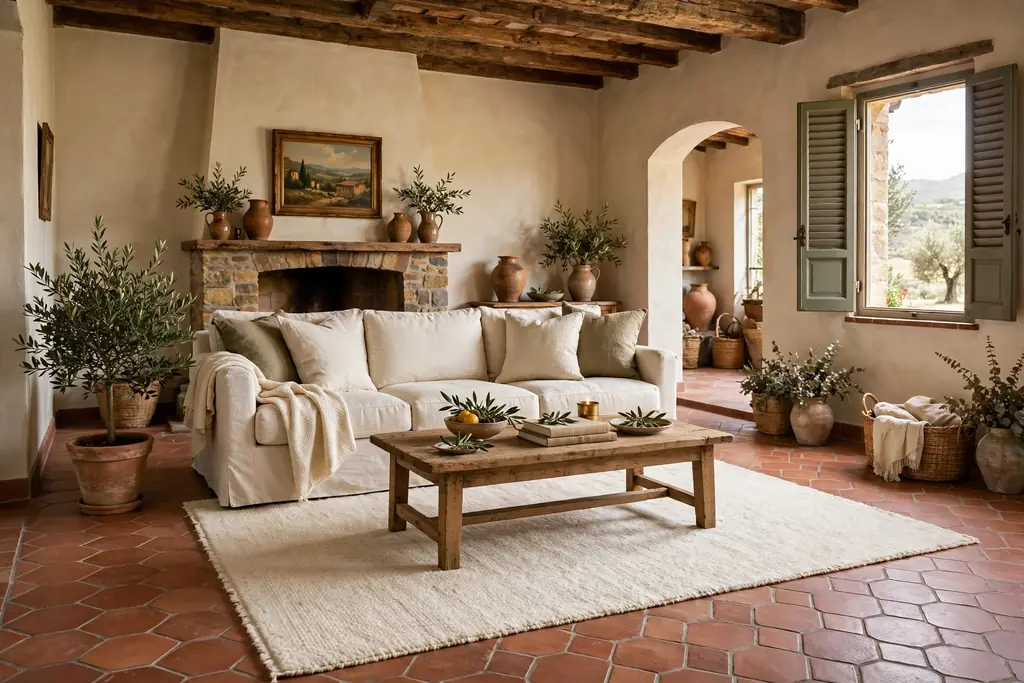
    34. Keep a Rental Bedroom Scottish With Textiles Only

    Rental bedroom dressed only in tartan and wool textiles, no paint changes.

    Build a Scottish bedroom from textiles alone, with no paint, panels, or fixed work: tartan bedding or a throw, wool cushions, a flat weave rug, and a basket of blankets. Textiles can be changed with the season, washed easily, and taken with you when you move, which makes them ideal for rentals. Start with the bed, then add the rug and one window textile.

    Keep the base calm with cream bedding and plain curtains, so the tartan and wool pieces stand out. Store the original fittings and any removed items safely, and check your lease before changing anything fixed. For warm, layered ideas that work in a rental, see these winter bedroom ideas.

    Conclusion

    A Scottish bedroom works best when a few honest materials do the work: tartan in one or two places, wool layers you actually use, wood furniture with visible grain, and colours borrowed from hills and heather. Start with the bed, add one wall or window change, and finish with a rug and a reading corner if space allows. Live with each change for a few nights before adding the next, and keep the base calm so the character pieces stand out. Save this list on Pinterest, and work through it one area at a time: bed, walls, windows, then floors and small details.

    FAQs

    What makes a bedroom look Scottish without looking themed?

    A Scottish bedroom looks characterful rather than themed when you use a few real materials and muted colours, not a room full of symbols. Tartan bedding or a throw, wool layers, wood furniture, and heather or deep green accents give the character, while plain walls and cream bedding keep the room restful. Limit tartan to one or two places, repeat one or two colours from the tartan in solids, and leave most surfaces plain. That balance gives a Scottish feel you can live with daily, rather than a display that tires quickly.

    Which tartan colours work best in a bedroom?

    Muted tartans in green, navy, or red with cream or grey lines work best in a bedroom, since they pair well with plain bedding and wood furniture. A classic red tartan suits a bed that should be the focal point, while a muted green or navy tartan suits a throw, cushions, or a Roman shade in a calmer room. Test the fabric beside your bedding in daylight and lamplight, since tartan can look stronger at night. If you are unsure, start with a muted check on a throw or cushions, and add a larger tartan piece only if the room still needs it.

    How can I add Scottish character to a small bedroom?

    Use tartan in one place only, keep the walls pale, and let wool texture do the rest. A folded tartan throw, a pair of tartan cushions, or a tartan Roman shade gives character without closing in the room, while a plain rug and light wood furniture keep the space feeling open. Avoid tartan on the bed, the window, and the floor at the same time in a small room. A basket of blankets, a small framed landscape print, and one warm lamp add character without taking floor space.

    Can renters create a Scottish bedroom without painting or drilling?

    Yes, renters can build the whole look from textiles and freestanding pieces. Tartan bedding or a throw, wool cushions, a flat weave rug, a basket of blankets, and a tartan curtain on a tension rod all work without paint or fixed fittings. Use a freestanding wood headboard, a leaning framed print, and a trunk at the foot of the bed for furniture character. Keep any original doors and fittings stored safely, and check your lease before removing anything fixed, so the room can be returned to its original state.

    What bedding layers suit a Scottish bedroom in winter?

    Layer the bed in stages, with sheets, a duvet, a folded wool throw, and a chunky knit layer you can add or remove during the night. Wool and wool blend throws give warmth exactly where it is needed, while a tartan throw at the foot adds pattern as well as warmth. Keep a spare blanket in a basket beside the bed, so you can add a layer without remaking the whole bed. Choose washable layers where possible, since winter bedding gets daily use, and check care labels for wool pieces before washing.

    How do I mix tartan with other patterns in a bedroom?

    Mix tartan with one other pattern at most, vary the scale, and share a colour between the two. A large tartan check pairs well with a small stripe or a plain texture, while a small tartan pairs well with a larger, simple shape such as a knit or a wood grain. Keep the second pattern to one place, such as a cushion or a rug, and leave the rest of the room in solids. If the tartan is bold, skip a second pattern and use texture instead, such as knit, linen, or wool, to give depth without visual competition.


  • 16 Swedish Bedroom Ideas to Make Your Next Refresh Easier

    16 Swedish Bedroom Ideas to Make Your Next Refresh Easier

    A Swedish bedroom is built on light, plain surfaces, and materials that feel good to touch. White walls, pale wood, linen, wool, and a small amount of soft color do most of the work, while clutter stays out of sight and daylight stays in. These 16 Swedish bedroom ideas follow that approach, from layered linen bedding and sheepskin throws to simple wardrobes, reading corners, and soft layered light. Each idea is simple to picture and easy to try in stages. Start with the change that fixes your biggest daily frustration. For more ways to give every item a home, see these bedroom storage ideas.

    Key Takeaways

    • Keep the palette pale: white, soft grey, and light wood, with one quiet accent repeated in small doses.
    • Let daylight lead: sheer curtains, clear windowsills, and pale walls help a room feel brighter all day.
    • Layer natural textures: linen, wool, sheepskin, and wood add warmth without adding strong color or pattern.
    • Give clothes, shoes, and bedding each one clear home, and keep daily items at easy reach.
    • Make the bed the focus, with layered bedding, one throw, and bedside surfaces that stay mostly clear.
    • Add pieces in stages, and live with each change for a week before you add the next one.

    1. White Walls with a Pale Wood Bed Frame

    Bedroom with white walls and a pale wood bed frame.

    White walls with a pale wood bed frame give a Swedish bedroom its light, open base. The white walls reflect daylight around the room, while the pale wood warms the space just enough that it does not feel cold or bare. The bed stays the clear focus, and the rest of the room can stay plain without looking unfinished. This suits almost any bedroom, since white and pale wood link well to linen bedding, woven rugs, and simple furniture.

    Keep the wood tone consistent across the bed frame, bedside tables, and any shelves, so the pieces read as one planned group. Choose a low, simple frame with clean lines, and leave the wall behind the bed mostly clear, with one framed print at most. Wash or wipe the frame now and then, since pale wood shows dust more than a dark finish.

    2. Layered White and Grey Linen Bedding

    Bed with layered white and grey linen bedding.

    Layered white and grey linen bedding is the simplest way to make a bed look inviting in a Swedish room. The linen has a relaxed texture that softens plain white walls, and the mix of white and soft grey adds depth without a strong color. Thin layers also let you adjust warmth during the night without remaking the whole bed. This suits a main bedroom where the bed is the first thing you see.

    Build the bed in thin layers: plain sheets, a duvet in white or cream, and a lighter blanket or coverlet in soft grey folded across the lower half. Keep cushions to two or three, so making the bed stays quick. Wash bedding in matching sets and keep a spare set folded nearby, so a fresh bed is a quick swap rather than a chore.

    3. A Sheepskin Throw Draped Over the Bed

    Bed with a sheepskin throw draped over linen bedding.

    A sheepskin throw draped over the bed adds instant warmth and soft texture to a pale Swedish room. The thick, soft pile contrasts with smooth linen bedding and pale wood, so the bed looks layered even when the palette stays quiet. It also gives you a warm layer to pull over your legs on a cold evening without adding another blanket to the bed. This suits a bedroom that feels a little flat or cold in winter.

    Fold the throw across the lower third of the bed, or drape it over one corner, and keep the rest of the bed plain so the texture stands out. Shake the throw outside now and then, and brush it gently to keep the pile even. If a full sheepskin feels too warm, a smaller sheepskin on a chair gives the same texture in a smaller dose.

    4. Light Wood Floors with a Woven Wool Rug

    Bedroom with light wood floors and a woven wool rug under a bed.

    Light wood floors with a woven wool rug give a Swedish bedroom a warm, natural base underfoot. The pale floor keeps the room bright, while the woven rug adds texture and a soft first step out of bed. A rug in cream, grey, or a quiet stripe links the bed to the rest of the room without adding a strong pattern. This suits a room with hard floors, where bare boards can feel cold in the morning.

    Place the rug under the lower two thirds of the bed, extending out on both sides, so your feet land on wool rather than bare floor. Choose a low pile weave that doors and drawers can clear, and use a rug pad on smooth floors to reduce slipping. Vacuum the rug weekly, since wool holds dust, and rotate it once a season so wear stays even.

    5. A White Wardrobe with Simple Wooden Handles

    White bedroom wardrobe with simple wooden handles beside a bed.

    A white wardrobe with simple wooden handles gives a Swedish bedroom calm, closed storage that blends with pale walls. The white doors keep a large storage piece from dominating the room, while the wooden handles add one warm detail that links the wardrobe to the bed frame and bedside tables. This suits a main bedroom where clothes, shoes, and bags need one home.

    Plan the inside before you judge the outside. Give daily clothes a double hanging section, keep long coats and dresses in one tall section, and use a high shelf for seasonal boxes. Keep handles in one finish across all doors, so the wardrobe reads as one planned piece. Dust the doors and handles weekly, since white surfaces show marks fast.

    6. A Candle Lantern on a Minimal Bedside Table

    Minimal bedside table with a candle lantern beside a bed.

    A candle lantern on a minimal bedside table brings the soft, low light that Swedish evenings are known for. The lantern glows gently, so the bedside feels calm at night, while the small table keeps the surface clear for a book and a glass of water. This suits a bedroom where bright overhead light feels too harsh in the evening.

    Choose a simple wooden or metal table with one drawer, so chargers and small items stay hidden. Keep the lantern on the side away from bedding, and use a battery candle if you want the glow without a live flame near fabric. Put the lantern, a book, and a glass of water on the table, and move everything else elsewhere, so the bedside stays calm at night.

    7. A Reading Chair with a Wool Throw by the Window

    Bedroom reading chair with a wool throw by a window.

    A reading chair with a wool throw by the window gives a Swedish bedroom a second, quiet use beyond sleep. The chair sits in daylight during the day, so it invites a few minutes with a book, and the wool throw keeps the corner warm in the evening. This suits a bedroom with a window wall that has room for one chair and a small side table.

    Angle the chair slightly toward the room, so it does not look pushed away, and keep a small table beside it for a book and a cup. Choose the throw in a color already in the bedding, such as soft grey or cream, so the corner links to the bed. Keep the corner clear of clothes and bags, so it stays an invitation to sit rather than a storage spot.

    8. Nature Prints in Light Wood Frames

    Bedroom wall with nature prints in light wood frames.

    Nature prints in light wood frames add a quiet focal point to white bedroom walls without adding strong color. Prints of forests, coastlines, or simple botanical shapes suit the Swedish love of nature, and the light wood frames link the wall to pale furniture. This suits a plain bed wall or a wall above a dresser that needs interest without wallpaper.

    Choose three to five prints in similar sizes, and hang them in matching frames at eye level on one wall. Leave breathing room between frames, and center the group on the bed or dresser rather than scattering prints around the room. Use fixings suited to the wall and the weight, and avoid hanging heavy frames directly above pillows.

    9. Sheer Linen Curtains Hung High and Wide

    Bedroom window with sheer linen curtains hung high and wide.

    Sheer linen curtains hung high and wide soften daylight while keeping a Swedish bedroom bright. The loose weave lets light through in a gentle wash, so a small or north facing room feels lighter, while the view from outside stays blurred. This suits a bedroom where you wake with the light and do not need full darkness. For more curtain fabrics and hanging tips, see these bedroom curtain ideas.

    Hang the rod close to the ceiling and wider than the window frame, so the panels stack on the wall when open and daylight still enters. Let the panels fall to just above the floor, so they move a little with air from the window. Wash the panels often, since sheer linen shows dust more than a heavier fabric.

    10. Open Light Wood Shelves for Books and Plants

    Open light wood bedroom shelves holding books and plants.

    Open light wood shelves give a Swedish bedroom display space for books, plants, and a few calm objects, without a heavy cabinet. The pale wood matches the bed frame and wardrobe handles, so the shelves read as part of the room rather than an added unit. This suits a wall beside the bed or above a dresser, where a small group of items deserves a home.

    Limit each shelf to one group of items, such as books on one and a plant and a small print on another, so the wall reads as display rather than storage overflow. Keep heavy items low and light items high, and fix shelves into studs or with fixings rated for the load. Dust the shelves weekly, since open shelves near a bed collect lint fast.

    11. A Small Dala Horse Accent on a Dresser

    Bedroom dresser with a small painted Dala horse accent.

    A small Dala horse accent on a dresser adds one clear Swedish folk detail to an otherwise plain room. The painted wooden horse, in red or a muted tone, gives a dresser top a focal point that links to Swedish craft tradition, without needing pattern elsewhere in the room. This suits a bedroom that already has a calm palette and needs one small, warm accent.

    Place the horse on a dresser or shelf with one other item at most, such as a small plant or a tray, and leave the rest of the surface clear. Choose one horse in a size that suits the surface, rather than a group that crowds it. Dust the painted wood gently with a dry cloth, and keep it away from direct sun, so the paint stays even.

    12. A Touch of Swedish Blue in Cushions and Art

    Bed with soft Swedish blue cushions and a blue framed print.

    A touch of Swedish blue in cushions and art adds a quiet national color note to a pale bedroom. The soft, muted blue appears in the flag and in traditional painted furniture, and it pairs well with white, grey, and pale wood. Used in small doses, it gives the room a clear accent without breaking the calm palette. This suits a bedroom that feels a little too plain in all white.

    Repeat the blue twice: once in cushions on the bed, and once in a framed print or a throw on the chair. Keep the two blues close in tone, so they read as one planned accent rather than two separate colors. If the blue starts to feel strong, swap one cushion for a cream one, and let the art carry the accent alone.

    13. Woven Baskets for Calm Closed-Away Storage

    Bedroom shelves with woven baskets holding folded throws.

    Woven baskets give a Swedish bedroom soft, natural storage that hides clutter without adding doors or heavy furniture. Baskets in seagrass, cotton, or willow hold throws, scarves, and spare bedding, while their texture warms pale walls and wood. This suits a room with open shelves or a corner that needs storage but not another cabinet. For more storage layouts that keep surfaces clear, see the wardrobe and storage ideas in these bedroom wardrobe ideas.

    Use baskets of one material in two sizes at most, and sort by type, such as throws in one and scarves in another, so you can pull out one basket instead of searching a shelf. Keep baskets light enough to lift with one hand, and store heavy books elsewhere. Replace a basket when the weave frays, since a damaged basket snags clothes.

    14. A Wooden Headboard in a Natural Finish

    Bed with a wooden headboard in a natural finish.

    A wooden headboard in a natural finish gives the bed a clear center in a Swedish bedroom, without paint or pattern. The visible grain adds warmth to a white wall, and the simple shape suits pale linen bedding and light wood furniture. This suits a bedroom where an upholstered headboard would feel too soft or too formal.

    Choose a headboard in the same wood tone as the bed frame, so the two pieces read as one unit. Measure the bed width and the wall space before you buy, and leave room for bedside tables on both sides. Keep the wall above the headboard plain or hang one small print, so the wood grain stays the focus. Wipe the headboard weekly, since the area behind pillows collects dust quickly.

    15. Layered Soft Lighting with a Paper Pendant

    Bedroom in the evening with a paper pendant and warm bedside lamps.

    Layered soft lighting with a paper pendant gives a Swedish bedroom a warm evening glow without one bright ceiling light. The paper pendant spreads light gently across the room, while bedside lamps give reading light on each side of the bed. This suits a bedroom used for reading and rest in the evening, where harsh light feels out of place.

    Hang the pendant at a height that clears the bed and any tall furniture, and use a warm bulb so the light matches the bedside lamps. Put switches or dimmers where you can reach them from the bed, so you do not cross a dark room at night. Keep bulb color consistent across the room, since mixed warm and cool bulbs make a calm palette look uneven.

    16. Greenery on the Windowsill for a Fresh Finish

    Bedroom windowsill with potted greenery in plain pots.

    Greenery on the windowsill gives a Swedish bedroom a living finish that needs no pattern or strong color. A few potted plants in plain ceramic or terracotta pots bring green to a pale room, and the windowsill keeps them in daylight where they grow well. This suits a bedroom with a wide sill and a window that gets gentle light during the day.

    Choose plants that suit your light and watering habits, and group two or three pots of different heights rather than lining up many small pots. Keep the sill clear of other items, so watering and cleaning stay simple, and wipe leaves now and then so dust does not dull them. If fresh plants are hard to keep, one good quality faux stem in a plain pot gives a similar shape with less care.

    Conclusion

    A Swedish bedroom refresh does not need a full remodel or a new set of furniture. It needs pale color, natural wood, soft textiles, and surfaces that stay mostly clear, so daylight and texture do the work. Start with the bed, since layered linen, a wool throw, and a wooden headboard change the room more than any single decor piece. Then add one storage fix, one window change, and one lighting change, and live with each for a week before you add the next. For a calmer, more polished take on the same palette, see these elegant bedroom ideas. Pick the idea that fixes what bothers you most, and let the room grow calmer in stages.

    FAQs

    What colors define a Swedish bedroom?

    White, soft grey, and pale wood form the base, with one quiet accent, such as muted blue or sage, repeated in small doses. Keep large pieces pale, and add color through cushions, art, and throws that are easy to swap. If the room starts to feel flat, add texture with linen, wool, and wood rather than adding another strong color.

    How do I keep a white Swedish bedroom from feeling cold?

    Layer natural textures: linen bedding, a wool or sheepskin throw, a woven rug, and light wood furniture. Warm bulbs in bedside lamps and a paper pendant also help in the evening, since low warm light softens pale walls. Keep one warm wood tone across the bed, tables, and shelves, so the room feels planned rather than bare.

    Can Swedish bedroom ideas work in a small room?

    Yes, since the style favors pale color, clear surfaces, and simple furniture. Use a low bed frame, a white wardrobe with simple handles, and sheer curtains hung high and wide, so the room feels taller and brighter. Give every item one home, such as a basket for throws and a drawer for chargers, so small surfaces stay clear.

    What is the easiest first Swedish bedroom change?

    Start with the bed: layer white and grey linen bedding, add one wool or sheepskin throw, and keep cushions to two or three. The bed is the largest surface in the room, so a calmer bed changes the whole space at once. Next, clear one bedside table down to a lamp, a book, and a glass of water.

    How much pattern should a Swedish bedroom have?

    Very little. Keep bedding, curtains, and rugs mostly plain, and let texture do the work instead of pattern. One small group of nature prints, or one folk accent such as a Dala horse, is enough detail for a calm room. If you add a patterned cushion, keep the rest of the bed plain so the pattern reads as one accent.

    How do I care for linen bedding and wool throws?

    Wash linen in matching sets on a gentle cycle, and line dry or tumble dry on low when the care label allows it, since linen softens with washing. Shake wool and sheepskin throws outside now and then, and brush them gently to keep the pile even. Store spare bedding in a basket or a drawer, so it stays clean and easy to reach.


  • 30 Ikea Bedroom Ideas for a More Polished Space

    30 Ikea Bedroom Ideas for a More Polished Space

    A polished bedroom rarely comes from one large purchase. It comes from calm color, closed storage where it counts, and pieces that share a finish or tone, so the room reads as planned rather than patched together. These 30 Ikea bedroom ideas use that approach: white wardrobes, low platform beds, cube shelves, and small corners for dressing, reading, and work. Each idea is simple to picture and easy to try in stages. Start with the change that fixes your biggest daily frustration. For more ways to give every item a home, see these bedroom storage ideas.

    Key Takeaways

    • Keep the palette calm: white, light wood, and one soft accent, repeated across furniture, bedding, and storage.
    • Give clothes, shoes, and bedding each one clear home, and keep daily items at easy reach.
    • Mix closed storage for visual calm with a small amount of open storage for items you use every day.
    • Measure the wall, the door swing, and the space in front of wardrobes and drawers before you choose a piece.
    • Make the bed the focus, with plain linen bedding, one throw, and surfaces that stay mostly clear.
    • Add pieces in stages, and live with each change for a week before you add the next one.

    1. A White Sliding Door Wardrobe Wall

    Bedroom with a white sliding door wardrobe wall beside a neatly made bed.

    A white sliding door wardrobe wall gives a bedroom a calm, built in look without a full remodel. The flat white doors blend with pale walls, so a large storage wall does not dominate the room, and sliding doors need no swing space, which helps when the bed sits close to the wardrobe. This suits a main bedroom where clothes, shoes, and bags need one home.

    Plan the inside before you judge the outside. Give daily clothes a double hanging section, keep long coats and dresses in one tall section, and use a high shelf for seasonal boxes. Keep one finish on handles or use handleless doors, so the wall reads as one planned surface. Dust the sliding track now and then, so the doors keep moving smoothly.

    2. A Low Platform Bed with Drawers Underneath

    Low platform bed with drawers underneath showing folded bedding.

    A low platform bed with drawers underneath turns the space under the bed into useful storage, and its low profile makes a small room feel taller. The bed frame sits close to the floor, so the room looks calm and grounded, while the drawers hold spare bedding, off season clothes, or shoes. This suits a room with no spare closet.

    Sort each drawer by use, such as spare bedding in one and off season clothes in another, so you can find one item without emptying the bed base. Measure the clearance beside the bed first, so drawers open fully without hitting a nightstand or a rug edge. Keep the bedding plain and the top of the bed clear apart from pillows and one throw.

    3. A Cube Shelf Unit as a Bedside Table

    White cube shelf unit used as a bedside table beside a bed.

    A cube shelf unit beside the bed works as a nightstand with open storage below and a clear top for a lamp. The square openings hold books, a small basket, or a folded throw, while the top stays free for a glass of water and a phone. This suits a small room, since one cube unit can replace a nightstand and a small bookcase.

    Keep each cube to one group of items, so the unit reads as tidy rather than crowded. Put books in one cube, a basket for chargers in another, and leave one cube partly empty for items you add later. If the open cubes start to look busy, add a fabric box to one or two openings and leave the rest open.

    4. A Tall Narrow Shelf Beside the Bed

    Tall narrow white shelf beside a bed holding books.

    A tall narrow shelf beside the bed uses a slim strip of wall that a wide dresser cannot fill. The vertical shape draws the eye up, which helps a small room feel taller, and it holds books, folded clothes, and a small plant within reach of the bed. This suits a bedroom with a narrow gap between the bed and a door or window.

    Keep heavy items low and light items high, so the shelf stays stable, and fix tall shelves to the wall with the fittings supplied. Group items by use, such as books on one shelf and folded knitwear on another, and leave breathing room on each shelf. Dust the shelves weekly, since open shelves near a bed collect lint fast.

    5. A Light Wood Bed Frame with White Linen Bedding

    Light wood bed frame with white linen bedding.

    A light wood bed frame with white linen bedding is the simplest polished base in this list. The pale wood warms white walls without adding a strong color, and white bedding makes the bed look fresh and easy to keep. This suits almost any bedroom, since the frame and bedding link well to white wardrobes, pale rugs, and linen curtains.

    Layer the bedding in thin layers: plain sheets, a duvet in white or cream, and a light blanket folded across the lower half. Keep cushions to two or three, so making the bed stays quick. Wash bedding in matching sets and keep a spare set folded nearby, so a fresh bed is a quick swap rather than a chore.

    6. A Floating Bedside Shelf with a Wall Light

    Floating white bedside shelf with a wall light beside a bed.

    A floating bedside shelf with a wall light frees floor space and keeps the nightstand surface clear. The shelf holds a book and a glass of water, while the wall light gives reading light without a lamp base taking up room. This suits a very small bedroom, or a bed pushed into a corner where a full nightstand will not fit.

    Mount the shelf at a height you can reach while sitting up, and fix it into studs or with fixings rated for the load. Keep the shelf to evening items only, and move daytime clutter elsewhere, so the bed area stays calm at night. Choose a wall light with a warm bulb, so the light matches bedside lamps elsewhere in the room.

    7. A Wide Drawer Dresser Under the Window

    Wide white drawer dresser under a bedroom window.

    A wide, low drawer dresser under the window gives folded clothes a home and leaves the wall above the dresser free for light. The low shape suits a window wall, since it does not block daylight, and its top can hold a lamp, a tray, and one plant. This suits a bedroom with a long window wall and no room for a tall wardrobe.

    Sort drawers by type, such as tops in one, bottoms in another, and sleepwear in a third, and use small boxes or dividers inside so folded stacks stay upright. Keep the dresser top to three groups at most: light, a tray, and one decor piece. If the dresser feels heavy in a small room, choose one with legs, since visible floor beneath it makes the piece look lighter.

    8. Mirrored Wardrobe Doors for a Small Room

    Small bedroom with mirrored wardrobe doors beside a bed.

    Mirrored wardrobe doors help a small bedroom feel brighter, since they reflect daylight across the room and across the bed. The mirror also gives you a full view when dressing, without a separate standing mirror taking up floor space. This suits a small bedroom, or a room where the bed sits close to the wardrobe wall.

    Keep the mirror clean with a soft cloth, and check the sliding track for dust so the doors glide smoothly. If a full mirror feels too bright, use one mirrored door and one plain door, or a mirror panel on the door you use most. Keep the area in front of the mirror clear, so the reflection shows bedding or a plain wall, not clutter.

    9. An Open Clothing Rail in a Corner

    Open clothing rail in a bedroom corner with neatly hung clothes.

    An open clothing rail in a corner gives you a boutique style display for clothes you wear often, without a full wardrobe build. The rail uses a corner that a bed or dresser leaves awkward, and it lets you plan outfits at a glance. This suits a spare room used for dressing, or a bedroom where a full wardrobe wall will not fit.

    Limit the rail to clothes you wear each week, and store the rest in closed boxes or another wardrobe, so the corner stays tidy. Hang clothes facing the same way, group them by type and color, and leave space between hangers so outfits are easy to pull out. Add a shelf above for bags or folded knitwear, and a small tray below for belts and scarves.

    10. A Headboard Shelf for Books and a Lamp

    Bedroom headboard with a shelf holding books and a lamp.

    A headboard with a shelf, or a narrow shelf fixed just above the headboard, gives books, a phone, and a glass of water a home without a nightstand on each side. This suits a small room, since the shelf uses wall space rather than floor space, and it keeps evening items within reach while you sit up in bed.

    Choose a shelf deep enough for a book, but not so deep that pillows push items off the back. Keep the shelf to evening items only, and wipe it weekly, since shelves above a bed collect dust. If you already have a headboard you like, a narrow shelf fixed just above it gives a similar result with less change.

    11. A Desk Nook from a Shelf and a Tabletop

    Small bedroom desk nook with a white tabletop and a shelf above.

    A desk nook built from a wall shelf and a simple tabletop turns a spare wall into a work spot without a large desk. The tabletop gives room for a laptop and a notebook, while the shelf above holds books and a small plant. This suits a bedroom that also needs a study corner, and a renter who wants a setup that can be taken apart later.

    Keep the nook in the same palette as the bed, with one shared color linking the two areas. Use a chair that slides fully under the tabletop, so the walkway stays clear when the desk is not in use. Keep only daily work items on the surface, and move papers and chargers into a box on the shelf at the end of the day.

    12. A Storage Bench at the Foot of the Bed

    Storage bench at the foot of a bed with woven baskets underneath.

    A storage bench at the foot of the bed gives you a seat for dressing, a place to lay out tomorrow’s clothes, and hidden storage for spare blankets inside. The bench also marks the end of the bed zone, which helps a large room feel planned. This suits a bedroom with clear walking space at the sides of the bed.

    Store only light, soft items inside, such as throws and spare pillowcases, so the bench stays easy to open. Fold one throw over the bench top for a finished look, and keep the rest of the top clear. In a short room, a narrow bench or a single ottoman does the same job in less depth.

    13. A Slim Rolling Cart Beside the Bed

    Slim white rolling cart beside a bed.

    A slim rolling cart beside the bed fits a gap that a nightstand cannot fill, and it moves where you need it. Use the top tier for daily items, the middle for books or skincare, and the lowest for spare supplies. This suits a shared room, since one cart per person stops a shared nightstand from filling up, and it suits a bedside with no floor space for a table.

    Choose a cart with a small footprint and wheels that lock, so it does not drift at night. Keep the cart to items for one routine, such as bedtime reading or morning skincare, rather than general overflow. Wipe the tiers weekly, since carts near a bed collect dust and hair products.

    14. Matching Bedside Tables with One Drawer Each

    Bed with matching white bedside tables and matching lamps.

    Matching bedside tables with one drawer each give a bedroom symmetry, which reads as calm at a glance. The drawer hides chargers, notebooks, and small personal items, while the top holds a lamp and little else. This suits a shared bedroom, since each side holds only what that person uses nightly.

    Keep each table surface mostly clear, with a lamp, a book or a glass of water, and little else. If two people share the room, give each side the same table, so neither side becomes the dumping ground. When the two sides match in height, the eye rests on the bed, which is what a polished room needs.

    15. A Curtain Front Open Wardrobe for Renters

    Open wardrobe frame with a plain white linen curtain front.

    A freestanding open frame with a fabric curtain front gives renters wardrobe storage without drilling into walls. The frame gives hanging space and shelves, the curtain hides clutter and softens the look, and the whole unit can be taken apart and rebuilt in a new room. This suits a small bedroom, a spare room, or a first home.

    Choose a heavy cotton or linen curtain that hangs straight and covers the frame fully, with a simple rod or track at the top. Keep the curtain clear of heaters, wash it when it collects dust, and store the original fittings if you swap any hardware in a rented room. Group clothes by type inside, so the curtain only needs to hide a tidy rail.

    16. A Glass Front Cabinet for Books and Plants

    White glass front cabinet showing books and a small plant.

    A glass front cabinet in the bedroom shows neat books, folded knitwear, and a small plant, while keeping dust off the shelves. The glass breaks up a wall of solid doors and gives the room a lighter feel, since the eye sees through the cabinet rather than stopping at a solid door. This suits a bedroom with a tidy display habit.

    Keep what you show to a small set of matching or related pieces, and leave space on each shelf so the cabinet does not look crowded. Clear glass shows everything, so it suits tidy households, while ribbed or frosted glass softens the view and hides a less perfect shelf. Add a small light inside if you want the display to glow in the evening.

    17. A Shoe Bench by the Bedroom Door

    Low shoe storage bench by a bedroom door with shoes below.

    A shoe bench by the bedroom door gives shoes a home at the point where you take them off, so pairs stop piling up by the wall. The bench top gives a seat for putting shoes on, while the space below holds pairs in a row. This suits a bedroom with no entry hall storage, and a household where shoes tend to gather by the door.

    Keep daily shoes at easy reach and occasion shoes higher or further back, so the bench stays useful. Wipe shoes before putting them away, so dirt does not build up below the bench. Limit the bench to pairs you wear often, and store the rest elsewhere, so one bench is enough and the doorway stays clear.

    18. A Vanity Corner with a Small Table and Mirror

    Small bedroom vanity corner with a white table and a mirror.

    A vanity corner with a small table, a mirror, and a stool that tucks under gives you a getting ready spot that needs no extra furniture. The table sits in a corner or at the end of a wardrobe run, with a shallow drawer for daily items and a mirror above. This suits a bedroom with a long wall and no room for a separate dressing table.

    Keep only daily items on the surface, with the rest in the drawer, and choose a stool that slides fully under the table so the walkway stays clear. Light the corner with a small lamp or a mirror light, so morning routines do not rely on bright overhead light alone. If you share the room, place the vanity at the end of the run, so one person can dress while the other still reaches the main wardrobe.

    19. A Reading Corner with an Armchair and a Floor Lamp

    Bedroom reading corner by a window with an armchair and a floor lamp.

    A reading corner with an armchair, a floor lamp, and a small side table gives the bedroom a second use that stays quiet. Angle the chair slightly toward the room, so it does not look pushed away, and keep it clear of clothes and bags, so it stays an invitation to sit. This suits a bedroom with a window corner that a bed or wardrobe leaves empty.

    Keep the corner in the same palette as the bed, with one throw in a shared color to link the two areas. Choose a lamp that lights the book without shining across the room at night, and keep a clear path to the bed. A floor cushion beside a low shelf works in a tight room where a full chair will not fit.

    20. Under Bed Rolling Boxes for Seasonal Bedding

    Rolling storage boxes under a bed showing folded bedding.

    Under bed rolling boxes use the space under the bed for seasonal bedding, spare blankets, and off season clothes, without a new piece of furniture. The boxes roll out in one move, so you can swap bedding by season without emptying a wardrobe. This suits a room with a bed frame high enough for low boxes, and a household with limited closet space.

    Measure the clearance under the bed frame first, and leave a small gap so boxes roll out without catching the rug. Sort boxes by season, and label the front of each one, so you can pull out one box instead of searching them all. Pull each box out fully once a season, and remove anything you have not used, so the boxes stay useful.

    21. A Wall Rail with Hooks for Bags and Hats

    Bedroom wall rail with hooks holding a bag and a hat.

    A wall rail with hooks beside the door or wardrobe turns a blank wall into storage for a bag, a hat, and tomorrow’s outfit, with no floor space used. The rail keeps daily items visible and easy to grab, which helps on busy mornings. This suits a small bedroom, a guest room, and a room where a chair has been doing the same job badly.

    Limit the hooks to items you use daily, since an overloaded rail looks messy and is hard to use. Hang the heaviest bag lowest, and keep the top hook for a light scarf or hat. Choose hooks with a flat profile and fixings suited to your wall type, and keep the rail clear of heaters and door swings.

    22. Woven Baskets on Open Shelves

    Open white bedroom shelves with matching woven baskets.

    Woven baskets on open shelves turn open storage into closed storage without doors. Use baskets of one material, such as woven seagrass or cotton, in two sizes at most, and label the front of each one. This suits a bedroom that needs soft texture as well as order, since baskets add warmth that plain white boxes do not.

    Sort by type, such as scarves in one, belts in another, and spare chargers in a third, so you can pull out one basket instead of searching a shelf. Keep baskets light enough to lift with one hand, and store heavy books elsewhere. Replace a basket when the weave frays, since a damaged basket snags clothes.

    23. A Black and White Palette with Black Frame Accents

    Bedroom in a black and white palette with a black bed frame.

    A black and white palette gives a bedroom a crisp, polished edge without a strong color. White bedding, white furniture, and pale walls form the calm base, while black frames, a black bed frame, and black lamp bases add definition. This suits a bedroom with plain walls, since the contrast does the decorating work.

    Repeat black in two or three small places, so one black lamp alone does not look random, while a lamp plus a matching frame or tray looks planned. Keep the finish consistent across the black pieces, and pair black with wood, linen, and cream, so the room stays soft rather than hard. Wipe black surfaces with a soft cloth, since dust shows more on dark finishes.

    24. A Soft Sage Accent Wall with White Furniture

    Bedroom with a soft sage green accent wall behind a bed.

    A soft sage accent wall behind the bed adds gentle color to a white bedroom without making the room feel busy. The muted green links well to white furniture, light wood, and linen bedding, and it gives the bed wall a clear focus. This suits a bedroom with plain white wardrobes, since the wall adds interest that the furniture does not need to supply.
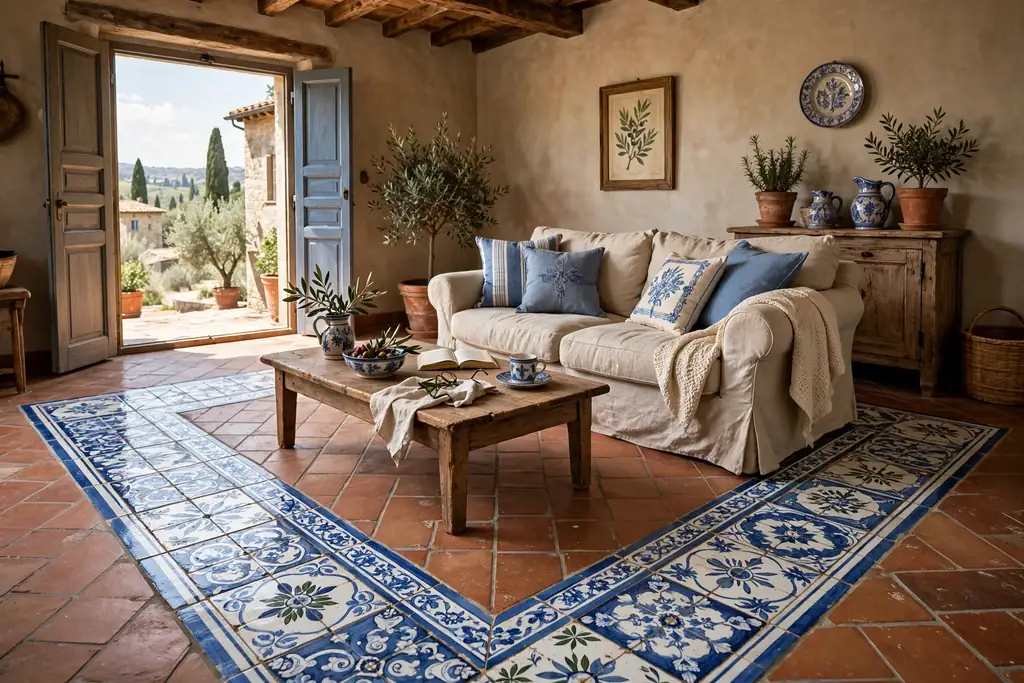
    Test paint samples on the bed wall in daylight and evening light, since a shade can look darker on a large flat surface. Keep the other walls plain, so the sage wall stays the focus, and repeat sage once more in a cushion or throw. Use paint suited to bedroom walls, and allow full drying time between coats.

    25. Layered Warm Light Instead of One Bright Ceiling Light

    Bedroom in the evening with layered warm lighting from bedside lamps.

    Layered warm light makes a bedroom feel settled in the evening, with bedside lamps for reading, a wall light where you dress, and the ceiling light kept for cleaning only. Low, warm light flatters bedding and wood, softens shadows, and helps the room feel calm before sleep. This suits almost any bedroom, and it costs little beyond a second lamp.

    Put switches or dimmers where you can reach them from the bed, so you do not cross a dark room at night. Keep bulb color consistent across the room, since mixed warm and cool bulbs make a calm palette look uneven. If space is tight, a plug in wall light frees the nightstand and still gives the same layered effect.

    26. A Large Rug to Anchor the Bed

    Bedroom with a large pale rug under the lower half of a bed.

    A large rug under the lower two thirds of the bed, extending out on both sides, links the bed to the rest of the room and gives a soft first step in the morning. A rug that is too small makes the bed look as if it is floating, so measure for a clear border on each side before you buy. This suits a bedroom with hard floors, and a room where the bed needs grounding.

    Choose a low pile rug that doors and drawers can clear, and use a rug pad on smooth floors to reduce slipping. Keep the rug in a plain tone or a quiet pattern that shares a color with the bedding, so it grounds the room without competing with it. Vacuum the rug weekly, since bedroom rugs collect lint and dust fast.

    27. Floor Length White Curtains Hung High and Wide

    Bedroom window with floor length white curtains hung high and wide.

    Floor length white curtains hung high, near the ceiling, and wide, beyond the window frame, make a bedroom window look larger and the room feel taller. Panels that just brush the floor give a finished edge, while panels that pool on the floor collect dust. This suits a bedroom with a plain window wall that needs softness.

    Use a sheer panel for daytime privacy and a heavier panel you can close at night, if your window needs both. Keep the curtain fabric clear of radiators and heaters, and open the panels fully during the day so the room gets full daylight. For more window ideas in the same calm style, see these bedroom curtain ideas.

    28. Framed Prints in Matching Frames

    Bedroom wall with framed art prints in matching white frames.

    Framed prints in matching frames make different images look like a set, which is calmer than a mix of frame styles and sizes across every wall. Choose three to five pieces, print them in similar sizes, and hang them in a row at eye level on one wall. This suits a bedroom with a plain dresser wall or a long wall above a bench.

    Hang the group centered on the bed, a dresser, or a chair, rather than scattered around the room, and leave breathing room between frames. Use secure fixings suited to the wall and the weight, and avoid hanging heavy frames directly above pillows where fixings could fail. If you prefer privacy, use landscapes or abstract prints in the room palette instead of portraits.

    29. A Small Bedroom Layout with the Bed to the Wall and Storage Up High

    Small bedroom with the bed against one wall and tall storage shelves.

    A small bedroom layout with the bed pushed to one wall and storage running up high frees floor space in the middle of the room. Tall shelves, a wardrobe wall, and wall hooks use height that a low dresser leaves empty, while the bed against the wall leaves a clear path to the door and window. This suits a box room, a guest room, and a first home.

    Keep daily items at easy reach and seasonal items higher, so you actually use the high storage instead of piling items on the floor. Use a small step stool nearby if the top shelf is high, and keep the middle of the room clear of extra furniture. Review the contents each season, and move out anything you did not use, so the small room stays useful.

    30. A Polished Finishing Layer of Tray, Throw, and Plant

    Neatly made bedroom with a folded throw, a tray, and a small plant.

    A polished finishing layer costs little and ties the room together: one tray on the dresser, one folded throw on the bed or bench, one small plant, and surfaces that stay mostly clear. The tray groups small items so the dresser reads as tidy rather than empty, while the throw and plant add softness and life. This suits a bedroom that already has storage sorted, but still feels unfinished.

    Limit the tray to three or four items, such as a small vase, a candle holder, and a folded cloth, so it stays a styling choice rather than storage. Lift the whole tray aside in one move when you need the surface for dressing, and wipe it weekly. If a surface starts to collect clutter again, remove one item at a time until the room feels calm.

    Conclusion

    A polished Ikea style bedroom comes down to a few calm choices repeated well. Start with white wardrobes or a light wood bed, add one storage solution for clothes and one for bedding, and keep surfaces mostly clear so the details you chose can be seen. Small moves, such as a floating shelf, a rolling cart, or a tray on the dresser, let you test the look before a larger change, and they suit renters as well as owners. For a cooler, more refined balance to the white and wood here, see these elegant bedroom ideas and these bedroom wardrobe ideas for wardrobes, bedding, and finishing touches that sit well beside calm neutrals.

    Save this list for your next free hour in the bedroom, and work through it in order: wardrobe and bed first, then bedside and dresser storage, then one work or reading corner, and finally the small tray, throw, and plant touches.

    FAQs

    What makes an Ikea style bedroom look polished rather than plain?

    Keep the palette calm, repeat one finish across furniture, and keep surfaces mostly clear. White wardrobes, a light wood bed, plain linen bedding, and closed storage for clutter give the room a planned look, while one soft accent, such as sage or black frames, adds definition. Polished comes from repetition and tidiness, not from filling every surface.

    How do I start an Ikea style bedroom on a small budget?

    Start with the changes that show most. Clear the surfaces, add a tray to the dresser, swap in white linen bedding, and use baskets on open shelves to hide clutter. A rolling cart, a wall rail with hooks, and a floating shelf are low cost changes that fix daily frustration. Save larger changes, such as a wardrobe wall or a platform bed, for a later stage.

    What storage works best in a small Ikea style bedroom?

    Use height and the space under the bed first. Tall narrow shelves, a wardrobe wall, wall hooks, and under bed boxes use space that a low dresser leaves empty. Keep daily clothes at eye level, shoes low, and seasonal items high, so you do not need to search the whole room each morning. Review the contents each season, so the storage stays useful.

    Can I mix Ikea style furniture with pieces I already own?

    Yes, if you link the pieces with color and finish. Keep the large pieces in white or light wood, repeat one metal finish on handles and lamps, and use bedding and a rug in shared tones to tie old and new pieces together. A matching pair of bedside tables or matching frames can also make a mixed room look planned.

    How do I keep an open wardrobe or open shelves tidy?

    Limit open storage to clothes and items you use each week, and store the rest in closed boxes or another wardrobe. Hang clothes facing the same way, group them by type and color, and leave space between hangers. Use matching baskets on open shelves, label each one, and keep one shelf partly empty, so new items have a place instead of landing on a chair.

    What colors suit a polished Ikea style bedroom?

    White, warm white, light wood, soft grey, and one muted accent, such as sage, dusty blue, or black, work best, because they let bedding, wood, and light stand out without competing with them. Keep the main palette to two or three colors, plus one metal finish and one wood tone, and test large samples in daylight and evening light before a large change.


  • 11 Coastal Bedroom Ideas That Balance Style and Comfort

    11 Coastal Bedroom Ideas That Balance Style and Comfort

    A coastal bedroom should feel like a deep breath: light walls, soft bedding, natural texture, and just enough sea color to set the mood. The best rooms start with a calm palette, one or two natural materials, and a comfortable bed at the center. These 11 coastal bedroom ideas cover color, bedding, wood, curtains, lighting, and small details you can try in stages. Start with the change that helps most, and test paint and fabric samples in daylight and lamplight first. If you want a warm neutral base to pair with coastal blues, these beige bedroom ideas show how soft neutrals and wood tones work together.

    Key Takeaways

    • Keep the palette calm: white, warm sand, and one or two sea blues, with natural wood and woven texture for warmth.
    • Let the bed lead: layered linen bedding in white and pale blue sets the coastal mood without a full redecorate.
    • Use natural materials in small doses: rattan, jute, weathered wood, and linen add seaside character without clutter.
    • Keep light soft and plentiful: sheer curtains, pale walls, and warm lamps help a coastal room feel bright by day and restful at night.
    • Add sea color in layers you can change: cushions, throws, art, and a chair are easier to swap than paint or furniture.
    • Leave breathing room: one coastal feature per wall or corner is enough, and clear surfaces keep the room restful.

    1. Start With a White, Sand, and Soft Blue Palette

    Bright coastal bedroom in white, sand and pale blue, with a light wood bed, pale blue bedding, a rattan pendant light, and windows looking over the sea.

    A white, sand, and soft blue palette is the simplest base for a coastal bedroom, because it reads as fresh in daylight and calm at night. Paint the walls white or warm white, keep large furniture pale, and let sand tones appear in wood, rugs, and baskets. Add soft blue only where you want the eye to rest, such as cushions, a throw, or art, so the room stays light rather than busy.
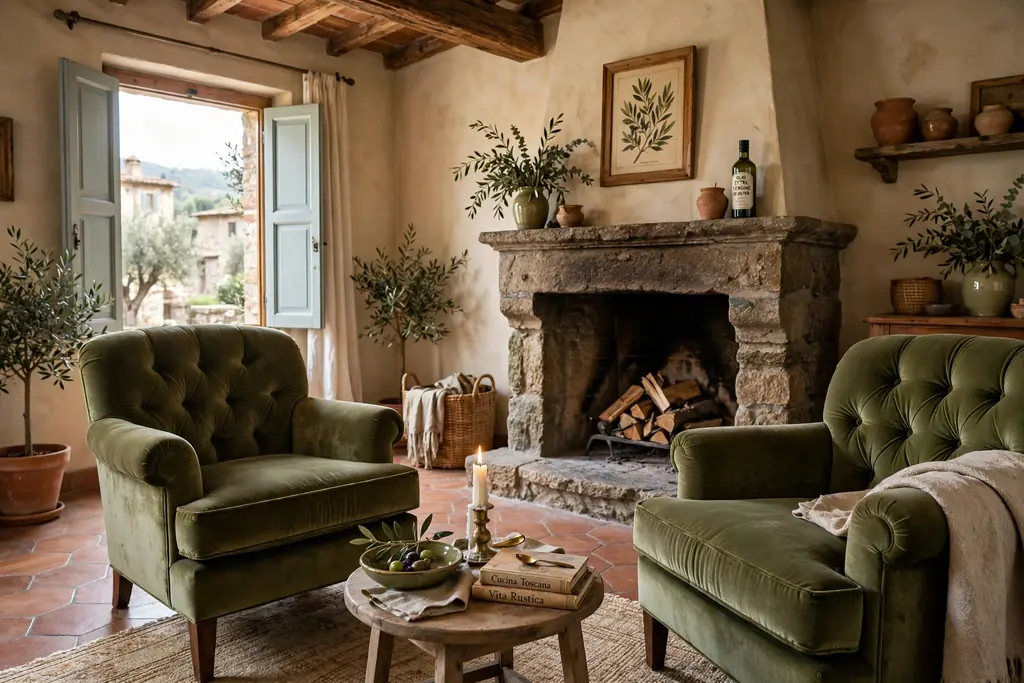
    This suits almost any bedroom, including a small room or a room with no sea view, since the palette does the coastal work. Test white paint beside your floor and bedding, because white can look grey in cool light or yellow in warm light. If the room starts to feel washed out, add one deeper blue cushion or a mid tone wood piece, and keep the rest of the palette pale so that one darker note has room to stand out.

    2. Layer White Linen Bedding for a Relaxed Bed

    Coastal bedroom bed with layered white linen bedding, pale blue cushions, a light wood dresser, and a window with a sea view.

    Layered white linen bedding gives a coastal bedroom its relaxed, lived in feel, because linen softens with washing and drapes loosely rather than sitting stiff. Start with white cotton or linen sheets, add a white duvet or coverlet, then fold a light linen throw across the foot of the bed. Finish with two sleeping pillows and one or two linen cushions in white or pale blue, so the bed looks inviting rather than piled high.

    This suits a bedroom you want to refresh without paint or new furniture, since bedding covers the largest surface in the room. Wash linen on a gentle cycle and let it dry flat or on a line when you can, so it keeps its soft texture. If you share the bed and one of you sleeps warm, use a light coverlet as the top layer and keep a second throw nearby, so each person can adjust their own warmth without changing the look of the bed.

    3. Choose a Whitewashed Wood Headboard

    Coastal bedroom with a whitewashed wood slatted headboard, white bedding, pale blue cushions, and sheer curtains beside sea view windows.

    A whitewashed wood headboard brings a beach house note to the bed without painting the whole room. The pale, washed finish lets the wood grain show through, which keeps the headboard feeling natural rather than flat white. A slatted or panel design suits most coastal bedding, and the light tone pairs well with white linen, pale blue cushions, and light wood nightstands.

    This suits a bedroom where the bed sits against a long blank wall and needs a clear center. Measure the headboard width against the bed and the wall, since a headboard that is too narrow looks lost and one that is too wide crowds the nightstands. Dust the slats with a dry cloth, and keep the wall behind the headboard plain, so the washed wood and the grain stay the focus of the bed wall.

    4. Add Sea Blue Cushions and a Deeper Blue Throw

    Coastal bedroom bed with white bedding, sea blue cushions, and a navy blue knit throw, beside a light wood nightstand.

    Sea blue cushions and a deeper blue throw are the easiest way to bring the coast into a white bedroom, because they add color exactly where you look first: the bed. Mix a pale sea blue cushion with a mid blue or navy cushion, and fold a deeper blue throw across the foot of the bed. The mix of blues gives the bed depth, while the white bedding underneath keeps the whole scheme light.

    This suits a renter or a reader on a smaller budget, since cushions and a throw need no tools and can move to another room later. Keep the rest of the room pale, and repeat the blue once more in a small item, such as art or a vase, so the color looks planned rather than random. Wash cushion covers as advised on the label, and fold the throw neatly each morning, since a throw left in a heap can make an otherwise calm bed look untidy.

    5. Hang Sheer Linen Curtains for Soft Daylight

    Coastal bedroom with sheer white curtains blowing beside a large window with a sea view, and a bed with pale blue bedding.

    Sheer linen curtains soften a coastal bedroom window and let daylight fill the room without giving up daytime privacy. The loose weave blurs the view from outside while keeping the room bright, which suits a bedroom where you wake with the light. Hang the panels from a simple rod, and let them fall to just above the floor, so they move a little with air from the window.

    This suits a bedroom with one main window, a sea view, or a garden view you want to keep visible. Keep the rest of the window plain, with no heavy valance, so the sheer can do its work. For more curtain fabrics, lengths, and hanging tips, see these bedroom curtain ideas. Wash sheer panels often, since pale linen shows dust more than a heavier fabric, and add a blackout lining or a second panel if you need full darkness for sleep.

    6. Bring In Rattan With a Pendant Light and Baskets

    Coastal bedroom with a woven rattan pendant light, woven baskets beside the bed, and white bedding.

    Rattan brings woven texture to a coastal bedroom in a way that feels natural and light, because the open weave lets light through. Hang one rattan pendant light over the bed or in the center of the room, and repeat the material once in baskets beside the bed for throws, books, or spare bedding. The pendant gives the ceiling a clear focal point, while the baskets keep useful items close without adding closed furniture.

    This suits a bedroom that already has white walls and pale bedding but feels a little flat, since rattan adds warmth without color. Dust woven pieces with a dry cloth or a soft brush, and keep rattan out of damp corners, since it can warp. If the room already has a lot of wood, use rattan in just these two spots, so the woven texture stays a feature rather than competing with every other material in the room.

    7. Place a Weathered Wood Bench at the Foot of the Bed

    Coastal bedroom with a weathered driftwood bench at the foot of a white bed, a folded blue throw on the bench, and sheer curtains at a window.

    A weathered wood bench at the foot of the bed gives a coastal bedroom a useful seat and a place to lay out clothes, a throw, or a book. The greyed, worn finish reads as seaside without needing a themed shape, and it pairs well with white bedding, a blue throw, and light wood floors. Choose a bench that is narrower than the bed, so you can walk around it at night without bumping it in the dark.

    This suits a bedroom with enough floor space at the bed end, and it works well in a guest room, where visitors need a spot to set a bag. Keep the bench mostly clear, with one folded throw, so it stays useful rather than turning into a pile of clothes. Wipe the wood with a damp cloth, and check the bench height against the bed, since a bench that is much higher or lower than the mattress can look awkward and feel less useful.

    8. Hang a Gallery Wall of Seaside Prints

    Coastal bedroom with five framed seaside prints in light wood frames above a bed with pale blue and white bedding.

    A gallery wall of seaside prints adds personality to a coastal bedroom without adding bold color that fights the scheme. Choose prints of the sea, the shore, boats, or coastal plants in pale blue, white, sand, and soft grey, with simple light wood frames. Hang them in a loose grid above the bed or along one wall, and keep the spacing even, so the wall feels calm rather than crowded.

    This suits a bedroom with a large blank wall that needs interest but not a feature color. Lay the frames on the floor first and plan the spacing, leaving equal gaps between frames, then hang the middle frame at eye level. Use picture hanging strips if you rent, and keep the largest frame near the center so the arrangement feels balanced. Swap one print with the seasons if you want a small change without redecorating the whole room.

    9. Ground the Room With a Natural Jute Rug

    Coastal bedroom with a large natural jute rug under a white bed, a woven bench at the foot, and light wood floors.

    A natural jute rug grounds a coastal bedroom and warms up a hard floor, which matters in a room where white and pale blue could otherwise feel cool. Lay a large jute rug under the bed, so it extends beyond each side, and let a softer rug or a bare floor edge show around it. The coarse, natural texture contrasts with soft linen bedding, and the sand tone links the bed to light wood furniture and woven baskets.

    This suits a bedroom with wood or laminate floors, and it works well when the rug is large enough that your feet land on it first thing in the morning. Use a rug pad underneath so the layers do not slip, and keep the rug pile low near the door swing. Vacuum jute with a brush head, since it sheds fibers at first, and blot spills quickly rather than rubbing, so the natural fibers keep an even tone.

    10. Add a Blue and White Striped Reading Chair

    Coastal bedroom reading corner with a blue and white striped armchair beside a window with a sea view and a rattan side table.

    A blue and white striped chair gives a coastal bedroom a clear reading corner and a stronger pattern than plain cushions alone. Place the chair beside a window, add a small side table for a book and a drink, and keep a soft throw over one arm for cooler evenings. The stripe reads as seaside without needing a themed print, and it works best when the rest of the room stays mostly solid, so the chair can be the one patterned piece.

    This suits a bedroom with a window corner that currently holds nothing, or a larger main bedroom that needs a second use beyond sleep. Choose a chair deep enough to sit in for an hour, not a stiff accent chair that looks good but stays empty. Keep the side table clear except for the book you are reading, and move the chair a little away from the window if strong sun fades the fabric over time.

    11. Finish Nightstands With Rope and Ceramic Lamps

    Coastal bedroom nightstand with a ceramic and rope table lamp, a shell, and small plants beside a bed with blue bedding in evening light.

    Rope and ceramic lamps finish coastal nightstands with texture and warm light, without adding a large new piece of furniture. A ceramic base in white or pale blue, wrapped or trimmed with rope, suits a light wood or weathered nightstand, and a linen shade softens the light in the evening. Pair the lamp with one small natural item, such as a shell or a small plant, and keep the rest of the nightstand clear, so the lamp and one book or glass of water are all you see at night.

    This suits a bedroom where overhead light feels too bright in the evening, since two low lamps make the room feel smaller and quieter. Choose warm white bulbs, and put the switches where you can reach them without getting up. Dust the rope detail with a dry cloth, and keep the lamp clear of curtains and bedding, so the shade stays clean and the light falls where you need it for reading.

    Conclusion

    A coastal bedroom that balances style and comfort comes down to a calm palette, a comfortable bed, and natural texture used with restraint. Start with white, sand, and soft blue, layer white linen bedding, and add one or two woven or weathered pieces, such as rattan, jute, or a whitewashed headboard. Keep surfaces mostly clear, let daylight in through sheer curtains, and warm the evenings with low lamps, so the room feels bright by day and restful at night. For a softer, layered bedroom mood to pair with these coastal ideas, see these hygge bedroom ideas.

    Save this list for your next free hour in the bedroom, and work through it in order: palette and bedding first, then curtains and rugs, then one wood or woven feature, and finally the art, chair, and nightstand details.

    FAQs

    What colors work best for a coastal bedroom?

    White, warm white, sand, pale sea blue, and one deeper blue work best, because they keep the room light while giving it a clear seaside note. Keep the main palette to white and sand, with blue on cushions, a throw, art, or a chair, and add natural wood and woven texture for warmth. Test paint and fabric samples in daylight and evening light before committing, since white and blue shift a lot through the day.

    How can I make a coastal bedroom feel comfortable, not just themed?

    Focus on comfort first: layered linen bedding you like to sleep in, a rug where your feet land, warm lamps for the evening, and a chair you actually sit in. Use coastal notes in materials, such as rattan, jute, weathered wood, and linen, rather than in a large number of themed objects. Keep surfaces mostly clear, so the room feels restful, and limit seaside prints or shells to one wall or one nightstand.

    Can I create a coastal bedroom without a sea view?

    Yes. A coastal bedroom is mainly a palette and a set of textures, not a view. White walls, sand tones, pale blue bedding, sheer curtains, and woven baskets give the same light, calm feel in an inland room. If you want a view to look at, a gallery wall of seaside prints above the bed gives a coastal focal point without changing the room layout.

    What bedding is best for a coastal bedroom?

    White linen or cotton bedding works best, layered with a light coverlet and a linen throw, plus cushions in white and pale or mid blue. Linen softens with washing and drapes loosely, which suits the relaxed coastal look, while cotton is easier to care for and suits a crisper bed. Keep the number of cushions small, so the bed is easy to make each morning, and add a deeper blue throw for cooler nights.

    How do I keep a coastal bedroom from looking cold?

    Add warmth through wood, woven texture, and warm light. Light or weathered wood furniture, a jute rug, rattan baskets, and a linen shade all warm a white and blue room without adding strong color. Use warm white bulbs in bedside lamps, and keep one warm sand tone in the room, such as a wood bench, a basket, or a rug, so the blues sit beside a warm note rather than alone.

    Is rattan practical in a bedroom?

    Yes, if you use it in a few well chosen pieces and keep it dry and dusted. A rattan pendant light, baskets, or a chair add woven texture and suit white and pale blue bedding. Dust rattan with a dry cloth or a soft brush, keep it out of damp corners, and avoid filling the room with woven pieces, since too much rattan can make the room feel busy rather than calm.


  • 26 Sage Green Bedroom Ideas for a Relaxed, Pulled-Together Home

    26 Sage Green Bedroom Ideas for a Relaxed, Pulled-Together Home

    Sage green sits in a useful middle ground for a bedroom. It has enough color to give a room character, but it stays muted enough to rest beside cream, white, wood, and beige without a fight. These 26 sage green bedroom ideas cover paint, wallpaper, bedding, furniture, curtains, storage, and light, so you can change one layer at a time or plan a fuller room. Start with the surface you see first when you walk in, test samples in your own light, and repeat each tone at least twice so the room reads as planned. For a warm neutral base to compare against sage, see these beige bedroom ideas.

    Key Takeaways

    • Start with one main sage surface, such as a wall, the bedding, or a wardrobe, and repeat the tone once or twice in smaller items.
    • Pair sage with warm white, cream, beige, light oak, or rattan so the room stays soft rather than cold or grey.
    • Test paint and fabric samples in morning and evening light, since sage shifts a lot between cool daylight and warm lamplight.
    • Mix textures, such as linen, velvet, wool, wood grain, and woven rattan, so a muted palette still has depth.
    • Keep one darker accent, such as charcoal or brass, in a few small places to give the room shape.
    • For a quick refresh with no paint, change bedding, curtains, and cushions first, and save walls and furniture for a weekend project.

    1. Sage Accent Wall Behind the Bed

    Bedroom with a sage green accent wall behind a wooden headboard bed with cream bedding.

    Paint the wall behind the headboard in a soft sage, and keep the other walls white or warm cream, so the bed has a clear focal point without the whole room going green. The accent wall frames the bed the way a large piece of art would, and it suits a room where you want color but not a full repaint. A muted, grey toned sage works better here than a bright green, since the wall sits behind you for much of the day and should stay restful.

    Keep the bedding mostly cream or white, with one sage cushion or throw to link the bed to the wall. Choose a matte or eggshell finish so the wall does not shine under lamplight, and paint the trim in the same white as the other walls for a clean edge. If the room is small, paint only up to the ceiling line and keep the ceiling white, so the accent wall adds depth without lowering the room.

    2. Soft Sage on All Four Walls

    Bedroom with soft sage green walls, crisp white trim, and a bed with white bedding.

    Use a pale sage on every wall for a room that feels wrapped and calm from every angle. This works best with a light sage, close to grey green, rather than a mid tone, since four walls of a stronger green can feel heavy by evening. White trim, a white ceiling, and pale bedding keep the room bright, while light wood furniture stops the green from feeling flat.

    This suits a main bedroom with good daylight, where the green can shift gently through the day. Test a large swatch on two walls, one facing the window and one facing away, since the same paint can look quite different in each spot. Keep the floor pale or mid wood, and avoid a second strong wall color, so the sage can do its quiet work across the whole room.

    3. Sage Panel Molding on the Bed Wall

    Bedroom bed wall with sage green panel molding, an upholstered headboard, and cream bedding.

    Add simple rectangular panel molding to the bed wall and paint wall and molding in the same sage, so the wall gains shape from shadow rather than from a new color. The molding gives a plain wall structure that suits traditional and transitional rooms, and it reads as finished even with plain bedding. Keep the rectangles even in size and spacing, and stop the molding at a height that clears the headboard.

    Paint the molding and the wall in one finish so the panels read as one surface, not as trim stuck onto a wall. This is a good choice when a flat accent wall feels too plain but wallpaper feels too busy. Measure the wall first and plan the panel widths on paper, so the outer panels match and the bed sits centered between them.
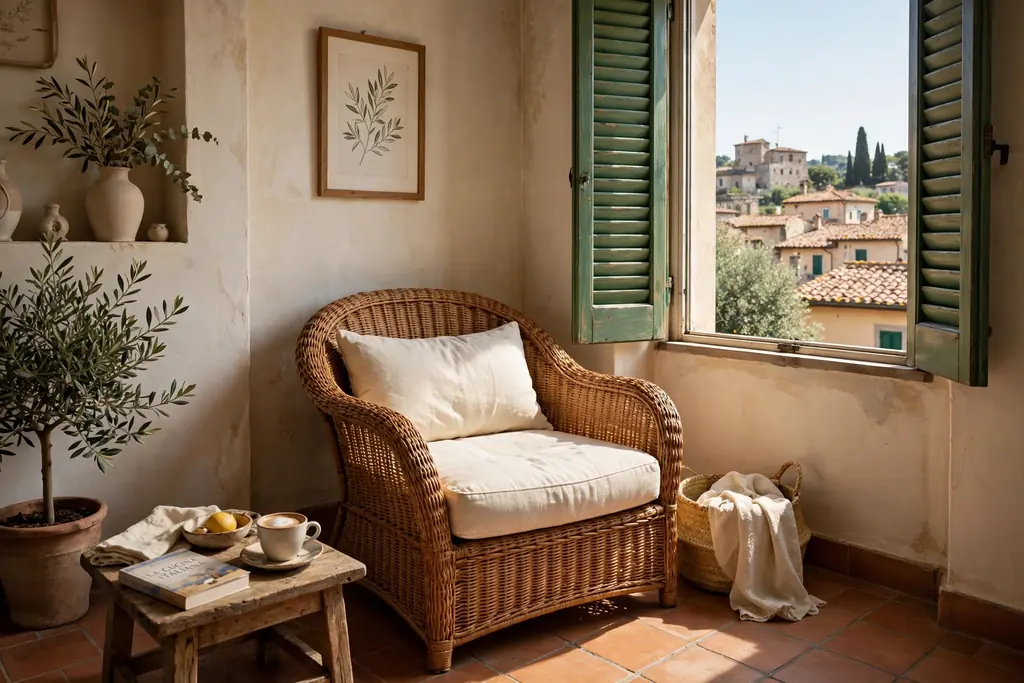
    4. Sage Botanical Wallpaper on One Wall

    Bedroom with a sage green botanical wallpaper feature wall behind a bed with cream bedding.

    Hang a sage botanical wallpaper on the bed wall for pattern that paint alone cannot give. A leaf or fern print in sage, cream, and a touch of deeper green adds a garden note to the room, and it suits a bedroom where the furniture is plain and the bedding is solid. Keep the other walls in a plain cream or pale sage pulled from the paper, so the pattern has room to breathe.

    Use the wallpaper on one wall only, and keep curtains and bedding mostly solid, so the room does not gain two competing patterns at once. Order an extra roll for matching and future repairs, since batches can vary. If you rent, look for a paste-the-wall or peel-and-stick paper that your lease allows, and test a sample in your light before you commit to the full wall.

    5. Sage Ceiling With White Walls

    Bedroom with a sage green painted ceiling, white walls, and a bed with cream bedding.

    Paint the ceiling in a soft sage and keep the walls white for a room that feels calm from above without a colored wall closing in the sides. This suits a bedroom with a simple bed and plain walls, where the ceiling is often the most ignored surface. A pale sage overhead reads as a gentle wash of color when you lie in bed, and it pairs well with white bedding and light wood.

    Keep the ceiling sage light, since a dark ceiling can make a low room feel lower. Paint the cornice or trim white to mark the edge cleanly, and repeat the sage once below, in a cushion, a throw, or a bench, so the ceiling color does not feel stranded. This is also a useful trick in a room where wall space is taken up by wardrobes or windows.

    6. Layered Sage and Cream Bedding

    Bed with layered sage green and cream bedding, a sage quilt, and a folded throw at the foot.

    Build the bed in layers of sage and cream, starting with cream or white sheets, adding a sage duvet or quilt, and folding a cream throw across the foot. The two tones give the bed depth without a pattern, and the layers let you adjust warmth through the night. This suits any bedroom, rented or owned, since it needs no paint or tools.

    Keep the palest shade closest to your face and the deeper sage toward the foot, which gives the bed a natural sense of order. Add cushions in linen and cotton, not all in the same fabric, so the bed feels soft to the touch as well as to the eye. Wash the throw and cushion covers on a regular cycle, since pale sage shows dust and marks sooner than darker colors.

    7. Sage Velvet Upholstered Headboard

    Bedroom with a tall sage green velvet headboard, cream bedding, and bedside lamps.

    Choose a tall sage velvet headboard for a soft focal point that makes the bed feel dressed even when the rest of the room is plain. Velvet catches light in a way flat fabric does not, so the headboard adds interest without a pattern or a bold color. Pair it with cream bedding and one or two cushions in a deeper green, and keep the wall behind it plain so the texture stands out.

    This suits a bedroom where the bed sits against a long blank wall. Measure the headboard width against the bed and the wall, since a headboard that is too narrow looks lost and one that is too wide crowds the nightstands. Vacuum the velvet gently with an upholstery tool, since the pile can trap dust over time, and keep it clear of direct sun if the color matters to you.

    8. Sage Linen Curtains Hung High and Wide

    Bedroom window with floor-length sage green linen curtains and soft filtered daylight.

    Hang sage linen curtains high and wide at the bedroom window for soft light and a fabric layer that hard surfaces lack. Linen filters daylight gently, which suits sage walls, since harsh light can make sage look washed out. Hang the rod close to the ceiling and wide enough that the panels clear the window frame when open, so daylight still fills the room.

    Choose a sage a shade deeper than the walls so the curtains read as a deliberate layer, not a match that disappears. For more window ideas that soften a bedroom and add a fabric layer, see these bedroom curtain ideas. Line the curtains if the room faces a street at night, and keep the fabric clear of radiators and heaters.

    9. Light Oak Bed Frame With Sage Bedding

    Bedroom with a light oak bed frame, sage green bedding, and oak nightstands.

    Pair a light oak bed frame with sage bedding for warmth that painted furniture cannot give. The oak grain softens the green, suits farmhouse, Scandinavian, and transitional rooms, and works with white, cream, and beige walls alike. A simple slatted or solid oak headboard keeps the look calm, while the sage bedding supplies the color.

    Keep one oak tone across the main pieces, such as the bed and nightstands, so the room reads as settled rather than busy. Match the wood to your floor if you can: pale oak with pale sage, warmer oak with a deeper sage. Keep the finish matte or satin rather than high gloss, which can look harsh next to soft linen and cotton.
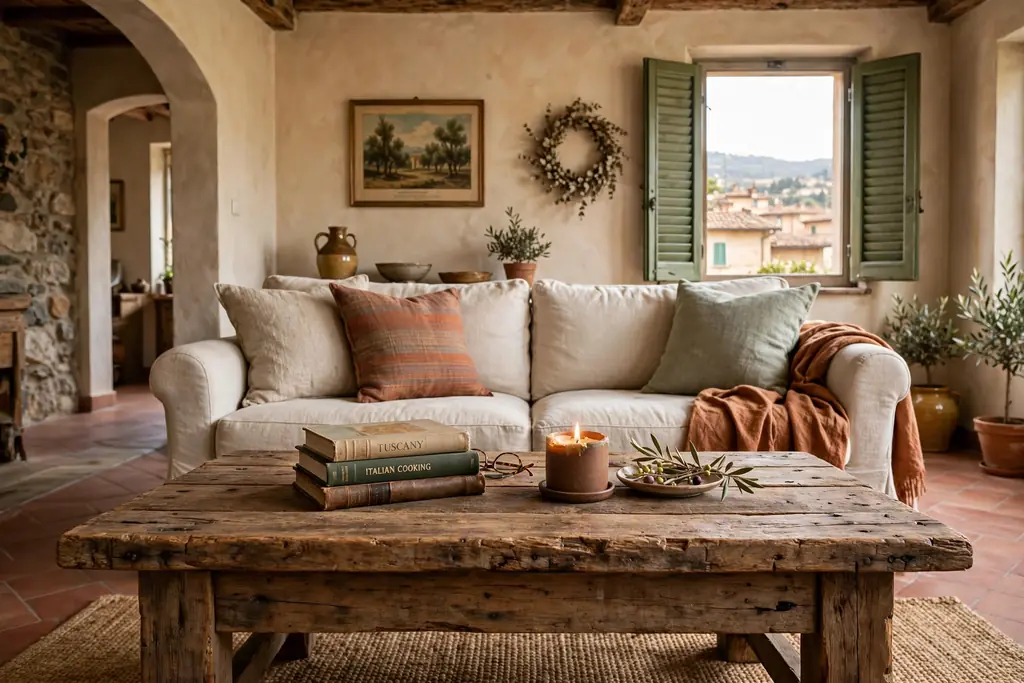
    10. Sage Painted Wardrobe Wall

    Bedroom with a sage green painted built-in wardrobe wall beside a bed with cream bedding.

    Paint a built-in wardrobe wall in sage so storage reads as part of the room rather than a block of furniture. Closed doors in a muted sage, with simple brass or wood handles, give a bedroom generous storage without a freestanding wardrobe taking over the floor. A few open shelves at one end, for books and a plant, stop the wall from feeling too solid.

    This suits a bedroom with no built-in closet, or a room where clothes and bedding need a proper home. Plan the interior before the doors: hanging space at one end, drawers in the middle, and high shelves for seasonal bedding. Measure door swings and drawer pulls carefully, since a wardrobe wall that blocks a walkway will annoy you daily.
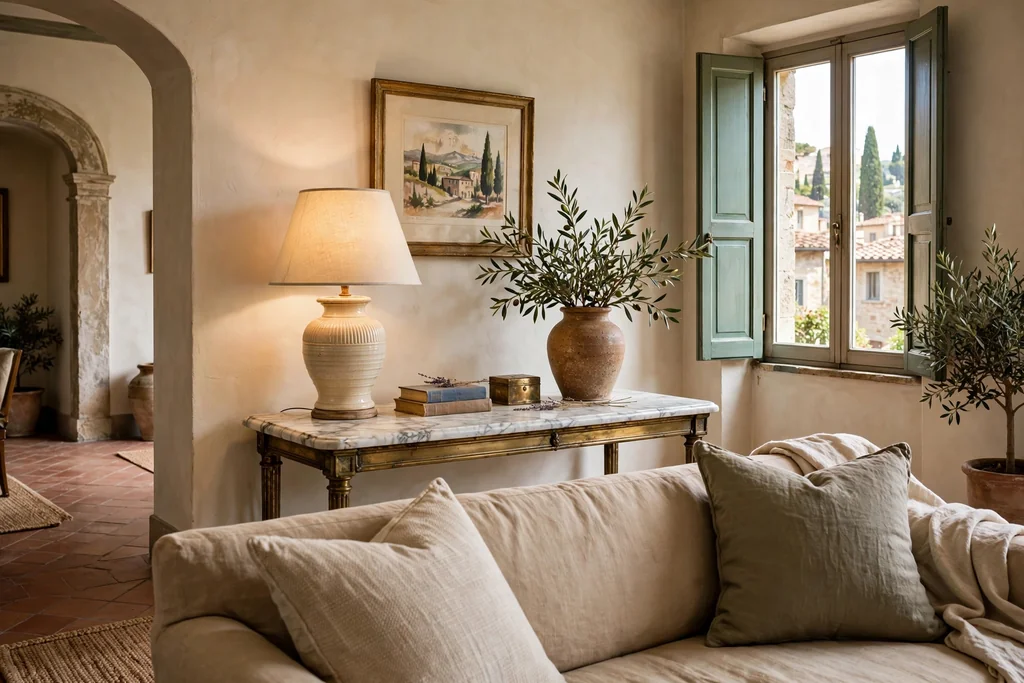
    11. Sage Painted Nightstands Beside a White Bed
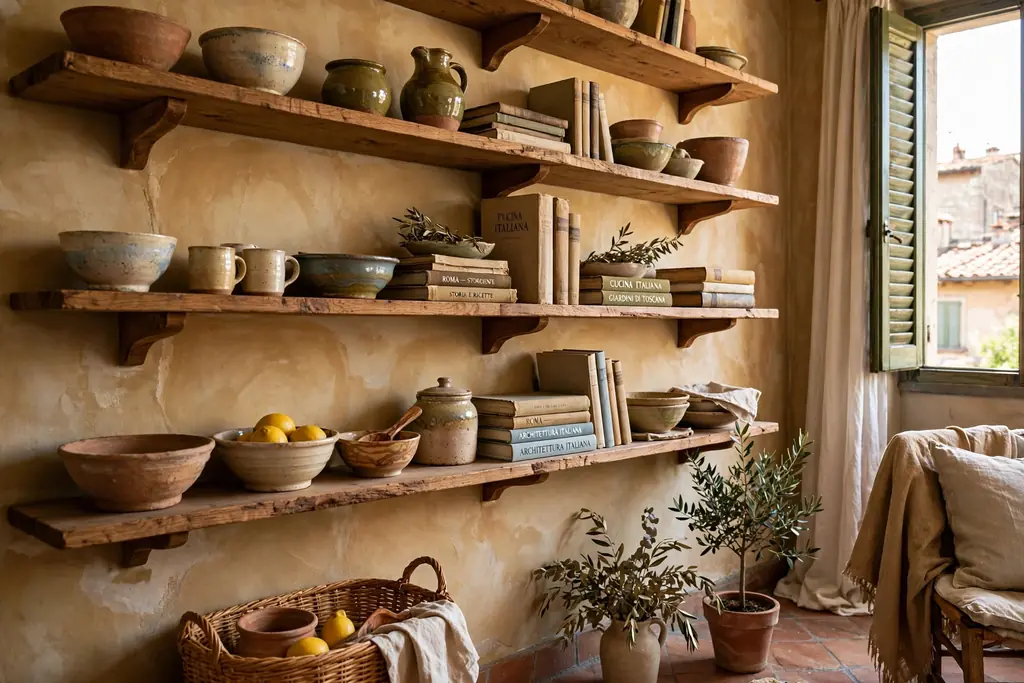
    Bedroom with a white bed flanked by two small sage green painted nightstands with lamps.

    Paint a pair of nightstands in sage and keep the bed white, so the color sits at bed height where you see it last at night. This is a lower risk change than painting a wall or a wardrobe, since two small pieces are easy to repaint later. The sage nightstands link to a sage cushion or throw on the bed, and the white bed keeps the room bright.

    Repeat one handle finish across both nightstands, such as brass or matte black, to tie them together. Keep the tops mostly clear, with a lamp, a book, and a glass of water, so the painted color stays visible. If the two nightstands do not match, paint them the same sage and they will read as a pair.

    12. Sage Reading Chair in a Quiet Corner

    Bedroom corner reading nook with a sage green armchair, a small side table, and a floor lamp.

    Place a sage upholstered chair in a corner with a small side table and a reading lamp, so the bedroom gains a second use that is still quiet. The chair gives you a place to read or dress that is not the bed, and the sage color marks the corner as its own place. A cushion in cream and a throw over the chair arm keep it inviting.

    This suits a bedroom with a window corner that currently holds nothing but a laundry basket. Choose a chair deep enough to sit in for an hour, not a stiff accent chair that looks good but stays empty. The same slow evening approach shapes these hygge bedroom ideas, where warm light and layered textiles come first. Keep a basket beside the chair for current books, so the corner stays tidy.
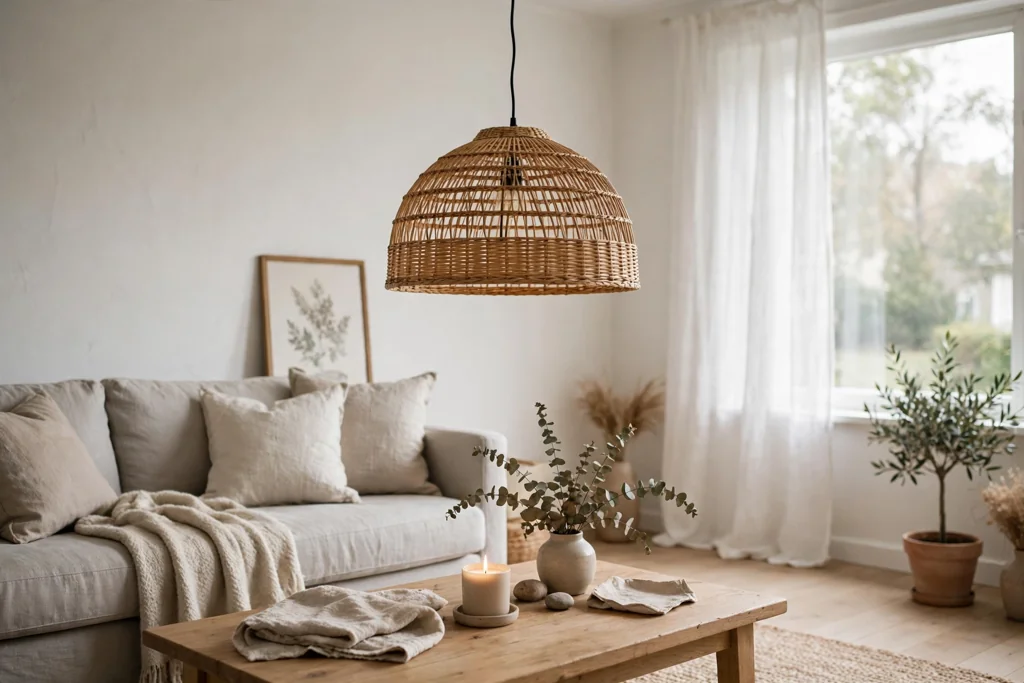
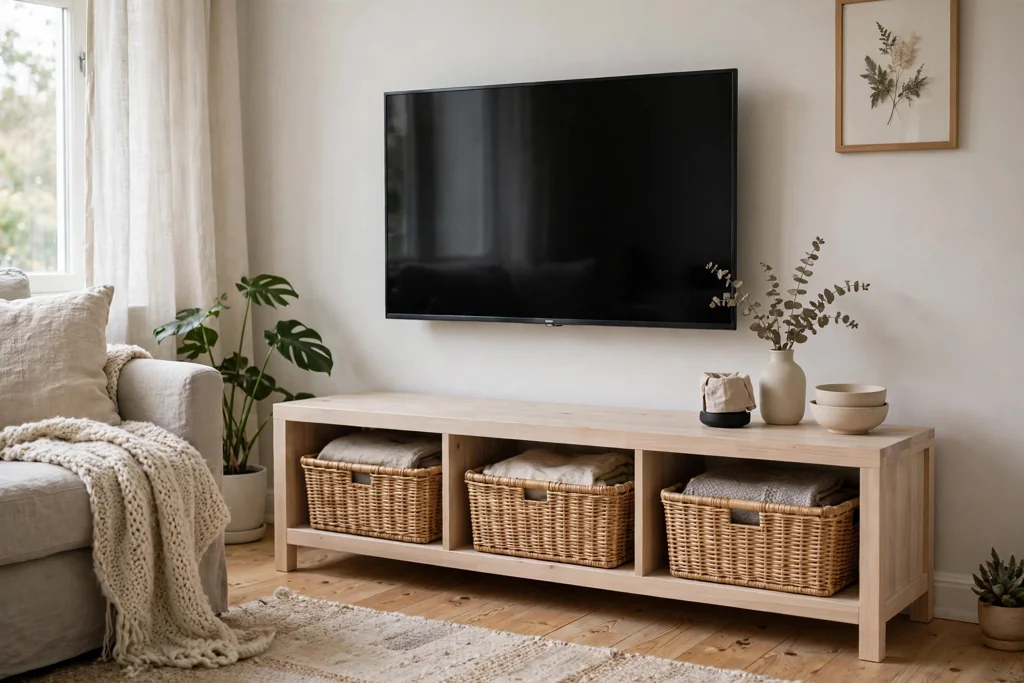
    13. Sage and Cream Rug Under the Bed

    Bedroom with a large sage green and cream rug under a bed with cream bedding.

    Lay a large rug in sage and cream under the bed to ground the room and warm up a hard floor. The rug adds a block of color at ground level, which balances a sage wall or sage bedding above, and it gives bare feet a soft place to land in the morning. Choose a low pile you can vacuum easily, and let the rug extend well beyond each side of the bed.

    This suits a bedroom with wood or laminate floors, and it works well when the rug pattern is quiet, such as a border or a simple stripe, rather than a busy print. Use a rug pad on smooth floors to stop slipping, and keep the rug pile low near the door swing. A washable rug is worth choosing if the room gets pet traffic or muddy shoes.

    14. Botanical Print Gallery Above the Bed

    Bedroom with a gallery wall of framed botanical prints in sage tones above a bed.

    Hang a gallery of botanical prints in sage tones above the bed for wall interest that needs no paint. Choose prints in sage, cream, and soft brown, with simple wood or black frames, and hang them in a loose grid or a single row. Mix leaf studies, fern shapes, and line drawings, but keep the palette tight so the wall feels calm.

    This suits a bedroom with a large blank wall that needs interest but not a feature color. Lay the frames on the floor first and plan the spacing, leaving equal gaps between frames, then hang the middle frame at eye level. Use picture hanging strips if you rent, and keep the largest frame in the center so the arrangement feels balanced.

    15. Brass Sconces Over Sage Nightstands

    Bedroom with brass wall sconces above sage green nightstands beside a bed with cream bedding.

    Fit brass wall sconces above sage nightstands to free up nightstand space and add a warm metal thread through the room. Brass warms sage in a way that chrome cannot, adding a soft golden note that suits traditional, farmhouse, and transitional bedrooms. Sconces at about bed height give reading light without a lamp base taking up the nightstand top.

    Match the brass to any other metal in the room, such as a mirror frame or drawer handles, so the finish reads as one thread. If brass feels too yellow beside your sage, pick a brushed or aged brass rather than a bright polished one. For a room with no wiring in the wall, plug-in sconces give the same look without building work.

    16. Rattan Headboard With Sage Bedding

    Bedroom with a natural rattan headboard, sage green bedding, and cream cushions.

    Pair a natural rattan headboard with sage bedding for a relaxed layer that suits casual and coastal rooms. The open weave lets light through, so the room keeps its airy feel, while the sage bedding supplies the color. Add a woven basket and a rattan pendant or tray to repeat the material once or twice, without filling the room with weave.

    This suits a bedroom that leans casual, and it pairs well with white walls and light wood floors. Keep rattan out of damp corners, since it can warp, and dust woven pieces with a dry cloth or a soft brush. If the room already has a lot of wood, use rattan in just one or two spots so the textures do not compete.

    17. Sage Bedding in a Small Bedroom

    Small bedroom with pale walls, a bed with sage green bedding, and white furniture.

    Use sage bedding as the main color in a small bedroom, and keep walls, furniture, and curtains pale, so the room feels calm without feeling smaller. A sage duvet and two sage cushions are enough to set the palette, and the bed, which takes up the most visual space, does the color work for the whole room. White walls and a mirror help the room stay bright.

    This suits a box room or a guest room where paint feels like a big step. Keep the rest of the palette to white, cream, and one light wood, and avoid a busy pattern on both the bedding and the rug at once. One runner on the side of the bed you use most gives the benefit of a rug without covering the whole floor.

    18. Sage and Beige, a Warm Pairing

    Bedroom pairing sage green walls with warm beige bedding and beige linen curtains.

    Combine sage walls or bedding with warm beige textiles for a pairing that feels soft and grounded. Beige acts as a warm neutral that bridges the gap between the cool green and the rest of the home, and it suits rooms where pure white feels too stark. Use beige for the rug, curtains, or a throw, and sage for the walls or the bed, so each color has a clear job.

    Layer different beige tones, from cream to warm taupe, against the sage, so the room has depth instead of one flat neutral. Keep the sage muted and grey toned, not bright or minty, so it sits back beside the beige rather than jumping forward. A wood bed frame or oak nightstands tie the two colors together.

    19. Sage Grounded With Charcoal Accents

    Bedroom with sage green walls, a black metal bed frame detail, charcoal cushions, and a black lamp.

    Add charcoal and black accents in small, hard items to ground a sage bedroom and stop pale colors from floating away. Use black in a metal bed frame detail, a lamp base, picture frames, or a tray, rather than in large blocks of fabric. Two or three dark touches are enough to give the room shape, while the sage still sets the mood.

    This suits a bedroom that feels too soft or washed out, and it works well in a room with modern furniture. Keep the black matte rather than glossy, which looks softer next to sage linen and wool. Avoid pairing black with a busy pattern, since the contrast will feel loud in a room meant for rest. A black framed mirror over a sage dresser is a simple place to start.

    20. Sage Dressing Table in a Corner

    Bedroom corner with a small sage green dressing table, a round mirror, a stool, and a lamp.

    Set a small sage dressing table in a corner with a mirror, a stool, and one lamp, so getting ready has a proper place that is not the bed or the bathroom. The sage table links to sage bedding or a sage wall, and the mirror adds light to the corner. Keep the tabletop mostly clear, with a tray for daily items, so the corner stays useful.

    This suits a bedroom with an unused corner near a window, where daylight helps for dressing. Choose a table deep enough for a mirror and a few items, but narrow enough to leave a clear walkway. If floor space is short, a wall mounted shelf with a mirror and a stool gives the same function in less room.

    21. Sage Storage Bench at the Foot of the Bed

    Bedroom with a sage green upholstered storage bench at the foot of a bed with cream bedding.

    Place a sage upholstered bench with storage at the foot of the bed for a place to sit while dressing and a home for spare bedding. The bench gives the bed a finished end, and the storage inside hides a spare blanket and out-of-season cushion covers. A folded throw on top links the bench to the bedding.

    This suits a bedroom with enough floor space to walk around the bench at night. Measure the bench width against the bed, since a bench wider than the bed crowds the room, and leave clear space at the sides for walking. In a short room, use a small ottoman instead, and check that it does not block a heat vent or a door.

    22. Renter Refresh With Sage Textiles Only

    Rental bedroom with white walls refreshed with sage green bedding, cushions, a throw, and curtains.

    Refresh a rented bedroom with sage textiles alone, using a sage duvet cover, sage cushion covers, a sage throw, and sage curtains, and leave the walls white. This is the fastest sage change, since every piece comes out again without marks, and it lets you test whether you like living with sage before you paint anything. Keep the textiles in two sage tones, not five, so the room reads as planned.

    Wash the set before you store it, and keep cushion covers in one bag so the next swap takes minutes. Use removable hooks for any wall art, and keep original fittings if you swap curtain hardware. This approach also suits a room you share, since the color change is easy to reverse if tastes differ.

    23. Sage Guest Bedroom That Feels Ready

    Guest bedroom with sage green walls, white and sage bedding, and a tray on the nightstand.

    Use sage in a guest bedroom for a room that feels fresh and calm without a personal style that guests must live around. Pale sage walls, white bedding with a sage throw, and a clear nightstand give guests a restful room that is easy to reset between visits. Add a small tray with a carafe and a towel on the nightstand, and keep a spare blanket in the wardrobe.

    This suits a spare room that doubles as a study or a storage room, since sage works beside a desk and shelves as well as beside a bed. Keep surfaces mostly clear, and leave one empty drawer or a luggage rack for guest belongings. Wash the throw and the spare blanket between visits, so the room always feels ready.

    24. Sage Cushions on a Window Seat

    Bedroom window seat with sage green cushions, cream pillows, and a folded throw.

    Dress a window seat with sage cushions, cream pillows, and a folded throw for a reading spot that uses space a bed or a chair cannot. The sage cushions link the seat to sage bedding or a sage wall, and the window light makes the green look fresh through the day. Add a small shelf or basket beside the seat for books.

    This suits a bedroom with a bay window or a deep sill that is wide enough to sit on. Measure the seat depth before you buy cushions, since a cushion that is too deep pushes you forward, and keep the throw washable, since a window seat takes daily use. If the seat is narrow, one long cushion and two pillows are enough.

    25. Plants and Eucalyptus With Sage Walls

    Bedroom with sage green walls, potted plants, and a vase of eucalyptus stems on a dresser.

    Add potted plants and a vase of eucalyptus stems to a sage bedroom, so the green on the walls meets real green in the room. The silver green leaves of eucalyptus sit close to sage paint, which makes the room feel linked to the outdoors without a new color. Place one tall plant near the window and a small vase on the dresser, and leave the rest of the surfaces clear.

    This suits a bedroom with enough daylight for the plants you choose, and it works best when you keep the plant count low, so the room stays restful. Check that each plant suits your light and your home, and keep plants out of reach if pets chew leaves. If real plants do not suit you, dried eucalyptus in a vase gives the same note with no watering.

    26. Layered Evening Light in a Sage Bedroom

    Sage green bedroom in the evening with warm bedside lamps and a soft glow.

    Plan evening light in layers for a sage bedroom, using warm bedside lamps, a dimmed ceiling light, and one small glow, such as a candle on a tray or a warm LED candle, on the dresser. Sage looks softer under warm light than under a single bright ceiling light, and low light helps the room feel settled before sleep. Put switches within reach of the bed so you do not cross a dark room.

    This suits any sage bedroom, since the paint and bedding choices are already made and light is what changes the mood at night. Use warm bulbs in the bedside lamps, and keep the ceiling light low or off in the evening. If one side of the bed lacks a lamp, a plug-in wall light needs no rewiring and frees space on a small nightstand.

    Conclusion

    A sage green bedroom works best when sage is one calm family of tones and textures, not a single shade repeated everywhere. Start with the layer you notice most, usually walls or bedding, then add wood, linen, and woven texture, and finish with one warm metal and one quiet dark accent. Keep the palette tight, let light in during the day, and layer warm light at night, so the room feels relaxed and pulled together rather than flat.

    Save this list on Pinterest before you start, and work through it one idea at a time: bedding and curtains first for a quick refresh, then a painted wall or a piece of furniture, then storage and light when you have a weekend to spare. For a seasonal version of the same calm approach, see these fall bedroom decor ideas.

    FAQs

    What color goes best with sage green in a bedroom?

    Warm white, cream, beige, light oak, rattan, brass, and charcoal all sit well with sage. Use sage as the main color and repeat one or two companions in at least two places, such as bedding and curtains, so the room looks planned. Avoid bright or neon colors in large blocks, since they fight the muted green and make the room feel restless.

    Will sage green make a small bedroom look smaller?

    Not if you keep the sage light and limit it to one main layer, such as the bedding or one accent wall, with pale walls and furniture elsewhere. Pale sage close to grey green reads as a soft neutral, and white trim, a mirror, and good daylight keep the room bright. Avoid dark sage on all four walls in a small room, since that can close the space in.

    Should I paint all the walls sage or just one?

    One accent wall suits a first step and a room where you want color without a full repaint, while pale sage on all four walls suits a main bedroom with good daylight. Test a large swatch on two walls first, one facing the window and one facing away, and look at it in morning and evening light. If you rent or feel unsure, start with sage bedding and curtains, which reverse in minutes.

    How do I stop sage green from looking grey or minty?

    Check the undertone of every sample beside your bedding, floor, and wood tones, not on its own. Sage with a grey base looks calm and muted, while sage with a yellow base looks warmer and sage with a blue base can read as minty under cool light. Test samples in your own light, and keep nearby whites in the same warm or cool family, so one item does not make the rest look off.

    Can renters use sage green bedroom ideas without painting?

    Yes, most of them need no fixed changes. Bedding, throws, cushion covers, curtains, a rug with a pad, framed prints on removable hooks, and a painted nightstand you own all come out again without marks. Check your lease before drilling or changing curtain hardware, and keep original fittings if you swap any hardware so you can restore the room later.

    Is sage green hard to keep clean in a bedroom?

    Pale sage shows dust and marks sooner than mid tones, so plan for it rather than avoiding the color. Choose washable paint finishes, washable cushion and throw covers, and a low pile rug you can vacuum easily. A quick wipe of painted nightstands and a regular wash of the throw keep the room looking fresh without constant deep cleaning.