Category: DIY & Styling

Simple styling projects and affordable ways to refresh your home.

  • 22 Easy Room Decor Ideas That Feel Both Cozy and Current

    22 Easy Room Decor Ideas That Feel Both Cozy and Current

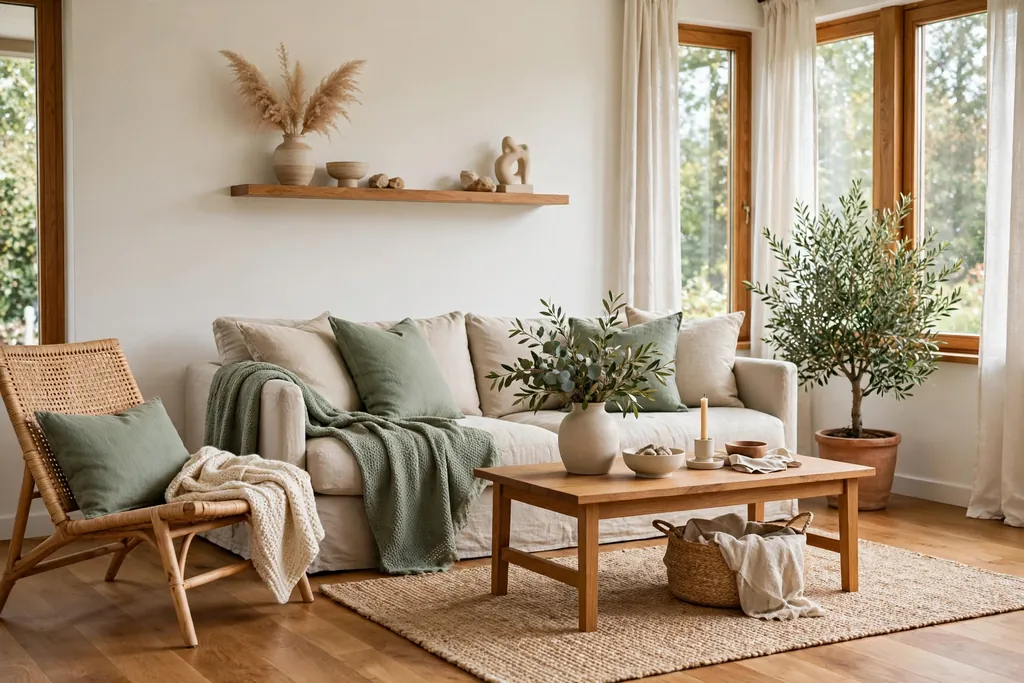
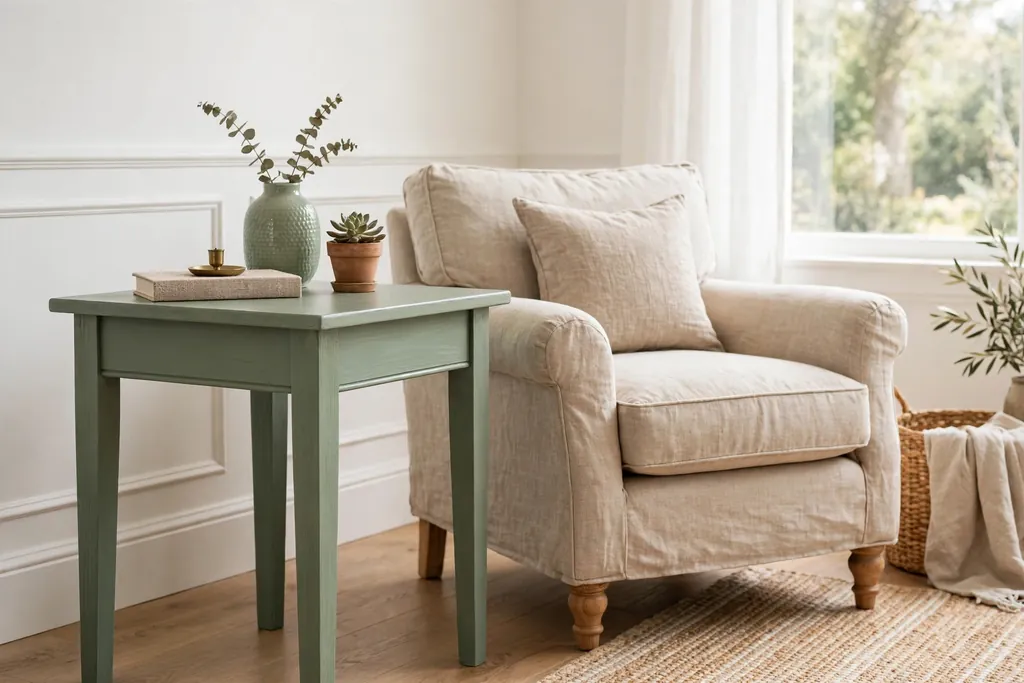
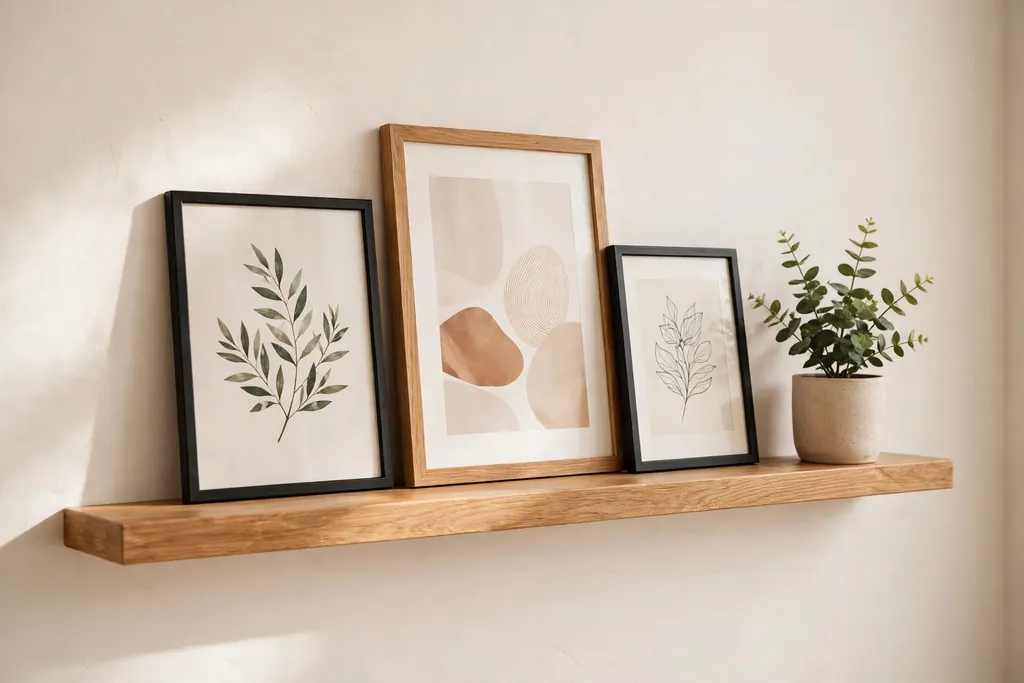
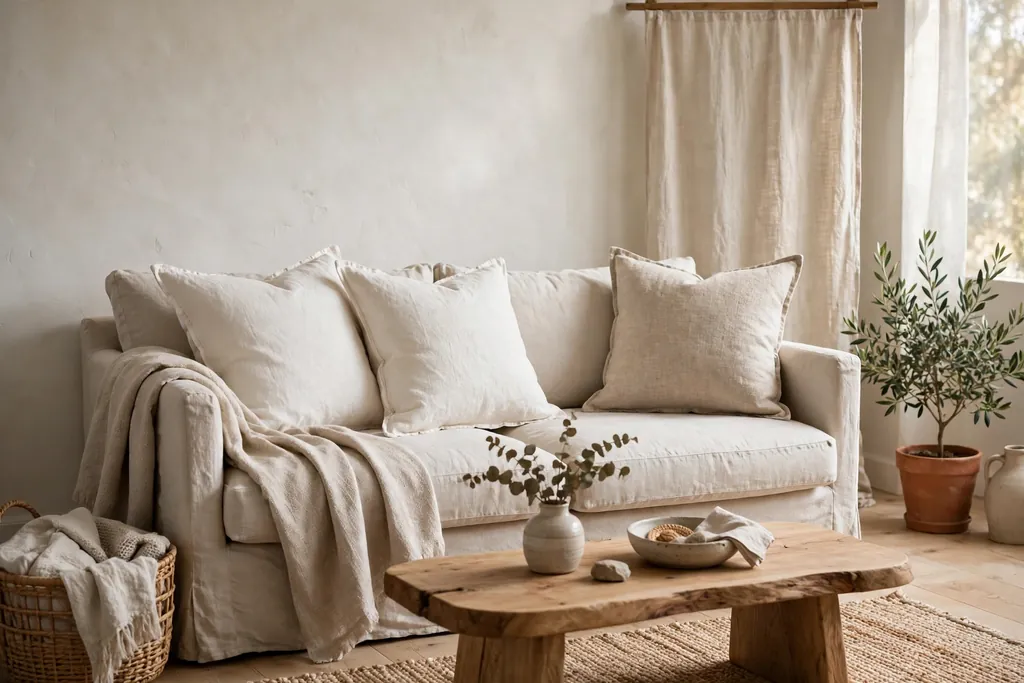
    A room can feel cozy and current at the same time when soft textures meet clean, simple shapes. You do not need new furniture or a full renovation to get there. Small changes in lighting, textiles, and styling often make the biggest difference, because they change how a room feels when you walk in and how it works day to day. These 22 easy room decor ideas cover living rooms, bedrooms, entries, and small corners, so you can start with one idea or combine a few across a weekend. Pick a calm base, repeat one or two materials, and add warmth where you sit, read, and rest most.

    Key Takeaways

    • Layer light at different heights, with lamps and candles beside overhead light, so rooms feel warm in the evening.
    • Keep one calm base of warm white, cream, and soft neutrals, then add one accent color in small, repeated doses.
    • Use texture to add coziness: linen, wool, woven baskets, wood, and a soft rug underfoot.
    • Give each room one clear focal point, such as art, a rug, or a styled shelf, and keep nearby surfaces quiet.
    • Start with swaps you can reverse, such as cushions, curtains, throws, and styling, before you commit to paint or wallpaper.
    • Repeat plants, wood, or baskets in more than one room so the whole home feels connected.

    1. Layer Light at Different Heights
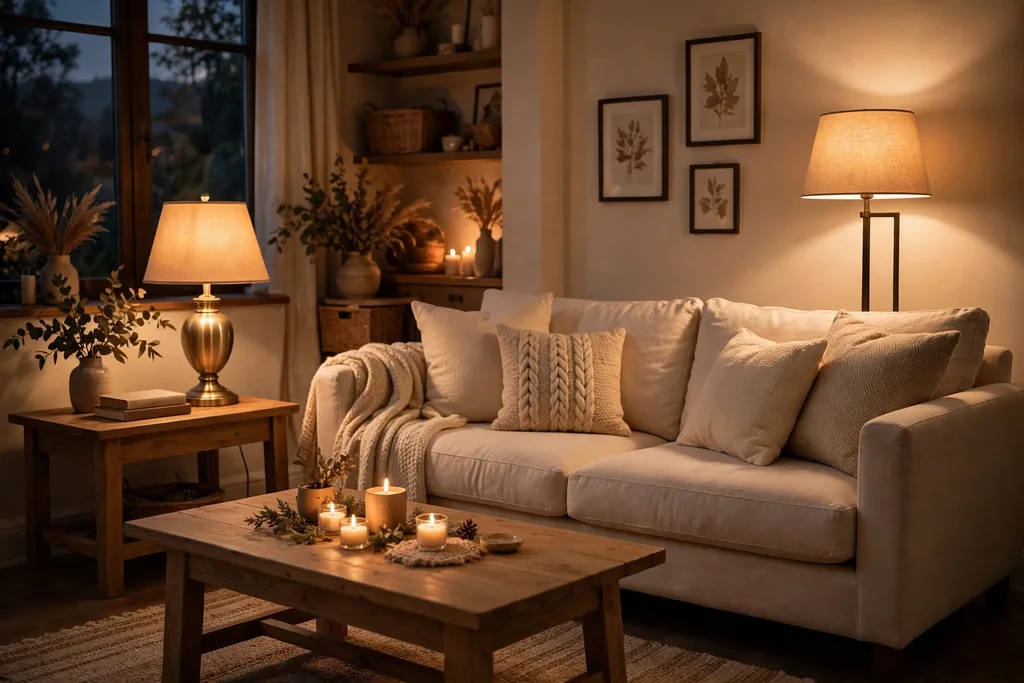
    Cozy living room in the evening with a warm table lamp, a floor lamp, and candles on a coffee table.

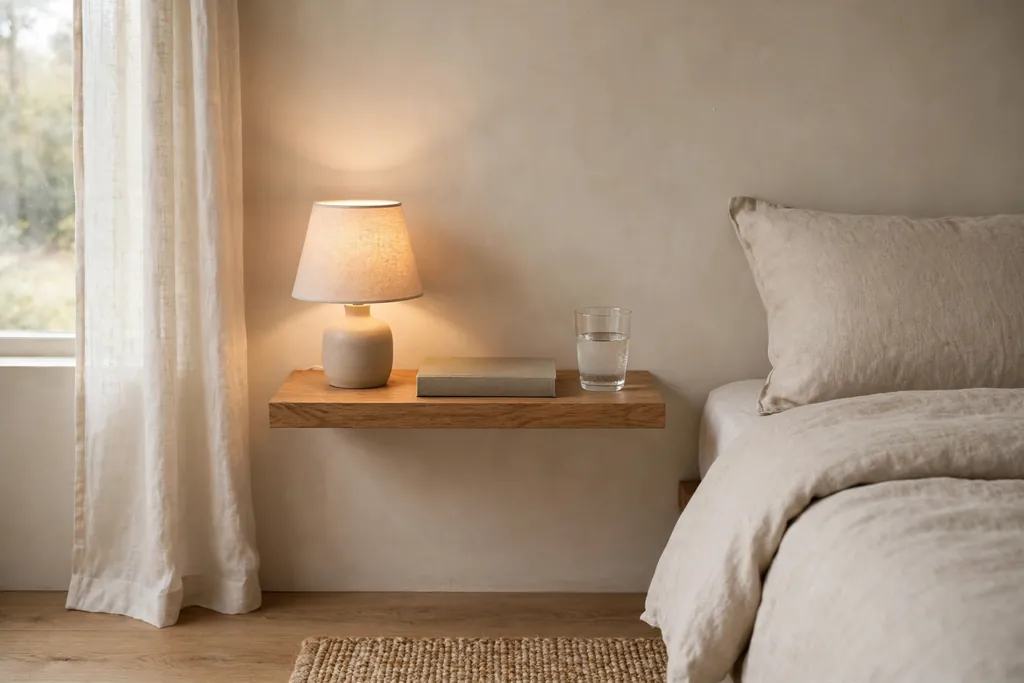
    Layered lighting makes a room feel cozy after dark, when a single ceiling light can feel flat and harsh. A table lamp beside the sofa, a floor lamp in a corner, and a small candle group on a side table each add light at a different height, so the room glows rather than glares. This suits almost any room, and it works well in rentals, since lamps need no wiring changes.

    Start with warm bulbs, and put the brightest lamp where you read or work. Keep cords tidy behind furniture, and use a dimmer or a lower watt bulb where the light feels too strong. If a room still feels dark in one corner, add a small lamp there instead of a brighter ceiling bulb, so the light stays soft and even across the room.

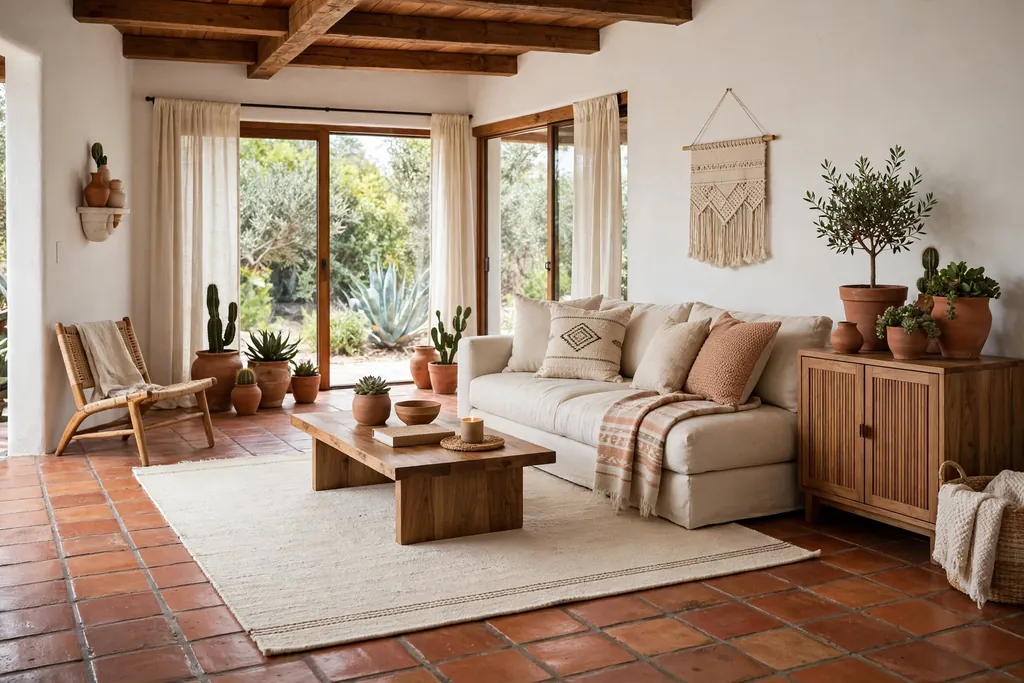
    2. Anchor the Room With a Large Textured Rug
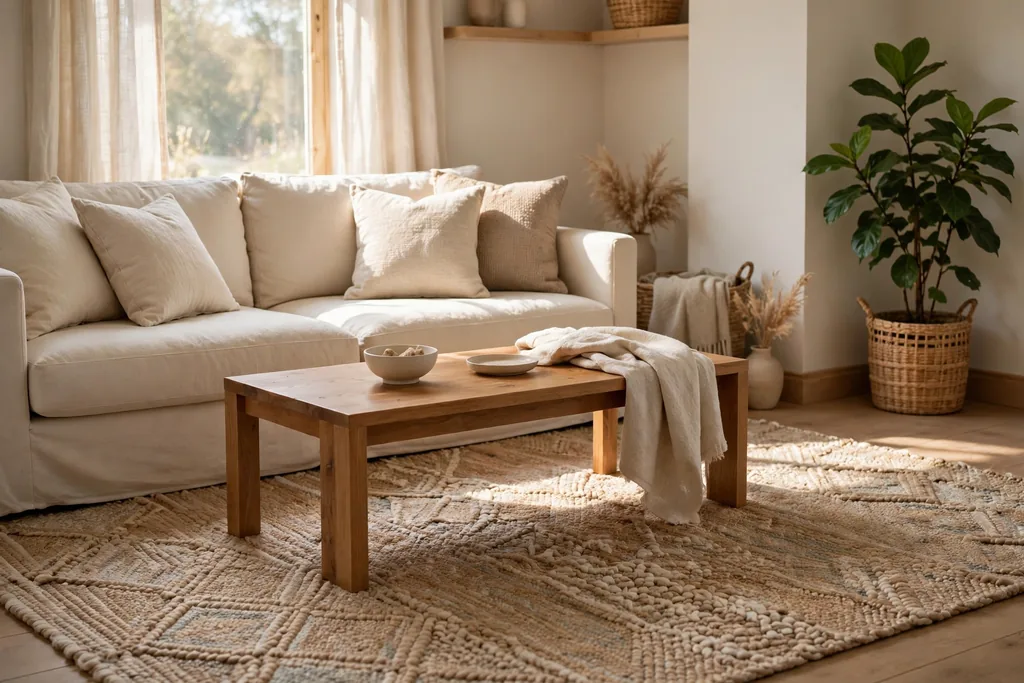
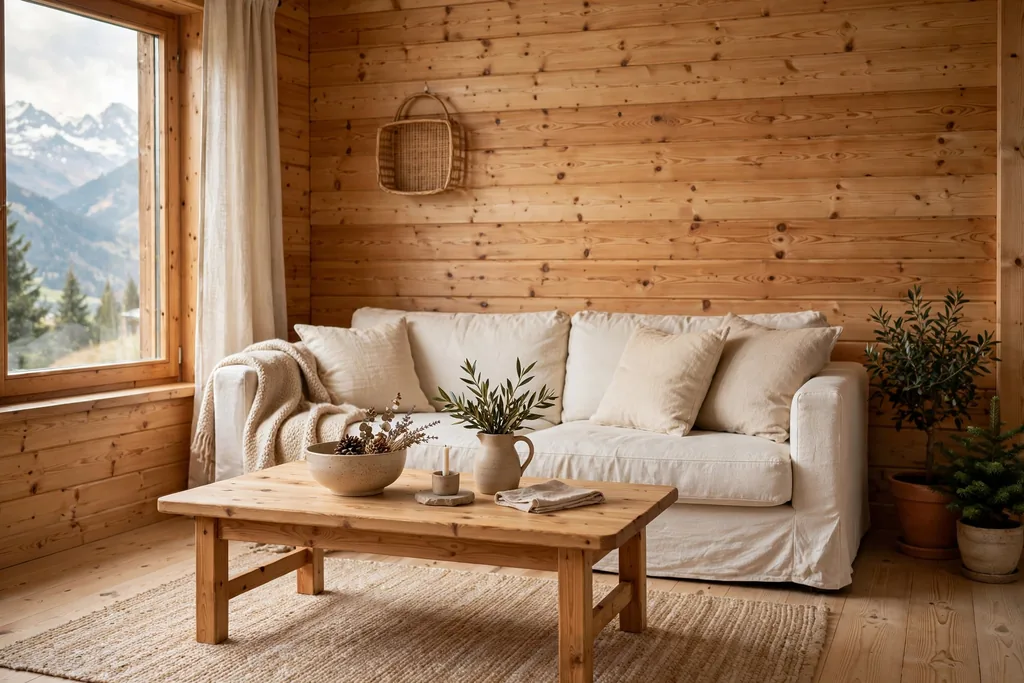
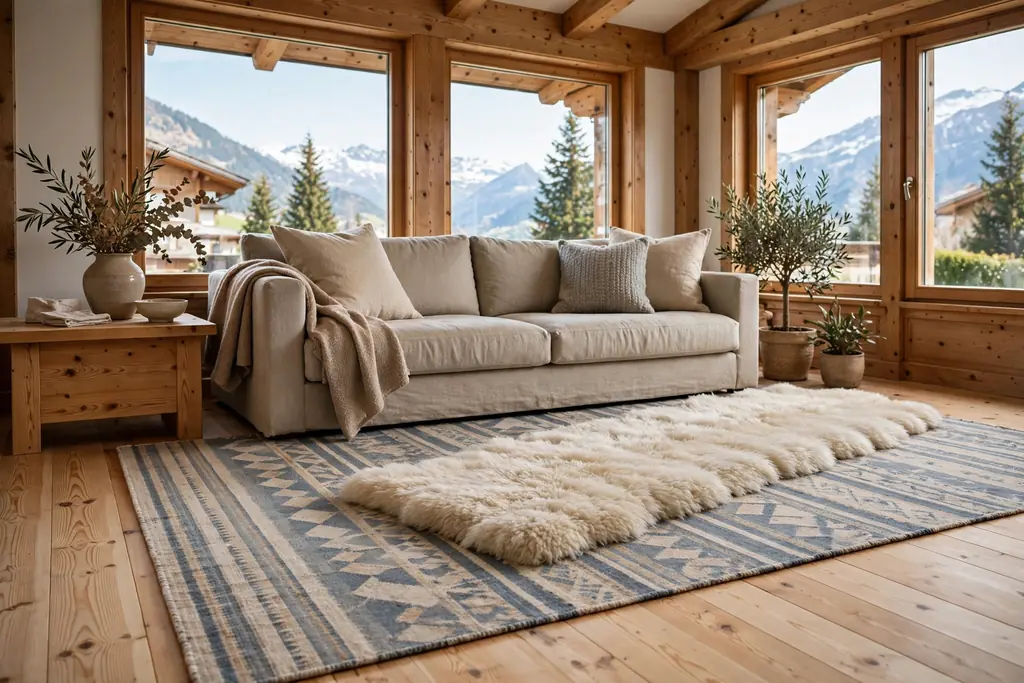
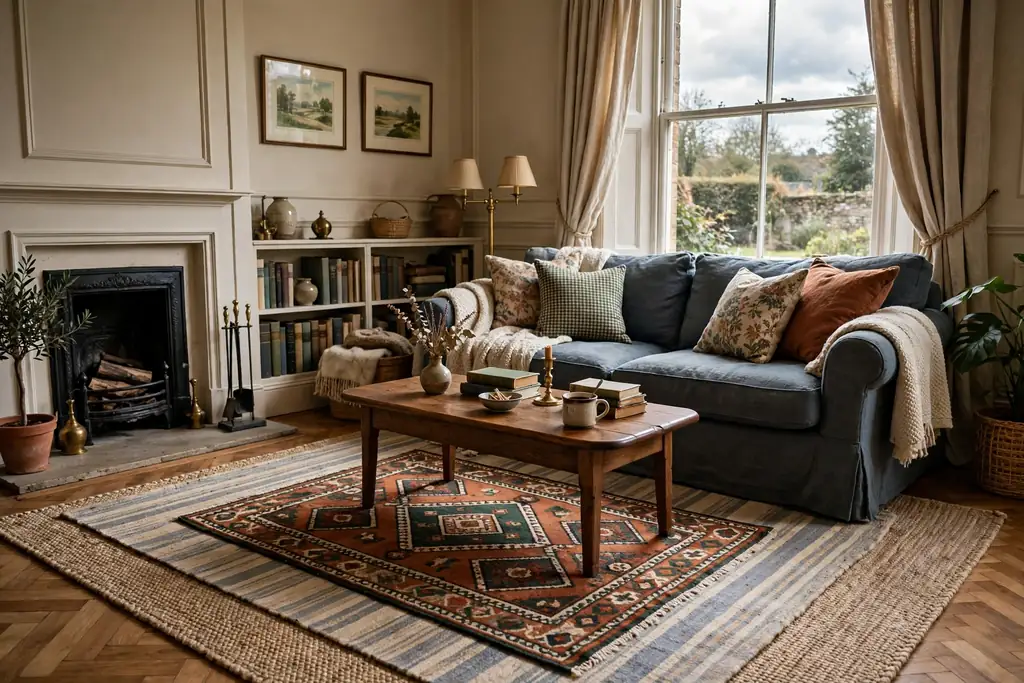
    Living room with a large textured woven rug under a cream sofa and a wood coffee table.

    A large textured rug anchors seating and makes a bare floor feel warm underfoot. Choose a rug big enough for the front legs of the sofa and chairs to sit on it, so the seating group reads as one area rather than separate pieces. A flatweave, wool, or woven cotton rug in a soft neutral suits most rooms and lets cushions and art carry the color.

    Keep the rug pattern simple if your sofa already has pattern, and vacuum often in a busy room, since textured fibres show dust. If you already own a smaller rug you like, layer it over a larger plain base rug, with a clear margin on all sides, and use a gripper pad underneath so the top layer does not slide.

    3. Hang Long Linen Curtains Close to the Ceiling
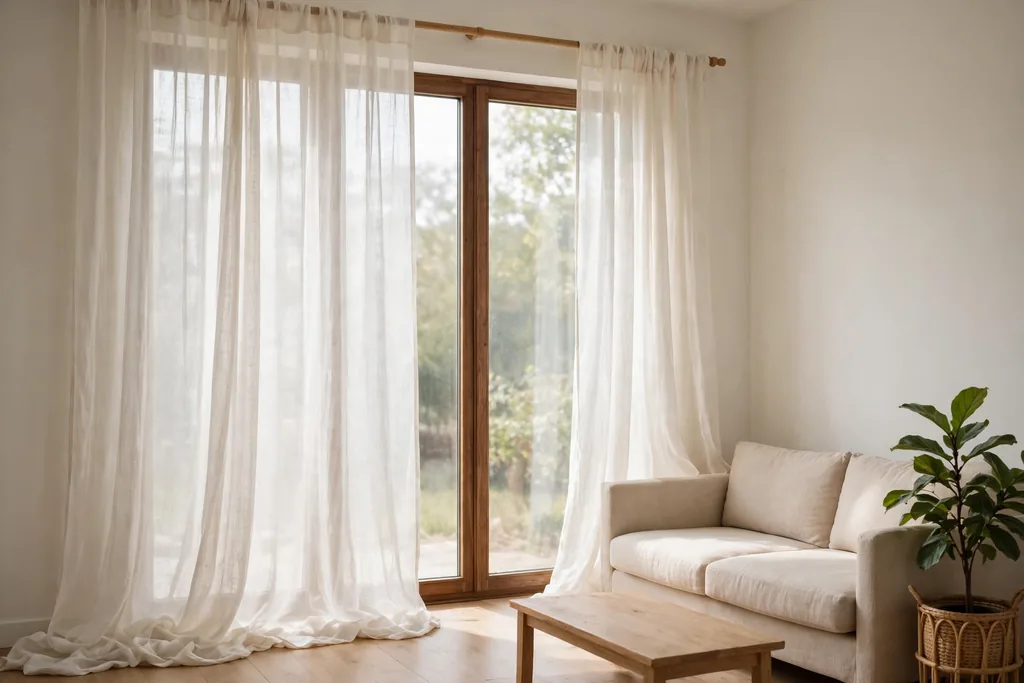
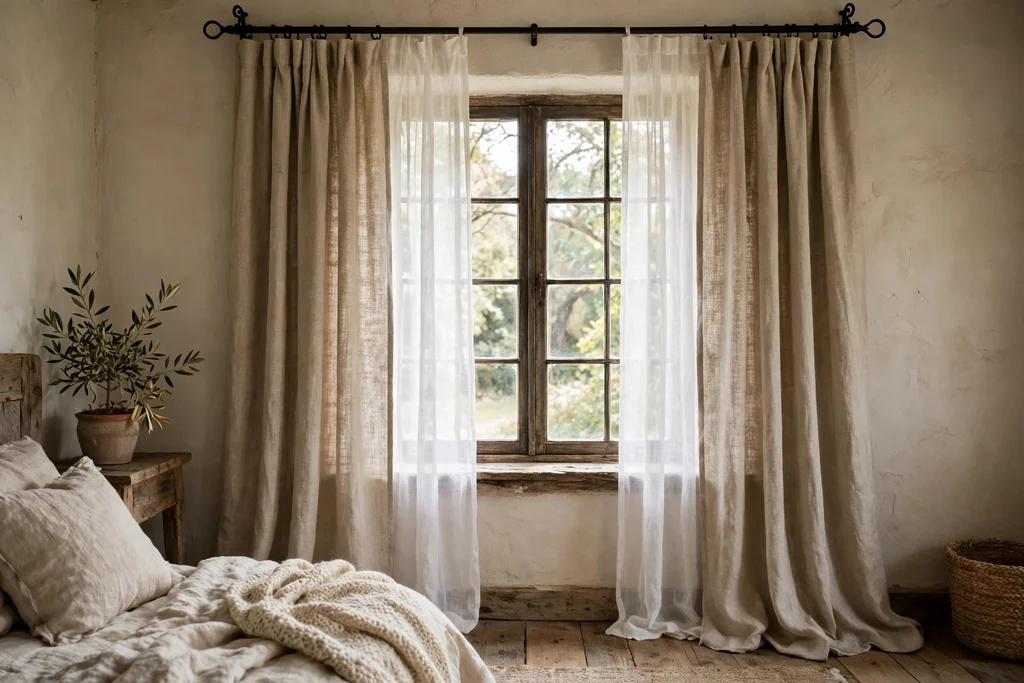
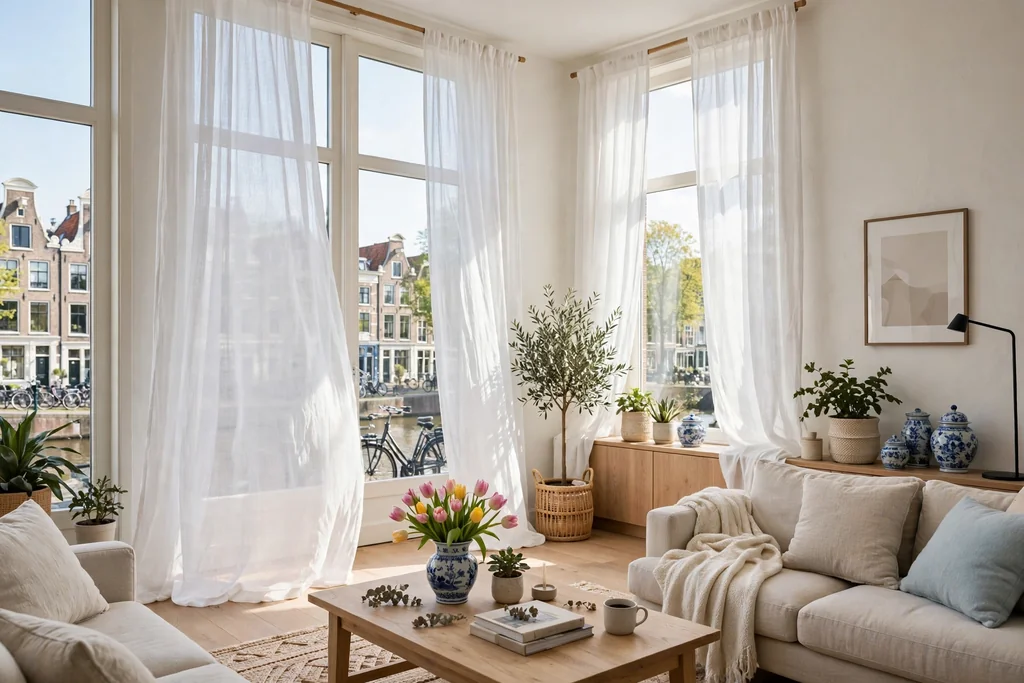
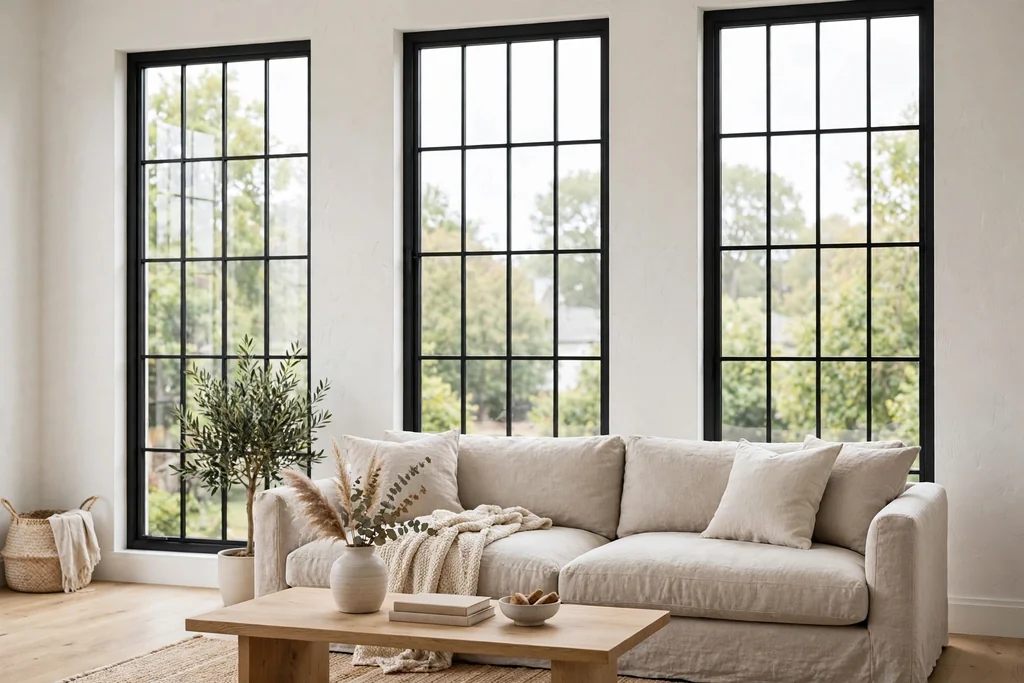
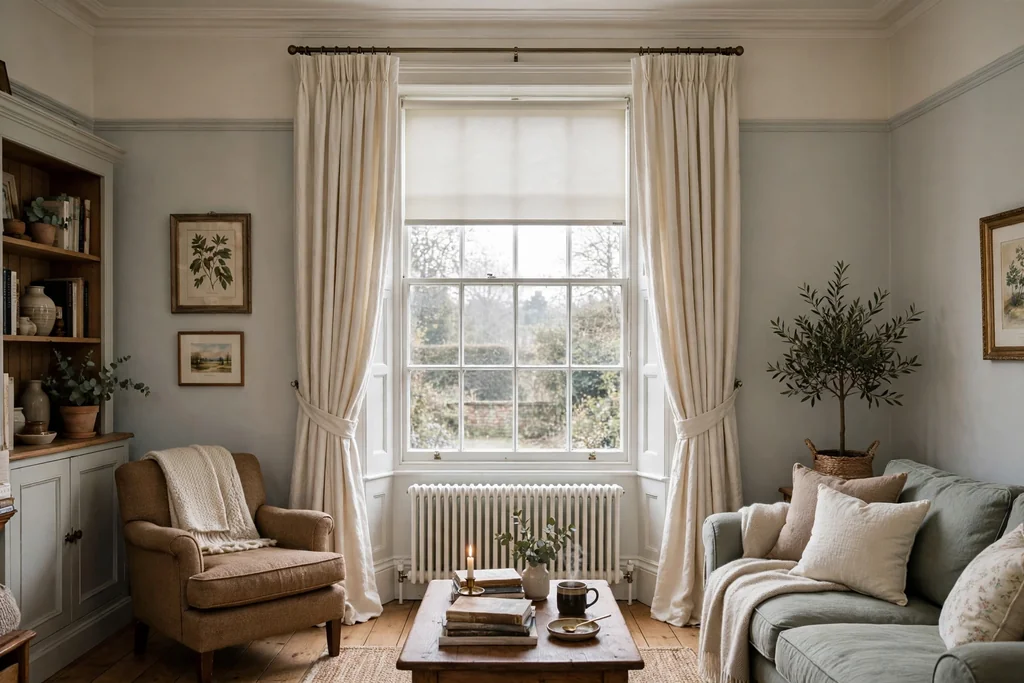
    Bright room with long sheer linen curtains in warm white hanging beside a large window.

    Long linen curtains soften a window wall and make a ceiling feel taller, even in a small room. Hang the rod close to the ceiling and wide enough that the curtains clear the window frame when open, so daylight still fills the room. Warm white, oatmeal, or soft grey linen suits a cozy, current look, and sheer layers work well where you want light without a bare window.

    Measure twice before you buy, since curtains that stop above the floor can make a room look unfinished. Let the fabric just touch the floor, and steam or wash it as advised on the label before hanging, so the linen falls in soft folds. Pair plain curtains with a simple wood or black rod, and keep the rest of the window wall free of clutter.

    4. Layer Throws and Cushions in One Palette
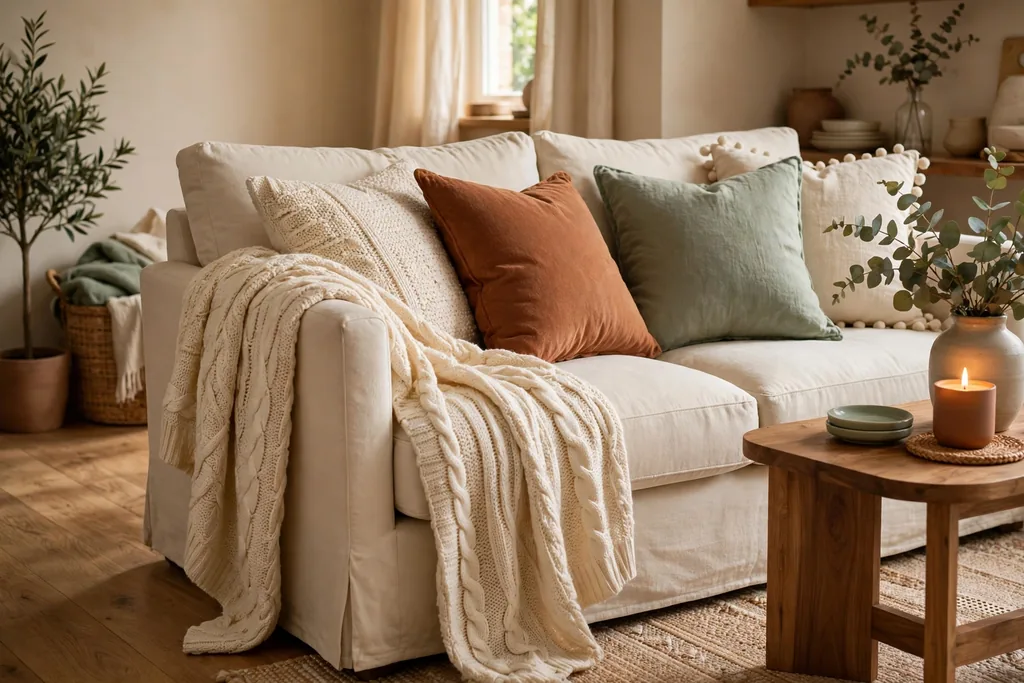
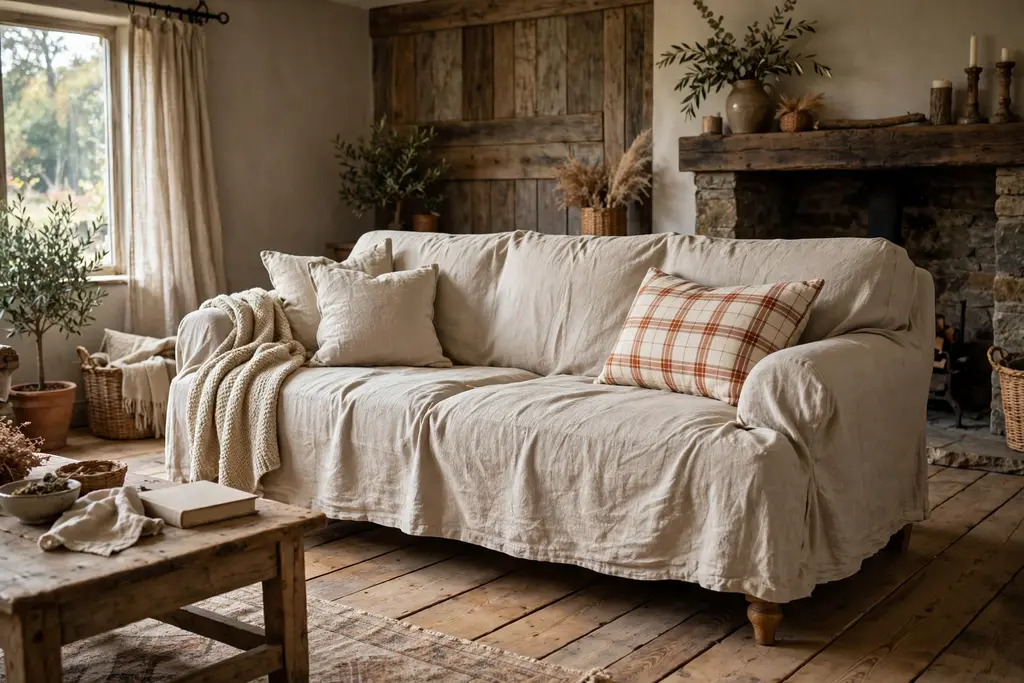
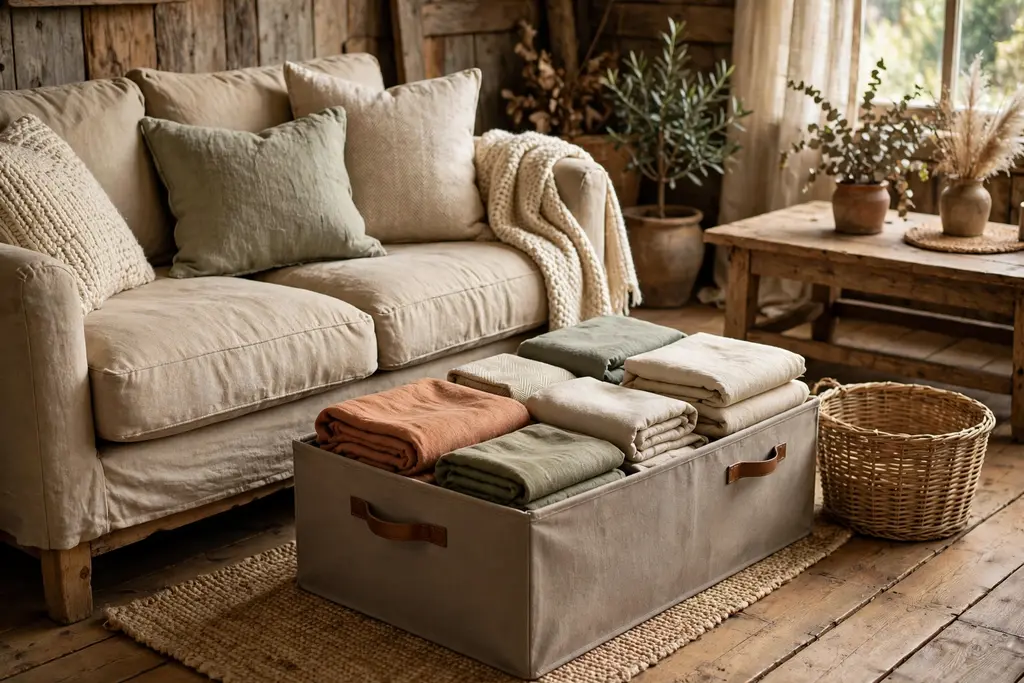
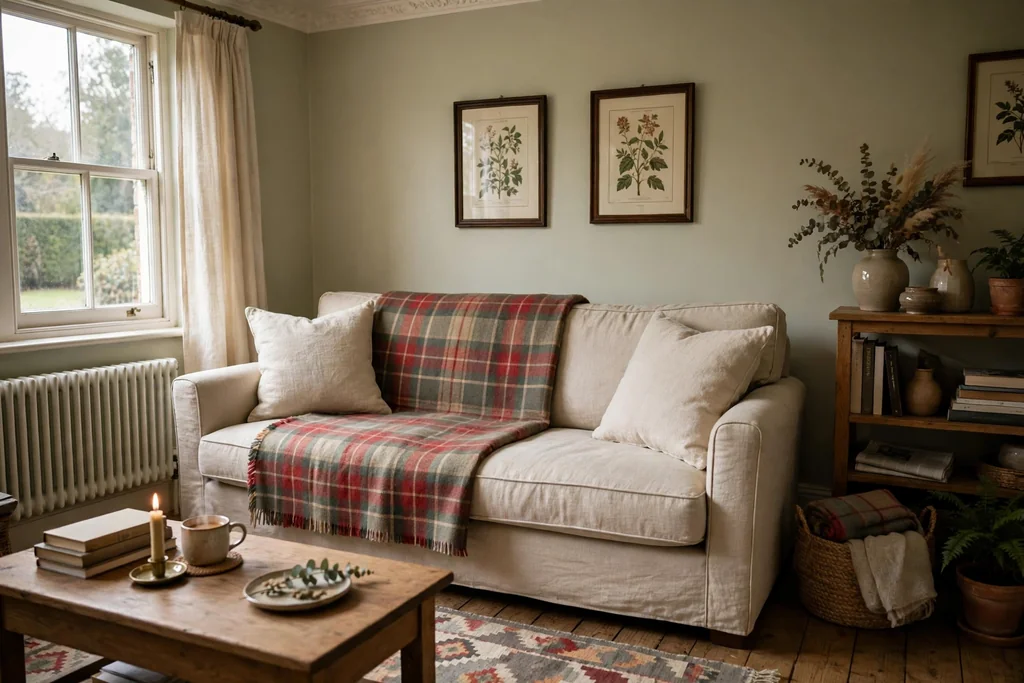
    Sofa layered with soft throws and cushions in cream, rust, and sage, with a knit throw over one arm.

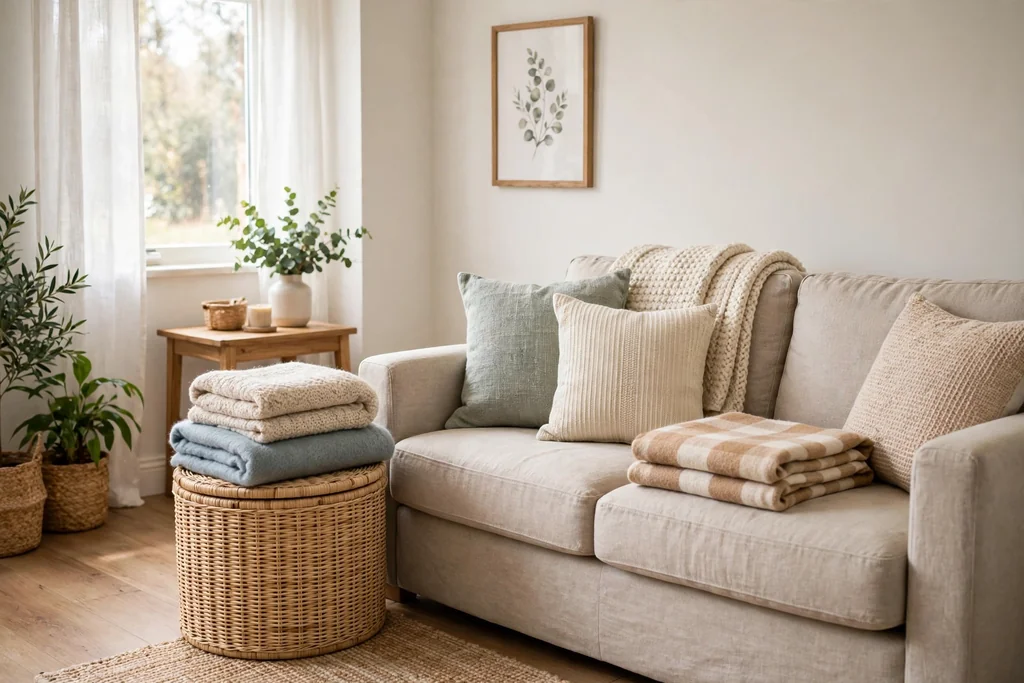
    Throws and cushions are the fastest way to make a sofa or bed feel cozy, and they cost far less than new seating. Pick one palette, such as cream, rust, and sage, and use it across the cushions, a throw over one arm, and a folded throw in a basket nearby. The repeat makes the room look planned, even when the pieces come from different shops.

    Mix textures rather than patterns: pair smooth linen cushions with a chunky knit throw and one velvet cushion, and keep the total count modest so the sofa stays easy to sit on. Swap cushion covers with the seasons if you want a fresh look, and store spare covers in a basket or a drawer, so the change takes minutes rather than a shopping trip.

    5. Hang One Oversized Piece of Art

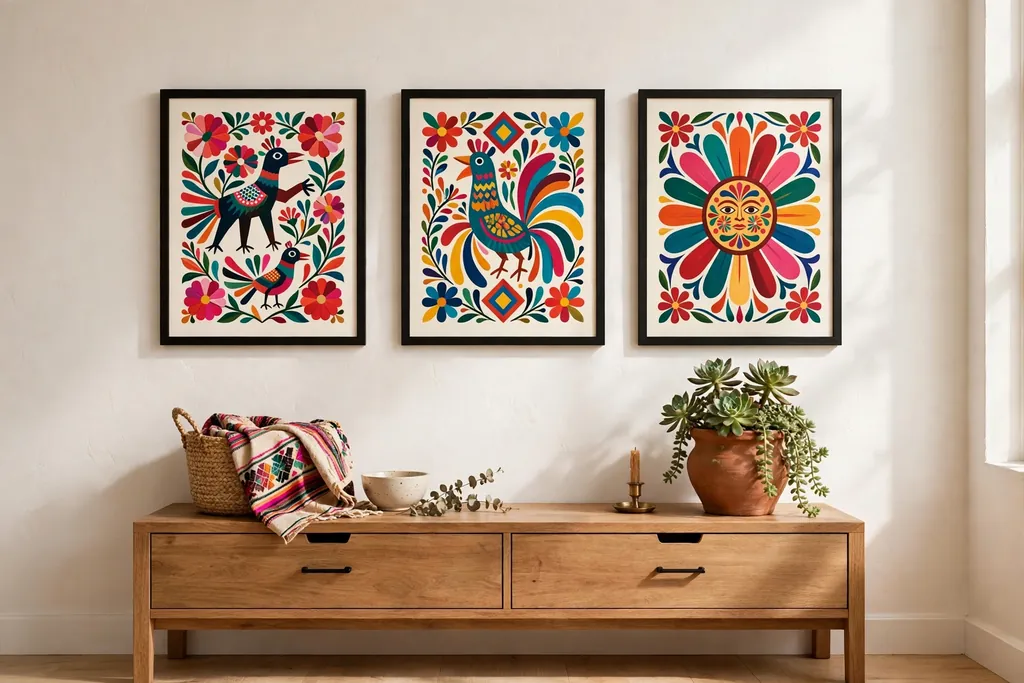
    Living room with one oversized framed print in warm earth tones hanging above a plain sofa.

    One oversized piece of art gives a room a clear focal point and can make a plain wall feel finished in a single step. Choose art with warm, earthy tones and a simple frame, and hang it above a sofa, a bed, or a console table, with its centre near eye level. A large print suits a room where smaller frames would look lost, and it keeps the wall calm, since one strong image replaces a busy mix.

    Leave breathing room around the frame, and keep the furniture below it simple, so the art stays the feature. If a large framed print is out of reach, try a large canvas or a framed textile, and check the wall fixing suits the weight before you hang it. For more ideas on giving a room a warm focal point, see these stylish rustic decor ideas.

    6. Build a Small Gallery Wall With Matching Frames
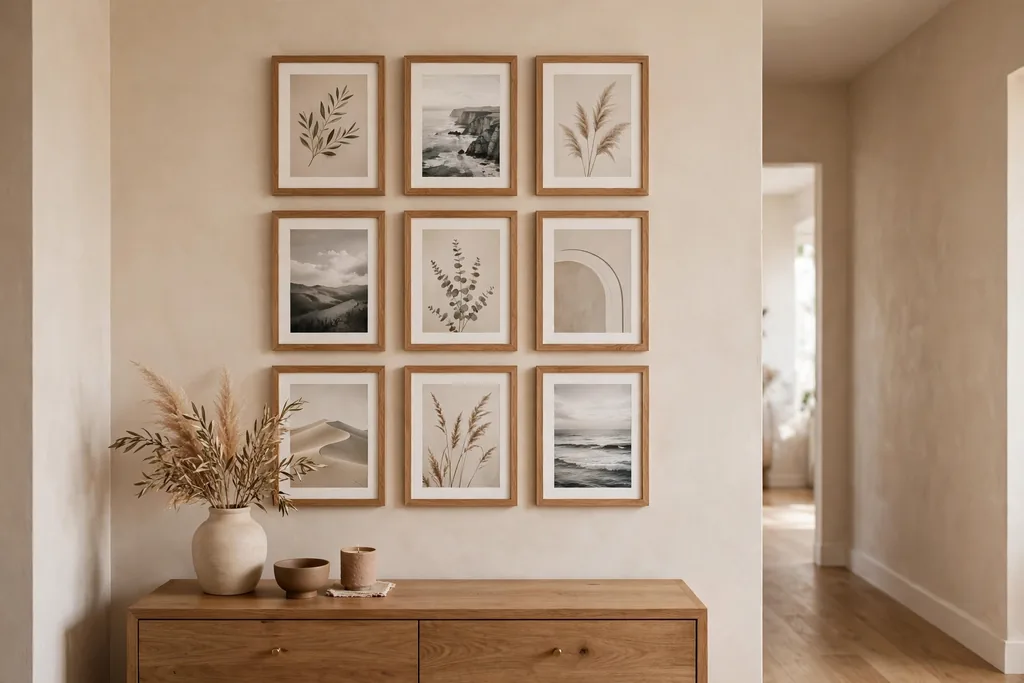
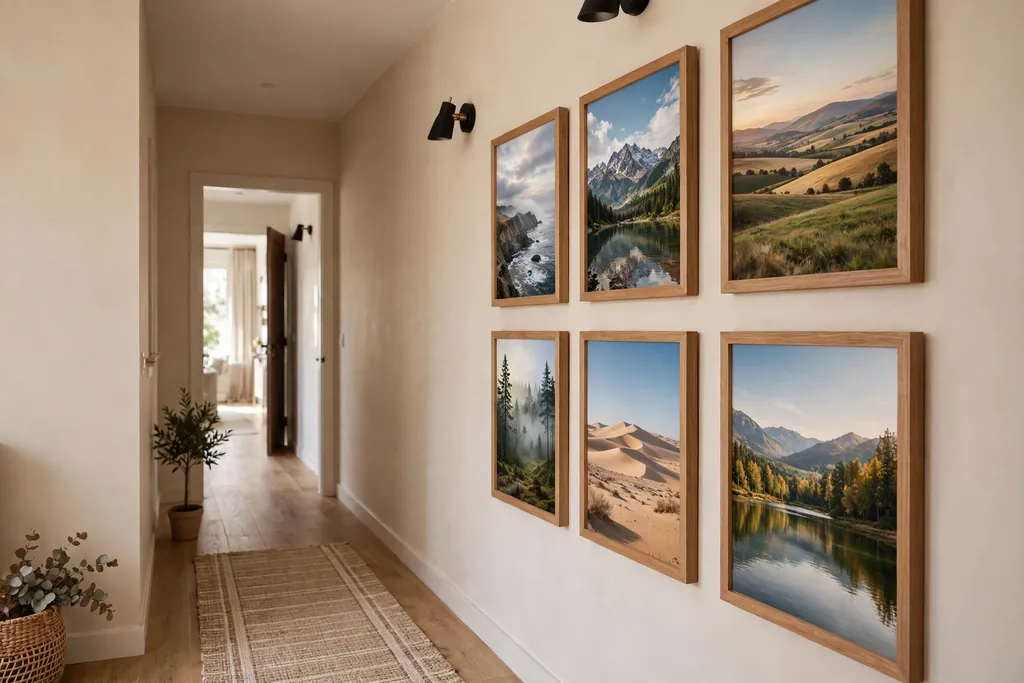
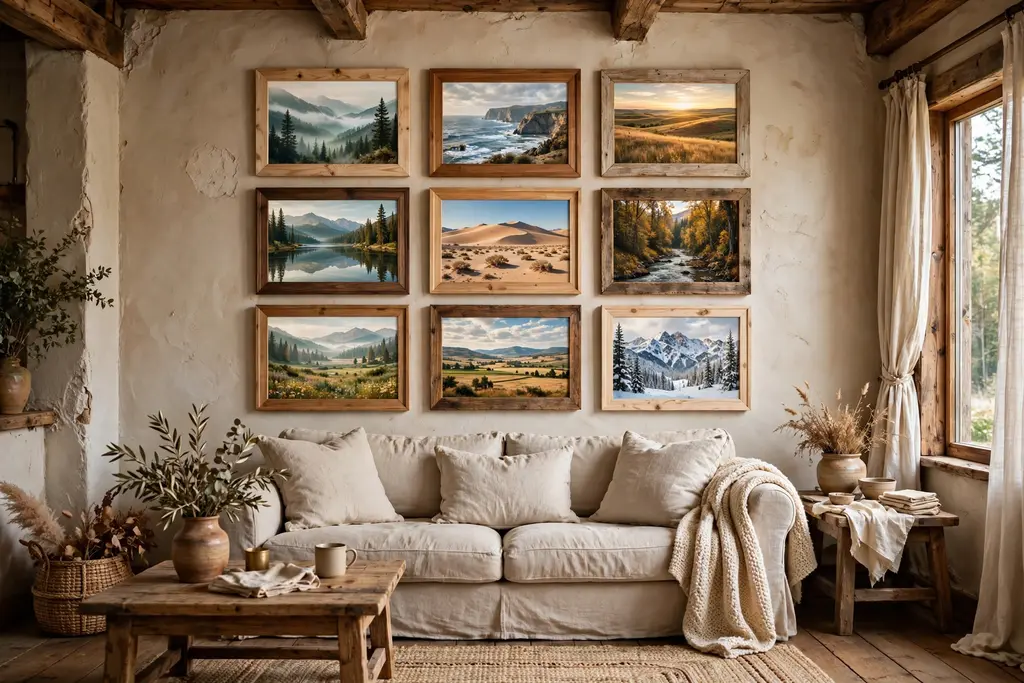
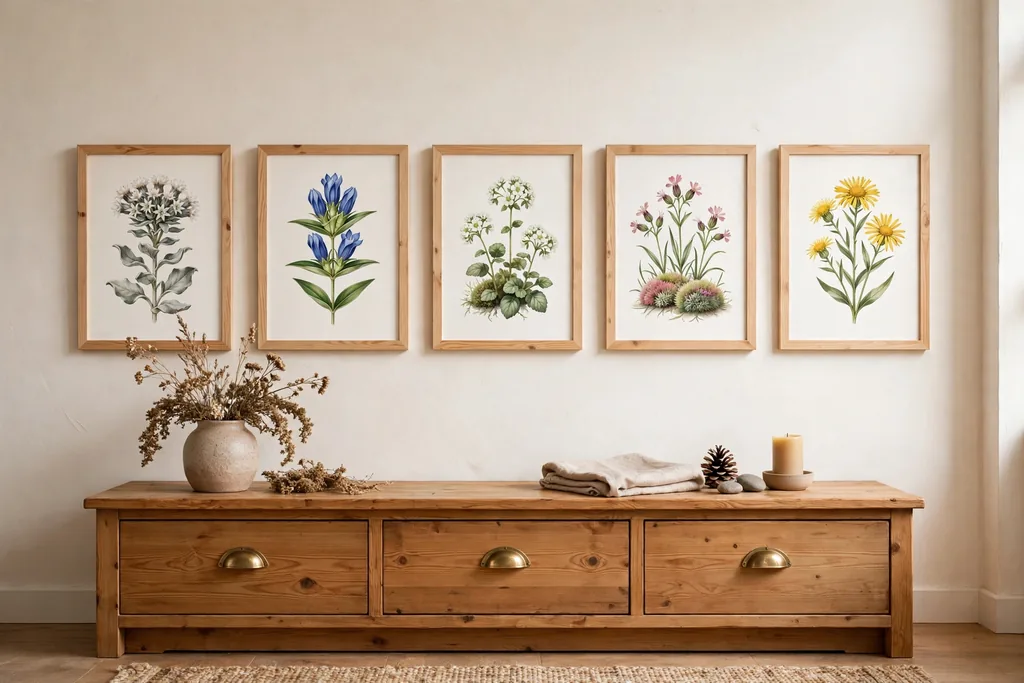
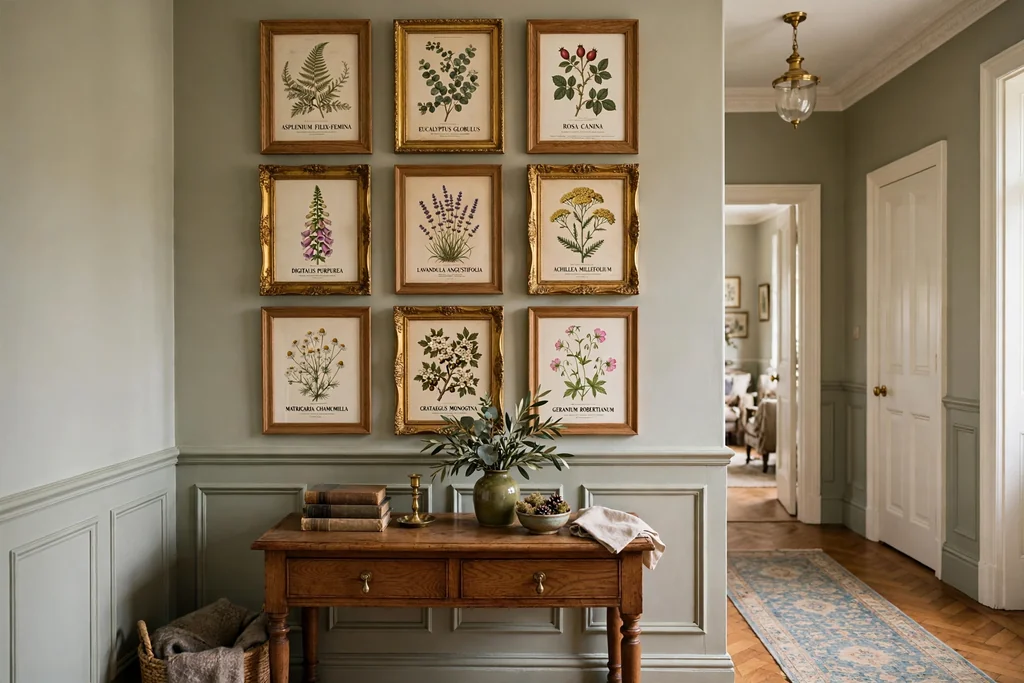
    Hallway wall with a gallery wall of framed prints in matching wood frames above a console table.

    A gallery wall works best when the frames match and the spacing stays even, so a mix of prints and photos reads as one display rather than a cluttered wall. Use wood or black frames in one size family, plan the layout on the floor first, and start with the largest piece near the centre. This suits a hallway, a stair wall, or the wall above a console table, where a single large piece would feel too heavy.

    Keep the theme calm, such as landscapes, botanical prints, or family photos in similar tones, and leave the same gap between each frame. Hang the group so its centre sits near eye level, and step back often while you hang, since small shifts show once the whole group is up. If you rent, use picture hanging strips rated for the frame weight, and check the wall surface suits them.

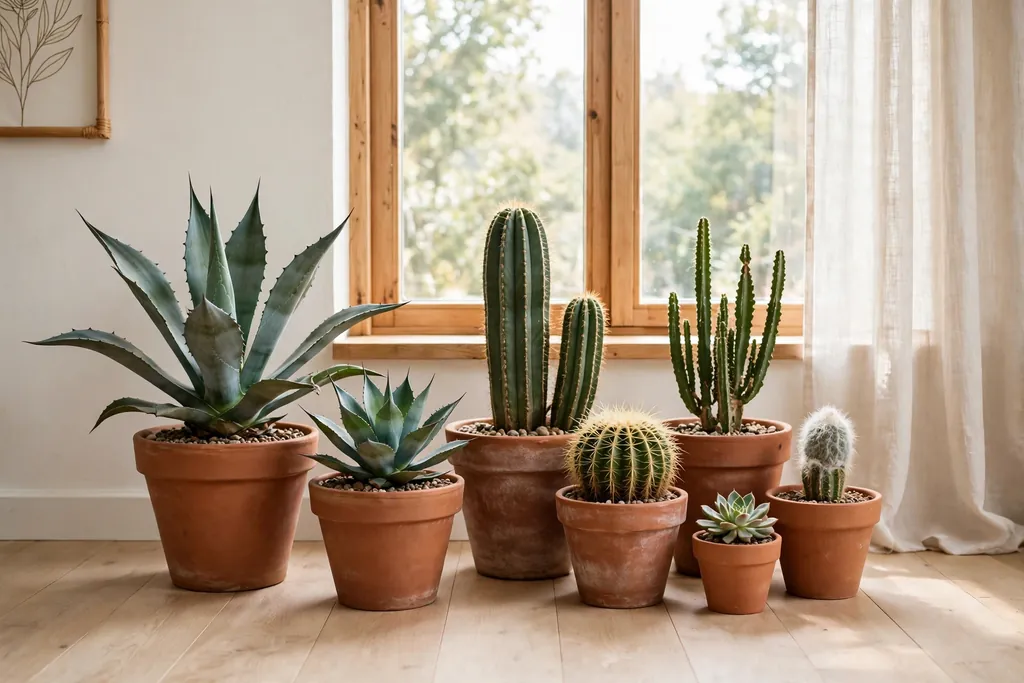
    7. Add Plants at Different Heights
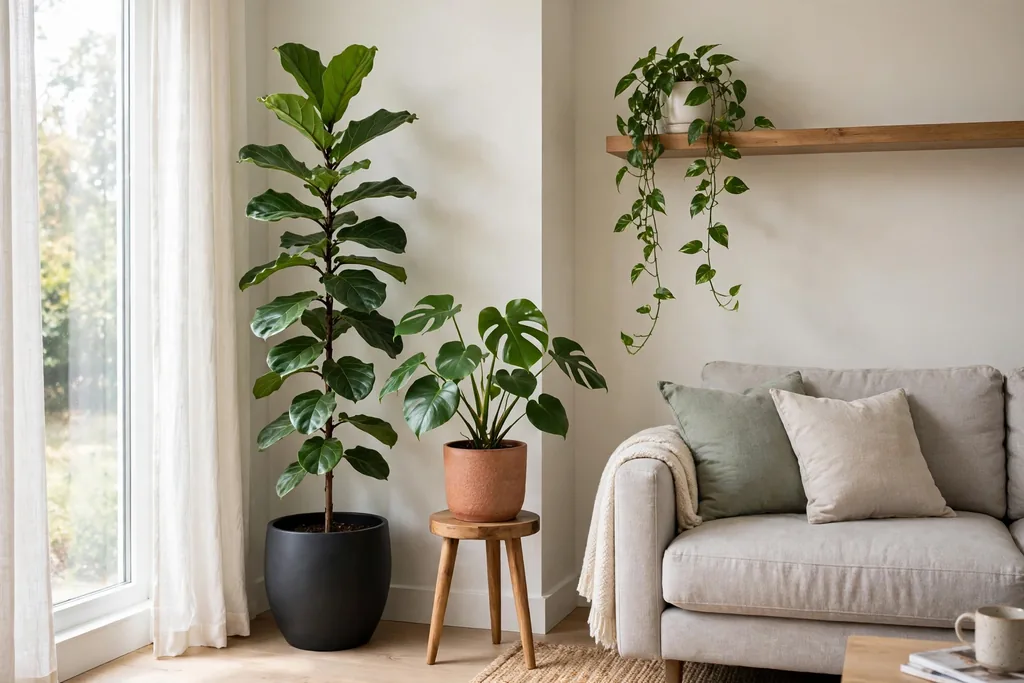
    Bright living room corner with houseplants at different heights, including a tall floor plant and a trailing plant on a shelf.

    Plants bring life and softness to a room, and grouping them at different heights looks more natural than a single pot on a sill. Try a tall floor plant in a corner, a medium plant on a stand, and a trailing plant on a shelf, so the eye moves up and down the room. This suits living rooms, bedrooms, and bright entries, and it works even in a small space, since a shelf plant uses no floor space.

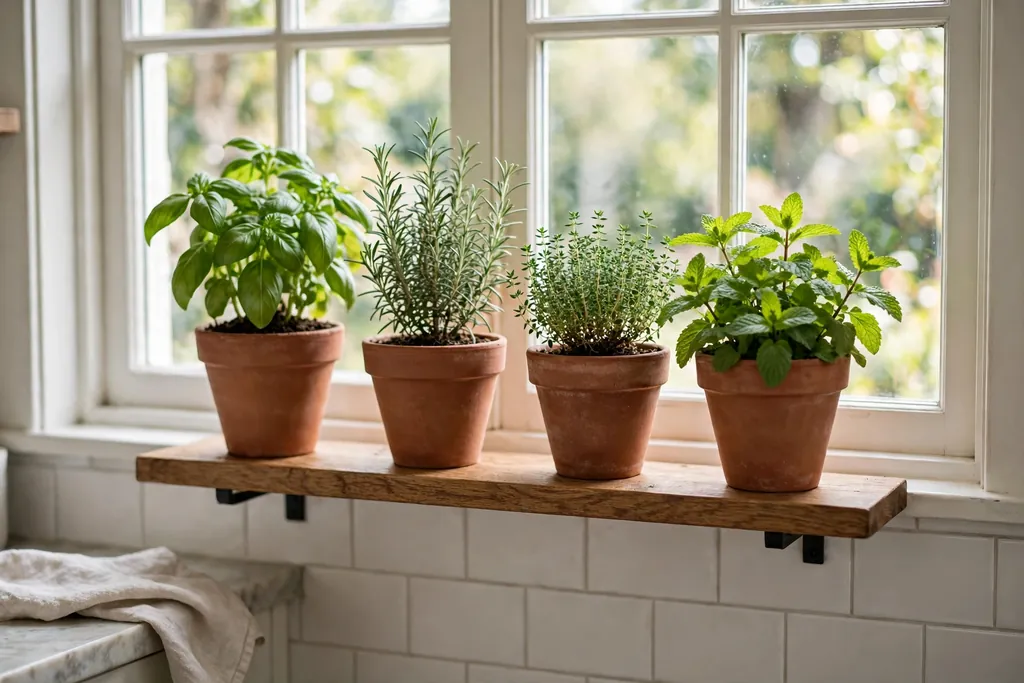
    Pick plants that suit your light, and check the care label before you buy, since a plant that needs strong sun will fade in a dark corner. Use pots in one or two materials, such as terracotta and woven baskets, and empty saucers after watering so roots do not sit in water. Start with two or three easy plants, and add more once you know how much light and water your room gives.

    8. Use Woven Baskets for Storage and Texture
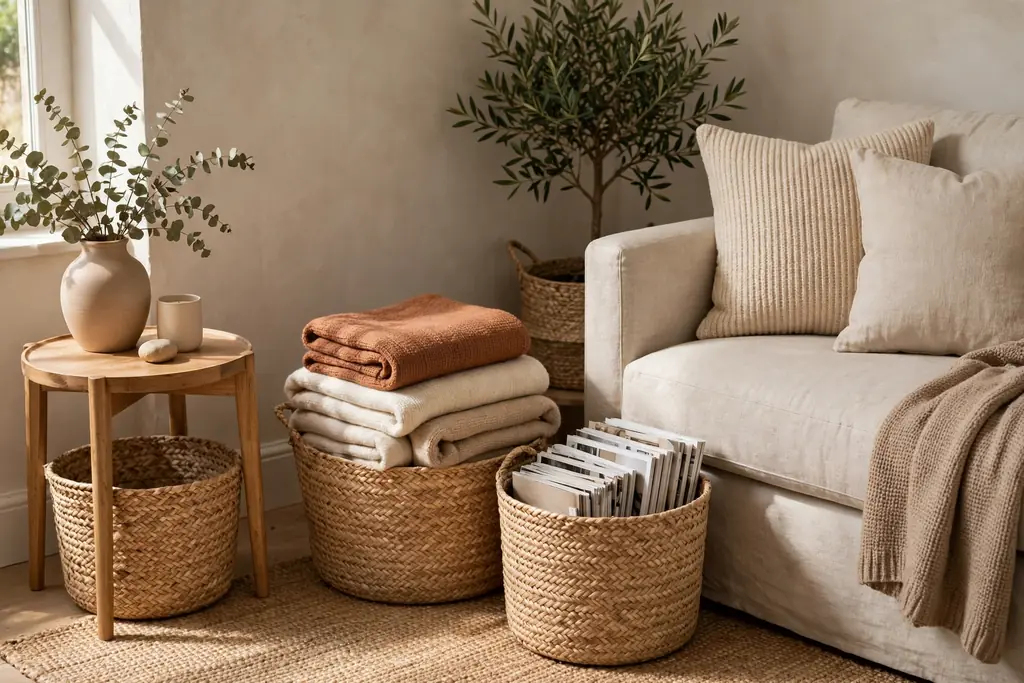
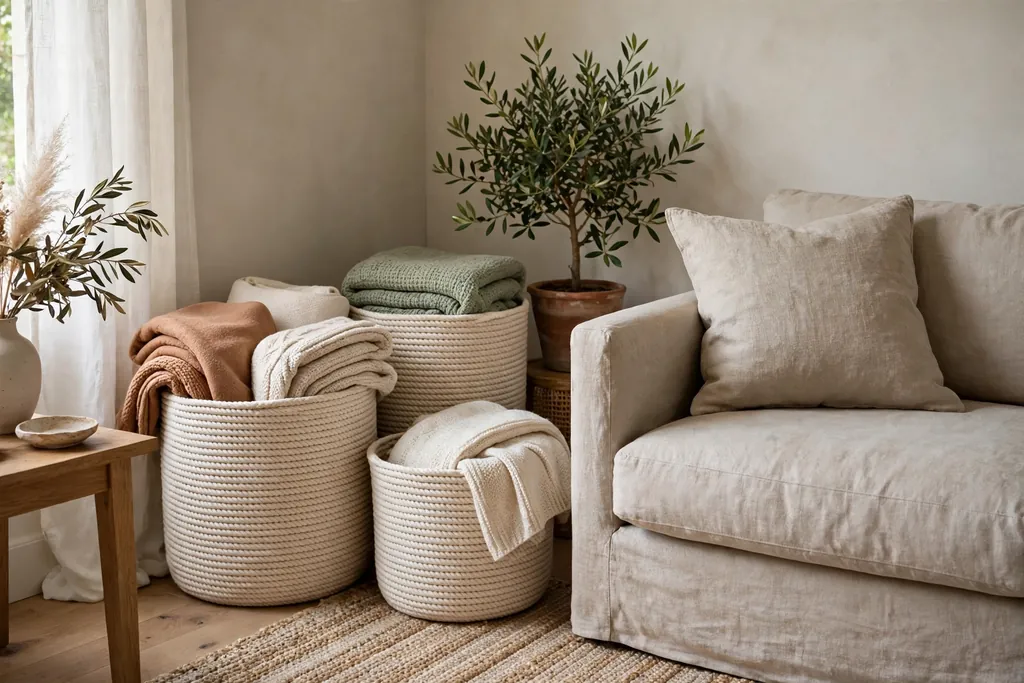
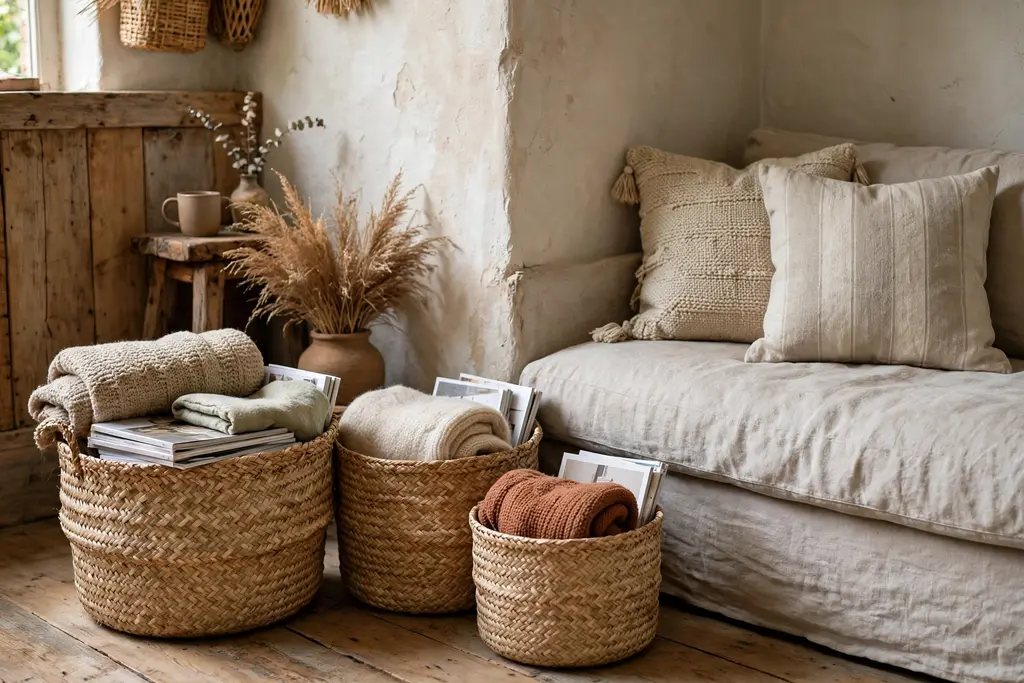
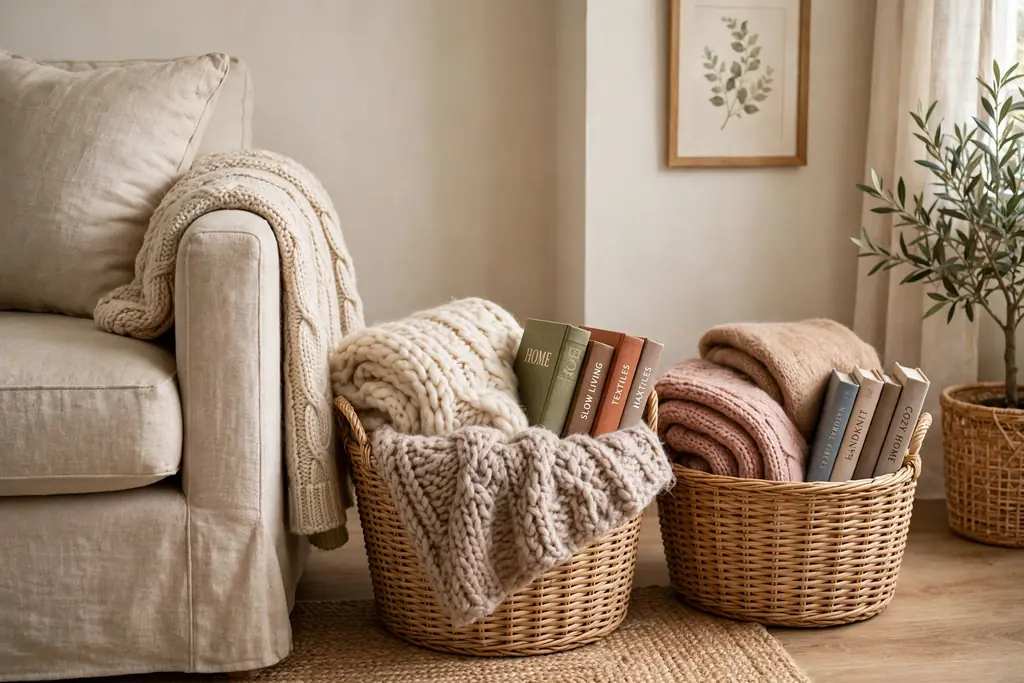
    Tidy living room corner with woven seagrass baskets holding folded throws beside a sofa.

    Woven baskets hide clutter and add natural texture at the same time, which makes them useful in almost every room. Use a large basket for throws beside the sofa, a medium basket for magazines or toys, and a small basket under a console table for keys or chargers. Seagrass, cotton rope, and rattan all suit a cozy, current room, and they soften hard furniture edges.

    Label nothing, but keep one use per basket, so you can find things without emptying each one. Wipe baskets with a dry cloth, and keep them out of damp spots, since natural fibres can stain. If a basket starts to look messy, empty it, keep only what you use weekly, and move the rest to closed storage, so the basket stays a styling piece as well as a store.

    9. Place a Mirror to Bounce Daylight Around
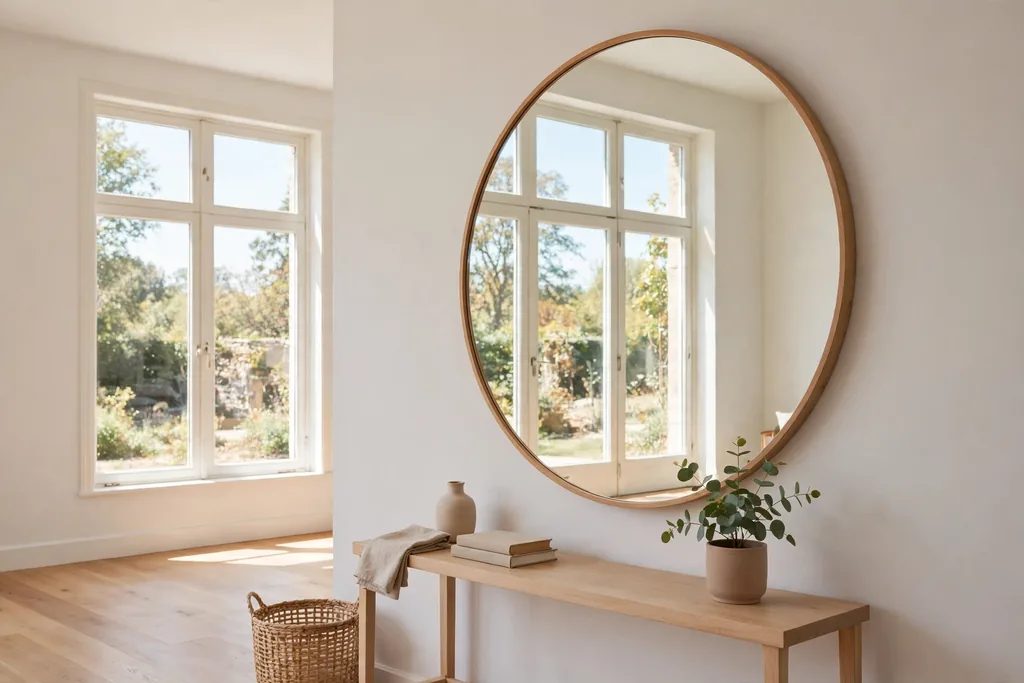
    Bright room with a large round mirror with a thin wood frame hanging above a console table near a window.

    A mirror placed opposite or beside a window bounces daylight deeper into a room and can make a small space feel larger. A large round mirror with a thin wood frame suits a console table, a hallway, or a bedroom wall, and it reflects the brightest part of the room rather than a blank wall. This is a simple fix for a dark corner, and it needs no wiring or paint.

    Hang the mirror so its centre sits near eye level, and check what it reflects before you fix it in place, since a mirror that reflects clutter will double the mess. Keep the frame simple if the wall already has art nearby, and wipe the glass often, since dust shows fast in reflected light. In a narrow hallway, a mirror on one wall and plain art on the other keeps the space from feeling like a tunnel.

    10. Try One Removable Wallpaper Accent Wall
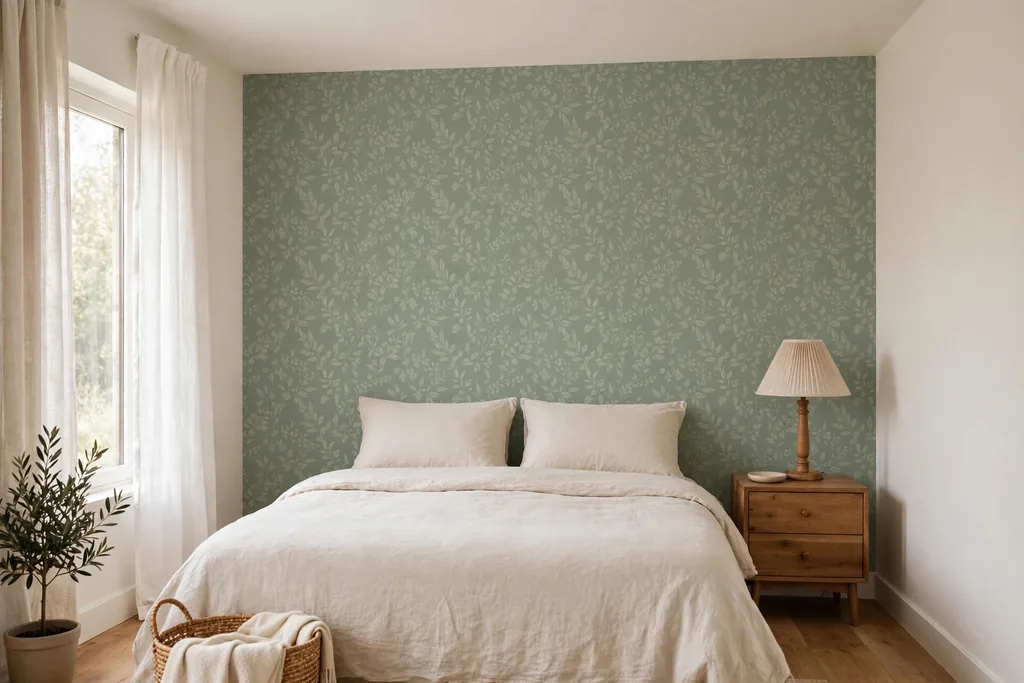
    Bedroom with one accent wall in soft sage wallpaper with a subtle pattern, plain bedding, and a wood nightstand.

    One accent wall in removable wallpaper adds pattern and color without the commitment of a full room of paper. Choose a soft, subtle pattern, such as a small botanical print or a gentle stripe in sage or warm grey, and use it on the wall you see first when you enter the room. This suits a bedroom wall behind the bed, a living room wall behind the sofa, or a small entry wall.

    Follow the maker instructions for a smooth, clean wall surface, and smooth out air bubbles as you go, starting from the centre of each strip. Keep the other walls plain, and repeat one color from the paper in cushions or a throw, so the wall connects with the rest of the room. If you rent, confirm the paper is truly removable, and test a small corner first, so you know it lifts cleanly later.

    11. Style the Coffee Table With a Tray
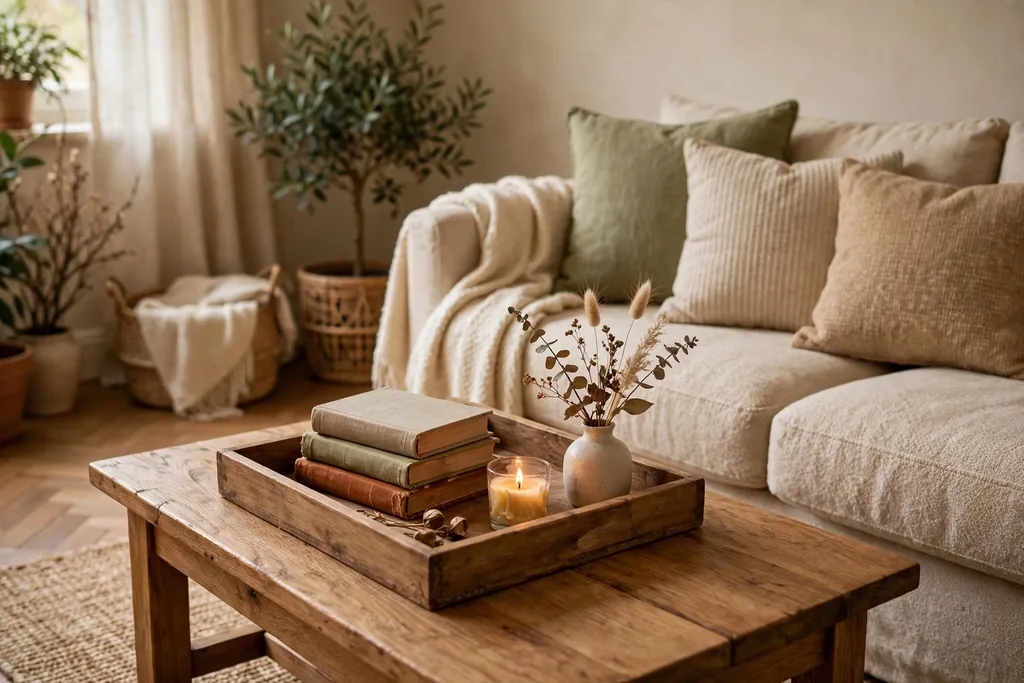
    Coffee table styled with a wood tray holding books, a candle, and a small vase with dried stems.

    A tray turns a coffee table from a dumping ground into a styled surface, because it groups small items into one tidy area. Put a wood or rattan tray on the table, then add a small stack of books, a candle, and a tiny vase with dried stems, leaving room for a cup of tea. This suits a living room where the table collects remotes, chargers, and mail, since the tray sets a clear boundary for what stays.

    Keep the tray items low, so you can still see across the table to talk, and limit the group to three or four pieces in different heights. Clear the tray once a week, and return anything that does not belong, so the table stays easy to use. If your table is small, use a round tray that fits with room to spare, rather than a tray that covers the whole surface.

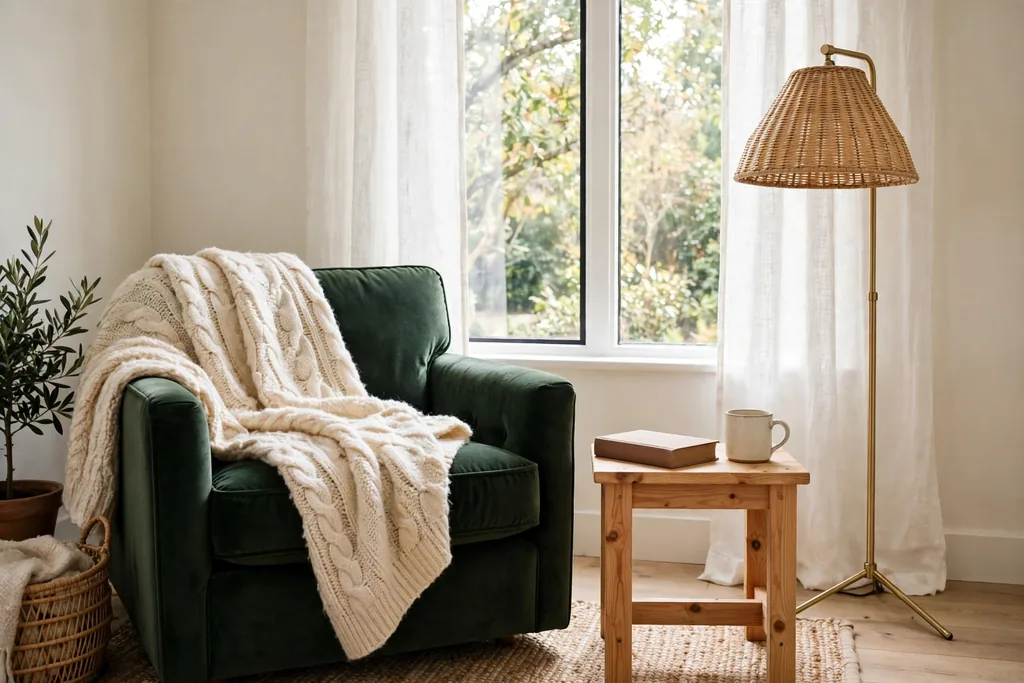
    12. Make a Reading Nook by a Window
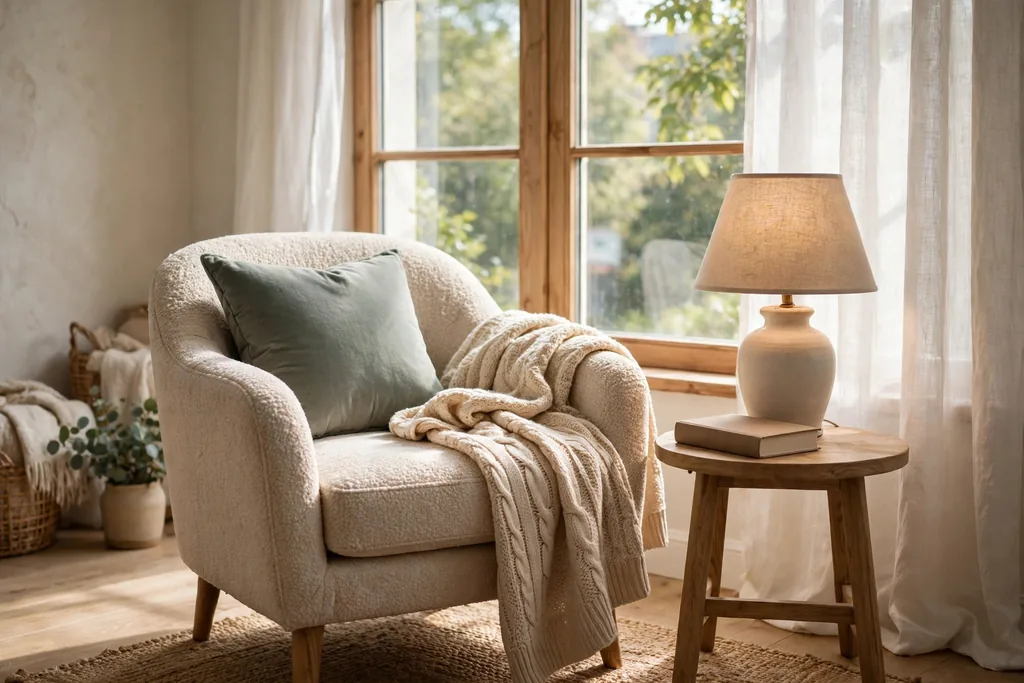
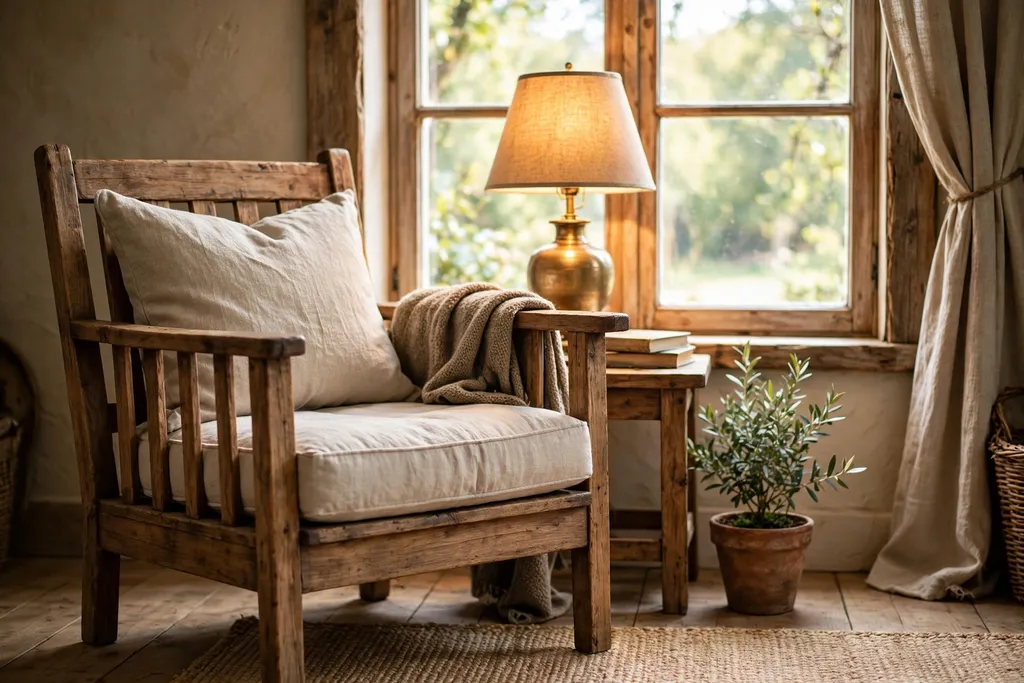
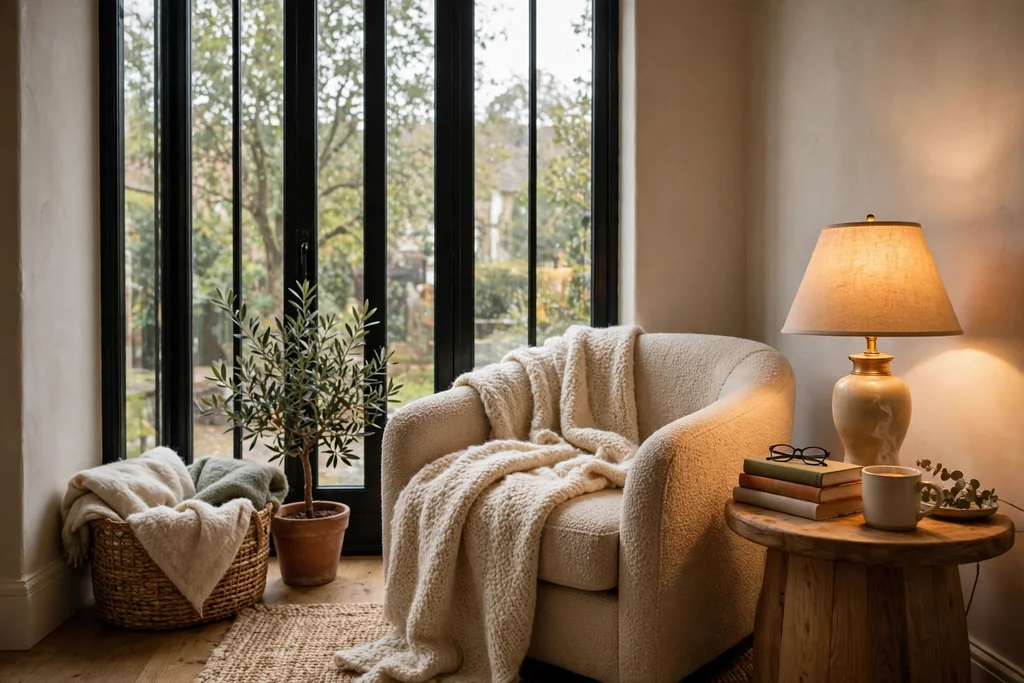
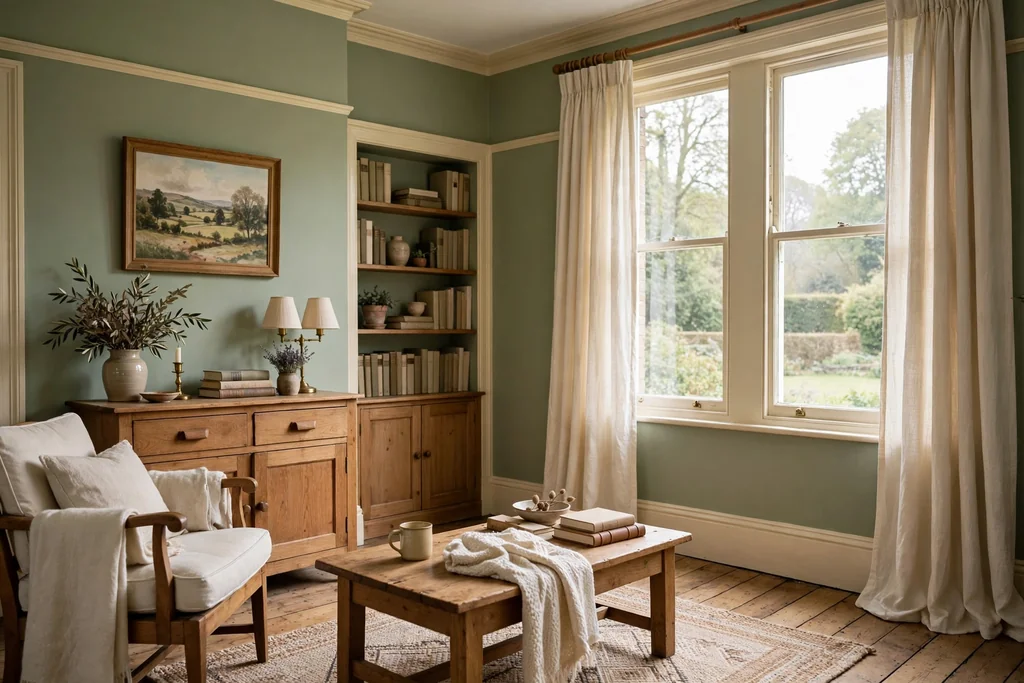
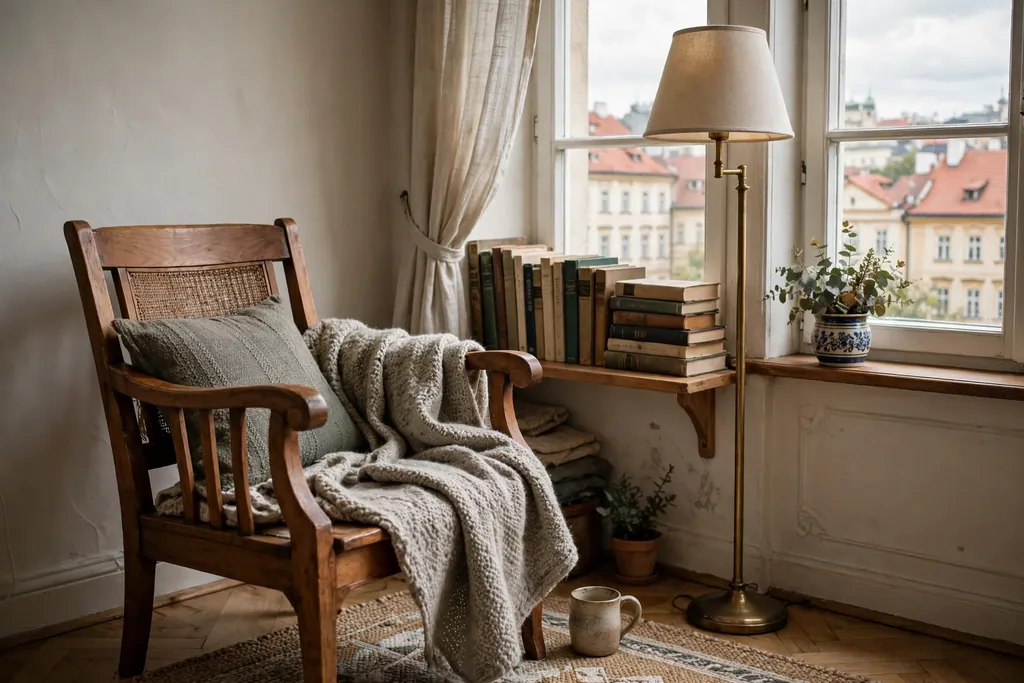
    Cozy reading nook by a window with an armchair, a cushion and throw, and a small side table with a lamp.

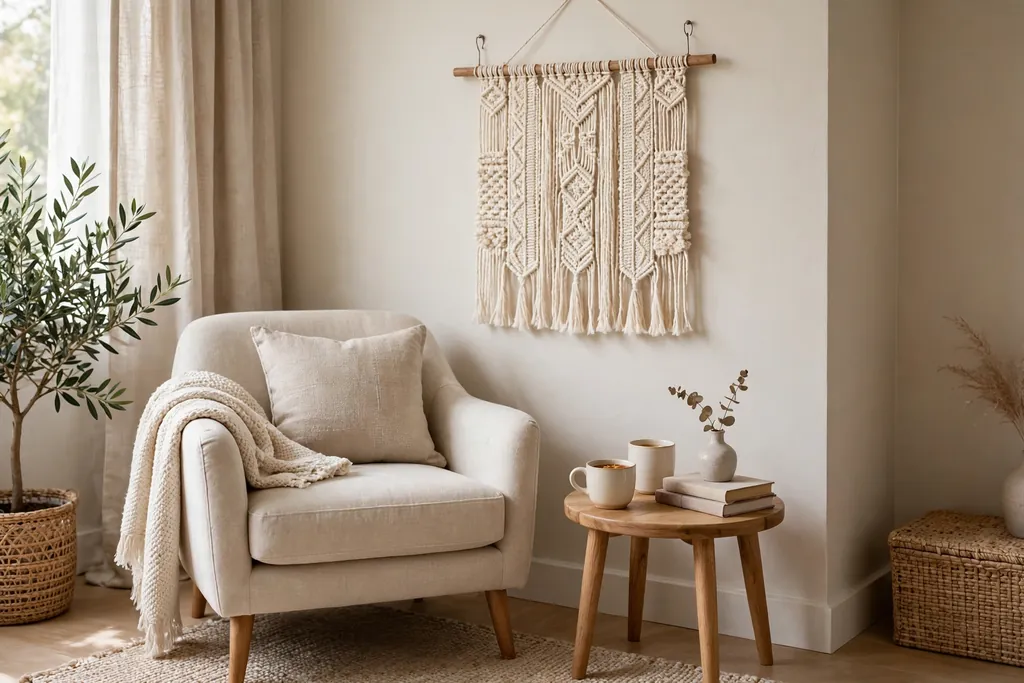
    A reading nook needs only a comfortable chair, good light, and a place for a book, yet it can make an unused corner feel like a destination. Place an armchair near a window, add a cushion and a throw, and put a small side table beside it with a lamp and a book. This suits a living room corner, a bedroom bay, or a wide hallway, and it gives a room a second use without new furniture.

    Keep the nook simple, with one basket for books nearby, so the corner stays inviting rather than crowded. If the window gives strong sun, choose a washable cushion cover, since pale fabric shows dust and sun marks fast. A floor lamp beside the chair means the nook works in the evening too, when daylight fades but you still want a quiet seat.

    13. Group Candles and Lanterns for Evening Glow
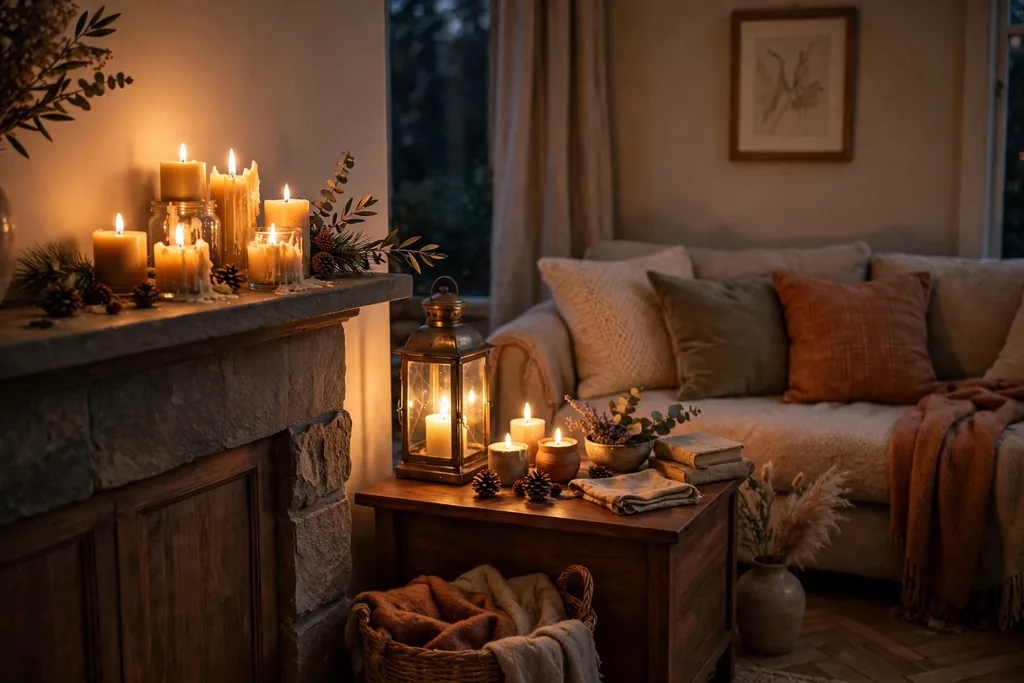
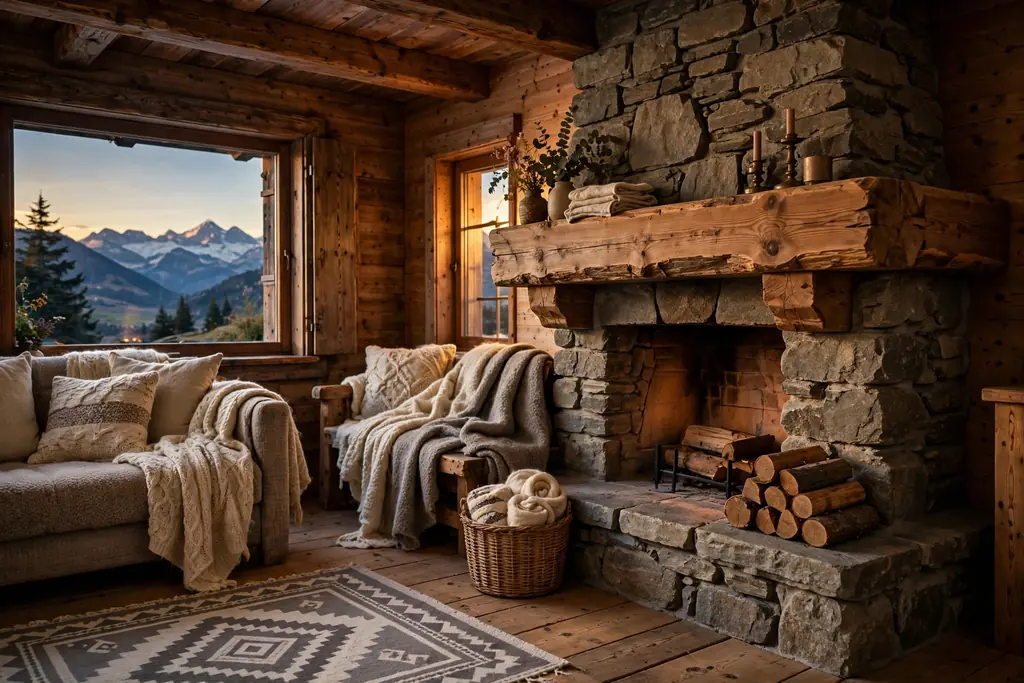
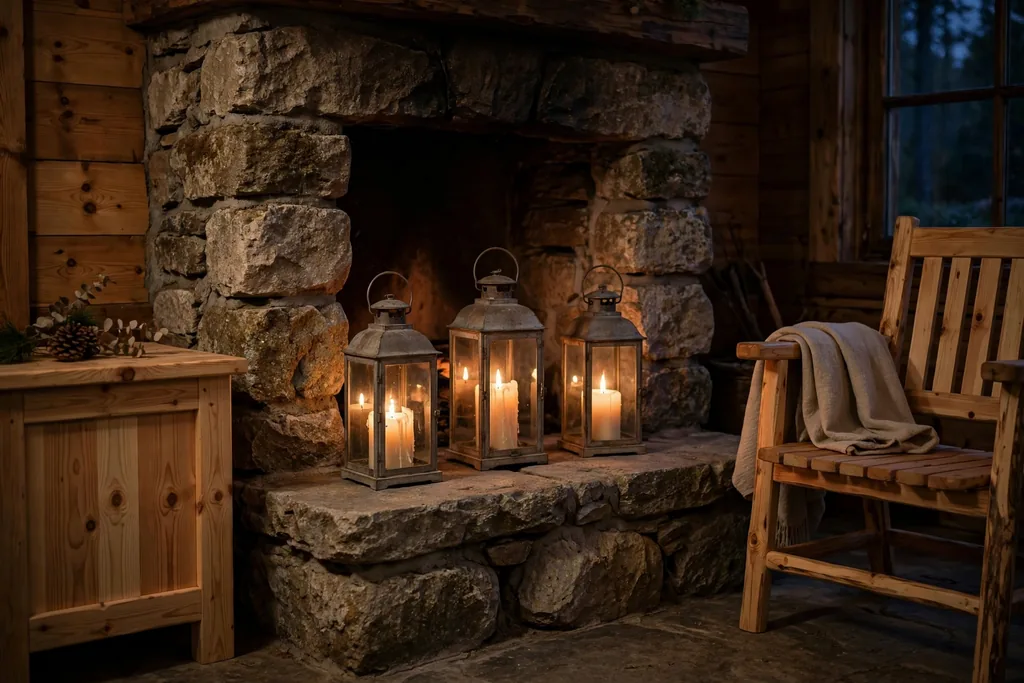
    Cozy evening living room with candles and a lantern glowing on a mantel and side table.

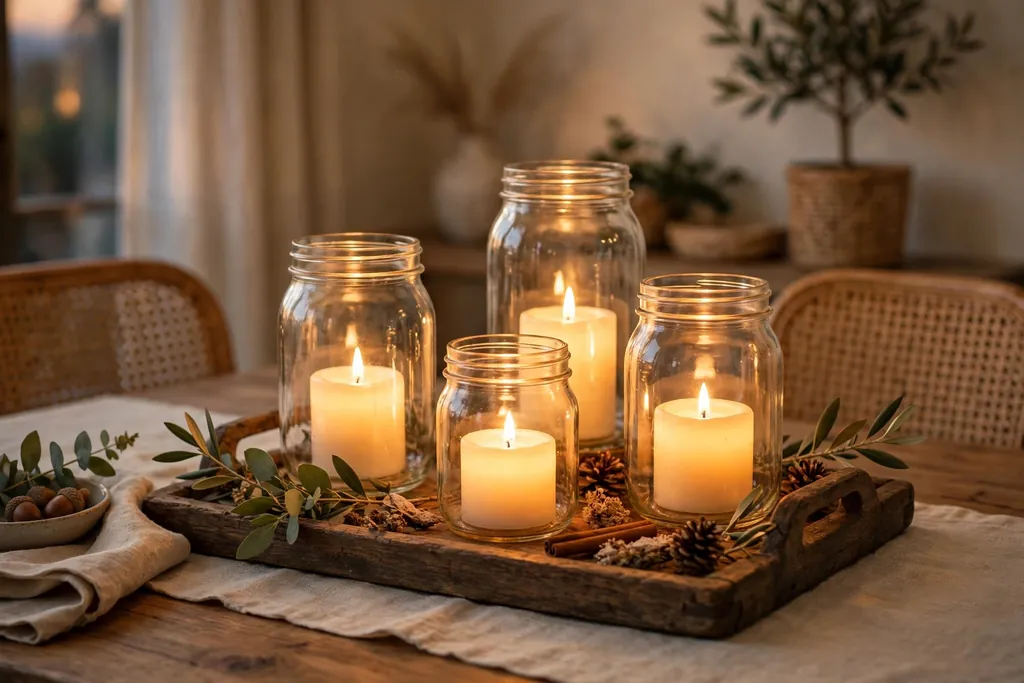
    Candles and lanterns give a room a low, warm glow in the evening that lamps alone can miss. Group three or four candles of different heights on a tray, a mantel, or a side table, and add one lantern on the floor nearby for a larger pool of light. This suits a living room, a bedroom, or a bathroom, and it works well for quiet evenings, since the light stays soft and low.

    Use sturdy holders that cannot tip easily, keep flames clear of curtains, throws, and paper, and never leave candles burning in an empty room. Battery candles give a similar glow where real flames are not practical, such as a shelf near books or a home with small children. Match the holders in one material, such as glass or wood, so the group looks calm rather than random.

    14. Add Warm Wood Accents in Small Doses
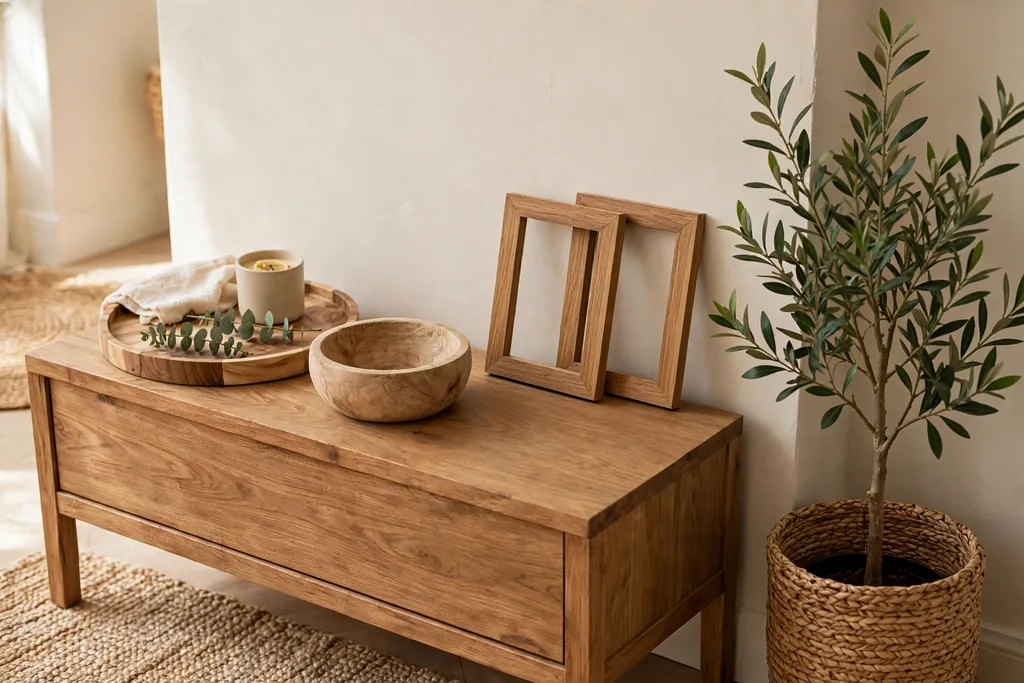
    Warm living room detail with natural wood accents, including a wood tray, wood frames, and a wood bowl on a console table.

    Warm wood accents add a natural, grounded feel to a room, and small doses often work better than large wood furniture. Try a wood tray on a coffee table, wood picture frames on a wall, and a wood bowl on a console table, in a tone close to other wood in the room. This suits a room that feels too white or too smooth, since wood adds grain and warmth without a new sofa or table.

    Keep the wood tones close, such as warm oak or light walnut, and avoid mixing many different wood colors in one room, since the mix can look random. Wipe wood with a dry cloth, and use coasters under hot drinks on a wood tray, so rings do not mark the surface. If a room already has a wood floor, repeat that tone in the accents, so the floor and the details feel connected.

    15. Style Open Shelves With Space Between Groups
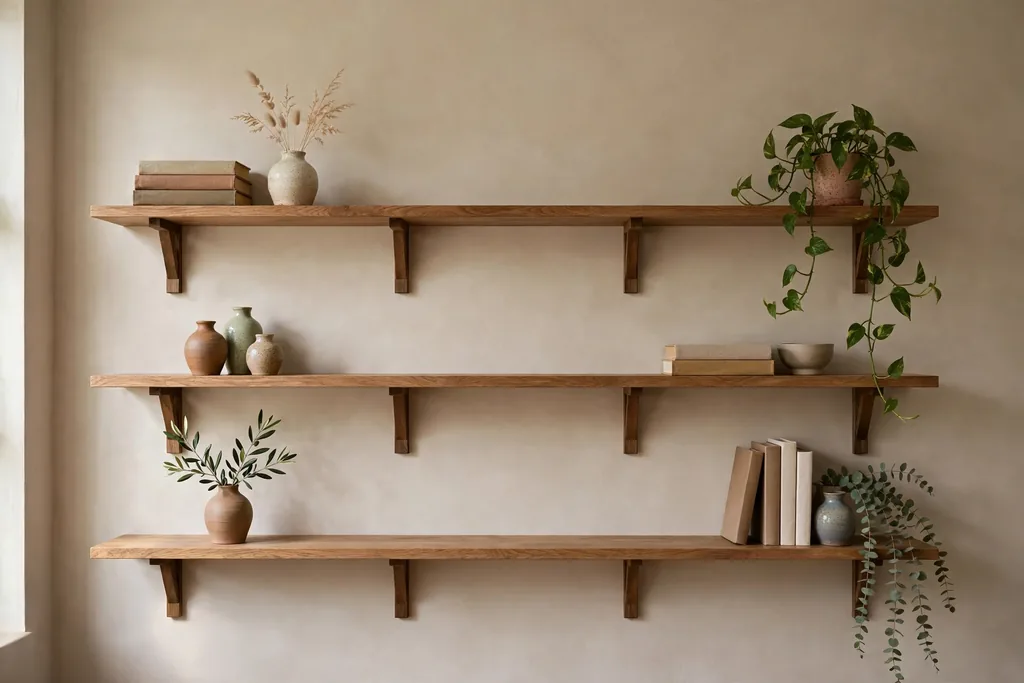
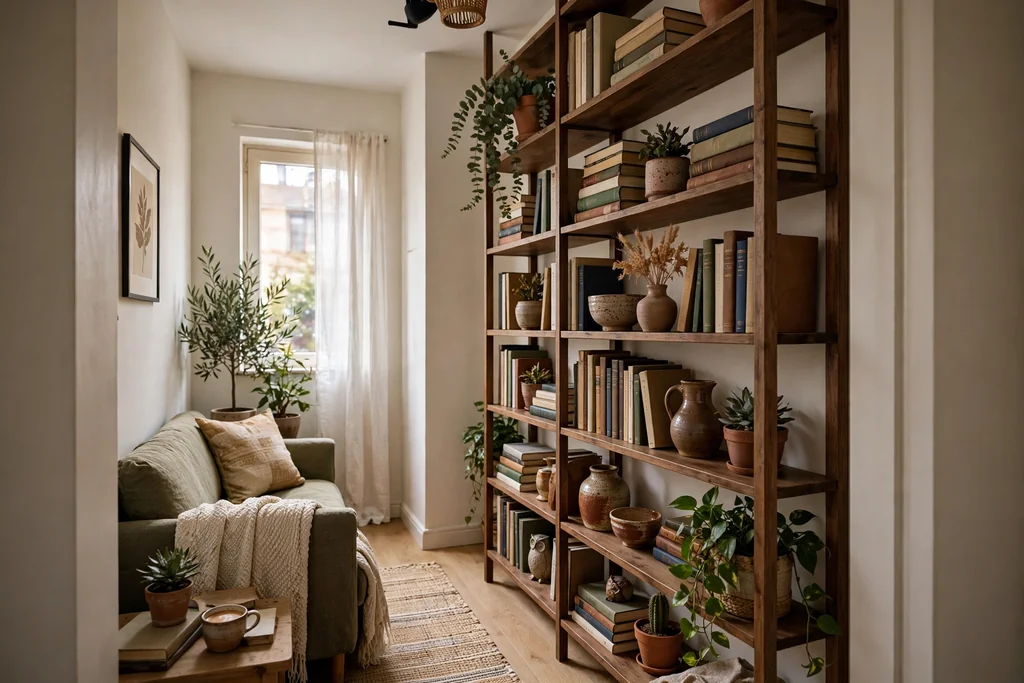
    Living room wall with open wood shelves styled with books, small pottery vases, and a trailing plant.

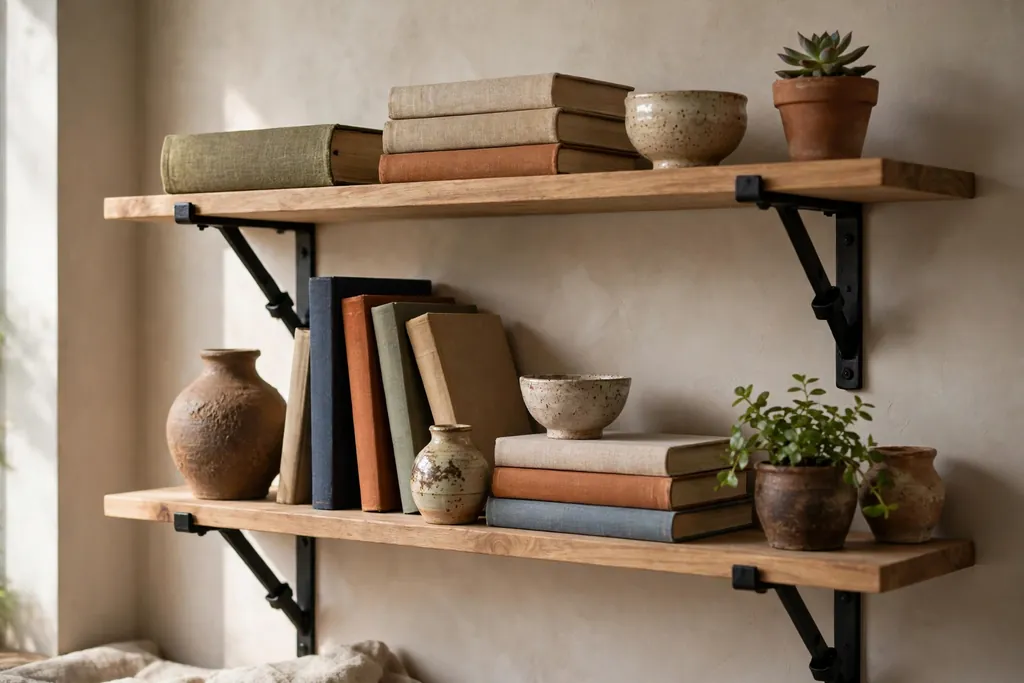
    Open shelves look calm when each group has space around it, and crowded when every inch is filled. Use one or two runs of wood shelves on a single wall, and group books, pottery, and a small plant into clusters, leaving gaps between groups. This suits a living room, a kitchen, or a bedroom, and it lets you show pieces you already own in a new way.

    Put heavier items low, keep the shelf count low in a small room, and store only items you use or enjoy looking at, so dust stays easy to manage. A single row above a sideboard is often enough, and a plant at one end softens the straight lines of the shelves. For more living room styling ideas, see these stylish rustic living room ideas.

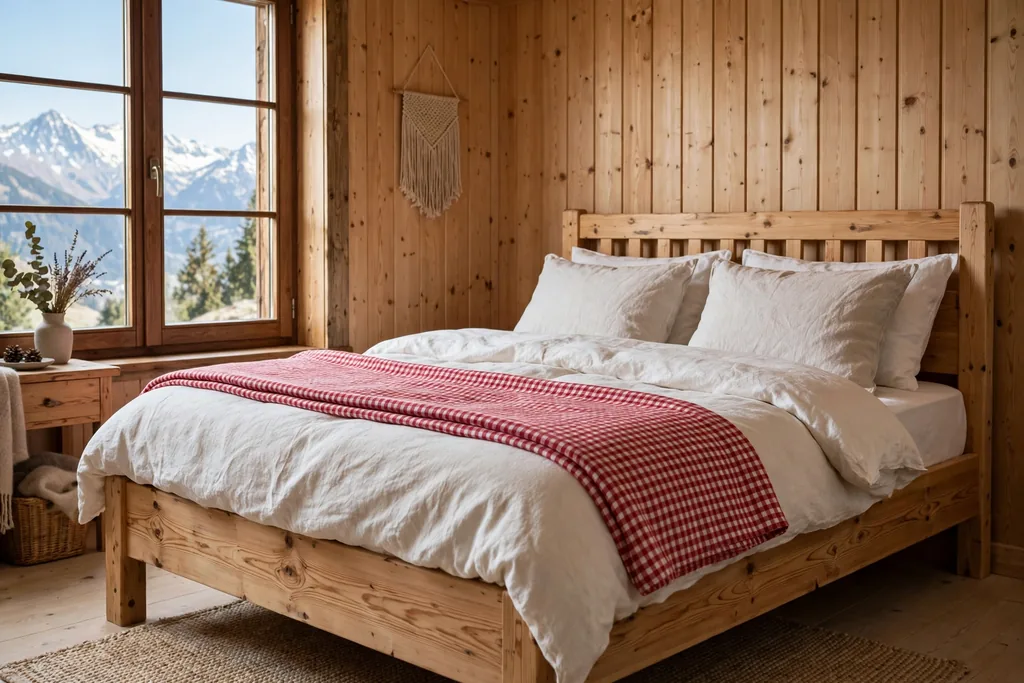
    16. Layer Bedding for a Cozy Bedroom
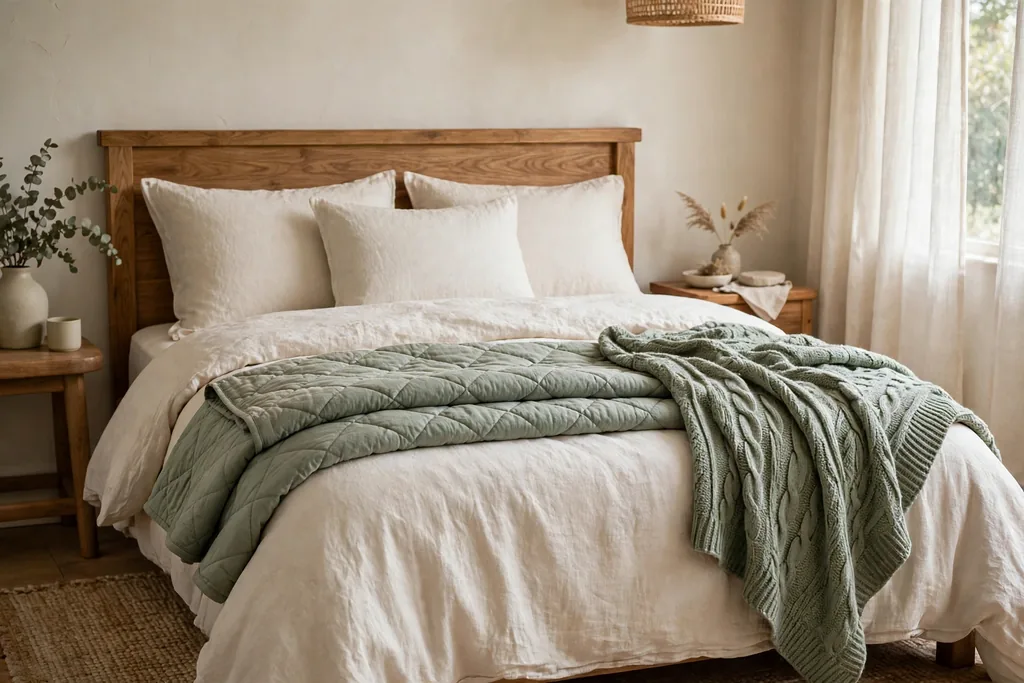
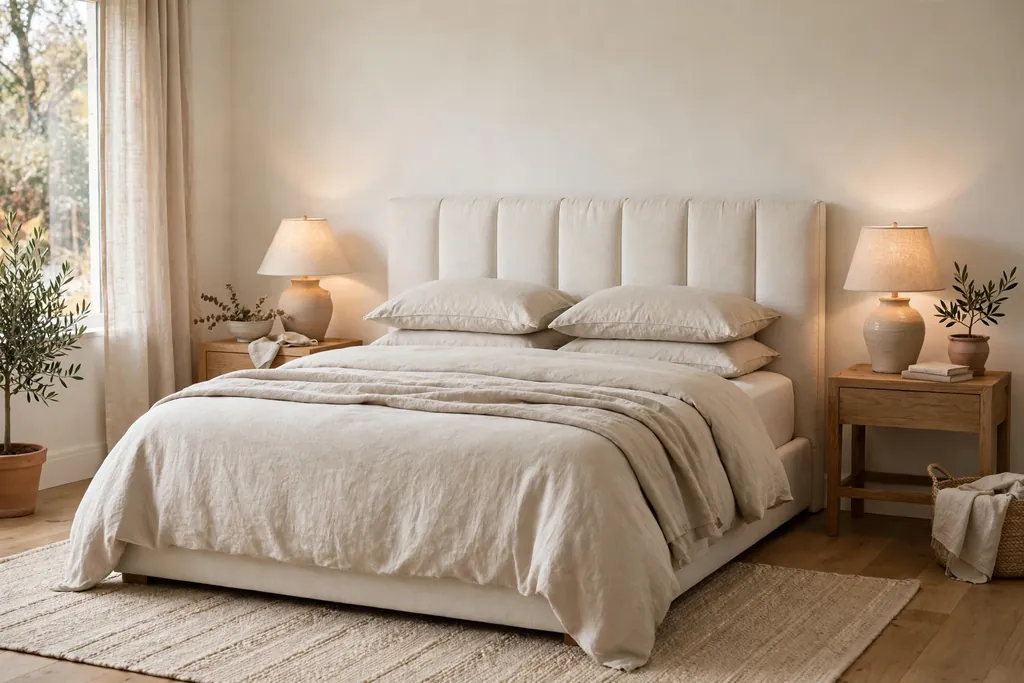
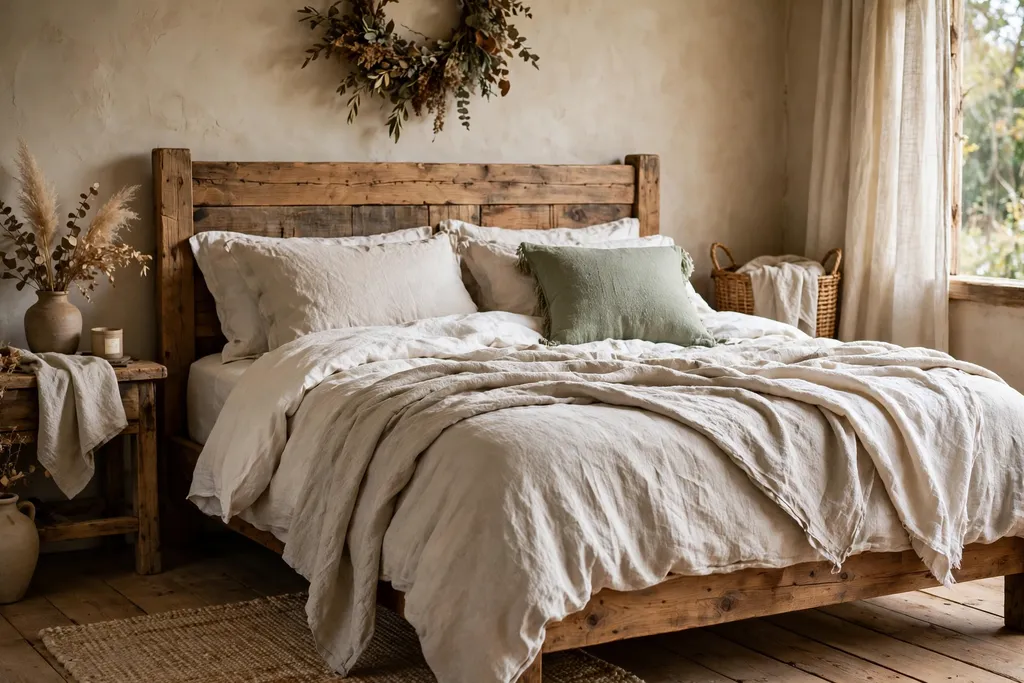
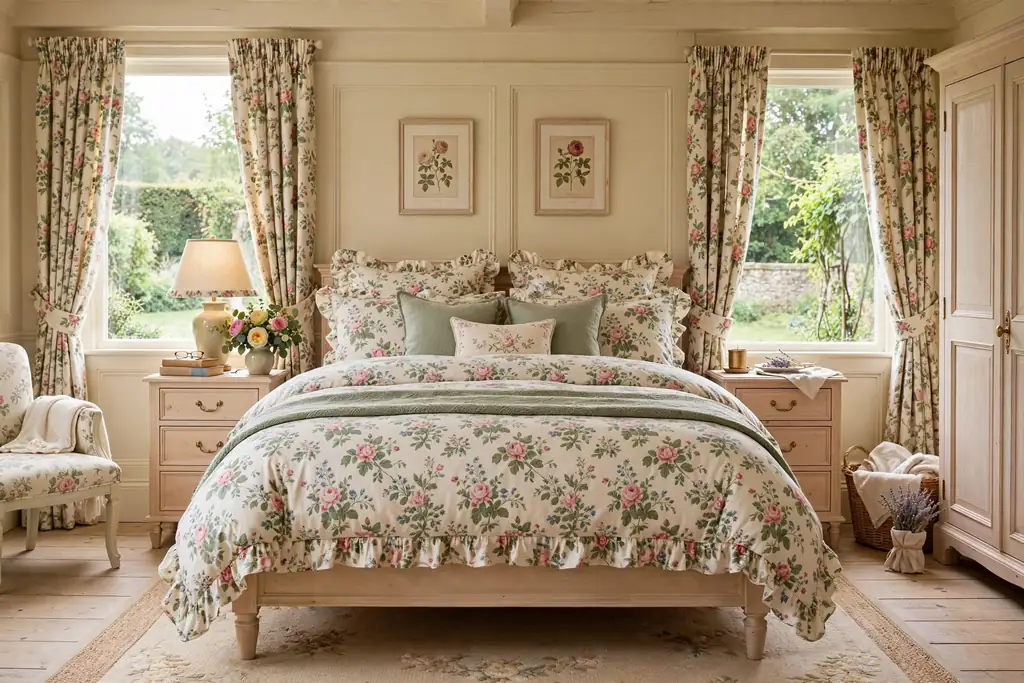
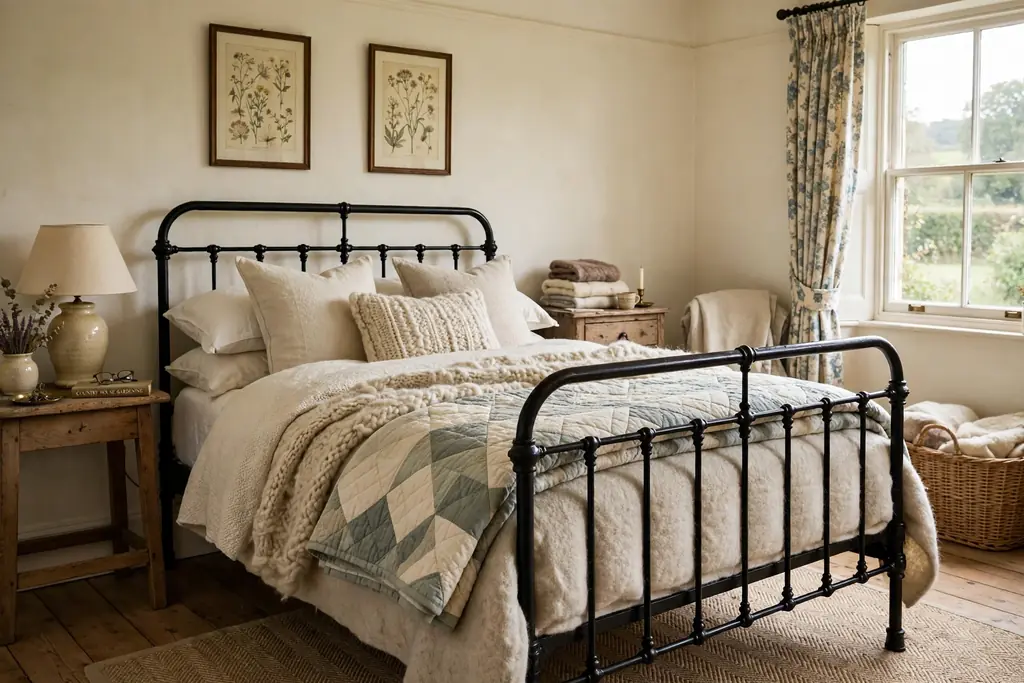
    Cozy bedroom bed with layered bedding in warm white and sage, a folded quilt, and a knit throw at the foot.

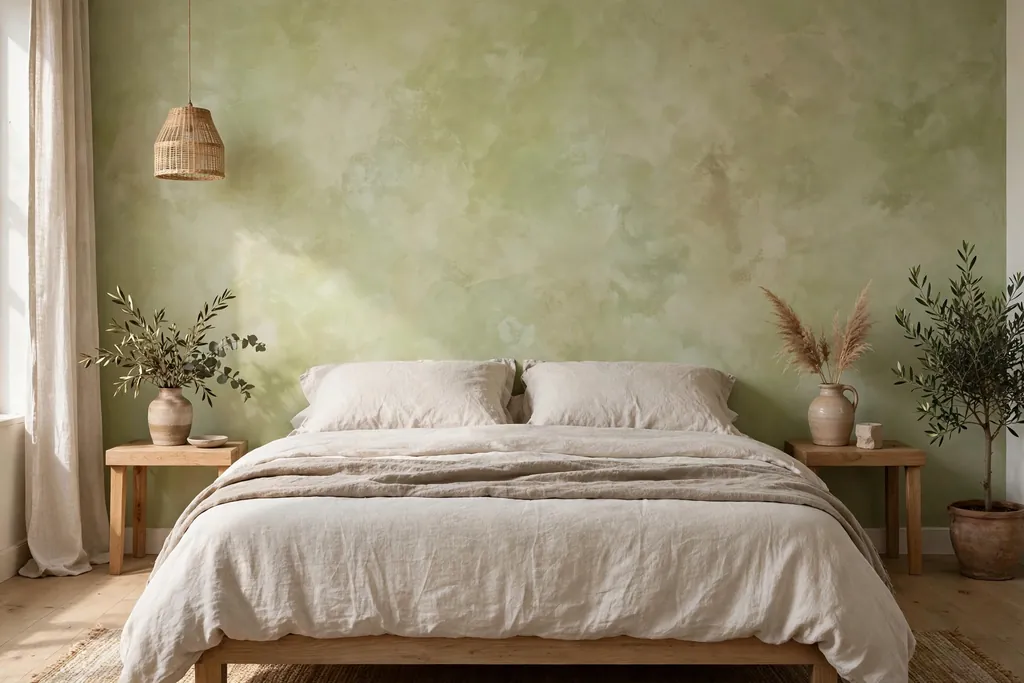
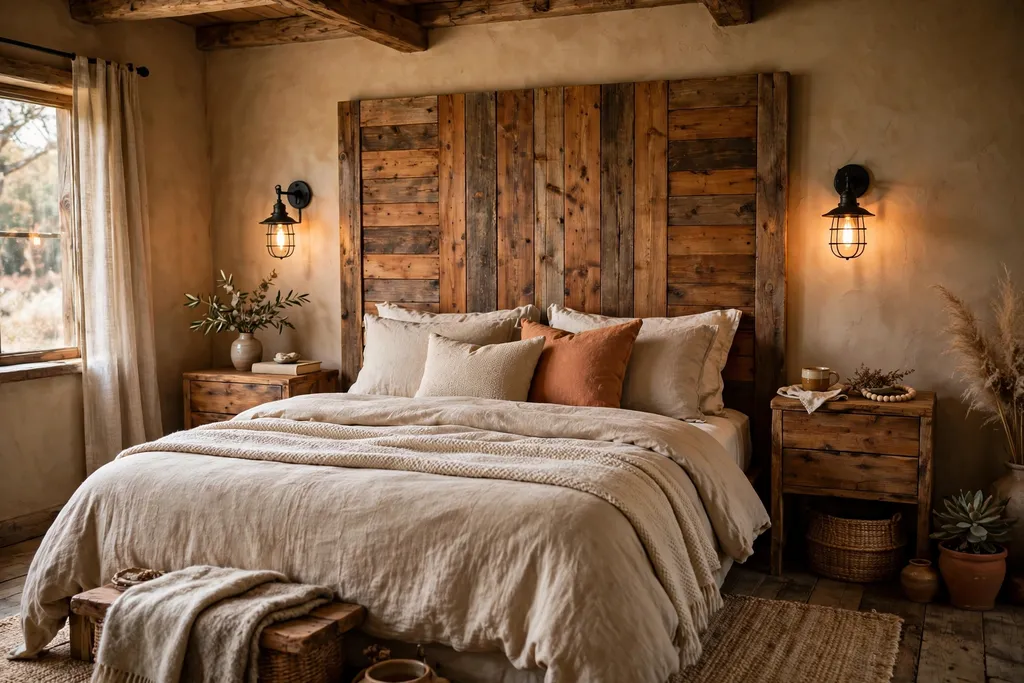
    Layered bedding makes a bedroom feel cozy and finished, even when the furniture stays the same. Start with a plain fitted sheet, add a duvet in warm white, fold a light quilt across the lower half of the bed, and finish with a knit throw at the foot. Keep the palette to warm white, oatmeal, and one soft accent, such as sage, so the bed looks calm rather than busy.

    Keep sleeping pillows plain, and add only two or three decorative cushions, so making the bed stays quick each morning. Shake the duvet out each day, and wash bedding as advised on the label, so the layers stay light and fresh. For more bedroom ideas in this style, see these stylish rustic bedroom decor ideas.

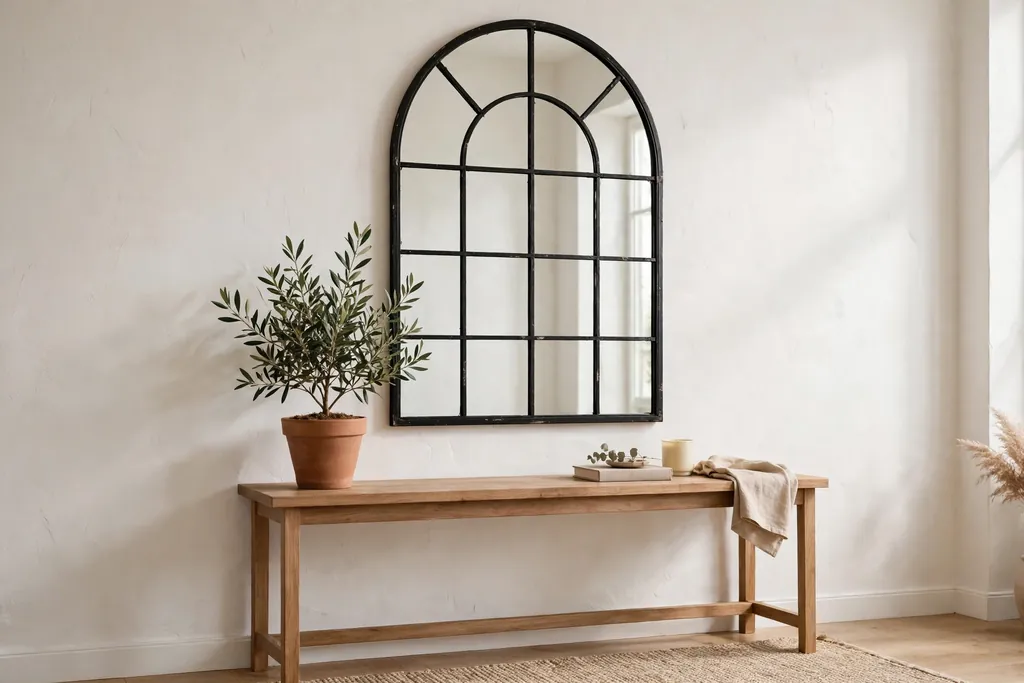
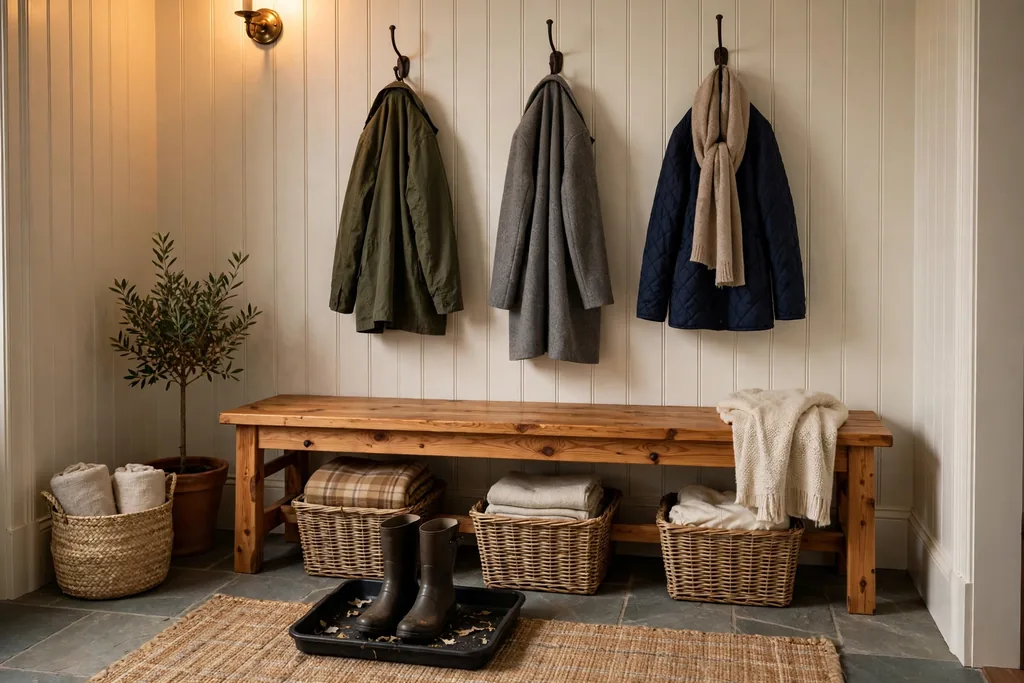
    17. Style a Slim Entry Console
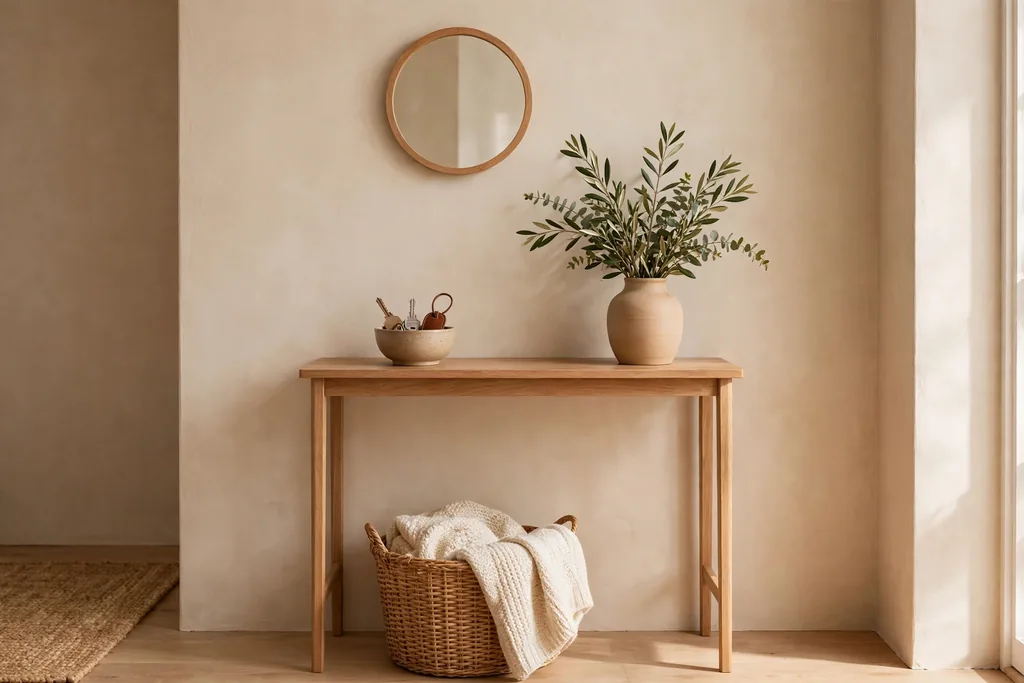
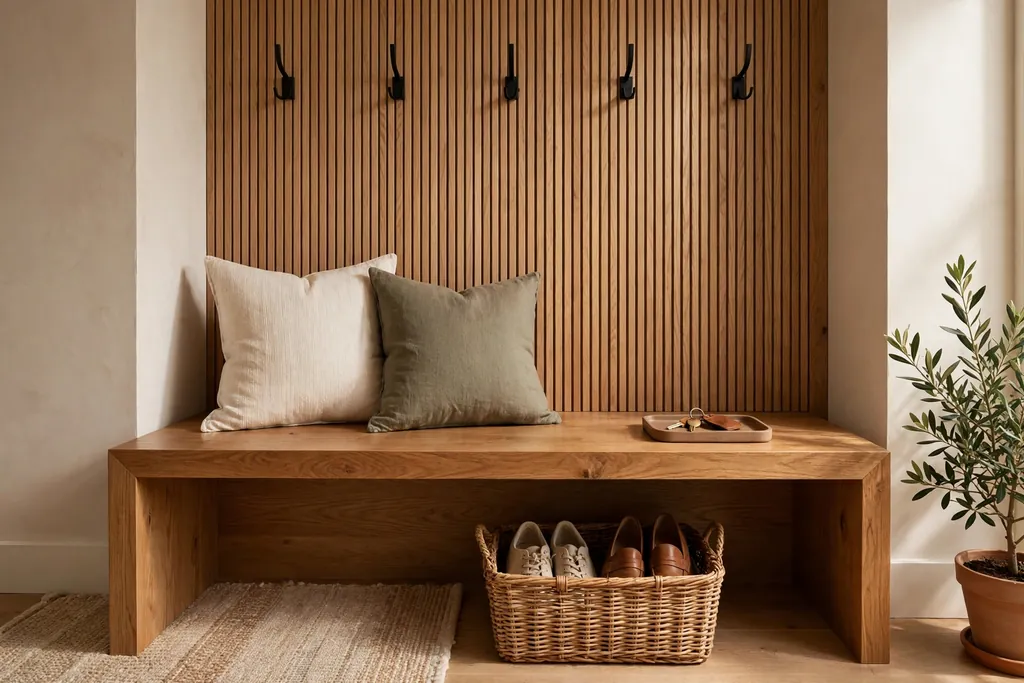
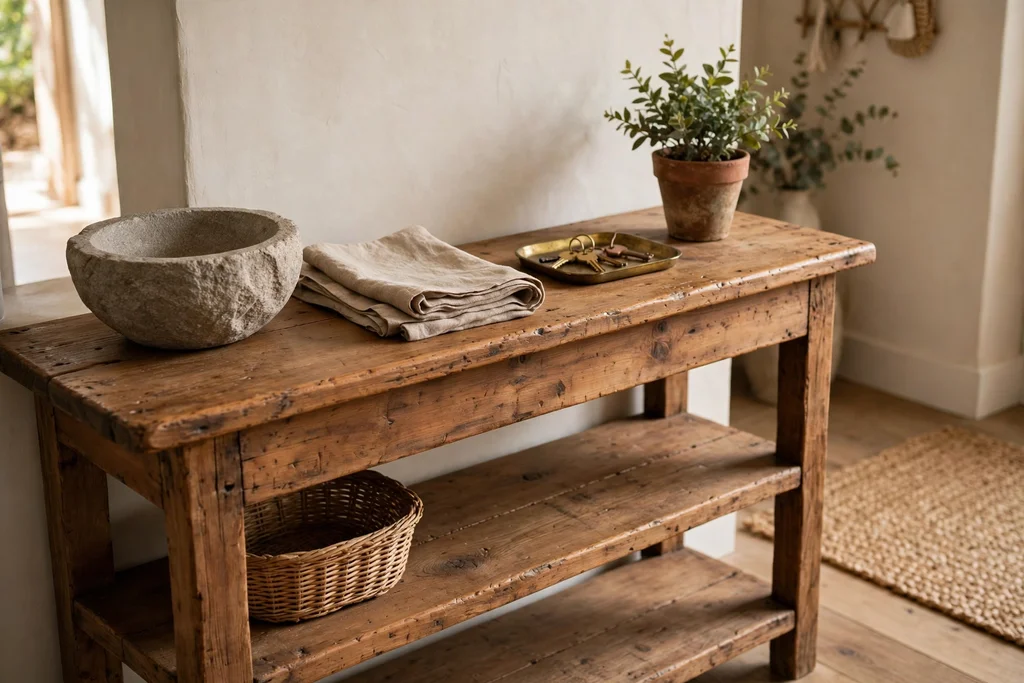
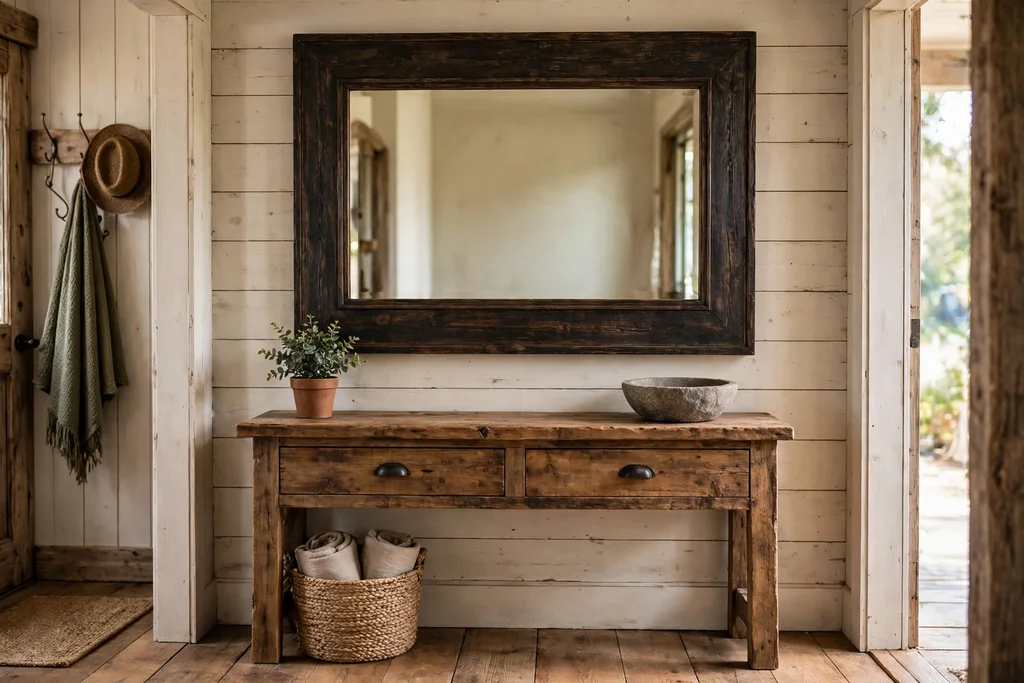
    Welcoming entryway with a slim wood console table, a mirror above, a bowl for keys, and a vase with stems.

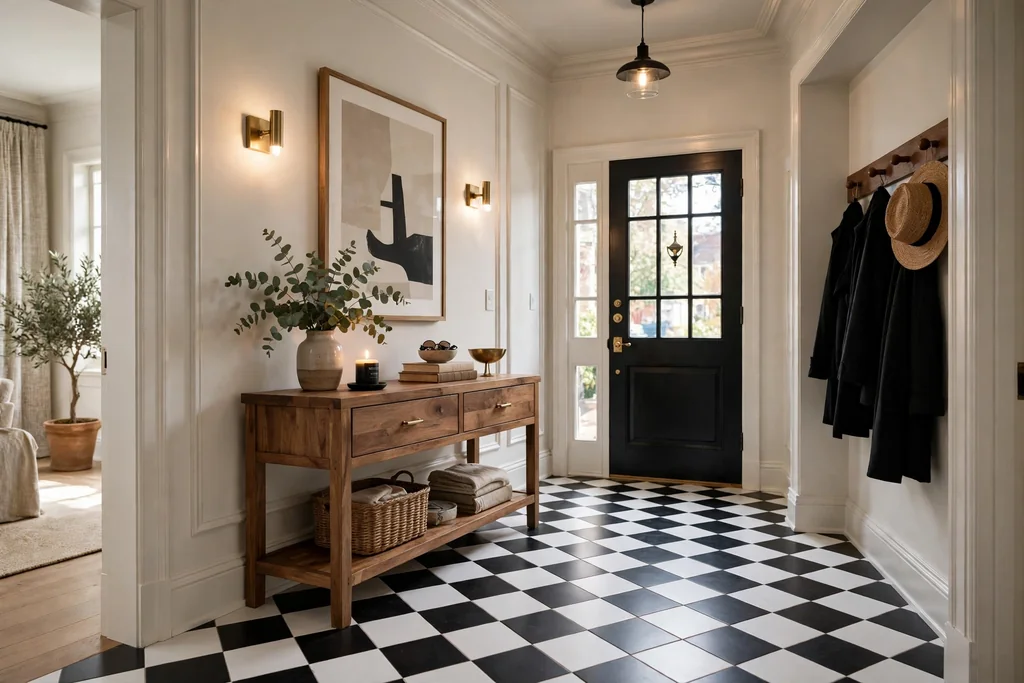
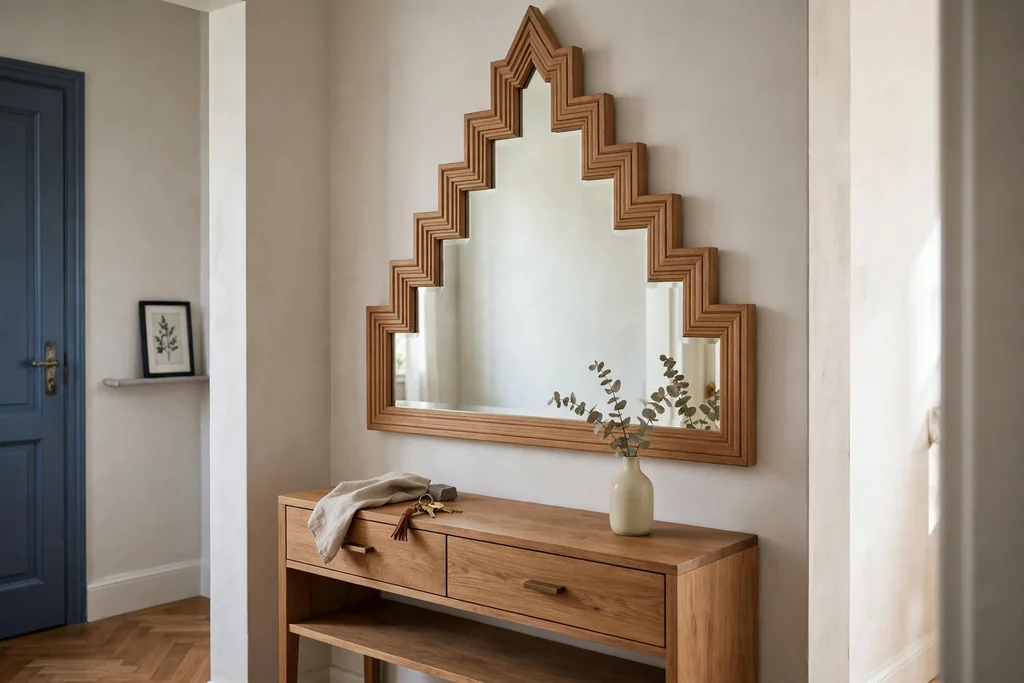
    An entry console sets the tone for the whole home, since it is the first surface guests see. Choose a slim table that fits the wall without blocking the walkway, hang a mirror or one piece of art above it, and add a small bowl for keys, a vase with stems, and a basket below for shoes or bags. This suits a hallway, a small entry, or a landing, and it gives keys and mail a home, so they stop landing on the kitchen counter.

    Keep the top mostly clear, with three or four items only, and leave the basket below for items you grab daily. Wipe the table often, since entries collect dust, and check the mirror height, so it reflects the room rather than the ceiling. If the entry is very narrow, use a wall shelf and hooks instead of a table, so the walkway stays clear.

    18. Repeat One Accent Color in Small Doses
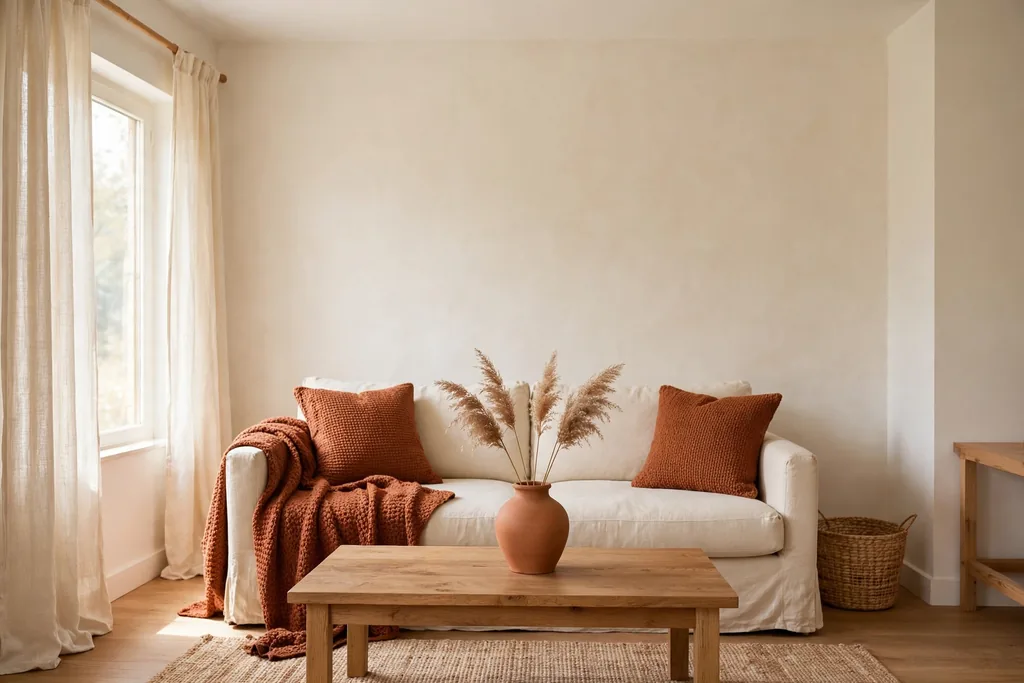
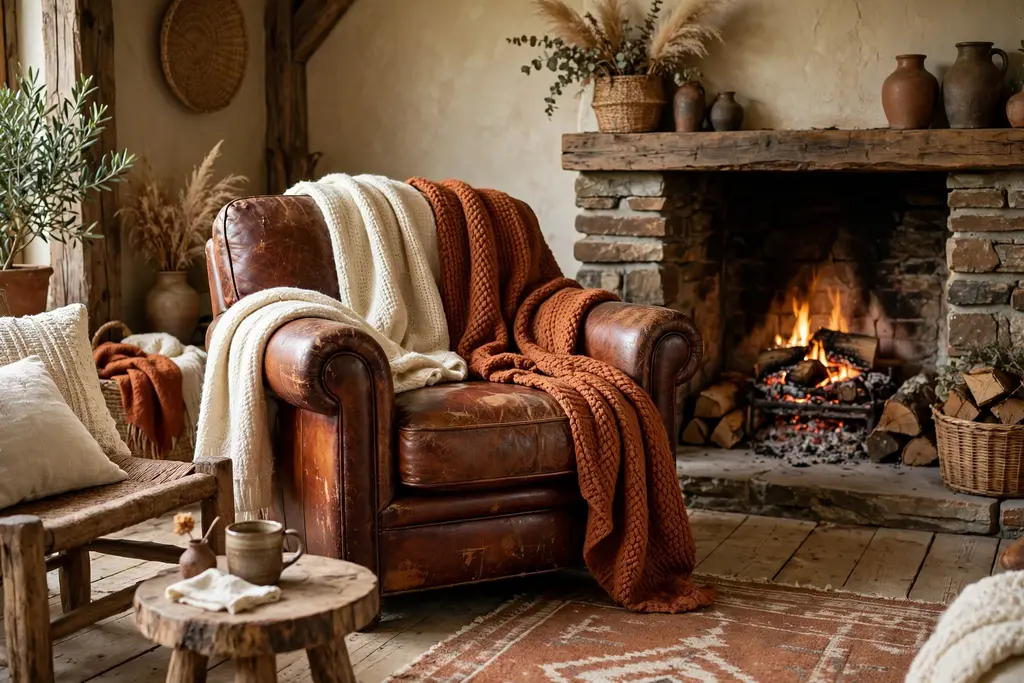
    Calm living room in cream and warm white with rust cushions, a terracotta vase, and a rust throw.

    One accent color, repeated in small doses, makes a room feel current without a bold repaint. Pick a warm accent, such as rust or terracotta, and use it in a cushion, a vase, and a throw, spread across the room rather than grouped in one spot. This suits a neutral room that feels flat, since the repeat draws the eye around the space and ties seating, shelves, and windows together.

    Keep the accent to about three touches per room, and keep the base neutral, so the color stays a highlight rather than a theme. If the room starts to feel too strong, remove one touch, such as the throw, and keep the cushion and vase, since two repeats are often enough. Swap the accent with the seasons if you like change, by changing cushion covers and a vase only.

    19. Add a Pouf and Floor Cushions for Casual Seating
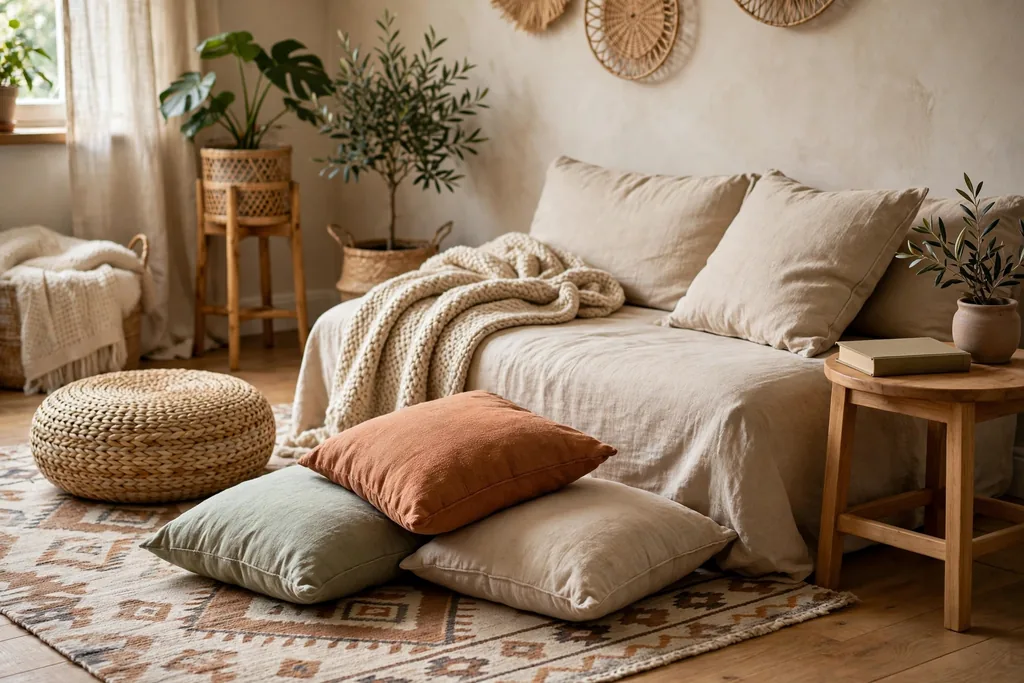
    Relaxed living room with a round woven pouf and floor cushions beside a low sofa on a rug.

    A pouf and a few floor cushions add casual, flexible seating that suits relaxed evenings and guests. Place a round woven pouf near the sofa as a footrest or an extra seat, and keep two floor cushions in a basket nearby for movie nights or reading on the floor. This suits a living room, a family room, or a bedroom corner, and it works well in a small space, since poufs tuck away when not in use.

    Choose covers you can wash, since floor seating shows wear fast, and keep the colors in your room palette, so the extra seats look planned. Store floor cushions upright in a basket, so they stay clean and easy to grab, and move the pouf to the side when you need floor space for play or exercise. A pouf in a natural weave also adds texture beside smooth sofa fabric.

    20. Restyle a Bookshelf With Books and Breathing Room
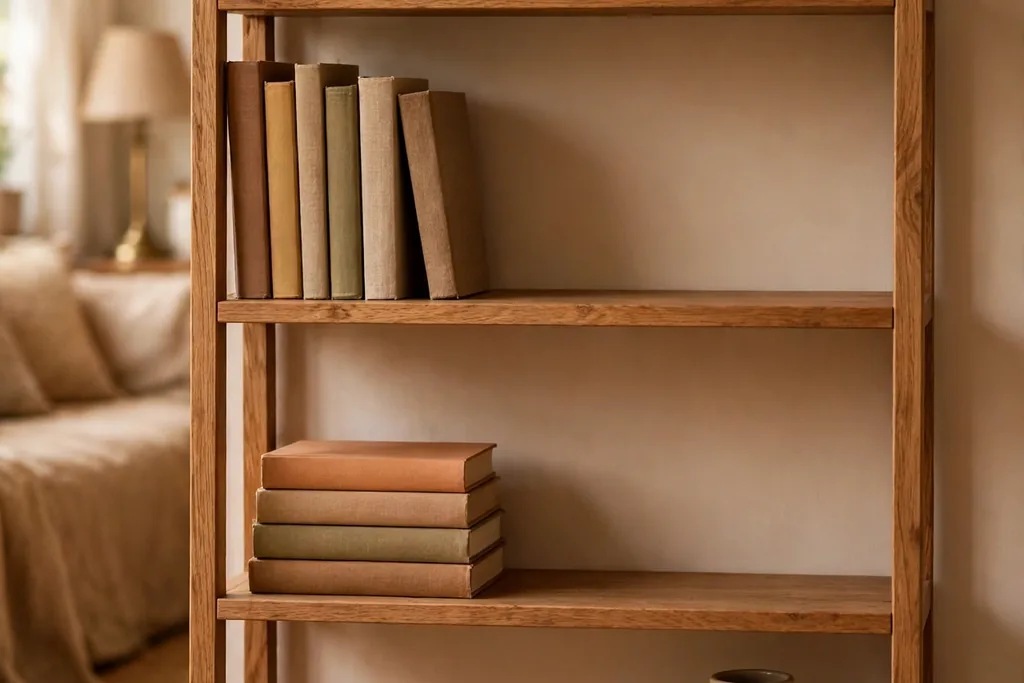
    Styled bookshelf with books grouped upright and stacked, a small plant, a ceramic vase, and one framed print.

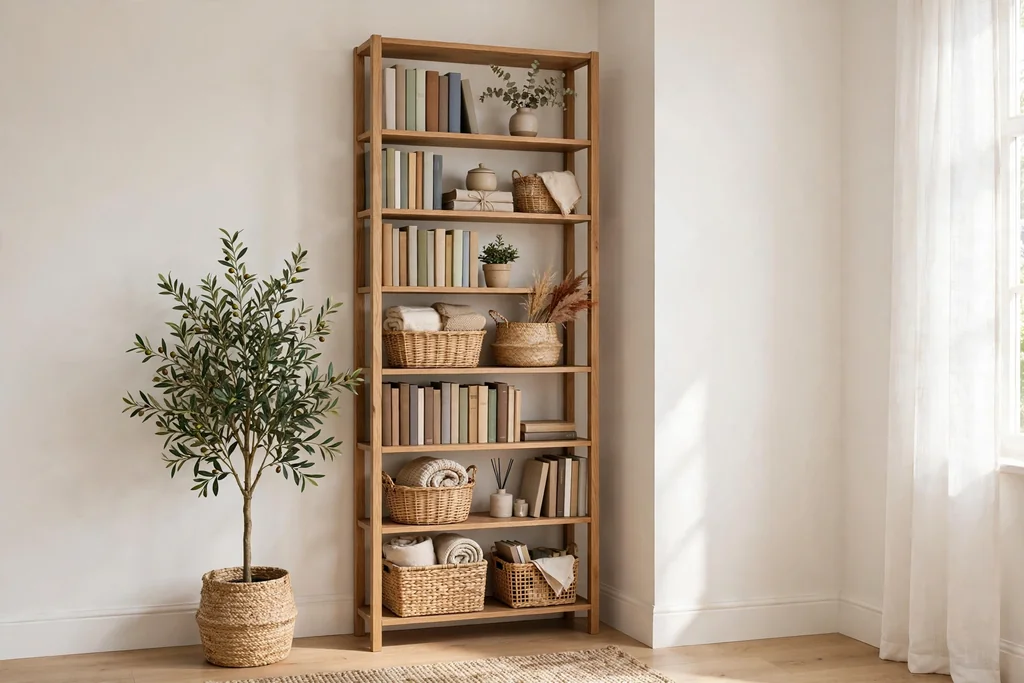
    A bookshelf feels current when books sit beside empty space and a few chosen objects, rather than packed tight on every shelf. Group books upright by height, stack a few horizontally to break the rows, and add a small plant, a ceramic vase, or one framed print on some shelves, leaving other shelves partly empty. This suits a living room, a study, or a bedroom, and it turns a storage unit into a display.

    Remove books you no longer read or enjoy, and move them to closed storage, so the shelf shows only what you like. Dust the shelves often, since open books collect dust, and keep heavier books low for safety. If a shelf looks bare, add a small stack of books on its side, rather than filling it with new objects, so the shelf stays calm and useful.

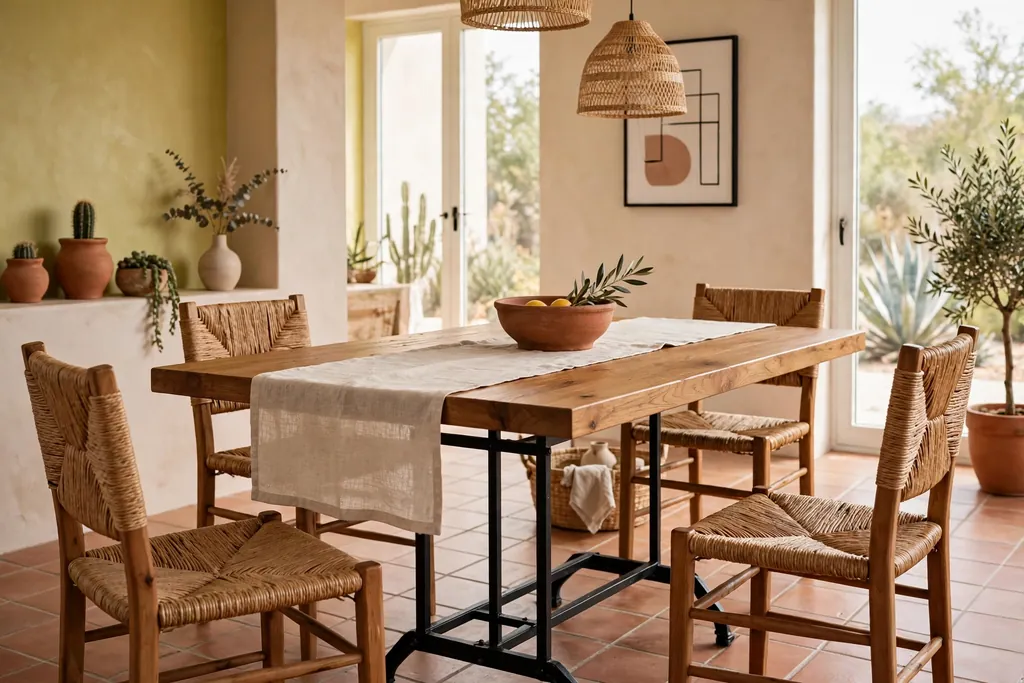
    21. Hang a Woven Pendant Light Over a Table
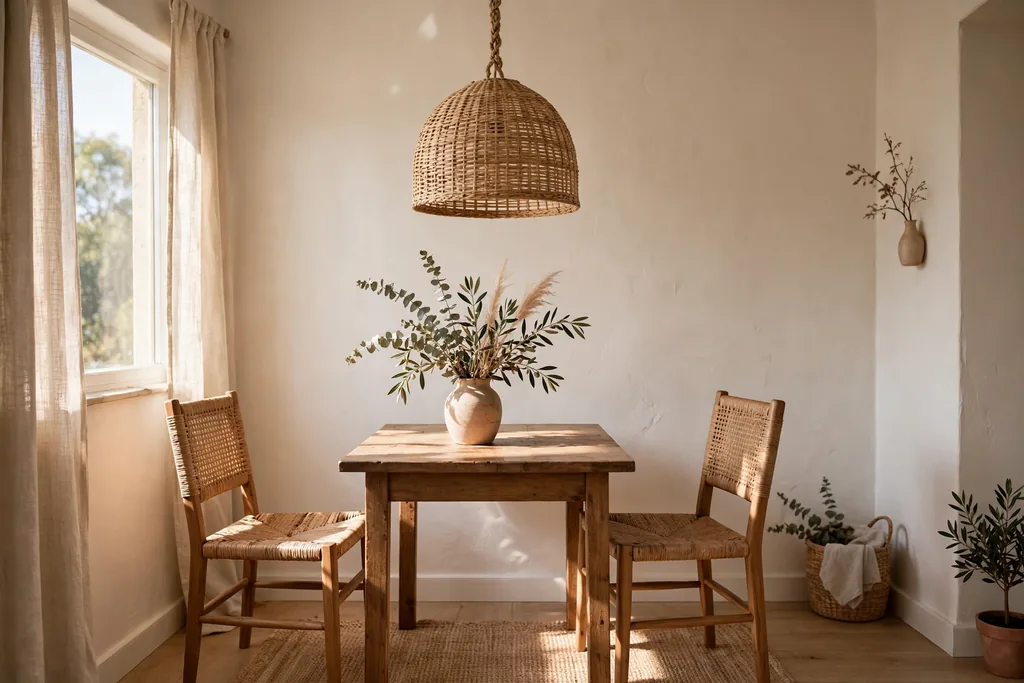
    Dining corner with a woven rattan pendant light hanging above a small wood table with two chairs.

    A woven pendant light adds texture above a table and gives a dining corner or a reading spot a clear centre. Hang a rattan or seagrass pendant over a small wood table, with the shade low enough to feel intimate but high enough to see across the table. This suits a dining nook, a kitchen table, or a bedroom side table, and it works well where a ceiling light alone feels too plain.

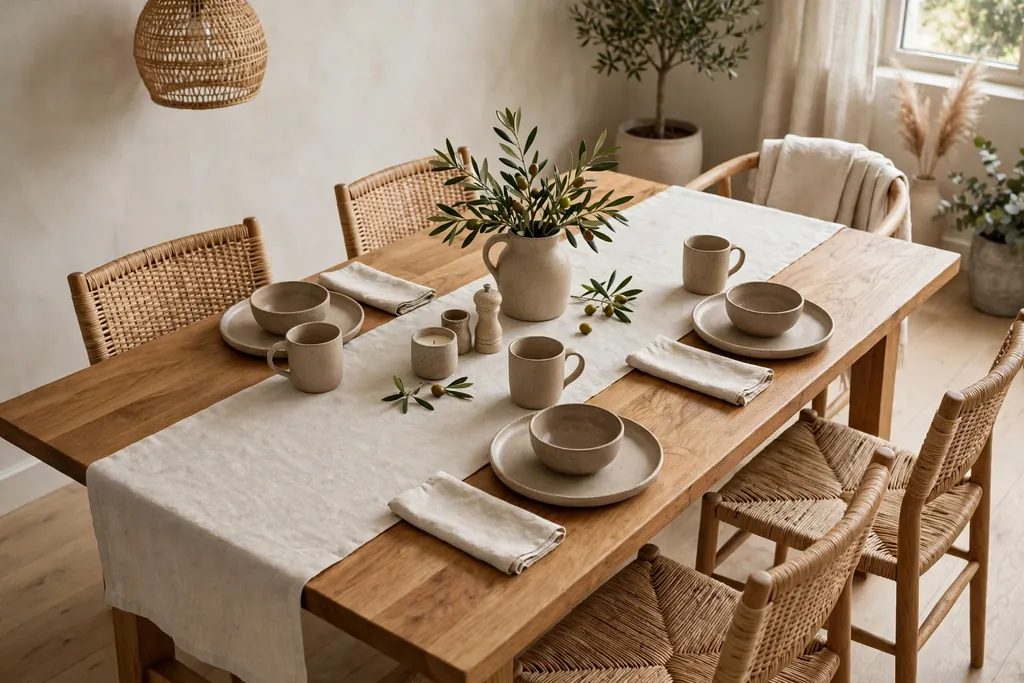
    Check the drop height before you fix the fitting, and use a warm bulb, so the woven shade glows softly in the evening. Keep the table below simple, with a vase and one or two place settings, so the pendant stays the feature. If you rent and cannot change a fitting, try a plug-in pendant with a hook, and check the cord route stays safe and tidy.

    22. Rearrange the Layout for Better Flow
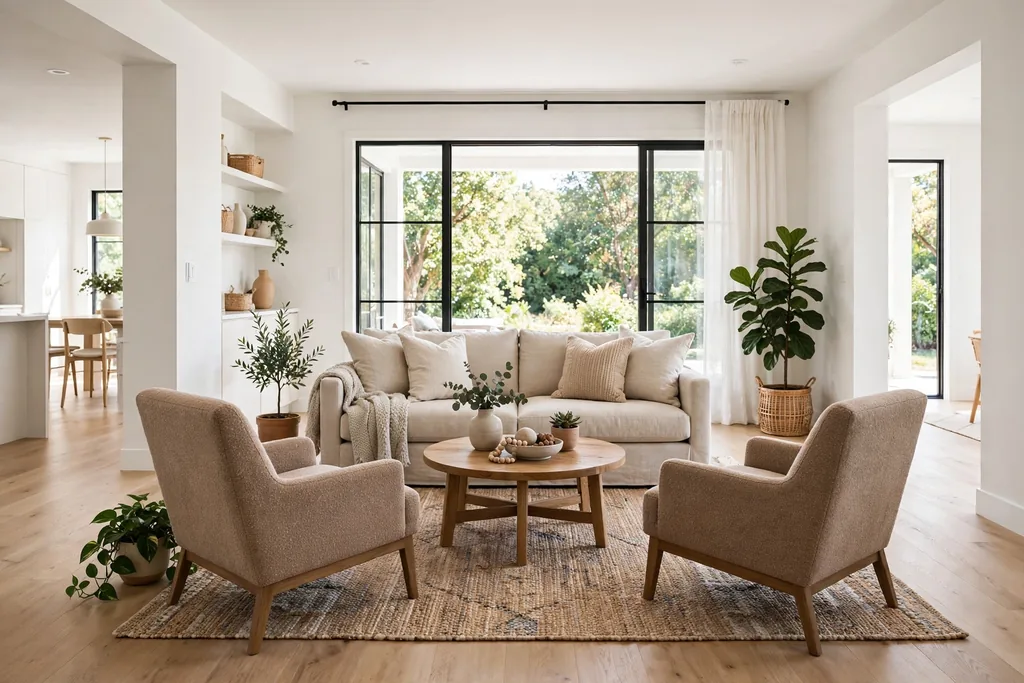
    Open living room layout with a sofa facing a window, chairs angled for conversation, and a rug defining the seating area.

    Rearranging furniture costs nothing, yet it can change how a room feels more than any new purchase. Start by clearing the room, then place the largest piece first, such as the sofa facing a window or a fireplace, and angle chairs for conversation, with clear walkways between pieces. This suits a room that feels cramped or awkward, since a new layout can open a path you did not notice before.

    Live with the new layout for a few days before you buy anything for it, and note where you still bump into furniture or lack light. Keep the rug under the seating group, and move lamps with the chairs they serve, so light follows seating rather than staying where it was. If a piece still does not fit, move it to another room or to storage, rather than forcing it into a tight corner.

    Conclusion

    Easy room decor does not need a big budget or a full renovation. Start with light, texture, and one calm palette, add plants and wood in small doses, and give each room one clear focal point. Try one or two ideas from this list first, live with the change for a few days, and then add the next swap, so each room grows cozy and current at a pace that suits your home and your budget. Save this list for your next weekend refresh, and return to it when a room starts to feel flat again.

    FAQs

    What is the easiest way to make a room feel cozy?

    Start with layered lighting, soft textiles, and a rug underfoot. Warm lamps, a throw, cushions in one palette, and a textured rug change how a room feels in an evening, without paint or new furniture, and each swap is easy to reverse if you change your mind.

    How can I make a room look current without redecorating fully?

    Keep the base neutral and current by using clean shapes, one accent color, and natural materials such as linen, wood, and woven baskets. Swap cushion covers, art, and a pendant shade, and remove clutter, so the room reads fresh without a renovation.

    How many accent colors should a cozy room have?

    One accent color, repeated in two or three small touches, is usually enough. A neutral base of warm white and cream, plus one warm accent such as rust or sage, keeps a room calm and cozy, while too many strong colors can make it feel busy.

    Do I need to buy new furniture to refresh a room?

    No. Rearranging furniture, changing cushions and curtains, adding plants, and styling shelves or a coffee table can refresh a room with no new furniture. Buy only after you live with a new layout for a few days and know what is still missing.

    How do I choose a rug size for a living room?

    Choose a rug large enough for the front legs of the sofa and chairs to sit on it, so the seating group feels connected. Measure the seating area before you buy, and leave a clear margin of floor around the rug, so the room still feels open.

    Can these ideas work in a rental home?

    Yes. Most ideas here are rental friendly, including lamps, rugs, cushions, curtains, baskets, plants, mirrors, removable wallpaper, and rearranging furniture. Check your lease and wall fixing rules before you hang heavy art or mirrors, and use removable options where you can.
  • 24 Narrow Laundry Room Ideas for a Welcoming, Lived-In Look

    24 Narrow Laundry Room Ideas for a Welcoming, Lived-In Look

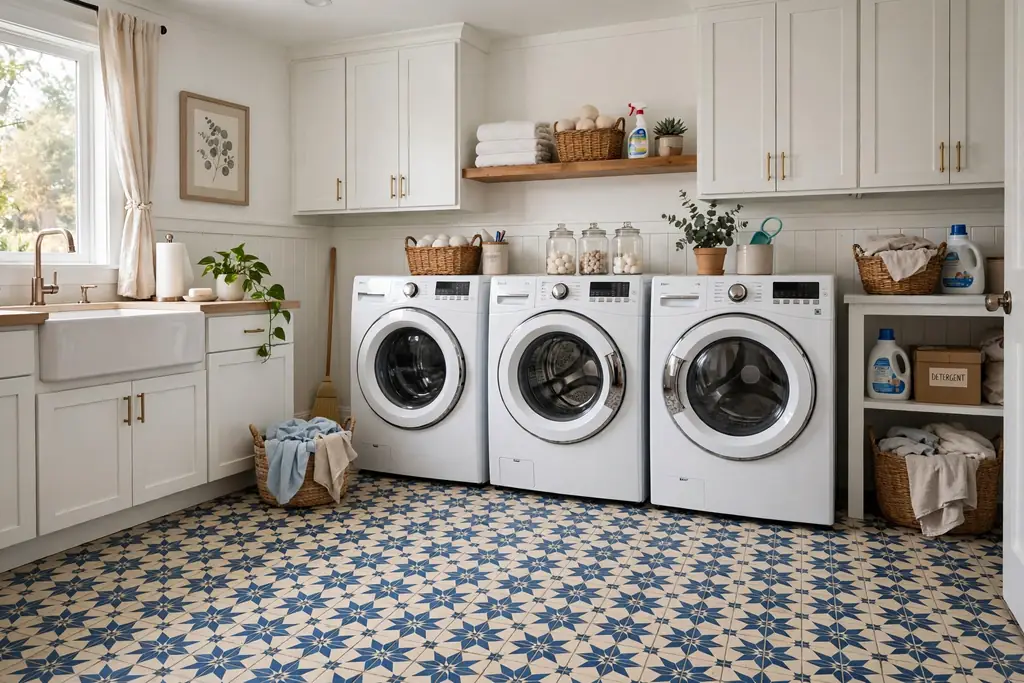
    A narrow laundry room can still feel good to use. The trick is to give every inch a clear job, keep the walkway open, and add a few warm details so the room reads as part of the home rather than a bare utility corner. These 24 narrow laundry room ideas cover layouts, storage, drying, folding, and simple styling, so you can pick one quick change or plan a fuller refresh. Start by measuring the width, the door swing, and the space around the machines, then choose the ideas that fit your room and your weekly routine.

    Key Takeaways

    • Measure first: room width, door swing, machine depth, and clearance for hoses and vents decide which layouts will fit.
    • Keep the walkway clear by moving storage to the walls, up high, and into slim gaps, and by choosing doors and racks that fold flat.
    • Stack machines or add a counter over front loaders to free a full wall for storage, folding, or a drying zone.
    • Sort laundry into slim bins by load type, and keep daily supplies at hand height with spare stock up high.
    • Warm the room with pale warm paint, wood tones, a washable runner, soft light, and one or two lived-in details such as a plant or framed prints.
    • Add drying space that disappears when not in use, such as a fold-down rack, a retractable line, or a ceiling pulley rack.

    1. Stack the Washer and Dryer Into One Tall Tower

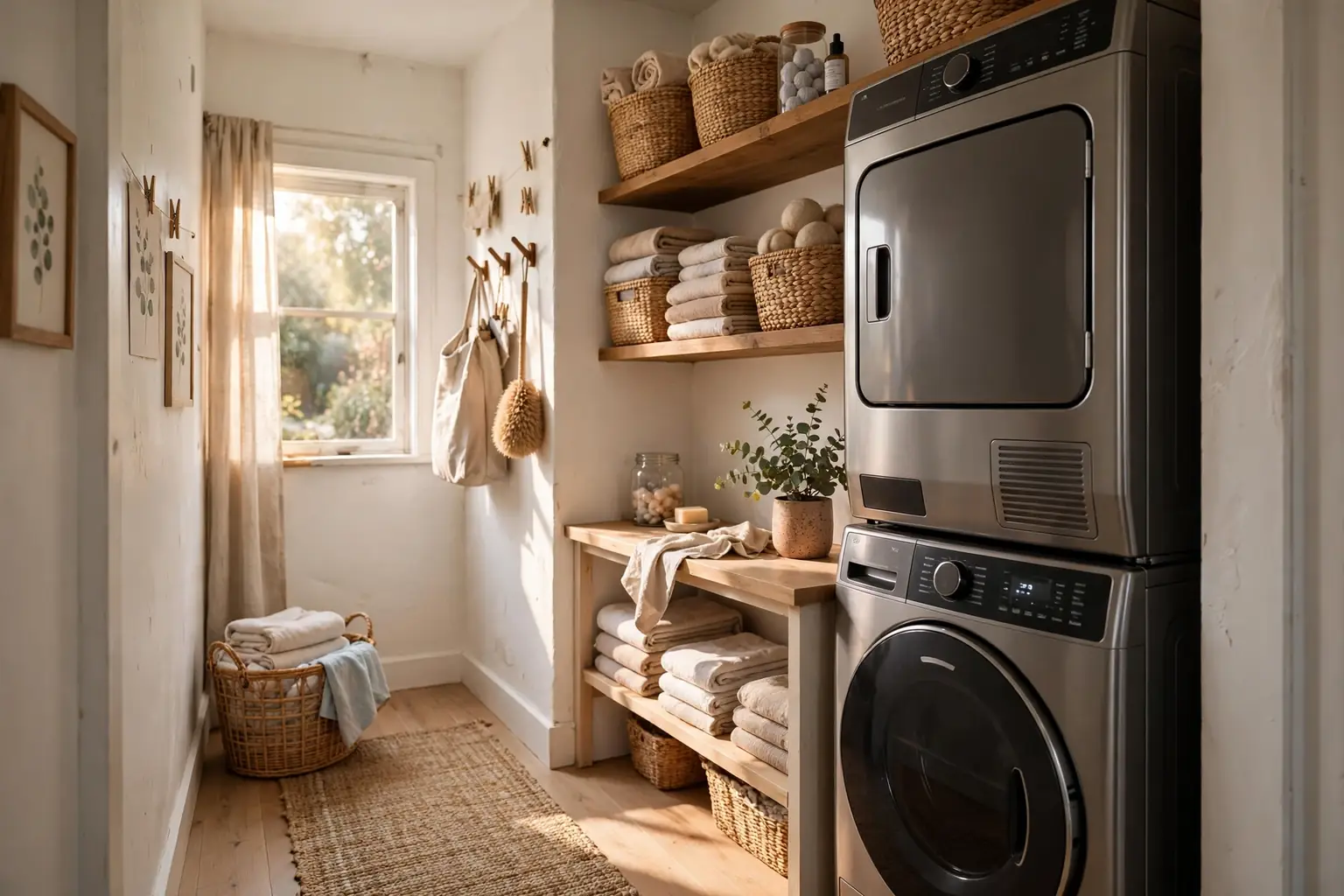
    Stacked washer and dryer tower in a narrow laundry room with a shelf beside it

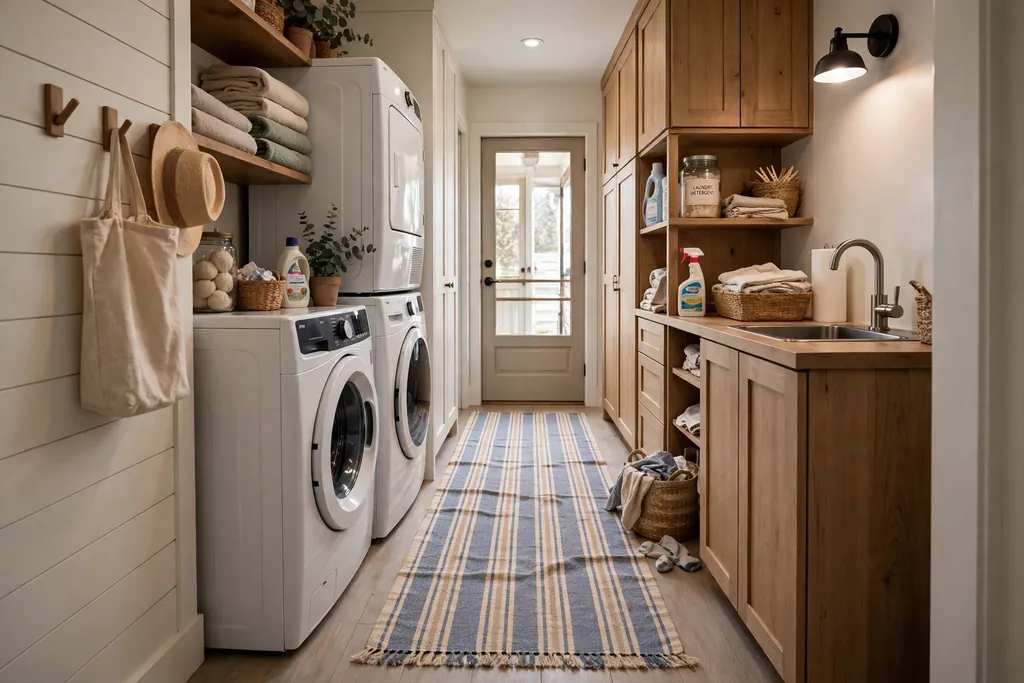
    Stacking the washer and dryer turns two floor footprints into one tall tower and frees the rest of the wall for storage or folding. This suits a narrow room where side by side machines leave no room to move, and it works best with a stacking kit made for your machine models. Keep the dryer controls within easy reach, and use a small step stool if the top controls sit high.

    Use the freed wall for a slim cabinet, open shelves, or a folding shelf. Leave the clearances the machine maker advises around the tower, and check that the door can still open fully without hitting the opposite wall. Anchor the tower as advised, and keep a small basket nearby for items waiting to go in.

    2. Add a Counter Over Side by Side Front Loaders

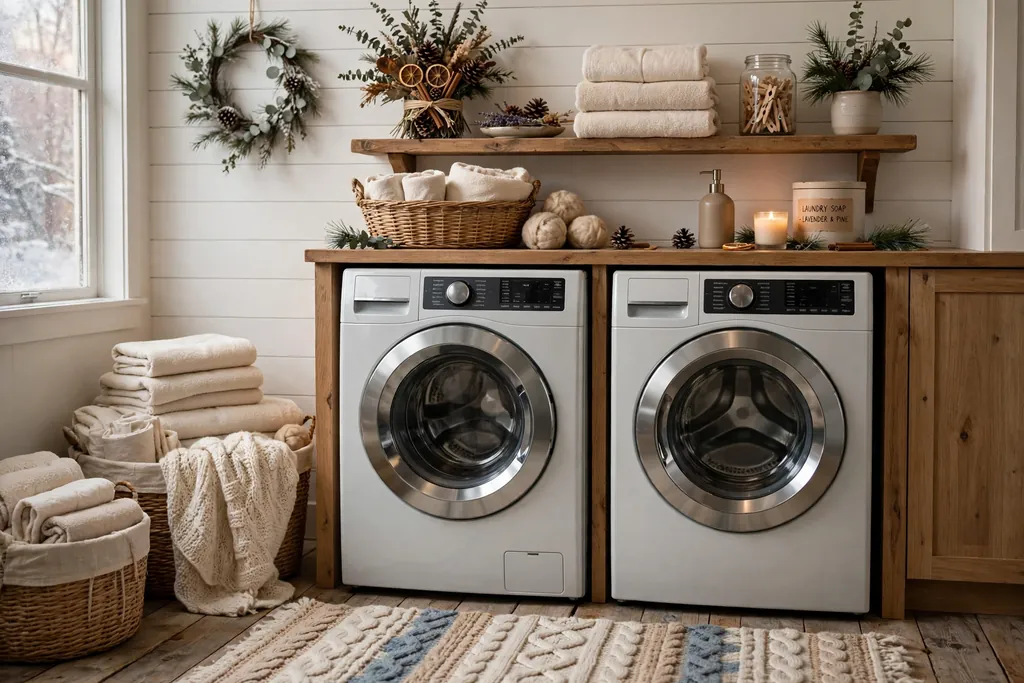
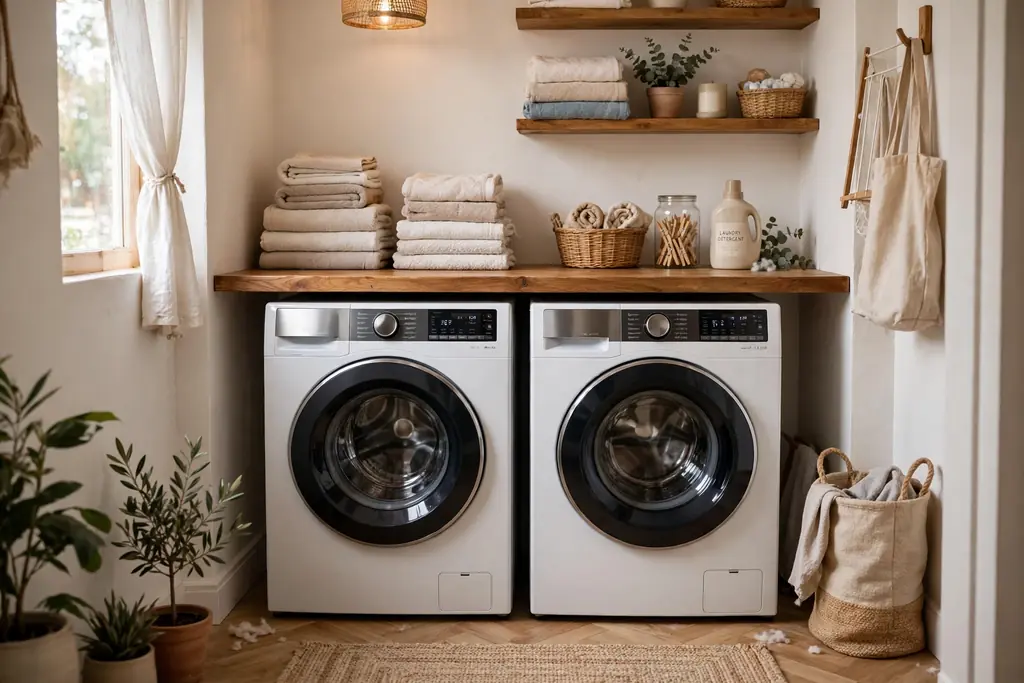
    Wood counter over two front loader washing machines with folded towels on top

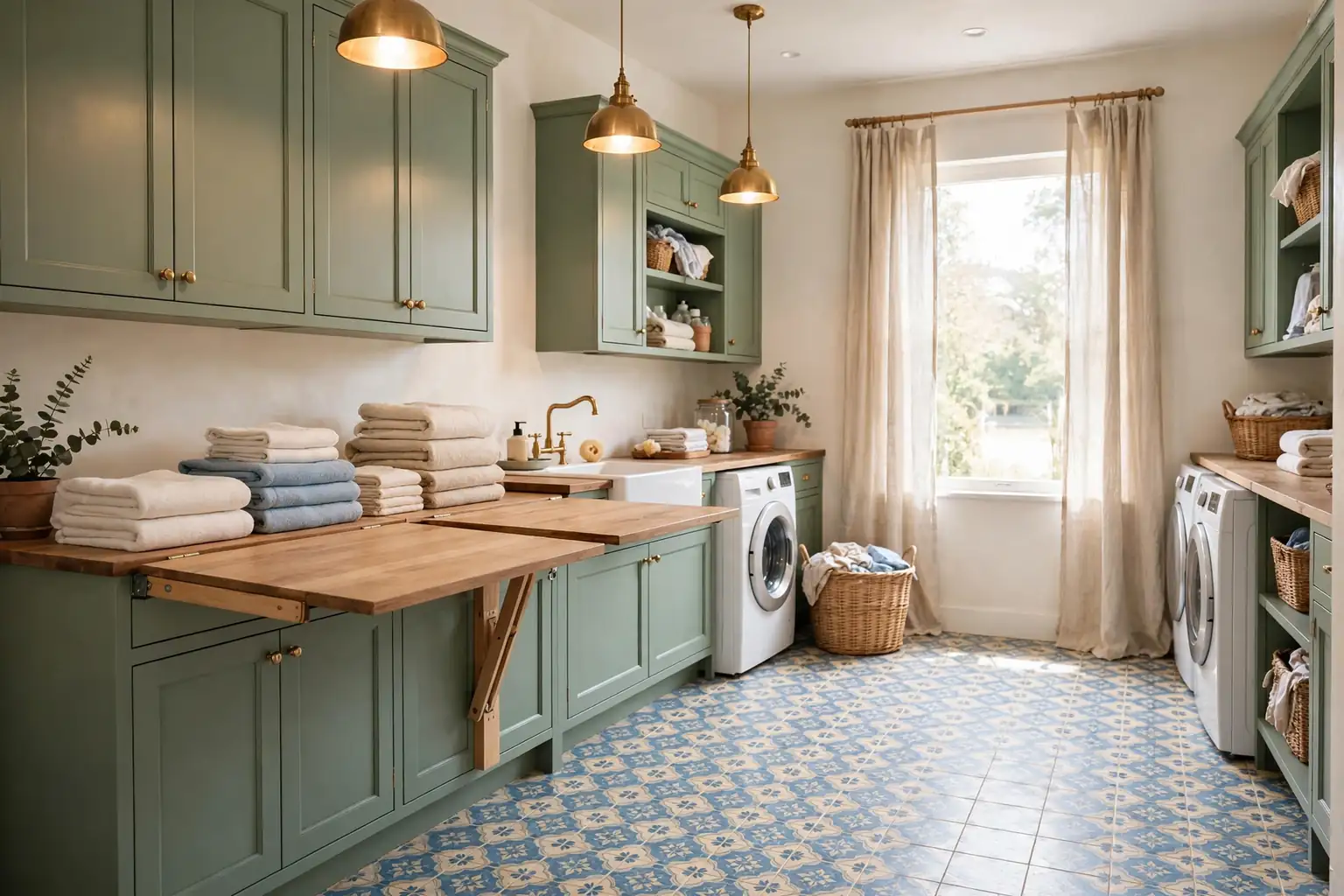
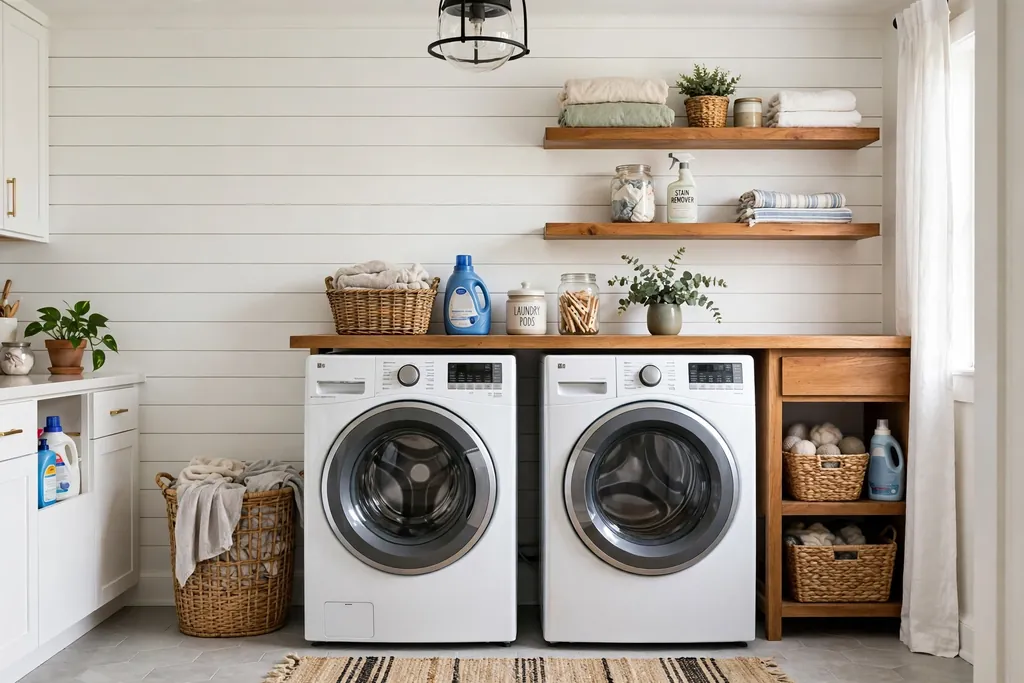
    A counter over side by side front loaders gives a narrow room a folding surface without taking any floor space. The counter spans both machines, so you gain a long worktop for folding, sorting, and stacking clean piles. Choose a water resistant top, such as sealed wood or laminate, and leave a small gap at the back for hoses.

    Keep the counter mostly clear, with one small tray for supplies you reach for daily. Sort folded piles by person or room, then carry them out in a basket so the counter stays ready for the next load. If the machines vibrate, check the leveling feet first, since a steady machine keeps items from sliding off the counter.

    3. Slide a Slim Rolling Cart Into the Gap

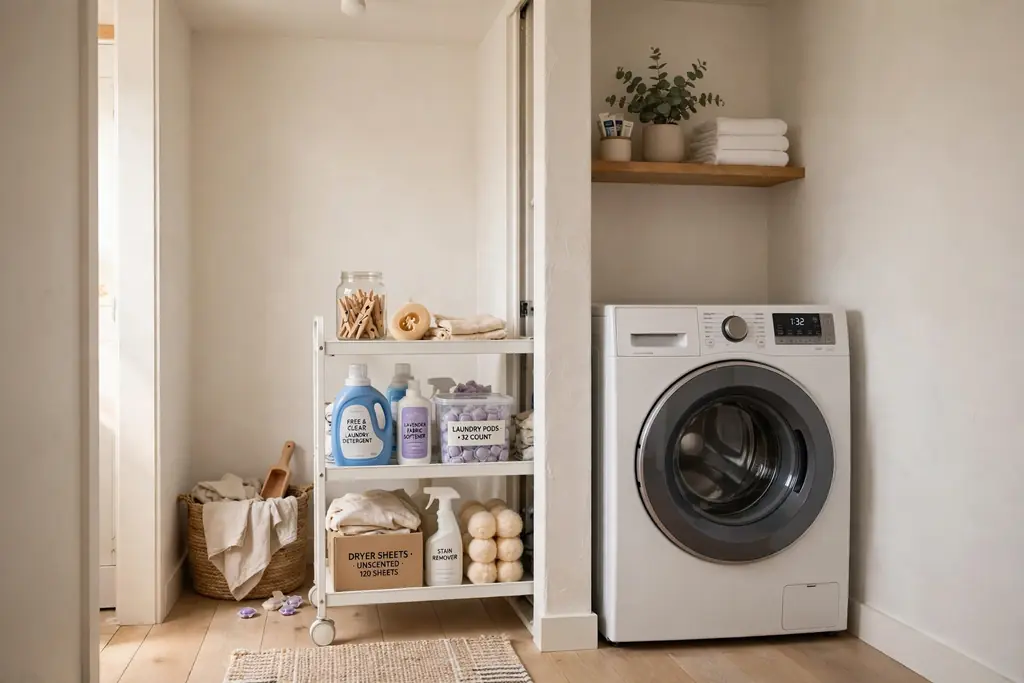
    Slim white rolling cart with shelves of laundry supplies beside a washing machine

    A slim rolling cart turns the gap beside a machine into three or four shelves of storage. Gaps of 15 to 25 centimetres often sit empty in a narrow laundry room, and a cart on wheels brings every shelf to you with one pull. Use it for detergent, stain spray, dryer balls, and spare cloths.

    Choose a cart narrower than the gap, with a handle at the front and a rim on each shelf so bottles stay put. Keep tall bottles on the lowest shelf so the cart stays stable when pulled out. Slide it back flush when done, so the walkway stays clear. This idea suits rented homes well, since it needs no drilling or fixing.

    4. Fit a Fold-Down Shelf for Folding

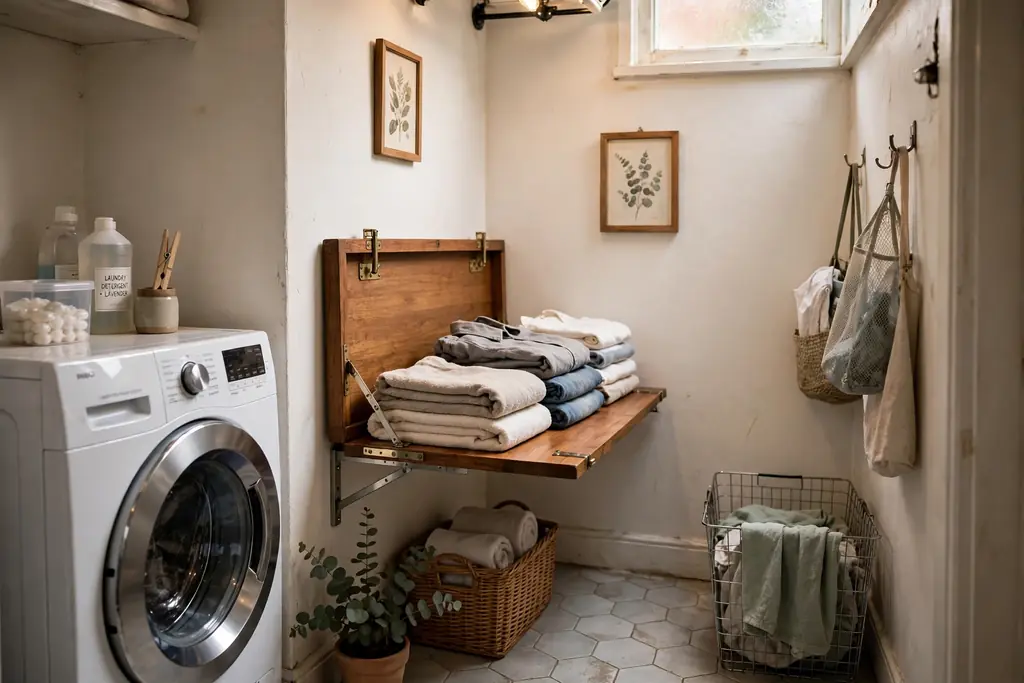
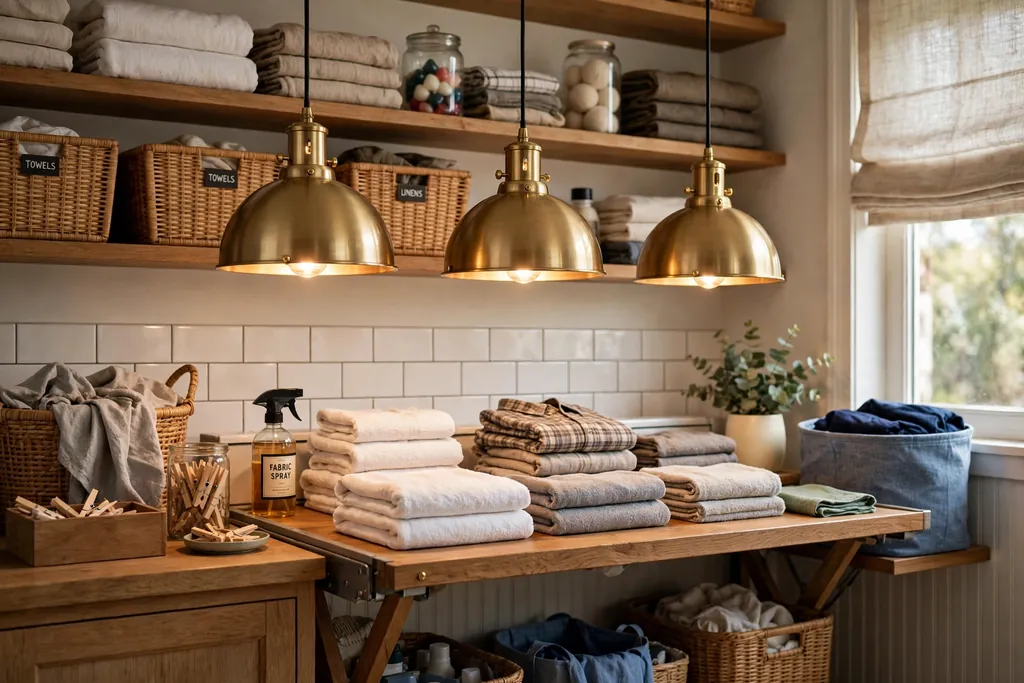
    Fold-down wooden wall shelf lowered in a narrow laundry room with folded clothes

    A fold-down wall shelf gives a narrow room a folding table only when you need it. Lowered, it holds a basket of clothes to fold; folded up, it leaves the wall and the walkway clear. Fix it at a comfortable standing height, above a machine or on the free wall, and use sturdy hinges and a support arm rated for the load.

    Keep the shelf depth shallow enough that it does not block the walkway when lowered. Fold clothes straight from the dryer onto the shelf, then carry the piles out in a basket. A fold-down shelf suits a room with no room for a fixed table, and it pairs well with a wall hook for the basket when the shelf is folded away.

    5. Run Cabinets Right Up to the Ceiling

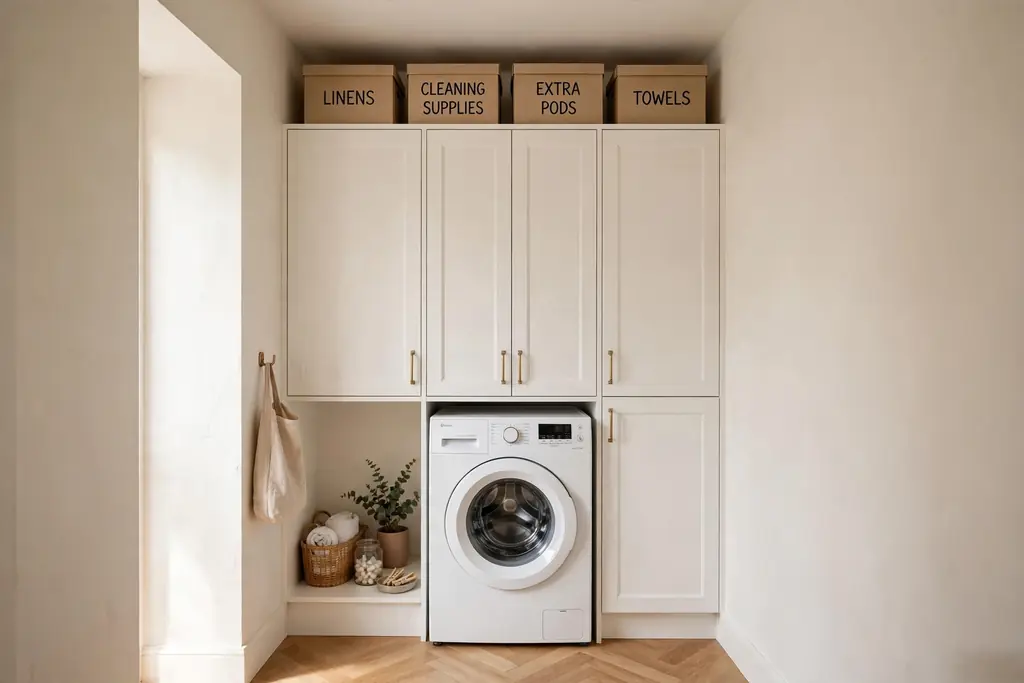
    White cabinets running to the ceiling above a washing machine in a narrow laundry room

    Cabinets that run to the ceiling use the tallest, most wasted strip of a narrow laundry room. The top shelves hold spare stock, seasonal items, and bulky supplies, while the lower shelves hold daily items at hand height. Use one door finish through the run so the cabinets read as one calm unit rather than a row of boxes.

    Keep a small step stool in the room for the top shelves, and label the highest boxes so you can find spare stock without opening each one. Store heavy items low and light items high. If the ceiling slopes or a vent crosses the wall, stop the cabinets below the obstruction and use the remaining gap for a shallow open shelf.

    6. Use Open Shelves With Matching Baskets

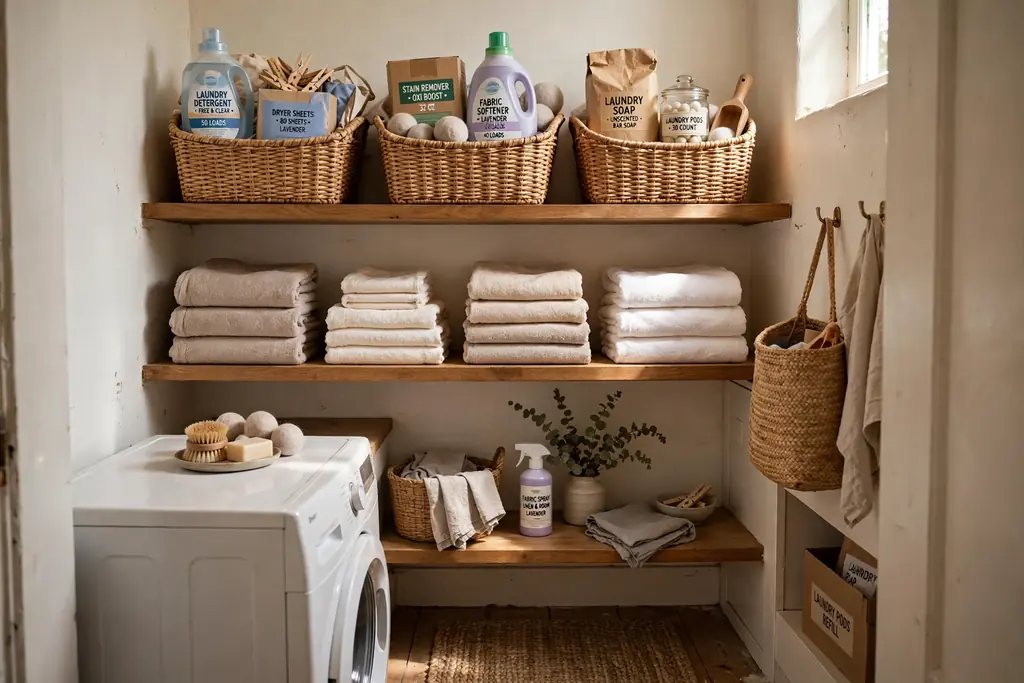
    Open wood shelves with matching woven baskets holding laundry supplies

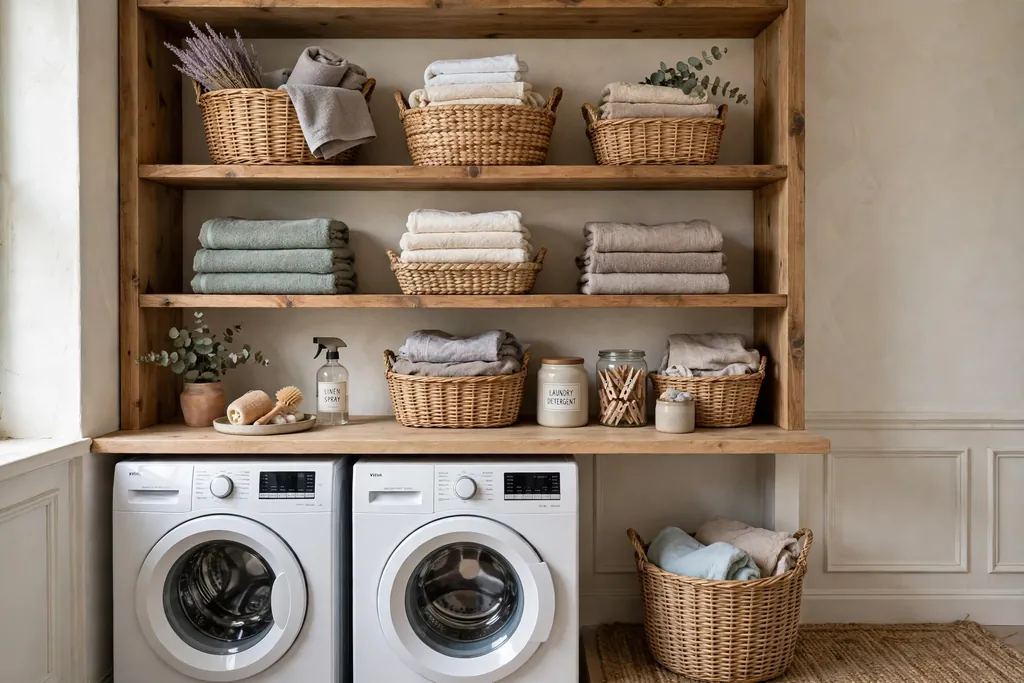
    Open shelves with matching baskets keep supplies visible and easy to grab, while the matching baskets keep the display calm. Use two or three shelves above the machines or on the free wall, and choose baskets in one material, such as cotton rope or woven seagrass, for a lived-in feel. Label each basket by job, such as washing, drying, and cleaning.

    Keep daily items on the lowest shelf and spare stock higher up. Leave a little empty space on each shelf so the display reads as tidy rather than crammed. Wipe the shelves when you restock, since lint settles fast in a laundry room. Open shelves suit renters when fixed with suitable wall anchors, and they cost less than a full cabinet run.

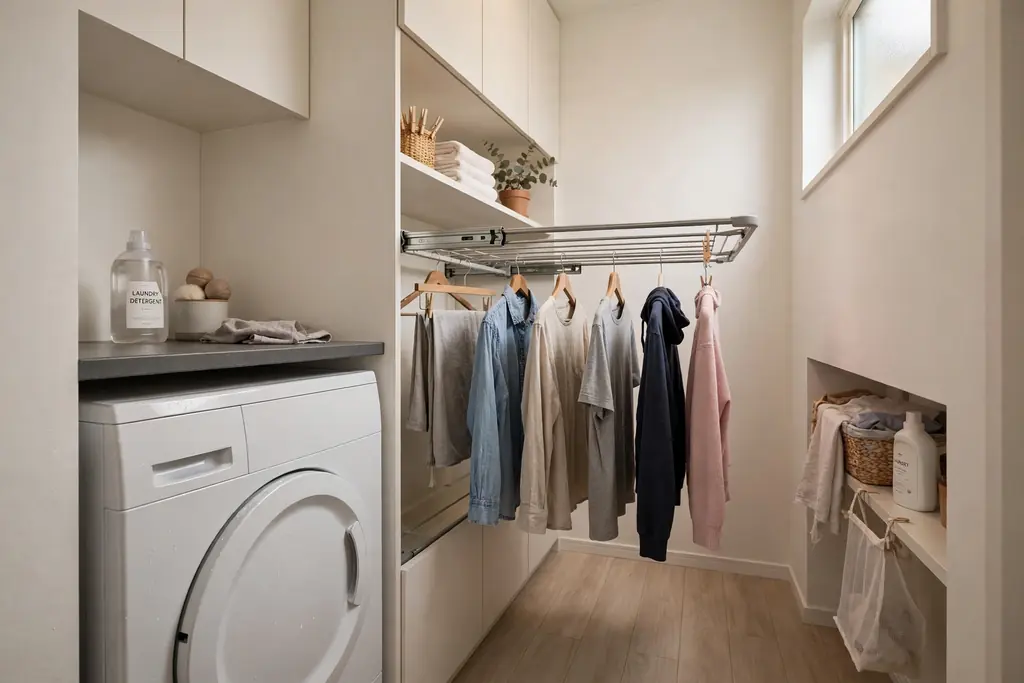
    7. Add a Pull-Out Drying Rack Between the Machines

    Pull-out drying rack slid out in a narrow laundry room holding hanging clothes

    A pull-out drying rack slides out from a slim cabinet or from the gap between machines, giving you drying space that vanishes when the load is done. The rack holds delicates and items that should not go in the dryer, and it folds or slides back flush so the walkway stays open. This suits a narrow room with no space for a freestanding drying rack.

    Mount the rack at a height that lets clothes hang without touching the floor, and leave air space around it so items dry rather than staying damp. Hang the heaviest wet items near the support end. If a pull-out rack will not fit, a rack that mounts on the inside of a cabinet door gives a similar result on a smaller scale.

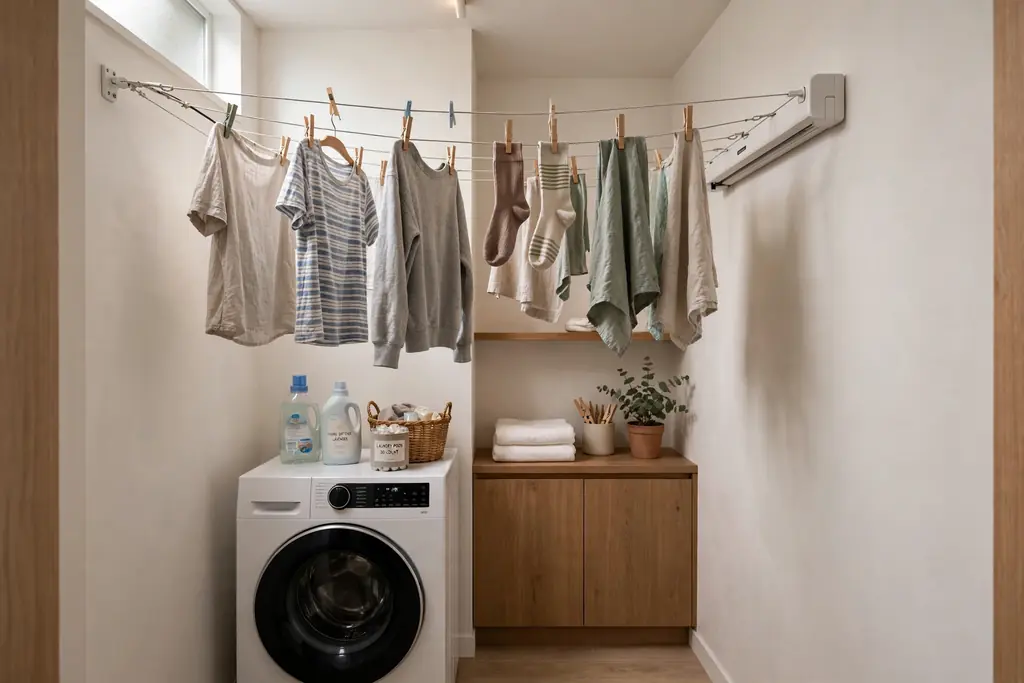
    8. Fix a Retractable Clothesline Across the Room

    Retractable clothesline strung across a narrow laundry room with clothes hanging

    A retractable clothesline spans the narrow room when you need it and winds back into its housing when you do not. Fix one end to the wall and hook the other end to the opposite wall only for drying time. Two or three parallel lines hold a full small load, and the lines sit high enough to keep clothes clear of the machines and the floor.

    Use the line for items that dry best in air, such as swimwear, wool, and printed tops. Keep the room ventilated while clothes dry, since still damp air slows drying and can leave a musty smell. Retract the line after each use so the room feels open again. This is a low cost change that suits rented homes when the housing is fixed with removable anchors or screws in a stud.

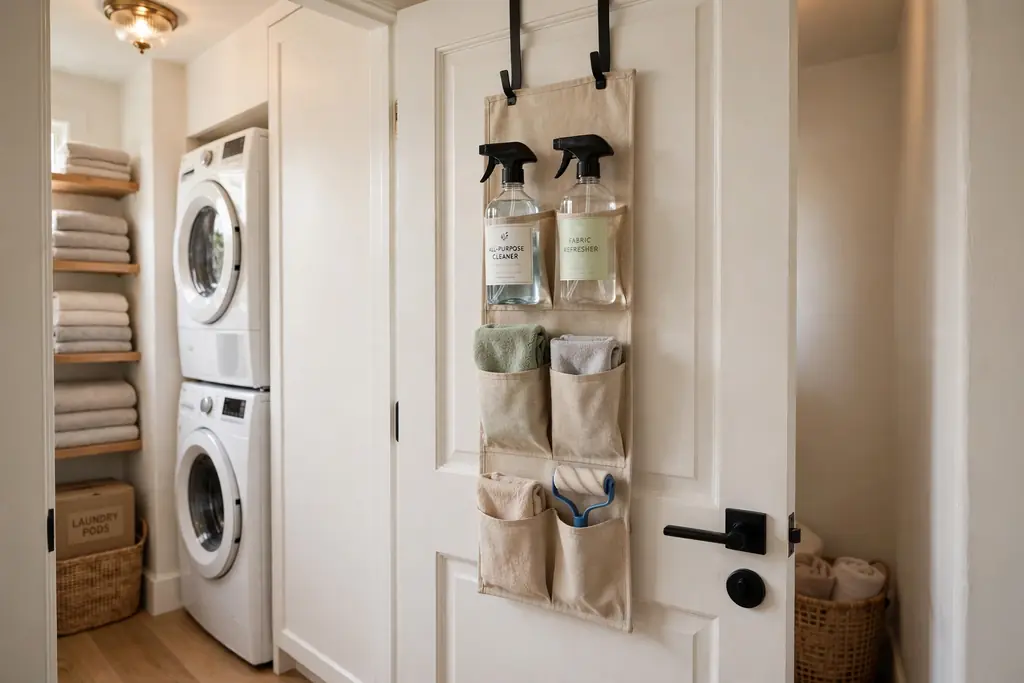
    9. Use the Back of the Door for Supplies

    Slim hanging organizer on the back of a laundry room door holding spray bottles

    Hooks and a slim organizer on the inside of the laundry room door hold supplies that would otherwise crowd a shelf. Use the pockets for stain spray, cloths, dryer balls, and small tools, and use hooks for a dustpan brush, a lint roller, and a small bag for stray socks. Keep heavy bottles low so the door still swings freely.

    Choose an organizer shallow enough that it does not hit a machine or a cabinet when the door opens. Hang it on the inside face so the pockets do not show from the hall. This change costs little, needs no drilling in many cases, and frees a full shelf for baskets or folded linens. Check that the door still latches fully once the organizer is loaded.

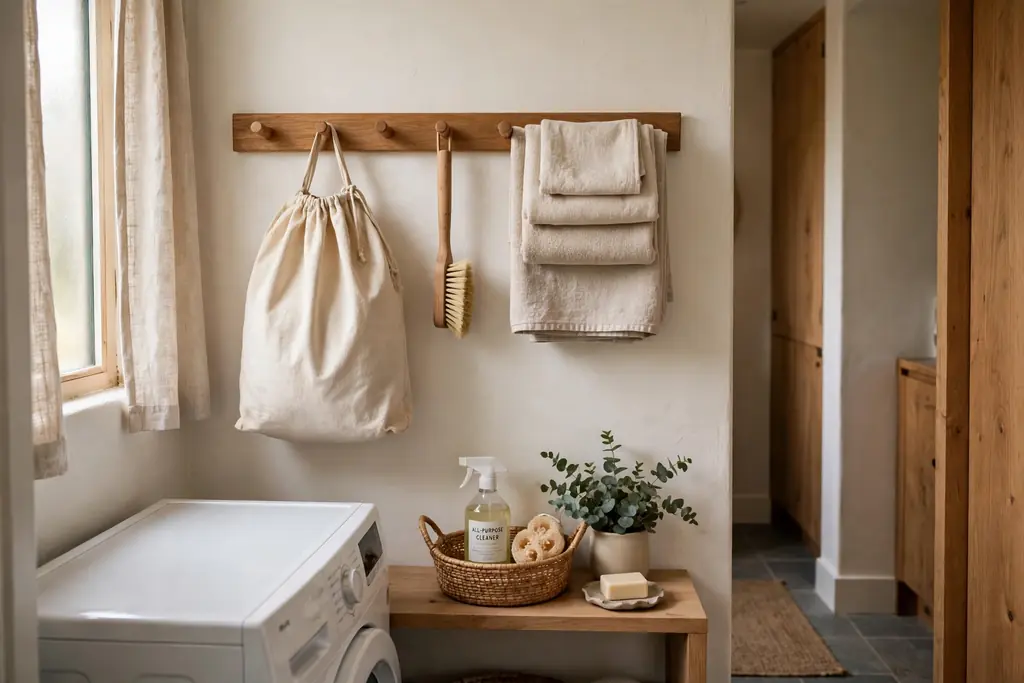
    10. Run a Peg Rail Along the Free Wall

    Wood peg rail with hooks holding a laundry bag

    A peg rail along the free wall gives a narrow laundry room a flexible row of hooks for hanging items, bags, and tools. Fix the rail at a height you can reach without stretching, and add a mix of hooks, clips, and small baskets. Hang a drying bag for delicates, a mesh bag for socks, and a brush, so each tool has a visible home.

    Keep the rail to one wall, and leave the opposite wall clear so the room does not feel closed in. Move hooks along the rail as your routine changes, such as adding a clip for a stain chart or a hook for a reusable shopping bag of items to mend. A wood peg rail also adds a warm, lived-in detail to a room that is mostly machines and white walls.

    11. Build In a Pull-Out Ironing Board

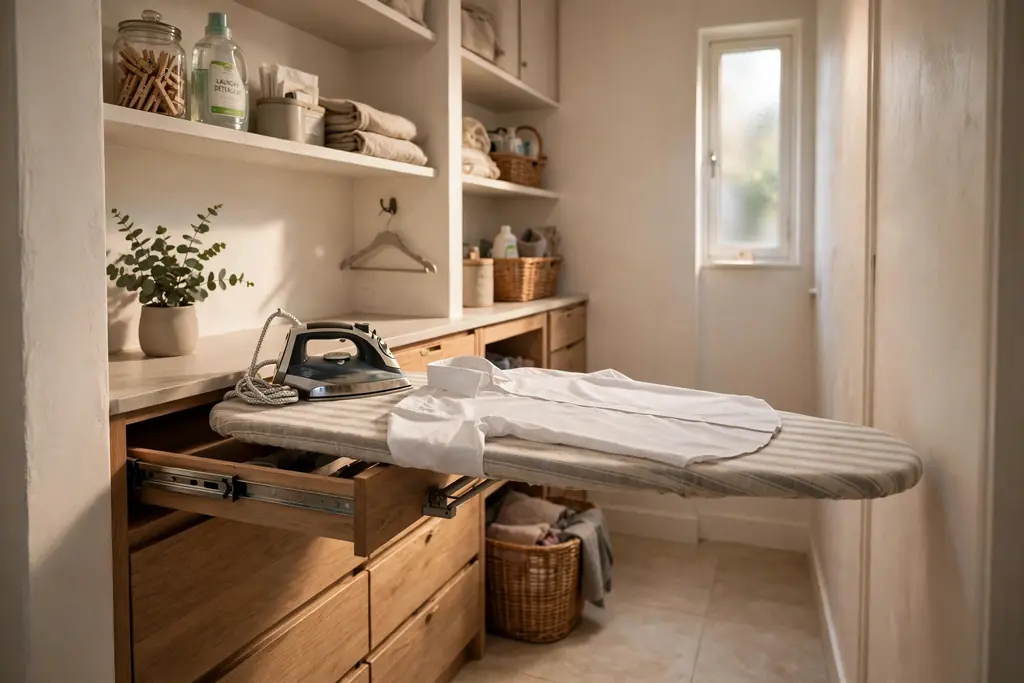
    Pull-out ironing board slid out in a narrow laundry room with an iron resting on it

    A pull-out ironing board hides inside a drawer or a slim cabinet and slides out only for ironing time. This suits a narrow room with no place to store a full board, and it keeps the walkway clear between laundry days. Choose a board sized to the drawer or cabinet, with a heat resistant cover, and fix the unit into studs or solid anchors.

    Iron near the machines so clothes move straight from dryer to board to hanger. Keep a small spray bottle and a heat safe rest for the iron beside the board, and fold the board away as soon as you finish so the room stays open. If a built-in board will not fit, a tabletop board used on the folding shelf in idea 4 gives a similar result.

    12. Fit a Slim Utility Sink Cabinet

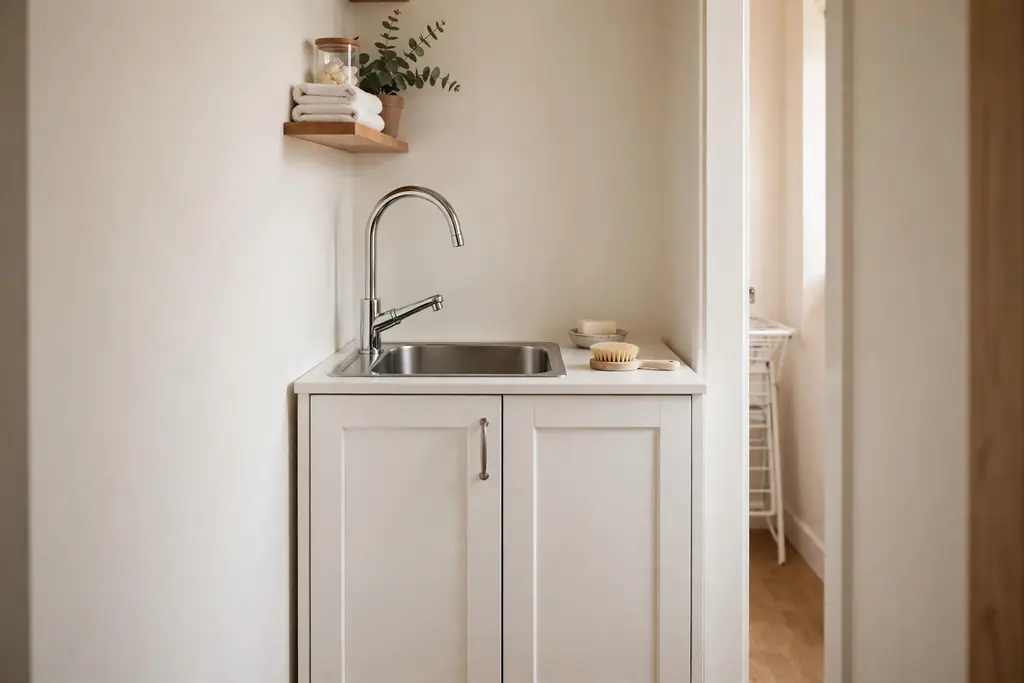
    Slim utility sink in a white cabinet in a narrow laundry room with a tap and brush

    A slim utility sink cabinet gives a narrow laundry room a place to soak stains, rinse muddy items, and fill a bucket, without the footprint of a full laundry tub. Choose the narrowest sink that still fits a bucket, and pair it with a cabinet below for cleaning supplies and spare cloths. A wall mounted faucet frees counter space beside the sink.

    Keep the area under the sink organized with the same bin approach used under a bathroom sink, grouping supplies by job so nothing is lost behind the pipes. For more ideas on making cabinet storage work around plumbing, see these under sink organization ideas. Wipe the sink after muddy jobs, and keep a small brush and a bar of stain soap in a dish beside the tap.

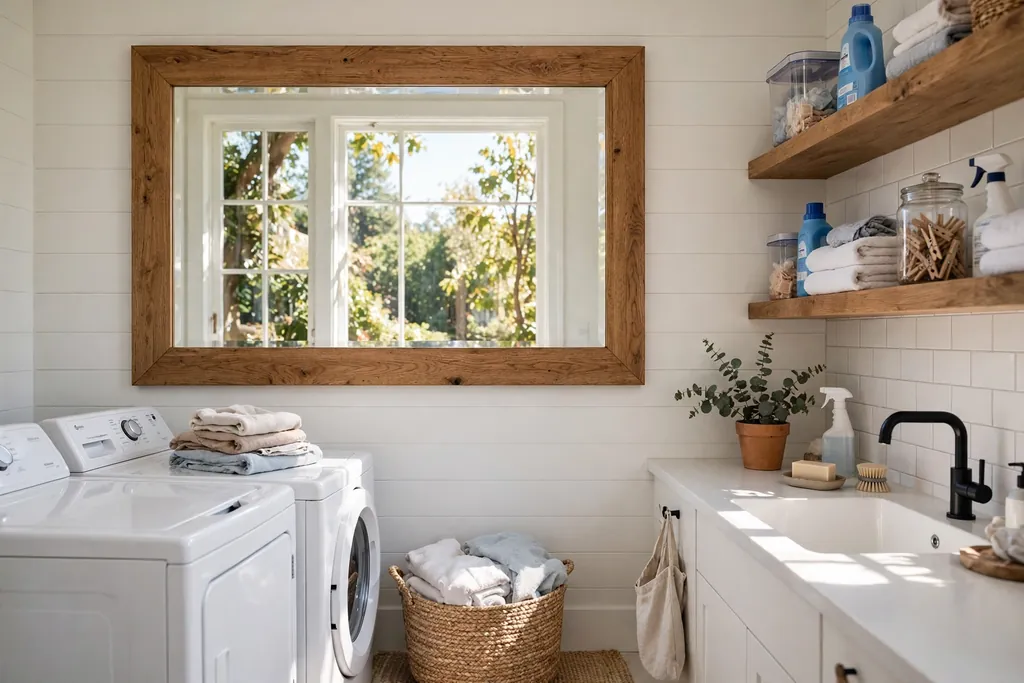
    13. Paint Warm White and Add Wood Trim

    Narrow laundry room with warm white walls

    Warm white paint with simple wood trim softens a narrow laundry room at once. Cool white can make a small utility room feel stark, while a warm white with a hint of cream warms the walls and suits wood, cotton, and wicker. Add wood trim around the door or a wood shelf, and the room starts to feel like part of the home.

    Paint the ceiling the same warm white to avoid a hard line overhead, and keep the trim to one wood tone so the small room stays calm. Test a painted patch beside the machines first, since machine finishes and artificial light shift how a white reads. This is a weekend change that lifts every other idea in this list, since warm walls make baskets, plants, and prints look at home.

    14. Lay a Washable Patterned Runner

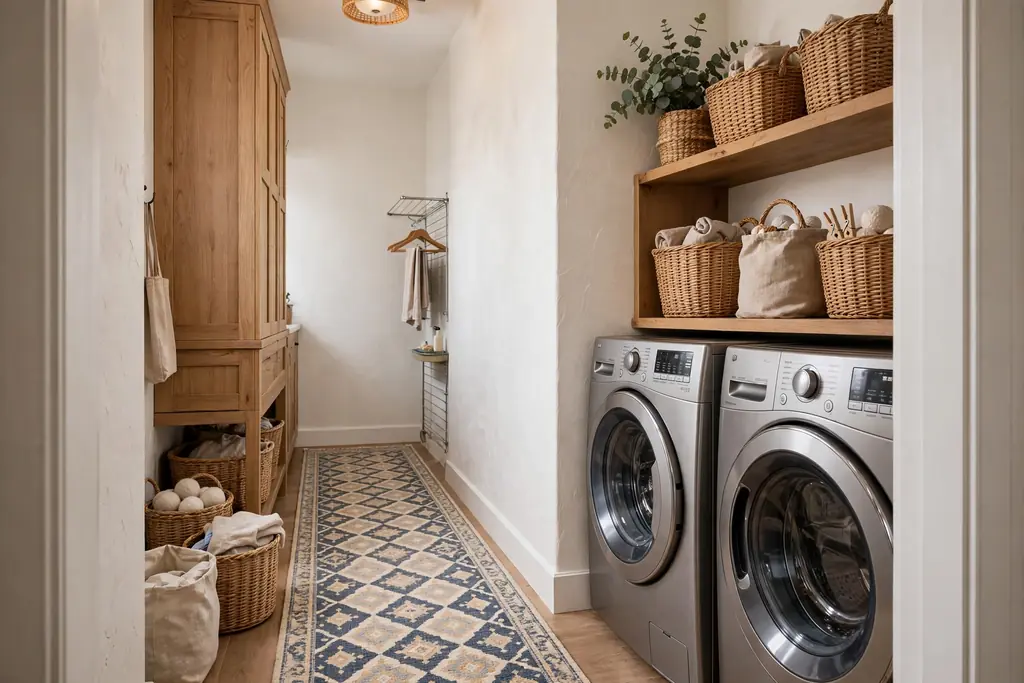
    Patterned washable runner on the floor of a narrow laundry room beside machines

    A washable patterned runner warms the floor, softens footsteps, and pulls the eye along the room, which makes a narrow space feel longer rather than cramped. Choose a low pile runner that fits the walkway with a small margin at each side, and a pattern that hides lint and stray marks between washes. A non slip backing keeps the runner in place on a smooth floor.

    Wash the runner with a load of towels, so it never becomes a separate chore. Keep the pattern simple, with two or three colours drawn from the baskets and paint, so the floor adds warmth without competing with the shelves. If the room has a drain or a floor that often gets wet, choose a runner made for damp areas and lift it to dry after a spill.

    15. Hang a Curtain to Close Off the Machines

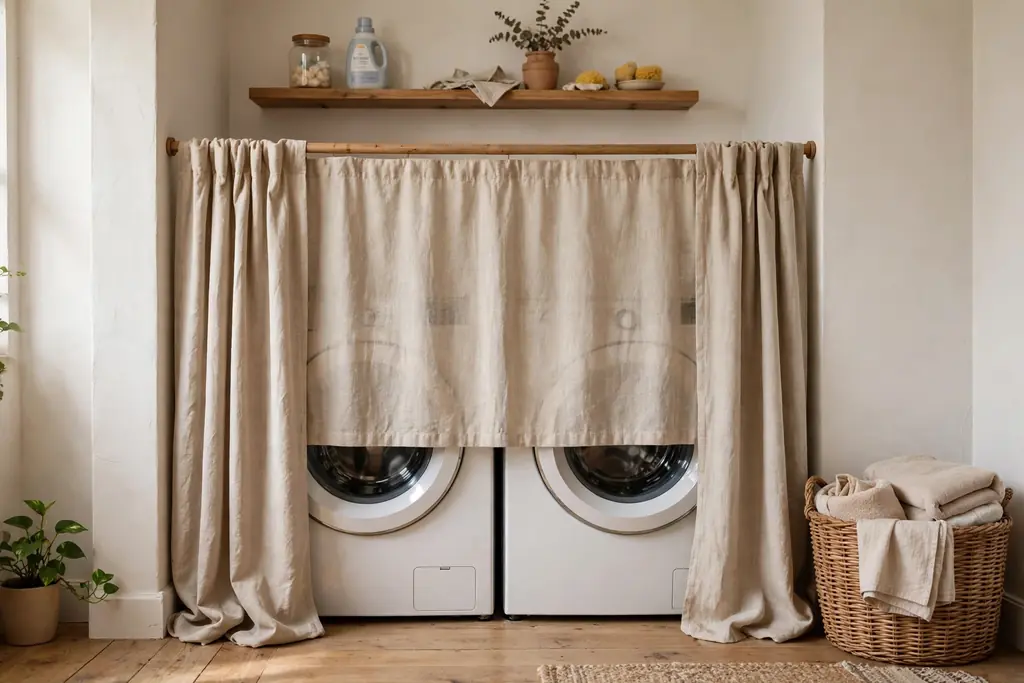
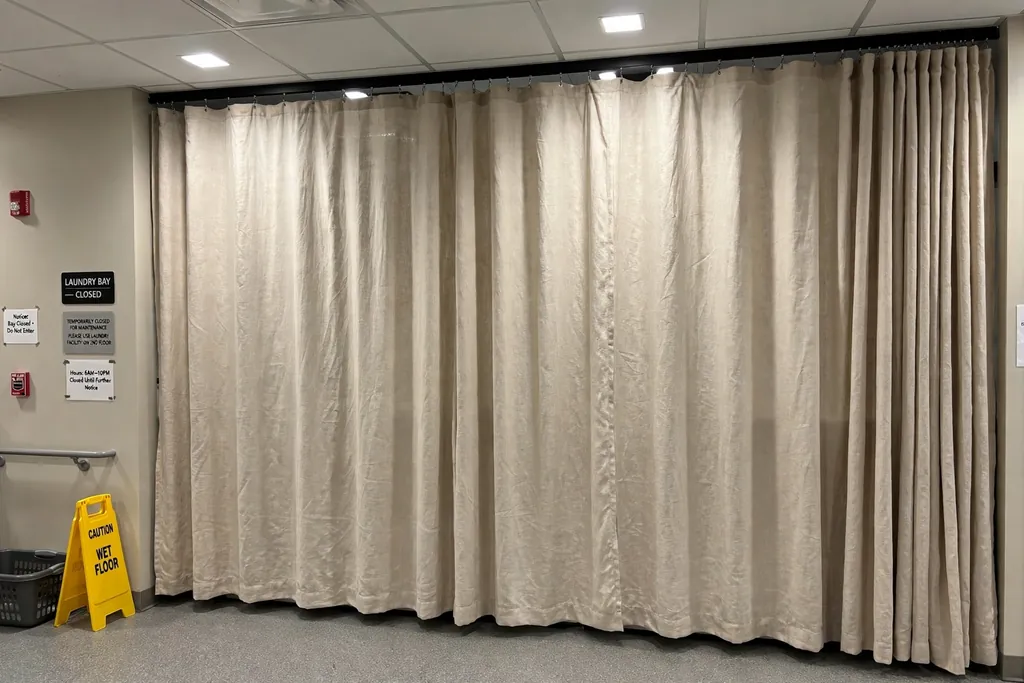
    Beige curtain panel drawn across washing machines in a laundry nook

    A curtain panel on a ceiling or wall track closes off the machines when laundry is not in progress, so the room reads as a calm passage rather than a wall of appliances. Choose a washable cotton or linen look curtain in a warm neutral, and hang it from a track that clears the machine doors. Draw it closed between laundry days, and open it fully when you work.

    A curtain suits a laundry nook off a hall or kitchen, where machines would otherwise stay on view all day. Keep the curtain clear of vents and dryer hoses, and wash it with a load of bedding now and then so it stays fresh. Pair the curtain with the warm paint in idea 13, and the closed room will feel like a linen cupboard rather than a utility corner.

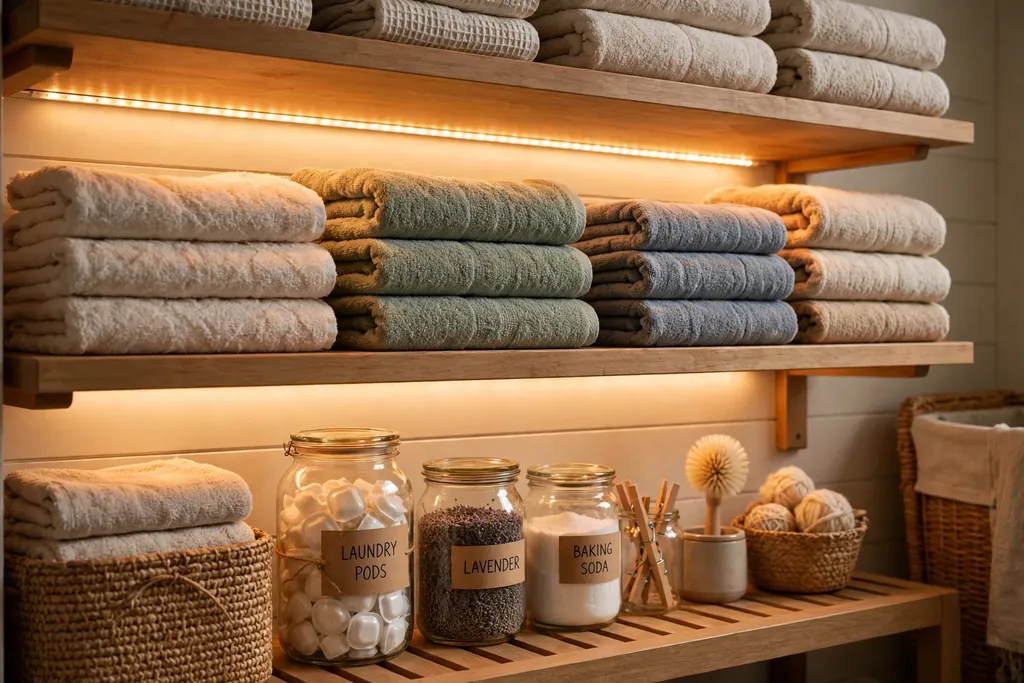
    16. Decant Supplies Into Matching Jars With Labels

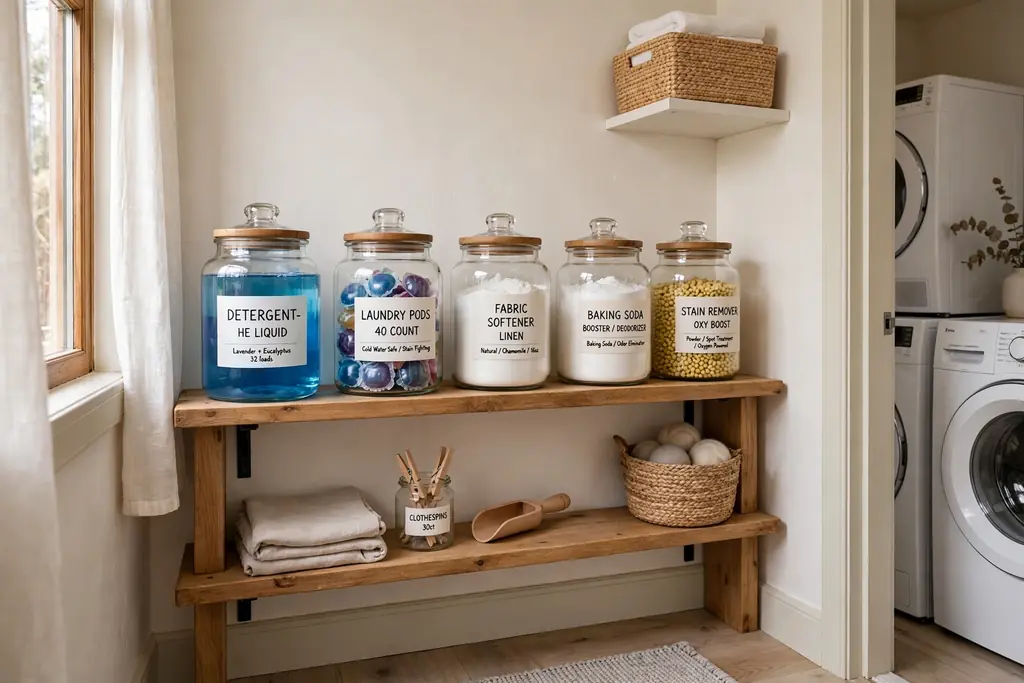
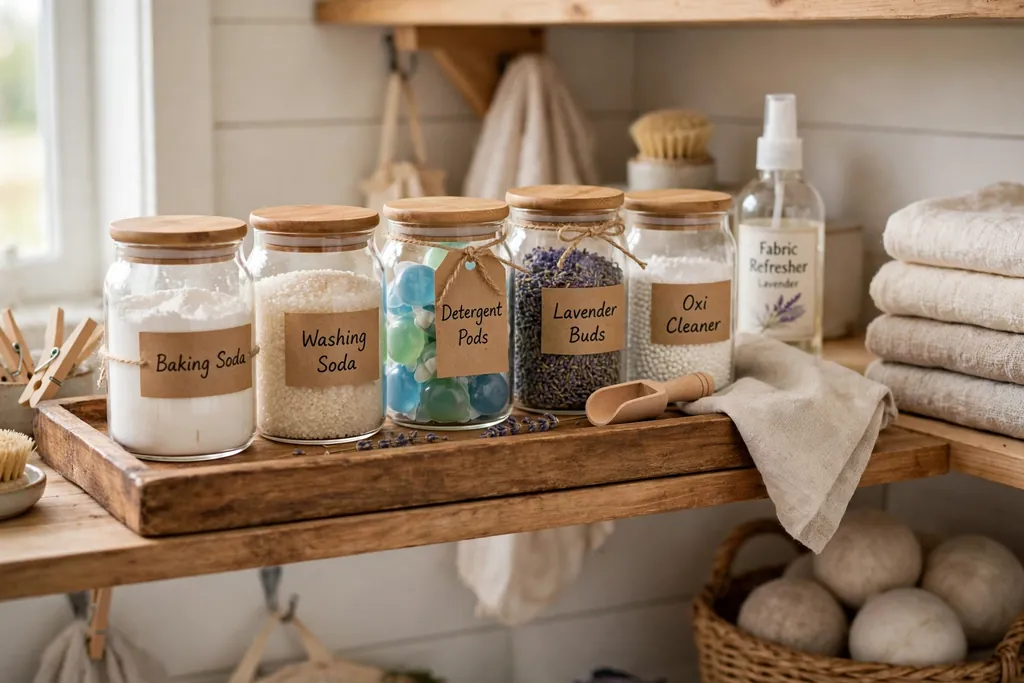
    Matching labelled glass jars of detergent and laundry supplies on a shelf

    Matching jars and clear labels turn a jumble of detergent boxes and bottles into a calm, lived-in display. Decant powder, pods, and stain treatments into glass or sturdy plastic jars, and label each jar with its contents and dose. Keep the jars on one shelf at hand height, with the most used jar at the front.

    Refill the jars from bulk stock stored up high, so the display shelf never holds more than you need for a week or two. Keep safety in mind: label clearly, keep jars out of reach of young children, and never decant into a container that once held food without washing and relabelling it first. Matching jars also make it easy to see at a glance when you are running low.

    17. Sort With Three Slim Bins on a Rail

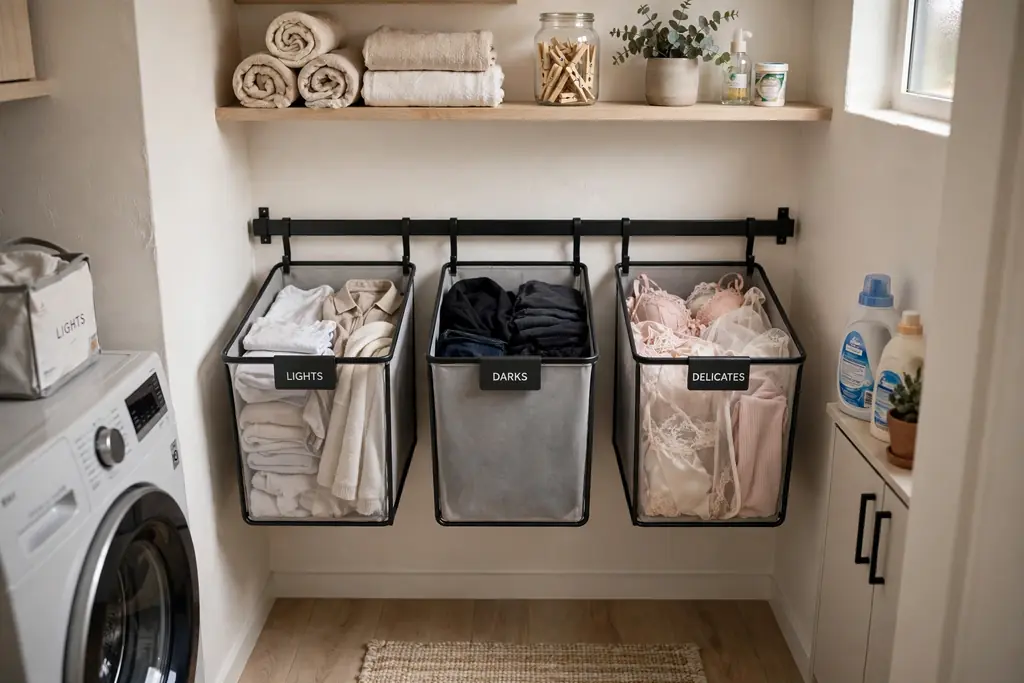
    Three slim labelled sorting bins on a wall rail in a narrow laundry room

    Three slim bins on a wall rail or a narrow shelf sort laundry by load type, such as lights, darks, and delicates, without taking floor space. Fix the rail at a height that lets you drop clothes in without bending, and choose bins that lift off for carrying to the machine. Label each bin, and keep one spare hook for a bag of items to mend.

    Empty the bins on laundry day and return them to the rail, so the sorting habit stays easy. If wall space is tight, stack the three bins on a slim shelf unit beside the machine instead. Sorting at the point where clothes come off means fewer piles on the floor, which matters most in a room where the walkway is already narrow.

    18. Hang a Ceiling Pulley Drying Rack

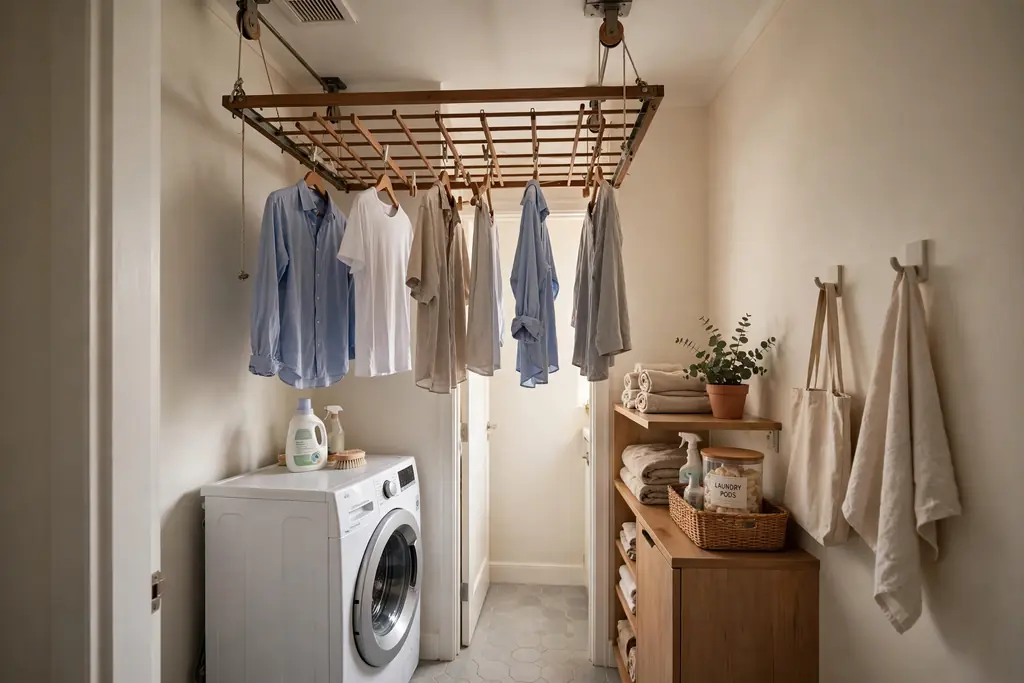
    Ceiling pulley drying rack raised overhead in a narrow laundry room with clothes hanging

    A ceiling pulley rack lifts wet clothes overhead, using air space that a narrow room otherwise wastes. Lower the rack to load it, raise it to dry, and lower it again to unload, so the floor and walls stay free. This suits a room with a clear ceiling run, away from light fittings and vents, and it holds a full small load of light items.

    Fix the pulley frame into ceiling joists, not plasterboard alone, and keep the load balanced so the rack rises level. Dry light items overhead and heavier items on the pull-out rack in idea 7, since a ceiling rack suits shirts, tea towels, and delicates best. Lower the rack fully when not in use, so the room feels open again.

    19. Layer Warm Light Instead of One Harsh Fitting

    Narrow laundry room lit with warm ceiling light and under-shelf task lighting

    Warm layered light makes a narrow laundry room feel welcoming after dark. Replace a single harsh ceiling fitting with a warm white ceiling light plus a small task light over the folding area, such as a battery or plug-in bar under a shelf. Warm light flatters wood, cotton, and skin tones, while a cool bright fitting can make the room feel clinical.

    Put the task light where you sort and fold, so you can read care labels without squinting. Keep the ceiling light dimmable if the wiring allows, and choose bulbs in the same warm tone so the layers blend. Good light also helps you spot stains before washing, which saves rewashing and keeps clothes looking better for longer.

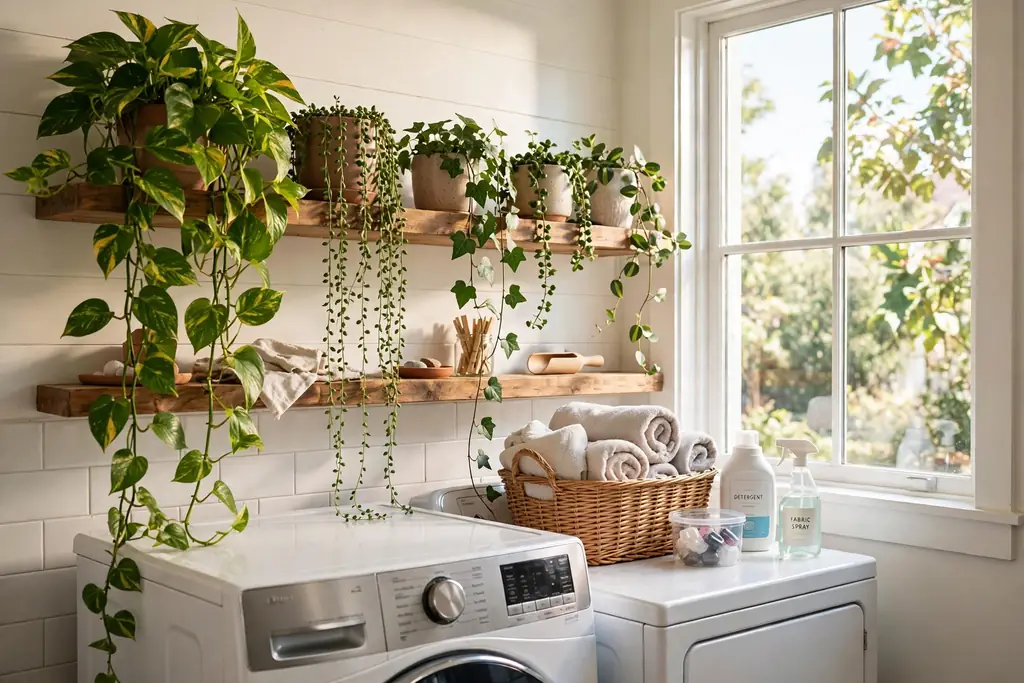
    20. Add Framed Prints and One Small Plant

    Narrow laundry room wall with framed prints and a small potted plant on a shelf

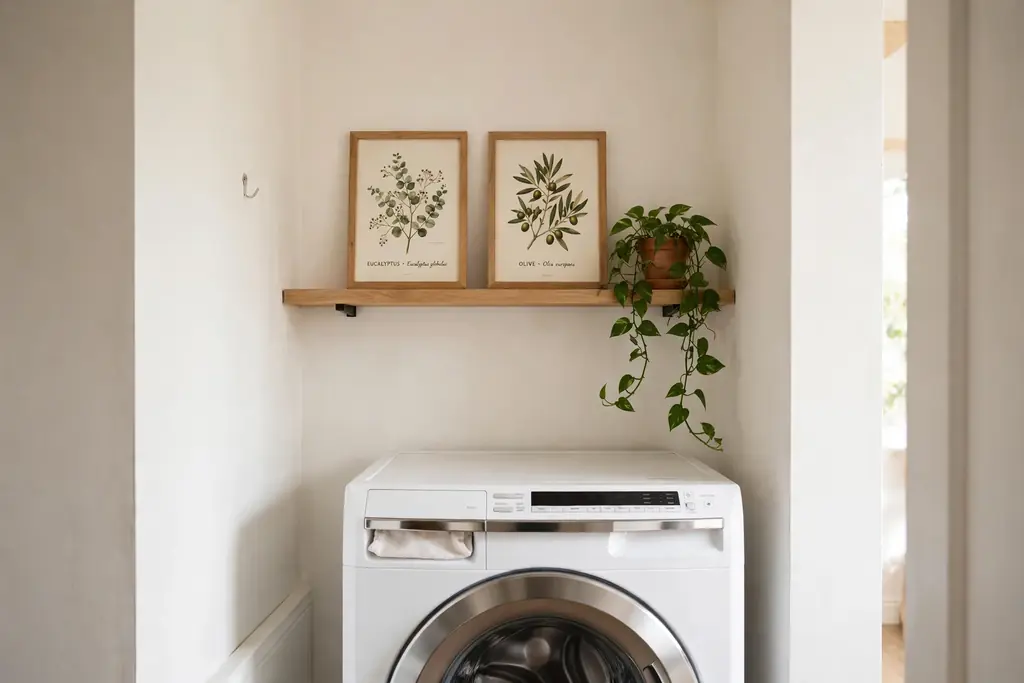
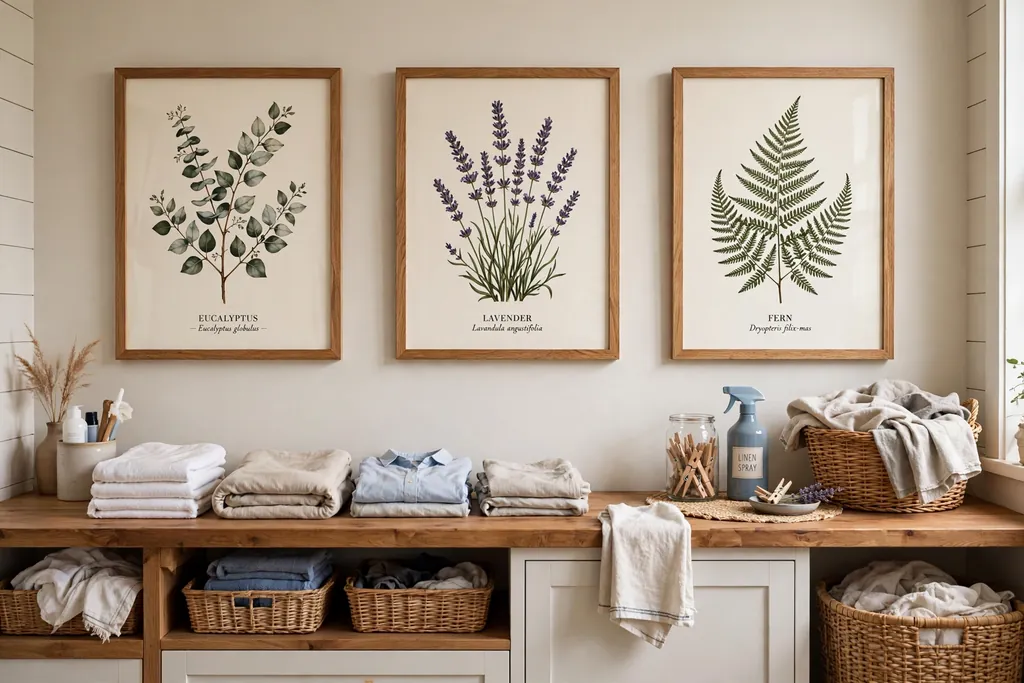
    Framed prints and one small plant are the fastest way to make a narrow laundry room feel lived in. Hang two or three small prints above the machines or on the free wall, choosing simple laundry themed art or botanical prints in plain frames. Add one trailing or upright plant in a pot that suits the light, such as a pothos near a bright door or a small fern on a shelf.

    Keep the plant in a pot with drainage, and water it when you pass through for laundry, so care becomes part of the routine. Avoid crowding the walls: two prints and one plant are enough in a narrow room, and the empty wall space keeps the room feeling open. Prints and plants also soften the hard lines of machines and cabinets.

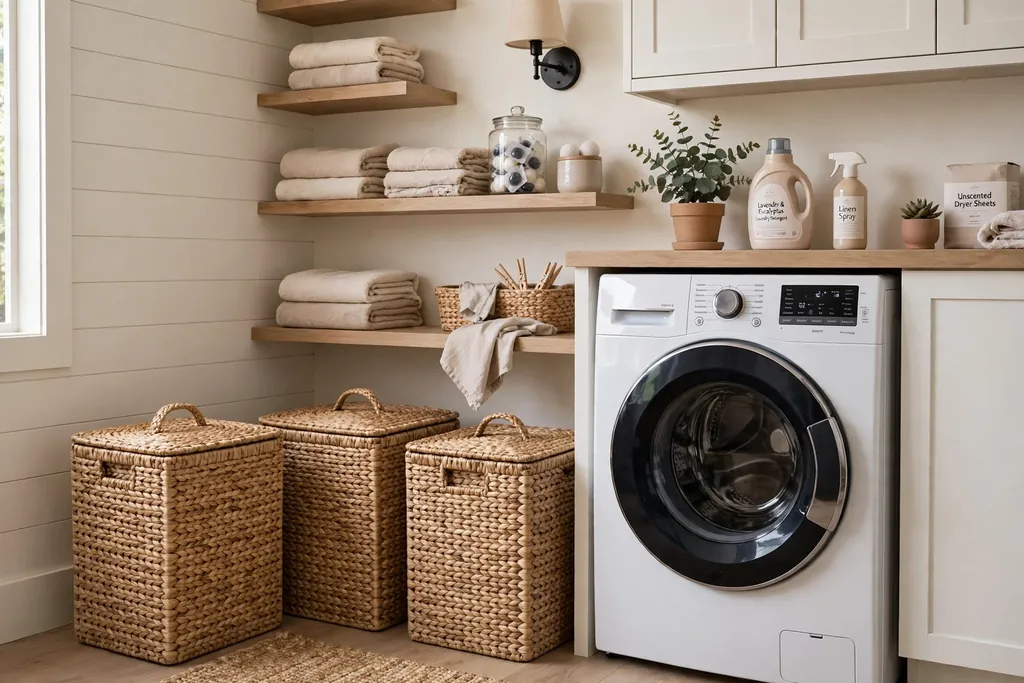
    21. Choose a Wicker Hamper That Looks Like Decor

    Tall wicker hamper with a lid beside a washing machine in a narrow laundry room

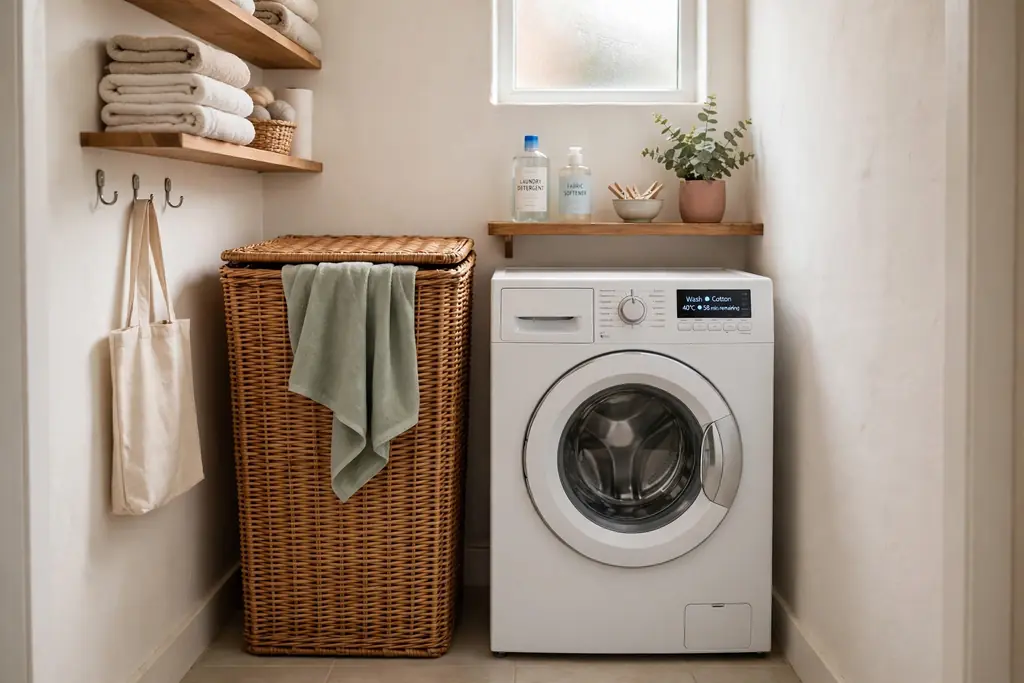
    A wicker hamper with a lid holds dirty laundry and looks like a piece of decor at the same time. Choose a tall narrow hamper that fits the gap beside a machine or at the end of the room, with a removable cotton liner for easy washing. The woven texture adds the same lived-in warmth as the baskets in idea 6, and the lid keeps piles out of sight.

    Keep one hamper for the household, or two slim hampers for lights and darks if the room allows. Empty the hamper on laundry day and wipe the liner, so damp clothes never sit long enough to smell musty. A hamper with handles moves easily to the bedroom for collection, which saves carrying loose piles through the house.

    22. Use the Machine Sides With Magnetic Holders

    Magnetic shelf and hooks on the side of a washing machine holding small supplies

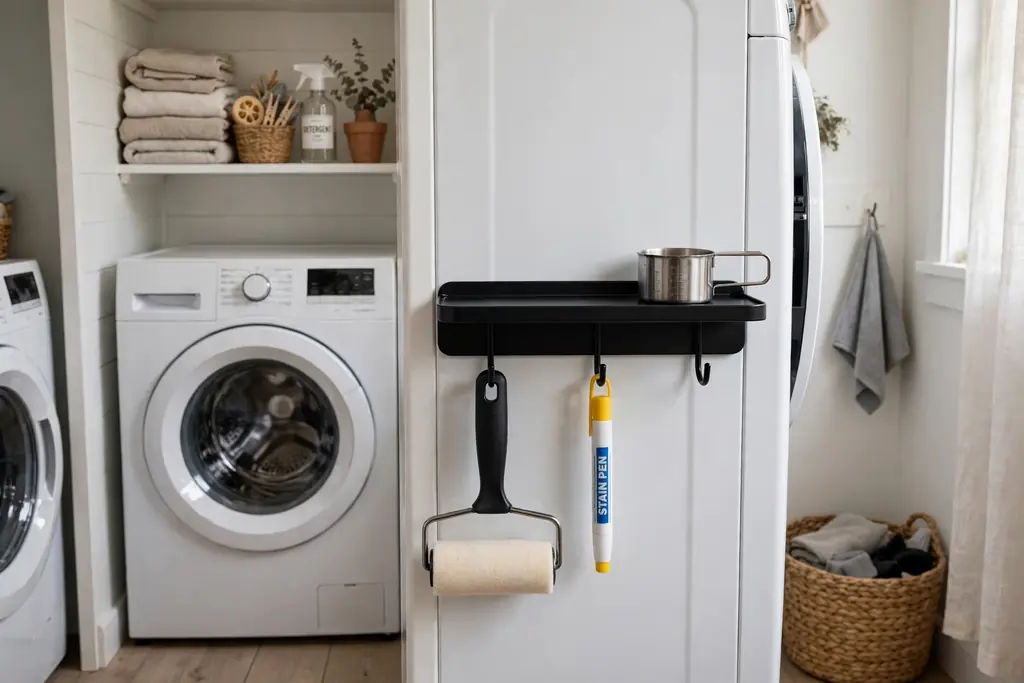
    Magnetic holders on the side of a steel machine add storage without a single screw. A magnetic shelf, hook rail, or small caddy holds a lint roller, a stain pen, a measuring cup, and a small plant, using a surface that otherwise stays bare. Check that your machine sides are magnetic before buying, since some panels are not.

    Keep the holders light and low, so they do not slide when the machine runs, and keep anything heat sensitive away from the dryer side. Magnetic holders suit renters and anyone who wants to test a layout before fixing shelves. Move them as your routine changes, such as adding a hook for a delicates bag during a week of hand washing.

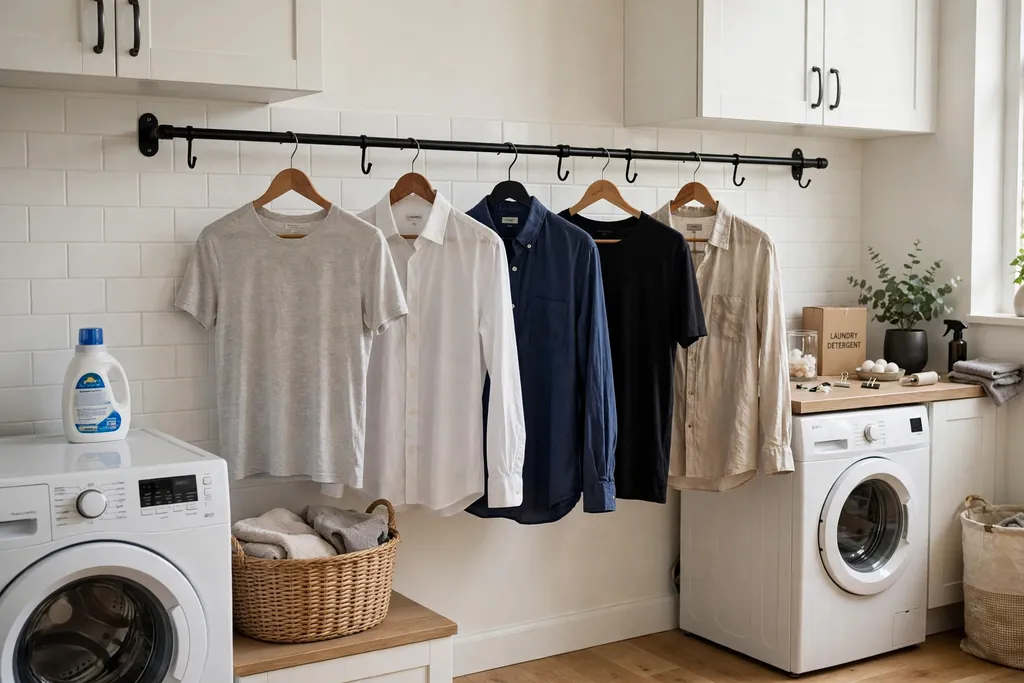
    23. Hang a Rod Under a Shelf for Drip-Dry Clothes

    Clothes on hangers on a rod fixed under a wood shelf in a narrow laundry room

    A hanging rod fixed under a shelf gives drip-dry clothes a home above the machines, where drips fall onto a tray or a washable mat rather than the floor. Fix the rod a few inches below the shelf, leaving room for hangers to swing, and hang shirts, blouses, and delicates straight from the wash. The shelf above holds the hangers and clips when the rod is empty.

    Use slim velvet or wood hangers so clothes stay put in a narrow space, and leave a gap between hangers so air moves and clothes dry faster. A rod under a shelf suits a room where a wardrobe rail would block the walkway, and it keeps drip-dry items out of the bedroom while they dry.

    24. Make a Landing Zone by the Door

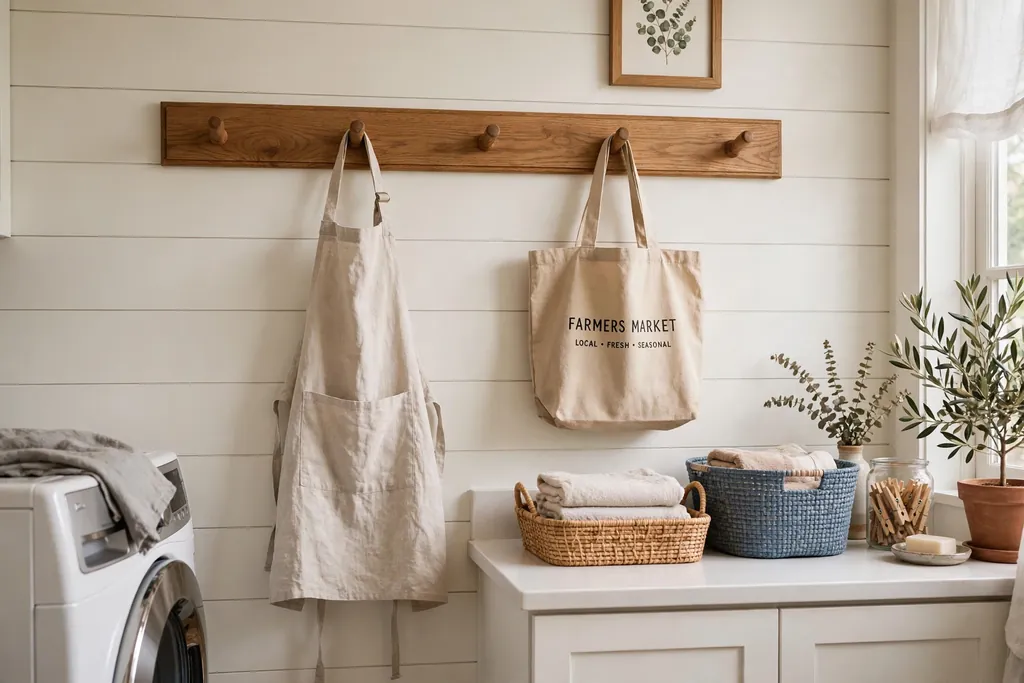
    Laundry room door area with wall hooks

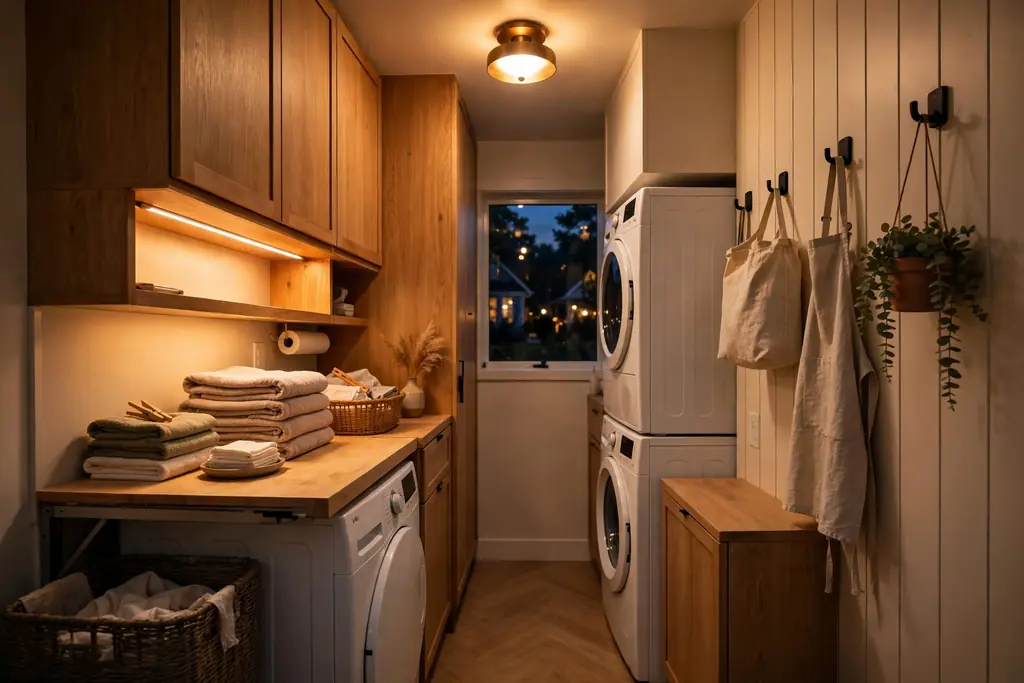
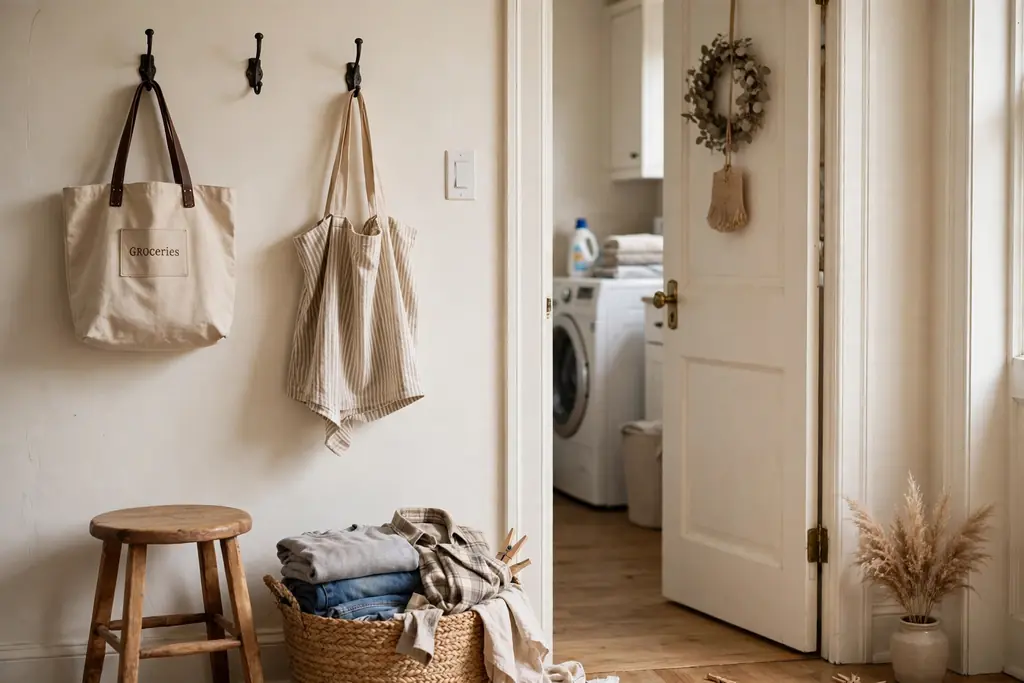
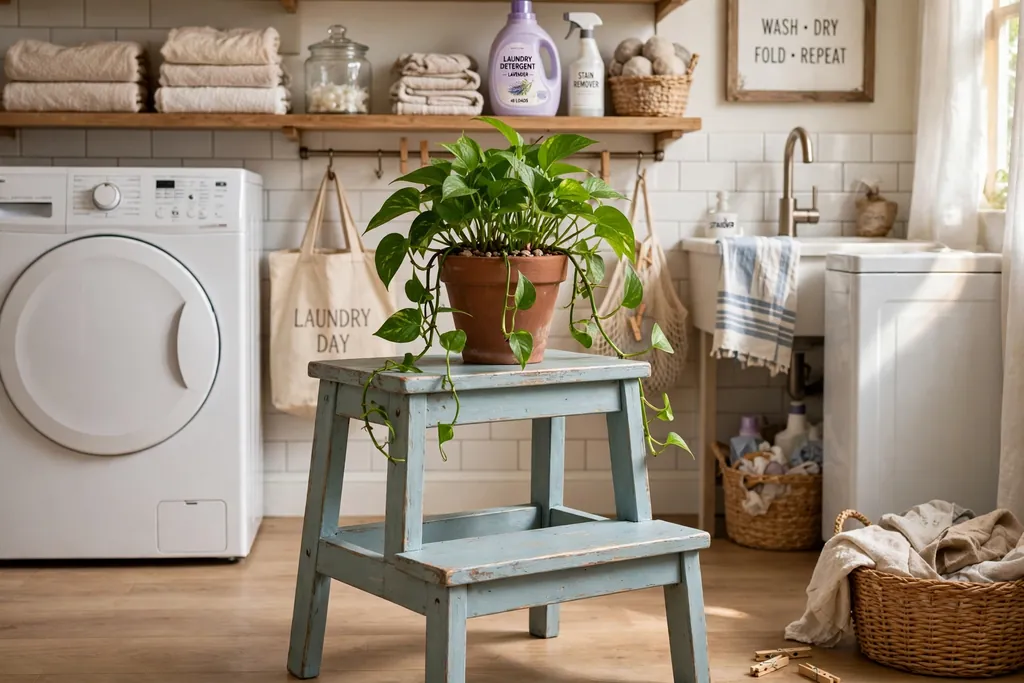
    A landing zone by the door gives the laundry room a welcoming entry and a place for the things that enter and leave with each load. Fix two hooks for a tote and an apron, set a small wooden stool beside the door for reaching high shelves or sitting to fold socks, and place a basket below for clean items waiting to go upstairs. Keep the zone to one short stretch of wall, so the walkway stays clear.

    Choose a stool that doubles as a small side table, and a basket that matches the shelves in idea 6, so the landing zone reads as part of one plan. Tidy the zone at the end of laundry day, returning the tote and basket to their hooks, so the next load starts in a calm room. This small finished corner is what makes a narrow laundry room feel lived in rather than purely functional.
    Conclusion

    A narrow laundry room works best when the layout stays simple, storage moves to the walls and ceiling, and a few warm details soften the machines. Pick the change that fixes your biggest daily frustration first, whether that is a missing folding surface, a lack of drying space, or a room that feels cold and bare. Add one idea at a time, keep the walkway clear, and let matching baskets, warm paint, and soft light do the rest. With the right small changes, a narrow laundry room can feel welcoming every time you walk in, not just on laundry day. If you liked these ideas, save this post to your laundry room board for your next refresh.

    FAQs

    How do you arrange a very narrow laundry room?

    Measure the width, the door swing, and the machine depth first. Stack the machines or run a counter over front loaders, move storage to the walls and ceiling, and keep the walkway clear of freestanding racks. Choose doors, shelves, and racks that fold flat or slide away, so the room stays easy to move through.

    What is the best layout for a narrow laundry room?

    A galley layout works best in most narrow rooms: machines along one wall and storage, folding, and drying on the opposite wall or above the machines. Stacked machines suit the narrowest rooms, while a counter over side by side machines suits a room wide enough for a comfortable walkway beside them.

    How can I add storage to a narrow laundry room without crowding it?

    Use the walls, the ceiling, the door, and the slim gaps beside machines. Cabinets to the ceiling, open shelves with baskets, a rolling gap cart, door organizers, and magnetic holders all add storage without taking floor space. For the same wall-first approach in a compact wet room, see these small bathroom space saving ideas.

    How do I dry clothes in a narrow laundry room with no space for a rack?

    Use drying space that disappears when not in use: a pull-out rack, a retractable clothesline, a rod under a shelf, or a ceiling pulley rack. Dry light items overhead or on a line, and keep the room ventilated while clothes dry so they dry fully and the room stays fresh.

    How can I make a laundry room feel cozy and lived in?

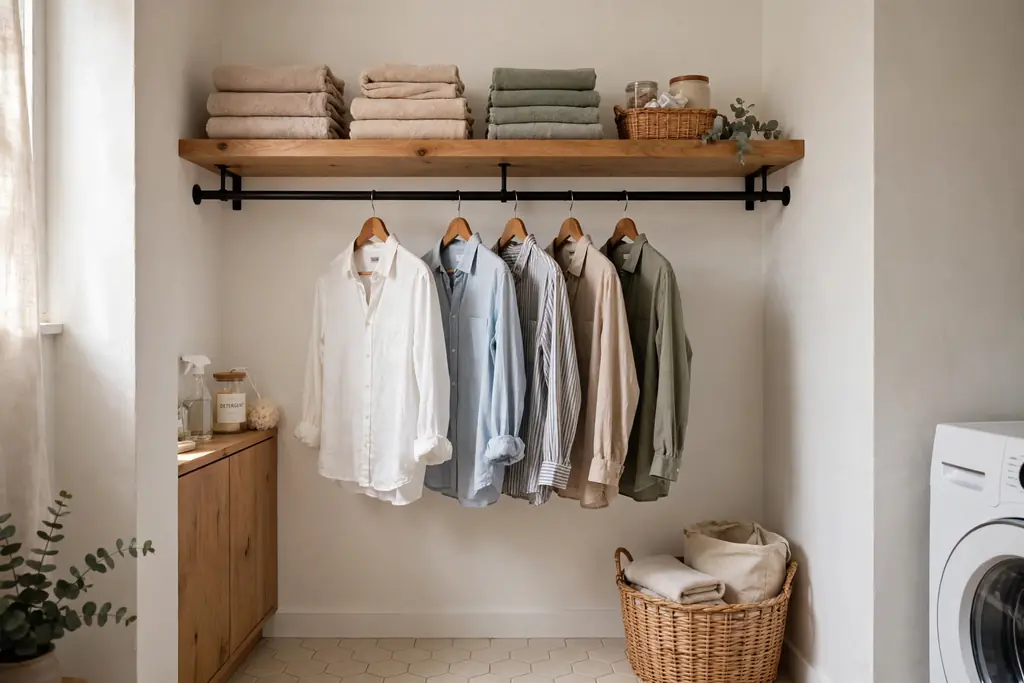
    Paint warm white, add one wood tone, lay a washable runner, and layer warm light over the folding area. Add matching baskets, two or three framed prints, one plant, and a wicker hamper, and keep the display calm rather than crowded. A curtain over the machines also helps the room feel like part of the home.

    Can I fit a sink in a narrow laundry room?

    Often yes, if you choose a slim utility sink cabinet and plan the plumbing route early. A narrow sink still handles soaking and rinsing, and the cabinet below adds storage for cleaning supplies. If a sink will not fit, a bucket filled at a nearby tap and a fold-down shelf for soaking can cover most of the same jobs.


  • 30 Temporary Door Ideas for the Home to Add Character to Your Space

    30 Temporary Door Ideas for the Home to Add Character to Your Space

    Not every doorway needs a fixed door. Some rooms need privacy only at night, some need a draft blocked in winter, and some just need a soft divide between a bed and a desk in one shared room. A temporary door gives you that divide without screws in the frame, a new slab, or a call to a contractor, and you can take it down in minutes when your needs change. These 30 temporary door ideas for the home cover curtains, screens, panels, and rolling pieces, so you can match the idea to the opening, the light, and the amount of privacy you actually need. Measure the opening first, then start with the idea that solves your biggest daily problem.

    Key Takeaways

    • Measure the opening, the trim, and the floor clearance before you buy or build anything, since a panel that is too wide or too long will drag, gap, or fall.
    • Tension rods, magnetic rods, over-door hooks, and freestanding screens give you a door with no holes in the wall, which suits rented homes best.
    • Fabric gives softness and light control, screens give a firm divide you can move, and panels give a flat surface you can also use for notes, art, or storage.
    • Match the weight to the mount: heavy curtains need a strong rod and a firm fit, while light panels can hang from hooks or wire.
    • Keep one clear path through the room, and test the door at night as well as in daylight, since light, drafts, and sound all change after dark.
    • Store the panel flat or rolled when it is not in use, so it stays clean and ready to hang again next season.
    1. Hang a Linen Curtain on a Tension Rod
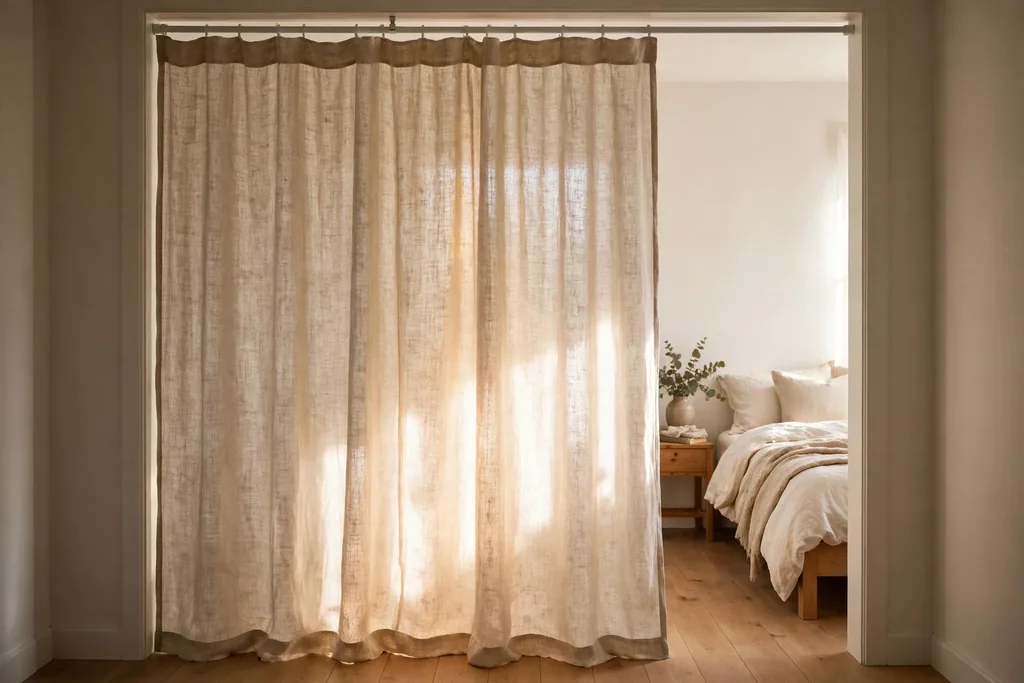
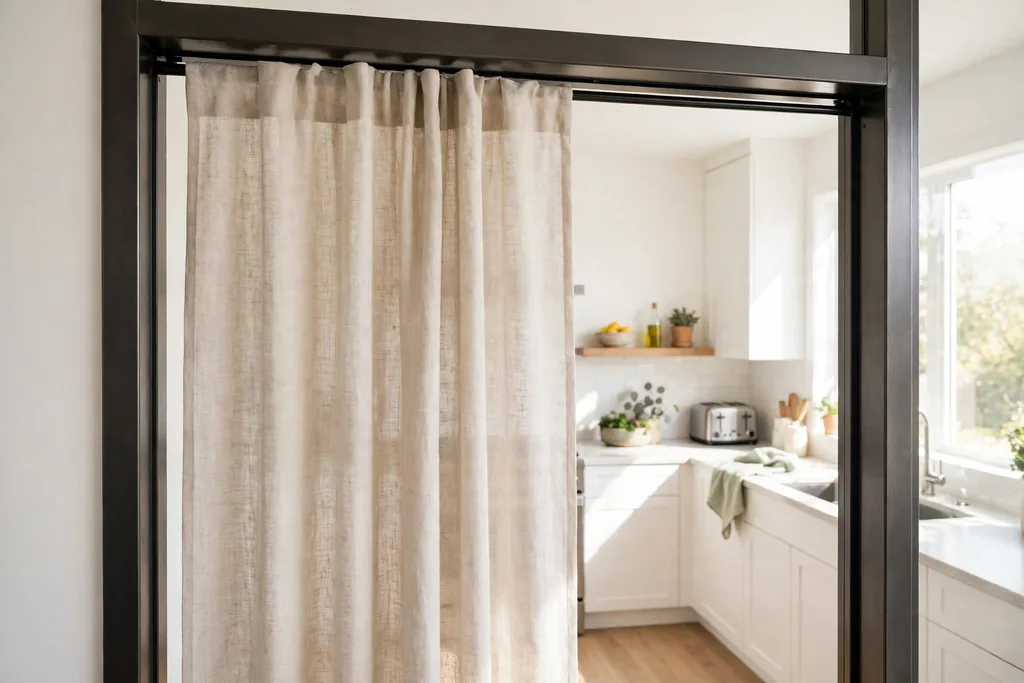
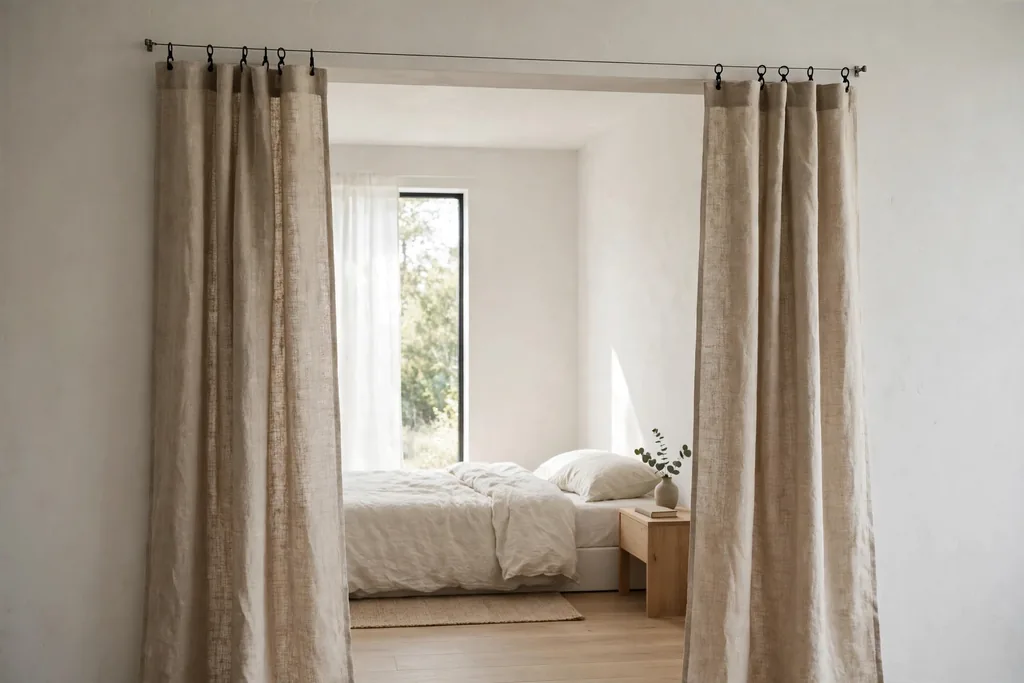
    Bedroom doorway covered by a natural linen curtain on a tension rod.

    A plain linen curtain on a tension rod is the simplest temporary door, and it suits almost any standard doorway. The rod wedges between the sides of the frame, so there are no screws and no marks, and the curtain hangs straight, hides clutter, and softens a plain opening. Choose a curtain that is a few inches wider than the opening, so it covers the sides without pulling tight.

    Measure the frame at the top, middle, and bottom, since older frames are not always square, and pick a rod rated for the width you measured. Hang the curtain so the hem clears the floor by a small amount, which stops it catching on feet and rugs. Wash the curtain when it collects dust, and keep it clear of heaters and open flames.

    2. Use a Sheer Voile Panel for Soft Light

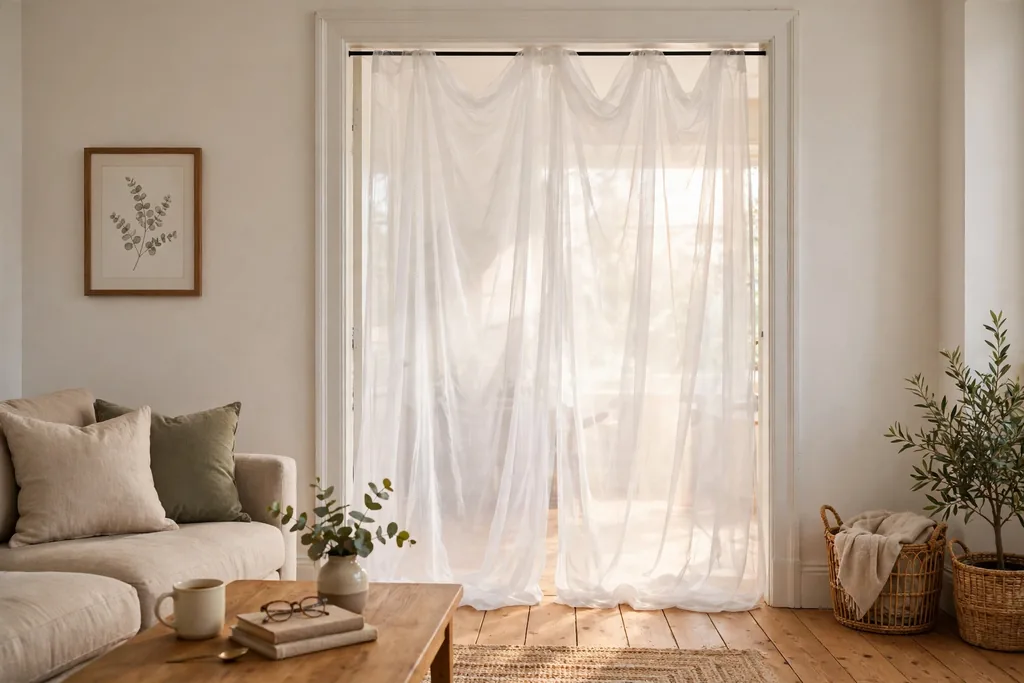
    Doorway covered by a sheer white voile panel with soft daylight glowing through.

    A sheer voile panel gives you a light divide rather than a closed door, which suits a room that needs some privacy without losing daylight. The fabric glows when light passes through it, and it marks the edge of a room while still letting you see shapes and movement beyond it. This works well between a living room and a dining area, or in front of a glass door.

    Hang the voile on a tension rod inside the frame for a neat fit, and keep the panel simple, since a busy pattern will block more light than a plain weave. If you need more privacy at night, add a second, heavier panel behind it, and draw that one closed only after dark. Keep the hem clear of the floor, and wash the panel often, since sheer fabric shows dust quickly.

    3. Hang a Beaded Curtain for a Casual Divide

    Doorway covered by a wooden beaded curtain in a casual room with plants.

    A beaded curtain divides a room with sound and movement rather than a solid wall, which suits a casual living room, a teen room, or a doorway that gets used all day. The strands part as you walk through, then fall back into place, so there is no handle to turn and no door to leave open. Wood beads give a warm, natural look, while glass or plastic beads catch more light.

    Hang the beaded curtain from a rod or a track fixed with removable hooks, and check the length before you hang it, since beads that drag on the floor will tangle. Keep the curtain away from small children who might pull strands down, and tie it to one side with a simple hook when you want the doorway fully open. If the sound of beads bothers you at night, swap this idea for a fabric panel in a bedroom doorway.

    4. Hang a Macrame Panel for Texture

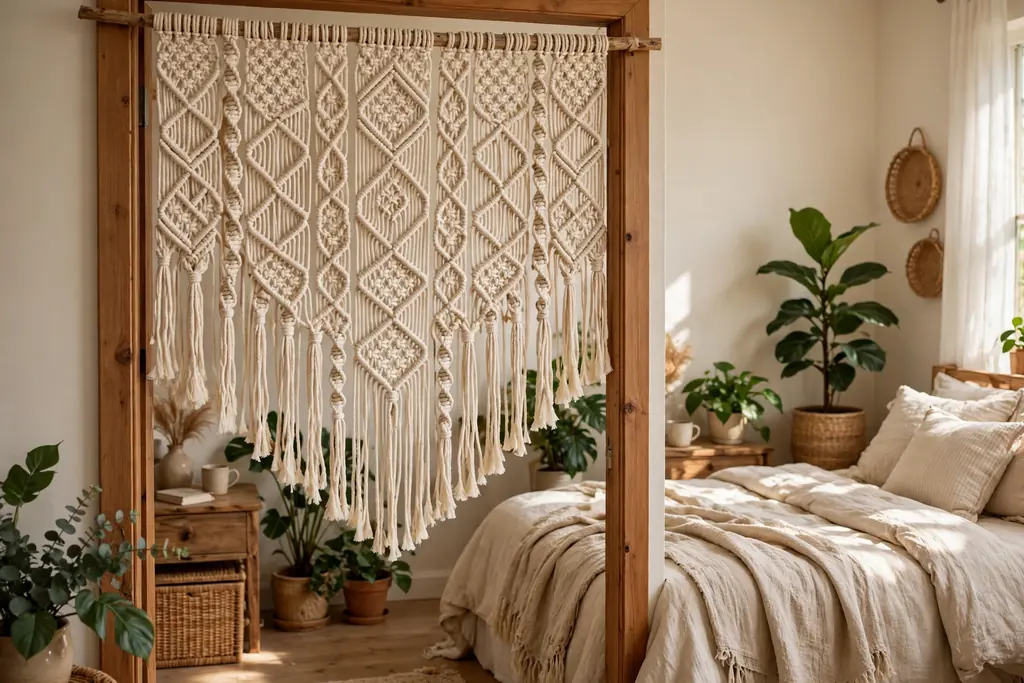
    Doorway covered by a cream macrame panel with knotted fringe on a wooden dowel.

    A macrame panel adds texture to a doorway in a way flat fabric cannot, with knots and fringe that catch light and shadow. This suits a bedroom, a reading nook, or a bohemian living room where the doorway is part of the decor, not just a passage. A panel on a wooden dowel hangs from two hooks or a tension rod, and it comes down as one piece when you no longer need it.

    Choose a panel that covers most of the opening but leaves a gap at the bottom, so you can step through without pushing the fringe aside each time, or hang two narrower panels side by side for a clearer path. Keep the panel away from damp walls, since cotton cord can hold moisture, and shake it outside now and then to remove dust. Pair it with plain walls, so the knotted texture stays the main feature.

    5. Hang a Heavy Velvet Curtain for Drafts and Sound

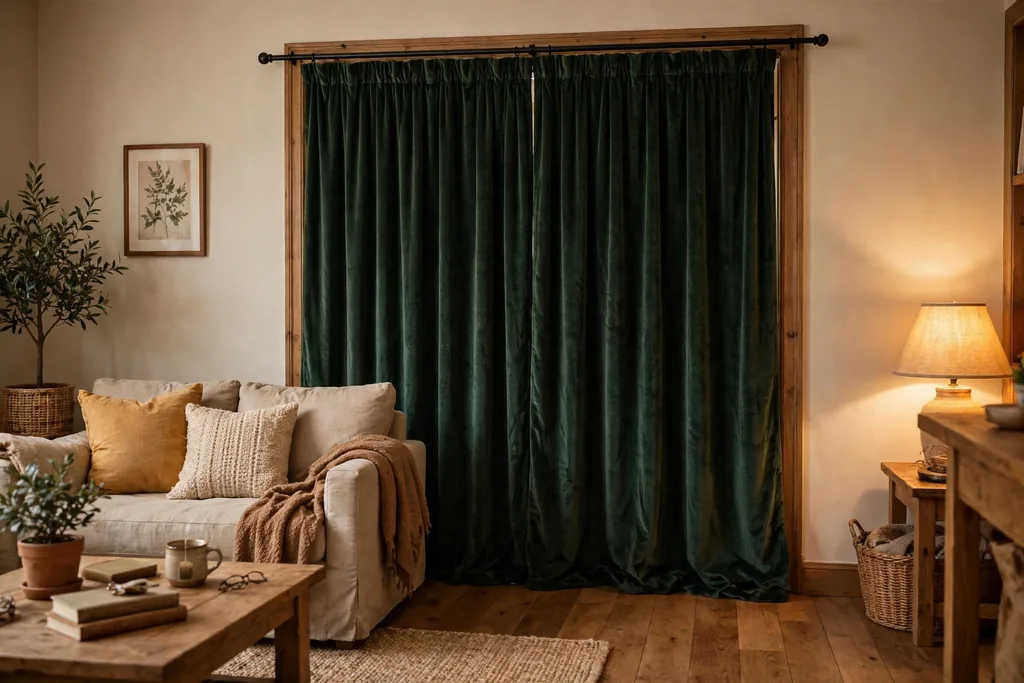
    Doorway covered by a heavy dark green velvet curtain in a warm living room.

    A heavy velvet curtain is the best fabric choice when a doorway lets in a cold draft or noise from the next room. The weight of the fabric helps it hang straight and seal the sides of the opening better than a light curtain, and the thick pile softens sound as well as light. This suits a doorway between a hall and a living room, or a bedroom door that faces a busy corridor.

    Use a strong tension rod or a rod held by removable brackets, and check that the rod can hold the curtain weight without bowing. Let the curtain reach close to the floor and overlap the frame at the sides, since gaps at the edges let drafts through. Keep velvet away from direct damp, and brush it now and then to lift dust from the pile.

    6. Hang a Quilt or Tapestry as a Door

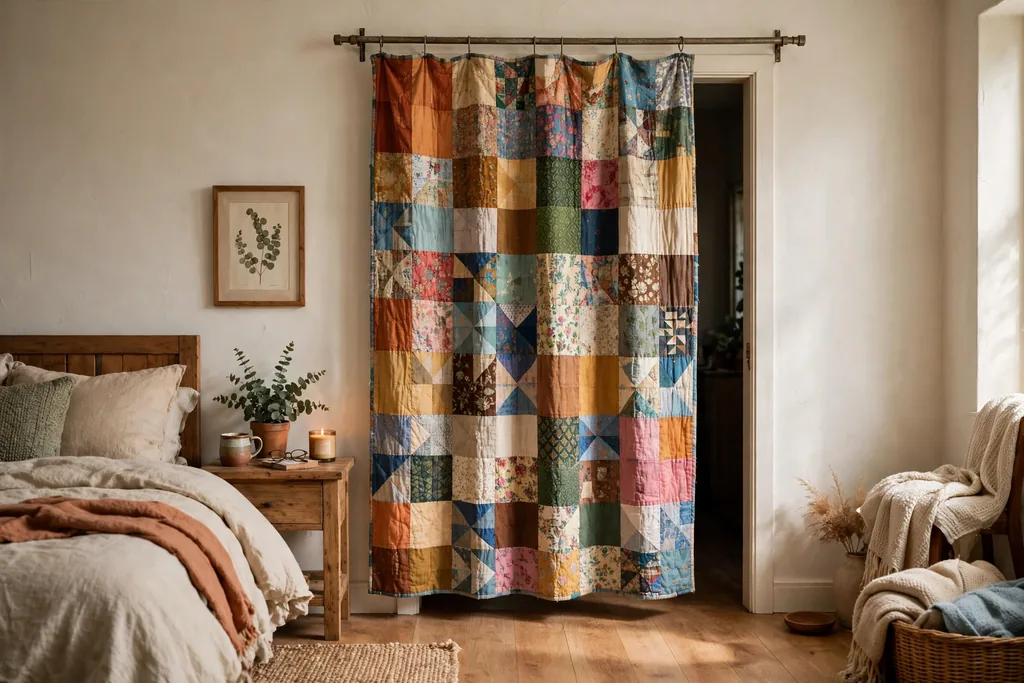
    Doorway covered by a colorful patchwork quilt hanging from a curtain rod.

    A quilt or tapestry turns a doorway into a display, and it costs nothing if you already own a piece you love. The thick fabric gives more privacy and draft cover than a sheer panel, and the pattern adds color to a plain wall without paint. This suits a bedroom, a guest room, or a hallway where a plain curtain would look dull.

    Hang the quilt from a curtain rod through a rod pocket or from clip rings, so the weight spreads evenly and the piece does not stretch. Check that the quilt clears the floor and any nearby heater, and rotate it now and then if one side gets more sun. If the piece is valuable or fragile, hang it in a doorway with light use, and keep it out of reach of pets that might pull at the hem.

    7. Layer Two Curtains on a Double Tension Rod

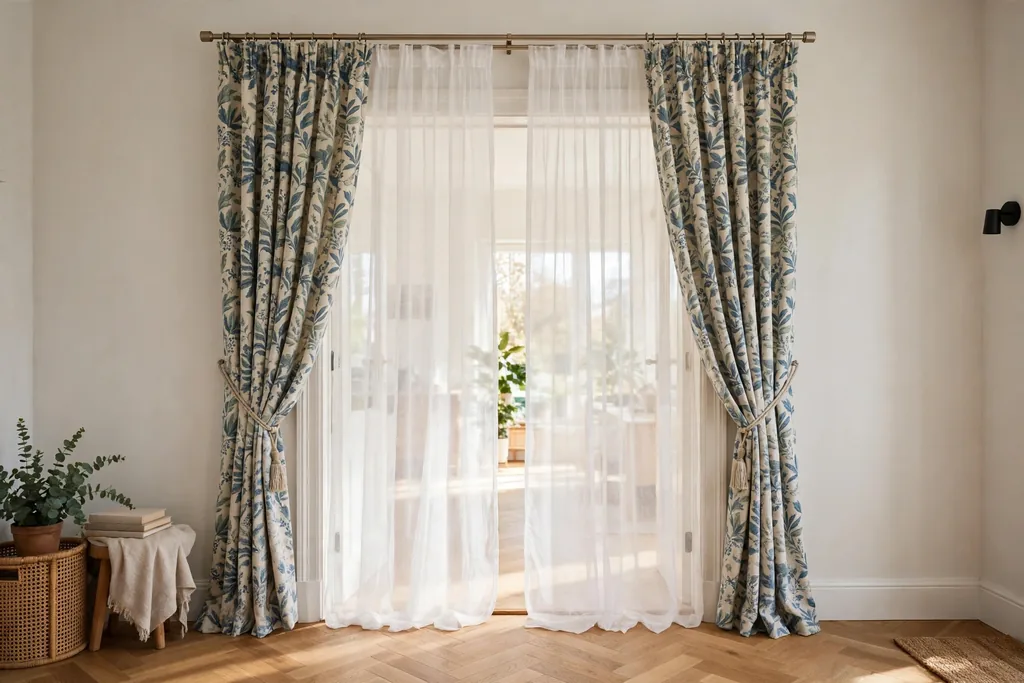
    Doorway with a sheer inner panel and a patterned outer curtain on a double tension rod.

    Two curtains on a double tension rod give you two doors in one opening: a sheer layer for daylight and a heavier layer for night. During the day, the sheer layer stays closed for soft light and light privacy, and at night you draw the heavier layer across for a fuller divide. This suits a bedroom or a studio where one room must work as both a living space and a sleeping space.

    Fit the double rod inside the frame, with the sheer layer on the inner rod and the heavier layer on the outer rod, so each layer moves without catching the other. Keep both hems clear of the floor, and choose fabrics that slide easily on the rod, since stiff fabric will bunch. When you want the doorway fully open, draw both layers to one side and hold them with a simple tieback.

    8. Use a Magnetic Rod Panel on a Metal Frame

    Metal door frame doorway covered by a light fabric panel on a magnetic curtain rod.

    A magnetic curtain rod sticks to a metal door frame without screws, hooks, or adhesive, which makes it a fast fix for a steel framed doorway or a metal patio door. The panel hangs from the rod just like a normal curtain, and the whole setup lifts off in seconds when you move out or change your mind. This suits a rented flat with metal frames, or a doorway where you cannot drill into the trim.

    Test the magnet on your frame first, since some painted metal frames hold a magnet weakly, and keep the panel light so the rod stays put. Choose a panel that covers the opening fully, and check that the rod does not block the door latch if the frame still holds a working door. Wipe the frame before you fit the rod, since dust under a magnet can mark paint over time.

    9. Stand a Freestanding Folding Wood Screen in the Opening

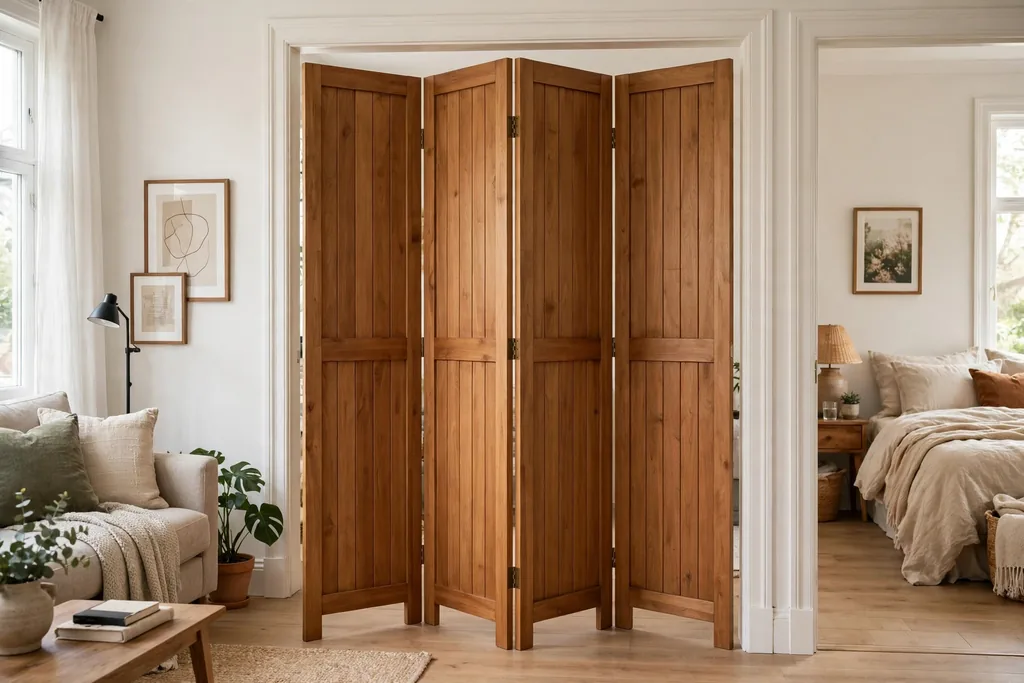
    Freestanding three panel folding wood screen standing in a wide doorway.

    A folding wood screen is a door you can move, fold, and store flat, with no fitting at all. Set it across a wide opening, angle the panels slightly so it stands steady, and you have a firm divide that still lets you walk around either end when you need to. This suits a studio, a large living room, or a guest space where a curtain would feel too soft.

    Choose a screen as tall as you need for privacy, and check that it stands on a flat floor without rocking, since a screen on a rug edge can tip. Keep the screen clear of heaters, and add felt pads under the feet if the floor marks easily. When you no longer need it, fold it flat and lean it against a wall, so it takes up almost no storage space.

    10. Use a Shoji-Style Paper Screen

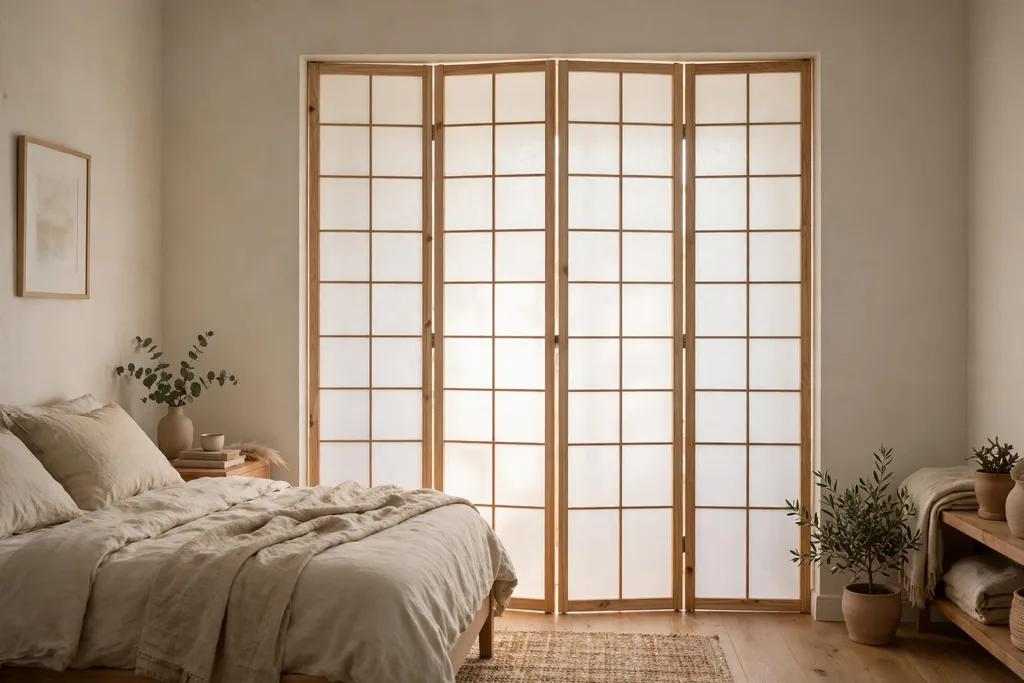
    Doorway covered by a shoji style screen with light wood frame and translucent paper panels.

    A shoji-style screen gives you a calm, glowing divide, with translucent paper panels in a light wood frame that soften light without blocking it fully. This suits a bedroom, a meditation corner, or a room with a Japanese or minimal style, where a heavy curtain would feel out of place. The screen folds for storage, and it needs no fitting in the doorway at all.

    Place the screen so it does not block a walkway you use in the dark, and keep it away from damp, since paper panels can warp if they stay wet. Wipe the frame with a dry cloth, and replace a torn paper panel rather than patching it, since a patch shows in backlight. If you need full privacy at night, pair the screen with a curtain behind it, and use the screen alone during the day.

    11. Use a Cane and Rattan Folding Screen

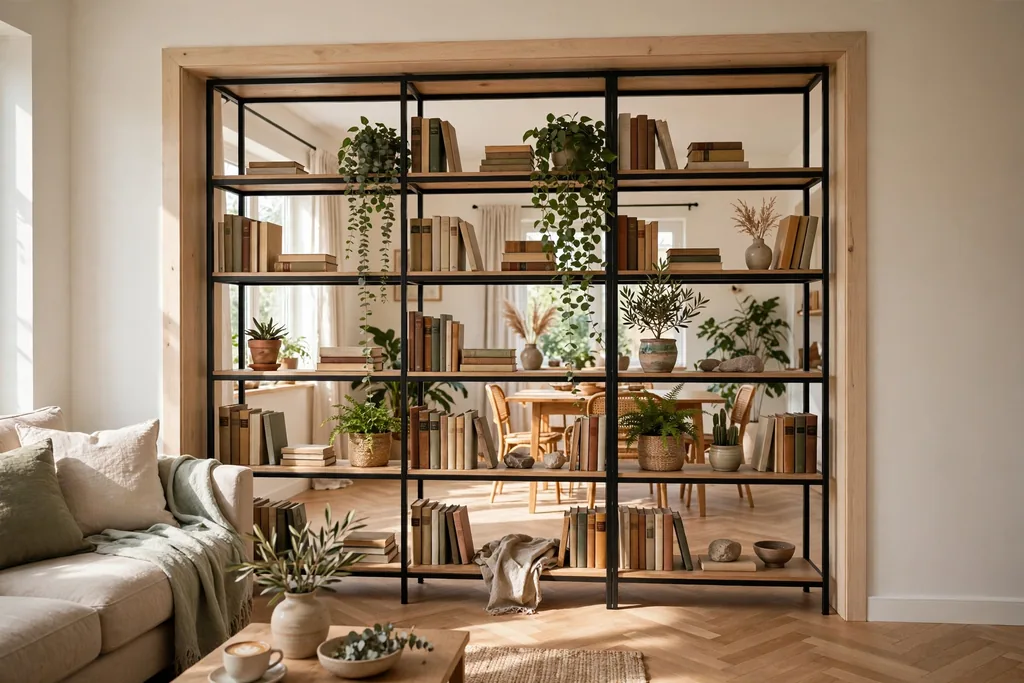
    Freestanding folding screen with woven cane rattan panels in a light wood frame.

    A cane and rattan screen adds a woven, airy divide that lets air and some light through while still marking the edge of a room. The open weave suits a warm room, a coastal style home, or a doorway near plants, where a solid panel would block airflow. Like other folding screens, it stands on its own and folds flat for storage.

    Check the weave for loose strands before you buy, and keep the screen out of constant damp, since cane can slacken if it stays wet. Dust the weave with a soft brush, and place the screen where it will not be knocked by a door swing or a pet running through. Pair cane with wood and plant tones, so the screen reads as part of the room rather than a spare piece.

    12. Place an Open Bookshelf Across a Wide Opening

    Open bookshelf standing across a wide doorway holding books and plants.

    An open bookshelf across a wide opening works as a door with storage, holding books, baskets, and plants while still letting light through the open back. This suits a wide arch or a double doorway in a studio, where a curtain would hang awkwardly and a screen would look too small. The shelf divides the room into zones without closing it off fully.

    Anchor the shelf to the wall or the floor following the maker instructions, since a tall shelf can tip, and keep heavy books low and light items high. Leave one shelf partly empty, so the unit does not look crowded from both sides, and keep the walkway around one end clear. If you need more privacy later, hang a small curtain on the back of the shelf, and the shelf still does its main job.

    13. Screen a Doorway with Tall Plants

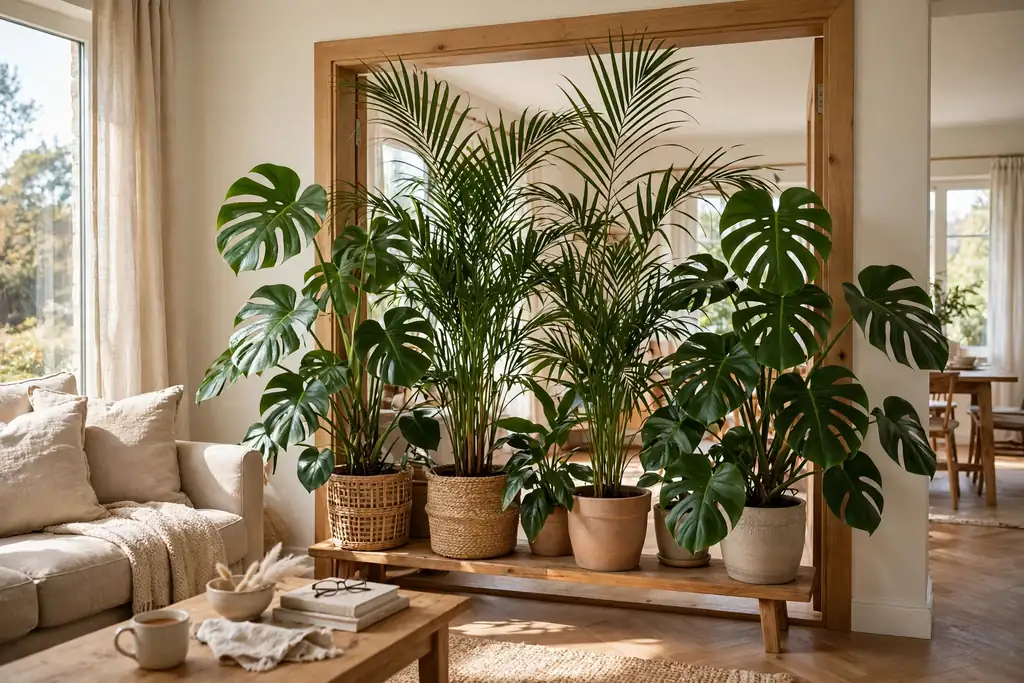
    Doorway screened by tall potted plants on a low plant stand.

    Tall plants on a low stand form a living screen that softens a doorway without any hardware at all. A row of tall pots, or one large plant beside a smaller one, marks the edge of a room and adds green to a plain hall, while still letting air and light move freely. This suits a bright doorway, a living room divide, or a home office corner where a hard screen would feel heavy.

    Choose plants that suit the light you actually have, and keep them in trays so watering does not mark the floor. Leave a clear walking gap beside the plants, so you do not brush leaves each time you pass, and prune stems that grow into the path. If the doorway gets little light, use plants that cope with shade, and rotate the pots now and then so growth stays even.

    14. Roll a Door Slab on Casters Across the Opening

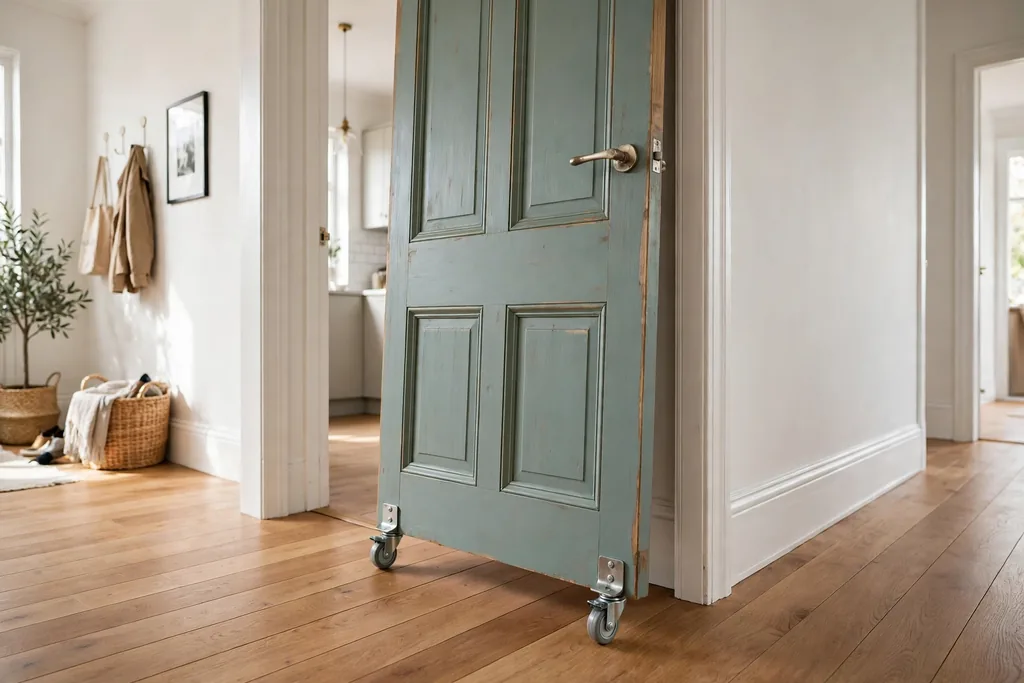
    Painted wooden door slab on small caster wheels rolling across a doorway.

    A door slab on casters is a solid temporary door you can roll into place and roll away again, with no track in the floor and no hinges in the frame. Fit small locking casters to the bottom of a light slab, stand it in the opening, and lock the wheels when you want it to stay put. This suits a workshop, a studio, or a room where you sometimes need a firm divide and sometimes need the doorway fully open.

    Choose a slab light enough to move safely, and check that the casters suit your floor, since hard wheels can mark wood. Keep the slab narrow enough to roll through the opening without scraping the trim, and lock at least two casters when the door is in use. Store the slab flat against a wall when it is not needed, with the casters locked so it cannot roll.

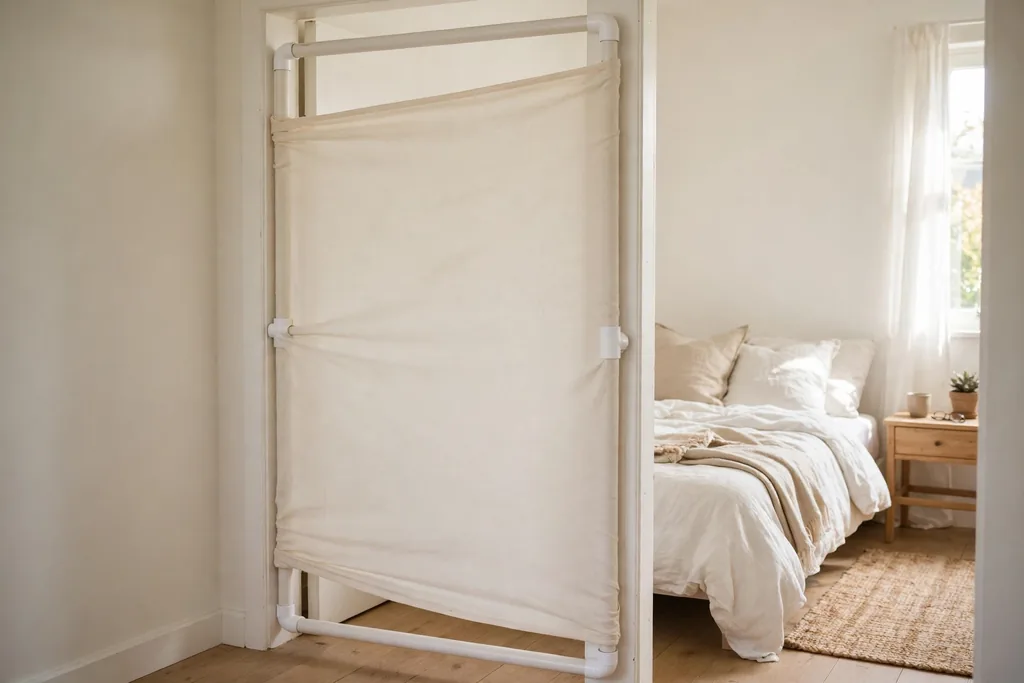
    15. Wedge a PVC Frame with Stretched Fabric into the Opening

    Light pipe frame wedged into a doorway with cream fabric stretched across it.

    A frame made from light pipe, with fabric stretched across it, wedges into a doorway with foam pads at the edges, so it stays put without screws. The fabric gives you a flat, neat door face, and you can change the fabric when you want a new color, which makes this a good low cost project for a spare room or a craft space. Build the frame to fit your opening exactly, and test it before you cover it.

    Measure the opening at several heights, and add foam pads where the frame meets the trim, so it grips without marking paint. Choose a fabric that stretches evenly and does not sag, and staple or clip it to the back of the frame, so the front stays smooth. Lift the frame out to store it, and keep it flat, so the frame does not warp between uses.

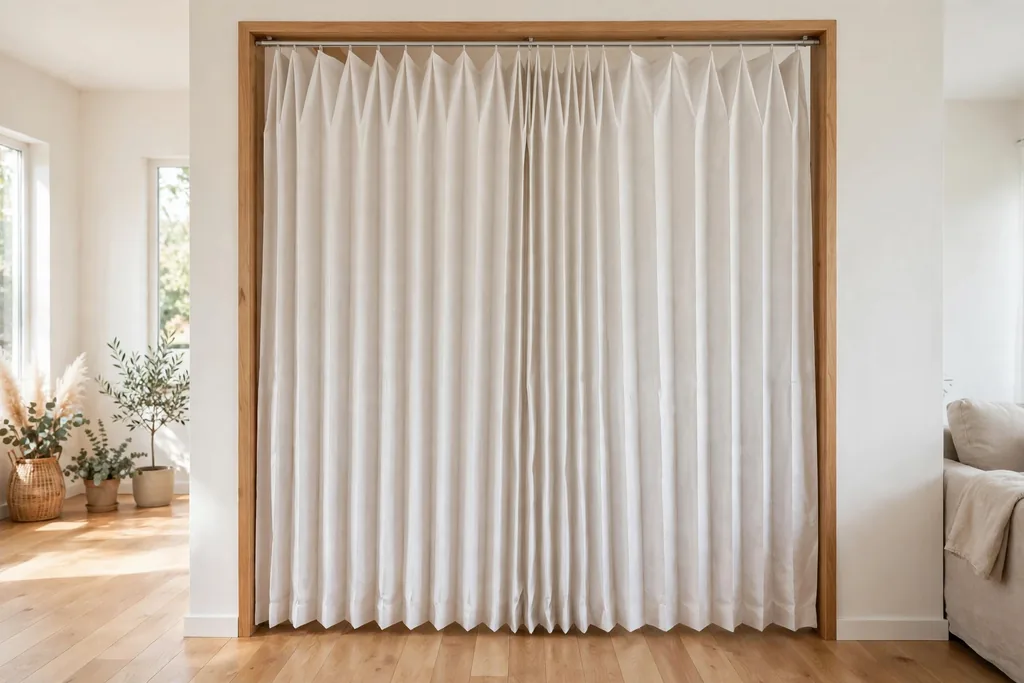
    16. Hang a Pleated Paper Accordion Panel

    Doorway covered by a pleated paper accordion panel in soft white.

    A pleated paper panel folds like a fan, so it takes up little space when open and covers the full opening when closed. The pleats add a crisp, graphic look to a doorway, and the panel hangs from a tension rod or a simple track, so it comes down as one piece. This suits a small room, a rental, or a doorway you want to dress up for a season without buying a curtain.

    Choose a panel in a color that works with the room, and check the length, since a panel that is too long will pool on the floor and crease. Keep the panel away from damp and from heaters, since paper creases permanently if it gets wet. When you want the doorway open, gather the pleats to one side and hold them with a clip, so the panel reads as a neat feature rather than a loose sheet.

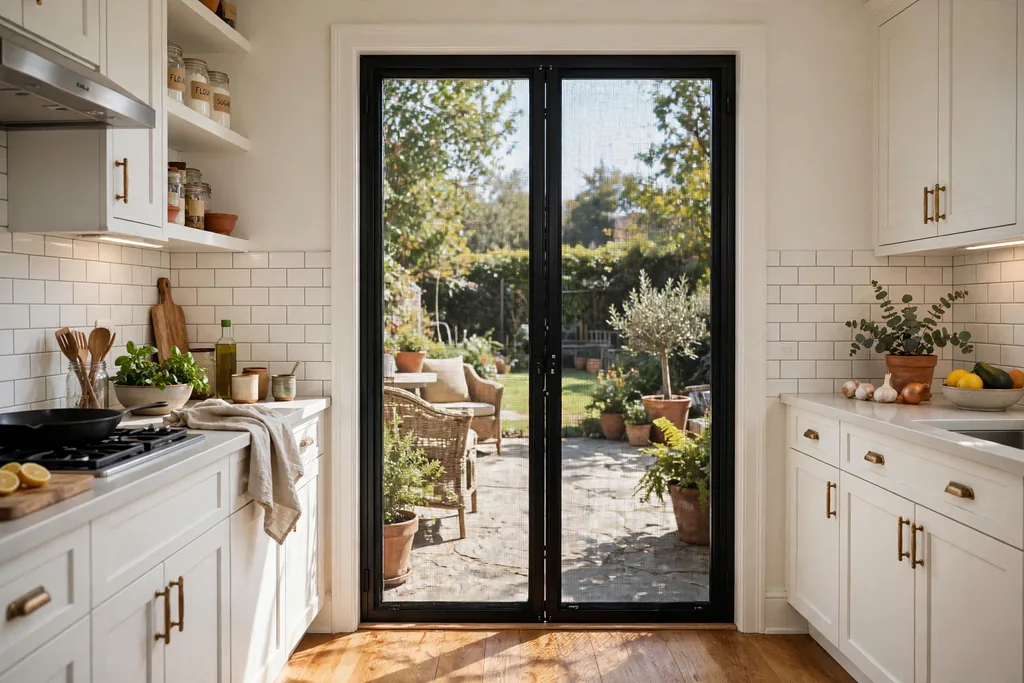
    17. Fit a Magnetic Mesh Screen Door

    Doorway fitted with a black magnetic mesh screen door closing in the middle.

    A magnetic mesh screen door lets air through while keeping insects out, and it closes itself with magnets down the middle as you walk through. The mesh hangs from the top of the frame with removable hooks or adhesive strips, so it fits a patio door, a kitchen door, or a bedroom door in summer without a new frame. This suits a home that needs airflow but not a full insect screen fitted by a contractor.

    Measure the frame and choose a mesh size that covers it fully, with no gaps at the sides where insects can slip through. Check that the magnets meet cleanly down the middle, and adjust the hanging height if they pull apart. Take the mesh down in winter, wash it, and store it flat, so the magnets do not crease the fabric between seasons.

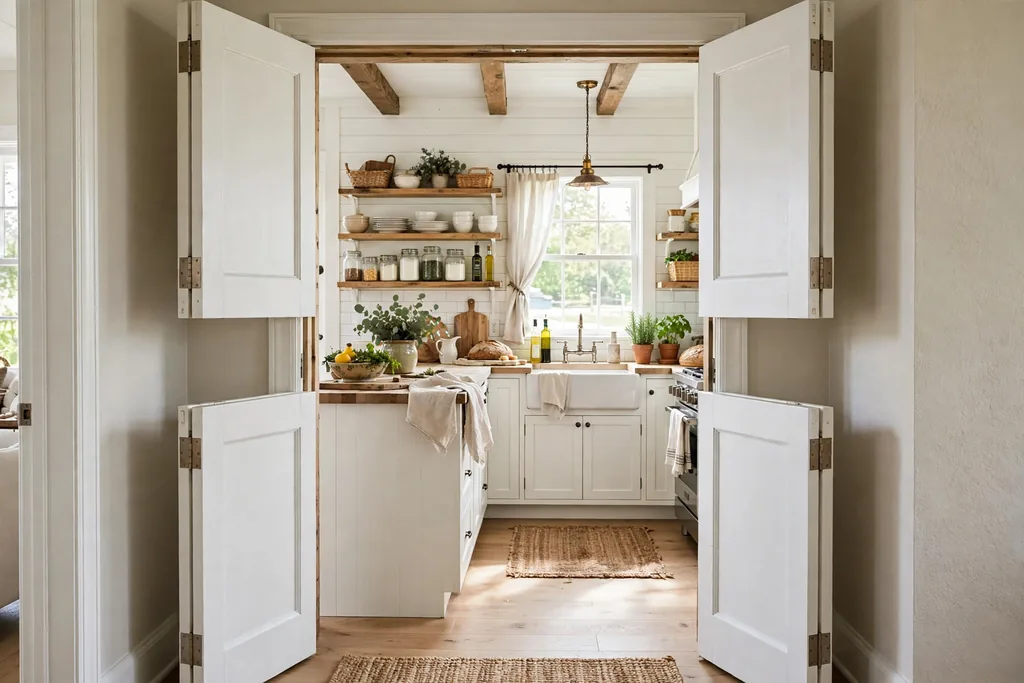
    18. Fit Cafe-Style Half Doors on Spring Hinges

    Doorway fitted with white cafe style half doors that swing in the middle.

    Cafe-style half doors cover only the middle of a doorway, leaving the top and bottom open, which suits a kitchen, a laundry room, or a doorway where you want a barrier for pets or small children but still want to see and hear across it. Spring hinges let the doors swing both ways and return to closed on their own, so you can walk through with full hands. Fit them with clamp-style or tension mounts where possible, so you avoid drilling into the frame.

    Measure the opening and the height you need, since half doors that are too low will not stop a pet, and doors that are too high will block the view you wanted to keep. Check that the doors swing clear of rugs and furniture, and keep the hinges clean, since dust in a spring hinge can make the door stick. If you need full privacy later, this is not the right idea, and a full curtain or panel will serve you better.

    19. Slide Fabric Panels on a Removable Ceiling Track

    Wide doorway with sliding grey fabric panels hanging from a ceiling track.

    Fabric panels on a ceiling track slide across a wide opening like a soft sliding door, and the track can be fitted with removable adhesive mounts or screws into a ceiling batten you can patch later, depending on your lease. This suits a wide doorway, a studio divide, or a room where a curtain rod would sag across a long span. The panels stack to one side when open, so the doorway feels fully clear.
    Choose panels that are light enough to slide easily, and keep the track level, since a track that slopes will let panels drift to one end. Measure the drop from the track to the floor, and hem the panels so they clear the floor by a small amount. Clean the track now and then, since dust in a track is the main reason a sliding panel starts to stick.

    20. Slide Fabric Panels on Tension Wire

    Doorway with plain linen panels sliding along a thin tension wire.

    Tension wire gives you a sliding panel system with almost no visible hardware, since a thin wire stretches across the opening and the panels hang from small clips or rings. This suits a minimal room, a small doorway, or a renter who wants a sliding door look without a track. The wire fits with tension mounts at each end, so it comes down without holes in most frames.

    Pull the wire taut before you hang the panels, since a slack wire will sag in the middle and drag the panels. Keep the panels light, and space the clips evenly, so the fabric hangs straight. If the opening is very wide, use two wires or a middle support, since one long wire will bow under even a light panel. Take the wire down when you move, and patch any small marks left by the mounts.

    21. Drape Fabric Across an Arched Opening

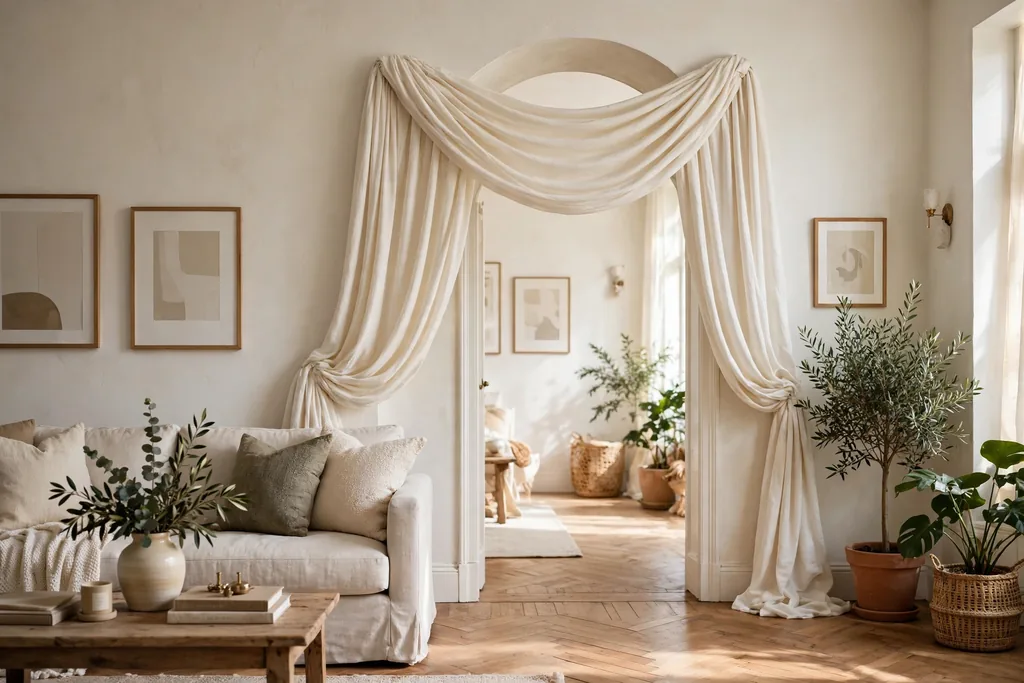
    Arched doorway draped with soft cream fabric swagged across the top and sides.

    An arched opening has no straight top for a rod, so draped fabric is often the simplest temporary door for it. Swag a length of soft fabric across the arch, gathering it at the sides with hooks or ties, and let the middle hang in a gentle curve. This suits an entry arch, a dining room arch, or a room with a romantic or classic style, where a rigid screen would fight the shape of the opening. For more entry styling around the door, see these DIY entryway makeover ideas.

    Use a fabric with some drape, such as cotton voile or light linen, since stiff fabric will not fall in a soft curve. Fix the fabric with removable hooks at the sides, and test the drape at different lengths before you settle on a look. Keep the fabric clear of the floor in a busy arch, so feet do not catch it, and take it down to wash it when it collects dust.

    22. Hang a String-Light Curtain for Evenings

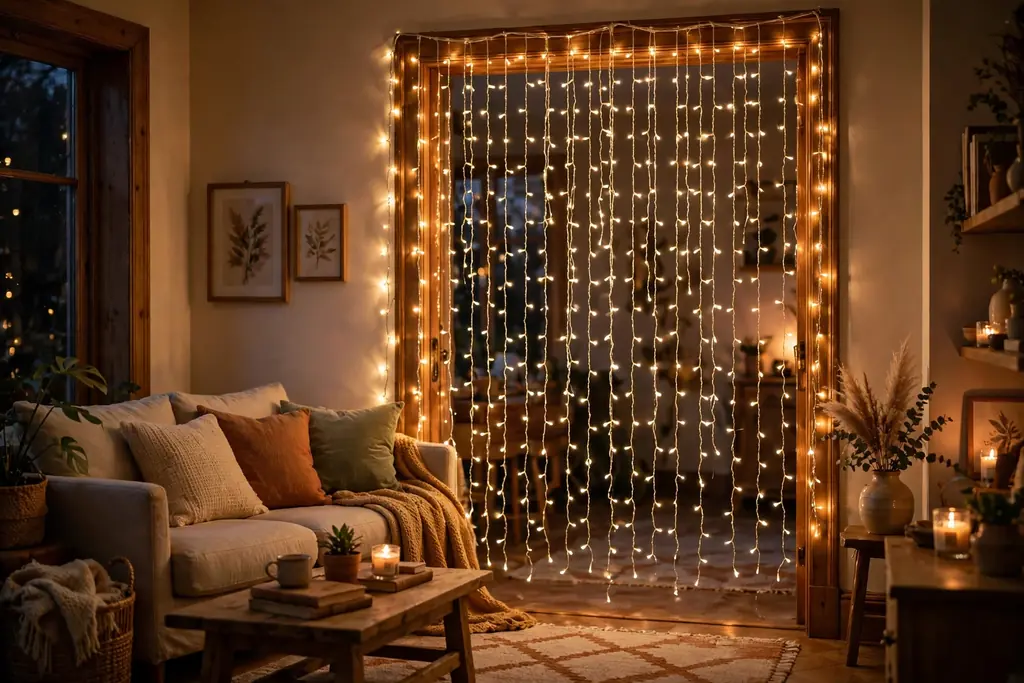
    Doorway covered by a curtain of warm string lights hanging in strands.

    A string-light curtain turns a doorway into a glowing divide in the evening, with strands of small lights hanging from a rod or a wire across the opening. This suits a living room, a bedroom, or a party doorway where you want atmosphere more than privacy, since the lights mark the room edge without closing it off. During the day, the unlit strands hang quietly and take up little visual space.

    Use battery or plug-in lights suited to indoor use, and keep the strands clear of curtains and bedding, since even small bulbs need airflow. Hang the lights from a tension rod, so the whole curtain lifts off when the season ends, and check the cord length before you hang it, so the plug or battery pack sits safely out of the walkway. If you need privacy as well, hang the light curtain in front of a sheer panel, and use both together after dark.

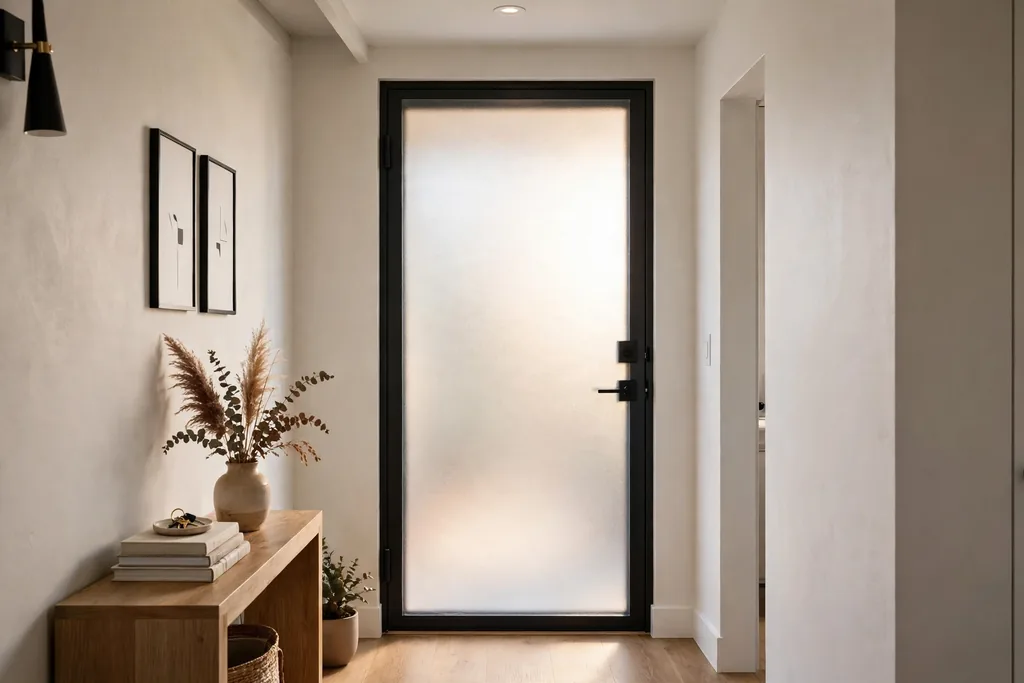
    23. Cover a Glass Door with Frosted Film

    Interior glass door covered with frosted window film for privacy.

    Frosted film turns a clear glass door into a private door without replacing the glass, and it peels off when you move out. The film sticks with water and a smooth tool, so there is no adhesive left on the glass, and it still lets light through, which suits a bathroom door, an office door, or a bedroom with a glazed panel. Cut the film to fit each pane, and smooth out bubbles as you work.

    Clean the glass well before you fit the film, since dust under the film shows in daylight, and trim the edges neatly so the film does not lift. If you want a pattern, choose a film with a simple design, and keep the pattern straight across panes, so the door reads as one piece. Peel the film off slowly when you no longer need it, and wash the glass to remove any residue.

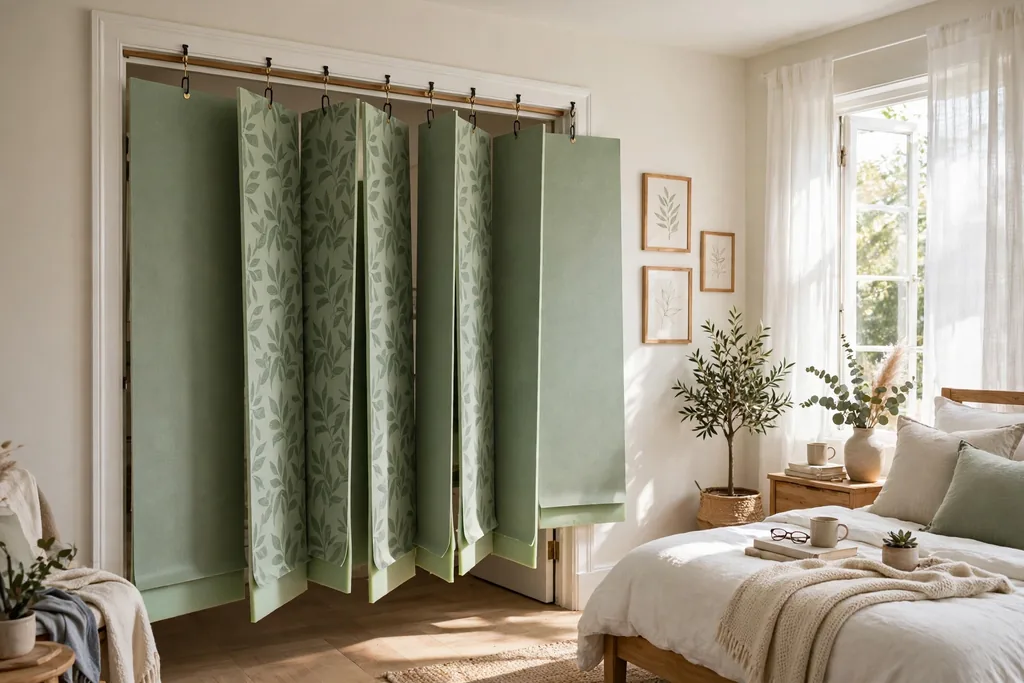
    24. Hang Foam Board Panels Wrapped in Removable Wallpaper

    Doorway covered by foam board panels wrapped in sage green removable wallpaper.

    Foam board panels wrapped in removable wallpaper give you a light, flat door face in any pattern you like, hung from hooks over the top of the frame. Cut the boards to fit the opening, wrap them tightly, and hang two or three side by side for a full door, or one panel for a partial divide. This suits a small room, a craft room, or a doorway you want to dress up for a season on a low budget.

    Measure the opening and cut the boards slightly smaller, so they hang without bowing, and wrap the wallpaper smoothly around the edges, so no foam shows. Hang the panels from sturdy over-door hooks, and check that they do not swing when the door behind them moves. Store the panels flat when not in use, since foam board dents easily if it is leaned against a sharp edge.

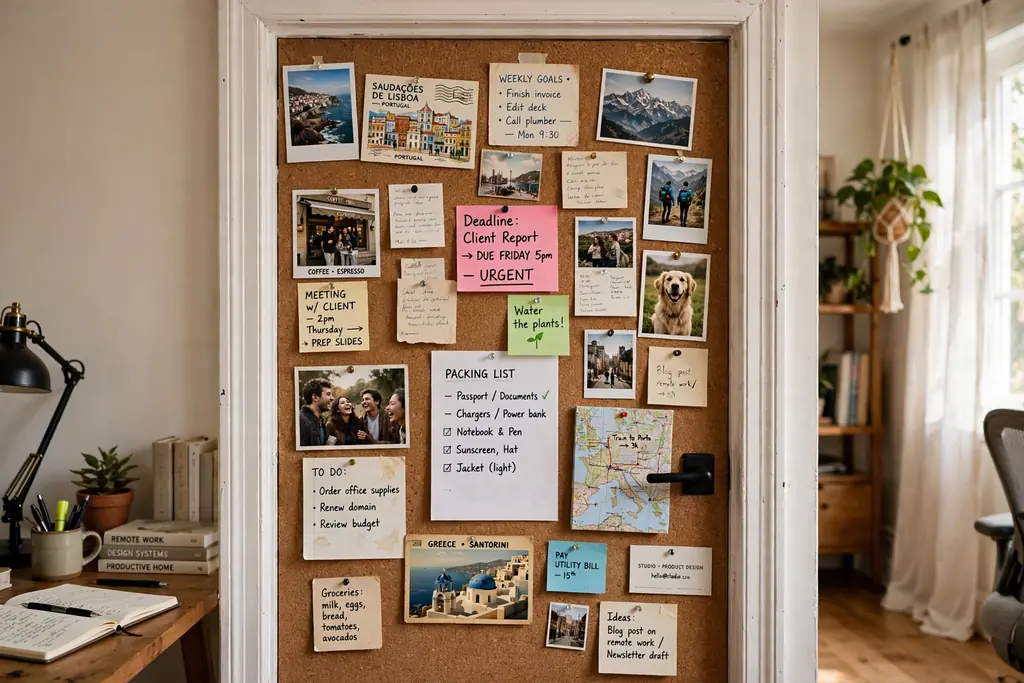
    25. Use a Corkboard Panel as a Working Door

    Doorway covered by a corkboard panel with pinned photos and notes.

    A corkboard panel across a doorway gives you a door that also works as a notice board, holding notes, photos, lists, and reminders on pins. This suits a home office, a kitchen doorway, or a student room, where the door is also the place you check each morning. Hang the panel from over-door hooks or a tension rod with clips, so it comes down without holes.

    Choose a panel that covers the opening well but is light enough to hang safely, and use short pins, so they do not push through the back. Keep the board tidy, with one section for each type of note, so it reads as a planned feature rather than a pile of paper. If the board gets heavy with paper, take some items down, since a loaded board can pull its hooks loose.

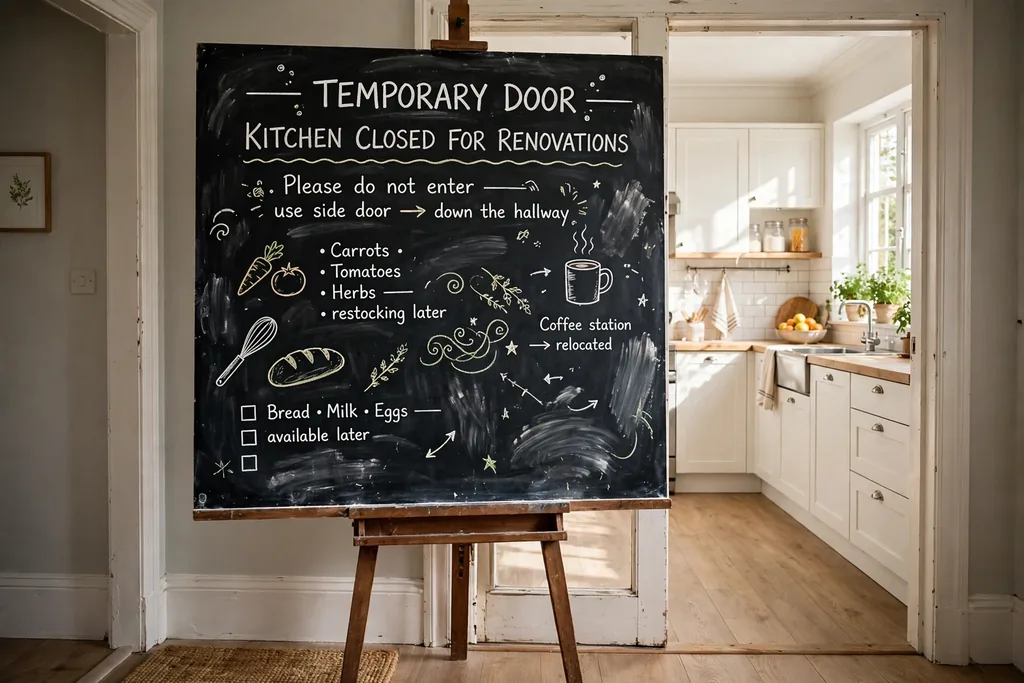
    26. Stand a Chalkboard Panel on an Easel in the Opening

    Chalkboard panel on a wooden easel stand placed in a doorway.

    A chalkboard panel on an easel stands in a doorway as a temporary door you can also write on, with menus, reminders, or drawings for children. This suits a kitchen doorway, a playroom, or a home where the doorway is also a message spot, and the easel means there is no fitting at all. Move the easel aside when you need the doorway fully open, and bring it back when you want the divide again.
    Choose an easel that stands steady on your floor, and check that it does not block the walkway you use in the dark. Keep chalk and an eraser nearby, and wipe the board clean each week, since old chalk dust builds up and dulls the surface. If the doorway is narrow, use a slim easel, so the panel does not crowd the passage.

    27. Hang a Pegboard Panel from Over-Door Hooks

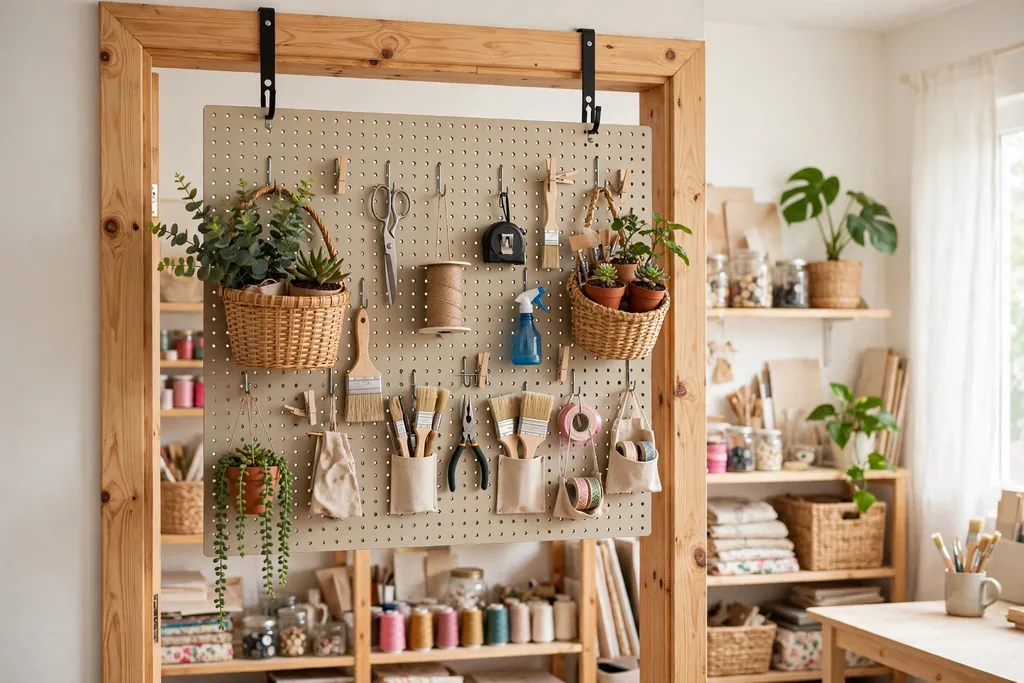
    Doorway covered by a pegboard panel hanging from over-door hooks with baskets and small plants.

    A pegboard panel hung from over-door hooks turns a doorway into useful storage, with hooks and small baskets holding tools, craft supplies, or kitchen items. This suits a craft room, a garage doorway, or a small kitchen where wall space is short, since the door itself becomes the storage wall. The panel hangs as one piece and lifts off the hooks when you no longer need it.

    Choose a panel that fits the opening and is light enough for the hooks, and spread the weight evenly, so one hook does not carry the whole load. Keep sharp tools out of reach of small children, and keep the panel clear of heaters. Check the hooks now and then, since a loaded pegboard can work a hook loose over time, and move heavier items low, so the panel stays steady.

    28. Lean a Mirror Panel Across Part of a Wide Opening

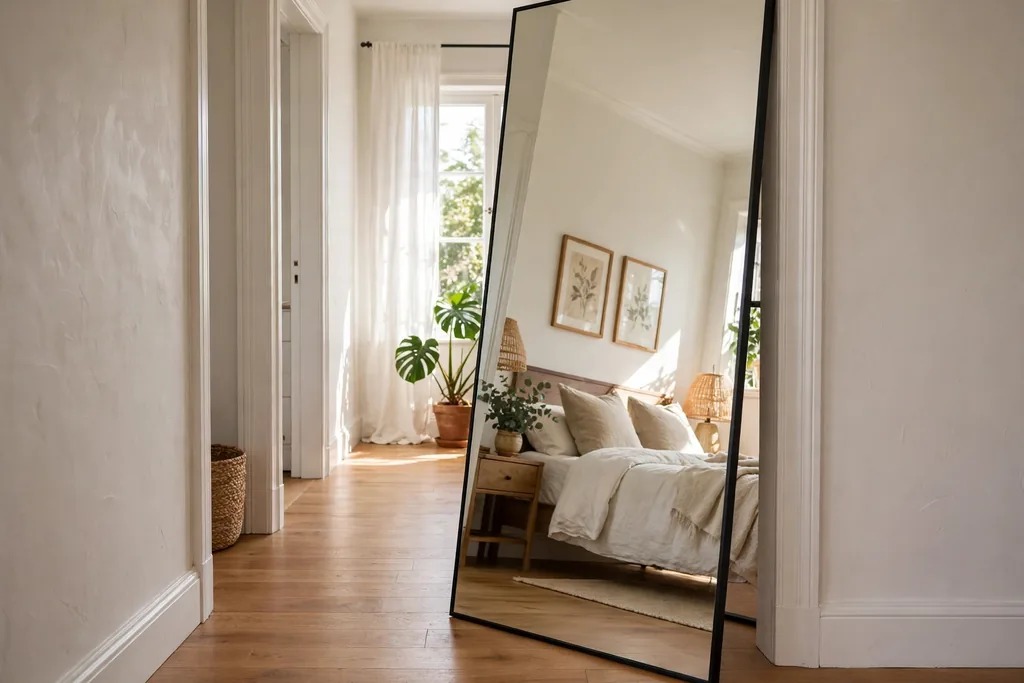
    Tall full length mirror panel leaning across part of a wide doorway.

    A leaning mirror panel across part of a wide opening gives you a partial divide that also bounces light around the room. This suits a wide arch, a dressing area, or a bedroom where you want a dressing mirror and a room divide in one piece, without closing the doorway fully. Lean the panel at a safe angle, with the top secured to the wall with a removable strap or hook, so it cannot slide.

    Check what the mirror reflects before you settle its position, since a mirror facing a cluttered corner doubles the clutter. Aim it toward a window, a plant, or a calm stretch of wall where possible, and keep the floor in front of it clear, so you can step around it safely. Clean the mirror with a soft cloth, and keep it out of direct sun on bedding for long hours.

    29. Hang a Ribbon Curtain for a Playful Divide

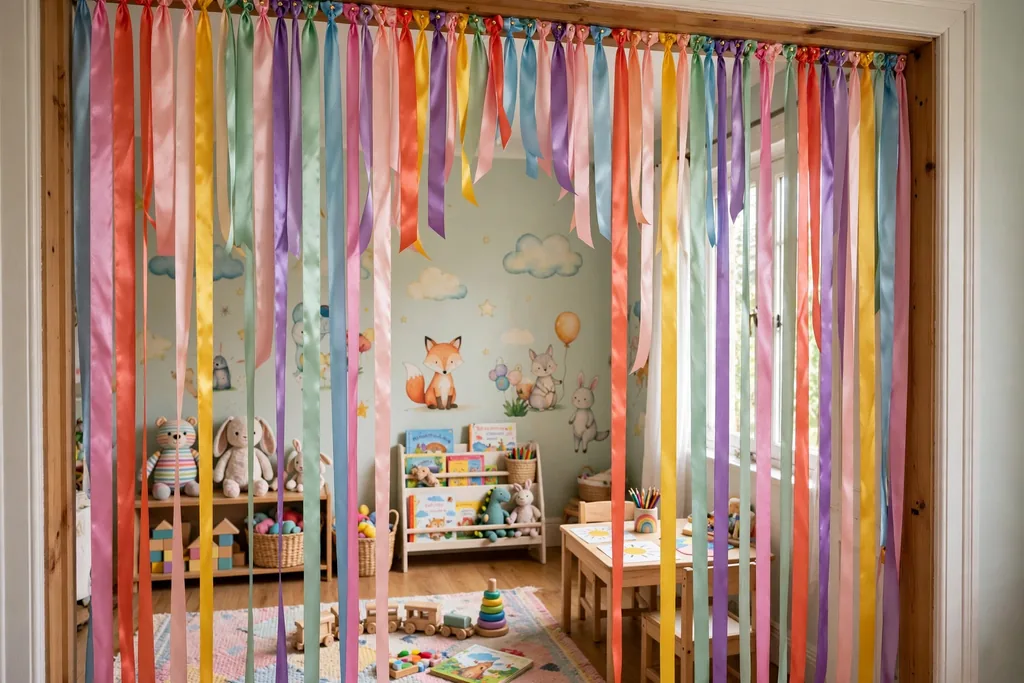
    Doorway covered by a curtain of colorful satin ribbons hanging in strands.

    A ribbon curtain, made from strands of ribbon in one color or many, gives a doorway a playful, light divide that suits a kids room, a party, or a craft room. The ribbons part easily as you walk through, and they flutter in a breeze, so the doorway feels open even when the curtain is down. Hang the ribbons from a rod or a strip of fabric across the top of the frame, and tie them securely, so they do not come loose.

    Choose ribbons in colors that work with the room, and keep the strands clear of the floor, so they do not tangle around feet. Keep ribbons away from heaters and open flames, and check the knots now and then, since ribbons can loosen with daily use. If the ribbon curtain is for a party only, take it down after the event and store the ribbons rolled, so they stay smooth for next time.

    30. Stand a Salvaged Door on a Portable Frame

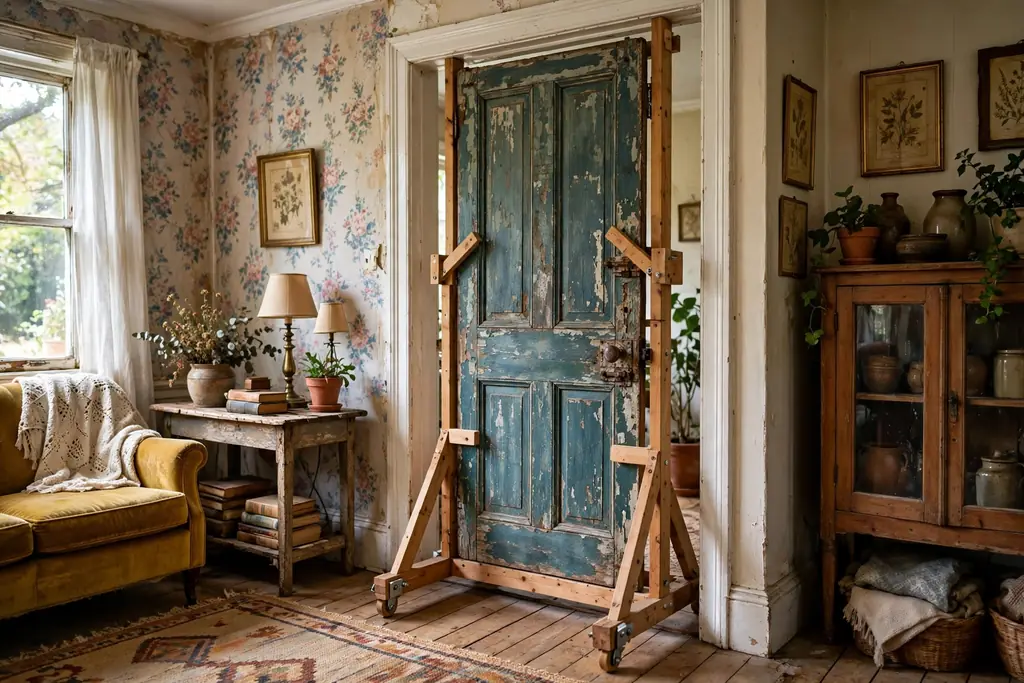
    Salvaged painted wooden door mounted on a portable wooden stand in a doorway.

    A salvaged door on a portable frame gives you a real door look without fitting hinges into your frame, since the door hangs on a freestanding stand that stands in the opening. This suits a vintage style home, a photo backdrop, or a room where you want the weight and feel of a solid door for a season. Choose a door that fits the opening, and check the stand before you use it, since a heavy door needs a steady base.

    Fix the door to the stand following the maker instructions, and test it on your floor, since a stand that rocks will make the door hard to use. Keep the door clear of heaters and damp, and sand any rough edges or loose paint before you bring a salvaged door indoors. If you later want a fixed door for a closet, see these closet door ideas.

    Conclusion

    A temporary door works best when you match it to the job, not to a photo. Start with the opening: measure it, check the light, and decide how much privacy, draft cover, and sound cover you actually need. Then pick the lightest idea that does that job, whether it is a tension-rod curtain, a folding screen, or a panel on hooks, and live with it for a few days before you add more. The best temporary door is the one you can put up in an afternoon, take down without a trace, and put back up next season when you need it again.

    Frequently Asked Questions

    What is a temporary door?

    A temporary door is a curtain, screen, panel, or rolling piece that divides a doorway without permanent fitting. It hangs from a tension rod, magnetic rod, over-door hooks, or a freestanding frame, so you can put it up and take it down without screws, tracks, or damage to the frame.

    Are temporary doors renter friendly?

    Yes, most of them are, as long as you avoid drilling and adhesive that marks paint. Tension rods, magnetic rods, over-door hooks, freestanding screens, and rolling slabs leave no holes, but check your lease first, and test any adhesive mount in a hidden spot before you use it on a visible frame.

    Can a temporary door give real privacy?

    It depends on the idea you pick. A heavy curtain, a solid panel, or a rolling slab gives good visual privacy, while a sheer panel, a beaded curtain, or a plant screen gives only a light divide. For a bedroom or bathroom, choose a full, opaque option, and check it at night with the lights on, since light from behind can show shapes through thin fabric.

    Will a temporary door block drafts?

    A heavy, floor-length curtain or a well-fitted panel blocks drafts better than a light curtain or an open screen. Let the fabric overlap the frame at the sides and reach close to the floor, since gaps at the edges let cold air through. A magnetic mesh screen, by contrast, is made for airflow, so it will not block a draft at all.

    What is the easiest temporary door to start with?

    A linen curtain on a tension rod is the easiest place to start. You need only a rod and a curtain, there is no fitting, and you can change the fabric later without buying new hardware. Measure the frame first, choose a rod rated for that width, and hang the curtain so the hem clears the floor.

    How do I remove a temporary door without damage?

    Take the panel down first, then remove the mount slowly, following the maker instructions for any adhesive or hook. Wipe the frame with a damp cloth to remove dust, and check for marks in daylight. If a tension rod left a faint ring on soft paint, a gentle clean usually removes it, but test any cleaner in a hidden spot first.


  • 26 Small Storage Ideas for Small Spaces for a More Polished Space

    26 Small Storage Ideas for Small Spaces for a More Polished Space

    Small rooms do not need more furniture. They need storage that fits the gaps you already have: under the bed, behind a door, above a desk, and inside a cabinet that is currently a jumble. When each item has a clear home, surfaces stay clear, cleaning gets faster, and the room feels calmer even though nothing about its size has changed. These 26 small storage ideas for small spaces cover bedrooms, living rooms, kitchens, bathrooms, closets, and entries, so you can start with one trouble spot and add more as you go. Pick the idea that solves your biggest daily annoyance first, then build from there.

    Key Takeaways

    • Start with dead space first: under beds, behind doors, above desks, and inside cabinet doors hold storage without taking any floor space.
    • Give every category one home, so shoes, chargers, cleaning supplies, and pantry goods each have a single place to return to.
    • Go vertical before you go wide: shelves, rails, pegboards, and tall narrow units use wall height that small rooms often waste.
    • Choose furniture that stores as well as it serves, such as ottomans, benches, and lift-top tables, so one piece does two jobs.
    • Keep daily items within reach and seasonal items out of the way, so the storage you use most is also the easiest to reach.
    • Label bins and keep one empty bin free, so new items have a place and the system still works after a busy week.

    1. Slide Rolling Bins Under the Bed

    Small bedroom with low rolling bins sliding under a bed.

    The space under a bed is often the largest unused storage area in a small bedroom. Low rolling bins turn it into a drawer you never had to build, ideal for off-season clothes, spare bedding, or shoes you wear less often. Because the bins roll out, you can reach the back of the bed without moving the whole frame, which keeps this storage useful rather than forgotten.

    Choose bins with lids if dust is a problem, and measure the clearance under your bed before you buy, since bed frames vary. Group one category per bin and label the end you see first, so you pull out the right bin at once. Keep daily clothes in the closet instead, and reserve under-bed bins for items you need weekly or seasonally, so you are not crouching down every morning.

    2. Hang an Over-Door Rack for Shoes and Accessories

    Bedroom closet door with an over-door rack holding shoes and bags.

    An over-door rack hooks over the top of a door and needs no screws, which makes it a strong choice for rented homes. Use it for shoes, scarves, belts, bags, or hats, and the door still opens and closes as normal. This suits a bedroom or entry where shoes pile by the door and there is no room for a shoe cabinet.

    Hang the rack on a door you use less often, such as a closet door, if the main door feels too busy. Keep heavier items low so the rack stays steady, and check that the hooks clear the door frame so the door still latches. If the rack swings when the door moves, add a small felt pad behind it to stop rattling and protect the door paint.

    3. Fit Floating Shelves Above a Desk

    Small desk nook with floating shelves holding books and supplies above the desk.

    Wall space above a desk is usually empty, yet it sits right where you work. Two or three floating shelves there hold books, notebooks, small plants, and desk supplies, freeing the desk surface for actual work. This suits a small bedroom or living room corner where a bookcase would crowd the floor.

    Mount shelves into wall studs or use fixings rated for your wall type, since books get heavy fast. Keep the lowest shelf within easy reach from your chair, and reserve higher shelves for items you need less often. Leave one shelf partly empty, so the wall still looks calm, and keep cords tidy with a small clip or channel so they do not dangle across the shelves.

    4. Use a Tall Narrow Bookcase in an Unused Corner

    Unused living room corner with a tall narrow bookcase holding books and baskets.

    Corners in small rooms often sit empty because standard furniture is too wide for them. A tall narrow bookcase fits that gap and adds several shelves of storage in a footprint barely wider than a chair. Use it for books, baskets, plants, or a mix, and the room gains storage without losing a walkway.

    Anchor the bookcase to the wall, especially in a home with children or pets, since tall units can tip. Put heavier books low and lighter items high, and use a basket on one shelf to hide small loose items. If the corner is dark, add a small clip light or place a plant on the top shelf, so the bookcase reads as a planned feature rather than a filler piece.

    5. Choose a Storage Ottoman for the Living Room

    Small living room with a storage ottoman beside a sofa holding blankets.

    A storage ottoman works as a footrest, an extra seat, and a box for blankets, remotes, chargers, or board games. With the lid closed, the room looks tidy, and guests never guess that the ottoman holds half the living room clutter. This suits a small living room where a coffee table with open shelves would show every item.

    Pick a size that leaves a clear path around it, and choose a fabric you can wipe or wash, since ottomans get daily use. Keep only items you reach for in the living room inside it, so it does not become a second junk drawer. If you also need a table surface, add a firm tray on top for drinks, and lift the tray off when you need to open the lid.

    6. Fold Down a Wall-Mounted Desk When You Need It

    Small room wall with a fold-down desk open for work with notebooks and a laptop.

    A wall-mounted desk that folds down gives you a work surface only when you need it, then folds flat against the wall when you do not. Inside, small shelves or pockets can hold a laptop, notebooks, and pens, so the desk doubles as a shallow cabinet. This suits a studio apartment, a guest room that doubles as an office, or a hallway nook too narrow for a full desk.

    Mount it at a comfortable sitting or standing height, and check the wall fixings suit the weight of the desk plus your laptop. Keep a chair that tucks away nearby, such as a folding chair hung on a hook, so the whole setup disappears after work. Clear the desk before you fold it up, or loose items will slide, and keep cables short so nothing snags on the hinge.

    7. Roll a Narrow Cart Into a Kitchen or Bathroom Gap

    Narrow kitchen gap beside a fridge with a rolling cart holding spices and bottles.

    The gap beside a fridge, a washing machine, or a bathroom vanity is often just wide enough to waste. A narrow rolling cart turns that gap into storage for spices, cleaning supplies, toiletries, or canned goods, and it pulls out fully so you can reach the back. This suits kitchens and bathrooms where cabinets are full and counter space is short.

    Measure the gap at the floor, the middle, and the top, since walls and appliances are not always straight. Choose a cart with a handle and smooth wheels, and keep heavier items on the lowest tier so it rolls steadily. Wipe the cart often if it lives near a stove or sink, and avoid storing anything that needs to stay cool beside a warm appliance.

    8. Divide the Under-Sink Cabinet With Tension Rods

    Under-sink cabinet with a tension rod holding spray bottles and a small bin below.

    Under-sink cabinets are hard to use because pipes block the middle and bottles fall over in the dark. A tension rod fitted across the cabinet, above the pipes, gives you a rail to hang spray bottles by their triggers, while a small bin below holds the rest. This simple change makes the whole cabinet visible and reachable without any drilling.

    Measure the cabinet width and fit the rod snugly, so it stays put when you pull a bottle off. Hang only light bottles from the rod, and keep heavy cleaners in a bin on the cabinet floor. Put a small tray under the bin to catch drips, and check the pipes now and then, since a rod pressed against a pipe can shift over time.

    9. Add Hooks Inside Cabinet Doors

    Open kitchen cabinet door with hooks inside holding measuring cups and lids.

    The inside of a cabinet door is a free wall that most kitchens ignore. Small adhesive or screw-in hooks there hold measuring cups, lids, pot holders, or cleaning cloths, and they keep those items off the counter and out of drawers. This suits a small kitchen where every drawer is already full and lids are the first thing to go missing.

    Check the door clearance before you fit hooks, so they do not hit shelves or items inside when the door closes. Use adhesive hooks for rented homes and light items, and screw-in hooks for heavier lids. Keep the hooks to one row per door, and group one category per door, so you always know which door holds the measuring cups and which holds the cloths.

    10. Build a Pegboard Wall for Tools and Supplies

    Entry wall with a pegboard holding keys, bags, and small baskets.

    A pegboard turns a blank wall into flexible storage, since hooks, bins, and shelves move whenever your needs change. Use it in an entry for keys and bags, in a kitchen for utensils, or in a craft corner for supplies, and everything stays visible at a glance. This suits a small home where closed storage hides items and open shelves cannot adapt.

    Mount the pegboard on battens so there is space behind it for the hooks, and use fixings rated for the wall and the weight you plan to hang. Outline heavy tools or group items by task, so each hook has a clear purpose. Keep the board to one wall or one section, and leave some pegs empty, so new items have a place without a full reorganization.

    11. Stack Labeled Bins on Closet Shelves

    Closet shelves with stackable labeled bins holding folded clothes.

    Closet shelves often hold tall, unstable piles that topple when you pull one item out. Stackable bins fix this by giving each pile a box, and labels on the front tell you what is inside without opening every bin. This suits a bedroom closet, a linen closet, or a hall closet where shelves are deep and items get lost at the back.

    Choose bins that match your shelf depth, and stack no higher than you can safely reach, since a tall stack is hard to lift down. Put the bin you use most at the front or on top, and seasonal bins at the back or on the highest shelf. Use the same bin style throughout one closet, so the stacks look neat and sit steadily, and re-label a bin when its contents change rather than letting the label lie.

    12. Place a Slim Console Shelf Behind the Sofa

    Living room sofa with a slim console shelf behind it holding books and a lamp.

    The gap behind a sofa, especially a sofa that floats in the middle of a room, is often wasted. A slim console table or shelf there holds lamps, books, chargers, and a plant, and it gives the back of the sofa a finished look from the other side of the room. This suits an open-plan living room where the sofa divides the seating area from the dining area.

    Choose a console no deeper than the gap allows, and keep the walkway behind it clear if people pass there. Run a small power strip along the shelf for phone chargers, and keep cords tucked behind the table legs. Keep the top mostly clear, with one lamp and a few books, so the shelf adds storage without becoming another cluttered surface.

    13. Fix a Magnetic Strip for Kitchen Tools

    Kitchen wall with a magnetic strip holding knives and metal utensils.

    A magnetic strip on a kitchen wall holds knives, scissors, and metal utensils in a single row, freeing a whole drawer and keeping tools within reach of the counter. This suits a small kitchen where drawer space is short and a knife block eats counter space. It also keeps sharp tools visible, so you pick the right one without digging.

    Mount the strip at a height adults can reach but children cannot, and use screws into a stud or wall fixings rated for the weight. Keep the strip away from the stove, so heat and steam do not dull the tools or loosen the fixings. Wipe the strip often, since kitchen grease settles on flat metal, and store only metal tools on it, with other utensils in a jar or drawer nearby.

    14. Fit Corner Shelves in the Bathroom

    Small bathroom corner with shelves holding rolled towels and toiletries.

    Bathroom corners are usually empty, yet they sit close to the shower, sink, and toilet where you need storage most. Small corner shelves hold shampoo, skincare, and rolled towels without taking floor space or crowding the sink. This suits a small bathroom where a cabinet would block the door or a cart would block the walkway.

    Choose shelves in a material that handles damp air, such as treated wood, metal, or plastic, and fix them firmly so they do not shift when wet. Keep daily items on the lowest shelf and backups higher, and use one small basket per shelf if loose bottles slide. Wipe the shelves often, since bathroom damp can leave marks, and avoid glass shelves in a home with small children.

    15. Sit Down to an Entry Storage Bench

    Entryway with a storage bench holding shoes in baskets below the seat.

    An entry bench gives you a seat for putting on shoes and a box or baskets below for the shoes themselves. With a few hooks above it, the bench becomes a complete entry station: coats up top, shoes below, and keys in a small tray on the seat end. This suits a small entry where shoes otherwise spread across the floor and coats pile on a chair.

    Pick a bench that fits the wall without blocking the door swing, and use baskets that slide out easily for cleaning. Assign one basket per person if the household is large, so shoes do not mix. Keep the bench top clear except for a small tray, and wipe it often, since entries collect dirt from outdoors.

    16. Repurpose an Over-Door Shoe Organizer for Supplies

    Pantry door with a clear over-door shoe organizer holding snacks and small packets.

    A clear over-door shoe organizer has deep pockets that hold far more than shoes. Hang one on a pantry door for snacks and packets, on a closet door for scarves and small accessories, or on a bathroom door for toiletries and cleaning supplies. The clear pockets let you see everything at once, which keeps small items from vanishing into a drawer.

    Label the rows if several people share the organizer, and keep heavier items in the lowest pockets so the door hangs evenly. Cut nothing from the organizer, since trimmed pockets fray, and wash it now and then if it holds food or toiletries. If the door is used often, choose an organizer with sturdy hooks, so it stays in place when the door swings.

    17. Fit Shelving Above the Toilet

    Small bathroom with shelves above the toilet holding towels and spare toilet paper.

    The wall above a toilet is often the only free wall in a small bathroom, and it sits at a height that is easy to reach. A small shelf unit or two floating shelves there hold spare toilet paper, towels, and toiletries, freeing the vanity for daily items. This suits a bathroom with no linen closet and a vanity that is already full.

    Keep shelves high enough that no one bumps their head, and avoid placing anything breakable directly above the tank. Use baskets on the shelves to group items and hide less tidy backups, and keep the lowest shelf for items you reach for often. Check the fixings suit a bathroom wall, which may be tile, and use a stud finder or tile-rated fixings rather than guessing.

    18. Decant the Pantry Into Clear Stackable Containers

    Kitchen pantry shelves with clear stackable containers holding dry food.

    Pantry shelves hide food in boxes and bags that tear, spill, and hide what is left. Clear stackable containers show the contents at a glance, stack neatly, and keep food fresh longer, which also stops you buying a second bag of something you already own. This suits a small kitchen where pantry space is limited and every shelf must earn its place.

    Decant one shelf at a time, and label each container with the contents and the date you filled it. Keep containers the same footprint where possible, so stacks stay steady, and store heavier staples like flour low. Wash and dry containers fully before refilling, and keep a small scoop in bulk containers, so you are not reaching in with wet hands.

    19. Hang a Rail With S-Hooks in the Kitchen

    Kitchen wall rail with S-hooks holding pans, utensils, and mugs.

    A wall rail with S-hooks turns a blank stretch of kitchen wall or the side of a cabinet into hanging storage for pans, utensils, mugs, and measuring cups. Hooks slide along the rail, so the layout changes as your cooking changes, and items stay visible instead of stacked in a drawer. This suits a small kitchen where pots pile in a low cabinet and lids never match their pans.

    Fix the rail into studs or with fixings rated for the weight of full pans, and keep it away from the stove burner line. Hang the most used items at the front or center, and keep sharp tools on hooks that do not swing into the walkway. Wipe the rail and hooks often, since cooking steam leaves a film, and leave a few hooks empty for new tools.

    20. Divide Drawers With Inserts

    Open kitchen drawer with dividers separating utensils and small tools.

    A deep drawer without dividers becomes one mixed pile, whether it holds kitchen tools, desk supplies, or socks. Adjustable inserts split the drawer into zones, so each category has a lane and you can see everything without lifting layers. This suits any small home, since drawers are often the only closed storage a room has.

    Measure the drawer before you buy, and choose inserts that expand or link, so they fit snugly without sliding. Group items by use rather than by size alone, for example cooking tools together and baking tools together, so you open one drawer per task. Leave one lane empty if you can, since a drawer packed edge to edge is hard to use, and re-sort the inserts when a category grows or shrinks.

    21. Mount File Holders on the Wall Beside a Desk

    Desk wall with mounted file holders holding labeled folders and mail.

    Paper piles grow fast in a small home, and a desk drawer rarely holds them all. Wall-mounted file holders beside a desk sort mail, bills, notebooks, and school papers into labeled slots, keeping the desk clear while the papers stay in reach. This suits a home office corner, a kitchen command center, or a student desk in a shared room.

    Mount the holders at arm height from your chair, and label each slot by task, such as bills, school, and to file, rather than by vague names. Clear one slot each week, filing or recycling what is done, so the system does not fill up and spill back onto the desk. Keep the holders to one wall section, and use the same holder style throughout, so the row looks tidy.

    22. Raise Cabinet Shelves With Tiered Risers

    Kitchen cabinet interior with tiered risers holding spices and small jars.

    Kitchen and bathroom cabinets waste the vertical space above short items, since you can only stack so high before the pile falls. A tiered riser, like a small set of steps inside the cabinet, lifts the back row so you can see and reach every item. This suits spice cabinets, canned goods, and bathroom cabinets where small bottles hide behind taller ones.

    Choose a riser that fits the cabinet depth and leaves the door free to close, and put the tallest items at the back on the highest step. Keep one category per riser, so spices do not mix with medicines, and wipe the riser when you restock. If the cabinet is deep, use two small risers side by side rather than one wide one, so you can pull one out without moving the other.

    23. Tuck Shoes Into a Slim Entry Cabinet

    Narrow entry hallway with a slim shoe cabinet beside the front door.

    A slim shoe cabinet, only a few inches deep, holds pairs of shoes on tilted shelves behind closed doors, so the entry looks tidy even when several pairs live there. Because it is shallow, it fits a narrow hallway or a wall beside the front door where a bench or rack would block the path. This suits a small entry where shoes are the main source of clutter.

    Anchor the cabinet to the wall, since tilted shelves shift when doors open, and wipe the shelves often, since shoes bring in dirt. Keep only the shoes you wear weekly in the cabinet, and store off-season pairs elsewhere, so the cabinet never overflows. Add a small tray on top for keys and mail, but keep it light, so the top does not become a dumping spot.

    24. Shrink Bulky Bedding With Vacuum Storage Bags

    Bedroom closet shelf with flat vacuum storage bags holding folded bedding.

    Spare duvets, winter blankets, and bulky coats take up a full shelf each, yet you only need them for part of the year. Vacuum storage bags shrink them flat by removing air, so one shelf or one under-bed bin holds what used to fill a closet. This suits a small bedroom or closet where bedding competes with clothes for space.

    Roll or fold items neatly before sealing, and do not overfill a bag, since a strained seal leaks air back in. Label each bag with its contents and the season, and store bags flat rather than standing them on edge, so they do not slide. Check the seal after a week, and keep delicate fabrics out of vacuum bags if the care label warns against compression.

    25. Double the Closet With a Second Hanging Rod

    Small closet with two hanging rods holding shirts on slim hangers.

    Most closets hang one long row of clothes, leaving empty air below short items like shirts and folded trousers. A second rod hung below the first doubles the hanging space in that section, using height that was already there. This suits a small bedroom closet where shirts, blouses, and jackets crowd one rod while the floor below stays empty.

    Hang the second rod at a height that leaves shirts clear of the floor or a shoe rack below, and use it for shorter items only, so longer coats still fit on the main rod. Keep heavier items on the main rod, since it is usually fixed more firmly, and use slim hangers on both rods to fit more pieces. If the closet has one long rod, use a hanging rod extender that hooks over the main rod, which needs no drilling and suits a rented home.

    26. Pick a Lift-Top Coffee Table With Storage

    Small living room with a lift-top coffee table open for work beside a sofa.

    A lift-top coffee table raises its top to a comfortable height for eating, working, or reading, then lowers it again, while the base holds books, blankets, and chargers. In a small living room, it replaces both a coffee table and a desk, and the closed base keeps clutter out of sight. This suits a studio apartment or a living room that doubles as a workspace.

    Check the lift mechanism before you buy, and choose one that stays steady at full height without wobbling. Keep the base organized with one small basket for chargers and one for remotes, so the inside does not become a tangle. For ideas on keeping the rest of the living room calm around a hardworking table, see these bedroom wall art ideas for wall styling that keeps a small room feeling open, and these bedroom curtain ideas for window treatments that suit small rooms too.

    Conclusion

    A polished small space does not come from buying more storage. It comes from matching each storage idea to a real gap in your home: a door, a wall, a gap beside an appliance, or a piece of furniture that can hold more than it shows. Start with the spot that bothers you most, use one idea well, and let the habit of putting things back in one home do the rest. Over time, a few of these changes add up to rooms that feel calm, easy to clean, and easy to live in, even when the floor plan stays exactly the same.

    If you found an idea here that suits your home, save this post on Pinterest so you can find it again when you are ready to start. Pin the look you like most, whether it is an under-bed bin setup, a pegboard wall, or a slim entry cabinet, and use it as a guide for your next weekend tidy-up.

    FAQs

    How do I start organizing a small space without buying everything at once?

    Start with the spot that causes the most daily friction, such as shoes by the door or a messy under-sink cabinet. Empty that one area, group what is left by category, and add a single storage solution for it, like hooks, a bin, or a riser. Once that area works, move to the next trouble spot, so the system grows around your real habits rather than a shopping list.

    What is the best storage idea for a rented small apartment?

    Choose storage that needs no drilling: over-door racks, tension rods, rolling carts, adhesive hooks, and freestanding shelves. These add real capacity without holes in the walls, and they move with you to the next home. If you do drill, keep it to one or two well-placed shelves, and check your lease and wall type first.

    How do I keep small space storage from looking cluttered?

    Use closed storage for messy categories and open storage only for tidy ones. Match bin styles within one room, label the front of closed bins, and leave some empty space on every shelf. When a shelf or bin is full, remove one item before adding another, so the system stays at the size you planned.

    How much should I store under the bed?

    Use under-bed storage for items you need weekly or seasonally, such as spare bedding, off-season clothes, or shoes you wear less often. Keep daily clothes in the closet, so you are not crouching under the bed every morning. Choose lidded rolling bins if dust is a problem, and measure your bed clearance before you buy.

    What storage works best in a very small kitchen?

    Use the walls, the insides of cabinet doors, and narrow gaps. A magnetic strip, a rail with hooks, hooks inside doors, and a rolling gap cart together add a lot of capacity without taking counter space. Clear stackable pantry containers and tiered risers then make the cabinets you already have easier to use.

    How do I maintain a small storage system over time?

    Build a short weekly reset into your routine: return stray items to their homes, wipe one shelf or bin, and clear one file holder slot or basket. Every few months, check each bin for items you no longer use, and re-label anything whose contents changed. A system that gets a small regular reset lasts far longer than one that gets a big annual clear-out.


  • 22 Laundry Room Decor Ideas That Balance Style and Comfort

    22 Laundry Room Decor Ideas That Balance Style and Comfort

    A laundry room earns its keep every week, yet it often gets the least care in the house. Machines, baskets, and bottles fill the room, and comfort drops off the list. These 22 laundry room decor ideas show how to balance the practical side with a calmer, more pleasant look, from sage cabinets and patterned tile to linen curtains, warm light, and soft textiles. You do not need a full remodel to see a change. Pick the idea that fixes your biggest daily frustration first, whether that is dim light, bare walls, or nowhere soft to sit, then add one more layer at a time.

    Key Takeaways

    • Pick one calm palette and repeat it: a wall color, a wood tone, and one metal finish carried through cabinets, shelves, and hardware keep a small room settled.
    • Put comfort where the work happens: a soft rug underfoot, warm light over the folding counter, and a seat for sorting make wash day easier on the body.
    • Use closed storage for bottles and open storage for towels and baskets, so the room looks tidy but still shows soft texture.
    • Add one textile layer at a time, such as a curtain, a runner, or a bench cushion, and keep the rest plain so the room does not feel crowded.
    • Keep daily items at hand height and move spares higher up, so the pretty parts of the room stay in reach and the clutter stays out of sight.
    • Swap small seasonal pieces, like towels, a rug, and a scent, when you want a fresh look without repainting or refitting anything.

    1. Paint the Cabinets Soft Sage Green

    Laundry room with soft sage green cabinets and brass pulls beside white machines.

    Soft sage green gives laundry cabinets a calm, lived in color that suits both white machines and warm wood. The muted green reads as fresh without feeling loud, and it pairs well with cream walls, brass pulls, and folded white towels. This suits a laundry room where plain white cabinets feel flat, or where a darker color would make a small room feel closed in.

    Paint the cabinet fronts and leave the inside in warm white, so the room stays bright when a door opens. Swap the pulls for simple brass or wood knobs at the same time, since new hardware makes a paint job look finished. Test the sage in daylight and in lamplight before you commit, because green can shift warm or grey depending on the bulbs in the room.

    2. Add a Shiplap Accent Wall Behind the Machines

    Laundry room with a white shiplap accent wall behind a washer and dryer.

    A shiplap accent wall gives a plain laundry room texture and a finished backdrop for the machines. The horizontal boards add a relaxed, cottage feel, and painted shiplap in warm white keeps a small room bright. This suits a room with one bare wall, where paint alone has not made the space feel cared for.

    Fit the boards on the wall behind the machines or on the wall you face when you walk in, and keep the other walls plain so the texture stays a feature rather than a pattern everywhere. Caulk the edges neatly and paint with a washable finish, since laundry rooms collect lint and splashes. If full boards feel like too much work, a single shiplap panel behind the folding counter gives the same texture in a smaller dose.

    3. Lay a Patterned Tile Floor in Blue and Cream

    Laundry room with a patterned blue and cream tile floor and white machines.

    A patterned tile floor in soft blue and cream gives a laundry room a clear identity the moment you step in. The pattern acts like a rug that never needs washing, and tile stands up to water, muddy shoes, and dropped baskets. This suits a room with a plain vinyl or concrete floor, where the floor is the largest bare surface.

    Keep the pattern to one tile design, repeated evenly, and use a grout tone close to the cream tile so the floor reads as one calm surface. Seal the grout as the maker directs, since a laundry floor takes regular splashes. For a similar use of pattern on a working wall, see these Italian laundry room ideas, where a tiled splashback carries the color in a smaller area.

    4. Roll Out a Washable Striped Runner Rug

    Narrow laundry room with a washable striped runner rug on the floor.

    A washable striped runner rug softens a hard laundry floor and warms the spot where you stand to load machines and fold. Stripes in cream and one soft color, such as sage or dusty blue, add pattern without competing with cabinets or tile. This suits a long, narrow laundry room, where a runner fits the walkway and a large rug would bunch around the machines.

    Choose a low pile rug with a non slip backing, so it stays flat when you step on it with a basket in hand. Pick a machine washable rug, since a laundry rug will meet lint, detergent drips, and wet feet. Shake it outside weekly and wash it on a regular cycle, and keep a spare in the same colors so the room never goes bare on wash day.

    5. Style Open Wood Shelves With Baskets and Towels

    Open wood shelves in a laundry room styled with woven baskets and folded towels.

    Open wood shelves above the machines or on a clear wall give a laundry room warmth and a place to show soft texture. Thick wood shelves with simple brackets suit a cozy room, and folded towels, woven baskets, and a small plant keep the display useful rather than fussy. This suits a room where closed cabinets make the walls feel blank, or where you want daily towels within easy reach.

    Edit the shelves firmly: one row of folded towels, one basket for cloths, and empty space between groups, so the shelves read as calm rather than crowded. Use baskets in one material, such as seagrass or cotton rope, in two sizes at most. For grouping and spacing lessons that carry over well here, see these smart laundry room organization ideas, which show how to give every group a set home on open shelves.

    6. Hang Botanical Prints Above the Folding Counter

    Botanical prints in wood frames hanging above a laundry folding counter.

    Botanical prints above the folding counter give a laundry room a gentle focal point at eye level, where you actually look while you work. Simple leaf or herb prints in plain wood frames suit a sage, cream, or white room, and they soften a wall that would otherwise hold only shelves. This suits a folding counter with a bare wall above it, where art can add interest without taking counter space.

    Use matching frames and equal gaps, and keep the set to two or three prints, so the wall stays calm. Hang the center of the group at eye level from where you stand to fold, and keep the frames clear of steam from the dryer. Choose prints behind glass or in wipeable frames, since laundry rooms collect lint and the glass keeps the art clean.

    7. Hang Warm Brass Pendants Over the Folding Counter

    Warm brass pendant lights hanging over a laundry folding counter.

    Warm brass pendants over the folding counter give the work surface its own pool of light and a jewelry-like detail in a plain room. The brass warms up white walls and sage cabinets, and a shaded pendant throws light down onto folding rather than into your eyes. This suits a counter that sits under a single harsh ceiling light, where folding in the evening feels dim and flat.

    Hang two small pendants over a long counter, or one over a short counter, with the bottom of the shade high enough to see across the surface. Use warm bulbs with a dimmer if the wiring allows, so bright light for stain checks and soft light for evening folding both work. Wipe the brass now and then, since lint settles on horizontal surfaces near a dryer.

    8. Dress the Window With a Linen Cafe Curtain

    Laundry room window dressed with a linen cafe curtain above a sink.

    A linen cafe curtain on the laundry window softens daylight, adds privacy, and keeps the upper panes clear for light. The light fabric filters sun into a gentle wash, which suits a room where bare glass feels cold and a full curtain would block the sill. This suits a window above a sink or a counter, where you stand close to the glass while you work.

    Hang a slim rod at mid height and let the curtain fall just past the sill, in warm white or natural flax, so it matches the room rather than adding a new color. Choose washable linen or cotton, since a laundry window curtain will meet steam and dust. If the window opens for air, keep the fabric clear of the handle and the latch so the window still opens fully.

    9. Add a Cushioned Bench as a Folding Perch

    Laundry room with a cushioned bench beside folded towels and a basket.

    A cushioned bench gives a laundry room a soft place to sit while you sort socks, fold small items, or put on shoes. The bench turns a pass-through room into a place you can pause, and a cushion in a washable cover adds color and softness at seat height. This suits a laundry room with a free stretch of wall, or a combined laundry and mudroom where people already sit to change shoes.

    Pick a bench low enough to sit on comfortably, with a cushion cover you can remove and wash, since laundry rooms are dusty. Keep a basket below the bench for shoes or for clothes waiting to be folded, so the bench earns its floor space. If the room is narrow, a wall-mounted fold-down seat gives a perch without a permanent bench blocking the path.

    10. Set Up a Lavender and Linen Spray Scent Station

    Laundry shelf scent station with dried lavender in a stoneware jug and a linen spray bottle.

    A small scent station with dried lavender and a linen spray makes a laundry room smell like the clean clothes it holds. A bundle of dried lavender in a stoneware jug, plus a spray bottle of linen spray on a small tray, gives scent and care in one tidy corner. This suits a room that smells faintly of detergent or damp towels, where a plug-in scent would feel too strong.

    Keep the station on a shelf or a counter end, away from the machines, so bottles do not vibrate off the edge. Tie the lavender with plain twine and replace the bundle when the scent fades, and keep the spray bottle labeled so no one mistakes it for a cleaning product. Shake the lavender outside now and then to remove dust, and keep the tray small so the station stays a detail rather than clutter.

    11. Frame a Vintage Style Laundry Print

    Framed vintage style laundry print hanging on a laundry room wall.

    A framed vintage style laundry print adds charm and a clear theme to a laundry wall without new furniture. A simple typographic print, such as a wash day motto in soft black on cream, or a line drawing of a washboard and pegs, suits a room with plain walls and plain cabinets. This suits a small wall beside the door or above a hamper, where a large piece of art would crowd the space.

    Choose one print in a frame that matches the other frames in the room, and hang it where you see it when you walk in, so the room reads as decorated from the doorway. Keep the print behind glass for easy wiping, and avoid a print with a long list of rules, since a short phrase reads better from across a small room. Pair it with a plain wall color so the print stays the focus.

    12. Decant Supplies Into Glass Jars on a Wooden Tray

    Glass jars of laundry supplies arranged on a wooden tray on a laundry shelf.

    Glass jars on a wooden tray turn everyday supplies into a tidy display on a shelf or a counter end. Clear jars show powder, pods, and pegs at a glance, and a tray keeps the group together so jars do not drift across the shelf. This suits a room where mismatched bottles make open shelves look busy, and where you want to see stock levels before you run out.

    Label each jar in plain words, such as wash powder, stain soak, and pegs, and keep a small scoop in the powder jar. Keep jars out of reach of small children, and never move a product into a jar without keeping its safety notes nearby, since strong cleaners need care. Set the tray on one shelf only, with one or two jars beside it at most, so the display stays a small vignette rather than a shop shelf.

    13. Fix a Black Metal Rail for Hangers and Air Drying

    Black metal wall rail in a laundry room holding shirts on hangers.

    A black metal rail on a free wall gives hangers and air dry clothes a firm home, and the dark metal adds a crisp line against pale walls. Shirts on hangers dry faster with air around them, and a rail lets you move a whole load to the closet in one trip. This suits a room with a clear wall run, where a floor drying rack would block the walkway.

    Fix the rail into studs or solid masonry, since a rail full of wet clothes carries real weight, and leave clearance below for the longest garment. Hang clothes with a small gap between hangers so air reaches each piece, and keep a few empty hangers on the rail for the next load. Keep the rail clear of the folding counter, so hanging clothes do not drip onto clean laundry.

    14. Grow Trailing Plants on a Shelf by the Window

    Trailing plants on a shelf by a bright laundry room window.

    Trailing plants on a shelf by the window soften a room that is mostly machines and hard surfaces. A pothos or trailing ivy in a plain pot spills gently over the shelf edge, and green leaves suit sage cabinets, cream walls, and wood shelves. This suits a laundry room with a bright window or a strong ceiling light, where a plant can live without a dedicated plant corner.

    Use pots with drainage holes and saucers, and water only when the top of the soil feels dry, since most indoor plants dislike wet roots. Keep plants clear of the dryer vent and away from harsh heat, and choose hardy plants if the room swings between warm and cool through the day. Rotate the pots weekly so each plant grows evenly toward the light.

    15. Swap Plastic Bins for Woven Seagrass Hampers

    Woven seagrass hampers with lids standing beside a washer in a laundry room.

    Woven seagrass hampers give a laundry room soft texture and a calmer look than bright plastic bins. The natural weave suits wood shelves, linen curtains, and cream walls, and lidded hampers hide dirty laundry between wash days. This suits a room where laundry lives in view, such as a laundry corner in a hallway or a combined laundry and bathroom.

    Use two hampers if space allows, one for lights and one for darks, with washable liners that lift out for carrying to the machines. Keep the hampers near the machines, with enough clearance to lift the lids fully. Wipe the weave with a dry cloth and air the hampers out now and then, since damp clothes left too long can leave a smell in natural fiber.

    16. Paint a Step Stool to Double as a Plant Stand

    Painted wooden step stool holding a potted plant in a laundry room.

    A painted wooden step stool does two jobs in a laundry room: it helps you reach high shelves, and it holds a plant or a small basket when it is not in use. Painted in the room color or in a soft accent tone, the stool reads as furniture rather than a tool left out. This suits a room with high shelves or high cabinets, where a tall stool is needed often.

    Paint the stool with a durable, washable finish and add non slip pads on the feet, so it stays steady on tile. Keep the stool in the laundry room rather than another room, so reaching a high shelf never becomes a reason to skip putting things away. Check the stool weight rating, and replace it if the hinges loosen or the feet wear smooth.

    17. Swap Towels, Rug, and Scent With the Seasons

    Laundry room styled for winter with warm cotton towels

    Seasonal swaps give a laundry room a fresh look four times a year without repainting or refitting anything. Swap the hand towels, the runner rug, and the scent station: light linen and citrus notes for summer, warm cotton and cedar or spice notes for winter, and soft pastels for spring. This suits a room that feels stale by the third month, or a household that likes a small refresh with each season.

    Store the off season set in one labeled basket on a high shelf, so the swap takes minutes rather than a search through the linen closet. Keep the wall color, cabinets, and hardware the same all year, so only the soft pieces change and the room still feels like itself. Wash the stored set before you pack it away, so it comes out fresh at the next swap.

    18. Close Off the Machine Bay With Linen Panels

    Laundry machine bay closed off with floor length linen panels.

    Floor length linen panels on a ceiling rod close off a machine bay when the machines are not in use, and pull back when wash day starts. The panels hide machines, hoses, and baskets in one soft move, which suits a laundry area that opens into a hallway or a living space. This suits a rented home well, since a rod and panels leave far fewer marks than new cabinet doors.

    Hang the rod close to the ceiling and wider than the bay, so the panels stack clear of the machines when open, and let the panels brush the floor rather than pool. Choose washable linen in warm white, and keep the panels clear of the dryer vent so warm air escapes freely. For more small room ideas that hide hardworking corners, see these tiny laundry room ideas.

    19. Hang a Wood Peg Rail for an Apron and a Tote

    Wood peg rail in a laundry room holding a linen apron and a market tote.

    A wood peg rail by the door holds a linen apron, a market tote, and a small drying bag on hooks you can move as needs change. The rail adds warm wood at hand height and keeps daily carry items off the machines, where they usually end up draped. This suits a laundry room door wall, where a rail uses space that a cabinet would waste.

    Mount the rail at hand height, with hooks spaced so items do not knock together, and keep it clear of the machine door swing. Group hooks by job, so the apron and tote sit together and a lint roller and scissors sit together. Use hooks with a closed end so items do not slide off when a machine vibrates, and keep the rail to four or five hooks so it stays tidy.

    20. Hang a Mirror to Bounce Light Around the Room

    Framed mirror on a laundry room wall reflecting a bright window.

    A mirror on the wall opposite the window or the light bounces daylight deeper into a laundry room and makes a small space feel wider. A simple framed mirror in wood or brass suits a room with plain walls, and it gives you a quick check before you leave the house with a basket. This suits a windowless or single window laundry room, where light fades fast toward the back wall.

    Hang the mirror at eye level, centered on the clearest stretch of wall, and check what it reflects before you fix it, since a view of a window or a plant looks good while a view of clutter does not. Keep the frame in the room metal or wood tone so the mirror reads as part of the decor. Wipe the glass often, since lint settles on every flat surface near a dryer.

    21. Add Warm Light Under the Shelves

    Warm LED strip light under laundry shelves lighting towels and jars.

    A warm LED strip under the shelves gives a laundry room soft evening light and makes the shelf contents easy to find. The strip lights towels, jars, and baskets from above, so you can read labels without switching on a harsh ceiling light. This suits a room used in the evening, or a room with deep shelves where the back row stays in shadow.

    Pick a warm white strip, not a cool blue white, so the light flatters wood, linen, and skin tones. Fix the strip toward the front edge of the shelf so the light falls on the items below, and hide the cord along the shelf bracket or behind the shelf. Use a strip with a simple switch or a plug-in timer, so the light is easy to turn off when you leave the room.

    22. Hang a Chalkboard Wash Day Planner

    Framed chalkboard wash day planner hanging on a laundry room wall.

    A chalkboard wash day planner on the wall turns a routine into a piece of decor and stops the guesswork about whose load is next. A framed chalkboard with days of the week, or a simple list of loads to run, suits a family laundry room where several people share the machines. This suits a wall beside the machines or near the door, where everyone sees it on the way in.

    Write in large, plain chalk lettering and update the board once a week, so it stays useful rather than becoming old notes. Keep a small chalk holder or a cup for chalk and an eraser on a hook beside the board, so updating it takes seconds. If chalk dust bothers you, a framed whiteboard in the same spot gives the same planner with less dust.

    Conclusion

    A laundry room that balances style and comfort does not need a large space or a full rebuild. A calm wall color, one good folding surface, warm light, soft textiles underfoot and at the window, and storage that hides bottles while showing towels will carry most of the look. Pick the idea that fixes your biggest daily frustration first, whether that is dim light, bare walls, or nowhere soft to sit, and add the next detail only when the first one earns its place.

    FAQs

    What colors work best in a laundry room?

    Soft sage, warm white, cream, dusty blue, and pale grey work well in a laundry room, because they stay calm in a small space and suit both white machines and wood. Keep the palette to three or four tones, repeated across walls, cabinets, textiles, and hardware, so the room feels planned rather than patched together.

    How can I make a small laundry room feel cozy?

    Add softness where your body meets the room: a washable runner underfoot, a cushioned bench for sorting, warm light over the counter, and a linen curtain at the window. Keep the walls light, hide bottles behind panels or in closed storage, and let towels and baskets supply the texture.

    Do I need to remodel to decorate a laundry room?

    No. Paint, a rug, curtains, prints, jars, and lighting change a laundry room a great deal without moving plumbing or machines. Start with one wall, one textile, and one light change, and add fitted work only if a daily frustration, such as no folding surface, stays unsolved.

    What kind of rug is safe in a laundry room?

    A low pile, machine washable rug with a non slip backing is the safest choice, since it stays flat, handles splashes, and can be washed when it meets lint and detergent drips. Avoid thick pile rugs, which hold moisture, and keep the rug clear of the dryer vent and machine door swing.

    How do I keep a decorated laundry room tidy?

    Give every group a set home, keep daily items at hand height, and edit open shelves to one row of towels, one basket, and empty space between groups. Wipe shelves and jars weekly, wash the rug and curtain covers on a routine, and review the room once a season to remove items you no longer use.

    Can I decorate a rented laundry room without damage?

    Yes. Use a rod and linen panels instead of cabinet doors, a washable rug, framed prints on existing hooks, jars on a tray, and freestanding hampers and benches. Check your rental agreement before drilling for shelves or rails, and choose removable hooks where drilling is not allowed.

    Save this post on Pinterest for your next wash day refresh, and return to it when you are ready to plan the next corner of your laundry room.


  • 18 DIY Home Decor Ideas for a Relaxed, Pulled-Together Home

    18 DIY Home Decor Ideas for a Relaxed, Pulled-Together Home

    A relaxed home rarely comes from one large purchase. It comes from a calm palette, a few handmade pieces, and surfaces that stay mostly clear. These 18 DIY home decor ideas cover painting, sewing, simple woodwork, wall art, lighting, and styling, so you can start with one weekend project or work through the list room by room. Most of the projects use basic tools, leftover paint or fabric, and pieces you may already own. Pick the project that fixes what bothers you most, finish it fully, and then move on, rather than starting five projects at once.

    Key Takeaways

    • Start with a calm palette of warm white, one wood tone, and one muted accent, and repeat those choices in every room.
    • Finish one project fully before starting the next, so each room gains one clear change instead of several half done jobs.
    • Mix one handmade piece with plain bought pieces, such as painted furniture beside plain linen, so rooms feel personal but calm.
    • Use simple joins, brackets, and fabric covers for most projects, and save complex woodwork for a time when you can work slowly and safely.
    • Keep surfaces mostly clear after styling, with one group of three items per surface rather than a row of small objects.
    • Choose washable fabrics and matte finishes for pieces that get daily use, such as cushion covers, table runners, and painted chairs.

    1. Set a Calm Whole-Home Palette Before You Buy Anything

    Relaxed living room with warm white walls, a warm oak floor, and a calm sage accent in cushions.

    A calm palette is the cheapest DIY project in this list, and it makes every other project look more deliberate. Choose warm white for walls and large linen pieces, one wood tone such as warm oak, and one muted accent such as sage, clay, or dusty blue. Write those choices down, and check new paint, fabric, and wood against them before you buy. This step suits a home where rooms feel disconnected, since a shared palette links them without matching furniture.

    Repeat each choice at least twice in a room, for example in a cushion and a throw, or in a wood frame and a wood shelf. Keep other colours to small doses, such as a plant pot or a book spine, so the palette stays calm. If a room starts to feel flat, change texture rather than colour, with linen beside wood or wool beside iron, so the room gains interest without a new hue.

    2. Paint a Tired Wooden Chair or Side Table in One Calm Colour

    Wooden side table freshly painted in sage green beside a linen armchair in a bright room.

    Paint gives a tired wooden chair or side table a second life in a single afternoon, and one painted piece can lift a whole corner. Choose a solid piece with good joints, and pick a colour already in your palette, such as sage, soft grey, or warm white. This suits a chair with a sound frame but a scratched finish, or a side table that clashes with the rest of the room.

    Clean the piece, sand lightly, and remove dust before painting, so the paint grips well. Use thin coats, let each coat dry fully, and seal the top of a table with a clear matte finish for daily use. Keep the rest of the corner plain, with one cushion or one small plant, so the painted piece reads as a deliberate accent rather than another coloured object in a busy room.

    3. Make Large Abstract Canvas Art With Leftover Paint

    Large abstract canvas art in warm white, sage, and clay tones above a linen sofa.

    Large abstract canvas art fills an empty wall for far less than a framed print, and leftover wall paint keeps the colours tied to the room. Use a large blank canvas, two or three colours from your palette, and simple shapes such as blocks, arcs, and loose brushstrokes. This suits a sofa wall, a bed wall, or a hallway where one large piece works better than a row of small frames.

    Paint in layers, let each layer dry, and step back often to check the balance from across the room. Leave some areas plain, since empty canvas gives the eye a rest and keeps the piece calm. Hang the centre of the canvas at eye level from where you see it most, and keep nearby furniture simple, so the art stays the focus of the wall.

    4. Build a Wood Picture Ledge for Art and Photos

    Wood picture ledge on a warm white wall holding framed prints and a small plant.

    A wood picture ledge lets you change art and photos without new holes in the wall each time, which suits renters and anyone who likes to rotate prints by season. Fit one or two boards with a small front lip on a living room or bedroom wall, using fixings suited to your wall type. The ledge holds framed prints, small canvases, and one small plant, and you can swap the order in minutes.

    Keep the ledge to a few frames in matching or close wood tones, with varied heights for interest and space between groups. Put heavier frames near the centre, and leave the ends mostly clear so the ledge does not look crowded. If the wall already has a large canvas, place the ledge on a different wall, so the two art displays do not compete.

    5. Sew Simple Linen Cushion Covers in Your Palette

    Linen sofa with simple handmade linen cushion covers in warm white and oatmeal.

    Simple linen cushion covers change a sofa or a bed faster than new furniture, and they let you test a colour before committing to larger pieces. Cut plain linen in warm white, oatmeal, or your muted accent, and sew straight seams with a simple envelope back, so no zip is needed. This suits a sofa with plain cushions that feel flat, or a bed that needs one soft layer of colour.

    Make two covers in the same fabric for balance, and pair them with plain cushions you already own, rather than a full set of new patterns. Wash the fabric before sewing if the maker advises it, so the finished covers do not shrink unevenly. Keep the cushion fill plump and the covers easy to remove, since washable covers stay fresh in a home with pets, children, or frequent guests.

    6. Knot a Simple Cotton Wall Hanging for a Plain Wall

    Cotton wall hanging on a wood dowel above a reading chair in a calm bedroom corner.

    A simple cotton wall hanging adds soft texture to a plain wall without paint or heavy fixings, and it suits a bedroom, a reading corner, or a narrow hallway. Use natural cotton cord on a wood dowel, and learn two or three basic knots, such as a square knot and a lark’s head knot, before starting the full piece. Keep the design simple, with a plain top section and a fringe at the bottom, so the hanging looks calm rather than busy.

    Measure the wall first, and keep the hanging narrower than the furniture below it, so it sits in proportion. Hang it from one small hook or nail rated for its weight, and keep the fringe clear of radiators and door swings. If the room already has patterned cushions or a patterned rug, choose plain cotton, so the wall hanging adds texture without adding a new pattern.

    7. Fit Open Wood Shelves With Iron Brackets

    Open wood shelves on black iron brackets holding books, pottery, and a small plant.

    Open wood shelves give a living room or kitchen useful display space without a new cabinet, and wood planks on black iron brackets suit a relaxed home well. Fit one or two runs on a single wall, anchor the brackets into studs or with fixings suited to your wall type, and keep the shelves level. This suits a wall above a sideboard, a desk, or a kitchen counter where everyday dishes and books need a home. For more living room shelf styling, see these stylish rustic living room ideas.

    Style each shelf with a mix of books, one plant, and one or two plain objects, and leave empty space on every shelf. Put heavier items low and near the brackets, and keep the shelf count low in a small room, since open shelves add visual weight. If the room already has a wood feature wall, place the shelves on a plain wall instead, so the wood does not compete with itself.

    8. Limewash One Feature Wall for Soft Texture

    Bedroom feature wall with soft limewash texture behind a bed with plain linen bedding.

    Limewash gives one wall soft, cloudy texture without a strong pattern, and it suits a bedroom or living room where flat paint feels dull. Choose one wall, usually the bed wall or the sofa wall, and test the wash on a small area first, since the final tone depends on the wall beneath and the number of coats. Use a brush in loose, crossing strokes, and let each coat dry before judging the colour.

    Keep furniture against the washed wall simple, with a plain bed, a plain sofa, or a wood bench, so the texture stays easy to see. Pair the wall with plain linen and one wood tone, and keep other walls warm white. If the wash looks too strong, a thinner second coat or a lighter tone on the next wall can soften the contrast, but avoid washing every wall, since the texture works best as one feature.

    9. Make Jar Lanterns for Tables and Shelves

    Glass jar lanterns with warm battery candles on a wood tray on a dining table.

    Jar lanterns give a table or a shelf a low, warm glow in the evening, and they use jars you may already have in a cupboard. Clean plain glass jars, wrap the neck with twine or a simple wire handle if you plan to hang them, and place a battery candle inside for a safe glow. This suits a dining table, a mantel, or a bathroom shelf where a real flame would be awkward.

    Group one large jar or three small jars on a wood tray, with space between them, so the tray stays easy to move for cleaning. Keep battery candles away from water in a bathroom, and keep real candles, if you use them, clear of curtains, throws, and paper, and never leave them burning in an empty room. Change the tray dressing by season, with a small plant in spring or dried stems in autumn, rather than adding more jars.

    10. Build an Entry Bench With Wall Hooks From Boards

    Entry bench in warm wood with wall hooks, a basket for shoes, and a small tray for keys.

    An entry bench with wall hooks turns a cluttered hallway into a place where coats, bags, and shoes have a set home. Build a simple bench from boards on sturdy legs, fit a row of hooks on a wood backboard above it, and place a basket below for shoes. This suits a narrow entry where a full cabinet would block the path, since a bench stays slim and open underneath.

    Fix the backboard into studs or with fixings suited to your wall type, since hooks carry daily weight. Keep the bench top mostly clear, with one small tray for keys, and limit the hooks to one coat and one bag per person, so the entry stays tidy. If floor space is very tight, a wall mounted rail with hooks and a single low basket gives a similar result on a smaller footprint.

    11. Make a Padded Headboard From Plywood and Fabric

    Bedroom with a padded linen headboard in warm white and plain oatmeal bedding.

    A padded headboard gives a bedroom a soft, finished centre without buying a new bed, and it suits a plain bed frame or a bed pushed against a bare wall. Cut plywood to the width of the bed, add a layer of padding, wrap it in plain linen or cotton in your palette, and fix it to the wall or the bed frame with fixings suited to the weight. Choose a simple straight or gently arched shape, so the headboard stays calm beside plain bedding.

    Keep the bedding plain in warm white or oatmeal, and add one darker cushion for contrast, so the headboard stays the focus. Check that the headboard spans the bed without crowding the nightstands, and keep the fabric taut and smooth when wrapping, since wrinkles show at eye level. For more bedroom ideas in this style, see these stylish rustic bedroom decor ideas.

    12. Create a Matching Gallery Wall With Printed Art

    Hallway gallery wall with matching wood frames and landscape prints with equal gaps.

    A gallery wall with matching frames and printed art gives a hallway or stair wall a collected feel, and printing art at home or locally keeps the cost low. Choose two or three landscape or abstract prints in soft tones from your palette, use matching wood or black frames, and hang them with equal gaps. This suits a long hallway, a stair wall, or a dining wall where one large piece would feel lost.

    Lay the frames on the floor first, and test the layout before fixing any hooks, so spacing stays even. Hang the centre of the group at eye level from where you see it most, and check what the frames reflect before fixing them. If the wall is narrow, a vertical row of three frames works better than a wide grid, and a single row above a sideboard is often enough in a small room.

    13. Refresh Kitchen Cabinets With New Hardware and One Painted Run

    Kitchen with matte black cabinet hardware and one painted sage cabinet run beside warm white cabinets.

    New cabinet hardware is a small change with a large effect in a kitchen, and painting one run of cabinets, rather than the whole kitchen, keeps the project manageable. Swap plain knobs and pulls for a consistent finish, such as matte black or aged brass, and use the same style on every door and drawer. Paint one run, such as the island base or the lower cabinets, in a calm colour from your palette, and keep the upper cabinets warm white. For more kitchen ideas in this style, see these chic rustic kitchen ideas.

    Clean and sand the painted run first, test the colour on a door back, and use thin coats with full drying time between them. Keep counters mostly clear while you work, and store everyday items in one box per cabinet, so the kitchen stays usable. If the kitchen already has open shelves, keep the hardware simple, so the shelves, the painted run, and the hardware do not compete.

    14. Build a Small Herb Shelf for the Kitchen Window

    Kitchen window shelf with clay pots of basil, rosemary, thyme, and mint in daylight.

    A small herb shelf by the kitchen window links cooking to the room, and it uses a single board and two brackets in an afternoon. Fit the shelf at window height, where herbs get good daylight, and place clay pots of basil, rosemary, thyme, and mint in separate pots, so each herb gets the water it needs. Set the pots on a tray to catch drips, and keep the shelf clear of the faucet splash zone.

    Snip herbs from the top of each plant, so the plants stay bushy, and rotate the pots weekly so growth stays even. Keep the shelf to four or five pots, so watering stays quick, and wipe the tray during your usual clean. If the window gets strong sun, move tender herbs back a little from the glass in summer, since leaves can scorch on very hot days.

    15. Wrap Plain Baskets in Cotton Rope for Storage

    Living room corner with baskets wrapped in cotton rope holding throws beside a linen sofa.

    Wrapping plain baskets in cotton rope gives useful storage a handmade look, and it suits baskets for throws, toys, magazines, or bathroom towels. Start with a plain, sturdy basket, wrap rope tightly around the outside from the base up, and fix the end with a small amount of glue suited to the basket material. Keep the rope even and snug, so the wrap stays neat with daily use.

    Use one wrapped basket per room at first, beside a sofa or a bed, and keep other storage plain, so the rope texture stays a deliberate accent. Choose baskets with handles, so they can be carried and tidied quickly, and line a basket used for magazines with plain cloth if the rope snags paper. Empty baskets once a month and return only what you actually use, so storage does not become another cluttered surface.

    16. Sew a Linen Table Runner and Matching Napkins

    Wood dining table with a plain linen table runner, matching napkins, and stoneware.

    A linen table runner and matching napkins make an everyday table feel considered, without a full tablecloth or a new table. Cut natural linen to the length of the table plus a short overhang at each end, hem the edges straight, and sew simple napkins from the same fabric. This suits a wood dining table, a kitchen table used for meals and homework, or a table dressed for guests.

    Keep the runner plain, and let stoneware, wood boards, and one small vase carry the detail, so the table stays calm between meals. Wash the linen as advised on the label, and iron or shake it out before use, so it falls in soft folds rather than stiff creases. If the table already has a strong wood grain, choose warm white or oatmeal linen, so the wood stays visible beneath the runner.

    17. Build a Floating Nightstand Shelf From a Wood Board

    Small bedroom with a floating wood nightstand shelf holding a lamp, a book, and a glass of water.

    A floating nightstand shelf gives a small bedroom bedside storage without a bulky cabinet, and it suits a room where a full nightstand blocks the path to the bed. Fit a thick wood board to the wall beside the bed, using brackets or hidden fixings rated for the weight, and keep the shelf deep enough for a lamp, a book, and a glass of water. This works best in a bedroom with a clear wall beside the bed and a bedside lamp that can sit safely on the shelf.

    Keep the shelf top mostly clear, with one lamp, one book, and a small tray, so the wood stays easy to see and the shelf stays useful. Fix the shelf at a height where you can reach it from bed without stretching, and check that drawers or doors nearby still open fully. If you need closed storage, place one small basket below the shelf for chargers and small items, rather than adding a second shelf.

    18. Do a One-Hour Styling Pass in Each Room

    Relaxed living room styled with grouped items in threes on a coffee table and a sideboard.

    A one-hour styling pass is the final DIY step, and it costs nothing but attention. Walk through one room with a basket, remove items that do not earn their place, and group what remains in threes on each surface, with varied heights and one plant or one plain object in each group. This suits a room that feels busy after several projects, since styling edits the whole room at once.

    Leave empty space on every surface, step back to check the room from the doorway, and move one group at a time until the room feels calm. Return removed items to their proper storage, rather than moving them to another room, so clutter does not simply travel. Repeat the pass once a season, after a new project, so each room stays relaxed and pulled together through the year.

    Conclusion

    A relaxed, pulled-together home comes from a calm palette, a few handmade pieces, and surfaces that stay mostly clear. Choose two or three projects from this list, finish each one fully, and repeat your palette and wood tone in every room, so the home looks planned rather than collected at random. Start with paint, fabric, or shelves for a quick change, and save larger woodwork for a weekend when you can work slowly and safely. With those layers in place, the home stays easy to live in, easy to tidy, and ready for the next small project.

    If you found an idea here that suits your home, save this post on Pinterest so you can find it again when you are ready to start. Pin the project you like most, whether it is painted furniture, handmade art, open shelves, or a linen table runner, and use it as a guide for your next weekend project.

    FAQs

    What is the easiest DIY home decor project for a beginner?

    Start with painted furniture, cushion covers, or jar lanterns, since each one uses basic tools and can be finished in an afternoon. Paint one chair, sew two linen cushion covers, or group three jar lanterns on a tray, and finish that project fully before starting the next. These projects also let you test a colour or fabric on a small scale before using it in a larger room.

    How do I choose colours for DIY projects so rooms look pulled together?

    Choose warm white for walls and large linen pieces, one wood tone, and one muted accent, and repeat those choices in every room. Check new paint, fabric, and wood against that palette before you buy, and change texture rather than colour when a room feels flat, with linen beside wood or wool beside iron. A written palette list helps, since it stops impulse buys in colours that clash with the rest of the home.

    Can DIY decor work in a small home or a rental?

    Yes, if the projects stay light and reversible. Use picture ledges, cushion covers, jar lanterns, wrapped baskets, and a gallery wall with a few small hooks, rather than full wall panelling or built-in woodwork. Keep furniture slim, surfaces mostly clear, and one wood tone throughout, so small rooms still feel open, and check your rental terms before fixing shelves or painting walls.

    How much time should I allow for a DIY decor project?

    Allow one afternoon for painting a chair, sewing cushion covers, wrapping a basket, or fitting a picture ledge, and one weekend for a padded headboard, an entry bench, or a painted cabinet run. Add drying time for paint and limewash, since thin coats with full drying time give a smoother finish than thick coats rushed in one day. Plan the project in steps, with cleaning and measuring first, so the making stage stays calm.

    How do I keep DIY projects from looking unfinished?

    Finish each project fully, with clean edges, even paint coats, taut fabric, and fixings suited to the weight. Keep the design simple, use one palette and one wood tone, and style the finished piece with plain neighbours, so the handmade detail stays the focus. If a project still looks rough after finishing, sand, repaint, or rewrap that one section, rather than adding more decoration to hide it.

    What tools do I need for most of these DIY home decor ideas?

    Most projects need only basic tools: a tape measure, a level, a drill with wall fixings, a saw for simple boards, sandpaper, brushes, and a sewing machine or a needle for straight seams. Check that wall fixings suit your wall type and the weight of shelves, ledges, and headboards, and wear eye protection when cutting or sanding. For larger woodwork, work slowly, measure twice, and ask for help with heavy boards or wall fixing.


  • 31 Rustic Styling Ideas for Home That Bring Practical Style Home

    31 Rustic Styling Ideas for Home That Bring Practical Style Home

    Rustic styling works best when rough materials meet soft ones and every piece earns its place. Reclaimed wood, natural stone, and dark iron give a home weight and age, while linen, wool, and warm light keep those materials from feeling hard or cold. These 31 rustic styling ideas cover living rooms, bedrooms, kitchens, dining spaces, bathrooms, and entries, with styling moves you can try in an afternoon as well as larger weekend projects. Pick one main wood tone, repeat two or three materials through the home, and style one feature per room so the look stays calm rather than crowded.

    Key Takeaways

    • Let two or three materials lead, such as warm wood, natural stone, and linen, and repeat each one at least twice so rooms look planned.
    • Keep the base calm with warm white, cream, soft grey, and one muted accent, so wood grain and stone texture can carry the interest.
    • Mix one rough texture with one smooth finish, such as reclaimed wood beside washed linen or worn leather, so rooms feel relaxed but finished.
    • Style one feature per room, such as a mantel, a bed wall, or an island, and keep nearby surfaces quiet so the feature can show.
    • Use warm, dimmable light at seating and bedside height, since harsh overhead light can make wood and stone look cold.
    • Start with bedding, curtains, baskets, and lighting for a no-paint refresh, and save plank walls, beams, and built-in woodwork for a weekend project.

    1. Repeat One Main Wood Tone Through the Home

    Rustic living room with warm white walls, a mid tone wood floor, and warm oak furniture.

    One main wood tone gives a rustic home a sense of order, even when furniture comes from different rooms and eras. Warm oak or weathered pine works as a thread: a wood floor in one room, a coffee table in the next, and a bench by the door all read as part of the same home. This suits a home where rustic pieces already vary in age and finish, since a shared tone keeps the mix from looking random.

    Repeat the tone in at least two places per room, for example in a bed frame and a nightstand, or in open shelves and a dining bench. Keep other finishes to linen, iron, and stone, and add colour in small doses through cushions, throws, and plants. If a room starts to feel flat, add one darker accent, such as a leather chair or an iron lamp, rather than a second wood tone.

    2. Limewash a Plain Wall for Soft Texture

    Rustic room wall with a soft limewash finish beside a wood bench and linen curtains.

    A limewashed wall adds soft, cloudy texture to a plain room without the weight of dark wood or stone. The pale wash catches light differently across the day, which suits a living room or bedroom that feels flat in warm white paint alone. Use it on one wall only, usually the wall you face from the sofa or the bed, and keep the other walls plain.

    Test the wash on a small patch first, since the final tone depends on the wall beneath and the number of coats. Keep furniture against a limewashed wall simple, with a plain sofa or a wood bench, so the texture stays easy to see. Pair the wall with linen curtains and one wood piece, and the room gains rustic character without a single new piece of furniture.

    3. Set a Three Colour Palette for Each Room

    Rustic living room in warm white, cream, and sage with a wood coffee table and linen sofa.

    A short palette keeps rustic styling calm when wood, stone, and woven fibres already add plenty of texture. Choose warm white or cream as the base, one mid tone such as sage, clay, or soft grey, and one dark accent such as charcoal or deep brown. Every cushion, throw, rug, and vase then has a clear place in the scheme.

    Write the three colours down before you shop, and check new pieces against them at home in daylight. If a piece falls outside the palette, it needs a strong practical reason to stay, such as a family chair or a rug you already own. Repeating the same three colours in nearby rooms also helps an open plan home feel joined up rather than patched together.

    4. Style a Wood Mantel in Odd Numbered Groups

    Rustic fireplace with a thick wood mantel styled with a framed print, candles, and a small plant.

    A wood mantel looks styled rather than filled when items sit in groups of three or five at different heights. Start with one tall piece at one end, such as a framed print or a tall candle holder, then add a mid height plant and a low bowl or stack of books. The wood edge stays visible between groups, which matters because the mantel itself is the rustic feature.

    Keep the mantel clear of anything that could fall into a working fire, and use heat safe materials near the opening. Change one item with the seasons, such as swapping a print or a plant, rather than refilling the mantel each time. If the mantel is very thick, keep the display low, so the wood edge stays visible from across the room.

    5. Hang One Pendant From a Wood Beam

    Rustic living room with a single linen pendant light hanging from a dark wood ceiling beam.

    A single pendant hung from a wood beam turns a ceiling detail into a lighting feature without adding clutter overhead. A linen drum shade or a black iron shade suits the beam, and the low light suits a seating group or a dining table below. This works well in a room with beams that already run across the ceiling, where a full row of lights would compete with the wood.

    Hang the pendant so the bottom of the shade sits above head height in a walkway, or lower over a table where no one walks beneath it. Use a warm bulb with a dimmer, so the beam and the table below glow in the evening. Keep the rest of the ceiling plain, and let this one pendant carry the ceiling detail for the room.

    6. Fit a Reclaimed Wood Picture Ledge

    Rustic living room wall with a reclaimed wood picture ledge holding framed prints and a small plant.

    A reclaimed wood picture ledge gives a plain wall a rustic shelf for art that you can change without new nail holes. One long ledge above a sofa or a sideboard holds two or three framed prints leaning against the wall, with a small plant or candle at one end. The wood adds warmth at eye level, where you notice it every day.

    Fix the ledge into studs or with fixings suited to your wall type, and keep the frames in one wood tone family so the group reads as deliberate. Leave space at one end of the ledge rather than filling it edge to edge, so you can swap a print in seconds. A ledge also suits a hallway, where a full gallery wall would feel busy.

    7. Style an Entry Console With a Wood, Stone, and Linen Trio

    Rustic entry console table in wood with a stone bowl, a folded linen cloth, and a small plant.

    An entry console looks finished when three materials share the surface: wood in the console itself, stone or ceramic in a bowl, and linen in a folded runner or a small cloth. Add one practical piece, such as a tray for keys, and one living piece, such as a small plant. The trio gives the entry warmth without blocking the path in and out.

    Keep the console top to four or five items in total, and leave one clear stretch for setting down bags or post. Store the rest inside a drawer or in a basket below, so the surface stays useful rather than becoming a dumping ground. A mirror above the console in a wood frame repeats the wood tone and helps a narrow entry feel wider.

    8. Group Woven Baskets in Three Sizes

    Rustic living room corner with woven baskets in three sizes holding throws and magazines.

    Woven baskets in three sizes give a rustic room storage that also reads as decor. Use a large basket for throws beside the sofa, a mid size basket for magazines under a side table, and a small basket for remote controls or chargers on a shelf. Seagrass, rattan, and willow all suit a rustic room because they add texture without a closed cabinet.

    Choose baskets with handles so they can be carried and tidied quickly, and keep one basket empty on purpose, as a quick tidy basket before guests arrive. Empty baskets once a month and return only what you actually use, so storage does not become another cluttered surface. Lining a basket used for paper with a plain cloth stops the weave snagging pages.

    9. Pair a Linen Slipcover With One Plaid Accent

    Rustic living room sofa with a natural linen slipcover and one plaid cushion in cream and rust.

    A natural linen slipcover in oatmeal or warm white gives a sofa a relaxed rustic shape, even if the frame underneath is plain. The loose fabric softens hard lines, and a washable cover suits a home with pets, children, or frequent guests. One plaid cushion in red, cream, or green adds a classic rustic pattern without turning the sofa into a theme.

    Pick a slipcover made for your sofa shape, with ties or a fitted skirt, so it stays in place rather than sliding. Keep the other cushions plain in cream, rust, or soft grey, so the single plaid cushion stands out. Wash the cover as advised on the label, and shake it out before refitting, so the linen falls in soft folds rather than stiff creases.

    10. Balance Leather Seating With Wool Throws

    Rustic seating group with a worn leather chair and wool throws in cream and rust.

    A worn leather sofa or chair brings a smooth, polished surface beside rough wood and soft linen, and wool throws keep it inviting. The leather ages with marks that suit a rustic room, while a wool throw over one arm softens the seat and invites people to sit. This pairing suits a fireplace seating group or a reading corner that needs one warm accent.

    Keep one throw folded over an arm and a second in a basket nearby, so a spare is close without piling both on the seat. Choose throws you can wash, in cream, rust, or soft grey, and vary the weave rather than the colour for interest: one smooth wool throw and one chunky knit throw give more texture than two identical pieces. Care for leather with a cleaner suited to its finish, and keep it out of strong direct sun.

    11. Layer a Flatweave Rug Over a Plain Jute Base

    Rustic living room seating area with a patterned flatweave rug layered over a large jute rug.

    Layering a smaller patterned flatweave rug over a large plain jute rug gives a rustic room softness underfoot and a collected feel. The large base rug sets the size of the seating group, while the top rug adds colour and pattern without covering the whole floor. This also lets you use a rug you already own in a new room, by buying a plain base to fit.

    Keep the top rug smaller than the base by a clear margin on all sides, and use a rug pad or gripper underneath so the top layer does not slide. Choose a flatweave jute base for easy care in a busy room, and keep the top rug pattern simple if cushions already carry pattern. Vacuum both layers often, since natural fibres show dust, and rotate the top rug now and then so it wears evenly.

    12. Style a Coffee Table by the Rule of Three

    Rustic coffee table styled with a wood tray, a stack of books, and a small potted plant.

    A coffee table looks styled rather than crowded when it holds three groups: a tray, a stack of books, and a living piece such as a small plant. The tray gathers small items like coasters and matches, the books add height, and the plant softens the wood or stone top. This rule works on a live edge slab, a reclaimed wood table, or a plain wood trunk used as a table.

    Keep the table top mostly clear around the three groups, with room for cups and a clear path to set things down. If the table is small, drop to two groups, such as a tray and a plant, rather than squeezing in a third. A tray also makes clearing the table fast, since the small items lift away in one move. For more living room ideas in this style, see these stylish rustic living room ideas.

    13. Cluster Lanterns at Three Heights

    Rustic living room in the evening with lanterns at three heights beside a fireplace.

    Lanterns grouped at three heights give a rustic room a low glow in the evening that ceiling lights alone cannot match. Set a tall lantern on the floor beside the fireplace, a mid height lantern on a side table, and a small lantern on the mantel or coffee table, and use plain white or cream candles in simple holders. The height change keeps the group from looking like a row of identical lights.

    Use sturdy holders that cannot tip easily, keep flames clear of curtains, throws, and paper, and never leave candles burning in an empty room. Battery candles give a similar glow where real flames are not practical, such as a shelf near books. Use warm bulbs in nearby lamps with a dimmer where you can, so wood and stone feel inviting instead of dark.

    14. Mix Dried Stems With Fresh Greenery in Stoneware

    Rustic side table with a stoneware vase holding dried stems mixed with fresh green sprigs.

    Dried stems mixed with a few fresh green sprigs in a stoneware vase add height and a natural note without needing daily care. Tall wheat or dried grasses give structure, while fresh eucalyptus or olive sprigs add soft green and a light scent. The stoneware or clay vase suits wood and linen, and the soft neutral tones pair with most rustic palettes.

    Keep the arrangement to one vase per room, and leave the rest of the table plain so it reads as a deliberate detail. Dust the dried stems gently, and keep them away from the fireplace and candles, since dried stems catch fire easily. Replace the fresh sprigs every week or two, and the dried stems can stay for months, so the arrangement costs little to keep fresh.

    15. Hang a Wood Framed Mirror to Bounce Light

    Rustic entry with a large wood framed mirror above a wood console table.

    A large mirror in a reclaimed or dark wood frame bounces daylight around a rustic room and makes a small space feel wider. Hang it opposite a window where it can reflect garden green or sky, or above a console in a narrow entry where it doubles the sense of space. The wood frame links the mirror to other wood in the room, so it reads as furniture rather than a plain glass panel.

    Hang the centre of the mirror at eye level from where you see it most, and check what it reflects before you fix it, since a mirror facing clutter doubles the clutter. Keep the wall around the mirror mostly plain, with one small plant or candle nearby at most. In a bedroom, a leaning floor mirror in a wood frame suits a corner beside a dresser.

    16. Layer Linen Bedding in Two Tones Plus One Accent

    Rustic bedroom bed with layered linen bedding in warm white and oatmeal with a sage accent cushion.

    Layering linen bedding in warm white and oatmeal, plus one accent such as sage or rust, gives a rustic bed a relaxed but finished look. Linen wrinkles a little by nature, so the bed reads as lived in rather than stiff, while the limited palette keeps it polished. This suits a rustic room with wood furniture, since the soft fabric balances the hard wood.

    Start with a plain fitted sheet, add a linen duvet in warm white, then fold a second linen layer or a light quilt across the lower half of the bed. Keep sleeping pillows plain and add only two or three decorative cushions, in the accent tone. Wash linen as advised on the label, and shake the duvet out each morning so the layers stay light. For more bedroom ideas in this style, see these stylish rustic bedroom decor ideas.

    17. Pair a Wood Headboard With Iron Bedside Sconces

    Rustic bedroom with a wood headboard and black iron bedside sconces over nightstands.

    A wood headboard in warm oak or reclaimed planks paired with black iron sconces gives a rustic bedroom a clear focal point and frees nightstand space. The wood adds warmth behind the pillows, while the iron shades add a workshop edge and focused light for reading. This suits a bedroom where bedside lamps crowd small tables, or where you want the lighting to feel like a feature.

    Hang the sconces so the bottom of each shade sits just above eye level when you sit in bed, and use warm bulbs with a dimmer for evening reading. Keep the cords or arms straight and the same length on both sides, so the pair looks deliberate. If you rent, plug in wall sconces give a similar look without new wiring, as long as the fixings suit the wall.

    18. Use a Vintage Trunk as a Bedroom Bench and Store

    Rustic bedroom with a vintage wooden trunk at the foot of the bed holding a folded throw.

    A vintage wooden trunk at the foot of the bed gives closed storage for blankets, seasonal bedding, or keepsakes, while adding aged wood to the room. It also works as a bench for laying out clothes, as long as the lid is flat and sturdy. This suits a rustic bedroom that needs storage but has no room for another cabinet.

    Check the trunk inside and out before you use it, and air it well if it smells musty. Line the inside with a clean cloth if you store bedding, and keep the lid hinges in good order so it stays safe to open. Style the top with one folded throw only, so the trunk stays useful and easy to open rather than becoming another display surface.

    19. Style a Barn Door Wall With Nothing Else on It

    Rustic bedroom wall with a sliding wood barn door on a black iron rail beside a plain wall.

    A sliding barn door in warm wood with black iron hardware gives a closet or an ensuite a rustic focal point, and it looks best on a mostly plain wall. The door itself carries the detail, so the wall beside it should stay clear of art, shelves, and hooks. This also matters in practice, since the door needs clear wall space to slide into.

    Check that the wall above the opening can take the rail, and that the door can slide fully clear of the opening without hitting a light switch or a vent. Keep the door in a tone close to other wood in the room, and use soft-close hardware if the door will be used at night. One small basket or stool below the rail end is enough; anything more crowds the slide path.

    20. Style Open Kitchen Shelves by Colour Family

    Rustic kitchen with open wood shelves holding cream and stone pottery in small groups.

    Open kitchen shelves look calm rather than cluttered when dishes sit in one colour family, such as cream, stone, and soft grey, with space between groups. Replace one run of upper cabinets with two or three wood shelves, and stack plates, bowls, and mugs in small groups, leaving gaps so each piece can breathe. Handmade pottery suits this best, since uneven glazes and shapes keep the shelves from looking like a shop display.

    Keep everyday pieces low and within reach, and put rarely used pieces higher, so the shelves stay practical as well as pretty. Dust open shelves during your usual clean, since shelves near cooking gather film faster than closed cabinets. If the shelves start to fill up, remove one group entirely rather than squeezing pieces closer together.

    21. Dress a Butcher Block Island With Stoneware and Wood

    Rustic kitchen island with a butcher block top styled with a wood board and a stoneware crock.

    A butcher block island top gains rustic character when styled with stoneware and wood rather than left bare or covered. Set a wood board, a stoneware crock holding utensils, and a small bowl for fruit in a loose group at one end, and leave the other end clear for prep and serving. The wood, stone, and clay tones repeat the kitchen materials at a smaller scale.

    Oil the island top regularly with food safe oil, and wipe spills promptly so water does not sit on the wood. Keep the styled group to three items, and move the board to the clear end when you cook, so styling never blocks prep space. A linen towel folded over one edge softens the wood and keeps a towel within reach. For more kitchen ideas in this style, see these chic rustic kitchen ideas.

    22. Set a Farm Table With a Runner and a Low Bowl

    Rustic dining room with a wood farm table, a linen runner, and a low bowl centrepiece.

    A farm table looks gathered rather than formal when dressed with a simple linen runner and one low bowl or vase down the centre. The runner protects the wood and adds soft texture, while a low arrangement keeps sight lines open across the table for conversation. This suits family meals, homework, and weekend baking alike, since the dressing lifts away in one move.

    Keep the tabletop mostly clear between meals, with just the runner and the bowl, so the table stays ready for use. Pair the table with mismatched wooden chairs in the same tone family, and add one bench on one side for flexible seating. If the table is small, skip the runner and use two linen placemats instead, so the wood still shows.

    23. Style a Kitchen Counter With Boards and a Herb Pot

    Rustic kitchen counter with wood cutting boards leaning against the wall beside a clay herb pot.

    A kitchen counter gains rustic warmth when a group of wood cutting boards leans against the wall beside a clay herb pot. Hang or lean boards in pale beech, mid oak, and dark walnut, with the largest near the centre, and set one potted herb such as rosemary or thyme in front. The boards stay dry and visible between uses, and the herb links the counter to cooking.

    Use hooks that grip the hanging hole, or a small loop of cord through it, and let boards dry fully before hanging them flat against the wall. Keep the group near the prep counter, so a board is easy to lift down when you start cooking. Snip herbs from the top of each plant, so plants stay bushy, and rotate the pot weekly so growth stays even.

    24. Style a Bathroom With a Wood Stool and Rolled Towels

    Rustic bathroom with a small wood stool holding rolled white towels beside a bath.

    A small wood stool beside a bath or vanity gives a rustic bathroom a place for a candle, a book, or folded clothes, without a new cabinet. Roll linen or cotton towels in warm white and stack two or three on the stool, with one hanging over the edge, so the bathroom looks ready for use rather than dressed for a photo. The wood warms a room full of tile and porcelain.

    Keep the stool top to two items at most, so it stays useful when someone needs to set something down. Choose a stool in the same wood tone as a mirror frame or vanity, so the piece links to the room rather than standing alone. Wipe the stool during your usual clean, since bathrooms gather damp, and keep it clear of direct splashes from the bath.

    25. Dress a Wood Vanity With a Stone Tray

    Rustic bathroom vanity in reclaimed wood with a stone tray holding soap, a plant, and a towel.

    A reclaimed wood vanity looks finished when everyday items sit on a stone or ceramic tray rather than scattered across the top. Group a soap dispenser, a small plant, and one rolled hand towel on the tray, and leave the rest of the vanity clear. The tray contains drips, makes cleaning fast, and gives the wood a calm frame.

    Keep the tray group to three items, and store the rest inside a drawer or a basket below, so the vanity stays practical in the morning rush. Pair the vanity with matte black or aged brass taps, and repeat that metal once more in a mirror frame or light fitting. A folded linen hand towel over the tray edge softens the stone and wood pairing.

    26. Build a Mudroom Row With a Bench, Hooks, and a Boot Tray

    Rustic entry mudroom row with a wood bench, iron wall hooks, and a boot tray below.

    An entry mudroom row works hardest when three pieces share one wall: a wood bench to sit on, iron hooks above it for coats and bags, and a boot tray below for shoes. The bench gives a place to sit while putting on shoes, the hooks keep coats off chairs, and the tray contains mud and water. This suits a busy family entry, where a single hook or basket alone cannot cope.

    Fix hooks into studs or with fixings suited to the wall type, and space them wide enough that coats do not overlap. Keep one hook empty on purpose for guests, and empty the boot tray weekly so it does not become a second shoe store. A woven basket under the bench holds hats and gloves, and a small mirror above the hooks helps last checks before leaving.

    27. Layer Linen Curtains Over a Sheer Panel

    Rustic bedroom window with floor length linen curtains layered over a sheer panel.

    Layering floor length linen curtains over a sheer panel gives a rustic window soft light by day and privacy at night. The sheer filters daylight and softens the view, while the heavier linen frames the window and adds texture at the sides. This suits a living room or bedroom where bare glass feels cold, or where a single heavy curtain blocks too much light.

    Hang the curtains on a dark iron rod, high and wide enough that the open curtains clear the glass fully. Keep the linen in warm white or oatmeal, and let it fall to just above the floor, so it does not gather dust on the sill. If the room is small, keep the curtain pattern plain, and let wood and plants carry the detail instead.

    28. Hang a Gallery Wall in Mixed Wood Frames

    Rustic living room gallery wall of landscape prints in mixed warm wood frames above a sofa.

    A gallery wall in mixed wood frames suits a rustic home better than identical frames, as long as the prints share one subject family, such as landscapes or botanical prints. Use two or three frame tones from the same warm family, such as oak, walnut, and a weathered finish, and keep the gaps between frames equal. The shared subject keeps the mix calm, while the varied frames add a collected feel.

    Hang the centre of the group at eye level from where you see it most, and lay the arrangement on the floor first to check spacing. Keep the set to four or five prints on one wall, rather than filling every wall, so the gallery stays a feature. Check what the frames reflect before you fix them, and keep one wall nearby plain.

    29. Run a Seasonal Swap Box for Throws, Stems, and Cushions

    Rustic living room sofa with a labelled storage box of folded throws and cushion covers nearby.

    A seasonal swap box keeps rustic styling fresh without buying new furniture each season. Keep one box per season with two cushion covers, one throw, and one bunch of stems or a small wreath, and swap only those pieces when the season changes. The wood, stone, and linen base stays the same all year, so the room never needs a full restyle.

    Label each box clearly, and store boxes where you can reach them without moving furniture, such as a closet shelf or under a bed. When you swap, remove the old pieces before adding new ones, so layers do not pile up. This system also stops impulse buying, since the box shows exactly which pieces you already own for each season.

    30. Carry One Accent Colour From Room to Room

    Rustic home interior with a sage green accent repeated in a cushion, a throw, and a tea towel.

    One accent colour carried from room to room joins a rustic home together, even when each room has its own function. Choose a muted tone such as sage green, dusty rust, or soft ochre, and repeat it in small doses: a cushion in the living room, a throw in the bedroom, a tea towel in the kitchen, and a hand towel in the bathroom. The accent never dominates, but the eye finds it in every space.

    Keep the accent to two or three small items per room, and keep the base palette the same throughout, so the thread stays subtle. If you change the accent, change it everywhere at once, in one afternoon, rather than room by room over months. This keeps the home feeling joined up, and it makes shopping simpler, since new pieces must match one accent only.

    31. Style One Quiet Corner Per Room and Leave the Rest Plain

    Rustic reading corner with a wood chair, linen cushion, warm lamp, and a small plant by a window.

    The strongest rustic styling move is restraint: style one quiet corner per room well, and leave the rest plain. Choose the corner you see most, such as a reading chair by a window, a bench by the door, or a stool beside the bath, and give it the full treatment of wood, linen, light, and one plant. The rest of the room then stays clear for daily life, and the styled corner reads as a deliberate pause rather than clutter.

    Start with the room that bothers you most, and style only its corner before buying anything for the next room. Sit in the corner for a few days and notice what is missing, such as a light, a basket, or a throw, then add one piece at a time. A home styled this way feels warm and practical, because every rustic detail has a job as well as a look.

    Conclusion

    Rustic styling for home comes down to a few repeated choices: one main wood tone, two or three materials, a calm base palette, and one styled feature per room. Start with the no-paint moves in this list, such as baskets, linen, throws, and lantern light, then add one weekend project, such as a picture ledge or a plank wall, when you are ready. Keep each surface to a few deliberate items, carry one accent colour through the home, and let wood grain, stone texture, and soft fabric do most of the work. The result is a home that feels warm, lived in, and easy to keep that way.

    If these ideas sparked a plan for your own home, save this post to your rustic decor board on Pinterest so you can find your favourite ideas again when you start styling. Pin the living room, bedroom, or kitchen idea that fits your next project first, then work through the rest of the list one room at a time.

    Frequently Asked Questions

    How do I start rustic styling without redecorating the whole house?

    Start with one room and one corner, such as a sofa wall or a bed wall, and add two or three rustic pieces in linen, wood, or woven fibre. Live with those pieces for a week before adding more, so you learn what the room actually needs rather than filling it at once. Baskets, throws, curtains, and lighting give the fastest change with no paint or building work.

    What colours work best with rustic styling?

    Warm white, cream, oatmeal, soft grey, sage, and clay suit rustic wood and stone best, with one muted accent such as rust or ochre used in small doses. Keep the base calm and the accent to two or three small items per room, so wood grain and stone texture carry the interest. Strong bright colours tend to fight with natural materials rather than flatter them.

    How do I keep rustic decor from looking like a cabin theme?

    Use rustic materials in small, deliberate doses rather than on every surface, and pair each rough texture with a smooth one, such as reclaimed wood beside washed linen or worn leather. Keep lines simple, keep the palette short, and leave plenty of plain wall and clear surface. One strong rustic feature per room, such as a mantel or a plank wall, is enough.

    Can rustic styling work in a small home or apartment?

    Yes, small homes suit rustic styling well, since the moves are mostly small pieces rather than large furniture. Use a picture ledge instead of a plank wall, a basket instead of a cabinet, and one wood framed mirror to bounce light. Keep the palette pale, keep surfaces mostly clear, and choose slim pieces with legs, so the floor stays visible.

    How do I mix rustic style with furniture I already own?

    Start from the wood tone or fabric you already have most of, and repeat that tone in new pieces rather than introducing a competing one. Add linen, wool, and woven baskets, which sit well beside most existing furniture, and swap only small items such as cushion covers, hardware, and lighting. Keep new pieces simple in shape, so they link to old and new furniture alike.

    How often should I change rustic styling through the year?

    A seasonal swap of cushion covers, throws, and stems two to four times a year is enough, since the wood, stone, and linen base stays the same all year. Keep one labelled box per season with the swap pieces inside, and remove old pieces before adding new ones. This keeps the home fresh without new furniture, and it stops layers piling up over time.


  • 12 Modern Mexican Home Decor Ideas for a Fresh Take on Your Home

    12 Modern Mexican Home Decor Ideas for a Fresh Take on Your Home

    Modern Mexican style keeps the warmth of the traditional look and leaves the clutter behind. Warm white walls, terracotta, hand painted tile, and woven texture do the heavy work, while clean lines, plain linen, and one bold color at a time keep rooms feeling current. These 12 modern Mexican home decor ideas cover living rooms, kitchens, bedrooms, and patios, so you can add a single layer to one room or build a whole home from them. Start with the room you use most, pick one warm tone and one pattern, and repeat them in at least two places so the look feels planned.

    Key Takeaways

    • Start with warm white walls and one warm tone, such as terracotta or clay, so bold tile and textiles have a calm base to sit against.
    • Let one pattern lead in each room, whether Talavera tile, a striped serape cushion, or a patterned floor tile, and keep the rest of the room plain.
    • Repeat natural materials at least twice: terracotta, wood, woven fiber, and black iron link rooms together without matching sets.
    • Choose clean, low furniture shapes so the color and craft read as modern rather than heavy or themed.
    • Use plants, woven light, and linen to soften hard surfaces, and keep one surface clear in every room so the eye has somewhere to rest.
    • Start with textiles, pots, and one tile moment for a low cost refresh, and save floors, arches, and built in benches for a larger project.

    1. Start With Warm White Walls and One Terracotta Accent

    Modern Mexican living room with warm white walls and a terracotta accent wall with clay pots.

    Warm white walls give a modern Mexican room a bright, calm base, and a single terracotta accent wall or a large terracotta pot group gives it warmth at once. The white keeps the room light, while the clay tone sets the palette for tile, cushions, and wood. This suits a living room or bedroom that feels cold or grey, and it works as a first step because almost every other Mexican element sits well against warm white.

    Keep the terracotta to one clear moment, such as the wall behind the sofa, a fireplace surround, or three large pots by the door, rather than painting every wall in a warm tone. Use a warm white with a soft yellow or pink undertone rather than a bright, cool white, so the clay reads as warm rather than orange. If painting is not an option, a large terracotta rug, a clay colored throw, and a group of pots can carry the same tone.

    2. Choose a Low, Clean Lined Sofa in Cream Boucle

    Low cream boucle sofa with serape striped cushions in a bright modern Mexican living room.

    A low sofa in cream boucle or plain linen gives a modern Mexican living room a soft, current seat that lets color and texture do the talking. The simple shape keeps the room from feeling themed, while the nubby fabric adds warmth that suits wood, terracotta, and woven pieces. This suits a main living room where the sofa is the largest piece and sets the tone for everything around it.

    Keep the sofa mostly plain, and add color through two or three cushions rather than a patterned sofa, so you can change the accent color with the seasons. Pair it with a light wood or black iron coffee table and a flatweave rug, and keep one cushion in a serape stripe and the rest in plain cream, rust, or olive. If boucle feels too warm for your climate, a washed linen slipcover in cream gives the same soft look and can be removed for washing.

    3. Use Talavera Tile as One Kitchen Backsplash Moment

    Modern kitchen with a Talavera tile backsplash behind the stove and plain light cabinets.

    A single field of Talavera tile on a kitchen backsplash brings the clearest Mexican pattern into a modern home without taking over the room. Hand painted floral and geometric designs in cobalt blue, yellow, and green suit plain cabinets and light counters, and one tiled zone reads as a deliberate feature rather than a busy room. For a full kitchen built around this tile, see these Mexican kitchen decor ideas.

    Tile only the strip behind the stove or the run between counter and cabinet, and use plain field tiles or plain plaster elsewhere, so the pattern stays readable. Choose a grout color close to the tile background, so the design reads clearly without a harsh grid, and keep counters mostly clear near the tile. If a full tile job is out of reach, a framed group of four tiles, a tile trivet, or a tile topped tray gives a contained first step in the same colors.

    4. Pair a Black Iron and Wood Dining Table With Woven Chairs

    Wood dining table with a black iron base and woven chairs in a modern Mexican dining room.

    A wood dining table with a black iron base, paired with woven rush or rattan chairs, gives a dining room a modern Mexican gathering place that is sturdy and easy to live with. The wood adds warmth, the iron adds a clean dark line, and the woven seats soften both materials. This suits a dining room or a kitchen dining space where the table is used daily for meals, work, and homework.

    Keep the tabletop mostly clear between meals, with a plain linen runner and one terracotta bowl or a small plant, so the wood grain stays visible. Use placemats at meals, since pale wood marks more easily than dark wood, and keep chairs in one woven style rather than mixing several seat types. If woven seats feel hard for long meals, add flat seat cushions in plain cream or a single stripe, tied on so they stay in place.

    5. Add an Arched Mirror or Niche for a Modern Curve

    Living room wall with a large arched mirror above a plain console and a terracotta pot.

    An arched mirror, an arched niche, or an arched headboard brings the curved shapes of Mexican architecture into a modern room without any building work. The arch softens straight walls and boxy furniture, and it gives one wall a clear focal point at once. This suits a hallway, a living room wall, or a bedroom where a rectangular mirror or plain wall feels too flat.

    Keep arches to one or two in a room, so they feel special rather than repeated on every wall, and hang the mirror where it reflects daylight or a plant rather than a cluttered corner. Choose a simple frame in black iron, light wood, or plain plaster, and keep the wall around it mostly clear. For a related warm plaster room built around arches and tile, see these Spanish Colonial home decor ideas. If a real niche is not practical, a freestanding arched screen or an arched bookcase gives the same curved shape.

    6. Lay Terracotta Floor Tile Softened With a Flatweave Rug

    Modern Mexican living room with terracotta floor tile and a large flatweave rug under a sofa.

    Terracotta floor tile, or a terracotta look tile, gives a modern Mexican room a warm floor that ages well with daily use. The clay tone suits living rooms, kitchens, and entries alike, and it pairs naturally with wood furniture and plain linen. A large flatweave rug over the tiles softens the seating area and keeps feet warm in cooler months.

    Size the rug to the seating group, with the front legs of the sofa and chairs resting on it, and keep a border of tile showing around it so the floor still reads as terracotta. Choose a rug in cream, rust, or a simple striped pattern, and seal tiles as the maker directs, since unsealed clay can stain. If replacing a floor is not in the plan, a large terracotta toned rug over a plain floor, plus terracotta pots and cushions, gives a similar warmth at floor level.

    7. Group Sculptural Plants in Terracotta Pots

    Group of cacti and agave plants in terracotta pots by a bright living room window.

    A group of sculptural plants, such as cacti, agave, and snake plants, in terracotta pots gives a modern Mexican room living texture that needs little care. The plant shapes add height and form, the clay pots repeat the warm tone of the floor or walls, and the group reads as one planned display rather than scattered pots. This suits a sunny living room corner, a bright entry, or a patio door where plants get steady light.

    Use pots in one size family and one clay tone, with a large plant as the anchor and two smaller pots beside it, rather than a crowd of small pots that need constant care. Plant in pots with drainage holes and a shared tray underneath to protect floors from water marks, and give cacti and agave the brightest light you have. If a room gets little direct sun, use snake plants and pothos in the same terracotta pots, since they cope better with lower light.

    8. Hang Woven Pendants for Warm, Patterned Light

    Dining table under woven rattan pendant lights in a warm modern Mexican room.

    Woven rattan or fiber pendants over a table, island, or seating area give a modern Mexican room warm light and texture at once. The woven shade casts soft, patterned light in the evening, suits wood and terracotta, and reads as modern when the shape is simple, such as a drum, dome, or cone. This suits a dining table, a kitchen island, or a living room corner where one overhead light feels harsh.

    Hang pendants high enough to see across the table, and use warm bulbs on a dimmer where one is already fitted, so the room can shift from bright to soft in the evening. Keep woven shades clear of steam and cooking grease where you can, and dust them often, since kitchen air carries fine oil. In a room with no island, one woven pendant over the table or a pair over a seating group gives the same effect.

    9. Dress a Modern Mexican Bedroom in White Linen and Clay

    Modern Mexican bedroom with white linen bedding, a terracotta throw, and a woven headboard.

    A bedroom with white linen bedding, a terracotta or clay colored throw, and a woven or rattan headboard gives a modern Mexican bedroom a calm, fresh bed that still carries the style. White linen keeps the bed light, the clay throw adds the warm tone, and the woven headboard adds texture without carving or heavy wood. This suits a main bedroom with plain walls, where the bed can be the main feature.

    Start with plain white sheets, add a white linen duvet, then fold a terracotta throw across the lower half of the bed, and keep pillows mostly plain, with one cushion in a serape stripe or a simple geometric print. Add wood nightstands and warm lamps, since a plain bed needs even light at night, and keep the rest of the room plain, with one plant and one framed print. Wash linen as advised on the label, and shake the duvet out each morning so the layers stay light rather than flat.

    10. Style Open Shelves With Handmade Pottery in a Restrained Palette

    Open wood shelves holding handmade pottery in cream, terracotta, and blue in a kitchen.

    Open shelves stocked with handmade pottery in a restrained palette, such as cream, terracotta, and one blue or green accent, give a modern Mexican kitchen display that is also useful storage. The pottery suits wood shelves and warm white walls, and the limited palette keeps mixed shapes from looking random. This suits a kitchen with one clear wall, where closed cabinets make the room feel boxed in.

    Keep shelves to two or three rows, and store only pieces you use or truly like, so the display stays tidy and dust free. Group items by color family rather than by type, keep the heaviest items on the lowest shelf, and leave some empty space on each shelf so each group reads clearly. Wipe shelves often, since open storage collects cooking dust, and keep one shelf mostly plain, with a single vase or a small plant, so the pottery has room to breathe.

    11. Build a Plaster Bench and Fire Bowl Patio Nook

    Patio nook with a low plaster bench, a fire bowl, terracotta pots, and woven cushions.

    A patio nook with a low plaster bench, a small fire bowl, terracotta pots, and woven cushions brings modern Mexican style outdoors in a simple, usable form. The plaster bench seats several people, the fire bowl gives evening warmth, and the pots and cushions repeat the indoor palette outside. This suits a small patio, a courtyard corner, or a garden nook where a full dining set would not fit.

    Size the bench so adults can sit and stand without effort, and add washable woven cushions in cream with one rust or stripe accent, bringing them indoors in rain. Keep the fire bowl clear of cushions, plants, and overhanging branches, and follow the maker guidance for fuel and placement on a heat safe surface. If a built in bench is not practical, a low wood bench with terracotta pots and a portable fire bowl gives the same gathering spot with pieces that can move.

    12. Hang One Bold Folk Art Gallery Moment

    Living room wall with bold colorful folk art prints above a plain console.

    One gallery moment of bold folk art, such as Otomi style embroidered textile art, bright framed prints, or a painted wood piece, gives a modern Mexican room its strongest color in a single, contained place. The art adds pattern and craft at eye level, while the rest of the room stays plain, so the color reads as a choice rather than clutter. This suits a living room wall, a hallway, or a dining wall where one large piece can be seen clearly.

    Choose one wall and one frame style, in black, light wood, or plain white, and keep the art to a single large piece or a tight group of three, with matching mats so the group reads as one display. Hang the group at eye level, with the center near 57 inches from the floor, and keep the furniture below it simple, such as a plain console or a bench. If bold color feels risky, start with one textile wall hanging that can move rooms, and build the rest of the room in cream, wood, and terracotta around it.

    Conclusion

    A modern Mexican room works when warmth and restraint share the space. Start with warm white walls and one clay tone, add one pattern in a single place, and repeat wood, woven fiber, terracotta, and black iron in at least two spots per room. Pick clean furniture shapes, keep one surface clear, and let plants and woven light soften the hard surfaces. Begin with the room you use most, add textiles, pots, and one tile moment first, then add floors, arches, or a patio bench only where the room still feels bare.

    If you found an idea here that suits your home, save this post on Pinterest so you can find it again when you are ready to start. Pin the look you like most, whether it is a Talavera backsplash, a terracotta floor with a flatweave rug, or a plaster bench patio nook, and use it as a guide for your next weekend refresh.

    FAQs

    How do I keep modern Mexican decor from looking too busy?

    Keep one pattern per room and let the rest stay plain. If the backsplash is patterned, use plain cushions and a plain rug, and if the rug is striped, keep the tile and bedding plain. Repeat each color at least twice, keep one surface clear in every room, and remove one patterned item if every surface competes for attention.

    What colors define modern Mexican home decor?

    Warm white, terracotta, clay, and soft cream form the base, with cobalt blue, yellow, green, pink, and olive as accents. Use warm white on the largest surfaces, terracotta in a few clear pieces, and one or two bright accents in tile, cushions, or art. Keep the palette to four or five colors at most, so the room looks planned rather than random.

    Can modern Mexican style work in a small home or apartment?

    Yes, if the layers stay light and limited. Use warm white walls, one terracotta accent, a striped cushion or two, a group of potted plants, and one tile moment, such as a framed group of tiles, rather than a full tile floor and a patterned room together. Keep floors clear and surfaces mostly tidy, and choose pieces that move with you, such as textiles, pots, and framed art.

    What is the easiest modern Mexican change with no painting or building?

    Start with textiles, pots, and art. Add a serape striped cushion or runner, group three terracotta pots with sculptural plants, hang one bold framed print, and swap in a woven pendant shade where the fitting allows. These swaps add Mexican warmth in an afternoon, with no paint or tools needed beyond hanging one frame.

    How do I mix Talavera tile, serape stripes, and folk art without clashing?

    Let one pattern lead, and keep the others in the same color family and at a different scale. For example, pair a blue and yellow tile backsplash with a plain striped runner in linked colors, and keep folk art to one wall in the same tones. If a piece has a strong pattern or a bright color, keep the pieces near it plain, and repeat its main color once more in a small item, such as a cushion or a pot.

    Does modern Mexican decor suit a home with modern furniture?

    Yes, when the shapes stay clean and the palette stays calm. A low linen sofa, a simple wood table with black iron legs, plain plaster walls, and one tile or textile moment can sit well in a modern home, since they add warmth without heavy carving or dark, ornate detail. Keep the lines simple, and let one or two natural materials do the work.


  • 27 Swiss Home Decor Ideas to Give Your Space a New Look

    27 Swiss Home Decor Ideas to Give Your Space a New Look

    Swiss home decor takes its cues from mountain chalets: warm pine, rough stone, soft wool, plain linen, and small red and white accents that keep a room cheerful without making it loud. It suits homes that need warmth in winter and a calm, natural feel in summer, and it works room by room, so you do not need a chalet to use it. These 27 Swiss home decor ideas cover living rooms, bedrooms, kitchens, entries, balconies, and a bathroom, with practical tips for each one. Start with the room you spend the most time in, pick one wood tone and one accent colour, and repeat them through the space.

    Key Takeaways

    • Let warm pine and pale plaster lead, with stone, wool, and linen as supporting materials, so rooms feel like a chalet rather than a themed set.
    • Use red sparingly, in cushions, a throw, or a window box, so it reads as a Swiss accent and not as a bright colour scheme.
    • Repeat one wood tone at least twice in a room, for example in beams and a coffee table, so the look feels planned.
    • Layer wool, sheepskin, and linen for warmth you can feel, and keep floors clear enough to walk through easily.
    • Mix one rustic finish, such as rough stone or carved wood, with one smooth finish, such as cream linen or plain ceramic, so rooms feel finished.
    • Start with textiles, window boxes, and wall displays for a no-build refresh, and save panelling, beams, and fireplaces for a larger project.

    1. Panel One Living Room Wall in Warm Pine

    Swiss living room with a warm pine panelled wall behind a linen sofa.

    Give a living room instant chalet character with one wall of warm pine panelling, fitted vertically or horizontally behind the sofa. Pine adds grain, warmth, and a natural scent to a plain room, and a single panelled wall keeps the look from feeling like a cabin interior. This suits a living room with pale walls and simple furniture, where one wood feature can carry the whole room.

    Keep the rest of the walls in warm white or pale cream, and choose a sofa in linen or wool so the wood stays the focus. Seal the pine with a clear matte finish to protect it, and wipe it with a dry cloth, since pine can mark if it stays damp. If full panelling feels like too much, panel only the wall behind a fireplace or a reading chair.

    2. Build a Stone Fireplace With a Chunky Wood Mantel

    Swiss living room with a stone fireplace and a chunky wood mantel.

    A stone fireplace with a chunky pine or oak mantel anchors a Swiss style living room and gives the whole room a mountain lodge feel. Rough stone in grey or warm cream suits pine furniture and wool throws, and a thick mantel gives you a shelf for candles, a clock, and a small stack of books. This suits a living room that already has a fireplace, or a room where a new surround can become the main feature.

    Keep the mantel mostly clear, with two or three items in different heights, so the stone and wood stay easy to see. Use the hearth for a basket of logs only if the fireplace is in use, and keep rugs and throws a safe distance from the fire opening. If your home has no working fireplace, a stone clad surround around an electric insert gives a similar look with less work.

    3. Show Off Exposed Wood Beams on the Ceiling

    Living room ceiling with exposed wood beams and warm white plaster.

    Exposed wood beams turn a plain ceiling into a Swiss chalet feature, even in a flat or a modern house. Dark stained pine or pale oak beams both work, and the choice depends on your floor: pale beams suit light floors, while darker beams suit a room with a stone fireplace. This suits a living room with a ceiling high enough that beams sit above head height and do not crowd the room.

    Paint the ceiling between the beams in warm white, so the beams stand out without darkening the room. If real structural beams are not an option, fit hollow pine beam covers, which look the same from below and weigh far less. Keep ceiling lights simple, such as a plain pendant or recessed spots, so the beams stay the main ceiling detail.

    4. Layer Sheepskin and Wool Throws on Seating

    Armchair with a sheepskin drape and a sofa with a chunky wool throw.

    Drape a sheepskin over one armchair and a chunky wool throw over the sofa to make a Swiss living room feel warm the moment you sit down. Sheepskin softens a wooden chair, wool adds weight to a linen sofa, and both invite you to stay longer in the room. This suits a living room that feels cold in winter, or a room with leather or plain cotton seating that needs softness.

    Choose throws in cream, oatmeal, or soft grey, with one red throw if you want a Swiss accent, and keep the layers to two per seat so the furniture still looks tidy. Shake throws outside now and then, and wash them as advised on the label, since wool holds dust more than cotton. Store a spare throw in a basket by the sofa, so guests can help themselves on a cold evening.

    5. Add Red and White Checked Cushions

    Linen sofa with red and white checked cushions in a Swiss living room.

    Red and white checked cushions give a Swiss living room its classic accent colour without repainting a wall or buying new furniture. The check reads as alpine and cheerful up close, and as a warm red note from across the room. This suits a sofa in cream, oatmeal, or soft grey, where a strong accent can lift the whole seating group.

    Use two or three checked cushions at most, and keep the rest plain in cream or oatmeal, so the check does not compete with other patterns. Pair the cushions with a plain wool throw, and repeat the red once more, in a candle, a book spine, or a small vase, so the accent feels linked. Choose washable covers, since red checks show wear on pale sofas if they are not cleaned often.

    6. Hang a Cowbell Display on a Hall or Living Room Wall

    Wall display of cowbells in different sizes on a leather strap and pine board.

    Hang a small group of cowbells on a leather strap or a pine board to make a Swiss wall display that is also a talking point. Bells in different sizes, from small to large, give the display rhythm, and the dark leather and aged metal suit pine and stone. This suits a hallway, a stair wall, or a living room corner where a flat wall needs one clear feature.

    Fix the board firmly to the wall, since bells are heavier than they look, and hang the largest bell in the middle or at one end, with smaller bells beside it. Keep the rest of the wall plain, and dust the bells with a dry cloth, since metal tarnishes faster in a damp hallway. If you prefer a quiet display, choose bells without clappers, or hang them where they will not be knocked.

    7. Hang a Carved Wood Clock as a Focal Point

    Carved wood clock with pinecone carving on a Swiss living room wall.

    Hang a carved wood clock on a living room or hallway wall to bring Swiss woodcraft into the room in one piece. A clock with a carved leaf, pinecone, or chalet motif suits a pine panelled wall or a stone fireplace wall, and its steady tick adds life to a quiet room. This suits a wall that needs a single focal point, rather than a full gallery of small frames.

    Hang the clock at eye level, centred on the wall or above a console, and keep the wall around it clear so the carving shows. Check that the clock hangs on a fixing rated for its weight, and wind or change the battery on a set day each month, so it keeps time without fuss. Pair it with one simple plant or candle below, and nothing else, so the clock stays the star.

    8. Plant Alpine Window Boxes With Red Geraniums

    Window boxes with red geraniums on a Swiss chalet style house.

    Fill window boxes with red geraniums, trailing green, and a few white blooms to copy the classic Swiss chalet window. The red against warm wood or white plaster is the most recognisable Swiss exterior detail, and it works on a flat balcony as well as on a house. This suits a sunny or partly sunny window, where geraniums get at least a few hours of light each day.

    Use a sturdy box with drainage holes, and line it with a plastic tray so water does not stain the sill or the wall. Water when the top soil feels dry, and deadhead spent blooms weekly, so new flowers keep coming through the season. In winter, swap the geraniums for pine branches and pinecones, so the box still looks dressed when flowers are out of season.

    9. Create a Fondue Nook With a Pine Table

    Fondue nook with a pine table

    Set up a fondue nook with a round or square pine table, two or three sturdy chairs, and a low pendant light, in a kitchen corner or beside a window. A dedicated nook makes shared meals feel special, and the pine table suits stoneware plates, a linen runner, and a simple candle. This suits a kitchen or dining corner that is too small for a full dining table but large enough for a sociable meal.

    Keep the table clear between meals, with only a candle and a small plant, so the nook stays inviting rather than cluttered. Choose chairs that tuck fully under the table, and keep serving boards and bowls in a nearby cupboard, so setting up takes minutes. A wipeable table finish matters here, since fondue meals can spill, so seal pine with a food safe finish if you cook at the table often.

    10. Seat the Dining Table With a Long Pine Bench

    Swiss dining room with a pine table and a long pine bench.

    Swap dining chairs on one side of the table for a long pine bench to give a Swiss dining room a farmhouse feel and seat more people in less space. A bench slides under the table when not in use, suits children and guests, and pairs well with a pine or oak table. This suits a kitchen diner or a dining room where a full set of chairs would crowd the walkway.

    Match the bench wood tone to the table, or paint it in cream if the table is dark, so the pair looks planned rather than mixed at random. Add a thin cushion in red gingham or plain linen for comfort, and keep it washable, since bench cushions get more use than chair pads. Leave enough room to pull the bench out fully, and check that it does not block a door or a cupboard when in use.

    11. Style Open Kitchen Shelving With Enamelware and Stoneware

    Swiss kitchen with open shelving holding white enamelware and cream stoneware.

    Style open kitchen shelving with white enamelware, cream stoneware, and a few pine boards to make a Swiss kitchen feel useful and calm. White and cream dishes suit warm wood shelves, and open storage keeps everyday plates within reach. This suits a kitchen with one or two sturdy shelves, where closed cupboards would make the room feel dark.

    Group plates by size, stack bowls in twos or threes, and leave one shelf partly empty, so the display looks tidy rather than packed. Hang enamel mugs on small hooks under a shelf, and keep heavier stoneware low, where it is easy to lift. Wipe shelves weekly, since open storage collects cooking dust faster than closed cupboards, and keep rarely used pieces in a closed cupboard instead.

    12. Pair Warm Wood With Cream Kitchen Cabinets

    Swiss kitchen with warm wood worktops and cream painted cabinets.

    Pair warm wood worktops, open shelves, or a pine dresser with cream painted cabinets for a Swiss kitchen that feels bright but still woody. Cream softens the wood, the wood warms the cream, and together they suit stone floors, linen curtains, and simple hardware. This suits a kitchen that feels too dark with all wood, or too cold with all white.

    Choose cabinet hardware in dark iron or aged brass, and keep it the same finish throughout, so the kitchen reads as one scheme. Add a pine chopping board, a ceramic jug, and a linen tea towel as the only countertop display, and store the rest behind doors. Clean cream cabinets with a damp cloth and dry them after, since cream shows marks from cooking splashes more than darker colours.

    13. Combine White Plaster and Timber in the Bedroom

    Swiss bedroom with white plaster walls and a timber bed frame.

    Combine white plaster walls with a timber bed frame, a pine wardrobe, or a wood headboard for a Swiss bedroom that feels restful and warm. White plaster keeps the room bright, timber adds grain and weight, and the pair suits linen bedding and a wool rug. This suits a bedroom with plain walls, where one timber piece can set the tone without a full refit.

    Keep bedding in warm white, oatmeal, or soft grey, and add one red or pine green accent in a throw or a cushion, so the room stays calm. If the bed frame is dark, choose pale timber for a bench or a bedside table, so the room does not feel heavy. Dust timber with a dry cloth, and keep the headboard clear of clutter, so the bedroom feels like a place to rest.

    14. Dress the Bed in Linen With a Red Gingham Throw

    Swiss bedroom bed dressed in warm white linen with a red gingham throw.

    Dress a Swiss bedroom bed in warm white linen, then fold a red gingham throw across the foot, for a simple look that feels alpine without being busy. Linen gives the bed a relaxed, lived in feel, and the gingham adds the Swiss red accent in one clear place. This suits a bedroom with a timber bed or pine furniture, where a patterned throw can lift plain bedding.

    Layer the linen duvet with a light wool blanket underneath in cold months, and keep pillows to two sleeping pillows plus one or two linen cushions, so the bed stays easy to make. Choose a washable gingham throw, since throws at the foot of the bed collect dust and pet hair. Fold the throw neatly each morning, so the bed looks dressed even on a busy day.

    15. Make a Mountain View Reading Nook by the Window

    Reading nook with a deep armchair

    Make a reading nook by the brightest window, with a deep armchair, a wool throw, a small side table, and a floor lamp, even if the view is a garden rather than a mountain. The nook works because it has the three things a reader needs: a comfortable seat, light for the page, and a surface for a drink. This suits a living room corner, a bedroom bay, or a landing with a window and a little spare floor space.

    Angle the chair slightly toward the room, so the nook feels part of the home rather than cut off from it, and add a basket for books and a throw beside the chair. The seating advice in these cozy apartment living room ideas also applies here: give each regular seat its own light and a reachable surface, instead of filling every gap with furniture. Keep the windowsill clear, so daylight reaches the chair without a plant blocking it.

    16. Fit an Entry Mudroom Bench With Hooks and Baskets

    Entry mudroom bench in pine with wall hooks and woven baskets below.

    Fit an entry bench with wall hooks above it and baskets below to make a Swiss mudroom that handles coats, boots, and bags in one place. Pine bench seating, dark iron hooks, and woven baskets suit a chalet entry, and the setup stops outdoor clutter from spreading into the living room. This suits a hallway, a porch, or a kitchen entry with even a short stretch of free wall.

    Fix hooks into studs or with fixings rated for heavy coats, and give each person one hook and one basket, so the entry stays fair and tidy. Keep boots in a tray under the bench, and wipe the bench weekly in wet weather, since pine marks if wet boots sit on it. Add a small mirror above the hooks if the entry is dark, so the space feels brighter when you leave the house.

    17. Dress a Balcony With Planters on a Carved Wood Railing

    Balcony with planters of geraniums on a carved wood railing.

    Dress a balcony railing with long planters of geraniums, trailing plants, and herbs, and add a small pine chair and a folding table if space allows. Carved or simple pine planters suit a Swiss balcony, and flowers at railing height make the balcony feel like a chalet terrace. This suits a sunny balcony, a terrace, or a flat with a Juliet rail, where a planter box can hang safely.

    Fix planters firmly to the railing with brackets rated for the full weight of soil and water, and use saucers or liners so water does not drip onto neighbours below. Choose plants that suit your light and wind, and water more often in summer, since balcony planters dry out faster than ground beds. Keep the balcony floor clear of pots, so you can still step out and use the chair.

    18. Lay an Embroidered Linen Table Runner

    Dining table with an embroidered linen runner and stoneware place settings.

    Lay an embroidered linen runner in cream, with red or pine green stitching, down the centre of a dining table for a Swiss table that feels handmade and calm. A runner adds pattern without covering the whole table, so pine or oak grain still shows, and it suits a table set with stoneware and simple glassware. This suits a dining table used for everyday meals as well as for guests, since a runner is easy to swap.

    Keep the runner flat and centred, with equal overhang at each end, and set plates on the table itself, not on the runner, so the embroidery stays visible. Wash the runner as advised on the label, and press it while slightly damp, so the linen falls flat. If the table is small, choose a narrow runner, so it does not crowd the place settings.

    19. Frame Edelweiss and Alpine Botanical Prints

    Row of framed edelweiss and alpine botanical prints above a dresser.

    Frame a small set of edelweiss and alpine botanical prints in matching pine or dark wood frames for a Swiss wall display that feels quiet and collected. Botanical prints suit a bedroom, a hallway, or a dining wall, and a set of three or four in a row reads as one display rather than scattered pictures. This suits a room with plain walls, where a small, calm print set can add interest without a large canvas.

    Hang the prints in a straight row above a dresser or a console, with equal gaps between frames, and keep the frame style the same throughout. The row layout advice in these bedroom wall art ideas works well here: a neat row of matching frames suits a calm room, while mixed frames suit a busier display. Keep the prints out of direct afternoon sun, so the colours hold, and dust the glass with a dry cloth.

    20. Layer Wool Rugs Over a Wood Floor

    Swiss living room with layered wool rugs over a pine wood floor.

    Layer a large flatweave wool rug with a smaller, softer wool rug on top, at a slight angle, to warm a Swiss living room floor without hiding the wood. The base rug anchors the seating group, the top rug adds softness underfoot, and the wood still shows at the edges. This suits a living room with pine or oak floors that feel cold in winter, or a room where one rug alone looks too small for the seating.

    Choose rugs in oatmeal, cream, and soft grey, with one red border or pattern if you want a Swiss note, and keep both rugs washable or easy to vacuum. Tape or use a rug pad under the top rug, so it does not slip on the flatweave below, and vacuum the layers weekly, since wool holds dust. Leave a clear border of wood around the base rug, so the floor still reads as wood, not carpet.

    21. Set Lanterns and Candles on the Stone Hearth

    Stone hearth with glass lanterns and pillar candles in the evening.

    Set a group of glass lanterns and pillar candles on a stone hearth, or on a pine side table beside the fireplace, for warm evening light in a Swiss living room. Lanterns suit stone and pine, and their glow softens a room far better than a bright ceiling light at night. This suits a living room with a fireplace, or any room where evening light needs to feel calm rather than bright.

    Use three lanterns in different heights, with one plain candle in each, and keep them away from curtains, throws, and paper, since open flames need clear space. Light them only when you are in the room, and use battery candles inside lanterns if you have children or pets. Wipe glass lanterns with a dry cloth, since soot builds up faster than you expect, and store spare candles in a nearby drawer.

    22. Grow Herbs on the Windowsill in Enamel Pots

    Kitchen windowsill with herbs growing in white enamel pots.

    Grow parsley, chives, mint, and thyme on a kitchen windowsill in white or cream enamel pots for a Swiss kitchen that smells fresh and looks useful. Enamel pots suit pine shelves and cream cabinets, and a windowsill herb row keeps cooking herbs within reach while you cook. This suits a sunny kitchen window, where herbs get at least a few hours of light each day.

    Use pots with drainage holes and saucers, so water does not mark the sill, and group herbs that need similar watering together. Snip herbs often, since regular cutting keeps plants bushy rather than leggy, and replace tired plants each season rather than letting one pot sit empty. Keep mint in its own pot, since it spreads fast and can crowd out slower herbs in a shared planter.

    23. Style a Carved Wooden Sideboard as a Display

    Carved wooden sideboard styled with a stoneware jug

    Style a carved wooden sideboard in a living room or dining room with a stoneware jug, a stack of books, and one small plant, and keep the top mostly clear. A carved sideboard gives a Swiss room its woodcraft detail, and a calm top lets the carving show. This suits a dining room wall, a hallway, or a living room where a sideboard can also store table linens and board games.

    Store linens and games inside, so the top stays free, and keep the display to three items in different heights. Dust carving with a soft brush, since grooves collect dust faster than flat wood, and polish the top only as advised for the finish. If the sideboard is dark, pair it with a cream wall and a light rug, so it does not darken the room.

    24. Hang Sheer Linen Curtains for Soft Alpine Light

    Room with sheer linen curtains in warm white on a dark iron rod.

    Hang sheer linen curtains in warm white from a dark iron or pine rod to soften daylight in a Swiss living room or bedroom. Sheer linen lets light through in a gentle wash, gives daytime privacy, and suits pine, stone, and wool far better than a heavy drape in summer. This suits a room with a good view or a bright window, where you want light without glare.

    Hang the rod high and wide, so the panels stack clear of the glass when open, and let them fall to just above the floor, so they move a little with air from the window. The hanging advice in these bedroom curtain ideas also helps here: a high, wide rod makes the window look larger and lets more daylight in. Wash sheer linen often, since it shows dust more than a heavier fabric, and keep the rest of the window plain, with no heavy valance.

    25. Warm a Small Bathroom With a Wood Stool and Linen Towels

    Small bathroom with a pine stool

    Warm a small bathroom with a pine or teak stool beside the tub, cream linen towels on a wooden ladder or rail, and a stoneware soap dish. Wood and linen soften tile and chrome, and a stool gives you a place for a towel, a book, or a candle. This suits a bathroom that feels cold or clinical, where one wood piece and soft towels can change the mood without a refit.

    Keep towels in warm white or oatmeal, and fold them neatly, so the bathroom looks calm rather than crowded. Wipe the stool dry after baths, since wood marks if it stays damp, and keep the soap dish on a tray, so water does not pool on the stool or the sill. Choose a stool with a flat top and sturdy legs, so it can also hold a small plant or a folded towel safely.

    26. Build a Pine Bunk Nook for an Attic Bedroom

    Attic bedroom with pine bunk beds

    Build a pine bunk nook in an attic or guest bedroom, with built in bunks, a small shelf for each bed, and a wool throw on each bunk, for a Swiss sleeping space that feels like a chalet loft. Pine bunks suit low attic ceilings, since wood keeps the nook warm, and a shelf per bed gives each sleeper a place for a book and a light. This suits a guest room, a family attic, or a holiday style bedroom where two beds need to fit a small floor plan.

    Fit a small wall light or clip light for each bunk, and keep the walkway to the bunks clear, so the nook stays safe at night. Choose washable wool throws in cream and one red accent, and keep bedding simple, with linen or cotton sheets and one pillow per bunk. Check that the top bunk has a guard rail and a safe ladder, and fix the bunks to the wall following the maker instructions.

    27. Hang a Pinecone and Pine Wreath on the Front Door

    Front door with a pinecone and pine branch wreath and a red ribbon.

    Hang a wreath of pine branches, pinecones, and a simple red ribbon on the front door to give a Swiss home a warm welcome in autumn and winter. Pine and pinecones suit a wood door, a stone porch, or a plain painted door, and the wreath needs no flowers to look finished. This suits a front door, a porch, or an entry wall, where one seasonal piece can set the tone for the whole entry.

    Hang the wreath from a sturdy hook or a door hanger, centred at eye level, and keep it out of heavy rain if you can, so the pine lasts longer. Replace the ribbon each season if it fades, and shake the wreath outside now and then, so loose needles do not fall into the entry. In spring, swap the pinecone wreath for a simple green branch wreath, so the door still feels dressed without a winter look.

    Conclusion

    Swiss home decor works best when it stays simple: warm pine, rough stone, soft wool, plain linen, and a little red, repeated room by room. You do not need a chalet, a fireplace, or a full refit to use it. Start with one room, add one wood feature and one textile layer, and live with it for a week before adding more. The ideas here give you a way in at every scale, from a window box and a cowbell display to a panelled wall and a pine bunk nook. Pick the one that solves your biggest daily frustration, whether that is a cold living room, a bare wall, or a cluttered entry, and build from there.

    FAQs

    What colours define Swiss home decor?

    Warm pine, white plaster, cream linen, grey stone, and a small amount of red define Swiss home decor. Use pine and cream as the base, stone and wool as supporting materials, and red only in cushions, throws, window boxes, or a ribbon, so the accent stays cheerful without taking over the room. Soft grey and pine green work as extra tones, but keep the palette to three or four colours in any one room.

    Can Swiss chalet style work in a flat or a modern home?

    Yes, if the layers stay light and limited. Use one pine feature, such as a panelled wall or a bench, with linen curtains, wool throws, and one red accent, rather than panelling, beams, and a stone fireplace all at once. Keep floors clear, surfaces mostly tidy, and shapes simple, so small or modern rooms still feel open and the chalet details read as warmth, not clutter.

    What is the easiest Swiss decor change with no building work?

    Start with textiles, window boxes, and wall displays. Add wool throws, red checked cushions, sheer linen curtains, a cowbell display or botanical prints, and geraniums in a window box. These swaps add Swiss warmth in a weekend, with no paint or tools beyond a few wall fixings, and they work in rented homes as well as owned ones.

    How do I keep a Swiss style room from looking like a theme park?

    Let one or two materials lead, and keep the rest plain. Repeat pine and linen through the room, use red sparingly, and avoid adding every Swiss motif at once, such as cowbells, a carved clock, a flag, and a fondue set in the same room. A room with one clear wood tone, one accent colour, and mostly plain surfaces feels like a home, not a display.

    What wood works best for Swiss home decor?

    Warm pine is the classic choice, since it suits panelling, beams, tables, benches, and bunks, and it pairs well with cream, stone, and wool. Oak also works, especially for a dining table or a sideboard, where a harder wood lasts longer. Match the wood tone within a room as closely as you can, and seal pine in kitchens and bathrooms, where damp and spills mark it faster.

    Is Swiss home decor only for winter?

    No. Pine, linen, stone, and geranium window boxes suit summer as well as winter, since sheer curtains and light wool layers work in warm months too. In summer, swap heavy throws for light linen, keep window boxes in flower, and use the balcony and reading nook more. In winter, add sheepskin, lantern light, and thicker wool rugs, so the same room feels warmer without a new scheme.

    Save these 27 Swiss home decor ideas to your Pinterest board, so you can find the pine, stone, and wool details again when you are ready to refresh a room. Pin the living room, kitchen, or bedroom idea that fits your home first, then come back for the rest when you have time to try them.


  • 22 Dutch Home Decor Ideas to Inspire Your Next Room Refresh

    22 Dutch Home Decor Ideas to Inspire Your Next Room Refresh

    Dutch homes are known for tall windows, white walls, dark wood, and blue and white pottery, and for rooms that feel bright, practical, and easy to spend time in. The Dutch word gezelligheid, which means a warm, sociable coziness, sits at the heart of the style: a reading chair by the window, a long table for shared meals, and light that is allowed to pour in. These 22 Dutch home decor ideas cover living rooms, bedrooms, kitchens, entries, and small canal house rooms, so you can add one Delft blue note at a time or plan a whole room refresh. Start with light and one strong color, then add wood, linen, and pottery in small doses.

    Key Takeaways

    • Let white, cream, and daylight lead, with Delft blue as the main accent, so rooms feel bright rather than busy.
    • Repeat blue and white at least twice in a room, for example in tiles and a vase, so the Dutch look feels planned rather than random.
    • Pair dark wood or dark green with pale walls, so tall rooms keep their height and small rooms still feel open.
    • Keep pattern to one strong print at a time, such as Delft tiles or a blue stripe, and keep the rest of the room plain.
    • Use natural materials at eye level, including linen, wood, wool, and stoneware, since they soften the crisp white and blue palette.
    • Start with curtains, pottery, bedding, and a vase of tulips for a no-paint refresh, and save tile, painted cabinets, and split doors for a weekend project.

    1. Lay a Delft Blue Tile Backsplash in the Kitchen

    Kitchen with a Delft blue tile backsplash, white cabinets, and pale wood counters

    A Delft blue tile backsplash gives a kitchen an instant Dutch focal point, with hand painted style scenes, windmills, flowers, or simple blue borders on white tile. The blue and white pattern suits cream walls, pale wood counters, and dark green cabinets, and it adds interest without a new wall color. This suits a kitchen with a plain backsplash, where one patterned strip can carry the whole room.

    Use the patterned tile in one band, such as behind the stove or along the sink wall, and keep the rest of the backsplash plain white, so the pattern reads clearly. Choose a grout in soft white or pale grey, and seal it as advised by the maker, since kitchen splashes show fast on light grout. Wipe tiles with a soft cloth and a gentle cleaner, and keep the counter in front mostly clear, so the tile work stays easy to see.

    2. Display Blue and White Pottery on Open Shelves

    Open kitchen shelves holding blue and white pottery plates, vases, and bowls

    A collection of blue and white pottery on open shelves, including plates, vases, jars, and bowls, gives a kitchen or dining room a Dutch display that is also useful storage. The shared blue and white palette links pieces of different shapes, so the shelf looks collected but calm, and the pottery repeats the colors used in tiles and textiles elsewhere. This suits a kitchen with one clear wall, where closed cabinets make the room feel boxed in.

    Group pottery by use, with daily bowls low, plates upright in a rack, and taller vases at the ends, and leave some empty space on each shelf. Keep the shelf count to two or three rows, and store only pieces you like to look at, so the display stays tidy. Dust pottery often, since open shelves collect cooking dust, and wash pieces you use for food before each use.

    3. Pair White Plaster Walls With Dark Wood Beams

    Living room with white plaster walls and dark wood ceiling beams above a linen sofa

    White plaster walls with dark stained wood beams give a living room a Dutch farmhouse base that feels bright at the top and grounded below. The white walls bounce daylight around the room, while the dark beams add structure and age, and the pairing suits linen sofas, wool throws, and blue and white pottery. This suits a living room with a plain ceiling, where the ceiling needs a clear feature.

    If real beams are not possible, use slim wood battens in a dark stain on a white ceiling, spaced evenly, so the effect reads as structure rather than decoration. Keep walls plain white or warm cream, and repeat the dark wood once more, for example in a coffee table or a mirror frame. Dust beams with a soft cloth, and check the fixing suits the ceiling before you hang any beam weight.

    4. Fit Tall Narrow Shelving for Canal House Rooms

    Narrow living room with tall narrow shelving holding books, pottery, and plants

    Tall, narrow shelving suits the tall, thin rooms found in Dutch canal houses, where floor space is tight but wall height is generous. A slim bookcase or a row of narrow shelves uses the full wall height for books, pottery, and plants, while leaving the floor clear for walking. This suits a narrow living room, a hallway, or a stair wall, where a wide bookcase would crowd the room.

    Choose a shelf unit close to the wall width you have, and anchor it to the wall for safety, since tall units can tip. Put heavy books low, lighter pottery and plants higher, and leave one shelf partly empty, so the unit does not look packed. Keep the shelf color pale wood or white, so it blends with the wall, and repeat the blue accent once on the shelves, such as one Delft vase.

    5. Fit a Split Dutch Door at the Entry

    Entry with a dark green split Dutch door, top half open, beside a boot tray

    A split Dutch door, which opens in two halves so the top can stay open while the bottom stays shut, is one of the most recognizable Dutch features, and it is practical too. The open top lets in light and air and lets you talk to a visitor, while the shut bottom keeps pets and small children inside. This suits a front or back entry with a porch or a garden path, where fresh air matters more than a full open door.

    Paint the door in a Dutch color, such as dark green, navy, or warm white, and add simple iron or brass hardware that matches the rest of the entry. Check the door frame and hinges suit a split door before you buy, since the two halves need separate latches and a level frame. Keep the step outside clear, and add a mat and a boot tray beside the door, so the entry stays tidy when the top half stands open.

    6. Dress Tall Windows With Sheer White Curtains

    Tall windows dressed with sheer white curtains in a bright Dutch living room

    Tall windows are a hallmark of Dutch homes, and sheer white curtains let daylight pour in while still giving daytime privacy. The light fabric softens the window frame without blocking the view, which suits a living room or bedroom that faces a street or a canal. This suits rooms where heavy drapes would darken the space and hide the window shape.

    Hang a slim rod above the frame, and let the panels fall to just above the floor, so the full window height shows. Keep the sheer in warm white, so it matches the walls and does not add a new color, and choose a washable linen or cotton, since sheers show dust. For fabric, length, and lining choices that suit different windows, see these bedroom curtain ideas.

    7. Paint Window Frames Black for a Canal House Look

    White living room wall with tall windows in black frames and a linen sofa

    Black window frames give a white Dutch facade and a white interior a crisp outline, and they make tall windows read as a clear feature rather than a hole in the wall. The dark frames contrast well with white walls, linen curtains, and wood floors, and they suit both modern and farmhouse rooms. This suits a room with large windows and plain walls, where the window wall needs structure.

    Paint frames in a matte or satin black made for the frame material, and test the finish on one frame first, since black shows dust and marks. Keep the rest of the trim white, so the black frames stay the focus, and repeat black once more in the room, such as a lamp base or a mirror frame. Clean frames with a soft cloth, and touch up chips promptly, since black chips show fast on a white wall.

    8. Lay a Black and White Checkerboard Floor in the Entry

    Entry hall with a black and white checkerboard tile floor and a wood console

    A black and white checkerboard tile floor gives an entry a Dutch farmhouse floor that is bold at floor level and easy to clean. The pattern adds interest as soon as you walk in, so walls and furniture can stay plain, and tile suits a hard working entry better than wood. This suits an entry with a plain floor, or a hallway where a rug would stain.

    Choose a tile size that suits the entry, with larger squares for a wide hall and smaller squares for a narrow one, and keep grout in a mid grey, so it does not show every mark. Lay the pattern in a single area, such as the entry floor, rather than through the whole home, and seal the grout as advised by the maker. Mop tile often in an entry, since outdoor dirt shows fast on pale tile.

    9. Set a Long Farmhouse Table for Shared Meals

    Dining room with a long farmhouse wood table, bench, chairs, and blue pottery

    A long wood dining table in pale oak or dark stained pine gives a dining room a Dutch farmhouse base built for shared meals, which is central to gezelligheid. The long top suits a bench on one side and chairs on the other, and the wood grain adds warmth against white walls and blue pottery. This suits a dining room with room for a longer table, and it works well in a kitchen dining space with a plain floor.

    Keep the table mostly clear between meals, with a linen runner and one stoneware vase, so the wood stays visible. Protect the top with placemats at meals, since pale wood marks more easily than dark wood, and wipe spills promptly. Pair the table with simple chairs in wood or black, so the table, not the chairs, carries the room.

    10. Hang a Stepped Gable Shaped Mirror

    Hall console with a stepped gable shaped mirror above it and a small vase

    Dutch canal houses are known for stepped and bell shaped gables, and a mirror in a stepped gable shape brings that outline indoors in a small, usable dose. The stepped top adds architectural interest above a console or a fireplace, while the mirror itself reflects light into the room. This suits a hallway, an entry, or a living room with a plain wall that needs a quiet focal point.

    Choose a mirror roughly two thirds of the console or mantel width, and hang it centered, so it does not crowd the ends. Keep styling beneath it simple, with one vase and one small tray, so the stepped shape stays easy to see. Check what the mirror reflects before you fix it, since a view of a window or a plant looks good, while a view of clutter does not.

    11. Fill Glass Vases With Fresh Tulips

    Dining table with fresh tulips in clear glass vases beside blue pottery

    Fresh tulips in clear glass vases are the simplest Dutch decor idea, and they add living color in a small, changeable dose. Tulips in red, yellow, pink, or white suit a white room with blue pottery, and a glass vase keeps the focus on the stems and blooms. This suits a dining table, a console, or a kitchen counter, where a tall arrangement would block sight lines.

    Trim stems at an angle, and change the water every two days, so tulips last longer and the water stays clear. Keep the vase simple, with no painted pattern, so the flowers stay the focus, and place tulips away from fruit bowls, since ripening fruit can shorten bloom life. When tulips fade, replace them with a new bunch in a different color for a fresh note.

    12. Line the Mantel With Miniature Canal Houses

    Fireplace mantel lined with miniature Dutch canal houses in varied heights

    A row of miniature Dutch canal houses on a mantel, a shelf, or a windowsill gives a living room a Dutch display with charm and a clear story. The small gabled houses, in varied heights and colors, repeat the canal house outline at a small scale, and they suit a mantel with plain walls behind it. This suits a living room with a mantel or a long shelf, where a full row of art would feel heavy.

    Line the houses in a single row, with taller houses at the ends or in the center, and leave space between them, so each gable reads clearly. Keep the mantel behind them plain, and add one small plant or one candle at one end only, so the houses stay the focus. Dust the miniatures with a soft brush, since small details collect dust fast.

    13. Frame a Fireplace With Delft Tile and Brick

    Living room brick fireplace framed with Delft blue tiles and a wood mantel

    A brick fireplace framed with Delft blue tiles gives a living room a Dutch hearth that feels warm, traditional, and easy to style. The brick adds rough texture, while the blue tiles add a patterned border at eye level, and the pairing suits wood floors, linen sofas, and cream walls. This suits a living room with a plain fireplace, where the surround needs a clear feature.

    Use Delft style tiles as a border or a single panel beside the fire opening, and keep the rest of the surround plain brick or plaster, so the tiles read clearly. Check that the tiles and adhesive suit heat near a working fireplace before you fit them, and keep mantel styling simple, with two candlesticks and one vase. Clean tiles with a soft cloth, and keep the hearth clear of clutter, so the fireplace stays safe and easy to use.

    14. Paint Kitchen Cabinets Dark Dutch Green

    Kitchen with dark green cabinets, white counters, brass handles, and blue pottery

    Dark green kitchen cabinets, in a deep, muted green, give a kitchen a Dutch farmhouse base that pairs well with white walls, brass handles, and blue and white pottery. The dark cabinets ground the room, while white counters and open shelves keep it bright, and the green reads as traditional without feeling cold. This suits a kitchen with good daylight, where dark cabinets still feel lively rather than gloomy.

    Paint cabinets in a finish made for kitchen use, and test the green on one door first, since dark colors shift a lot with light. Keep walls and counters pale, and add brass or wood handles for warmth, so the green does not feel flat. Clean cabinet fronts with a soft cloth and a gentle cleaner, since dark finishes show fingerprints and splashes.

    15. Add Dutch Orange in Small, Warm Doses

    Living room with white walls, blue cushions, and a small burnt orange accent cushion

    Dutch orange, used in small doses, adds a warm, lively note to a white and blue Dutch room without taking over the palette. Orange appears in one cushion, one vase of tulips, one framed print, or one throw, while white, blue, and wood carry the rest of the room. This suits a living room or bedroom that feels too cool, where one warm color can lift the whole space.

    Repeat the orange at least twice, for example in a cushion and a small vase, so it looks planned rather than random, and keep the orange muted, such as burnt orange or terracotta, rather than bright neon. If the room starts to feel loud, remove one orange piece, since a single strong accent often does more work than three. Keep orange out of large surfaces, such as walls or sofas, so the Dutch palette stays calm.

    16. Build a Gezelligheid Reading Corner by the Window

    Reading corner by a tall window with a chair, wool throw, side table, and warm lamp

    A gezelligheid reading corner by the window, with a comfortable chair, a wool throw, a small side table, and warm lamplight, gives a Dutch home its most sociable spot. The corner suits slow evenings, coffee with a friend, or a quiet hour with a book, and it uses the tall window light that Dutch rooms are known for. This suits a living room corner, a bedroom corner, or a bay window, where a chair can sit close to daylight.

    Place the chair at an angle to the window, so light falls over a book without glare, and add a small table for a cup and a book. Keep the corner to one chair, one throw, and one lamp, so it stays inviting rather than crowded, and choose warm white bulbs for evening light. Add a basket beside the chair for books and a throw, so the corner stays tidy between uses.

    17. Place Wooden Shoe Planters by the Entry Door

    Entry step with a wooden clog planter holding small flowers beside a door mat

    Wooden shoe planters, shaped like traditional Dutch clogs, give an entry or a porch a playful Dutch note in a small, useful dose. Used as planters for herbs, small flowers, or succulents, they suit a front step, a porch shelf, or an entry console, where a full garden would not fit. This suits a home with a porch or a bright entry, where a quirky planter can greet visitors.

    Plant only in a lined planter with drainage, so wood does not rot, and keep the planter out of standing water. Choose one pair, or one single shoe, rather than a row of them, so the note stays charming rather than crowded, and pair it with a plain pot or a boot tray nearby. Water plants as advised for the species, and bring wood planters indoors in hard frost, since wet wood can crack.

    18. Hang a Bike Neatly on the Entry Wall

    Entry wall with a bike hung on a wall rack above a small tray for helmet and keys

    Wall mounted bike storage gives a Dutch entry a practical feature, since cycling is part of daily Dutch life, and a bike hung well can look like part of the room. A wall hook or a vertical rack keeps the bike off the floor, frees the hallway, and suits an entry with a plain wall and a clear walkway. This suits a small home or apartment, where floor space matters and a bike would otherwise block the hall.

    Fix the rack to a stud or a solid wall, and check it suits the bike weight before you hang it, since a falling bike can damage walls and floors. Keep the wall behind the bike plain, and add a small tray below for a helmet and keys, so the entry stays useful. Wipe tires before you bring a bike indoors in wet weather, and keep the walkway clear, so the hung bike does not block the door.

    19. Dress a Sofa With Natural Linen and Blue Cushions

    Living room with a natural linen sofa dressed with Delft blue cushions and a wool throw

    A natural linen sofa, in warm white or soft flax, dressed with Delft blue cushions, gives a Dutch living room a relaxed base with a clear color story. The linen softens dark wood and black frames, while the blue cushions link the sofa to tiles and pottery elsewhere in the home. This suits a living room where a patterned sofa would feel too heavy, and where plain linen needs one strong accent.

    Keep cushions to two patterns at most, such as one Delft style print and one plain blue, and keep the rest plain in cream or flax. Choose removable cushion covers, since light linen shows marks, and keep the sofa out of strong direct sun, so the fabric fades evenly, if at all. Add a wool throw in cream or soft blue for cooler evenings, and fold it over one arm, so the sofa looks ready rather than staged.

    20. Grow a Windowsill Herb Garden in the Kitchen

    Kitchen windowsill with herb pots in stoneware, including basil, parsley, and mint

    A windowsill herb garden in the kitchen, with pots of basil, parsley, chives, and mint, gives a Dutch kitchen living green, fresh flavor, and a useful windowsill display. The pots suit a bright kitchen window, where herbs get daylight, and they repeat the green used in cabinets and plants elsewhere. This suits a kitchen with a wide, bright sill, where a full garden would not fit.

    Use matching pots in stoneware or terracotta, and label each herb, so cooking stays easy. Water herbs as advised for each species, and trim them often, since regular picking keeps plants bushy. Keep the sill clear of clutter, so pots get light and air, and rotate pots weekly, so plants grow evenly rather than leaning toward the glass.

    21. Store Throws and Books in Woven Baskets

    Living room corner with woven baskets holding wool throws and books beside a sofa

    Large woven baskets in seagrass or willow give a living room or bedroom storage that looks like part of the decor, and they suit Dutch linen, wood, and wool. Baskets hold throws, books, and toys, and they move easily when you clean or rearrange, which suits a sociable room that changes use through the day. This suits a room with little closet space, or a family room where throws need a quick tidy at the end of the day.

    Choose baskets with lids for items you want hidden, and open baskets for throws you reach for often. Keep basket sizes to two or three, in a similar tone, so the group looks planned rather than random. Empty and shake baskets outside now and then, since woven fibers collect dust, and keep baskets off damp floors, so the base does not mark.

    22. Layer Blue and White Striped Bedding in the Bedroom

    Bedroom with blue and white striped bedding, white walls, and a wood bed frame

    Blue and white striped bedding gives a Dutch bedroom a crisp, classic bed that links to Delft tiles and pottery without a second strong print. Stripes read as orderly and fresh, which suits a bedroom with white walls and wood furniture, and the cream in the stripe keeps the pattern light. This suits a main bedroom or a guest room, where bedding can carry the color story.

    Start with white sheets, add a blue and white striped duvet, then fold a plain cream throw across the foot of the bed. Keep the rest of the bedding plain, with one blue cushion, and repeat the blue once more in a small item, such as a vase or a framed print. For more ways to use blue and cream in a bedroom, from headboards to rugs, see these blue and cream bedroom ideas.

    Conclusion

    A Dutch home feels bright, practical, and sociable when white and daylight lead, blue and white repeat in small doses, and dark wood or dark green grounds the room. Choose one strong Dutch note first, such as Delft tiles, a split door, or dark green cabinets, then add linen, pottery, and plants around it, so the room grows in layers rather than all at once. Start with curtains, pottery, bedding, and tulips for a quick refresh, and save tile, painted cabinets, and doors for a weekend project, when you can test colors in daylight and lamplight first.

    If you found an idea here that suits your home, save this post on Pinterest so you can find it again when you are ready to start. Pin the look you like most, whether it is a Delft tile backsplash, a split Dutch door, or a gezelligheid corner by the window, and use it as a guide for your next room refresh.

    FAQs

    What colors define Dutch home decor?

    White, cream, Delft blue, dark wood tones, and dark green define Dutch home decor, with small doses of orange for warmth. Use white and cream for walls and large linen pieces, Delft blue for tiles, pottery, and cushions, and dark wood or dark green for beams, frames, or cabinets, so rooms stay bright with a clear color story.

    What is gezelligheid in home decor?

    Gezelligheid means a warm, sociable coziness, and in decor it shows up as a comfortable chair by the window, a long table for shared meals, warm lamplight, and soft throws within reach. It is less about one style of furniture and more about rooms that invite people to sit, talk, and stay a while, with light, warmth, and easy seating.

    Can Dutch decor work in a small apartment?

    Yes, if the layers stay light and limited. Use white walls, sheer curtains, one Delft blue accent, and one dark wood feature, such as a mirror frame or a small table, rather than a full tile wall and dark cabinets together. Keep floors clear and surfaces mostly tidy, and use tall narrow shelving, so small rooms still feel open.

    How do I use Delft blue without making a room feel cold?

    Warm the scheme with wood, wool, and warm white lamps. A wood table, a wool throw, and lamps with cream shades add warmth that blue and white alone cannot give. Keep at least one warm material in the room, choose warm white bulbs for the evening, and use blue in two or three spots, rather than on every surface.

    What is a Dutch door, and is it practical?

    A Dutch door is a door split into two halves, so the top can open while the bottom stays shut. It is practical for letting in light and air while keeping pets and small children inside, and for talking to a visitor without opening the full door. Check the frame and hinges suit a split door before you buy, since the two halves need separate latches.

    How do I keep blue and white decor from looking themed or kitschy?

    Let one Dutch note lead, and keep the rest of the room plain. For example, pair a Delft tile backsplash with plain cabinets and plain linen, or pair blue striped bedding with white walls and wood furniture, rather than using tiles, pottery, clogs, windmills, and tulips all in one room. One or two Dutch details, repeated calmly, read as style, while a room full of motifs reads as a theme.


  • 22 British Home Decor Ideas to Make Any Room Feel Cozier

    22 British Home Decor Ideas to Make Any Room Feel Cozier

    British homes feel cozy for a reason. They layer wool, wood, and pattern over practical layouts, and they give every room a warm place to sit, read, or gather. Think of a fire lit in an inglenook, a tartan throw folded over a sofa arm, and a kitchen table that seats the whole family. These 22 British home decor ideas cover living rooms, bedrooms, kitchens, bathrooms, and entries, so you can borrow one idea for a single room or build a whole home from them. Start with the room you use most, keep the palette soft and muted, and let one honest piece, such as a wood burner or a farmhouse table, set the tone for the rest.

    Key Takeaways

    • Let muted heritage colours lead, such as sage green, dusty blue, warm cream, and soft red, with pattern kept to one or two prints per room.
    • Repeat natural materials at least twice in a room, such as wood, wool, linen, and brass, so the British look feels planned rather than collected at random.
    • Build coziness around a warm focus, such as a fireplace, a window seat, or a reading chair with a good lamp, before adding decoration.
    • Layer textiles for warmth: a wool throw, a flatweave rug over wood floors, and lined curtains all add softness without clutter.
    • Choose furniture that works hard first, such as a boot room bench with storage or a kitchen table with room for guests, and let decoration follow use.
    • Start with curtains, bedding, and throws for a low cost refresh, and save panelling, tile, and fireplace work for a weekend project.

    1. Warm the Room With an Inglenook Fireplace

    Inglenook fireplace with a wood burner, brick surround, log basket, and armchairs beside it.

    An inglenook fireplace, with its deep recess, brick or stone surround, and space for a wood burner or open fire, gives a living room the warmest focus a British home can offer. The recess frames the fire, seating tucked beside it feels sheltered, and the whole room tends to gather around it on cold evenings. This suits a cottage or period living room with a working chimney, and it works as a first step because the fireplace shapes furniture layout, lighting, and colour for the rest of the room.

    Keep the mantel simple, with a clock, a pair of candlesticks, and one framed print, so the fire stays the focus. Use a basket for logs and a fireguard if children or pets share the room. If a real fire is not possible, a wood burner style electric stove set into the recess can give a similar glow, and a painted fire surround in cream keeps a shallow recess looking tidy.

    2. Add Painted Wood Panelling to a Plain Wall

    Living room wall with painted shaker wood panelling in sage green and a wood console below prints.

    Painted wood panelling, in shaker style rectangles or simple tongue and groove boards, gives a plain living room or hallway the crafted feel of a British period home. Panelling adds shadow and structure to a flat wall, suits rooms that feel bare even when furnished, and pairs well with plain linen curtains and wood floors. This suits a living room feature wall, a hallway, or a bedroom wall behind the bed.

    Paint the panelling in the same colour as the wall for a calm look, or one shade deeper for gentle contrast. Keep the boards to dado height in a small room, so the wall does not feel heavy, and run them full height only where ceilings are tall. Finish with a simple shelf or picture rail at the top, which gives a place for small prints without extra holes in the wall.

    3. Dress the Bed With Floral Chintz Bedding and Curtains

    Bedroom with floral chintz bedding and curtains, cream walls, and pale wood furniture.

    Floral chintz, the glazed cotton print long used in English country bedrooms, brings soft colour to a bed without a full redecoration. A floral duvet cover or a pair of floral curtains in rose, peony, or small sprig prints suits a bedroom that feels plain, and it works well with cream walls and pale wood furniture. This suits a guest bedroom or a main bedroom where you want warmth without dark colours.

    Use the floral print in one or two places, such as bedding and one cushion, and keep the rest of the bed plain in cream or white linen. If the print feels busy, choose a smaller scale sprig pattern, which reads as texture from a distance. Wash chintz on a gentle cycle and line dry where you can, so the print and the light glaze last longer.

    4. Fold a Tartan Wool Throw Over the Sofa

    Plain sofa dressed with a folded tartan wool throw and cream linen cushions.

    A tartan wool throw in muted red, green, or navy gives a living room instant British warmth and a practical layer for cold evenings. Tartan suits a plain sofa, a leather chair, or a window seat, and it adds pattern without repainting or buying new furniture. This suits a living room that feels finished but not yet cozy, and it is one of the easiest ideas on this list to try.

    Fold the throw over one sofa arm or drape it across the back, so it looks ready to use rather than staged. Choose pure wool or a wool blend for warmth, and keep the rest of the cushions plain so the tartan stays the main pattern. If the room already has a strong floral print, pick a tartan in tones that match one colour from that print, so the two patterns sit well together.

    5. Build a Bay Window Seat for Reading and Storage

    Bay window seat with a thick cushion, stacked cushions, and a storage bench below.

    A bay window seat turns an awkward curve of glass into the coziest seat in the house. A fitted bench with a thick cushion, a pile of cushions, and storage below gives a living room or bedroom a reading spot, a place for guests to perch, and a tidy home for blankets or board games. This suits a period home with a bay window, and it works in a bedroom bay just as well as in a living room.

    Build the bench to seat height, add a cushion in a hard wearing fabric, and hinge the top or add drawers for storage. Keep the window clear of heavy curtains during the day, using a slim blind or sheer panel instead, so daylight reaches the seat. Add one small lamp or a wall light nearby, so the seat stays useful after dark as well as in daylight.

    6. Dress Sash Windows With Linen Curtains and a Slim Blind

    Tall sash window dressed with full length cream linen curtains and a slim blind.

    Sash windows are a defining feature of many British homes, and they look best when the dressing stays light. Full length linen curtains in cream or soft sage, hung on a simple rod, soften the window without hiding the frame, while a slim roller or Roman blind inside the recess gives privacy at night. This suits a living room or bedroom with tall sash windows that feel bare or drafty.

    Hang curtains just above the frame and let them fall to the floor, so the window looks taller, and keep the blind in a plain colour close to the wall tone. If drafts are a problem, add lined curtains and a draft excluder at the sill, which help more than heavy fabric alone. Keep the sill clear of tall plants, so the lower sash still opens easily for fresh air.

    7. Anchor the Living Room With a Chesterfield Sofa

    Leather Chesterfield sofa with deep buttons and rolled arms facing a fireplace.

    A Chesterfield sofa, with its deep buttoned back, rolled arms, and low seat, anchors a British living room with a piece that suits both formal and relaxed rooms. Leather Chesterfields suit a study or a traditional living room, while a linen or velvet Chesterfield softens the same shape for a family room. This suits a living room that needs one strong piece to set the style for everything around it.

    Place the Chesterfield against the longest wall or facing the fireplace, and keep the rug and coffee table simple, so the sofa stays the focus. Pair leather with wool throws and plain linen cushions, which soften the formality, and pair fabric versions with one leather chair for contrast. Condition leather as the maker directs, and keep the sofa out of harsh direct sun so the colour fades evenly.

    8. Fit a Farmhouse Kitchen Around a Belfast Sink

    Farmhouse kitchen with a white Belfast sink, wood worktop, and open shelving with crockery.

    A Belfast sink, deep, white, and set into a wood or painted cabinet run, gives a kitchen the practical heart of a British farmhouse. The deep bowl suits large pans and baking trays, the apron front adds character, and open shelving or a dresser nearby keeps daily crockery in reach. This suits a kitchen with room for a wide sink cabinet, and it works in a modern kitchen as well as a period one.

    Pair the sink with a simple bridge tap in brass or chrome, and keep the worktop in wood or stone so the white ceramic stands out. Store washing up items in a small tray or caddy, so the sink edge stays clear, and use a sink mat to protect the base from heavy pans. If plumbing a Belfast sink is a big job, a butler style inset sink gives a similar look with a simpler fit.

    9. Lay Victorian Tiles in the Hallway

    Hallway with patterned Victorian floor tiles in black, white, and terracotta, cream walls, and a wood console.

    Patterned Victorian floor tiles, in black and white, terracotta and cream, or muted blue, give a hallway the classic look of a British period home the moment you step inside. The pattern adds interest to a narrow space without furniture, and the hard surface suits muddy boots and wet umbrellas. This suits an entry hallway with a sound subfloor, and it works in a small porch as well as a long hall.

    Keep the walls plain and the runner minimal, so the tile pattern carries the hallway, and choose a border tile to frame the main pattern neatly at the edges. Seal encaustic style tiles as the maker directs, and sweep and mop with a gentle cleaner, since harsh products can dull the finish. If full tiling is too big a job, a tiled door mat area by the front door gives a similar welcome in a smaller patch.

    10. Line a Wall With Built In Bookshelves and a Ladder

    Wall of painted built in bookshelves filled with books, with a leaning ladder beside them.

    Built in bookshelves, painted in a soft heritage colour and filled with books, give a living room or study the feel of a British library without a separate room. Shelves that run wall to wall make a plain wall useful, and a sliding or leaning ladder adds both reach and charm. This suits a living room with one clear wall, a hallway nook, or a home office that needs storage and character.

    Paint the shelves the same colour as the wall trim for a fitted look, and mix books with a few plain objects, such as a vase or a small clock, so the shelves do not look packed. Keep heavy books low, lighter paperbacks higher, and leave some empty space on each shelf. If built ins are out of reach, two tall bookcases joined with a top cornice give a similar fitted effect.

    11. Choose an Iron Bed Frame With Wool Bedding

    Bedroom with a black iron bed frame dressed with layered wool bedding and a folded quilt.

    A traditional iron bed frame, in black, cream, or soft grey, gives a bedroom a British country feel that suits both cottages and city flats. The open frame keeps the room feeling light, while layered wool bedding, a cotton sheet, a wool blanket, and a quilt, adds the warmth the frame alone cannot. This suits a bedroom with plain walls and wood floors, where the bed is the main piece of furniture.

    Layer bedding in order: a fitted sheet, a flat sheet, a light wool blanket, and a quilt or duvet folded back at the top, so the bed looks inviting and stays warm through the night. Add two sleeping pillows and two square cushions in a muted check or plain linen, and keep the throw folded at the foot. Choose washable wool or a wool blend for the blanket, since bedroom layers need regular washing.

    12. Bring the Garden In With Roses and Dried Lavender

    Kitchen table with a jug of garden roses and small tied bunches of dried lavender.

    Fresh garden roses in a simple jug, and dried lavender tied in small bunches, bring a British cottage garden indoors without a full floral display. Roses suit a kitchen table or a hallway console, lavender suits a bedroom drawer, a bathroom shelf, or a tied bunch on a door handle, and both add scent as well as colour. This suits any room that feels plain but already has its furniture in place.

    Keep rose stems trimmed and water changed every two days, so the display lasts, and place the jug where it gets daylight but not a hot radiator. Dry lavender by hanging small bunches upside down in a dark, airy spot, then tie with twine for shelves and drawers. If fresh flowers are scarce in winter, a pot of forced bulbs or a small rosemary plant gives a similar living touch.

    13. Set Up a Tea Corner With a Trolley or Tray Station

    Tea corner with a wood trolley holding a teapot, mugs, and a tin of tea.

    A tea corner, built around a small trolley, a tray on a side table, or a shelf near the kettle, gives a kitchen or living room a distinctly British ritual spot. A teapot, a few mugs, a tin of tea, and a small jar of biscuits, kept together and ready, make tea for guests feel easy rather than a search through cupboards. This suits a kitchen corner, a dining room sideboard, or a living room nook near the sofa.

    Keep the station to one tray or one trolley shelf, so it stays tidy, and store extra tea and mugs in the nearest cupboard rather than on display. Choose a sturdy tray with handles if the station moves between rooms, and add a small cloth or mat under the teapot to protect wood surfaces. If space is tight, a wall shelf above the kettle with two hooks for mugs gives the same idea in a much smaller footprint.

    14. Warm Plain Rooms With Brass and Copper Accents

    Living room shelf with a brass picture light, copper tray, and warm wood details.

    Brass and copper accents, in picture lights, fireplace tools, drawer handles, and small trays, warm a plain British room without a new colour scheme. The metals catch lamplight in the evening, suit wood and painted furniture, and add a crafted detail that feels collected over time. This suits a living room, hallway, or kitchen where the base colours are already calm but the room feels flat.

    Use the metals in small doses: a brass picture light over one print, copper pans on a kitchen rail, or brass handles on a painted dresser, rather than all three in one room. Keep finishes close, so polished brass and aged brass do not clash, and polish only as needed, since a soft patina suits the British look. If the room already has chrome taps, keep brass to one room, so the metals do not compete.

    15. Paint With a Muted Heritage Palette

    Room painted in sage green with cream trim, wood furniture, and cream linen curtains.

    A muted heritage palette, built from sage green, dusty blue, warm cream, soft stone, and a touch of deep red, gives a British home a calm base that suits period and modern rooms alike. These colours sit well with wood, wool, and linen, and they let pattern and texture carry interest instead of bright colour. This suits a whole home repaint, or a single room that feels too stark in bright white.

    Pick one main colour for walls, one deeper tone for woodwork or one feature wall, and cream for ceilings and trim, so the scheme stays simple. Test paint in daylight and lamplight before committing, since muted colours shift more than bright ones. Keep the palette consistent across hallways and joining rooms, so the home feels connected even when each room uses a different main colour.

    16. Layer Flatweave and Wool Rugs Over Wood Floors

    Living room with a flatweave rug layered under a smaller wool rug over wood floors.

    Layering rugs, a large flatweave base with a smaller wool rug on top, or a wool rug over bare wood floors, gives a British living room or bedroom warmth underfoot and a finished look. The layers add texture, soften hard floors, and help define a seating group in an open plan room. This suits a living room with wood floors that feels cold or echoey, and a bedroom where bare feet meet the floor first thing.

    Keep the largest rug under the front legs of the sofa and chairs, so the seating group sits together, and let the top rug sit at an angle or centred on the coffee table. Choose a flatweave in a plain or small pattern for the base, so the top rug can carry the pattern, and use a rug grip underneath to stop slipping. Shake rugs outside and vacuum both layers regularly, since layered rugs trap dust between them.

    17. Gather Around a Kitchen Table With Windsor Chairs

    Farmhouse kitchen table with Windsor chairs, a linen runner, and a jug of flowers.

    A solid wood kitchen table with Windsor chairs, with their spindle backs and shaped seats, gives a dining space the feel of a British farmhouse kitchen built for long meals. The table suits family dinners, homework, and weekend baking alike, and the chairs tuck in neatly when not in use. This suits a kitchen dining space with room to pull a chair out fully, and a dining room that needs a less formal table.

    Keep the tabletop mostly clear between meals, with a linen runner and one jug of flowers, so the wood stays visible. Use placemats at meals, since pale wood marks more easily than dark wood, and keep one chair with arms at the table end for guests who prefer support. If Windsor chairs feel hard for long meals, add flat tied seat pads in a plain linen or muted check.

    18. Hang a Gallery Wall of Botanical Prints

    Hallway gallery wall of framed botanical prints in wood and gilt frames above a console.

    A gallery wall of botanical prints, in simple wood or gilt frames, gives a hallway, stairwell, or living room a British collected feel without a large art budget. Botanical prints suit cream walls and wood furniture, and a group of small prints fills a wall that one large print would leave bare. This suits a stairwell, a hallway above a console, or a living room wall beside a bookshelf.

    Plan the layout on the floor first, keeping gaps even and the centre of the group at eye level, then hang from the middle outward. Mix frame finishes only slightly, such as wood with a few gilt frames, so the group looks gathered rather than random. Use prints in a shared palette, such as green and cream, so different plant subjects still read as one collection.

    19. Fit a Freestanding Roll Top Bath in the Bathroom

    Bathroom with a freestanding white roll top bath, painted panelling, and a brass tap.

    A freestanding roll top bath, in white with ball and claw or plinth feet, gives a bathroom the centrepiece of a traditional British home. The bath suits a bathroom with floor space around it, and it pairs well with painted panelling, a wood stool, and a simple brass tap. This suits a main bathroom being refitted, or a large family bathroom where the bath is used daily.

    Place the bath so at least one side has room for a stool or a small table for towels and soap, and keep the floor in tile or sealed wood that can take splashes. Choose a floor mounted or wall mounted filler that suits the plumbing, and check floor strength before fitting a cast iron bath, since it is heavy when full. If space is tight, a smaller slipper bath against one wall gives a similar traditional shape in a smaller footprint.

    20. Create a Boot Room With a Bench and Hooks

    Boot room with a wood bench, sturdy coat hooks, baskets below, and a boot tray.

    A boot room, even a small one carved from a hallway corner, gives a British home the practical entry it needs for coats, boots, and dog leads. A bench with storage below, a row of sturdy hooks above, and a tray for muddy boots keep the rest of the house clean and the entry tidy. This suits a back door entry, a utility corner, or a hallway wide enough for a shallow bench.

    Build or buy a bench at seat height, add baskets or a shelf below for shoes, and fix hooks into studs or solid wall so they hold heavy coats. Keep one hook free for guests, and label baskets by person if the household is large, so the bench stays sorted. Add a small mirror and a dish for keys above the bench, so the entry works for leaving the house as well as coming home.

    21. Make an Attic Bedroom Cozy Under the Eaves

    Attic bedroom under sloping white eaves with a low bed and built in drawers below the slope.

    An attic bedroom under sloping eaves feels cozy when the low walls are used well and the palette stays light. A low bed, built in drawers under the eaves, and soft bedding in cream and muted checks turn awkward angles into storage and charm. This suits a loft conversion, a cottage bedroom with dormers, or a top floor room that feels cramped in bright white.

    Keep the ceiling and slopes in warm white, so the room feels taller, and use low furniture that fits under the slopes rather than tall wardrobes that crowd the centre. Add a reading lamp at the bed and a small shelf at pillow height, since bedside tables may not fit under a slope. Use the dormer window for a seat or a desk, so the brightest spot in the room gets daily use.

    22. Layer Lamplight for Warm Evenings

    Living room in the evening lit by warm table lamps, a floor lamp, and firelight.

    Layered lamplight, from table lamps, a floor lamp, and candles or a fire, gives a British living room its evening warmth far better than one bright ceiling light. Low, warm light flatters wood and wool, makes a room feel smaller and more sheltered, and suits reading, conversation, and quiet evenings alike. This suits any living room or bedroom that feels harsh under overhead light alone.

    Place one lamp beside each main seat, one floor lamp in a dark corner, and keep the ceiling light on a dimmer for tasks that need it. Choose warm white bulbs throughout, so all the lamps share one tone, and use fabric shades, which soften light better than clear glass. Keep candles on stable trays away from curtains and throws, and switch lamps on before dusk, so the room feels welcoming as daylight fades.

    Conclusion

    British decor works because it puts comfort and daily use first, then adds pattern, wood, and wool in calm, muted layers. You do not need a period house or a full refit to get the feel: a tartan throw, a tea corner, layered lamplight, or a gallery wall can shift a plain room toward cozy in a single afternoon. Pick the idea that suits the room you use most, try it properly for a week, and add the next layer only when the first one feels like part of the home. That slow, practical approach is what keeps British rooms feeling warm rather than staged, season after season.

    Frequently Asked Questions

    What colours define British home decor?

    Muted heritage colours define the look: sage green, dusty blue, warm cream, soft stone, and deep red used in small amounts. Keep walls calm, add pattern through textiles such as tartan or floral prints, and repeat wood, wool, and brass so rooms feel connected rather than busy.

    How can I make a modern flat feel British without period features?

    Start with textiles and furniture, not structure. A Chesterfield style sofa or a linen slipcovered sofa, tartan or wool throws, layered rugs over wood floors, and a gallery wall of botanical prints all add British character without panelling or a fireplace. Add brass accents and lined linen curtains for a finished feel.

    Is tartan too bold for a small living room?

    Tartan works in a small room when it is the only strong pattern. Use it on one throw or two cushions, keep the sofa and rug plain, and pick a muted tartan in tones that match the wall colour. A small scale check reads as texture from across the room and adds warmth without shrinking the space.

    What is the difference between English country and British farmhouse style?

    English country style leans floral, with chintz, botanical prints, and soft painted furniture, while British farmhouse style leans practical, with Belfast sinks, Windsor chairs, boot rooms, and sturdy wood tables. Many homes mix the two, using farmhouse pieces in the kitchen and floral textiles in bedrooms and living rooms.

    Can I mix British decor with a neutral modern scheme?

    Yes, and the mix often works well. Keep the modern base of plain walls and simple furniture, then add British layers one at a time: a wool throw, a wood bench, brass handles, or a roll top bath in a plain bathroom. Stop when the room feels warm, before pattern or antiques start to compete with the clean lines.

    Where should I start if I can only change one room?

    Start with the living room, since it is the room most people use and see most. Add layered lamplight, a wool throw, and one strong piece such as a bookshelf wall or a Chesterfield style chair, then carry one colour from that room into the hallway. A single warm, finished room makes the whole home feel more inviting.

    Save this post on Pinterest to keep these 22 British home decor ideas in one place, and pin the idea that suits your next room refresh so you can find it again when you are ready to start.


  • 32 Czech Home Decor Ideas to Make Every Corner Count

    32 Czech Home Decor Ideas to Make Every Corner Count

    Czech homes often feel warm because the pieces earn their place. Pale plaster, dark wood, Bohemian glass, folk embroidery, and blue and white porcelain do most of the work, while lace softens the windows and plants add green at every sill. These 32 Czech home decor ideas cover living rooms, bedrooms, kitchens, small flats, bathrooms, and Christmas, so you can add one idea to a single room or build a whole home from them. Start with the room you use most, keep the palette simple, and let one practical piece, such as a long wood table or a painted cabinet, shape how the room is used each day.

    Key Takeaways

    • Let warm white, pale wood, and soft blue lead, with garnet red and folk embroidery as the main accents, so rooms feel warm rather than busy.
    • Repeat wood, linen, and porcelain at least twice in a room, so the Czech look feels planned rather than collected at random.
    • Choose furniture that works hard first, such as a table with benches, a wardrobe with closed storage, and a bench in the entry, and let decoration follow function.
    • Use one strong pattern at a time, whether it is folk embroidery, blue onion porcelain, or a painted tile border, and keep the pieces near it plain.
    • Use warm, layered light from crystal, lamps, and candles, and keep overhead light soft in the evening.
    • Start with cushions, bedding, and table linens for a no-paint refresh, and save beams, tile borders, and painted furniture for a weekend project.

    1. Warm White Walls With Dark Wood Beams

    Czech living room with warm white walls and dark wood beams.

    Warm white walls with dark wood beams give a Czech style room a bright base with a clear sense of age. The white keeps daylight moving through the room, while the beams add warmth overhead and suit both old houses and newer rooms that feel too plain. This works best in a living room or a dining room where the ceiling can carry a little detail without closing the room in.

    Keep the walls in a warm white rather than a bright white, so the wood reads as warm rather than harsh. Add a plain wool rug, a wood coffee table, and linen cushions in cream or soft red, and leave one wall mostly clear so the beams stay the focus. In a low room, use fewer, slimmer beams in a mid tone wood, and keep the ceiling itself in warm white.

    2. A Bohemian Crystal Chandelier Over the Seating Area

    Bohemian crystal chandelier over a seating area in a Czech living room.

    A Bohemian crystal chandelier gives a living room a Czech feature that catches light all day and glows in the evening. Crystal suits a room with wood floors, plaster walls, and plain linen, since the sparkle adds detail without a new color. Hang it over a coffee table or a seating group, where it can be seen from the door and from every seat.

    Size the chandelier to the room, since a very large fixture can crowd a small ceiling, and a very small one can look lost over a large sofa. Use warm bulbs and a dimmer where one is already fitted, so the light can shift from bright to soft. Dust the drops with a soft cloth now and then, and keep the fixture clear of tall plants and hanging fabric.

    3. Folk Embroidery Cushions in Red and Blue

    Folk embroidery cushions in red and blue on a plain linen sofa.

    Folk embroidery cushions in red, blue, and cream add the clearest Czech pattern to a sofa without repainting a wall. The floral motifs suit plain linen sofas, wood chairs, and wool throws, and a small number of cushions can carry the whole look. This suits a living room that feels plain, where one strong textile layer can add color and craft at once.

    Use embroidery in two or three cushions at most, and keep the rest of the sofa plain in cream or soft grey, so the pattern reads clearly. Mix one large floral cushion with one smaller geometric cushion, and repeat one color from the embroidery in a throw or a rug. Choose washable covers where the sofa gets daily use, and turn cushions often so the embroidery wears evenly.

    4. A Painted Moravian Cabinet as a Room Anchor

    Painted Moravian cabinet with folk flowers in a Czech living room.

    A painted wooden cabinet with folk flowers on the doors gives a living room storage with Czech character at wall height. The painted panels add color and craft, while the closed doors hide books, games, and chargers that would otherwise clutter a shelf. This suits a living room with one clear wall, where a plain sideboard would disappear.

    Place the cabinet under a plain mirror or a framed print, so the painted doors stay the focus, and keep the top mostly clear with one vase or one small plant. Match the cabinet color to one tone already in the room, such as cream, soft blue, or warm red, so the folk painting links to the rest of the space. Dust the painted doors with a soft cloth, and keep the cabinet out of damp corners so the paint stays sound.

    5. Deep Garnet Red as a Single Strong Accent

    Czech living room with a deep garnet red armchair and cream walls.

    Deep garnet red, used in one place only, gives a Czech room warmth and depth without turning the whole room dark. Garnet suits wood, cream linen, and brass, and it echoes the red glass and garnets made in Bohemia. Use it on one armchair, one rug border, or a set of curtains, and keep the rest of the room in warm white and pale wood.

    Repeat the garnet tone once more in a small way, such as a cushion, a book cover, or a vase, so the accent looks planned rather than random. Keep large surfaces plain, since garnet on walls, sofa, and rug together can feel heavy fast. In a small room, choose the smaller accent, such as cushions and a throw, and let daylight and cream walls do most of the work.

    6. A Stone Fireplace Corner With a Wood Bench

    Stone fireplace corner with a low wood bench in a Czech living room.

    A stone fireplace corner with a low wood bench beside it gives a Czech living room a gathering place for cold evenings. Stone adds weight and age, the bench gives a place for books and a basket of wood, and the corner shape uses space that a flat wall fireplace often wastes. This suits a living room with a corner that feels bare, or a cottage room where a plain heater looks out of place.

    Keep the mantel simple, with one candle group, one small plant, and one framed print, so the stone stays the focus. Choose a floor that can take heat near the opening, such as stone or tile, and keep throws, baskets, and curtains clear of hot surfaces. For another warm European room built around plaster, wood, and tile, see these Italian home decor ideas.

    7. Grouped Czech Glass Vases on a Sideboard

    Grouped Czech glass vases in clear, amber, and green on a sideboard.

    A group of Czech glass vases in clear, amber, and soft green gives a sideboard color and light without a new piece of furniture. Glass suits wood and linen, and a group of different heights reads as deliberate, while a single small vase can look lost. This suits a living room sideboard, a hallway console, or a dining room wall where a plain surface needs one clear feature.

    Mix shapes, such as a tall vase, a round bowl, and a short bud vase, but keep the color family close so the group reads as one. Leave one or two vases empty, and put fresh stems or dried branches in one only, so the glass itself stays visible. Wipe the glass with a soft cloth, and keep heavy vases low and steady where children or pets pass by.

    8. A Reading Nook With Czech Books and a Wool Throw

    Reading nook with a wood armchair, Czech books, and a wool throw.

    A reading nook with a wood armchair, a small shelf of Czech books, and a wool throw gives a living room a quiet corner for one person. The nook suits a corner by a window, where daylight helps reading, and it gives a room a purpose beyond the main sofa group. Keep the chair comfortable for a long sit, since a stiff chair will stay empty.

    Place a floor lamp beside the chair, so light falls over the shoulder rather than from behind, and keep the side table to a book, a cup, and a small lamp. Fold the wool throw over the chair arm, so it is ready on cold evenings, and keep the shelf to books you read, with one small plant at the end. Rotate the books now and then, so the shelf stays useful rather than only decorative.

    9. White Linen Bedding With an Embroidered Throw

    Czech bedroom with white linen bedding and a folk embroidered throw.

    White linen bedding with a folk embroidered throw gives a Czech bedroom a calm, fresh bed with one clear pattern. Linen keeps the bed light rather than formal, white sheets keep the room bright, and the embroidered throw adds red or blue at the foot of the bed. This suits a bedroom with a wood bed frame or a white painted bed, where patterned bedding would feel too busy.

    Start with plain sheets, add a linen duvet in white, then fold the embroidered throw across the lower half of the bed. Keep sleeping pillows plain, and add two linen pillow shams plus one cushion in a small folk motif. Wash linen as advised on the label, and shake the duvet out each morning so the layers stay light rather than flat.

    10. A Painted Wooden Headboard With Folk Flowers

    Painted wooden headboard with folk flowers in a Czech bedroom.

    A painted wooden headboard with folk flowers gives a bedroom Czech character without painting a whole wall. The flowers suit a plain wood bed, cream walls, and white linen, and the headboard frames the bed as the main feature of the room. This suits a bedroom with a plain bed frame, where the wall behind the bed feels bare.

    Keep the rest of the room plain, with a wood bedside table and one lamp on each side, so the painted headboard stays the focus. Match one flower color to a cushion or a throw, so the headboard links to the bedding. If a painted headboard is not practical, a painted panel hung behind the bed gives a similar effect and can be moved when you redecorate.

    11. Blue Onion Porcelain Accents in the Bedroom

    Blue onion porcelain vase and dish on a Czech bedroom dresser.

    Blue onion porcelain, known as cibulak, gives a bedroom a Czech accent in a calm blue and white pattern. A small vase, a trinket dish, or a framed tile on a dresser adds pattern without a new color family, and the porcelain suits wood, cream linen, and pale walls. This suits a bedroom dresser or a bedside table, where one small piece can be seen clearly each day.

    Use porcelain in one or two pieces only, and keep the rest of the dresser plain, so the blue pattern reads well. Pair the porcelain with a plain linen runner or a small wood tray, and keep heavy pieces low and steady. Wash porcelain by hand where the maker advises it, and keep it clear of the bed edge, where it could be knocked off at night.

    12. Lace Curtains at a Tall Bedroom Window

    Bedroom window with white lace curtains in a Czech home.

    Lace curtains at a tall bedroom window give privacy while keeping daylight and a view of the street or garden. The lace softens the window, suits a wood bed and cream walls, and lets you see out over the top of a cafe length panel. This suits a bedroom window that faces a street or a neighbor, where full length heavy curtains would block light.

    Hang a slim rod at mid height for cafe panels, or at the top of the frame for full length lace, and let the panels fall just below the sill or just above the floor. Keep the lace in white or cream, so it matches the frame and does not add a new color. Choose panels that slide easily on rings, and wash them as advised on the label, since lace shows dust fast.

    13. A Carved Wooden Wardrobe for Closed Storage

    Carved wooden wardrobe in a Czech bedroom with linen bedding.

    A carved wooden wardrobe in pine or walnut gives a bedroom closed storage with Czech craft, without a built in closet. The tall doors hide clothes and bedding, while carved panels and plain hardware add detail at wall height. This suits a bedroom with little closet space, or a guest room where a wardrobe is more useful than a dresser.

    Check the wardrobe inside before you buy, and clean shelves and drawers well, since older pieces can carry dust or a musty smell. Keep the top mostly clear, with one small vase or one framed print, so the carved panels stay visible. If the doors stick, check the hinges and the floor level first, since an uneven floor often causes the problem rather than the doors themselves.

    14. A Prague Apartment Bedroom With Tall Windows and Plants

    Prague apartment bedroom with tall windows, a wood bed, and plants.

    A Prague apartment bedroom with tall windows, a plain wood bed, and plants on the sill gives a city bedroom light and green without a large floor plan. Tall windows suit cream walls and pale wood, plants soften the window frame, and a plain bed keeps the room calm. This suits a rented flat or a small bedroom, where paint and building work may not be practical.

    Keep the bed low and plain, with white linen and one folk cushion, so the windows stay the main feature. Place plants in pots that suit the sill depth, and choose plants that suit the light, such as herbs in sun and leafy plants in shade. Open the curtains fully during the day, so the room gets full daylight, and close them at night for privacy.

    15. A Cozy Attic Bedroom Under the Eaves

    Cozy attic bedroom under the eaves with a low wood bed and warm lamps.

    A cozy attic bedroom under the eaves, with a low wood bed, warm lamps, and soft textiles, gives a Czech home a snug room that uses roof space well. Low ceilings suit a low bed and low storage, warm light suits wood and linen, and the eaves shape makes the room feel sheltered. This suits a top floor room, a cottage loft, or a guest room under a pitched roof.

    Keep furniture low, with a low bed frame, low drawers, and a small bedside shelf, so headroom stays clear where you walk. Use warm bulbs in lamps, and keep overhead light soft in the evening, since a bright ceiling light can feel harsh under eaves. Add a wool throw and a thick rug beside the bed, so the room stays warm on cold mornings.

    16. Blue Onion Porcelain on Display in the Kitchen

    Blue onion porcelain plates and bowls on open shelves in a Czech kitchen.

    Blue onion porcelain on display in the kitchen gives a Czech kitchen its most familiar pattern in blue and white. Plates, bowls, and a teapot on open shelves or a dresser suit pale wood, cream walls, and linen, and the pattern adds detail without a new color. This suits a kitchen with one clear wall, where closed cabinets make the room feel boxed in.

    Keep shelves to two or three rows, and store only pieces you use or truly like, so the display stays tidy. Group items by type, with plates upright in a rack, bowls stacked low, and cups hung on hooks, and leave some empty space on each shelf. Wash porcelain by hand where the maker advises it, and keep heavy pieces on the lowest shelf for safety.

    17. A Long Wooden Farmhouse Table With Benches

    Long wooden farmhouse table with benches in a Czech dining room.

    A long wooden farmhouse table with benches gives a Czech dining room a gathering place built for many guests. Wood shows grain and age well, benches tuck under the table when not in use, and the long shape suits family meals, homework, and board games alike. This suits a dining room or a kitchen dining space with room to pull a bench out fully.

    Keep the tabletop mostly clear between meals, with a linen runner and one stoneware jug, so the wood stays visible. Use placemats at meals, since pale wood marks more easily than dark wood, and keep chairs at the table ends for guests who prefer a backrest. If benches feel hard for long meals, add flat seat cushions in a folk print or plain linen, tied on so they stay in place.

    18. Open Wood Shelves With Stoneware and Enamel

    Open wood shelves with stoneware bowls and enamel dishes in a Czech kitchen.

    Open wood shelves stocked with stoneware bowls, enamel dishes, and plain mugs give a Czech kitchen display that is also useful storage. Stoneware suits pine shelves and cream walls, and the solid shapes add weight to a room that might otherwise feel too pale. This suits a kitchen with one clear wall, where a single open shelf can replace one closed cabinet.

    Keep shelves to two or three rows, and store only pieces you use daily, so the display stays tidy and dust free. Group items by use, with daily bowls low, mugs on hooks, and serving pieces higher, and leave some empty space on each shelf. Wipe shelves often, since open storage collects cooking dust, and keep heavy stoneware on the lowest shelf.

    19. A Drying Rack for Herbs Above the Kitchen Worktop

    Herb drying rack with bunches of herbs above a kitchen worktop.

    A drying rack for herbs above a kitchen worktop gives a Czech kitchen a useful feature that also smells good. Bunches of herbs hung upside down suit a farmhouse kitchen, dry well in warm air, and stay within reach for cooking. This suits a kitchen with a clear wall above a worktop, where a rack can hang without blocking light or a cupboard door.

    Hang the rack where air moves, but clear of the hob and any open flame, and keep bunches small so they dry evenly. Use twine or small hooks, and label jars once the herbs are dry, so you can find each herb fast. Check bunches often, since damp herbs can spoil, and replace any bunch that smells musty rather than fragrant.

    20. A Painted Tile Backsplash With a Folk Border

    Painted tile backsplash with a folk flower border in a Czech kitchen.

    A painted tile backsplash with a folk flower border gives a Czech kitchen one clear feature above the stove or sink. A blue, red, or green border on cream tiles suits pale wood and linen, and the pattern adds detail without covering a whole wall. This suits a kitchen that needs one strong feature, where a plain backsplash would stay bare.

    Keep the pattern to a border or a single panel, and let the surrounding wall stay plain, so the folk motif reads clearly. Choose tiles that wipe clean, since a kitchen backsplash meets steam, splashes, and cooking marks daily. Seal the tile and grout as the maker directs, and keep the rest of the kitchen plain, so the border stays the focus.

    21. A Kitchen Window Herb Garden in Clay Pots

    Kitchen window herb garden in clay pots on a wood sill.

    A kitchen window herb garden in clay pots gives a Czech kitchen fresh herbs and green at the sill, with no garden needed. Clay pots suit a wood sill and cream walls, herbs stay useful for cooking, and the green softens a plain window. This suits a kitchen window with at least a few hours of light, where a pot can sit without blocking the sink or the worktop.

    Choose pots with drainage holes and saucers, so water does not mark the sill, and plant herbs you cook with often, such as parsley, chives, and dill. Water only when the top of the soil feels dry, and snip herbs from the top, so plants stay bushy. Turn pots now and then, so growth stays even, and replace any plant that has gone woody or sparse.

    22. An Embroidered Runner and Candles for the Dining Table

    Dining table with an embroidered runner and candles in a Czech home.

    An embroidered table runner with candles gives a Czech dining table a dressed look for everyday meals and for guests. The runner adds folk pattern down the center of the table, candles add warm evening light, and the pair suits wood, stoneware, and plain linen napkins. This suits a long wood table, where a runner can carry the interest without a full tablecloth.

    Keep the runner in one folk pattern, and keep napkins and placemats plain in cream or soft red, so the table does not mix two strong prints. Use candle holders that suit the table height, and keep candles clear of the runner ends and any dried flowers. Choose washable cotton or linen for the runner, since table linens need frequent washing.

    23. Paint a Folk Flower Motif on an Old Chair

    Old wooden chair painted with a folk flower motif in a Czech dining room.

    Painting a folk flower motif on an old wooden chair gives a plain chair Czech character for the cost of paint and an afternoon. A painted flower on the backrest or the seat edge suits a wood table, cream walls, and linen cushions, and one painted chair can lift a whole dining set. This suits a chair that is sturdy but plain, where a full repaint would hide the wood grain you like.

    Clean and lightly sand the chair first, so paint holds well, and sketch the flower in pencil before you paint. Use one or two colors from the room, such as red and blue on cream, and seal the paint as the maker directs, so it survives daily use. Keep the motif to one chair at first, and paint more only if the first chair sits well with the table.

    24. Make Embroidered Hoop Art for a Plain Wall

    Embroidered hoop art with folk motifs on a plain wall.

    Embroidered hoop art, made from folk motifs stitched on linen and left in the hoop, gives a plain wall Czech craft in a small, low cost form. Hoops suit a hallway, a bedroom wall, or a kitchen wall, and a group of three hoops in different sizes reads as a planned display. This suits a wall that feels bare, where a large framed print would feel too formal.

    Choose motifs in one color family, such as red and blue on cream linen, so the group reads as one display. Hang hoops at eye level, with even gaps between them, and keep the wall around them mostly clear. Use a simple stitch you can finish well, rather than a complex motif that stays half done, and keep hoops out of damp rooms so linen stays sound.

    25. Upcycle Wooden Crates Into Open Shelves

    Wooden crates used as open shelves in a Czech style room.

    Upcycling wooden crates into open shelves gives a Czech style room rustic storage with a clear handmade feel. Crates suit a hallway, a kitchen wall, or a bedroom, and they hold books, plants, and small dishes without a new piece of furniture. This suits a small budget refresh, where a plain wall needs storage and a little wood warmth at once.

    Clean crates well, sand rough edges, and fix them to the wall with brackets rated for their full weight when loaded. Line the inside with plain paper or linen where crates hold clothes or food, and keep heavy items low. Leave some crate space empty, so the display does not look packed, and paint or stain crates in one tone, so they read as shelves rather than packing boxes.

    26. Frame Czech Vintage Posters and Old Maps

    Framed Czech vintage posters and an old map on a hallway wall.

    Framing Czech vintage posters, old maps, or travel prints gives a wall color, history, and a sense of place without a new color scheme. Posters suit a hallway, a living room wall, or a stair wall, and a single large print can anchor a room that feels plain. This suits a home where you want Czech character that is easy to change, since frames can move when you redecorate.

    Choose prints in one color family, such as muted red, blue, and cream, so a group reads as one display. Hang large prints at eye level, with the center of the print near eye height, and keep the wall around a single print mostly clear. Use plain wood frames, so the print stays the focus, and keep posters out of strong direct sun, so colors fade evenly, if at all.

    27. Window Boxes With Geraniums for a Small Balcony

    Window boxes with red geraniums on a small Czech balcony.

    Window boxes filled with red geraniums give the outside of a Czech home its most familiar look, even on a small balcony. The flowers add color against white walls and wood frames, and a box on a rail or a sill uses space that a pot on the floor would waste. This suits a street facing window, a cottage front, or a balcony rail where a box can be fixed safely.

    Fix the box with brackets rated for its full weight when watered, and use a liner with drainage holes so roots do not sit in water. Plant geraniums in sun, and water boxes often in warm weather, since small boxes dry fast. Deadhead geraniums so they keep flowering through the season, and bring boxes indoors or cover them before hard frost.

    28. An Entry Nook With a Bench, Hooks, and a Basket

    Entry nook with a wood bench, wall hooks, and a basket in a Czech home.

    An entry nook with a wood bench, a row of sturdy hooks, and a basket gives a Czech home an orderly first impression in a small space. Shoes stay under the bench, coats hang on hooks, and the basket holds scarves and gloves, so the hall stays clear. This suits a front entry, a back entry, or a hallway nook where shoes and coats otherwise pile up by the door.

    Keep hooks at two heights if children use the entry, and limit each person to one or two hooks so the wall does not fill up. Use a basket with handles, so it can be carried to a closet when seasons change, and keep the bench top mostly clear for bags and keys. Add one folk cushion on the bench, so the nook links to the rest of the home.

    29. A Fold Down Desk and Folk Textiles for a Small Flat

    Fold down desk with folk textiles in a small Czech flat.

    A fold down desk with folk textiles gives a small Czech flat a work corner that can close away at the end of the day. The desk uses wall space rather than floor space, folk cushions and a runner add pattern, and the room can return to a living room in minutes. This suits a studio flat, a small bedroom, or a living room corner where a full desk would crowd the seating group.

    Fix the desk at a height that lets you sit with feet on the floor, and keep the wall above it to one shelf and one small plant, so the work corner stays tidy. Fold the desk up when work ends, and keep work items in a single basket or a box, so the room resets fast. Choose a chair that tucks under the desk or folds flat, so the walkway stays clear.

    30. A Wood Stool, Linen Towels, and Enamel in the Bathroom

    Bathroom with a wood stool, linen towels, and enamel dishes.

    A bathroom with a wood stool, enamel dishes, and plain linen towels gives a Czech bathroom a simple, practical feel. Wood warms a tiled room, enamel suits a plain sink, and linen towels dry fast and look calm when folded. This suits a bathroom with plain white or cream tile, where a patterned shower curtain would add too much color.

    Keep the stool beside the tub or sink for towels and clothes, and use enamel dishes for soap and small items, so the sink stays clear. Fold towels in a single color, such as white or soft blue, and keep one spare set in a basket or on a shelf. Wipe the wood stool after wet use, since standing water can mark wood, and wash linen towels often so they stay soft.

    31. Blue and White Tile With a Folk Border in the Bathroom

    Blue and white bathroom tile with a folk flower border around a mirror.

    Blue and white tile with a folk flower border gives a Czech bathroom pattern in a calm color family that suits water and steam. A border at eye level or around a mirror adds detail without covering a whole wall, and blue and white suits wood, linen, and enamel. This suits a bathroom with plain white tile, where a full patterned wall would feel too busy.

    Keep the border to one row or one panel, and let the rest of the tile stay plain, so the folk motif reads clearly. Seal the tile and grout as the maker directs, since a bathroom meets steam and splashes daily. Pair the border with plain towels in white or soft blue, and keep the rest of the bathroom simple, so the tile stays the focus.

    32. Bohemian Glass Ornaments and Straw Stars at Christmas

    Christmas tree with Bohemian glass ornaments and straw stars in a Czech living room.

    Bohemian glass ornaments with straw stars give a Czech Christmas tree a look that is both bright and handmade. Glass balls in red, blue, and clear catch tree light, straw stars add a pale, natural shape, and the pair suits a wood floor, cream walls, and warm lamps. This suits a living room tree, a tabletop tree in a small flat, or a hallway branch display.

    Hang glass ornaments where they can be seen but not knocked, with heavier pieces low and lighter straw stars higher, and keep the tree clear of heaters and open flames. Use warm white lights, so glass and straw read as warm rather than cold, and store ornaments in tissue and straw stars flat, so both last for many seasons.

    Conclusion

    A Czech room that works comes from restraint as much as from glass and embroidery. Choose a few natural materials, keep the palette to three or four warm tones, and pick furniture that serves daily life first, from a long table to a bench by the door. Start with the room you use most, add cushions, bedding, and table linens first, then add a painted cabinet, a tile border, or window boxes only where the room still feels bare. With those layers in place, the home stays warm, practical, and easy to live in every day.

    If you found an idea here that suits your home, save this post on Pinterest so you can find it again when you are ready to start. Pin the look you like most, whether it is a Bohemian chandelier, a blue onion porcelain shelf, or a window box of geraniums, and use it as a guide for your next weekend refresh.

    FAQs

    How do I keep Czech decor from looking too busy?

    Keep the base calm, with warm white walls, pale wood, and plain linen, and use folk pattern in one place at a time. For example, pair embroidered cushions with plain curtains, or blue onion porcelain with plain wood shelves, and keep surfaces mostly clear, so each pattern reads well.

    What colors work best in Czech home decor?

    Warm white, pale wood, soft blue, and garnet red work well, since they suit plaster, linen, porcelain, and glass without competing with them. Use warm white for walls and large linen pieces, soft blue for porcelain and tile, and garnet red for one accent, such as cushions or a chair, and keep darker tones to small pieces.

    What is blue onion porcelain, and how do I use it?

    Blue onion porcelain, known as cibulak, is a Czech blue and white porcelain pattern used for plates, bowls, teapots, and vases. Use it in one or two pieces on a dresser or an open shelf, keep the pieces near it plain, and wash it by hand where the maker advises it, so the pattern stays the focus.

    Can Czech style work in a small home or apartment?

    Yes, if the layers stay light and limited. Use warm white walls, a pale wood tone, lace curtains, one folk accent, and one glass or porcelain feature, rather than beams, a stone fireplace, and a full tile wall together. Keep floors clear and surfaces mostly tidy, so small rooms still feel open.

    What is the easiest Czech change with no painting or building?

    Start with cushions, bedding, and table linens. Add folk embroidery cushions, white linen bedding with an embroidered throw, an embroidered table runner, and a group of glass vases on a sideboard. These swaps add Czech texture in an afternoon, with no paint or tools needed.

    Does Czech decor suit a modern home?

    Yes, when the pieces use clean lines and a calm palette. A simple wood table, a linen sofa, a crystal pendant, and cream curtains can sit well in a modern home, since they add warmth without heavy carving or dark, ornate detail. Keep the shapes simple, and let one or two natural materials do the work.