Category: Bedroom

Restful bedroom ideas, layered bedding, and practical bedside styling.

  • 34 Stylish Rustic Bedroom Decor Ideas for a More Polished Space

    34 Stylish Rustic Bedroom Decor Ideas for a More Polished Space

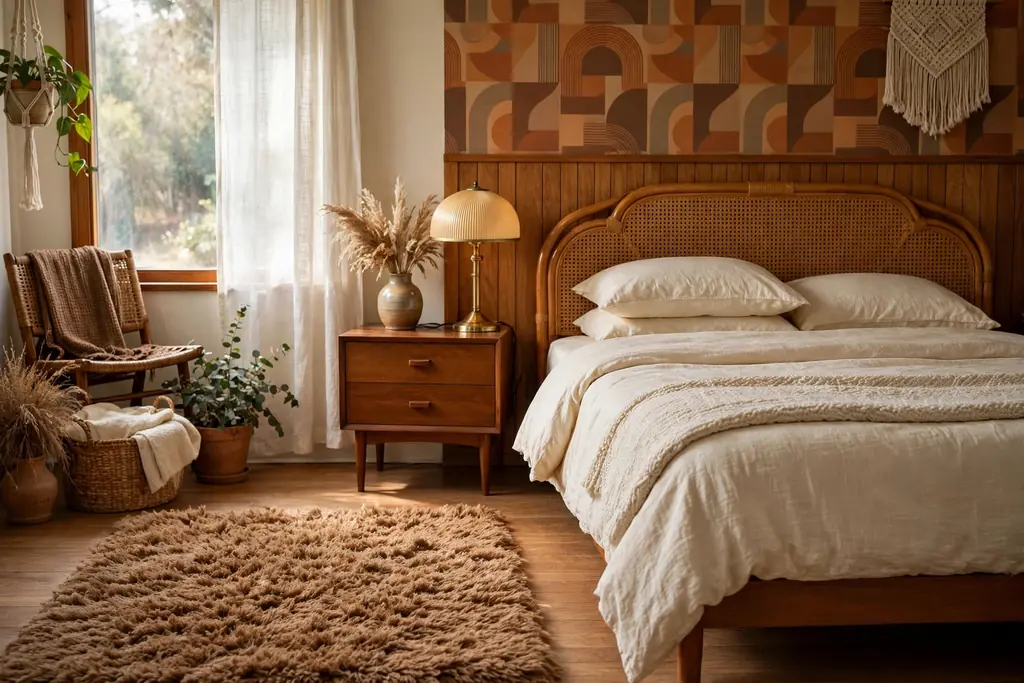
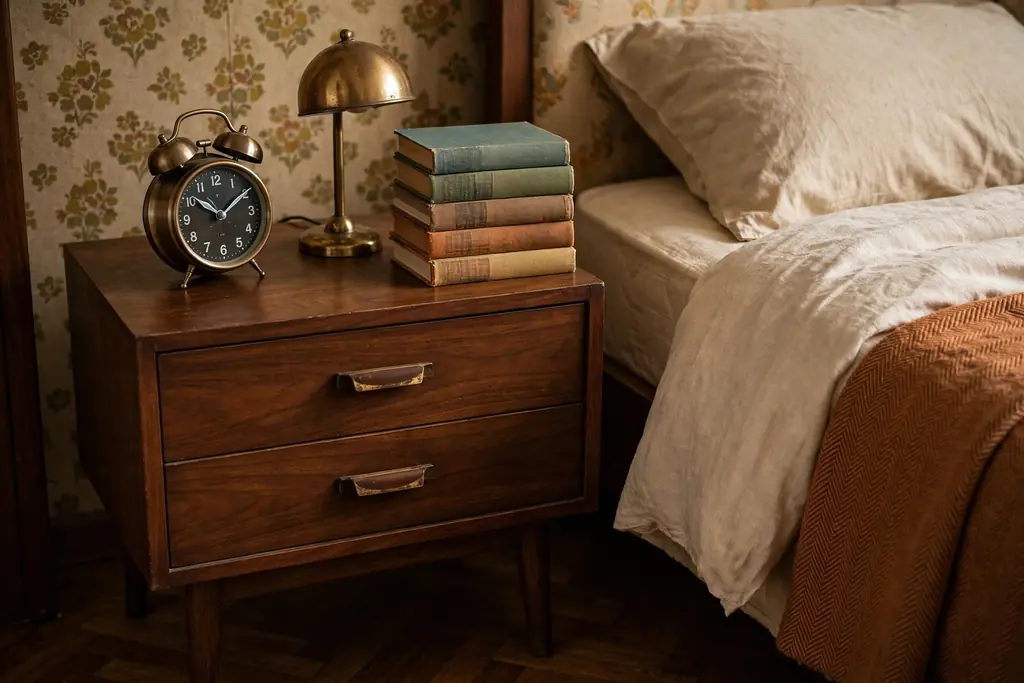
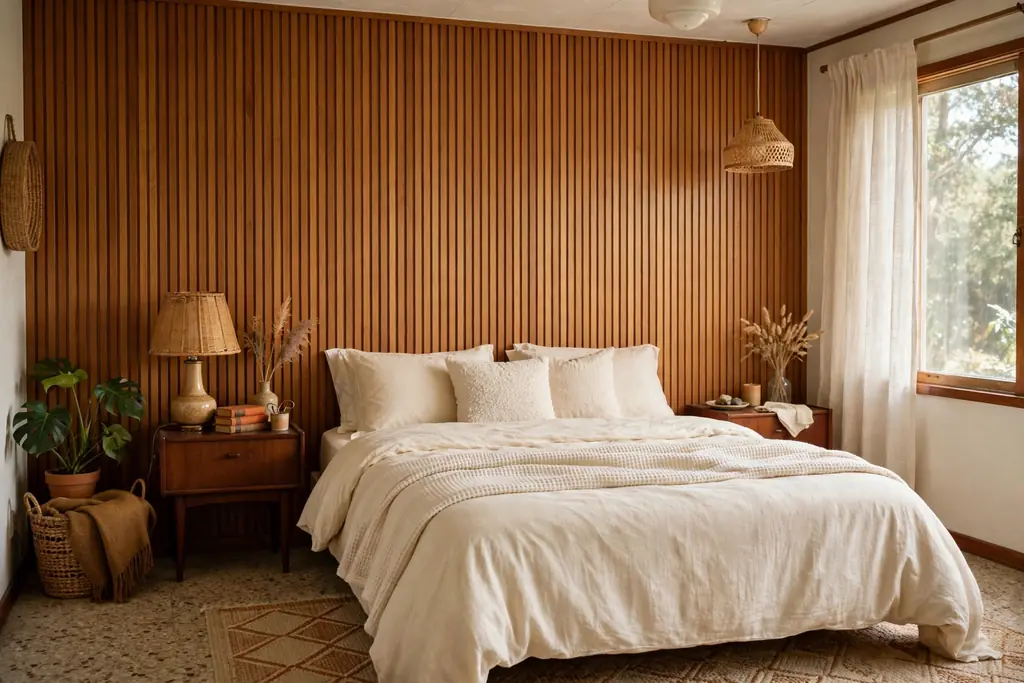
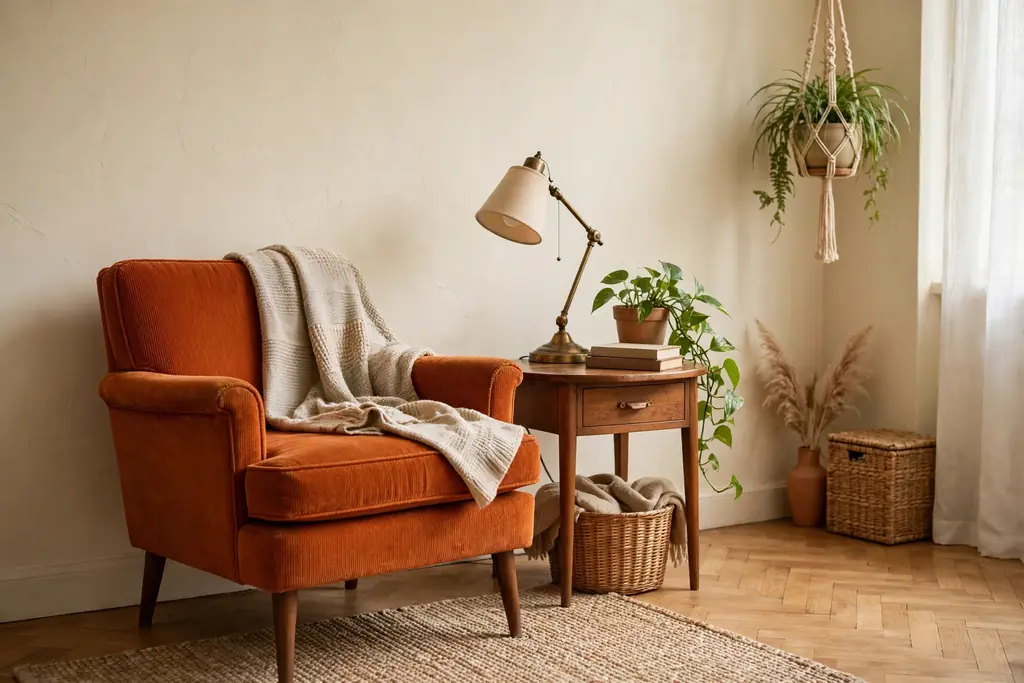
    Rustic style works best in a bedroom when the rough edges are kept in check. Warm wood, soft linen, and dark iron can make a room feel calm and grounded, while clean lines and a limited palette keep it from feeling cluttered or cabin-like. These 34 stylish rustic bedroom decor ideas cover walls, beds, furniture, lighting, storage, and small finishing touches, so you can add one rustic layer or plan a full room refresh. Start with the change that fixes what bothers you most, keep one or two materials as the lead, and let the rest of the room stay quiet.

    Key Takeaways

    • Let two or three materials lead: warm wood, natural linen, and dark iron or brass give a rustic room a clear, polished base.
    • Keep the palette calm: warm white, sage, clay, and charcoal suit rustic wood better than a long list of competing colors.
    • Repeat each material at least twice, in the bed and a nightstand, or in lighting and a mirror frame, so the room looks planned.
    • Mix one rough texture with one smooth finish, such as reclaimed wood beside washed linen, so the room feels relaxed but finished.
    • Use warm, dimmable light at bedside height, since harsh overhead light can make rustic wood look cold or stark.
    • Start with bedding, lighting, and baskets for a no-paint refresh, and save plank walls, beams, and painted furniture for a weekend project.

    1. Add a Reclaimed Wood Plank Wall Behind the Bed
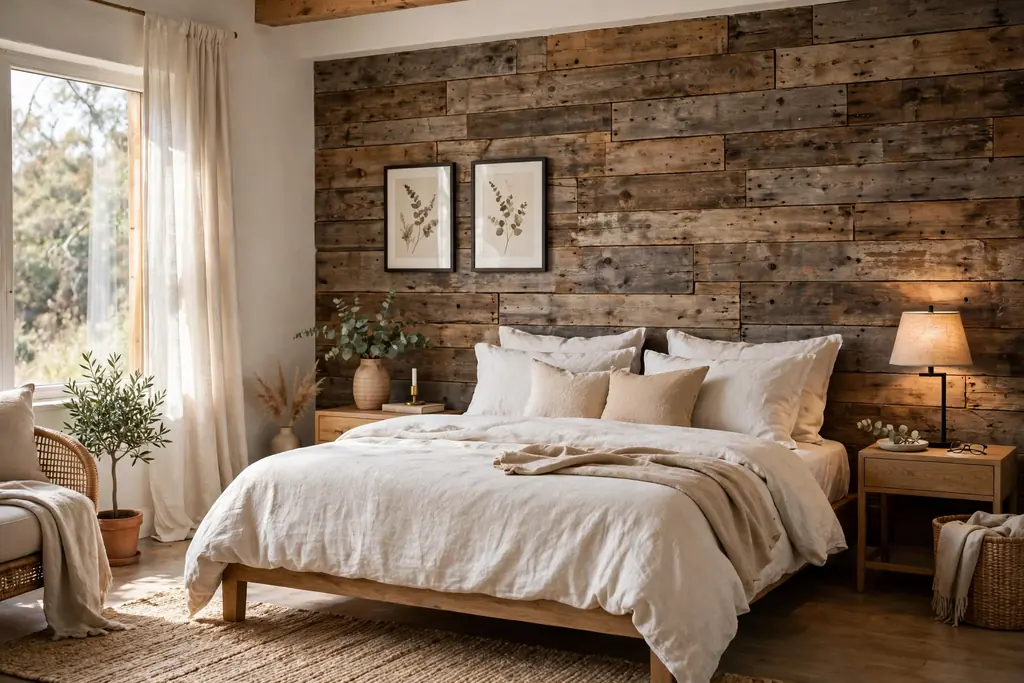
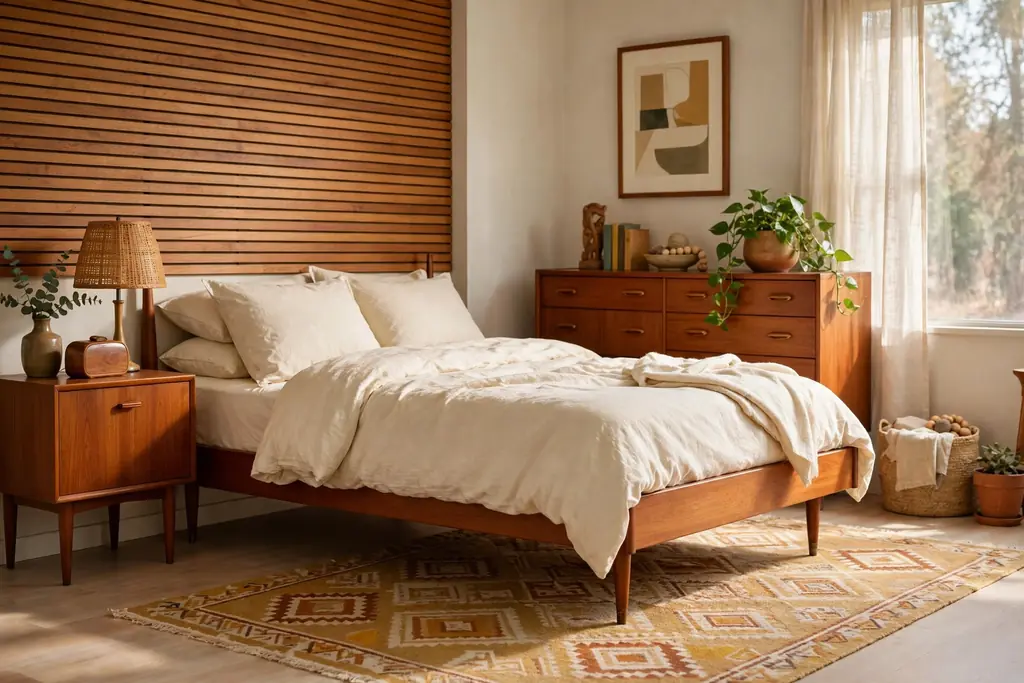
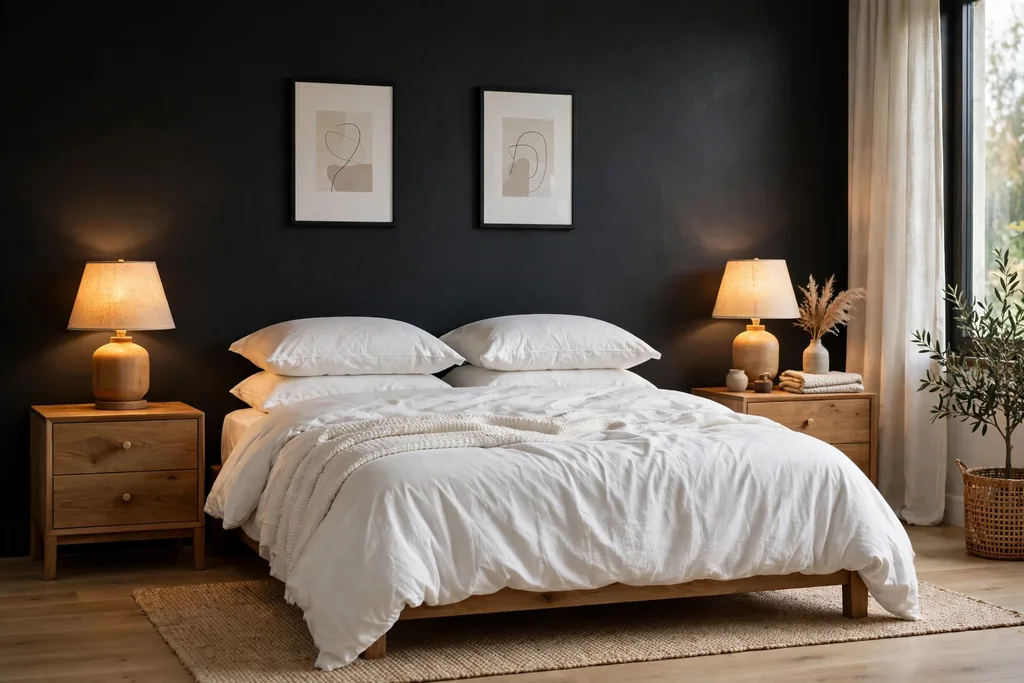
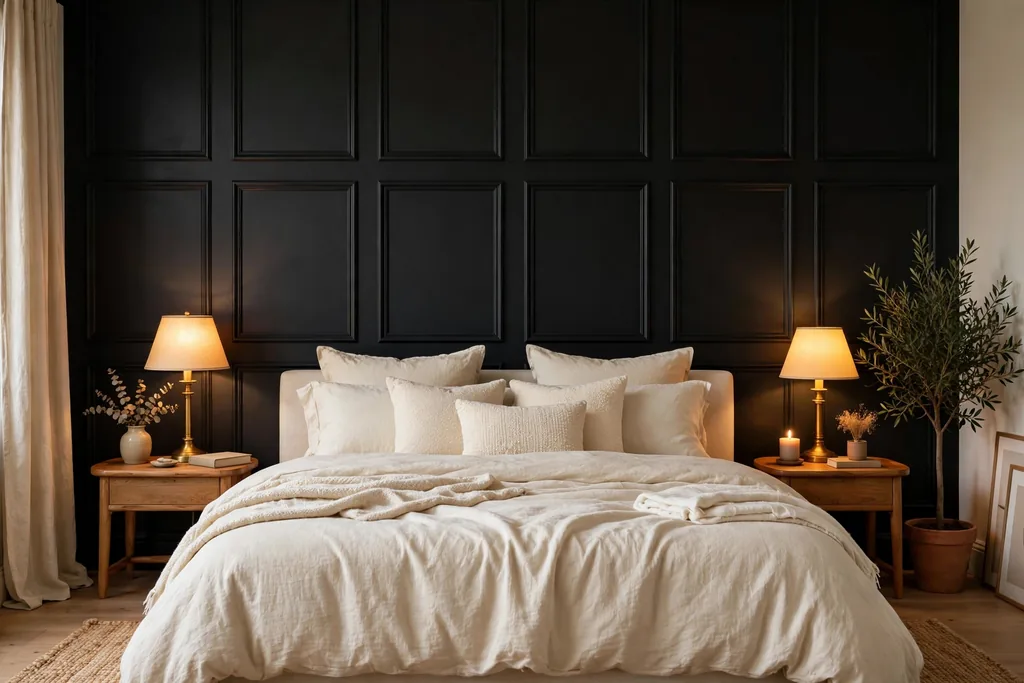
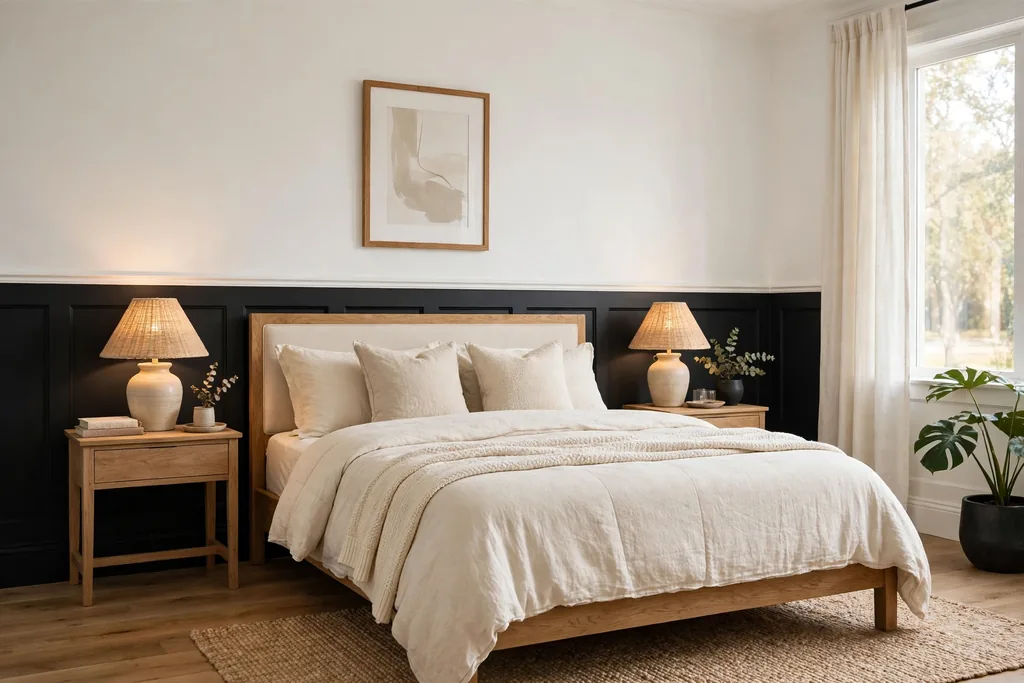
    Fit horizontal reclaimed wood planks on the wall behind the bed, and keep the other walls warm white. The wood gives the bed a clear focal point and a sense of warmth, while the pale side walls keep the room open. This suits a plain bedroom where the bed wall feels empty, and it works with a simple wood or upholstered bed.

    Choose planks in a similar tone range, with some grain variation but no strong color jumps, so the wall reads as one surface rather than a patchwork. Seal the wood with a matte finish to reduce dust, and leave a clean edge at the ceiling and corners. Keep art on this wall to a minimum, since the planks already carry the detail.

    2. Choose a Tall Linen Headboard in Warm White
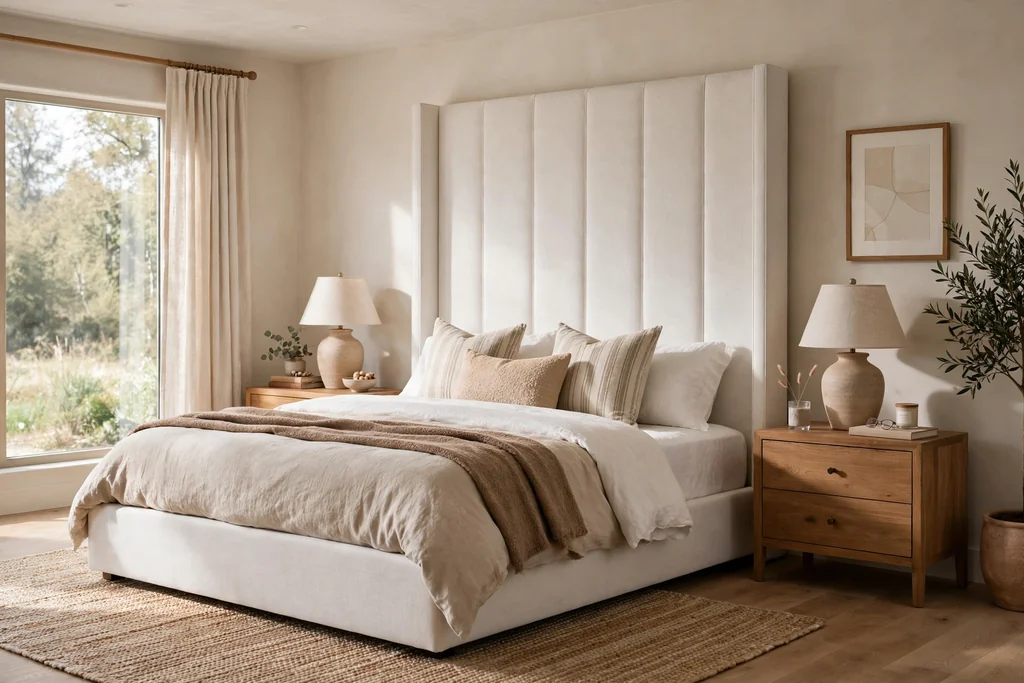
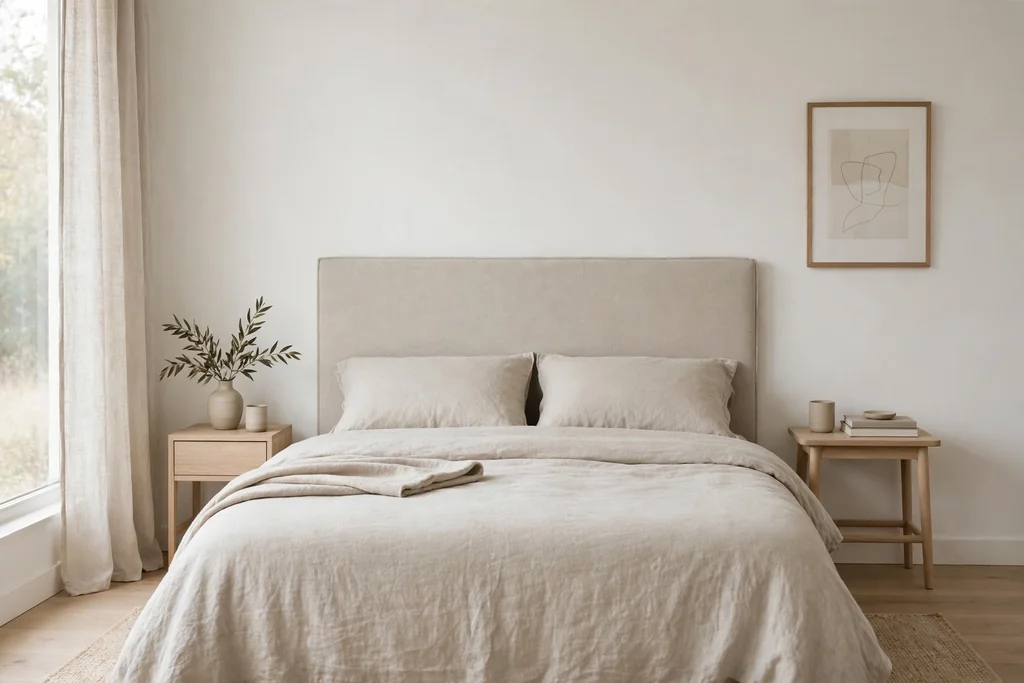
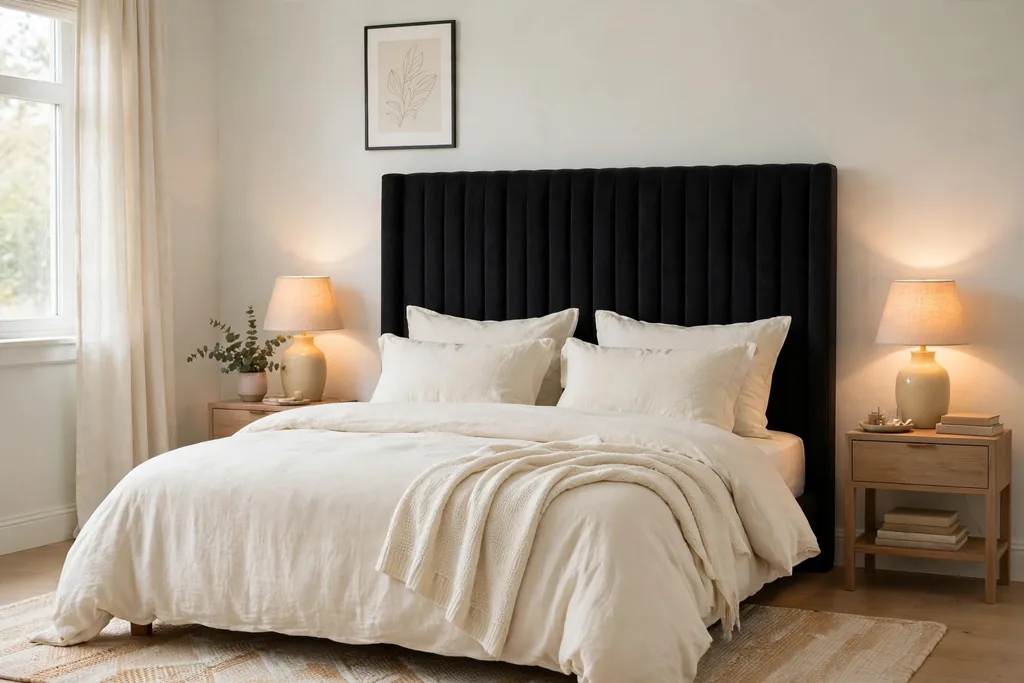
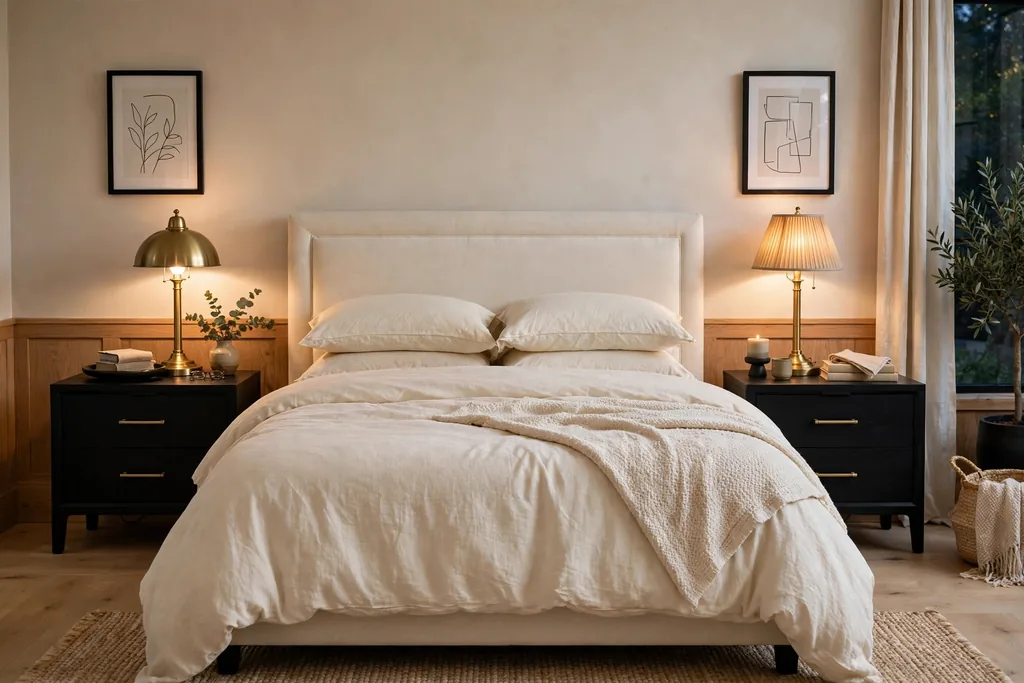
    A tall linen headboard in warm white softens a rustic room without losing its calm, natural feel. The fabric adds comfort for reading in bed, and the pale tone keeps dark wood furniture from making the room feel heavy. This suits a bedroom with a wood plank wall or dark beams, where a hard wood headboard would add too much of the same material.

    Pick a headboard with a simple shape, such as a straight panel or a gentle arch, and a removable cover if you can find one, so it stays easy to clean. Keep the bedding in a matching warm white or soft sage, and add one darker cushion for contrast. Measure the bed width first, so the headboard spans the bed without crowding the nightstands.

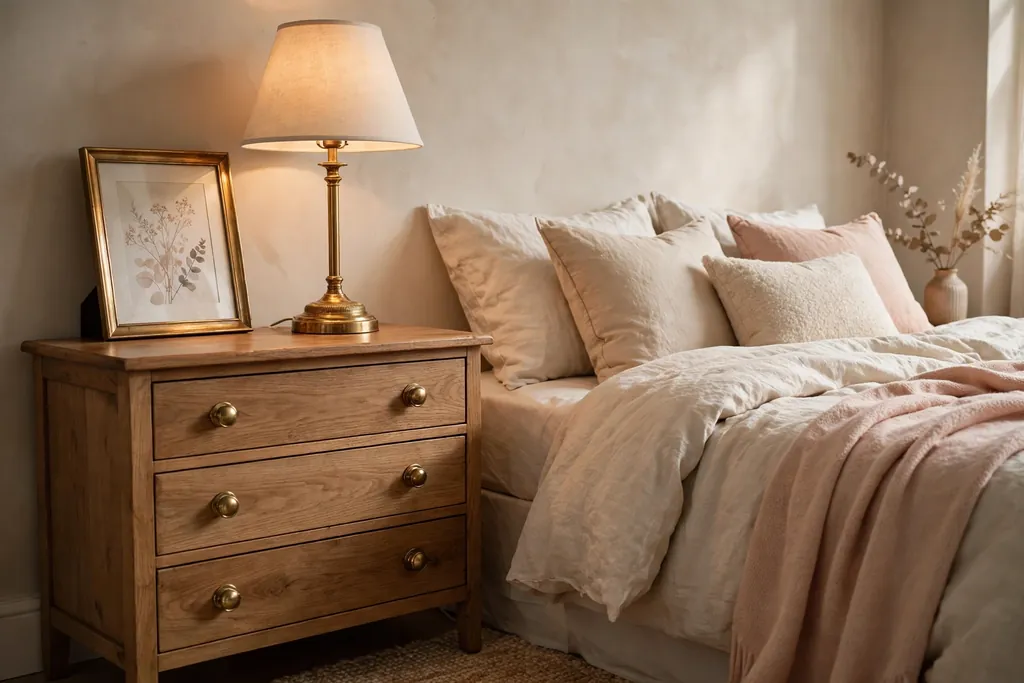
    3. Use Live-Edge Bedside Tables
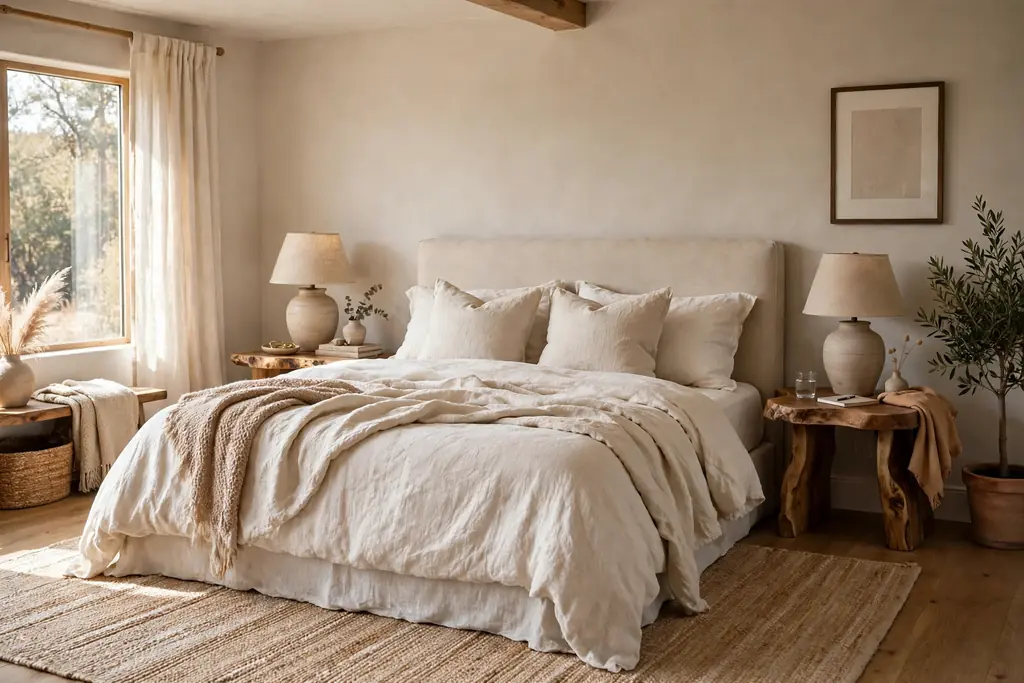
    Live-edge bedside tables bring one piece of natural wood shape into the room, which suits a rustic bedroom that otherwise uses straight, clean lines. The uneven edge adds character at bed height, where you see it every day, without taking over the wall or the floor. Choose tables with a simple iron or wood base, so the top stays the focus.

    Keep the tops mostly clear, with a lamp, a book, and a small tray, so the wood edge stays easy to see. If the two tables differ in shape, link them with matching lamps or matching drawer pulls. Seal the live edge well, since a rough edge can catch fabric, and dust it with a soft cloth rather than a damp one.

    4. Fit a Sliding Barn Door for the Closet
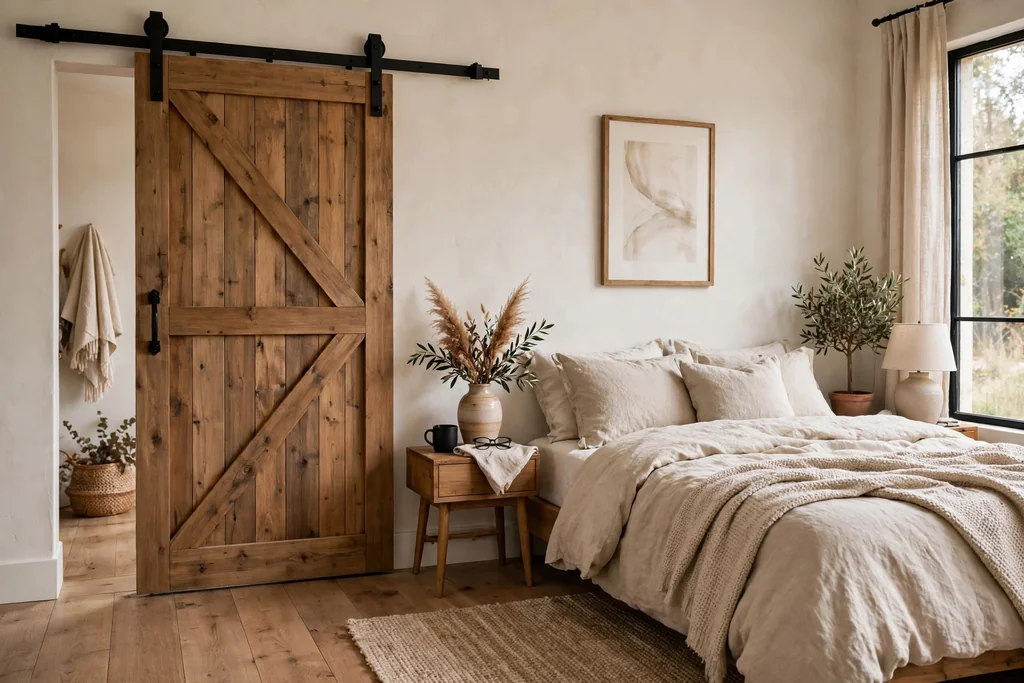
    A sliding barn door in warm wood with black iron hardware gives a closet or an ensuite a rustic focal point and saves the swing space of a hinged door. This suits a bedroom where a standard door feels plain, or where floor space is tight beside the bed. The door also adds wood at a height that balances a wood bed or a plank wall.

    Check that the wall above the opening can take the rail, and that the door can slide fully clear of the opening without hitting a light switch or a vent. Keep the door in a tone close to other wood in the room, and use soft-close hardware if the door will be used at night. Leave the wall beside the door mostly plain, so the door reads as a feature.

    5. Add Faux Wood Beams to the Ceiling
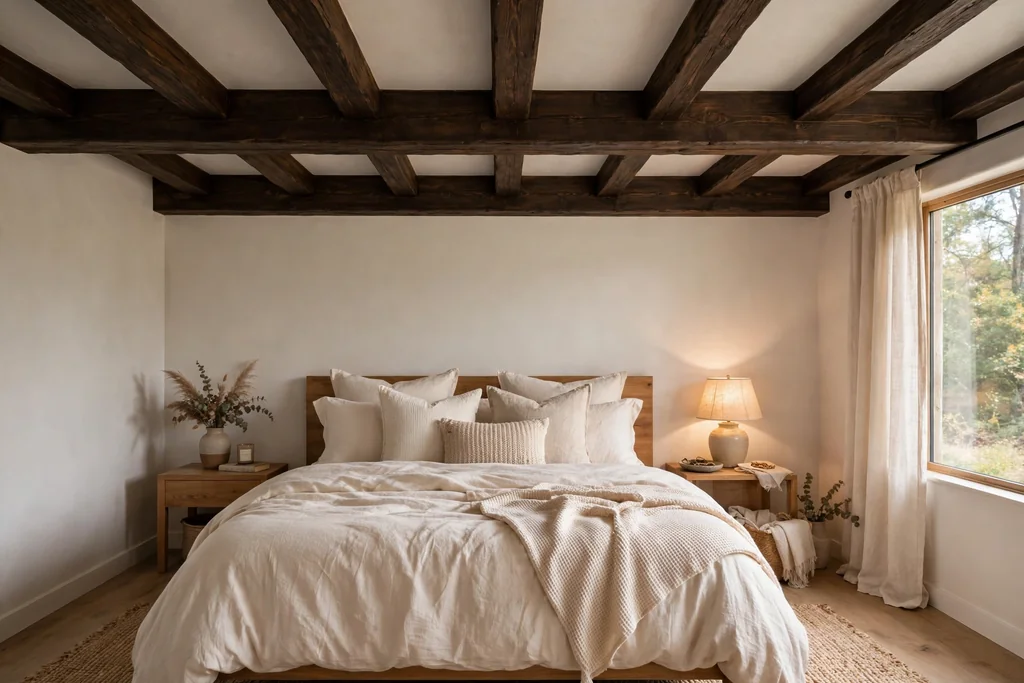
    Faux wood beams across the ceiling add rustic structure without the weight or cost of solid timber. They suit a bedroom with a plain, flat ceiling and pale walls, where the room needs warmth overhead. Dark beams work best with warm white walls and warm lamplight, so the ceiling still feels bright.

    Space the beams evenly and run them across the shorter span of the room, so they look structural rather than decorative. Keep ceiling lights simple, such as recessed lights or a single wood and iron pendant, so the beams stay clear. If the ceiling is low, choose slim beams in a mid wood tone, since deep, dark beams can make a low room feel lower.

    6. Whitewash a Brick Feature Wall
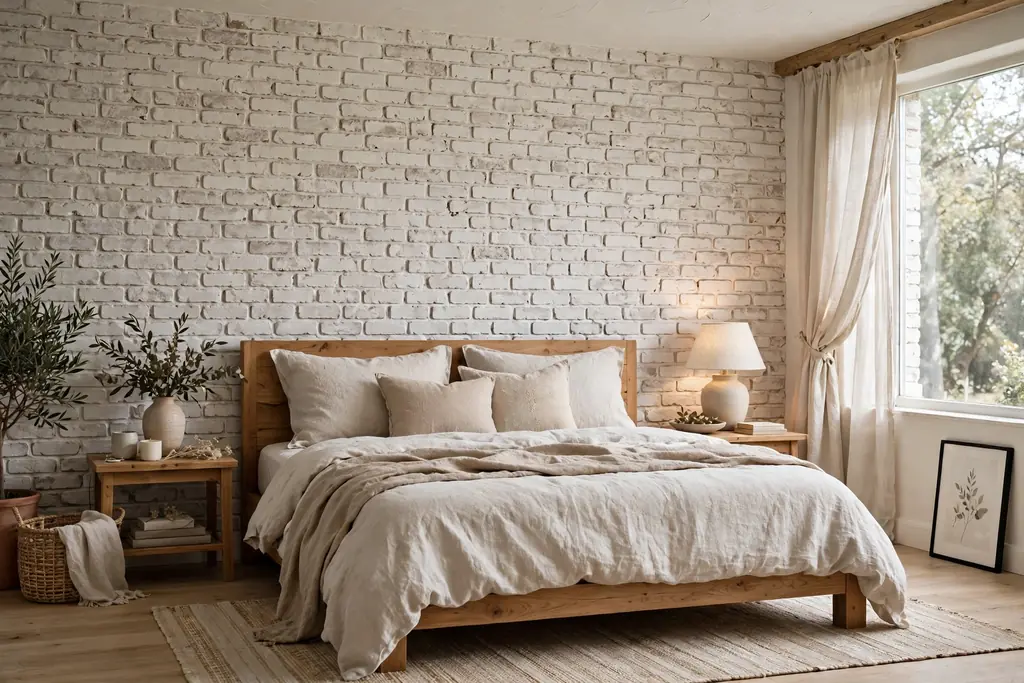
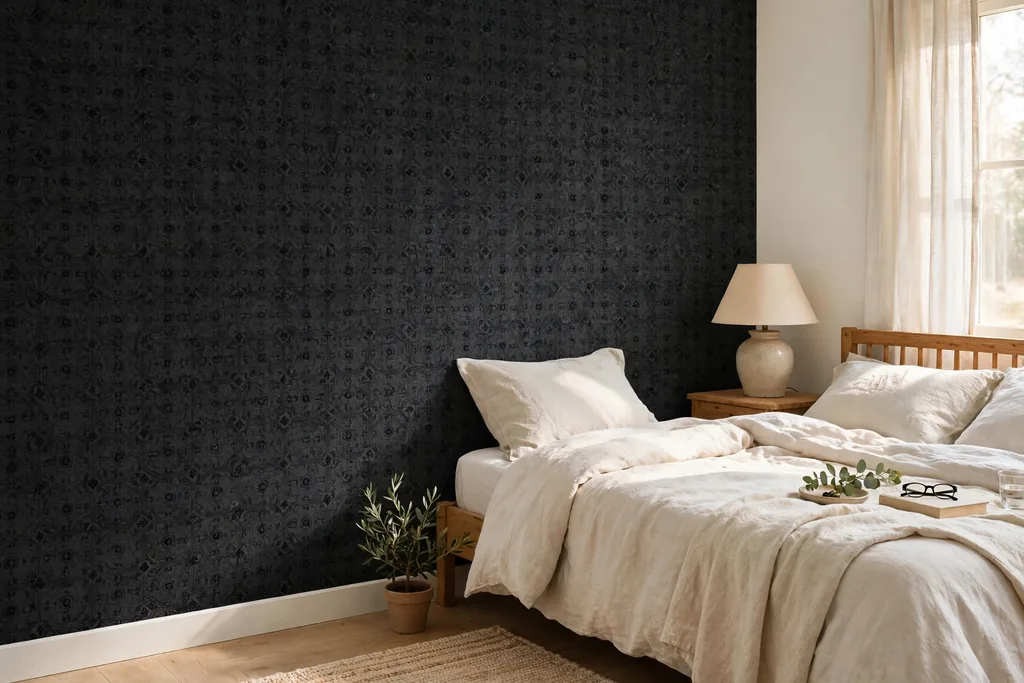
    Whitewashing a brick wall softens its color while keeping its texture, which suits a rustic bedroom that needs interest without dark, heavy brick. The pale wash lets the brick pattern show through, and it pairs well with wood furniture, linen bedding, and warm lamplight. This works on one wall only, usually the bed wall or the wall opposite the bed.

    Test the wash on a small area first, since brick absorbs paint unevenly and the final tone depends on the brick beneath. Use a thin, even coat and wipe back areas where you want more brick to show. Keep furniture against this wall simple, with a plain bed or a plain dresser, so the texture stays easy to see. For art and frame choices on a textured wall, see these bedroom wall art ideas.

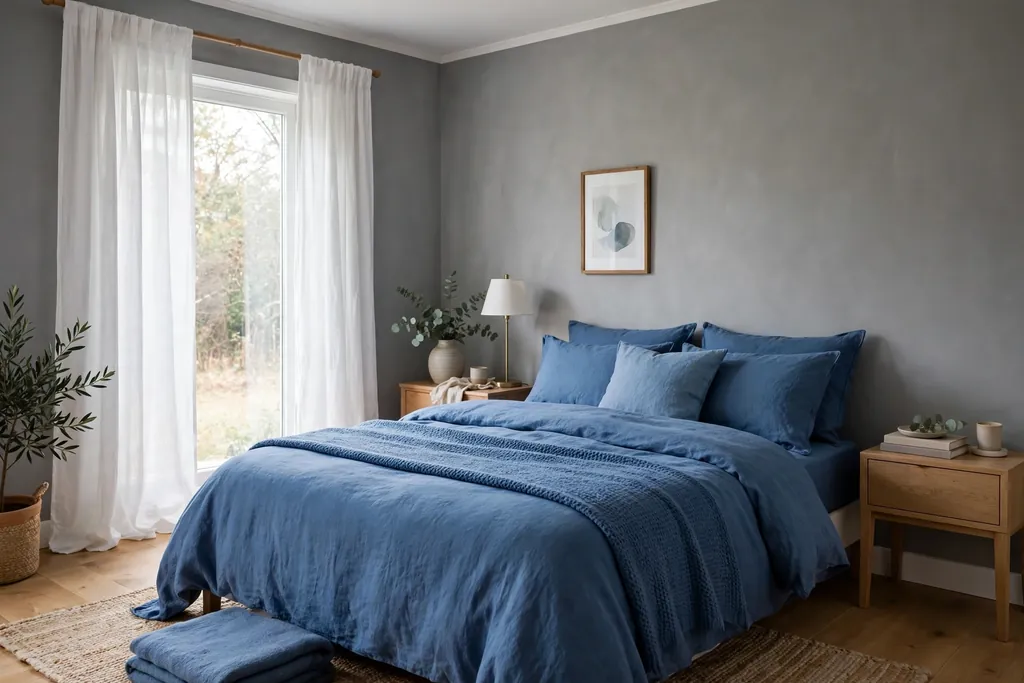
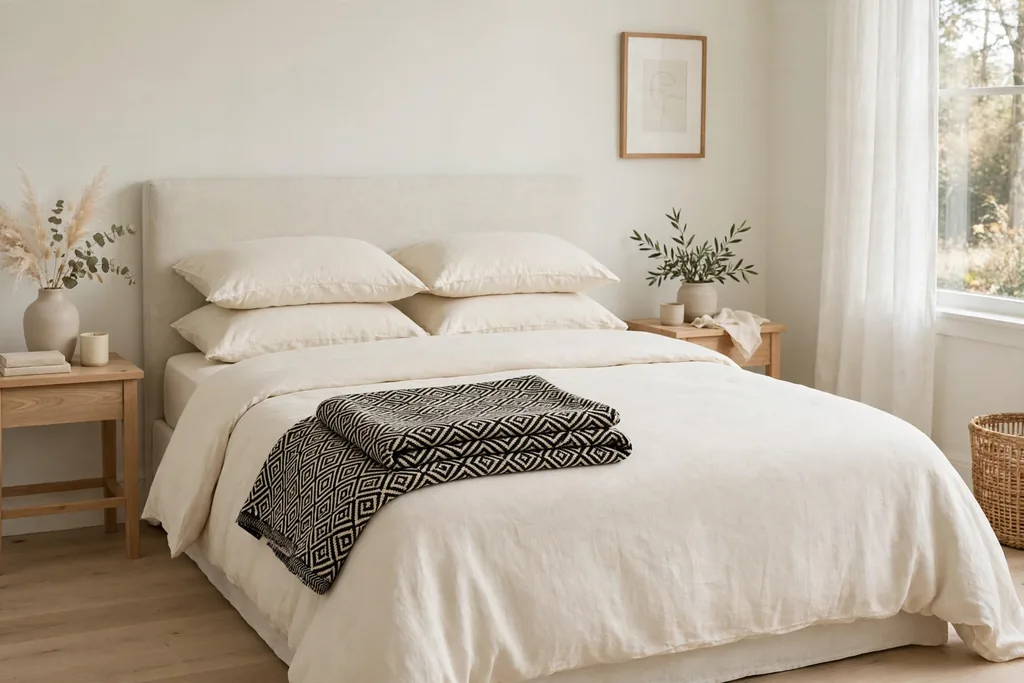
    7. Layer Linen Bedding in Warm Neutrals

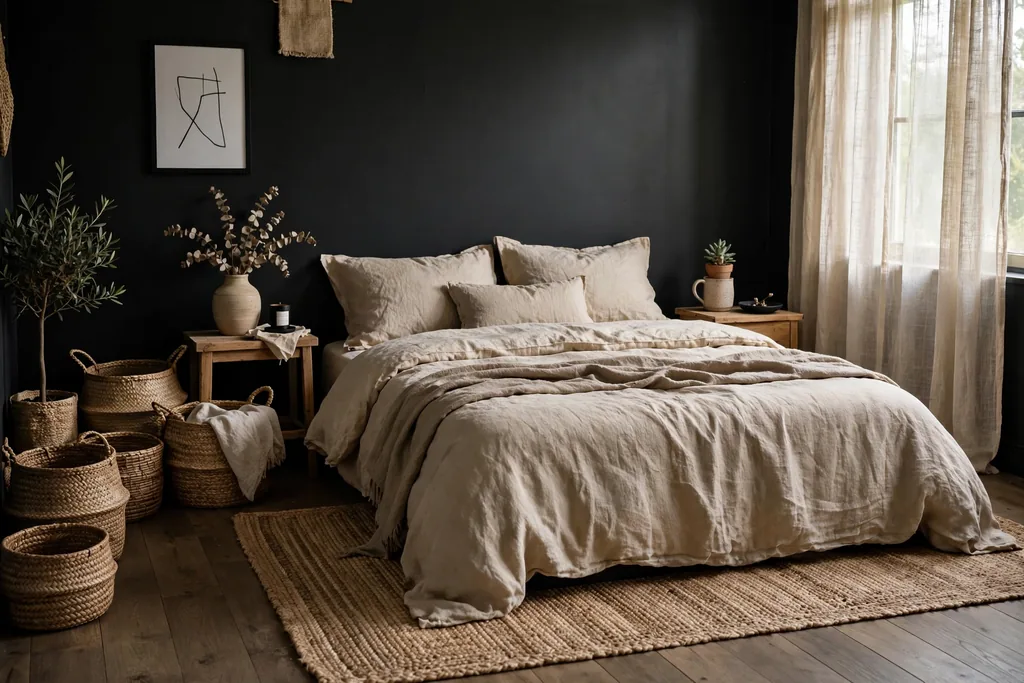
    Layer linen bedding in warm white, oatmeal, and soft sage for a bed that looks relaxed but still finished. Linen wrinkles a little by nature, so the bed reads as lived in rather than stiff, while the limited palette keeps it polished. This suits a rustic room with wood furniture, since the soft fabric balances the hard wood.

    Start with a plain fitted sheet, add a linen duvet in warm white, then fold a second linen layer or a light quilt across the lower half of the bed. Keep sleeping pillows plain and add only two or three decorative cushions, in one or two tones from the bed. Wash linen as advised on the label, and shake the duvet out each morning so the layers stay light.

    8. Place a Wool and Knit Throw at the Foot of the Bed
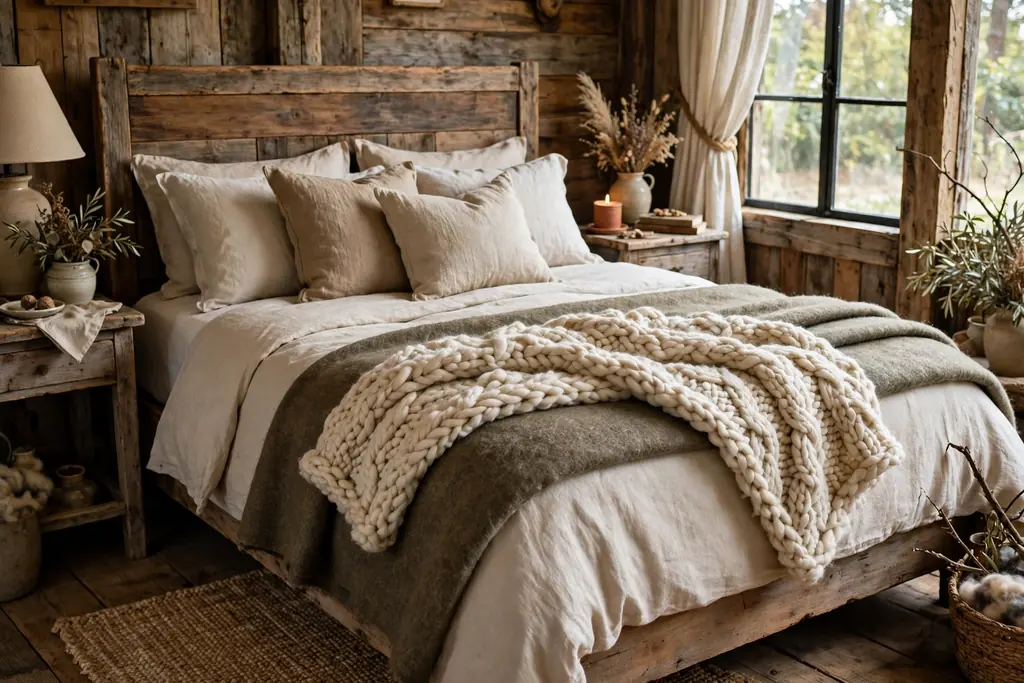
    A chunky knit throw over a lighter wool blanket at the foot of the bed adds warmth and texture in one easy layer. This suits a rustic bedroom in a cool climate, or a room with plain bedding that needs one soft accent. The throw also makes the bed look finished in the daytime, without extra cushions.

    Choose a throw in a muted tone, such as cream, rust, or sage, that repeats a color already in the room. Fold it in thirds across the foot of the bed, so it is easy to pull up at night, and keep it off the floor. Store a spare throw in a basket nearby, so a guest or a cold night is covered without searching the closet.

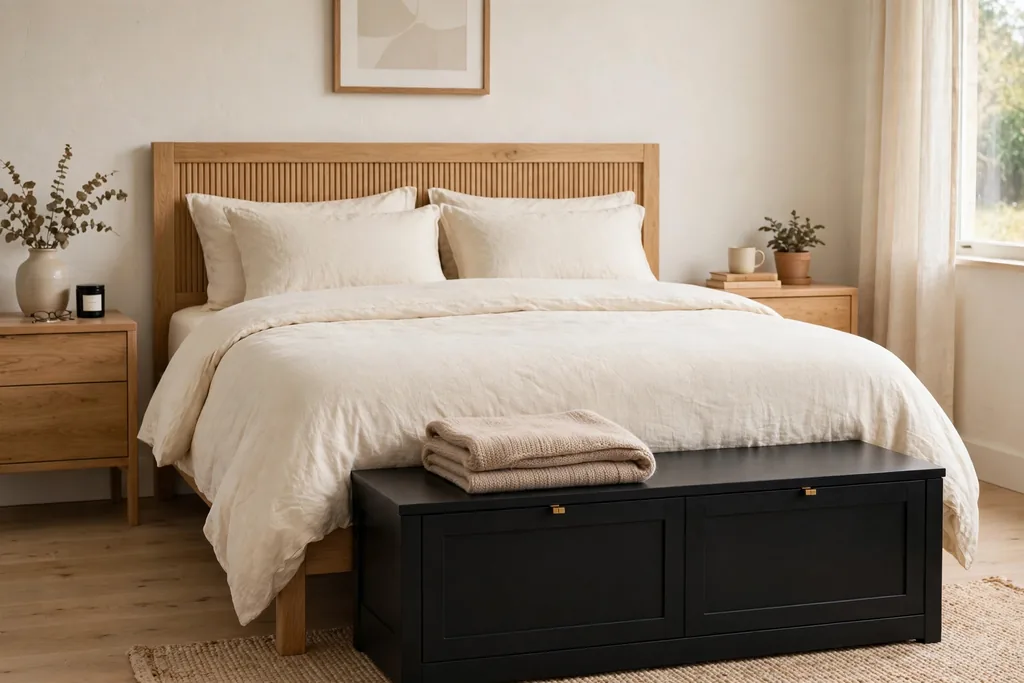
    9. Put a Leather Bench at the Foot of the Bed
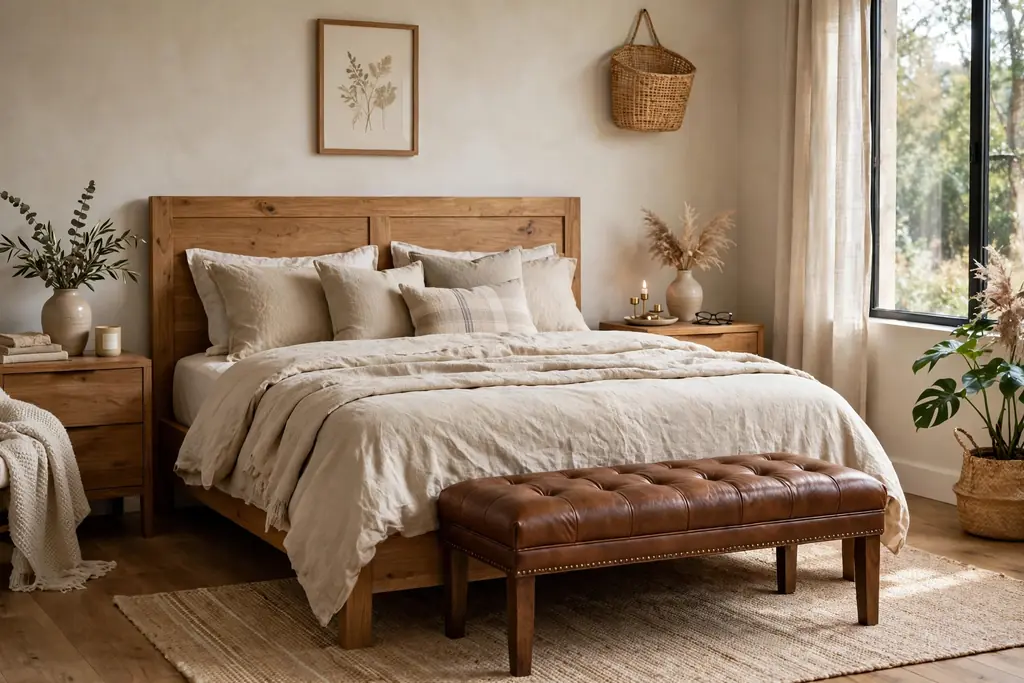
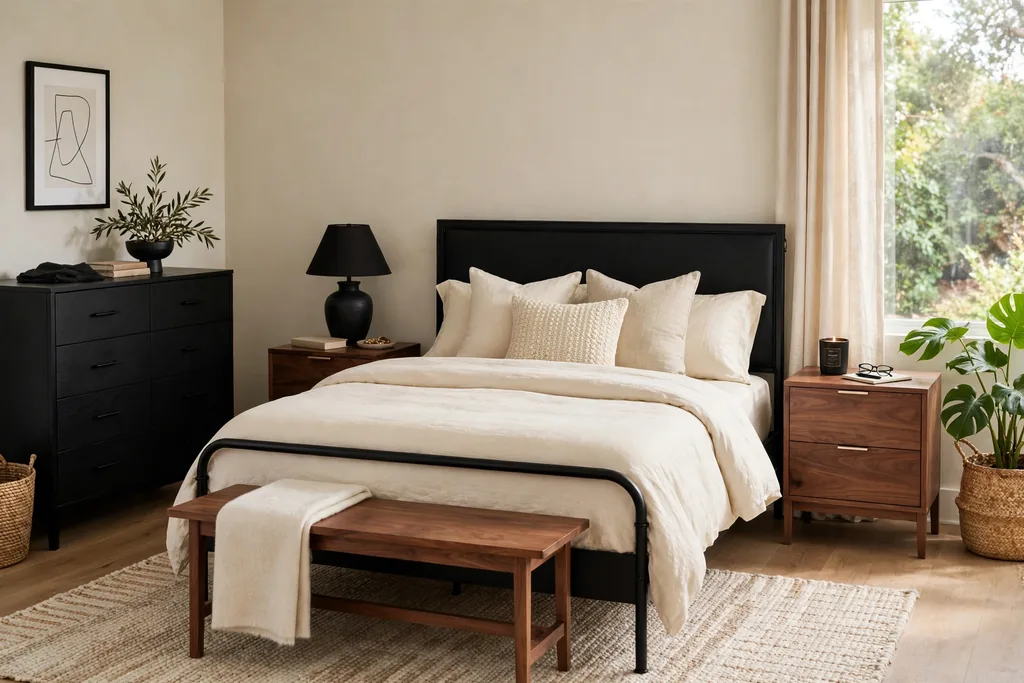
    A leather bench at the foot of the bed gives you a place to sit, lay out clothes, and store spare blankets, while adding a smooth, polished surface beside rustic wood. This suits a larger bedroom with clear floor space at the foot of the bed, and it helps a wood bed frame feel more finished. Choose a bench slightly narrower than the bed, so it does not crowd the walkway.

    Pick leather in a warm cognac or dark brown, and pair it with a simple wood or iron frame. Keep the top mostly clear, with one folded throw or a small tray, so the bench stays useful. Condition the leather as advised by the maker, and keep it out of direct sun, since strong sun can dry and fade it.

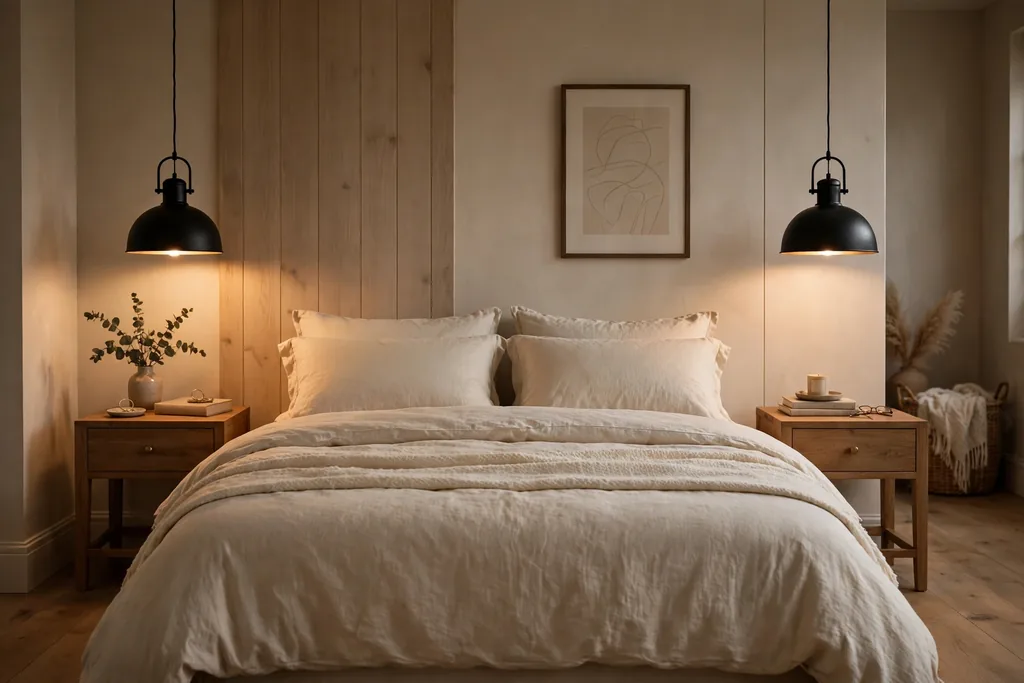
    10. Hang Wrought-Iron Pendants Beside the Bed
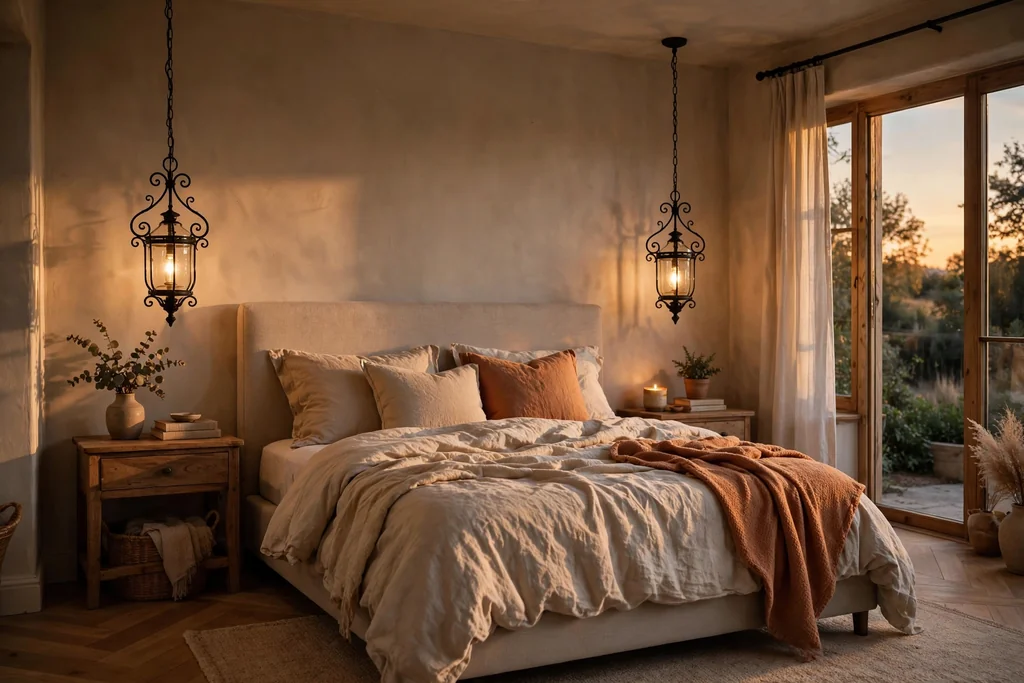
    Hang a pair of wrought-iron pendants beside the bed, one over each nightstand, for focused light that also adds rustic detail. Iron suits wood and linen well, and pendants free up nightstand space for books and water. This suits a bedroom where bedside lamps crowd small tables, or where you want the lighting to feel like a feature.

    Hang the pendants so the bottom of each shade sits just above eye level when you sit in bed, and use warm bulbs with a dimmer for evening reading. Keep the cords or rods straight and the same length on both sides, so the pair looks deliberate. If you rent, check that the ceiling fixings suit the weight before you hang iron shades.

    11. Hang a Rattan Pendant in the Center of the Room
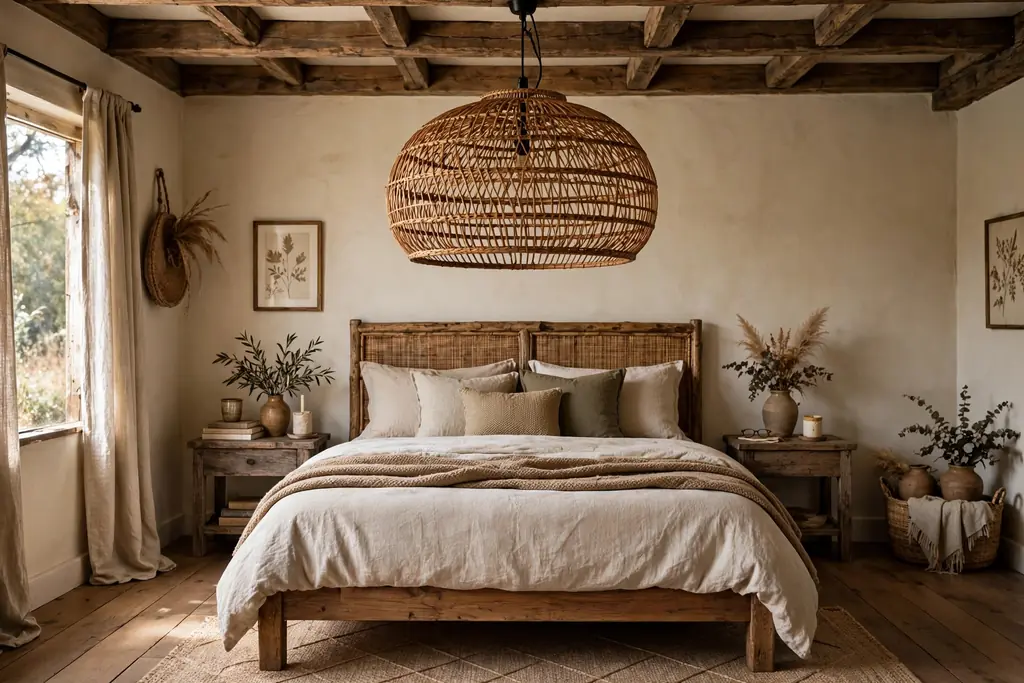
    A large rattan pendant in the center of the room adds natural texture overhead without the weight of wood or iron. It suits a rustic bedroom with pale walls and a plain ceiling, where one woven piece can warm the whole room. The open weave also lets light spread softly, which helps the room feel calm at night.

    Choose a pendant sized to the room, roughly one third of the bed width for a main bedroom, and hang it high enough to clear the door swing and your head. Pair it with a warm bulb, and keep the rest of the ceiling plain, so the rattan stays the focus. Dust the weave with a soft brush now and then, since woven pieces collect dust in their gaps.

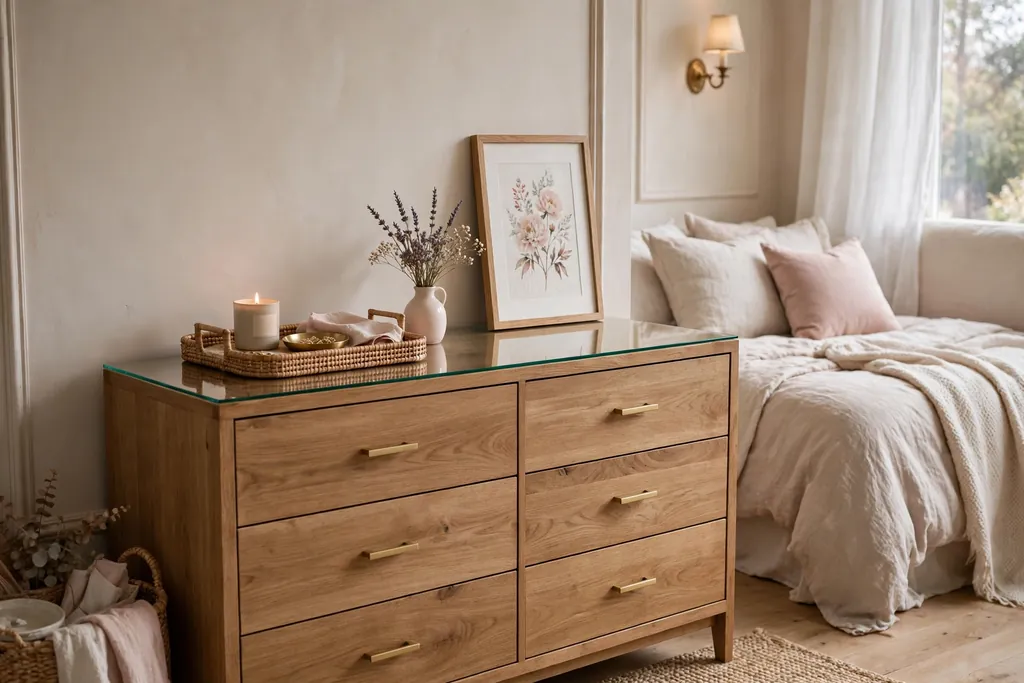
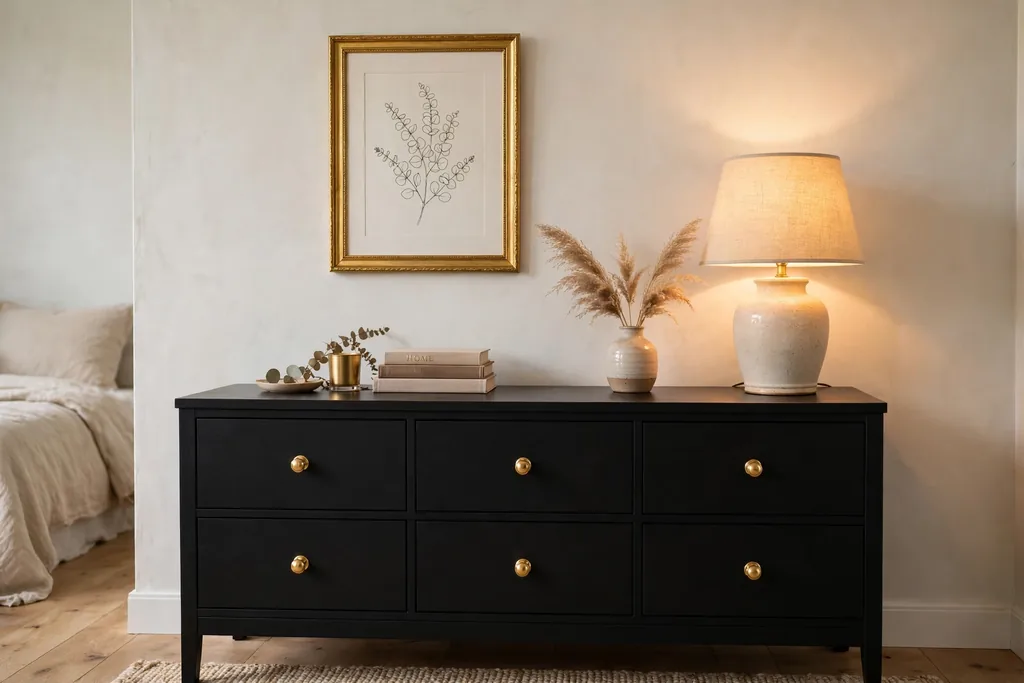
    12. Refinish a Wood Dresser With Matte Black Hardware
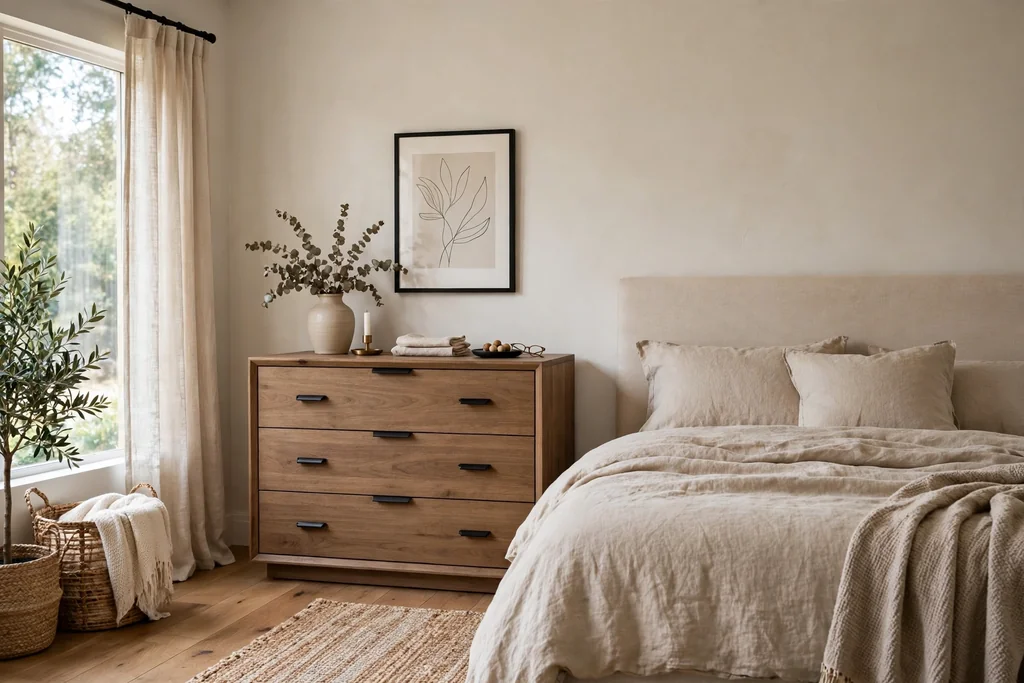
    Refinish a wood dresser with a matte stain or a clear finish, and swap the pulls for matte black hardware, for a rustic piece that still looks current. The dark pulls give the dresser a clean edge, while the wood grain keeps it warm. This suits a bedroom with an older dresser that feels dated but is still solid.

    Sand and clean the piece first, and test the stain on the back or inside a drawer, since wood tones shift once sealed. Keep the pulls simple, such as bar pulls or round knobs, and use the same finish on every drawer. Style the top with one tray, one lamp, and one small plant, so the refinished wood stays easy to see.

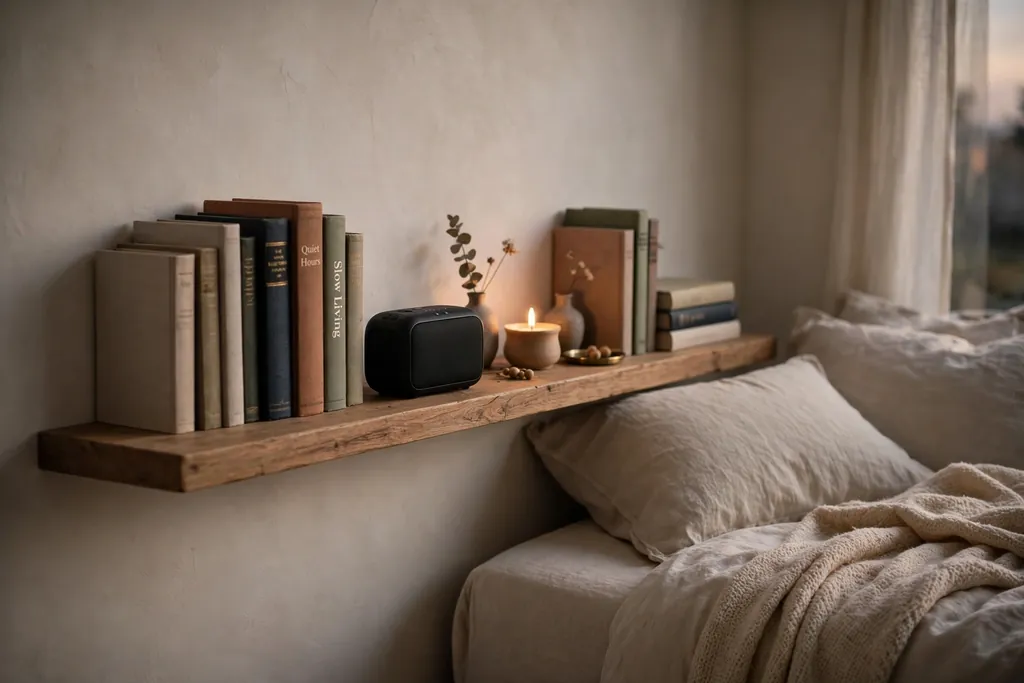
    13. Fit Floating Reclaimed Wood Shelves
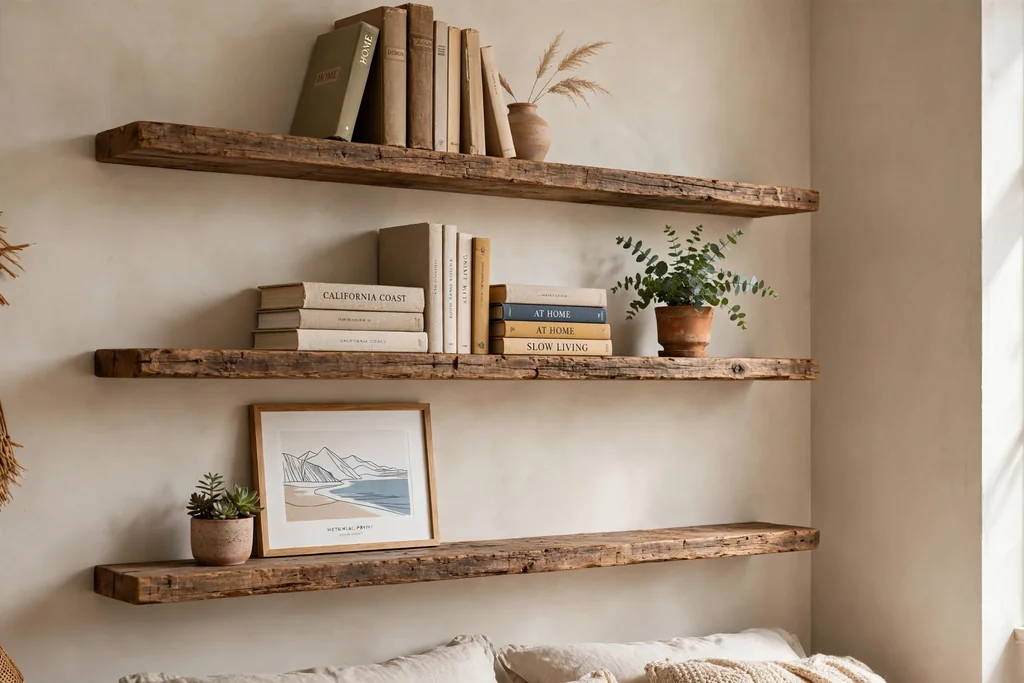
    Fit two or three floating reclaimed wood shelves on a side wall or above a dresser, for display space that adds wood without a new piece of furniture. Shelves suit a rustic bedroom with limited floor space, since they use wall space above a dresser or beside a window. Keep the shelves level and the same depth, so the row looks planned.

    Style each shelf with a mix of books, a small plant, and one framed print, and leave some empty space on every shelf. Avoid packing shelves edge to edge, since a crowded shelf makes a rustic room feel cluttered rather than polished. Check that the fixings suit the wall type and the weight, especially for thick reclaimed boards.

    14. Layer a Jute Rug Under a Wool Rug
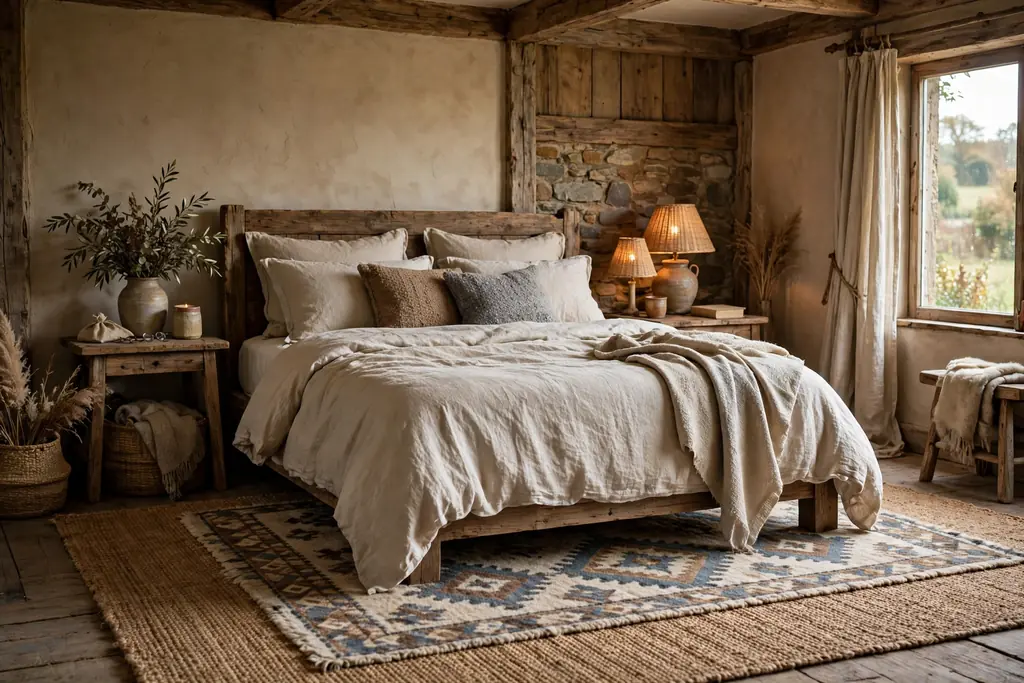
    Layer a large jute rug on the floor, with a smaller wool rug on top under the lower two thirds of the bed, for texture at floor level and warmth underfoot. The jute gives a natural, rustic base, while the wool rug adds softness and a clearer pattern or color. This suits a bedroom with a hard floor and plain bedding, where the floor needs one strong layer.

    Measure first, so the jute rug extends past the bed on both sides and the wool rug sits centered on it. Choose a low pile wool rug that doors and drawers can clear, and use a rug pad on smooth floors to reduce slipping. Vacuum both layers often, since natural fibers show dust, and rotate the top rug now and then so it wears evenly.

    15. Use a Vintage Wooden Trunk for Storage
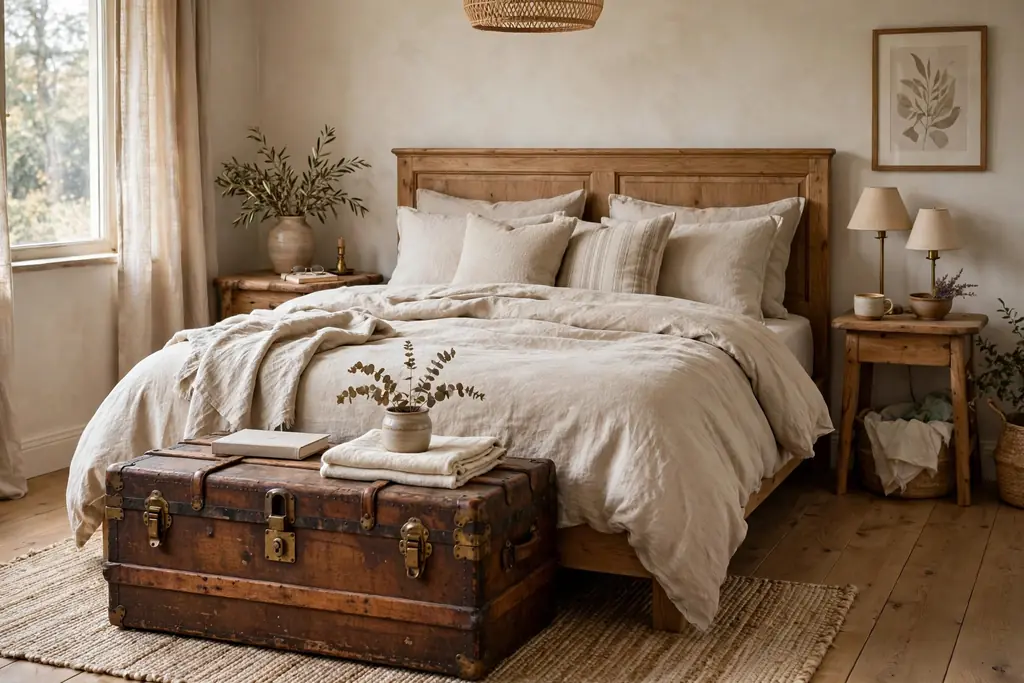
    A vintage wooden trunk at the foot of the bed or beside a dresser gives closed storage for blankets, seasonal bedding, or keepsakes, while adding aged wood to the room. This suits a rustic bedroom that needs storage but has no room for another cabinet, and it works as a bench in a larger room if the lid is flat and sturdy.

    Check the trunk inside and out before you use it, and air it well if it smells musty. Line the inside with a clean cloth if you store bedding, and keep the lid hinges in good order so it stays safe to open. Style the top with one folded throw only, so the trunk stays useful and easy to open.

    16. Hang Framed Landscape Prints in Wood Frames
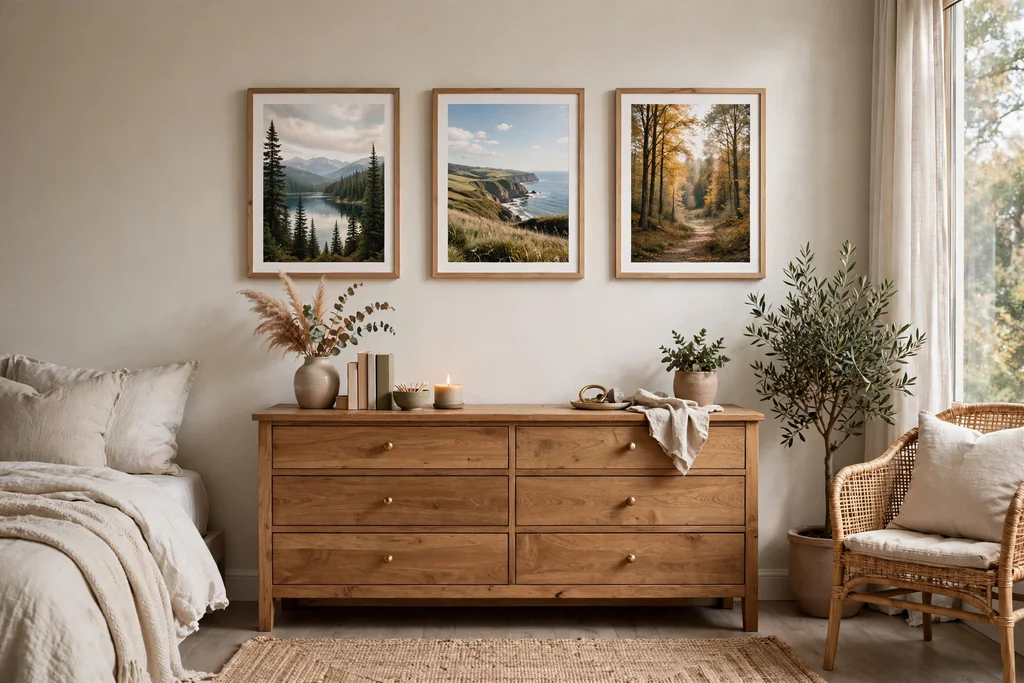
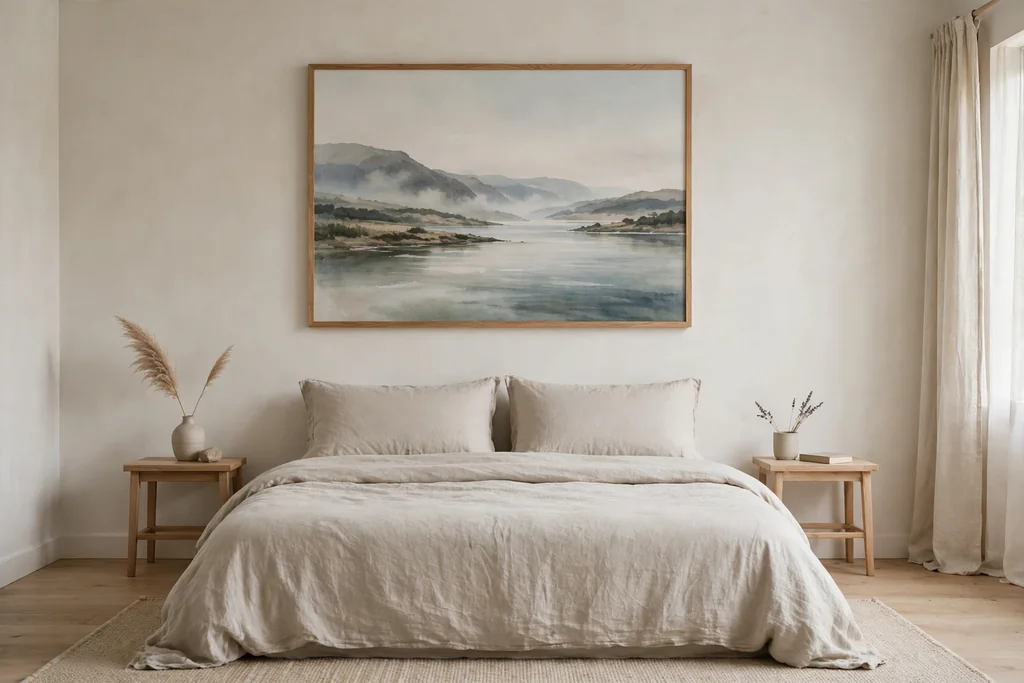
    Hang framed landscape prints in simple wood frames above a dresser or on the wall opposite the bed, for calm, natural art that suits rustic wood. Landscapes in soft greens, warm browns, and pale skies link well to linen bedding and wood furniture, without adding a strong new color. This suits a bedroom with one large empty wall and plain bedding.

    Use matching wood frames and equal gaps, and keep the set to two or three prints, so the wall stays calm. Hang the center of the group at eye level from where you see it most, and check what the frames reflect before you fix them. For sizing and hanging tips for art above a bed or a dresser, see these bedroom wall art ideas.

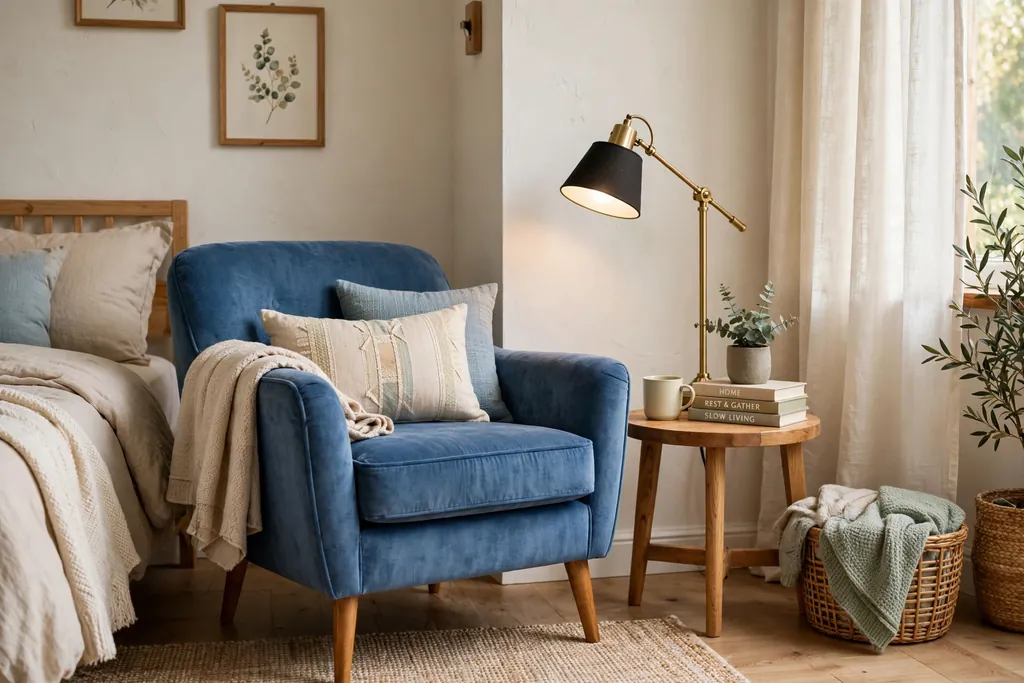
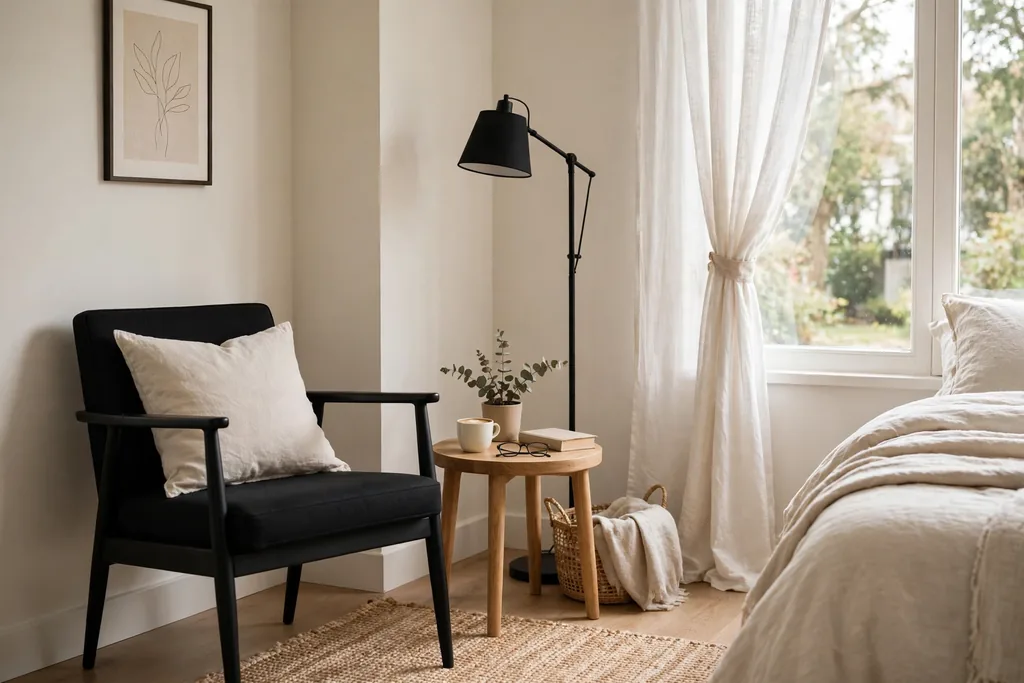
    17. Create a Reading Corner With an Armchair
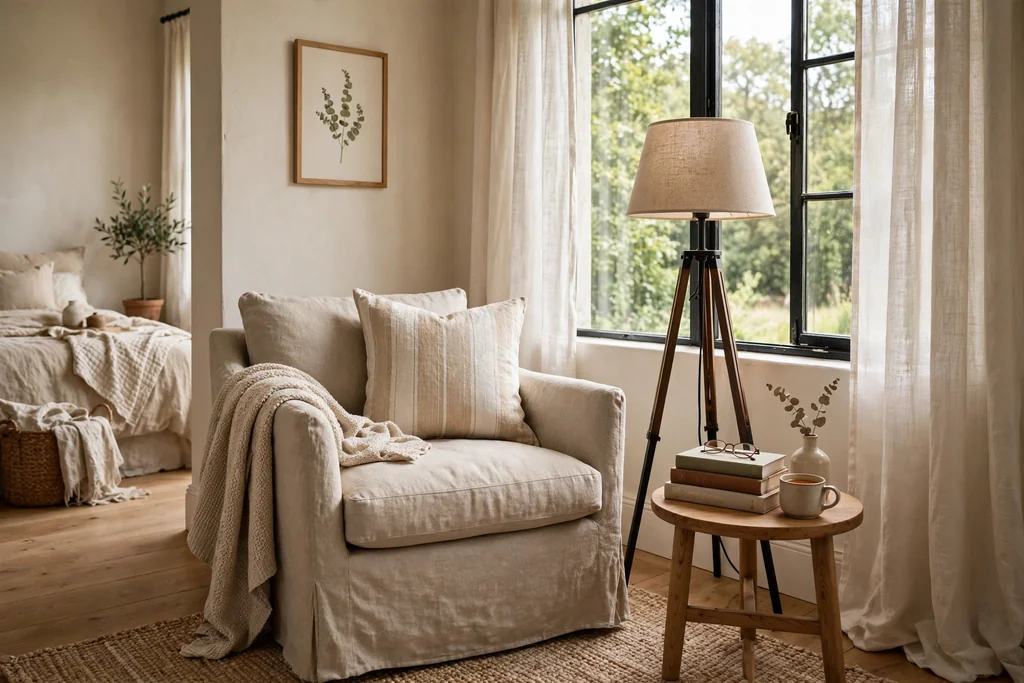
    Create a reading corner with a comfortable armchair, a small side table, and a floor lamp in a bedroom corner that otherwise goes unused. A linen or leather armchair in a muted tone suits a rustic room, and the corner gives the bedroom a second use beyond sleep. This works best in a corner near a window, where daylight helps during the day.

    Add a small basket for books beside the chair, and a throw over one arm, so the corner feels ready to use. Keep the lamp warm and close to the chair, so evening reading does not need the main ceiling light. If the room is small, choose a chair with slim arms and a small side table, so the corner does not block the path to the bed.

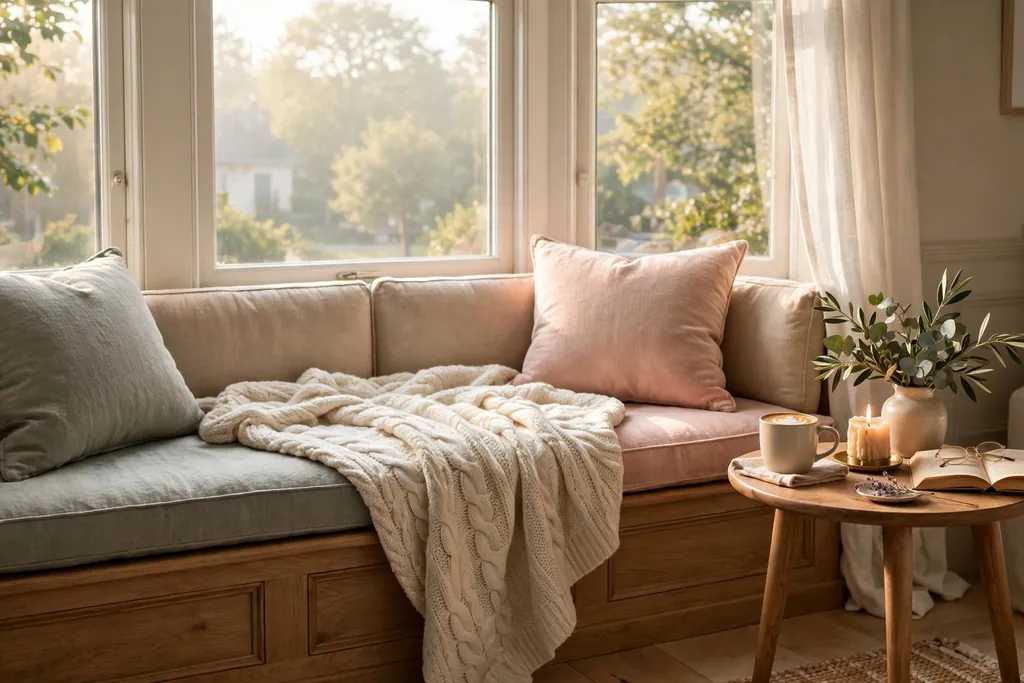
    18. Build a Window Seat With Wood and Linen
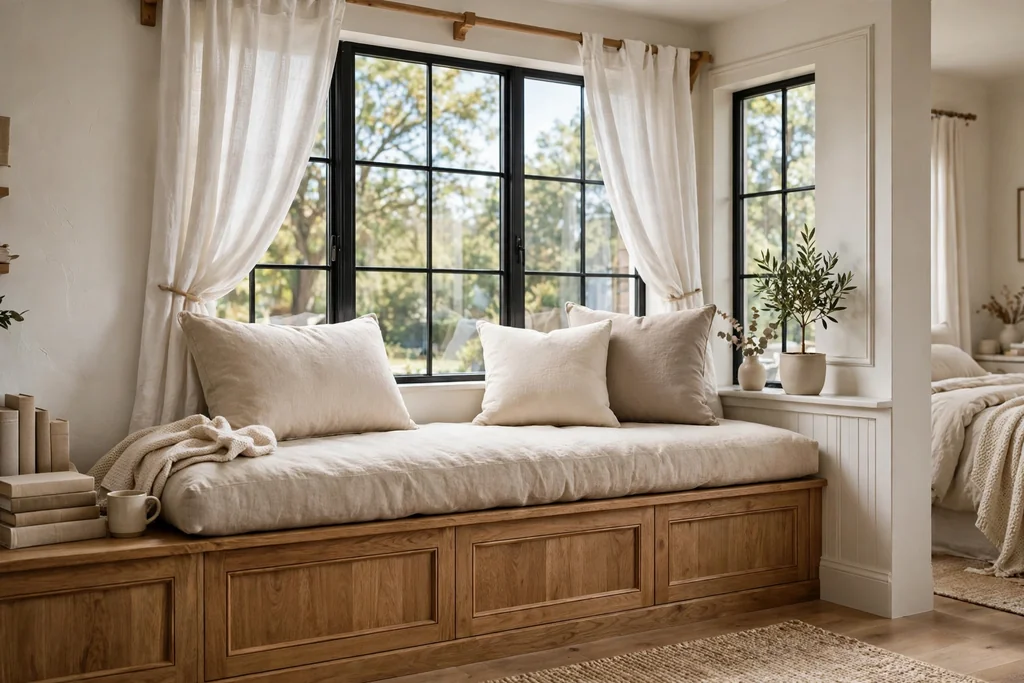
    Build a window seat with a wood base, a thick linen cushion, and a few plain cushions, for a reading spot that also adds storage beneath the seat. This suits a bedroom with a wide window and a wall that can take a built-in or a sturdy bench, and it makes the window a feature of the room. The wood base links to other rustic furniture, while the linen keeps it soft.

    Add drawers or a lift-up lid under the seat for blankets or books, so the seat earns its floor space. Keep the cushions in warm white or sage, and add one darker cushion for contrast. If the window gets strong sun, choose a washable cushion cover, since sun and dust show fast on pale linen.

    19. Hang Floor-Length Linen Curtains on an Iron Rod
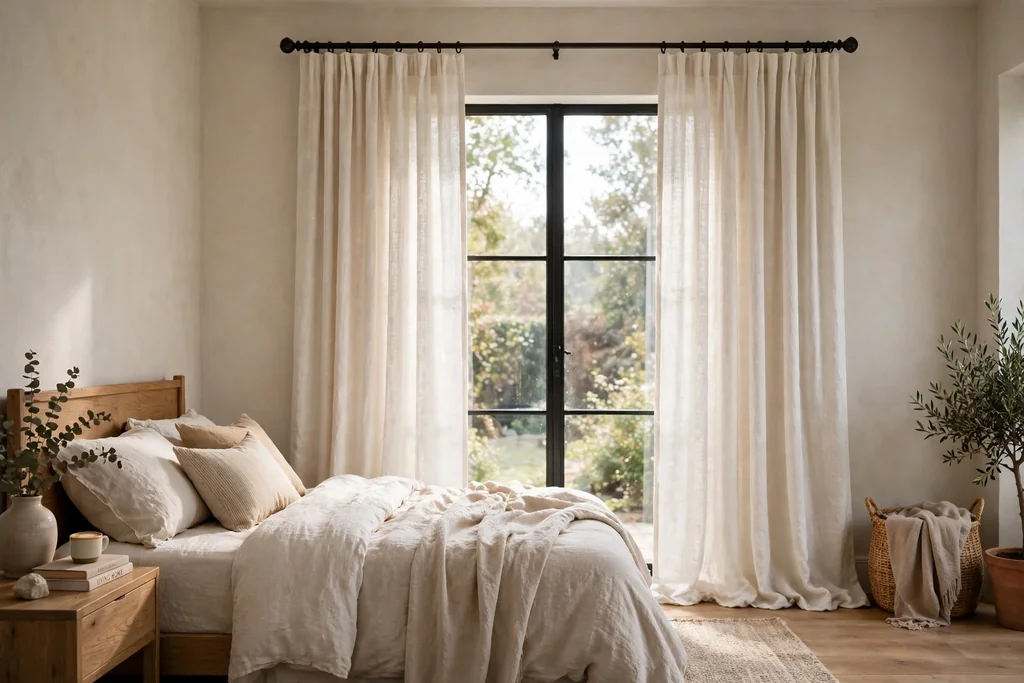
    Hang floor-length linen curtains in warm white or soft sage on a dark iron rod, for a window treatment that suits rustic wood and soft bedding. Linen filters light gently during the day and adds height to the window when hung high and wide. This suits a bedroom with wood furniture and a plain wall, where the window needs softness rather than pattern.

    Hang the rod close to the ceiling and wider than the frame, so the panels stack clear of the glass when open. Let the panels brush the floor rather than pool, so they stay clean and easy to vacuum around. For fabric, length, and lining choices that suit different windows, see these bedroom curtain ideas.

    20. Store Throws and Laundry in Woven Baskets
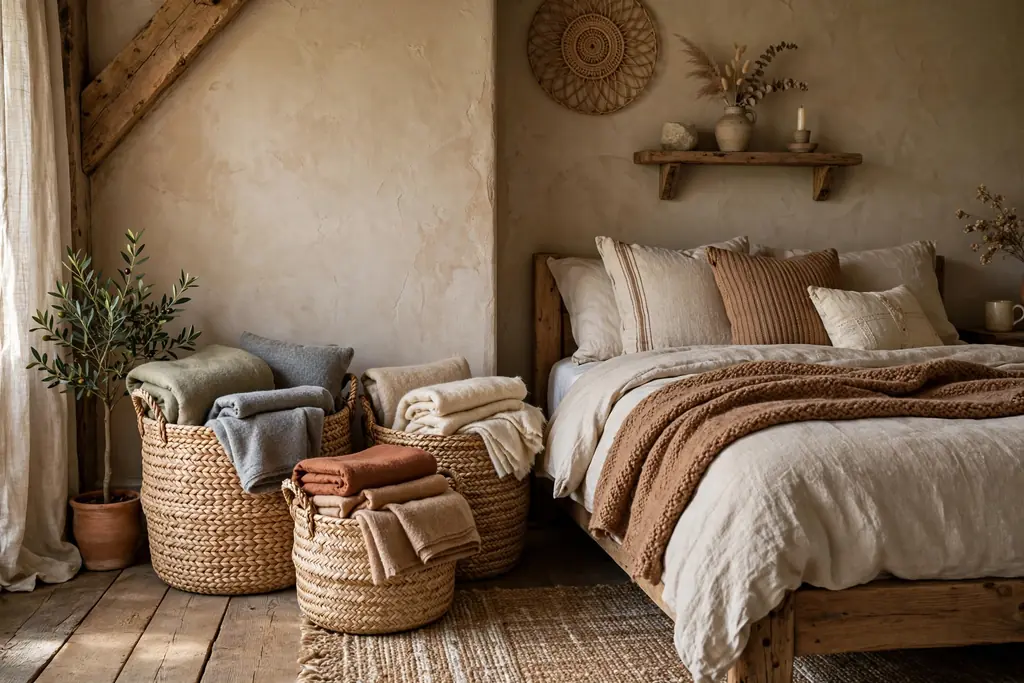
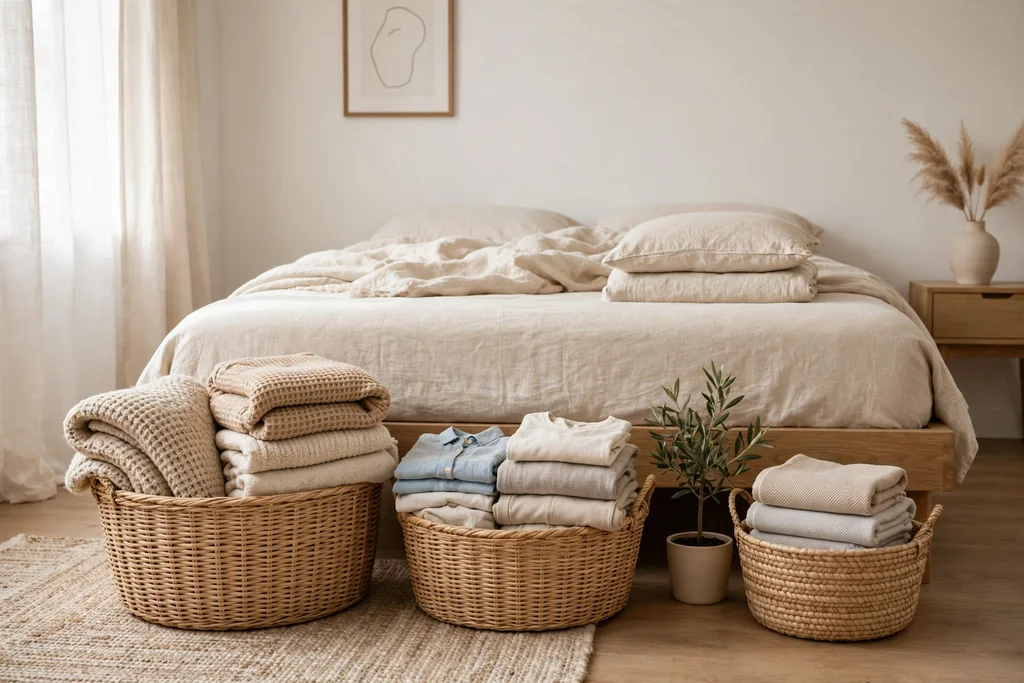
    Use large woven baskets for throws, spare cushions, and laundry, so storage looks like part of the decor rather than a chore. Baskets in seagrass, rattan, or cotton rope suit rustic wood and linen, and they move easily when you clean. This suits a bedroom with little closet space, or a room where a basket by the bed is more useful than another cabinet.

    Choose baskets with lids for laundry, and open baskets for throws you reach for often. Keep basket sizes to two or three, in a similar tone, so the group looks planned rather than random. Empty and shake baskets outside now and then, since woven fibers collect dust and lint.

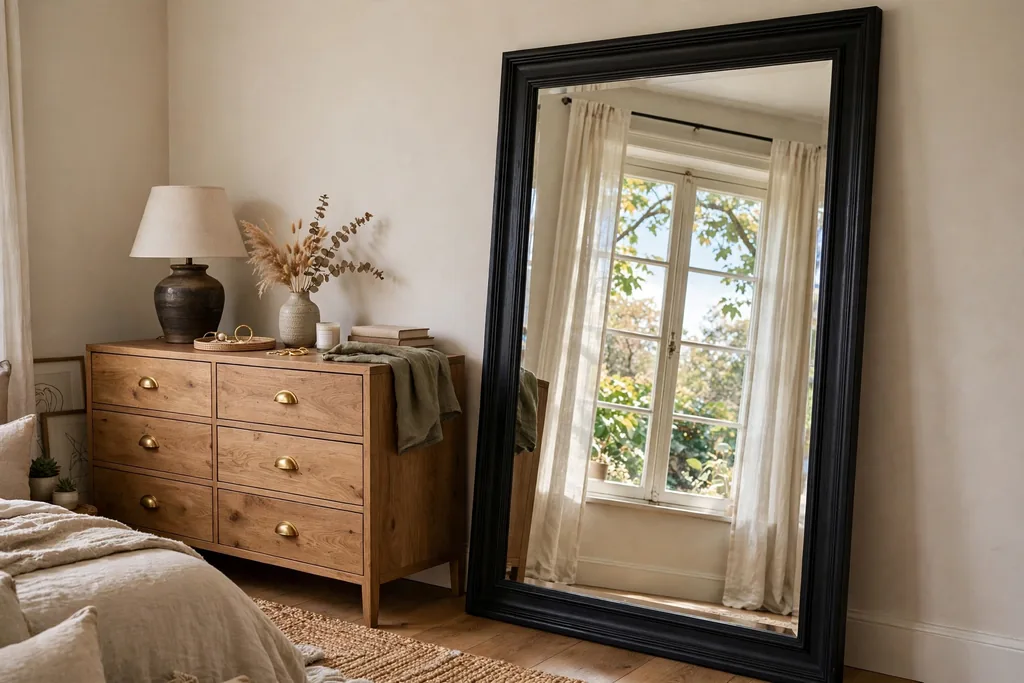
    21. Hang a Large Wood-Framed Mirror Above the Dresser
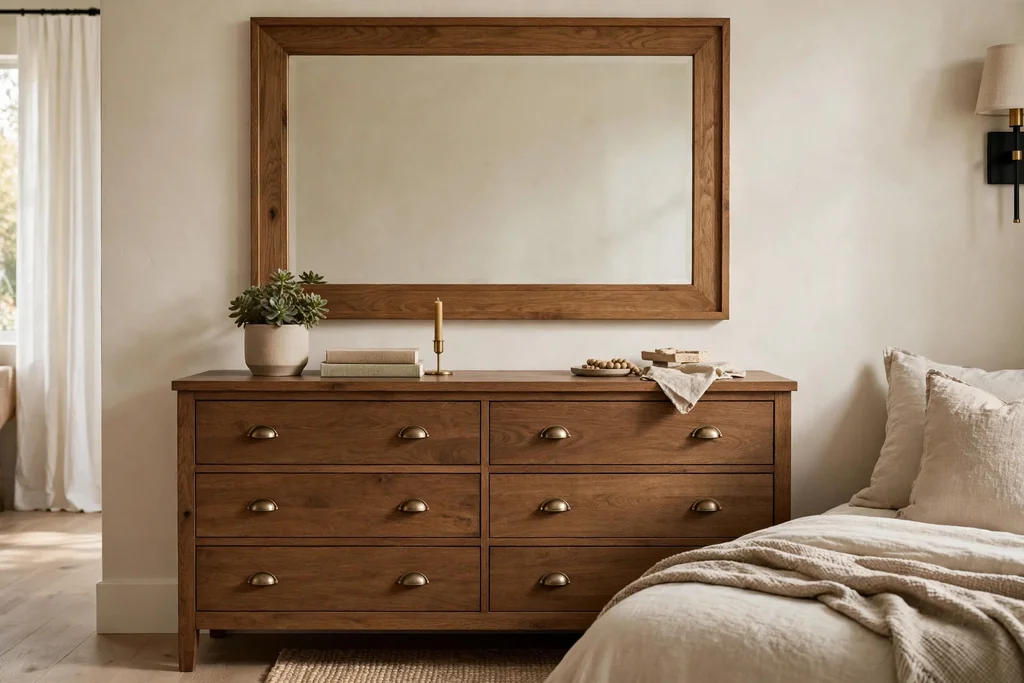
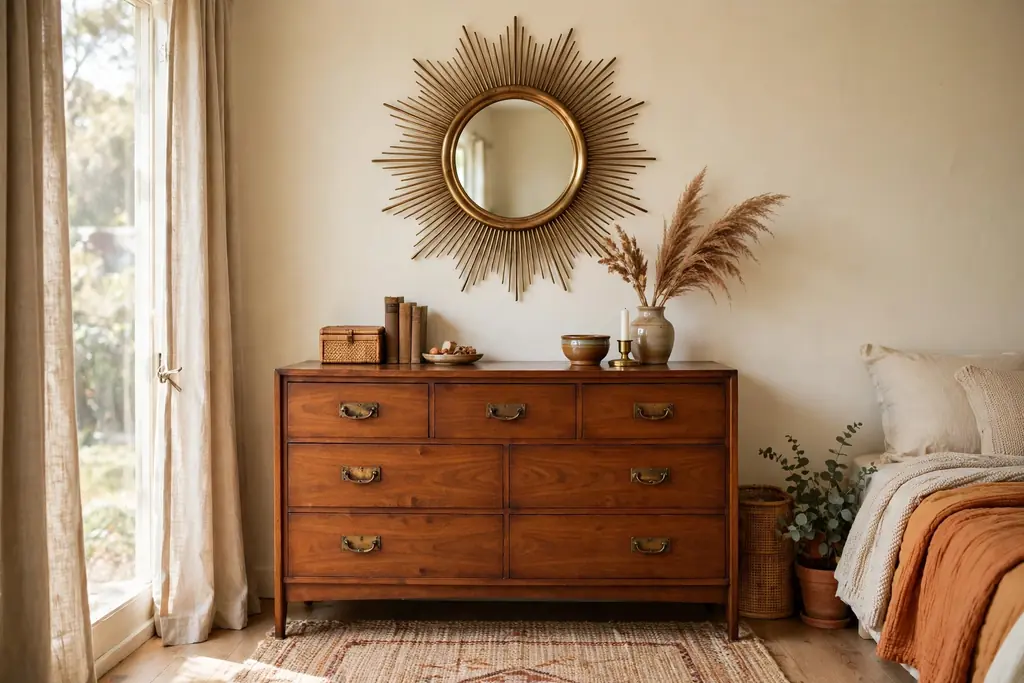
    Hang a large mirror in a simple wood frame above the dresser, for light, depth, and a rustic focal point on a plain wall. A mirror bounces daylight around the room, which helps a bedroom with dark wood furniture feel brighter. This suits a dresser wall that feels empty, or a small bedroom that needs a sense of space.

    Choose a mirror roughly two thirds of the dresser width, and hang it so the center sits at eye level from where you stand at the dresser. Check what the mirror reflects before you fix it, since a view of the window or a plant looks good, while a view of clutter does not. Keep the dresser top mostly clear, so the mirror stays the focus.

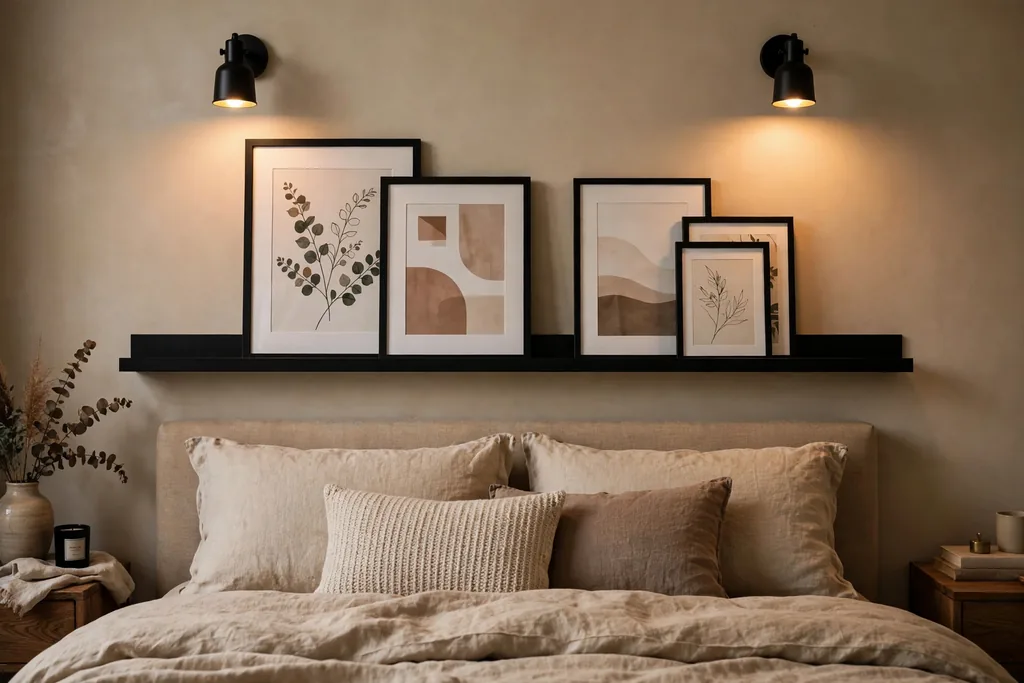
    22. Fit Wall Sconces in Brass and Wood
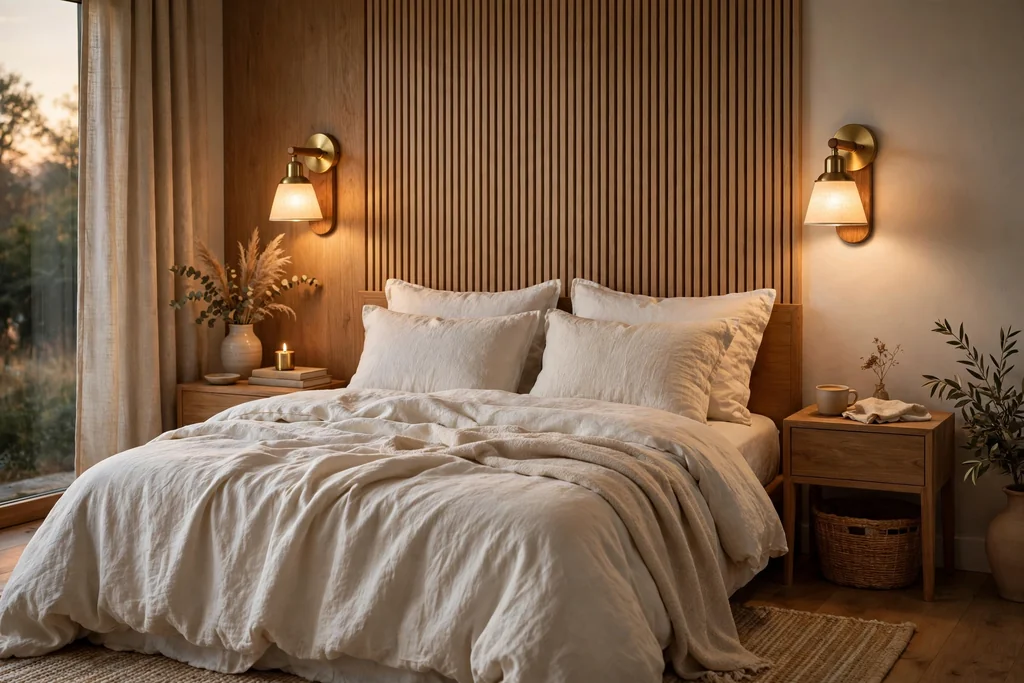
    Fit a pair of wall sconces in brass and wood beside the bed, for warm light at a height that suits reading, without using nightstand space. Brass adds a polished note to rustic wood, while a wood backplate keeps the sconce linked to the room. This suits a bedroom with small nightstands, or a room where pendants would hang too low.

    Mount the sconces at shoulder height when you sit in bed, and use warm bulbs with a dimmer, so evening light stays soft. Keep the pair matched in size and finish, and keep the wall behind them plain, so the light and the wood show clearly. If you rent, use plug-in sconces with a neat cord cover, rather than wired ones.

    23. Refresh Wide-Plank Wood Flooring

    Refresh wide-plank wood flooring with a matte finish and a warm tone, for a rustic floor that still looks clean and current. Wide planks give a bedroom a calm, grounded base, and a matte finish hides small marks better than a high shine. This suits a bedroom where the floor is worn, or where carpet makes the room feel dull.

    Clean and sand the floor as needed before you finish it, and test the tone on a small area, since wood darkens once sealed. Keep rugs in a similar warm range, and keep furniture feet protected, so the new finish lasts. If a full refinish is too much, a deep clean and a fresh matte topcoat can still lift a tired floor.

    24. Place a Potted Olive Tree in a Terracotta Pot
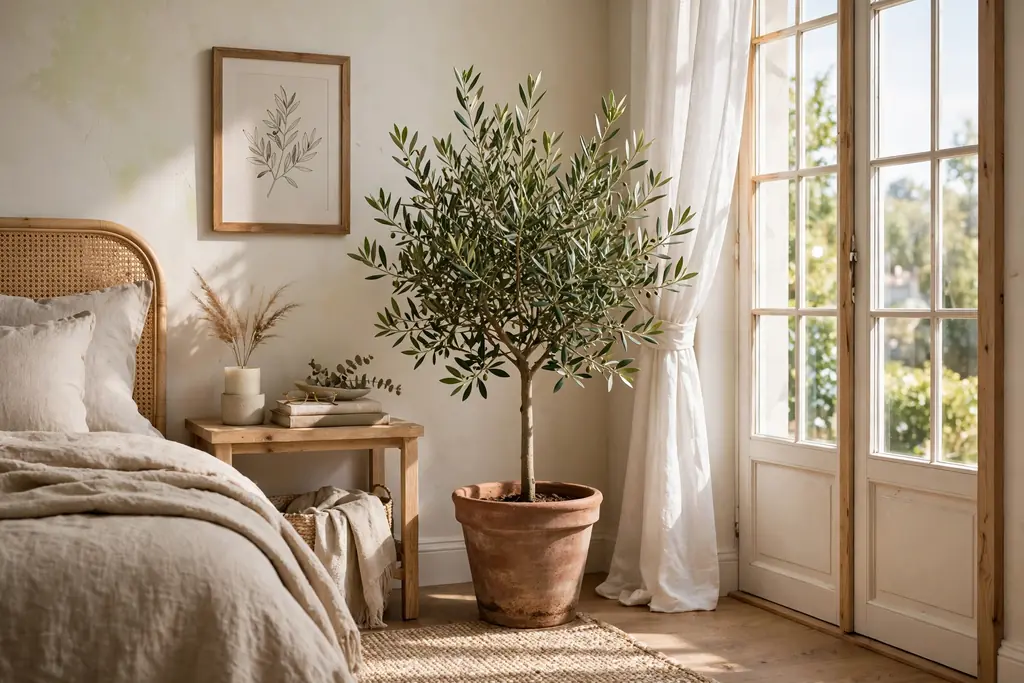
    Place a potted olive tree in a terracotta pot in a bright bedroom corner, for living green that suits rustic wood and warm neutrals. The soft grey-green leaves link to sage bedding and wood tones, without adding a strong new color. This suits a bedroom with a bright window and floor space in a corner, where a plant can grow without crowding the bed.

    Choose a pot with drainage, and a saucer that suits the floor, so watering does not mark wood or rugs. Water only when the top soil feels dry, and rotate the pot now and then so the tree grows evenly. Keep the pot simple, with no painted pattern, so the tree and the terracotta stay the focus.

    25. Group Lanterns With Candles on the Dresser
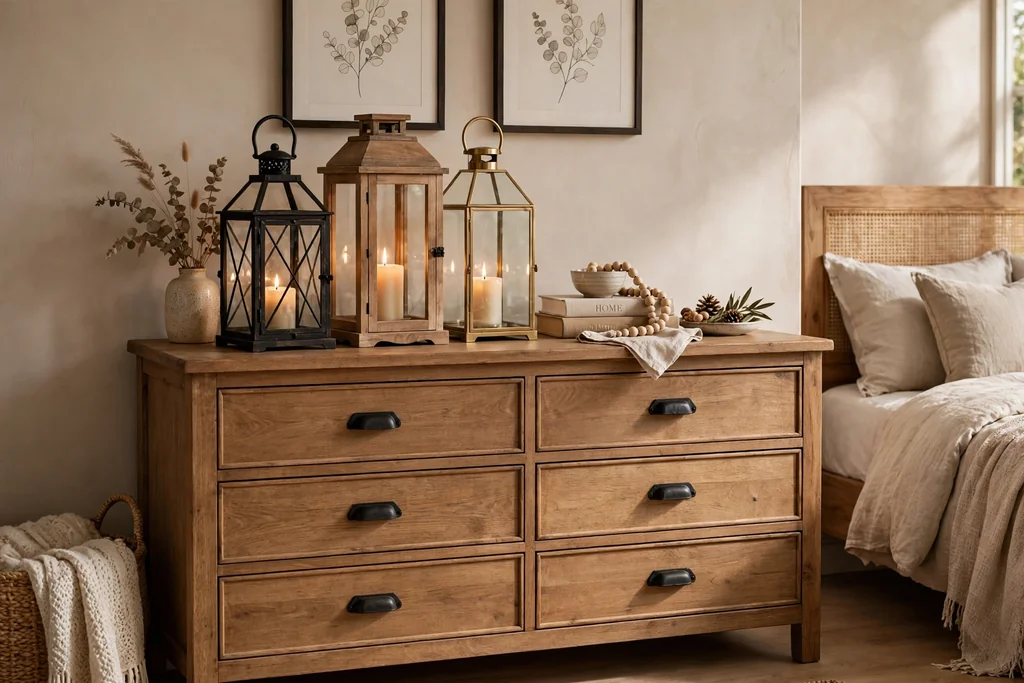
    Group two or three lanterns with candles on the dresser, in wood, glass, and dark iron, for warm evening light and a rustic display that costs little space. Lanterns suit a bedroom with wood furniture and linen bedding, since the glass and iron add a different texture without a new color. This works best on a dresser with a clear corner, away from curtains and bedding.

    Use battery candles inside lanterns near bedding or curtains, for safety, and keep real candles only where they sit clear of fabric and are never left lit alone. Vary the lantern heights, but keep the finishes to two, such as iron and wood, so the group looks planned. Dust the glass now and then, since a dusty lantern dulls the light.

    26. Add a Muted Plaid Quilt

    Add a muted plaid quilt in soft sage, cream, and clay, folded across the lower half of the bed, for a rustic pattern that stays calm. Plaid suits wood furniture and linen bedding, and a muted palette keeps it polished rather than busy. This suits a bedroom with plain walls and solid bedding, where one pattern can carry the bed.

    Let the quilt lead, and keep cushions in one tone taken from the quilt, so the bed does not mix two patterns. Fold the quilt back at night to show plain sheets beneath, so the bed still feels calm for sleep. Wash the quilt as advised on the label, and store it folded in a basket when you swap to a lighter layer.

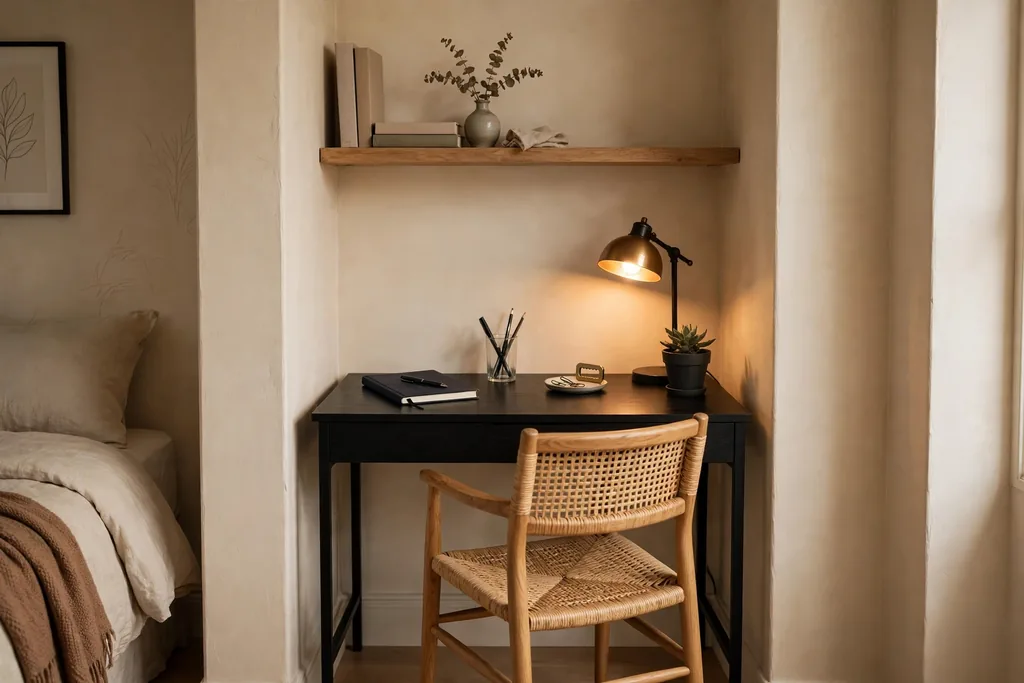
    27. Set Up a Reclaimed Wood Desk or Vanity Corner
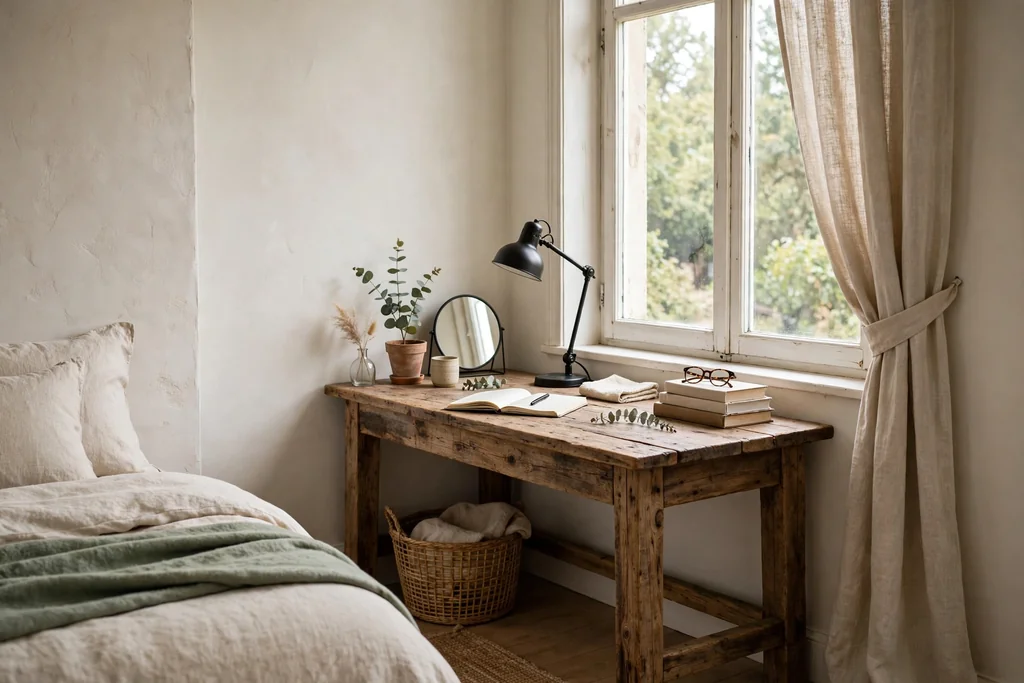
    Set up a small desk or vanity in reclaimed wood in a bedroom corner, for a work or dressing spot that matches rustic furniture. A simple wood top with iron legs suits the room, and a small mirror or a task lamp makes the corner useful without a large cabinet. This suits a bedroom with an unused corner near a window, where daylight helps.

    Keep the corner tidy, with one tray for small items and one chair that tucks under the desk, so the spot does not spill into the room. Add a cushion on the chair in a tone from the bedding, to link the corner to the bed. If the corner is small, choose a narrow desk and wall shelves above it, rather than a wide dresser.

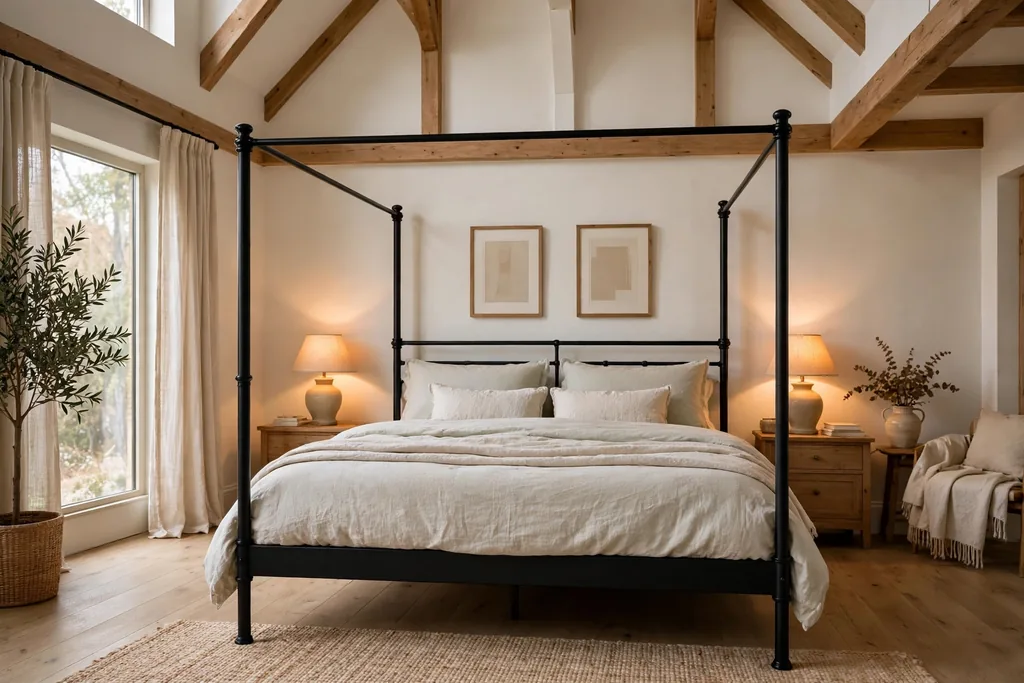
    28. Choose a Wood and Iron Canopy Bed Frame

    Choose a canopy bed frame in wood and dark iron, with a simple, open top, for a rustic bed that feels grand without heavy drapes. The frame gives the bed structure and height, and it suits a larger bedroom with a high ceiling, where a plain frame would look lost. Keep the canopy open, with no fabric, so the room stays light.

    Dress the frame with plain linen bedding, so the wood and iron stay the focus, and add one throw in a muted tone at the foot. Check the ceiling height and the room size before you buy, since a canopy frame needs clear space on all sides. Dust the top rails now and then, since high frames collect dust out of sight.

    29. Clad the Ceiling in Tongue-and-Groove Wood
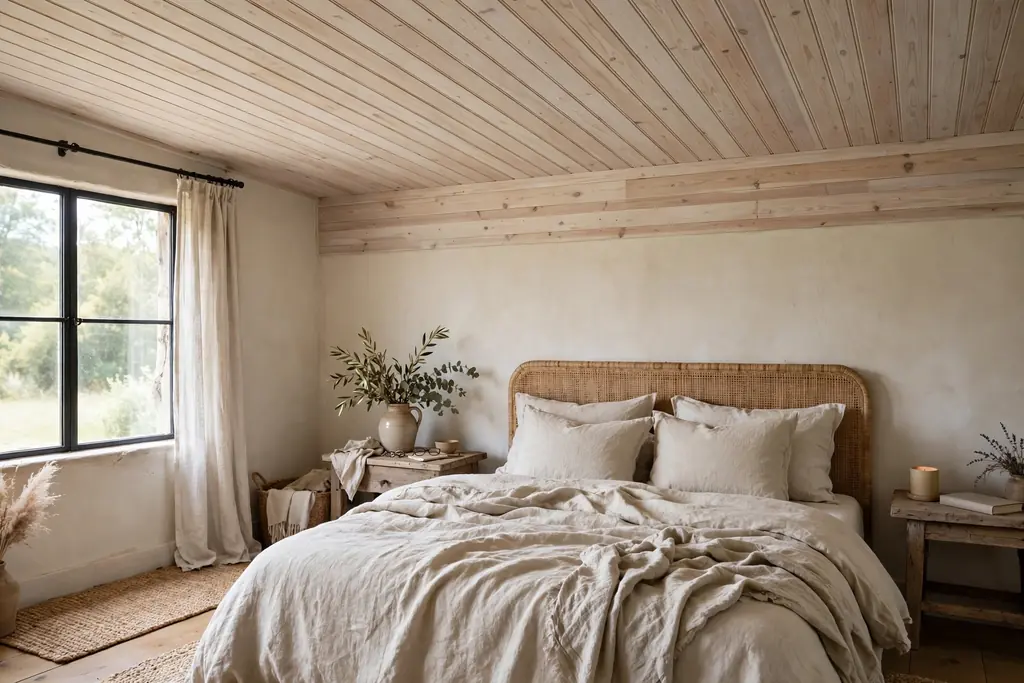
    Clad the ceiling in tongue-and-groove wood boards in a pale or mid tone, for a rustic ceiling that feels warm and finished. Unlike beams, which add lines across the ceiling, boards cover the whole surface and give a cabin-like warmth that still looks tidy when the tone stays pale. This suits a bedroom with a plain ceiling and warm white walls, where the ceiling needs one strong layer.

    Keep the boards in a consistent tone, and finish them matte, so the ceiling does not shine under lights. Pair the ceiling with simple wall colors and plain bedding, since the ceiling already adds a lot of wood. If the room is small, choose a pale wash, so the boarded ceiling does not make the room feel lower.

    30. Use Stone or Ceramic Table Lamps
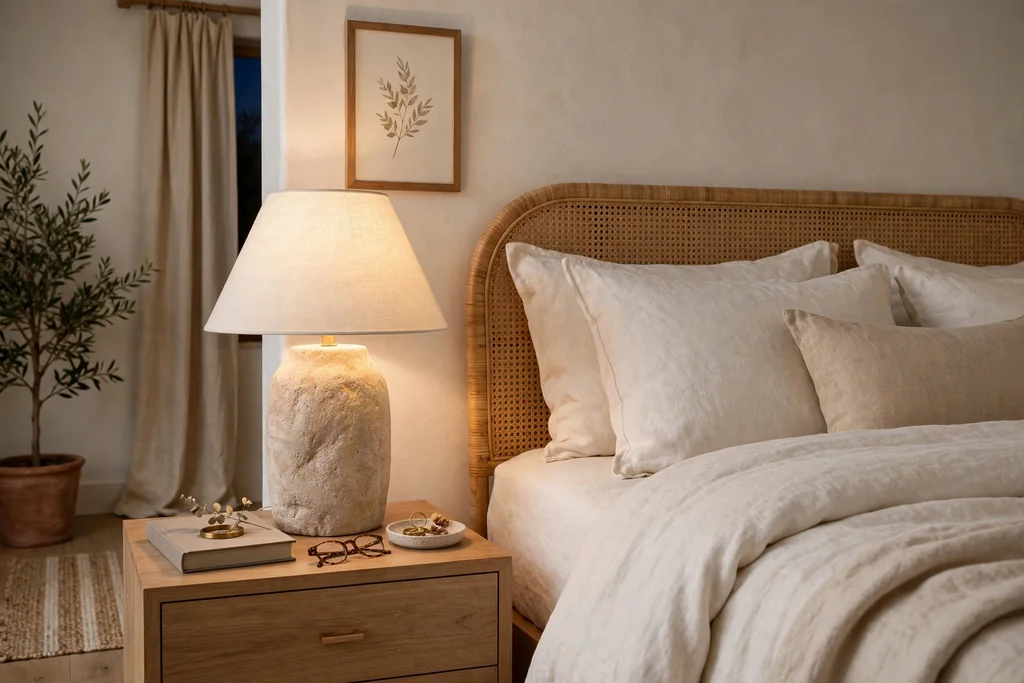
    Use stone or ceramic table lamps on the nightstands, for bedside light with a natural, matte surface that suits rustic wood. A lamp in a warm cream, sage, or clay tone adds color at bed height, without the shine of metal or glass. This suits a bedroom with a wood plank wall or a wood bed, where a second natural material helps the room feel layered.

    Choose lamps in a similar height and shape, so the pair looks balanced, and use warm bulbs with a dimmer for evening light. Keep the lamp bases simple, with no busy pattern, so they sit well beside linen bedding. Clean the bases with a soft cloth, and check that the shades sit straight, since a tilted shade shows fast at bedside height.

    31. Try a Rattan Headboard for a Lighter Rustic Look
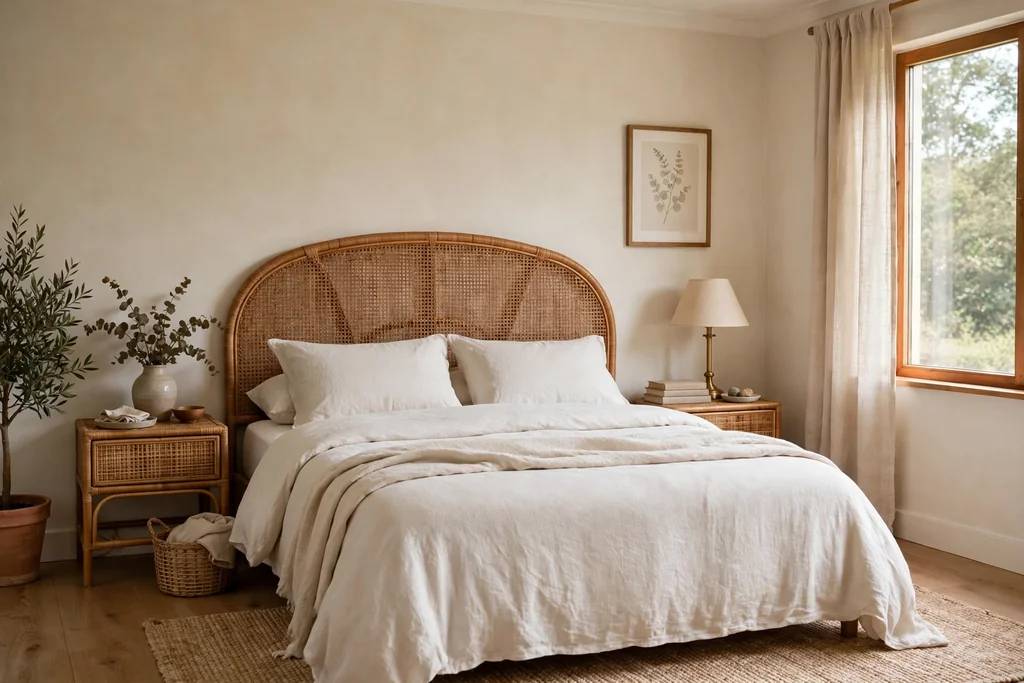
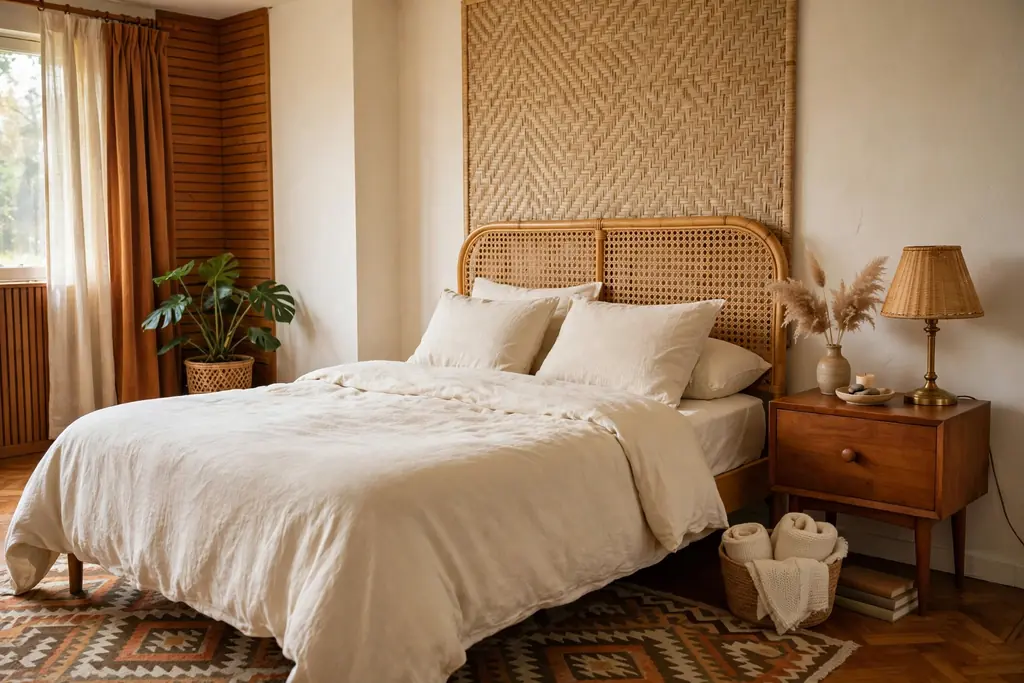
    Try a rattan headboard for a lighter rustic look, where a solid wood or upholstered headboard would feel too heavy. The open weave adds texture and warmth, while still letting the wall color show through, which helps a small or pale bedroom feel open. This suits a bedroom with light wood furniture and linen bedding, where a woven piece links the bed to baskets and shades.

    Keep the bedding plain, in warm white or soft sage, so the rattan pattern stays clear. Pair the headboard with one woven basket or one rattan lamp shade, to repeat the material once more in the room. Dust the weave with a soft brush, and keep the headboard out of direct sun, since strong sun can dry rattan over time.

    32. Fit an Open Wood and Iron Clothing Rail

    Fit an open clothing rail in wood and dark iron on a side wall, for easy-to-reach clothes and a rustic display that suits a bedroom without a large closet. The rail adds iron and wood at a useful height, and it works as a dressing area when paired with a small bench or a basket below. This suits a guest room, a small bedroom, or a room where a closet door would crowd the bed.

    Keep the rail to a short length, and hang only clothes you wear often, in a similar palette, so the display looks tidy. Add a shelf above the rail for hats or bags, and a basket below for shoes, so the area stays contained. If the rail starts to fill, move off-season clothes to closed storage, since an overloaded rail makes a rustic room look untidy fast.

    33. Choose a Ceiling Fan With Wood Blades

    Choose a ceiling fan with wood blades and a simple iron or brass fitting, for air movement that still suits a rustic bedroom. Wood blades link to other wood in the room, while a plain fitting keeps the fan from looking like a separate style. This suits a bedroom that gets warm in summer, or a room with a high ceiling where a fan helps air move.

    Pick a fan sized to the room, and hang it high enough to clear doors and tall furniture, with the blades above head height. Use a warm light kit only if you need it, since a plain fan with separate bedside lamps often looks cleaner. Clean the blades often, since wood blades show dust, and check that the fan runs quietly before you settle on a speed.

    34. Pull the Room Together With a Three-Color Palette
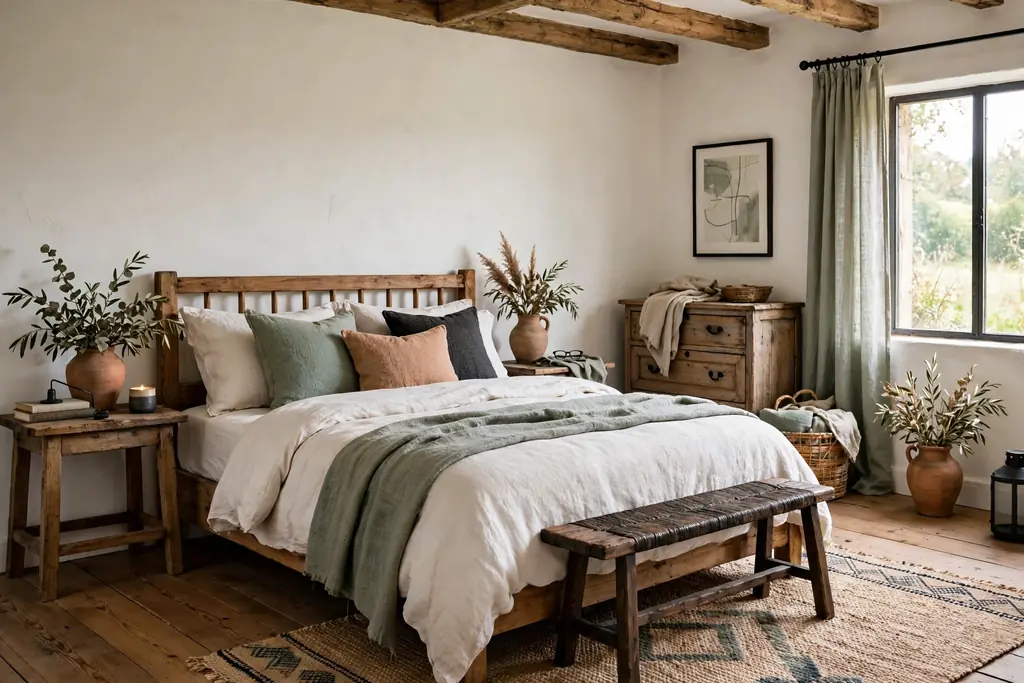
    Pull the room together with a simple palette of warm white, sage, and clay, plus charcoal as an accent, and repeat those tones across bedding, art, and cushions. A limited palette is what makes a rustic room look polished, since it stops wood, linen, iron, and plants from competing. This suits any rustic bedroom, and it is the easiest idea to apply after you have chosen furniture.

    Use warm white for walls and sheets, sage for one layer of bedding or a cushion, clay for a throw or a pot, and charcoal only in small doses, such as hardware or a frame. Repeat each color at least twice, and keep one surface plain, such as a plain rug or plain curtains, so the palette has room to breathe. If a new piece does not fit the palette, keep it out of the bedroom or save it for another room.

    Conclusion

    A polished rustic bedroom comes from restraint as much as from wood and texture. Choose a few natural materials, keep the palette to three or four calm tones, and repeat each material once or twice so the room looks planned. Start with the bed, the lighting, and one wood feature, then add baskets, plants, and art only where the room still feels bare. With those layers in place, the room stays warm and relaxed, but still feels finished every day.

    If you found an idea here that suits your room, save this post on Pinterest so you can find it again when you are ready to start. Pin the look you like most, whether it is a plank wall, a linen bed, or a reading corner, and use it as a guide for your next weekend refresh.

    FAQs

    How do I make a rustic bedroom look polished instead of rough?

    Keep the palette to three or four calm tones, mix one rough texture with one smooth finish, and leave empty space on walls and surfaces. Choose simple shapes for furniture and lighting, repeat each material at least twice, and avoid adding too many rustic pieces at once, since a crowded room reads as rough rather than finished.

    What colors work best in a stylish rustic bedroom?

    Warm white, oatmeal, sage, clay, and charcoal work well, since they suit wood tones without competing with them. Use warm white for walls and sheets, sage or clay for bedding and cushions, and charcoal only in small doses, such as hardware, frames, or a lamp base, so the room stays calm.

    Can a small bedroom suit rustic decor?

    Yes, if the rustic layers stay light and limited. Use a pale wood tone, linen bedding, one woven basket, and one wood feature, such as a mirror frame or a nightstand, rather than a full plank wall and dark beams together. Keep the floor clear and the surfaces mostly tidy, so the room still feels open.

    What is the easiest rustic bedroom change with no painting or building?

    Start with bedding, lighting, and baskets. Swap to linen bedding in warm neutrals, add a wool throw at the foot of the bed, use woven baskets for storage, and change bedside lamps to stone, ceramic, or iron. These swaps add rustic texture in an afternoon, with no paint or tools needed.

    How do I mix wood, iron, and linen without clashing?

    Let wood lead, use iron only in lighting and hardware, and keep linen in plain, warm tones. Repeat each material at least twice, in the bed and a nightstand, or in lighting and a mirror frame, so no material appears only once. If a piece has a strong pattern or a bright color, keep the pieces near it plain.

    Does rustic decor suit a modern home?

    Yes, when the rustic pieces use clean lines and a limited palette. A simple wood bed, a linen headboard, matte black hardware, and warm lighting can sit well in a modern home, since they add warmth without heavy carving or dark, ornate detail. Keep the shapes simple, and let one or two rustic materials do the work.
  • 16 Emerald Green Accent Bedroom Ideas That Balance Style and Comfort

    16 Emerald Green Accent Bedroom Ideas That Balance Style and Comfort

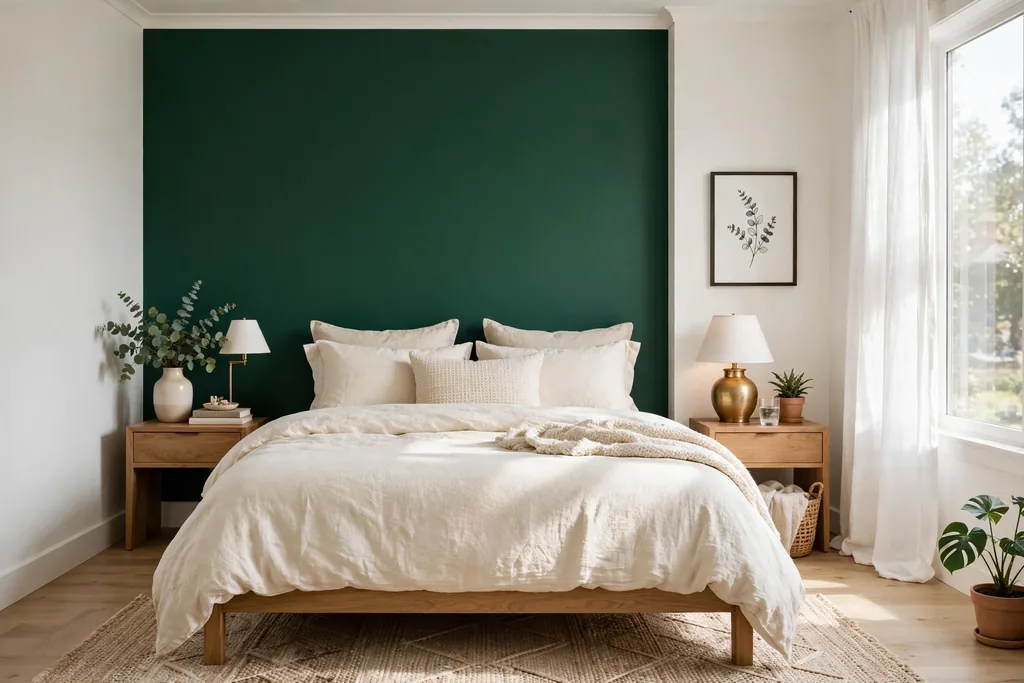
    Emerald green works as a bedroom accent because it is deep enough to anchor a room and calm enough to sleep beside. Used in one or two places, it adds richness without making the room feel dark, and it pairs well with cream, warm white, light wood, and brass. These 16 emerald green accent bedroom ideas show where to put the color, from the wall behind the bed and a velvet headboard to curtains, bedding, rugs, and styling pieces. Start with the change that helps most, repeat the emerald tone once or twice in smaller items, and keep the rest of the room light so the accent stays clear.

    Key Takeaways

    • Give emerald one main job, such as the bed wall, the headboard, or the bedding, and repeat it once or twice in smaller items like cushions or a throw.
    • Pair emerald with cream, warm white, light wood, and brass, so the deep green reads as rich rather than heavy.
    • Keep the ceiling pale and at least one large surface plain, so the room still feels open and restful at night.
    • Test paint and fabric in morning light and evening lamplight, since emerald looks brighter by day and much deeper at night.
    • Start with bedding, cushions, curtains, and a throw for a no-paint refresh, and save walls and painted furniture for a weekend project.
    • In a small room, keep emerald to one wall or one large piece, and use smaller doses elsewhere, so the color adds depth without closing the room in.

    1. Paint an Emerald Accent Wall Behind the Bed

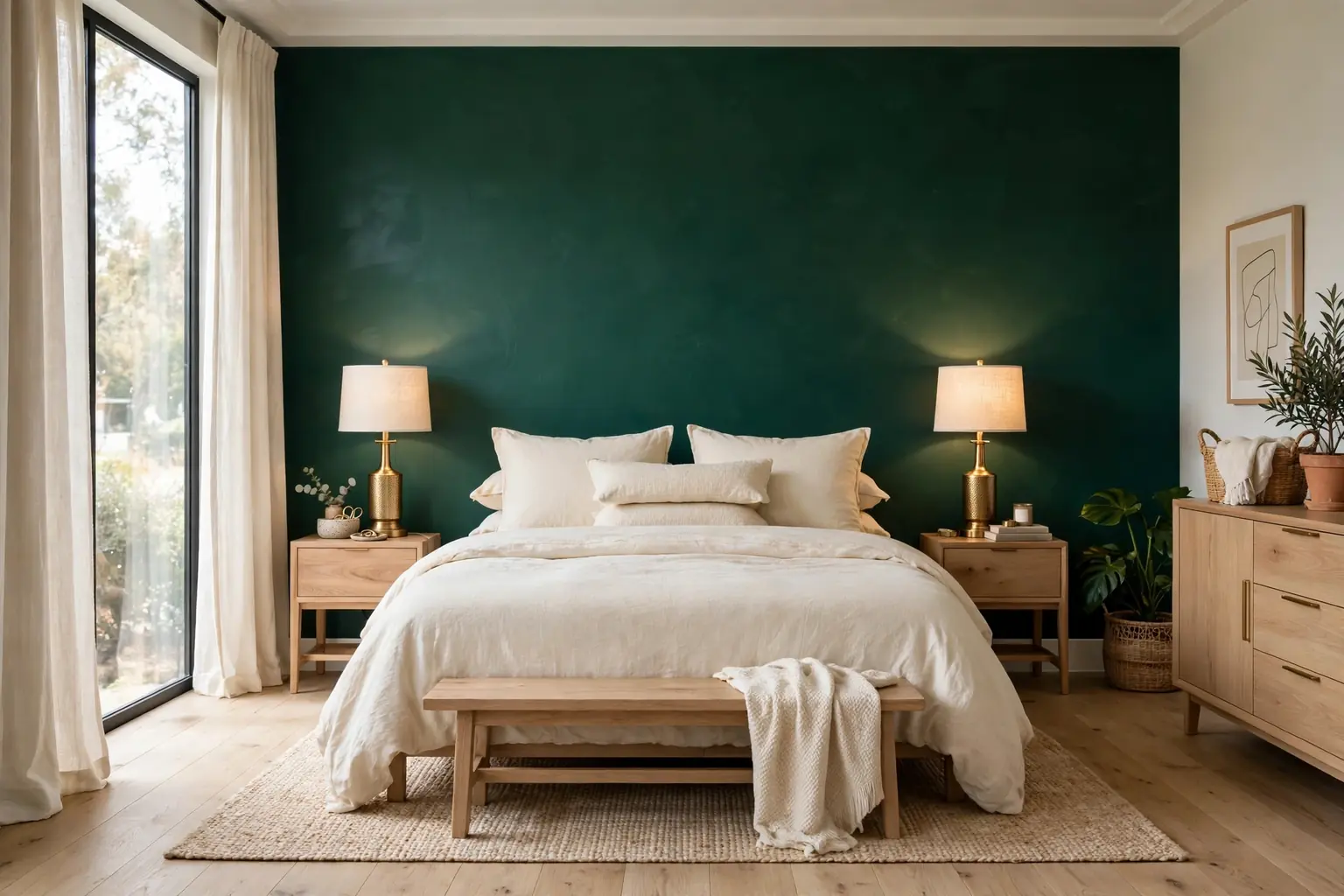
    Bedroom with an emerald green accent wall behind a bed with cream bedding.

    Paint the wall behind the bed in emerald green and keep the other walls warm white or cream. The bed wall becomes the clear focal point, and the pale side walls keep the room from feeling closed in. This suits a room with plain furniture, since the wall does the color work and little else needs to change. A matte or eggshell finish keeps the wall soft under lamplight, while white trim gives a clean edge where the green meets the other walls.

    Test a large sample on the bed wall first, and look at it in the morning and again at night, since emerald can look fresh by day and much deeper in lamplight. Keep the bedding mostly cream or white, with one emerald cushion to link the bed to the wall. If emerald feels too strong for a full wall, a softer green room may suit you better, as shown in these sage green bedroom ideas.

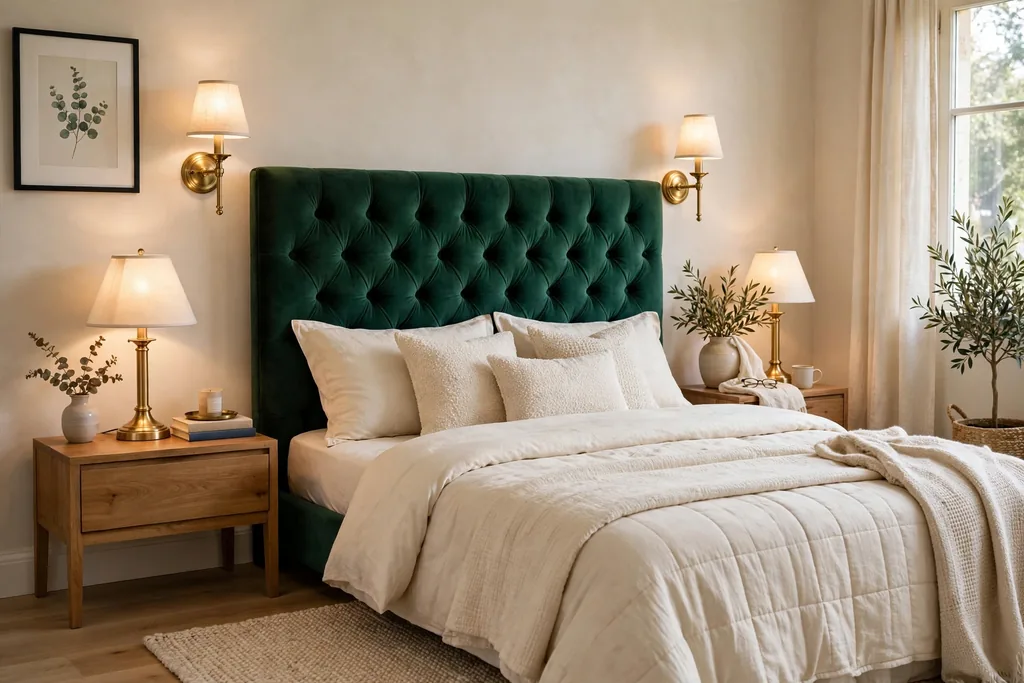
    2. Choose an Emerald Velvet Headboard

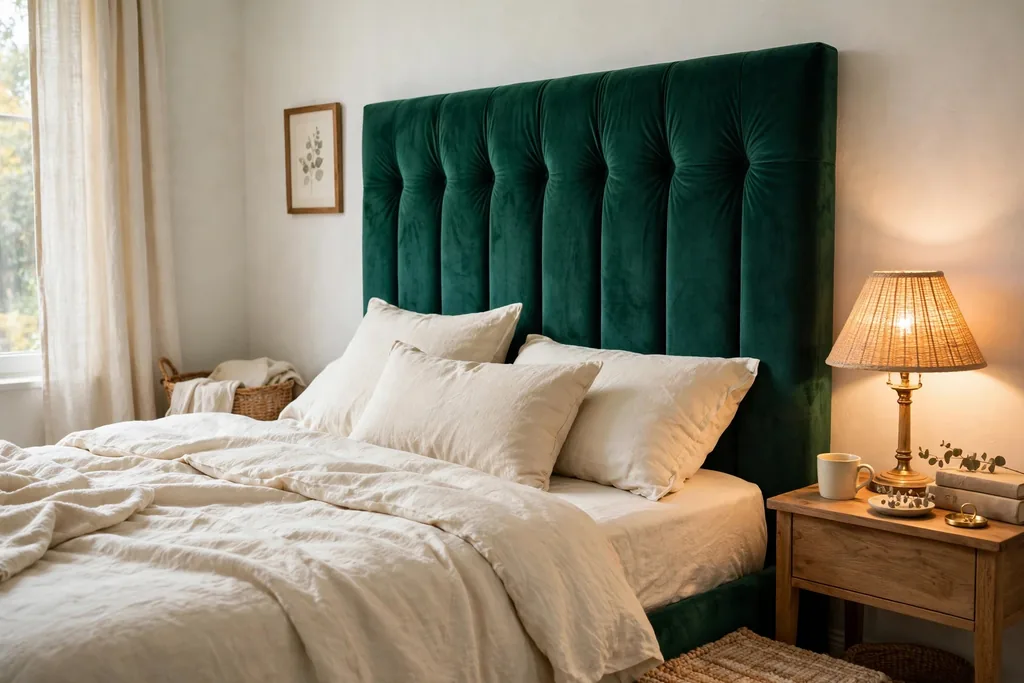
    Bedroom with an emerald green velvet headboard and cream bedding.

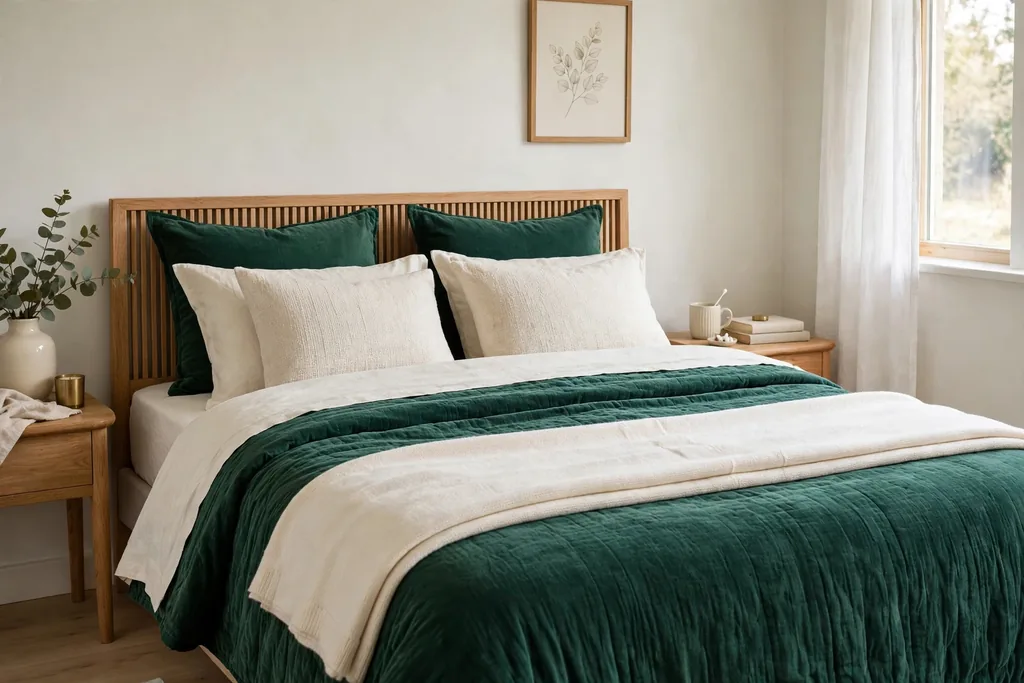
    An emerald velvet headboard adds deep color and softness behind the bed without any paint. The velvet catches light in a way flat fabric does not, so the headboard adds interest even with plain bedding, and it makes sitting up to read more comfortable than a hard wall. This suits a room with pale walls and warm lamplight, where the headboard can be the one rich note in the room.

    Measure the bed width and the wall space before you buy, and leave room for bedside tables on both sides. Keep the bedding in a paler tone, such as cream or soft grey, so the headboard stays the clear focal point, and add one cushion in the headboard color to link the bed to the wall. Vacuum the velvet gently now and then, since velvet holds dust, and keep the cover removable if possible.

    3. Layer Emerald and Cream Bedding

    Bed with layered emerald green and cream bedding and a folded cream throw.

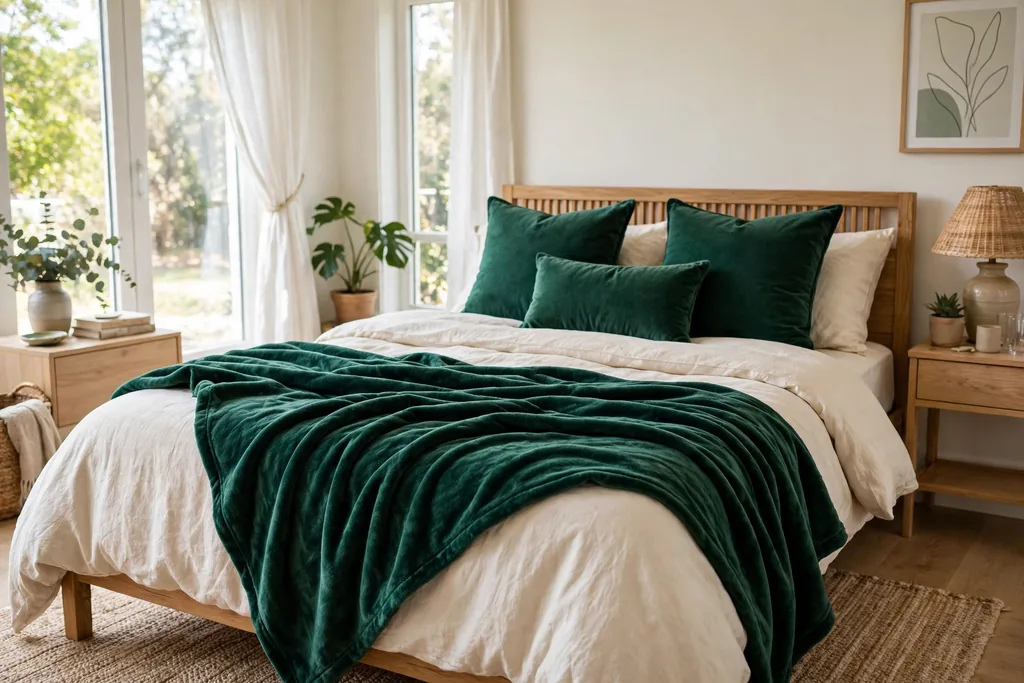
    Build the bed in layers of emerald and cream, starting with cream or white sheets, adding an emerald duvet or quilt, and folding a cream throw across the foot. The two tones give the bed depth without a pattern, and the layers let you adjust warmth through the night. This suits any bedroom, rented or owned, since it needs no paint or tools, and the bedding can change with the seasons.

    Keep the palest shade closest to your face and the deeper emerald toward the foot, which gives the bed a natural sense of order. Add cushions in linen and cotton, not all in the same fabric, so the bed feels soft to the touch as well as to the eye. Wash the throw and cushion covers on a regular cycle, since cream shows marks sooner than darker colors.

    4. Paint a Pair of Emerald Nightstands

    Bedroom with two emerald green painted nightstands beside a bed with pale bedding.

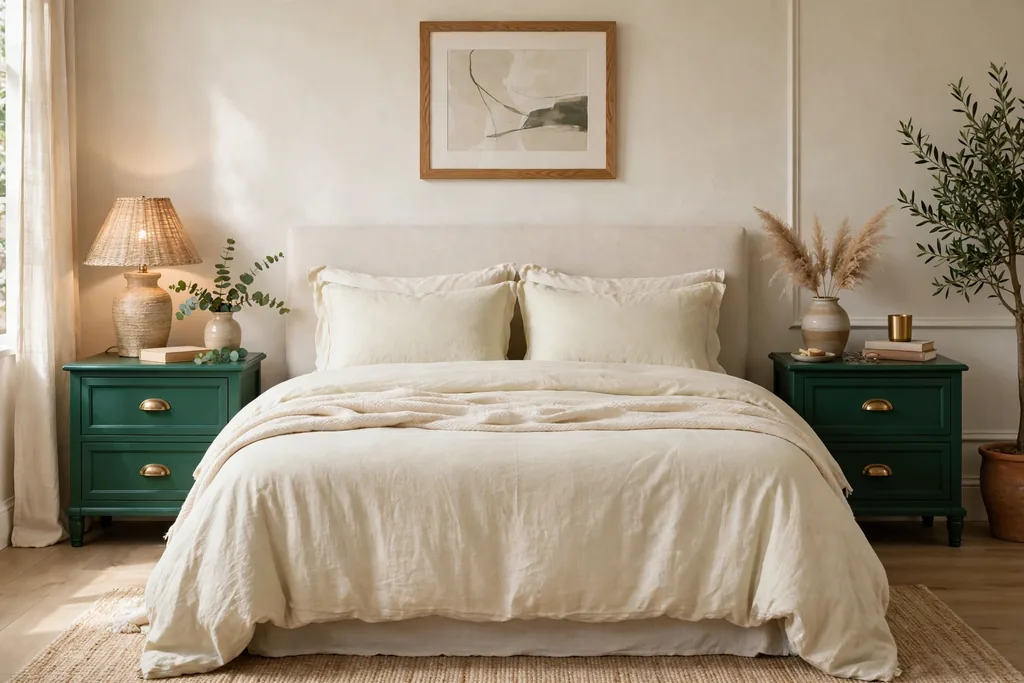
    Paint two nightstands in emerald green and keep the bed and walls pale, so the color sits at bed height where you see it last at night. This is a lower risk change than painting a wall or a wardrobe, since two small pieces are easy to repaint later. The nightstands link to an emerald cushion or throw on the bed, and the pale bed keeps the room bright.

    Sand and prime the pieces first, and use a paint made for furniture so the finish stands up to daily use. Repeat one handle finish across both nightstands, such as brass or matte black, to tie them together, and keep the tops mostly clear, with a lamp and a book, so the painted color stays visible. If the two nightstands do not match, painting them the same emerald will make them read as a pair.

    5. Hang Floor-Length Emerald Curtains

    Bedroom window with floor-length emerald green curtains beside a bed.

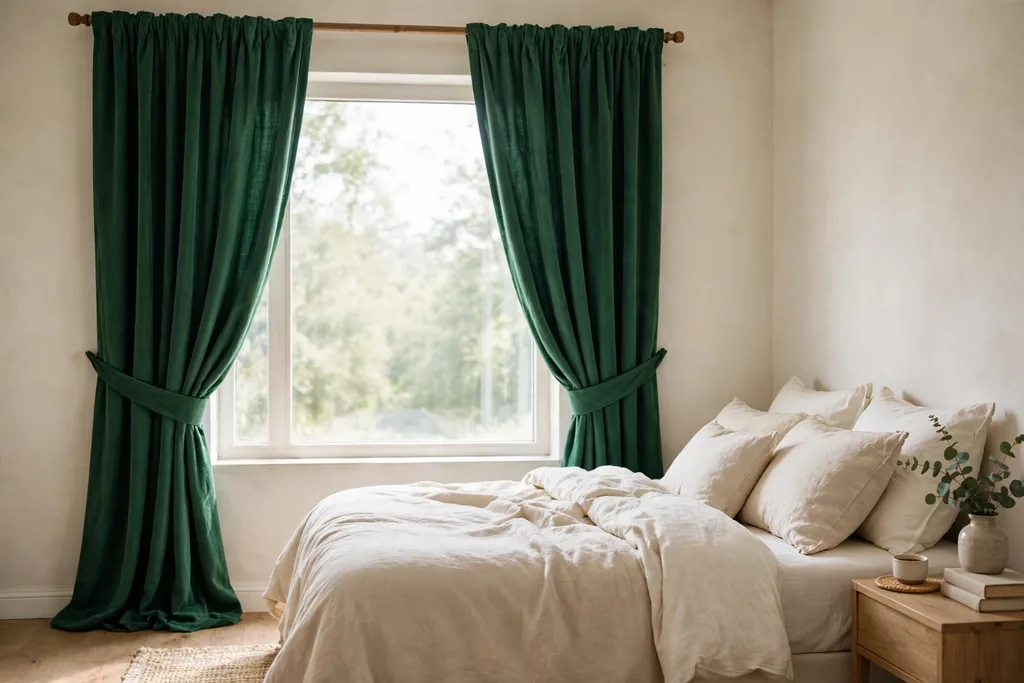
    Hang floor-length emerald curtains at the bedroom window for a tall block of color that frames the view and softens the wall. The deep green reads as rich in daylight and cozy at night when the curtains are closed, and it suits a room with pale walls and plain bedding that needs one strong fabric layer. Velvet gives the fullest drape, while linen gives a lighter, more casual fall.

    Hang the rod high and wide, so the panels stack clear of the glass when open and daylight still fills the room. For fabric, length, and lining choices that suit different windows, see these bedroom curtain ideas. Line the curtains if the room faces a street at night, and keep the fabric clear of radiators and heaters. Repeat the emerald once in the bedding or a cushion, so the window links to the bed.

    6. Place an Emerald Reading Chair in a Corner

    Bedroom corner with an emerald green armchair, small side table, and reading lamp.

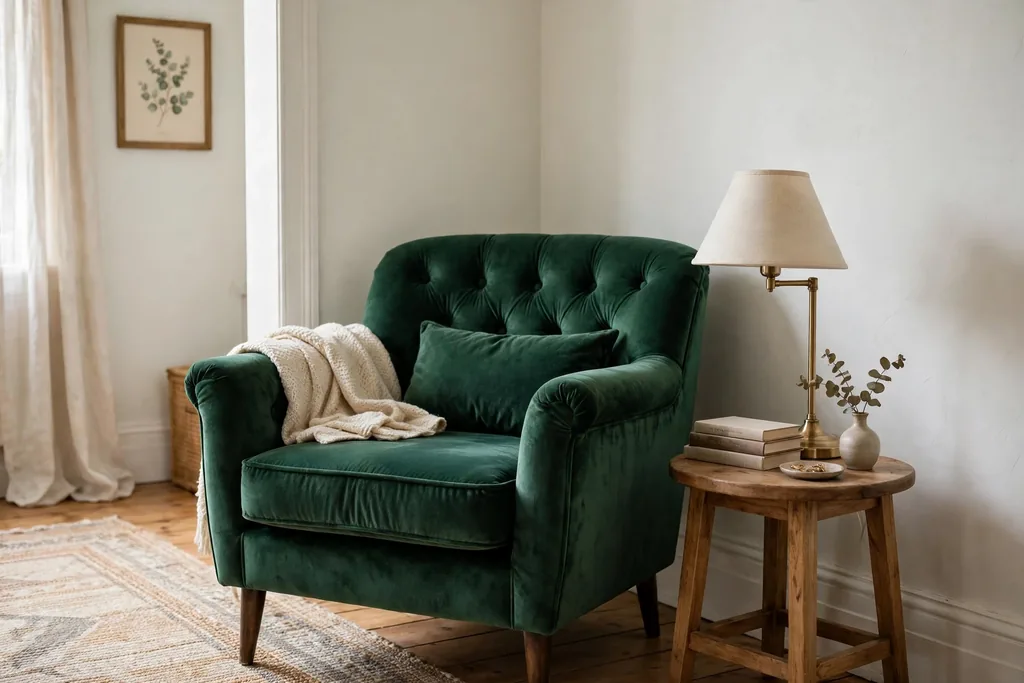
    Place an emerald upholstered chair in a bedroom corner with a small side table and a reading lamp, so the room gains a second use that is still quiet. The chair gives you a place to read or dress that is not the bed, and the emerald color marks the corner as its own place. A cushion in cream and a throw over the chair arm keep it inviting.

    This suits a bedroom with a window corner that currently holds nothing but a laundry basket. Choose a chair deep enough to sit in for an hour, not a stiff accent chair that looks good but stays empty. Keep a basket beside the chair for current books, so the corner stays tidy, and angle the chair slightly toward the room so it feels part of the bedroom rather than cut off from it.

    7. Swap in an Emerald Throw and Cushions

    Bed with an emerald green throw and cushions over cream bedding.

    Swap plain cushions and a throw for emerald versions when you want color with no paint, no tools, and no lasting commitment. A folded emerald throw across the foot of the bed and two or three cushions in emerald and cream change the bed in minutes, which suits a rental or a room where you want to test the color before you paint. This swap also lets you try emerald for a season and put it away if it feels too strong.

    Keep sleeping pillows plain and change only the decorative cushions and the throw, so the bed stays easy to make. Store the off-season set in a lidded basket or a shelf box, folded and clean, so the swap takes minutes. Wash new covers before the first use, since deep dyes can mark pale sheets at first, and keep one cushion in a tone taken from the rug or the art so the swap looks planned.

    8. Anchor the Room With an Emerald Rug

    Bedroom with a large emerald green patterned rug under the lower half of a bed.

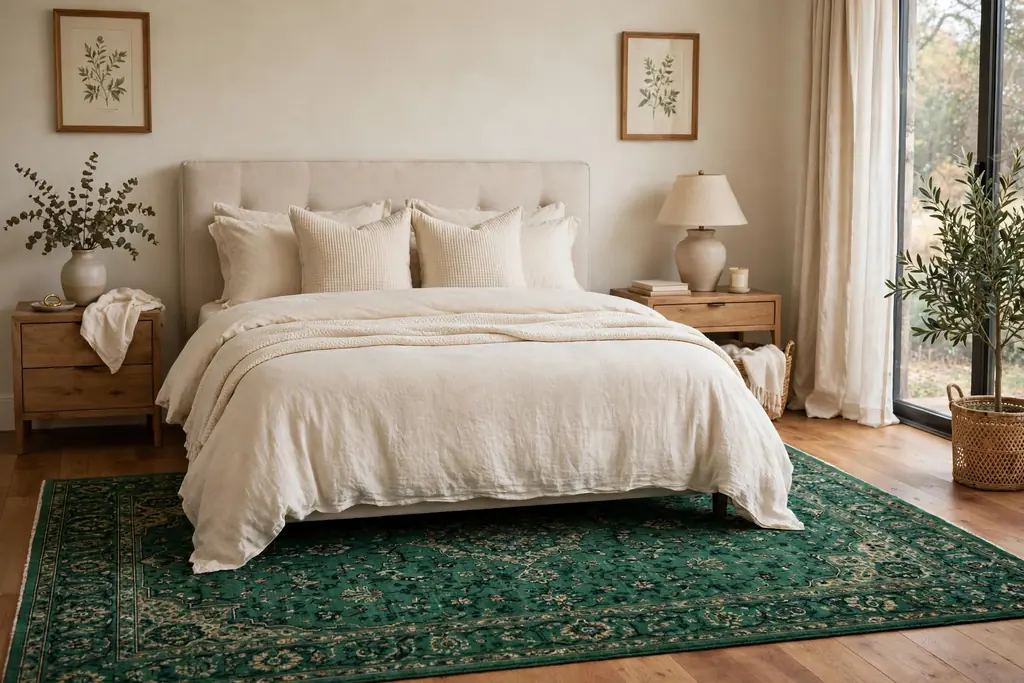
    Lay a large rug with an emerald pattern or an emerald border under the lower two thirds of the bed, extending out on both sides. The rug gives the room a color base at floor level, which suits a bedroom with pale walls and plain bedding, and it balances an emerald wall or headboard above. A rug that is too small makes the bed look as if it is floating, so measure for a clear border on each side before you buy.

    Choose a low pile rug that doors and drawers can clear, and use a rug pad on smooth floors to reduce slipping. Repeat one rug color in the bedding or a cushion, so the floor color connects to the bed, and keep the pattern quiet, such as a border or a simple motif, rather than a busy print that fights the bedding. Vacuum often, since a deep green rug shows dust and lint more than a mid-tone one.

    9. Build a Gallery Wall With Emerald Prints

    Bedroom wall with a gallery of framed prints in emerald tones above a bed.

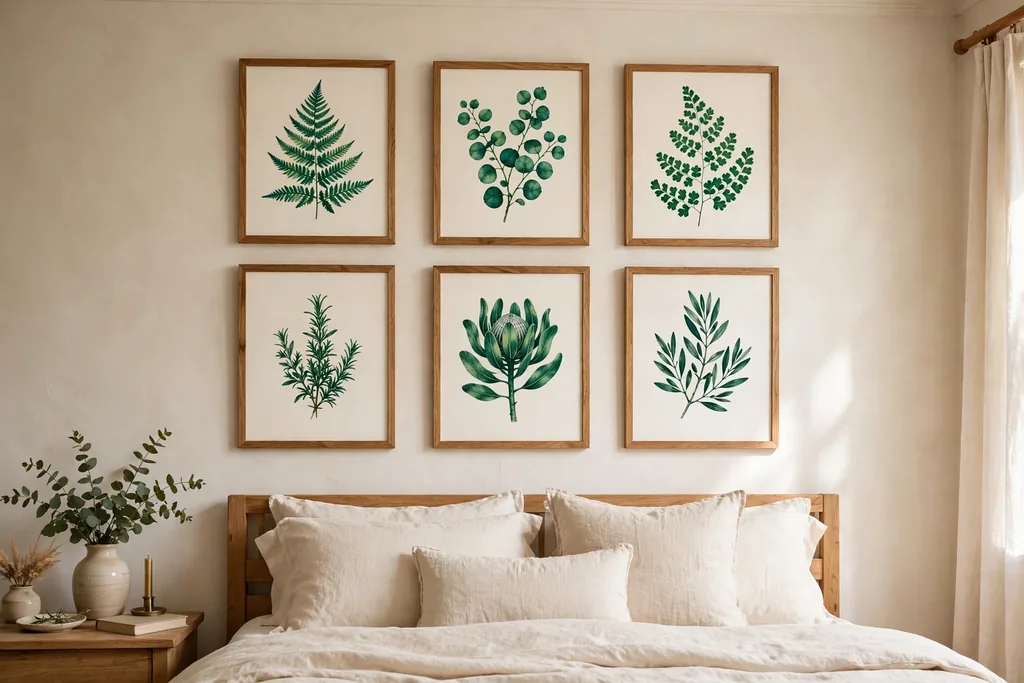
    Hang a gallery of prints in emerald tones above the bed or above a dresser for wall interest that needs no paint. Choose prints in emerald, cream, and soft gold, with simple wood or black frames, and hang them in a loose grid or a single row. Botanical prints, leaf studies, and abstract washes all suit this palette, but keep to one style so the wall feels calm rather than scattered.

    Lay the frames on the floor first and plan the spacing, leaving equal gaps between frames, then hang the middle frame at eye level. For more ways to size and hang art above a bed or a dresser, see these bedroom wall art ideas. Use picture hanging strips if you rent, and keep the largest frame in the center so the arrangement feels balanced. Repeat one print color in a cushion, so the wall links to the bed.

    10. Paint a Dresser or Wardrobe in Emerald

    Bedroom with an emerald green painted dresser beside a bed with cream bedding.

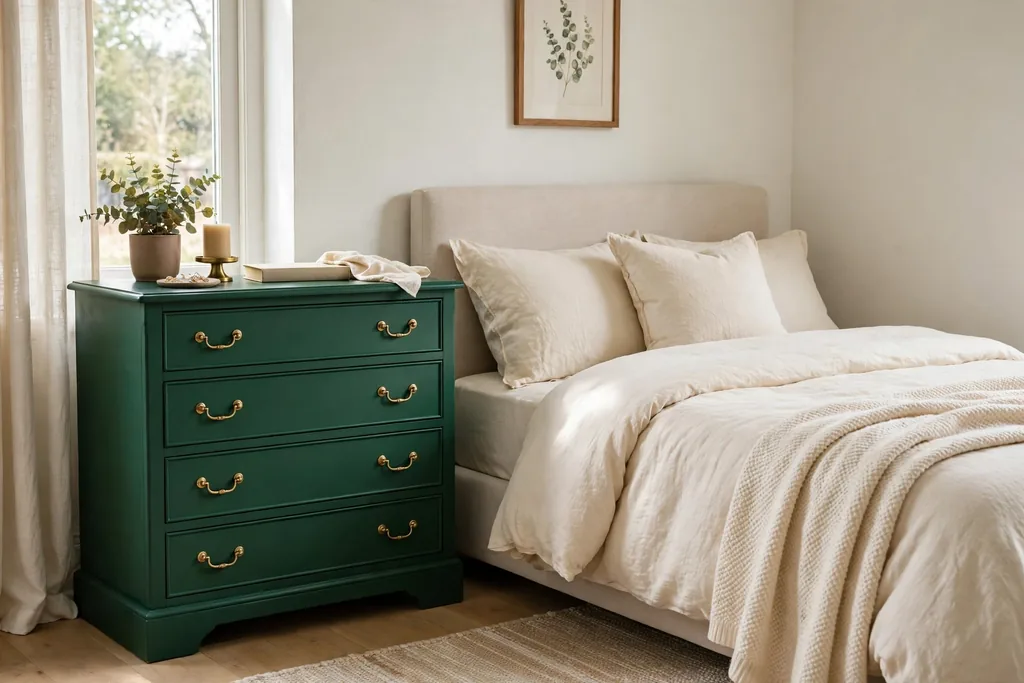
    Paint one large furniture piece, such as a dresser or a wardrobe, in emerald green, and keep the walls pale. The piece anchors the room like a painted accent wall, but it can move with you, which suits a rental or a room you plan to rearrange. The deep color also hides small marks better than a pale finish, which helps a piece that gets daily use.

    Remove the handles before painting, and paint the doors in the same finish for an even look. Put the handles back in a simple finish, such as brass or wood, so the color stays the focus, and keep the top of the piece mostly clear, with one tray or one vase, so the painted surface reads clearly. If the room already has an emerald wall, keep this piece in a pale tone instead, so the room does not gain two competing blocks of green.

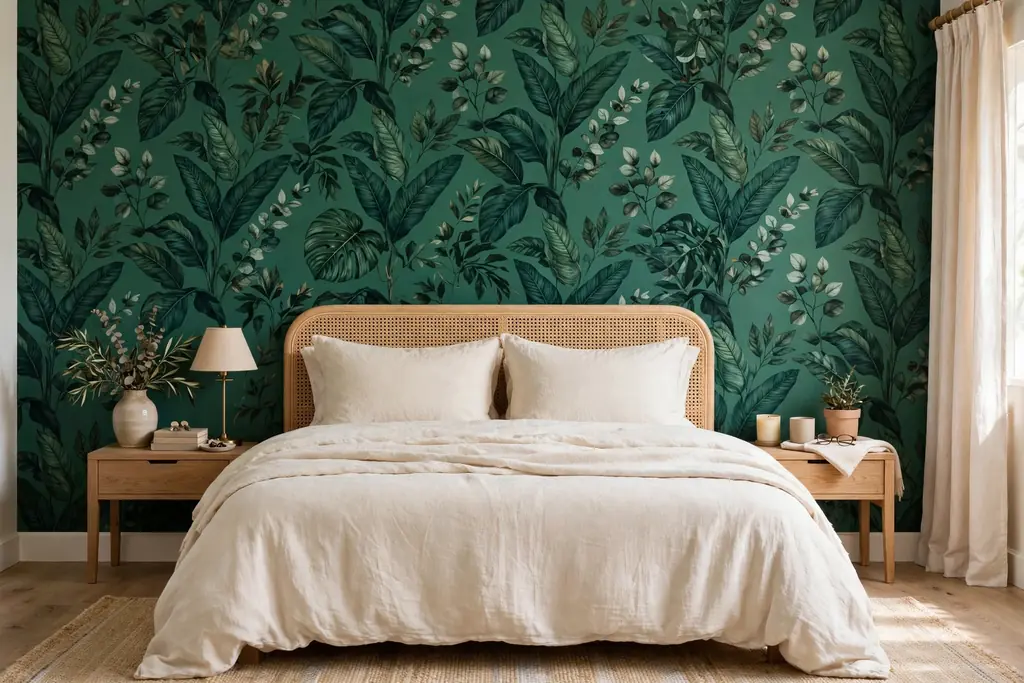
    11. Paper the Bed Wall With Emerald Botanical Wallpaper

    Bedroom bed wall with emerald green botanical wallpaper and cream bedding.

    Hang an emerald botanical wallpaper on the bed wall for pattern that paint alone cannot give. A leaf or fern print in emerald, cream, and a touch of gold adds a garden note to the room, and it suits a bedroom where the furniture is plain and the bedding is solid. Keep the other walls in a plain cream or a pale tone pulled from the paper, so the pattern has room to breathe.

    Use the wallpaper on one wall only, and keep curtains and bedding mostly solid, so the room does not gain two competing patterns at once. Order an extra roll for matching and future repairs, since batches can vary. If you rent, look for a peel-and-stick paper that your lease allows, and test a sample in your light before you commit to the full wall, since emerald prints shift a lot between daylight and lamplight.

    12. Pair Emerald With Brass Lamps and Sconces

    Bedroom with brass lamps and sconces beside an emerald green headboard.

    Fit brass lamps or wall sconces beside an emerald bed, headboard, or wall, so a warm metal thread runs through the room. Brass warms emerald in a way that chrome cannot, adding a soft golden note that suits traditional, farmhouse, and transitional bedrooms, and sconces free up nightstand space for a book and a glass of water. Sconces at about bed height give reading light without a lamp base taking up the nightstand top.

    Match the brass to any other metal in the room, such as a mirror frame or drawer handles, so the finish reads as one thread. If brass feels too yellow beside your emerald, pick a brushed or aged brass rather than a bright polished one. For a room with no wiring in the wall, plug-in sconces give the same look without building work, and warm bulbs keep the green looking rich rather than cold at night.

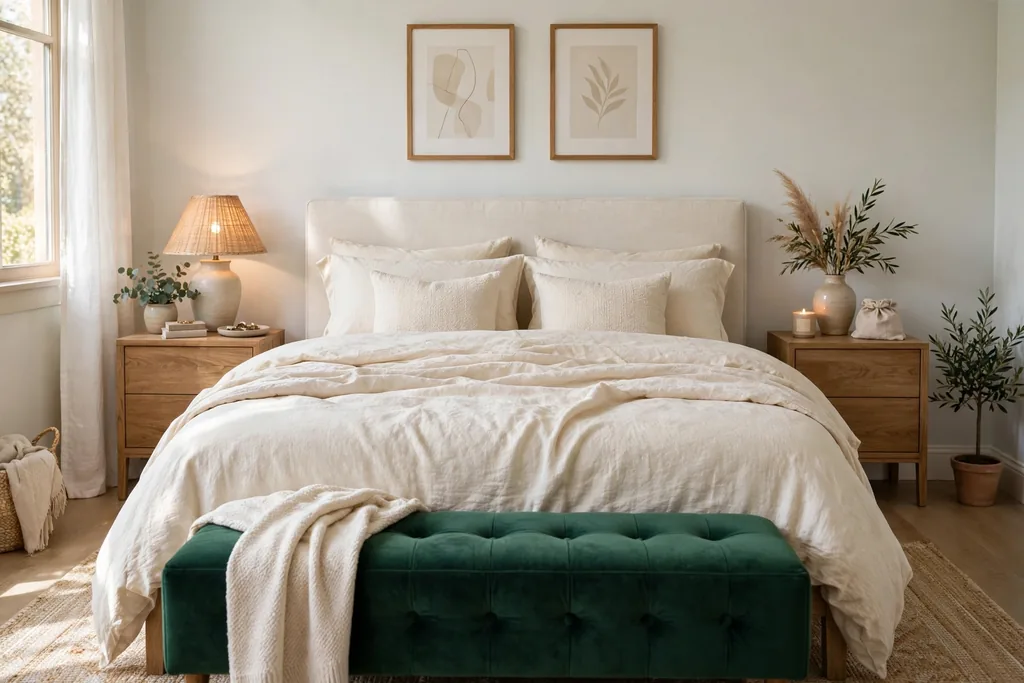
    13. Add an Emerald Bench at the Foot of the Bed

    Bedroom with an emerald green upholstered bench at the foot of a bed.

    Place an upholstered bench in emerald at the foot of the bed, where it gives a place to sit, lay out clothes, or set a tray in the morning. The bench adds a second block of emerald at a lower height than the headboard, which suits a larger bedroom or a room where the bed wall is already plain and needs balance. A bench also stops the foot of the bed from looking bare, especially in a room with a large rug.

    Choose a bench close to the bed width, so it reads as part of the bed rather than a separate piece, and keep the legs simple, in wood or matte black, so the emerald fabric stays the focus. Keep the top mostly clear, with one folded throw at most, so the bench stays usable and easy to keep tidy. If floor space is tight, a narrow bench or a pair of small stools gives the same color note without blocking the walkway.

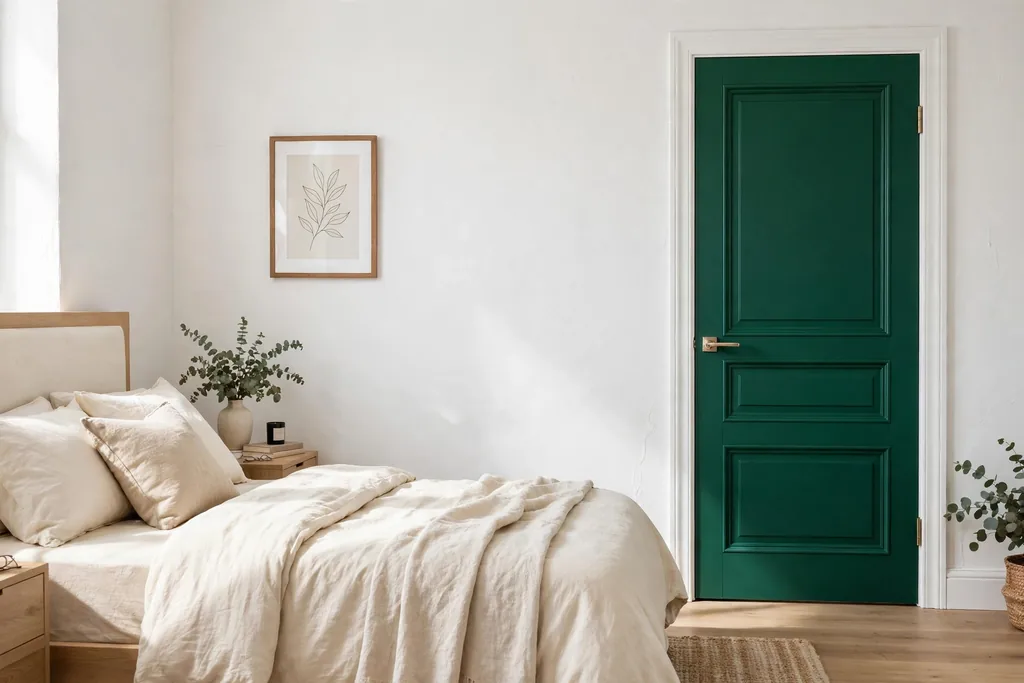
    14. Paint the Bedroom Door and Trim in Emerald

    Bedroom with an emerald green painted door and white walls.

    Paint the bedroom door, or just the trim around it, in emerald green, and keep the walls pale. The door becomes a framed block of color that you see every time you enter, which suits a room where the bed wall already has art or a headboard that should stay the focus. This is a small paint job, so it suits a weekend, and it is easy to repaint if you tire of it.

    Paint the door in the same finish as the trim for a clean edge, and remove the handles before you start. Repeat the door color once in the room, in a cushion or a small frame, so the emerald door does not look isolated. Keep the hallway side of the door in a neutral tone if the rest of the house is pale, so the strong color stays a bedroom surprise rather than a hallway statement.

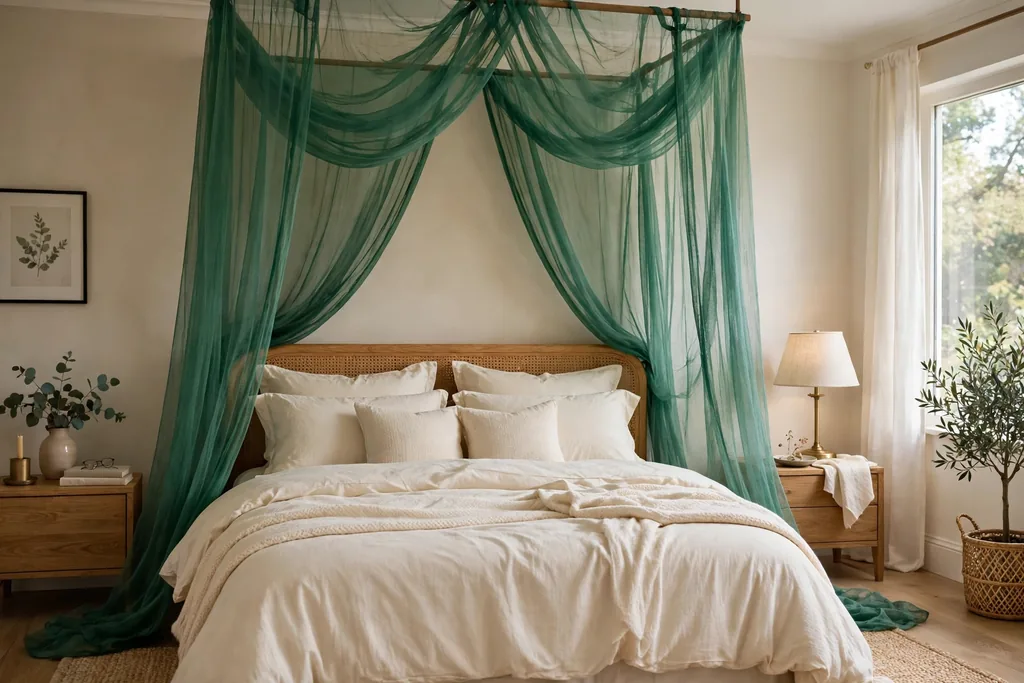
    15. Drape an Emerald Canopy Over the Bed

    Bedroom bed with a light emerald green canopy draped above it.

    Hang a light canopy or a draped fabric panel above the bed in emerald, so the bed gains color overhead and a soft, enclosed feel. The fabric suits a room with a plain ceiling and simple bedding, and a sheer or light emerald lets air move, so the canopy feels airy rather than heavy. A single draped panel on one side of the bed gives color without enclosure, if a full canopy feels like too much.

    Fix the canopy to the ceiling with fixings suited to the ceiling type, and keep it clear of bedside lamps, since fabric near a hot bulb is a risk. Wash the fabric often, since a canopy collects dust above the bed, and keep the bedding mostly cream beneath it, so the emerald overhead stays the focus. In a low room, hang the drape from a slim frame above the headboard instead of the ceiling, so the bed still feels open.

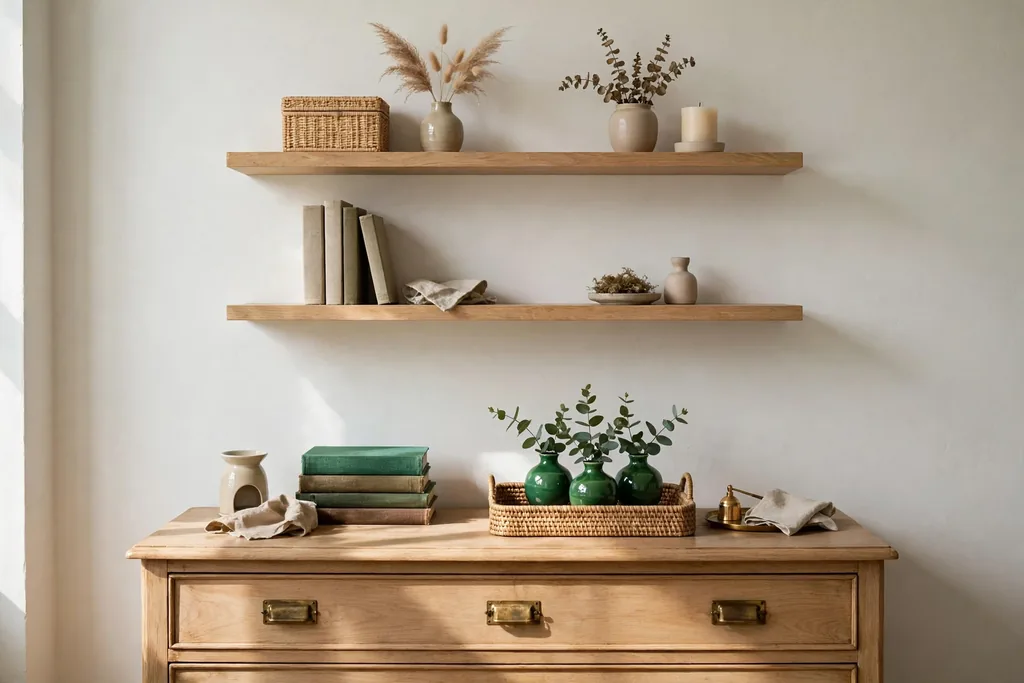
    16. Style Shelves and a Dresser Top With Emerald Objects

    Bedroom shelves styled with small emerald green vases, books, and a tray above a dresser.

    Style one or two open shelves, or a dresser top, with small emerald objects, such as a vase, a tray, a stack of books, and a small plant pot, against a pale wall. The display adds emerald in small doses that you can change without repainting, which suits a room where the walls must stay pale or where a large block of green would feel too strong. Group objects in threes, and leave one end of each shelf empty, so the display does not look packed.

    Repeat the emerald in the bedding or a cushion, so the shelves link to the rest of the room, and keep daily items, such as chargers and brushes, off the display, so the color groups stay clear. Dust the shelves often, since open displays collect dust faster than closed storage, and swap one object by season, for a quick color change that needs no new furniture. This small-dose approach also suits a small bedroom, where one emerald wall might close the room in.

    Conclusion

    An emerald green bedroom does not need green on every surface. Pick one strong place for the color, such as the bed wall, the headboard, or the bedding, then repeat it once or twice in smaller items and keep the rest of the room pale, with cream, light wood, and a touch of brass. Test paint and fabric in daylight and lamplight, start with bedding, cushions, and curtains when you want a quick change, and save walls and furniture for a weekend project. Pin the ideas you like so you can find them again when you start, and build a bedroom that feels rich by day and restful at night.

    FAQs

    How much emerald green should a bedroom have?

    Use emerald as one main accent, plus one or two smaller repeats, and keep the rest of the room pale. Put the strongest emerald on the bed wall, the headboard, or the bedding, keep the ceiling pale, and leave one calm surface, such as plain sheets or a plain rug, so the room still feels restful at night. If the room starts to feel dark, remove one emerald item before you add another.

    What colors pair best with emerald green in a bedroom?

    Cream, warm white, light oak, and brass pair best with emerald, since they soften the deep green and keep the room bright. Soft gold, pale grey, and muted blush also work as smaller notes, while black or dark wood can ground the palette in small doses, such as frames or handles. Avoid pairing emerald with too many other strong colors at once, since the room can quickly feel busy.

    Does emerald green make a bedroom feel dark?

    It can, if it covers too many surfaces or if the room gets little daylight, but kept to one wall or one large piece with pale walls and a pale ceiling, it adds depth without darkness. Warm bulbs, a light rug, and cream bedding all help, since they reflect light back into the room. Test paint in evening lamplight before you commit, since emerald looks much deeper at night than it does by day.

    What is the easiest way to add emerald without painting?

    Start with bedding, cushions, a throw, and curtains, since these swap in minutes and need no paint. An emerald rug, a velvet chair, a bench at the foot of the bed, or small objects on a shelf can also add a lot of color without touching the walls. Keep the new items in a shared emerald tone, so the room looks planned even though nothing was painted.

    Can a small bedroom handle emerald green?

    Yes, if the emerald stays in one place, such as one accent wall, the bedding, or a rug, while the other walls and the ceiling stay pale. A small room also suits emerald in smaller doses, such as cushions, a throw, a painted nightstand, or objects on a shelf. Keep the floor clear and the surfaces mostly tidy, since clutter makes a small dark-toned room feel crowded faster than a large one.

    How do I keep an emerald bedroom restful at night?

    Use warm bulbs, plain sleeping pillows, and a plain top sheet, so the bed feels calm even when the room has deep green elsewhere. Keep the strongest emerald off the wall directly opposite the bed if it catches lamplight, and use a dimmer on the bedside lamps, since lower light softens strong colors in the evening. Cream bedding and light wood also help the room feel calm once the daylight fades.


  • 30 Yellow and Grey Bedroom Decor Ideas to Inspire You

    30 Yellow and Grey Bedroom Decor Ideas to Inspire You

    Yellow and grey make a friendly pair for a bedroom. Yellow brings warmth and morning light, while grey keeps the room steady and restful, so neither color has to do all the work. These 30 yellow and grey bedroom decor ideas cover walls, bedding, furniture, curtains, art, lighting, and small swaps, so you can add a little sunshine in one place or build a full two color palette over time. Start with the change that fixes what bothers you most, test it in daylight and lamplight, and repeat each color at least twice so the room looks planned.
    Key Takeaways

    • Let grey carry the large surfaces, such as walls, bedding, and the rug, and let yellow work in smaller, repeated doses on cushions, curtains, art, and lamps.
    • Put the strongest yellow where you see it first, such as the bed wall, the bedding, or the window, and keep the ceiling pale so the room still feels open.
    • Repeat each color at least twice, in bedding and art, or in curtains and a cushion, so the palette looks linked rather than random.
    • Choose a yellow you can live with at night: soft butter and warm mustard suit most bedrooms better than a bright, sharp yellow on a large wall.
    • Test paint and fabric in morning light and evening lamplight before you commit, since yellow shifts a lot during the day.
    • Start with bedding, cushions, and curtains for a no-paint refresh, and save walls and painted furniture for a weekend project.

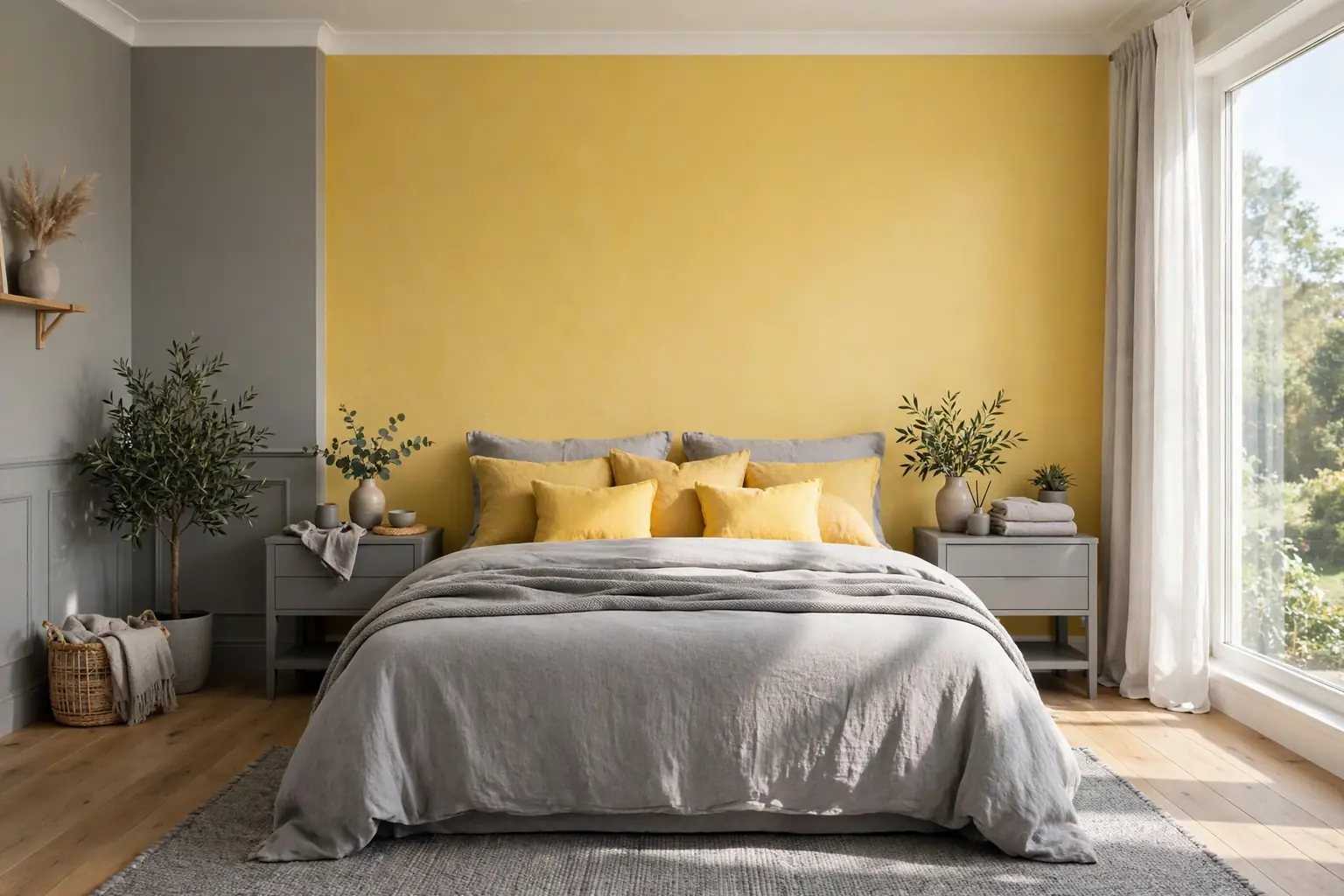
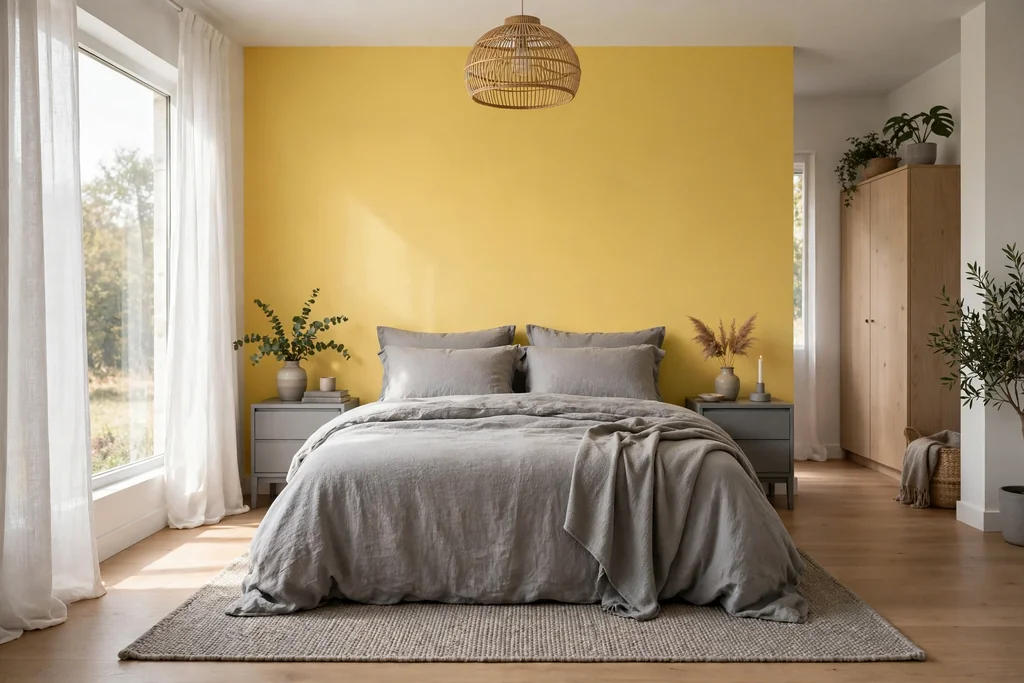
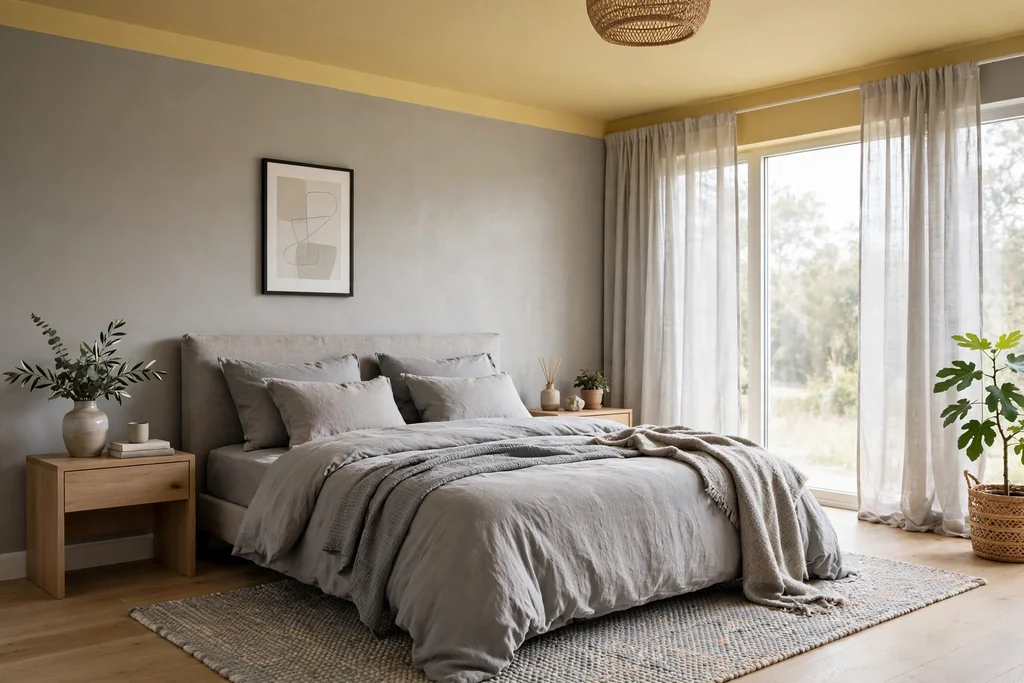
    1. Paint a Sunny Yellow Accent Wall Behind the Bed

    Bedroom with a sunny yellow accent wall behind a bed with grey bedding.

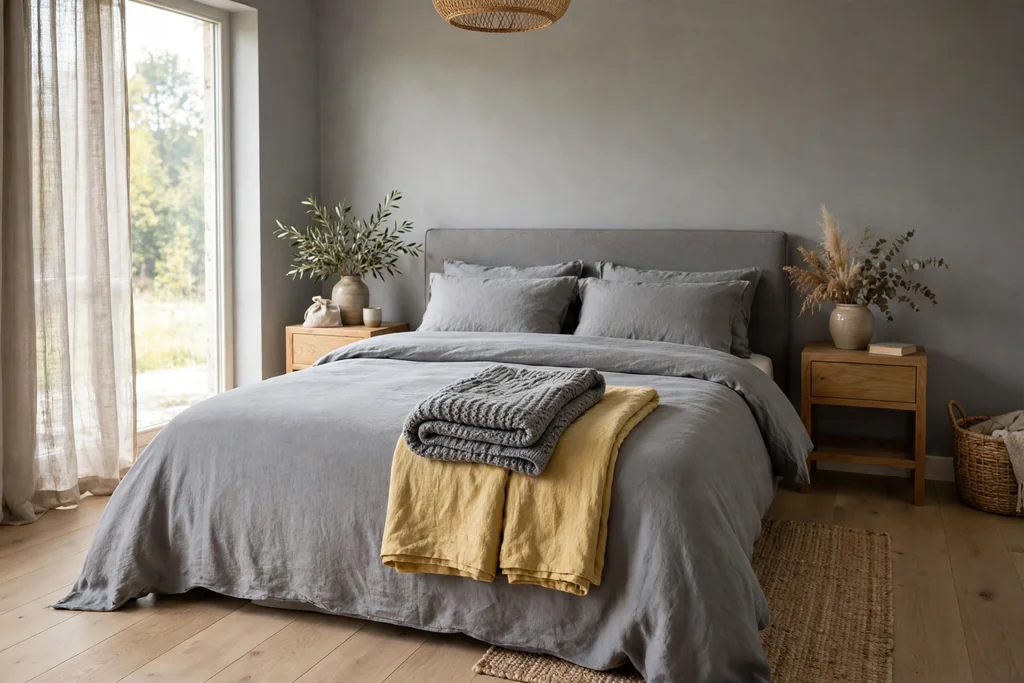
    Paint the wall behind the bed in a warm, sunny yellow and keep the other walls soft grey. The bed wall becomes the clear focal point, and the grey side walls keep the room from feeling loud. This suits a room with plain furniture, since the wall does the color work and little else needs to change.

    Choose a matte or eggshell finish so the wall does not shine under lamplight, and paint the trim in the same pale tone as the grey walls for a clean edge. Test a large sample on the bed wall first, and look at it in the morning and again at night, since a yellow that looks fresh by day can look much deeper in lamplight.

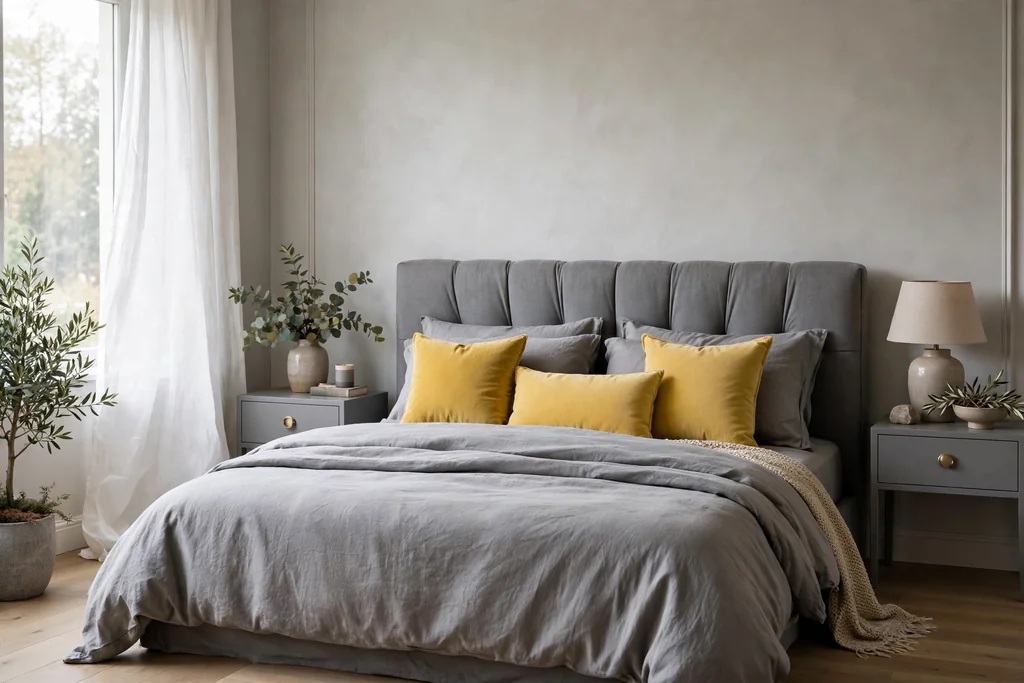
    2. Pair a Grey Upholstered Headboard With Yellow Cushions

    Bedroom with a grey upholstered headboard and yellow cushions on grey bedding.

    Choose a grey upholstered headboard in linen or velvet, then add two or three yellow cushions in front of plain grey or white sleeping pillows. The grey headboard gives the bed a soft, finished back, while the yellow cushions add the sunny note without any paint. This suits a room where the walls must stay pale, such as a rental.

    Measure the bed width and leave room for bedside tables on both sides before you buy. Keep the cushion count small so the bed stays easy to make, and put zip covers on the yellow cushions so you can wash them and swap shades by season. Repeat the yellow once more, in a throw or a small print, so the cushions do not sit alone.

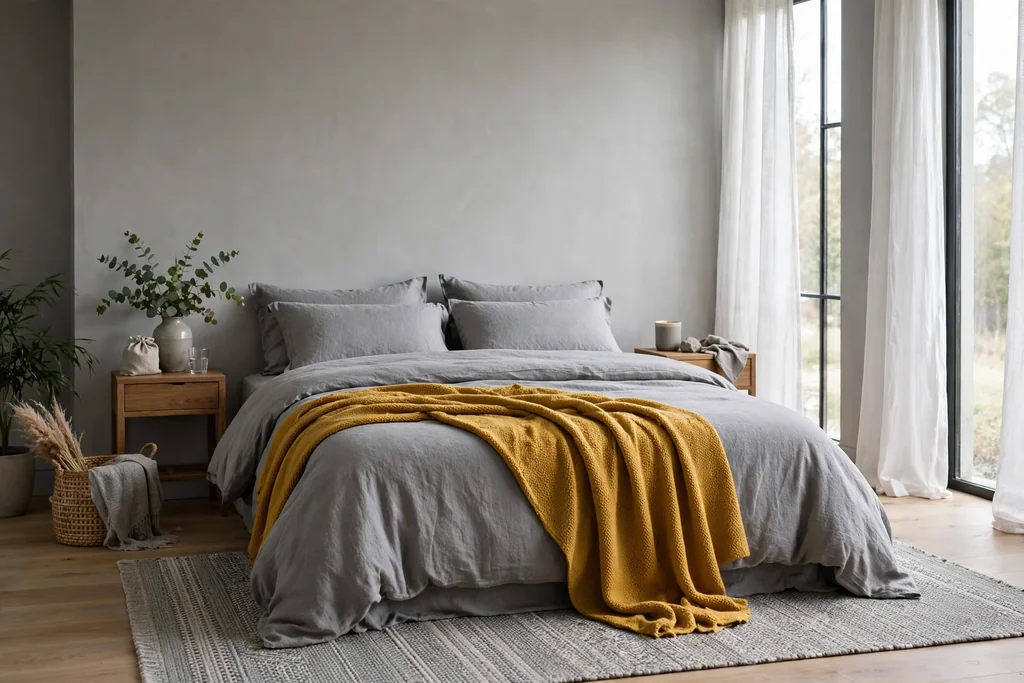
    3. Layer a Mustard Duvet Over Grey Sheets

    Bed with a mustard throw layered over grey sheets and a grey duvet.

    Build the bed in layers: grey sheets and a grey or white duvet, with a mustard duvet cover or a mustard throw folded across the lower half. The mustard warms the bed at a glance, while the grey underneath keeps the whole bed calm. This suits a room with grey walls, since the bed then carries the yellow and the walls stay quiet.

    Fold the top sheet back over the duvet each morning so the grey layer shows at the top and the mustard sits lower down. Wash the mustard cover apart from pale pieces at first, since strong dyes can mark light fabric. If mustard starts to feel strong, fold the throw narrower, so less of it shows.

    4. Hang Sunny Yellow Curtains on Grey Walls

    Bedroom with sunny yellow curtains on soft grey walls and grey bedding.

    Choose curtains in a sunny yellow, in plain linen or a soft cotton, and hang them on soft grey walls with plain grey or white bedding. The window becomes a block of sunshine, which suits a room with grey walls and simple furniture. Pick a yellow that shares a tone with one cushion, so the window links to the bed.

    Hang the rod high and wide, so the panels stack clear of the glass when open and daylight still fills the room. Line the curtains if the room faces strong sun, since yellow can fade, and keep the curtain length just brushing the floor so the panels look finished rather than short.

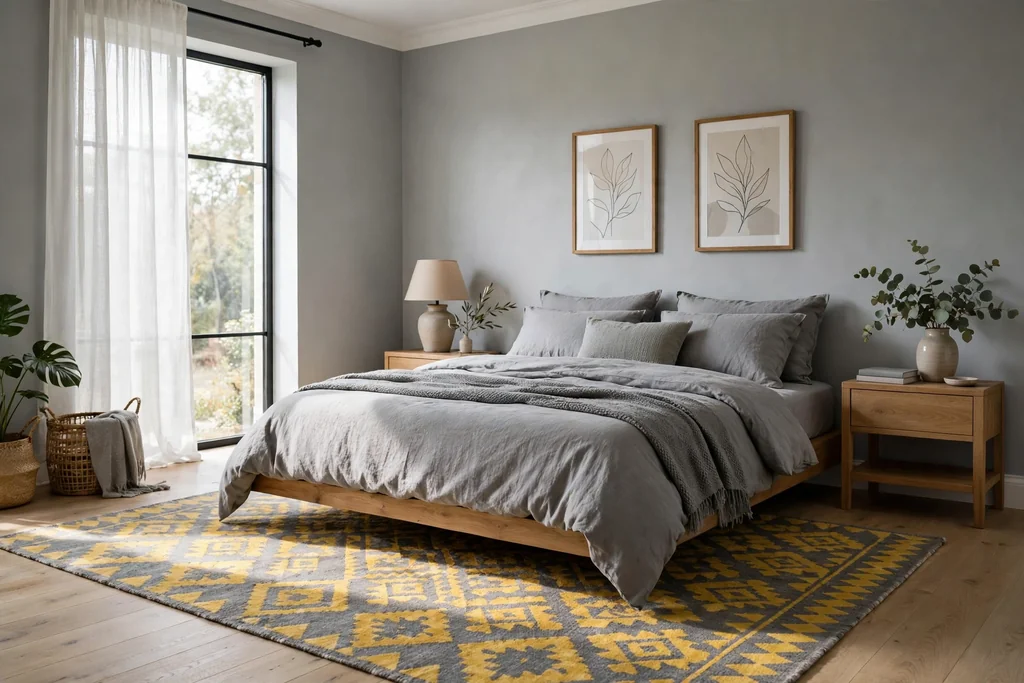
    5. Anchor the Bed With a Yellow and Grey Patterned Rug

    Bedroom with a yellow and grey patterned rug under the lower half of a bed.

    Place a large rug with a yellow and grey pattern, such as a soft geometric print or a wide border, under the lower two thirds of the bed, extending out on both sides. The rug gives the room a color base at floor level, which suits a bedroom with grey walls and plain bedding. A rug that is too small makes the bed look as if it is floating, so measure for a clear border on each side before you buy.

    Choose a low pile rug that doors and drawers can clear, and use a rug pad on smooth floors to reduce slipping. Repeat one rug color in the bedding or a cushion, so the floor color connects to the bed. Vacuum often, since a light grey rug shows dust more than a dark one.

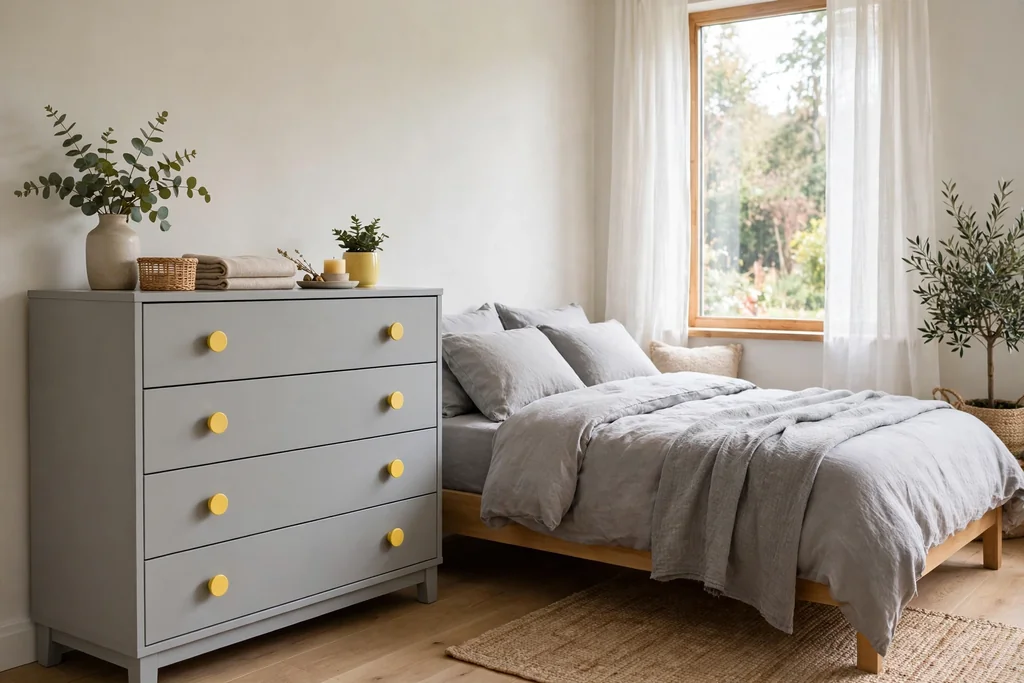
    6. Paint a Dresser Grey and Add Yellow Drawer Pulls

    Bedroom dresser painted soft grey with yellow drawer pulls.

    Paint a dresser in a soft mid grey and fit it with yellow drawer pulls, in ceramic, painted wood, or brushed metal with a yellow finish. The grey keeps the piece calm and easy to place, while the yellow pulls add small, repeated pops of color at hand height. This suits a room where a full yellow piece would feel like too much.

    Remove the old pulls before painting, and use a paint made for furniture so the finish stands up to daily use. Keep the dresser top mostly clear, with one tray or one vase, so the yellow pulls stay easy to see. Repeat the yellow once, in a cushion or a small frame, so the pulls do not look like a one off choice.

    7. Layer a Grey Knit Throw With a Yellow Linen Throw

    Bed with a grey knit throw and a yellow linen throw folded at the foot.

    Fold a grey knit throw and a yellow linen throw together across the foot of the bed, with the yellow layer slightly narrower so both colors show. The two textures add warmth and depth, and the pairing lets you change the mood by folding one throw back. This suits a room where the bedding is already grey, since the throws do the yellow work.

    Keep sleeping pillows plain, and put the throws at the foot of the bed, where they are easy to fold back at night. Wash the throws as advised on their labels, and store a spare yellow throw in a basket so a seasonal swap takes minutes. If the bed starts to feel busy, remove one throw and keep the other.

    8. Hang One Large Yellow and Grey Abstract Above the Bed

    Bedroom with one large yellow and grey abstract print above a bed.

    Hang one large abstract print in yellow and grey above the bed, with plenty of pale background so the colors read clearly without crowding the wall. The single piece becomes the art story of the room, while the bedding and furniture can stay simple. This suits a bedroom with one large empty wall above the bed and little else on it.

    Size the print to about two thirds of the bed width, and hang it so the bottom edge sits 6 to 8 inches above the headboard, or above the pillows if you have no headboard. For more ways to size and hang art above a bed or a dresser, see these bedroom wall art ideas. Use matching frame tones with the grey in the room, so the frame does not add a third color.

    9. Set Yellow Table Lamps on Grey Nightstands

    Bedroom with grey nightstands and yellow table lamps on both sides of a bed.

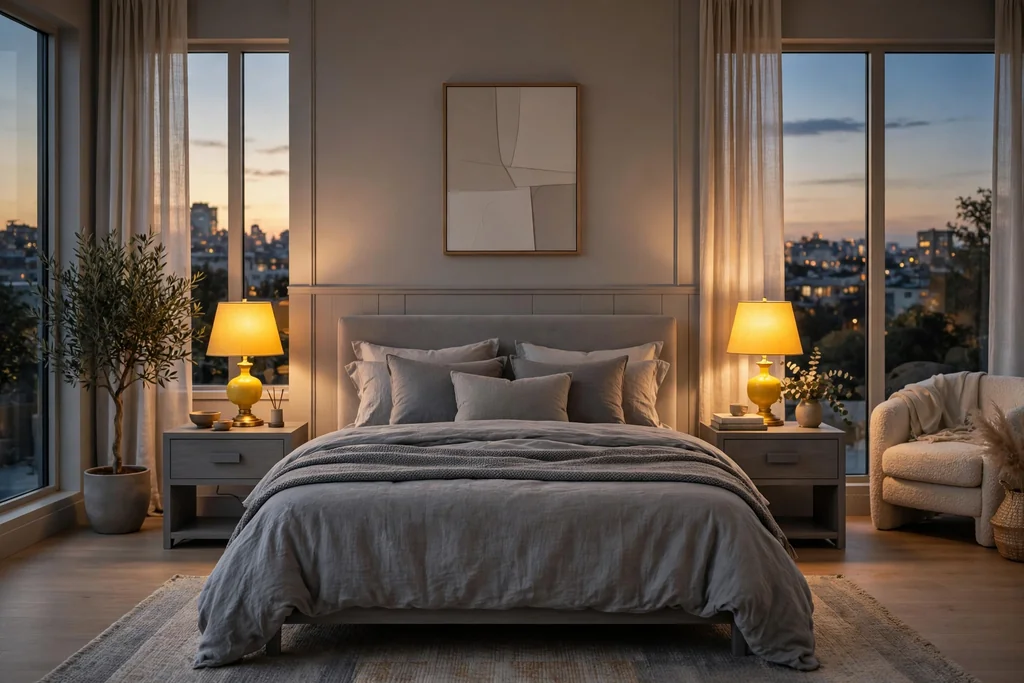
    Place grey nightstands on both sides of the bed, each with a yellow table lamp in ceramic, glass, or painted metal. The lamps add yellow at eye level in the evening, when wall color matters less, which suits a room that feels plain after dark. This is a quick change, since it needs no paint and no new furniture.

    Keep both lamps the same color and a similar size, so the bed still looks balanced, and use warm bulbs so the yellow glows softly at night. Keep bulb color consistent across the room, since mixed warm and cool bulbs make a palette look uneven. Keep each nightstand top mostly clear, so the lamp stays the focus.

    10. Make a Yellow Accent Chair the Grey Corner Focus

    Bedroom corner with a yellow accent chair and a small grey side table.

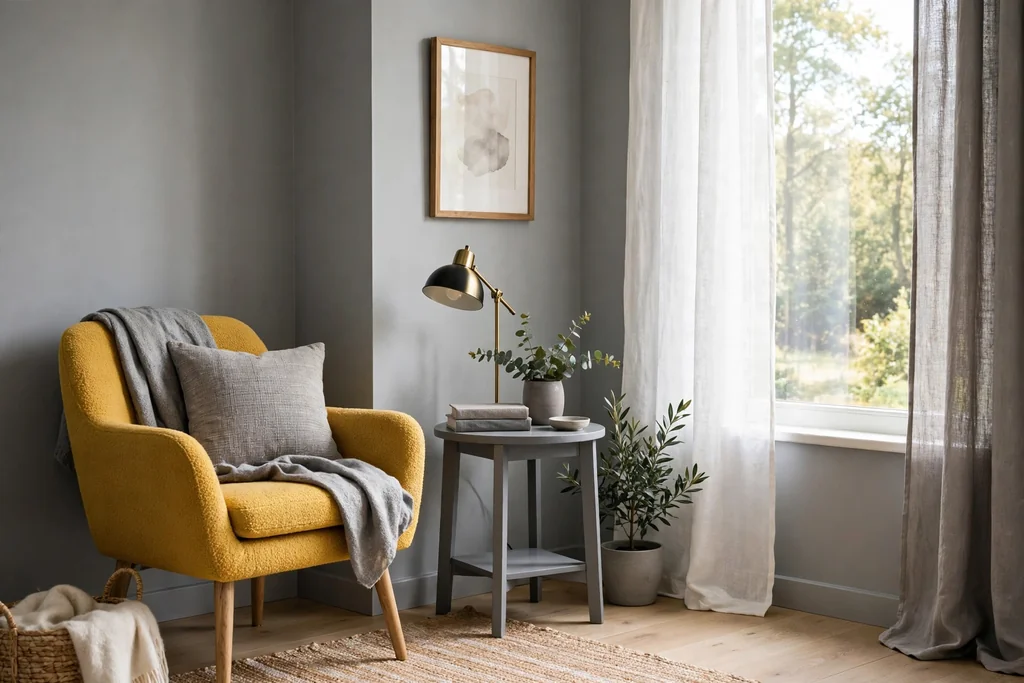
    Place one armchair in a warm yellow fabric in a bedroom corner, with a small grey side table and a reading lamp. The chair gives the room a second color focus away from the bed, which suits a larger bedroom or a room with an empty corner. A yellow chair also makes the corner an invitation to sit, rather than a spot for bags and laundry.

    Angle the chair slightly toward the room, and keep it clear of clothes, so it stays usable. Repeat the yellow once, in a cushion on the bed or a print on the wall, so the corner does not look cut off from the room. Choose a washable cover if the chair will get daily use.

    11. Dress the Bed in Yellow and Grey Striped Bedding

    Bed with yellow and grey striped bedding and plain grey walls.

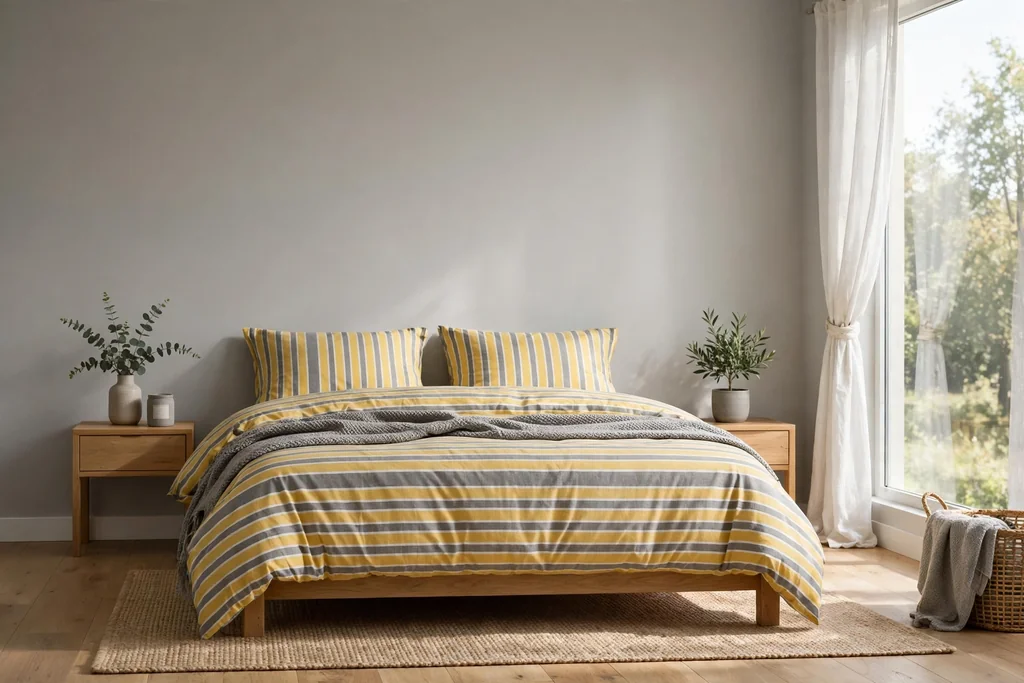
    Choose a duvet set with yellow and grey stripes, in a wide stripe for a bold look or a narrow stripe for a quieter one, and keep the walls and curtains plain. The bed becomes the pattern story of the room, which suits a room with grey walls and simple furniture. Pick a set with a pale grey stripe rather than a dark charcoal one, so the bed stays bright.

    Keep cushions to one or two solid tones taken from the set, and keep the throw plain, so the stripes stay the focus. Wash the set as advised on the label, since bright yellow dyes can fade in strong sun or hot washes. If the stripes feel strong at night, fold the duvet back to show plain grey sheets at the top.

    12. Paint the Bed Frame Yellow and Keep the Bedding Grey

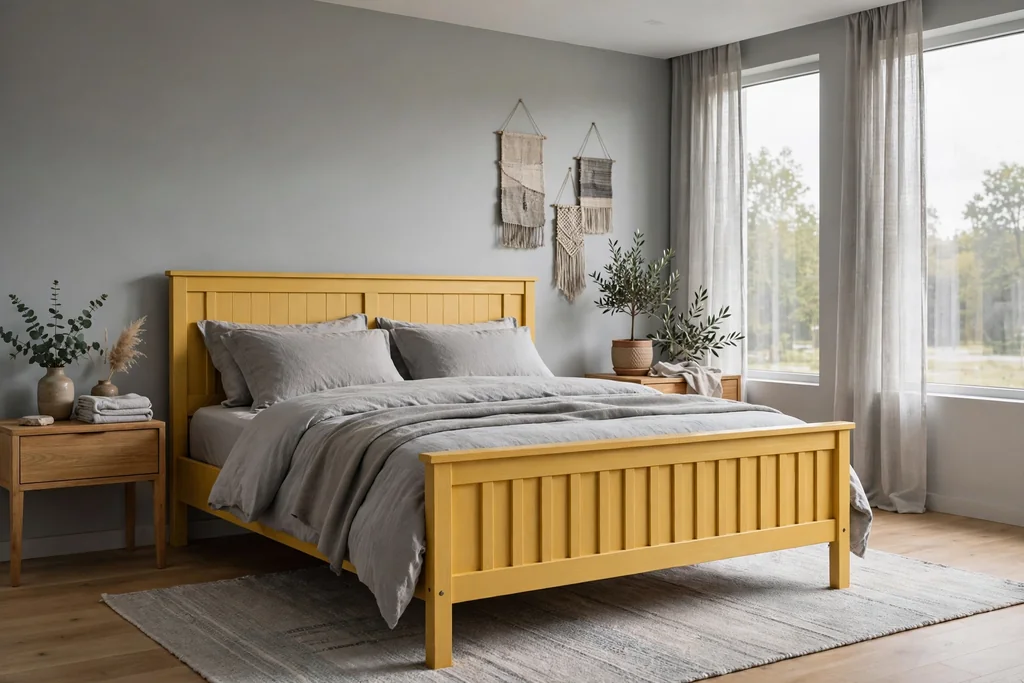
    Bedroom with a warm yellow painted bed frame and soft grey bedding.

    Paint a wood bed frame in a warm yellow, such as mustard or butter, and keep the bedding in soft grey and white. The frame becomes a bright outline for the bed, which suits a simple room with grey walls and little furniture. This works best on a wood frame with clean lines, where the color can show clearly.

    Sand and prime the frame first, and paint the headboard and footboard in the same color for a finished look. Keep the side rails in the same tone, or the frame can look unfinished from the door. Add one yellow cushion to the bed, so the bright outline feels planned rather than random.

    13. Paper the Bed Wall With Yellow and Grey Geometric Wallpaper

    Bedroom bed wall with yellow and grey geometric wallpaper and grey bedding.

    Use wallpaper with a yellow and grey geometric print, such as diamonds, arches, or a soft lattice, on the bed wall only. The pattern adds color and detail without painting the whole room, and the grey in the print keeps the yellow from feeling loud. Keep the other walls plain soft grey, so the papered wall stays the focus.

    Measure the wall and order a little extra paper for pattern matching at the seams. Start at the center of the bed wall and work outward, smoothing each strip as you go, so the pattern stays centered on the bed. If you rent, look for a peel and stick version made for your wall type, and test one strip in a hidden spot first.

    14. Pair Grey Wainscot Panels With a Butter Yellow Upper Wall

    Bedroom wall with grey wainscot panels below and butter yellow paint above.

    Fit grey wainscot panels or painted trim on the lower half of the bed wall, and paint the upper half in a soft butter yellow. The grey panels ground the wall, the yellow above adds light, and the split keeps either color from taking over the room. This suits a bedroom with plain furniture, since the wall itself carries the two color story.

    Paint the panels and the trim in the same grey for a clean edge, and stop the panels at a height that clears the headboard, so the line stays visible. Keep the other walls soft grey, so the bed wall stays the focus. If a full panel job feels like too much, paint the lower half grey without trim for a simpler two tone wall.

    15. Paint the Ceiling Butter Yellow Over Soft Grey Walls

    Bedroom with a butter yellow painted ceiling and soft grey walls.

    Paint the ceiling in a soft butter yellow and keep the walls soft grey. The color overhead feels sunny when you lie in bed, but it stays out of the main sightline from the door, so the room still feels calm on entry. This suits a room with grey walls that needs one quiet surprise.

    Keep the ceiling color pale rather than saturated, since a strong yellow ceiling can feel heavy in a low room. Paint the trim white for a clean edge, and test the color on a large board held overhead before you paint the full ceiling. Pair the ceiling with one yellow cushion or throw, so the color feels linked to the bed.

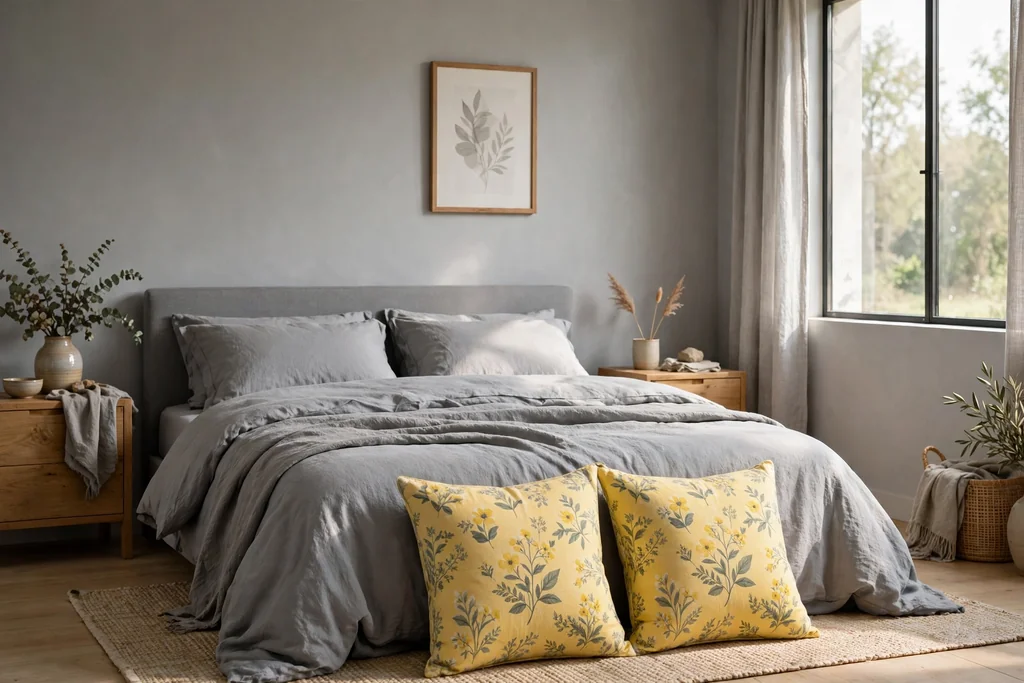
    16. Add Yellow Floral Cushions to Grey Bedding

    Bed with soft grey bedding and yellow floral cushions at the front.

    Build the bed in soft grey bedding, then add two yellow floral cushions, in an embroidered or printed floral, at the front of the pillow stack. The flowers add a soft yellow pattern, while the grey bedding keeps the bed calm. This suits a room with grey walls, since the cushions carry the yellow and the print adds detail without a new pattern on the walls.

    Keep the rest of the bed plain, with solid grey cushions behind the floral pair, so the flowers stay the focus. Wash the cushion covers as advised on their labels, and keep one spare cover so a faded cushion can swap out fast. If the floral feels busy, use one floral cushion and one plain yellow cushion instead of two florals.

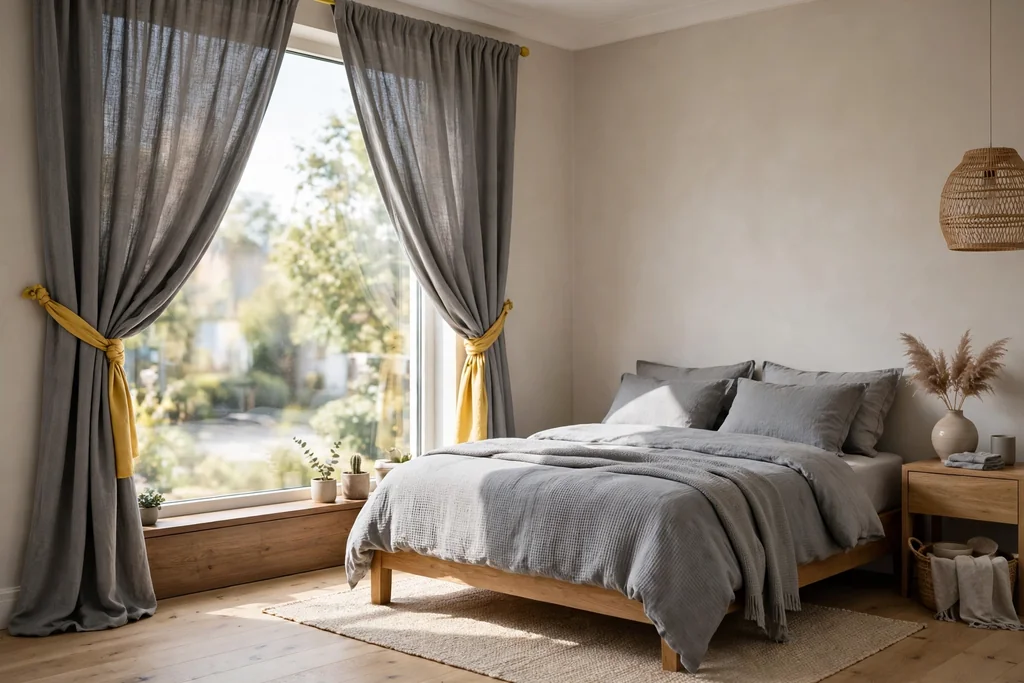
    17. Dress Grey Curtains With Yellow Tiebacks and Trim

    Bedroom window with grey curtains pulled back by yellow tiebacks.

    Hang grey curtains at the window, then add yellow tiebacks, or a yellow trim along the leading edge, to pull the panels back in the day. The grey panels keep the window calm, while the yellow detail adds a small, repeated sunny note. This suits a room where full yellow curtains would feel too strong, or where the bedding already carries a lot of yellow.

    Choose tiebacks in a fabric close to the curtain weight, so they hold the panels without slipping. Repeat the yellow once more, in a cushion or a small vase, so the tiebacks do not sit alone. Open the panels fully during the day, so the room gets full daylight and the yellow trim shows clearly.

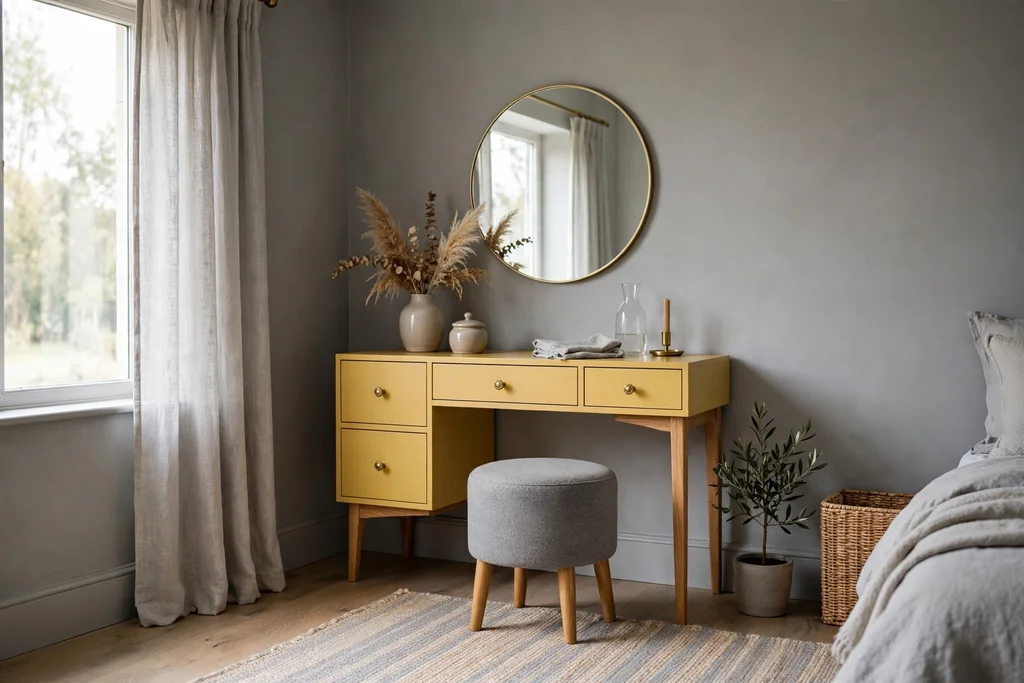
    18. Style a Yellow Dressing Table With a Grey Stool

    Bedroom corner with a yellow dressing table and a grey upholstered stool.

    Set a small dressing table in a warm yellow painted finish in a bedroom corner, with a grey upholstered stool, a plain mirror, and a tray for daily items. The corner becomes a cheerful dressing spot, while the grey stool keeps it tied to the rest of the room. This suits a bedroom with an empty corner near a window.

    Keep the table top mostly clear, with a tray for daily items, so the corner stays usable and easy to clean. Repeat the grey once, in the bedding or a rug, so the stool links to the bed. If space is tight, use a wall mounted shelf as the table top and a stool that slides underneath.

    19. Place a Yellow Bench at the Foot of a Grey Bed

    Bedroom with a yellow bench at the foot of a bed with grey bedding.

    Place a narrow bench in warm yellow, upholstered or painted wood, at the foot of a bed dressed in grey bedding. The bench gives you a place to sit while dressing and a spot to lay out clothes, while the yellow adds a clear block of color at the foot of the bed. This suits a room with clear walking space at the foot of the bed.

    Measure the gap to the opposite wall or door first, since a bench that blocks the walkway makes the room feel smaller, not brighter. Keep the top mostly clear, with one folded grey throw, and avoid using the bench as extra storage for clothes. In a short room, a small yellow stool at one side of the foot does the same job in less depth.

    20. Hang Yellow Pendant Lights Over Grey Nightstands

    Bedroom with yellow pendant lights hanging over grey nightstands.

    Hang a small yellow pendant light over each grey nightstand, instead of a table lamp, so the bedside light comes from above and the nightstand tops stay clear. The pendants add yellow at eye level in the evening and free up table space for a book or a glass of water. This suits a small bedroom, where nightstand space is tight.

    Hang the pendants at the same height on both sides, low enough to read by but high enough to clear the headboard and pillows. Use warm bulbs and a dimmer if you can, so the yellow glows softly at night. Keep the pendant cords tidy and the shades in the same yellow, so the pair looks planned.

    21. Fold a Yellow and Grey Patchwork Quilt Across the Bed

    Bed with a yellow and grey patchwork quilt folded across the lower half.

    Lay a patchwork quilt in yellow and grey squares across the lower half of a bed dressed in plain grey sheets. The mixed squares add pattern and warmth, and the quilt can fold back to show plain sheets beneath when the room needs a calmer look. This suits a room with plain grey walls and simple furniture, since the quilt carries both colors in one piece.

    Let the quilt lead and keep the rest of the bed plain, with solid cushions in one tone taken from the quilt. If the quilt feels busy, fold it across the lower half of the bed only, so the top half stays quiet. A quilt also suits a guest room, since it makes the bed look finished with little else in the room.

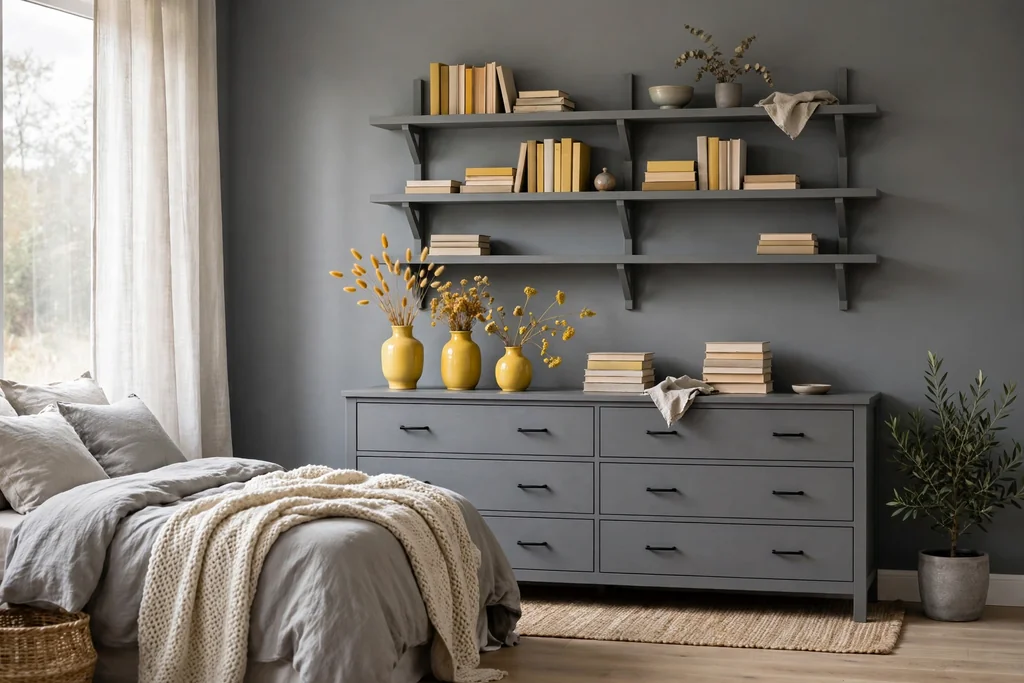
    22. Style Open Grey Shelves With Yellow Vases and Books

    Bedroom open grey shelves above a dresser styled with yellow vases and books.

    Fit one or two open shelves in soft grey above a dresser, and style them with yellow vases, a stack of books with yellow spines, and one small plant. The shelves become a color display that you can change without repainting, which suits a room where the walls must stay grey. Group objects in threes, and leave one end of each shelf empty, so the display does not look packed.

    Repeat the yellow in the bedding or a cushion, so the shelves link to the rest of the room. Keep daily items, such as chargers and brushes, off the shelves, so the color groups stay clear. Dust the shelves often, since open displays collect dust faster than closed storage.

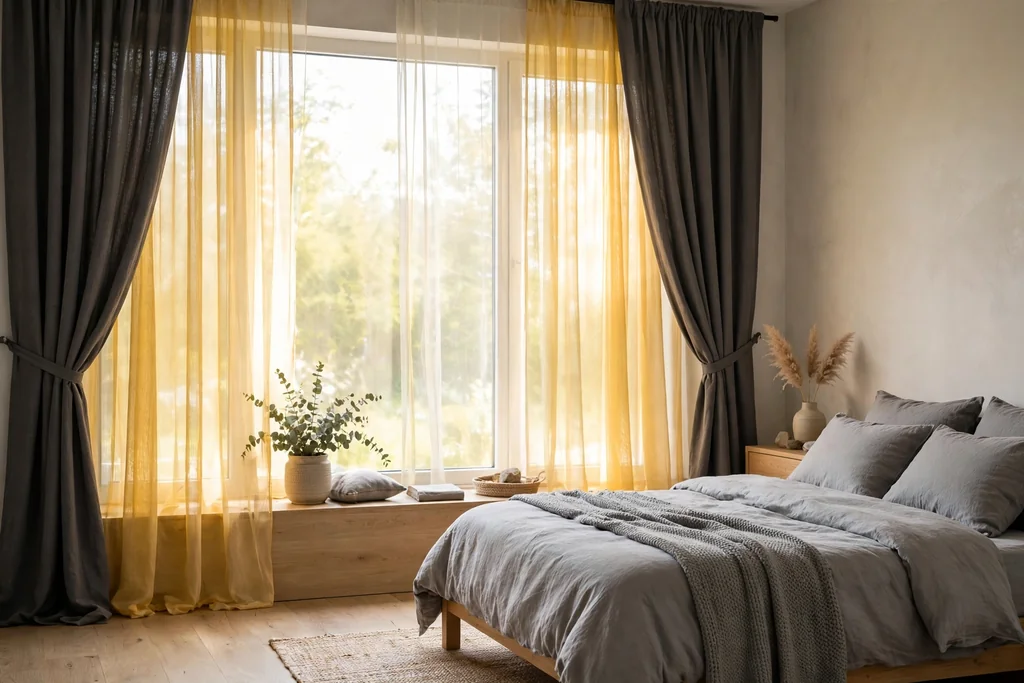
    23. Layer Grey Blackout Curtains With Yellow Sheer Panels

    Bedroom window with grey blackout curtains and yellow sheer panels in daylight.

    Hang grey blackout curtains on the outside of the window frame, with yellow sheer panels on the inside, closest to the glass. By day the sheers glow yellow in the sunlight while the grey panels stack to the sides, and at night the blackouts close for darkness and privacy. This suits a bedroom that needs both light control and a sunny daytime look.

    Hang the sheer rod close to the glass and the blackout rod high and wide, so each layer moves freely without catching. Wash the sheers often, since light fabric shows dust, and keep the blackout panels in a plain grey, so the yellow sheers stay the focus. For more pairing ideas that start from two colors, see these amazing bedroom color combos.

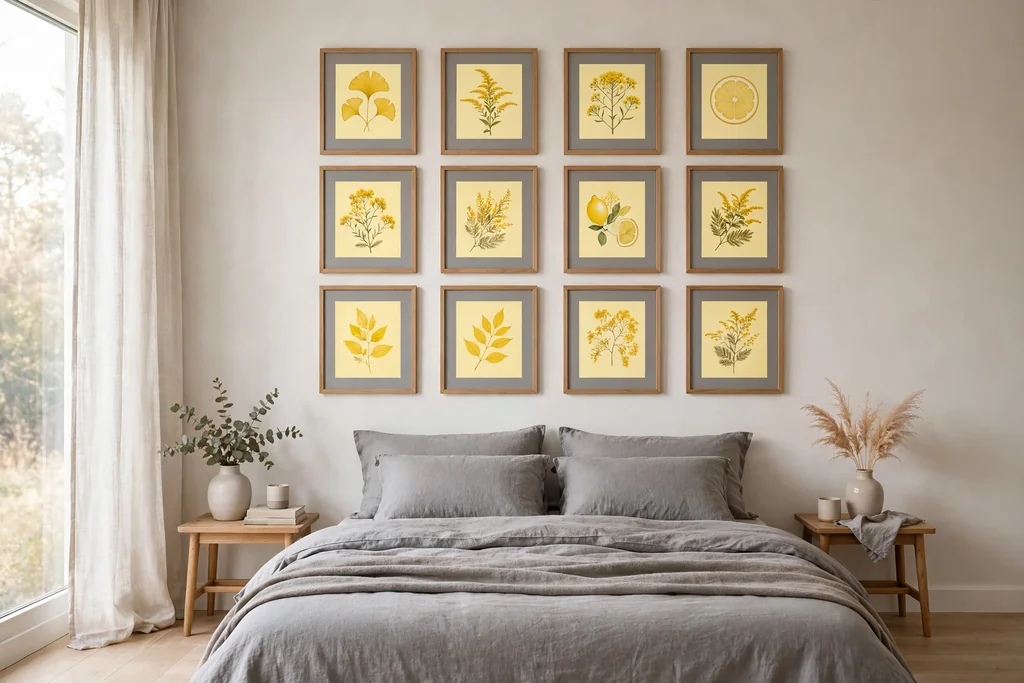
    24. Build a Yellow and Grey Gallery Grid With Grey Mats

    Bedroom wall with a grid of yellow prints in grey mats and simple frames.

    Hang a grid of prints with yellow subjects, such as lemons, sun shapes, or abstract blocks, in grey mats and simple frames on the wall opposite the bed. The grid gives the room a clear yellow story, while the grey mats and frames keep it tied to the walls and bedding. This suits a bedroom with one large empty wall and little else on it.

    Use matching frames and equal gaps, so the mix of prints looks ordered rather than scattered. Lay the frames on the floor first, measure the full block, and mark the wall with painter tape before you hang anything. For a calm base under a bright grid, see these elegant bedroom ideas, which show how plain bedding and clear surfaces keep a colorful room restful.

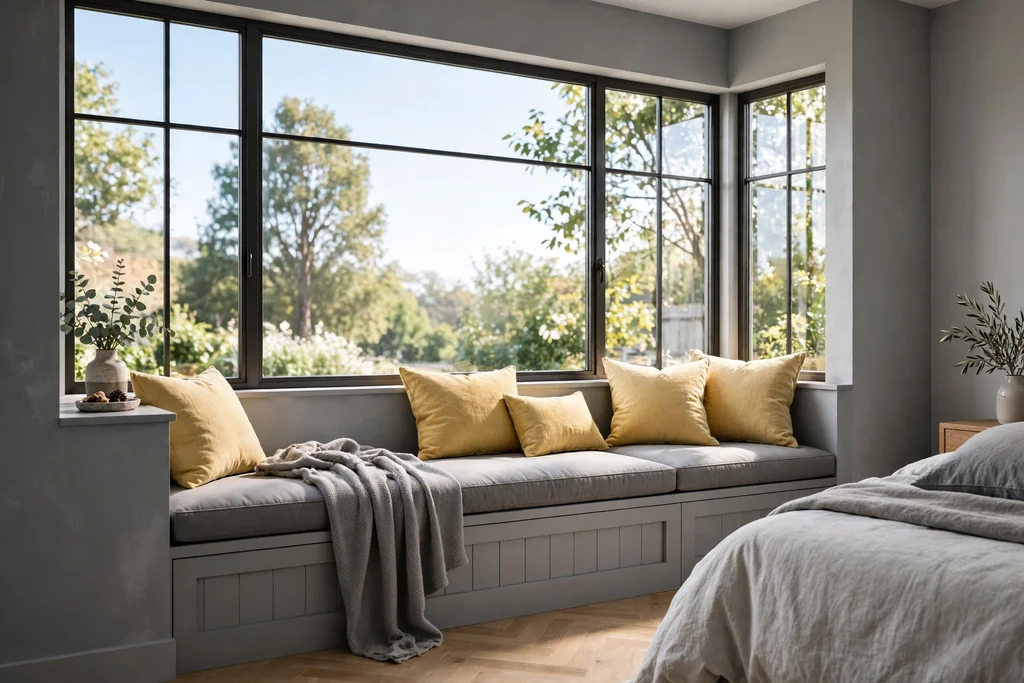
    25. Dress a Grey Window Seat With Yellow Cushions

    Bedroom window seat in soft grey with yellow cushions and a grey throw.

    Fit or style a window seat in soft grey, with a grey seat pad, then add yellow cushions and one grey throw for sitting and reading. The seat becomes a sunny nook by the window, while the grey base keeps it tied to the bed and walls. This suits a bedroom with a bay window or a wide sill that can hold a seat pad.

    Keep the cushions to two or three, so the seat stays usable, and store spare cushions in a basket nearby. Choose washable covers, since a window seat gets sun and daily use. Add a small basket below the seat for books, so the nook stays tidy and inviting.

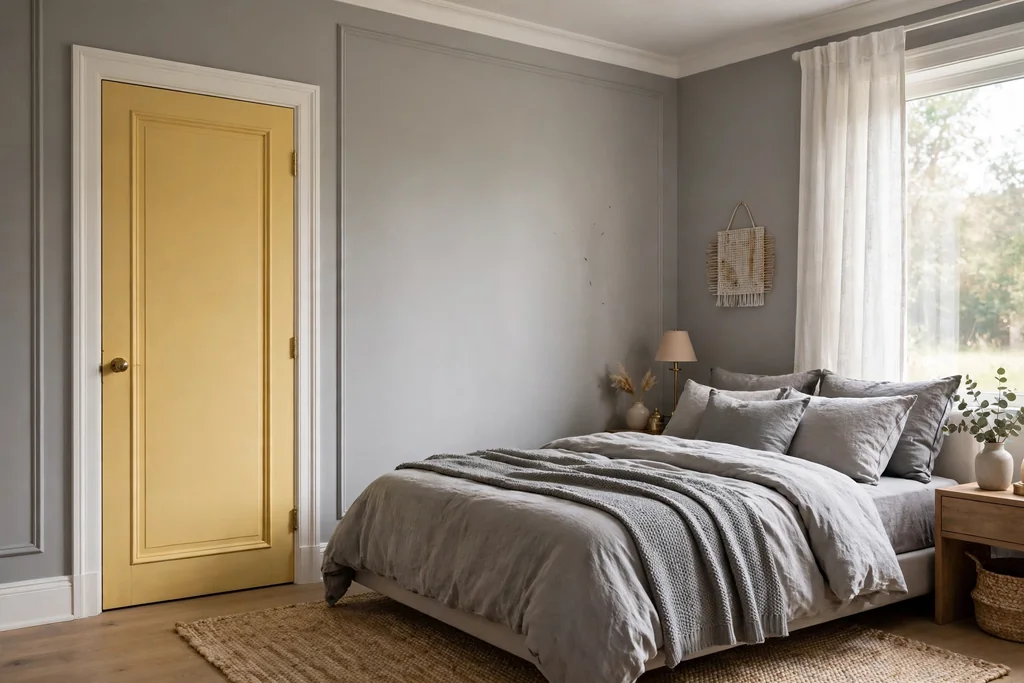
    26. Paint the Bedroom Door Yellow Against Grey Walls

    Bedroom with a warm yellow painted door against soft grey walls.

    Paint the bedroom door, or just the door on the bedroom side, in a warm yellow, and keep the walls soft grey with white trim. The door becomes a framed block of color that you see every time you enter, which suits a room where the bed wall already has art or a headboard that should stay the focus. This is a small paint job, so it suits a weekend.

    Paint the door in the same finish as the trim for a clean edge, and remove the handles before you start. Repeat the yellow once in the room, in a cushion or a small frame, so the bright door does not look isolated. Keep the hallway side of the door in a neutral tone if the rest of the house is pale.

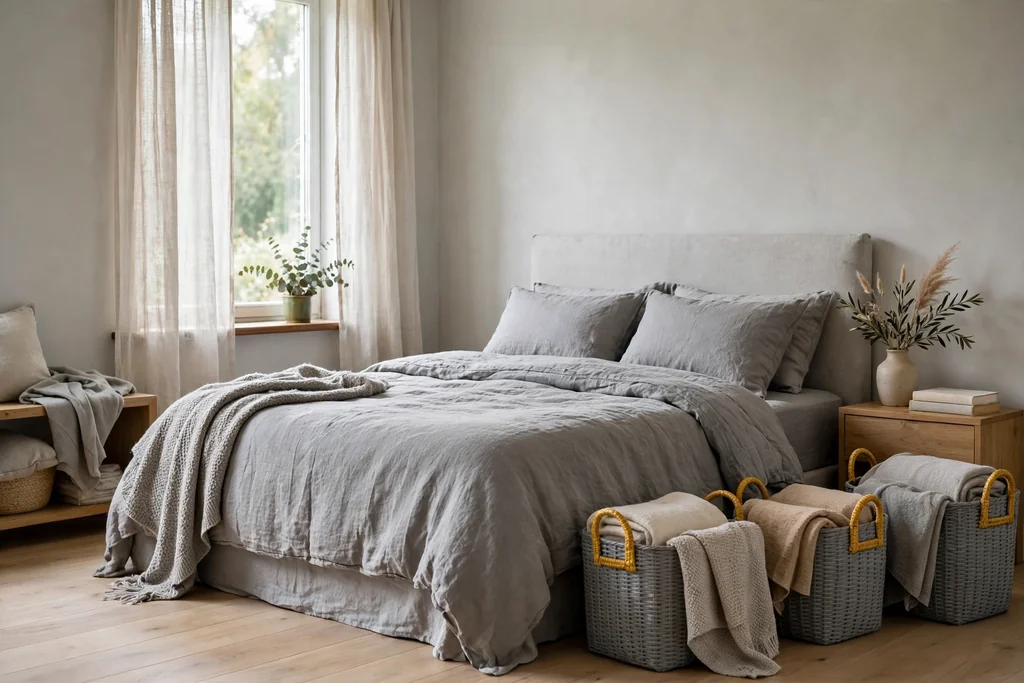
    27. Use Grey Storage Baskets With Yellow Woven Handles

    Bedroom with grey woven storage baskets with yellow woven handles.

    Replace plain storage boxes with grey woven baskets fitted with yellow woven handles, for throws, spare bedding, and laundry. The baskets add color at floor level and keep clutter out of sight, which suits a small bedroom where storage must stay on show. Choose baskets with lids for laundry and open baskets for throws you reach for daily.

    Keep basket colors to grey with yellow handles only, so the storage looks planned rather than mixed. Label the inside of a lidded basket if it holds seasonal bedding, so you can find it without emptying every basket. Wipe woven baskets with a damp cloth, since dust settles into the weave.

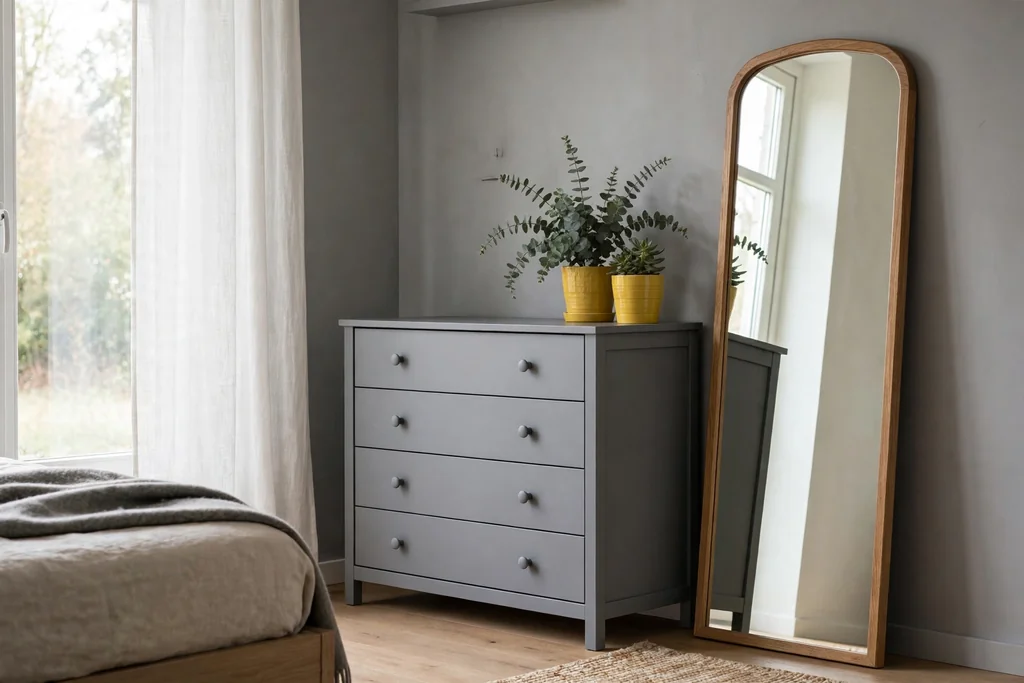
    28. Group Yellow Pots With Plants on a Grey Dresser

    Grey dresser with potted plants in yellow pots beside a bedroom mirror.

    Group three to five potted plants in yellow pots on a grey dresser or a windowsill, with trailing leaves and upright stems mixed together. The plants add living green plus yellow pot color, which suits a room with grey walls and plain bedding. Choose pots in one yellow tone, so the group looks planned rather than scattered.

    Keep plants in pots with drainage, and put a tray under the group to protect the dresser top. Water plants over a sink where possible, so the dresser stays dry, and rotate the pots now and then, so growth stays even. If the dresser top is narrow, use a plant stand beside the dresser instead, so pots do not crowd the mirror.

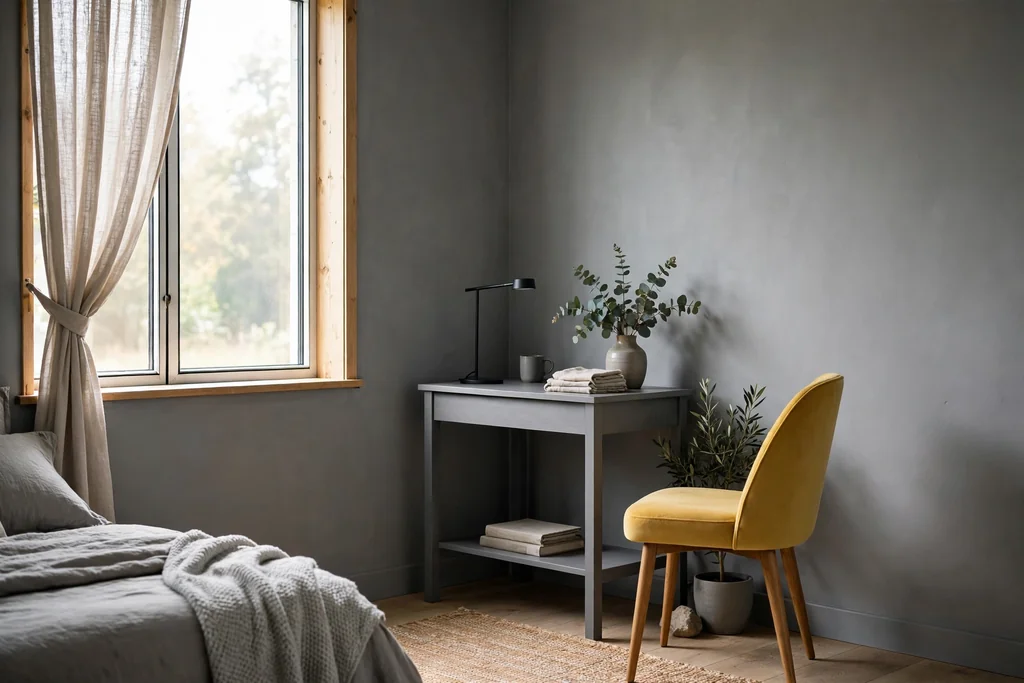
    29. Create a Grey Desk Corner With a Yellow Chair

    Bedroom corner with a small grey desk and a warm yellow chair.

    Place a small grey desk in a bedroom corner, with a warm yellow chair, a grey pinboard, and a lamp in a matching yellow. The corner becomes a clear work or reading spot, which suits a bedroom that must also serve as a study. Keep the work corner in the same yellow and grey palette as the bed, so the room still reads as one space.

    Keep the desk top mostly clear, with a tray for pens and papers, so the corner stays usable. Put the desk near a window if you can, so daylight helps during the day and the lamp takes over at night. Repeat the yellow once, in a cushion on the bed, so the chair links to the rest of the room.

    30. Hang a Yellow and Grey Striped Roman Blind

    Bedroom window with a yellow and grey striped roman blind in a neat fold.

    Fit a roman blind in yellow and grey stripes at the bedroom window, instead of full curtains, so the window gets pattern and color in a neat, flat fold. The blind suits a small bedroom or a window with furniture below it, where long curtains would bunch or block a radiator. Pick a stripe scale that reads clearly from across the room, but keep the rest of the window plain.

    Mount the blind inside the frame for a tidy look, or outside for more coverage if the window is small. Choose a lining that suits the room: blackout lining for sleep, or light filtering lining if you want morning glow. Raise the blind fully during the day, so daylight fills the room and the stripes stack neatly at the top.

    Conclusion

    A yellow and grey bedroom does not need yellow on every surface. Pick one strong place for yellow, such as the bed wall, the bedding, or the window, then repeat that yellow once or twice in smaller items and keep the rest of the room grey and calm. Test paint and fabric in daylight and lamplight, start with bedding and cushions when you want a quick change, and save walls and furniture for a weekend project. Save this post on Pinterest so you can find the ideas that fit your room size, your light, and how much sunshine you want to wake up to, and build a bedroom that feels bright by day and calm at night.

    FAQs

    How much yellow should a grey bedroom have?

    Use grey as the main color on walls, bedding, and large furniture, and yellow as the accent on cushions, curtains, art, lamps, and one larger piece at most. Repeat the yellow at least twice, so it looks planned, and keep the ceiling pale, so the room still feels open. If the room starts to feel loud, remove one yellow item before you add another.

    What shade of yellow works best with grey?

    Warm, muted yellows, such as butter, mustard, and soft ochre, sit best with grey, since they add warmth without glare. A bright, sharp yellow can work in small doses, such as a vase or a cushion, but it can feel harsh on a large wall, especially under lamplight. Test samples in morning light and evening light, since yellow shifts a lot during the day.

    Can a small bedroom handle yellow and grey?

    Yes, if the yellow stays in one or two places, such as the bedding or the curtains, while the walls and ceiling stay pale grey or white. A small room also suits yellow in smaller doses, such as a bench, a lamp, or art above the bed. Keep the floor clear and the surfaces mostly tidy, since clutter makes a small two color room feel crowded faster than a large one.

    How do I keep a yellow and grey bedroom calm at night?

    Use warm bulbs, plain grey sleeping pillows, and a plain grey top sheet, so the bed feels calm even when the room has yellow elsewhere. Close grey blackout curtains at night if the room faces a streetlight, and keep the brightest yellow off the wall directly opposite the bed if it catches lamplight. A dimmer on the bedside lamps helps too, since lower light softens yellow in the evening.

    What grey works best with yellow?

    A soft, warm grey suits most yellow shades, since a cold blue grey can make yellow look harsh. Mid grey works well on walls and furniture, while pale grey suits bedding and rugs, and charcoal grey should stay in small doses, such as frames or handles. If your room gets little sun, lean to pale grey, so the yellow can carry the light.

    How do I add yellow to a grey bedroom without painting?

    Start with bedding, cushions, a throw, and curtains, since these swap in minutes and need no paint. A yellow rug, yellow lamps, yellow pots, or a set of prints on one wall can also add a lot of yellow without touching the walls. Keep the new items in one yellow tone, so the room looks planned even though nothing was painted.


  • 26 Anime Inspired Bedroom Ideas for a Fresh Take on Your Home

    26 Anime Inspired Bedroom Ideas for a Fresh Take on Your Home

    Anime style brings soft color, bold line work, and a sense of story to a bedroom, without needing a full room makeover. A pastel poster wall, a low platform bed, or a row of paper lanterns can set the mood, while plain bedding and clear surfaces keep the room calm enough for sleep. These 26 anime inspired bedroom ideas cover walls, bedding, lighting, storage, and cozy corners, so you can start with one poster or plan a full themed room. Before you buy anything, pick one color palette and one focal wall, then let the rest of the room stay quiet around it.

    Key Takeaways

    • Pick one palette first, such as pastel pink and sky blue or navy and warm gold, and repeat it in bedding, art, and one accent piece.
    • Let one wall lead, with posters, a mural, or a neon sign, and keep the other walls plain so the room still feels restful at night.
    • Mix themed pieces with plain basics, so posters and figures sit against solid bedding, simple curtains, and clear furniture.
    • Use soft, layered light, with lanterns, LED strips, and a bedside lamp, rather than one harsh overhead light.
    • Give collections a home, with shelves, baskets, and a display case, so figures, books, and plush toys look arranged rather than scattered.
    • Keep the bed easy to use every day, with bedding you can wash, cushions you can move aside, and a reading light within reach.

    1. Pastel Anime Poster Gallery Wall

    Bedroom wall with pastel anime style posters in matching frames above a bed..

    A poster gallery wall is the fastest way to bring anime style into a bedroom. Choose posters in a shared palette, such as pastel pink, sky blue, and cream, and hang them in matching frames above the bed or a dresser. The matching frames keep a mix of art styles looking ordered, while the pastel tones keep the wall soft rather than loud.

    Lay the posters on the floor first and measure the full block, so the set spans about two thirds of the bed width. Hang the largest poster at eye level in the center, then build outward with smaller prints. For more ways to size and hang art above a bed or a dresser, see these bedroom wall art ideas. Leave one wall plain, so the gallery stays the clear focus of the room.

    2. Manga Reading Shelf by the Bed

    Manga shelf beside a bed with upright volumes and a small plant..

    A manga shelf beside the bed turns a collection into decor and keeps the next volume within reach. Fit a short shelf or a small bookcase at bed height, and arrange volumes upright with their spines facing out, grouped by series or by color. A few volumes laid flat on top make a handy spot for a bookmark or a small plant.

    Keep the shelf to one or two rows, so it reads as a reading corner rather than a storage wall. Leave a gap at the end of each row for new volumes, and pull out any duplicates or damaged copies. If the shelf sits near a lamp, check that light falls on the spines without glaring on the bed, so late reading stays comfortable.

    3. Cherry Blossom Decal Accent Wall

    Bedroom wall with a cherry blossom branch decal above a bed with plain bedding..

    Cherry blossom decals give a bed wall a soft, storybook feel without paint or wallpaper. A branch decal that runs from a corner across the headboard wall, with scattered petals, suits a pastel or pale neutral room. Decals peel off cleanly in most cases, which makes them a good choice for a rented room or a first themed room.

    Place the main branch above the headboard, then add petals sparingly toward the ceiling or a side wall, rather than covering every surface. Keep bedding plain in white, cream, or pale pink, so the blossoms stay visible. Test one petal in an unseen spot first, and follow the decal instructions for removal, so the wall paint stays intact.

    4. Soft Neon Word Sign Above the Bed

    Bedroom with a soft pink neon style word sign glowing above a bed..

    A soft neon style sign adds a warm glow and a personal word above the bed. Choose a short word or a simple shape in warm white, soft pink, or pale blue, and mount it centered above the headboard. The glow works as evening light, so the room can stay dim and calm before sleep.

    Plug the sign into a switched socket, so you can turn it off easily at night, and keep the cord tidy with clips along the wall or behind the headboard. Pair the sign with plain bedding, so the glow stays the main feature. If the sign feels bright for sleep, add a dimmer or switch it off and use a small bedside lamp instead.

    5. City Skyline Mural at Night

    Bedroom wall with a city skyline mural at night behind a bed..

    A city skyline mural brings the feel of a night scene to a bedroom wall, with lit windows, rooftops, and a dark sky. Paint it on one wall only, or use a large removable mural panel, and keep the other walls plain. The mural suits a bed wall, where you see it from the door and from the bed itself.

    Keep the mural colors simple, with a deep blue or charcoal sky and warm yellow window lights, so the scene reads clearly from across the room. Pair it with plain bedding and a dark rug, and avoid adding a busy poster wall on the same wall. If you rent, choose a removable panel or a large canvas version, so the wall stays undamaged.

    6. Floor Cushion Watching Nook

    Bedroom corner with floor cushions, a low tray, and a throw for watching..

    A floor cushion nook gives you a soft spot for watching shows, reading, or talking with friends, without taking over the whole room. Place two or three large floor cushions and a low bolster in a corner, with a small tray for drinks and a throw within reach. A rug under the cushions marks the nook and keeps it from sliding on a hard floor.

    Stack the cushions against the wall when the nook is not in use, so the corner stays tidy during the day. Choose cushion covers you can wash, since floor cushions collect dust and spills faster than bed pillows. Add a small lamp or a string of lights nearby, so the nook has its own soft light in the evening.

    7. Original Cel Style Art Prints

    Bedroom wall with framed original cel style art prints above a desk..

    Original art prints in a cel style, with clean outlines and flat color, capture anime style without copying a licensed image. Look for prints from independent artists, or make your own simple scenes, such as a girl with an umbrella, a cat on a rooftop, or a train crossing a field. Framed in matching slim frames, the prints feel like a small gallery.

    Hang two or three prints together above a desk or a dresser, rather than scattering single prints around the room. Keep the frame style consistent and the mat color plain, so the art stays the focus. Rotate prints by season if you like, and store the spares flat in a portfolio, so they stay clean and unbent.

    8. Anime Pattern Bedding Set

    Bed with anime style star and cloud patterned bedding and plain pillows..

    Patterned bedding is the largest themed surface in a bedroom, so it sets the mood fast. Choose a duvet set with a clear anime style pattern, such as stars, clouds, cherry blossoms, or a simple character-free scene, in colors that match your wall palette. A patterned duvet with plain pillowcases keeps the bed from looking busy.

    Wash the bedding as advised on the label, and keep a plain spare set for laundry days, so the room never loses its base color. If the pattern is bold, keep curtains and rugs plain, and repeat one color from the bedding in a single cushion. This balance keeps the bed lively in the day and calm enough for sleep at night.

    9. Star Ceiling With Soft LED Glow

    Bedroom ceiling with glowing star dots above a bed at night..

    A star ceiling turns the ceiling into a night sky, with small glowing dots that suit a bedroom made for relaxing. Use adhesive star decals that glow softly, a star projector, or a string of tiny lights fixed in a simple pattern above the bed. The effect works best in a room with dark or dim evening light.

    Keep the stars above the bed or in one ceiling corner, rather than covering the whole ceiling, so the effect feels like a sky rather than a busy pattern. Test the projector or lights at night before fixing anything in place, and choose a timer or remote, so the lights switch off after you fall asleep. Pair the ceiling with plain walls, so the stars stay the evening focus.

    10. Low Tatami Style Platform Bed

    Low wooden platform bed with plain bedding in a calm bedroom..

    A low platform bed gives a bedroom a calm, Japanese inspired base that suits anime style well. A simple wooden platform, close to the floor, with a firm mattress and plain bedding, leaves the wall and art free to carry the theme. The low height also makes a small room feel taller, since more wall shows above the bed.

    Choose a platform with a solid base and a gap for air under the mattress, so moisture does not build up below it. Keep the area beside the bed clear, with a small tray or a low stool for a book and a lamp, rather than a tall nightstand. If you like floor cushions, the low bed height makes it easy to move between the bed and a watching nook.

    11. Paper Lantern Bedside Lighting

    Bedroom nightstand with a glowing paper lantern lamp beside a bed..

    Paper lanterns give a bedroom a soft, diffused glow that suits evening reading and winding down. Hang one lantern beside the bed, or place a small lantern lamp on a nightstand, in white, cream, or a pale pastel tone. The paper softens the bulb light, so the room feels warm without glare.

    Use a low wattage bulb or an LED bulb that stays cool, and keep the lantern away from bedding and curtains, since paper needs clear space around it. If the lantern hangs, check that it sits above head height when you sit up in bed, so it never brushes your head. Dust the lantern gently with a dry cloth, since paper tears easily when wet.

    12. Plush and Figure Display Shelf

    Bedroom shelf displaying plush toys and small figures above a dresser.

    A display shelf gives plush toys and small figures a clear home, so they look like a collection rather than clutter. Fit a shelf above a dresser or a desk, with a raised edge or a small case for figures, and group pieces by size, with larger plush toys at the ends and smaller figures in the middle. A plain shelf color keeps the focus on the pieces.

    Dust the shelf weekly, since figures and plush toys collect dust fast, and rotate a few pieces each month, so the display stays fresh without growing larger. Keep the shelf out of direct sun, so colors and fabrics do not fade. If the collection grows, add a second shelf rather than crowding one, so each piece still has breathing room.

    13. Drawing and Sketching Corner

    Bedroom desk corner with sketchbook, pens, and a lamp near a window..

    A sketching corner turns anime interest into a creative habit, with a desk, good light, and supplies within reach. Set a small desk near a window, with a lamp, a sketchbook, pens, and a cup for pencils, and keep the desk top mostly clear, so drawing starts fast. A pinboard above the desk holds reference sketches and color swatches.

    Keep supplies in one tray or a small organizer, so the corner stays usable between sessions. Choose a chair that supports a long sitting session, and place the lamp on the side opposite your drawing hand, so your hand does not cast a shadow on the page. If space is tight, a fold-down desk or a desk that shares space with a reading nook can work well.

    14. Sky and Cloud Sheer Curtains

    Bedroom window with sheer sky and cloud patterned curtains in daylight..

    Sheer curtains printed with a soft sky or cloud pattern bring a daytime anime feel to a bedroom window. The sheer fabric lets daylight through in a gentle wash, while the cloud print adds interest without blocking the view. This idea suits a bedroom where you wake with the light and want a soft, dreamlike window.

    Hang the rod high and wide, so the panels stack clear of the glass when open and daylight still fills the room. For fabric, length, and lining choices that suit different windows, see these bedroom curtain ideas. Wash patterned curtains as advised on the label, since bright prints can fade in strong sun. Pair the curtains with plain bedding, so the window stays the patterned feature.

    15. Floating Shelves for Collectibles

    Bedroom wall with floating shelves holding small figures and books..

    Floating shelves give a bedroom a clean way to show collectibles without a bulky bookcase. Fit two or three shelves on one wall, spaced so taller pieces fit below the top shelf, and group items by theme or color on each shelf. A shelf near the bed or desk suits small figures, while a higher shelf suits lighter pieces you rarely handle.

    Fix shelves into studs or with fixings rated for the full load, since a shelf of books and figures gets heavy fast. Keep one shelf partly empty, so new pieces have a place and the display never looks packed. Check that shelves sit above head height over a bed or desk, so you never bump them when you stand up.

    16. Sakura Pattern Area Rug

    Bedroom with a sakura blossom pattern rug under the lower half of a bed..

    A sakura pattern rug anchors the bed and adds a soft floral note underfoot. Choose a rug large enough to sit under the lower two thirds of the bed, with a blossom pattern in one or two colors from your palette, on a pale background. The rug defines the sleeping area and softens a hard floor in the morning.

    Vacuum the rug often, and spot clean spills fast, since a pale rug shows marks quickly. If the rug sits on a smooth floor, add a non slip pad below it, so it stays in place when you step out of bed. Keep the rest of the floor plain, so the rug pattern reads clearly, and repeat one rug color in a cushion or a throw.

    17. Washi Tape Photo and Print Wall

    Bedroom wall with small prints and photos taped with pastel washi tape..

    Washi tape turns a photo and print wall into a flexible display you can change often. Tape small prints, photos, ticket stubs, and sketches to one wall in a loose grid, using tape colors that match your palette. The tape frames each piece without holes, which suits a rented room or a wall you like to refresh.

    Plan the layout on the floor first, then tape the largest pieces at eye level and fill around them with smaller ones. Leave a small gap between pieces, so the wall color shows and the display does not look crowded. Replace tape that loses grip, and test a strip on your wall paint first, since some tapes lift paint on fresh or matte finishes.

    18. Curtained Bed Den for Reading

    Bed with sheer curtains forming a cozy reading den around the head end..

    A curtained bed den turns a bed into a cozy reading spot, with curtains hung from a ceiling track or a bed frame around the head end. Sheer curtains keep the den light and airy, while heavier curtains make it darker and more private. The den suits a bed in a corner, where two walls already help enclose the space.

    Hang the track close to the ceiling, so the curtains fall to the mattress edge without pooling on the bed. Keep a reading light inside the den, clipped to the headboard or on a small shelf, so you can read without holding a lamp. Tie the curtains back during the day, so the bed still feels open and the room stays bright.

    19. Mood Board and Inspiration Corkboard

    Bedroom corkboard with fabric swatches, paint chips, and small sketches..

    A corkboard mood board collects the colors, scenes, and ideas behind your anime bedroom in one place. Pin fabric swatches, paint chips, print cutouts, and small sketches to a board above a desk or dresser, and rearrange them as the room takes shape. The board also works as a planning tool before you buy new pieces.

    Keep the board to one clear palette, and remove any swatch that clashes, so the board guides choices rather than confusing them. Use pins rather than glue, so pieces can move as ideas change. If the board sits in a main view, frame it in a simple wood frame, so it reads as decor rather than a work surface.

    20. Night Sky Bed Canopy With Fairy Lights

    Bed with a sheer canopy and warm fairy lights above the headboard..

    A bed canopy with fairy lights gives a bedroom a night sky feel above the bed. Drape sheer fabric from a ceiling ring or a frame above the headboard, and weave a string of warm white fairy lights through the top edge. The fabric softens the light, so the bed feels enclosed and calm in the evening.

    Keep the fabric light and sheer, so air still moves around the bed, and check that the canopy hangs clear of lamps and heaters. Use battery lights with a timer, or plug-in lights with a switch near the bed, so the lights switch off easily at night. Tie the canopy sides back during the day, so the bed stays open and easy to make.

    21. Sunset Gradient Accent Wall

    Bedroom wall painted in a sunset gradient from peach to soft pink behind a bed..

    A sunset gradient wall, fading from a warm peach at the bottom to a soft pink or pale blue at the top, gives a bedroom a sky-like backdrop behind the bed. Paint the gradient on one wall only, blending the colors while the paint is still wet, or use a gradient wall decal for a simpler version. The soft fade suits plain bedding and simple furniture.

    Test the colors on a large board first, and view the board in both daylight and evening light, since gradient colors shift as light changes. Keep the other walls plain and the bedding mostly solid, so the gradient stays the clear feature. If painting feels risky, a large gradient canvas behind the bed gives a similar effect without painting the wall.

    22. Themed Storage Baskets and Boxes

    Bedroom with pastel storage baskets and labeled boxes beside a shelf..

    Themed storage baskets keep an anime bedroom tidy without hiding its style. Use baskets and boxes in your palette, with simple labels or small tags, for manga, chargers, art supplies, and plush toys. A basket beside the bed holds the current read, while a box on a shelf holds spare cables and small items.

    Choose baskets with lids for items you rarely use, and open baskets for daily items, so putting things away stays quick. Keep one basket empty, so new items have a place and clutter does not spill onto the floor. Label baskets with simple words rather than long lists, so anyone can find and return items without asking.

    23. Shoji Style Sliding Closet Panels

    Bedroom closet with shoji style sliding panels in a wood frame..

    Shoji style sliding panels give a closet a light, Japanese inspired front, with a wood frame and a translucent panel that glows softly when light falls behind it. The panels slide rather than swing, which saves floor space in a small bedroom. They suit a closet beside the bed or on a wall that needs a calm, plain surface.

    Measure the closet opening carefully, and choose panels that slide smoothly without sticking, since a stiff panel quickly becomes annoying. Keep the panels plain, with no busy pattern, so they read as a quiet background for the rest of the room. Dust the frames and wipe the panels with a dry cloth, since the translucent surface shows marks easily.

    24. Cozy Nightstand With a Small Plant

    Bedroom nightstand with a small potted plant, a lamp, and a book..

    A nightstand with a small plant, a lamp, and a book gives an anime bedroom a calm, lived-in corner beside the bed. Choose a small potted plant that suits your light, such as a pothos or a small succulent, and place it at the back of the nightstand, so it never blocks the lamp or a glass of water. The green softens the themed decor around it.

    Water the plant as its type needs, and check that the pot has drainage, so water never pools on the nightstand. Keep the nightstand surface mostly clear, with only the lamp, the plant, and one book, so the corner stays restful at night. If natural light is low, move the plant to a windowsill during the day and return it at night.

    25. Layered Throws and Character Cushions

    Bed with layered throws and themed cushions in pastel tones..

    Layered throws and cushions add warmth and anime style to a bed without changing the bedding itself. Choose one throw in a palette color, plus two or three cushions, including one with a simple themed print and the rest in plain tones. The mix gives the bed a styled look that still comes apart fast at bedtime.

    Fold the throw across the foot of the bed, and place larger cushions at the back with smaller ones in front, so the bed looks arranged from the door. Keep the total cushion count low, so making the bed stays quick, and store spare cushions in a basket when they are not in use. Wash cushion covers often, since bed cushions collect dust and hair.

    26. Seasonal Poster and Bedding Swap

    Bedroom with swapped seasonal posters and a fresh throw on the bed..

    A seasonal swap keeps an anime bedroom fresh without buying a whole new room each year. Change posters, cushion covers, and a throw with the season, such as cherry blossom tones in spring, deep blue night tones in winter, and warm sunset tones in autumn. The base room, with plain walls and simple furniture, stays the same.

    Store off-season pieces flat in a box under the bed or on a high shelf, labeled by season, so swaps take minutes. Change only two or three items at a time, so the room still feels familiar after each swap. This habit also protects posters and bedding, since no single set stays on show all year and fades in the sun.

    Conclusion

    An anime inspired bedroom works best when one clear idea leads and the rest of the room stays calm around it. Start with a poster wall, a themed bedding set, or a cozy watching nook, then add soft light and simple storage to keep the room easy to live in. Keep colors to one palette, give collections a shelf or a basket, and leave space for the room to change with the seasons. If an idea here caught your eye, save this post on Pinterest, so you can find your favorite look again when you are ready to refresh your room.

    Frequently Asked Questions

    How do I make an anime bedroom without it looking cluttered?

    Pick one palette and one focal wall, then keep the rest of the room plain. Give figures, books, and plush toys a shelf or a basket, keep bedding mostly solid, and leave one wall empty. A room looks themed when a few clear pieces repeat, not when every surface holds a new item.

    What colors work best for an anime inspired bedroom?

    Pastel pink, sky blue, cream, and soft lilac suit a light anime look, while navy, charcoal, and warm gold suit a night scene look. Choose one main color, one supporting color, and one neutral, then repeat those three in bedding, art, and one accent piece.

    Can I make an anime bedroom in a rented home?

    Yes. Use removable decals, washi tape displays, poster frames with adhesive hooks, and freestanding shelves, rather than paint or fixed murals. Keep the larger furniture plain, so the themed pieces can move with you, and test any adhesive on an unseen spot first.

    How do I light an anime bedroom for both day and night?

    Use daylight from the window in the day, then switch to layered soft light at night, with a bedside lamp, paper lanterns, or LED strips behind the bed. Avoid one harsh overhead light in the evening, and put lights on a switch or timer near the bed, so they are easy to turn off.

    What is the cheapest way to start an anime bedroom?

    Start with posters in matching frames, a themed throw or cushion set, and a string of fairy lights. These three changes set the mood for a low cost, and you can add shelves, a rug, or a mural later. A seasonal poster swap then refreshes the room without new furniture.

    How do I display anime figures and manga without dust damage?

    Use shelves with a raised edge or a small display case, keep pieces out of direct sun, and dust weekly with a soft dry cloth. Rotate a few pieces each month, so the display stays fresh, and store spare volumes upright on a shelf away from damp walls.


  • 22 Blue Bedroom Ideas to Give Your Space a New Look

    22 Blue Bedroom Ideas to Give Your Space a New Look

    Blue is an easy color to live with in a bedroom. It can feel calm in a pale shade, bold in navy, and fresh in a coastal mix with white and wood. The trick is to give blue a clear place in the room, so it reads as a choice rather than a random add on. These 22 blue bedroom ideas cover walls, bedding, furniture, curtains, rugs, art, lighting, and small swaps, so you can start with one change or plan a full room refresh. Test paint and fabric samples in daylight and lamplight before you commit, since blue shifts a lot with light.

    Key Takeaways

    • Give blue a main job: one wall, the bed, or one large furniture piece, with smaller repeats elsewhere.
    • Mix at least two blues, such as navy and pale blue, so the scheme has depth instead of one flat shade.
    • Keep large surfaces pale, including bedding and ceilings, when the room is small or short on daylight.
    • Repeat blue three times in a room, such as bedding, art, and a rug, so the color looks planned.
    • Warm the scheme with wood, rattan, brass, and warm lamps, since blue alone can feel cool.
    • Start with bedding, cushions, or curtains for a quick refresh, and save walls and large furniture for a bigger project.

    1. Paint a Navy Accent Wall Behind the Bed

    Bedroom with a navy accent wall behind a bed with white bedding.

    Paint the wall behind the bed navy and keep the other walls white or pale grey. The dark wall gives the bed a clear focal point, and pale bedding on top of it looks brighter by contrast. This suits a room with good daylight, since light keeps navy lively rather than heavy.

    Keep the trim white for a clean edge, and hang one or two simple framed prints on the navy wall so the bed zone feels finished. Test a large painted sample on the wall and look at it in morning and evening light before painting the whole wall, since navy shifts a lot with light. If you rent and cannot paint, a large navy tapestry or a set of navy framed prints can give a similar anchor without paint.

    2. Wash All Four Walls in Pale Sky Blue

    Bedroom with pale sky blue walls, white bedding, and pale wood furniture.

    Paint all four walls a pale sky blue for a soft, even wash of color that suits a small room or a room with little daylight. Pale blue reads as fresh in the morning and calm at night, and it pairs well with white bedding, pale wood, and plain curtains. The whole room gains color without one wall doing all the work.
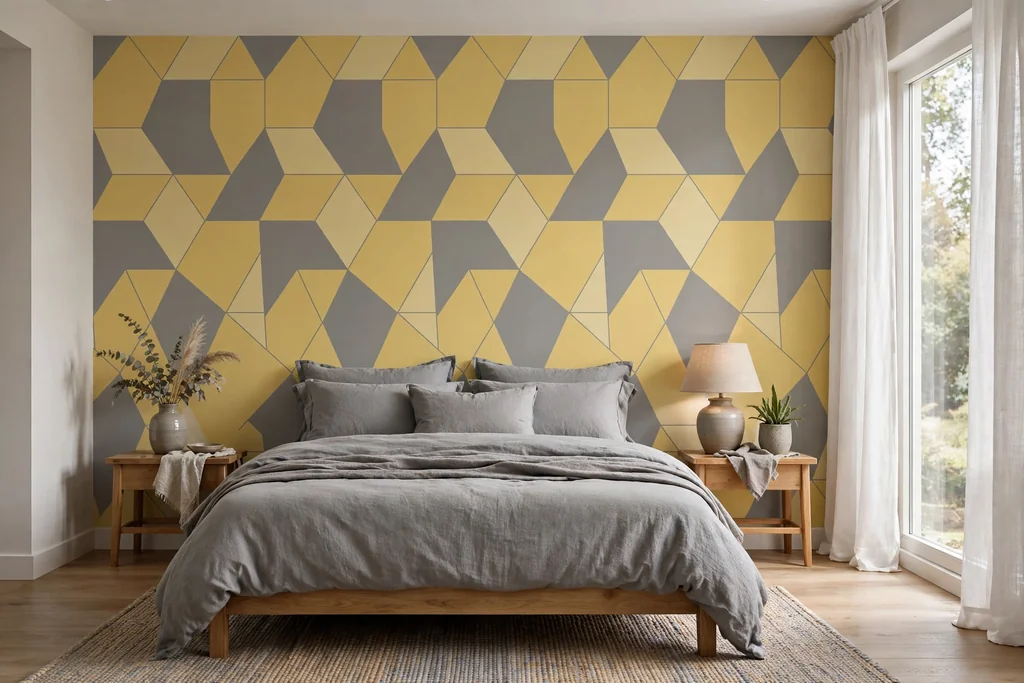
    Keep the ceiling white and the bedding mostly white or cream, so the pale blue stays light rather than closing the room in. Add one deeper blue cushion or throw so the scheme has a darker note to rest the eye on. Wash painted walls gently, since pale blue can show marks near light switches and bedside tables.

    3. Layer Blue Bedding in Three Shades

    Bed layered with pale blue sheets, mid blue duvet, and navy throw at the foot.

    Build the bed in three shades of blue: pale blue sheets, a mid blue duvet or coverlet, and a navy throw folded at the foot. The layers give the bed depth, and you can remove the throw on warm nights without losing the scheme. This suits a room where the walls must stay pale, such as a rental.

    Keep sleeping pillows pale and put the darkest shade at the foot of the bed, where it is easy to fold back at night. Add one white cushion to break up the blue, so the bed does not read as one solid block. Wash the layers together so the blues stay even in tone over time.

    4. Choose Blue and White Striped Bedding

    Bed with blue and white striped bedding and a wooden bed frame.

    Choose blue and white striped bedding for a crisp pattern that adds interest without a second print elsewhere in the room. Stripes read as orderly and classic, which suits a bedroom that needs structure, and the white in the stripe keeps the pattern light. A wooden bed frame and plain walls let the bedding lead, so the room stays calm rather than busy.

    Keep the rest of the bedding plain, with one white throw folded at the foot, and repeat the blue once more in a small item, such as a cushion or a vase. If the stripe feels strong, pick a narrower stripe or a softer dusty blue, which reads more gently in a small room. This is a renter friendly change, since bedding needs no tools and can move to another room later.

    5. Paint a Dresser Navy With Brass Handles

    Bedroom dresser painted navy with brass handles under a round mirror.

    Paint a wooden dresser navy and add brass handles for a furniture piece that anchors a pale room. The dark blue gives the dresser presence, while brass handles add warmth that keeps the navy from feeling cold. A round mirror above it and a small vase on top finish the corner without adding more furniture.

    Keep the wall behind the dresser pale so the navy stands out cleanly, and leave the top mostly clear, with a book, a small tray, and one vase. Sand and prime the dresser before painting, and use a paint made for furniture so the finish holds up to daily drawer use. If brass feels too warm, brushed gold handles give a similar effect with a softer shine.

    6. Pick a Blue Velvet Headboard

    Bedroom with a blue velvet headboard and pale bedding.

    Pick a headboard in blue velvet, in navy, teal blue, or dusty blue, for softness and color behind the bed without any paint. Velvet adds texture, so the headboard reads as furniture rather than a flat panel, and it makes sitting up to read more comfortable than a hard wall. This suits a main bedroom where the bed sits against a long blank wall and needs a focal point.

    Keep the bedding in a paler tone, so the headboard stays the clear focal point, and add one cushion in the headboard color to link the bed to the wall behind it. Measure the headboard width against the bed and the wall, since a headboard that is too narrow looks lost and one that is too wide crowds the bedside tables. Vacuum velvet gently with an upholstery tool, since the pile can trap dust over time.

    7. Hang Blue Curtains Over White Sheers

    Bedroom window with dusty blue curtains over white sheer panels.

    Hang dusty blue linen curtains over white sheer panels for a window that works in both daytime and nighttime. Open the blue panels in the morning for soft light through the sheer, then close them at night for privacy and a darker room for sleep. This pair suits a bedroom on a busy street, where daytime privacy and nighttime darkness both matter.

    Use a double rod so each layer moves on its own, and hang the rod high and wide so the window looks larger and the panels clear the glass when open. Keep the sheer in white and choose the blue panel in a tone from your bedding, so the layers look linked when closed. For more curtain fabrics, lengths, and hanging tips, see these bedroom curtain ideas. Wash sheer panels often, since white shows dust more than a heavier fabric.

    8. Anchor the Room With a Blue Patterned Rug

    Bedroom with a large blue patterned rug under the lower half of a bed.

    Lay a large blue patterned rug under the bed to ground the room and pull the whole scheme together. The pattern links the bed to the floor, while pale bedding above it keeps the room light, and the rug gives bare feet a soft landing first thing in the morning. This suits a bedroom with wood or laminate floors, where a rug adds warmth and cuts echo.

    Choose a rug large enough to extend beyond each side of the bed, and use a rug pad underneath so the layers do not slip. Keep the rug pile low near the door swing, and vacuum with a brush head on a regular cycle. If the pattern is bold, keep the bedding mostly plain so the rug can be the one patterned piece in the room.

    9. Build a Blue Gallery Wall Above the Bed

    Bedroom with a gallery wall of blue framed prints above a bed.

    Hang a gallery wall of blue prints above the bed for personality without painting a wall or buying new furniture. Choose prints in navy, dusty blue, and pale blue, with simple wood or white frames, and hang them in a loose grid so the wall feels calm rather than crowded. Mix abstract shapes, botanical prints, and simple line drawings, but keep the palette tight.

    Lay the frames on the floor first and plan the spacing, leaving equal gaps between frames, then hang the middle frame at eye level. Use picture hanging strips if you rent, and keep the largest frame near the center so the arrangement feels balanced. For more ways to size and hang art above a bed or a dresser, see these bedroom wall art ideas. Swap one print with the seasons if you want a small change without redecorating the whole room.

    10. Try Two Tone Walls With a Chair Rail

    Bedroom wall painted navy below a chair rail and pale blue above it.

    Paint the lower wall navy and the upper wall pale blue or white, with a chair rail between them, for a bedroom wall with clear structure. The dark lower half grounds the room, while the pale upper half keeps it bright, and the rail gives a clean line where the two colors meet. This suits a traditional bedroom, a long wall, or a room where one flat color feels too plain.

    Keep the rail and trim white, and keep the bedding pale so the wall can be the feature. Measure the rail height with care, since a rail set too high can cut the wall in an awkward place; a height near the top of the bedside tables often works well. If you rent, a painted board fixed with removable strips can give a similar two tone line without a full wall job.

    11. Paint the Bed Frame a Clear Blue

    Bedroom with a blue painted wood bed frame and calm cream bedding.

    Paint a wood bed frame a clear blue, such as denim blue or dusty blue, and keep the bedding in a calmer tone. The frame becomes a bright outline for the bed, which suits a simple room with plain walls and little furniture. This works best on a wood frame with clean lines, where the color can show clearly.

    Remove the bedding and sand the frame lightly before painting, and use a paint made for furniture so the finish stands up to daily use. Keep the headboard in the same blue or in pale wood, so the frame reads as one piece rather than two separate colors. Add a white or cream throw at the foot, so the blue frame still has a pale break beside it.

    12. Paint the Ceiling a Soft Pale Blue

    Bedroom with a soft pale blue ceiling and warm white walls.

    Paint the ceiling a soft pale blue and keep the walls warm white for a gentle surprise overhead that does not dominate the room. The blue ceiling reads as sky on a bright day, while white walls keep the room grounded and bright. A white pendant light hangs cleanly against the blue, and pale bedding below ties the scheme together.

    Keep the blue pale rather than mid tone, since a ceiling color looks darker once it covers a large area, and test a large sample overhead before committing. Paint the trim white for a clean edge, and keep the choice consistent around the room so the edge reads as planned. This suits a bedroom with white trim, where the ceiling can be the one unexpected color.

    13. Go Coastal With Blue, White, and Rattan

    Coastal bedroom with pale blue walls, rattan headboard, and white linen bedding.

    Pair pale blue walls with a rattan headboard and white linen bedding for a coastal take on a blue bedroom. The pale blue reads as fresh in daylight, rattan adds woven warmth, and white linen keeps the bed soft and relaxed. Woven baskets beside the bed hold throws and books without adding closed furniture.

    Keep the palette tight: pale blue walls, white bedding, and rattan in two or three spots, so the room stays calm. Dust woven pieces with a dry cloth or a soft brush, and keep rattan out of damp corners, since it can warp. For a wider coastal palette, including sand tones and sea blues, see these coastal bedroom ideas. A sea view is not needed: the palette and textures do the coastal work on their own.

    14. Swap Blue Throws and Cushions With No Paint

    Bed with blue throws and cushions in a basket beside it for a no paint swap.

    Keep a small set of blue throws and cushion covers, and swap them when you want a new look, with no paint and no new furniture. A navy throw in winter, a pale blue set in summer, and a patterned cushion pair for guests can change the bed in minutes. This suits a rental, a room you share, or a reader who likes to test a color before committing to paint.

    Store the off season set in a lidded basket or a shelf box, folded and clean, so the swap takes minutes. Keep sleeping pillows plain all year, and change only the decorative cushions and the throw, so the bed stays easy to make. Wash new covers before the first use, since strong dyes can mark pale sheets at first.

    15. Use Blue Lampshades and Warm Bulbs

    Bedroom at night with blue lampshades glowing warm light beside a bed.

    Choose lampshades in blue, such as navy on bedside lamps or pale blue on a pendant, and pair them with warm white bulbs for soft evening light. The blue shade adds color at eye level in the evening, when walls and bedding matter less, and warm bulbs keep the blue from feeling cold. This suits a bedroom where overhead light feels too bright at night.

    Keep the lamp bases simple, in wood, white, or brass, so the shade stays the focus, and put the switches where you can reach them without getting up. Check that the shade size suits the lamp base, since a shade that is too large can crowd a small nightstand. Dust fabric shades with a dry cloth, and keep shades clear of curtains and bedding.

    16. Paper One Wall With Blue Patterned Wallpaper

    Bedroom bed wall with blue patterned wallpaper and plain bedding.

    Paper the bed wall with a blue patterned wallpaper, such as a botanical print, a small geometric repeat, or a soft stripe, and keep the other walls plain. The pattern adds color and detail at eye level, while plain side walls keep the room from feeling crowded. This suits a bedroom with one large blank wall and simple furniture, since the wall becomes the feature.

    Keep the wallpaper to one wall, and let the other walls stay pale, so the pattern does not crowd the room. Order a sample first and look at it in daylight and lamplight, since blue prints shift a lot with light. If you rent, a paste the wall paper that strips cleanly, or a set of framed wallpaper panels, gives a similar effect without a full wall commitment.

    17. Make a Blue Reading Chair the Corner Focus

    Bedroom corner with a blue armchair, small side table, and reading lamp.

    Place a blue armchair in a bedroom corner, with a small side table and a reading lamp, for a second use beyond sleep. A deep blue chair reads as a clear focal point, while a pale blue chair feels softer and suits a small room. Add a throw over one arm for cooler evenings, and keep a book on the side table so the corner looks used, not staged.

    Choose a chair deep enough to sit in for an hour, not a stiff accent chair that looks good but stays empty. Keep the side table clear except for the book you are reading, and move the chair a little away from the window if strong sun fades the fabric over time. Repeat the chair color once more in a cushion on the bed, so the corner links to the rest of the room.

    18. Style Blue Shelves Above a Dresser

    Bedroom open shelves above a dresser styled with blue books, vases, and objects.

    Fit open shelves above a dresser and style them with blue books, vases, and small objects, for color at eye level without new furniture. The shelves turn a plain wall into a display, and blue items grouped together read as a planned palette rather than scattered objects. This suits a bedroom with a dresser against a blank wall and little else on it.

    Keep the shelves to two or three boards, and leave one end of each shelf empty so the display does not look packed. Mix blue items with white and wood pieces, so the blue stands out without taking over the wall. Dust the shelves often, since open shelves collect dust faster than closed storage, and keep heavy items on the lowest shelf.

    19. Pair Blue With Grey for a Calm Room

    Bedroom with blue bedding, grey walls, and white curtains for a calm pairing.

    Pair blue with grey for a calm bedroom that feels quiet rather than bold. Use mid blue bedding with grey walls, or grey bedding with navy cushions, and keep wood and white as the third notes in the room. The grey softens the blue, which suits a bedroom used for sleep and reading, where a strong color might feel too active at night.

    Keep the grey warm rather than cold, since a cold grey with a cold blue can feel flat; a warm grey, pale wood, and warm lamps lift the pair. Repeat each color at least twice, such as blue in bedding and art and grey in curtains and a rug, so neither color looks like a leftover. Test the pair in lamplight, since both colors darken in the evening.

    20. Warm Navy With Brass and Warm Wood

    Navy bedroom with brass lamp and warm wood bed frame and nightstand.

    Warm a navy bedroom with brass details and warm wood, so the deep blue feels inviting rather than cold. Brass handles, a brass lamp, and a warm wood bed frame or nightstand give navy a warm frame, while white bedding keeps the bed light. This suits a main bedroom with good daylight, where navy can be used in larger doses.

    Keep brass to a few spots, such as handles, one lamp, and one frame, so it reads as an accent rather than a theme. Pair the wood with a warm tone, such as oak or walnut, rather than a pale washed wood, so the contrast with navy stays clear. For a softer blue and cream pairing to compare with this warmer navy scheme, see these blue and cream bedroom ideas.

    21. Add a Blue Upholstered Bench at the Foot of the Bed

    Bedroom with a blue upholstered bench at the foot of a bed with a folded throw.

    Place a blue upholstered bench at the foot of the bed for a useful seat and a place to lay out clothes, a throw, or a book. A navy bench grounds a pale room, while a pale blue bench suits a room that already has a dark wall or headboard. Choose a bench that is narrower than the bed, so you can walk around it at night without bumping it in the dark.

    Keep the bench mostly clear, with one folded throw, so it stays useful rather than turning into a pile of clothes. Check the bench height against the bed, since a bench that is much higher or lower than the mattress can look awkward and feel less useful. Vacuum the bench fabric on a regular cycle, since a bench at the foot of the bed collects dust and lint.

    22. Build a Blue Window Seat With Storage

    Bedroom window seat with blue seat cushions and storage baskets below.

    Build or dress a window seat in blue, with blue seat cushions, blue back cushions, and storage baskets or drawers below, for a bedroom nook that works for reading and storage. The seat gives the window a purpose beyond light, and the blue cushions link the window to the bed. This suits a bedroom with a wide window, a bay window, or an unused wall under a window.

    Keep the cushions in a washable fabric, since a window seat gets sun and daily use, and add one plain cushion in white or cream so the blue does not read as one solid block. Use the storage below for spare bedding, books, or off season throws, so the seat stays clear and inviting. Check that the seat depth suits sitting with a book, and add a small side light if you plan to read there in the evening.

    Conclusion

    A blue bedroom works best when blue has a clear job and pale surfaces soften everything around it. Start with the layer you notice most, usually the bed or one wall, then add blue in two or three smaller spots, such as cushions, curtains, or a rug. Keep the palette tight, let daylight in, and warm the room with wood, rattan, brass, and warm lamps, so the scheme feels calm and lived in rather than cold.

    Save this list on Pinterest before you start, and work through it one idea at a time: bedding and cushions first for a quick refresh, then curtains and rugs, then walls and furniture when you have a weekend to spare.

    FAQs

    What is the best blue for a bedroom?

    Navy works best as an anchor, such as a headboard or one wall, while dusty blue and pale blue work best in larger doses, such as bedding, curtains, or a ceiling. Use navy in one or two spots and dusty blue in soft layers, so the room has depth without feeling dark. Test samples in daylight and lamplight, since blue shifts a lot with light.

    Can blue work in a small bedroom?

    Yes, if pale blue leads and dark blue stays in smaller doses. Keep walls and bedding pale, and add blue through cushions, a throw, art, or one bench. A pale blue ceiling or pale blue curtains also work in a small room, since they add color without shrinking the walls. Avoid a dark blue on all four walls in a small room.

    How do I keep a blue bedroom from feeling cold?

    Warm the scheme with wood, rattan, brass, and warm white lamps. A wooden bed frame, a woven rug, and lamps with warm shades add warmth that blue alone cannot give. Keep at least one warm material in the room, and choose warm white bulbs for the evening, so the room feels restful at night.

    Should the bedding or the walls carry the blue?

    Bedding is the easier first step, since it covers the largest surface and can change with the seasons. Walls suit a reader who wants a lasting anchor, such as one navy accent wall behind the bed. If you are unsure, start with bedding, live with it for a few weeks, and paint a wall only if the room still needs a stronger blue note.

    What colors pair well with blue in a bedroom?

    White, cream, grey, and warm wood pair well with blue, since they soften it without fighting it. White and cream keep the room bright, grey keeps it calm, and warm wood adds warmth. Add one warm accent, such as brass or mustard cushions, only if you want a livelier room, and keep that accent to a few small spots.

    How many shades of blue should I use in one bedroom?

    Two or three shades usually work best: one pale shade for large surfaces, one mid shade for bedding or curtains, and one dark shade for a single anchor, such as a headboard or a bench. More than three shades can look scattered unless they share the same undertone. Repeat each shade at least twice, so the palette looks planned.


  • 18 70s Bedroom Decor Ideas to Inspire Your Next Room Refresh

    18 70s Bedroom Decor Ideas to Inspire Your Next Room Refresh

    A 70s bedroom feels warm, relaxed, and a little bold, with earth tones, natural wood, woven textures, and patterns that are fun without being loud. The decade mixed burnt orange, mustard, avocado, and chocolate brown with rattan, cork, and shag pile, and it kept furniture low and rooms easy to live in. These 18 70s bedroom decor ideas cover walls, beds, seating, lighting, and small details, so you can add one retro touch or build a full room around the look. Start with the change that suits your room size and your budget, then repeat one color or material once more so the room feels planned.

    Key Takeaways

    • Build the palette on warm earth tones: burnt orange, mustard, avocado, cream, and chocolate brown, with one lead color and quieter tones around it.
    • Use natural materials for the retro feel: rattan, cane, wood, cotton, wool, and cork, rather than glossy plastic or chrome.
    • Keep furniture low and seating relaxed, with a platform bed, a rattan chair, or floor cushions, so the room feels grounded and calm.
    • Add pattern in one or two places, such as bedding, wallpaper, or curtains, and keep the rest of the room plain so patterns do not fight each other.
    • Use warm, low lighting in the evening, with lamps and a lava lamp, since bright ceiling light flattens the warm 70s palette.
    • Most ideas here need no building work and suit rented rooms, since they rely on paint, textiles, furniture, and freestanding decor.

    1. Paint a Burnt Orange Accent Wall

    Bedroom with a burnt orange accent wall behind a bed with cream bedding.

    Paint the wall behind the bed in burnt orange and keep the other walls warm cream. The orange wall becomes the clear focal point, and it makes wood furniture, rattan, and cream bedding stand out at once. This suits a room with plain furniture, since the wall does the color work and little else needs to change.

    Choose a matte or eggshell finish so the wall does not shine under lamplight, and test a large sample in daylight and again at night, since orange deepens a lot in warm light. Repeat the orange once in a cushion or a throw, so the wall feels linked to the bed, and keep the ceiling pale so the room still feels open.

    2. Choose a Low Wooden Platform Bed

    Low wooden platform bed in warm teak tones with earth tone bedding.

    Set the mattress on a low wooden platform frame for the grounded, relaxed feel that defined 70s bedrooms. The low bed makes the room feel wider, and it suits a room with low art, low storage, and a rug that spreads out from the bed. A warm wood tone, such as teak or walnut, pairs well with earth tone bedding and woven textures.

    Use a firm platform and a good mattress, since a low bed still needs proper support, and keep a small bedside table or crate within reach for a book and a drink. Leave enough floor space beside the bed for a rug and a pair of slippers, so the low layout stays easy to get in and out of.

    3. Add a Rattan or Cane Headboard

    Bedroom bed with a rattan cane headboard and cream and rust bedding.

    Fit a rattan or cane headboard behind the bed for instant 70s character without any paint. The open weave keeps a small room feeling airy, while the warm cane tone pairs well with cream, rust, and mustard bedding. An arched or curved cane headboard reads most clearly as 70s, while a straight woven panel suits a simpler room.

    Measure the bed width before you buy, and centre the headboard on the bed wall so it reads as part of the bed rather than a separate panel. Keep the bedding mostly plain at first, so the weave stays the focus, and wipe the cane with a dry cloth now and then to remove dust.

    4. Dress the Bed in Groovy Floral Bedding

    Bed with large scale 70s floral bedding in orange, mustard, and brown.

    Choose bedding in a large scale 70s floral, with bold blooms in orange, mustard, and brown on a cream or gold ground. The print carries the retro story of the room in one piece, which suits a bedroom with plain walls and simple wood furniture. A duvet cover alone can set the look, so this is a good first change if you are testing the style.

    Keep the pillowcases mostly plain, in one tone taken from the print, so the bed does not look busy from the door. Fold a plain throw across the foot of the bed for cooler nights, and wash the printed cover as advised on the label, since bold dyes can mark pale sheets at first.

    5. Fit a Warm Wood Slat Feature Wall

    Bedroom wall with vertical warm wood slats behind a low bed.

    Fit vertical wood slats on the wall behind the bed for warmth and rhythm without a full repaint. The slats add texture in daylight and soft shadow lines in lamplight, which suits a room that already has wood furniture and earth tone bedding. Choose a mid warm tone, and keep the slats evenly spaced so the wall reads as one calm panel.

    Fix the slats to battens or a backing board, so you can remove the panel later without damaging the whole wall, which helps in a rented room. Keep art and hanging decor off this wall, so the slat pattern stays easy to see, and let the bed and one lamp sit in front of it.

    6. Lay a Thick Shag Rug Beside the Bed

    Thick cream shag rug beside a low bed on a wood floor.

    Lay a thick shag rug beside the bed, in cream, rust, or mustard, for softness underfoot and a clear 70s texture. The deep pile suits a bedroom with wood floors and a low bed, since it warms the floor where you step out of bed each morning. Choose a rug large enough to extend past both sides of the bed, so it reads as a room layer rather than a small mat.

    Use a rug pad on smooth floors to reduce slipping, and vacuum the pile often, since shag shows dust and lint more than a flat weave. Keep the rug clear of doors and drawers, so it does not bunch, and shake it outside now and then to keep the pile fresh.

    7. Create a Rattan Reading Corner

    Bedroom corner with a rattan peacock chair, small side table, and reading lamp.

    Place a rattan peacock chair or a rounded rattan armchair in a bright corner, with a small side table and a reading lamp beside it. The chair gives the room a relaxed seating spot and a sculptural shape, which suits a bedroom with space beside a window or at the foot of the bed. A cushion in mustard or rust makes the chair comfortable and links it to the bed.

    Keep the corner simple, with one chair, one table, and one lamp, so the chair stays the focus and the corner does not fill with clutter. Choose a chair that fits through the bedroom door and leaves a clear walkway, and check that the frame sits level on the floor before you add cushions.

    8. Hang a Large Macrame Wall Hanging

    Large cream macrame wall hanging with fringe above a bed.

    Hang a large macrame wall hanging above the bed or on a side wall for soft, handmade texture. The knotted cotton and long fringe suit a 70s bedroom at once, and the piece softens a plain wall without paint or a frame. Cream or natural cotton suits most earth tone bedding, while a dyed piece in rust can add one more accent color.

    Hang it from a wooden dowel, centred above the bed, and keep the wall behind it plain so the knot work shows clearly. For more ways to use woven and textile wall pieces, see these hippie bedroom ideas. Macrame is light and easy to hang, so it suits a rented room, and it pairs well with plants and woven baskets nearby.

    9. Hang a Beaded Curtain in the Doorway

    Wooden beaded curtain hanging in a bedroom doorway.

    Hang a beaded curtain in the bedroom doorway or across an open closet for instant retro character. Wooden beads give a warm, earthy look and a soft sound as you pass through, while the curtain marks the bedroom as its own space without closing it off with a door. This suits a room with an open plan or a closet you want to screen.

    Measure the doorway first, and hang the curtain from a tension rod or a small rail so no drilling is needed. Keep the beads clear of the floor so they do not tangle or trip anyone, and keep the curtain clear of heaters and candles. In a small room, a beaded curtain on a closet works just as well and hides open shelves.

    10. Add a Sunburst Mirror Above the Dresser

    Sunburst mirror with wood rays above a warm wood dresser in a bedroom.

    Hang a sunburst mirror above a warm wood dresser for a bold 70s focal point that also bounces light around the room. The radiating wood or brass rays suit a bedroom with plain walls and simple furniture, since the mirror does the decorating work on that wall. Choose a size that sits well above the dresser without crowding the ceiling.

    Centre the mirror on the dresser, and check what it reflects before you fix it, since a view of the window or a plant looks good while a view of clutter does not. Keep the dresser top mostly clear, with one tray or one vase, so the mirror stays the focus, and dust the rays with a soft cloth now and then.

    11. Build a Vinyl Record Listening Corner

    Bedroom vinyl listening corner with a record player on a low wood cabinet and a crate of records.

    Set up a small vinyl listening corner with a record player on a low wood cabinet, a crate of records beside it, and a comfortable chair nearby. The corner gives the room a clear 70s activity, and it suits a bedroom with an empty wall or a corner near a window. Warm wood and earth tone sleeves on display add color without new art.

    Keep the player on a level, stable surface away from direct sun, and store records upright in the crate so sleeves stay in shape. Place the chair close enough to reach the player, and keep cables tidy along the wall, so the corner stays safe and easy to use in the evening.

    12. Use a Lava Lamp and Warm Low Lighting

    Bedroom nightstand with a glowing orange lava lamp and a warm bedside lamp at night.

    Place a lava lamp on a nightstand or dresser, and pair it with warm bedside lamps, for the soft evening glow that suits a 70s palette. The slow moving wax adds gentle motion to the room, while warm bulbs keep burnt orange, mustard, and brown tones rich rather than flat. This suits a bedroom where the ceiling light feels too harsh at night.

    Keep the lava lamp on a stable surface, clear of bedding and curtains, and give it time to warm up before you expect full motion. Use warm white bulbs in the bedside lamps, and put one lamp on each side of the bed when space allows, so reading light stays even.

    13. Fill a Corner With Plants in Terracotta Pots

    Bedroom corner with plants in terracotta pots at three heights near a window.

    Group plants in terracotta pots in a bright corner, with tall plants on the floor, medium plants on a stool or crate, and trailing plants on a shelf. The warm clay tone suits a 70s bedroom at once, and the greenery softens wood, rattan, and earth tone walls. Spider plants, pothos, and snake plants all suit beginners and trail or stand well.

    Match plants to the light the corner actually gets, and group plants with similar watering needs together, with a saucer under each pot. Rotate the pots every few weeks so growth stays even toward the light, and keep trailing leaves clear of walkways and bedside lamps.

    14. Paper One Wall With Retro Geometric Wallpaper

    Bedroom wall with retro geometric wallpaper in orange, mustard, and brown arches.

    Paper one wall with a retro geometric print, such as bold arches, circles, or wavy stripes in orange, mustard, and brown. The pattern carries the 70s story in one bold move, which suits a bedroom with plain furniture and plain bedding. One wall is enough, since a full room of bold geometry can feel busy at night.

    Use peel and stick wallpaper in a rented room, so the print comes down cleanly later, and match the pattern carefully at each join. Keep the other walls plain and the bedding mostly solid, so the wallpaper stays the clear focus, and repeat one wallpaper color in a cushion to link the wall to the bed.

    15. Layer Corduroy and Velvet Cushions in Earth Tones

    Bed layered with corduroy and velvet cushions in rust, mustard, and brown.

    Layer cushions in corduroy and velvet, in rust, mustard, avocado, and chocolate brown, across the bed. The mix of ribbed and soft textures adds depth to plain bedding, and it suits a room where the walls are already warm and patterned. Two or three textures in a shared earth palette read as planned, while too many colors can look scattered.

    Keep sleeping pillows plain and behind the decorative cushions, so the bed stays easy to make at night. Choose cushion covers you can remove and wash, since textured fabrics show dust, and store spare covers in a basket so a seasonal swap takes minutes.

    16. Place a Wicker Trunk at the Foot of the Bed

    Wicker trunk at the foot of a bed in a warm 70s bedroom.

    Place a wicker trunk at the foot of the bed for storage that also reads as 70s furniture. The trunk holds spare bedding, throws, and seasonal clothes, which suits a bedroom with little closet space, and the woven texture links to rattan and cane elsewhere in the room. Choose a trunk that sits lower than the bed top, so it does not block the view of the bed.

    Line the inside with a clean cotton cloth to protect stored bedding, and keep the lid clear so the trunk stays easy to open. Check that the trunk sits level and does not wobble, and keep heavy items at the bottom so the lid lifts safely.

    17. Hang a Retro Rainbow and Sun Art Gallery

    Bedroom wall with retro rainbow and sun art prints in matching wood frames.

    Hang a small gallery of retro art prints, with rainbow arcs, abstract suns, and bold curved shapes in orange, mustard, and brown. The prints give the room a clear 70s graphic story, which suits a bedroom with plain walls and simple bedding. Use matching wood frames and equal gaps, so the mix of shapes looks ordered rather than scattered.

    Lay the frames on the floor first, measure the full block, and mark the wall with painter tape before you hang anything. For more ways to size and hang art above a bed or a dresser, see these bedroom wall art ideas. Keep the gallery to one wall, and repeat one print color in the bedding or a cushion, so the art feels connected to the room.

    18. Dress Windows With Retro Patterned Curtains

    Bedroom window with retro patterned curtains in orange, mustard, and brown.

    Hang curtains in a retro print, such as bold florals, wavy stripes, or geometric shapes in orange, mustard, and brown, at the bedroom window. The window becomes a block of pattern and color, which suits a room with plain walls and solid bedding. Pick a print that shares one color with the rug or a cushion, so the window links to the rest of the room.

    Hang the rod high and wide, so the panels stack clear of the glass when open and daylight still fills the room. For fabric, length, and lining choices that suit different windows, see these bedroom curtain ideas. Wash patterned curtains as advised on the label, since bold prints can fade in strong sun.

    Conclusion

    A 70s bedroom works best when warm color, natural material, and one or two bold patterns share the room, and everything else stays calm. Pick a lead color, such as burnt orange, add rattan or wood for texture, and use bedding, wallpaper, or curtains for pattern, then repeat each choice once more so the room feels pulled together. Start with textiles and freestanding pieces when you want a quick refresh, and save paint and wallpaper for a weekend project. Save the ideas that fit your room size, your light, and how much retro color you want to wake up to, and build a bedroom that feels warm by day and relaxed at night.

    FAQs

    How do I get a 70s bedroom look without repainting the whole room?

    Start with bedding, cushions, a shag rug, and a rattan chair, since these change the room in an afternoon and need no paint. Add one accent through a macrame hanging, retro art prints, or a beaded curtain, and keep the walls warm cream. If you want wall color later, paint one accent wall or use peel and stick wallpaper on one wall, so the change stays easy to reverse.

    What colors define a 70s bedroom?

    Burnt orange, mustard, avocado green, chocolate brown, and warm cream form the core 70s palette, with gold and rust as common accents. Use one lead color, such as burnt orange, a second color in smaller doses, and cream as the quiet base, so the room feels warm rather than loud. Test each color in evening lamplight, since warm tones deepen a lot under warm bulbs.

    Which materials matter most for a 70s bedroom?

    Rattan, cane, warm wood, cotton, wool, corduroy, velvet, and cork carry the 70s feel, since they add natural texture and warmth. Mix two or three of these materials, such as a rattan headboard, a wood platform bed, and a wool shag rug, rather than using every material at once. Keep glossy or chrome pieces to a minimum, so the natural textures stay the focus.

    Can a small bedroom handle a 70s look?

    Yes, if the boldest choices stay in one or two places, such as the bedding or one accent wall, while the other walls and the ceiling stay pale. A low platform bed, a cane headboard, and a shag rug suit a small room, since they keep sightlines open and the floor feeling clear. Avoid a large peacock chair and a full vinyl corner in the same small room, and pick the one that fits your floor space.

    How do I mix 70s patterns without making the room look busy?

    Limit the room to one large pattern, such as floral bedding or geometric wallpaper, and keep other patterns small or solid. Share one color between patterns, such as mustard in both the bedding and the curtains, so the mix looks linked. If two patterns still fight each other, make one of them plain, or move the smaller pattern to a cushion or a throw that you can swap easily.

    How do I keep a 70s bedroom restful at night?

    Use warm bulbs, plain sleeping pillows, and a plain top sheet, so the bed feels calm even when the room has bold color and pattern elsewhere. Keep the brightest pattern off the wall directly opposite the bed if it catches lamplight, and use low lamps rather than a bright ceiling light in the evening. A lava lamp or a dim bedside lamp softens strong colors, so the room settles well for sleep.

    Save these ideas on Pinterest for your next room refresh, and pick one change to start with this weekend.


  • 31 80s Bedroom Decor Ideas to Make Any Room Feel Cozier

    31 80s Bedroom Decor Ideas to Make Any Room Feel Cozier

    The 80s bedroom was bold, bright, and unafraid of color, and that spirit still works today when you use it with a light hand. One neon accent, one geometric print, or one chrome detail can wake up a plain room, while soft bedding and warm lamplight keep it cozy at night. These 31 80s bedroom decor ideas cover walls, bedding, furniture, lighting, and small retro accessories, so you can borrow one detail or build a full decade look over time. Start with the change that fixes what bothers you most, test bright colors in daylight and lamplight, then add a second retro note only where the room still feels flat.

    Key Takeaways

    • Pick one 80s lead, such as neon color, Memphis pattern, or chrome furniture, and let the rest of the room stay calm so the look reads as retro, not busy.
    • Balance bright color with cozy texture: pair neon or bold prints with soft bedding, a thick rug, and warm lamplight.
    • Put the strongest color where you see it first, such as the bed wall or the bedding, and keep the ceiling pale so the room still feels open.
    • Repeat each bright color at least twice, in bedding and art, or in curtains and a cushion, so the palette looks planned rather than random.
    • Test neon and pastel paint in morning light and evening lamplight before you commit, since bright colors shift a lot during the day.
    • Start with bedding, cushions, curtains, and small accessories for a no-paint refresh, and save walls and lacquered furniture for a weekend project.

    1. Paint a Hot Pink Neon Accent Wall

    Bedroom with a hot pink accent wall behind a bed with white bedding.

    Paint the wall behind the bed in hot pink, and keep the other walls warm white. The bed wall becomes the clear focal point, and the plain side walls keep the room from feeling closed in. This suits a room with plain furniture, since the wall does the color work and nothing else needs to change.

    Choose a matte or eggshell finish so the wall does not shine under lamplight, and paint the trim in the same pale tone as the other walls for a clean edge. Test a large sample on the bed wall first, and look at it in the morning and again at night, since a pink that looks bright by day can look much deeper in lamplight.

    2. Layer Memphis Geometric Bedding

    Bed with Memphis geometric bedding in black, white, teal, and pink.

    Build the bed with Memphis style bedding: bold squiggles, triangles, and dots in black, white, teal, and pink. The print carries the whole 80s story, so the walls and furniture can stay plain. This suits a room where the walls must stay pale, such as a rental, since bedding changes the look without paint.

    Keep sleeping pillows in a plain tone close to the duvet, and put the boldest print on the duvet cover or a folded throw at the foot of the bed. Wash the printed cover apart from white pieces at first, so the dark print does not dull the pale layers.

    3. Use a Pastel Miami Wall Palette

    Bedroom with pastel peach and mint walls and white bedding.

    Paint the walls in a soft Miami palette: pale peach on the bed wall, mint on one side wall, and warm white elsewhere. The pastels give the room a sunny 80s mood without the glare of full neon. This suits a small or north facing room, since pale color adds warmth while still bouncing light around.

    Repeat one pastel in the bedding, such as a mint cushion or a peach throw, so the walls link to the bed. For more guidance on pairing pale tones with a stronger accent, see these amazing bedroom color combos. Keep the ceiling white, so the pastel walls do not make the room feel low.

    4. Fit a Mirrored Headboard Wall

    Bedroom with a mirrored headboard wall behind a bed with plain bedding.

    Cover the wall behind the bed with mirror panels or one large framed mirror as a headboard feature. Mirrors were a classic 80s move, and they bounce light around the room while making a small bedroom feel larger. This suits a dark or narrow room, where extra light matters more than extra pattern.

    Secure heavy panels with fixings suited to the wall type, and keep the bedding mostly plain so the mirror stays the focus. Check what the mirror reflects before you fix it: a view of the window or a plain wall looks good, while a view of clutter does not.

    5. Hang a Neon Word Sign Above the Bed

    Bedroom with a pink neon style word sign glowing above a bed.

    Mount a neon style sign with a short word or simple shape above the bed, in warm pink, soft blue, or warm white. The glow gives the room an evening focal point and a clear 80s note, without repainting a wall. This suits a teen room, a guest room, or a main bedroom with a relaxed style.

    Plug it into a switched socket so you can turn it off easily, and keep the cord tidy with clips along the wall. Pair it with plain bedding so the glow stays the main feature, and keep the sign color soft at night, since harsh color can feel jarring before sleep.

    6. Hang Memphis Print Curtains

    Bedroom window with Memphis print curtains in teal, pink, and black.

    Choose curtains in a Memphis print, with squiggles, dots, and zigzags in teal, pink, and black on a white ground, and keep the bedding mostly plain. The window becomes a block of pattern and color, which suits a room with white walls and solid furniture. Pick a print that shares one color with a cushion or the rug, so the window links to the rest of the room.

    Hang the rod high and wide, so the panels stack clear of the glass when open and daylight still fills the room. For fabric, length, and lining choices that suit different windows, see these bedroom curtain ideas. Wash printed curtains as advised on the label, since bright prints can fade in strong sun.

    7. Use Clear Lucite Nightstands

    Bedroom with clear lucite nightstands on both sides of a bed.

    Place clear lucite nightstands on both sides of the bed for a light, almost invisible 80s note. The clear surface keeps a small room feeling open, while the glossy material still reads as a deliberate retro choice. This suits a bedroom with bold bedding or a bright wall, since the tables do not compete for attention.

    Keep each nightstand surface mostly clear, with a lamp, a book, or a glass of water, and little else, since clutter shows through clear furniture. Wipe the lucite with a soft cloth, and avoid harsh cleaners that can cloud the surface over time.

    8. Color Block the Walls in Two Bold Tones

    Bedroom with teal lower walls and white upper walls behind a bed.

    Paint the lower half of the walls in teal and the upper half in warm white, with a crisp painted line or a slim trim strip between them. The two tone split gives the room a graphic 80s structure, while the white upper half keeps it feeling open. This suits a room with plain furniture, since the walls do the design work.

    Mark the line with painter tape and a level, and paint the lower color first so any drips land on the part you paint later. Repeat the teal once more in the room, in a cushion or a throw, so the lower wall color feels linked to the bed.

    9. Frame Retro Pop Art Prints

    Bedroom wall with framed retro pop art prints above a dresser.

    Hang two or three framed pop art prints, with bold shapes, bright color blocks, and simple graphic faces or objects, above a dresser or beside the bed. The art brings 80s gallery energy to the room without new furniture. This suits a bedroom with one large empty wall and plain bedding.

    Use matching frames and equal gaps, so the mix of bright prints looks ordered rather than scattered. For more ways to size and hang art above a bed or a dresser, see these bedroom wall art ideas. Lay the frames on the floor first, measure the full block, and mark the wall with painter tape before you hang anything.

    10. Style a Boombox Display Shelf

    Wall shelf with a vintage style boombox and cassettes above a dresser.

    Set a vintage style boombox on a wall shelf above a dresser, with a small stack of cassettes beside it. The shelf turns an 80s object into decor, and it suits a room that needs one clear retro talking point rather than a full theme. Keep the shelf at eye level, where the boombox reads as display, not storage.

    Anchor the shelf with fixings suited to the weight, and keep the rest of the shelf mostly clear, so the boombox stays the focus. Dust the boombox often, since shelf pieces collect dust faster than closed storage, and keep it away from direct sun so colors do not fade.

    11. Add Neon Strip Glow Behind the Headboard

    Bed with a neon style strip light glowing behind the headboard.

    Fit a neon style strip light behind the headboard, so a soft pink or blue glow washes up the wall behind the bed. The backlight gives the room an 80s evening mood without a bright sign or a painted wall. This suits a room with a plain headboard and plain bedding, since the glow becomes the feature.

    Use a strip with a dimmer, and set it to a low level for the evening, so the light feels cozy rather than glaring. Keep the cord hidden behind the headboard, and pair the glow with warm bedside lamps, so the room still feels restful at night.

    12. Layer Ruffled Pastel Bedding

    Bed with ruffled pastel pink bedding and a soft throw.

    Build the bed with ruffled pastel bedding: a pale pink or mint duvet, a ruffled pillow sham, and a soft throw folded across the foot. The ruffles and pastels give the room a soft 80s feel, which balances the bolder neon and graphic ideas elsewhere in this list. This suits a room with plain walls, since the bed carries the color.

    Keep the ruffle to the shams and one throw edge, rather than every layer, so the bed still looks easy to make. Wash the bedding as a set, so the pastels stay even, and store a spare sham in a basket for a quick refresh.

    13. Choose a Black Lacquer Dresser With Brass Pulls

    Bedroom with a black lacquer dresser with brass pulls beside a bed.

    Place a black lacquer dresser with brass pulls against one wall, and keep the top mostly clear with one small vase or a framed print. The glossy black and warm brass pairing is a classic 80s furniture move, and it grounds a room with bright walls or bold bedding. This suits a bedroom with plain floors and light walls, where the dresser can anchor the space.

    Wipe lacquer with a soft, dry cloth, and avoid harsh cleaners that can dull the gloss. For a calmer take on the same grouped styling, with one tray and one or two objects on a clear top, see these elegant bedroom ideas. Repeat the brass once more, in a lamp base or a frame, so the pulls do not look isolated.

    14. Build a Glass Block Bedside Feature

    Bedroom corner with a glass block column glowing softly beside a bed.

    Stack glass blocks into a short bedside column or a small window panel beside the bed, with a soft light behind it. Glass blocks were a signature 80s material, and they filter light while keeping privacy. This suits a bedroom with a plain corner that needs texture and glow rather than more color.

    Keep the block feature to one column or one panel, so it reads as a deliberate accent, not a wall. Clean the blocks with glass cleaner and a soft cloth, and check that the base is level and stable before you add a lamp or a plant on top.

    15. Lay a Geometric Squiggle Rug

    Bedroom with a geometric squiggle rug under the lower half of a bed.

    Lay a rug with a bold geometric print, squiggles, triangles, and dots in black, teal, and pink, under the lower half of the bed. The rug brings the Memphis pattern to the floor, where it softens first steps and links the bed to the rest of the room. This suits a bedroom with plain bedding, since the floor carries the pattern.

    Choose a low pile rug that doors and drawers can clear, and use a rug pad on smooth floors to reduce slipping. Keep the rug in a size that extends out on both sides of the bed, so your feet land on pattern, not bare floor, on either side.

    16. Set a Chrome and Smoked Glass Vanity

    Bedroom corner with a chrome and smoked glass vanity and round mirror.

    Set a vanity with a chrome frame and a smoked glass top in a bedroom corner, with a small stool and a round mirror above it. The chrome and smoked glass pairing is pure 80s glamour, and it gives the room a dressing corner without a full furniture set. This suits a bedroom with a quiet corner near a window, where daylight helps for dressing.

    Keep the vanity top mostly clear, with a tray for daily items, so the glass stays easy to see and clean. Wipe chrome with a soft cloth to keep it even, and keep the stool tucked under the vanity when not in use, so the corner stays tidy.

    17. Create a Retro Arcade Game Corner

    Bedroom corner with a small retro arcade machine and a stool.

    Set a small retro arcade machine or a tabletop arcade game in a bedroom corner, with a small stool and a neon style poster above it. The corner gives the room a playful 80s use beyond sleeping, and it suits a teen room, a guest room, or a main bedroom with space to spare. Keep the corner to one machine and one stool, so it stays a corner, not a second room.

    Place the machine near a socket, and keep the cord tidy along the wall with clips. Leave a clear path to the bed, and choose a machine size that fits the corner without blocking a door or a drawer.

    18. Paper One Wall in Bold Grid Wallpaper

    Bedroom bed wall with bold black grid wallpaper and plain bedding.

    Paper the bed wall in a bold grid wallpaper, with a black grid on white, or a pastel grid on cream. The grid gives the room a graphic 80s structure, while the pale ground keeps it from feeling heavy. This suits a bedroom with plain bedding and simple furniture, since the wall carries the pattern.

    Paste one wall only, and keep the other walls plain, so the grid stays the focus. If you rent, use peel and stick grid wallpaper, and test one strip in a hidden spot first, so removal leaves the wall clean.

    19. Dress the Bed in Denim Bedding

    Bed with washed denim bedding and a bright pink cushion.

    Dress the bed in denim bedding: a washed denim duvet cover, denim shams, and one bright cushion in pink or yellow. Denim was everywhere in 80s fashion, and on a bed it feels casual, sturdy, and easy to live with. This suits a room with white walls and wood furniture, since the denim adds texture without a new color scheme.

    Wash denim bedding apart from pale pieces at first, so the dye does not dull lighter layers. Soften stiff denim with a plain cotton throw folded across the foot, so the bed still feels cozy to sleep in.

    20. Fit Chrome Track Lighting

    Bedroom ceiling with chrome track lighting aimed at the bed wall.

    Fit a chrome track light across the bedroom ceiling, with three or four adjustable heads aimed at the bed wall, the art, and the dresser. Track lighting was a staple 80s ceiling choice, and it lets you aim light where you need it instead of relying on one central bulb. This suits a room with art or a feature wall that deserves its own light.

    Use warm bulbs in every head, so the light stays consistent across the room, and aim one head at the bed wall for evening reading light. Keep the track centered on the room, not on one wall, so the light spreads evenly, and dust the chrome rail now and then to keep it bright.

    21. Pair a Rattan Headboard With Neon Cushions

    Bed with a rattan headboard and neon pink and lime cushions.

    Fit a rattan or cane headboard behind the bed, and add two neon cushions in hot pink and lime on plain white bedding. The natural rattan softens the neon, and the neon stops the rattan from feeling too quiet, so the pairing reads as 80s with a cozy edge. This suits a room with wood floors and plants, where natural texture already leads.

    Keep the neon to the cushions and one small repeat, such as a throw edge, so the bright color stays in small doses. Dust the rattan with a soft brush, since the weave collects dust faster than a flat headboard, and keep the headboard out of direct sun so the cane does not dry out.

    22. Add a Sequin and Metallic Throw

    Bed with a metallic sequin throw folded across plain bedding.

    Fold a sequin or metallic throw across the foot of the bed, in silver, gold, or hot pink, over plain bedding. The shine gives the bed an 80s party note, while the plain bedding underneath keeps the room restful. This suits a guest room or a main bedroom that needs one glamorous detail without a full repaint.

    Keep the sequin throw folded, not spread, so the shine stays in one band and the bed still looks easy to get into. Store the throw in a basket during the day if sequins catch on other fabrics, and wash it as advised on the label, since sequins need gentler care than cotton.

    23. Paint a Bold Diagonal Stripe Wall

    Bedroom wall with bold diagonal stripes in teal and white.

    Paint one wall with bold diagonal stripes, in teal and white, or pink and cream, running from one corner to the opposite edge. The diagonal direction feels playful and graphic, and it suits a bedroom with plain furniture, since the wall does the design work. Keep the other walls plain, so the stripes stay the focus.

    Mark the stripes with painter tape and a long level, and paint the pale stripe first so any overlap lands on the part you paint later. Repeat one stripe color once more in the room, in a cushion or a rug edge, so the wall feels linked to the bed.

    24. Style a Rotary Phone Nightstand Vignette

    Nightstand styled with a retro rotary style phone, books, and a lamp.

    Style one nightstand with a retro rotary style phone, a small stack of books, and a simple lamp. The vignette turns a nightstand into an 80s still life, and it suits a room that needs one small retro note rather than a full theme. Keep the group to three items, so the nightstand still holds a glass of water at night.

    Use the phone as decor, and keep a working phone elsewhere if you need one by the bed. Dust the phone and the books often, since nightstand pieces collect dust fast, and keep the cord tidy behind the table.

    25. Stand an Oversized Arc Floor Lamp

    Bedroom corner with an oversized chrome arc floor lamp beside a chair.

    Stand an oversized arc floor lamp beside the bed or a reading chair, with a chrome stem and a large shade that arcs over the seating. The arc shape is a classic 80s lighting move, and it gives reading light without a ceiling fixture. This suits a bedroom with a reading corner or a chair that currently has no lamp.

    Place the heavy base flat on the floor, clear of walkways, so nobody trips on it at night. Choose a warm bulb, and keep the shade high enough to read under without glare, while still clearing the headboard or the chair back.

    26. Display Vinyl Records as Wall Art

    Bedroom wall with vinyl records in frames in a row above a dresser.

    Hang vinyl records in clear frames or on slim ledges in a row above a dresser, with sleeves that share one color thread, such as pink, teal, or black. The row turns a music collection into wall art, and it suits a bedroom with a plain dresser wall. Keep the row to one line, so it reads as a display, not clutter.

    Use frames or ledges rated for the record weight, and keep the display out of direct sun, so sleeves do not fade. Rotate one or two records now and then, so the wall stays fresh without new holes.

    27. Lay a Black and White Checkerboard Rug

    Bedroom with a black and white checkerboard rug beside a bed.

    Lay a black and white checkerboard rug beside the bed or under the lower half of it, with plain bedding and one bright cushion to soften the contrast. The checkerboard is a bold 80s floor pattern, and it grounds the room while the bright cushion keeps it from feeling hard. This suits a bedroom with pale walls and simple furniture.

    Choose a low pile rug that doors can clear, and use a rug pad to stop it slipping on smooth floors. Keep other patterns in the room to a minimum, since the checkerboard already gives the floor plenty of detail.

    28. Mix Satin and Velvet Cushions

    Bed with satin and velvet cushions in teal, magenta, and gold.

    Mix satin and velvet cushions on the bed, in jewel tones such as teal, magenta, and gold, over plain bedding. The shine of satin against the depth of velvet gives the bed an 80s luxe feel, while the plain duvet keeps it restful. This suits a room with plain walls, since the bed carries the texture story.

    Keep the cushion count to three or four, so the bed stays easy to make, and store decorative cushions in a basket at night. Use zip covers, so you can wash the cushions and swap colors by season without buying new fills.

    29. Fit Smoked Mirror Wardrobe Doors

    Bedroom with smoked mirror wardrobe doors beside a bed.

    Fit smoked mirror doors on a wardrobe, or add smoked mirror panels to a plain wardrobe front. The tinted mirror bounces light softly, hides the wardrobe contents, and gives the room a glamorous 80s note. This suits a bedroom with a large wardrobe wall that currently feels flat.

    Clean smoked mirror with glass cleaner and a soft cloth, and check what the doors reflect before you fit them, so the view is bedding or a plain wall, not clutter. Keep the wardrobe handles simple and chrome, so the doors stay the focus.

    30. Make Cassette Tape Wall Art

    Bedroom wall with framed cassette tapes in a tight grid above a desk.

    Frame cassette tapes in a tight grid, with tapes grouped by spine color, in a set of small matching frames above a desk or a dresser. The grid turns a small 80s object into graphic art, and it suits a bedroom with a narrow wall that cannot take a large frame. Keep the grid even, with equal gaps, so the mix of colors looks ordered.

    Use light frames and fixings suited to the wall type, and keep the grid to one wall, so it reads as one display. If you have few tapes, start with a small grid of nine and grow it over time, rather than filling a large wall at once.

    31. Build a Bean Bag Reading Corner

    Bedroom corner with a large bean bag, neon throw, and floor lamp.

    Set a large bean bag in a bedroom corner, with a neon throw, a small side table, and a floor lamp beside it. The bean bag corner gives the room a relaxed 80s place to read or listen to music, and it suits a teen room or a main bedroom with an empty corner. Keep the corner to one bean bag and one table, so it stays inviting, not crowded.

    Choose a bean bag with a washable cover, since corner seating collects dust and spills faster than bed bedding. Angle the bean bag slightly toward the room, so it does not look pushed away, and keep a clear path to the bed.

    Conclusion

    An 80s bedroom works best when you borrow the decade with care: one neon note, one bold print, or one chrome detail, balanced by soft bedding, warm light, and a pale ceiling. Start with the idea that fixes what bothers you most, whether that is a flat wall, a plain bed, or a dark corner, and live with it for a week before you add the next retro detail. Small swaps, such as cushions, curtains, and a throw, let you test the look without paint, while walls and lacquered furniture can follow once you know which colors suit your light. Save this post on Pinterest before your next refresh, so you can come back to the ideas that caught your eye and build your 80s bedroom one cozy detail at a time.

    FAQs

    Can 80s bedroom decor feel cozy instead of loud?

    Yes, when you balance one bold note with soft texture. Pair neon color or a Memphis print with plain bedding, a thick rug, and warm lamplight, and keep the ceiling pale. The cozy feel comes from the soft layers, while the 80s detail supplies the character.

    What is the easiest 80s bedroom idea to start with?

    Bedding and cushions are the easiest start. A Memphis print duvet, ruffled pastel bedding, or two neon cushions change the bed, which is the largest surface in the room, without paint or new furniture. You can swap them back in minutes if the look does not suit your light.

    Which 80s colors work best in a small bedroom?

    Pastels work best in a small room, since peach, mint, and pale pink add 80s warmth while still bouncing light around. Use neon in small doses only, such as one cushion or one sign, and keep the walls mostly pale, so the room does not feel closed in.

    How do I mix 80s decor with modern furniture?

    Let one 80s detail lead, and keep the rest modern and plain. A mirrored headboard or a lucite nightstand sits well with a simple modern bed, while a neon sign or a geometric rug adds retro character without changing the furniture. Repeat the retro color once more, so the detail looks planned.

    Is neon lighting suitable for a bedroom used for sleep?

    Soft neon style lighting suits a bedroom when you can dim it and switch it off from the bed. Choose warm pink, soft blue, or warm white, keep the glow behind the headboard or above the bed, and pair it with warm bedside lamps, so the room still feels restful at night.

    What 80s bedroom ideas suit a rental?

    Bedding, cushions, curtains, rugs, and freestanding pieces suit a rental, since none of them change the walls. Try Memphis bedding, a geometric rug, a bean bag corner, or a framed cassette display, and use peel and stick wallpaper or a freestanding mirror if you want a wall feature without paint.


  • 12 90s Bedroom Decor Ideas to Make Every Corner Count

    12 90s Bedroom Decor Ideas to Make Every Corner Count

    The 90s bedroom was loud, cozy, and personal, and the best parts still work today. Think band posters, plaid bedding, glow stars on the ceiling, and a lava lamp on the nightstand, all mixed with pieces you can actually live with as an adult. These 12 90s bedroom decor ideas pick the decade’s most recognizable looks and show how to use each one in a single corner or on one wall, so the room feels nostalgic without feeling like a time capsule. Start with the idea that brings back the strongest memory, then add a second only where the room still feels plain.

    Key Takeaways

    • Pick one 90s lead per wall or corner, such as a poster wall, plaid bedding, or a neon sign, and keep the rest of that area plain so the retro piece reads clearly.
    • Limit the palette to two or three 90s colors, such as teal, purple, and cream, and repeat each color at least twice so the room looks planned rather than random.
    • Use removable or easy to swap pieces, like posters, bedding, and beaded curtains, before you commit to paint, wallpaper, or large furniture.
    • Keep sleep surfaces calm: plain sheets, one or two decorative cushions, and warm bedside light, even when the walls carry bright 90s color.
    • Balance loud 90s pieces with plain wood, white walls, or a plain rug, so the room still feels restful at night.
    • Start with the corner you see first from the door, and add a second 90s idea only after living with the first for a few days.

    1. Build a Band Poster Gallery Wall

    Bedroom wall above a bed covered with framed band posters and music flyers.

    Cover one wall above the bed or the dresser with band posters, music magazine covers, and concert flyers in a loose grid or a single row. The wall becomes the room’s clear 90s statement, while the bedding and furniture can stay simple. This suits a bedroom with one large empty wall, since the posters fill the space without new furniture.

    Use matching thin frames for the largest posters and tape or clips for smaller flyers, so the mix looks collected rather than messy. Leave a small gap between pieces, and keep the wall to one theme, such as 90s rock, pop, or hip hop, so the display reads as a set. For more ways to size and hang art above a bed or a dresser, see these bedroom wall art ideas. If you rent, use removable strips or poster rails, and swap one poster when a new favorite arrives.

    2. Add an Inflatable Chair Reading Corner

    Bedroom corner with a clear inflatable chair, small side table, and reading lamp by a window.

    Place a clear or brightly colored inflatable chair in a corner with a small side table and a reading lamp. The chair is the most recognizable 90s seating piece, and it gives the bedroom a second use that stays light and fun. This suits a teen room, a guest room, or a main bedroom with an empty corner near the window.

    Inflate the chair fully and set it on a rug or a mat, so it stays put on smooth floors. Keep the corner in the same palette as the bed, with one throw in a shared color to link the two areas. The chair suits short reads and phone calls better than long sitting, so pair it with a proper desk chair if the corner will also be a study spot. Deflate and store it flat when you need the floor space back.

    3. Dress the Bed in Plaid Flannel Bedding

    Bed with red and navy plaid flannel bedding and plain cream pillows.

    Choose plaid flannel bedding in a 90s palette, such as red and navy, green and cream, or purple and black, and keep the walls mostly plain. The pattern brings instant 90s warmth to the bed, and flannel suits cooler nights. This suits a room with plain walls and simple furniture, since the bed does the pattern work.

    Keep sleeping pillows in a plain tone close to the duvet, and put the brightest plaid at the foot of the bed as a folded throw, so the bed stays easy to make. Wash flannel bedding as advised on the label, since the fabric can pill if washed with rough items. If a full plaid duvet feels like too much, start with plaid pillowcases and a plaid throw, and add the duvet later.

    4. Hang a Neon Style Word Sign

    Bedroom wall above a bed with a soft pink neon style word sign glowing in the evening.

    Mount a neon style sign with a short word or a simple shape above the bed or on the wall you see from the door. The glow is a direct 90s reference, and it gives the room soft evening light without a bright ceiling light. This suits a teen room, a guest room, or a main bedroom with a relaxed style.

    Keep the color warm white or soft pink for a bedroom, since harsh colors can feel jarring at night. Plug it into a switched socket so you can turn it off easily, and keep the cord tidy with clips along the wall. Pair the sign with plain bedding so the glow stays the main feature, and use a dimmer or a timer if the sign offers one.

    5. Hang a Beaded Curtain in a Doorway

    Bedroom doorway with a colorful beaded curtain in teal and purple beads.

    Hang a beaded curtain in the doorway to a closet, a dressing corner, or an ensuite, using wood, plastic, or glass beads in one or two 90s colors. The curtain adds movement and sound to a plain doorway, and it marks a corner without a door. This suits a bedroom where a full door feels heavy, or where a closet has no door at all.

    Choose a curtain wide enough to cover the opening, and hang it from a tension rod or a slim rail so it can come down easily. Keep beads away from the bed edge, where they could catch bedding at night, and keep the floor beneath clear so the strands hang straight. For fabric, length, and hanging choices for bedroom windows, see these bedroom curtain ideas. If the beads feel noisy, use wood beads, which sound softer than plastic or glass.

    6. Stick Glow Stars on the Ceiling

    Bedroom ceiling above a bed with glow in the dark stars and a crescent moon at night.

    Place glow in the dark stars and a crescent moon on the ceiling above the bed, in a loose scatter rather than a strict pattern. By day they read as small pale shapes, and at night they give the room a soft, starry ceiling. This suits a bedroom with a plain white ceiling, especially a child’s room, a teen room, or a guest room.

    Charge the stars with daylight or lamplight before bed, and keep the layout to the area above the bed so the rest of the ceiling stays plain. Use removable adhesive stars if you rent, and test one on a hidden spot first, since some adhesives can mark paint. If the stars fade, replace only the dimmest ones, so the ceiling keeps an even glow.

    7. Choose Light Oak and Pine Furniture

    Bedroom with light oak bed frame, dresser, and nightstands with plain bedding.

    Pick light oak or pine furniture, such as a simple bed frame, a dresser, and a pair of nightstands, with visible wood grain and plain handles. Light wood was a 90s bedroom staple, and it keeps a room with bright posters and bedding from feeling dark. This suits a room where the walls already carry color, since the pale wood gives the eye a calm place to rest.

    Keep the wood tone consistent across the large pieces, and repeat it once more in a mirror frame or a shelf, so the furniture looks like a set. Wipe the wood with a soft cloth, and use coasters on nightstands, since pine marks more easily than darker hardwoods. If you already own dark furniture, start with one light wood piece, such as a nightstand, and see how it sits with the rest of the room.

    8. Make a Retro TV and Tape Corner

    Bedroom corner with a retro style TV on a low stand and a shelf of tapes and discs.

    Set up a small media corner with a retro style TV or a compact screen on a low stand, plus a shelf for tapes, discs, or games in labeled boxes. The corner nods to 90s movie nights without taking over the bedroom, and it gives tapes and discs a home instead of a pile on the floor. This suits a bedroom with a spare corner away from the bed, where screen light will not disturb sleep.

    Keep the stand low and the shelf tidy, with the most used items at hand height and spares in closed boxes. Run cables along the wall with clips, and keep the screen angled away from the bed so it does not glow across the pillows at night. If a real old TV is hard to find or heavy, a small modern screen in a wooden cabinet gives the same corner feel with less weight.

    9. Lay Down a Checkerboard Rug

    Bedroom with a black and white checkerboard rug beside a bed with cream bedding.

    Place a black and white or teal and cream checkerboard rug beside the bed or under the lower half of the bed, extending out on both sides. The bold check is a clear 90s pattern, and it grounds a room with plain walls and patterned bedding. This suits a bedroom with pale floors, since the rug gives the floor a strong graphic base.

    Choose a low pile rug that doors and drawers can clear, and use a rug pad on smooth floors to reduce slipping. Keep the bedding in one color taken from the rug, such as cream or teal, so the floor pattern links to the bed. Vacuum often, since a light check shows dust and lint more than a dark or plain rug. In a small room, one runner in a checkerboard pattern on the side you use most gives the same effect for less cost.

    10. Fill a Wall With a Film Photo Collage

    Bedroom wall with a tight cluster of film photos and photo booth strips above a desk.

    Print film style photos, photo booth strips, and candid snapshots, and arrange them in a tight cluster on one wall or on a corkboard above a desk. The collage feels personal and handmade, which was the heart of the 90s bedroom wall, and it costs little beyond printing. This suits a bedroom with a narrow wall or a desk corner, where a large framed piece would not fit.

    Use the same size prints or the same border color, so the cluster looks planned rather than scattered. Leave one small gap to add new photos later, rather than filling the wall at once. For a calmer result, keep the collage to one wall and leave the other walls plain, so the room still feels restful at night. If you prefer privacy, use landscapes, pets, or places rather than portraits of people.

    11. Light the Nightstand With a Lava Lamp

    Bedroom nightstand with a lava lamp glowing beside a bed in the evening.

    Place a lava lamp on the nightstand or the dresser, in a classic color pairing such as red wax in clear liquid or purple wax in blue liquid. The slow moving wax gives the room a gentle 90s glow, and it works as a night light that is softer than a bright lamp. This suits a bedside table with space to spare, away from bedding that could catch on a warm base.

    Keep the lamp on a stable surface, clear of curtains and paper, and follow the maker’s guidance on how long to leave it on. Let the lamp cool before you move it, since the liquid and wax need time to settle. Pair it with one plain bedside lamp for reading, so you are not relying on the lava lamp alone for light. If the lamp feels too bright, place it on the dresser instead of the nightstand.

    12. Run a Floral Wallpaper Border Along the Top of the Wall

    Bedroom wall top with a floral wallpaper border in dusty rose and sage below the ceiling.

    Fit a floral or striped wallpaper border along the top of the walls, just below the ceiling, in a 90s palette such as dusty rose, sage, or navy on cream. The border adds pattern to the top edge of the room without papering a whole wall, which suits a bedroom with plain walls that need one retro detail. This suits a room with a clear wall top, away from sloped ceilings or fitted wardrobes that would break the line.

    Use a peel and stick border if you rent, and measure each wall run before you cut, so the pattern meets neatly at the corners. Keep the bedding and curtains in one color from the border, so the top edge links to the rest of the room. If the border feels busy, run it on the bed wall only, and leave the other walls plain. For a calmer room overall, keep the rest of the palette quiet, as in these elegant bedroom ideas.

    Conclusion

    A 90s bedroom does not need every trend at once. Pick one strong piece, such as a poster wall, plaid bedding, or a neon sign, repeat its colors once or twice in smaller items, and keep the rest of the room calm. Start with removable pieces like posters, bedding, and beaded curtains, then add paint, borders, or furniture only where the room still feels plain. Save the ideas that fit your room size, your light, and the 90s memory you want to keep, and build a bedroom that feels nostalgic by day and restful at night.

    FAQs

    How do I make a 90s bedroom look grown up instead of childish?

    Limit the room to one or two 90s lead pieces, such as a framed poster wall or plaid bedding, and keep the rest of the room in plain, current pieces like light wood furniture and plain curtains. Use matching frames, a limited palette of two or three colors, and mostly clear surfaces, so the retro pieces read as a deliberate choice rather than a collection of novelties. If a piece feels too loud on its own, pair it with a plain wall or plain bedding to calm it down.

    What are the easiest 90s bedroom ideas to start with?

    Start with bedding, posters, and lighting, since these swap in minutes and need no paint or new furniture. Plaid flannel bedding, a poster wall with removable strips, a lava lamp, and glow stars on the ceiling all add clear 90s character at low cost. Keep the new items in a shared palette, so the room looks planned even though nothing structural changed, and add a beaded curtain or a checkerboard rug next if the room still feels plain.

    Which 90s colors work best in a bedroom?

    Teal, purple, dusty rose, navy, and cream were common 90s bedroom colors, and they still work when used in small doses. Pick one strong color for the bed or the wall, a second color for smaller repeats like cushions or a rug, and a quiet base such as white, cream, or light wood for the rest. Test paint and fabric in evening lamplight, since a tone that looks fresh by day can feel harsh at night, and keep the ceiling pale so the room still feels open.

    Can a small bedroom handle 90s decor?

    Yes, if the 90s pieces stay in one place, such as one poster wall, the bedding, or a rug, while the other walls and the ceiling stay pale. A small room also suits 90s ideas in smaller doses, such as a lava lamp, a photo collage on one wall, or glow stars above the bed. Keep the floor clear and the surfaces mostly tidy, since clutter makes a small retro room feel crowded faster than a large one.

    How do I mix 90s pieces with modern furniture?

    Use light wood or plain modern furniture as the calm base, then add 90s pieces as accents on top of it. A modern bed frame with plaid bedding, a plain dresser with a lava lamp, or a simple desk with a photo collage all mix well, since the modern pieces keep the room current. Repeat one color from the 90s piece in a cushion or a throw, so the old and new parts of the room feel linked rather than separate.

    Are 90s bedroom ideas renter friendly?

    Many are, since posters, bedding, beaded curtains, rugs, inflatable chairs, and lava lamps need no drilling or paint. Use removable strips for posters, peel and stick borders, and removable glow stars, and test any adhesive on a hidden spot first. Keep the large furniture you already own, and change only the soft pieces and wall decor, so the room can return to plain when you move out.


  • 27 Romantic Bedroom Decor Ideas for Couples for Homes of Every Size

    27 Romantic Bedroom Decor Ideas for Couples for Homes of Every Size

    A romantic bedroom for two people works best when it feels soft, calm, and shared. That does not mean matching everything or filling the room with roses. It means warm light, bedding you both like, a place for each person to put a book or a glass of water, and surfaces that stay mostly clear. These 27 romantic bedroom decor ideas for couples cover bedding, light, art, storage, and small rooms, so you can pick one change for tonight or build a full refresh over a few weekends, whatever size home you live in.

    Key Takeaways

    • Agree on a shared palette first, with one warm base, one soft accent, and plain bedding, so the room suits both people.
    • Use warm, low light from bedside lamps and dimmers, and keep bright overhead light for dressing and cleaning only.
    • Give each person a nightstand, a light, and a small bit of storage, so the room feels fair and easy to live in.
    • Keep one calm surface and one clear walkway, even in a small room, so romance does not turn into clutter.
    • Start with bedding, light, and scent for a fast refresh, and save paint, wardrobes, and window seats for longer projects.
    • Repeat each color and material at least twice, in bedding and art or in wood and brass, so the room looks planned.

    1. Layer Bedding in a Shared Palette

    Bed with layered bedding in warm neutral and dusty rose tones with a folded throw.

    Build the bed in layers you both like: plain sheets, a duvet in a warm neutral, and a folded throw in a soft accent such as dusty rose, sage, or warm taupe. Layers look inviting, and they let each person adjust warmth during the night without remaking the whole bed. Keep sleeping pillows plain and close in tone to the duvet, so the bed reads as calm rather than fussy.

    Fold the top sheet back over the duvet each morning and smooth the throw fold, so the bed looks made with little effort. If you disagree on color, let one person pick the duvet tone and the other pick the throw and cushion tones, within the same warm palette. Wash bedding sets together so the tones stay even over time.

    2. Give Each Person a Nightstand With a Personal Touch

    Bed with matching nightstands on both sides, each with a lamp and a book.

    Place a nightstand on each side of the bed, matched in height and scale, and let each side hold only what that person uses at night. One side might hold a book and reading glasses, while the other holds a water carafe and a phone charger. Matching heights keep the bed wall balanced, while the small personal items keep the room feeling shared rather than staged.

    Keep each top mostly clear, with a lamp, one book or device, and little else, and move chargers, papers, and laundry elsewhere. If space is tight, a small wall shelf or a narrow stool can serve as a nightstand, as long as it holds a lamp and a glass safely. A tidy pair of nightstands makes the whole room feel calmer at night.

    3. Use Warm Dimmable Bedside Lighting

    Bedroom in the evening lit by warm dimmable bedside lamps beside a bed.

    Use bedside lamps with warm bulbs and a dimmer, or a lamp with a low setting, so evening light stays soft and flattering. Low, warm light suits conversation and reading, and it helps the room feel settled before sleep. Two lamps at about bed height give even light on both sides, so neither person sits in shadow.

    Put switches or dimmers where you can reach them from the bed, so you do not cross a dark room at night. Keep bulb color consistent across the room, since mixed warm and cool bulbs make a calm palette look uneven. If nightstand space is short, a plug in wall light frees the surface and still gives the same soft glow.

    4. Choose a Tall Upholstered Headboard for Reading Together

    Bed with a tall upholstered linen headboard and plain bedding, made for reading.

    A tall padded headboard gives the bed a clear center and makes sitting up to read, talk, or have breakfast in bed far more comfortable than a hard wall. Choose a simple shape in linen, cotton, or velvet, in a color close to the bedding, so it adds softness without shouting. The headboard also frames the bed, which helps a plain room feel finished.

    Measure the bed width and the wall space before you buy, and leave room for bedside tables on both sides. If a new headboard is not practical, a long padded cushion leaned against the wall can give a similar effect for less cost. Keep the cover removable if possible, since the area behind pillows collects dust quickly.

    5. Drape a Soft Canopy Over the Bed

    Bed with soft sheer canopy panels draped above it in a calm bedroom.

    Hang light fabric panels from a simple frame or ceiling hooks above the bed, so the bed feels like a quiet nook within the room. Sheer white or cream fabric suits most rooms, since it softens light without blocking it, and it can tie back during the day. This suits a plain bedroom that needs one romantic gesture without new furniture.

    Keep the fabric clear of lamps and heaters, and choose washable panels so you can freshen them often. In a small room, use only two panels at the head end, or a short crown of fabric above the headboard, so the bed does not feel closed in. Tie the panels back each morning so the bed still looks open by day.

    6. Make a Two Seat Reading Nook by the Window

    Bedroom window nook with two chairs, a shared side table, and a reading lamp.

    Set two comfortable chairs, or one small loveseat, near a window, with a shared side table and a reading lamp between them. A nook gives the bedroom a second use that belongs to both people, for morning coffee, evening reading, or quiet talk before bed. Angle the seats slightly toward each other, so the corner feels like a place to sit together rather than two chairs pushed to a wall.

    Keep the nook in the same palette as the bed, with one throw in a shared color to link the two areas. In a tight room, a pair of floor cushions beside a low shelf can do the same job in less depth. Leave a clear path to the bed, and choose a lamp that lights the books without shining across the room at night.

    7. Build a Gallery Wall of Shared Trips and Memories

    Bedroom wall with a gallery of matching framed travel and memory photos above a dresser.

    Hang a set of framed photos from trips, celebrations, and everyday moments you both value, in matching frames with equal gaps. A gallery wall turns a bedroom wall into a record of your life together, and matching frames keep a mix of photos looking ordered rather than scattered. This suits the wall opposite the bed or above a dresser, where you see it up close.

    For more ways to size, space, and hang art above a bed or a dresser, see these bedroom wall art ideas. Print photos at a decent size, since small phone prints can look lost on a large wall, and leave one gap to add a new print later. Keep very private photos out of a guest room, and choose landscapes or shared scenes for walls guests will see.

    8. Set Up a Shared Bedside Charging and Book Station

    Nightstand with a small tray holding phones, a book, and charging cables kept tidy.

    Give phones, books, and glasses one shared home, such as a small tray or a divided basket on a nightstand, a shelf, or the top drawer of a dresser. A station stops chargers and cables from spreading across both nightstands, and it keeps the bed wall tidy at night. Keep one charging point with a short cable for each person, so neither side ends up tangled.

    Put the station where both people can reach it without crossing the bed, and keep it to one tray or one basket, not a whole shelf of gadgets. If you prefer a screen free bedroom, move the charging station to the hallway or the dresser, and keep only books and water by the bed. Either way, a single home for small items keeps the room calm.

    9. Keep One Vase of Fresh Flowers, Refreshed Weekly

    Bedroom dresser with one vase of fresh roses and a small candle beside it.

    Place one vase with fresh stems, such as roses, ranunculus, or simple garden stems, on the dresser or a nightstand, and refresh the water and stems each week. One vase reads as romantic, while small items spread across every surface can make a calm room feel cluttered. Choose a vase shape that suits the spot: tall and narrow for a dresser, short and wide for a nightstand.

    Trim stems to a height that clears any mirror or shelf above, and change the water every few days so the arrangement stays fresh. Keep the vase away from the bed edge, where it could be knocked at night, and away from direct heat. If fresh stems are hard to keep, a good quality faux stem you can wipe clean gives the same shape with less care.

    10. Add Gentle Scent With a Diffuser or a Candle Pair

    Bedroom with a reed diffuser and a pair of candles on a tray beside a bed.

    Use a reed diffuser, a small electric diffuser, or a pair of candles in a soft scent you both like, such as lavender, cedar, or warm vanilla, and place them where scent can drift without sitting beside bedding. Scent is one of the fastest ways to make a room feel romantic, and it costs little compared with new furniture. Choose one scent for the room, rather than several competing ones.

    If you use candles, place them on a heat safe tray, away from curtains, bedding, and drafts, and never leave them burning while you sleep or leave the room. A diffuser suits a bedroom better for overnight scent, since it needs no flame. Agree on the scent together, and keep it light, since a strong scent can feel heavy in a small room.

    11. Lay a Large Soft Rug on Both Sides of the Bed

    Bed with a large soft rug extending out on both sides of the bed.

    Place a large rug under the lower two thirds of the bed, extending out on both sides, so both people step onto something soft in the morning. A rug that is too small makes the bed look as if it is floating, so measure for a clear border on each side before you buy. Choose a low pile rug that doors and drawers can clear, and use a rug pad on smooth floors to reduce slipping.

    Keep the rug in a plain tone or a quiet pattern that shares a color with the bedding, so it grounds the room without competing with it. In a small room, two runners, one on each side of the bed, give the same soft first step for less cost and less cleaning. Vacuum often, since a pale rug shows dust and lint more than a dark one.

    12. Layer Sheer and Blackout Curtains for Mornings and Nights

    Bedroom window with sheer and blackout curtain layers beside a bed.

    Hang a sheer panel closest to the glass with a blackout panel on the outside, so the window works all day and all night. Open the blackout panels in the morning for soft light through the sheer, then close them at night for darkness, privacy, and a settled feel. This pair suits a bedroom on a busy street, where daytime privacy and nighttime darkness both matter, and it also suits a couple with different sleep times.

    Use a double rod, or a rod plus a track, so each layer moves on its own, and keep the sheer in white or cream with the blackout panel in a color from your bedding. For fabric, length, and lining choices that suit different windows, see these bedroom curtain ideas. Hang the rod high and wide, so the panels stack clear of the glass when open and daylight still fills the room.

    13. Hang One Large Piece of Art Above the Bed

    Bed with one large soft landscape art print hanging centered above the headboard.

    Choose one large piece of art, such as a soft landscape, an abstract wash, or a botanical print, and hang it centered above the bed. One large piece does the work of a whole gallery wall, and it suits a wide wall behind a bed, since it gives the room a clear focal point without extra clutter. Pick a print about two thirds of the bed width, so it looks sized to the furniture rather than lost above it.

    Hang it so the bottom edge sits 6 to 8 inches above the headboard, or above the pillows if you have no headboard, and pair it with plain bedding so the art stays the focus. If the piece feels heavy in a small room, pick a light background and a slim frame to keep it airy. One strong piece also leaves the other walls quiet, which helps the room feel restful at night.

    14. Paint a Warm Muted Accent Wall Behind the Bed

    Bedroom with a warm muted dusty rose accent wall behind a bed with plain bedding.

    Paint the wall behind the bed in a warm muted tone, such as dusty rose, soft terracotta, warm taupe, or muted plum, and keep the other walls warm white. The bed wall becomes the clear focal point, and the plain side walls keep the room from feeling closed in. This suits a room with plain furniture, since the wall does the color work and nothing else needs to change.

    Choose a matte or eggshell finish so the wall does not shine under lamplight, and test a large sample on the bed wall first, looking at it in the morning and again at night. For a calm, grown up take on the same idea, see these elegant bedroom ideas, which keep the palette limited and the surfaces mostly clear. If you rent, use removable panels or a large canvas in the same tone instead of paint.

    15. Lean a Tall Mirror to Open a Small Room

    Small bedroom with a tall leaning mirror opposite a window catching daylight.

    Lean a tall mirror against the wall opposite a window, or beside the bed where it catches daylight, to bounce light deeper into the room and make the space feel larger. A simple wood or brass frame suits a romantic bedroom better than a very ornate frame, which can compete with the bed. Secure the top of the mirror to the wall, even when it leans, so it cannot slip.

    Keep the area in front of the mirror clear, so the reflection shows bedding or a plain wall, not clutter. A mirror also helps when dressing, since it gives a full view without a separate standing mirror. If floor space is tight, hang a tall mirror on the wall at the same spot, and keep the frame in the room palette.

    16. Set a Morning Coffee Tray on the Dresser

    Bedroom dresser with a tray holding two coffee cups and a small vase.

    Keep a small tray on the dresser with two cups, a small carafe or kettle space nearby, and a tiny vase or a candle, so weekend mornings start slowly without a trip to the kitchen. A tray makes the ritual feel planned, and it keeps cups and spoons from spreading across the dresser. Choose a tray in wood, brass, or ceramic that matches one material already in the room.

    Clear the tray each evening, or keep it to cups and one small object only, so it does not turn into storage. If you do not drink coffee, use the same tray for tea, water, or breakfast pastries on a weekend. The point is a shared slow start, not a full kitchen in the bedroom, so keep the tray small and easy to lift away.

    17. Give Each Person a Zone in a Shared Wardrobe

    Shared wardrobe divided into two clear zones with matching hangers and baskets.

    Divide a shared wardrobe or closet into two clear zones, one per person, with matching hangers, one shelf each for folded items, and a small basket each for accessories. Zones stop one person’s clothes from taking over, and they make mornings faster, since each person knows where their things live. Label the inside of a shelf or a basket only if it helps, and keep the labels hidden, so the closet still looks calm.

    Keep the most used items at eye level and the least used items high up, and leave one empty shelf or a bit of hanging space, so new items have somewhere to go. If you share a small closet, use slim hangers and a second hanging rail at a lower height for shorter items. A fair closet is a small thing that makes daily life together much smoother.

    18. Place a Bench at the Foot of the Bed

    Bed with a narrow wood bench at the foot holding a folded throw.

    A narrow bench at the foot of the bed gives you a place to sit while dressing, lay out clothes for the morning, and set a folded throw during the day. Choose a simple wood bench, or an upholstered bench in a fabric close to the bedding, and leave clear walking space on both sides. A bench with a shelf below can also hold a blanket basket without adding another piece of furniture.

    Measure the gap to the opposite wall or door first, since a bench that blocks the walkway makes the room feel smaller, not more romantic. Keep the top mostly clear, with one folded throw or a single cushion, and avoid using the bench as extra storage for clothes. In a short room, a small stool or a low ottoman at one side of the foot does the same job in less depth.

    19. String Soft Fairy Lights Along the Headboard

    Bed headboard with warm white fairy lights woven along the frame in the evening.

    Weave warm white fairy lights along the headboard, a shelf, or a wall frame, so the bed wall glows softly in the evening. Fairy lights give a gentle, low light that suits talk and winding down, and they cost little compared with new lamps. Choose warm white, not bright white or multicolor, so the glow stays calm and flattering.

    Use battery or plug in lights with a timer, so they switch off on their own, and keep the wires tidy with small clips along the frame. Keep lights clear of bedding and curtains, and check that plug in sets are made for indoor use. If the lights feel too bright, drape them behind a sheer panel, which softens the glow further.

    20. Use Cushions and Throws in Pairs, Not Piles

    Bed styled with two pairs of cushions in shared tones and one folded throw.

    Style the bed with two matching cushions, or two pairs in shared tones, plus one folded throw, rather than a pile of cushions that must move each night. Pairs look planned, and they keep the bed easy to make, since each person has one cushion to place and one to set aside. Put a zip cover on each cushion, so you can wash them and swap colors by season.

    Keep sleeping pillows clear at night, and store decorative cushions in a basket or on the bench while you sleep, so the bed stays practical. If you have to move a pile to get into bed, you have too many cushions for daily use. Two or four cushions, in colors already in the room, give softness without the nightly chore.

    21. Frame Initials or a Shared Date Print

    Bedroom wall beside a bed with a small framed print showing initials and a date.

    Hang one small framed print with your initials, a shared date, or the coordinates of a place that matters to you both, on the wall beside the bed or above a dresser. A personal print adds meaning without filling the room with photos, and it suits a couple who want romance that feels private rather than showy. Keep the frame in the same style as other frames in the room, so the print looks like part of the decor.

    Choose a simple design, with plain lettering on a pale background, rather than a busy graphic, so it stays readable from across the room. Hang it at eye level from where you see it most, and keep the wall around it mostly clear. If you prefer not to display a date, use a shared word, a short line of song lyrics, or a simple line drawing of a place you love.

    22. Use Wall Shelves Instead of Nightstands in a Small Room

    Small bedroom with wall shelves on each side of the bed holding a lamp and a book.

    Fit a small wall shelf on each side of the bed, at nightstand height, to hold a lamp, a book, and a glass, and leave the floor below clear. Shelves suit a small bedroom, a studio, or a room where a full nightstand would block a door or a drawer, since they give each person a surface without taking floor space. Choose a shelf deep enough for a small lamp base, and fix it to the wall with fittings suited to the wall type.

    Keep each shelf to three items at most, so it does not look crowded, and use a small clip or tray to keep a charging cable tidy. If you need more storage, add a second shelf higher up for books, and keep the lower shelf for nightly items only. Wall shelves also make cleaning easier, since the floor below stays open for a vacuum.

    23. Make a Wind Down Shelf With Books and a Speaker

    Bedroom shelf with books, a small speaker, and a candle for evening wind down.

    Set aside one shelf, or one section of a dresser, for wind down items you share: a few books, a small speaker, a candle tray, and a notebook. A wind down shelf gives the evening a clear start, since you can pick a book, play soft music, and put phones away in one place. Keep the shelf in a spot you both pass in the evening, such as beside the bed or near the door.

    Limit the shelf to items you actually use at night, and move anything else to another room, so the shelf does not become a junk shelf. If you share different tastes in music or books, keep one small section each, side by side, within the same shelf. A tidy wind down shelf helps the room feel like a place to rest, not a place to work.

    24. Repeat Warm Wood and Brass Accents Twice

    Bedroom detail with warm wood and brass accents on a lamp base and drawer pulls.

    Use warm wood and brass in two or three small places, such as lamp bases, drawer pulls, a picture frame, or a tray, for a warm metallic and natural note that suits a romantic bedroom. Wood and brass work best when repeated, so one brass lamp alone can look random, while a lamp plus a matching frame or tray looks planned. Keep the finish consistent, either polished or brushed, across the pieces you choose.

    Avoid adding wood and brass to every surface, since too much of either can make a calm room feel hard or busy. Pair brass with linen, wool, and cream, and let it sit next to soft textures rather than next to chrome or black metal. Wipe brass with a soft cloth to keep it even, and check care guidance for lacquered pieces before using any cleaner.

    25. Build a Window Seat Made for Two

    Bedroom window seat with two cushions, a shared throw, and a small side table.

    If you have a wide window, a bay, or a deep sill, add a padded seat with two cushions, a shared throw, and a small side table, so the window becomes a place to sit together. A window seat suits morning light, evening rain, and quiet talk, and it gives a small room a second seating spot without a full sofa. Choose a cushion in a washable fabric, since window seats collect sun and dust.

    Keep the seat clear of clutter, with one throw and two cushions only, and store extra cushions in a basket nearby. If the window is narrow, a single wide cushion with two back cushions still seats two people side by side for a short sit. Add a sheer panel for daytime privacy, so the seat feels private even when the window faces a street.

    26. Plan Seasonal Bedding Swaps Together

    Bed with cool season bedding in warm tones and a folded wool throw in a basket nearby.

    Keep two bedding sets, one for warm months and one for cool months, and swap them together at the change of season. A light cotton or linen set suits summer, while a heavier duvet, a wool throw, and flannel sheets suit winter, and the swap itself becomes a small shared ritual. Store the off season set in a lidded basket or a shelf box, folded and clean, so the swap takes minutes.

    Keep sleeping pillows plain all year, and change only the duvet cover, the throw, and the decorative cushions, so the bed stays easy to make. Wash new covers before the first use, since bright dyes can mark pale sheets at first. Agree on the new palette before you buy, and keep it within the room palette, so the seasonal set still links to the walls and art.

    27. Style a Clear Dresser Vignette With a Tray for Two

    Bedroom dresser styled with a tray, a small vase, and a framed print on a clear top.

    On the dresser, arrange a small group of three: a tray, a vase or a small plant, and a framed print or a book, then leave the rest of the surface clear. Groups of three look planned, and a tray makes dusting and tidying faster, since you can lift the whole group at once. Use the tray for shared nightly items, such as watches, rings, or keys, so both people have one place to set things down.

    Use pieces in the room palette, with one material repeated, such as wood, brass, or ceramic, to tie the group together. Keep daily items, such as brushes and chargers, outside the group, so the vignette does not turn into storage. If the dresser is small, reduce the group to a tray and one object, and keep the rest of the top empty.

    Conclusion

    A romantic bedroom for couples does not need a large room or a large budget. Pick a shared palette, warm low light, and bedding you both like, then give each person a nightstand, a light, and a bit of storage, so the room feels fair as well as soft. Start with one idea from this list, such as layered bedding, a vase of fresh flowers, or a wind down shelf, and live with it for a week before you add the next. Save the ideas that fit your room size, your light, and how you both like to spend evenings, and build a bedroom that feels calm by day and close at night. If this list gave you a starting point, save it on Pinterest so you can find it again when you are ready to refresh your room.

    FAQs

    How can couples decorate a bedroom when they have different tastes?

    Start with a shared palette of one warm base, one soft accent, and plain bedding, then let each person choose within that palette. One person might pick the duvet tone and the other the throw and cushion tones, or one might choose art while the other chooses lamps. Keep large pieces neutral and shared, and let personal taste show in smaller items, such as books, a single cushion, or one side of a nightstand, so neither person feels the room belongs to only one of them.

    What makes a bedroom feel romantic without looking cluttered?

    Warm low light, plain bedding, one soft accent color, and mostly clear surfaces do most of the work. Add romance in a few focused places, such as a vase of fresh flowers, a pair of candles on a tray, or one large piece of art above the bed, and leave the rest of the room quiet. If a surface starts to fill up, remove one item before you add another, and keep a clear walkway and one calm wall, so the room still feels restful.
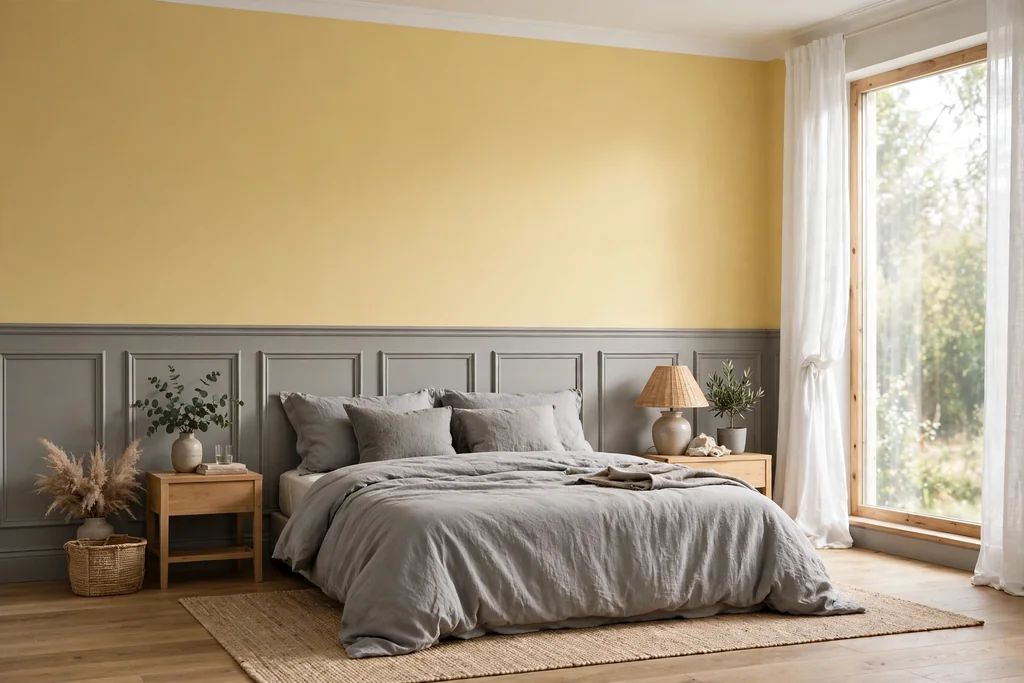
    How do you make a small bedroom romantic for two people?

    Use wall shelves instead of nightstands, a tall mirror to bounce light, and one soft accent color on bedding or one wall, while the other walls and the ceiling stay pale. Keep furniture low and mostly clear, choose a rug or two runners that fit the floor space, and use layered curtains for privacy and darkness. Small rooms suit romance in small doses, such as fairy lights, a shared throw, and one vase of flowers, rather than large furniture or many patterns.

    What lighting is best for a romantic bedroom?

    Warm, low, layered light works best: bedside lamps with warm bulbs and dimmers, plus a small reading light or fairy lights for evenings, with bright overhead light kept for dressing and cleaning only. Keep bulb color consistent across the room, and put switches or dimmers where you can reach them from the bed. Avoid harsh white bulbs and single bright ceiling lights at night, since they flatten soft colors and make the room feel less settled.

    How can couples share storage without arguing over space?

    Divide wardrobes, closets, and dressers into clear zones, one per person, with matching hangers and one shelf or basket each, and leave a little empty space for new items. Keep the most used items at eye level, move seasonal items high up, and agree on one shared tray for watches, keys, and small nightly items. A fair split, reviewed now and then, stops one person’s clothes from taking over and makes mornings faster for both people.

    What is the cheapest way to make a bedroom more romantic?

    Start with bedding, light, and scent, since these cost little and change the room fast. Swap in a soft throw and two cushions in a shared tone, switch to warm bulbs or add fairy lights, and add one vase of fresh stems or a diffuser in a scent you both like. Clear one dresser top, add a small tray for shared items, and keep the bed made and the floor tidy, since a calm, tidy room feels more romantic than a room full of new decor.


  • 22 Minimalist Bedroom Ideas on a Budget for a Warm, Inviting Home

    22 Minimalist Bedroom Ideas on a Budget for a Warm, Inviting Home

    A minimalist bedroom should help you rest, not feel empty or cold. The trick is to keep only what you use and love, then add warmth through wood, linen, soft light, and one or two plants. These 22 minimalist bedroom ideas on a budget show how to do that without new furniture for every corner: edit first, reuse what you own, buy secondhand where it helps, and spend only where it changes daily life. Start with the edit, then fix the light and the bed, and finish with small warm layers. For storage ideas that pair with the edit below, see these bedroom storage ideas.

    Key Takeaways

    • Edit before you buy: remove what you do not use, then see what the room actually needs.
    • Keep one warm base palette across walls, bedding, and large furniture, and add warmth through texture, not extra objects.
    • Spend first on the bed, the light, and one good rug, since those shape how the room feels every day.
    • Give everything a closed home, such as a box, a drawer, or a basket, so surfaces stay clear.
    • Buy secondhand and reuse what you own before buying new, and choose plain pieces that suit more than one layout.
    • Add warmth in layers you can move: a throw, a plant, a wood tray, and a lamp with a warm bulb.

    1. Start with a Weekend Edit, Not a Shopping Trip

    Minimalist bedroom mid edit with a tidy bed, one basket of items to pass on, and clear surfaces.

    Take everything out of one zone at a time, such as the nightstand, the dresser top, or the closet, and keep only what you use weekly or love enough to display. Box the rest for a month before passing it on, so you can rescue anything you truly miss. This costs nothing and often makes the room feel larger in an afternoon.

    Work in this order: surfaces first, then drawers, then the closet, then under the bed. Keep a single basket for items that leave the room, so the edit does not spread clutter into the hall. Once the room is clear, you will see which of the ideas below are worth spending on, and which were only filling space.

    2. Refresh the Walls with Warm White Paint

    Bedroom with freshly painted warm white walls, plain bedding, and wood furniture in daylight.

    One coat of warm white paint is one of the cheapest ways to make a bedroom feel calm and unified, especially if the walls carry marks, mixed colors, or old posters. Warm white suits wood, linen, and plants, and it keeps the room bright without the cold feel of a pure white. Paint the whole room if you can, or start with the bed wall and finish the rest later.

    Prep matters more than the paint brand: fill small holes, wipe the walls, and tape the edges before you start. Keep the ceiling and trim the same warm white for a simple, seamless look. If you rent and cannot paint, the same calm base comes from plain bedding, a large rug, and curtains in one warm neutral.

    3. Keep One Calm Base Palette Across the Room

    Minimalist bedroom in warm white, oatmeal, and mid wood tones with plain bedding.

    Choose three tones and repeat them: a warm white for walls and bedding, a mid wood tone for furniture, and one soft accent, such as oatmeal, sage, or dusty terracotta, for cushions and art. When the largest surfaces agree, the room reads as calm even with a few personal items on show. This also stops impulse buys from clashing, since new items must match the palette to earn a place.

    Apply the palette to the bed first, then the curtains, then the rug, since those cover the most area. Keep strong color to items you can move, such as a cushion cover or a throw, so a change of mood costs little. If two people share the room, agree the palette together before buying anything large.

    4. Choose a Simple Low Bed Frame

    Low plain wood bed frame with plain bedding in a calm minimalist bedroom.

    A low, plain bed frame in wood or metal gives a minimalist bedroom its anchor without the bulk of a tall headboard or a storage base you do not need. Low frames also make a small room feel taller, since more wall stays visible above the bed. Secondhand frames are easy to find, and a simple frame suits almost any bedding style you choose later.

    Check the frame length and width against the room, leaving room to walk around at least two sides of the bed. If the frame has no headboard, a row of firm cushions against the wall works for reading, and costs nothing extra. Keep the space under the bed clear or use flat boxes only, so dust does not collect out of sight.

    5. Dress the Bed in Plain, Layered Bedding

    Bed with plain layered bedding in white and oatmeal with a folded throw at the foot.

    Plain bedding in white, oatmeal, or soft grey is the fastest route to a calm minimalist bed, and it costs less than patterned sets that date quickly. Layer a flat sheet, a light duvet, and one folded throw at the foot, so the bed looks finished without a pile of cushions. Natural fabrics such as cotton and linen feel warm to the touch and wash well, which matters for bedding used every night.

    Buy the best duvet and sheets you can afford, and keep cushion covers plain so they can swap between rooms. Fold the throw rather than draping it loosely, since a neat fold reads as intentional. If you like pattern, keep it to one item, such as a single striped cushion, and let the rest of the bed stay plain.

    6. Limit the Bed to One Throw and Two Cushions

    Neatly made bed with one folded throw and two cushions in a minimalist bedroom.

    A minimalist bed needs only one throw and two sleeping cushions, plus a reading cushion if you read in bed. This rule stops the nightly pile of cushions on the floor, and it makes making the bed a one minute job. Choose a throw in a warm texture, such as waffle cotton or soft wool, so the bed still feels inviting with fewer layers.

    Store spare cushions and blankets in a box in the closet, not on a chair, so the room stays clear between uses. If guests use the bed, keep one extra set of bedding in the closet rather than on the bed itself. The goal is a bed you can make without thinking, and a room that stays tidy after you leave it.

    7. Find a Thrifted Nightstand or Use a Stool

    Thrifted wood nightstand beside a bed holding a lamp, a book, and a glass of water.

    A secondhand nightstand, a small stool, or a sturdy side table gives you a bedside surface for a lamp, a book, and water, without the price of a matching bedroom set. Look for solid wood pieces with simple lines, and repaint or sand only if the finish truly needs it. One good nightstand beats two bulky ones in a small room, and a stool can move to another room later.

    Keep the top to three items: light, a book or phone, and water. If two people share the bed and space is tight, give each side a wall shelf instead of a second table, which saves floor space and costs less. Check that the height suits the bed, so reaching for a lamp in the dark stays easy.

    8. Hide Clutter in Flat Under Bed Boxes

    Flat labeled storage boxes slid under a low bed in a tidy minimalist bedroom.

    Flat boxes under the bed give spare bedding, off season clothes, and bags a home without adding furniture to the room. This suits minimalist bedrooms well, since the storage stays out of sight and the floor stays clear. Choose boxes with lids and handles, and label each one, so you can find an item without pulling every box out.

    Keep the boxes to what fits neatly under the frame, and leave a small gap so they slide out without catching the rug. Review the boxes each season, and pass on anything you did not use, since under bed storage can quietly become a second closet. For more hidden storage ideas, see these bedroom storage ideas.

    9. Swap a Bulky Dresser for One Open Shelf Run

    Single run of open bedroom shelves with books, baskets, and folded items.

    If a dresser crowds the room, try one run of open shelves on a single wall for books, baskets, and folded items, with heavier pieces kept low. A shelf run uses wall space instead of floor space, and it forces a regular edit, since everything on show must earn its place. This works best for items you use often, with closed baskets for anything you would rather hide.

    Fix shelves into studs or with fixings suited to your wall type, and keep the top shelf for light, rarely used items. Leave gaps between groups so the shelves read as display rather than overflow. If you rent, a freestanding shelf unit gives a similar result with no wall fixing at all.

    10. Use a Picture Ledge for Art You Can Rotate

    Bedroom picture ledge with leaning framed prints in natural wood frames above a dresser.

    A narrow picture ledge lets you lean framed prints against the wall instead of hanging each piece separately, which suits renters and anyone who likes to change the display. Hang one or two ledges above a dresser or beside the bed, overlap frames of different sizes, and lean the largest frame at the back. Rotating art with the seasons keeps the room fresh without buying new furniture.

    Print your own photos or free art prints at home, and use simple frames in one finish, such as natural wood, so the group looks planned. Keep the ledge clear of the walkway, secure the frames so they cannot slide off, and leave one end empty so the arrangement looks intentional rather than crowded.

    11. Place One Large Mirror Opposite the Window

    Large mirror opposite a bright bedroom window reflecting daylight and a plant.

    One large mirror opposite or beside a window bounces daylight deeper into the room and makes the far wall feel farther away, which matters in a small minimalist bedroom. A single large mirror works better than several small ones scattered across the room, and a simple wood or plain frame suits the calm palette. Lean a full length mirror against the wall if hanging is not allowed, and secure it so it cannot slide.

    Check what the mirror reflects before you fix its position, since a mirror that reflects a messy corner doubles the mess. Aim it toward the window, a plant, or a calm stretch of wall. The zoning and mirror advice in these studio apartment decorating ideas applies here too, especially where a bedroom shares space with living or work areas.

    12. Layer Light at Two Levels, Not One Ceiling Light

    Bedroom in the evening lit by a floor lamp and a bedside lamp with a warm glow.

    A single ceiling light flattens a bedroom and makes it feel harsh in the evening. Two levels work better on a budget: a soft ambient light, such as a floor lamp or a dimmable ceiling bulb, plus a task light beside the bed for reading. Warm bulbs, around the soft end of the white range, keep the room inviting after dark without extra decor.

    Place the bedside lamp at shoulder height when you sit up in bed, and keep a second lamp near a chair or dresser if the room has one. Dimmable bulbs or a simple plug in dimmer let you shift from bright daytime light to a calm evening glow without rewiring, which matters in a rental. Turn the ceiling light off in the evening and let the lower lamps carry the room.

    13. Hang Plain Curtains High and Wide

    Bedroom window with plain oatmeal curtains hung high and wide over a calm bed.

    Plain curtains in linen look fabric, hung close to the ceiling and wider than the window, make a bedroom feel taller and calmer for little money. The extra height draws the eye up, and the extra width lets the curtains stack clear of the glass during the day, so daylight still fills the room. Choose one warm neutral that matches the bedding, and keep the fabric plain so it suits any future palette change.

    Use a simple rod and rings, and check that the curtains clear the floor by a small margin so they do not collect dust. If you need darkness for sleep, add a plain blackout lining behind the same curtains rather than a second patterned pair. Washable fabric keeps the setup practical, since bedroom curtains collect dust fast.

    14. Anchor the Room with One Large Flatweave Rug

    Large flatweave rug under the lower half of a bed in a warm minimalist bedroom.

    One large flatweave rug under the lower two thirds of the bed anchors a minimalist bedroom and adds warmth underfoot without the bulk of thick pile. The rug marks the sleeping zone, softens hard floors, and ties the bed, nightstand, and dresser into one group. Flatweave rugs cost less than thick pile, are easier to clean, and let chairs and boxes slide without catching.

    Size matters: the rug should extend past the sides of the bed enough to step onto in the morning, and sit under the front legs of any bedside tables. If a large rug is out of reach, layer a smaller soft rug beside the bed where your feet land first. Keep the rug in a warm neutral or a simple stripe, so it supports the palette rather than competing with it.

    15. Add Two or Three Easy Plants in Plain Pots

    Minimalist bedroom corner with three easy plants in plain terracotta and white pots.

    Two or three easy plants in plain terracotta or white pots bring life to a minimalist bedroom without filling every surface. A tall floor plant fills an empty corner, a trailing plant softens a shelf, and a small plant on the nightstand adds green at eye level. Match each plant to the light it will actually get, and group plants that need similar watering together, so care stays simple.

    Keep pots plain and in one material, so the plants, not the pots, carry the interest. Use saucers under pots on wood floors, and start with a few plants rather than a dozen, since a minimalist room needs plants you can actually keep alive. If light is low, choose plants suited to shade and place them near the window rather than in a dark corner.

    16. Give Throws and Laundry One Good Basket Each

    Woven baskets in a minimalist bedroom holding folded throws and laundry.

    A woven basket for throws and a second basket for laundry stop the two most common bedroom messes: a chair covered in clothes, and blankets folded on the bed. Baskets suit minimalist rooms because they hide clutter in a natural texture, and they move easily when you clean. Choose sturdy baskets with handles, in one material, so they look planned rather than patched together.

    Keep the throw basket beside the bed or a chair, and the laundry basket near the closet or door, so each item lands in the right place without thought. Empty the laundry basket on wash day and refold throws once a week, so the baskets stay useful rather than becoming overflow. One basket per job beats one large basket for everything, since mixed contents are harder to find.

    17. Make a Simple Fabric Panel Headboard

    Bed with a simple fabric panel headboard in plain oatmeal linen behind it.

    A fabric panel headboard, made from a plywood board covered in plain linen or cotton and hung behind the bed, gives a soft, finished look for far less than a bought headboard. It also protects the wall and gives a comfortable backrest for reading. Choose a fabric that matches the bedding, keep the panel the width of the bed, and hang it with fixings suited to your wall type.

    Pad the board lightly with a thin layer of batting before covering it, so it feels soft rather than hard. If sewing is not your strength, a plain stretched canvas or a large piece of fabric hung from a simple rod gives a similar soft backdrop. Keep the rest of the bed wall bare, so the panel stays the focus.

    18. Hang One Large Print Instead of Many Small Frames

    Bedroom with one large framed landscape print above the bed in a calm palette.

    One large print above the bed or dresser makes a stronger, calmer statement than a wall of small frames, and it often costs less once frames are counted. Choose a landscape, a botanical print, or an abstract in the room palette, and frame it simply in natural wood or black. A single large piece gives the eye one place to rest, which is the heart of a minimalist room.

    Print the art at home or through a local print shop, and size it to roughly two thirds of the bed width for balance. Hang it at eye level from the bed, not from standing height, since you see it most from the bed. If you tire of the print, swapping one large piece is quicker and cheaper than rearranging a whole gallery wall.

    19. Edit the Closet to a Capsule with Matching Hangers

    Tidy capsule closet with clothes on matching wood hangers and labeled shelf boxes.

    A closet edit to clothes you actually wear, hung on matching hangers, makes a minimalist bedroom feel calm every time you open the door, and it costs almost nothing. Remove anything unworn for a season, anything damaged, and duplicates that serve the same job, then hang what remains with space between groups. Matching hangers stop the closet from looking crowded, since mixed hangers waste width and catch on each other.

    Sort by type, such as tops, bottoms, and jackets, and keep folded items in labeled boxes on shelves. Keep one empty hanger section for new items, so the closet does not refill at once. Review the closet each season, and pass on what you did not wear, since a capsule closet only stays minimal with a regular, honest edit.

    20. Create a Bedside Landing Tray for Nightly Essentials

    Bedside tray on a nightstand holding a phone, glasses, and a glass of water.

    A small tray on the nightstand corrals the nightly essentials, such as a phone, glasses, lip balm, and water, into one tidy group instead of a scattered surface. This tiny habit keeps the bedside clear, since everything has a visible home and anything outside the tray stands out at once. A wood, ceramic, or woven tray in the room palette costs little and suits almost any nightstand.

    Keep the tray to items you use every night, and move anything used less than weekly elsewhere. Charge the phone on the tray rather than on the bed, so the bed stays a rest zone, and keep a small dish inside the tray for rings or earrings. If the nightstand is small, a wall shelf with a tray on top gives the same landing spot without using floor space.

    21. Warm the Room with One or Two Wood Accents

    Minimalist bedroom warmed by wood accents: a wood tray, a stool, and a wood frame.

    One or two wood accents, such as a wood tray, a stool, or a simple frame, warm a minimalist bedroom without adding clutter or color. Wood suits warm white walls and linen bedding, and it stops a pale room from feeling cold or clinical. Choose pieces with visible grain in a mid tone, rather than dark or glossy finishes that dominate a small room.

    Place the wood where you touch it daily: a tray on the dresser, a stool beside the bed, or a frame on the ledge. Keep the rest of the surfaces plain, so the wood reads as a warm note rather than a collection. If you already own wood furniture, sanding or oiling one piece can refresh it for little money, and it keeps a good piece in use.

    22. Keep a Seasonal Swap Box for Textiles

    Labeled seasonal swap box in a closet holding folded throws and cushion covers.

    A single swap box in the closet holds off season throws, cushion covers, and heavier blankets, so the bedroom stays minimal all year while still changing with the seasons. In summer, store the heavy throw and swap in a light cotton cover; in winter, reverse the change. This gives the room a fresh feel twice a year without buying new decor each season.

    Label the box by season, and keep only textiles inside, so it stays light enough to lift. When you swap, wash the outgoing items before storing them, and check the box for anything you did not use in a full year. This habit pairs well with the closet edit in Idea 19, since both keep the room to what the current season actually needs.

    Conclusion

    A warm minimalist bedroom on a budget is not about owning less for its own sake. It is about editing first, keeping one calm palette, spending where it matters, and adding warmth through wood, linen, light, and plants. Start with the weekend edit, then fix the bed and the light, and add one idea at a time, living with each change for a week before adding the next. If you try an idea here, save this post to your bedroom board on Pinterest so you can find it when you are ready for the next change, and share the one that made the biggest difference in your room. For more calm, small space ideas, the zoning advice in these studio apartment decorating ideas and the layered warmth in these cozy apartment living room ideas pair well with the bedroom ideas above.

    FAQs

    How do I make a minimalist bedroom feel warm instead of bare?

    Start with warmth you can touch: wood, linen, wool, and plants, plus light at two levels with warm bulbs. Keep walls and bedding in warm white or oatmeal rather than cold white or grey, and add one throw, one rug, and two or three plants. Warmth in a minimalist room comes from texture and light, not from adding more objects, so edit first and add layers one at a time until the room feels inviting.

    What is the cheapest way to start a minimalist bedroom?

    Begin with a free edit: remove what you do not use, clear surfaces, and keep only daily items visible. Then spend little on high impact changes, such as warm white paint, plain bedding, a flatweave rug, and a thrifted nightstand or stool. Buy secondhand first, reuse what you own, and spend only on the bed, the light, and storage that keeps surfaces clear.

    How many items should a minimalist bedroom have?

    There is no fixed number, since room size and lifestyle differ, but a useful rule is one job per item and a home for everything. Keep the bed, one bedside surface, one storage piece, one rug, one or two lamps, and a few personal items, then add only what solves a daily problem. If an item has no job and no home, it belongs in another room or out of the house.

    Can a minimalist bedroom work in a small room or a rental?

    Yes, and small rooms often suit minimalism best, since fewer pieces leave more walking space and light. Choose renter friendly options first, such as freestanding shelves, a leaning mirror, plain curtains on a tension rod or existing rod, and baskets instead of built in storage. Check your lease before drilling, and keep the setup to pieces that pack into a few boxes, so moving stays simple.

    What colors work best for a warm minimalist bedroom?

    Warm white, oatmeal, soft beige, and pale greige make a calm base, with mid wood tones and one soft accent, such as sage, dusty terracotta, or muted mustard, for cushions and art. Keep strong color to items you can move, such as a cushion cover or a throw, so a change of mood costs little. Avoid mixing many strong colors, since a calm base is what lets a minimalist room feel restful.

    How do I keep a minimalist bedroom tidy over time?

    Give every item a home, such as a box, a drawer, a basket, or a tray, and put items back after use rather than in a weekly clean. Keep one empty basket or drawer for new items, review the closet and the swap box each season, and remove one item for every new decorative piece you add. A ten minute reset once a week, returning anything that drifted out of place, keeps the room calm without a deep clean.


  • 22 Retro Bedroom Decor Ideas for a Stylish Room That Works

    22 Retro Bedroom Decor Ideas for a Stylish Room That Works

    Retro style works in a bedroom when one era leads and the rest of the room stays calm. A teak bed frame, a geometric wallpaper, or a burnt orange accent can set the mood, while plain bedding and warm light keep the room easy to sleep in. These 22 retro bedroom decor ideas cover 1950s, 1960s, and 1970s details, from furniture and walls to rugs, lamps, and small styling touches, so you can borrow one idea or build a full retro room. Start with the piece that fixes what bothers you most, test color in daylight and lamplight, then add a second retro detail only where the room still feels flat.

    Key Takeaways

    • Pick one era as the lead, such as mid century wood tones or 1970s warm color, and let other retro details support it rather than compete with it.
    • Use one strong retro feature, such as a patterned wall or a velvet headboard, and keep the rest of the room plain so the look stays stylish, not busy.
    • Repeat each retro color at least twice, in bedding and art, or in curtains and a cushion, so the palette looks planned rather than random.
    • Mix old and new on purpose: pair a vintage style piece with plain modern bedding, good lamps, and closed storage for everyday use.
    • Test bold retro color in morning light and evening lamplight before you commit, since orange, gold, and deep green shift a lot during the day.
    • Keep one calm surface in the room, such as plain sheets or a plain rug, so pattern and color have somewhere to rest and the room still feels restful at night.

    1. Paint One Burnt Orange Accent Wall

    Bedroom with a burnt orange accent wall behind a bed with cream bedding.

    Paint the wall behind the bed in burnt orange and keep the other walls warm white. The orange wall gives an instant 1970s mood, while the plain side walls keep the room from feeling closed in. This suits a room with plain furniture, since the wall does the color work and nothing else needs to change.

    Choose a matte or eggshell finish so the wall does not shine under lamplight, and paint the trim in the same pale tone as the other walls for a clean edge. Test a large sample on the bed wall first, and look at it in the morning and again at night, since orange can look brighter by day and deeper in lamplight. Pair the wall with wood tones and cream bedding for a warm, settled result.

    2. Choose a Low Teak Mid Century Bed Frame

    Bedroom with a low teak mid century bed frame and cream bedding.

    Choose a low bed frame in teak or a warm wood tone, with clean straight lines and short tapered legs. The low profile and visible wood grain are classic mid century details, and they suit a room with plain walls and simple bedding. A low frame also makes a small room feel less crowded, since the bed does not dominate the wall.

    Keep the bedding in a calm tone, such as cream, olive, or rust, so the wood stays the focus. Check the frame height before you buy, since a very low frame needs a nightstand at a matching height. For a calm base under a wood bed, see these elegant bedroom ideas, which show how plain bedding and clear surfaces keep a detailed room restful.

    3. Paper the Bed Wall With Bold Geometric Wallpaper

    Bedroom bed wall with bold geometric wallpaper in orange

    Use wallpaper with a bold geometric pattern, such as large circles, diamonds, or repeating arches, on the bed wall only. The pattern sets a clear retro mood without covering every wall, which suits a room where full papering would feel too strong. Keep the other walls plain, so the papered wall stays the focus.

    Measure the wall and order a little extra paper for pattern matching at the seams. Start at the center of the bed wall and work outward, smoothing each strip as you go, so the pattern stays centered on the bed. If you rent, use peel and stick wallpaper, and test one strip in a hidden spot first to check how it lifts.

    4. Add a Mustard Velvet Headboard

    Bedroom with a mustard velvet headboard and pale bedding.

    A headboard in mustard velvet adds warm color and softness behind the bed, without any paint. The rich tone suits a room with plain walls and warm lamplight, and it makes sitting up to read more comfortable than a hard wall. Keep the bedding in a paler tone, such as cream or soft white, so the headboard stays the clear focal point.

    Measure the bed width and the wall space before you buy, and leave room for bedside tables on both sides. Vacuum the headboard gently now and then, since velvet holds dust, and keep the cover removable if possible. Add one cushion in the headboard color to link the bed to the wall behind it.

    5. Hang a Round Sunburst Mirror Above the Dresser

    Bedroom dresser with a round sunburst mirror in brass above it.

    Hang a round sunburst mirror, with slim wood or brass rays around a central mirror, above a dresser or on the wall beside the bed. The sunburst shape is a clear mid century detail, and it bounces light around the room, which helps a dark corner. This suits a bedroom with plain walls, since the mirror adds shape without a new pattern.

    Keep the wall behind the mirror plain, so the rays read clearly, and hang it at eye level from where you see it most. For more ways to size and place mirrors and art in a bedroom, see these bedroom wall art ideas. Secure the fixing to suit the wall type, since a ray mirror can be heavier than a flat frame.

    6. Build a Vinyl Listening Corner

    Bedroom corner with a record player on a low wood stand and a chair nearby.

    Set a small record player on a low wood stand in a bedroom corner, with a few records stored upright beside it and one comfortable chair nearby. The corner gives the room a second use and a clear retro story, which suits a larger bedroom or a room with an empty corner. Keep the setup simple, so listening stays easy rather than becoming a display you cannot use.

    Place the player on a steady surface away from direct sun and heat, and keep the records upright so sleeves do not warp. Add a small lamp for evening listening, and keep cables tidy behind the stand. If space is tight, use a wall shelf for the player and a stool that slides underneath.

    7. Lay a Checkerboard Rug Beside the Bed

    Bedroom with a checkerboard rug in cream and rust beside a bed.

    Place a rug with a checkerboard pattern in warm tones, such as cream and rust or cream and brown, beside the bed or under its lower half. The checker pattern is a bold retro graphic, and it gives the room a color base at floor level. This suits a bedroom with pale walls and plain bedding, where the floor can carry the pattern.

    Choose a low pile rug that doors and drawers can clear, and use a rug pad on smooth floors to reduce slipping. Repeat one rug color in the bedding or a cushion, so the floor pattern connects to the bed. Vacuum often, since a light checker pattern shows dust and lint more than a dark or plain rug.

    8. Restore a Warm Wood Dresser With Brass Pulls

    Bedroom with a warm wood dresser with brass pulls beside a bed.

    Use a warm wood dresser with simple brass pulls as the main storage piece in the room. The wood tone and brass hardware read as mid century at once, and a dresser gives closed storage that keeps a retro room tidy. This suits a room where the bed is plain, since the dresser becomes the furniture focal point.

    Clean the wood and tighten or replace worn pulls before the dresser goes in the room, and keep the finish consistent across the handles. Keep the top mostly clear, with a tray, a small vase, and one framed print, so the wood surface stays easy to see. If the dresser is secondhand, check drawers for smooth runners before you load them.

    9. Hang Patterned Barkcloth Style Curtains

    Bedroom window with bold retro print curtains and plain bedding.

    Choose curtains in a bold retro print, such as large florals, abstract leaves, or a warm geometric, and keep the bedding mostly plain. The window becomes a block of pattern and color, which suits a room with white walls and solid furniture. Pick a print that shares one color with the rug or a cushion, so the window links to the rest of the room.

    Hang the rod high and wide, so the panels stack clear of the glass when open and daylight still fills the room. For fabric, length, and lining choices that suit different windows, see these bedroom curtain ideas. Wash patterned curtains as advised on the label, since bright prints can fade in strong sun.

    10. Light the Room With Globe and Mushroom Lamps

    Bedroom at night with globe lamps glowing warm light beside a bed.

    Swap plain bedside lamps for globe lamps or mushroom shaped lamps in warm white, amber, or soft orange glass. The rounded shapes glow softly at night and read as retro at once, which suits a room that feels plain after dark. This is a quick change, since it needs no paint and no new furniture.
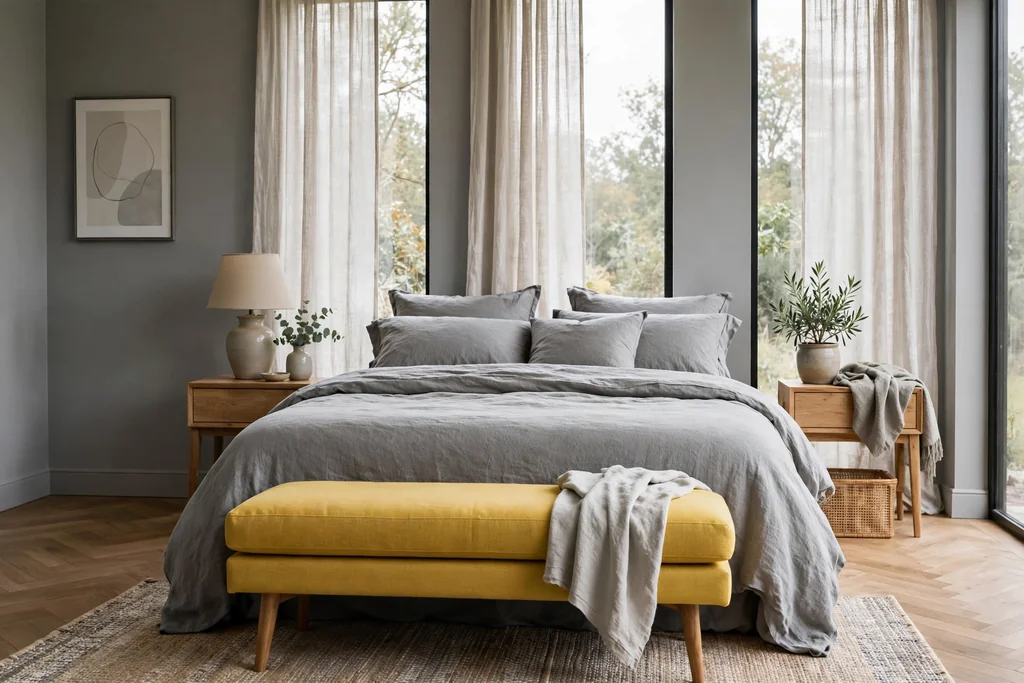
    Keep both bedside lamps the same shape or in two close tones, so the bed still looks balanced. Check that the shade size suits the lamp base, and keep bulb color consistent across the room, since mixed warm and cool bulbs make a palette look uneven. Use a dimmer where you can, so evening light stays soft.

    11. Frame a Gallery of Vintage Style Prints

    Bedroom wall with framed vintage style prints in matching frames above a dresser.

    Hang a set of framed vintage style prints, such as travel posters, abstract shapes, or old record covers, in a loose grid above a dresser or beside the bed. The gallery gives the room a collected retro story, while the bedding and furniture can stay simple. This suits a bedroom with one large empty wall and little else on it.

    Use matching frames and equal gaps, so the mix of prints looks ordered rather than scattered. Lay the frames on the floor first, measure the full block, and mark the wall with painter tape before you hang anything. Keep the prints to one palette family, such as warm orange, gold, and brown, so the wall does not look random.

    12. Add a Rattan or Cane Headboard

    Bedroom with a rattan cane headboard and cream bedding.

    Fit a headboard in rattan or cane, with a natural woven panel in a simple wood frame, behind the bed. The woven texture adds a 1970s feel and warmth, without color or paint, which suits a room with plain walls and cream bedding. Cane also keeps the bed wall light, since you can see the wall through the weave.

    Dust the weave with a soft brush now and then, since grooves collect dust faster than a flat surface. Keep the bedding plain, so the texture stays the focus, and pair the headboard with one wood nightstand to link the natural tones. If the cane feels fragile, check the frame joints before you lean against it daily.

    13. Dress the Bed in Color Blocked Retro Bedding

    Bed with color blocked bedding in cream

    Build the bed in blocks of retro color: a plain duvet in cream, a folded throw in rust or gold, and one or two cushions in olive or deep brown. The blocks read as deliberate, and you can swap the throw or the cushions when you want a new mood without buying new bedding. This suits a room where the walls must stay pale, such as a rental.

    Keep sleeping pillows in a plain tone close to the duvet, and put the brightest block at the foot of the bed, where it is easy to fold back at night. Wash the throw and cushion covers together so the colors stay even, and store spare covers in a basket so a seasonal swap takes minutes.

    14. Place a Shag Rug at the Side of the Bed

    Bedroom with a thick shag rug in warm brown beside a bed.

    Place a thick shag rug in cream, rust, or warm brown on the side of the bed where your feet land first. The deep pile is a clear 1970s detail, and it makes the first step of the day soft, which suits a bedroom with wood or hard floors. A shag rug also adds texture without a new pattern on the walls.

    Choose a rug size that gives a clear border on each side of the bed, and shake it outside often, since deep pile holds dust. Keep the rug away from door swings, so the pile does not catch, and vacuum with a suction only setting where the maker advises it. Pair the rug with plain bedding, so the texture stays the focus.

    15. Style a Nightstand With Retro Small Objects

    Bedroom nightstand styled with a round alarm clock

    Style one nightstand with a small group of retro objects, such as a round alarm clock, a small brass lamp, and a stack of two books. The group gives a retro note at bed height, where you see it from the door and from the bed, without changing any furniture. This suits a room where a full retro refresh feels like too much.

    Keep the group to three items and leave the rest of the nightstand clear, so the bedside stays usable at night. Put the clock where you can see it from the pillow, and keep a glass of water off the book stack. If the clock ticks loudly, move it to the dresser and keep only the lamp and books by the bed.
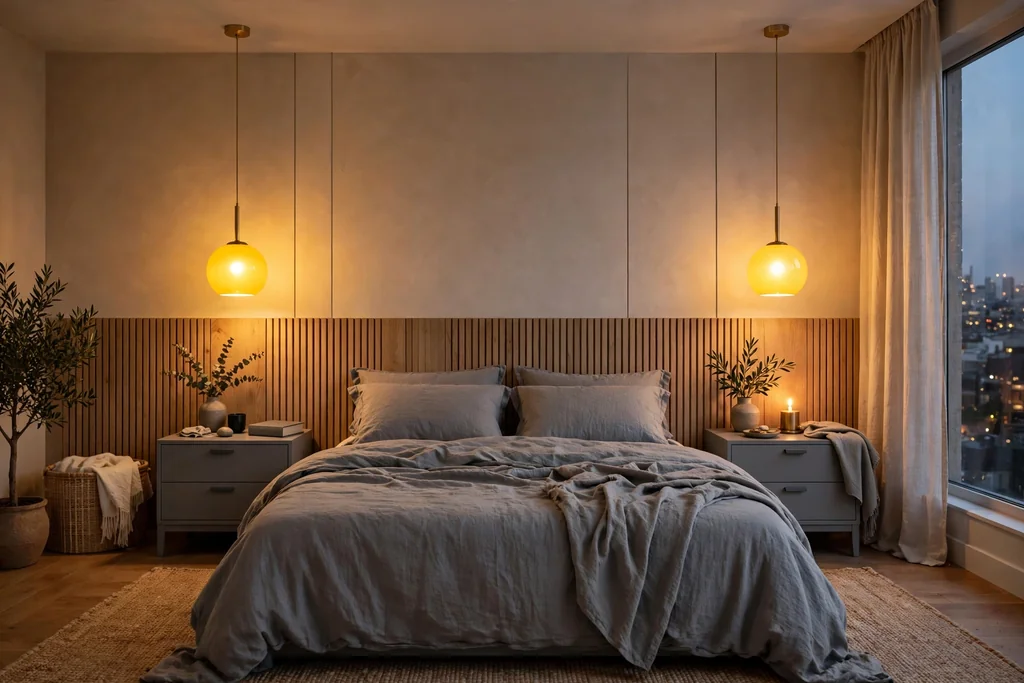
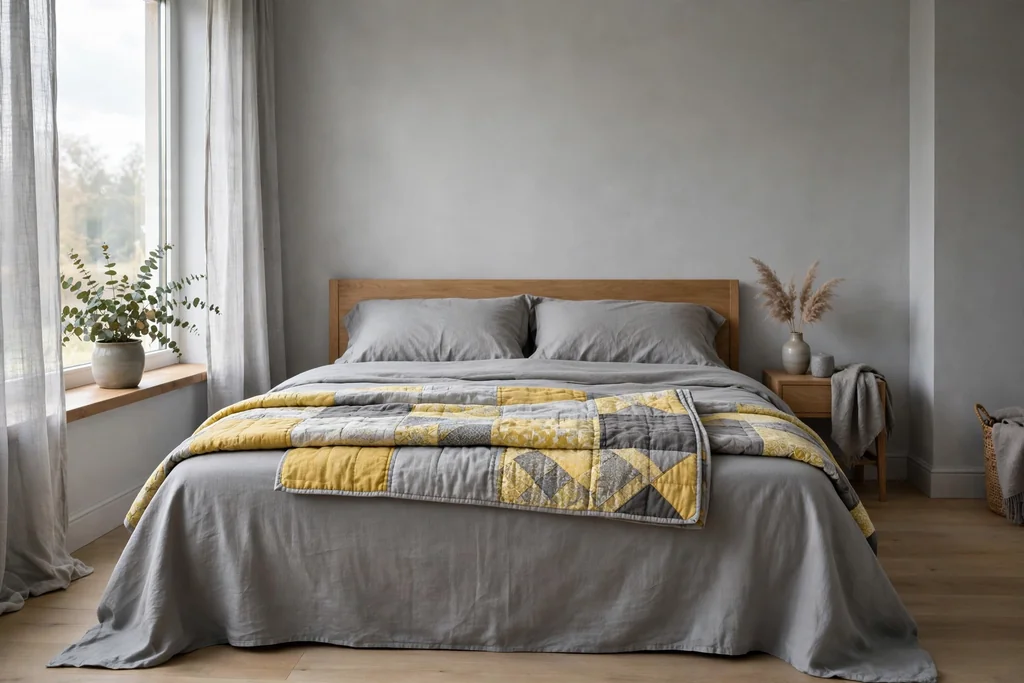
    16. Fit a Warm Wood Slat Wall Behind the Bed

    Bedroom bed wall with vertical warm wood slats behind a bed.

    Fit vertical wood slats in a warm tone on the wall behind the bed, with narrow gaps between them for shadow and depth. The slat wall adds wood warmth and a mid century rhythm, without wallpaper or paint, which suits a room with plain bedding and simple furniture. The vertical lines also make the bed wall feel taller.

    Center the slats on the bed, not on the room, and stop them clear of the ceiling and the floor for a finished edge. Fix the slats to suit your wall type, and test one slat in a hidden spot first if you plan to stain them. Keep the headboard simple, so the slat pattern stays easy to see.

    17. Hang a Woven Wall Hanging Above the Bed

    Bedroom wall with a woven wall hanging in warm tones above a bed.

    Hang a woven wall hanging in warm tones, with fringe or a simple geometric weave, above the bed or on a narrow wall. The woven texture adds a handmade 1970s feel, and it suits a relaxed bedroom where you want softness rather than a hard frame. Cream, rust, and gold threads work well with wood furniture and warm lamplight.

    Hang it from a wooden dowel or a slim rod, and let it fall flat against the wall so it does not billow. Keep the wall behind it plain, so the weave shows clearly, and keep it out of direct sun so the colors hold. Shake it outside now and then, since woven pieces collect dust.

    18. Stack Vintage Suitcases as a Nightstand

    Bedroom with stacked vintage suitcases used as a nightstand beside a bed.

    Stack two vintage style suitcases beside the bed to use as a nightstand with hidden storage inside. The stacked cases read as retro at once, and they give a place for spare bedding or out of season clothes, which suits a small bedroom where storage must stay on show. Keep the stack stable, with the largest case at the bottom.

    Check the cases for musty smells and clean them well before they go near the bed, and keep the top case closed when not in use. Place a small tray on top for a lamp or a book, so items do not slide off the curved lid. If the stack wobbles, use only one case on a low stool instead.

    19. Place a Burnt Orange Reading Chair in a Corner

    Bedroom corner with a burnt orange armchair

    Place one armchair in burnt orange fabric or a bold retro print in a bedroom corner, with a small side table and a reading lamp. The chair gives the room a second color focus away from the bed, which suits a larger bedroom or a room with an empty corner. A bright chair also makes the corner an invitation to sit, rather than a spot for bags and laundry.

    Angle the chair slightly toward the room, and keep it clear of clothes, so it stays usable. Repeat the chair color once, in a cushion on the bed or a print on the wall, so the corner does not look cut off from the room. Choose a washable cover if the chair will get daily use.

    20. Build a Vanity Corner With a Round Brass Mirror

    Bedroom corner vanity with a round brass mirror

    Set a small dressing table in a bedroom corner, with a round mirror in a brass frame, a small tray, and a stool that slides underneath. The round brass mirror is a clear retro detail, and the corner becomes a useful dressing spot, which suits a bedroom with an empty corner near a window. Keep the mirror frame simple, so the brass stays the focus.

    Keep the vanity top mostly clear, with a tray for daily items, so the corner stays usable and easy to clean. Repeat the brass tone once more in the room, in a lamp base or a picture frame, so the corner links to the bed. If space is tight, use a wall mounted shelf as the vanity top.

    21. Paint Retro Stripes on One Narrow Wall

    Bedroom narrow wall painted with wide horizontal stripes in cream and rust.

    Paint wide horizontal stripes in two warm tones, such as cream and rust or cream and olive, on one narrow wall, such as the wall beside a dresser. The stripes add a retro graphic without covering the bed wall, which suits a room where the bed wall already has wallpaper or a headboard that should stay the focus. This is a small paint job, so it suits a weekend.

    Use painter tape and a level for straight edges, and paint the lighter stripe first for a clean result. Keep the other walls plain, and repeat one stripe color in a cushion or a throw, so the striped wall does not look isolated. If the stripes feel strong, use them on a short wall only, not on a long main wall.

    22. Add Warm Glow With a Lava Lamp Corner

    Bedroom corner with a lava lamp glowing on a dresser beside a small plant.

    Place a lava lamp on a dresser or a low shelf in a bedroom corner, with a small plant or a framed print beside it, for a soft retro glow in the evening. The slow moving color is a clear 1970s detail, and it gives the room a gentle night light, which suits a bedroom that feels plain after dark. Keep the lamp away from bedding and curtains, since it warms up with use.
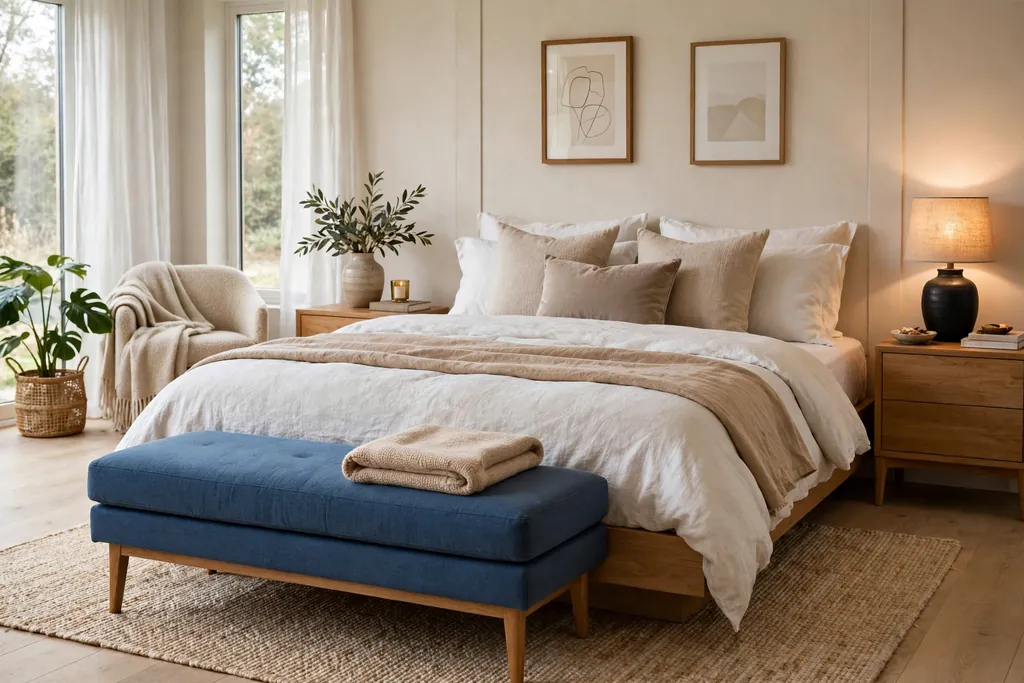
    Put the lamp on a steady surface where it cannot be knocked, and switch it off before sleep, since it is a mood light rather than a night light. Keep the area around it clear, so the glow shows against a plain wall, and follow the maker guidance on how long to leave it on. If the lamp feels too strong, move it to a corner you see from the door rather than from the bed.

    Conclusion

    A retro bedroom does not need a detail from every decade on every surface. Pick one era to lead, such as mid century wood or 1970s warm color, then repeat that color or material once or twice in smaller items and keep the rest of the room calm. Test paint and fabric in daylight and lamplight, start with bedding, lamps, and cushions when you want a quick change, and save walls and furniture for a weekend project. Save the ideas that fit your room size, your light, and how much retro detail you want to wake up to, and pin this post so you can find your favorite looks again when you are ready to start.

    FAQs

    How do I make a retro bedroom look stylish instead of dated?

    Pick one era as the lead and keep the rest of the room calm, with plain bedding, good light, and clear surfaces. Use one strong retro feature, such as a patterned wall or a velvet headboard, and repeat its color once or twice in smaller items, rather than adding a retro detail to every surface. Mixing one vintage style piece with plain modern bedding and closed storage also keeps the room livable.

    Which retro era suits a small bedroom best?

    Mid century style often suits a small room best, since low furniture, slim legs, and warm wood keep the room feeling open. A low teak bed frame, one wood dresser, and a plain rug give a retro mood without heavy pattern. If you love 1970s color, keep it to one accent wall or one chair, and keep the other walls and the ceiling pale.

    What colors work best for a retro bedroom?

    Warm tones, such as burnt orange, mustard, olive, rust, and deep brown, with cream or warm white as the base, give the clearest retro feel. Teal and gold can also work, especially with wood and brass. Test any bold color in evening light, since a tone that looks fresh by day can feel darker or stronger at night.

    Can I mix retro pieces with modern furniture?

    Yes, if the palette stays shared. Pair a retro bed frame or dresser with plain modern bedding, simple lamps, and one or two retro colors repeated in cushions or art. Keep furniture lines simple on both sides, so the mix looks planned rather than random. If a new item does not share a tone with the retro pieces, leave it out or move it to another room.

    How much pattern should a retro bedroom have?

    Use one main pattern, such as geometric wallpaper or a bold curtain print, and keep the other patterns small or plain. A checker rug, a striped wall, and a patterned curtain in one room can fight each other, so pick the pattern you see first and let the rest stay solid. If two patterns must share a room, keep one large and the other small, in shared colors.

    How do I add retro style on a low budget?

    Start with bedding, cushions, lamps, and small styling, since these swap in minutes and need no paint or new furniture. A mustard throw, globe lamps, a framed vintage style print, and a shag rug can change the mood of a plain room. Save walls and large furniture for later, and look for secondhand wood pieces you can clean and keep, rather than buying a full matching set at once.


  • 32 Black Bedroom Decor Ideas to Bring More Personality Home

    32 Black Bedroom Decor Ideas to Bring More Personality Home

    Black can make a bedroom feel calm, grounded, and personal, but only when it has a clear job. One black wall, one black headboard, or one black dresser can anchor a plain room, while pale bedding, warm wood, and soft lamplight keep it from feeling heavy. These 32 black bedroom decor ideas cover walls, beds, furniture, lighting, storage, and small rooms, so you can add black in one place or build a fuller scheme over time. Start with the change that fixes what bothers you most, test it in daylight and lamplight, then add a second black piece only where the room still feels unfinished.

    Key Takeaways

    • Give black one clear job in the room, such as the bed wall, the headboard, or one large furniture piece, and keep the rest of the room lighter.
    • Pair black with warm wood, cream, brass, or green plants so the room feels warm rather than cold and flat.
    • Use matte or eggshell black on large surfaces, since gloss can show every bump and brush mark under lamplight.
    • Add light on or near each black surface, such as a bedside lamp, a sconce, or a mirror that catches daylight.
    • Repeat each black piece once more in a small detail, such as a frame or a lamp base, so the scheme looks planned.
    • Test paint and fabric in morning light and evening lamplight before you commit, since black shifts a lot during the day.
    • Start with bedding, cushions, and curtains for a no-paint refresh, and save walls and painted furniture for a weekend project.

    1. Paint One Black Accent Wall Behind the Bed

    Bedroom with a matte black accent wall behind a bed with white bedding.

    Paint the wall behind the bed in matte black and keep the bedding in white, cream, or soft grey, so the bed stands out against the dark backdrop. Matte paint softens the wall and hides small surface flaws better than gloss, which matters on a large bedroom wall. This suits a main bedroom where you want a calm, hotel-like focal point without adding furniture.

    Keep bedside lamps in warm white and add one wood or brass detail, such as a wooden tray or a brass lamp base, to stop the corner feeling cold. For more ways to plan the wall, its finish, and its trim, see these chic black accent wall ideas. If the room is small, keep the other walls pale, leave the ceiling white, and add a mirror nearby to bounce light back into the room.

    2. Choose a Black Upholstered Headboard

    Bed with a black upholstered headboard and cream bedding.

    A black upholstered headboard adds depth behind the bed without any paint, and it makes sitting up to read more comfortable than a hard wall. The soft fabric suits a room with plain walls and warm lamplight, and the dark shape frames the pillows clearly. Keep the bedding in a paler tone, so the headboard stays the clear focal point of the room.

    Measure the bed width and the wall space before you buy, and leave room for bedside tables on both sides. Vacuum the headboard gently now and then, since dark fabric shows dust and lint, and choose a removable cover if possible. Add one cushion in a tone taken from the room, such as cream or rust, so the bed links to the rest of the scheme.

    3. Layer Black and White Bedding

    Bed with black and white bedding and a black throw at the foot.

    Build the bed in clear black and white blocks: a white duvet, a black throw folded across the foot, and cushions split between the two tones. The contrast reads as deliberate, and you can change the balance by swapping the throw or one cushion, without buying new bedding. This suits a room where the walls must stay pale, such as a rental.

    Keep sleeping pillows in white or cream, and put the strongest black block at the foot of the bed, where it is easy to fold back at night. Wash black and white pieces separately at first, since new black dye can mark pale fabric. A black and white bed also suits a guest room, since it looks finished with little else in the room.

    4. Paint the Bed Frame Matte Black

    Matte black painted bed frame with pale bedding.

    Paint a wood bed frame in matte black and keep the bedding in a calmer tone, so the frame becomes a dark outline for the bed. The painted frame suits a simple room with plain walls and little furniture, where the bed needs a stronger shape. This works best on a wood frame with clean lines, where the color can show clearly.

    Sand and prime the frame first, and use a paint made for furniture so the finish stands up to daily use and moving the bed for cleaning. Repeat the black once more in the room, in a frame or a lamp base, so the frame does not look like the only dark piece. Keep the floor beside the bed pale or in warm wood, so the dark frame does not blend into a dark floor.

    5. Add a Black Wardrobe or Dresser

    Black wardrobe with brass handles in a pale bedroom.

    Paint one large furniture piece, such as a wardrobe or a dresser, in black, and keep the walls pale. The piece anchors the room like a painted accent wall, but it can move with you, which suits a rental or a room you plan to rearrange. Black also hides small marks better than a pale finish, which helps on a piece used every day.

    Remove the handles before painting, and put them back in a simple finish, such as wood or brushed brass, so the black stays the focus. Keep the top of the piece mostly clear, with one tray or one vase, so the painted surface reads clearly. If the piece sits against a pale wall, add a lamp or a plant beside it so the dark block does not feel isolated.

    6. Hang a Black Framed Gallery Grid

    Grid of prints in black frames above a bedroom dresser.

    Hang a set of prints in black frames in a strict grid, such as nine frames in three rows of three, above a dresser or on the wall opposite the bed. The matching black frames give order to the wall, while the prints inside can vary in subject, from line drawings to photographs. This suits a bedroom with one large empty wall and plain bedding.

    Use equal gaps of 2 to 3 inches between frames, and keep the mat size the same, so the grid looks tidy rather than scattered. For more help sizing and hanging art above a bed or a dresser, see these bedroom wall art ideas. Lay the frames on the floor first, measure the full block, and mark the wall with painter tape before you hang anything.

    7. Dress the Window in Black Curtains

    Bedroom window with long black linen curtains.

    Choose black curtains in a soft fabric, such as linen or cotton, and keep the bedding mostly pale. The window becomes a tall dark panel, which suits a room with white walls and solid furniture, and the curtains also block morning light well. Pick a fabric with a little texture, so the panels do not read as flat slabs of color.

    Hang the rod high and wide, so the panels stack clear of the glass when open and daylight still fills the room. For fabric, length, and lining choices that suit different windows, see these bedroom curtain ideas. Keep the curtain color tied to one other black detail in the room, such as a frame or a lamp, so the window does not feel like a lone dark block.
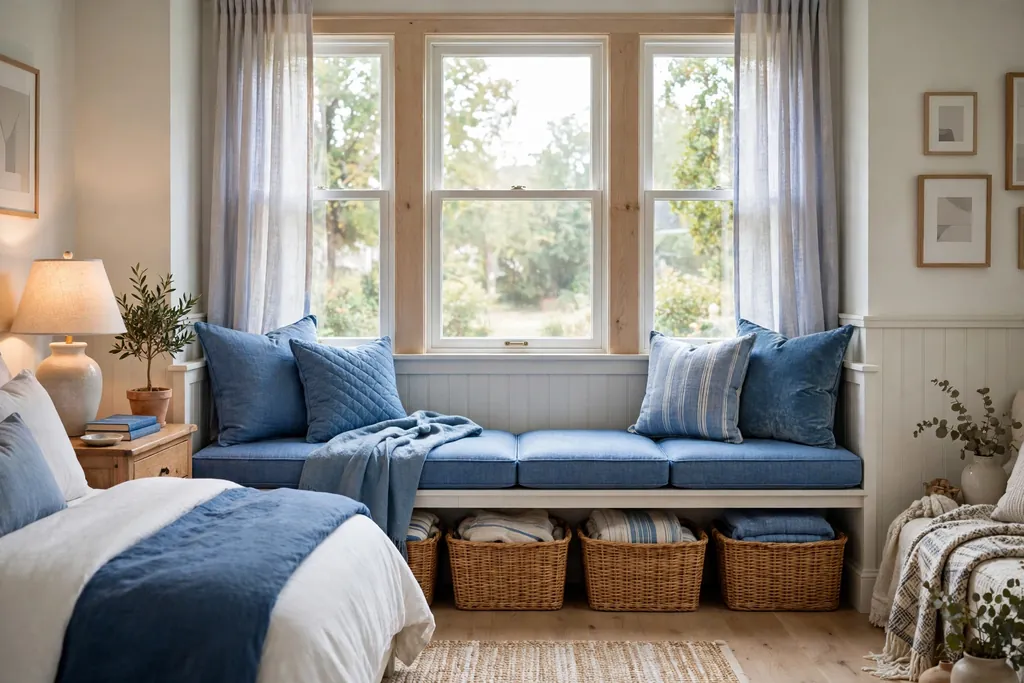
    8. Ground the Room With a Black Textured Rug
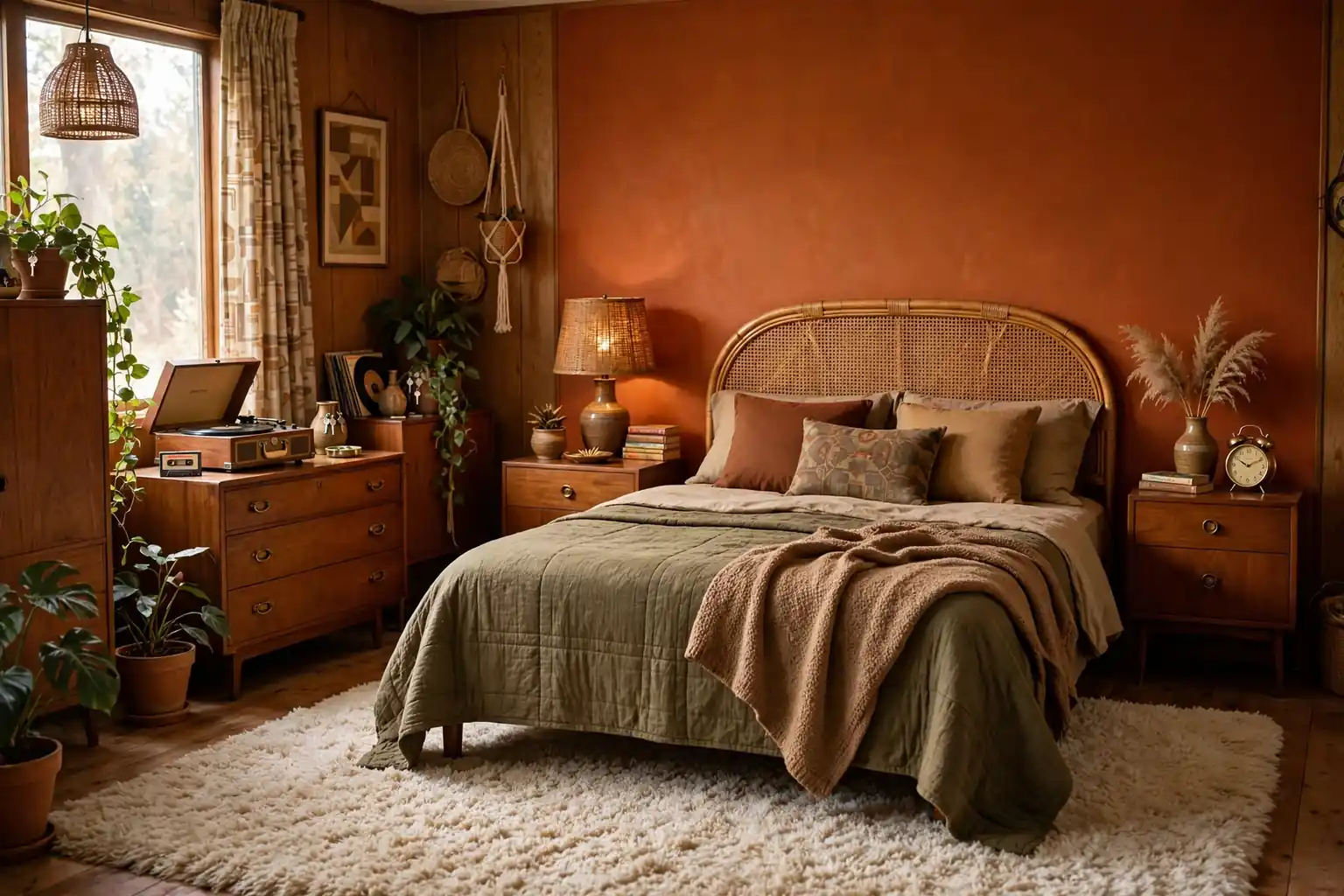
    Textured black rug under a bed with pale bedding.

    Place a large black rug with clear texture, such as a high pile, a woven flatweave, or a subtle pattern, under the lower two thirds of the bed, extending out on both sides. The rug gives the room a dark base at floor level, which suits a bedroom with pale walls and plain bedding. A rug that is too small makes the bed look as if it is floating, so measure for a clear border on each side before you buy.

    Choose a texture you can see and feel, since a flat black rug can look like a shadow on the floor. Use a rug pad on smooth floors to reduce slipping, and repeat the black once in the bedding or a cushion, so the floor color connects to the bed. Vacuum often, since a black rug shows dust, lint, and pet hair more than a mid tone rug.

    9. Pair Black Nightstands With Brass Lamps

    Black nightstands with brass lamps beside a bed.

    Place black nightstands on both sides of the bed and top each one with a brass lamp. The black gives the bed a grounded base at bed height, while the brass catches lamplight and warms the dark wood or paint. This suits a room where a full repaint feels like too much, since the change sits at furniture level.

    Keep the lamp shades in a pale tone, such as cream or linen, so the light spreads softly rather than pooling under a dark shade. Use matching lamps for a tidy look, or two brass lamps in different shapes for a collected feel, and keep the nightstand tops mostly clear. Repeat the brass once more in the room, in a frame or a tray, so the metal looks planned.

    10. Add Black Panel Moulding to One Wall

    Black panel moulding wall behind a bed with cream bedding.

    Fit simple panel moulding to the wall behind the bed and paint the panels and the wall the same black. The moulding adds shadow lines and depth that flat paint alone cannot give, which helps a plain bedroom feel finished. This suits a room with high ceilings or a wide bed wall, where the panels can run in a clear, even rhythm.

    Plan the panel sizes on paper first, keeping the gaps even and the panels clear of switches and sockets. Paint the moulding and the wall in the same finish, so the joints read as shadow rather than as stripes. Keep the bedding pale and the art simple against this wall, so the panel pattern stays easy to see.

    11. Mix Black With Warm Walnut Wood

    Black bedroom with warm walnut wood nightstands.

    Pair black pieces with warm walnut wood, such as a walnut headboard rail, walnut nightstands, or a walnut bench, so the room gains warmth beside the dark tones. The wood grain softens black paint and black fabric, and it keeps the room from feeling cold. This mix suits a bedroom with wood floors, since the walnut links the furniture to the floor.

    Keep the walnut tone consistent across two or three pieces, rather than mixing many wood tones at once. Add cream bedding and one green plant to complete the palette, and keep metal details in brass or black for a quiet finish. If the room already has pale wood, a single walnut piece can still work, but keep the rest of the wood pale so the mix stays calm.

    12. Try Black Patterned Wallpaper on One Wall

    Bedroom wall with subtle black patterned wallpaper.

    Hang black patterned wallpaper on one wall, in a subtle stripe, a small botanical print, or a faux linen texture, and keep the other walls plain. The pattern adds interest that flat paint cannot, while the black keeps the wall grounded. This suits a bedroom where you want depth without a bold color, and it works in a rental if you choose a removable paper.

    Clean the wall first, measure carefully, and hang the first strip with a level, since a crooked first strip throws off the whole wall. Smooth out air bubbles with a plastic smoother as you go, and trim at the ceiling and baseboard with a sharp blade. Keep the bedding plain, so the pattern stays the main feature of that wall.

    13. Make the Bed in All Black Bedding

    Bed dressed in all black bedding with mixed textures.

    Dress the whole bed in black, from the fitted sheet to the duvet and the pillowcases, and keep the walls pale and the lamps warm. The all black bed becomes a bold, cocoon-like center in a light room, and it suits a bedroom where you want drama without painting a wall. Texture matters here, since one flat black fabric can look dull.

    Mix textures to keep the bed interesting: a matte cotton duvet, a waffle or linen throw, and velvet or corduroy cushions in the same black. Add one pale cushion or a cream throw at the foot, so the bed still has a point of contrast and is easy to make in the morning. Wash black bedding inside out and separately, so the color stays even.

    14. Set Up a Black Dressing Table Corner

    Black dressing table with a mirror in a bedroom corner.

    Place a small black dressing table or console in a bedroom corner, with a mirror above it and a stool tucked beneath. The corner gains a clear purpose, and the black table reads as a piece of furniture rather than a dark wall. This suits a bedroom with an unused corner near a window, where daylight helps for getting ready.

    Keep the tabletop tidy with one tray for daily items, and hang the mirror so it catches window light rather than facing a cluttered wall. Add a small lamp or a candle on the tray for evening use, and keep the stool in a pale or wood tone so the corner does not feel heavy. Store less used items in the drawer, so the surface stays clear.

    15. Fit Black Open Shelves Beside the Bed

    Black open shelves beside a bed with books and a plant.

    Mount one or two black open shelves beside the bed, at a height you can reach from the mattress, and use them for books, a small plant, and a lamp. The shelves turn an empty side wall into useful storage, and books and objects stand out against the dark shelf backs. This suits a small bedroom where a nightstand would crowd the floor.

    Fix shelves into studs or with fixings rated for the weight, and leave some shelf space empty so the display does not look packed. Keep the shelf contents to a few items each, mixing books with one vase or one framed photo, and repeat the black in the bed frame or a lamp base. A small clip light on the top shelf helps for reading without a table lamp.

    16. Hang Black Pendant Lights Over the Nightstands

    Black pendant lights over bedside tables.

    Hang a black pendant light over each nightstand, in place of a table lamp, so the bedside surface stays clear. The pendants draw the eye up and give the bed a framed, hotel-like look, while the black cords and shades tie in with other dark pieces. This suits a bedroom with a low ceiling only if the pendants hang clear of the bed and the pillows.

    Hang the pendants so the bottom of each shade sits just above head height when you sit up in bed, and use warm white bulbs with a dimmer if possible. Keep the shades simple, such as a dome or a drum, so the light spreads evenly. If you rent, plug-in pendants with a cord cover give a similar look without new wiring.

    17. Add a Black Accent Chair for Reading

    Black accent chair with a pale cushion in a bedroom corner.

    Place a black accent chair in a bedroom corner with a small side table and a floor lamp, to make a reading spot that is separate from the bed. The chair adds a dark anchor away from the bed wall, which balances a room where all the black sits on one side. This suits a larger bedroom, or a corner near a window with enough room to sit comfortably.

    Choose a chair with a shape you can sit in for a while, such as a rounded armchair, and add a pale cushion so the seat does not feel dark to sit in. Keep a small basket for books beside the chair, and angle the floor lamp over the shoulder you read from. If floor space is tight, a slim slipper chair gives the same corner without crowding the room.

    18. Lean a Large Black Framed Mirror

    Large mirror in a black frame leaning against a bedroom wall.

    Lean a large mirror in a black frame against a bedroom wall, beside a dresser or in a corner, so the room gains light and a sense of height. The mirror bounces daylight and lamplight around the room, which helps a bedroom with black walls or black furniture feel open. This suits a room with a wide empty wall and little else on it.

    Choose a mirror taller than the dresser or nightstand beside it, so it reads as a deliberate piece rather than a mirror waiting to be hung. Anchor it with a small non slip pad behind the bottom edge, and keep it out of the main walkway so nobody knocks it. Check what the mirror reflects before you settle it: a window or a plant looks good, while a view of clutter does not.

    19. Add Black and Gold Details Sparingly

    Black dresser with gold drawer pulls and a gold framed print.

    Use black and gold together in small details, such as gold drawer pulls on a black dresser, a gold framed print on a black wall, or gold lamp bases beside a black bed. The gold warms the black and catches lamplight, but it works best in small doses. This pairing suits a bedroom that leans formal, or a room where plain black feels too stark.

    Pick one gold detail per area, such as the pulls on one dresser, and keep the rest of the metal in the room in black or brass tones that sit close to gold. Avoid gold on every surface, since too much shine fights the calm mood a bedroom needs. Keep bedding pale, so the black and gold details read clearly against a quiet background.

    20. Paint the Interior Door Black

    Bedroom door painted black with a brass handle.

    Paint the bedroom door black, including the frame if it suits the room, and keep the walls pale. The door becomes a strong vertical block that frames the entry to the room, and it costs far less than painting a wall. This suits a bedroom with white trim elsewhere, since the black door stands out as a deliberate accent.

    Use a durable paint made for doors and trim, since doors get touched often, and paint both sides if the door opens into a hallway you also want to tie in. Keep the handle in brass or black, and add a black frame or a black hook on the wall nearby, so the door does not feel like the only dark piece. If the room is small, keep the door closed view in mind, since you see it from the bed.

    21. Paint the Floorboards Black in a Small Room

    Small bedroom with black painted floorboards and a pale rug.

    Paint the floorboards black in a small bedroom and keep the walls pale, the ceiling white, and the bedding light. The dark floor grounds the room and makes pale furniture stand out, which can make a small room feel styled rather than bare. This suits a room with plain wood floors that are worn or mismatched, since paint unifies them.

    Use a floor paint made for wood floors, and seal it as the maker directs, so the finish stands up to foot traffic. Add a pale rug beside the bed, so bare feet land on a soft surface and the dark floor does not dominate the view from the door. Keep the baseboards white for a clean edge, and touch up scuffs in the main walkway now and then.

    22. Choose a Black Four Poster Frame

    Black four poster bed frame with pale bedding.

    Choose a black four poster bed frame, in slim metal or painted wood, and keep the bedding pale so the frame reads as a clear outline. The posts give the bed height and structure, and the frame turns the bed into the main feature of the room without any wall paint. This suits a bedroom with a high ceiling, where the posts have room to breathe.

    Keep the top of the frame open, without a canopy fabric, if the room is small, so the posts do not close in the bed. Hang a light fabric from the top rail only if you want a softer look, and keep it sheer so daylight still reaches the bed. Add bedside lamps in warm white, since the dark posts can shadow the corners of the bed at night.

    23. Soften Black With Blush Bedding Accents

    Black bedroom with blush cushions and a blush throw.

    Soften a black bedroom with blush accents, such as blush cushions, a blush throw, or blush curtains, while keeping the main black pieces in place. The soft pink warms the black without taking over the room, and it suits a bedroom where plain black feels too stark. Keep the blush to bedding and small textiles, so it is easy to swap later.

    Use two blush pieces, such as a throw and one cushion, rather than one lone item, so the color looks planned. Keep the rest of the bedding in cream or white, and repeat the blush once more in a small detail, such as a vase or a print, if the room allows. If blush feels too sweet, a dusty rose or a muted terracotta gives a similar softening effect.

    24. Let Green Plants Pop Against Black

    Green plants in clay pots against a black bedroom wall.

    Place green plants against black walls or beside black furniture, so the leaves stand out against the dark backdrop. The green warms the room and adds life, and it suits almost any black bedroom, from a single black wall to a fuller dark scheme. Choose plants that suit your light, such as a snake plant for low light or a monstera for a bright corner.

    Use pots in cream, terracotta, or natural clay, so the plants read clearly and the pots do not blend into the black. Group plants at different heights, with one tall floor plant and one smaller plant on a nightstand or shelf, so the green feels layered. Water as each plant needs, and wipe large leaves now and then, since dust shows more on dark backgrounds.

    25. Fit a Black Desk Nook in the Bedroom

    Small black desk nook in a bedroom alcove.

    Fit a small black desk into a bedroom nook or alcove, with a chair, a lamp, and one shelf above it. The dark desk marks the work zone clearly, even in a shared room, and it gives a small corner a defined purpose. This suits a spare corner, a window alcove, or the wall beside a wardrobe, where a full desk would crowd the room.

    Keep the desk surface light where you work, with a pale mat or a light wood tray, so papers and a laptop read clearly against the black. Add one warm lamp with a focused beam, and keep cables tidy with clips or a tray, since loose cables show up more against black. When the workday ends, clear the desk surface so the nook reads as part of the bedroom again.

    26. Add a Black Storage Bench at the Foot of the Bed

    Black storage bench at the foot of a bed.

    Place a black storage bench at the foot of the bed, with lift up seating or baskets beneath, for spare bedding, shoes, or seasonal clothes. The bench finishes the bed visually and adds storage without a new wardrobe, which suits a bedroom short on closet space. Choose a bench close to the bed width, so it does not stick out past the mattress on either side.

    Keep the bench top clear or topped with one folded throw, so it stays useful as a seat for getting dressed. Use the storage for items you reach for often, such as spare blankets, and label baskets inside if the bench has open cubbies. Repeat the black in the bed frame or a nightstand, so the bench links to the rest of the bed area.

    27. Use a Black Geometric Throw as the Pattern

    Bed with a black geometric patterned throw at the foot.

    Use a black geometric throw, such as a bold stripe, a diamond pattern, or a simple block print, as the main pattern in an otherwise plain bedroom. The throw adds pattern without a new color, which suits a room where you want interest but not a busy palette. Drape it across the foot of the bed or over a chair, where the pattern is easy to see.

    Keep the rest of the bedding plain, in white, cream, or grey, so the throw pattern stays the focus. Fold the throw back at night rather than removing it, so the bed still looks dressed in the morning. Wash the throw as the label directs, since black patterned fabric can fade in strong sun if it sits near a window.

    28. Add a Black Picture Ledge With Sconces

    Black picture ledge with layered frames and wall sconces.

    Fit a black picture ledge above the bed or above a dresser, and flank it with small black wall sconces. The ledge lets you layer frames and swap art without new holes, while the sconces give warm light on either side of the display. This suits a bedroom where you like to change art often, or a rental where fixed hanging feels limiting.

    Stand larger frames at the back of the ledge and smaller ones in front, and leave one end of the ledge empty so the display does not look packed. Use warm white bulbs in the sconces, and put them on a dimmer if possible, so the light suits both reading and winding down. Keep the ledge depth in mind: shallow ledges suit flat frames, while deeper ones hold small objects too.

    29. Paint Only the Lower Wall Black With White Above

    Bedroom with a black lower wall and white upper walls.

    Paint the lower half of the bedroom walls black and keep the upper half white or cream, with a chair rail or trim board marking the split. This gives the room the depth of black without darkening the whole space, since the pale upper wall and white ceiling keep the room bright. It suits a bedroom where full height black paint feels too strong, or a room with low ceilings.

    Fit the rail at about one third of the wall height, and paint the rail the same black or in white for a crisper edge. Use a washable paint finish on the lower section, since that part of the wall gets scuffs from the bed, bags, and hands. Keep art above the rail simple and light, so the upper wall stays calm against the dark base.

    30. Mix Black With Natural Linen and Jute

    Black bedroom with natural linen bedding and a jute rug.

    Pair black furniture and black walls with natural linen bedding, a jute rug, and woven baskets, so the room gains warmth and texture beside the dark tones. The natural fibers soften black paint and black fabric, and they suit a bedroom with a relaxed or coastal feel. This mix works well in a room with plenty of daylight, where the textures show clearly.

    Keep the linen in natural, cream, or oatmeal tones, and let the jute rug sit under the bed or beside it, where it adds texture underfoot. Add one or two woven baskets for storage, in a tone close to the rug, so the natural materials link together. Avoid too many woven pieces at once, since a room full of baskets can feel cluttered rather than calm.

    31. Use a Black Chalkboard Wall for Notes and Art

    Bedroom wall painted as a black chalkboard with chalk notes.

    Paint one bedroom wall with chalkboard paint, to make a black wall you can write on, draw on, and change with the week. Use it for a weekly plan, a simple drawing, or a favorite line, and wipe it clean when you want a fresh start. This suits a teen bedroom, a guest room, or a main bedroom where one wall can carry a changing display.

    Use two or three thin coats for an even writing surface, and season the wall by rubbing chalk over it and wiping it clean before the first use, following the paint maker instructions. Keep chalk and an eraser in a small cup nearby, and use a damp cloth for a full clean. If chalk dust bothers you, chalk markers give a cleaner line and wipe off with water on most chalkboard paints.

    32. Go All In With a Small All Black Cocoon Room

    Small bedroom with all black walls and warm lamps.

    Paint all four walls black in a small bedroom, dress the bed in black bedding, and use warm dimmable lamps for light. The all black room feels like a cocoon, which suits a small bedroom used mainly for sleep, where a dark, enclosed feel helps you wind down. This works best when the room has a clear light plan, since an all black room without lamps can feel flat.

    Layer the light: a warm overhead light on a dimmer, a bedside lamp on each side, and one small light near the mirror or wardrobe, so no corner falls into shadow. Mix black textures, such as matte paint, velvet cushions, and linen bedding, so the room has depth rather than one flat tone. Keep the ceiling white or very pale, so the room keeps its height even with dark walls.

    Conclusion

    Black works in a bedroom when it has a clear job and the rest of the room gives it light, warmth, and breathing room. Pick one idea to start, such as a black wall, a black headboard, or black bedding, test it in daylight and lamplight, and add a second black piece only where the room still feels unfinished. Pair black with warm wood, cream, brass, or plants, and keep one pale surface in the room, so the dark tones have somewhere to rest. Save this list on Pinterest before you start, so you can work through it in order and stop to adjust if the balance feels off.

    FAQs

    Will a black bedroom feel too dark at night?

    It can, if every surface is dark and the lighting is weak, but a black bedroom with warm lamps, pale bedding, and a mirror usually feels cozy rather than gloomy. Layer the light with bedside lamps and one overhead light on a dimmer, keep the ceiling pale, and add one light surface, such as cream sheets or a pale rug, so the room has contrast.

    What finish of black paint suits a bedroom wall?

    Matte or eggshell suits most bedroom walls, since both hide small flaws and give a soft, even look. Use a washable eggshell in a room where the wall gets touched often, such as a kids room, and save flat matte for a main bedroom wall that sees little contact. Test a large sample board in daylight and lamplight before painting a full wall.

    How much black is too much in a bedroom?

    Start with one large black piece, such as a wall, a headboard, or a dresser, and add smaller black details only where the room still feels flat. If the room starts to feel heavy, add a pale rug, cream bedding, or a plant, rather than removing the black piece itself. The right amount is the point where the black reads as a feature, not as the whole room.

    Can I use black decor in a small bedroom?

    Yes, if you keep the black to one wall or a few furniture pieces, and keep the ceiling white, the floor light, and the bedding pale. A mirror, warm lamps, and one plant help a small black bedroom feel open, and a black accent wall behind the bed often makes the bed feel more defined rather than making the room feel smaller.

    What colors go best with a black bedroom?

    Cream, warm white, walnut wood, brass, blush, and green plants all sit well beside black. Cream and warm white keep the room bright, walnut and brass add warmth, blush softens the scheme, and green plants add life against a dark backdrop. Pick one or two of these partners and repeat them, rather than adding many colors at once.

    Can I try black bedroom decor in a rental?

    Yes, if you use bedding, curtains, furniture, removable wallpaper, or a freestanding paneled board, rather than painting the walls. Black bedding, black curtains, and a black dresser all give the look without changing the walls, and removable black wallpaper gives a black wall you can peel off when you move out. Check your lease first, and test any removable product in a hidden spot.