Category: Seasonal Decor

Thoughtful seasonal touches, tablescapes, and holiday decorating ideas.

  • 15 Artificial Fall Flower Arrangements for Lasting Seasonal Color

    15 Artificial Fall Flower Arrangements for Lasting Seasonal Color

    Artificial fall flower arrangements give lasting seasonal color without watering, wilting, or weekly replacement. Choose rust, gold, and burgundy blooms, pair them with berries, leaves, and wheat, and place them in vases, baskets, or pitchers that suit each room. The 15 ideas below cover mantels, tables, entries, and porches for the whole season.

    These 15 artificial fall flower arrangements are grouped by container and placement, so you can start with the spot you want to style and pick the shape that fits it. A tall floor vase suits an entry, a low bowl suits a dining table, and a small trio suits a mantel. Keep the color range tight, repeat one warm tone in each room, and leave breathing room around each arrangement so the blooms read clearly from across the room.

    Key Takeaways

    • Start with the placement, then choose a container and stem height that fit that spot.
    • Repeat two or three fall colors, such as rust, gold, and burgundy, so separate arrangements read as one plan.
    • Mix bloom shapes with berries, leaves, or wheat so a faux bouquet looks full without looking crowded.
    • Keep arrangements clear of heat sources, open flames, and busy walkways, and keep table arrangements low enough for conversation.
    • Choose stems you can bend, trim, and rearrange, so one set of flowers can serve more than one display.
    • Store arrangements upright in a covered box or bag at the end of the season, so they hold their shape for next year.

    1. Rust and Gold Bouquet in a Ceramic Vase
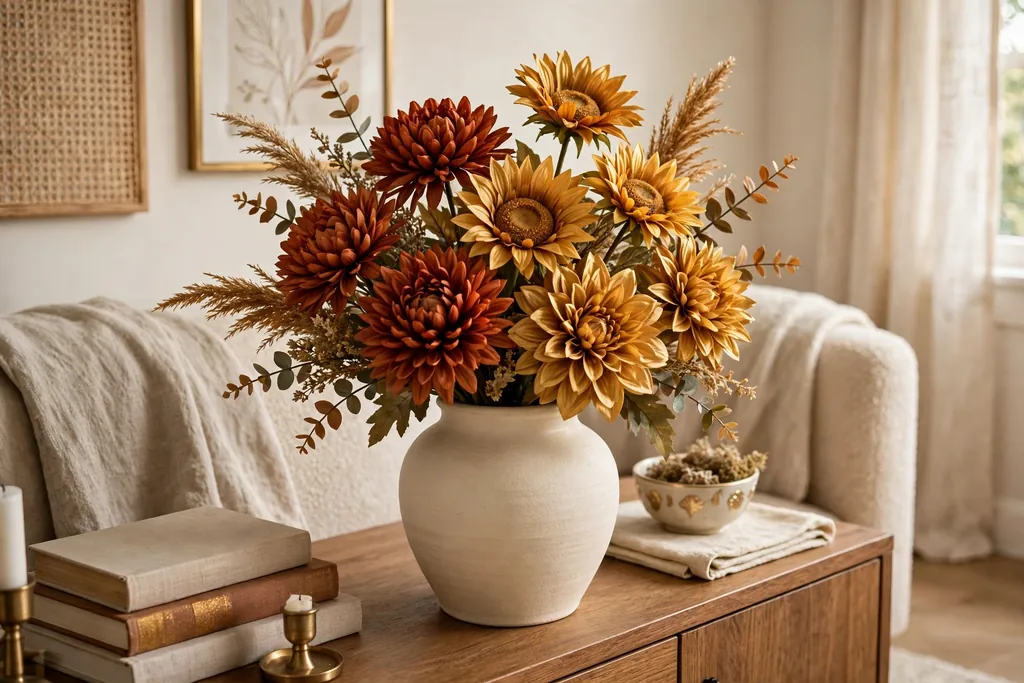
    Rust and gold artificial mums and sunflowers in a cream ceramic vase.

    A rust and gold bouquet in a ceramic vase is the classic starting point for artificial fall flower arrangements. Use five to seven stems of faux mums, dahlias, and sunflowers in rust, mustard, and deep gold, then add two or three maple leaf stems for shape. A mid height ceramic vase in cream, sage, or warm brown grounds the bright blooms and suits a sideboard, console, or coffee table.

    Trim the stems so the tallest bloom sits about one and a half times the vase height, and bend the outer stems slightly outward for a full, rounded shape. Turn the vase as you build, checking it from the side guests will see most. For more living room styling around this kind of display, see these fall living room decor ideas.

    2. Tall Sunflower and Wheat Stems in a Floor Vase
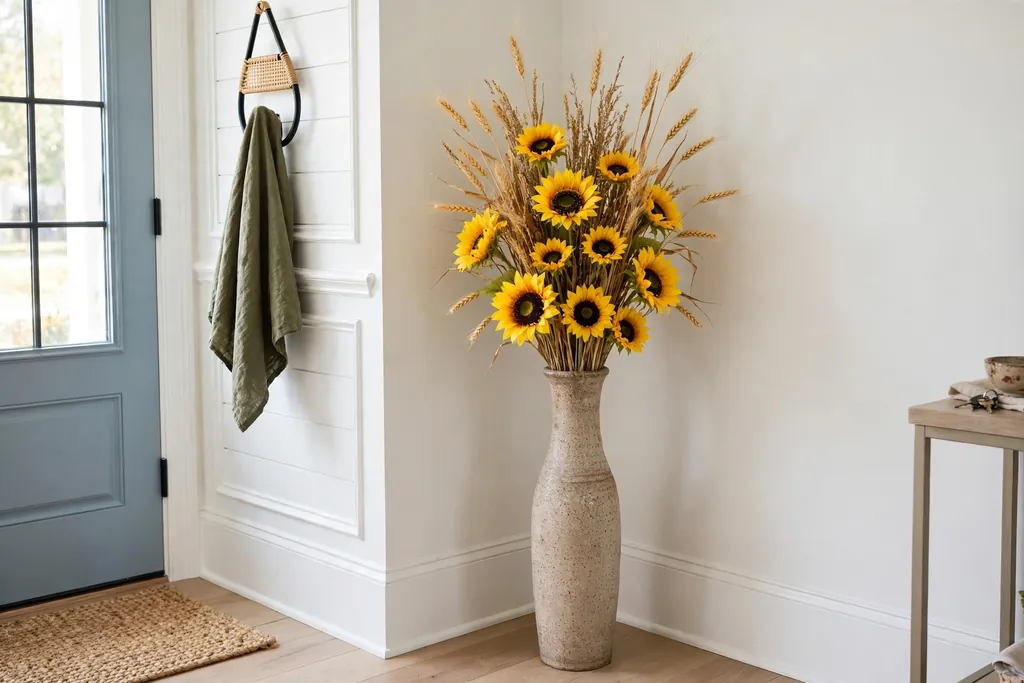
    Tall floor vase with artificial sunflowers and wheat stems in an entryway.

    Tall sunflower and wheat stems in a floor vase give an entry or a bare corner instant height. Choose a heavy floor vase that will not tip, then add five to nine long stems: faux sunflowers for color, wheat for texture, and one or two leafy branches for width. Keep the total height below door frames and light fixtures, and place the vase where it will not be brushed by bags or coats.

    This arrangement works best with a simple color plan, since height alone makes it a focal point. Use gold and rust blooms with natural wheat tones, and skip small filler pieces that would get lost at this scale. Dust the stems with a dry cloth now and then, and straighten any bent wheat heads after moving the vase.

    3. Low Dining Table Centerpiece with Mini Pumpkins and Mums
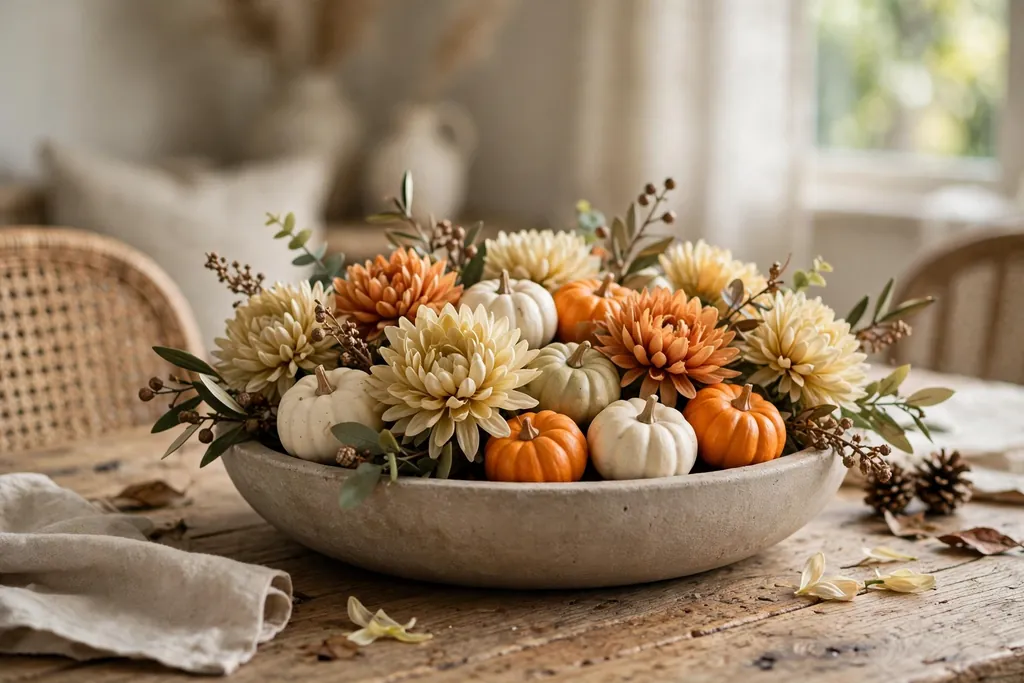
    Low dining table centerpiece of artificial mums with mini pumpkins.

    A low dining table centerpiece pairs artificial fall flower arrangements with small seasonal accents guests can see past. Set a shallow bowl or low tray in the center, add short faux mums and dahlias in rust and cream, then tuck two or three mini pumpkins and a few leaves around the base. Keep the whole display under about 12 inches tall so conversation stays easy.

    This centerpiece suits everyday meals as well as gatherings, since it lifts away in one move when the table needs clearing. Choose a tray with a rim so pumpkins and leaves stay in place, and keep candles, if you use them, in holders clear of the faux stems. Swap the pumpkins for pinecones later in the season to carry the same arrangement toward winter.

    4. Mason Jar Trio on the Mantel
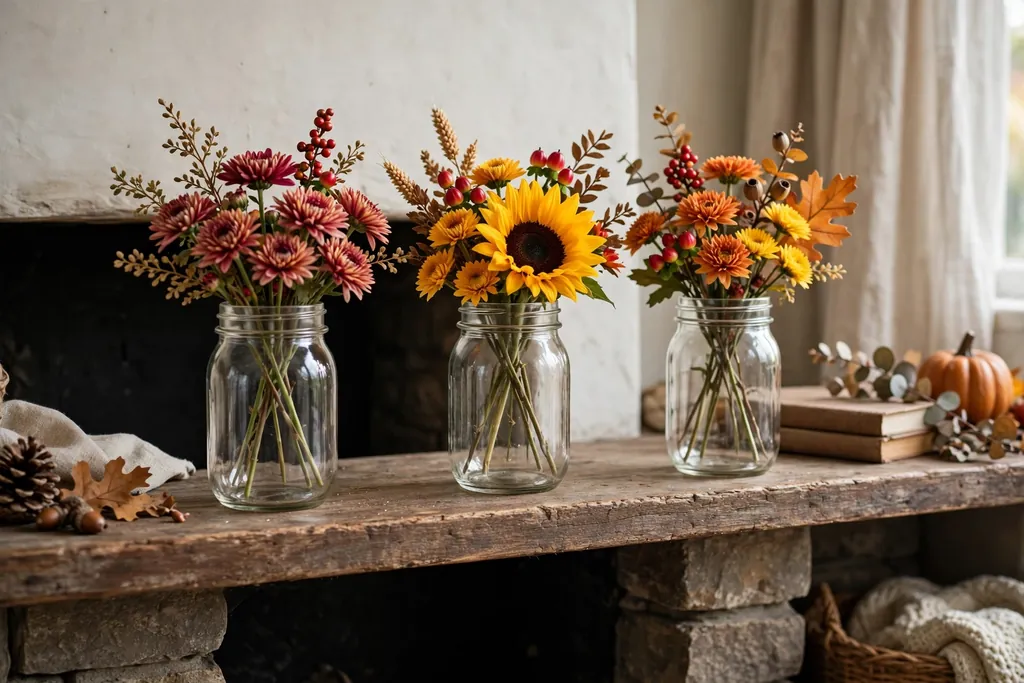
    Three mason jars with artificial fall stems on a fireplace mantel.

    A mason jar trio on the mantel turns three small artificial fall flower arrangements into one balanced display. Fill each jar with three to five short stems, using the same color family in all three jars but a different lead bloom in each: mums in one, sunflowers in another, and berries with leaves in the third. Space the jars evenly, with the tallest jar in the middle or at one end.

    Keep the mantel display clear of heat if the fireplace is in use, and place the jars on a tray or runner to protect the mantel surface. This idea suits a mantel that already holds art or a mirror, since the jars sit low and do not block what hangs above them. Change one jar’s stems each year for a fresh look without buying a whole new set.

    5. Galvanized Bucket Arrangement for the Porch
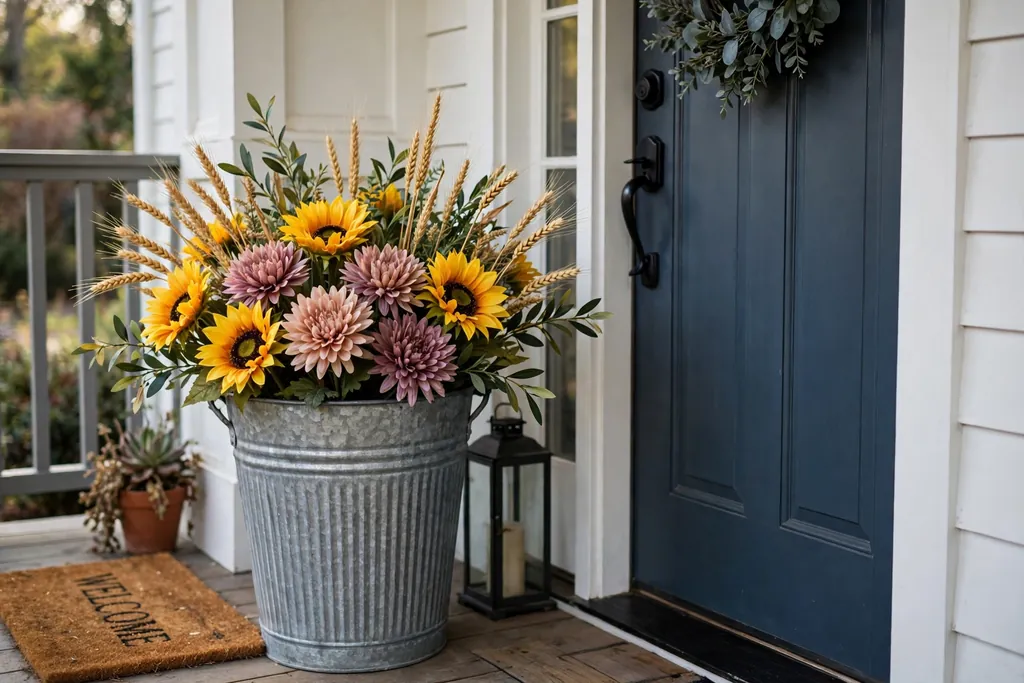
    Galvanized bucket of artificial sunflowers and mums beside a front door.

    A galvanized bucket arrangement brings artificial fall flower arrangements outside, where fresh blooms would fade fast. Fill a galvanized bucket or metal pail with tall faux sunflowers, mums, and wheat, then add berry stems and a few maple leaves for fullness. Weight the base with stones or a brick so wind does not tip it, and set the bucket beside the door or on a porch step.

    Choose stems rated for outdoor use where possible, and bring the bucket under cover in heavy rain or strong wind to keep the blooms in shape. A metal bucket suits farmhouse, rustic, and cottage porches alike, and it pairs well with a plain doormat and one or two pumpkins. Check the stems after storms and replace any that have faded badly.

    6. Wooden Box Arrangement for the Coffee Table
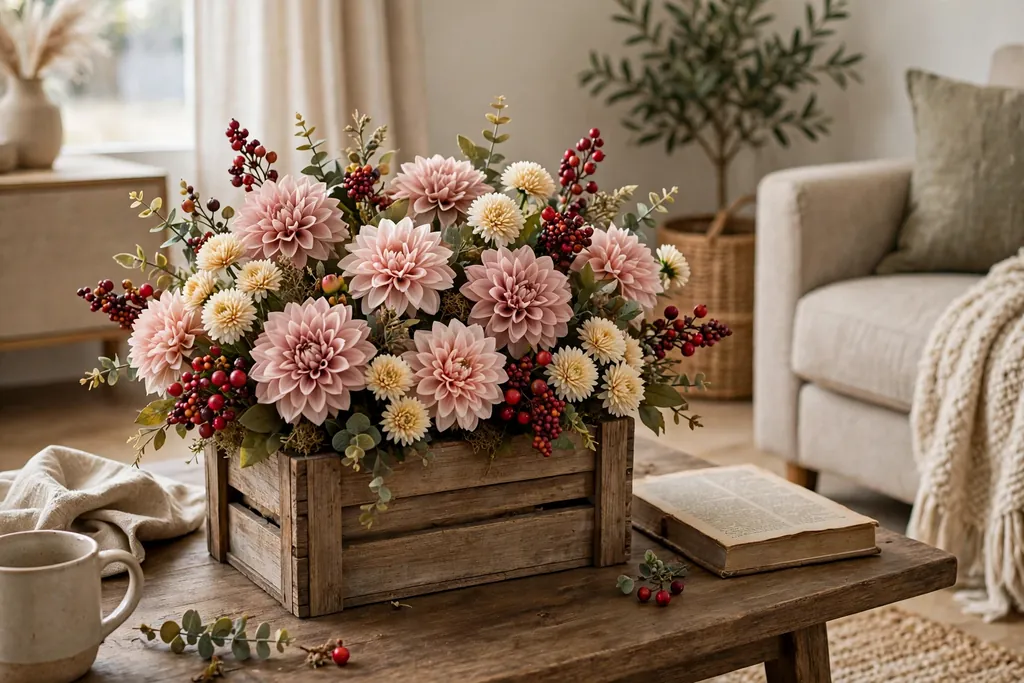
    Wooden box of artificial dahlias and berries on a coffee table.

    A wooden box arrangement keeps artificial fall flower arrangements low, contained, and easy to move from a coffee table. Line a long, shallow wood box with a block of floral foam, then add short faux dahlias, mums, and berries in rust, cream, and burgundy, with a few leaves spilling slightly over the edges. Keep the arrangement low enough that it does not block the television or conversation.

    This idea suits a coffee table that also holds books, cups, and remotes, since the box defines one clear display zone. Lift the whole box aside when the table is needed for a meal or a game, and return it after. Choose a box finish that matches other wood in the room, and dust the blooms before guests arrive.

    7. Slim Glass Cylinders on a Modern Console
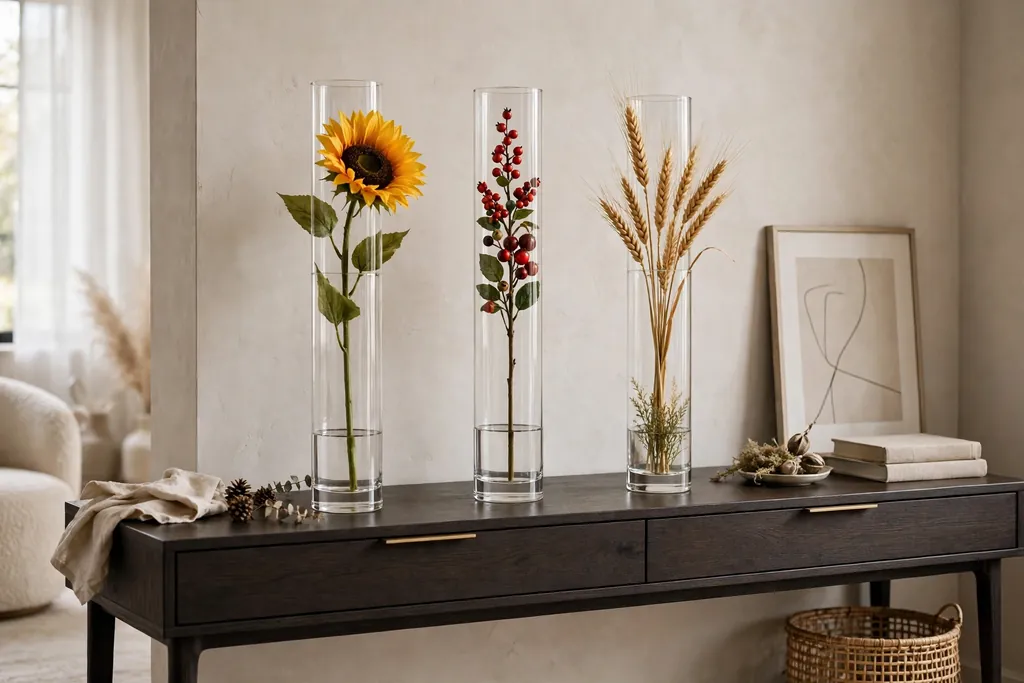
    Three slim glass cylinders with single artificial stems on a console.

    Slim glass cylinders suit a modern console where a full bouquet would look too heavy. Use three cylinders in different heights, each holding one to three stems: a single sunflower, a short spray of berries, or a pair of wheat stems. Keep the palette restrained, such as rust and cream with green leaves, and leave clear space between the cylinders so each one reads on its own.

    Glass shows the stems, so trim them cleanly and remove any loose leaves inside the vase. This arrangement works well in a hallway or behind a sofa, where a narrow console leaves little depth for a wide bouquet. Wipe the glass now and then, since fingerprints and dust show more on clear cylinders than on ceramic or wood.

    8. Harvest Basket with Berries and Eucalyptus
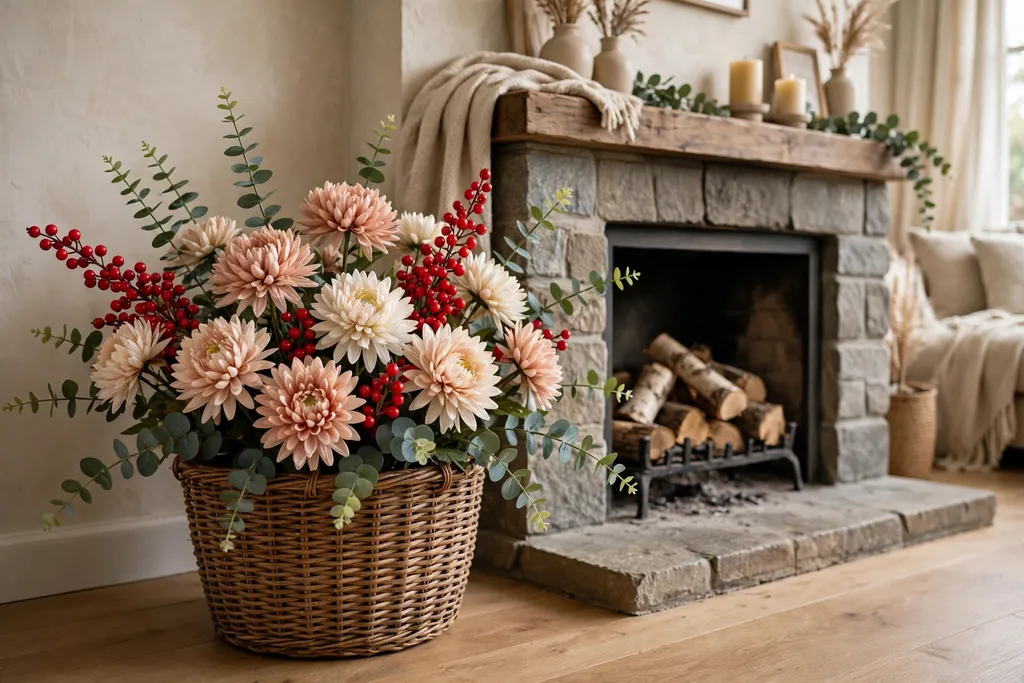
    Woven basket of artificial mums with berries and eucalyptus.

    A harvest basket with berries and eucalyptus mixes fall color with softer, muted greenery. Fill a woven basket with faux mums and dahlias in rust and gold, then weave in berry sprays and eucalyptus stems so the green tones break up the warm blooms. Set the basket on a bench, a side table, or the floor beside a fireplace, with a cloth or mat underneath to protect the surface.

    Baskets suit a relaxed, gathered look, and they hide the mechanics of the arrangement well, since foam and stem ends stay out of sight. Choose a basket with a sturdy handle if you plan to move it between rooms, and keep it away from damp floors. At the end of the season, lift the whole arrangement out and store it in the basket, covered, for next year.

    9. Copper Pitcher Arrangement for the Kitchen
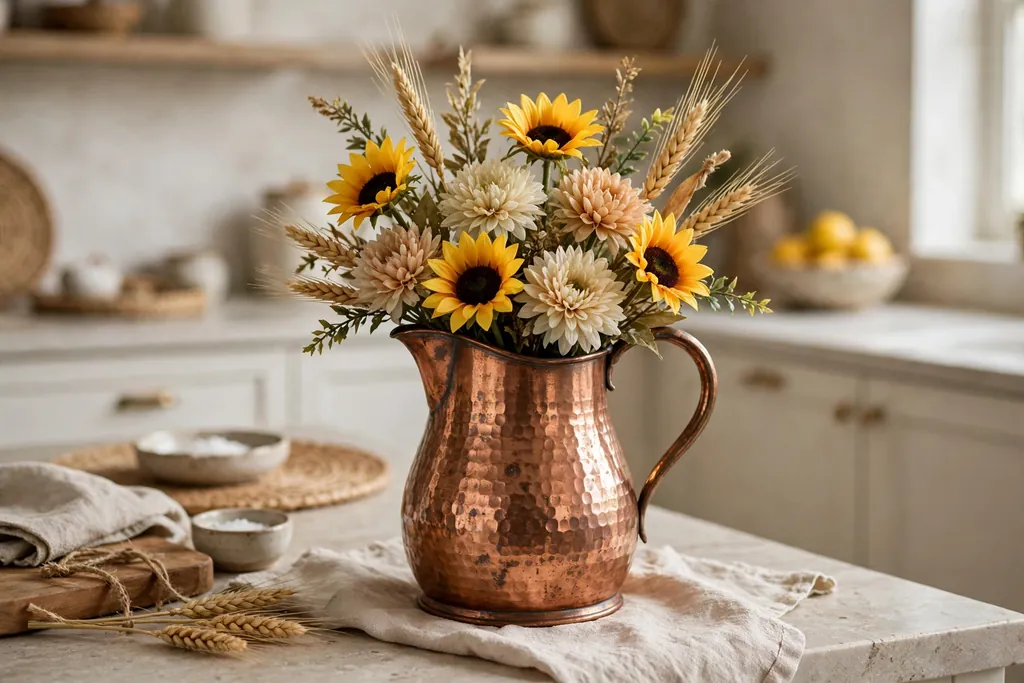
    Copper pitcher with artificial sunflowers and wheat on a kitchen counter.

    A copper pitcher arrangement adds warm metal and fall color to a kitchen counter or open shelf. Fill a copper pitcher with short faux sunflowers, mums, and wheat, keeping the stems compact so the display fits under upper cabinets. Place the pitcher at the end of a counter or on a shelf, clear of the stove and sink splash zone.

    Copper pairs well with wood, cream, and sage kitchen details, and the pitcher shape keeps the bouquet upright without extra support. Keep the arrangement small in a busy kitchen, since counter space is working space: one pitcher is enough, and it should lift away in seconds when you need the counter back. Wipe the pitcher dry if it sits near the sink.

    10. Lantern Arrangement with Leaves and Battery Candles
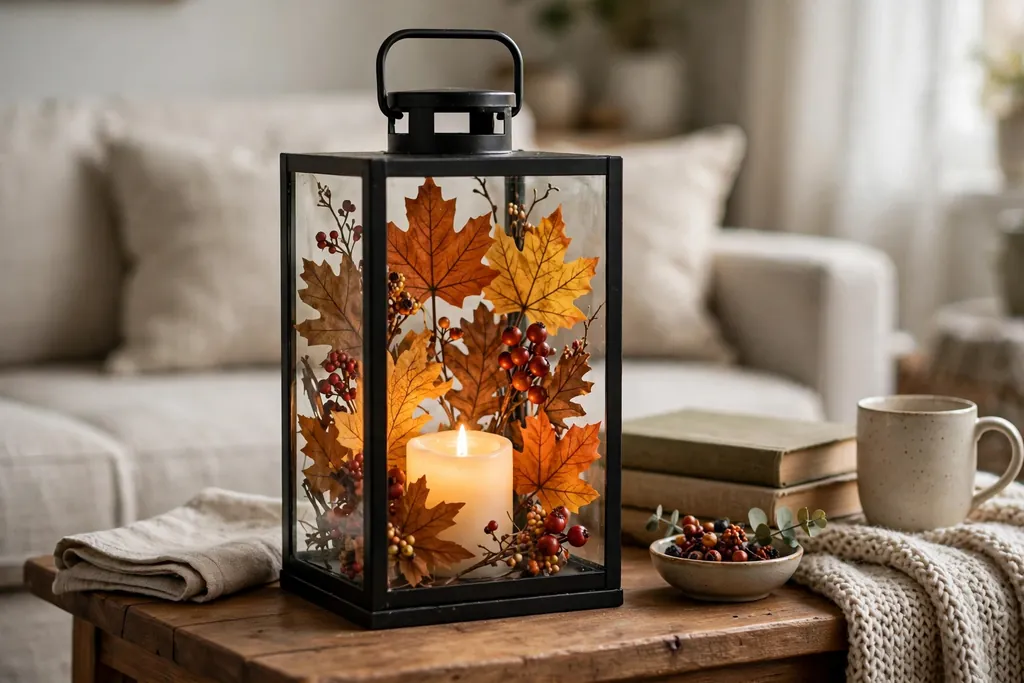
    Glass lantern with artificial fall leaves and a battery candle.

    A lantern arrangement frames artificial fall flower arrangements inside a glass lantern, which suits a porch, hearth, or side table. Place a small bunch of faux leaves, berries, and one or two short blooms inside an open lantern, then add a battery candle in the center so the display glows in the evening. Keep the stems short and clear of the candle, and use battery candles only, never a real flame near faux foliage.

    This idea works well where a full vase would feel too formal, such as a porch step or a bathroom shelf. Choose a lantern size that fits the spot, with glass panels that show the leaves from all sides. Switch the battery candle on in the evening for a warm glow, and dust the glass panels so the display stays clear.

    11. Terracotta Pot Trio on a Windowsill
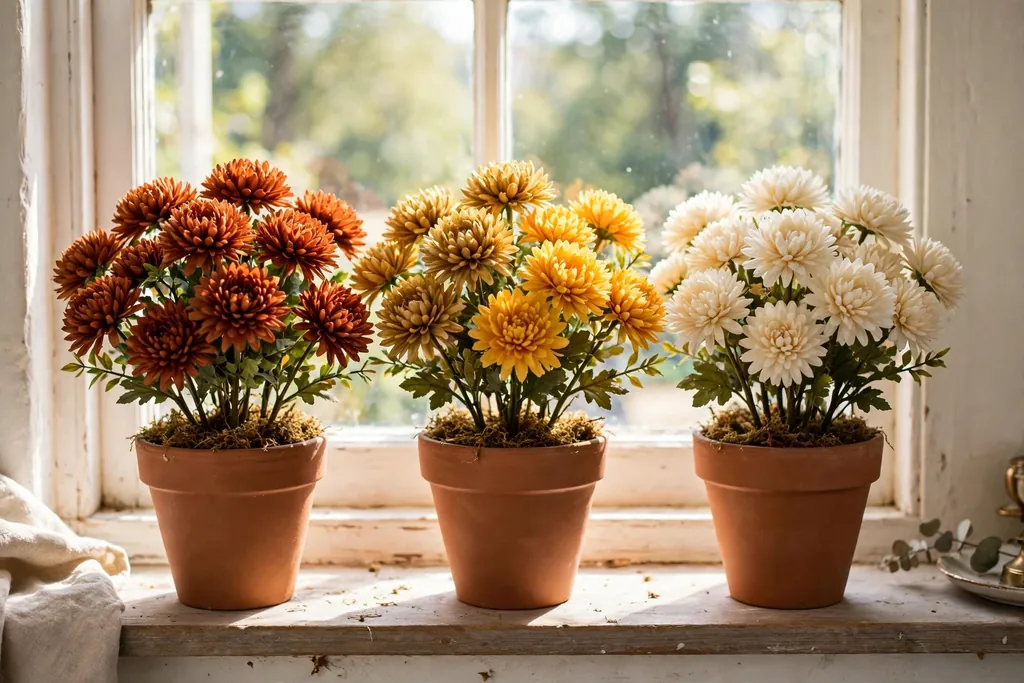
    Three terracotta pots of artificial mums on a windowsill.

    A terracotta pot trio on a windowsill gives artificial fall flower arrangements a garden feel indoors. Fill three small terracotta pots with short faux mums in rust, gold, and cream, one color per pot, and line them along a windowsill or a narrow shelf. Add a few small leaves to each pot so the blooms look rooted rather than stuck in place.

    Terracotta warms up a white or pale windowsill, and the small scale suits kitchens, bedrooms, and bathrooms where a large bouquet would crowd the room. Keep the pots clear of window handles and curtains, and set each pot on a small saucer to protect the sill. This trio also works on a bathroom shelf, where fresh flowers would struggle with steam and low light.

    12. Soft Cream and Blush Arrangement in a White Pitcher
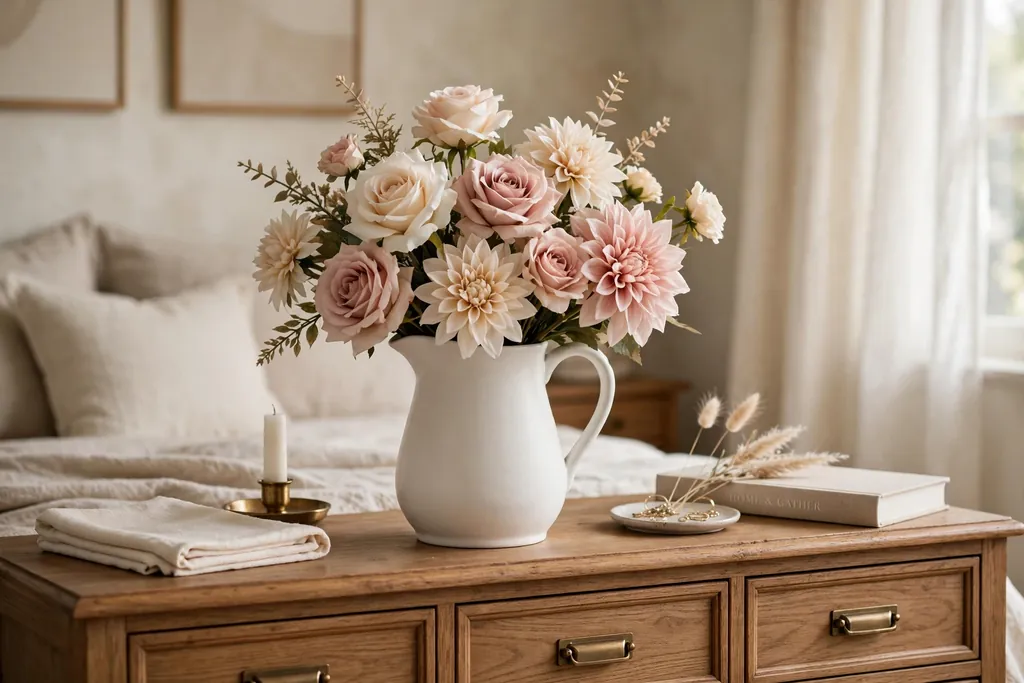
    White pitcher with cream and blush artificial roses on a dresser.

    A soft cream and blush arrangement in a white pitcher suits a bedroom or a calm living room that does not want strong orange tones. Use faux roses, dahlias, and ranunculus style blooms in cream, blush, and dusty rose, with pale green leaves and a few wheat stems for texture. A white ceramic pitcher keeps the look light and lets the soft colors carry the fall mood.

    Place the pitcher on a dresser, nightstand, or bedside table, where its gentle colors can be enjoyed up close. Keep the bouquet compact, with stems trimmed short, so it does not crowd the surface or catch on bedding. This arrangement pairs well with linen bedding and wood furniture, and it can stay out past fall if the colors suit the room.

    13. Dough Bowl Arrangement for a Harvest Table
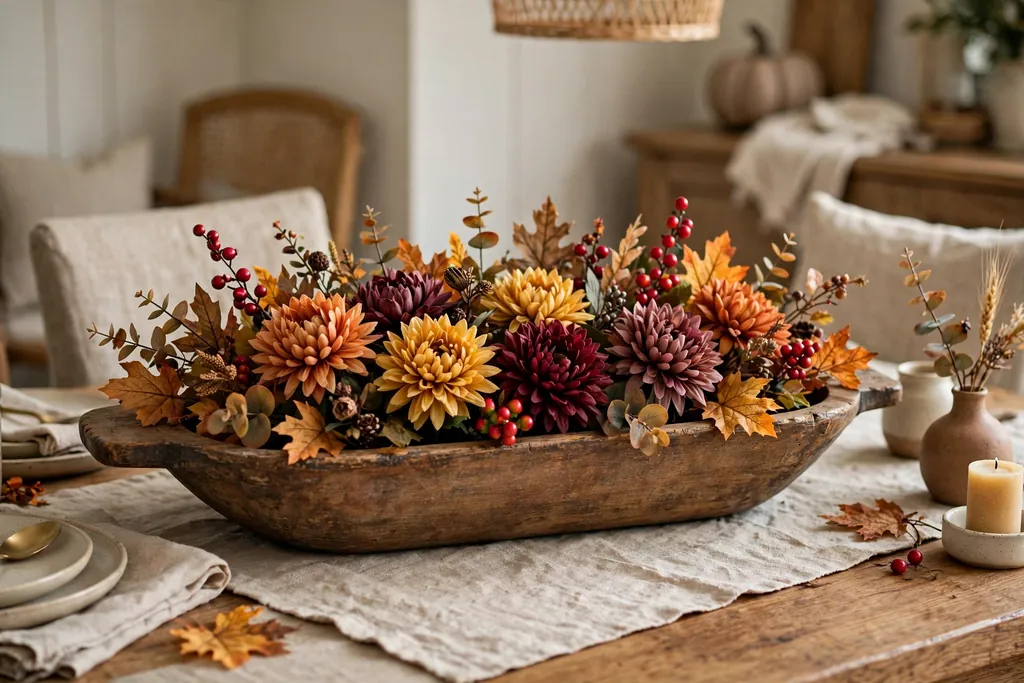
    Wooden dough bowl of artificial mums and berries on a dining table.

    A dough bowl arrangement uses a long, shallow wooden bowl as the base for a harvest table display. Lay a strip of floral foam along the bowl, then add faux mums, dahlias, berries, and leaves in rust, gold, and burgundy, keeping the height low and the shape long rather than round. Tuck two or three mini pumpkins or pinecones at the ends to anchor the arrangement.

    This shape suits a long dining table or a sideboard, where a round bouquet would leave the ends bare. Keep the center of the arrangement low so guests can see across the table, and lift the whole bowl away when the table is set for a large meal. A dough bowl also works as a serving piece after the season, once the foam and stems are removed and the bowl is cleaned.

    14. Wall Basket Arrangement for a Narrow Entry
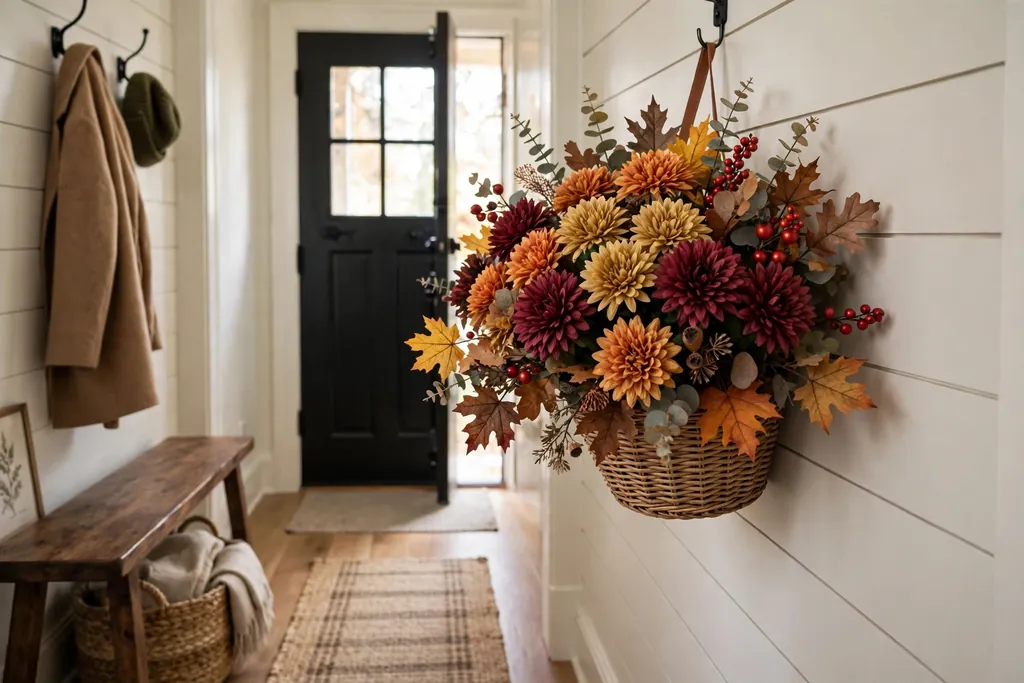
    Wall basket of artificial mums and berries in a narrow entry.

    A wall basket arrangement solves a narrow entry where there is no floor or table space for a vase. Hang a flat backed wall basket or a half basket planter on the wall, then fill it with faux mums, leaves, and berry sprays that spill slightly over the front edge. Keep the arrangement shallow so it does not catch coats, bags, or shoulders passing by.

    Choose a wall fixing rated for the weight of the basket and stems, and hang it at eye level or slightly above, clear of door swings. This idea suits hallways, stair landings, and small entries, and it pairs well with a mirror or a row of hooks below it. Take the basket down now and then to dust the wall behind it and check the fixing.

    15. Oversized Floor Urn by the Fireplace Hearth
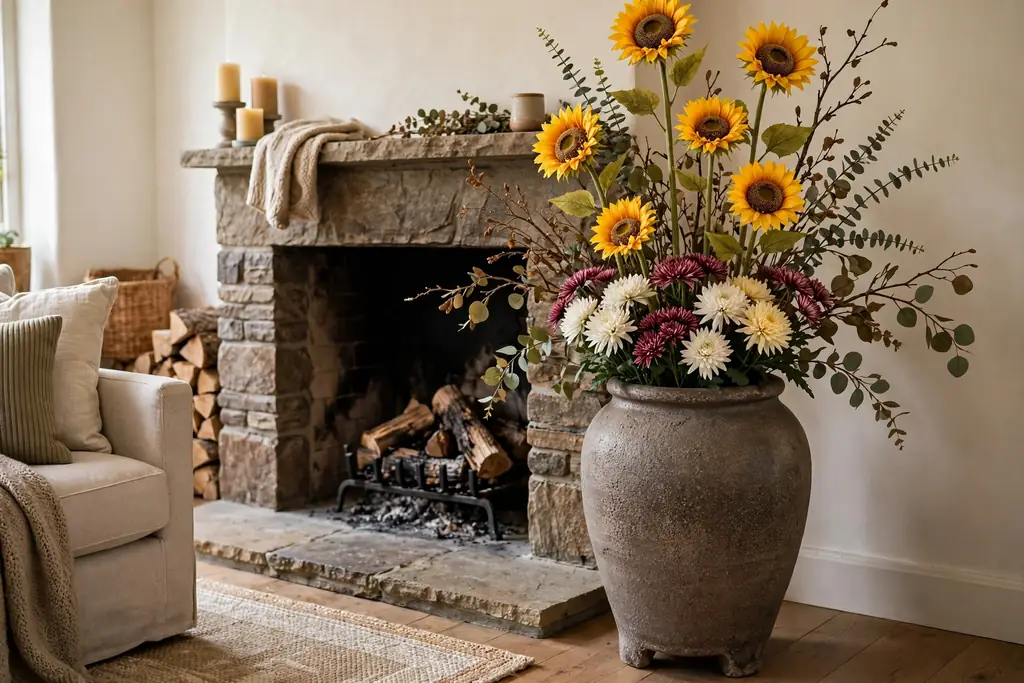
    Oversized floor urn with tall artificial sunflowers beside a fireplace hearth.

    An oversized floor urn by the fireplace hearth makes one bold artificial fall flower arrangement the focal point of the room. Fill a large urn with tall faux branches, sunflowers, and mums in rust, gold, and burgundy, then add wheat and berry stems for height and width. Place the urn to one side of the hearth, clear of the firebox opening, and weight the base so the tall stems cannot tip it.

    This arrangement suits a living room with a fireplace and enough floor space for a large container, and it needs no other fall display nearby to make its point. Keep all faux stems well clear of any open flame or heat source, and use this spot only beside an unused fireplace or with a generous safety gap. Step back and check the shape from the seating area, trimming any stem that blocks art or a mirror above the mantel.

    Conclusion

    Artificial fall flower arrangements earn their place by lasting the whole season with very little care. Pick one placement first, match the container and stem height to that spot, and keep the colors to two or three warm tones. Start with a single bouquet or centerpiece, live with it for a few days, and add a second arrangement only where the room still feels bare. That measured approach gives you seasonal color that looks planned, stores well, and is ready to bring out again next fall. For whole house fall styling around these arrangements, see these fall decor ideas.

    FAQs

    What are the best flowers for artificial fall flower arrangements?

    The best flowers for artificial fall flower arrangements are mums, sunflowers, dahlias, and roses in rust, gold, burgundy, and cream, paired with berries, maple leaves, and wheat. Mums give fullness, sunflowers give a clear focal point, and berries and leaves fill gaps so the bouquet looks natural rather than sparse. Choose blooms with varied shapes and matte finishes, and avoid shiny plastic looking petals where possible.

    How do I make artificial fall flowers look real?

    Make artificial fall flowers look real by mixing bloom sizes, bending stems at natural angles, and adding leaves, berries, and grasses between the blooms. Trim stems to varied lengths instead of one even height, turn the vase as you build, and keep the arrangement slightly loose rather than packed tight. A good container, such as ceramic, wood, or copper, also helps, since a plain plastic pot can give the whole display away.

    How long do artificial fall flower arrangements last?

    Artificial fall flower arrangements last for many seasons when they are kept out of direct sun, dusted now and then, and stored upright in a covered box or bag. Faux blooms do not wilt or need water, so a well made arrangement can be used year after year with only small repairs, such as straightening bent stems or replacing one faded bloom. Keep them clear of heat and damp to avoid warping or color loss.

    What size vase should I use for fall flower arrangements?

    Use a vase about one third to one half as tall as the finished arrangement, so the stems have enough support without hiding the blooms. For a table centerpiece, keep the total height low enough for conversation, while a floor vase can be much taller if it has a heavy base. Check the vase opening too: a narrow neck suits a few stems, while a wide mouth suits a full bouquet that needs room to spread.

    Can artificial fall flower arrangements go outside?

    Artificial fall flower arrangements can go outside on a covered porch or in a sheltered spot, but they last longer when they are protected from heavy rain, strong wind, and long hours of direct sun. Use a weighted container, such as a galvanized bucket or a heavy urn, and bring the arrangement under cover in storms. Check outdoor stems at the end of the season and replace any that have faded or frayed.

    How do I store artificial fall flower arrangements?

    Store artificial fall flower arrangements upright in a tall box or a clean bin, with tissue or a cloth bag around the blooms to stop dust and crushing. Keep the box in a dry spot, clear of heavy items that could bend the stems, and label it by season so next fall starts with a quick setup. If space is tight, remove the stems from the vase, bundle them loosely, and store the container separately.
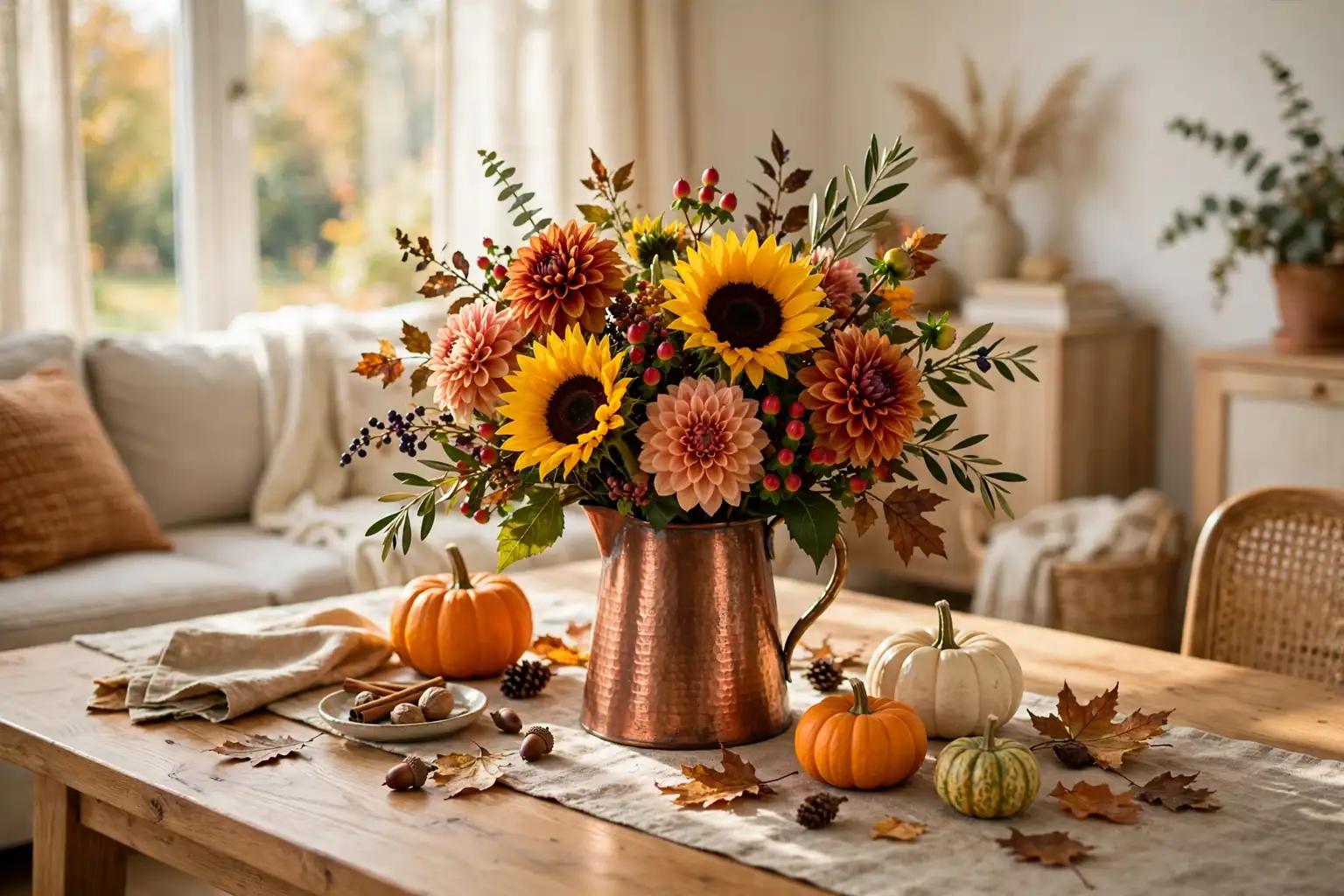
  • 17 Fall Flower Arrangements You Can Make at Home

    17 Fall Flower Arrangements You Can Make at Home

    You can make fall flower arrangements at home with a sturdy container, fresh or dried stems in rust, gold, and burgundy, and a few filler greens. Start with a focal flower, add supporting blooms at varied heights, and finish with berries or dried grasses. These 17 ideas use simple containers and easy steps for tables, mantels, and entryways.

    Fall flowers bring warm color indoors just as the days shorten, and most of these arrangements take less than an hour once your stems are trimmed and your container is ready. Mix fresh blooms with dried grasses or berries to stretch the life of a display, and keep the palette to two or three colors so the result looks planned rather than busy. For more seasonal styling around the house, see these fall decor ideas to pair your arrangements with the rest of the room.

    Key Takeaways

    • Start with a focal flower, then add supporting blooms at varied heights and finish with filler greens, berries, or dried grasses.
    • Keep the palette to two or three fall colors, such as rust, gold, and burgundy, so the arrangement reads as one plan.
    • Choose a container that suits the spot: low and wide for a dining table, tall and narrow for an entryway console.
    • Trim stems at an angle, remove leaves below the waterline, and change the water every two to three days for fresh arrangements.
    • Mix fresh and dried stems to make an arrangement last longer and to reuse part of it next season.
    • Keep table arrangements low enough that people can see across the table while they talk.

    1. Classic Mason Jar Sunflower Bouquet

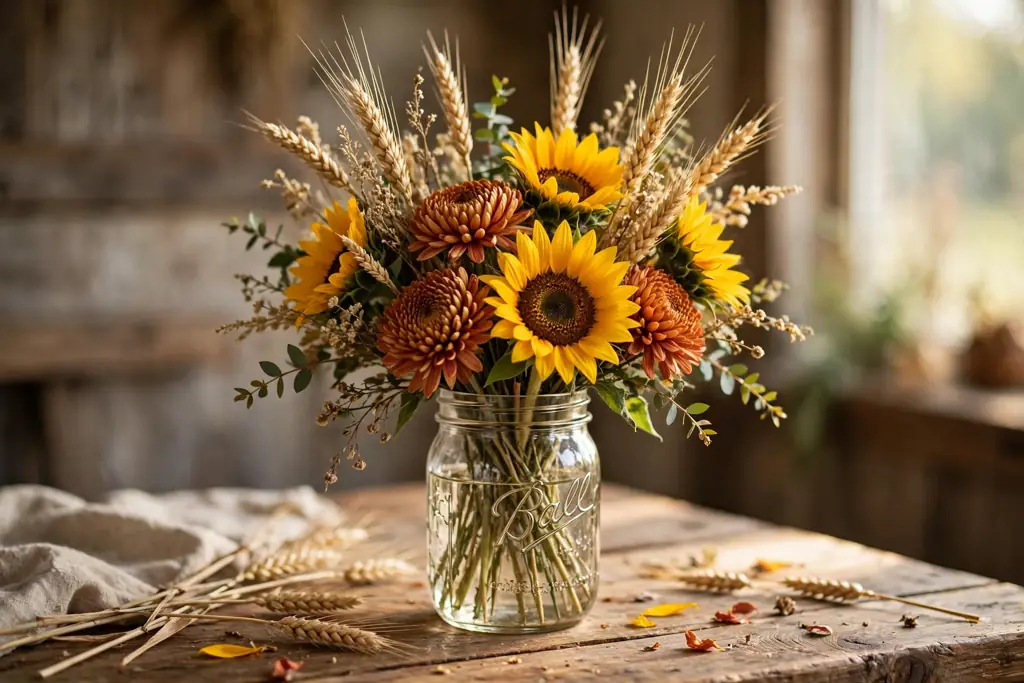
    Mason jar bouquet with sunflowers, wheat stems, and rust chrysanthemums on a wood table.

    A mason jar sunflower bouquet is the easiest place to start with fall flower arrangements. Fill a wide-mouth jar with water, add three or four sunflowers as the focal blooms, then tuck in sprigs of wheat and a few small rust chrysanthemums around them. Tie a length of twine around the neck of the jar for a simple finish.

    Set the jar on a kitchen table, a windowsill, or a bedside table where it gets indirect light. Sunflowers drink a lot of water, so check the level daily and top it up as needed. If one stem droops, trim half an inch off the end at an angle and return it to fresh water.

    2. Rustic Wooden Crate Chrysanthemum Display

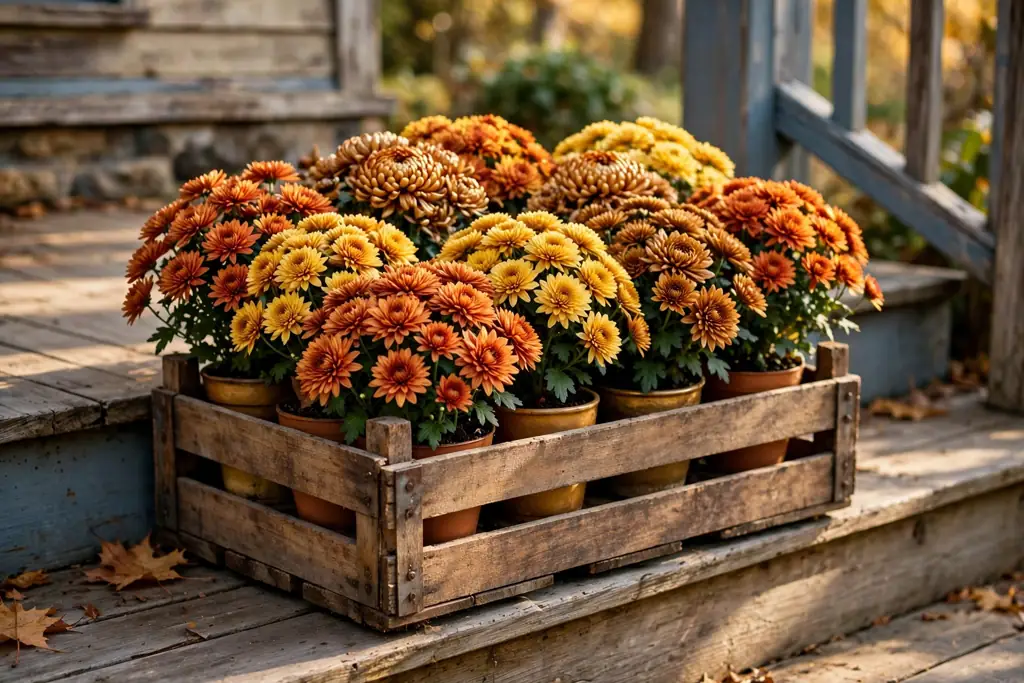
    Wooden crate filled with potted chrysanthemums in rust and gold tones.

    A low wooden crate filled with potted chrysanthemums makes a sturdy fall display for a porch step, a hearth, or a long console. Line the crate with a plastic tray, set three pots inside at varied heights using a small block under one pot, and fill gaps with moss or dried leaves.

    Water the pots in place and empty the tray so the crate stays dry. When the blooms fade, lift the pots out and swap in fresh ones without rebuilding the whole display. This is a good option for a spot that gets bumped often, since the crate keeps everything together.

    3. Copper Pitcher Autumn Bouquet

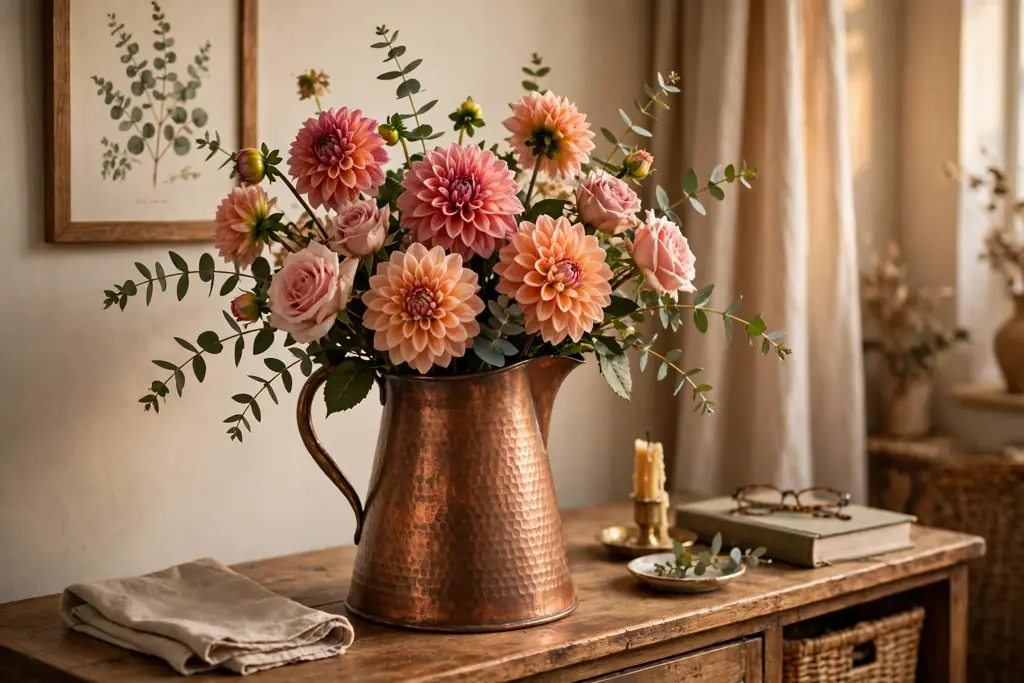
    Copper pitcher holding dahlias, roses, and eucalyptus stems on a sideboard.

    A copper pitcher gives a fall bouquet a warm glow and a shape that suits tall stems. Place dahlias or roses in rust and gold tones in the pitcher, add a few stems of eucalyptus for height, and let one or two stems lean slightly outward for a relaxed shape.

    Keep the pitcher on a sideboard or a kitchen counter away from direct heat. Copper can mark surfaces when wet, so set it on a cork mat or a small tray. Wipe the outside dry after watering to keep the finish bright.

    4. Hollowed Pumpkin Vase Centerpiece

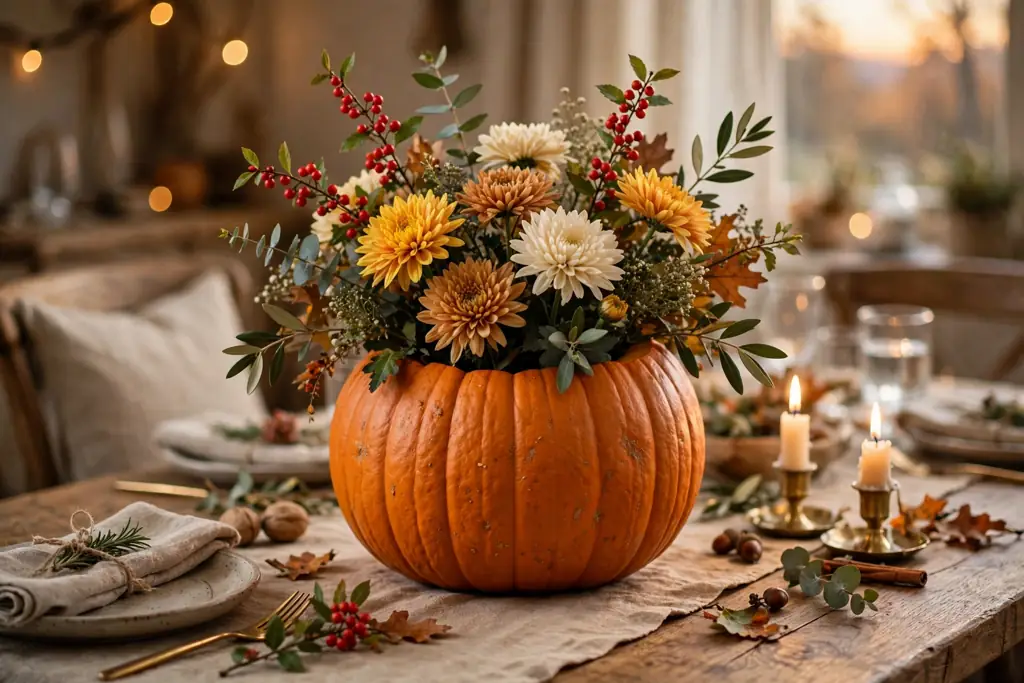
    Hollowed pumpkin vase with chrysanthemums and berry sprigs as a dining table centerpiece.

    A hollowed pumpkin makes a seasonal vase for a dining table centerpiece. Cut the top off a medium pumpkin, scoop out the seeds, and set a jar or a block of floral foam inside so the flowers have water. Fill it with chrysanthemums, small sunflowers, and berry sprigs, keeping the arrangement low and wide.

    Use this centerpiece for a dinner or a weekend gathering, and compost the pumpkin when it softens, usually after about a week indoors. For a longer lasting version, use a craft pumpkin with a jar fitted inside, and swap fresh stems as needed. See these fall kitchen decor ideas if the table sits in an open kitchen and dining space.

    5. Dried Wheat and Eucalyptus Bundle

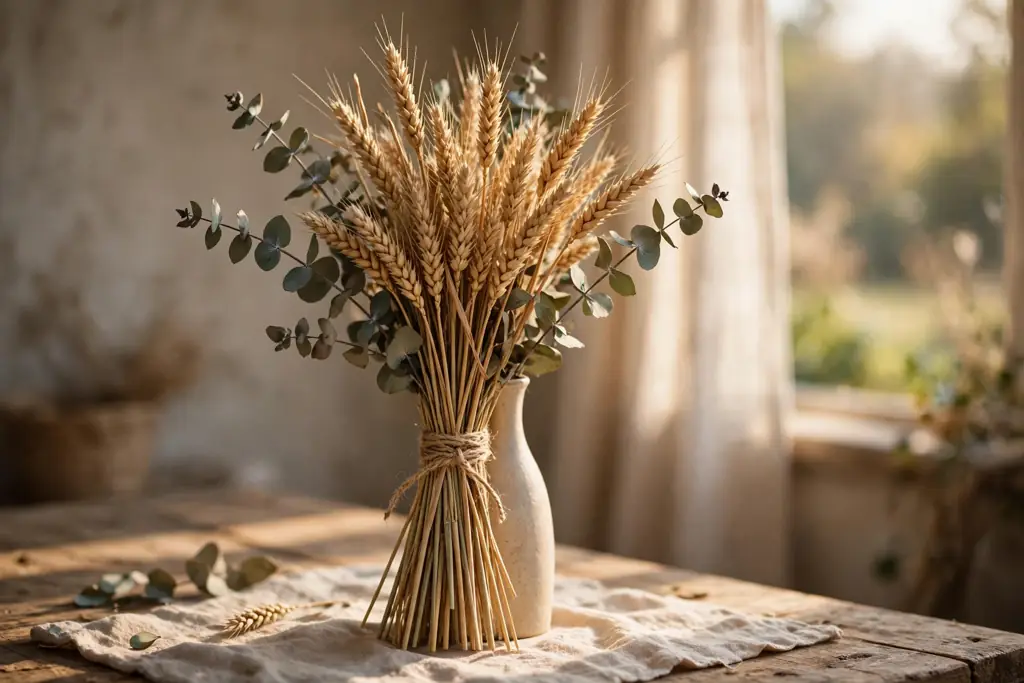
    Dried wheat and eucalyptus bundle tied with twine in a tall vase.

    A dried wheat and eucalyptus bundle needs no water and lasts all season. Gather a dozen wheat stems, add five or six eucalyptus sprigs, and bind the bunch with twine. Stand it in a tall vase, a crock, or a plain glass cylinder, and fan the stems out so the bundle fills the opening.

    This arrangement suits a hallway corner, a fireplace side, or a shelf that is hard to reach for watering. Keep dried stems away from open flames and direct sun, which can fade the color. Shake the bundle outdoors now and then to remove dust.

    6. Low Dining Table Runner Arrangement

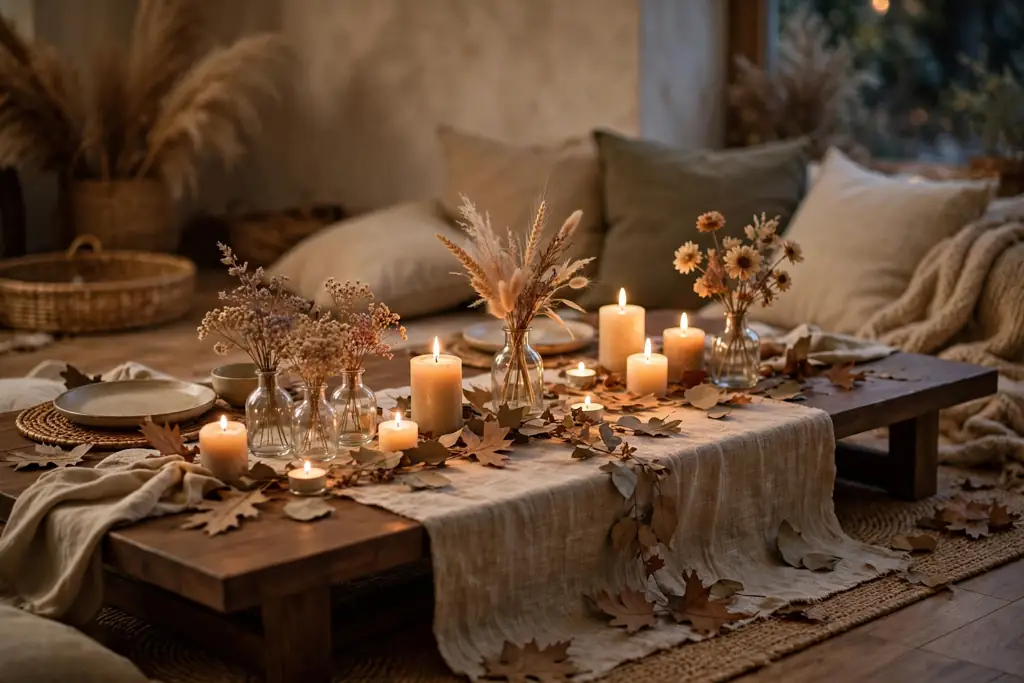
    Low dining table arrangement with small flower vases, candles, and dried leaves along a runner.

    A low runner arrangement keeps a dining table dressed without blocking conversation. Lay a wood board or a linen runner down the center of the table, then place three small vases or jars along it, each with two or three stems. Add a few candles between the vases and scatter a small number of dried leaves along the runner.

    Use the same flower in each vase for a calm look, or vary the blooms while keeping one shared color. Leave a clear space at each place setting, and lift the board off the table in one move when you need the full surface for serving.

    7. Tall Entryway Console Branch Arrangement

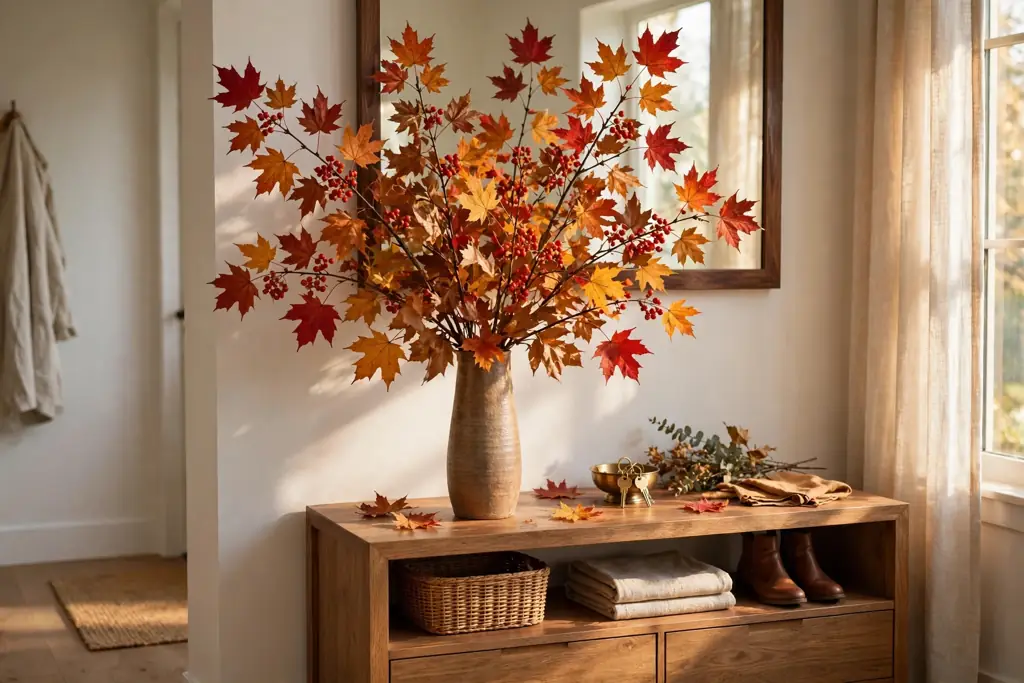
    Tall vase with autumn branches and berries on an entryway console table.

    Tall branches give an entryway console height without a large bouquet. Place three to five branches of maple, oak, or dried birch in a tall, heavy vase, and add a few stems of berries for color. The vase must be heavy enough that the branches cannot tip it forward.

    Set the arrangement at one end of the console so keys, mail, and a small tray still have room. Trim branches to fit the ceiling height, leaving at least a hand width of clear space above the tallest stem. Swap the branches as leaves dry and drop.

    8. Trio of Small Bud Vases on a Windowsill

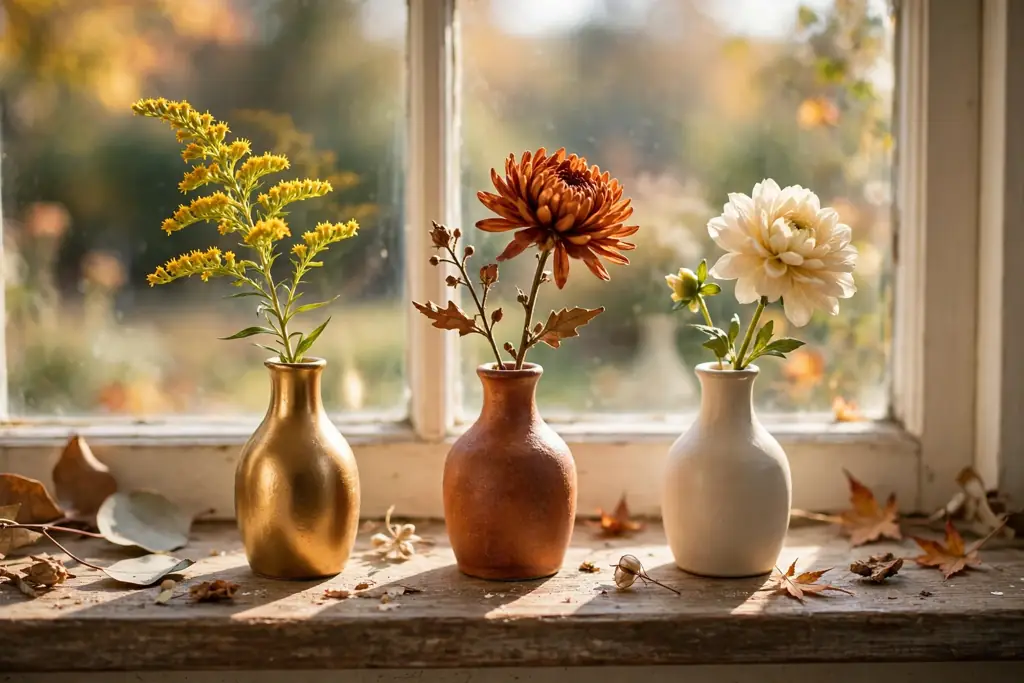
    Three small bud vases with single fall flower stems on a sunny windowsill.

    A trio of bud vases suits a windowsill, a bathroom shelf, or a narrow mantel. Use three vases of different heights, put a single stem in each, and keep the flowers in one color family, such as gold, rust, and cream. The small scale makes this a good use for leftover stems from a larger bouquet.

    Change the water every two days, since small vases run dry fast. If a stem is too tall for its vase, trim it so the bloom sits just above the rim. Group the vases close together so they read as one display, not three separate items.

    9. Terracotta Pot Mum Grouping

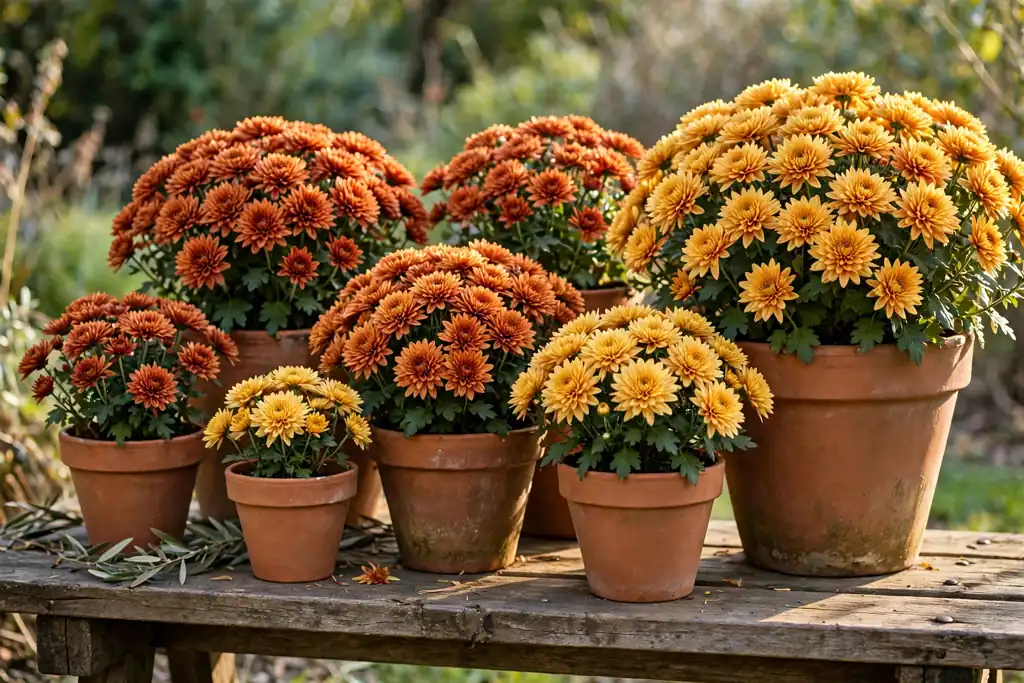
    Terracotta pots grouped with chrysanthemums in rust and gold on a bench.

    A grouping of terracotta pots filled with mums works on a table, a bench, or a set of steps. Use pots in three sizes, plant one mum in each, and cluster them with the tallest pot at the back. Tuck dried moss over the soil for a finished look.

    Water mums at soil level and let pots drain fully, since mums dislike wet feet. Bring the pots indoors at night if a hard frost is forecast, or move the grouping inside for the season. The terracotta color pairs well with rust and gold blooms and with wood furniture.

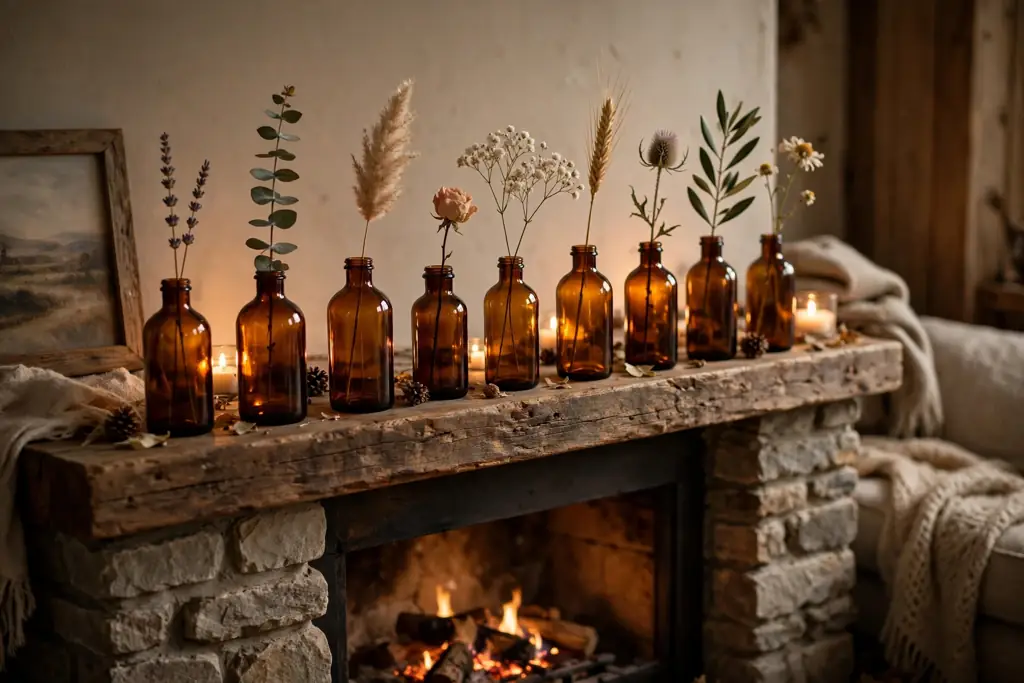
    10. Amber Glass Bottles with Single Stems

    Amber glass bottles holding single flower stems lined along a mantel.

    Amber glass bottles turn single stems into a fall display. Collect three to five bottles in varied heights, fill each with water, and place one stem in each, such as a rose, a dahlia, or a dried grass plume. Line them along a mantel, a shelf, or a windowsill.

    The amber glass warms the color of pale blooms and hides cloudy water between changes. Keep the bottles out of direct sun if they hold fresh stems, since warm water shortens bloom life. This idea also works with dried stems for a no-water version.

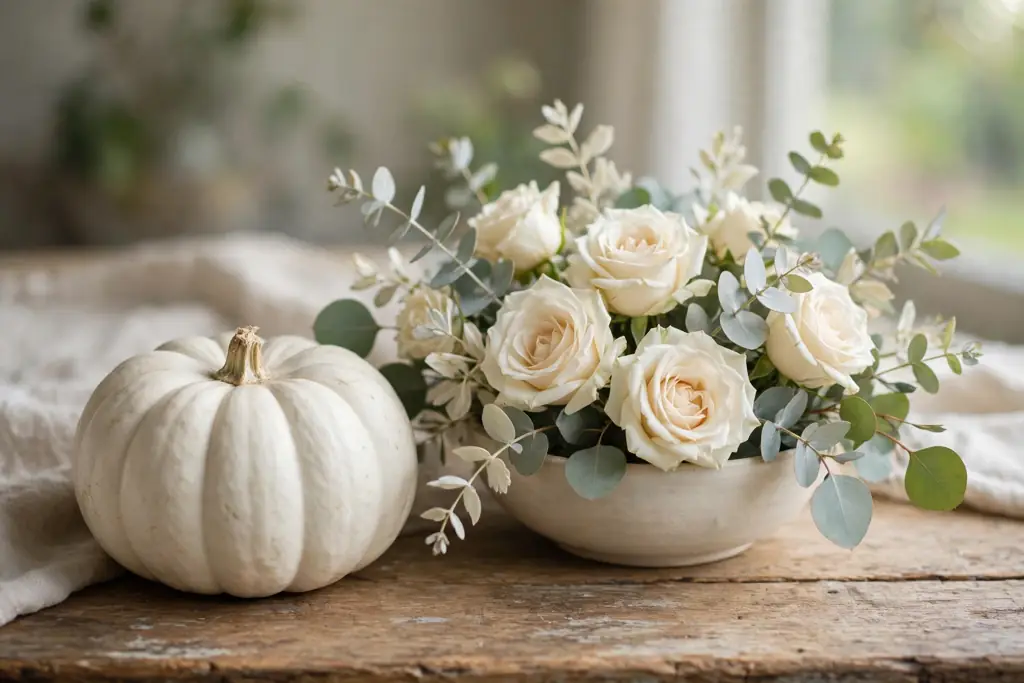
    11. White Pumpkin and Cream Rose Arrangement

    White pumpkin beside a low bowl of cream roses and pale eucalyptus.

    A white pumpkin and cream rose arrangement is a softer take on fall flowers. Set a small white pumpkin beside a low bowl of cream roses, ranunculus, and pale eucalyptus, or hollow a craft pumpkin and use it as the vase itself. Add a few cream berries for texture.

    This palette suits a living room with pale walls or a bedroom dresser, where strong rust tones might feel too loud. Keep the arrangement out of direct sun so the cream petals do not brown at the edges. For more living room styling, see these fall living room decor ideas.

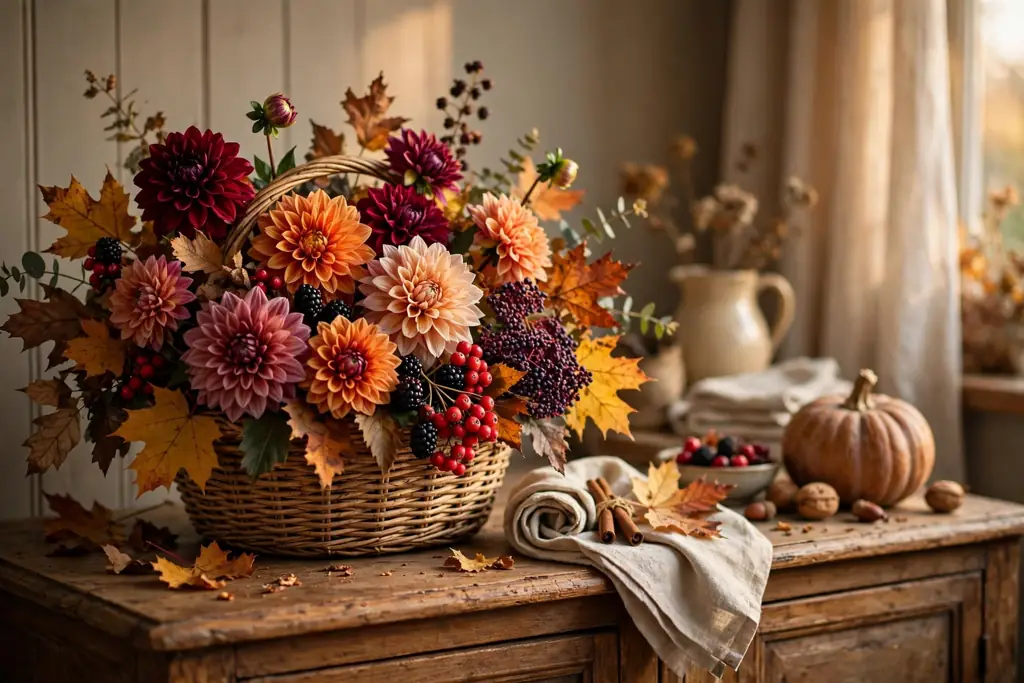
    12. Harvest Basket with Dahlias and Berries

    Harvest basket filled with dahlias, berries, and autumn leaves on a sideboard.

    A harvest basket filled with dahlias and berries makes a full, gathered look for a sideboard or a coffee table. Line a shallow basket with a waterproof tray, set a jar of water inside, and arrange dahlias as focal blooms with berry sprigs and small leaves filling the gaps. Let a few stems spill over the basket edge.

    Keep the arrangement low enough to see over from a sofa. Check the water level daily, since baskets hide the jar from view. When the dahlias fade, replace them and keep the berries, which often last longer than the blooms.

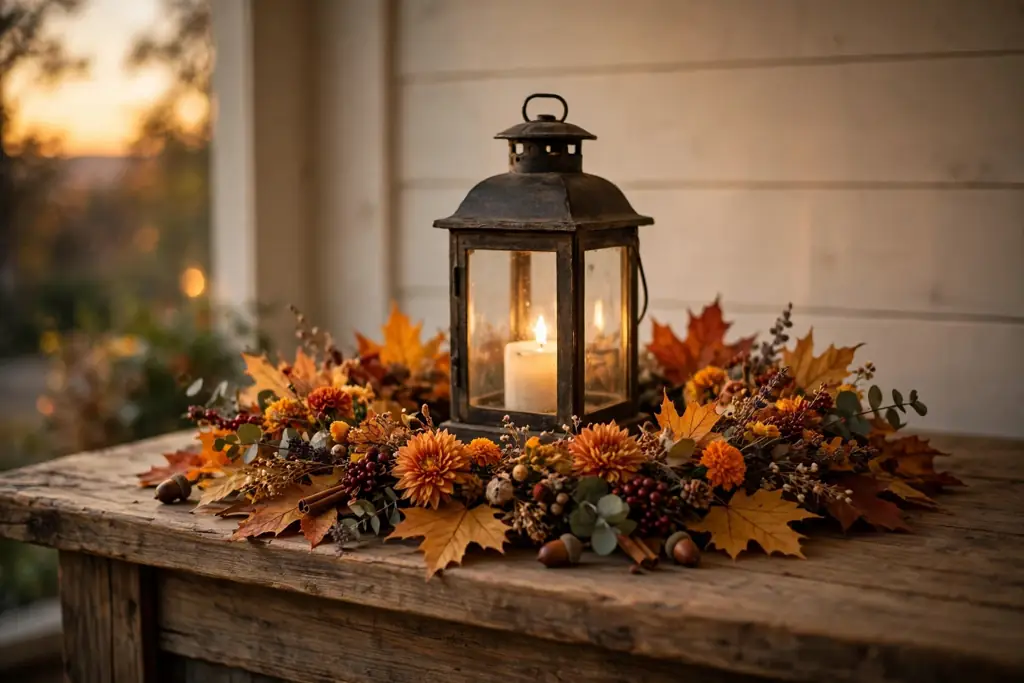
    13. Lantern Surrounded Flower Arrangement

    Lantern surrounded by a low ring of fall flowers and leaves on a mantel.

    A lantern surrounded by flowers makes a calm focal point for a mantel or a porch table. Place a lantern in the center, then arrange a low ring of small vases or a wreath of dried leaves and blooms around its base. Use a battery candle inside the lantern so heat does not dry the flowers.

    Keep fresh flowers at least a few inches from the lantern glass, and never use a real flame beside dried stems. This arrangement works well in an entryway at night, when the lantern light warms the colors of the blooms around it.

    14. Mantel Arrangement with Taper Candles

    Fireplace mantel styled with fall flower vases and taper candles.

    A mantel arrangement with taper candles frames a fireplace for the season. Place a long, low container or three small vases along the mantel, fill them with mums, roses, and dried grasses, and add taper candles in holders between the flowers at varied heights.

    Use battery tapers if the mantel is near dried material, and keep real flames away from leaves and grasses. Step back to check the balance from across the room, and shift one vase if one side looks heavier than the other. Replace fresh stems weekly to keep the mantel looking fresh.

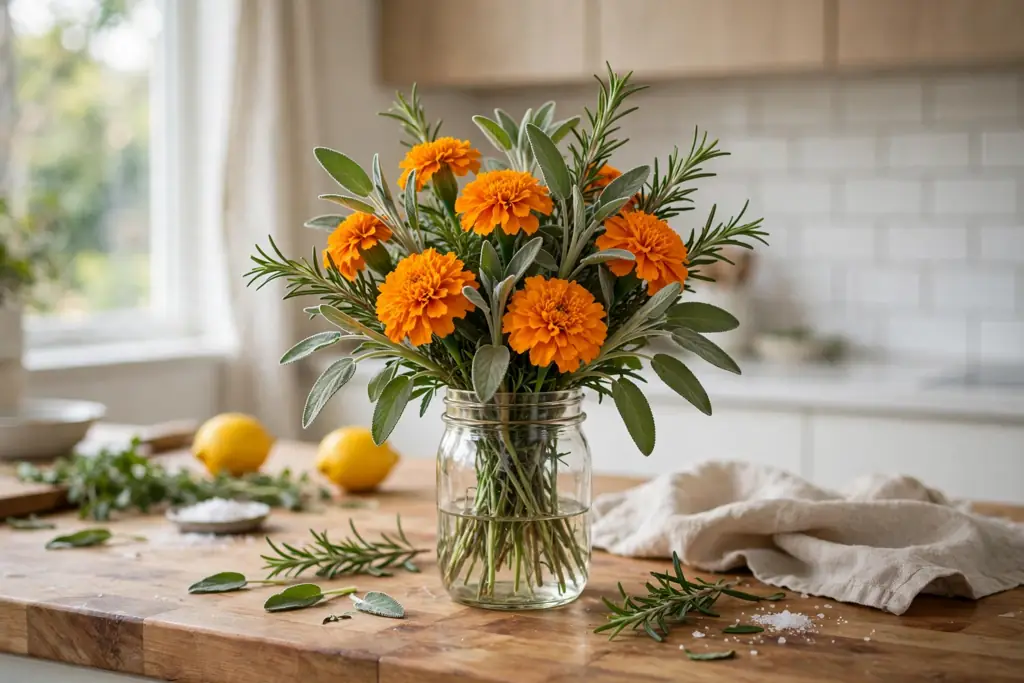
    15. Fall Herb Bouquet with Marigolds

    Jar bouquet with marigolds, sage, and rosemary sprigs on a kitchen counter.

    A fall herb bouquet mixes marigolds with sage, rosemary, and thyme for color and scent. Bundle the herbs first, then add marigolds as focal blooms and a few small yellow chrysanthemums for support. Tie the bunch with twine and stand it in a jar or a small crock.

    This bouquet suits a kitchen counter or a dining table, where the herbs can be snipped for cooking as needed. Change the water every two days and trim herb stems often, since woody stems can seal over and stop drinking. Dry any leftover herbs for later use.

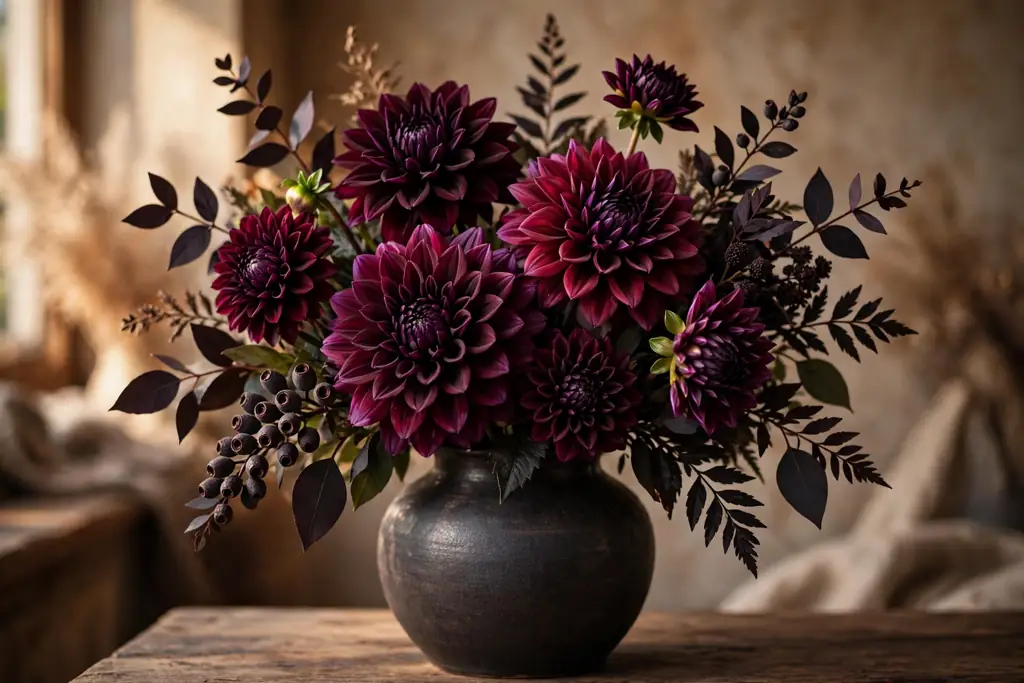
    16. Moody Burgundy and Plum Bouquet

    Burgundy and plum flower bouquet with dahlias and dark foliage in a ceramic vase.

    A burgundy and plum bouquet gives fall flowers a deeper, evening look. Combine dahlias, roses, and scabiosa in burgundy, plum, and dusty pink, add dark foliage such as ninebark, and finish with a few blackberry sprigs. Use a dark ceramic vase so the colors stand out against it.

    This palette suits a dining room or a living room with dark wood and warm lighting. Keep the arrangement in a cool spot overnight to slow fading, and remove spent blooms promptly so they do not stain nearby petals. A single gold stem can lift the whole bouquet if the mix looks too dark.

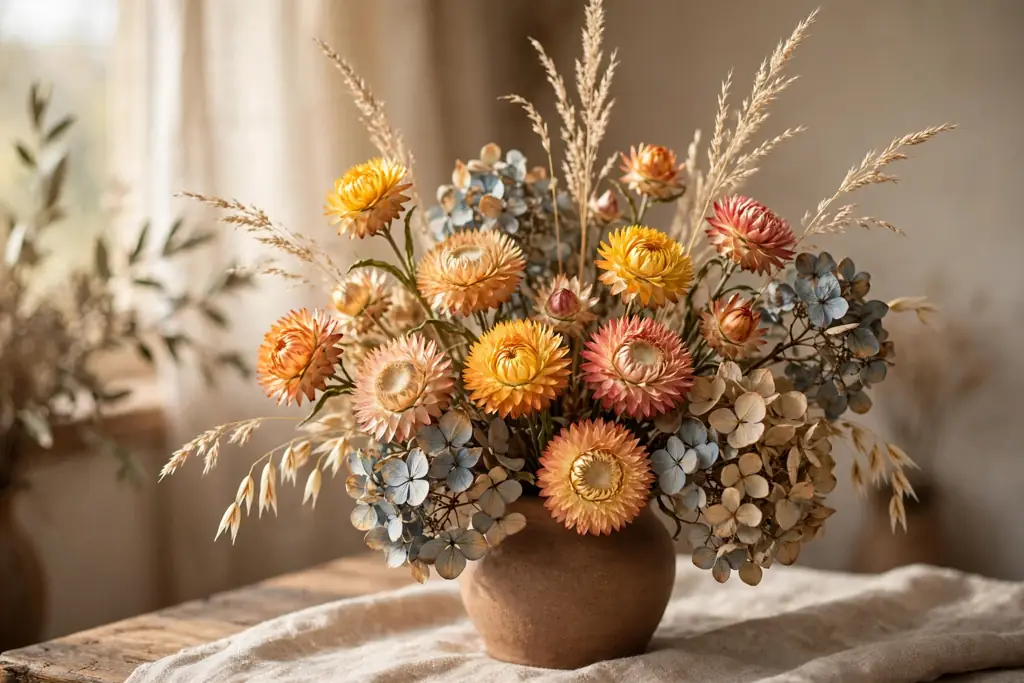
    17. Everlasting Dried Flower Arrangement

    Dried flower arrangement with strawflowers, hydrangeas, and grasses in a vase.

    An everlasting dried flower arrangement uses strawflowers, dried hydrangeas, and grasses that keep their shape for months. Start with dried hydrangea heads as the base, add strawflowers in rust and gold, and finish with tall grasses for height. Arrange in a dry vase with no water.

    This is the best choice for a spot you rarely tend, such as a high shelf or a guest room. Keep dried flowers out of damp rooms and away from open flames. Dust them gently with a soft brush or a cool hair dryer, and store the arrangement in a box between seasons to protect it.

    Conclusion

    Fall flower arrangements are easy to make at home once you have a container, a focal bloom, and a simple color plan. Start with one of these 17 ideas, use stems you can find locally, and adjust the height and palette to fit the room. A small arrangement on a table or a windowsill can carry the season, and a fuller display on a mantel or an entryway console can anchor a whole room. Keep fresh stems watered, swap blooms as they fade, and reuse dried stems next year for a display that costs little and lasts well beyond one season.

    FAQs

    How do you make a fall flower arrangement last longer?

    Change the water every two to three days, trim stems at an angle each time, and keep the arrangement out of direct sun and away from heat vents. Remove spent blooms promptly, and mix in dried stems or berries, which last longer than fresh flowers.

    What flowers are best for fall arrangements?

    Chrysanthemums, dahlias, sunflowers, roses, and marigolds are reliable choices for fall arrangements, since they come in rust, gold, burgundy, and cream tones. Add berries, wheat, eucalyptus, or dried grasses for texture and to fill gaps between blooms.

    What container should I use for a fall flower arrangement?

    Use a low, wide container for a dining table so guests can see across it, and a tall, heavy vase for an entryway or a floor display. Mason jars, copper pitchers, wooden crates, terracotta pots, and baskets all work well, as long as the container holds water or a jar that does.

    Can I make fall flower arrangements with dried flowers only?

    Yes, dried flowers alone make a lasting fall arrangement with no watering needed. Use strawflowers, dried hydrangeas, wheat, and grasses in a dry vase, keep the display away from damp rooms and open flames, and dust it gently now and then.

    How many stems do I need for a fall bouquet?

    A small bud vase needs one to three stems, a mason jar bouquet needs about seven to ten stems, and a full table centerpiece needs roughly fifteen to twenty stems, depending on bloom size. Start with fewer stems than you think you need, step back, and add more only where the arrangement looks thin.

    Do fall flower arrangements need floral foam?

    No, floral foam is optional for most fall flower arrangements. A jar inside a pumpkin or basket, a grid of tape across a vase mouth, or a simple bunch tied with twine will hold stems in place. Foam helps for a shaped design, but it can shorten stem life if it dries out.


  • 23 Fall Table Decor Ideas for Everyday Meals and Gatherings

    23 Fall Table Decor Ideas for Everyday Meals and Gatherings

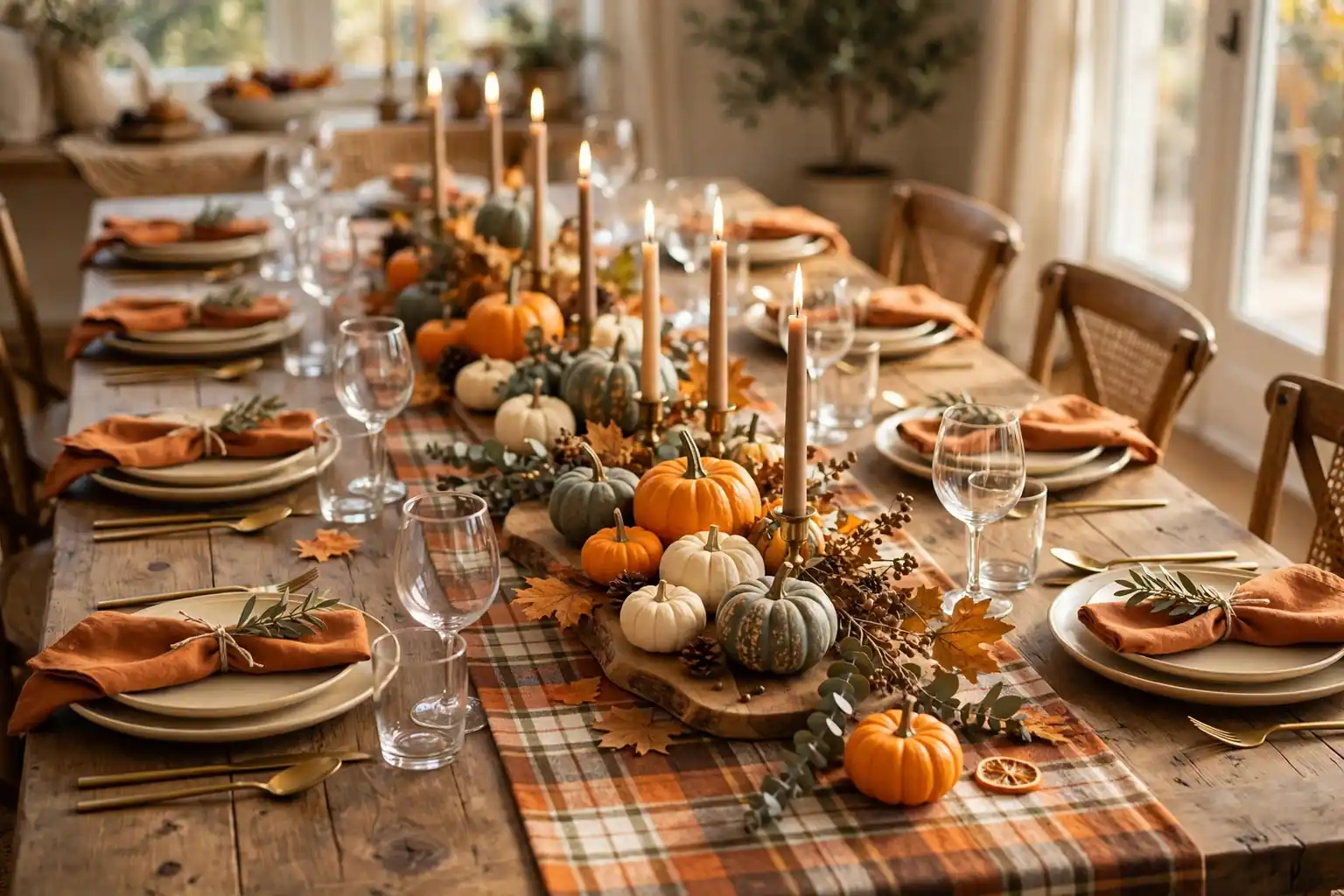
    Fall table decor works best when it stays low, warm, and easy to live with. Use a runner, one low centerpiece, and plates, napkins, and candlelight in rust, cream, and warm wood, then add pumpkins or dried leaves. The 23 ideas below cover everyday meals and larger gatherings, so you can pick one change or dress the whole table.

    Start with the base you already own: a plain tablecloth or runner, everyday plates, and cloth napkins in a warm neutral. Then add one seasonal layer at a time, such as a pumpkin cluster, a leaf garland, or a set of taper candles. Keep the centerpiece low enough to see across, leave room for serving dishes, and choose pieces you can lift off in one move when the table needs to clear.

    Key Takeaways

    • Keep the centerpiece low and narrow, so guests can see each other and serving dishes still fit.
    • Pick a palette of rust, cream, warm wood, and muted olive, and repeat each color at least twice.
    • Start with textiles: a runner, napkins, and placemats carry most of the seasonal color and wash easily.
    • Use one main centerpiece per table, not several competing clusters, and leave empty space at each place.
    • Choose candlelight with care: keep flames clear of dried leaves, fabric, and paper, and use flameless candles near children or dried material.
    • For gatherings, add place cards, a drink station, or a menu card, so the table also helps guests settle in.

    1. Pumpkin and Candle Centerpiece on a Wood Board

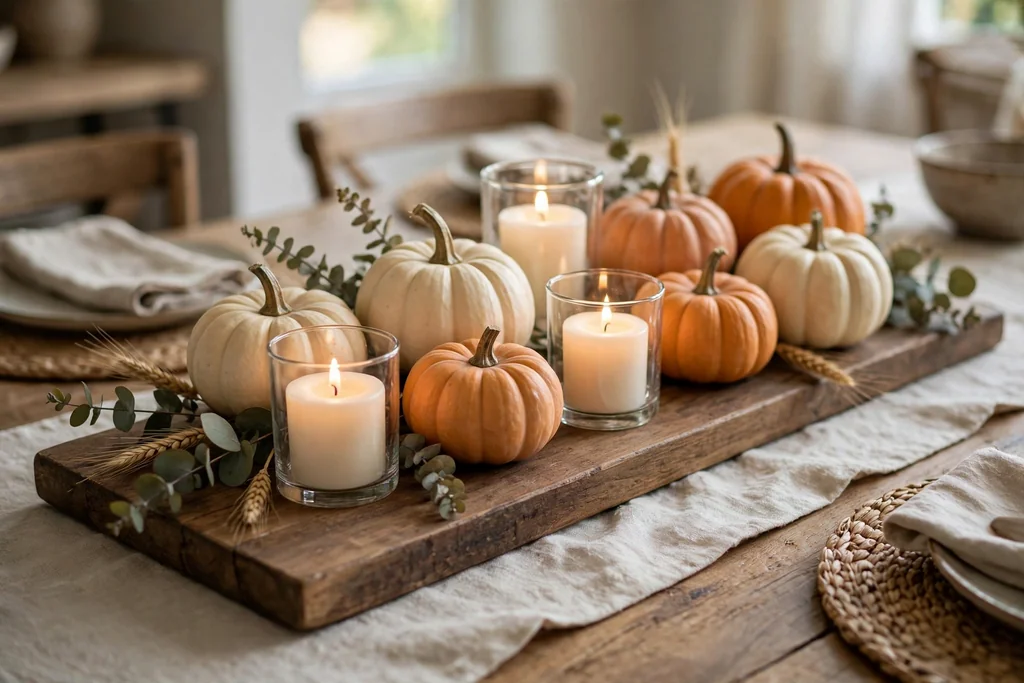
    Wood board centerpiece with small pumpkins in cream and muted orange and short pillar candles in glass holders on a dining table.

    Set a long wood board down the middle of the table, then group three to five small pumpkins in cream, muted orange, and pale green along it, with short pillar candles in glass holders between them. The board keeps the group contained, so it reads as one centerpiece, and it lifts off in one move when you need the full table for serving.

    Use battery candles if the board will sit near dried leaves or if children will be at the table. For a real flame, keep candles in holders, clear of pumpkin stems and any fabric, and never leave them burning unattended. Swap one pumpkin for a small vase of dried stems if the group looks too round and flat.

    2. Low Eucalyptus Runner with Taper Candles

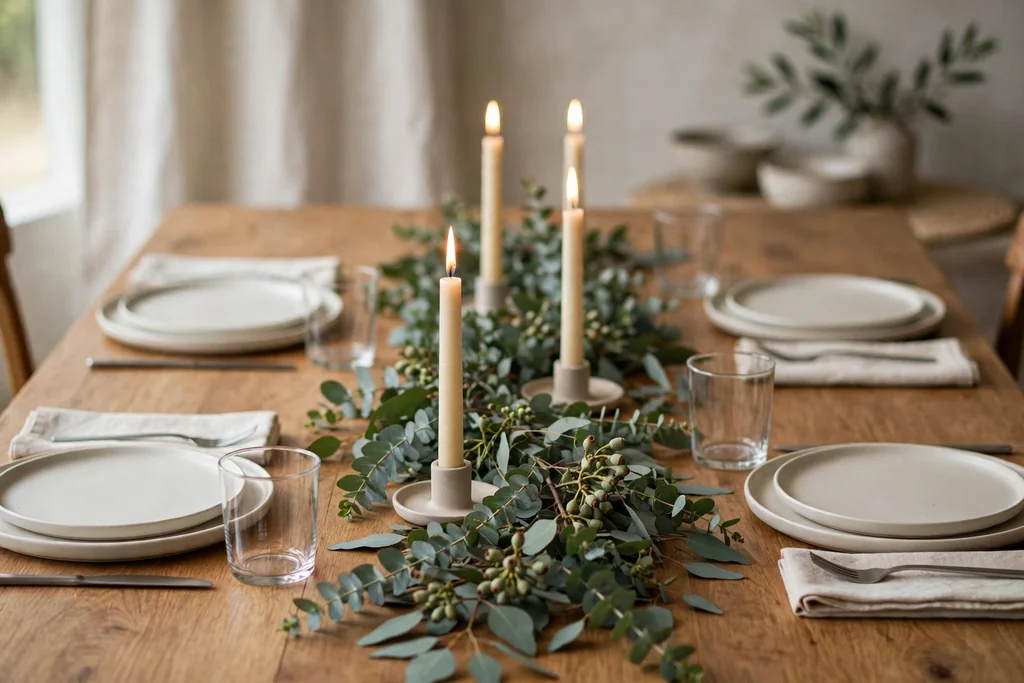
    Low eucalyptus runner down a dining table with taper candles in simple holders and plain place settings.

    Lay a loose eucalyptus runner down the center of the table, then set taper candles in simple holders along it at uneven intervals. The green-grey leaves soften the table without adding height, and the candles give evening meals a warm glow that overhead light cannot match.

    Trim the eucalyptus so it stays inside the table edges and does not brush plates or glasses. If fresh stems dry out and shed, switch to faux eucalyptus you can wipe clean, or use short sprigs tucked into napkin rings instead of a full runner. Keep taper flames clear of the leaves, and use flameless tapers if the runner will sit under a shelf or near curtains.

    3. Plaid Runner with Wood Chargers

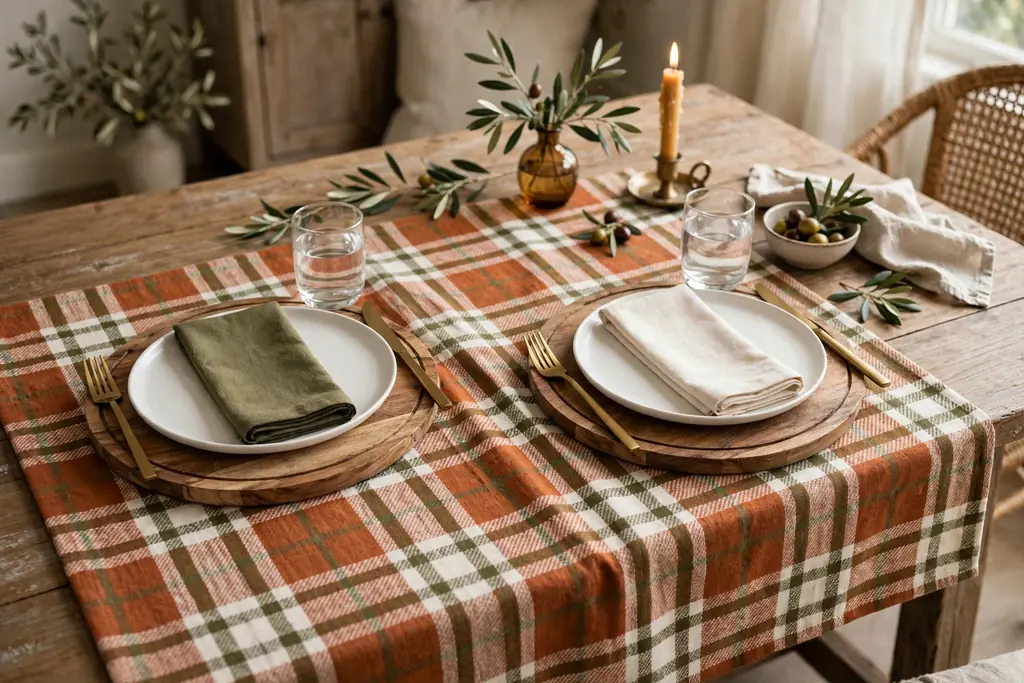
    Plaid runner in rust, cream, and olive on a dining table with round wood chargers under white plates.

    A plaid runner in rust, cream, and muted olive gives a plain table an instant fall base, and round wood chargers under each plate add warmth without a new dinner set. Lay the runner so it hangs evenly at both ends, then center one charger at each place, with the plate on top.

    Keep the plaid scale in proportion to the table: a large check suits a long dining table, while a small check suits a round breakfast table. Wipe wood chargers after meals and store them flat, since they can warp if left damp. If the runner is thick, use it alone and skip a tablecloth, so plates sit level.

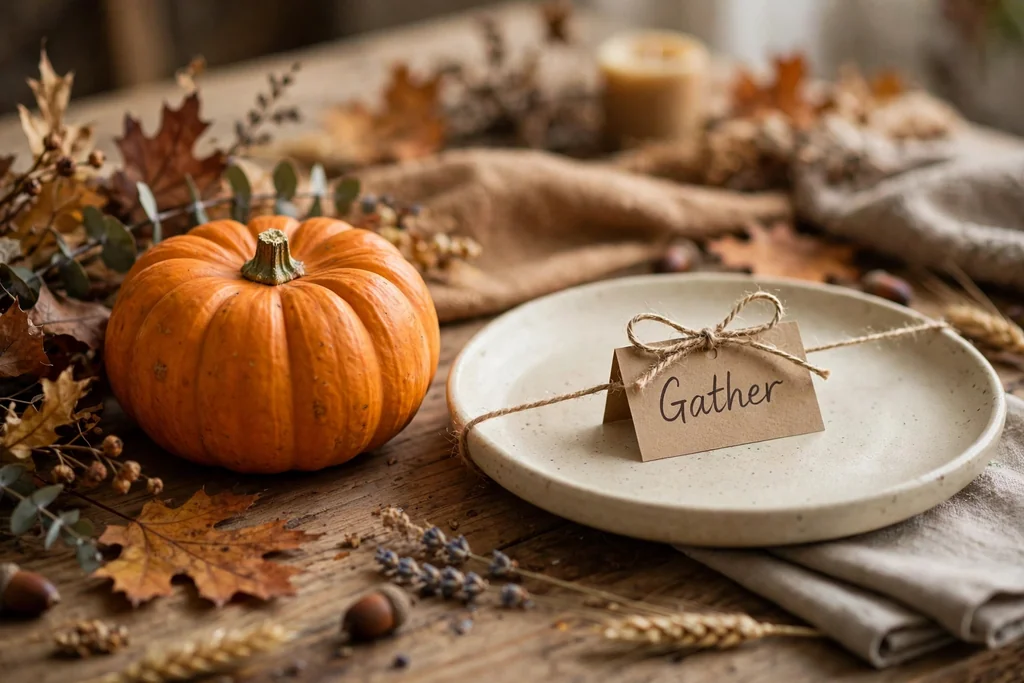
    4. Mini Pumpkin Place Cards

    Mini pumpkin beside a plate with a small handwritten place card tied with twine on a fall table.

    Set one mini pumpkin at each place, with a small card tucked beside it or tied to the stem with twine, showing the guest name or a short welcome note. This idea works for a family dinner as well as a larger gathering, because it marks each seat and doubles as a small take-home piece.

    Choose pumpkins small enough to sit beside a plate without crowding the glass. Write names in clear, large lettering, and keep the card short, since a long note will be read once and then set aside. For everyday meals, skip the names and use the mini pumpkins alone as a simple place marker.

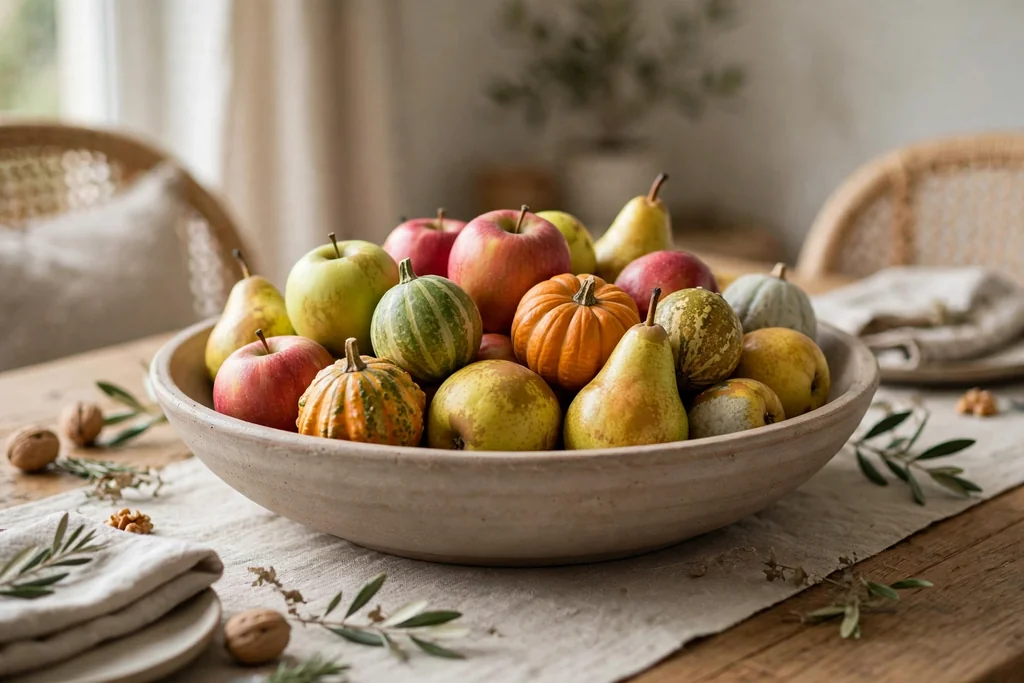
    5. Harvest Fruit Bowl Centerpiece

    Wide shallow bowl filled with apples, pears, and small gourds as a centerpiece on a dining table.

    Fill a wide, shallow bowl with apples, pears, and a few small gourds, and set it in the center of the table as a centerpiece you can also eat from. The fruit gives real fall color and shape, and the bowl takes up only one spot, leaving the rest of the table free for plates and serving dishes.

    Check the fruit every few days and move any soft piece to the kitchen, since one spoiling apple can mark the rest. Keep the bowl low and wide rather than tall, so it does not block sightlines. At the end of the meal, the bowl can move to the counter, which makes clearing the table a single step.

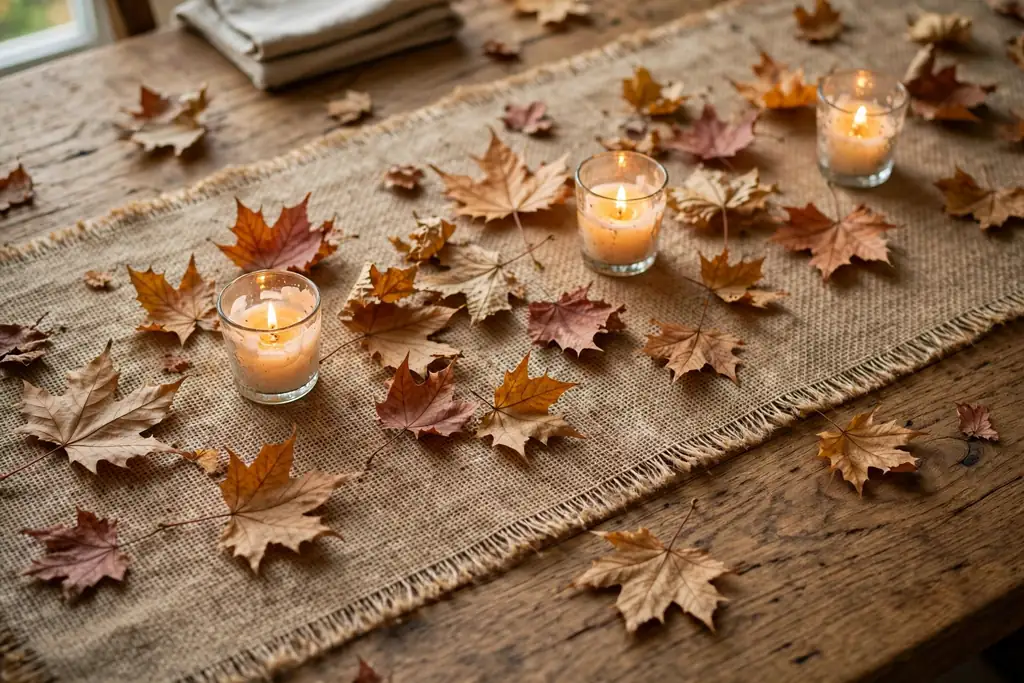
    6. Burlap Runner with Dried Leaf Scatter

    Burlap runner on a dining table with a light scatter of dried maple leaves and small candles in holders.

    Lay a plain burlap runner down the table, then scatter a small number of dried maple or oak leaves along it, with two or three small candles in holders to anchor the ends. Burlap adds texture without pattern, so it suits tables that already have patterned plates or colored glass.

    Use leaves sparingly, about one leaf per place setting length, so the table still looks tidy and leaves do not end up in food. Keep dried leaves well clear of any real flame, and use flameless candles here. Shake the runner outside after the meal, since burlap sheds fibers and dried leaves crumble.

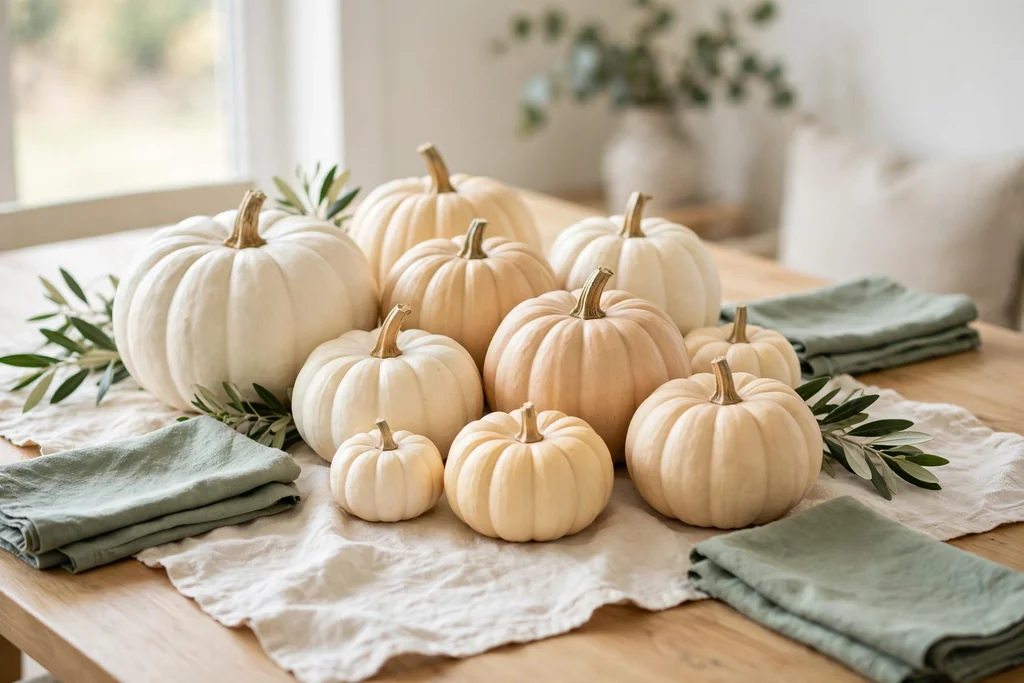
    7. White Pumpkins on Cream Linen

    White and cream pumpkins grouped on cream linen with sage green napkins on a bright dining table.

    Group white and cream pumpkins on a cream linen tablecloth or runner, and add one soft accent, such as sage green napkins or a single rust candle, so the table stays calm rather than flat. This pale palette suits a bright dining room and works well with wood, brass, and glass.

    Vary the pumpkin sizes, with one larger pumpkin in the middle and smaller ones at the sides, and leave space between them so each shape shows. Wipe ceramic pumpkins clean before setting them out, and set real white pumpkins on a small mat if the linen is light, to guard against marks. One accent color is enough; a second bright color will break the quiet look.

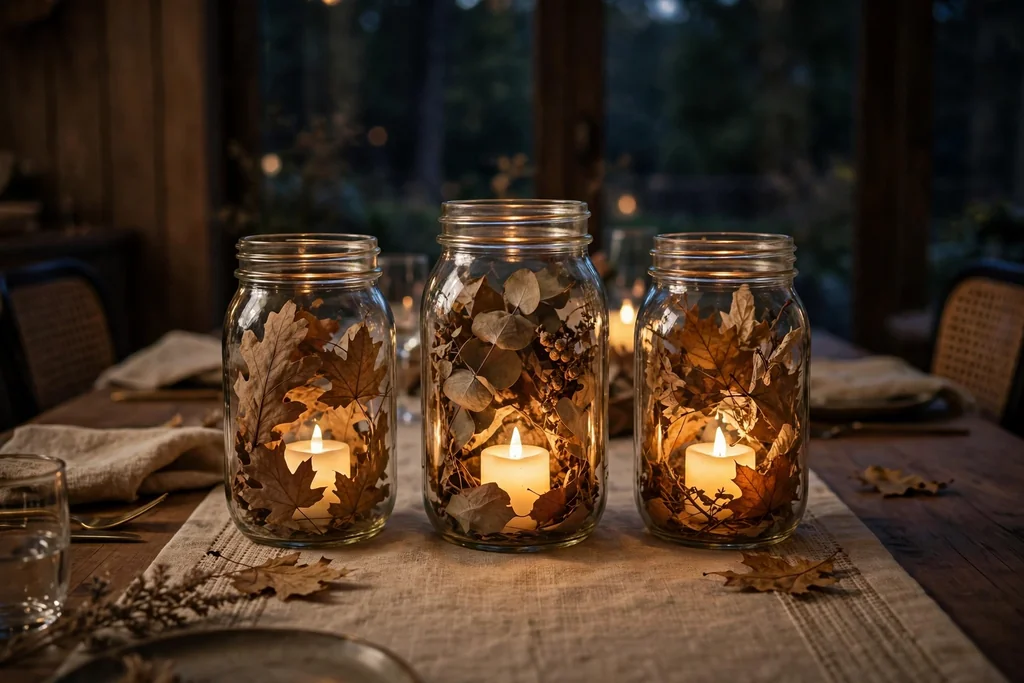
    8. Mason Jar Lanterns with Autumn Leaves

    Mason jars with battery candles and dried leaves inside, set down the center of a dining table in the evening.

    Fill two or three mason jars with a battery candle and a few dried leaves pressed against the inside of the glass, then set the jars down the center of the table. The jars glow softly in the evening, and the leaves show through the glass without shedding onto plates.

    Keep the jars short enough to see over, and set them on a small tray or wood board if the table surface marks easily. Use battery candles only inside closed or narrow jars, since a real flame needs air and a safe holder. If leaves block too much light, use fewer leaves and let the candle glow through clear glass instead.

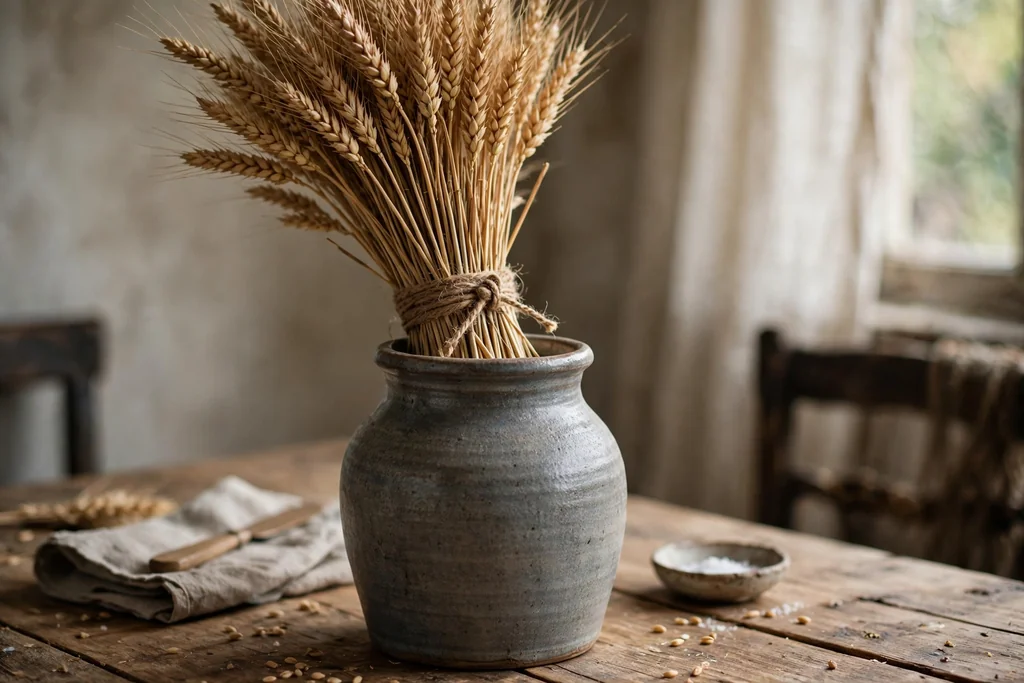
    9. Wheat Bundle in a Stoneware Jug

    Bundle of dried wheat stems tied with twine standing in a heavy stoneware jug on a dining table.

    Tie a bundle of dried wheat stems with twine and stand it in a heavy stoneware jug at one end of a long table, or in the center of a round table. The wheat gives height and a clear harvest shape, while the jug keeps the bundle steady and easy to move.

    Trim the stems so the heads sit below eye level when guests are seated, and keep the jug clear of elbows and serving dishes. Dried wheat sheds, so shake the bundle outside before bringing it in, and keep it clear of real flames and the stove. If shedding bothers you, use faux wheat stems in the same jug.

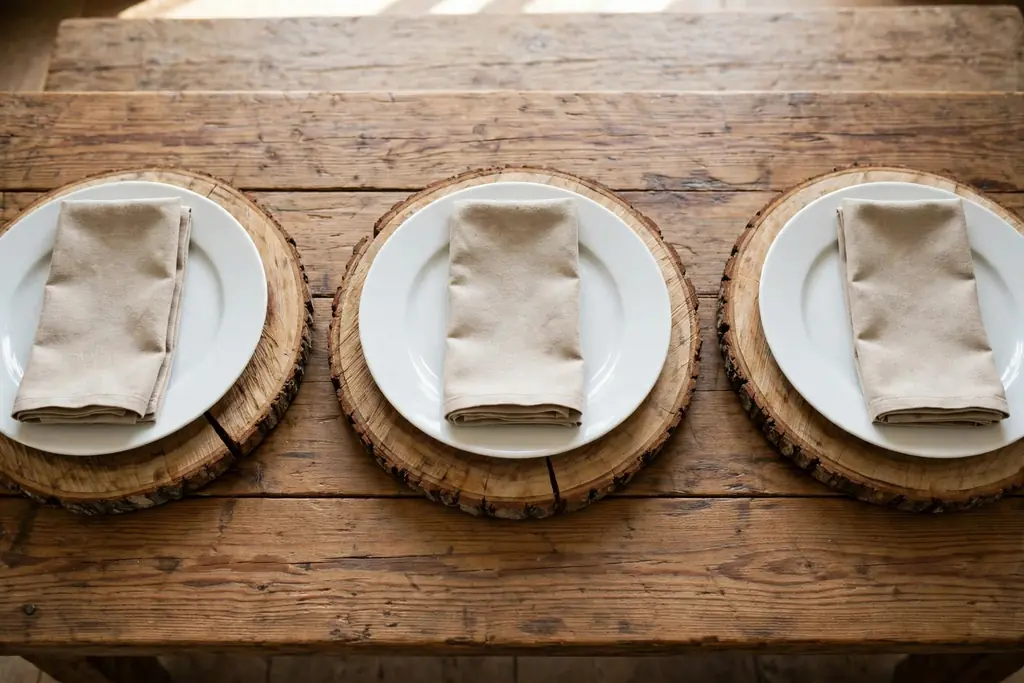
    10. Wood Slice Chargers under Everyday Plates

    Round wood slice chargers under everyday white plates with folded napkins on a wood table.

    Use round wood slices as chargers under your everyday plates, so a normal weeknight dinner gains a rustic fall layer with no new dishes. Center one slice at each place, set the plate on top, and keep napkins and cutlery in their usual spots, so the table still works for daily use.

    Choose slices with a flat, sanded top, so plates sit level and glasses do not wobble. Wipe slices clean after meals and do not soak them, since wood can warp when left damp. If slices vary in size, put the largest ones at the ends of the table, where the difference looks planned rather than uneven.

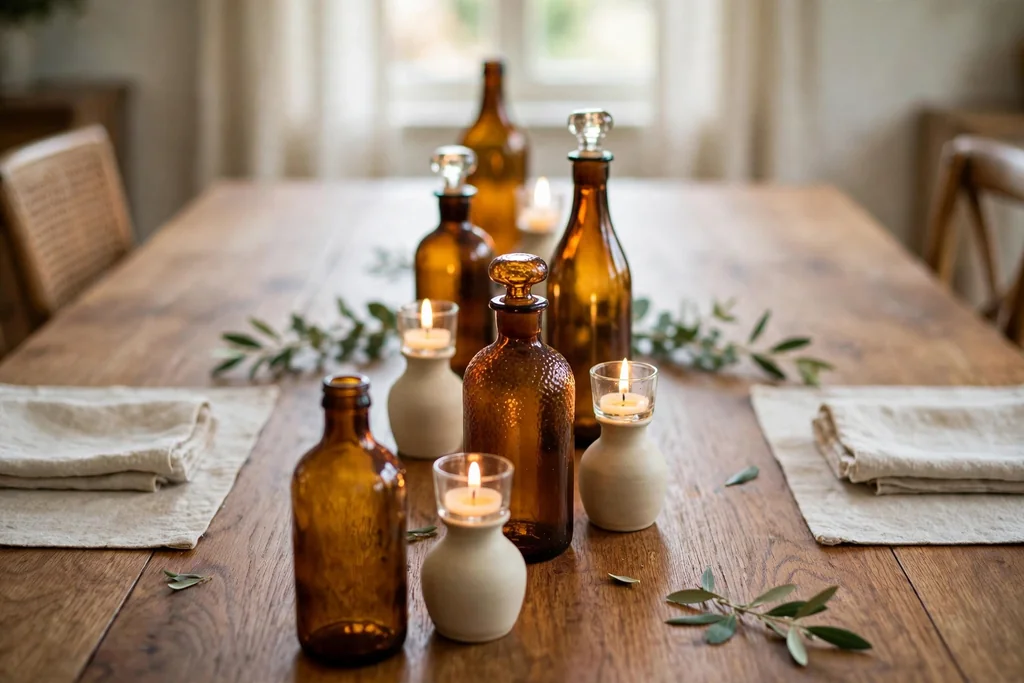
    11. Amber Glass and Warm Candlelight

    Amber glass bottles and small vases with short candles between them down the center of a dining table.

    Set amber glass bottles, small vases, or drinking glasses down the center of the table, with short candles in holders between them, so the glass catches the light and warms the whole setting. Amber glass suits rust, cream, and wood palettes, and it works with plain white plates as well as patterned ones.

    Mix heights, with one taller bottle and two shorter glasses, but keep the total group low enough to see across. Use battery candles inside narrow bottles, and real candles only in proper holders on a stable surface. Wash amber glass before the meal, since fingerprints show more on colored glass than on clear glass.

    12. Twine Napkin Rings with a Dried Sprig

    Folded linen napkin wrapped with twine and a small dried sprig beside a plate on a fall table.

    Wrap a length of twine around each folded napkin two or three times, tie it in a simple knot, and tuck a small dried sprig, such as lavender, wheat, or a tiny leaf stem, under the twine. This small detail dresses an everyday place setting in minutes and costs little, since twine and dried stems store well.

    Fold napkins in a simple rectangle or roll so the twine sits flat, and keep the sprig short so it does not brush the plate. For a gathering, use the same sprig at every place, so the table looks matched. Remove the sprig before washing napkins, and compost or discard dried stems when they start to shed.

    13. Tiered Stand for a Gathering Table

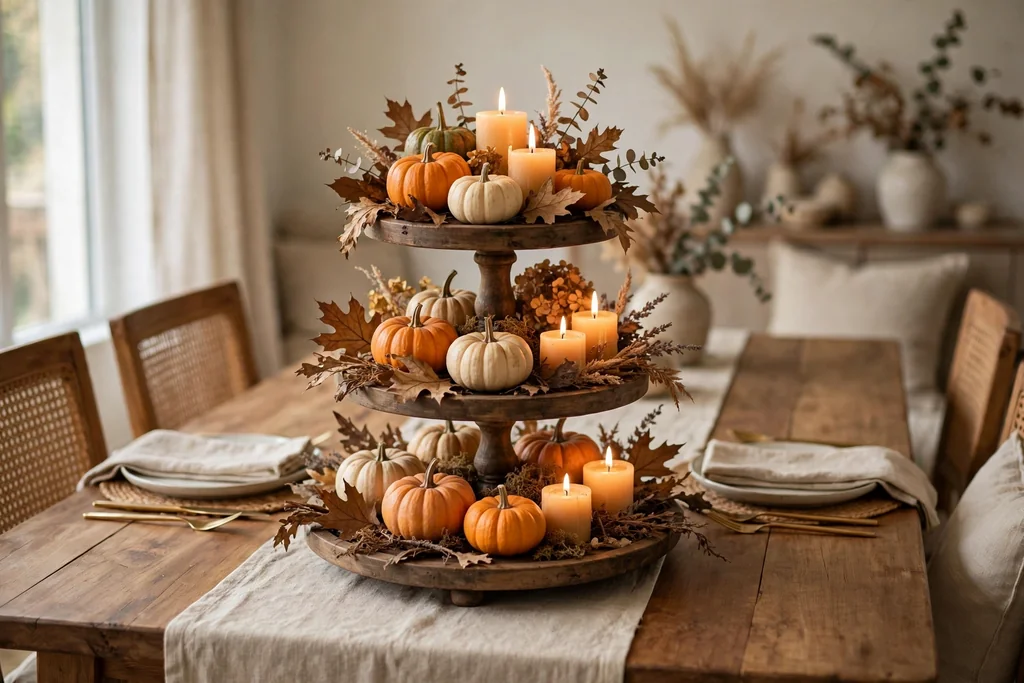
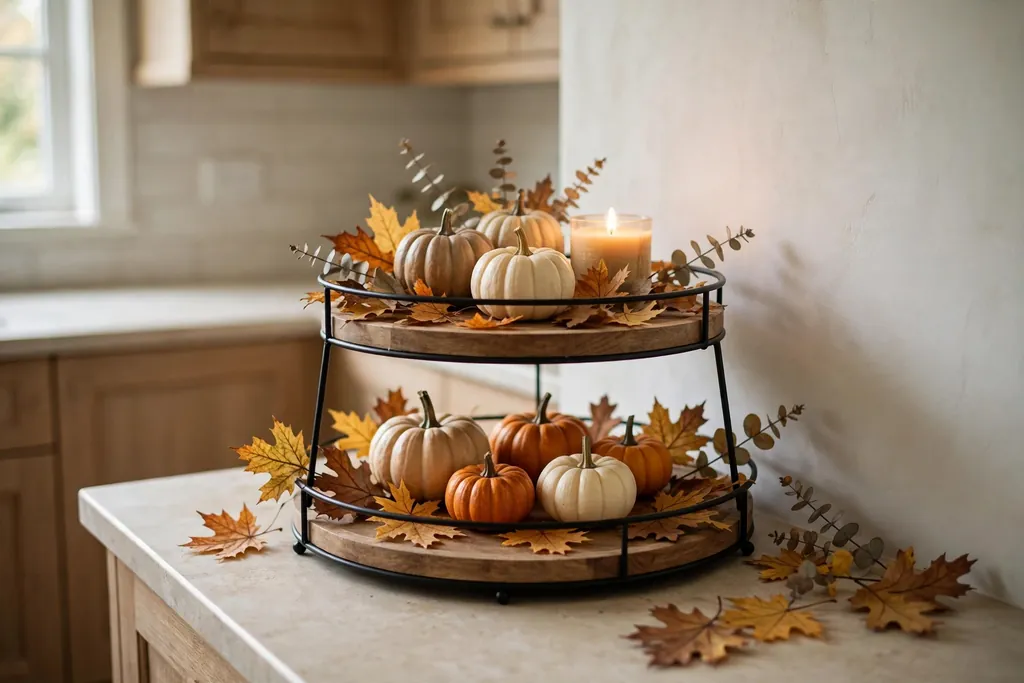
    Tiered stand at the end of a dining table holding small pumpkins, candles, and dried leaves.

    Set a two or three tier stand at one end of the table or on a sideboard, and fill it with small pumpkins, candles in holders, and a few dried leaves, so the gathering table gains height without blocking the center. A tiered stand also works for serving, with bread, fruit, or small bites on the tiers at a buffet style meal.

    Keep the stand stable and clear of the main serving path, and put heavier items on the bottom tier. If the stand will hold food, use it for food only, and set the decor version on a separate stand or tray. Wipe the tiers after use, since candle wax and leaf dust collect in the rims.

    14. Rustic Wood Table with Folded Linen Napkins

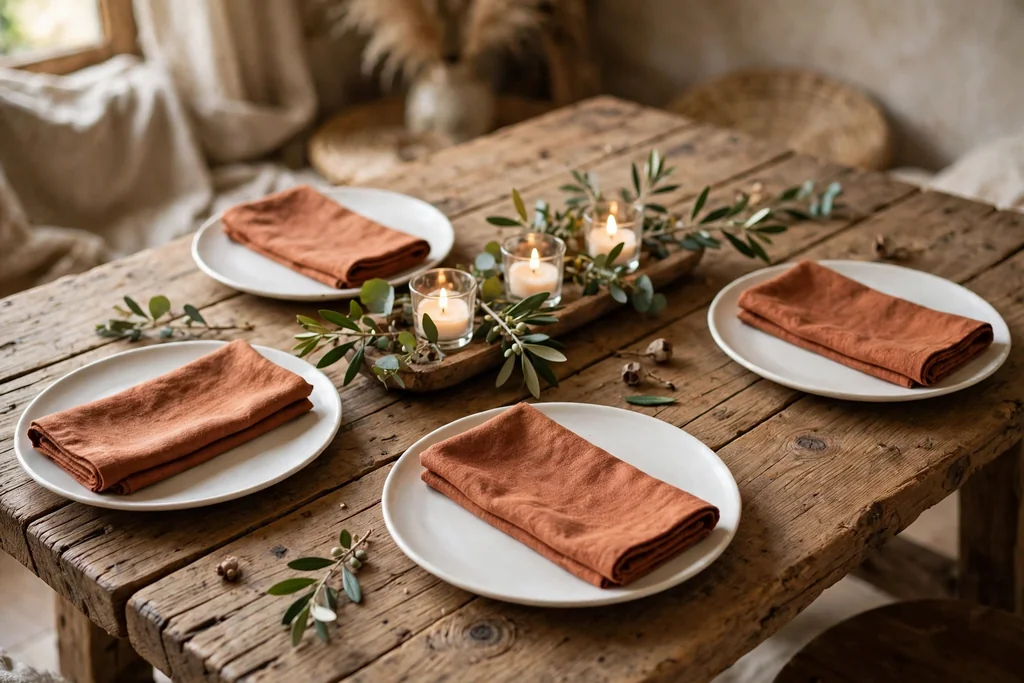
    Bare rustic wood dining table with folded linen napkins in rust, plain plates, and a low candle centerpiece.

    Leave a wood table bare, with no runner or cloth, and let the grain do the work, then set folded linen napkins in rust or cream at each place, with simple cutlery and plain plates. This approach suits a farmhouse or rustic dining room, and it keeps the table easy to wipe after everyday meals.

    Use placemats under plates if the wood marks easily, and keep the centerpiece to one low group, such as a wood board with candles, so the wood still shows. Fold napkins the same way at every place for a tidy look, and iron linen napkins before a gathering, since creases show more on bare wood than under a patterned cloth.

    15. Leaf Garland Down the Center

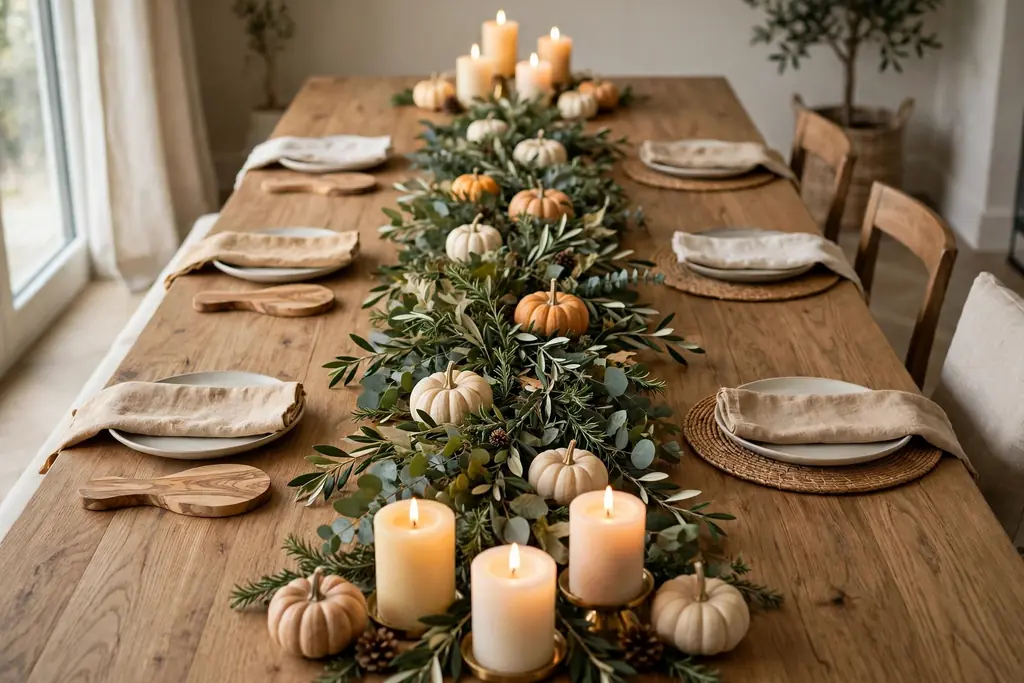
    Leaf garland down the center of a long dining table with mini pumpkins and candles at each end.

    Lay a faux or dried leaf garland down the center of the table, letting it dip slightly at the ends, then tuck in two or three mini pumpkins and one candle in a holder at each end to anchor it. The garland carries fall color along the whole table, which suits a long dining table for a gathering.

    Secure the garland so it does not slide when plates are set down, and trim it to fit the table, leaving room at each end for serving dishes. Keep dried garlands clear of real flames, and use flameless candles along the garland. Dust a faux garland before laying it out, and store it flat or rolled loosely so leaves do not crush.

    16. Brass Candlesticks with Cream Tapers

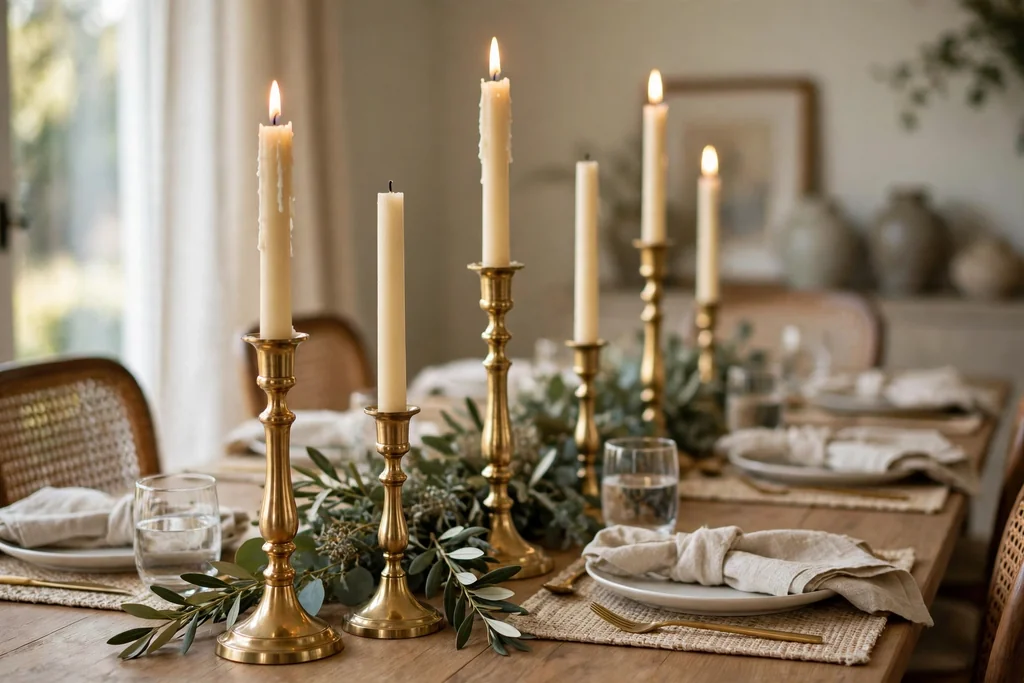
    Brass candlesticks of two heights with cream taper candles down the center of a dining table.

    Set brass candlesticks of two heights down the center of the table, with cream taper candles in each, and keep the rest of the centerpiece simple, such as a short leaf runner or a few mini pumpkins at the base. Brass adds a warm metal note that suits both everyday dinners and larger gatherings.

    Check that candlesticks sit level and that tapers fit snugly, so candles do not lean or drip onto the table. Use a tray or small plates under the candlesticks if wax drips are a concern, and trim wicks before lighting. For a table with children, use flameless tapers in the same brass holders for the same look without a flame.

    17. Acorn and Pinecone Scatter with Pillar Candles

    Plain runner with a light scatter of acorns and pinecones and pillar candles in glass holders on a dining table.

    Scatter a small number of acorns and pinecones along a plain runner, then set two or three pillar candles in glass holders among them, so the table gains a woodland fall note without a large arrangement. This idea suits a neutral table, where the natural shapes and candlelight carry the season.

    Use acorns and pinecones sparingly, about a handful along a long table, and keep them clear of plates and food. Clean gathered pinecones fully and check them for insects before bringing them inside, and keep them clear of real flames. If small pieces worry you with young children at the table, use larger pinecones only and skip the acorns.

    18. Washable Fall Placemats for Everyday Meals

    Washable fall plaid placemats under everyday plates on a kitchen dining table with plain napkins.

    Swap everyday placemats for washable ones in a fall plaid, rust stripe, or muted leaf print, and keep the rest of the table plain, so weeknight meals feel seasonal with one easy change. Placemats protect the table, mark each place, and wash with the regular laundry or wipe clean, depending on the material.

    Choose placemats that lie flat and do not curl at the edges, since curled corners catch plates and glasses. Keep the print scale small on a round table and larger on a long table, and repeat one placemat color in the napkins or runner. Store spare placemats folded flat, so they are ready to swap when the season changes.

    19. Tall Branch Centerpiece for Large Gatherings

    Tall narrow vase with bare branches and a few dried leaves in the center of a long gathering table.

    For a large gathering table, set a tall, narrow vase or jug with bare branches or branches with a few dried leaves in the center, so the table gains height without blocking conversation, since guests can see around slim branches. This idea suits a long table where a low centerpiece would get lost among many place settings.

    Choose a heavy vase that will not tip, trim branches so they clear light fixtures, and keep the arrangement narrow, not wide. Set the vase where it will not be brushed by serving dishes passing down the table. If branches shed, shake them outside first, and keep dried branches clear of candles and other flames.

    20. Cider and Cocoa Station at the Table End

    Small drink station tray at the end of a dining table with mugs, a jug, and cinnamon sticks.

    Set a small drink station at one end of the table or on a nearby sideboard, with a tray holding mugs, a jug of cider or a pot of cocoa, and a small bowl of cinnamon sticks or dried orange slices for garnish. Guests can help themselves without leaving the table area, which suits a relaxed gathering.

    Keep the station on a tray, so spills stay contained and the whole station lifts away after the meal. Use mugs with handles that hang or stack neatly, and keep hot drinks clear of the table edge where children pass. Wipe the tray after use, since drink stations gather drips faster than other table decor.

    21. Handwritten Menu Cards for Guests

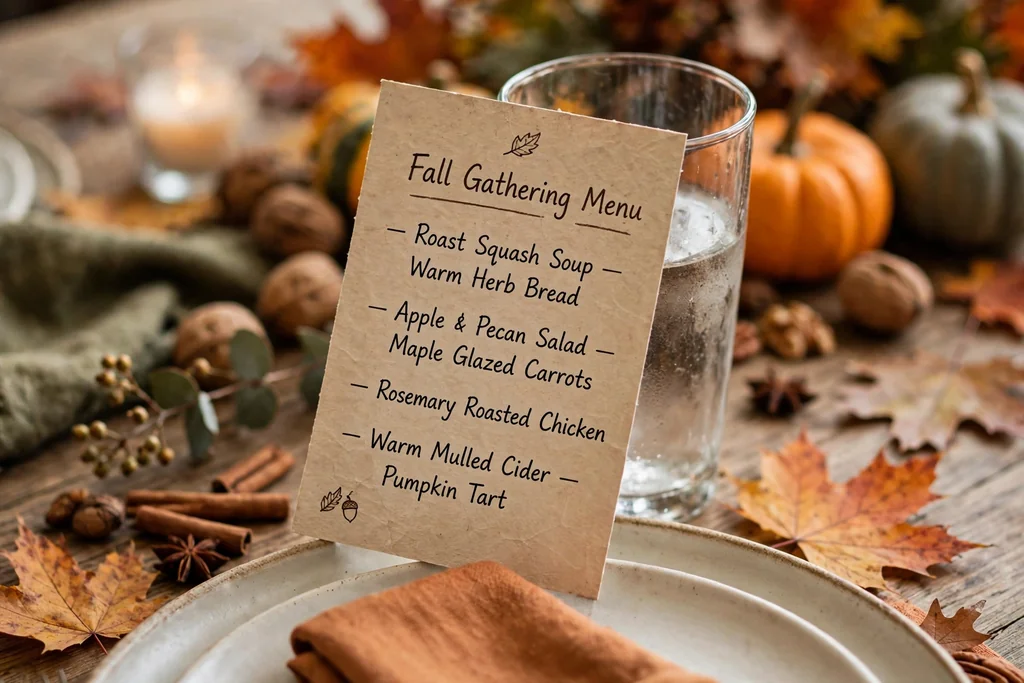
    Handwritten menu card leaning against a glass above a plate on a fall gathering table.

    Write the menu by hand on small cards, one per place or one shared card per two guests, and lean each card against a glass or lay it flat above the plate. A menu card helps guests with food choices, marks the meal as a gathering, and doubles as a simple table decoration in itself.

    Keep the writing large and clear, list dishes in serving order, and note any main ingredients guests may need to know, without making claims you cannot stand behind. Use plain card and a pen that does not smudge, and keep cards clear of wet glasses. For everyday meals, skip the menu and use a single card with a short note or the date for a special family dinner.

    22. Mixed Wood and Ceramic Place Settings

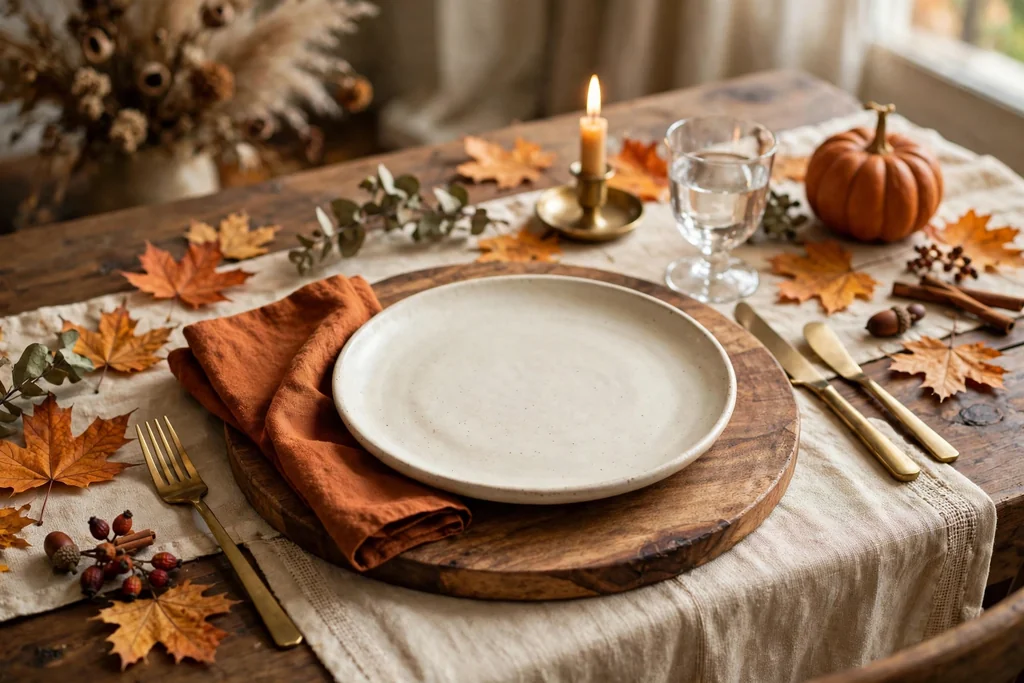
    Place setting mixing a wood charger, cream ceramic plate, and rust napkin on a fall dining table.

    Mix wood chargers or wood handled cutlery with ceramic plates in cream, rust, or sage, so each place setting gains warmth and texture without a matching new set. This mix suits a table that already has plain white plates, since the wood and one colored ceramic piece do the seasonal work.

    Repeat the same mix at every place, so the table looks planned rather than random, and keep glassware plain, so the mix does not compete with patterned glasses. Check that wood pieces are food safe and wipe them after meals. If you own only a few wood chargers, use them at the head places and plain settings elsewhere, with the same napkins throughout to tie the table together.

    23. Paper Leaf Craft Table for Children

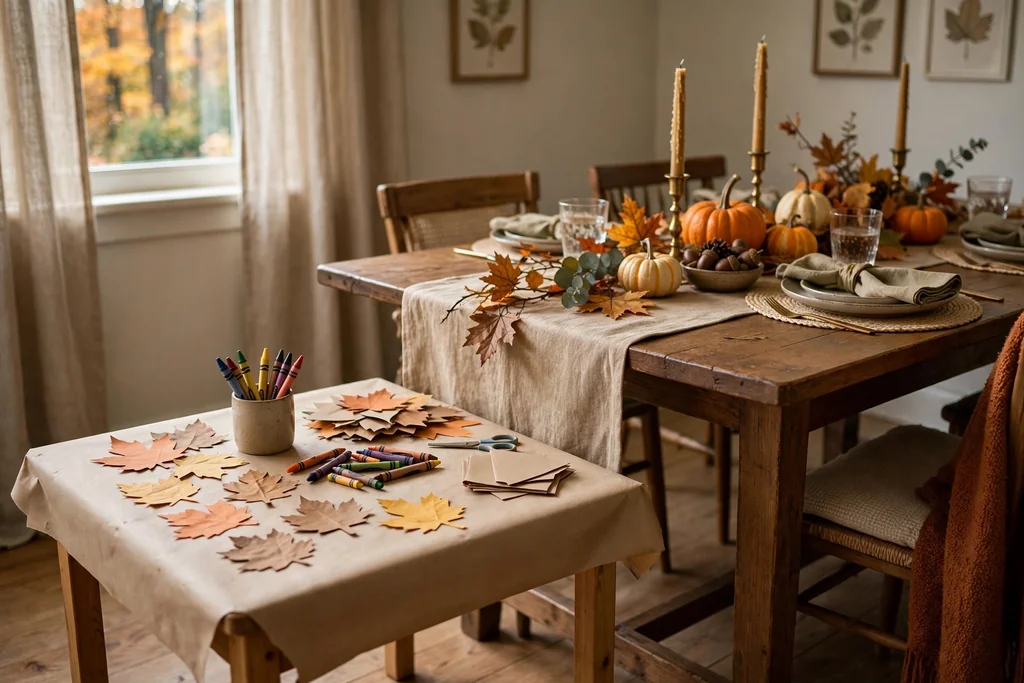
    Small table covered with plain paper, paper leaves, and crayons set for children beside a fall dining table.

    For a family gathering with children, cover one end of the table or a separate small table with plain paper, and set out paper leaves, crayons, and safe scissors, so children can color and cut leaves while adults eat nearby. This idea keeps young guests busy at the table and gives them a fall activity that fits the season.

    Use washable crayons and blunt scissors for young children, and keep craft supplies clear of food and drinks. Tape the paper down at the corners, so it does not slide, and set a small bin nearby for scraps. At the end of the meal, the paper leaves can go home with guests or decorate a window, and the paper cover lifts off for a fast cleanup.

    Conclusion

    Fall table decor does not need a large centerpiece or a new dinner set to work. A low runner, one contained centerpiece, and plates, napkins, and candlelight in rust, cream, and warm wood will carry most tables through everyday meals and larger gatherings. Start with textiles, add one seasonal group at the center, and leave room for serving dishes and conversation.

    For more seasonal ideas for the whole house, see 33 fall decor ideas for home, and for the room next door, see fall kitchen decor ideas. Keep what you use often, store the rest together in one box, and let the table return to a simple, usable base when the season ends. Save this list on Pinterest for your next meal, and work through it one idea at a time.

    FAQs

    How do I decorate a fall table without blocking conversation?

    Keep the centerpiece low and narrow, below eye level when guests are seated, and leave the middle of the table partly open. A wood board with small pumpkins, a leaf runner, or a row of short candles all sit low enough to see across. If a tall arrangement is needed for a large table, use slim branches in a narrow vase, so guests can see around them.

    What colors work best for fall table decor?

    Rust, cream, warm wood, and muted olive work well together, because they suit wood tables, white plates, and brass or amber glass. Repeat each color at least twice, such as rust napkins with a rust candle, or cream linen with cream pumpkins, so the table looks planned. Keep bright orange to one or two small pieces, so the table stays calm enough for everyday meals.

    How can I make a fall table safe with candles and dried leaves?

    Keep real flames in holders, clear of dried leaves, fabric, paper, and napkins, and never leave candles burning unattended. Use flameless candles near dried garlands, leaf scatters, and children’s places, since dried material catches fire easily. Set candles on a stable surface, trim wicks before lighting, and keep a clear path for serving dishes, so nothing gets knocked toward a flame.

    What is the simplest fall table for everyday meals?

    Start with a washable runner or placemats in a fall color, cloth napkins in a warm neutral, and one low centerpiece, such as a wood board with two small pumpkins. That set takes minutes to lay out, washes easily, and lifts off in one move when the table is needed for homework or work. Add candles in the evening, and the same base works for a weeknight dinner and a weekend meal.

    How do I scale fall table decor up for a gathering?

    Add place cards, a drink station at the table end, and a menu card at each place, while keeping the same runner and centerpiece base. Use the same napkin fold and sprig at every place, and add one taller element, such as brass candlesticks or slim branches, only if the table is long enough to keep sightlines open. Keep serving dishes in mind, and leave space at the table ends for platters.

    How do I store fall table decor after the season?

    Wash runners, napkins, placemats, and tablecloths, dry them fully, and store them folded together in one box. Wrap ceramic pumpkins and brass candlesticks in soft cloth or paper, keep dried stems upright in a tall box so they do not crush, and check real pumpkins and fruit before packing anything away. Storing the set together makes next fall setup a single short job.


  • 21 Exterior Decorating Ideas for Fall Beyond the Front Door

    21 Exterior Decorating Ideas for Fall Beyond the Front Door

    Exterior decorating for fall looks best when it spreads past the front door to the walkway, yard, patio, and side entries. Use hardy mums, pumpkins, lanterns, and warm light in a small set of autumn colors, keep paths clear, and repeat one or two materials so the whole outside reads as one plan.

    The front door gets plenty of attention each autumn, yet most of a home sits beyond it. A walkway, a back patio, a side gate, and a garden bed all offer room for seasonal color without crowding one small porch. The 21 ideas below move through those spaces one at a time, so you can start with a single spot and add more as time and weather allow.

    Key Takeaways

    • Spread fall decor past the front door to walkways, patios, side entries, and garden beds for a fuller seasonal look.
    • Repeat two or three autumn colors, such as rust, gold, and cream, across every display so separate spots read as one plan.
    • Keep paths, steps, and gates clear and well lit, even when pumpkins and planters sit close by.
    • Choose hardy plants like mums, ornamental kale, and pansies for containers that must last through cool nights.
    • Use battery or solar light for lanterns and string lights where no outdoor outlet sits nearby.
    • Bring cushions, throws, and paper items inside during heavy rain, and store sturdy pieces in one labeled box at season end.

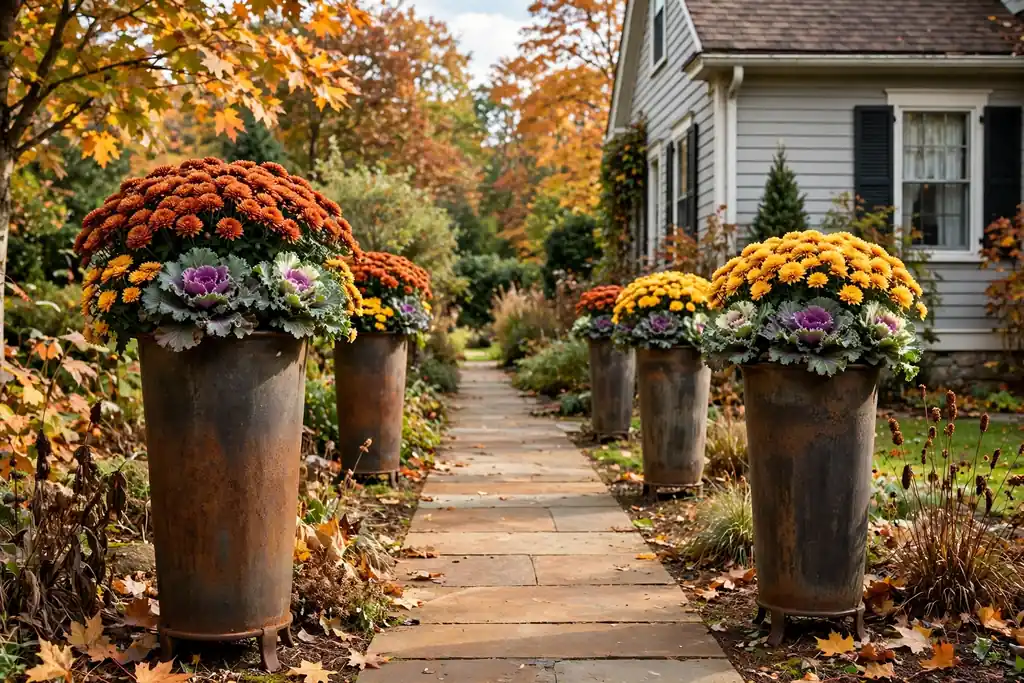
    1. Walkway Planters Layered with Mums and Kale

    Walkway planters with fall mums and ornamental kale beside a path.

    Tall planters on either side of a walkway frame the route to the house and set the fall color plan at once. Fill each planter with a mum in rust or gold, a rosette of ornamental kale for texture at the base, and a trailing sprig of ivy or dried grass for softness at the rim.

    Place the planters where they do not narrow the path. A pair at the walkway start and a second pair near the steps gives rhythm without blocking foot traffic. Water mums when the soil feels dry to the touch, and trim spent blooms so the planters stay tidy through the season.

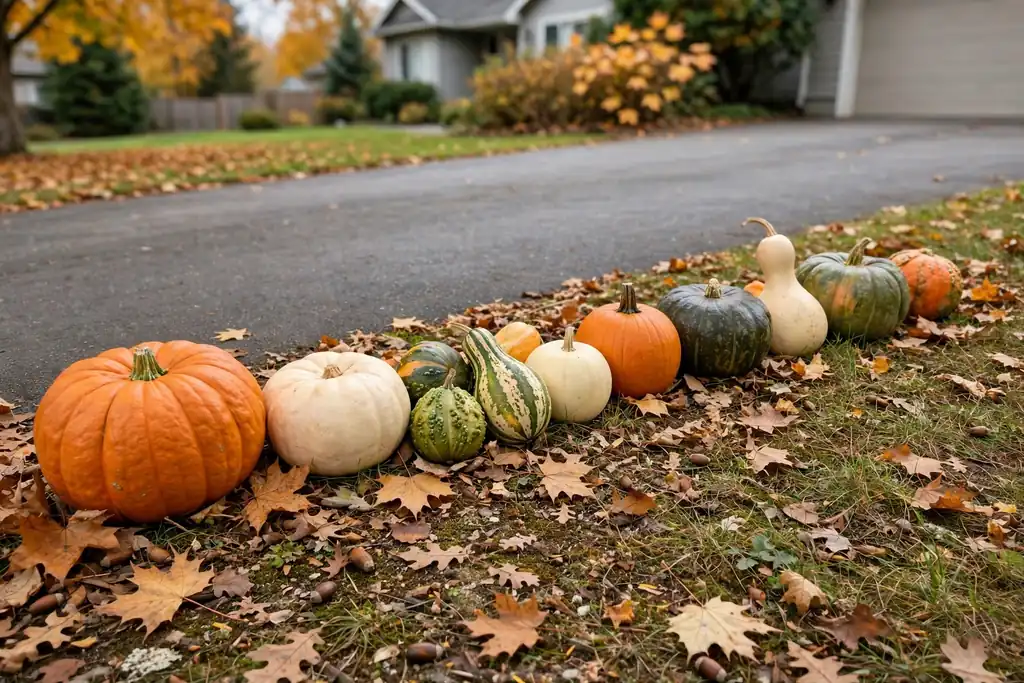
    2. Pumpkin Border Along the Driveway Edge

    Pumpkins and gourds lining the edge of a driveway.

    A low border of pumpkins along the driveway edge adds harvest color to a spot most people pass every day. Set pumpkins and gourds in a loose line on the grass or gravel beside the drive, mixing sizes and colors, and leave gaps so the border reads as a display rather than a wall.

    Keep every pumpkin clear of tire paths and turning room, and avoid the spot where car doors swing open. Larger pumpkins anchor the ends of the line, while small gourds fill the middle. At the end of the season, compost soft pumpkins and save firm ones for a table display indoors.

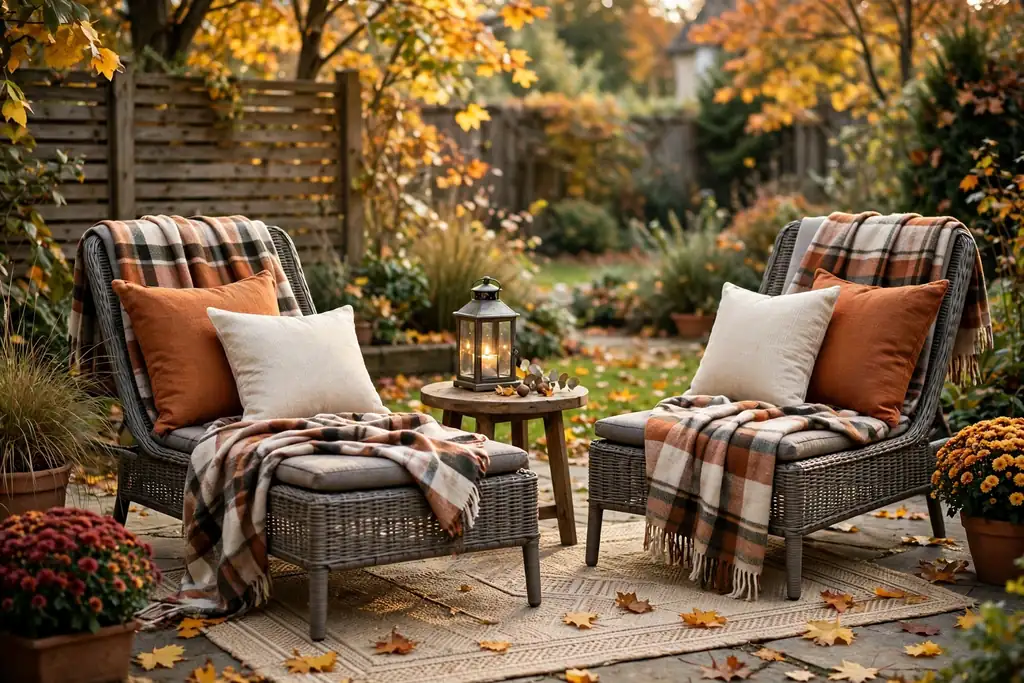
    3. Back Patio Lounge with Plaid Throws and Pillows

    Back patio lounge chairs with plaid throws and fall pillows.

    A back patio lounge turns fall evenings outside into a regular habit. Dress existing patio chairs with plaid throws folded over the chair backs and add two or three pillows in rust, mustard, and cream. A small side table holds drinks and a lantern, so the seating area works after sunset too.

    Choose throws and pillow covers that wash well, since outdoor fabric picks up leaves and dust. Bring them inside during rain, and store them in a lidded basket by the back door so the patio can be dressed again in minutes. Keep the seating group close to the house wall for shelter from wind.

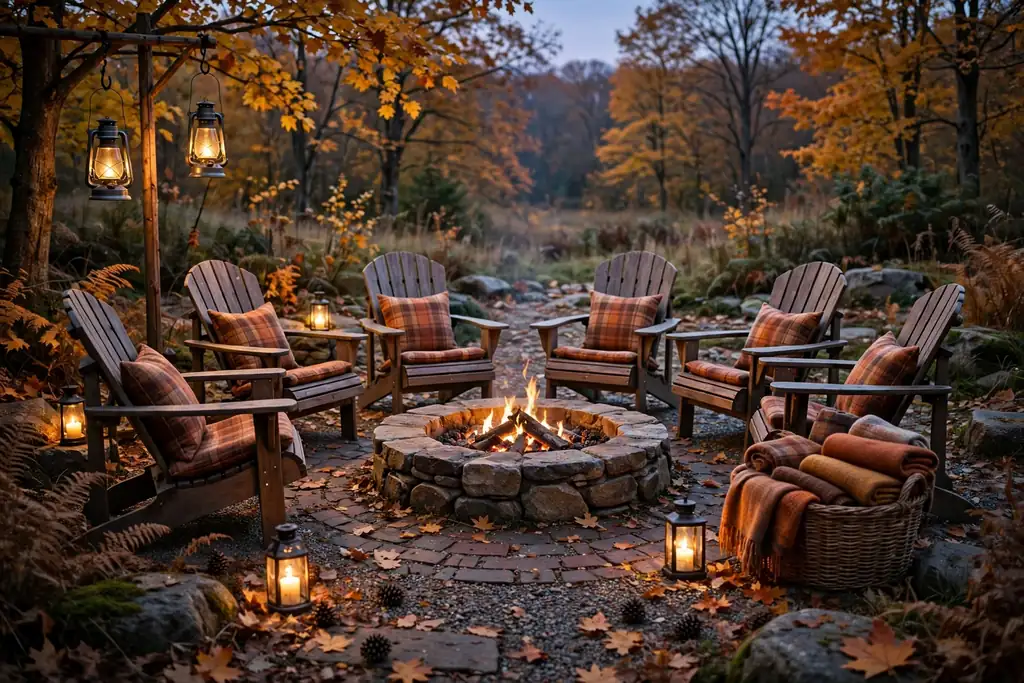
    4. Fire Pit Corner with Autumn Cushions and Lanterns

    Fire pit corner with fall cushions and glowing lanterns.

    A fire pit corner already draws people outside, and a few fall touches make it feel seasonal without changing its layout. Add cushions in warm plaid or solid rust to the seating ring, set lanterns on a low stone edge or on the ground beside chairs, and keep a basket of throws within reach.

    Check local rules for open flames before lighting a fire, and keep lanterns and fabric clear of sparks. Battery candles inside lanterns give a steady glow on nights when no fire is lit. Sweep leaves away from the pit before each use, since dry leaves near flames are a real hazard.

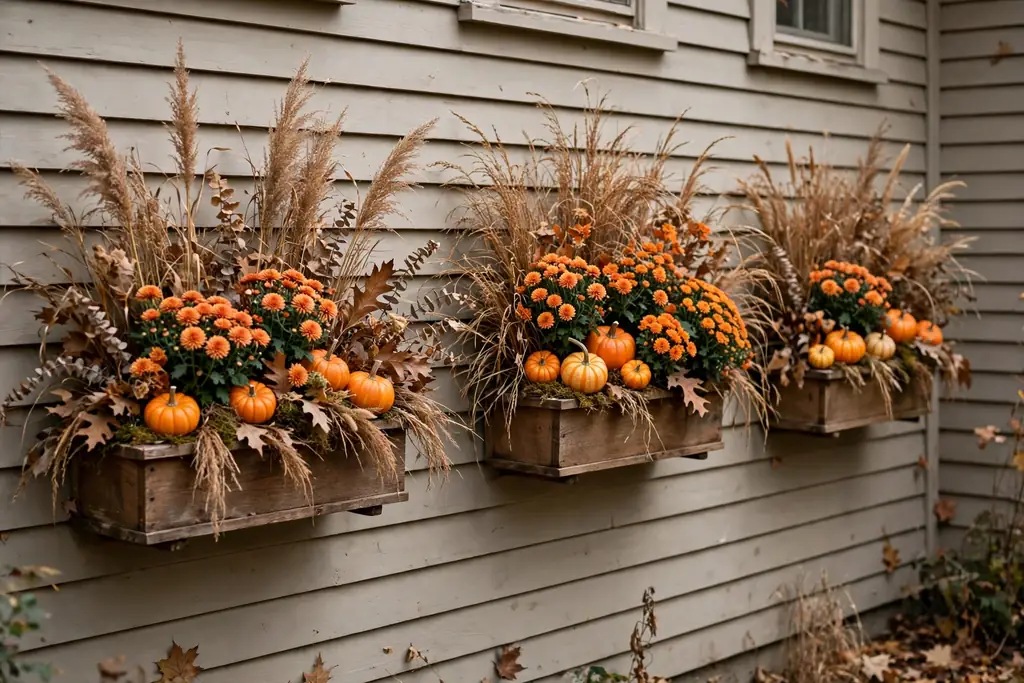
    5. Window Boxes Filled with Grasses and Mini Pumpkins

    Fall window boxes with grasses, mums, and mini pumpkins.

    Window boxes offer fall color at eye level on side and back windows, not just at the front of the house. Fill each box with dried or faux grasses for height, small mums for color, and two or three mini pumpkins tucked at the front edge where they show from the yard.

    Secure the boxes well before adding weight, and check that pumpkins do not block the window from inside. Grasses suit boxes on brick, siding, and stone alike, and their pale gold tone pairs with both orange and cream pumpkins. Refresh the boxes once midseason by swapping tired blooms for fresh ones.

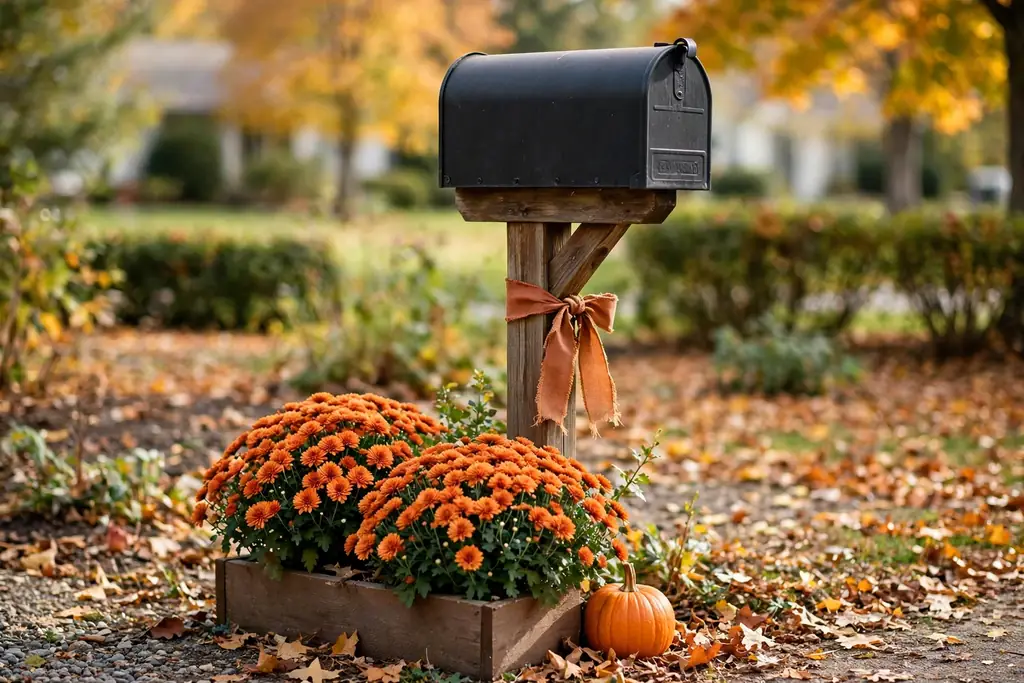
    6. Mailbox Dressed with a Fall Planter and Ribbon

    Mailbox dressed for fall with a mum planter and ribbon.

    The mailbox is often the first thing visitors see, and it takes only a small display to dress it for fall. Set a low planter of mums or ornamental kale at the mailbox base, tie a simple ribbon in rust or gold around the post, and add one small pumpkin beside the planter if room allows.

    Keep the mailbox door and house numbers fully visible, and do not hang anything that blocks mail delivery. Choose a planter heavy enough to stay put in wind, and avoid items that spill onto the road or sidewalk. This small spot works well with the walkway planters in idea 1, using the same colors at a smaller scale.

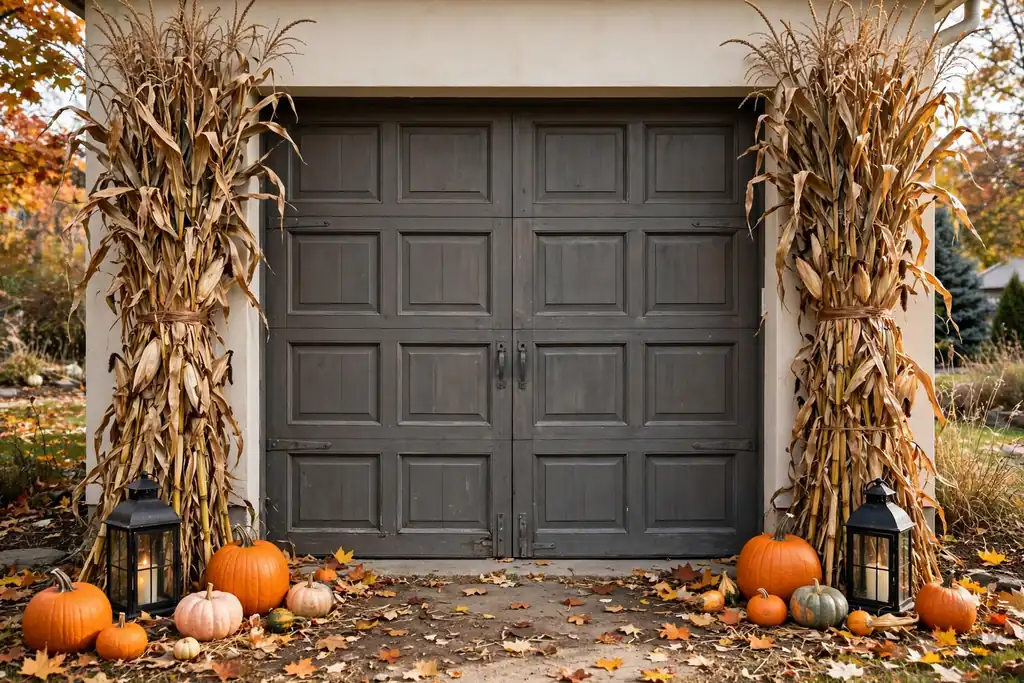
    7. Garage Sides Framed by Cornstalks and Lanterns

    Garage sides framed by cornstalks, lanterns, and pumpkins.

    Garage walls offer a wide, flat backdrop that suits tall fall displays. Tie bundles of cornstalks to the wall on either side of the garage door, set a lantern at the base of each bundle, and add a small cluster of pumpkins on the ground between them.

    Fasten cornstalks firmly so wind cannot pull them loose, and keep them clear of the garage door track and any vents. Lanterns with battery candles are the safer choice here, since cornstalks are dry by nature. This idea pairs well with a driveway pumpkin border, using the same pumpkin colors at both spots.

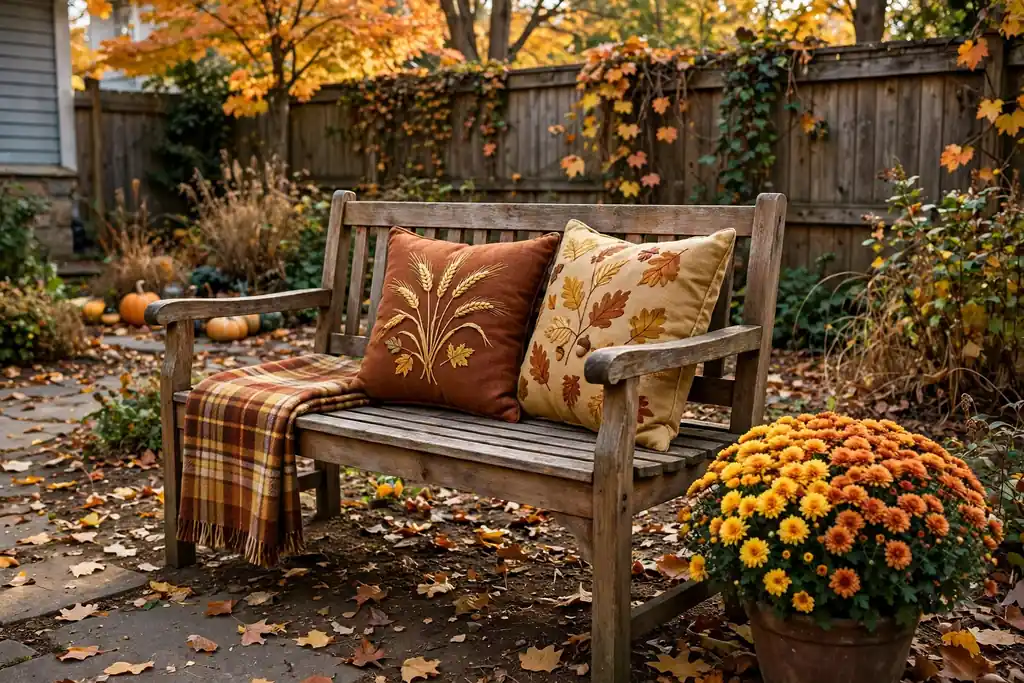
    8. Side Yard Bench Nook with Harvest Pillows

    Side yard bench nook with harvest pillows and a mum planter.

    A bench tucked into a side yard becomes a quiet fall reading spot with very little work. Add two pillows in harvest colors, a folded throw over one arm, and a small crate or stool beside the bench to hold a drink or a book. A planter of mums at the bench end ties the nook to the rest of the yard.

    Site the bench where it catches afternoon sun and stays clear of dripping gutters. If the bench sits on soil, set it on flat stones so the legs stay level and dry. Bring pillows inside at night during wet spells, and brush leaves off the seat before each use so the nook stays inviting.

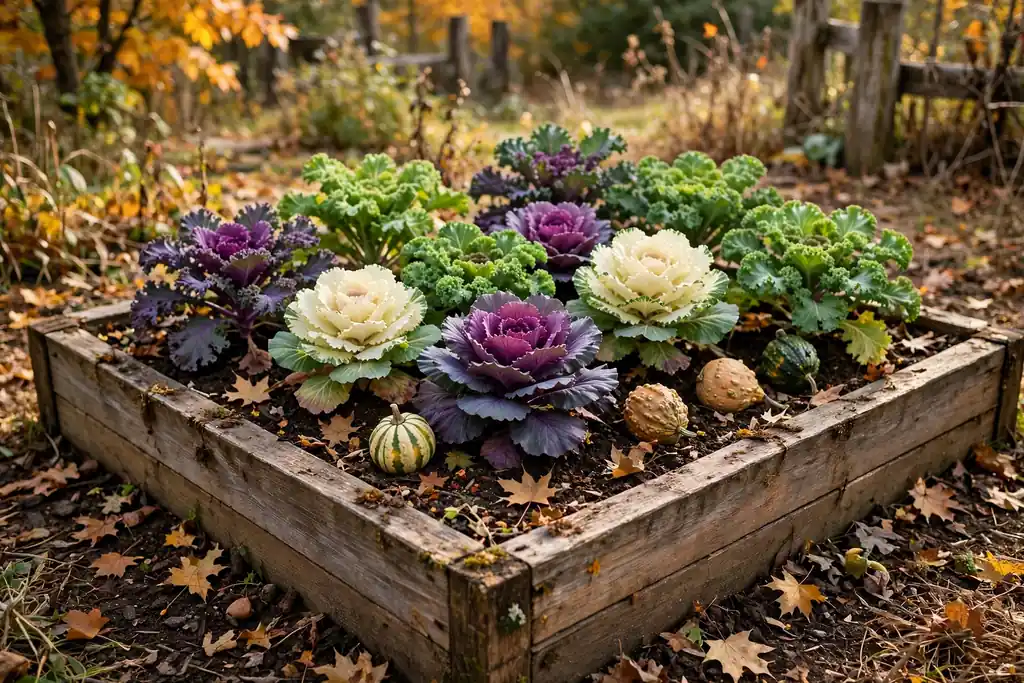
    9. Raised Beds Styled with Ornamental Cabbage and Gourds

    Raised bed styled for fall with ornamental cabbage and gourds.

    Raised beds need not look empty once summer crops finish. Plant ornamental cabbage and kale in the bed edges for rosettes of purple, cream, and green, then rest a few small gourds on the soil between plants where they show above the bed rim. Dried stems in a jar at the bed end add height.

    This idea suits beds near a patio or kitchen door, where the display is seen daily. Keep gourds off tender new growth, and remove any that soften in rain. Ornamental cabbage tolerates light frost, so this bed often looks good well into late fall, longer than most container mums.

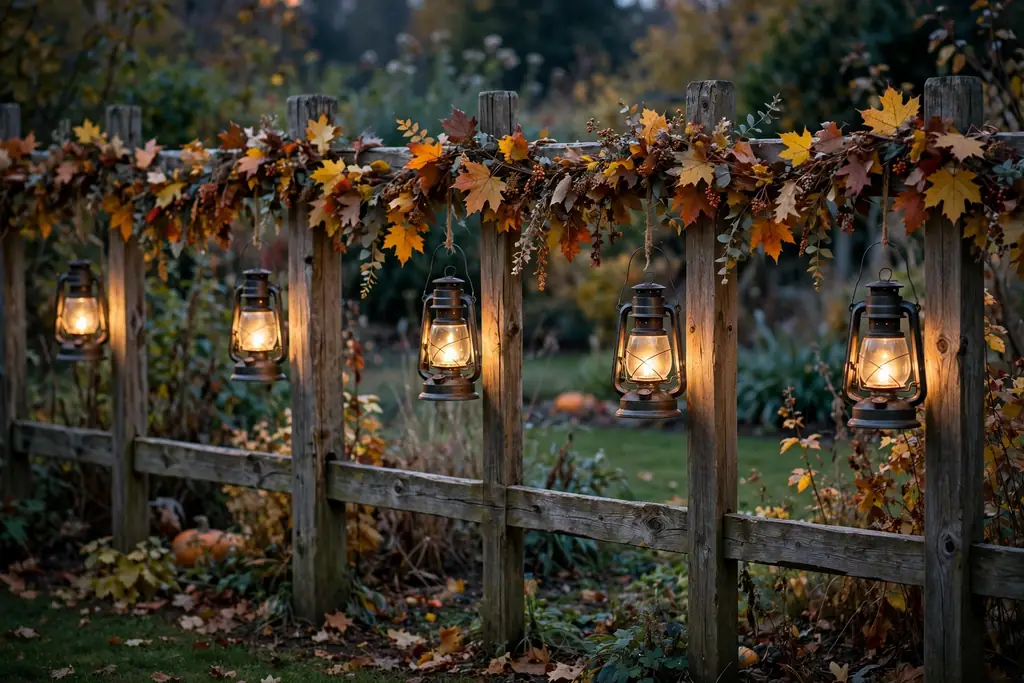
    10. Fence Line with Hanging Lanterns and Leaf Garland

    Fence line with hanging lanterns and fall leaf garland.

    A plain fence becomes a fall backdrop when lanterns and garland run along its top rail. Hang lanterns from hooks at spaced intervals, drape a leaf garland along the rail between them, and let a few leaves hang over the front face for depth. Battery candles keep the lanterns safe near dry leaves.

    Space the lanterns evenly rather than crowding one section, and check that hooks hold firm in wind. This display works along a back fence, a side fence, or a short garden fence alike. Take the garland down before heavy storms, and store lanterns indoors over winter to protect glass and metal.

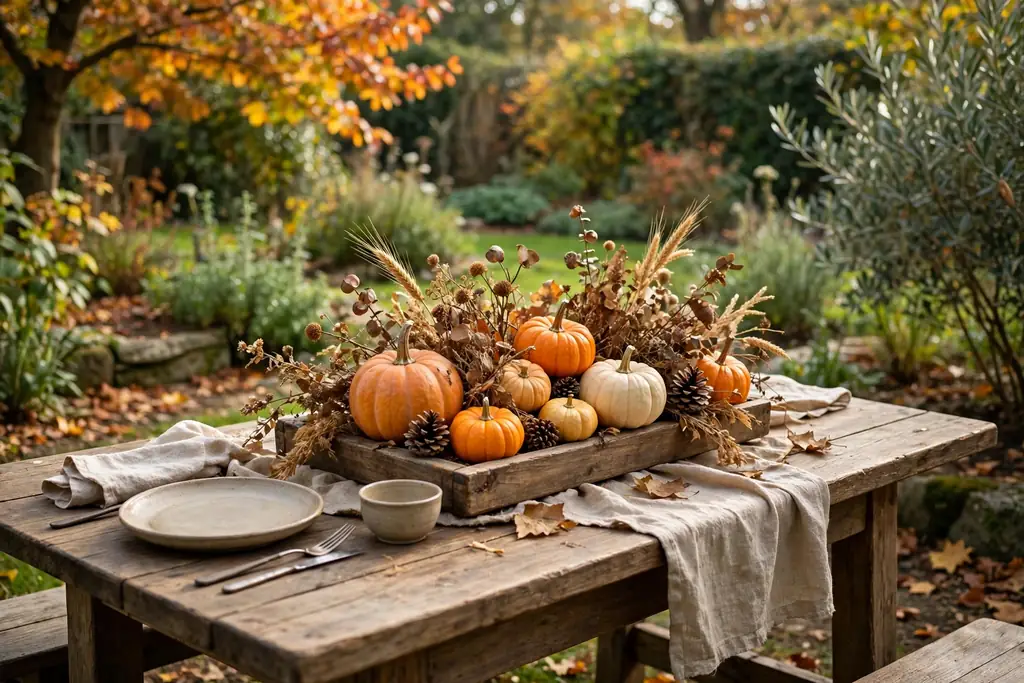
    11. Outdoor Dining Table with a Harvest Centerpiece

    Outdoor dining table with a fall harvest centerpiece.

    An outdoor dining table deserves its own fall centerpiece, separate from any front porch display. Lay a simple runner down the center, set a low wooden tray or basket on it, and fill the tray with small pumpkins, pinecones, and a few dried stems. Keep the arrangement low so guests can talk across the table.

    Choose a runner and tray that wipe clean, since outdoor tables collect dust and pollen. For everyday meals, the tray alone is enough, and candles can join it for a gathering. Bring the centerpiece inside during rain, and return it once the table dries, so the wood tray does not stay damp.

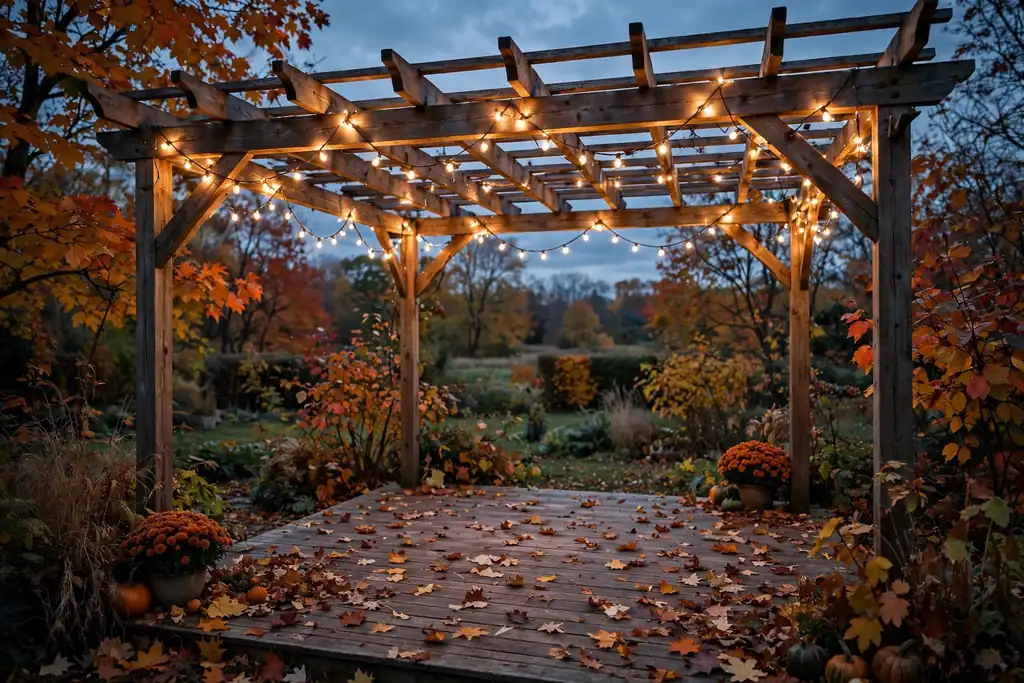
    12. String Lights Across the Deck or Pergola

    Deck pergola with warm string lights for fall evenings.

    String lights give a deck or pergola a warm evening glow that suits fall gatherings. Drape warm white lights in gentle swags between pergola beams or along a deck rail, keeping the cord clear of walkways and seating. Solar or plug-in outdoor rated lights both work, depending on what outlets sit nearby.

    Check that light strands are rated for outdoor use, and secure them with clips rather than nails that split wood. Keep lights clear of dry leaves and fabric throws. One or two strands often give enough glow for a small deck, while a larger pergola may need three, spaced evenly for a balanced look.

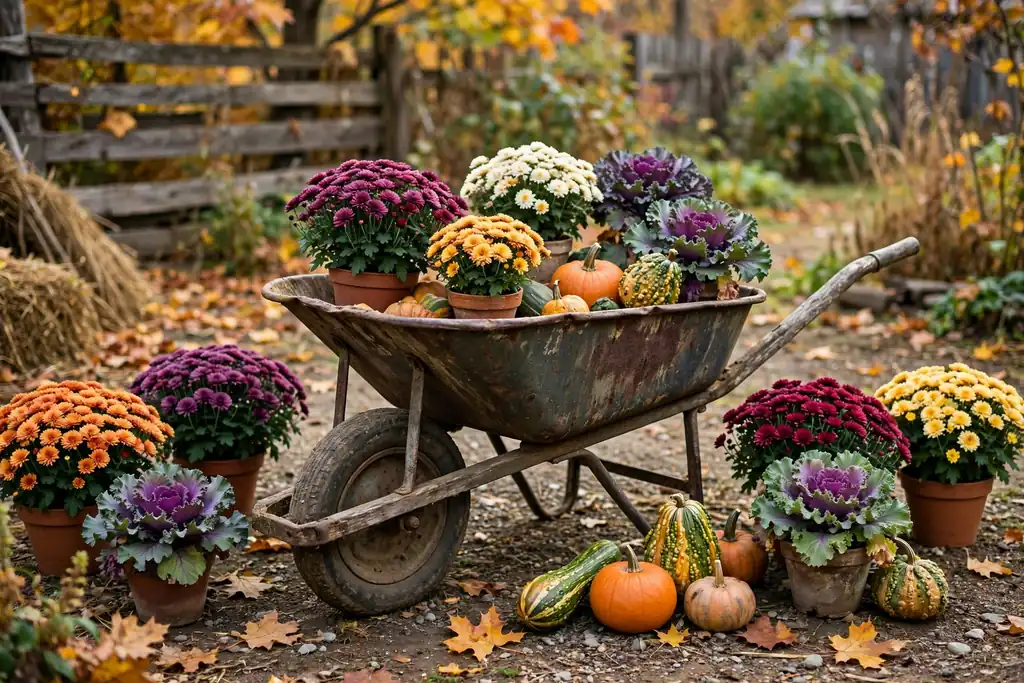
    13. Wheelbarrow Planter Overflowing with Pumpkins and Mums

    Wheelbarrow planter filled with fall mums and pumpkins.

    An old wheelbarrow makes a charming mobile fall planter for a yard corner or garden path. Line the barrow with landscape fabric, add potted mums and ornamental kale, and tuck pumpkins and gourds around the pots so the barrow looks full from every side. Park it where it does not block a path.

    Make sure the barrow drains, since standing water rots both pots and pumpkins. A wheelbarrow with a flat tire can stay in place all season as a fixed display, while a working barrow can roll to a sheltered spot before a storm. This idea suits cottage, farmhouse, and rustic yards especially well.

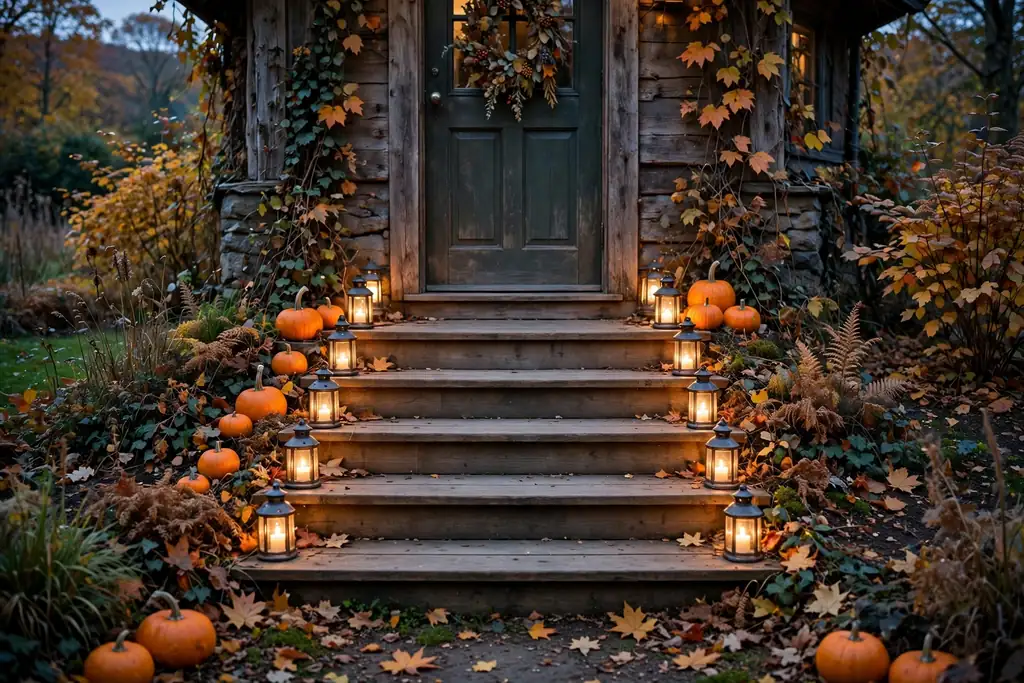
    14. Back Steps Lined with Lanterns and Small Pumpkins

    Back steps lined with lanterns and small pumpkins.

    Back steps are used every day, yet they rarely get seasonal attention. Set a lantern on every second step, alternating sides, and place a small pumpkin beside one or two lanterns. Battery candles inside the lanterns give a steady glow without an open flame near foot traffic.

    Keep the center of each step clear, and never place items where a foot must land. This rule matters most on narrow steps and in wet weather, when surfaces turn slick. Choose lanterns with a stable base and a handle, so they can be lifted inside quickly before a storm or a frost.

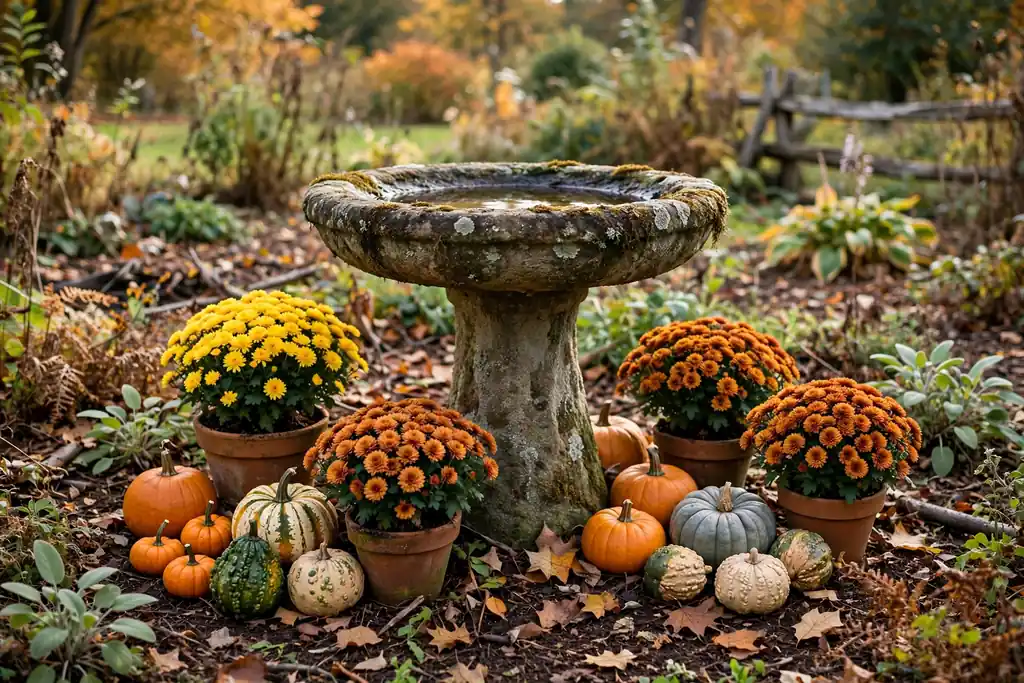
    15. Birdbath Surrounded by a Low Fall Display

    Birdbath surrounded by pumpkins and potted mums.

    A birdbath can anchor a small fall display in a garden bed or lawn corner. Set small pumpkins and gourds on the ground around the base, add a low ring of mums in small pots, and leave the basin itself clear so birds can still use it. Dried leaves scattered sparingly complete the scene.

    Do not fill the basin with decor, and keep the water fresh for visiting birds. If the birdbath sits in a bed, keep pumpkins off plant stems and clear of the path around it. This display is easy to refresh, since tired pumpkins can be swapped without moving the birdbath at all.

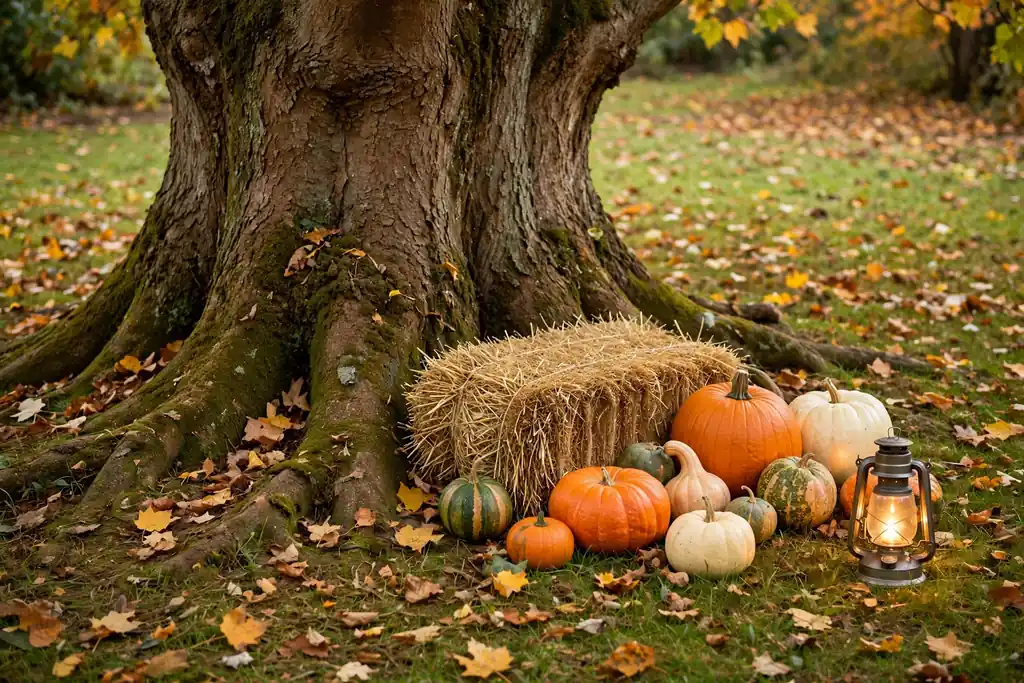
    16. Yard Tree Base with Hay, Pumpkins, and a Lantern

    Yard tree base display with hay, pumpkins, and a lantern.

    A yard tree offers a natural focal point for a larger fall display. Set a small bale of hay at the base on one side, arrange pumpkins and gourds in front of it, and place a lantern on the ground nearby. Keep the display clear of the trunk so air and water still reach the roots.

    Avoid piling soil or mulch against the trunk, and do not nail anything into the bark. A tree base display suits front yards as well as back yards, and it reads well from the street. Move pumpkins that sit in a low spot where rain pools, since wet ground softens them fast.

    17. Layered Rugs at the Back Door Entry

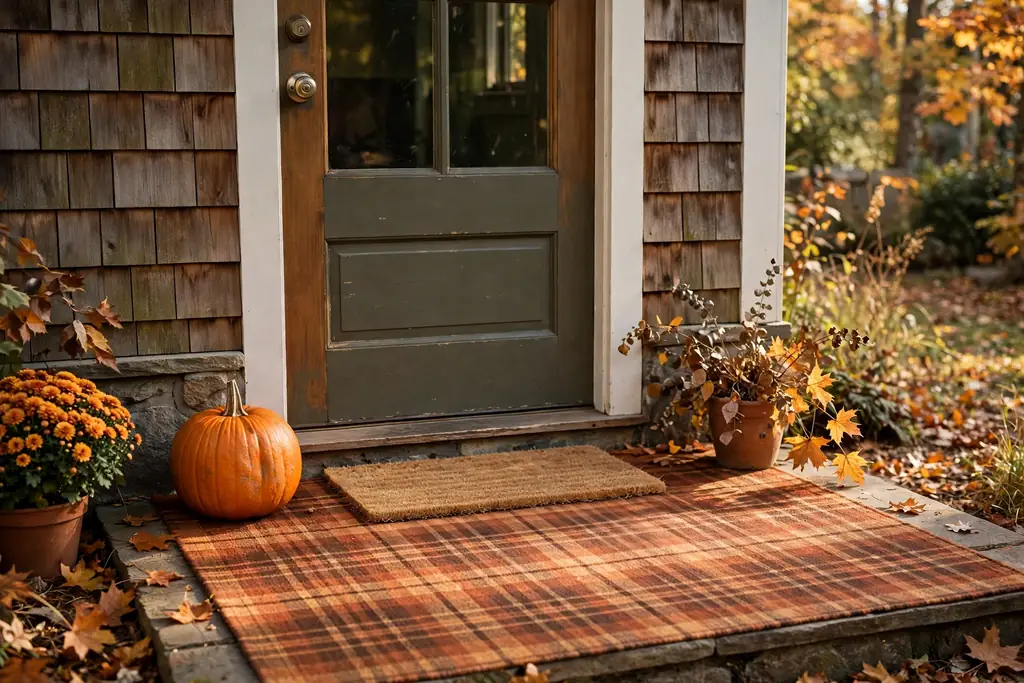
    Layered fall rugs at a back door entry.

    Layered rugs give a back door entry the same welcome as a front porch, in a smaller footprint. Lay a larger flat weave rug in a fall plaid or solid rust, then set a smaller coir mat on top, slightly off center, so both layers show. Shake both rugs out weekly to keep leaves and dirt from building up.

    Choose rugs rated for outdoor use, since back doors see mud and rain. Keep the top mat thin enough that the door swings clear over it, and trim any curled corners that could trip someone. This idea works at a mudroom door, a kitchen door, or a side door alike.

    18. Potting Bench Styled as a Fall Display Station

    Potting bench styled as a fall display station.

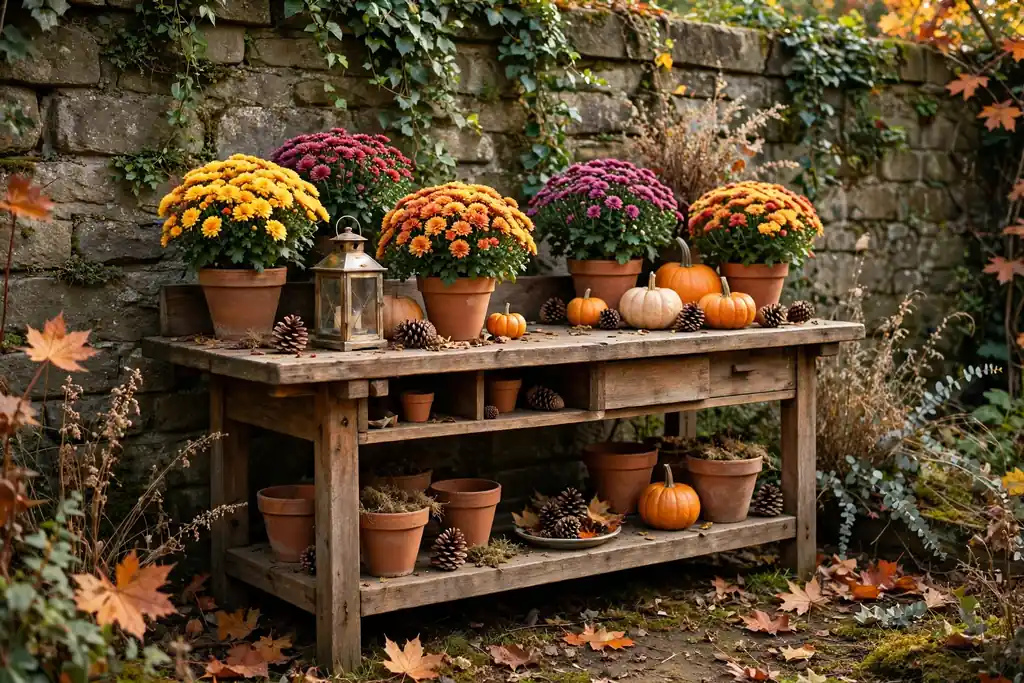
    A potting bench can serve as a fall display station once summer potting slows down. Clear the bench top, set potted mums and small pumpkins along the back edge, and use the lower shelf for a watering can, a basket of pinecones, and a stack of empty terracotta pots. A small lantern on one end adds evening interest.

    Keep the bench against a wall or fence for shelter, and keep its work surface usable for late season tasks like potting bulbs. Wipe the bench after rain, and bring small pots inside before a hard frost. This idea suits gardeners who already own a bench and want it to earn its place through fall.

    19. Garden Path Luminaries for Evening Walks

    Garden path lined with fall luminaries at dusk.

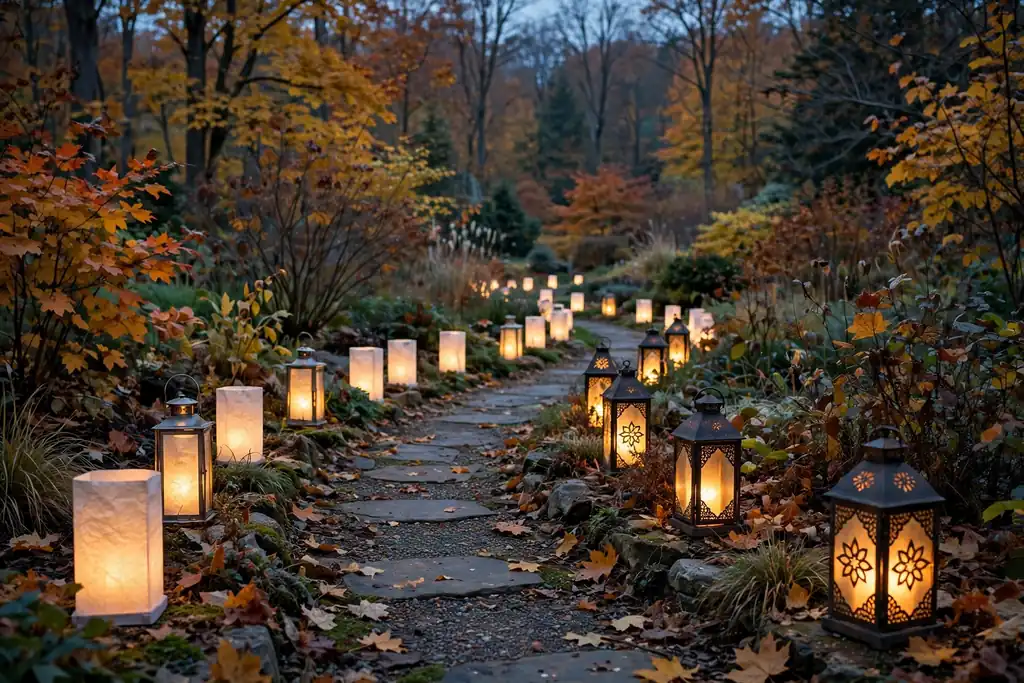
    Luminaries along a garden path guide evening walks and give the whole yard a calm glow. Set paper or metal luminaries in a line on either side of the path, spaced evenly, and use battery candles inside each one. Solar stake lights can mark the same path on nights when luminaries stay indoors.

    Keep luminaries clear of dry leaves and overhanging plants, and never use real flames inside paper luminaries. Bring them inside during rain and wind, and store them flat or nested so they last more than one season. A path lit this way pairs well with the fence lanterns in idea 10.

    20. Harvest Crates Stacked by the Side Gate

    Harvest crates stacked by a side gate with pumpkins.

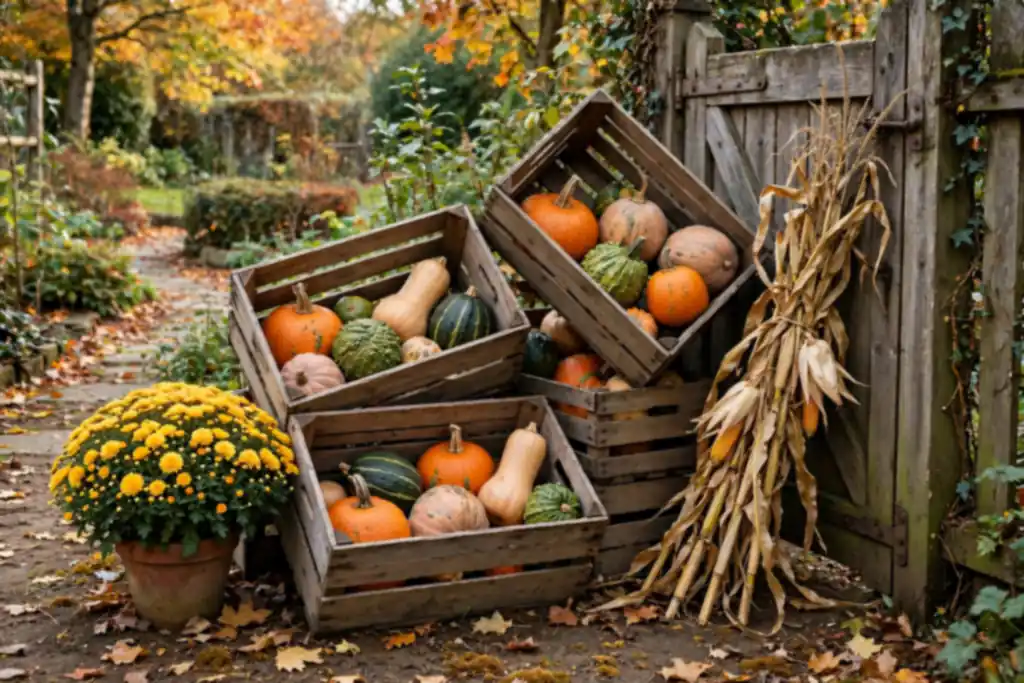
    Wooden crates stacked by a side gate make a simple harvest display in a spot guests often pass. Stack two crates at angles, set pumpkins and gourds inside the top crate, and place a potted mum beside the stack. A small bunch of dried corn or wheat leaning against the crates adds height.

    Secure the stack so it cannot topple onto the gate path, and keep the gate swing fully clear. Crates suit side yards and kitchen garden gates, where a rustic look fits the setting. Bring the crates under cover during long wet spells, since damp wood weakens and stains over time.

    21. Garden Shed Door Framed with a Wreath and Pumpkins

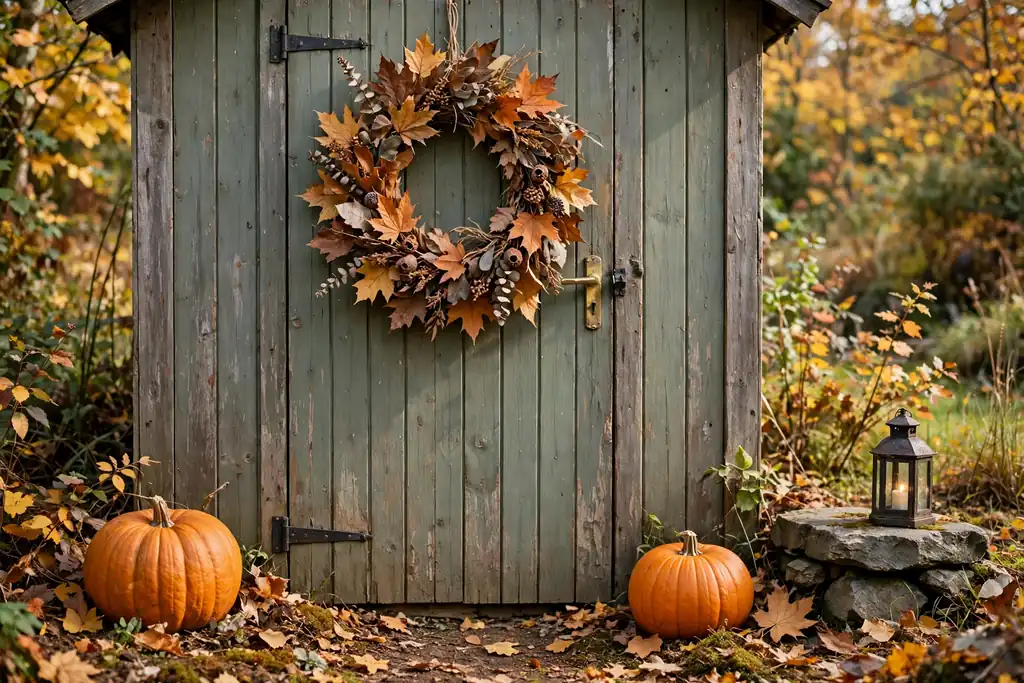
    Garden shed door framed with a fall wreath and pumpkins.

    A garden shed door can close the fall tour of the yard with a neat, simple display. Hang a wreath of dried leaves or grapevine on the door, set a pair of pumpkins on the ground on either side, and add a small lantern on a nearby stump or stone. Keep the door handle and hinges clear so the shed stays easy to open.

    Choose a wreath light enough for the shed door, and hang it from a removable hook rather than a nail. This idea works for tool sheds, potting sheds, and playhouses alike. At season end, store the wreath flat in a bag so its shape holds for next year.

    Conclusion

    Exterior decorating for fall works best as a slow walk around the house, not a single crowded display at one door. Pick one idea from the walkway, one from the patio or yard, and one from a side entry, then repeat the same two or three colors across all three. Keep paths clear, light the spots you use after dark, and choose plants and materials that can handle cool nights and rain. Done this way, the outside of your home feels seasonal from every angle, and the displays stay easy to care for through the whole season. Save the ideas you like best, and return to them next fall with the pieces that held up well this year.

    FAQs

    What is the easiest way to start exterior decorating for fall?

    Start with one walkway planter and one pumpkin cluster, since both take minutes to set out and show up at once. Add lanterns next, then spread to the patio or yard only after the first two spots look settled.

    How do I keep outdoor fall decor safe in rain and wind?

    Use heavy planters, stable lantern bases, and firm ties for cornstalks and garlands, and bring cushions, throws, and paper luminaries inside during storms. Check displays after the first windy day, and move any piece that shifted or tipped.

    Which plants last longest outside in fall?

    Mums, ornamental kale and cabbage, pansies, and asters last well in cool fall weather, since they tolerate light frost better than summer bedding plants. Water when the soil feels dry, trim spent blooms, and shelter pots from hard frosts to stretch their season further.

    How can I decorate a small yard or balcony for fall?

    Focus on containers, window boxes, and one lit corner, since small spaces suit a few strong pieces better than many small ones. A pair of planters, a lantern, and a small pumpkin cluster can carry the whole look without crowding the space.

    When should I put out and take down fall exterior decor?

    Put fall exterior decor out when nights turn cool and summer plants fade, often in early to mid fall, and take it down after the first hard frosts or before winter weather sets in. Pumpkins that soften should be removed at once, while hardy plants and lanterns can stay out longer.

    How do I light outdoor fall decor without running new wiring?

    Use battery candles in lanterns, solar stake lights along paths, and solar or battery string lights on decks and pergolas, since none of these need a new outlet. Place solar lights where they catch daylight, and keep spare batteries on hand for lanterns used every evening.


  • 25 Fall Front Porch Decor Ideas for a Welcoming Entrance

    25 Fall Front Porch Decor Ideas for a Welcoming Entrance

    Fall front porch decor means layering seasonal plants, pumpkins, warm light, and cozy textiles at your entrance so guests feel welcome the moment they arrive. Start with a wreath and layered mats, add mums and pumpkins in varied heights, then finish with lanterns and a bench or chair styled for autumn evenings.

    These 25 fall front porch decor ideas cover the whole entrance, from the steps and door frame to the railing, seating, and walkway. Each idea works on its own, and they combine well, so you can start with two or three touches and add more through the season. Pick a color thread, such as rust, mustard, and cream, and repeat it across pots, cushions, and pumpkins so the porch reads as one plan.

    Key Takeaways

    • Start at the door: a wreath, layered mats, and a pair of planters set the tone for the whole porch.
    • Vary heights across the porch, with tall corn stalks, mid height mums, and low pumpkins, so the display looks full from the street.
    • Repeat two or three fall colors, such as rust, mustard, and cream, across pots, textiles, and pumpkins.
    • Add warm light with lanterns or string lights, since porches are used most in the early evening in fall.
    • Keep the walkway and steps clear, with decor grouped to the sides, so guests can reach the door with ease.
    • Choose pieces that move indoors in bad weather, such as cushions, throws, and small lanterns, so the porch stays tidy all season.

    1. Pumpkins Lining the Porch Steps

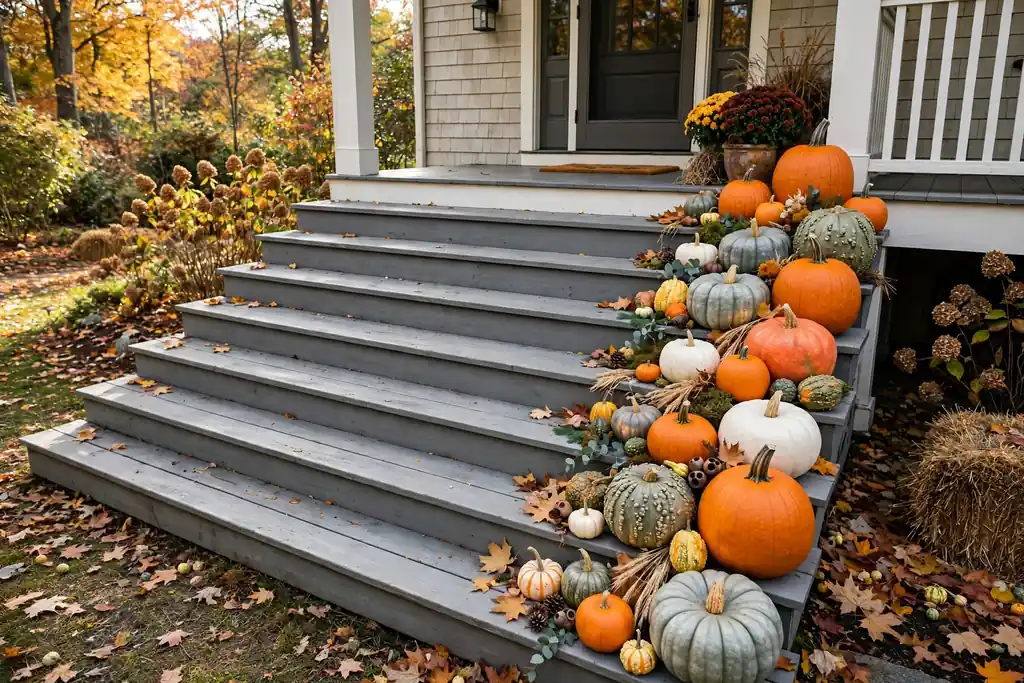
    Pumpkins in mixed sizes lining front porch steps.

    Pumpkins in mixed sizes along the porch steps are the simplest way to mark fall at the entrance. Place larger pumpkins at the bottom of the steps and smaller ones higher up, keeping one side of each step clear for safe footing. Mix orange, cream, and sage green pumpkins so the steps look gathered rather than matched.

    Set pumpkins on the flat part of each step, not on the edge, and push them back toward the wall or railing. If you have only a few steps, use three pumpkins on the ground at the base instead, with one larger pumpkin as an anchor. Real pumpkins last well in cool autumn air, and you can swap any that soften before a gathering.

    2. Corn Stalk Bundles Flanking the Door

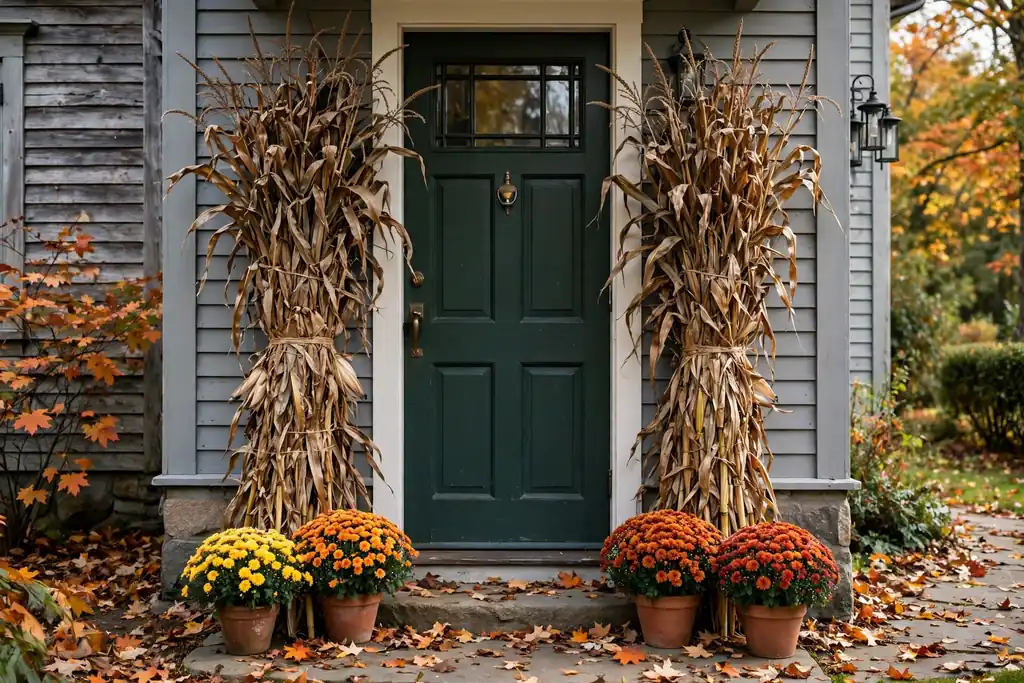
    Corn stalk bundles flanking a front door with mums at the base.

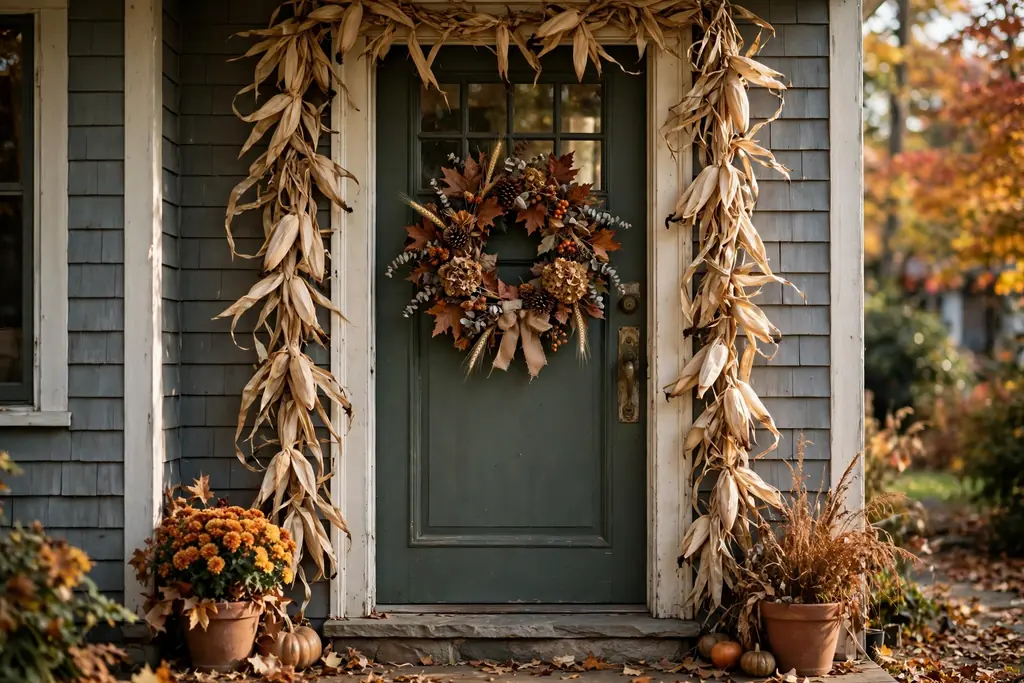
    Tall corn stalk bundles give the door instant height and a harvest feel. Tie two or three bundles to each side of the door frame or porch posts with twine, and let the dried leaves fall naturally. The vertical lines draw the eye up and make even a plain door look dressed for the season.

    Secure the bundles well, since autumn wind can topple loose stalks. Use a zip tie or wire behind the twine for a firm hold, and trim any stalks that block the doorbell or house number. Pair corn stalks with mums at their base to hide the tied ends and to add color at ground level.

    3. A Classic Fall Wreath on the Front Door

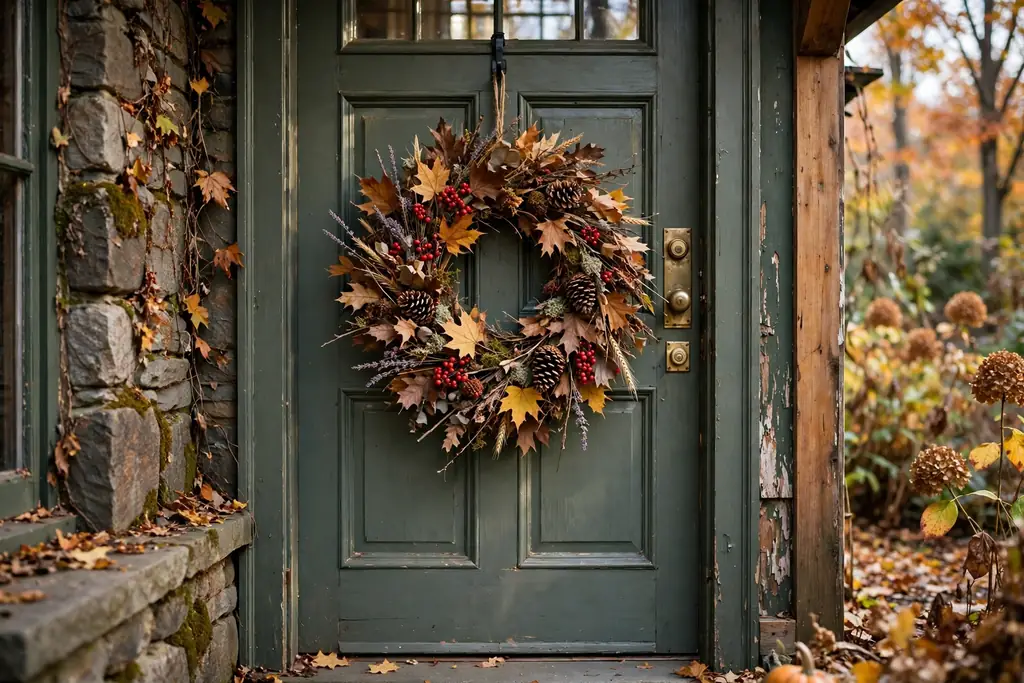
    Fall wreath with dried leaves and pinecones on a front door.

    A fall wreath is the single piece most guests notice first, so it earns its place at the center of the door. Choose a wreath with dried leaves, pinecones, and small berries in your porch color thread, and hang it at eye level. A full wreath suits a plain door, while a simpler wreath suits a door with glass panels or bold paint.

    Hang the wreath with a hook over the door or a small nail, and check that it clears the handle when the door swings. If your door faces strong sun, pick a wreath with fade resistant leaves, and bring it indoors during heavy rain to keep it looking fresh through the season.

    4. Layered Doormats at the Threshold

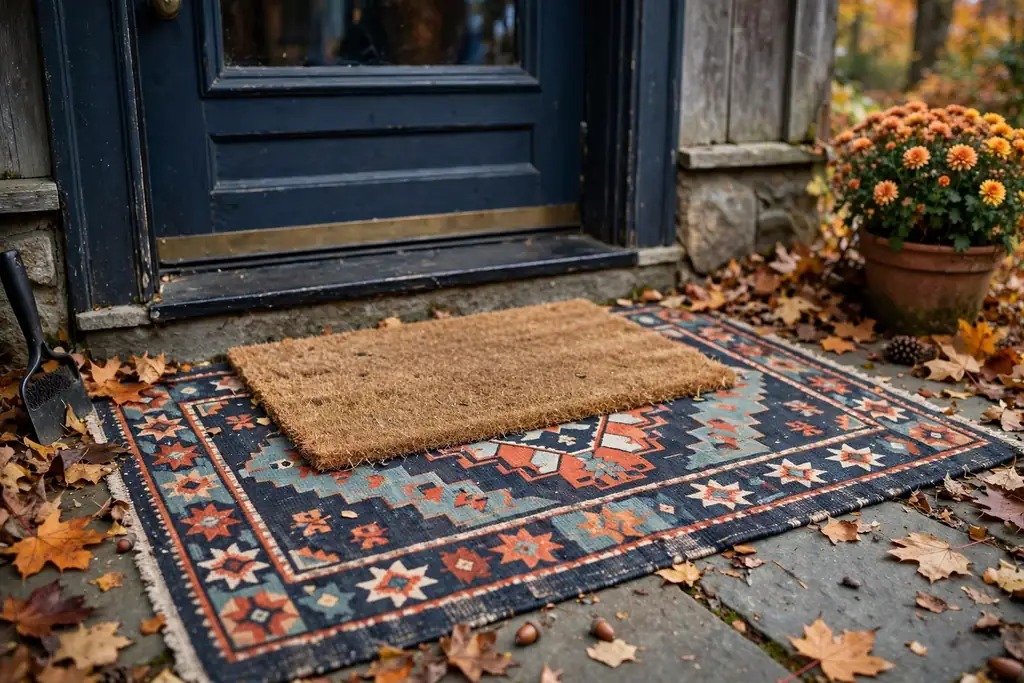
    Layered doormats at a front door threshold.

    Layering a larger patterned rug under a smaller coir doormat adds depth to the threshold in one step. Lay a flat outdoor rug in plaid, stripes, or a solid fall tone first, then center the coir mat on top, leaving an even border on all sides. The layers catch dirt and give the doorway a finished look.

    Keep both mats low and flat so the door opens freely over them. Shake them out weekly, and move them to a dry spot in heavy rain if they are not rated for outdoor use. A layered mat also lets you change the look fast: swap the top mat for a holiday version later in the season while the base rug stays put.

    5. Mums in Terracotta Pots by the Door

    Mums in terracotta pots beside a front door.

    Mums are the workhorse plant of fall porches, with dense blooms in rust, gold, and burgundy that last for weeks in cool weather. Place one large terracotta pot on each side of the door, or group three pots of varied heights on one side for a fuller display. Terracotta warms the look and suits both brick and painted porches.

    Water mums when the top of the soil feels dry, and deadhead spent blooms to keep new buds opening. If nights turn cold, move pots close to the house wall for shelter, or cover them with cloth overnight. Pair mums with trailing ivy or ornamental grass for a pot that looks planned rather than single note.

    6. A Wooden Crate Filled with Pumpkins and Gourds

    Wooden crate filled with pumpkins and gourds beside a front door.

    A wooden crate turns a pile of pumpkins into a tidy display. Set the crate beside the door or at the base of the steps, line it with straw or burlap, and fill it with small pumpkins, gourds, and a few pinecones. The crate contains the display, so it looks intentional even when the pieces are mixed shapes and colors.

    Choose a crate low enough that it does not block the view of the door, and keep it off the main walking path. At the end of the season, the crate can hold garden tools or firewood, so it earns its keep beyond fall. If rain is frequent, set the crate on small feet or a stone slab to keep the wood dry.

    7. Lanterns with Candles Along the Steps

    Lanterns with candles along front porch steps.

    Lanterns add warm light to the porch after dark, when guests most often arrive. Place one lantern on each step, or group three lanterns of varied heights at the base of the steps, with battery candles inside for safety. The glow softens the whole entrance and makes the house number and door easier to find.

    Use battery candles on porches where wind or children make real flames risky, and keep real candles inside glass with a stable base if you use them. Bring lanterns indoors in storms, and wipe the glass clean so the light stays bright. Black metal lanterns suit most house styles, while wood or brass lanterns warm a rustic porch.

    8. A Hay Bale as a Display Base

    Hay bale display with pumpkins and a lantern on a front porch.

    A single hay bale gives pumpkins and pots a raised stage at the side of the porch. Set the bale near the railing or beside the door, top it with a wood board for a flat surface, and arrange small pumpkins, a lantern, and a potted mum on top. The height change keeps the display from sitting flat on the ground.

    Keep the bale out of the walking path and away from open flames, since dry straw catches fire with ease. Cover the bale in heavy rain, or set it under the porch roof, to slow it breaking down. At the end of the season, the bale can go to garden beds as mulch, so nothing is wasted.

    9. A Plaid Throw on a Porch Rocking Chair

    Porch rocking chair with a plaid throw and cushion.

    A plaid throw draped over a rocking chair says the porch is a place to sit, not just to pass through. Fold the throw over the chair back or arm, in rust, cream, and brown plaid, and add one plain cushion in a matching tone. The textile softens wood and metal chairs alike and adds pattern without a new purchase.

    Choose a throw rated for outdoor use, or bring it indoors at night and in rain, so it stays fresh. If the chair is used daily, pick a washable throw and shake it out each week. A throw also lets you shift the porch palette fast: swap plaid for a solid rust throw when you want a calmer look.

    10. A Rustic Wood Welcome Sign by the Door

    Rustic wood welcome sign leaning beside a front door.

    A tall wood welcome sign leans beside the door and greets guests before they knock. Choose a sign in weathered wood with simple painted lettering, and lean it against the wall or porch post at a slight angle. It fills a narrow gap beside the door that pots alone cannot fill.

    Secure the sign so wind cannot topple it, with a small stake behind it or a heavy base pot at its foot. Keep the lettering simple and easy to read from the walkway, and avoid signs with long phrases that crowd the board. A plain welcome sign works from early fall through Thanksgiving, so it is one of the longest lived porch pieces.

    11. A Dried Corn Garland Around the Door Frame

    Dried corn garland around a front door frame.

    A garland of dried corn husks or leaves around the door frame adds texture above eye level. Drape the garland along the top of the frame and down one side, fixing it with small hooks so it does not pull on the paint. The natural tones frame the wreath and tie the door into the rest of the porch display.

    Keep the garland clear of the door swing and the handle, and check that it does not cover the house number or doorbell. Dried garlands last best under a porch roof, away from direct rain. If the garland sheds, shake it outdoors before hanging and trim loose pieces with scissors.

    12. A Basket of Apples Beside the Door

    Basket of apples beside a front door.

    A basket of apples brings harvest color and a useful touch to the porch. Fill a sturdy woven basket with red, green, and yellow apples, set it beside the door or on a bench, and let guests help themselves if you like. The basket doubles as decor and as a simple welcome for visitors.

    Keep the basket under cover so rain does not spoil the fruit, and check the apples every few days, removing any that soften. Line the basket with a cloth for a tidy look, and use a shallow basket so the apples sit in one visible layer. At the end of the week, bring the remaining apples indoors for cooking or eating.

    13. A Porch Bench Dressed with Fall Cushions

    Porch bench with fall cushions and a folded throw.

    A bench with fall cushions turns the porch into a sitting spot for autumn evenings. Place two or three outdoor cushions in rust, mustard, and cream on the bench, with a folded throw at one end. The cushions add color at sitting height, which balances the taller plants and stalks nearby.

    Pick cushions with removable, washable covers, since porch cushions gather dust and pollen. Store them in a dry box overnight in wet weather, or choose quick dry foam fills if the bench sits outside the roof line. Keep one end of the bench clear so bags and parcels have a place to sit.

    14. A Simple Scarecrow Figure in the Corner

    Small scarecrow seated on a hay bale in a porch corner.

    A small scarecrow in a porch corner adds a playful harvest note without taking over the display. Dress a simple figure in a plaid shirt, straw hat, and jeans, and seat it on a hay bale or lean it against the railing. Keep the figure modest in size, so it reads as decor rather than a costume on display.

    Place the scarecrow where it does not block the walkway or startle guests at night, and bring it indoors in heavy rain to keep the stuffing dry. If you have small children visiting, a friendly face and soft materials work better than a tall, dark figure. Pair the scarecrow with pumpkins at its feet to ground it in the scene.

    15. Warm String Lights Overhead

    Warm string lights over a fall decorated front porch.

    String lights overhead give the porch a gentle glow that flatters every other piece on display. Drape warm white lights along the porch ceiling edge, around posts, or across the roof beam, with the cord tucked out of the walking path. The light makes the porch usable after sunset and highlights the wreath and pumpkins.

    Choose outdoor rated lights and a timer so they switch on at dusk without daily effort. Keep bulbs clear of dried leaves, garlands, and fabric, and check the cord each season for wear. Warm white suits fall better than cool white, since it echoes candlelight and keeps the porch feeling calm.

    16. A Pumpkin Topiary in an Urn

    Pumpkin topiary stacked in an urn beside a front door.

    A pumpkin topiary stacks pumpkins in an urn for a formal look at the door. Choose three pumpkins that decrease in size from bottom to top, set the largest in the urn, and stack the rest with a dowel through the center for stability. The vertical stack suits narrow porches where a wide display would block the path.

    Use lighter faux pumpkins for the top tiers if real pumpkins feel heavy or unstable, and keep the urn base wide so wind cannot tip it. Place one topiary on each side of the door for symmetry, or a single topiary beside a bench for a quieter look. Tuck moss or leaves around the base pumpkin to hide the urn rim.

    17. A Fall Leaf Garland on the Porch Railing

    Fall leaf garland along a porch railing.

    A leaf garland along the porch railing adds fall color at hand height and frames the seating area. Drape faux or dried leaves along the top rail, letting a few leaves hang over the front, and fix the garland with twine at intervals. The garland ties the railing into the door display and softens plain wood or metal rails.

    Keep the garland light so it does not sag or shade the steps, and keep it clear of handrails guests grip for support. If you use dried leaves, expect some shedding and sweep the porch floor weekly. A leaf garland pairs well with string lights woven through it for evening glow.

    18. A Galvanized Bucket with Dried Stems and Wheat

    Galvanized bucket with dried wheat on a front porch.

    A galvanized bucket filled with dried wheat, grasses, or branches adds a tall, natural accent to a porch corner. Set the bucket beside the door or bench, fill it with a bundle of stems tied at the base, and let the stems fan out above the rim. The metal bucket contrasts with wood and terracotta nearby.

    Weigh the bucket down with stones at the base so wind cannot tip the tall stems. Trim stems to a height that clears the porch roof and does not block windows. If the bucket sits in rain, drill a small drain hole or tip it out after storms so stems do not sit in standing water.

    19. An Asymmetric Harvest Swag on the Door

    Harvest swag hanging on a front door.

    A harvest swag offers a looser option than a round wreath for the door. Gather dried leaves, berries, wheat, and a small pumpkin pick into a teardrop bundle, tie it at the top, and hang it slightly off center on the door. The asymmetric shape suits modern doors and narrow porches where a full wreath feels heavy.

    Hang the swag with a hook that holds its weight, and check that it does not swing into the handle. Keep the swag to one side of any glass panel so light still passes through the door. A swag is easy to refresh: swap one stem or berry pick as the season moves on, without remaking the whole piece.

    20. A Wooden Ladder Display with Throws and Pumpkins

    Wooden ladder display with a throw and pumpkins on a porch.

    A leaning wooden ladder gives the porch a vertical display in a narrow space. Lean the ladder against the wall near the seating area, drape a throw over one rung, hang a small wreath from another, and set small pumpkins on the bottom rungs or at the base. The ladder adds height without a new piece of furniture.

    Secure the ladder at the top so it cannot slip, and keep it out of the main walking path. Use a ladder with wide, flat rungs for stable display, and avoid hanging heavy items high up. At the end of the season, the ladder folds away for storage, which suits small porches.

    21. A Chalkboard Sign with a Seasonal Greeting

    Chalkboard sign with a fall greeting near a front door.

    A chalkboard sign by the door lets you change the greeting through the season with chalk alone. Write a short greeting, such as “Welcome” or “Happy Fall”, in large letters, and set the sign on an easel or lean it against the wall near the door. The sign adds a personal note that printed signs cannot match.

    Use chalk markers for rain resistant lettering, and keep the sign under cover so the writing stays clear. Rewrite the greeting for gatherings or for Thanksgiving to keep the porch feeling current. If chalk dust is a worry near the door, seal the finished writing with a light spray made for chalk art.

    22. Potted Ornamental Cabbage and Kale

    Potted ornamental cabbage and kale on a front porch.

    Ornamental cabbage and kale bring rich purple, green, and cream rosettes to porch pots in cool weather. Plant one rosette per pot, or mix them with mums for contrast, and place the pots where they get morning light. These plants hold their color well into late fall, after many flowers fade.

    Water when the soil feels dry, and remove yellowed outer leaves to keep the rosettes tidy. Ornamental cabbage and kale suit terracotta, stone, and galvanized pots alike, and they pair well with pumpkins at the pot base. They are grown for looks, so keep them as decor rather than for eating.

    23. A Bowl of Pinecones and Acorns on a Side Table

    Bowl of pinecones and acorns on a porch side table.

    A bowl of pinecones and acorns on a porch side table adds a small, natural detail guests notice up close. Fill a wood or ceramic bowl with mixed pinecones, acorns, and a few dried leaves, and set it beside a chair or bench. The bowl fills a table that would otherwise sit bare and echoes the larger harvest displays nearby.

    Keep the bowl under cover so rain does not soak the pinecones, and check it weekly for debris. If children visit, use larger pinecones that cannot be picked up as small toys. Swap the bowl filling for cinnamon sticks or dried orange slices later in the season for a fresh scent and look.

    24. A Large Fall Toned Rug Under the Seating Area

    Large fall toned rug under porch seating.

    A large outdoor rug under the seating area anchors the porch furniture and defines the sitting zone. Choose a rug in rust, brown, or a muted pattern that repeats your porch color thread, and lay it flat under the bench or chairs with an even border. The rug softens hard porch floors and makes the seating area feel like a room.

    Pick a rug rated for outdoor use, with a low pile that dries fast after rain, and sweep or hose it clean as needed. Keep the rug clear of the walkway to the door so guests do not trip on its edge. A rug also lets you shift the porch palette with one change, without replacing cushions or pots.

    25. A Porch Swing Dressed with Fall Pillows and a Throw

    Porch swing with fall pillows and a throw.

    A porch swing dressed for fall invites guests to linger, which is the point of a welcoming entrance. Add two outdoor pillows in rust and cream, drape a throw over one arm, and set a small lantern or pumpkin at the base of the swing frame. The swing becomes the porch focal point, with the door display as its backdrop.

    Use outdoor pillows with washable covers, and bring the throw indoors in rain. Check the swing chains and hooks each season for wear, and keep the swing path clear of pots and lanterns so it moves freely. A dressed swing pairs well with string lights overhead for evenings spent outdoors.
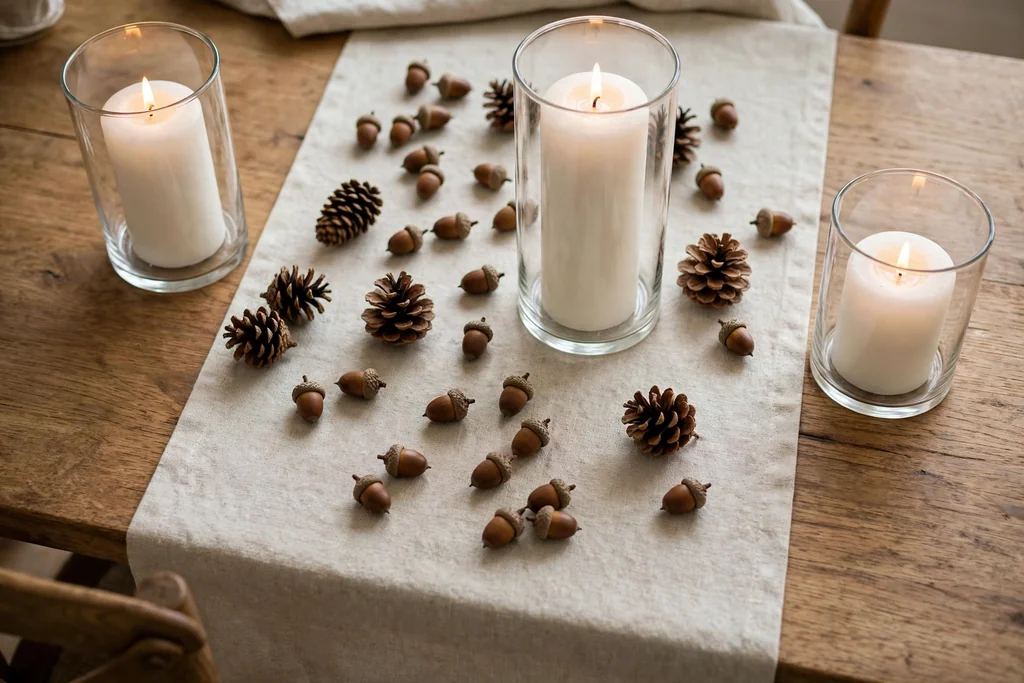
    Conclusion

    Fall front porch decor works best when you layer a few strong pieces rather than filling every inch of the porch. Start with the door, add plants and pumpkins at varied heights, bring in warm light, and finish with one comfortable seat. That order keeps the entrance welcoming, safe to walk through, and easy to refresh as the season moves on.

    For more seasonal styling inside the house, browse the ideas on Dwell Ovell. Keep the porch palette to two or three colors, store cushions and throws in dry weather, and swap a few pieces at Thanksgiving to carry the display into the next holiday without starting over.

    FAQs

    What is the easiest fall front porch decor idea?

    The easiest fall front porch decor idea is a wreath on the door with layered mats at the threshold, since those two pieces change the entrance in minutes. Add a pair of potted mums beside the door, and the porch reads as dressed for fall without any building or heavy lifting.

    How many pumpkins should I put on a front porch?

    Put five to nine pumpkins on a front porch for a full look, grouped in odd numbers at varied heights, with larger pumpkins at the base and smaller ones higher up. Fewer pumpkins suit a small porch, while a large porch can hold a dozen or more if they stay clear of the walkway and steps.

    How do I decorate a small front porch for fall?

    Decorate a small front porch for fall with vertical pieces, such as a wreath, a tall welcome sign, and a pumpkin topiary, rather than wide displays that block the path. Use one pot of mums, layered mats, and a single lantern, and keep the walking line to the door fully clear.

    When should I put up fall front porch decor?

    Put up fall front porch decor in early fall, when mums and pumpkins first appear in shops and markets, and keep it up through Thanksgiving if you like. Start with the wreath and mats, add plants and pumpkins as the weather cools, and swap a few pieces for Thanksgiving rather than redoing the whole porch.

    How do I keep fall porch decor safe in wind and rain?

    Keep fall porch decor safe in wind and rain by securing tall pieces, such as corn stalks and ladders, weighing down buckets and urns, and bringing cushions, throws, and small lanterns indoors in storms. Use battery candles instead of real flames, and set wood crates and hay bales under cover or on raised feet.

    What colors work best for fall front porch decor?

    Rust, mustard, cream, and warm wood brown work best for fall front porch decor, since they echo harvest colors and suit most house exteriors. Pick two or three of these colors and repeat them across pots, cushions, pumpkins, and mats, so the porch reads as one planned display rather than a set of unrelated pieces.

  • 19 Fall Kitchen Decor Ideas for Counters, Shelves, and Tables

    19 Fall Kitchen Decor Ideas for Counters, Shelves, and Tables

    Fall kitchen decor works best when you style the surfaces you already use: counters, open shelves, and the table. Add pumpkins and gourds, warm wood, amber glass, plaid linen, and dried leaves in small groups, keep one work area clear, and repeat two or three fall colors through the room for a seasonal look that still cooks well.

    These 19 fall kitchen decor ideas focus on counters, shelves, and tables, the three spots where seasonal styling shows up most. Each idea uses items you can move, swap, or store with ease, so the kitchen can shift from early fall to Thanksgiving without a full redo. Start with one surface, step back, and add more only where the room still looks bare.

    Key Takeaways

    • Style counters, shelves, and the table first, since those are the surfaces guests and family see most in a kitchen.
    • Repeat two or three fall colors, such as rust, mustard, and warm wood brown, so separate displays read as one plan.
    • Keep at least one clear work area on the counter for prep, even when the rest of the kitchen is dressed for fall.
    • Group items in odd numbers and at varied heights, which looks more natural than a single row of same-size pieces.
    • Choose items you can move in seconds, such as trays, bowls, and small pumpkins, so cooking and cleaning stay easy.
    • Store fall pieces in one labeled box at the end of the season, so next year starts with a quick setup, not a search.

    1. Mini Pumpkin Cluster on the Island

    Mini pumpkins and gourds clustered at the end of a kitchen island.

    A small cluster of mini pumpkins and gourds is the fastest way to mark the season on a kitchen island. Choose five to seven pieces in mixed shapes and colors, such as cream, orange, and sage green, and set them in a loose group near one end of the island, away from the main prep zone.

    Leave the center of the island clear for chopping and serving. If the island is small, use three pumpkins only, and add a sprig of dried leaves or a small wood slice under the group to ground it. Swap a few pieces as the season moves on, and remove the cluster at mealtimes if the table needs the extra room.

    2. Wooden Dough Bowl Centerpiece for the Table

    Wooden dough bowl filled with pinecones, dried leaves, and small pumpkins on a table.

    A long wooden dough bowl makes a calm, useful centerpiece for a kitchen table. Fill it with pinecones, dried leaves, and two or three small pumpkins, and let the wood tone set the color plan for the rest of the table.

    Keep the filling low so people can see across the table while they talk. A dough bowl also works as a serving piece in a pinch: lift out the filling, wipe the bowl, and use it for bread or rolls at dinner. When the meal is over, return the fall filling so the table stays dressed between meals.

    3. Amber Glass Jars and Bottles on Open Shelves

    Amber glass jars and bottles on open kitchen shelves beside white dishes.

    Amber glass brings warm fall color to open shelves without adding clutter. Place two or three amber jars or bottles on a shelf beside white dishes or wood bowls, and let the glass catch light from the window or under cabinet lighting.

    Use the jars for dry goods, such as dried beans or pasta, or leave them empty as simple color accents. Keep the shelf grouping loose, with space between items, so the amber reads as a warm accent rather than a crowded collection. If you love this look, see these white kitchen ideas for shelf styling that keeps pale cabinets calm beside warm accents.

    4. Copper Mugs and a Kettle on the Counter

    Copper mugs and a kettle arranged on a kitchen counter.

    Copper adds a warm metal note that suits fall cooking, from hot drinks to soups and stews. Hang copper mugs from a small rail or stand them on a tray beside the kettle, near the stove or coffee station, so they are easy to reach and pleasant to look at.

    Keep the group to three or four mugs, and polish them only as often as you like the shine; a softer, aged finish also suits a rustic fall kitchen. If counter space is tight, hang the mugs on hooks under a shelf and keep only the kettle on the counter. Wipe copper dry after use to avoid water marks.

    5. Plaid Runner and Dried Stems on the Dining Table

    Dining table with a plaid runner and dried stems in a low vase.

    A plaid runner in rust, cream, and brown sets a fall table in one step, and it works over wood, painted, or stone tables alike. Lay the runner down the center, then add a low vase of dried stems, such as wheat or dried grasses, so the table feels seasonal without blocking conversation.

    Choose a runner that can be washed, since kitchen tables see spills, and keep the centerpiece low and narrow. For everyday meals, the runner alone is enough; add candles or small pumpkins at the ends only for a gathering. Fold the runner away between seasons, or swap it for a plain linen runner in spring.

    6. Tiered Tray for a Counter Corner

    Two tier tray with small pumpkins and a candle in a kitchen counter corner.

    A two tier tray turns an empty counter corner into a small fall display without spreading items across the work surface. Place small pumpkins, a tiny wood sign, a candle, and a sprig of leaves across the two tiers, and keep the tray near a wall or beside the sink, out of the prep path.

    A tiered tray is easy to refresh: swap the candle scent or the small accents as fall moves toward Thanksgiving, and lift the whole tray away when you need the counter back. Choose a wood or metal tray that matches your kitchen hardware, and keep the tallest item short enough to sit under upper cabinets.

    7. Dried Orange Slice Garland Above the Window

    Dried orange slice garland draped above a kitchen window.

    A garland of dried orange slices adds warm color and a soft citrus note above a kitchen window or along a shelf. String the slices on twine with small wood beads, and hang the garland so it drapes gently, with the ends secured by small hooks or clear tape.

    Dried orange slices suit kitchens with wood, cream, or sage cabinets, and they pair well with a simple linen curtain or a bare window. Keep the garland clear of the stove and any open flame, and store it flat in tissue at the end of the season so the slices stay whole for next year.

    8. Framed Fall Print Leaning on a Backsplash Shelf

    Framed fall leaf print leaning on a kitchen backsplash shelf.

    A single framed print with fall leaves, pumpkins, or a harvest scene brings seasonal art to a kitchen without a nail in the wall. Lean the frame on a backsplash shelf or against the wall at the back of the counter, beside a cutting board or a small plant.

    Choose a frame in wood or black that matches other kitchen details, and keep the print simple so it reads clearly from across the room. Swap the print with the seasons, and use the same frame all year, which keeps the cost low and the counter plan steady. Keep the frame clear of the sink splash zone and direct stove steam.

    9. Cinnamon Sticks, Candles, and a Wood Board by the Stove

    Wood board with a candle and cinnamon stick bundles beside a kitchen stove.

    A small wood board beside the stove can hold a candle, a bundle of cinnamon sticks tied with twine, and a tiny dish, giving the cooking zone a fall scent and look. Keep the board to one side of the stove, not behind it, so nothing sits in the path of heat or steam.

    Never leave a lit candle unattended, and keep cinnamon bundles and cloth away from burners. This display works best in a kitchen where the stove wall has a little spare counter, and it pairs well with a wood spoon jar or a small herb pot. Move the board away when you cook a large meal, and return it after the stove cools.

    10. Wooden Crate of Apples on the Table

    Wooden crate filled with red, green, and yellow apples on a table.

    A small wooden crate filled with apples makes a harvest centerpiece that doubles as a fruit bowl. Set the crate in the middle of the kitchen table, line it with a linen cloth, and fill it with red, green, and yellow apples for natural color and varied shape.

    Keep the crate low and narrow enough that it does not block the view across the table, and eat from it through the week, topping it up as needed. This idea suits a farmhouse or rustic kitchen, and it works just as well on an island for a family that grabs fruit on the way out. Wipe the crate clean before refilling it.

    11. Wheat Bundle in a Tall Vase at the Counter End

    Tall vase with dried wheat standing at the end of a kitchen counter.

    A bundle of dried wheat in a tall vase adds height at the end of a counter or on a side table, where a low display would get lost. Choose a plain vase in glass, ceramic, or stoneware, and trim the wheat so it stands a little above eye level when you sit at the table, but below upper cabinets.

    Wheat suits neutral kitchens, since its gold tone warms cream, grey, and wood surfaces alike. Keep the vase away from the stove and sink, and dust the wheat gently with a dry cloth. If wheat feels too tall for your counter, use a shorter bundle in a wide jar instead, with the same gold color at a lower height.

    12. Rust Napkins and Wooden Chargers for Everyday Table Settings

    Table setting with rust linen napkins, wooden chargers, and cream plates.

    Rust colored linen napkins and wooden chargers dress a table for fall without changing a single dish. Set a charger at each place, add a white or cream plate on top, and fold a rust napkin beside the plate or on top of it, with simple flatware.

    This setting works for everyday dinners as well as weekend gatherings, and it lets the table look seasonal even when no centerpiece is out. Choose napkins that wash well, and keep the chargers for the table only, not for serving food directly. Add a small sprig of dried leaves on each plate for a gathering, and remove it before eating.
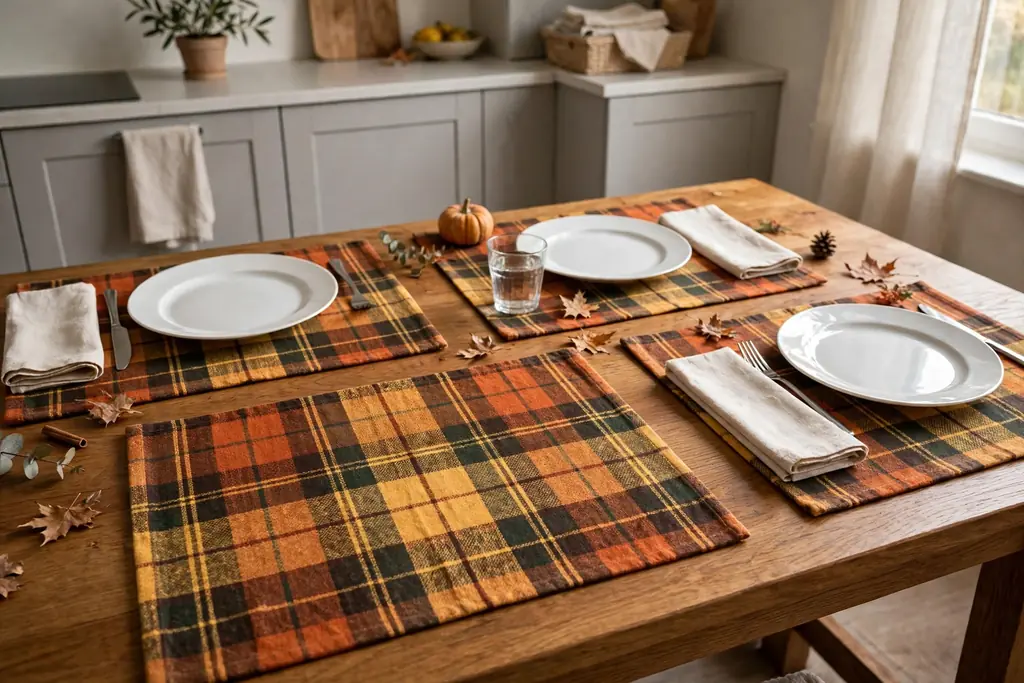
    13. Leaf Garland Along the Top of Open Shelves

    Fall leaf garland draped along the top of open kitchen shelves.

    A leaf garland along the top edge of open shelves frames the shelf display with fall color. Drape faux or dried leaves along the shelf top, letting a few leaves hang over the front edge, and keep the garland light so it does not shade the dishes below.

    This idea works best on one or two shelves, not every shelf in the room, so the leaves read as an accent rather than a cover. Pair the garland with plain white dishes and wood bowls, and remove it before dusting the shelf tops. If you use dried leaves, keep them clear of heat sources and replace any that crumble.

    14. Cutting Board Display with Fall Produce on the Counter

    Wood cutting board leaning on a backsplash beside a bowl of fall produce.

    Leaning a wood cutting board against the backsplash, with a small bowl of fall produce beside it, makes a working display. Choose a board with a warm grain, add squash, onions, or apples in a low bowl, and keep the group near the prep area so it is useful as well as decorative.
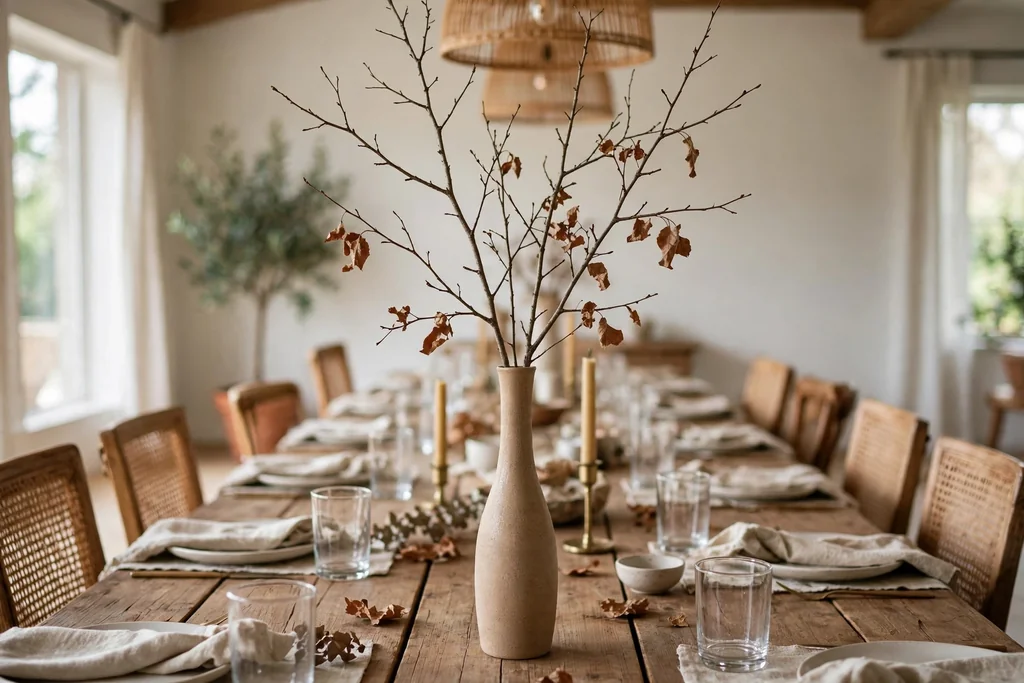
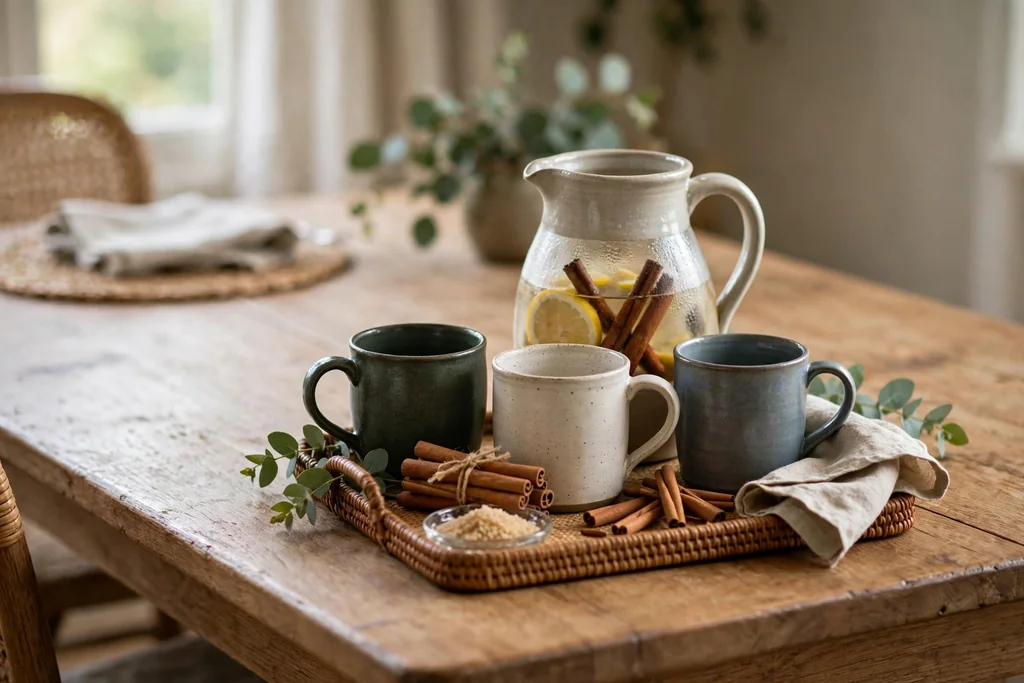
    This idea suits cooks who like the kitchen to look ready for a meal, and it avoids purely decorative pieces that must be moved before cooking. Keep the produce fresh, rotating it into meals through the week, and wash the board after use. When the board is needed, lift it down, cook, and set the display back up after.

    15. Glass Hurricanes with Candles and Fall Leaves

    Glass hurricanes with pillar candles and fall leaves on a table.

    Glass hurricane shades with pillar candles and a ring of fall leaves give a table or counter a soft evening glow. Place a few leaves or small pinecones inside the base of each hurricane, set a pillar candle in the center, and group two or three hurricanes at varied heights.

    Use battery candles if you have children or pets, or if the display sits near curtains or paper. Keep real flames away from leaves and cloth, and never leave them burning unattended. This idea works well for a dinner table centerpiece, a sideboard, or a window sill where the glow shows in the evening.

    16. Small Wreath on a Cabinet or Pantry Door

    Small fall wreath with dried leaves hanging on a pantry door.

    A small wreath on a cabinet or pantry door adds fall color at eye level without taking counter space. Choose a wreath of dried leaves, berries, or wheat, sized to fit one door, and hang it from a small hook or a ribbon looped over the top of the door.

    Keep the wreath flat enough that the door still opens and closes with ease, and avoid heavy wreaths that pull on the door. This idea suits a pantry door, a tall cabinet, or the inside of a kitchen door, and it pairs well with a matching wreath on the front door. Take the wreath down before cleaning the door front.

    17. Wooden Spice Rack Restyled for Fall Cooking

    Wooden spice rack with labeled jars of fall baking spices near a stove.

    A wooden spice rack restyled for fall puts the season’s cooking spices where you can see and reach them. Group cinnamon, nutmeg, cloves, ginger, and pumpkin pie spice in matching jars on a small rack or tray near the stove, and label each jar clearly.

    This display is practical first: it shortens the search for spices during baking and soup season, and it adds warm wood and glass to the counter. Keep the rack away from direct stove heat and steam, and check spice dates at the start of the season so stale jars are replaced. Return everyday spices to the rack after cooking, so the display stays tidy.

    18. Rust and Plaid Cushions in the Breakfast Nook

    Breakfast nook bench with rust and plaid cushions beside a wood table.

    Rust and plaid cushions give a breakfast nook a fall feel with a change you can feel as well as see. Add one or two cushions in rust, mustard, or plaid to the bench or chairs, and pair them with a folded throw over the bench end for chilly mornings.

    Choose cushion covers that can be washed, since a nook sees daily use, and keep the cushion count low so the bench stays easy to sit on. This idea works well with a wood table and a simple vase of dried stems, and the cushions can move to the living room or porch when the nook needs a change. Store summer covers in the same box as other fall pieces.

    19. Fall Baking Station with a Cookie Jar and Mixing Bowls

    Kitchen baking station with a glass cookie jar, mixing bowls, and a small pumpkin.

    A fall baking station gathers cookie jars, mixing bowls, and baking tools in one counter zone, ready for weekend baking. Place a glass cookie jar, a stack of mixing bowls, and a small tray of baking tools near the oven, and add a tiny pumpkin or a sprig of leaves as the only decorative extra.

    Keep the station to one short run of counter, so the rest of the kitchen stays clear for everyday cooking. This idea suits families who bake often in fall, and it saves time, since bowls and tools are already out when a recipe starts. Wipe the zone after baking, and refill the cookie jar only when it is clean and dry.

    Conclusion

    Fall kitchen decor does not need a large budget or a full room redo. The ideas here work because they focus on counters, shelves, and tables, use a small set of fall colors and natural materials, and leave room for real cooking. Pick the one or two ideas that fit your kitchen first, live with them for a week, and then add more only where the room still feels bare. That slow, surface by surface approach keeps the kitchen warm for the season and easy to use every day.

    FAQs

    What is the easiest fall kitchen decor idea for counters?

    A mini pumpkin cluster is the easiest fall kitchen decor idea for counters, since it needs only a few small pumpkins and a clear corner of the island or counter. Group five to seven pieces in mixed colors, keep the main work area clear, and move the cluster aside when you need the space for cooking or serving.

    How do I decorate open shelves for fall without clutter?

    Decorate open shelves for fall by adding one warm accent per shelf, such as amber glass, a small pumpkin, or a sprig of dried leaves, and leaving space between items. Keep everyday dishes as the base of the display, limit each shelf to one fall accent group, and remove anything that blocks the dishes you reach for daily.

    What colors work best for fall kitchen decor?

    Rust, mustard, warm wood brown, cream, and sage green work best for fall kitchen decor, since they echo harvest colors without overwhelming a kitchen. Pick two or three of these colors and repeat them across counters, shelves, and the table, so separate displays read as one seasonal plan rather than a set of unrelated pieces.

    How can I decorate a small kitchen for fall?

    Decorate a small kitchen for fall with one or two small displays, such as a tiered tray in a counter corner and a small wreath on a cabinet door, rather than styling every surface. Choose items that move in seconds, keep the main prep area clear, and use vertical spots, such as shelf tops and doors, so floor and counter space stay open.

    When should I put up fall kitchen decor?

    Put up fall kitchen decor in early fall, when pumpkins and harvest produce first appear in shops and markets, and keep it up through Thanksgiving if you like. Start with one surface, such as the table or island, and add more as the season moves on, then store the pieces together at the end of the season for a quick setup next year.

    How do I keep fall kitchen decor practical for cooking?

    Keep fall kitchen decor practical by styling only the surfaces you do not need for prep, using trays and bowls that lift away in one move, and keeping one counter run fully clear. Choose displays that double as useful items, such as a fruit crate, a spice rack, or a cutting board display, so the decor earns its counter space every day.

  • 17 Coastal Fall Decor Ideas in Soft Seasonal Colors

    17 Coastal Fall Decor Ideas in Soft Seasonal Colors

    Coastal fall decor pairs a light beach house base with soft autumn color. Keep white walls, sand linen, pale wood, and sea glass, then add muted rust, sage, dusty blue, and warm cream in small doses. White pumpkins, driftwood, woven baskets, and cozy layers bring fall warmth without losing the calm, airy coastal feel.

    Use the ideas below as a room by room checklist. Start with the palette, then add one seasonal display, one textile layer, and one natural texture. That order keeps the look soft rather than crowded. Keep most pieces in white, sand, pale blue, and driftwood gray, and let muted rust and sage act as accents. When a display starts to feel busy, remove one item before adding another.

    Key Takeaways

    • Keep two thirds of the room in a light coastal base: white, sand, pale wood, and sea glass tones.
    • Use muted rust, sage, and dusty blue as accents, not as the main color story.
    • Choose white, cream, and pale green pumpkins over bright orange for a softer coastal fall look.
    • Repeat natural textures such as driftwood, rattan, linen, and woven seagrass through the home.
    • Add fall warmth in layers: one display, one textile change, and one natural element per room.
    • Edit often. A calm coastal room usually needs fewer seasonal pieces, placed with space around them.

    1. White and Cream Pumpkins on a Driftwood Tray

    White and cream pumpkins arranged on a driftwood tray on a coastal coffee table.

    Place white and cream pumpkins of different sizes on a long driftwood tray on the coffee table. Add a small pile of pinecones at one end and a short candle in a clear glass holder at the other. The tray keeps the display contained, so the coffee table still has room for books and cups.

    Choose pumpkins with smooth skin and soft, even color. Mix one large pumpkin with two or three smaller ones rather than lining up many pieces in a row. If the tray looks flat, raise one pumpkin on a small stack of books or a short wooden riser. Keep the rest of the table clear so the tray reads as one calm display.

    2. Rust and Sea Glass Pillows on a Slipcovered Sofa

    Slipcovered sofa styled with muted rust, sea glass, and cream pillows for fall.

    Swap two or three summer pillows for a mix of muted rust, sea glass green, and warm cream covers. Keep the sofa slipcover light and let the pillows carry the season. A rust pillow adds warmth, while sea glass and cream keep the mix from feeling heavy.

    Use different textures rather than matching sets. Try one linen pillow, one knit pillow, and one with a subtle stripe or woven pattern. Place the darkest pillow near a corner and the lightest pillow toward the center, so the eye moves across the sofa. Store the summer covers together so the swap is easy to reverse.

    3. Driftwood and Dried Grass on the Mantel

    Coastal fall mantel with driftwood, dried grass, white pumpkins, and candles.

    Lay a long piece of driftwood along the mantel, then add tall dried grass stems in a low vase at one end. Add two white pumpkins and one short candle holder to balance the other end. The driftwood gives the mantel a coastal line, while the dried stems add fall height without bright color.

    Keep the mantel display low in the center so it does not block a mirror or art above it. If the mantel is narrow, use a shorter piece of driftwood and a single small vase. Check that candles sit away from dried stems and fabric, and use battery candles if the mantel is near curtains or dried material.

    4. Sand Linen Runner and a Shell and Candle Centerpiece

    Dining table with a sand linen runner and a coastal fall centerpiece of pumpkins and shells.

    Dress the dining table with a sand colored linen runner, then build a low centerpiece down the middle. Use a shallow wooden bowl or tray, white pumpkins, a few shells, and candles in glass holders. The runner softens the table, while the low centerpiece keeps conversation easy across the table.

    Leave room for plates and serving dishes by keeping the centerpiece narrow. Use odd numbers for the pumpkins, such as one large and two small, and repeat the shell color in one other place on the table, such as a napkin ring or a small dish. After a meal, the tray lifts off in one piece, which makes cleanup simple.

    5. Seagrass Baskets Filled with Pinecones and Small Pumpkins

    Seagrass basket filled with pinecones, small white pumpkins, and a rolled linen throw.

    Set a large seagrass basket beside the sofa or near the fireplace and fill it with pinecones, small white pumpkins, and a rolled linen throw. The basket adds woven texture and gives fall items a clear home, so they do not spread across every surface.

    Choose a basket that fits the corner without blocking a walkway. Place larger pinecones at the bottom and smaller pumpkins near the top so the fill looks natural. If the basket will hold a throw, keep the pumpkins to one side so the throw stays easy to reach on a cool evening.

    6. Pale Blue and Sage Wreath for the Front Door

    Front door decorated with a pale blue and sage eucalyptus wreath for fall.

    Hang a wreath made with dried eucalyptus, pale sage leaves, and a few small white pumpkins or cream berries on the front door. The soft blue green tones read as coastal, while the dried leaves and small pumpkins mark the season. A simple linen bow in sand or cream finishes the wreath without adding bright color.

    Hang the wreath at eye level and check it from the street, not only from inside. If the door gets strong sun or rain, choose a sheltered spot or a wreath made with sturdy dried stems that can handle weather. Swap the bow each season to reuse the same wreath base in a new color.

    7. Layered Knit and Linen Throws on the Sofa

    Coastal sofa layered with a cream knit throw and a light linen throw for fall.

    Drape a chunky knit throw in cream over one sofa arm and fold a lighter linen throw across the back. The knit layer adds warmth for cool evenings, while the linen layer keeps the sofa from looking heavy. Together they give a coastal living room a soft fall feel without changing the furniture.

    Keep throws in the same pale family, such as cream, oatmeal, and soft gray, and let one muted rust cushion nearby provide the only strong accent. Fold throws neatly rather than bunching them, so the sofa still looks inviting. Wash or air throws before storing them, so they stay fresh for the next season.

    8. Coastal Fall Entryway with a Rope Basket and Wool Rug

    Coastal fall entryway with a rope basket, wool rug, and pumpkin console display.

    Style the entryway with a rope basket for shoes or umbrellas, a flat weave wool rug in sand and cream, and a small console display of white pumpkins and dried stems. The rug warms the floor, the basket hides daily clutter, and the small display sets the seasonal tone as soon as someone walks in.

    Keep the entry clear by choosing one basket and one rug, not several small pieces. Place the pumpkin display on the console, not on the floor, so it stays out of the path. A small dish for keys on the console keeps the surface useful as well as seasonal.

    9. Hurricane Lanterns with Sea Glass and Candles

    Glass hurricane lanterns with candles and sea glass on a coastal side table.

    Group two or three glass hurricane lanterns on a side table, hearth, or dining console. Place a candle inside each one and scatter a few pieces of sea glass or small shells around the base. The glass softens the candlelight and ties the display back to the shore.

    Use different lantern heights so the group looks collected rather than matched. Keep lanterns away from table edges and away from curtains, and use battery candles in homes with children or pets. On a dining console, one lantern alone can be enough if the table already holds a centerpiece.

    10. Muted Plaid and Stripe Bedding in the Bedroom

    Bedroom with muted plaid bedding in cream, dusty blue, and pale rust for fall.

    Change the bed with muted plaid or soft stripe bedding in cream, dusty blue, and pale rust. Keep the sheets light and let the duvet or quilt carry the pattern. A folded knit throw at the foot of the bed adds warmth without making the room feel dark.

    Balance the pattern with plain pillows in cream or sand. If the plaid feels strong, use it only on the throw or on two pillow shams, and keep the duvet plain. Add a small vase of dried stems on the nightstand to echo the season without adding another pattern to the bed.

    11. Shell and Pumpkin Tiered Tray in the Kitchen

    Kitchen tiered tray styled with small white pumpkins, shells, and a tiny plant.

    Style a two tier tray on the kitchen counter with small white pumpkins, shells, a tiny plant, and a short candle. Keep the bottom tier for larger items and the top tier for small pieces, so the tray looks balanced from across the room. The tray adds fall color without taking over counter space needed for cooking.

    Place the tray near a wall or in a corner, not beside the stove or sink. Choose items that can be wiped clean, since kitchen displays collect dust and cooking steam. If counter space is tight, use a single tier tray or a small wooden board with just three items.

    12. Dried Hydrangeas and Pampas in Tall Ceramic Vases

    Tall ceramic vases filled with dried hydrangeas and pampas grass in a coastal room.

    Fill tall ceramic vases in cream, sand, or pale blue with dried hydrangeas and a few stems of pampas grass. Place one vase on the floor beside a console and a smaller one on a side table. The dried flowers add fall texture and height, while the pale vase colors keep the display coastal.

    Trim stems so the arrangement sits a little above the vase rim, not far above it, to avoid a top heavy look. If pampas sheds, spray stems lightly outdoors before bringing them inside and keep them away from open flames. Replace any stems that look faded or dusty, rather than adding more stems to hide them.

    13. Muted Porch Planters with Mums and Ornamental Grass

    Coastal porch planters with muted mums and ornamental grass for fall.

    Fill weathered wood or pale ceramic planters on the porch with muted mums in cream, soft yellow, and dusty rose, plus ornamental grass for height. The soft flower colors suit a coastal porch better than bright orange, and the grass adds movement in a breeze.

    Water planters based on the plant label and the weather, and check drainage so pots do not sit in standing water. Place the tallest planter near the door frame and smaller pots near the steps, so the entry stays clear. When blooms fade, trim them back to keep the planters looking tidy through the season.

    14. Sand Towels, a Wood Tray, and Eucalyptus in the Bathroom

    Bathroom wood tray with rolled sand towels and dried eucalyptus.

    Roll sand and cream towels on a wooden tray on the bathroom counter or on open shelves. Add a small bundle of dried eucalyptus tied with twine and a short candle in a glass holder. The tray keeps towels neat, while the eucalyptus adds a soft scent and a seasonal touch.

    Keep the display away from direct water spray so towels stay dry. If shelf space is small, use one tray with two rolled towels and the eucalyptus bundle only. Replace the eucalyptus when it loses scent or color, and keep candles away from towels and curtains.

    15. Shore and Botanical Prints in a Coastal Fall Gallery Wall

    Gallery wall with shore prints, botanical prints, and a muted fall landscape.

    Build a small gallery wall with shore prints, botanical prints, and one muted fall landscape in matching pale wood frames. Mix sea scenes with dried flower art so the wall reads as coastal first and seasonal second. Keep frame sizes varied but close in tone, so the group looks planned.

    Lay the frames on the floor first and test the layout before hanging anything. Leave even gaps between frames, and hang the largest print slightly off center to anchor the group. If the wall already holds art, swap one or two prints for fall rather than adding a whole new wall of frames.

    16. Fall Vignette on a Dining Sideboard

    Dining sideboard styled with candlesticks, bowls, and white pumpkins for fall.

    Style the dining sideboard with a wooden board, two candlesticks, a small stack of bowls, and white pumpkins in two sizes. The sideboard display carries the season when the dining table is set for a meal, so the table itself can stay clear. Wood and candlelight warm the room without bright color.

    Keep the sideboard display to one end if the other end holds serving pieces or a lamp. Repeat one color from the dining table, such as cream or sand, in the sideboard display to link the two areas. Clear the sideboard of daily mail and small items before styling, so the vignette has room to breathe.

    17. Cozy Coastal Reading Nook with a Rattan Chair

    Rattan chair reading nook with a cream knit throw, books, and dried stems.

    Create a reading nook with a rattan chair, a cream knit throw, a small side table, and a candle or lamp with warm light. Add a stack of books and a small vase of dried stems on the side table. The rattan keeps the corner coastal, while the throw and warm light make it inviting on cool fall evenings.

    Place the nook near a window for daylight reading, and add a floor lamp if evening light is weak. Keep the side table small so the chair stays easy to get in and out of. A woven basket beside the chair can hold the throw and a few books when the nook is not in use.

    Conclusion

    Coastal fall decor works best when the shore stays in charge and fall arrives in soft layers. Keep the base light, choose muted rust, sage, and dusty blue accents, and repeat driftwood, linen, rattan, and sea glass through each room. Start with one display and one textile change, then edit before adding more. The result is a home that feels warm for fall and still calm, bright, and coastal. Save the ideas that fit your rooms, and revisit the palette each season to keep the look fresh without starting over.

    FAQs

    What is coastal fall decor?

    Coastal fall decor is a decorating style that pairs a light beach house base with soft autumn color and natural texture. It keeps white walls, sand linen, pale wood, and sea glass, then adds muted rust, sage, and cream through pumpkins, throws, driftwood, and dried stems, so fall warmth does not overpower the airy coastal feel.

    What colors work best for coastal fall decor?

    White, sand, pale blue, sea glass green, driftwood gray, and warm cream work best as the base, with muted rust and sage as accents. Keep bright orange, deep red, and dark brown to small doses, such as one pillow or a few small pumpkins, so the room stays light and the coastal palette stays clear.

    Can I use pumpkins in coastal fall decor?

    Yes, white, cream, pale green, and soft yellow pumpkins suit coastal fall decor well. Use them in small groups on trays, mantels, tables, and porches, and mix sizes rather than filling a room with many pumpkins. A few pale pumpkins give a clear fall signal without the bold color of bright orange displays.

    How do I keep coastal fall decor from looking too dark?

    Keep most surfaces light and add fall color only in accents such as pillows, throws, and small displays. Use pale pumpkins, cream textiles, glass lanterns, and mirrors or light art to reflect daylight. If a room starts to feel heavy, remove one dark or large item before adding another seasonal piece.

    What natural materials suit coastal fall decor?

    Driftwood, rattan, seagrass, linen, wool, wood, shells, sea glass, pinecones, and dried stems suit coastal fall decor well. Mix rough textures such as woven baskets and driftwood with soft textures such as knit throws and linen, so each room feels layered and lived in rather than flat or overly matched.

    How can I decorate a small space for coastal fall?

    Use one seasonal display, one textile swap, and one natural texture in a small space, and keep everything else light and clear. A small tray of white pumpkins, a folded throw, and a vase of dried stems can mark the season without crowding counters, tables, or walkways. Choose items that serve a purpose, such as a basket for storage or a throw for cool evenings.


  • 23 DIY Fall Home Decor Projects on a Budget

    23 DIY Fall Home Decor Projects on a Budget

    You can make DIY fall home decor on a budget by using natural materials you already have, simple paint and fabric techniques, and small seasonal swaps in the entryway, living room, kitchen, and porch. Start with one focal piece, repeat warm autumn colors and textures, and add handmade touches so the result feels warm, personal, and ready for fall gatherings.

    These 23 projects use pumpkins, leaves, pinecones, twigs, fabric scraps, jars, and wood in different ways. Pick the ones that fit your rooms, your time, and the supplies you already own. Most can be finished in an afternoon, and many can be stored and reused next autumn.

    Key Takeaways

    • Start with natural and low cost materials such as leaves, pinecones, twigs, fabric scraps, and jars.
    • Repeat two or three autumn colors across rooms so separate projects look planned rather than random.
    • Use one larger focal piece in each room, then add smaller handmade details around it.
    • Choose projects that suit your space: porch and entryway pieces for first impressions, table pieces for gatherings, and soft fabric pieces for living rooms and bedrooms.
    • Store sturdy handmade pieces in labeled boxes so they can be reused next fall.

    1. Mini Pumpkin Tabletop Cluster

    Small pumpkins grouped on a wooden tray as a fall tabletop display

    Group three to five small pumpkins of different heights on a tray, a wooden board, or a folded cloth runner. Add a few dried leaves or a small sprig of greenery between them for a finished look. This works well on a coffee table, a console, or a dining sideboard. Keep the group tight so it reads as one display, and leave space around it so the table still feels usable.

    2. Painted Mason Jar Lanterns

    Painted mason jar lanterns with warm candlelight on a mantel

    Paint the outside of clean glass jars in warm autumn shades, leaving small unpainted patches so light can show through. Place a battery candle inside each jar and set them on a mantel, a windowsill, or a porch step. Use jars in two sizes for a more natural arrangement. Keep the jars away from curtains and paper, and use battery candles rather than open flames.

    3. Dried Leaf Garland for the Mantel

    Dried autumn leaf garland draped along a fireplace mantel

    Press or dry flat leaves in assorted autumn colors, then attach them to a length of twine with small clips or dabs of glue. Drape the garland along a mantel, a shelf, or a doorway, and let the ends hang slightly for a relaxed shape. Mix leaf shapes and sizes so the garland does not look flat. Replace any leaves that crumble, and keep the garland out of damp areas.

    4. Pinecone and Candle Centerpiece

    Pinecone and candle centerpiece in a shallow bowl on a dining table

    Fill a shallow bowl or tray with pinecones, add two or three battery candles at different heights, and tuck in a few dried leaves or small berries. This centerpiece suits a dining table or a coffee table, and it can be changed by swapping the bowl or the candle colors. Keep candles clear of pinecones and leaves, and use battery candles for safety.

    5. No Sew Plaid Table Runner

    Dining table with a plaid fall table runner and a simple centerpiece

    Lay a length of plaid fabric down the center of a dining table, fold the cut ends under, and press them flat for a clean edge. Add a simple centerpiece on top, such as a tray of pumpkins or a row of candles. Choose a plaid with warm rust, gold, or deep green tones to carry the fall palette. When the season ends, fold the runner and store it flat.

    6. Twig and Twine Wreath

    Handmade twig wreath with dried leaves hanging on a front door

    Form a simple ring from flexible twigs or a plain wreath base, then wrap twine around it to hold the shape. Attach dried leaves, small pinecones, and a bow made from ribbon or fabric scraps. Hang the wreath on a front door, an interior door, or above a mantel. Keep the front layer light so the ring shape stays clear.

    7. Cinnamon Stick Candle Wraps

    Candle wrapped with cinnamon sticks tied with twine

    Stand cinnamon sticks upright around a wide pillar candle and tie them in place with twine or ribbon. Set the wrapped candle on a small plate or tray in the living room or bathroom. The sticks add texture and a warm autumn scent without any paint or glue on the candle itself. Use a battery candle if you prefer a flameless option.

    8. Pressed Leaf Wall Art

    Framed pressed autumn leaves displayed on a wall

    Press flat leaves between sheets of paper under heavy books for a few days, then mount the best leaves on plain card and frame them. Hang a single frame in a hallway, or group three frames in a row above a console. Choose leaves with clear shapes and strong color. This is a good project for leaves gathered on a walk, and it costs little beyond frames and card.

    9. Sweater Covered Pumpkins

    Pumpkins covered in sweater fabric arranged on a wooden shelf

    Cut sleeves or body pieces from an old sweater, wrap them around round pumpkins or foam pumpkin shapes, and gather the fabric at the top with twine. Add a small twig as a stem. These soft pumpkins suit shelves, mantels, and bedroom dressers. Use sweaters in cream, rust, gray, or mustard for a calm autumn palette.

    10. Corn Husk Door Swag

    Dried corn husk swag with a bow on a front door

    Bundle dried corn husks together, tie them at the top with twine, and fan the lower ends out into a swag shape. Add a small bow and a few dried leaves near the tie. Hang the swag on a front door or beside an entryway mirror. Keep it sheltered from rain so the husks stay dry and hold their shape.

    11. Wood Slice Coasters with Leaf Stamps

    Wood slice coasters with leaf designs on a coffee table

    Sand small wood slices smooth, stamp or paint a simple leaf shape on each one, and seal the surface with a clear finish suitable for wood. Use the coasters on a coffee table or a side table during fall gatherings. Make a set of four or six in matching colors. Let the finish dry fully before use, and wipe the coasters clean rather than soaking them.

    12. Acorn and Berry Bowl Filler

    Bowl filled with acorns, pinecones, and dried berries as fall filler

    Fill a wooden or ceramic bowl with acorns, small pinecones, and dried berries, then place it on a coffee table, a kitchen counter, or an entryway console. The bowl adds autumn color without taking much space. Mix sizes so the filler looks gathered rather than uniform. Keep small pieces away from very young children.

    13. Hand Lettered Wood Fall Sign

    Hand lettered wooden fall sign leaning on a fireplace mantel

    Paint a plain wooden board in a neutral color, then letter a short fall word or phrase by hand or with a stencil. Lean the sign on a mantel, a porch bench, or a kitchen shelf. Keep the wording short so it can be read from across the room. A simple border in a contrasting color can help the sign stand out.

    14. No Sew Sweater Pillow Covers

    Sofa styled with sweater knit pillow covers for fall

    Slip a throw pillow insert into a sweater body or a large sweater sleeve, fold the open end under, and secure it with a few stitches or fabric-safe adhesive. Place the covers on a sofa, an armchair, or a bed. Knit texture adds warmth to a living room or bedroom in fall. Choose sweaters that fit the insert snugly so the cover does not sag.

    15. Apple Crate Porch Display

    Wooden crate filled with pumpkins and a potted mum on a porch

    Set a wooden crate on a porch or beside a front door, fill it with pumpkins, dried leaves, and a small potted mum, and add a folded blanket or a lantern beside it. The crate keeps the display contained and easy to move. Change the pumpkins or greenery as the season moves on. Keep the display clear of walkways.

    16. Dried Orange Slice Garland

    Dried orange slice garland hanging in a bright window

    Dry thin orange slices in a low oven until firm, then thread them on twine with small dried leaves or cinnamon sticks between them. Hang the garland on a mantel, in a window, or along a staircase rail. The slices add warm color and a citrus scent. Store the garland flat in a dry place if you plan to reuse it.

    17. Harvest Door Basket

    Harvest basket filled with fall leaves and small pumpkins by a door

    Hang a sturdy basket on a front door or an entryway hook, and fill it with dried leaves, small pumpkins, pinecones, and a few stems of dried grass. Keep the arrangement balanced so the basket does not tip forward. This is a useful alternative to a wreath, and it can be refreshed by swapping a few stems. Check the hook weight limit before hanging a full basket.

    18. Leaf Stamped Tea Towels

    Kitchen tea towels stamped with autumn leaf shapes

    Stamp leaf shapes onto plain cotton tea towels with fabric paint, using one or two autumn colors. Let the towels dry, then heat set the paint if the paint instructions call for it. Hang the towels in the kitchen or fold them in a basket near the sink. This project adds seasonal color to a working room without changing the kitchen layout.

    19. Twig Lanterns for the Porch

    Twig lanterns with candlelight on front porch steps

    Glue or tie short twigs upright around a glass jar or a plain lantern frame, leaving small gaps so light can show through. Place a battery candle inside and set the lanterns on porch steps or beside a front door. Two lanterns of different heights look more natural than a single tall one. Bring the lanterns inside during heavy rain.

    20. Pumpkin Planters for Mums

    Pumpkin planter holding a potted mum on a porch

    Cut a wide opening in the top of a large pumpkin, scoop out the inside, and set a small potted mum inside so the pot sits just below the rim. Place the planter on a porch, a patio table, or an entryway console. Water the mum carefully so the pumpkin stays dry. Replace the pumpkin when it softens, and compost it at the end of its use.

    21. Twine and Clothespin Photo Display

    Autumn photos clipped to twine with wooden clothespins on a wall

    String twine across a wall, a mantel, or a window frame, and clip printed autumn photos, postcards, or small leaf pressings to it with wooden clothespins. Change the photos through the season to mark gatherings, walks, and family visits. Keep the line taut so the display hangs straight, and use removable hooks on painted walls.

    22. Woven Paper Placemats

    Table set with woven paper placemats in autumn colors

    Cut strips of sturdy paper or thin card in two autumn colors, weave them into a simple over and under pattern, and trim the edges straight. Use the placemats on a dining table or a kitchen table for fall meals. They are easy to make with children, and they can be replaced quickly if they get stained. Wipe them with a dry cloth rather than washing them.

    23. Simple Wooden Blanket Ladder

    Wooden blanket ladder holding folded blankets in a living room

    Build a leaning ladder from two long wood boards and three or four shorter rungs, sand all edges smooth, and finish it with paint or wood stain. Lean it against a living room or bedroom wall at a safe angle, and drape folded blankets over the rungs. Keep the base on a flat floor and away from doorways. This project adds both storage and a seasonal display in one piece.

    Conclusion

    DIY fall home decor on a budget works best when you start with materials you already have, choose one focal piece per room, and repeat warm autumn colors across your projects. These 23 ideas cover porches, entryways, living rooms, kitchens, dining tables, and bedrooms, so you can decorate a little at a time. Pick a project, gather your supplies, and enjoy a home that feels warm and personal all season. For more ideas from Dwell Ovell, browse the home page for seasonal decorating guides.

    FAQs

    Can I make DIY fall home decor without spending much money?

    Yes, you can make DIY fall home decor on a low budget by using leaves, pinecones, twigs, fabric scraps, jars, and pumpkins you already have. Start with one or two projects, reuse supplies across ideas, and add new pieces only when you need them. Many projects in this list use free natural materials and simple tools.

    What are the easiest DIY fall decor projects for beginners?

    The easiest projects are the mini pumpkin cluster, the acorn and berry bowl filler, and the pinecone and candle centerpiece. Each one needs only a container, a few natural materials, and a few minutes of arranging. They are good starting points before trying painted, stitched, or built projects.

    How do I make fall decor look cohesive across rooms?

    You can make fall decor look cohesive by repeating two or three colors, such as rust, gold, and deep green, in each room. Use similar materials, such as wood, twine, and natural leaves, in several projects. Keep one focal piece per room and let smaller pieces support it rather than compete with it.

    Are DIY fall decorations safe to use with candles?

    Yes, DIY fall decorations can be used safely with candles if you use battery candles near leaves, pinecones, fabric, and paper. Keep any open flame clear of dry materials, never leave a lit candle unattended, and place candles on stable, heat safe surfaces. Battery candles give the same glow without the fire risk.

    How long do handmade fall decorations last?

    Handmade fall decorations can last one season or several seasons, depending on the materials used. Wood, fabric, and glass projects often last for years with careful storage. Leaf, pumpkin, and dried flower pieces usually last one season, so store sturdy pieces in labeled boxes and remake natural pieces each autumn.

    Can I reuse DIY fall decor next year?

    Yes, you can reuse many DIY fall decorations next year if you store them dry, clean, and protected from crushing. Wood signs, blanket ladders, pillow covers, wreaths, and jar lanterns tend to hold up well. Natural pieces such as leaf garlands and fresh pumpkins are best remade each year.

  • 19 Classy Fall Decor Ideas for an Elegant Home

    19 Classy Fall Decor Ideas for an Elegant Home

    Classy fall decor uses a calm palette, natural materials, and a few polished accents to bring autumn warmth into a home without clutter. Choose cream, camel, brass, and deep green, layer soft textiles, add candles and seasonal foliage, and repeat one or two finishes across rooms for a refined seasonal look.

    Autumn decorating works best when each room gets one clear focal point rather than a collection of small seasonal items. A mantel, a table, or an entry bench can carry the season, while the rest of the room stays calm and livable. The ideas below follow that approach, with practical notes on color, texture, and placement. For more home ideas, browse Dwell Ovell.

    Key Takeaways

    • A restrained palette of cream, camel, brass, and deep green keeps fall decor refined.
    • Natural materials such as wool, linen, wood, brass, and dried foliage add warmth without noise.
    • One focal point per room, such as a mantel or a table centerpiece, prevents clutter.
    • Repeating one or two finishes across rooms makes the whole home feel connected.
    • Candles, soft throws, and layered lighting do more for autumn warmth than extra ornaments.

    1. Brass Candlesticks and Taper Candles on the Mantel

    Fireplace mantel with brass candlesticks, cream taper candles, and dried grasses

    Place a pair of brass candlesticks at each end of the mantel and add cream taper candles. Keep the center simple with a small vase of dried grasses or a framed print. The brass adds a warm metallic note, while the cream candles keep the look soft rather than busy.

    Use candles of different heights for gentle variation, and leave space between objects so each piece can be seen. Battery candles work well if the mantel sits near curtains or if the fireplace is used often. Trim wicks and check candle placement before lighting real flames.

    2. Cream and Ivory Pumpkins on the Console

    Console table styled with cream and ivory pumpkins and a stack of books

    Group three or five cream and ivory pumpkins on a console table, using varied sizes but a single color family. Add a low stack of books or a small bowl beside them to ground the display. The limited palette keeps the vignette calm and suited to a hallway or living room.

    Avoid mixing bright orange pumpkins into this arrangement, since a single strong color can pull focus away from the rest of the room. Ceramic, plaster, or fabric pumpkins all suit this look, and they store well for reuse next year.

    3. Velvet Cushions in Rust and Olive on the Sofa

    Sofa with rust and olive velvet cushions in a calm living room

    Swap two or three sofa cushions for velvet covers in rust and olive, and keep the remaining cushions neutral. Velvet adds depth in autumn light, and the muted tones pair well with cream, grey, and camel sofas. Choose covers with simple piping rather than bold patterns.

    Limit the change to cushions and one throw so the sofa still feels like everyday seating. If the room already has a patterned rug, plain cushion covers will sit more comfortably beside it.

    4. A Camel Wool Throw on a Reading Chair

    Reading chair draped with a camel wool throw beside a side table and lamp

    Drape a camel wool throw over the arm of a reading chair, with one end folded neatly across the seat. Add a small side table and a reading lamp nearby to complete a quiet corner. Camel works with most wood tones and adds warmth without a seasonal print.

    Fold the throw rather than bunching it, and keep the chair clear of extra cushions. A single well placed throw reads as intentional, while several layered blankets can look untidy in a small corner.

    5. Dried Grasses and Eucalyptus in a Tall Vase

    Tall vase filled with dried grasses and eucalyptus stems

    Fill a tall ceramic or glass vase with dried grasses and a few stems of eucalyptus, and place it on the floor beside a console or fireplace. The height draws the eye upward and suits corners that feel empty in autumn. Keep stems loose rather than tightly packed.

    Trim stems to different lengths so the arrangement has a natural shape. Dried stems last through the season, and the vase can hold fresh greenery later in the year.

    6. A Linen Runner and Gold Chargers on the Dining Table

    Dining table set with a linen runner, gold chargers, and cream napkins

    Lay a natural linen runner down the center of the dining table and set gold chargers at each place. Add cream napkins and simple glassware, then finish with a low centerpiece of candles or a small bowl of foliage. The table looks dressed for a gathering without feeling formal or fussy.

    Keep the centerpiece low so guests can see across the table. If the table is used daily, store the chargers nearby and set them out for meals and weekend dinners.

    7. A Woven Basket and Wool Throw by the Entry Bench

    Entry bench with a woven basket and folded wool throw

    Place a woven basket beside an entry bench and roll a wool throw inside it, with a second throw folded on the bench. The basket keeps extra layers tidy, and the entry feels welcoming on cooler days. Add a small tray for keys to keep the surface clear.

    Choose a basket that fits the space without blocking the walkway. Natural woven fibers pair well with wood benches, dark hooks, and a simple mirror above the bench.

    8. Champagne and Oatmeal Bedding Layers in the Bedroom

    Bedroom with champagne and oatmeal bedding layers and a folded quilt

    Layer champagne and oatmeal bedding with a light quilt folded at the foot of the bed. Add two sleeping pillows and two standard pillows in matching cases, plus one textured cushion for contrast. The pale, warm tones suit autumn mornings and pair with wood furniture.

    Keep the bed made with straight folds and a single cushion arrangement. Pale bedding shows texture well, so a waffle or linen weave adds interest without a seasonal pattern.

    9. A Brass Tray and Amber Glass in the Guest Bathroom

    Guest bathroom counter with a brass tray, amber glass bottle, and folded towel

    Set a small brass tray on the bathroom counter with an amber glass soap bottle, a folded hand towel, and a small candle. The tray groups small items into one tidy display and adds a warm finish to a plain counter. Choose towels in cream or soft rust.

    Keep only daily items on the tray, and store spares in a cabinet. A clear counter with one styled tray feels more polished than several separate bottles and jars.

    10. Copper and Cream Ceramics on Kitchen Shelves

    Open kitchen shelves styled with cream ceramics and copper pots

    Style open kitchen shelves with cream ceramics, a copper pot or two, and a small wooden board. Leave breathing room between groups so the shelves read as storage with a seasonal touch rather than a display shelf. Copper adds warmth that suits autumn cooking.

    Group items by use, with everyday bowls and mugs within easy reach. If shelves hold many items, limit the seasonal pieces to one or two per shelf.

    11. Birch Logs and Lanterns by the Fireplace

    Fireplace hearth with stacked birch logs and lanterns

    Stack birch logs neatly beside the fireplace and place two lanterns of different heights nearby. The pale bark adds a natural seasonal note, and lanterns give soft light on evenings when a fire is not lit. Keep logs contained in a holder or a neat stack.

    Place lanterns on a hearth or a fireproof surface, and keep flames away from logs and curtains. Battery candles inside lanterns offer the same glow with less upkeep.

    12. Plaid Cushions on a Window Seat

    Window seat with plaid cushions and a folded knit blanket

    Add two plaid cushions in muted rust, cream, and brown to a window seat, plus a folded knit blanket at one end. The window seat becomes a natural reading spot in autumn, and plaid adds seasonal pattern in a controlled way. Keep the remaining cushions plain.

    Choose a small scale plaid if the seat is narrow, since large checks can overwhelm a small space. A single blanket keeps the seat usable rather than covered in layers.

    13. A Brass Bowl of Pinecones on the Coffee Table

    Coffee table with a brass bowl filled with pinecones

    Fill a shallow brass bowl with pinecones and place it on the coffee table beside a small stack of books. The bowl adds a natural autumn detail without taking up much surface, and brass ties the display to other metallic accents in the room. Keep pinecones clean and dry.

    Leave room on the table for cups and everyday use. A single bowl works better than several small seasonal objects spread across the surface.

    14. Cream Planters, Mums, and Lanterns on the Porch

    Front porch with cream planters of mums and lanterns beside the door

    Set cream planters filled with mums on either side of the front door, and place a lantern beside each planter. The repeated pairing looks balanced from the street, and cream planters suit many door colors. Water mums regularly and remove faded blooms.

    Keep the porch clear of extra items so the entry stays easy to use. Two planters and two lanterns give a complete look without crowding steps or railings.

    15. A Dried Hydrangea Wreath on the Front Door

    Front door decorated with a dried hydrangea wreath

    Hang a wreath of dried hydrangeas in soft cream and pale rust on the front door, using a simple hook or ribbon. Dried hydrangeas have a full, soft shape and a muted color that suits a refined entry. Keep the wreath size in proportion to the door.

    Check that the wreath hangs flat and does not block the handle or letterbox. A covered porch helps dried flowers last longer through wet autumn weather.

    16. Amber Glass Vases and Candles on the Sideboard

    Sideboard styled with amber glass vases and candles

    Arrange three amber glass vases of different heights on a sideboard, with a few stems of dried foliage in the tallest vase and candles beside the others. Amber glass glows in lamplight and adds autumn color without a bright orange accent. Keep the arrangement to one end of the sideboard if it also holds serving dishes.

    Use unscented candles near food service areas, and keep vases stable on a level surface. The sideboard can return to everyday use by removing the candles and leaving one vase in place.

    17. Autumn Landscape Art in the Hallway

    Hallway with framed autumn landscape prints in wood frames

    Hang one or two autumn landscape prints in simple wood or gold frames along a hallway. Choose scenes with muted greens, golds, and soft browns rather than high contrast colors. Art adds seasonal feeling to a pass through space without adding objects to surfaces.

    Hang prints at eye level and space them evenly. A single larger print suits a short hallway, while a pair works well above a console or bench.

    18. A Checked Cloth and Ceramic Mugs in the Breakfast Nook

    Breakfast nook table with a checked cloth and ceramic mugs

    Dress a breakfast nook table with a checked cloth in cream and soft brown, and set out ceramic mugs on a small tray. The nook feels seasonal for morning coffee, and the checked pattern adds warmth without a full table setting. Keep the center clear for plates and food.

    Choose a washable cloth for daily use, and store the tray of mugs nearby when the table needs a clear surface. Simple ceramic mugs in cream or rust complete the look.

    19. Dried Orange Slices and Greenery on a Stair Garland

    Stair rail decorated with a greenery garland and dried orange slices

    Drape a greenery garland along the stair rail and tuck in dried orange slices at intervals, secured with twine. The garland adds autumn color to a staircase, and dried orange slices bring a warm, natural accent. Keep the garland slim so the handrail stays easy to grip.

    Attach the garland firmly and check that it does not hang into the walking path. Remove dried slices at the end of the season and store the greenery garland flat for reuse.

    Conclusion

    Classy fall decor comes down to restraint, natural materials, and a consistent palette across rooms. Start with one focal point in each space, repeat cream, camel, brass, and deep green, and let candles, textiles, and foliage do the seasonal work. With those choices in place, a home can feel warm for autumn and still calm enough for everyday living. For more ideas to browse by room, visit Dwell Ovell.

    FAQs

    What colors define classy fall decor?

    Classy fall decor uses cream, camel, brass, deep green, rust, and soft brown, with one muted accent at a time. This palette adds autumn warmth while keeping rooms calm, and it pairs well with existing neutral furniture and wood finishes.

    How do I decorate for fall without clutter?

    Decorate for fall without clutter by giving each room one focal point, such as a mantel, a table centerpiece, or an entry bench. Remove a nonseasonal item when a seasonal piece goes in, and leave clear surfaces around each display so the room still feels open.

    What materials look most elegant in autumn?

    Wool, linen, velvet, brass, copper, wood, ceramic, and dried foliage look most elegant in autumn. These materials add texture and warmth in natural light, and they suit a wide range of room styles, from traditional rooms to simpler modern spaces.

    Can classy fall decor work in a small home?

    Yes, classy fall decor works well in a small home because it favors a few well chosen pieces over many decorations. Use one throw, one vase arrangement, and one table accent per room, and choose pale colors and slim displays that do not crowd surfaces or walkways.

    When should I put up fall decor?

    Most homes put up fall decor in early to mid autumn, once cooler days arrive and summer items feel out of place. Start with textiles and entry displays, then add mantel and table pieces, and keep the full display up through the main autumn weeks.

    How do I reuse fall decor next year?

    Reuse fall decor next year by storing items by room in labeled boxes, with fragile pieces wrapped and dried foliage kept dry. At the start of the next season, check each item, replace faded stems or candles, and rotate one or two displays to different rooms for a fresh look.

  • 17 Modern Fall Home Decor Ideas with Simple Seasonal Touches

    17 Modern Fall Home Decor Ideas with Simple Seasonal Touches

    Modern fall home decor works best when you keep the base calm and add only a few seasonal touches. Choose a warm neutral palette, one muted fall color, and natural textures such as linen, wool, wood, and dried stems. Add warm light, swap two or three textiles, and place one small seasonal group in each room.

    These 17 ideas cover living rooms, bedrooms, kitchens, bathrooms, dining spaces, and entryways. Start with the room you use most, then repeat the same palette in the next room so the whole home reads as one plan. For a modern base that already favors natural materials and pale walls, these organic modern living room ideas pair well with the seasonal touches below.

    Key Takeaways

    • Keep the base calm: warm white, cream, beige, or soft grey walls and furniture let one fall color stand out.
    • Pick one muted fall color, such as rust, ochre, olive, or warm brown, and repeat it in two or three places per room.
    • Change textiles first: cushion covers, a throw, a rug layer, and bedding give the largest change for the least work.
    • Use natural textures: linen, wool, knit, wood, stone, dried stems, and woven baskets read as fall without novelty prints.
    • Limit seasonal objects to one group per surface, so rooms stay modern and easy to clean.
    • Warm the light in the evening with lamps, dimmers, and candles kept clear of fabric and drafts.
    • Store the seasonal set together, washed and labelled, so next fall setup takes one short session.

    1. Set a Warm Neutral Base with One Fall Accent Color

    Modern living room with warm white walls, cream sofa, and rust accent cushions.

    Start by settling the room on warm white, cream, sand, or pale grey, then choose one fall accent color to carry the season. Rust suits rooms with wood floors and brass. Ochre suits pale rooms that need warmth. Olive suits rooms with plants and natural wood. Keep the other colors close to the base so the accent reads as a choice, not a clash.

    Test the accent in a cushion cover and a throw before you commit to a rug or curtains. Put the two pieces in the room for a day and look at them in morning light and evening lamplight. If the color feels too strong, move to a muted version of the same tone and keep the larger pieces neutral.

    2. Swap Sofa Cushions to Rust, Cream, and Warm Brown

    Cream sofa styled with rust, cream, and warm brown cushions.

    Change cushion covers rather than buying new cushions. Use two larger covers in cream or warm brown, one rust cover in a plain weave, and one lumbar cover in a muted stripe or knit. This mix gives the sofa a fall note while keeping the shapes modern and simple.

    Keep the total to four or five cushions on a standard sofa, and remove any cushion that forces you to move a stack before sitting down. Wash and store the summer covers flat so the swap back is quick. Repeat the rust tone once more in the room, such as in a throw or a small vase, so the cushions do not sit alone.

    3. Layer One Chunky Knit Throw on the Sofa Arm

    Chunky knit throw folded over the arm of a modern sofa.

    Fold a chunky knit throw over one sofa arm or drape it across the back corner, rather than spreading throws across every seat. One well placed throw reads as a seasonal layer and stays ready for cool evenings. Choose cream, oatmeal, rust, or warm brown, and match the throw to one cushion color.

    Keep the throw in a knit, wool blend, or woven cotton that washes well, since sofa throws see daily use. Shake it out weekly and refold it after use so the sofa keeps a tidy line. In a small room, a throw basket beside the sofa holds a second throw without adding furniture.

    4. Style a Minimal Mantel with Dried Stems and Candles

    Minimal modern mantel with dried stems in a vase and candles.

    Keep the mantel to three groups: a tall vase with dried stems on one side, a pair of candles in the middle or on the other side, and one low bowl or small stack of books. This restrained layout suits a modern fireplace and leaves the wall and mantel shape visible.

    Choose dried wheat, eucalyptus, or pampas style stems in one natural tone, and trim them so they clear any mirror or art above. Keep candles clear of stems, curtains, and the fire opening, and use flameless candles if the mantel sits near fabric or if children and pets use the room. Remove the stems after the season and keep the candles for winter use.

    5. Group Muted Ceramic Pumpkins in Threes

    Three muted ceramic pumpkins in cream, rust, and sage on a console table.

    Place three ceramic pumpkins in cream, sage, rust, or warm brown on a console, mantel, or coffee table tray. Muted tones suit modern rooms better than bright orange, and a group of three reads as a deliberate display rather than scattered decor. Vary the sizes slightly, with one tall piece and two smaller pieces.

    Keep the group on one surface only, and leave clear space around it so the shapes stand out. If you use real mini pumpkins elsewhere, keep them off linen and check them weekly for soft spots. Store ceramic pieces wrapped in soft cloth so paint and glaze stay intact for next year.

    6. Build a Low Coffee Table Tray with Pinecones and a Candle

    Coffee table tray with a candle, books, and pinecones.

    Use a wood, stone, or rattan tray to hold one candle, a small stack of books, and three or four pinecones. The tray corrals the group, protects the table top, and makes the whole display easy to lift when you need the table for drinks or work. Keep the group low so sight lines across the room stay open.

    Leave at least one third of the coffee table clear for everyday use. Choose unscented or lightly scented candles if the room is small, and keep pinecones away from the flame. Swap the pinecones for a small bowl of dried leaves in late fall if you want a second look without buying new pieces.

    7. Place Tall Dried Stems in a Simple Vase

    Tall dried stems in a plain clay vase on a console table.

    Set a tall, plain vase on a console, sideboard, or floor corner and fill it with dried stems in one tone. A tall vase adds height without a busy arrangement, and dried stems need no water or weekly replacement. Clay, stone, glass, or matte ceramic all suit a modern room, as long as the vase shape stays simple.

    Trim stems to about one and a half times the vase height for a table vase, and taller for a floor vase, so the arrangement looks balanced from across the room. Keep the vase clear of walkways and door swings, especially at floor level. Dust stems gently or shake them outdoors before storing them flat or upright in a tall box.

    8. Warm the Evening Light with Lamps and Dimmers

    Modern living room in the evening lit by warm table and floor lamps.

    Turn off the overhead light in the evening and use table lamps, a floor lamp, and a dimmer where wiring allows. Warm bulbs make rust, cream, wood, and wool look richer, and low light helps a room feel settled as days shorten. Place lamps at seat height near sofas and chairs, not only in corners.

    Use one metal finish for lamp bases and shades where possible, such as matte black or brushed brass, so the lighting looks planned. Keep lamp shades clear of curtains and tall stems, and keep cords tucked behind furniture. If a room has no dimmer, a lower wattage warm bulb in one lamp gives a similar soft effect.

    9. Style the Entry Console with a Basket, Bowl, and Wreath

    Modern entry console with a woven basket, a bowl, and a simple wreath.

    Give the entry one seasonal moment: a woven basket for throws or scarves below the console, a shallow bowl for keys on top, and a simple wreath on the wall or door. A wreath of dried leaves, plain twigs, or eucalyptus adds a fall shape without taking up surface space.

    Hang the wreath with a hook rated for its weight, and check that the door still closes fully. Keep the console top mostly clear so keys, mail, and bags have a home. A neutral doormat in coir or woven cotton completes the entry without adding a strong pattern or color.

    10. Dress the Dining Table with a Linen Runner and Taper Candles

    Modern dining table with a linen runner, eucalyptus stems, and taper candles.

    Lay a linen runner in cream, rust, or olive down the center of the dining table, then add a low row of eucalyptus stems or a small bowl of pinecones and two or three taper candles in simple holders. Keep the centerpiece low so people can talk across the table, and leave place settings clear.

    Use washable linen if the table sees daily meals, and store the runner folded flat. Keep candles clear of the runner ends and dried stems, and use candle holders with a stable base. For everyday meals, remove the candles and keep only the runner and the low bowl, then add candles back for guests.

    11. Layer Fall Bedding in Rust and Cream

    Bedroom with rust and cream layered bedding and a knit throw.

    Swap the top layer of the bed to a rust, ochre, or warm brown duvet cover or quilt, and keep sheets and pillowcases in cream or white. Add one knit throw at the foot of the bed and two cushions in mixed textures, such as one velvet and one knit, in the same palette. This change gives the bedroom a fall feel in one short session.

    For more bedroom specific swaps, from rugs to nightstand styling, see these fall bedroom decor ideas. Keep the bed easy to make: a duvet, one folded throw, and two or three cushions are enough. Wash the summer cover before storing it, so the next swap starts clean.

    12. Add Amber Glass and Wood to Open Kitchen Shelves

    Open kitchen shelves with amber glass jars, a wood board, and plain bowls.

    Style one run of open kitchen shelves with amber glass jars, a wood board, and a small stack of plain bowls. Amber glass adds a warm fall tone without a themed print, and wood boards link the shelves to counters and floors. Keep the rest of the shelves in everyday white, cream, or stoneware so the amber pieces stand out.

    Put heavier items low and lighter items higher, and leave gaps between groups so the shelves do not look crowded. Wash glass jars before use if they will hold dry food, and keep boards clear of the stove steam zone. Remove the amber pieces after fall and keep the wood boards for year round use.

    13. Refresh the Bathroom with Rust Towels and a Wood Tray

    Modern bathroom with rust hand towels and a small wood tray.

    Swap hand towels to rust, warm brown, or olive, and place a small wood tray on the vanity or bath edge to hold soap and a candle. One towel color change plus one natural tray is enough to carry the season into a bathroom without themed accessories. Keep the rest of the bathroom in white, cream, or stone tones.

    Choose washable towels and a tray that drains or dries quickly, since bathrooms stay damp. Keep the candle clear of towels and curtains, and use a flameless candle if the tray sits near fabric. Store the summer towels together so the seasonal swap stays a five minute job.

    14. Swap One Wall Print for an Autumn Landscape

    Living room wall with one framed autumn landscape print above a sofa.

    Change a single framed print to an autumn landscape, leaf study, or muted abstract in rust, gold, and green tones. Keep the frame and position unchanged, so no new holes are needed, and store the everyday print flat behind the new one or in a folder. One print change brings the season onto the wall with little effort.

    Choose art that matches your bedding or sofa palette, so the wall links to the rest of the room. Avoid hanging heavy frames directly above pillows or seats where fixings could fail. If you rent, use the existing hooks and frames, and keep the original print safe for the swap back.

    15. Pair Sheer Linen Panels with Camel Side Curtains

    Living room window with sheer linen panels and camel side curtains.

    Hang sheer linen panels for daytime light, with heavier camel, rust, or warm brown side panels for evening privacy and warmth. Sheers keep the room bright, while the side panels add a fall color block at the window without replacing the whole window treatment. Hang panels from close to the ceiling to the floor for a taller window look.

    Use a simple rod in wood or matte black metal, and let the panels fall straight rather than pooling heavily on the floor. Open the side panels fully during the day so daylight reaches the room. Wash sheers before the season starts, since pale linen shows dust faster than darker fabric.

    16. Create a Reading Corner with a Boucle Chair and Basket

    Modern reading corner with a boucle chair, side table, warm lamp, and basket.

    Set one boucle or linen chair in a corner with a small side table, a warm lamp, and a woven basket holding a throw and a book. This corner gives fall evenings a defined place to sit that is not the sofa or the bed. Keep the chair clear so it stays an invitation, not a storage spot.

    Choose a chair in cream, oatmeal, or warm grey, and let the throw and basket carry the fall color. Place the lamp so light falls on the book, not in the eyes of the reader. In a small room, a floor cushion beside a low shelf and a basket gives the same corner in less floor space.

    17. Keep the Porch Simple with Planters, a Mat, and Lanterns

    Modern front porch with two planters, a neutral doormat, and lanterns.

    Place two planters by the front door with ornamental cabbage, grasses, or mums in muted tones, add a neutral coir doormat, and set one or two lanterns beside the door. This trio reads as fall from the street without a large display, and it suits a modern exterior with clean lines.

    Choose planters in stone, concrete, or matte ceramic, and water plants by their own needs, since porch pots dry at different rates in sun and shade. Keep lanterns clear of the mat and door swing, and use flameless candles in lanterns left outdoors overnight. Bring planters inside or protect them before the first hard frost if the pots are not frost safe.

    Conclusion

    Modern fall home decor does not need a large budget or a full room change. A calm base, one muted fall color, layered textiles, warm light, and one small seasonal group per surface give a home a clear seasonal feel while keeping rooms modern and easy to live in. Start with the sofa and the mantel, then carry the same palette into the bedroom, kitchen, and entry.

    For a neutral base that makes seasonal swaps easy, these neutral color living room decor ideas show how pale walls, wood, and layered texture work year round. Save this list, work through it one room at a time, and store the seasonal set together when fall ends so next year starts with pieces you already own.

    FAQs

    What is modern fall home decor?

    Modern fall home decor is a calm, seasonal style built on a neutral base, one muted fall color, and natural textures such as linen, wool, wood, and dried stems. It avoids bright orange, novelty prints, and crowded surfaces, and it uses textiles, light, and one small seasonal group per surface to signal fall. The goal is a room that still looks modern in November and returns to its everyday look with a few swaps.

    What colors work best for modern fall home decor?

    Muted, warm colors work best: rust, ochre, olive, warm brown, cream, sand, and soft grey. Pick one fall accent color and repeat it in two or three places per room, such as a cushion, a throw, and a vase or bowl. Check samples in daylight and evening lamplight, since warm bulbs deepen rust and brown tones at night. Keep large furniture neutral so the accent color can change next season without a large purchase.

    How can I decorate for fall without making my home look cluttered?

    Change textiles and light first, then add only one seasonal group per surface. Swap cushion covers and a throw, warm the lamps, and place one group, such as three ceramic pumpkins or a tray with pinecones, on the coffee table or mantel. Remove one everyday item for each seasonal item you add, and leave clear space around each group. A basket for spare throws keeps layers contained instead of spread across chairs and sofas.

    What is the easiest modern fall decor idea to start with?

    Start with the sofa. Swap two or three cushion covers to rust, cream, and warm brown, and fold one chunky knit throw over one arm. This change takes minutes, costs less than a rug or curtain change, and shows which fall color you enjoy living with before you change larger pieces. Add warm lamp light in the evening, and the room will read as fall even before you add pumpkins or stems.

    Can renters use these modern fall home decor ideas?

    Yes, most of these ideas need no fixed changes. Cushion covers, throws, trays, vases, baskets, towels, and print swaps inside existing frames all come out again without marks. Use removable hooks for a wreath, and check your lease before drilling or changing curtain hardware. Keep original fittings if you swap any hardware, and store summer textiles washed and folded so the room returns to its usual look quickly.

    How should I store modern fall decor after the season?

    Wash cushion covers, throws, towels, and the linen runner, let everything dry fully, and pack textiles in one labelled box or storage bag. Wrap ceramic pumpkins and glass jars in soft cloth, store dried stems upright in a tall box so they do not crush, and keep prints flat in a folder. Keeping the set together makes next fall setup faster and helps you avoid buying duplicates you already own.


  • 21 Fall Living Room Decor Ideas for a Cozy Refresh

    21 Fall Living Room Decor Ideas for a Cozy Refresh

    Fall living room decor works best when you start with textiles, warm light, and one natural display, then repeat a small palette of rust, cream, warm wood, and muted olive across the room. Swap cushion covers and add a throw, lower the lighting, and style one surface, such as the mantel or coffee table, before adding smaller seasonal pieces.

    These 21 fall living room decor ideas follow that order: textiles and light first, then the fireplace, shelves, and windows. Each idea works on its own, so you can try one this weekend or work through the list across the season. For a whole house approach that starts outside and moves room by room, see these fall decor ideas for home.

    Key Takeaways

    • Change textiles first: throws, cushion covers, curtains, and rugs give the biggest fall shift and store flat when the season ends.
    • Pick two or three fall colors, such as rust, mustard, and olive, and repeat each one at least twice so the room looks planned.
    • Use warm, low light in the evening, with lamps and candles kept clear of dried stems, fabric, and anything that can catch fire.
    • Style one surface at a time, such as the mantel, coffee table, or shelves, and leave the rest of the room mostly clear.
    • Group seasonal items in twos and threes, with one cluster per surface, so the room reads as calm rather than crowded.
    • Choose pieces that serve a second use or store well, such as blankets you use daily, baskets that hold throws, and pumpkins that compost at the end of the season.

    1. Layer Chunky Knit Throws on the Sofa

    Sofa with chunky knit throws in cream and rust draped over the arm.

    A chunky knit throw draped over one sofa arm or folded across the back changes how the whole seating area feels. Choose cream, rust, or camel, and let the texture do the work rather than adding a novelty print. One good throw, kept within reach, gets used every evening, which makes it decor that earns its place.

    Fold the throw in thirds so it sits neatly when not in use, and keep a second, lighter throw nearby for mild nights. Wash throws before the season starts, and shake them out weekly so they stay fresh. If the sofa already has a pattern, use a plain knit so the two do not compete.

    2. Swap Cushion Covers to Rust, Mustard, and Olive

    Sofa with cushion covers in rust

    Swapping cushion covers to fall colors changes the sofa in minutes and costs far less than new cushions. Pick two or three covers in rust, mustard, and olive, mix one plain, one knit, and one subtle pattern, and repeat one of those colors somewhere else in the room, such as a throw or a rug, so the sofa links to the rest of the space.

    Choose zip covers so you can wash them and store them flat when the season ends, and keep the number of cushions to what fits without a pile on the floor when someone sits down. If your sofa is already patterned, use plain covers in one fall color only, so the room stays calm.

    3. Drape a Leaf Garland Along the Mantel

    Leaf garland draped along a fireplace mantel with small pumpkins and candles.

    A leaf garland draped along the mantel carries fall color across the whole living room wall. Lay a faux or dried leaf garland along the mantel shelf, letting it dip slightly in the middle and at the ends, then tuck in two or three small pumpkins and one candle in a holder at each end to anchor it.

    This idea suits a living room with a fireplace best, since the mantel is already the natural focal point. Secure the garland with small removable hooks if it slides, and keep it clear of any open flame, since dried leaves catch fire easily. Dust the garland before hanging it, and check that picture frames behind it are not hidden in a way that bothers you daily.

    4. Build a Wood Tray Vignette on the Coffee Table

    Wood tray on a coffee table holding a small pumpkin

    A wood tray on the coffee table gives fall decor a defined home and keeps the rest of the table free for cups and books. Set a low wooden tray in the center, add a small pumpkin, a candle in a holder, and a short stack of books with warm colored spines, and leave the rest of the tray empty so the group reads as calm.

    This idea suits a coffee table that collects clutter, since the tray makes it obvious what belongs and what does not. Keep the tray small enough that cups still fit on the table beside it, and lift the whole tray aside in one move when you need the table for a meal or a game. One or two pumpkins are enough at this scale, since a crowded tray stops being useful.

    5. Layer a Patterned Rug Over a Natural Fiber Rug

    Patterned rug layered over a jute rug under a coffee table in a living room.

    Layering a smaller patterned rug over a larger natural fiber rug, such as jute or sisal, warms the living room floor and adds a block of fall color at ground level. Center the top rug under the coffee table, leaving an even border of the base rug showing, and use a rug pad between the layers if they slide.

    This idea suits a large living room best, since the layered edge needs room to show. Pick a top rug in a muted rust or warm brown pattern that hides lint and pet hair, and vacuum both layers weekly so dirt does not build up between them. In a small room, one patterned rug alone is enough, since two layers can crowd the floor.

    6. Switch to Warm, Low Evening Light

    Living room lit by warm table lamps and candles in the evening.

    As evenings get darker earlier, turn off the overhead light after dinner and use table and floor lamps with warm bulbs at about seating height. Low, warm light makes rust, cream, and wood tones look richer and helps the room feel settled before bed. A group of flameless candles on a tray adds a small glow without a live flame near fabric or dried stems.

    Keep switches within reach of the sofa so you do not cross a dark room, and put lamps at both ends of the seating area so no one sits in shadow. If you use real candles, keep them clear of throws, garlands, and curtains, and never leave them burning when you go out or go to bed.

    7. Fill a Bowl With Pinecones on the Sideboard

    Wide bowl filled with pinecones on a living room sideboard.

    A wide, shallow bowl filled with pinecones gives a sideboard or console a natural fall display with almost no arranging. Choose a bowl in wood, ceramic, or woven fiber, fill it loosely with pinecones of similar size, and add two or three small dried leaves or a single cinnamon stick bundle on top for scent and color.

    This idea suits a sideboard that needs a low display, since the bowl sits below eye level and does not block art or a mirror behind it. Dry pinecones fully before bringing them inside if you gather them yourself, so they open and any sap sets, and check them for insects first. A bowl of pinecones stores in one bag when the season ends.

    8. Stand Dried Wheat Stems in a Tall Floor Vase

    Tall floor vase with dried wheat stems in a living room corner.

    A tall floor vase of dried wheat, grasses, or pampas style stems adds height and a clear harvest shape to a living room corner. Choose a heavy vase that will not tip, trim the stems so the heads sit above the vase rim by about a third of the vase height, and set the vase where it will not be brushed by doors or foot traffic.

    This idea suits a bare corner or a spot beside a bookcase well, since the stems fill vertical space without taking up floor room. Keep dried stems away from open flames and radiators, and shake them outside once a month so dust does not build up. If shedding bothers you, use a faux stem you can wipe clean, or swap in a tall branch arrangement in the same vase.

    9. Hang a Fall Wreath Above the Sofa

    Fall leaf wreath hanging on the wall above a sofa.

    A wreath of dried look leaves, berries, and small wheat stems gives the wall above the sofa a finished fall shape in minutes. Choose a wreath in rust, gold, and deep green, sized so it does not crowd nearby frames, and hang it from a single hook rated for the weight.

    This idea suits a bare wall well, since the wreath fills the space without a new furniture piece. Check that the wreath hangs level and does not catch on cushion backs when someone stands up. Wipe faux leaves clean before hanging, and choose unscented foliage if anyone in the home is sensitive to fragrance. A plain twig wreath with a few leaves can stay up past fall if you remove the most seasonal pieces.

    10. Stack Firewood in a Basket by the Fireplace

    Basket of stacked firewood beside a fireplace hearth.

    A basket of stacked firewood beside the fireplace looks like fall even before the first fire is lit. Choose a sturdy basket or a metal log holder that fits the space, stack split logs with the cut ends facing out, and keep the basket close enough to reach from the hearth but clear of the firebox opening.

    This idea suits a home with a working fireplace or stove best, but a small basket of logs also works beside an unused fireplace as a visual anchor. Keep the basket on a mat if the floor is light colored, since bark sheds, and bring logs inside only as needed so the stack stays neat. Check local guidance on storing firewood indoors if you keep a large supply, since damp logs can bring in insects.

    11. Hang Heavier Curtains in a Warm Neutral

    Living room window dressed with heavy curtains in warm white.

    Swapping light summer curtains for a heavier pair in warm white, flax, or soft brown changes how the room feels at the window and helps block evening drafts as nights cool. Hang the panels so they meet in the middle without a gap, and open them fully during the day for light.

    Keep curtain fabric clear of radiators and portable heaters, and store the summer pair washed and folded so the spring swap takes minutes. If new curtains are not in the budget, add a warm toned sheer layer behind the existing panels, or tie the current panels back with a fabric tie in rust or gold for a small seasonal note.

    12. Build a Reading Corner With a Blanket Basket

    Reading corner with an armchair

    Fall evenings suit a defined place to read that is not the sofa. Set one chair in a corner with a cushion, a small side table, and the warmest throw you own, then place a basket beside it for a spare blanket and your current book. A small lamp at chair height completes the corner, so you can read after dark without the overhead light.

    Keep the chair clear so it stays an invitation rather than a clothes pile. In a tight room, a floor cushion beside a low shelf works instead, with the same basket beside it. The corner borrows the same palette as the rest of the room, so it feels like part of the living room rather than a separate display.

    13. Style the Shelves With Mini Pumpkins and Books

    Bookshelf styled with mini pumpkins beside books.

    A bookshelf styled for fall needs only a few seasonal pieces among the books you already own. Set two or three mini pumpkins, real or fabric, on one shelf beside a short row of books with warm colored spines, and leave the next shelf mostly as it was, so the seasonal note stays in one or two spots.

    Keep the group low and stable, since a pumpkin that rolls can mark a shelf or fall on a pet. Choose pumpkins in cream, rust, or muted green if bright orange clashes with your room. Check real pumpkins weekly, because a softening pumpkin can mark wood and paper. One styled shelf, done well, reads more clearly than small items spread across every shelf.

    14. Lean a Blanket Ladder by the Armchair

    Blanket ladder by an armchair draped with plaid and knit throws.

    A blanket ladder leaning against the wall beside an armchair keeps throws visible, reachable, and tidy. Drape two or three throws over the rungs, such as one plaid, one knit, and one plain fleece, in colors that already appear in the room, and keep the bottom rung free so the ladder does not look overloaded.

    Set the ladder where it will not block a walkway or a radiator, and check that it leans at a stable angle, especially in a home with children or pets. The ladder also works in a narrow gap beside a bookcase, where a basket would not fit. When the season ends, the same ladder holds everyday blankets through winter.

    15. Add Copper and Brass Accents

    Mantel styled with copper and brass candleholders and a tray.

    A few copper or brass accents, such as candleholders, a small tray, or a picture frame, add a warm metallic note that suits fall light. Keep the finish consistent, for example all aged brass or all copper, and limit the accents to three or four pieces across the room so the metal reads as a thread rather than a collection.

    Place one metallic piece near the seating area, one on the mantel or shelves, and one near the window, so the finish repeats without crowding any single surface. Wipe metal pieces clean before the season starts, and keep them away from damp spots where they can mark wood. If your room already has chrome or black fixtures, use brass sparingly, in one or two spots only.

    16. Group Pumpkins on the Hearth

    Pumpkins in cream

    A group of pumpkins on the hearth is the clearest fall welcome a living room can give, and it needs no tools at all. Mix three to five pumpkins in different sizes, with one large pumpkin as the anchor, and set them to one side of the hearth rather than in a single flat row, so the firebox stays clear and usable.

    Cream, muted orange, and pale green pumpkins look calm next to most fireplace surrounds, while one bright orange pumpkin keeps the group from looking flat. Set real pumpkins on a small mat if the hearth is painted, and check the undersides weekly for soft spots. For a display that lasts the whole season, mix one or two fabric or ceramic pumpkins in with real ones.

    17. Swap One Wall Print for an Autumn Landscape

    Framed autumn landscape print hanging above a sofa.

    Changing a single print in a frame you already own is a low cost way to bring the season onto the wall. Choose an autumn landscape, a leaf study, or a woodland scene in the same rust, gold, and green tones as your cushions, and keep the frame and position unchanged so no new holes are needed.

    The everyday print stores flat inside the frame behind the new one or in a folder, which makes the swap back just as quick. Keep glass frames secure, and avoid hanging heavy pieces directly above seating where fixings could fail. One swapped print is enough; changing every frame at once can make the room feel themed rather than seasonal.

    18. Hang a Dried Orange Slice Garland on the Mirror

    Dried orange slice garland draped across the top of a mirror.

    A garland of dried orange slices, strung on twine with a few cinnamon sticks and small leaves, gives a mirror or doorway a harvest shape that differs from a leaf garland. Drape it across the top of a mirror or along a door frame, and keep the ends clear of handles and light switches.

    This idea suits a plain mirror well, since the garland adds color and scent without covering the glass. Dry the slices fully before stringing them, so they do not mark the wall, and keep the garland away from steam and direct sun, which can fade it fast. When the season ends, the garland packs flat in one bag for next year.

    19. Dress the TV Console With a Runner and Lanterns

    TV console dressed with a plaid runner and lanterns.

    A TV console dressed for fall needs only a runner and one or two lanterns beside the screen, not a full display. Lay a runner in a muted plaid or warm solid along the console top, set one lantern at each end, and leave the middle clear for remotes and everyday items.

    Use flameless candles inside the lanterns if the console sits near curtains or fabric, and keep cords tucked behind the console so the runner lies flat. Choose a runner that washes well, since console tops collect dust and drink rings. When guests come over, the lanterns give the room a warm glow without moving the television or blocking the screen.

    20. Set Woven Baskets Out for Blankets and Magazines

    Woven baskets beside a sofa holding throws and magazines.

    Woven baskets in seagrass, rattan, or cotton rope add natural texture and solve the storage problem that fall layers create. Set one large basket beside the sofa for throws, one smaller basket near the chair for magazines and books, and keep both lids off so the baskets stay easy to use.

    Choose baskets that slide fully under or beside furniture, so they do not block walkways, and line them with a plain cloth if they hold light colored throws. A basket with handles moves easily to the bedroom or porch, so the same baskets work year round. Empty each basket once a month, so it does not become a place where clutter settles.

    21. Create a Harvest Display on the Windowsill

    Windowsill styled with mini pumpkins

    A windowsill harvest display brings fall color to a spot that often goes unused. Line the sill with three to five small items, such as mini pumpkins, a tiny vase of dried stems, and one candle in a holder, and leave clear space at each end so the window still opens and closes.

    This idea suits a deep sill best, since shallow sills need only one or two small pieces to stay safe. Keep the display clear of curtain fabric, and move real pumpkins off the sill on very sunny days, since heat can soften them fast. A windowsill display works well in a small room, because it adds the season without taking any floor space.

    Conclusion

    A cozy fall living room refresh comes from a short list of swaps done in the right order: textiles and light first, then the fireplace, shelves, and windows, then the small surfaces. Each idea in this list stores flat or folds away, so the room can return to its usual look in one morning when the season turns.

    Carry the same palette into the bedroom with these fall bedroom decor ideas, and keep the whole house feeling linked by repeating rust, cream, and warm wood from room to room. Save this list on Pinterest before your next refresh, and work through it one idea at a time: sofa first, then light, then the mantel.

    FAQs

    What is the easiest fall living room decor idea to try first?

    Start with the sofa. Swap two or three cushion covers to rust, mustard, or olive and drape one chunky knit throw over an arm, since both changes take minutes and show you which colors you actually enjoy living with before you change curtains, rugs, or art.

    What colors work best for fall living room decor?

    Warm, muted colors work best: rust, mustard, olive, warm brown, cream, and deep green. Pick two or three and repeat each one at least twice, for example in cushions and a throw, so the room looks planned. Check fabric samples in evening lamplight as well as daylight, because warm bulbs deepen these shades at night.

    How can I decorate a small living room for fall without clutter?

    Change textiles instead of adding objects. Swap cushion covers, add one throw, and layer one rug, then style only one surface, such as the coffee table tray or the windowsill. Use the wall for a wreath instead of floor decor, and remove one everyday item for each seasonal item you bring in, so surfaces stay usable.

    Can renters use these fall living room decor ideas?

    Yes, most of them need no fixed changes. Throws, cushion covers, rugs with pads, baskets, trays, and displays on existing surfaces all come out again without marks. Use over door hooks or removable fixings for wreaths and garlands, and check your lease before drilling or changing curtain hardware. Keep original fittings if you swap any hardware so you can restore the room later.

    How do I keep a fall living room calm instead of overly themed?

    Limit novelty shapes to one or two groups, such as pumpkins on the hearth, and let color and texture do the rest. Knit, velvet, plaid, dried stems, and warm wood tones all read as fall without printed slogans or bright orange everywhere. Keep surfaces mostly clear and lighting low and warm, and the room stays comfortable for everyday use.

    How should I store fall living room decor after the season?

    Wash cushion covers, throws, and runners, let everything dry fully, and pack textiles in one labelled box or storage bag. Store prints flat, wrap fragile items in soft fabric, and keep dried stems and garlands upright in a tall box so they do not crush. Keeping the set together makes next fall setup faster and helps you avoid buying duplicates.

  • 27 Fall Decor Ideas to Make Your Home Feel Cozy

    27 Fall Decor Ideas to Make Your Home Feel Cozy

    Fall decor ideas start with warm color, natural texture, and soft light, added room by room. Use pumpkins, dried leaves, plaid, wood, and candlelight in entryways, living rooms, kitchens, and bedrooms. These 27 ideas mix small swaps, table styling, porch displays, and cozy textiles so you can pick a few favorites or style the full season.

    Key Takeaways

    • Start with one focal point per room, such as a mantel, a table centerpiece, or a front door display.
    • Repeat a small palette of rust, gold, cream, and warm brown so rooms feel connected.
    • Mix natural materials like wood, woven baskets, dried grasses, and linen for depth.
    • Use battery candles and lanterns for safe, warm light in the evenings.
    • Swap textiles first for fast impact: throws, cushions, towels, and bedding.
    • Keep everyday function in mind and leave clear space for walking, eating, and working.

    1. Dried Leaf and Berry Wreath on the Front Door

    Front door with dried leaf and berry fall wreath

    Hang a wreath made with dried leaves, small berries, and a simple bow on the front door. It sets the autumn tone before anyone steps inside and pairs well with a plain doormat and a pair of planters.

    Choose colors that suit your door. Rust and gold pop on a dark door, while cream and soft green suit a bright door. Hang it at eye level and check that it does not block the handle or the lock.

    2. Layered Doormats at the Entry

    Layered doormat and woven rug at a home entry

    Layer a larger woven or patterned outdoor rug under a smaller coir doormat. The two layers add texture and help catch dirt, and the combination looks intentional rather than bare.

    Keep the top mat flat and low so the door opens freely. A simple seasonal message or a plain striped design works for the whole season.
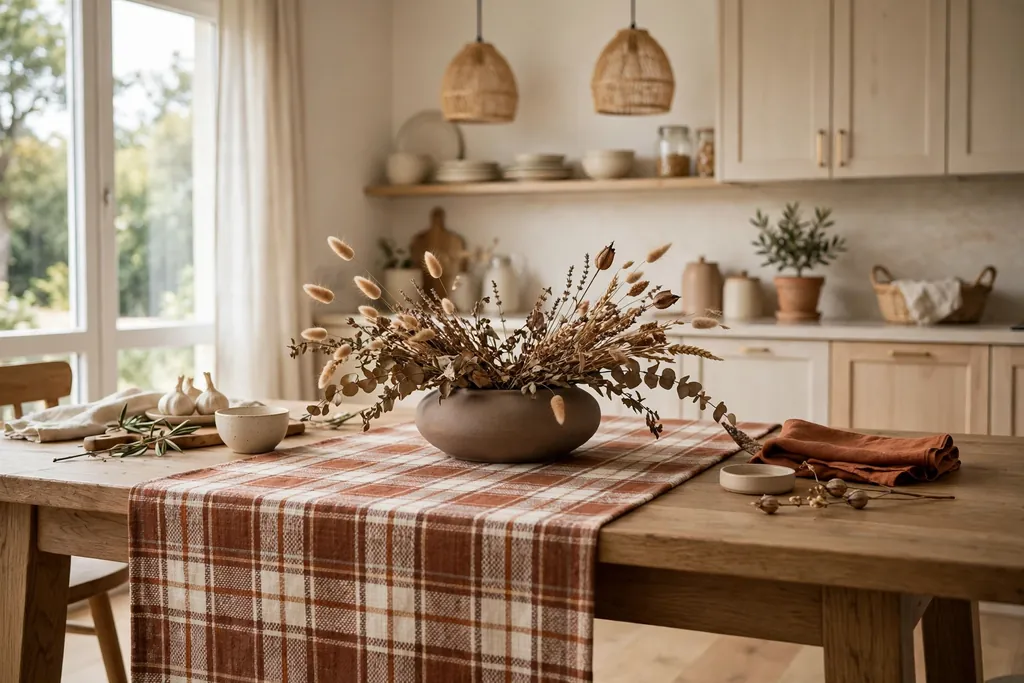
    3. Pumpkin Cluster on the Console Table

    Cluster of pumpkins on an entry console table

    Group three to five pumpkins of different sizes on an entry console or hall table. Mix real or faux pumpkins in orange, cream, and soft green, and leave space for keys and mail.

    Place the largest pumpkin at the back and smaller ones in front. Add a small tray or a stack of books underneath to ground the display and keep it tidy.
    4. Lanterns With Battery Candles on the Porch Steps
    Lanterns with candles on porch steps in autumn evening

    Set two or three lanterns of different heights on the porch steps or beside the door. Battery candles inside give a warm glow in the evening without an open flame near dry leaves.

    Use warm white candles for a soft look. Bring lanterns inside during heavy rain if they are not rated for outdoor use, and store spare batteries nearby.

    5. Plaid Throws and Knit Cushions on the Sofa

    Sofa styled with plaid throw and knit fall cushions

    Drape a plaid throw over one sofa arm and add two knit or woven cushions in rust, cream, or mustard. The mix of pattern and texture makes the sofa feel ready for cool evenings.

    Fold the throw neatly when it is not in use, and keep one extra throw in a basket for guests. Choose washable fabrics if the sofa gets daily use.

    6. Dried Leaf Garland Across the Mantel

    Fireplace mantel decorated with dried leaf garland

    Drape a garland of dried leaves, seed heads, or faux foliage across the mantel. Let it dip slightly in the middle and trail a little at each end for a relaxed shape.

    Secure it with small hooks or clear clips so it does not slip. Keep the garland clear of open flames, and balance it with candles or small pumpkins at each end.

    7. Stacked Books and Mini Pumpkins on the Coffee Table

    Coffee table with stacked books and mini pumpkin

    Stack two or three books on the coffee table and top the stack with a mini pumpkin and a small candle holder. The books add height, and the pumpkin adds a clear seasonal note.

    Leave at least half the table surface clear for drinks and remotes. Rotate the books by color or subject to match the rest of the room.

    8. Amber Glass Vases With Dried Grasses

    Amber glass vases filled with dried grasses

    Fill amber or smoked glass vases with dried grasses, wheat stems, or pampas stems. The warm glass color suits autumn light, and dried stems last for months with no watering.

    Trim stems so they sit about one and a half times the height of the vase. Keep tall arrangements away from walkways where they could be knocked over.

    9. Wooden Crate Harvest Display by the Fireplace

    Wooden crate harvest display beside a fireplace

    Set a wooden crate beside the fireplace and fill it with pumpkins, gourds, dried corn, and a folded blanket. The crate keeps the display contained and easy to move when you need the space.

    Line the crate with a cloth if the wood is rough. Keep the display away from the fire opening and any heat source for safety.

    10. Woven Basket for Blankets in the Living Room

    Woven basket of rolled blankets beside a sofa

    Place a large woven basket beside the sofa or an armchair and fill it with rolled throws. The basket adds natural texture and solves the problem of throws ending up on the floor.

    Roll rather than fold the throws so you can see each color and pattern. Choose a basket with handles so it is easy to move for cleaning.

    11. Bowl of Pinecones and Acorns on a Side Table

    Bowl of pinecones and acorns on a side table

    Fill a shallow wooden or ceramic bowl with pinecones, acorns, and a few dried leaves. It is a simple, low cost accent for a side table, a shelf, or a windowsill.

    Add a scented pinecone or two if you like a subtle scent, and keep small pieces out of reach of toddlers and pets. Refresh the bowl when pieces start to look dusty.

    12. Rustic Wood Slice Chargers for the Fall Table

    Fall table setting with wood slice chargers

    Use wood slice chargers under dinner plates for a rustic fall table. The natural edge and grain add warmth, and they pair well with cream plates and linen napkins.

    Wipe chargers clean after meals and avoid soaking them. For everyday meals, use them only on special occasions and store them flat.

    13. Mini Pumpkin Place Settings

    Mini pumpkin place setting on a fall table

    Place one mini pumpkin on each plate or beside each napkin as a place setting accent. Tie a small paper tag with a guest name around the stem for a dinner party touch.

    Use a mix of white, orange, and striped mini pumpkins for variety. Guests can take them home, which makes them a simple favor as well as decor.

    14. Harvest Centerpiece With Gourds and Eucalyptus

    Harvest centerpiece with gourds and eucalyptus

    Build a centerpiece on a wooden board or a low tray using gourds, dried eucalyptus, and a few taper or battery candles. Keep the arrangement low so guests can talk across the table.

    Start with the largest gourds in the middle and fill gaps with leaves and smaller pieces. Remove fresh elements that wilt and replace them during the season.

    15. Open Kitchen Shelves With Copper and Ceramics

    Open kitchen shelves styled with copper and ceramics

    Style open kitchen shelves with copper pans, warm ceramic bowls, and a small pumpkin or a jar of dried herbs. The mix of metal and ceramic gives the kitchen a harvest feel without clutter.

    Keep everyday items at the front and decorative pieces at the back. Leave breathing room between groups so shelves look styled, not crowded.

    16. Fall Kitchen Towel and Apron Swap

    Kitchen with rust fall towels and apron on a hook

    Swap bright summer towels for rust, mustard, or plaid kitchen towels, and hang a heavier apron on a hook. These small textile changes shift the kitchen mood in minutes.

    Choose towels that match your dishes or your table linens. Keep a clean spare set ready so the look lasts through the week.

    17. Flannel Bedding and a Rust Throw in the Bedroom

    Bedroom with flannel bedding and rust fall throw

    Change the bed to flannel or brushed cotton sheets and add a rust or gold throw across the foot of the bed. The warmer bedding suits cool nights and brings autumn color into the bedroom.

    Layer the throw over a plain duvet so it stands out. Add one or two cushions in a matching tone, and keep the rest of the bedding calm for sleep.

    18. Bedside Vase With Dried Wheat Stems

    Bedside vase with dried wheat stems

    Place a small vase of dried wheat stems or dried lavender on the bedside table. It adds a soft natural accent without taking up much space or needing water.

    Keep the vase small and stable so it does not get knocked over at night. One bundle of stems is enough; a large bunch can feel crowded on a small table.

    19. Amber Soap Dispensers and Rust Towels in the Bathroom

    Bathroom with amber dispensers and rust towels

    Swap clear plastic bottles for amber glass dispensers and hang rust or warm brown hand towels. The change gives the bathroom a warm, seasonal feel with very little effort.

    Refill dispensers with your usual soap and lotion. Wash towels often, and keep a spare towel on a ring or a hook for guests.

    20. Entry Bench With a Boot Tray and a Woven Basket

    Entry bench with boot tray and woven basket

    Set a boot tray under an entry bench and a woven basket beside it for scarves, hats, and gloves. The setup keeps autumn layers tidy and makes the entry feel welcoming.

    Choose a tray with a raised edge to catch mud and water. Empty the basket once a week so it does not overflow as the season goes on.

    21. Window Sill Display of Small Gourds and Candles

    Window sill display of small gourds and candle

    Arrange small gourds, a battery candle, and a tiny plant along a wide window sill. The display catches daylight during the day and glows softly in the evening.

    Keep the sill clear of curtains that could touch a candle, and use battery candles for safety. Group items in odd numbers for a balanced look.

    22. Dining Hutch With Amber Glassware on Show

    Dining hutch with amber glassware on display

    Display amber or smoked glassware in a dining hutch or on open shelves, mixed with cream plates and a small pumpkin. The warm glass adds color even when the table is not set.

    Place taller glasses at the back and shorter pieces in front. Dust the display when you dust the rest of the room so the glass keeps its glow.

    23. Porch Rocking Chair With a Plaid Cushion and Throw

    Porch rocking chair with plaid cushion and throw

    Add a plaid cushion and a folded throw to a porch rocking chair or bench. The chair becomes a spot for morning coffee on mild autumn days.

    Use outdoor rated fabric if the chair stays outside in rain. Bring cushions inside overnight in wet weather to keep them fresh.

    24. Stair Rail Garland With Leaves and Warm Lights

    Stair rail with leaf garland and warm lights

    Wrap a leaf garland around the stair rail and weave in warm white string lights. The garland draws the eye upward and makes the hallway feel part of the seasonal decor.

    Attach the garland loosely so the rail is still easy to hold. Use battery lights with a timer so they switch off on their own.

    25. Fall Gallery Wall With Botanical Prints

    Gallery wall with botanical prints in autumn tones

    Hang a small gallery wall of botanical prints, leaf art, and landscape photos in autumn tones. Use simple wood or black frames and keep spacing even between prints.

    Plan the layout on the floor first, then hang the largest print in the middle. Swap just the prints, not the frames, when the season changes.

    26. Stovetop Simmer Pot Display in the Kitchen

    Stovetop simmer pot with orange slices and cinnamon

    Simmer orange slices, cinnamon sticks, and cloves in a pot on the stove for a short time to fill the kitchen with autumn scent, then leave the cooled pot on a trivet as a display piece. It adds scent and color to the kitchen in one step.

    Never leave a pot on the heat unattended, and top up the water if you simmer for a while. Compost the fruit and spices when you are done.

    27. Outdoor Fire Pit Seating With Blankets and Pumpkins

    Outdoor fire pit seating with blankets and pumpkins

    Arrange chairs around a fire pit with folded blankets on each seat and pumpkins along the edge of the patio. The setup makes outdoor evenings comfortable well into autumn.

    Keep blankets in a covered basket nearby so they stay dry. Place pumpkins away from the fire and from walkways, and clear them before frost damages them.

    Conclusion

    Fall decorating does not need a full room makeover. A wreath at the door, a throw on the sofa, a low centerpiece on the table, and warm light in the evening can change how a home feels for the whole season. Pick the ideas that fit your rooms, your budget, and your daily routine, and repeat a small palette of rust, gold, cream, and wood so the look holds together. Save this list and revisit it next autumn to see which ideas you want to repeat.

    FAQs

    How do I decorate for fall on a small budget?

    Start with textiles and natural items first, because throws, towels, pinecones, dried leaves, and mini pumpkins cost little and make a visible difference. Style one focal point per room, such as a mantel or a table, and reuse baskets, vases, and candle holders you already own. Add a few new pieces each year instead of buying a full set at once.

    What colors work best for fall decor?

    Rust, gold, mustard, warm brown, cream, and soft green form a classic autumn palette that suits most homes. Use one or two strong colors, such as rust and gold, with cream and wood as calm background tones. Repeat the same palette across rooms so the house feels connected rather than busy.

    How can I decorate for fall in a small space?

    Choose small scale items like mini pumpkins, a single vase of dried stems, and a folded throw, and style surfaces you already use, such as a windowsill, a side table, or a shelf. Skip large displays that block walkways, and use vertical space with a wreath or a small gallery wall. One clear focal point per room is enough in a small home.

    Are real or faux pumpkins better for fall decor?

    Real pumpkins look natural and suit outdoor displays, but they soften and need replacing during the season. Faux pumpkins last for years, suit indoor displays, and work well in spots that are hard to reach. Many homes use both: real pumpkins on the porch and faux pumpkins on tables and shelves.

    How do I make fall decor safe around candles?

    Use battery candles near dried leaves, garlands, and fabric, and keep real candles away from anything that can catch fire. Never leave a lit candle unattended, and place candles on stable, heat safe surfaces with clear space around them. Battery candles with timers give the same warm glow with less risk.

    When should I put up fall decor and take it down?

    Most homes put fall decor up in early autumn and keep it through late November, then swap it for winter or holiday decor. Start with outdoor pieces like a wreath and porch lanterns, then add indoor touches room by room. Take down fresh items like real pumpkins before they spoil, and store faux pieces in labeled boxes for next year.