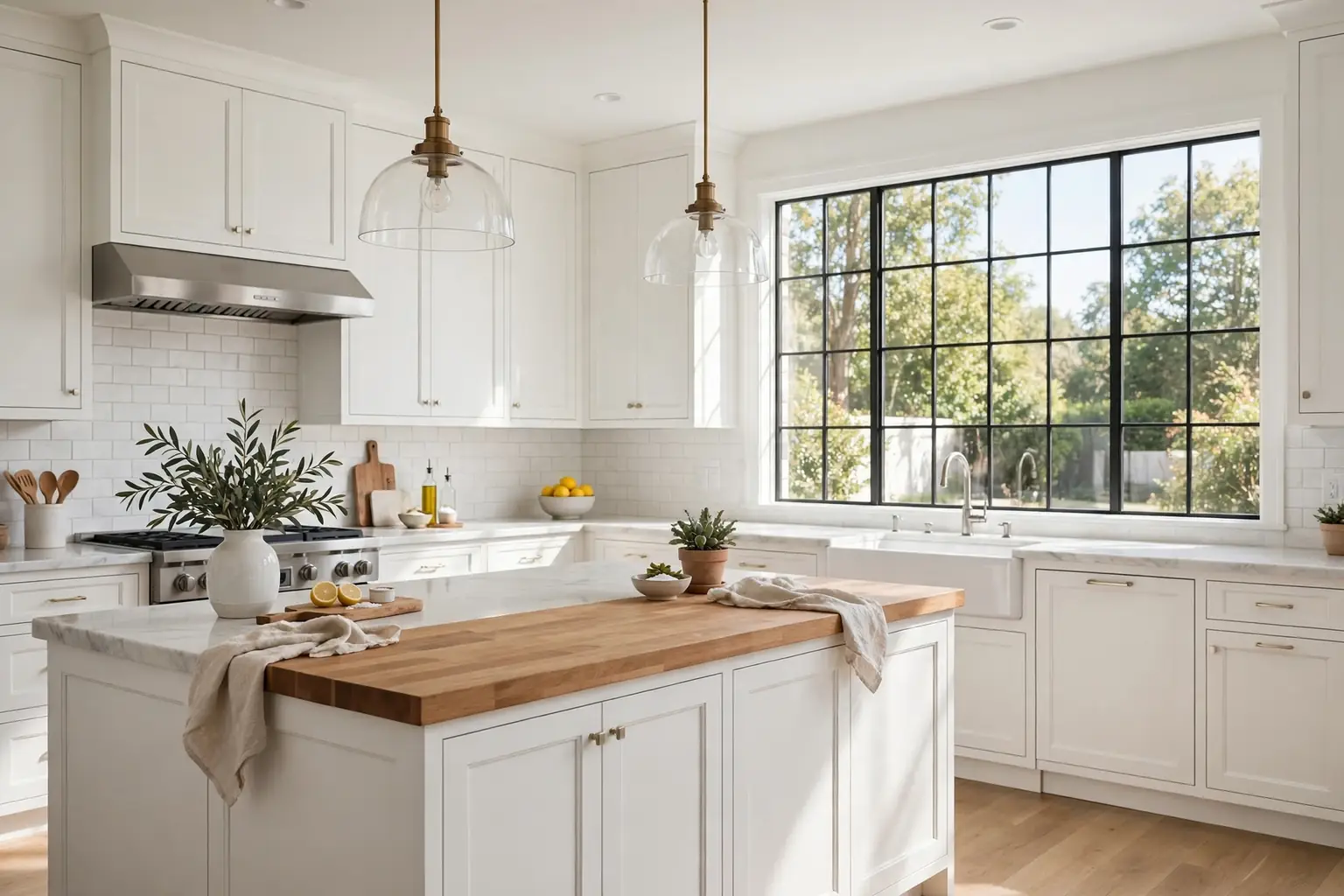
A white kitchen earns its reputation for a simple reason: it stays bright on a grey morning, it suits almost any house style, and it gives you room to change the details later without starting over. The risk is a room that feels flat or hard to live in, with every surface the same shade and nothing to soften it. These 34 white kitchen ideas solve that problem one choice at a time, from cabinet style and counter material to lighting, storage, and seating. Pick the ideas that fit your layout and budget, keep one or two warm materials in the mix, and let the white do the quiet work of holding the room together.
Key Takeaways
- Mix your whites on purpose. A warm white on cabinets, a cooler white on walls, and a natural stone counter keep the room from looking flat.
- Add one or two warm materials, such as wood, brass, or rattan, so a white kitchen feels relaxed rather than clinical.
- Choose cabinet style first, since it sets the tone for hardware, backsplash, and lighting choices that follow.
- Plan storage before decoration. A pantry wall, a plate rack, and a clear counter plan matter more than a new accessory.
- Layer the light: daylight, under-cabinet task light, and pendants over an island or table, so white surfaces glow at night as well as by day.
- Keep counters clear by giving coffee, baking, and prep each a home, so the white surfaces stay easy to wipe and pleasant to use.
1. Start With Classic White Shaker Cabinets
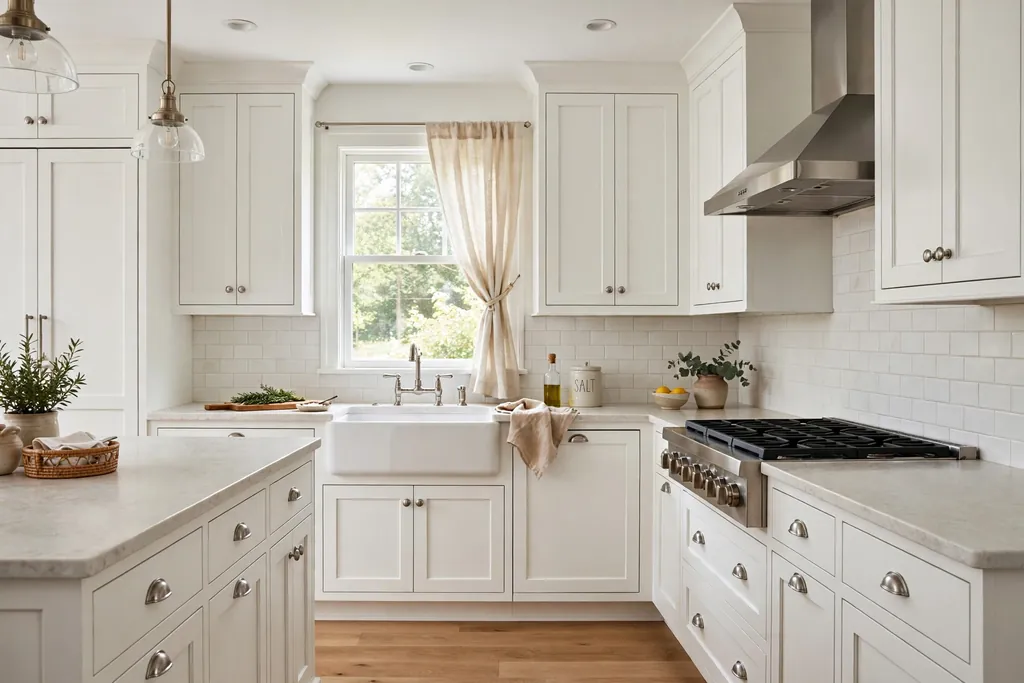
White Shaker cabinets are the safest starting point for a relaxed kitchen, because their simple recessed panel suits farmhouse, cottage, and modern homes alike. The frame gives the cabinets shape without fussy detail, so the room reads as calm and finished rather than plain. Pair them with a soft white paint that has a warm undertone, and keep the walls a shade lighter or darker so the cabinets stand out gently.
Choose cup pulls or simple knobs in a finish you already use elsewhere in the house, such as brushed nickel or aged brass, and repeat that finish on the faucet. Shaker cabinets also take well to a mix of closed storage below and open or glass fronts above, which stops a long run of white doors from feeling heavy. If you are repainting existing cabinets, test the white beside your counter and floor first, since white shifts a lot under kitchen lighting.
2. Try Flat-Front Handleless White Cabinets
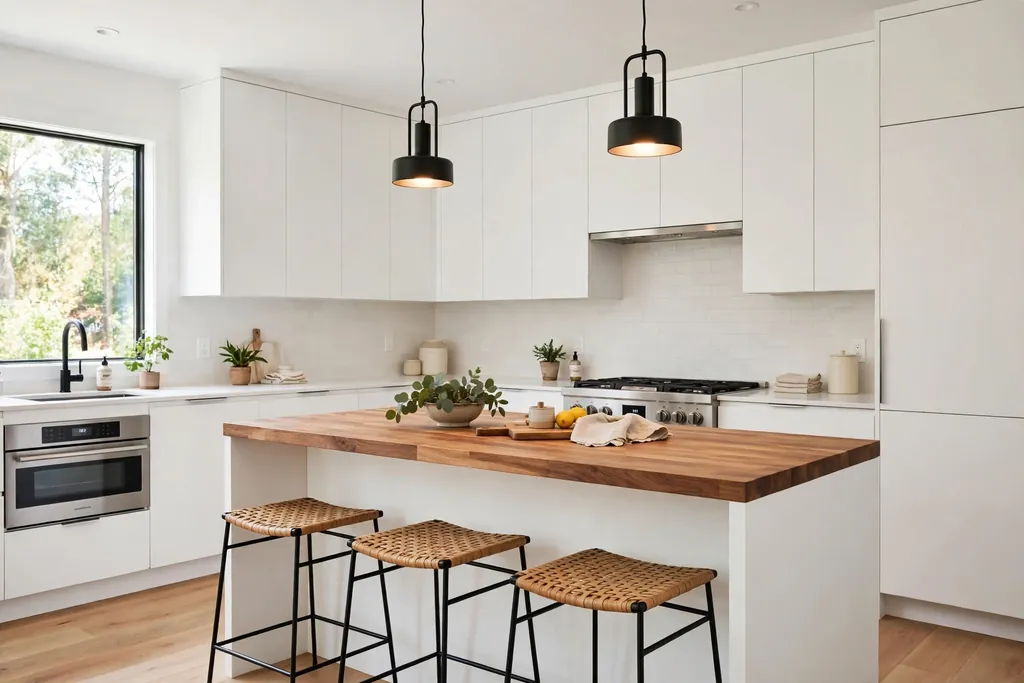
Flat-front handleless cabinets give a white kitchen a clean, modern feel, with long lines and no hardware to break up the surface. This suits a contemporary home or a small kitchen where visual clutter makes the room feel busy. Push-to-open doors or a routed finger pull under each door front keep the look smooth while still being easy to use every day.
Because there is no hardware to add warmth, bring it in another way: a wood island top, a stone counter with visible veining, or open timber shelving on one wall. Keep the wall color close to the cabinet color so the room reads as one calm block, and add texture through a woven blind or linen curtains. Handleless fronts show fingerprints less than gloss doors, but a matte finish is the most forgiving choice for a busy family kitchen.
3. Add Charm With White Beadboard Cabinets
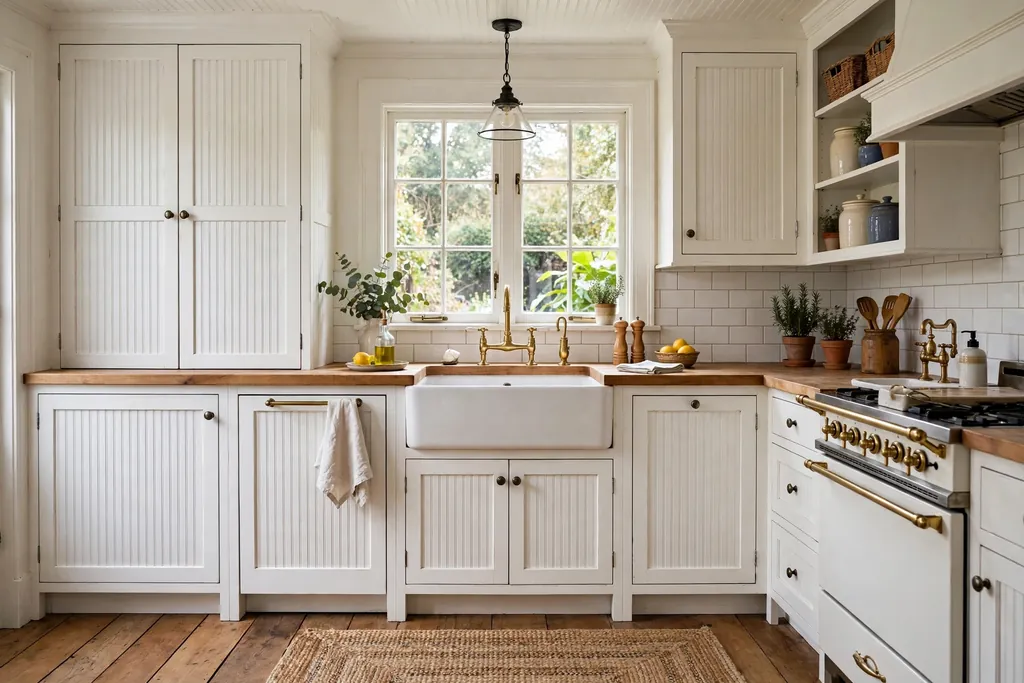
Beadboard cabinets bring a cottage feel to a white kitchen, with narrow vertical grooves that catch light and add texture to flat doors. They suit a farmhouse or coastal home, and they work well on an island or a pantry wall even when the rest of the kitchen uses plainer doors. Paint the beadboard the same white as the other cabinets so the texture, not a color change, does the work.
Beadboard is also a good choice for a kitchen with plain walls, since it gives the eye something to rest on without pattern or color. Keep counters simple, such as butcher block or a pale stone, and add a vintage style faucet or a ceramic sink to complete the cottage look. Wipe the grooves with a soft cloth during a normal clean, since crumbs and dust settle in the channels more than on a flat door.
4. Use Glass-Front White Cabinets for Display
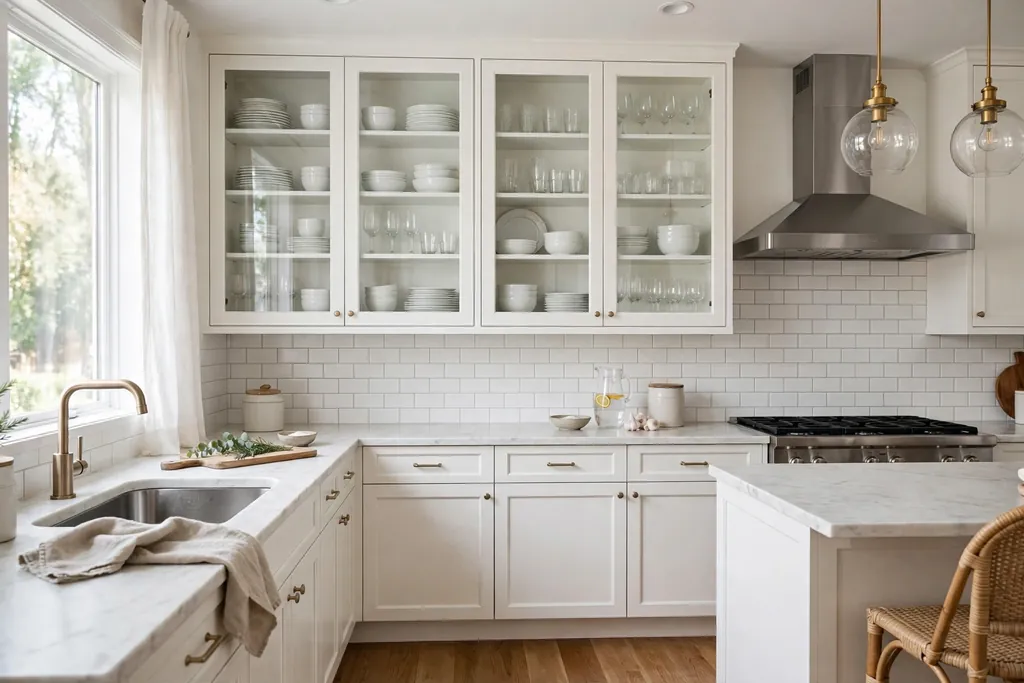
Glass-front upper cabinets break up a wall of white doors and give you a place to show the pieces you actually use, such as white dishes, glassware, and wooden bowls. They make a kitchen feel lighter, because the eye sees through the cabinet rather than stopping at a solid door. Use them on one run of cabinets, or on either side of a window or range, rather than everywhere, so the display stays calm.
Keep what you show to a small set of matching or related pieces, and leave some space on each shelf so the cabinet does not look crowded. Clear glass shows everything, so it suits tidy households; reeded or seeded glass softens the view and hides a less perfect shelf. Add a small light inside the cabinet if you want the display to glow in the evening, and keep the items you reach for daily on lower shelves.
5. Swap Upper Cabinets for White Open Shelving
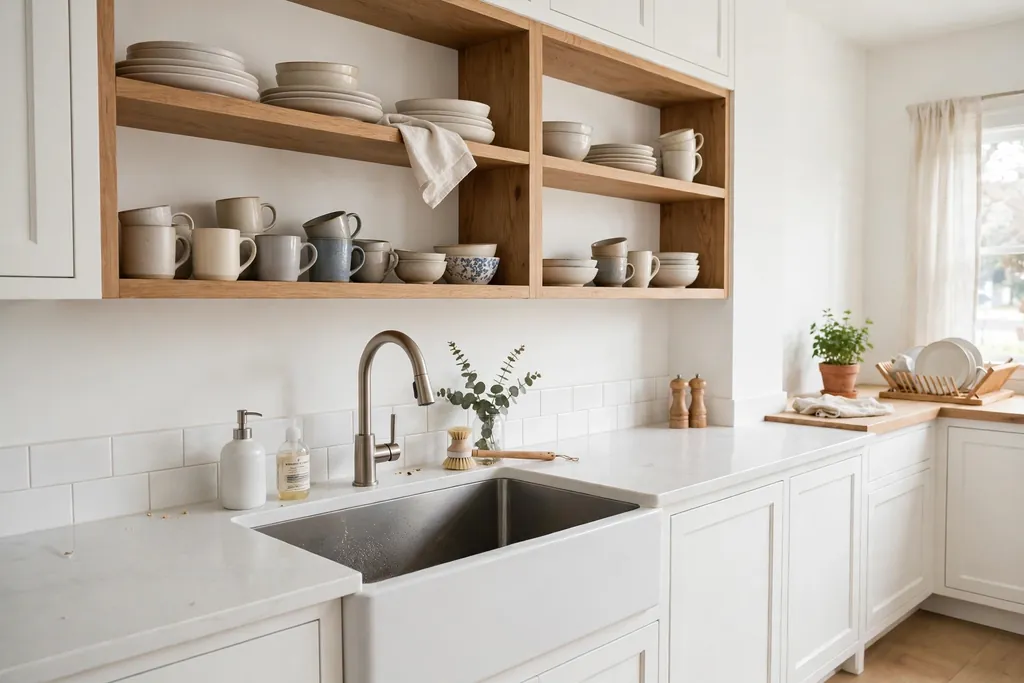
Replacing some upper cabinets with open shelving makes a white kitchen feel taller and more open, especially in a small room or above a sink. Two or three shelves in white or pale wood hold everyday dishes, mugs, and bowls within easy reach, and they stop the wall from feeling like a solid block of doors. This idea works best when you keep the shelves to items you use often, so nothing sits long enough to gather dust.
Anchor the shelves with a simple bracket or a wood board that matches the counter, and style each shelf with a mix of stacked plates, a jug, and one small plant. Keep the rest of the kitchen storage closed, so the open shelves are a feature rather than a necessity. If dust is a worry, use open shelving for one short run only, and keep the remaining uppers closed for items you use less often.
6. Pair White Cabinets With Butcher Block Counters
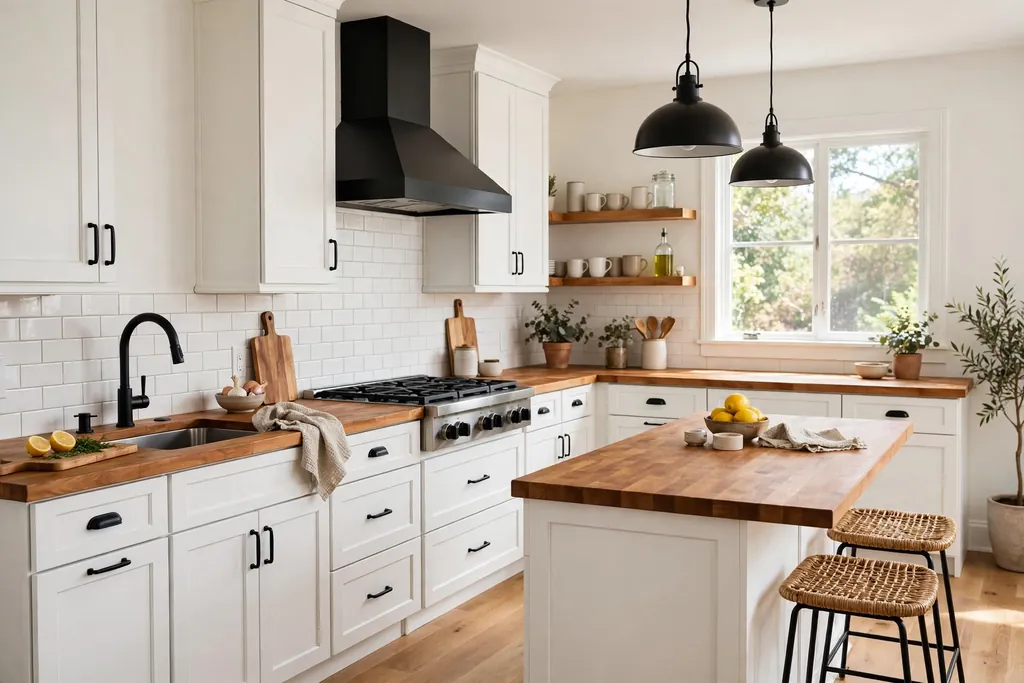
Butcher block counters warm up white cabinets at once, adding a honey toned wood surface that softens the whole room. The wood works well in farmhouse, cottage, and Scandinavian style kitchens, and it pairs with black, brass, or nickel hardware. A butcher block counter is also pleasant to work on, since it is warm to the touch and easy on dishes and glasses.
Use butcher block on an island or a single run of counter, rather than everywhere, if you want to limit care. Oil the surface on a regular schedule, wipe spills promptly, and use a board for cutting so the counter keeps an even look. Near the sink, a stone or quartz section avoids constant water contact on wood. The mix of white cabinets and one wood counter is often enough to make a white kitchen feel relaxed without adding color elsewhere.
7. Choose Marble Counters for a Classic White Kitchen
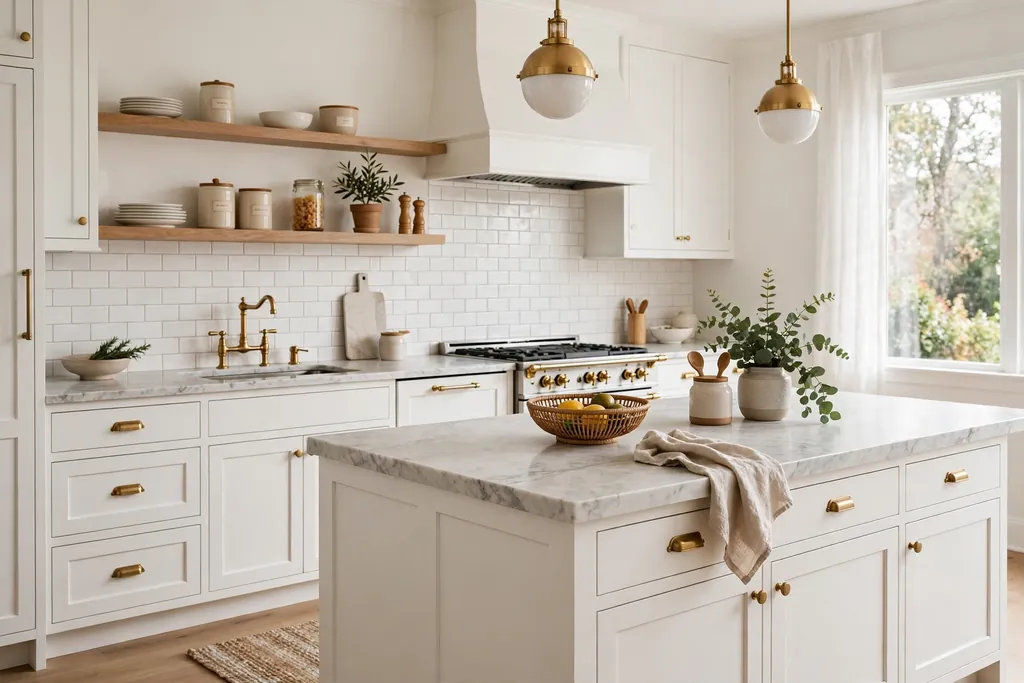
Marble counters are the classic partner for white cabinets, with soft grey veining that adds movement to an otherwise plain surface. The stone suits traditional and elegant kitchens, and it looks at home with Shaker cabinets, brass hardware, and a subway tile backsplash. Choose a slab with gentle veining if you want a calm look, or a bolder vein pattern if the counter is meant to be the main feature of the room.
Marble needs more care than quartz, so seal it as advised by the supplier, wipe acidic spills quickly, and use trivets under hot pans. If you love the look but cook daily with citrus, tomato, and wine, consider marble on an island used for serving and a harder wearing surface on the main prep run. The contrast between white cabinets and a veined stone counter is one of the simplest ways to make a white kitchen feel finished.
8. Build a White Waterfall Island in Quartz
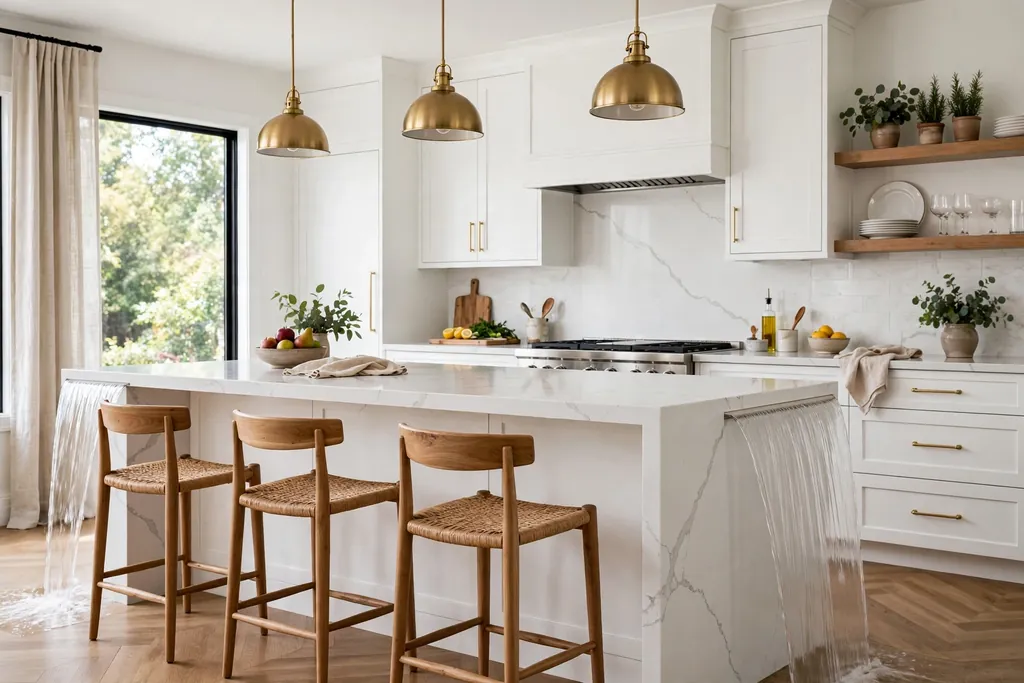
A waterfall island wraps the counter material down both sides of the island, giving a white kitchen a clear focal point and a very clean outline. Quartz suits this treatment well, since it is consistent in color, hard wearing, and easy to wipe. The solid ends make the island read as a piece of furniture rather than a workbench, which suits an open plan room where the kitchen faces the living area.
Keep the island front simple, with no handles or panels competing with the stone, and choose a quartz with soft veining or a plain white finish. Add seating on one side only, so the waterfall ends stay visible, and pick stools in wood or rattan to warm the stone. A waterfall island costs more than a standard island, so measure the room first and leave enough walkway space on every side before you commit to the size.
9. Add Contrast With Black Hardware on White Cabinets
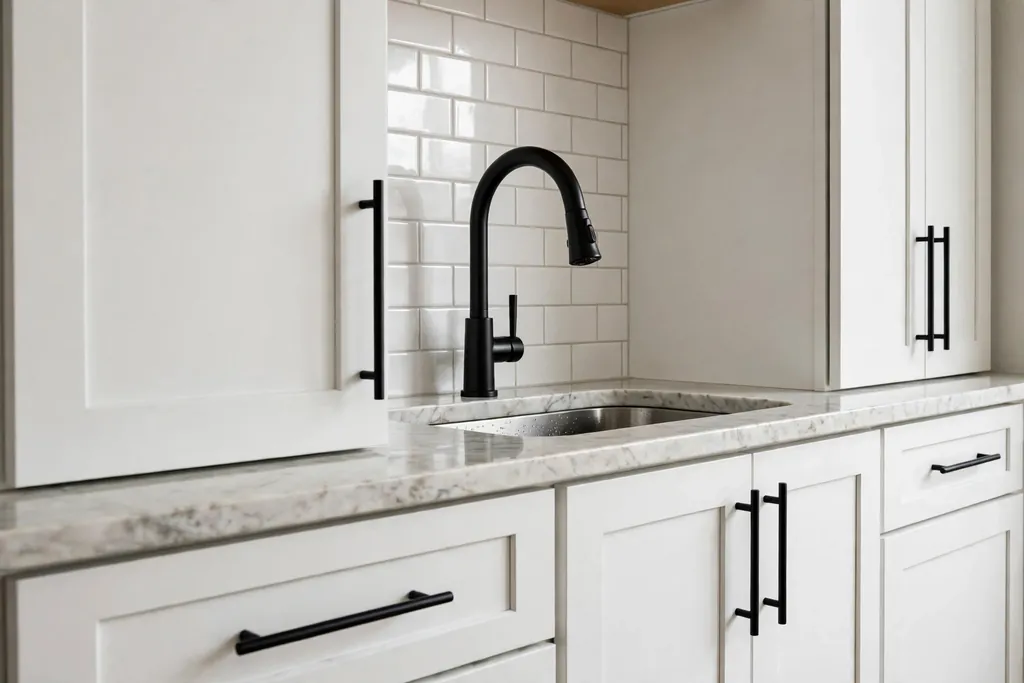
Black hardware is the quickest way to give white cabinets definition, since each knob and pull draws a clear line against the white door. Matte black bar pulls suit a modern kitchen, while small black knobs suit a traditional one. The contrast also helps in a large kitchen, where an all white run of cabinets can blur into one pale mass.
Repeat the black in one or two other places, such as the faucet, a pendant light, or a stool frame, so the hardware looks planned rather than added alone. Keep the rest of the room soft, with wood or stone counters and a pale backsplash, so the black stays an accent. If you are updating existing cabinets, swapping hardware is a low cost change that you can test on one drawer bank before you buy pulls for the whole kitchen.
10. Warm White Cabinets With Brass Hardware
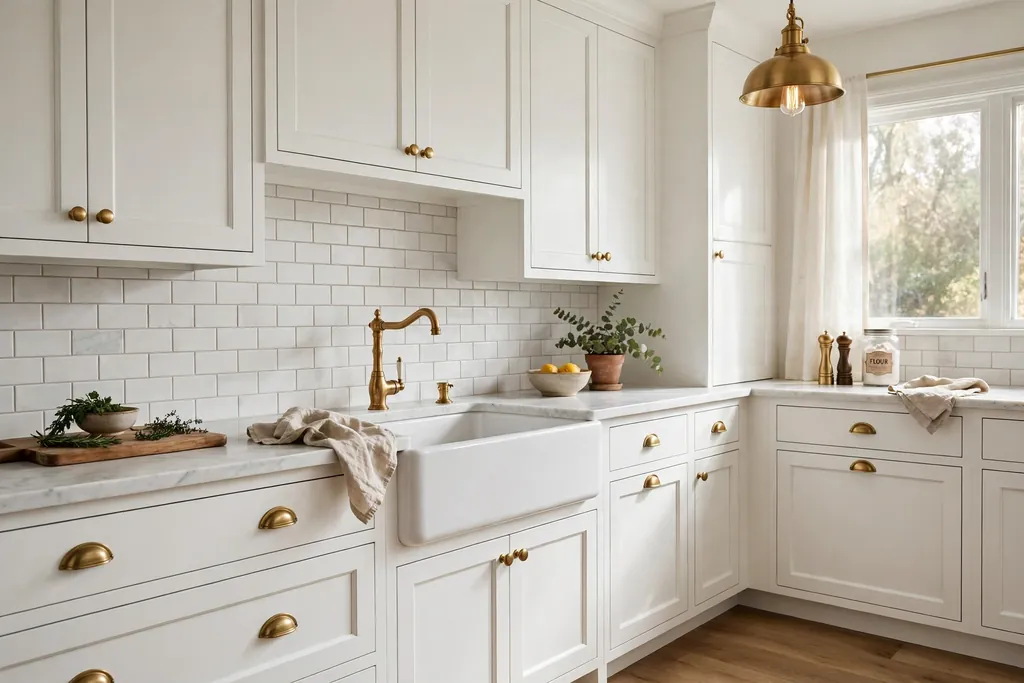
Brass hardware warms white cabinets in a way that black cannot, adding a soft golden glow that suits traditional, farmhouse, and transitional kitchens. Unlacquered brass deepens in tone over time, while lacquered brass keeps a steady shine, so choose the finish that fits how much change you want to live with. Cup pulls on drawers and knobs on doors are a classic pairing that still looks current.
Match the brass to the faucet and to any pendant or shelf brackets, so the metal reads as one thread through the room. If brass feels too yellow beside your white, pick a brushed or aged brass rather than a bright polished one. For a broader look at how cabinet color and finish work together, see these kitchen cabinet colors. Brass also pairs well with marble counters and wood floors, both of which keep a white kitchen from feeling cold.
11. Fit a Farmhouse Kitchen With an Apron-Front Sink
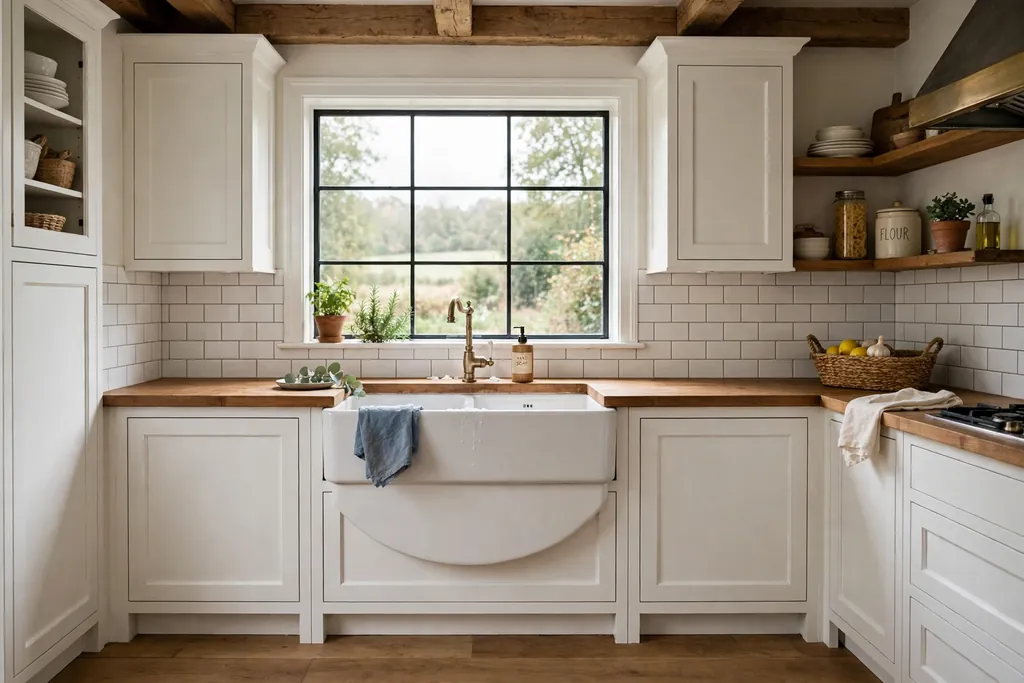
An apron-front sink, with its deep basin and exposed front panel, is the centerpiece of a farmhouse white kitchen. The sink sits proud of the cabinet front, so it reads as a feature rather than a fitting, and its depth handles large pots and baking trays with ease. Pair it with white Shaker or beadboard cabinets, a simple bridge faucet, and a wood or stone counter for a room that feels practical and welcoming.
Choose a fireclay or ceramic sink for a classic look, and check the cabinet size before you order, since apron sinks need a purpose built base unit. Keep the area around the sink clear, with a dish rack or a folded linen cloth nearby, and let the sink do the talking rather than adding a busy backsplash behind it. A single large basin suits most cooks better than a split basin in a farmhouse kitchen.
12. Add a Second Prep Sink for a Working Kitchen
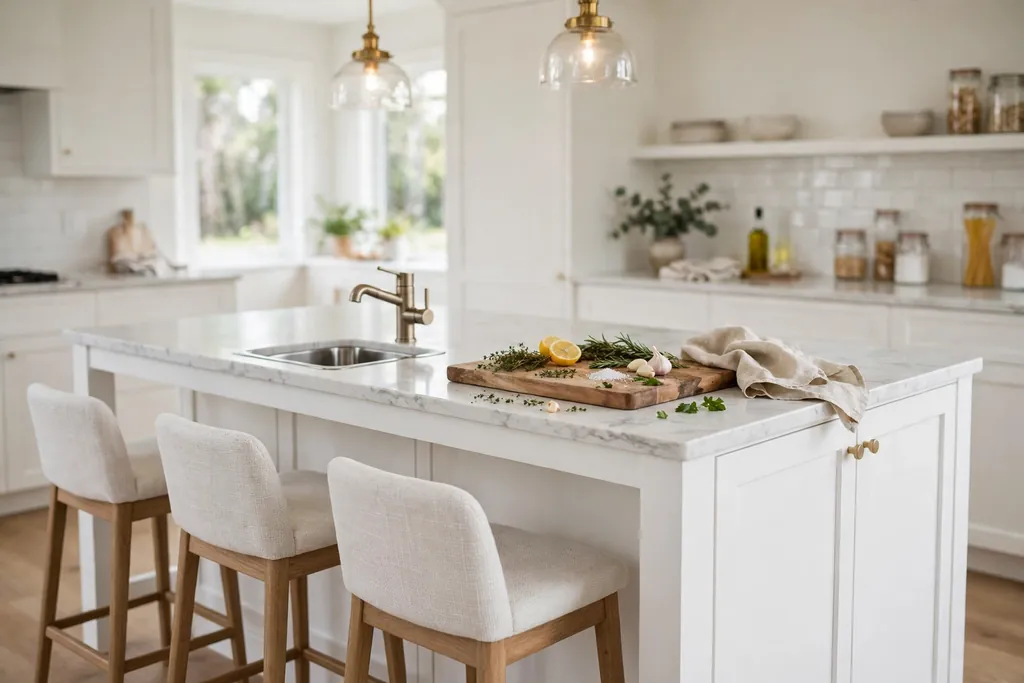
A second prep sink turns a white kitchen into a room where two people can cook without getting in each other’s way. Place it on the island or on a secondary run, near the fridge or the chopping area, so one person can rinse vegetables while the other works at the main sink. The prep sink also keeps drinks, ice, and salad prep away from dirty dishes at the main sink.
Keep the prep sink small, with a simple faucet and a cutting board that fits over the bowl, so it does not eat into counter space. Plumb it during a renovation if you can, since adding water later costs more. In a white kitchen, a matching white or stainless sink keeps the extra fitting quiet, and the gain in daily ease is worth more than the extra cleaning of one more basin.
13. Keep It Simple With a White Subway Tile Backsplash
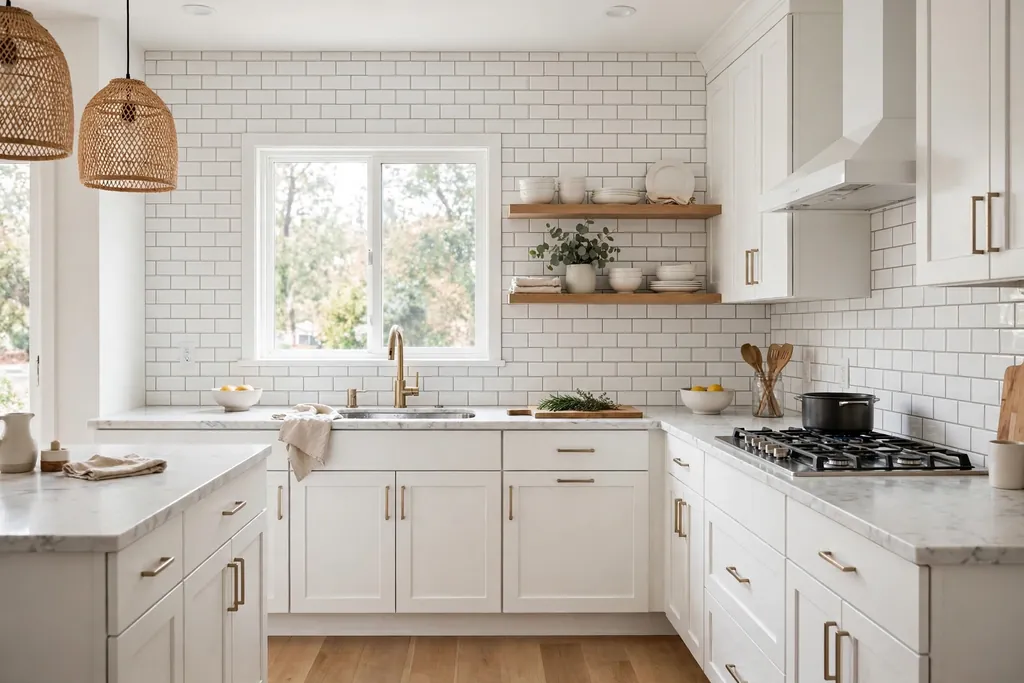
A white subway tile backsplash is the most reliable choice for a white kitchen, because it adds pattern through its brick shape without adding color. Laid in a running bond, the tiles give the wall a gentle rhythm, and the grout lines add just enough detail to stop the wall from looking blank. Gloss tiles bounce light around the room, which helps a kitchen with a small window.
Vary the look by changing the grout: white grout for a seamless wall, or a soft grey grout to show the tile pattern more clearly. Try a stacked or herringbone layout on one wall if you want more interest without a new material. Subway tile is also easy to wipe after cooking, and a single broken tile can be replaced without redoing the whole wall, which makes it a practical long term choice.
14. Add Texture With a Zellige Tile Backsplash
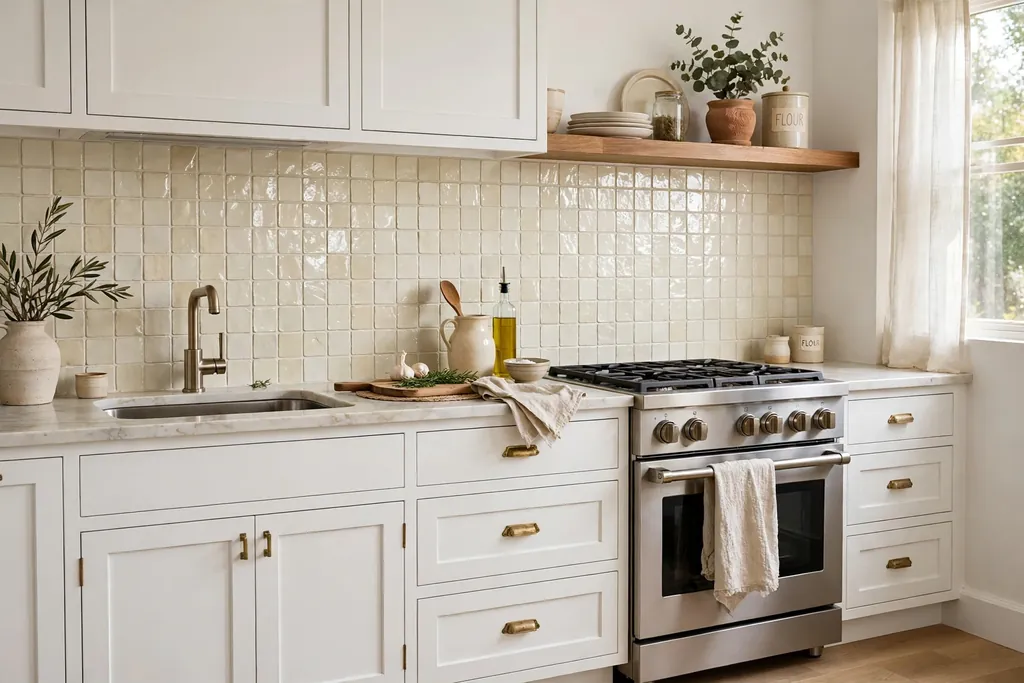
Zellige tiles bring handmade texture to a white kitchen, with slight variations in tone and surface that catch light in a way flat tiles cannot. Each tile differs a little from the next, so the backsplash reads as crafted rather than factory perfect. In a soft white or pale cream, zellige adds depth without color, which suits a relaxed kitchen that still wants character.
Use zellige on the backsplash only, and keep counters and cabinets plain, so the texture stays the focus. The uneven glaze means grout lines look softer, and the wall feels warmer than a gloss subway tile wall. Order extra tiles, since handmade batches vary and a few spares help if a tile chips later. Wipe the surface with a soft cloth, and seal the grout to keep cooking splashes from staining it.
15. Run a Full-Height Stone Slab Backsplash
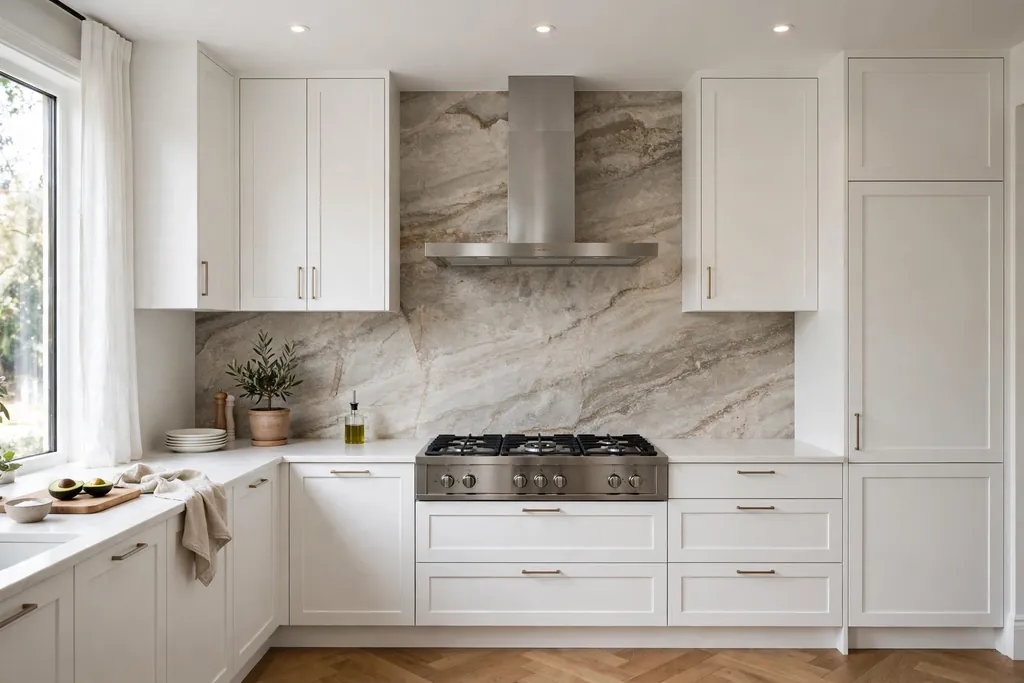
A full-height stone slab backsplash carries the counter material all the way up the wall to the underside of the upper cabinets, or to the ceiling in a kitchen without uppers. The result is a calm, seamless wall with one continuous vein pattern, and no grout lines to clean. This suits a modern white kitchen, or a traditional one where the stone is the main feature and everything else stays quiet.
Choose the slab at the same time as the counter, so the veining matches or flows sensibly from one surface to the other. Keep open shelving minimal on a slab wall, since brackets and plates break the clean line. A slab backsplash costs more than tile, so use it on the main cooking wall and a simpler tile on a secondary wall if the budget needs it. The payoff is a wall that wipes clean in one pass.
16. Ground a White Kitchen With Patterned Floor Tiles
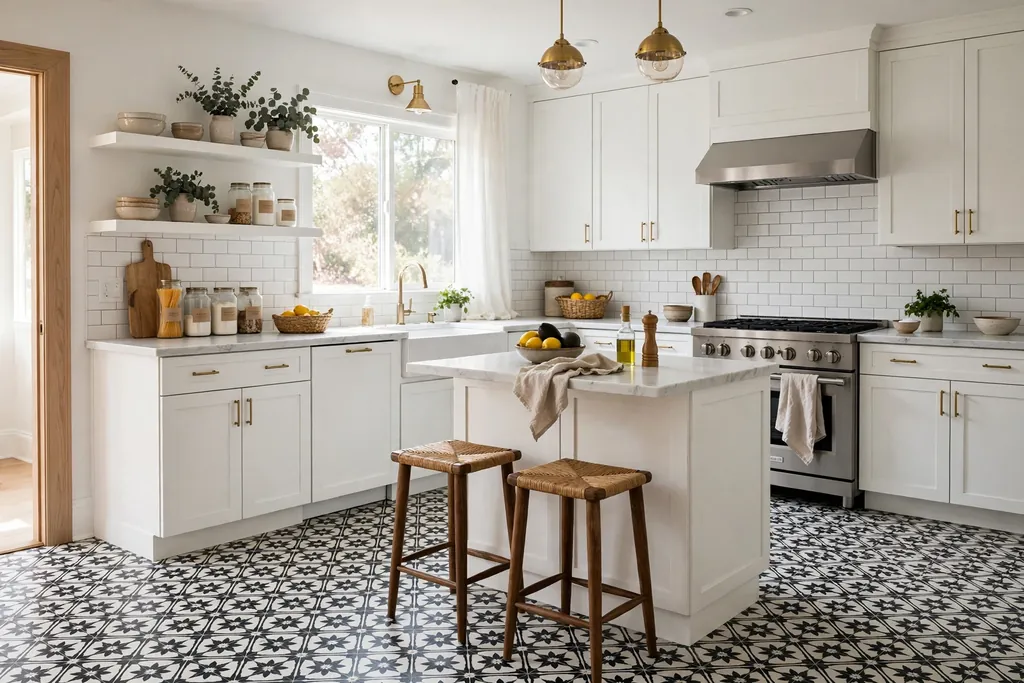
Patterned floor tiles give a white kitchen a firm base, so the pale cabinets and counters do not float in the room. A black and white pattern, a soft grey geometric, or a muted encaustic style tile adds interest underfoot without touching the walls. The floor becomes the one patterned surface in the room, which keeps the rest of the kitchen calm.
Keep the pattern scale in proportion to the room: a large pattern suits a big open kitchen, while a small pattern suits a narrow galley. Choose a matte finish for grip, and a grout color close to the tile so the pattern reads clearly. Patterned floors also hide crumbs and marks better than a plain pale floor, which is a real advantage in a kitchen used every day.
17. Warm White Cabinets With Wood Floors
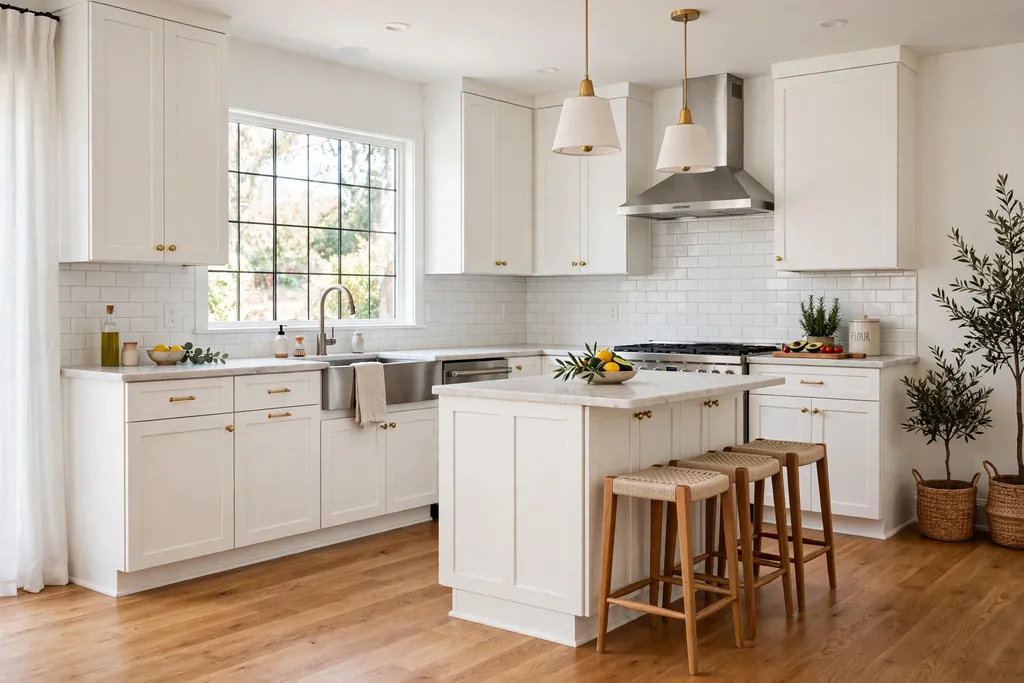
Wood floors are the simplest way to warm a white kitchen, since the natural grain and honey tones soften every white surface around them. Oak, in a natural or pale finish, suits almost any white kitchen, from farmhouse to modern, and it links the kitchen to adjoining rooms with the same floor. A wood floor also feels warm underfoot in the morning, which matters in a room you use barefoot.
Protect the floor near the sink and dishwasher with a runner or a mat, and wipe spills promptly so water does not sit on the boards. If the kitchen opens to a living area, run the same wood through both rooms so the white kitchen reads as part of the home, not a separate block. Keep rugs simple, in natural fibers, so the wood stays the warm note in the room.
18. Top a White Island With a Wood Counter
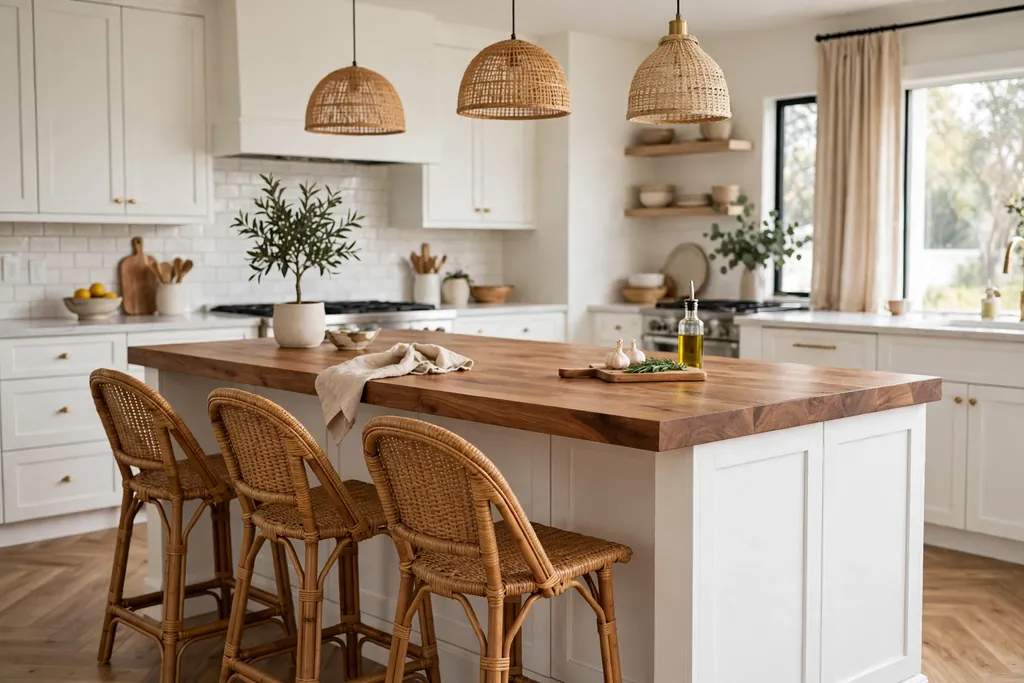
A wood-topped island in a white kitchen gives you a warm work surface and a natural gathering point in one piece. The island top can be butcher block, a thick oak slab, or reclaimed boards, depending on the style of the room. Wood suits seating, since it is warm to lean on and forgiving if a glass is set down hard, and it contrasts gently with white cabinet fronts.
Use the wood top on the island only, and keep the perimeter counters in stone or quartz, so each surface does the job it suits best. Oil the island top regularly, and keep a board handy for chopping so the top keeps an even patina. Pair the wood with stools in a matching tone, or in rattan for a lighter look, and add a simple pendant above to mark the island as the social center of the kitchen.
19. Plan a Large Central Island With Seating
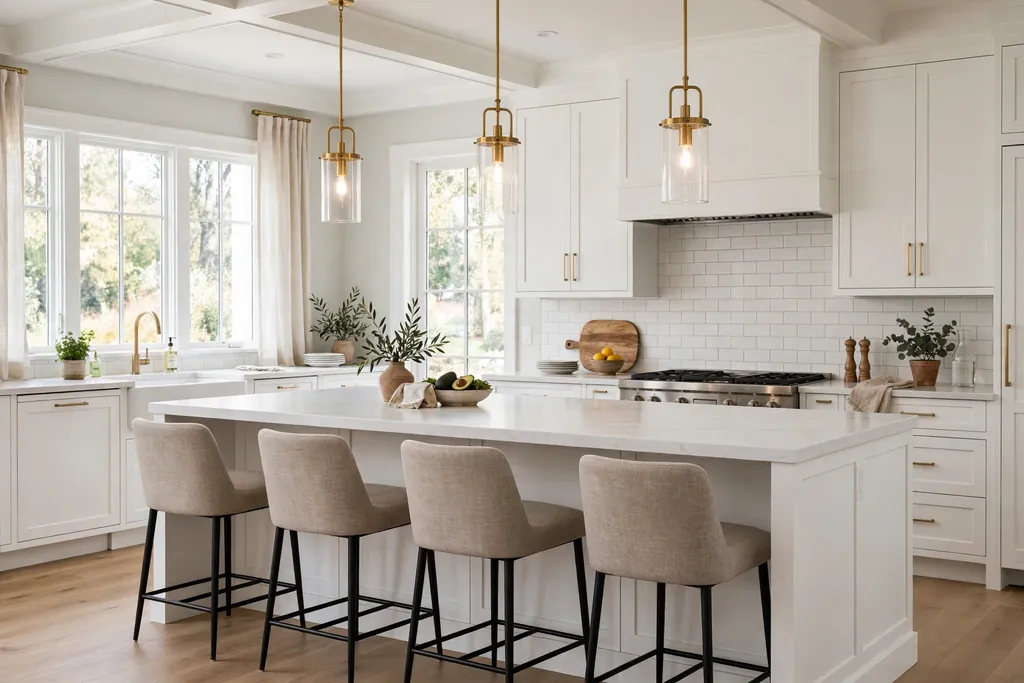
A large central island with seating turns a white kitchen into a room for cooking, homework, and conversation at the same time. The island gives you extra counter space, storage on the working side, and a comfortable overhang for stools on the living side. In an open plan home, it also marks the edge of the kitchen without a wall.
Allow at least a comfortable knee space under the overhang, and leave clear walkways around the island so two people can pass. Choose stools that tuck under the counter when not in use, and keep the island front free of fussy panels so the room stays calm. A large island suits a room with enough floor space; in a smaller kitchen, a narrower island or a peninsula gives most of the same benefit without crowding the room.
20. Design a White Galley Kitchen for Light
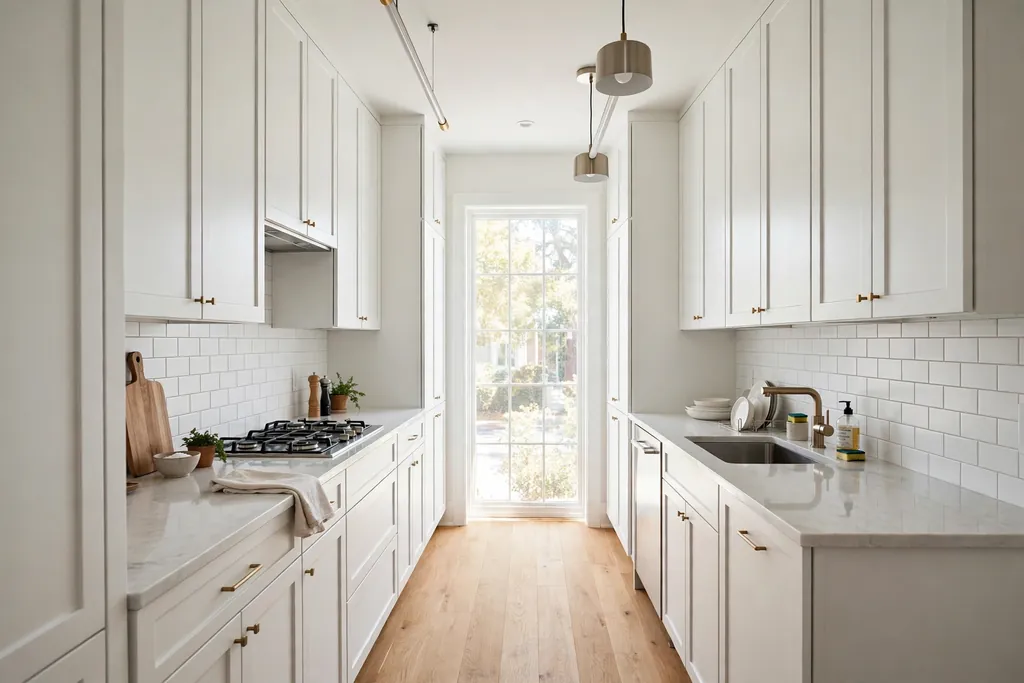
A galley kitchen, with two parallel runs of cabinets, can feel bright and easy in white, because the pale surfaces bounce light down the narrow room. Keep the upper cabinets white and the counters light, and use the end wall for a window, open shelves, or a pale backsplash that draws the eye through the space. Good lighting matters more here than in a wide kitchen, so plan it from the start.
Put the sink and hob on opposite runs where the layout allows, so the work triangle stays short and safe. Use pull-out storage and tall units at one end to keep the runs clear, and avoid a dark floor that would cut the room in half. A white galley kitchen rewards discipline: keep only daily items on the counter, store the rest behind closed doors, and the narrow room will feel calm rather than cramped.
21. Shape a White L-Shaped Kitchen With a Breakfast Corner
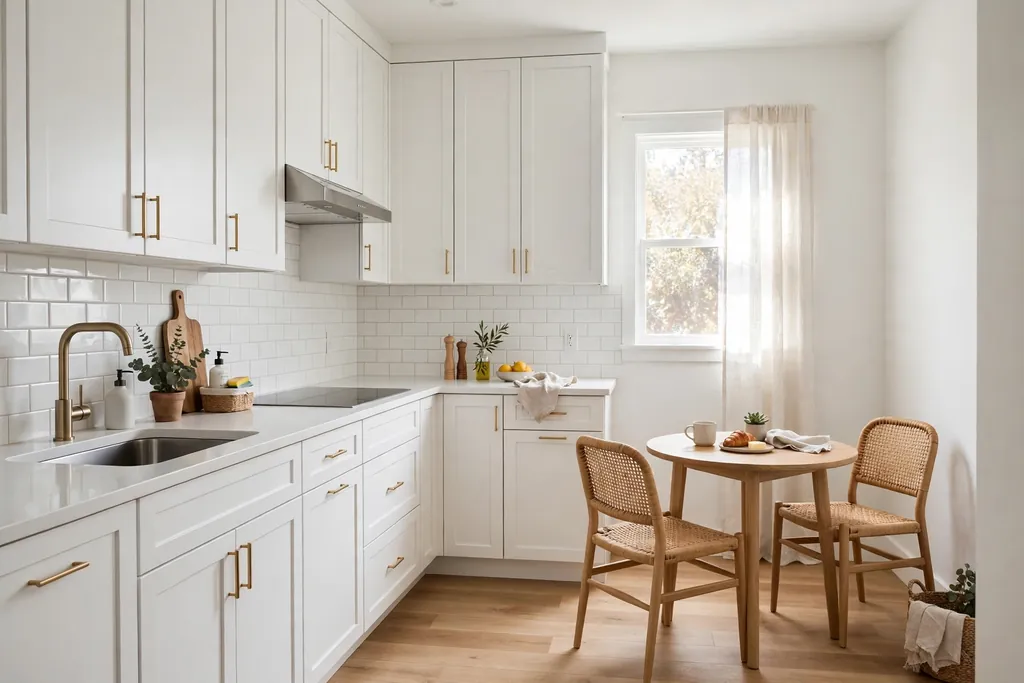
An L-shaped layout leaves one corner of a white kitchen free, which is the ideal place for a small breakfast table and two chairs. The table gives the kitchen a place to sit without a full island, and it suits a room where the main seating is elsewhere in the house. Morning light in the corner makes it a pleasant spot for coffee, and the table can double as extra prep space when you cook for a crowd.
Choose a round table if the corner is tight, since it leaves more room to move around than a square one. Keep the table and chairs in wood or painted white to match the kitchen, and add a simple pendant or a wall light above. Store breakfast items, such as cereals and mugs, in a nearby cabinet or on a small shelf, so the corner works as a self contained breakfast zone.
22. Build a Banquette Into a White Kitchen
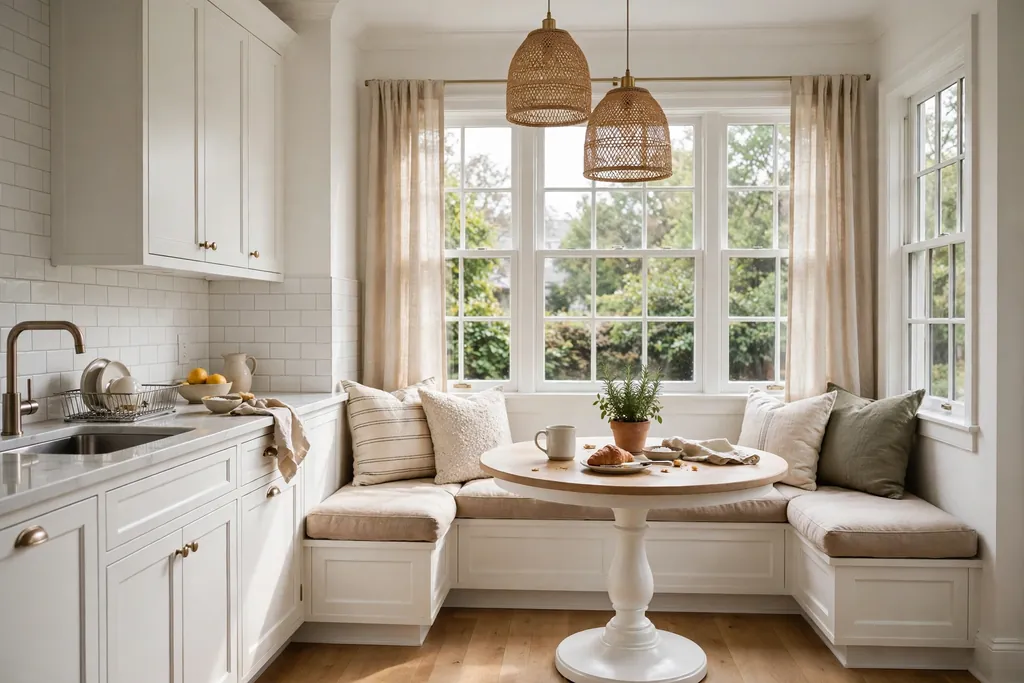
A built-in banquette turns an awkward corner or a bay window into the most used seat in a white kitchen. The bench, fixed to the wall, saves the space that chair legs and pushing back would need, and the base can hide storage for table linens, board games, or rarely used pans. A banquette suits families, since children can slide in beside each other, and it makes a kitchen feel like a room for lingering, not just cooking.
Upholster the bench in a wipeable fabric in a soft neutral, and add cushions in a pattern that links to the rest of the house. Pair it with a pedestal table, which leaves leg room free, and keep the wall above the bench simple, with one picture or a small shelf. If the banquette sits under a window, the daylight will make it the brightest seat in the kitchen, which is exactly where people want to sit.
23. Carve Out a Coffee Station Nook
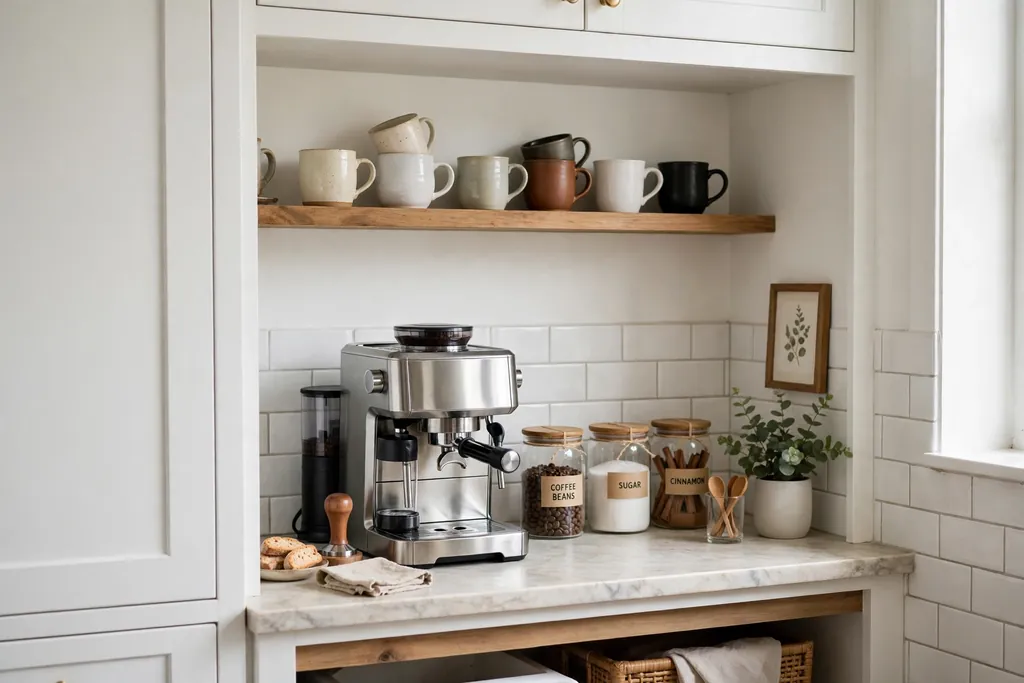
A coffee station nook gathers the machine, mugs, beans, and spoons in one small area, so the main counter stays clear for cooking. A shallow cabinet, a tray on the counter, or a dedicated shelf near a power point is all you need. In a white kitchen, the nook looks best when the mugs and jars are kept to a small, matching set, so the station reads as tidy rather than cluttered.
Place the station away from the hob and the main sink, near the breakfast table or the seating area if you can. Add a small shelf above for mugs, and keep filters, sugar, and spoons in a drawer or a jar below. A coffee nook also works well in a pantry or a larder cabinet with doors that close, so the machine and supplies disappear when the kitchen needs to look calm for guests.
24. Fit a Tall Pantry Wall in a White Kitchen
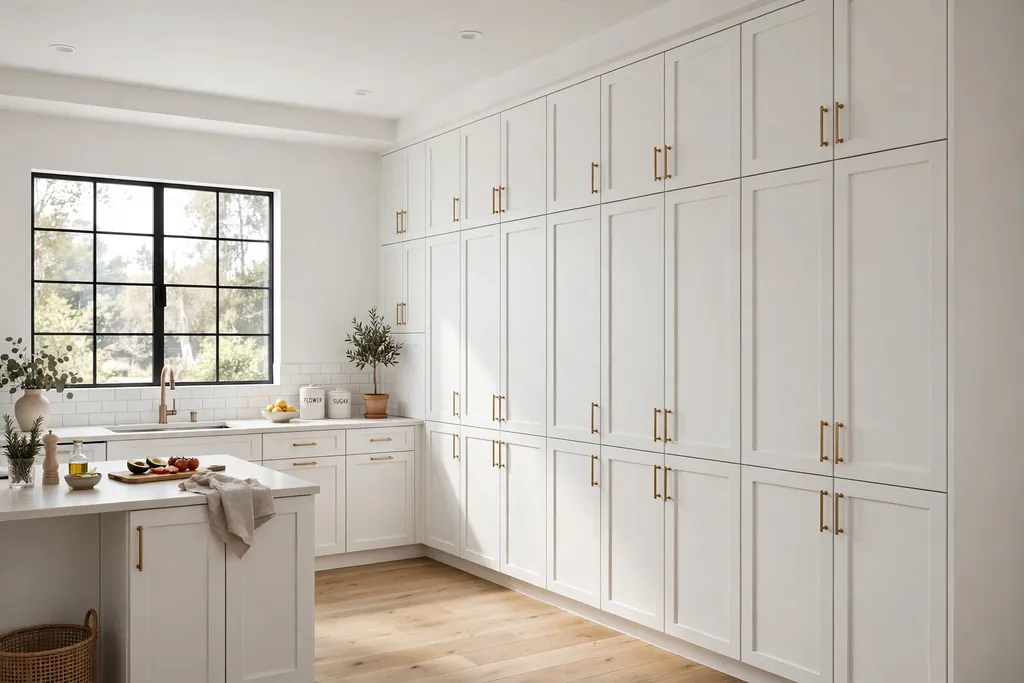
A tall pantry wall, with floor to ceiling cabinets on one run, gives a white kitchen serious storage without a separate pantry room. Deep shelves hold dry goods, small appliances, and baking trays, and pull-out racks make the back of each shelf easy to reach. Because the cabinets match the rest of the kitchen in white, the pantry wall reads as part of the room, not as a storage block.
Plan the interior before you fit the doors: shallow shelves for jars, a tall section for a vacuum cleaner or a mop, and one shelf at counter height for a small appliance you use daily. Label jars and use clear containers so you can see what you have. A pantry wall works best on a wall without a window, where it can run full height, and it frees the rest of the kitchen from cluttered counters and overfilled wall cabinets.
25. Hang a Plate Rack for Everyday Dishes
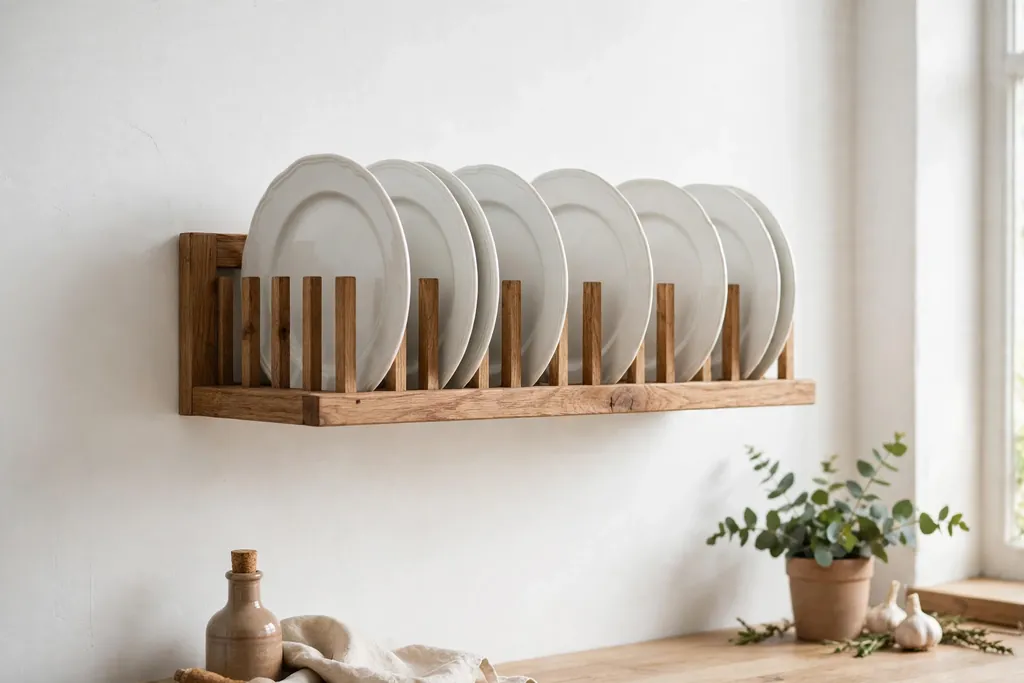
A plate rack, mounted on the wall or built into a cabinet, keeps everyday dishes visible, easy to grab, and quick to put away. In a white kitchen, a rack of white or cream plates adds a quiet pattern to the wall, and it suits farmhouse and cottage styles especially well. A rack above the sink or near the dishwasher shortens the walk from washing up to storage.
Choose a rack sized for the plates you actually use, and leave a little space between plates so they dry and lift out without chipping. A wooden rack warms a white wall, while a painted white rack blends in for a calmer look. Keep the rack to one or two rows, and store serving dishes and rarely used pieces elsewhere, so the rack stays a working tool rather than a display that needs dusting.
26. Add Under-Cabinet Lighting to White Counters
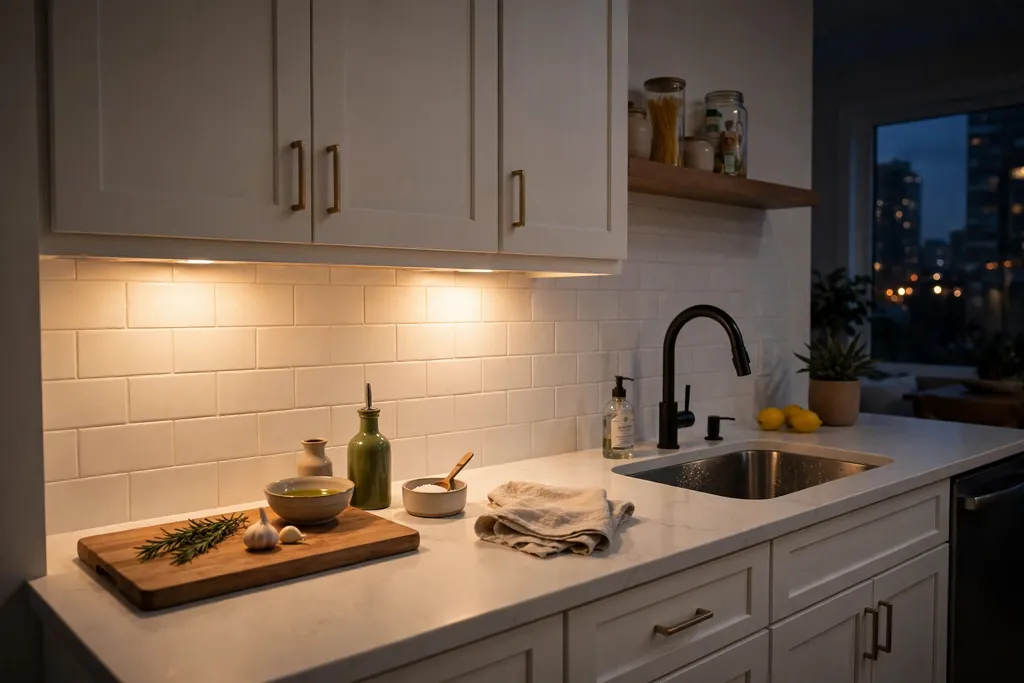
Under-cabinet lighting changes how a white kitchen works at night, because it lights the counter where you chop and read recipes, without lighting the whole room harshly. Warm white LED strips, fitted to the underside of upper cabinets, make white counters glow and show the true color of food. The light also bounces off a pale backsplash, so the kitchen feels bright even when the main ceiling light is off.
Fit the strips toward the front of the cabinet underside, so the light falls on the counter rather than the wall, and hide the strip itself behind a small lip or pelmet. Choose a dimmable fitting if you can, so you can lower the light for an evening meal. Under-cabinet lighting is a small cost in a renovation, but it is one of the most noticed improvements in daily use, since it removes shadows exactly where you work.
27. Hang Pendants Over a White Island
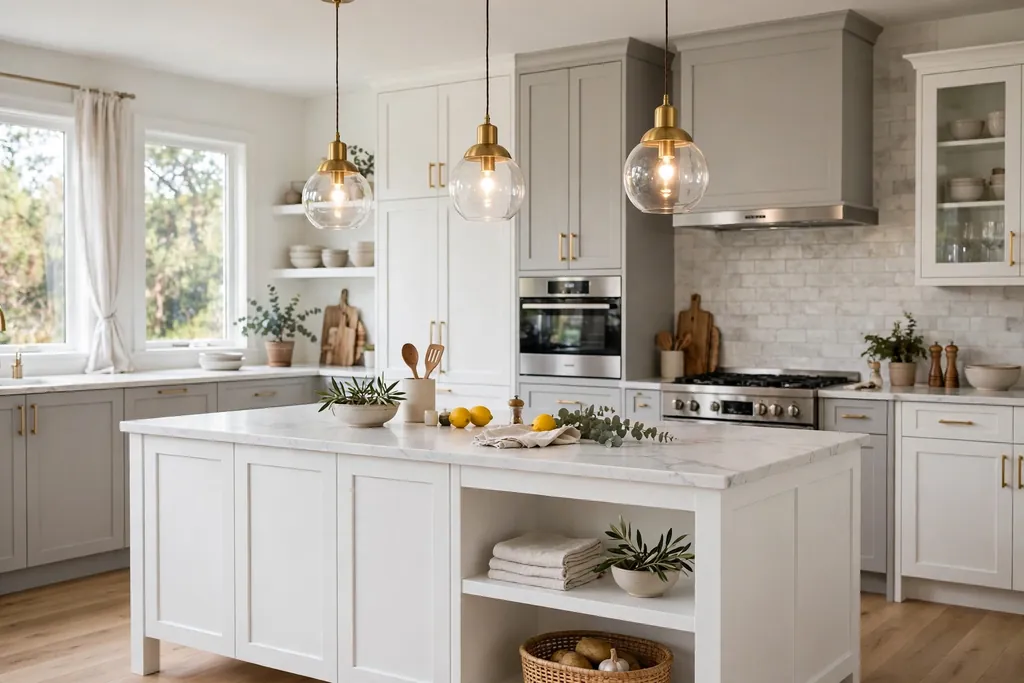
Pendant lights over an island mark the island as the center of a white kitchen and add a warm pool of light where people gather. Two or three pendants, spaced evenly, suit most islands; one large pendant suits a small island or a peninsula. Glass pendants keep the view across the room open, while metal or rattan shades add texture and a stronger shape.
Hang the pendants low enough to light the island surface, but high enough that you can see across the island to the person opposite. A warm bulb tone, rather than a cool daylight bulb, keeps white surfaces from looking stark in the evening. Match the pendant finish to the cabinet hardware or the faucet, so the lighting feels linked to the rest of the kitchen, and put the pendants on a dimmer for flexible evening light.
28. Make a White Range Hood the Focal Point
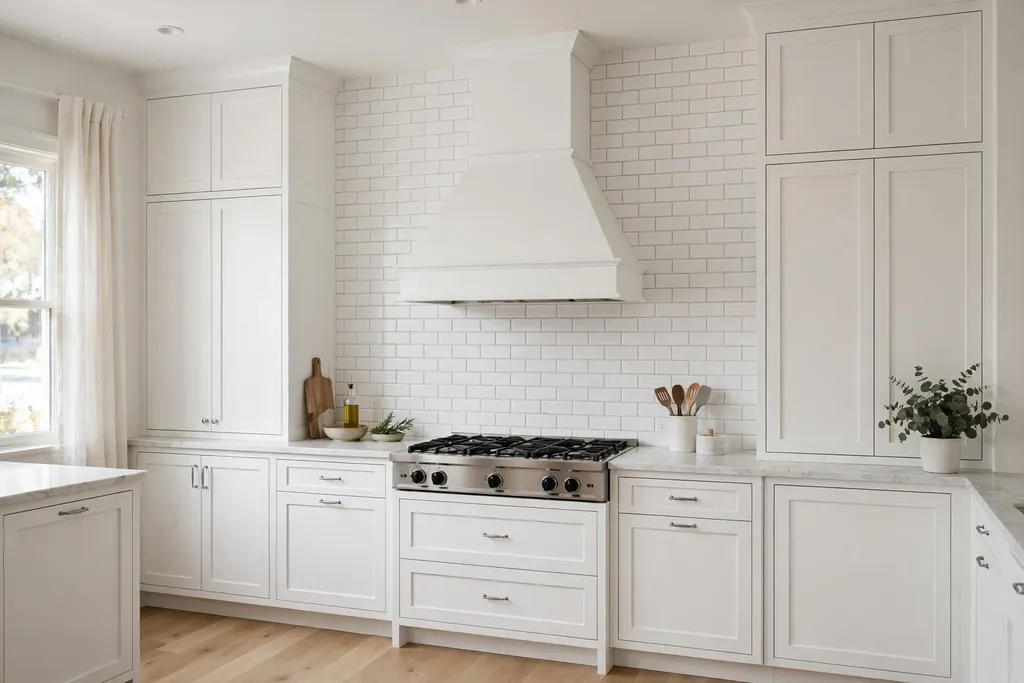
A white range hood, whether plaster, painted wood, or a simple canopy in the same white as the cabinets, can be the quiet focal point of a white kitchen. The hood draws the eye to the cooking wall, and its shape gives the room a sense of structure. A chimney style hood suits a traditional kitchen, while a slim, boxy hood suits a modern one.
Keep the wall around the hood simple, with a plain backsplash or a single shelf, so the hood shape stands out. Check the extraction rate and ducting before you choose a style, since a beautiful hood that does not clear steam and cooking smells is a poor trade. If a full chimney hood is too much, a white canopy hood over a range, paired with open shelving on either side, gives a similar focal point with less bulk.
29. Hide Appliances Behind Panel-Ready Fronts
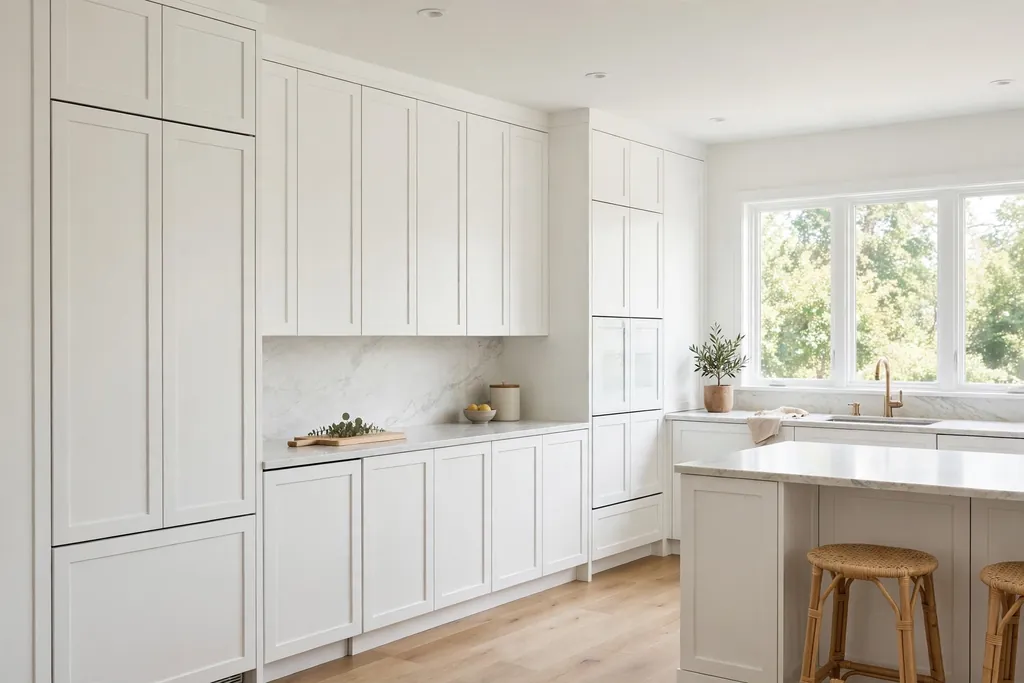
Panel-ready appliances, fitted with door fronts that match the white cabinets, make a white kitchen look like a single piece of furniture. The dishwasher and fridge disappear into the cabinet run, so the room stays calm and unbroken. This suits an open plan kitchen especially well, since there are no stainless fronts to catch the eye from the living area.
Plan panel-ready appliances early in a renovation, since the panels, hinges, and ventilation need to fit the appliance model you choose. Keep one appliance visible if you prefer, such as a range in a contrasting finish, so the kitchen does not feel too uniform. Panel fronts need the same care as cabinet doors, so wipe them with the same cloth and cleaner you use on the cabinets, and the whole run will age evenly.
30. Grow Herbs at the Kitchen Window
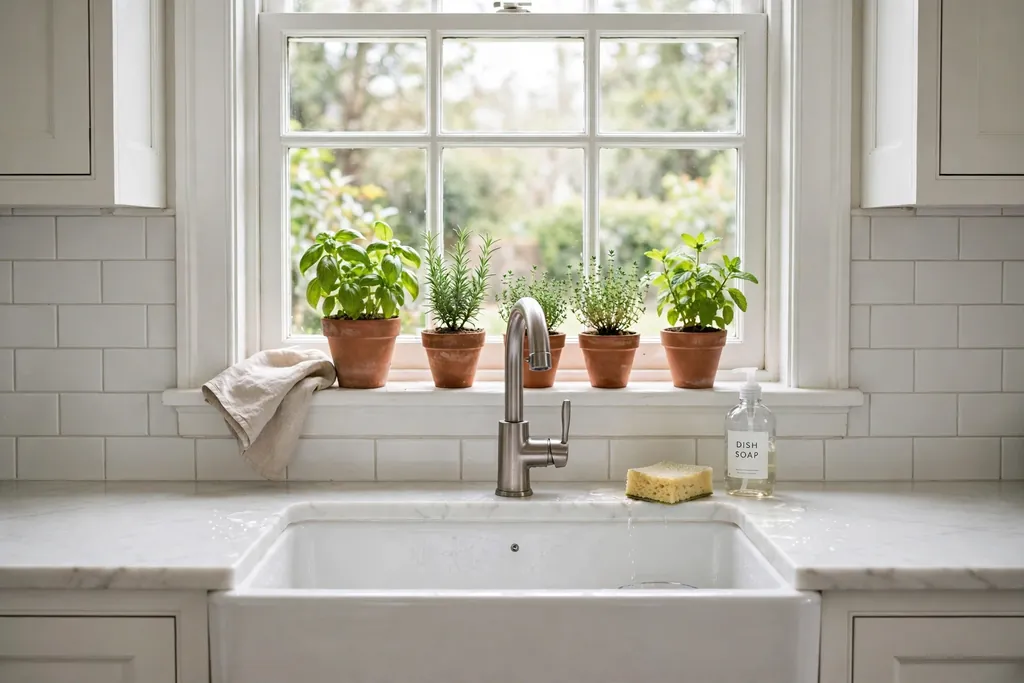
A windowsill herb garden brings life to a white kitchen without adding color to the cabinets or walls. Small pots of basil, mint, parsley, and chives on the sill above the sink are within reach while you cook, and the green leaves soften the hard lines of the window frame. Herbs also scent the room gently when you brush past them, which suits a kitchen used all day.
Use matching pots in white, terracotta, or stone, and a tray underneath to catch water, so the sill stays clean. Give herbs the brightest window you have, and water little and often rather than flooding the pots. For more window ideas, from sill styling to light and privacy, see these kitchen window decor ideas. Rotate the pots weekly so each plant grows evenly, and replace any herb that grows leggy with a fresh plant from a nursery.
31. Use a Rolling Island Cart in a Small White Kitchen
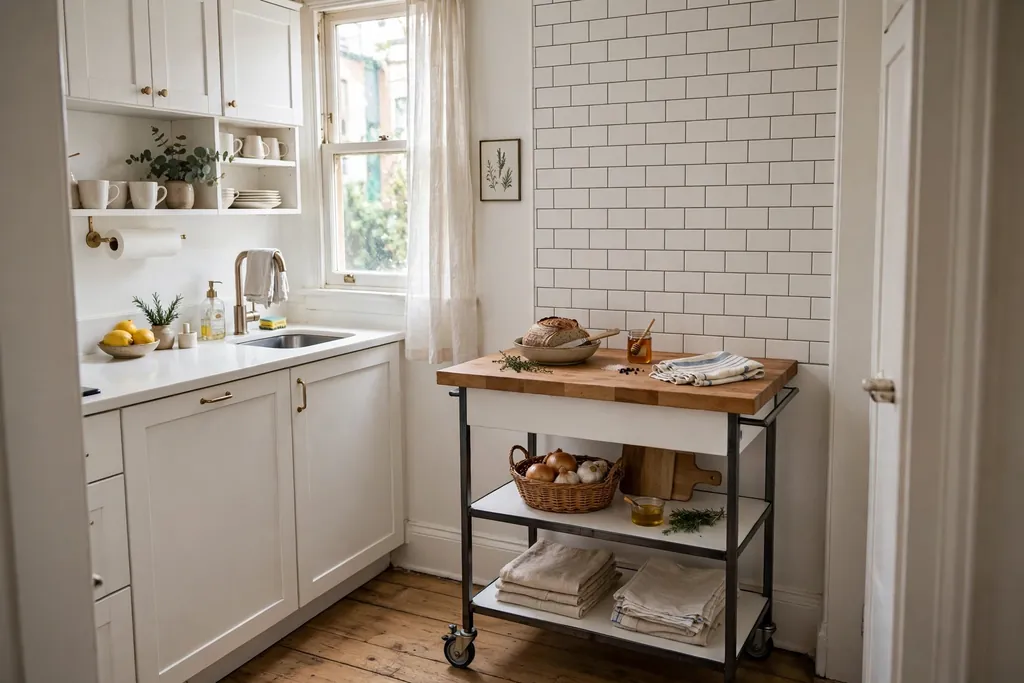
A rolling island cart gives a small white kitchen extra counter space, storage, and a serving trolley in one piece, without the commitment of a fixed island. The cart can sit against a wall when not needed, roll to the center for prep, and move to the dining area for serving. A white or wood cart with a butcher block top blends into a white kitchen, and the open shelf below holds bowls, cookbooks, or a basket of vegetables.
Choose a cart with lockable castors, so it stays steady while you chop, and check the height against your existing counters so it works as a real prep surface. A cart with a towel rail or a hook for utensils adds function without bulk. In a rental or a small kitchen, a rolling cart is often the most practical island of all, since it can leave with you when you move.
32. Set Up a Dedicated Baking Station
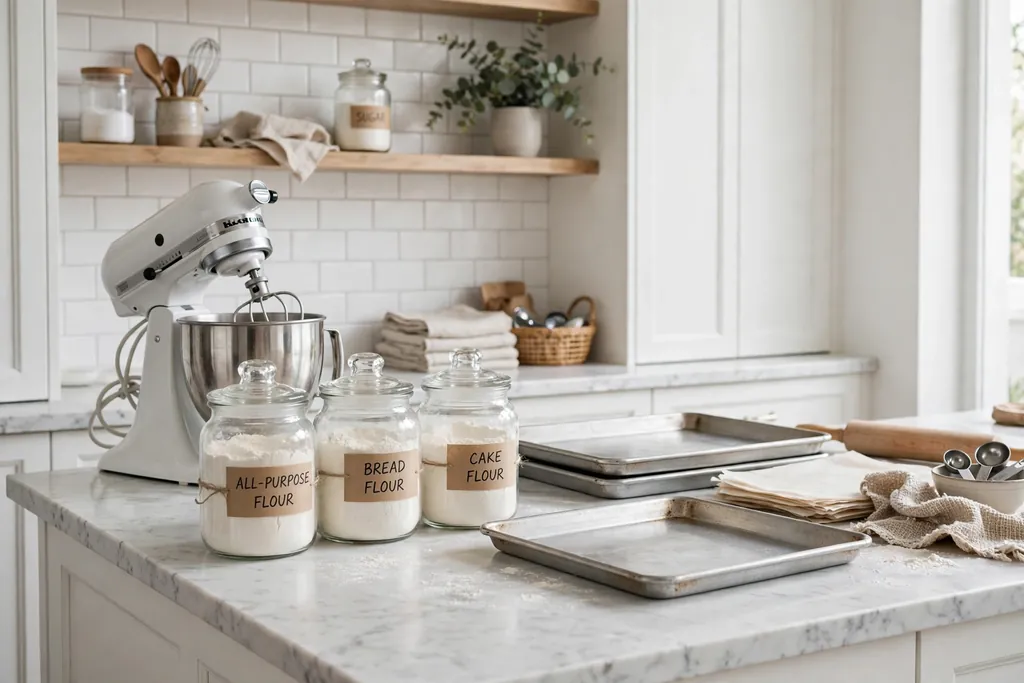
A baking station gathers flour, sugar, baking trays, a mixer, and measuring tools in one area of a white kitchen, so baking does not spread across every counter. A section of counter near the oven, with a mixer on a lift shelf or a sturdy stand, and jars of dry goods above or below, is all you need. The station keeps the rest of the kitchen clear, which matters when baking fills the room with flour.
Use a marble or stone offcut as a pastry surface if you have one, since cool stone suits rolling dough. Store trays upright in a narrow divider, and keep measuring cups and spoons in a drawer directly below the work surface. In a white kitchen, glass jars with simple labels keep the baking station looking tidy, and a wood board under the mixer protects the counter from vibration and marks.
33. Layer Natural Textures to Soften White
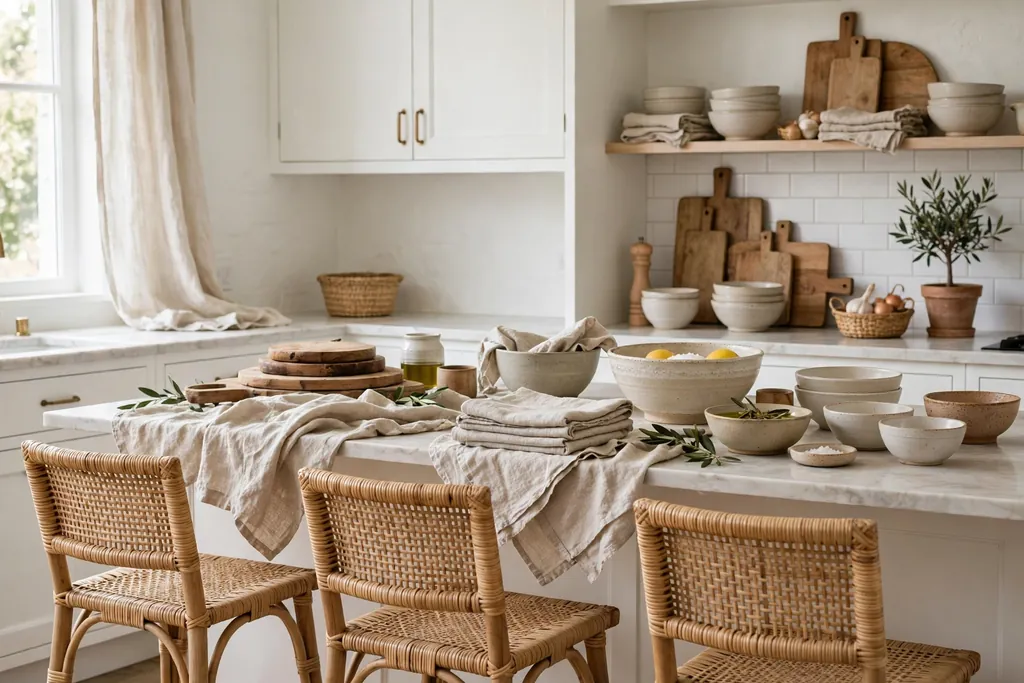
Natural textures are what stop a white kitchen from feeling cold: linen curtains, rattan stools, a wood chopping board, ceramic bowls, and a woven runner each add a soft or rough surface that the eye can rest on. None of these items changes the color scheme, yet together they make the room feel lived in and warm. Texture matters most in an all white room, where there is little color to create interest.
Add texture in layers, starting with the largest surfaces: a wood island top or floor, then seating in rattan or woven fiber, then small items such as linen tea towels and ceramic jars. Keep the palette to white, cream, wood, and one soft neutral, so the textures work together rather than competing. Replace one texture at a time when you want a change, such as swapping a runner for a new weave, and the kitchen will feel fresh without a repaint.
34. Mix Vintage Pieces Into a White Kitchen
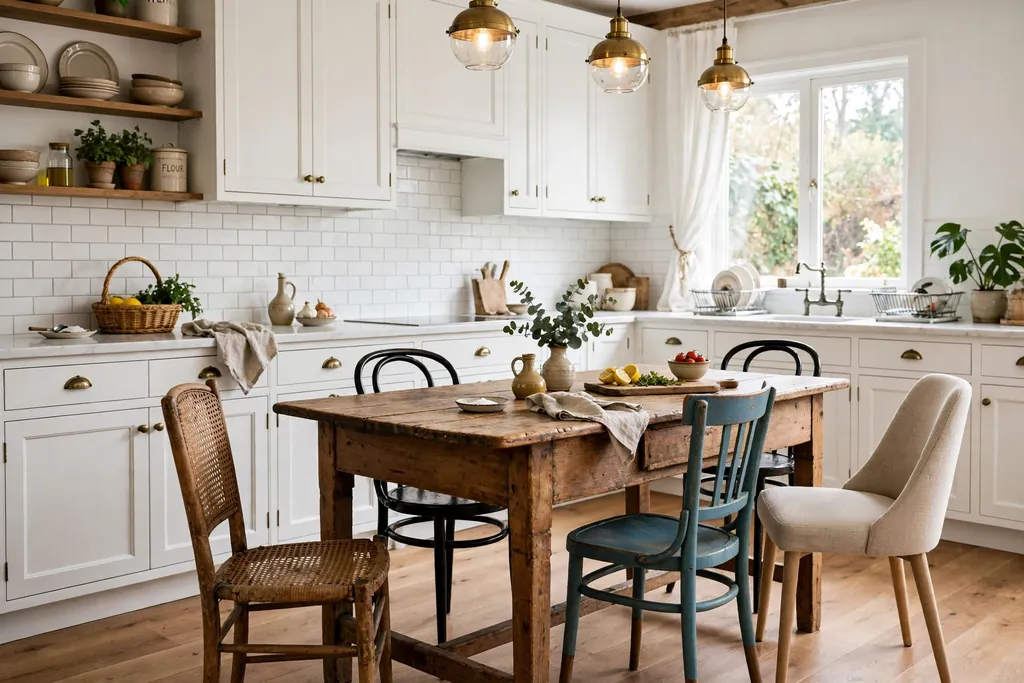
Vintage pieces, such as an old wood table used as an island, a set of mismatched chairs, or a secondhand dresser used for storage, give a white kitchen a history that new cabinets alone cannot. The worn wood and older shapes contrast gently with crisp white doors, and the room feels collected over time rather than bought in one order. This idea suits farmhouse, cottage, and eclectic kitchens best.
Choose one or two vintage pieces, not a room full, so the kitchen still feels clean and easy to use. Check that a vintage table is steady and at a workable height before you use it as an island, and seal or oil the wood if it will hold food or drinks. Pair the vintage piece with simple white walls and plain counters, so it stands out as a feature. A vintage find also keeps a white kitchen personal, since no two pieces are exactly alike.
Conclusion
A relaxed white kitchen is not about using one perfect shade of white. It is about pairing white cabinets with warm materials, clear storage, and light that works morning and evening. Start with the cabinet style that suits your house, add one warm counter or floor, and give each daily job, from coffee to baking, a place of its own. The ideas here work on their own or together, so pick a few that fit your room and your budget, and let the rest wait for a later refresh. Save the ideas you love, test paint and materials beside your own light, and build a white kitchen that stays calm, practical, and pleasant to spend time in.
FAQs
Will a white kitchen show every mark and stain?
White surfaces show crumbs, spills, and fingerprints more than dark ones, but they also show you where to clean, so marks rarely sit long enough to stain. Wipe counters daily with a soft cloth, clean cabinet fronts weekly, and choose a wipeable paint finish on doors near the hob and sink. A matte or satin finish hides small marks better than high gloss, and a patterned floor or a wood island top breaks up large white areas where marks would show most.
What countertop works best with white cabinets?
The best countertop depends on how you cook. Quartz is hard wearing, easy to wipe, and needs little care, which suits a busy family kitchen. Marble looks classic with white cabinets but needs sealing and prompt cleaning after acidic spills. Butcher block warms the room and suits an island or a single run, while a pale stone slab gives a seamless, elegant wall and counter. Many kitchens mix two surfaces, such as stone on the main run and wood on the island, to get the best of both.
How do I keep a white kitchen from feeling cold?
Add warmth through materials, not color. Wood floors or a wood island top, brass hardware, rattan seating, linen curtains, and ceramic dishes all soften white surfaces. Layer the lighting too, with warm under-cabinet light and pendants over the island, so the room glows in the evening. A plant or a bowl of fruit on the counter adds a living note, and a woven runner underfoot keeps the floor from feeling bare.
What hardware suits white kitchen cabinets?
Black hardware gives white cabinets clear definition and suits modern and farmhouse kitchens alike. Brass hardware warms the room and suits traditional and transitional styles. Nickel or chrome hardware keeps the look cool and quiet, which suits a contemporary kitchen. Choose one main finish and repeat it on the faucet and light fittings, and test the hardware against your white in both daylight and evening light, since metal tones shift with the light.
Are white cabinets hard to keep clean?
White cabinets need regular wiping, but they are not hard to keep clean if the finish suits the kitchen. A satin or semi-gloss paint wipes more easily than flat paint, and a soft cloth with mild soapy water handles most daily marks. Keep a cloth near the sink for quick wipes after cooking, and clean around handles and hinges monthly, where grease collects. Avoid harsh scouring pads, which can dull the paint over time.
Can a small kitchen work in white?
Yes, white is one of the best choices for a small kitchen, because pale surfaces reflect light and make the room feel larger. Keep upper cabinets white, use open shelving sparingly, and choose a light counter and backsplash so the room reads as one bright space. Add storage that uses the full height of the wall, a rolling cart for extra counter space, and good under-cabinet lighting, so the small room works hard without feeling crowded.