
To arrange throw pillows on a sofa for a balanced look, anchor the largest pillows at each end, layer medium pillows in front of them, and finish with one smaller accent or lumbar pillow near the center. Repeat one or two colors, mix textures, and leave enough seat space so the sofa stays comfortable to sit on.
A sofa can look crowded with too many pillows, or bare with too few, even when the colors are right. The fix is usually order, not more pillows. This guide works in the order that matters: clear the sofa, set a palette, choose a count that fits the sofa size, layer from large to small, and then check comfort from a normal sitting position. For seasonal textile ideas that pair well with a pillow refresh, see these fall living room decor ideas.
Key Takeaways
- Start with an empty sofa and measure its width, seat depth, and arm height before choosing pillows.
- Anchor the largest pillows at the ends, layer medium pillows in front, and finish with a small accent near the center.
- Repeat one or two colors across the sofa and the room so the arrangement looks planned, not random.
- Mix textures and limit strong patterns to one or two pillows, with plainer pillows beside them.
- Leave enough open seat space for people to sit without moving a pile of pillows first.
- Fluff, angle, and step back to check balance, then sit down and adjust for comfort.
Supplies You May Need
- A measuring tape for sofa width, seat depth, and arm height
- Throw pillows in at least two sizes, plus one small accent or lumbar pillow if the sofa is wide enough
- Pillow inserts that are about 2 inches larger than the covers, if you use removable covers
- One or two pillow covers in a plain color that already appears in the room
- A throw blanket in a color or texture that matches at least one pillow
- A basket or nearby chair to hold spare pillows while you try arrangements
- A phone camera, useful for checking balance in a photo from across the room
1. Clear the Sofa and Measure It First
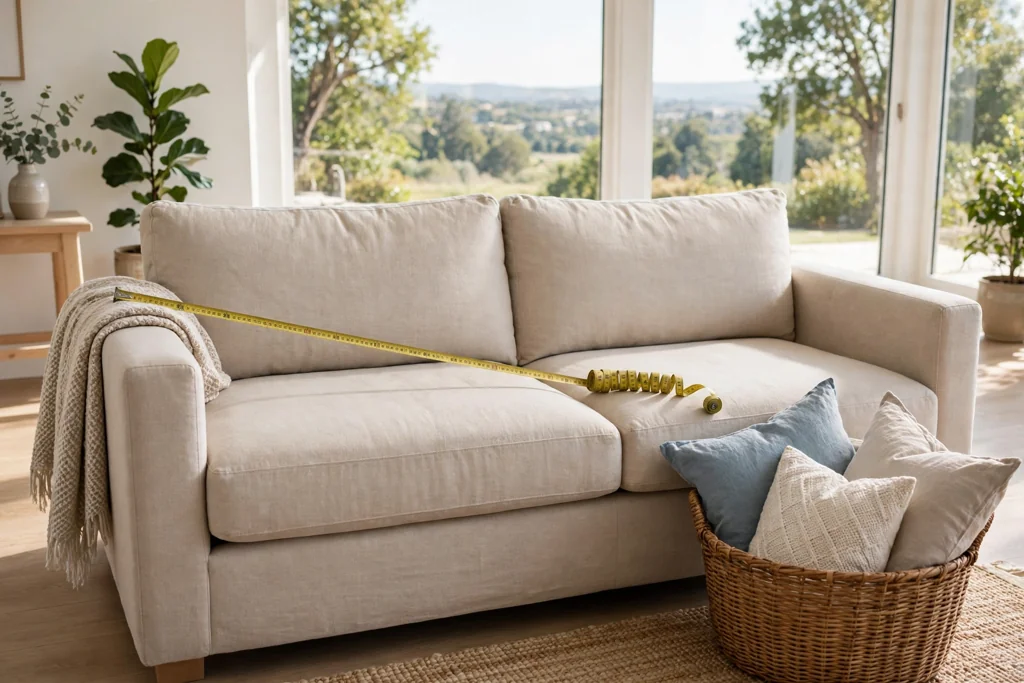
Remove every pillow, throw, and stray item from the sofa, and note the sofa width from outside arm to outside arm, the seat depth, and the height of the back and arms. A three seat sofa, a loveseat, and a long sectional each need a different count, and guessing that count is how sofas end up either crowded or bare.
Stand back and look at the empty sofa with the rug, curtains, and wall color in view. Note the colors already in the room, since pillows should link to at least one of them. Measure any pillow you already own as well, and set aside pillows that are flat, stained, or far too small for the sofa, since they will weaken the arrangement even if their color is right.
2. Set a Simple Color Palette
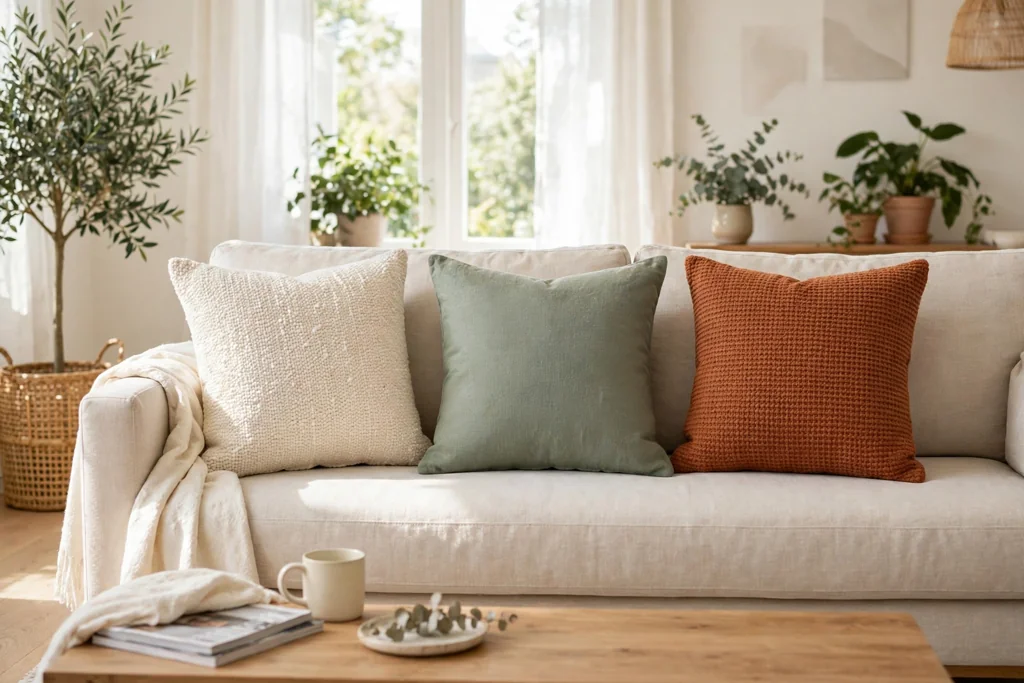
Choose two or three colors for the whole arrangement: one main neutral, one or two accents, and a repeat of a color already in the room, such as a rug, curtain, or piece of art. A small palette keeps a mix of patterns and textures from looking busy, and it makes it easy to swap one pillow later without starting over.
Repeat each accent color at least twice on the sofa, for example once on the left and once on the right, or once on a pillow and once on a throw. Avoid giving every pillow a different strong color, since the eye then has no resting place. If the sofa itself is patterned, use plainer pillows in one or two colors drawn from that pattern, so the pillows calm the sofa rather than compete with it.
3. Decide How Many Pillows the Sofa Needs

Let the sofa size set the count. A loveseat usually looks balanced with three or four pillows, a standard three seat sofa with five or six, and a long sofa or sectional with six to eight, counting both sides together. Fewer pillows suit a sofa used every day for sitting and napping, while more pillows suit a sofa that is mainly for looking at and light sitting.
Count seats, not just width, since a deep sofa can hold more pillows without crowding the sitter. As a check, once pillows are in place, a person should be able to sit in each main seat without first moving more than one pillow. If sitting requires clearing a pile, remove one pillow from each end and try again, even if the sofa looks a little less full at first.
4. Choose a Mix of Sizes and Shapes
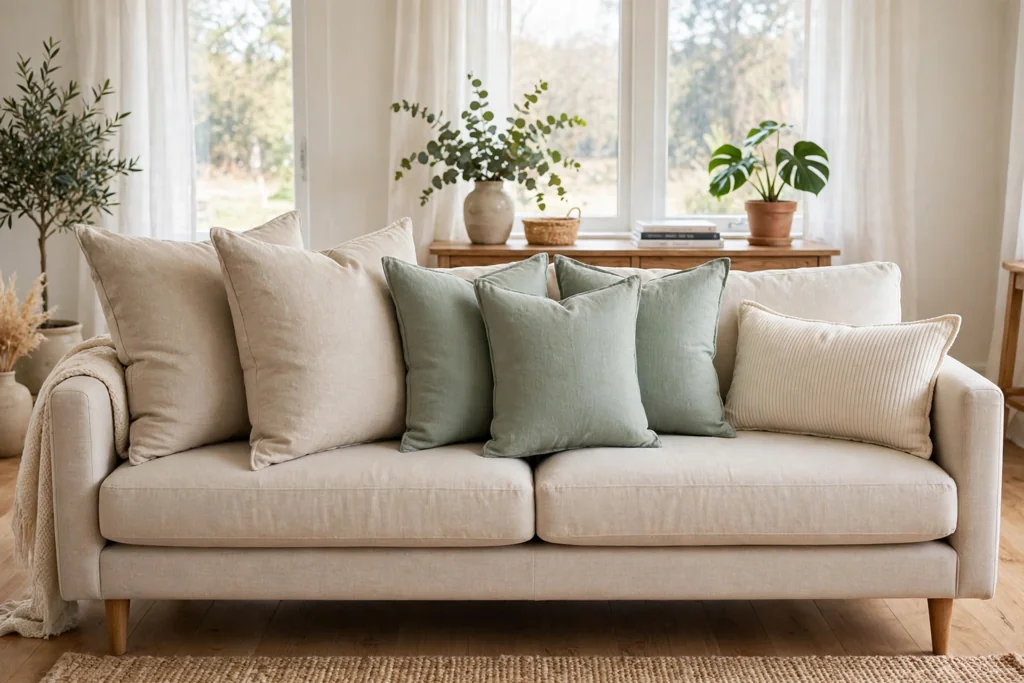
Use at least two sizes in one arrangement, such as large square pillows at the back and medium squares or a lumbar pillow in front. Common pairings include 22 inch squares at the ends with 20 inch squares in front, or 20 inch squares with a long lumbar pillow across the middle. The size step between layers is what gives the arrangement depth.
Add one shape change only if the sofa is wide enough, such as a single round pillow or one lumbar pillow near the center. Too many shapes at once can look scattered, so keep the rest of the pillows square. Check each pillow against the sofa back height as well: a pillow that towers above the back or sinks below the seat cushion will look out of scale, even in a good color.
5. Anchor Each End With the Largest Pillows
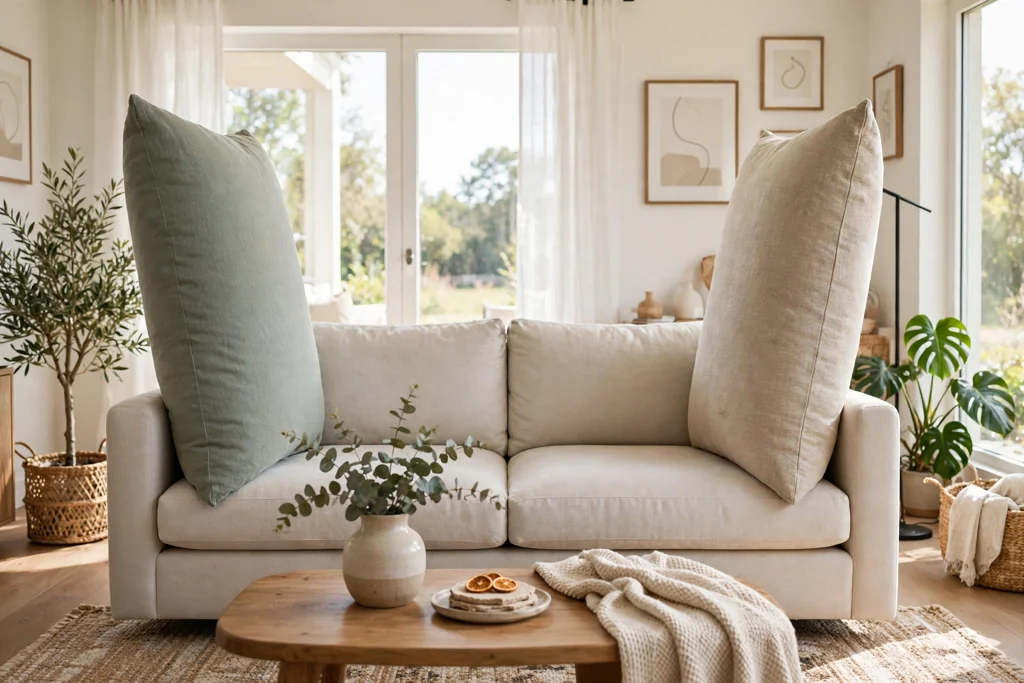
Place the largest pillows first, one at each end of the sofa, standing upright against the arms or slightly angled toward the center. These anchor pillows set the height and the outer shape of the arrangement, and every later pillow sits in front of them, not beside them in a flat row.
Angle each anchor pillow a little, with its outer corner tucked near the arm and its inner corner turned toward the middle of the sofa. This slight turn keeps the ends from looking stiff and flat, and it leaves a clear pocket in front of each anchor for the next layer. If the sofa has a chaise or corner section, anchor that end in the same way, then work toward the main seating area.
6. Layer Medium Pillows in Front of the Anchors
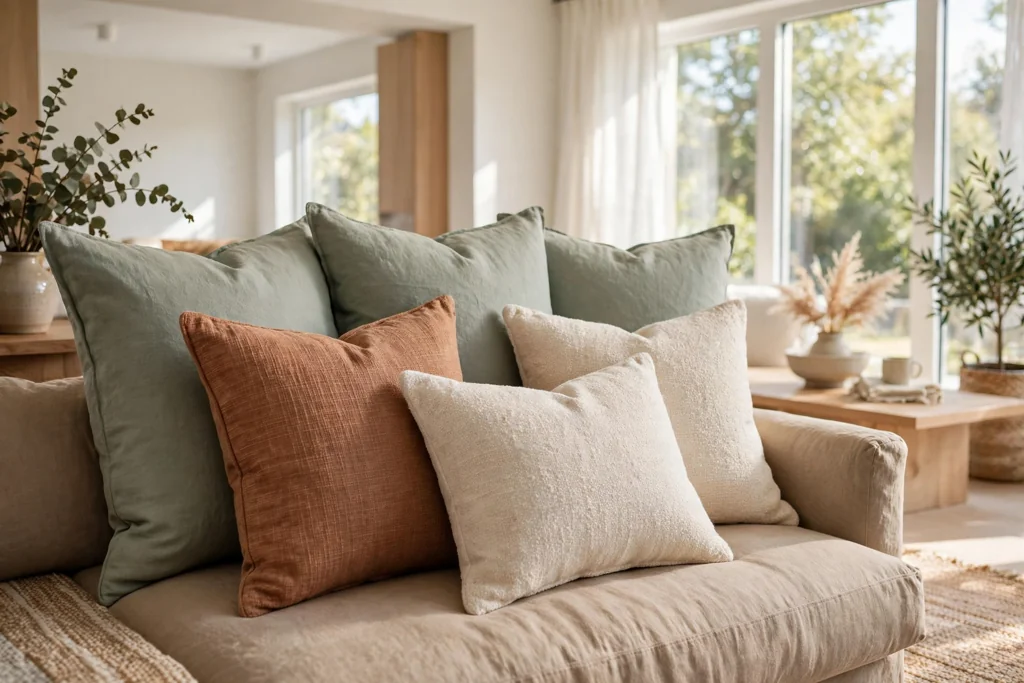
Set one medium pillow in front of each anchor pillow, slightly lower and slightly closer to the center. This second layer adds color and pattern where the eye naturally lands, and it softens the straight line of the sofa back without hiding the anchor pillows behind it.
Keep the medium pillows a little more upright than flat, and pull them forward just enough that their tops sit below the tops of the anchors. If a medium pillow keeps sliding forward, it may be too small for the seat depth, or the insert may be too soft. A firmer insert, or a cover one size smaller than the insert, helps a pillow hold its shape and stay in place.
7. Finish the Center With One Small Accent
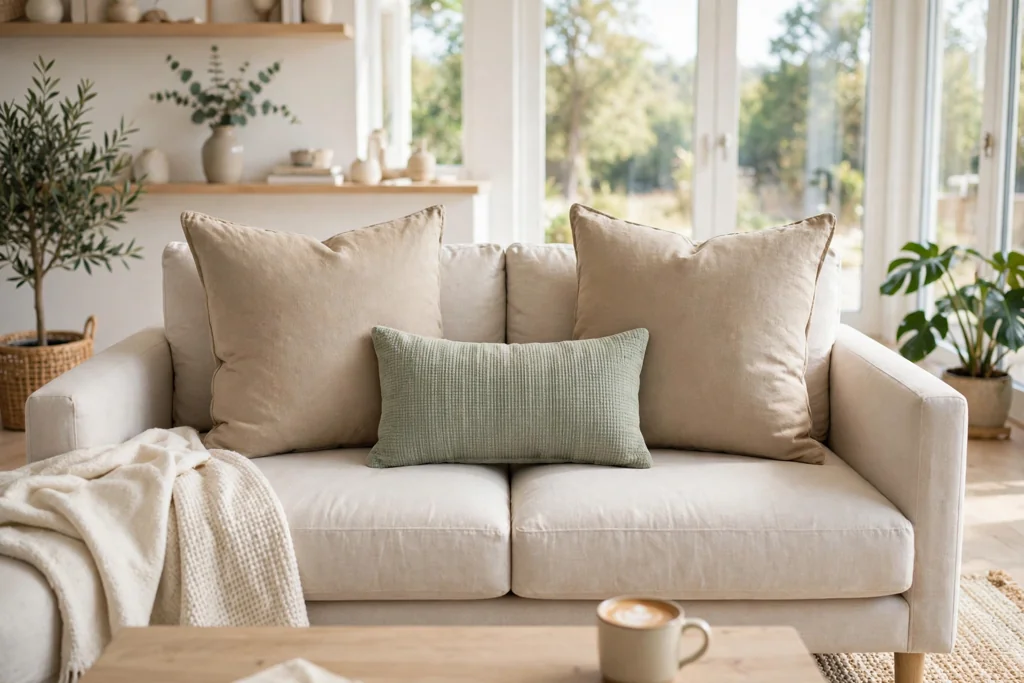
Add one small accent near the center of a three seat sofa, such as a lumbar pillow, a small square, or a round pillow, placed in front of the middle seat back. On a loveseat, skip the center accent or use a single small pillow only if two seats still have clear sitting space. On a sectional, use the center accent at the corner or at the join between sections, where it marks the turn.
Keep the center pillow the smallest in the group, and give it the strongest pattern or color if you want a focal point. A single bold center pillow works because the larger pillows around it are calmer. If the center pillow is also large and bold, the middle of the sofa will look heavy and the ends will seem to disappear.
8. Mix Textures and Limit Strong Patterns
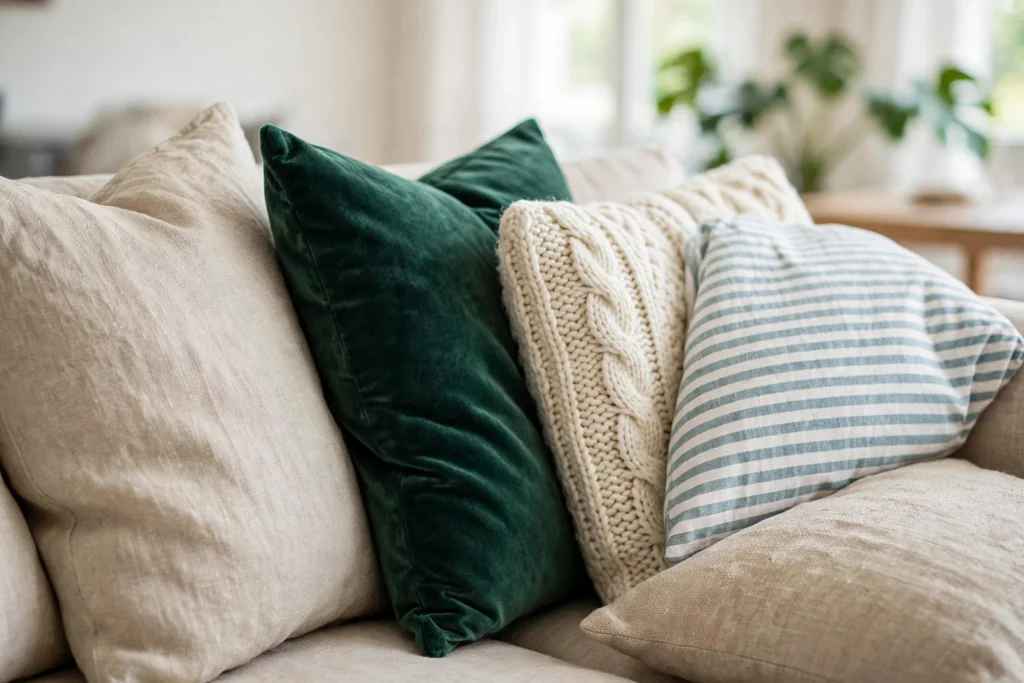
Pair smooth, nubby, and soft textures in one arrangement, such as linen beside velvet, cotton beside knit, or a woven cover beside a plain one. Texture adds interest without adding color, which is useful when the palette is small. Run a hand over each pillow in the group: if every pillow feels the same, swap one for a different weave.
Limit strong patterns to one or two pillows, and place a plain pillow next to each patterned one so the pattern has room to show. A stripe, a check, or a floral can each work, but two strong patterns side by side tend to fight. For a calm farmhouse style base to compare against, see these farmhouse decor ideas for the living room, where plain linen and one checked pattern carry most of the look.
9. Choose a Balanced Style: Symmetrical or Casual

Decide whether the sofa should read as symmetrical or casual, and then keep that choice on both sides. A symmetrical arrangement mirrors the left and right sides: same sizes, same colors in the same order, with one center pillow. It suits a formal living room, a pair of matching lamps, or a centered piece of art above the sofa.
A casual arrangement keeps the same sizes and colors but changes the order or the pattern on one side, for example a stripe on the left and a plain pillow on the right. Casual still needs balance: if one side has a dark pillow, the other side needs a dark pillow or a throw in a similar weight, or the sofa will look heavier on one side. Whichever style you choose, check it from the doorway, since that is the view most visitors see first.
10. Fluff, Angle, and Set Each Pillow by Hand
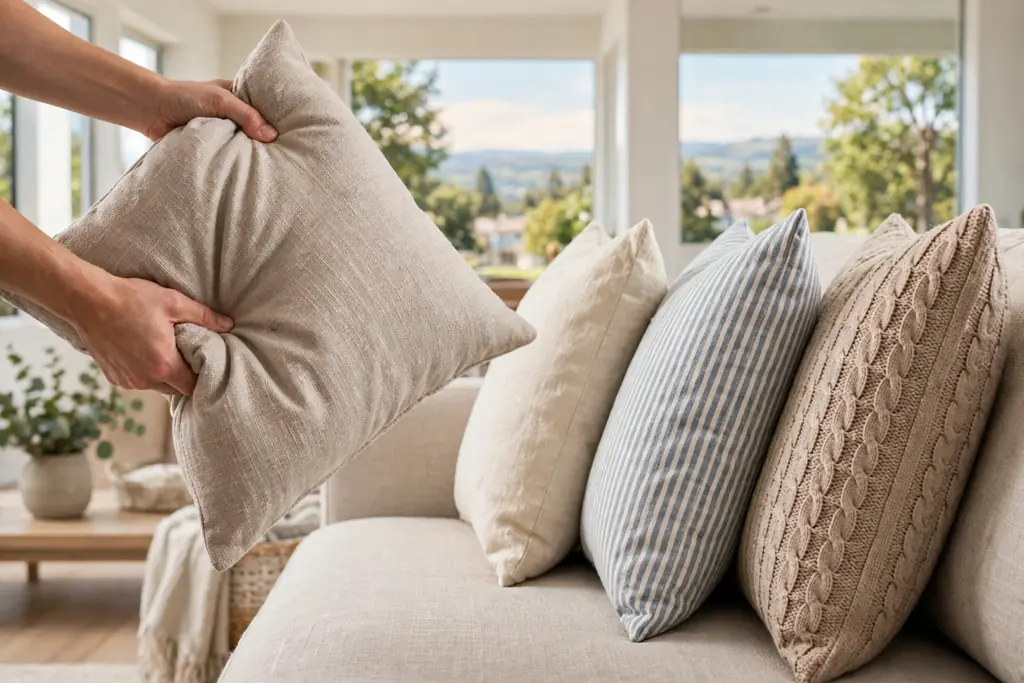
Fluff each pillow by holding opposite corners and pushing air into the center, then set it back in place and smooth the front face. Pull the top corners slightly forward and let the bottom edge sit against the seat cushion, so the pillow leans back at a slight angle rather than lying flat or standing stiffly upright.
For a soft, lived in crease down the middle of a square pillow, press the top center in with the side of your hand after fluffing. This is optional, and it works best on soft, down style inserts rather than firm foam. Avoid creasing every pillow in the same way, since identical creases can look staged. Two or three gently shaped pillows among plainer ones is enough.
11. Balance the Pillows With a Throw and Nearby Decor

Drape a throw over one arm, fold it across the back at one end, or fold it in thirds and lay it across a seat cushion that is not the main sitting spot. The throw should share at least one color or texture with the pillows, so the sofa reads as one group rather than as pillows plus an unrelated blanket.
Check the wall above the sofa and the coffee table in front of it as well. If the art is large and bold, keep the pillows a little calmer; if the wall is plain, the pillows can carry more pattern. Move any item that blocks the pillow arrangement from the doorway view, such as a tall plant directly in front of one end, so the balance you set can actually be seen.
12. Step Back, Sit Down, and Adjust for Comfort

Step back to the doorway and look at the whole sofa, then take a photo from across the room and check it. A photo often shows an uneven side or a color that stands out too much, even when the sofa looks fine up close. Shift one pillow at a time, rather than rebuilding the whole arrangement, until both sides feel equal in height, color weight, and pattern strength.
Then sit in each main seat and check comfort. You should be able to lean back without a pillow pressing into your neck at an odd angle, and you should not need to move more than one pillow to sit down. If a pillow is in the way, move it to the end, swap it for a smaller one, or remove it. A balanced look that no one can sit against will not stay balanced for long.
Conclusion
A balanced sofa pillow arrangement starts with an empty sofa and a small palette, then builds from large anchor pillows at the ends, through medium layers, to one small center accent. Repeat colors, mix textures, limit strong patterns, and keep the style the same on both sides. Finish by fluffing each pillow, adding a throw that shares a color, and sitting down to check comfort. Adjust one pillow at a time until the sofa looks even from the doorway and feels good to sit on. For more ideas from Dwell Ovell, browse the home page for home decor guides.
FAQs
How many throw pillows should I put on a sofa?
A loveseat usually looks balanced with three or four pillows, a standard three seat sofa with five or six, and a long sofa or sectional with six to eight in total. Choose the lower end of the range if the sofa is used daily for sitting and napping, and check that each main seat can be used without moving more than one pillow first.
What size throw pillows work best on a standard sofa?
Large 22 inch square pillows work well as anchors at the ends of a standard sofa, with 20 inch squares layered in front and a lumbar or small square as a center accent. The key is a clear size step between layers, so each pillow stays visible, and a pillow height that sits well against the sofa back rather than towering above it or sinking below the seat.
How do I arrange throw pillows so they look balanced but not stiff?
Anchor the largest pillows at the ends, layer medium pillows in front, and finish with one small center accent, then angle each pillow slightly toward the middle instead of lining them up in a flat row. Keep the same sizes and color weights on both sides, even in a casual arrangement, and fluff each pillow by hand so the group looks soft rather than rigid.
Should throw pillows match the sofa or contrast with it?
Throw pillows should link to the room, not necessarily match the sofa exactly, so repeat one or two colors from the rug, curtains, or art, and use plainer pillows if the sofa itself is patterned. A small palette with one main neutral and one or two accents keeps the arrangement calm, while one bold pillow can act as a focal point if the pillows around it are calmer.
How do I mix patterns on sofa pillows without clashing?
Limit strong patterns to one or two pillows, place a plain pillow next to each patterned one, and keep all patterns within the same two or three colors. Mix textures as well, such as linen beside velvet or cotton beside knit, since texture adds interest without adding another pattern or color that could compete.
How can I keep throw pillows from sliding or going flat?
Use a firmer insert, or a cover one size smaller than the insert, so the pillow holds its shape and stays upright against the sofa back. Fluff pillows by holding opposite corners and pushing air into the center, set the bottom edge against the seat cushion at a slight lean, and rotate and refluff pillows regularly so the fill does not settle on one side.