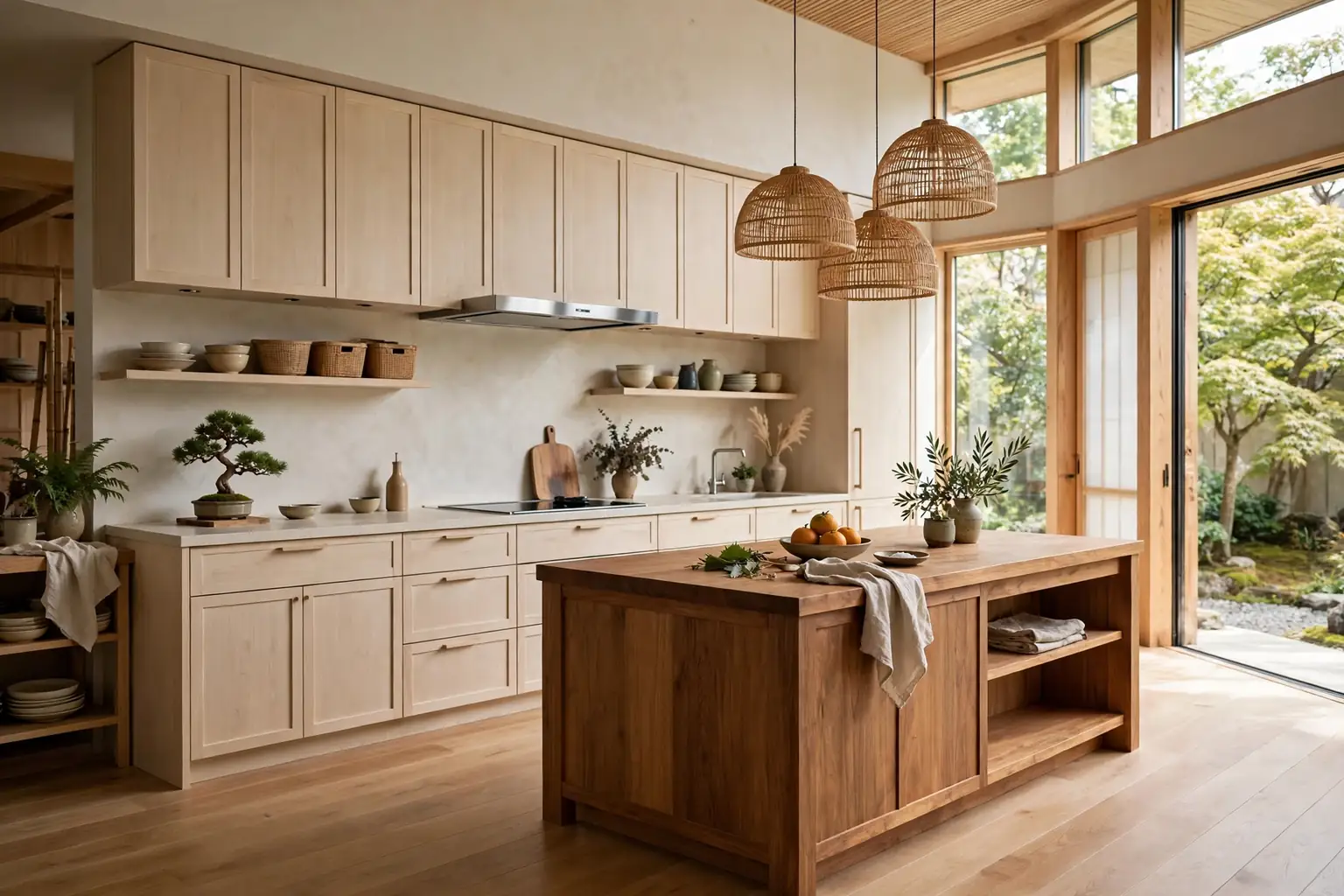
A Japanese kitchen works when it feels calm in the morning and warm in the evening. Pale wood, soft white, and one darker wood tone give the room its quiet base, while paper light, ceramics, and a single plant keep it comfortable for daily cooking and slow meals. These 22 Japanese kitchen ideas cover cabinets, screens, counters, light, storage, seating, and small finishing touches, so you can pick the changes that fit your layout and budget. Start with the change that fixes your biggest daily frustration, such as a crowded counter or a dark corner, and add the next idea only when the first one feels settled.
Key Takeaways
- Keep the base quiet: pale wood, soft white, and one darker wood tone, repeated through the room, carry most of the look.
- Use natural materials where hands land most: wood boards, ceramic bowls, linen cloths, and bamboo details warm a plain room fast.
- Give every daily item a closed home, and keep counters mostly clear, so the kitchen stays calm between meals.
- Layer the light: daylight first, then under-cabinet task light, then warm paper or simple pendants for evenings.
- Pick one feature per wall, a screen, a shelf, a tea corner, or a display alcove, rather than adding every idea at once.
- Start small if you rent or plan a larger change later: textiles, stools, a tray, and lighting shift the feel with no cabinet work.
1. Pale Wood Flat-Front Cabinets
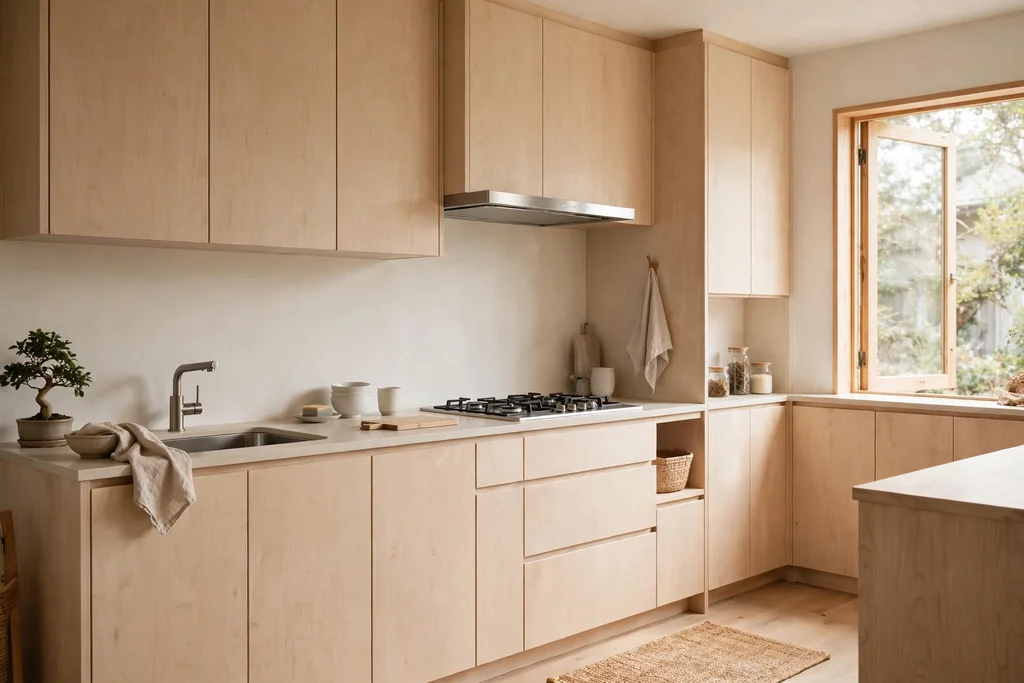
Pale wood flat-front cabinets give a Japanese kitchen its calm base, with long, quiet lines and no raised panels to catch the eye. Light oak or ash keeps the room bright, and a matte finish shows fewer marks than gloss in a busy cooking space. Keep the cabinet color close to the wall color, so the run reads as one soft surface, and let the wood grain add the detail.
Pair the pale cabinets with a plain counter and simple hardware in black or brushed metal, so no single surface fights for attention. For a pale starting point that pairs well with wood, see these white kitchen ideas. Test the wood tone beside your floor and counter in daylight and evening light first, since pale wood shifts a lot under kitchen lighting.
2. Shoji Style Sliding Panels
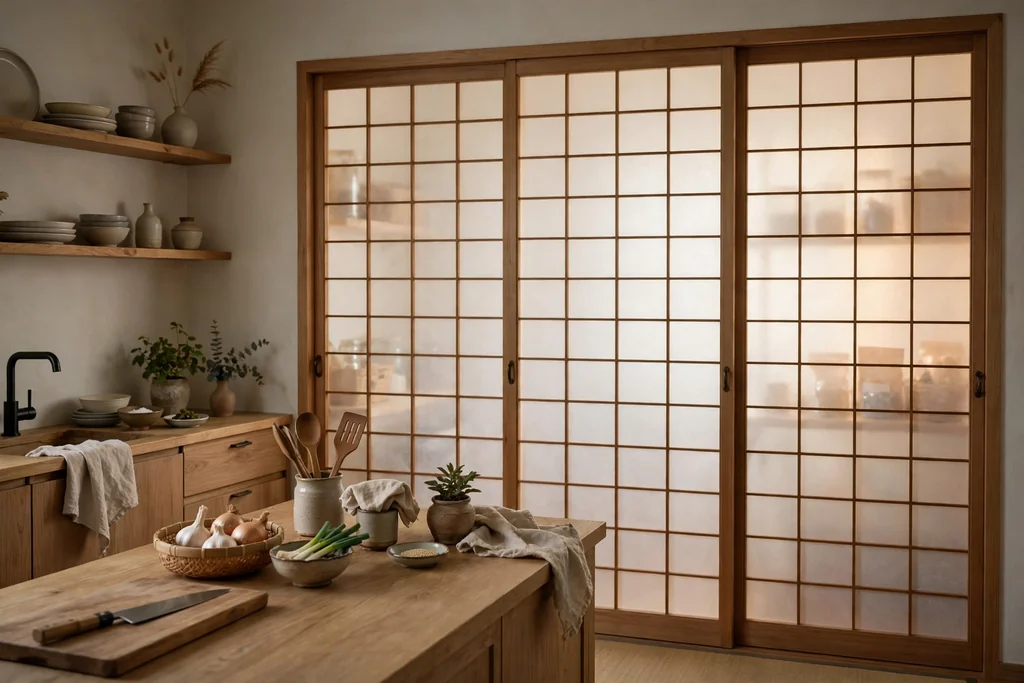
Shoji style sliding panels, with a wood frame and a translucent panel, soften a kitchen without closing it off. Use them to screen a pantry, a laundry corner, or the opening to a dining area, so light still passes through while the view stays gentle. The grid pattern gives the wall a clear rhythm, and the panels slide rather than swing, which saves floor space in a small kitchen.
Choose a frame in the same wood tone as the cabinets, and keep the panel material wipeable where it sits near cooking steam. Fix the track level and test the slide with wet hands, since a panel that sticks will soon stay shut. In a rented home, a freestanding screen in the same style gives a similar soft division with no fixed track.
3. A Warm Wood Island with Slim Seating
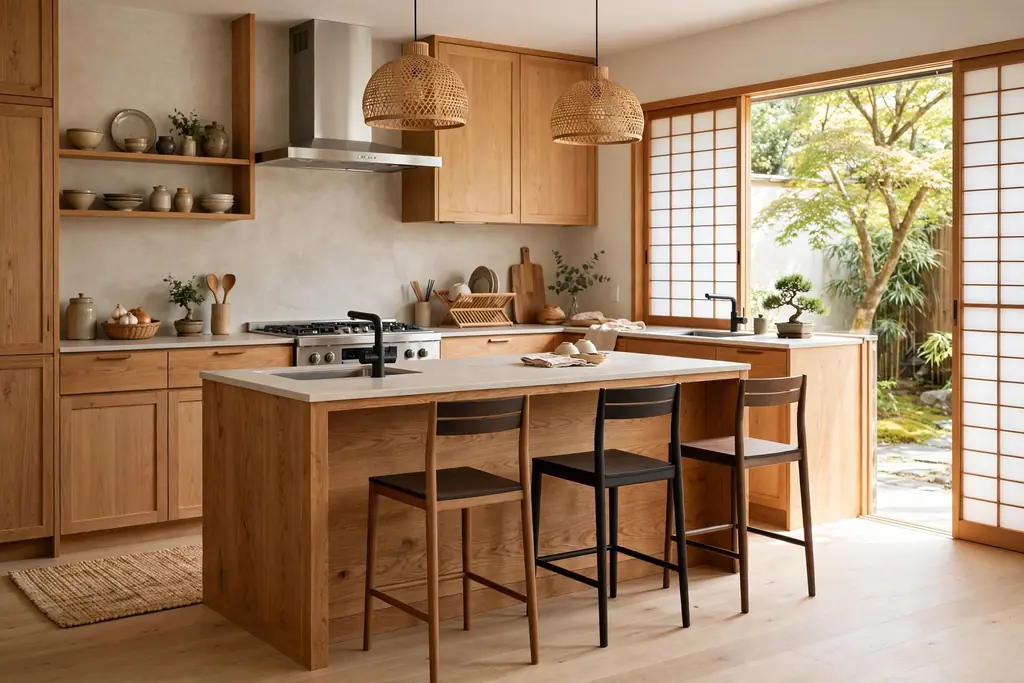
A warm wood island anchors a Japanese kitchen as both a work surface and a gathering spot. Oak or walnut keeps the island warm in tone, so it does not darken an open plan room, and a plain slab or butcher block top feels warm to the touch for casual meals. Keep the island front simple, with flat panels and no extra trim, so the wood itself carries the look.
Leave a clear overhang on the seating side, and choose slim stools in wood or with a dark metal frame that slide fully underneath. Two or three stools are enough for most islands, and they keep the walkway clear when the island is used for prep. Keep the island top mostly clear apart from one tray or a small vase, so it can shift from cooking to eating without a full tidy first.
4. Open Shelves for Everyday Ceramics
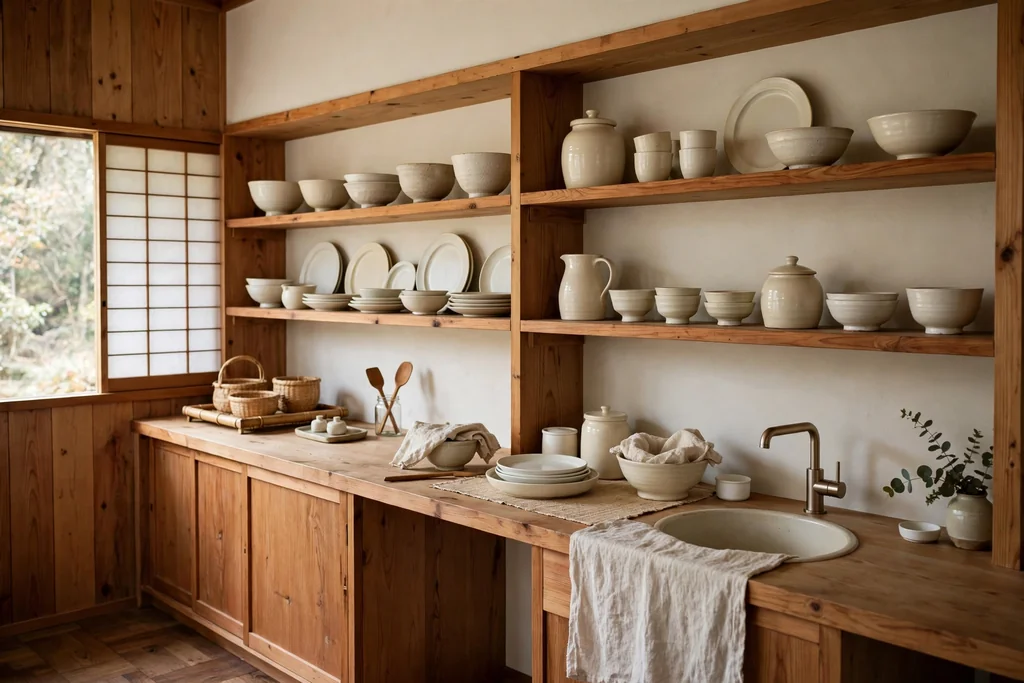
One or two runs of open wood shelves replace a block of upper cabinets with a lighter wall, and they suit a kitchen where daily dishes deserve an easy home. White, cream, and soft grey bowls, plates, and cups read as a calm group against pale wood, and the shelves stop a long cabinet run from feeling heavy. This works best on one wall or beside a window, rather than on every wall at once.
Limit each shelf to items you use weekly, in a small range of colors, and leave at least a third of each shelf empty. Stack plates in one group, stand bowls in a short row, and add one small plant at the end. Dust the shelves weekly, since open storage near cooking collects a light film faster than closed cabinets, and keep the remaining storage closed for items you use less often.
5. A Dark Wood Anchor in a Pale Room
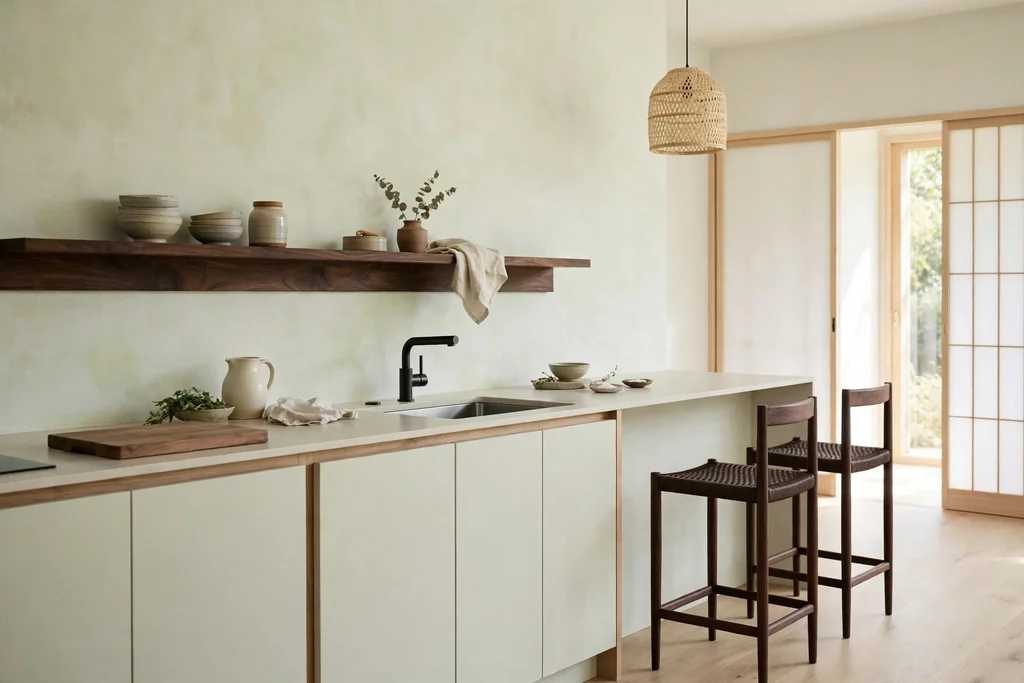
A single dark wood anchor stops a pale Japanese kitchen from looking washed out, and walnut is the simplest way to add it. A dark wood shelf, a walnut island top, or dark stool frames give the eye a place to land, and the contrast makes pale cabinets and pale counters look crisper. This is the smallest change on this list, and often the most effective.
Repeat the dark wood in just two places, such as the shelf and the stool frames, and keep everything else pale. Avoid adding dark cabinets, dark counters, and dark floors at the same time, since that turns a pale kitchen into a dark one. If you rent, dark stools and a dark tray give the same anchor with no fixed change, and they can move with you.
6. Washi Paper Pendant Lighting
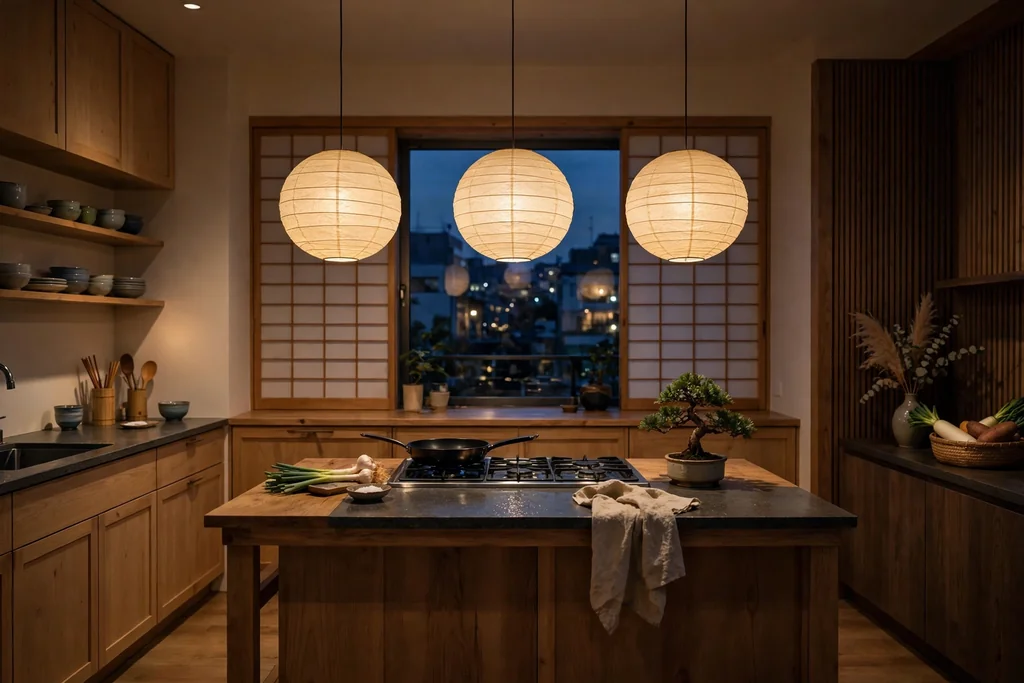
Paper pendants give a Japanese kitchen its soft evening glow, with light that spreads evenly rather than glaring from one bulb. A round or oval paper shade over an island or table suits the room because it reads as one simple shape, and the warm light flatters wood, ceramic, and food alike. Hang one large shade, or two smaller shades in a row, rather than a cluster of mixed fixtures.
Hang pendants high enough to see across the table, and keep the lowest point well above the counter. Keep paper shades clear of the hob and open flames, and choose a bulb with a warm white color so food and wood tones look natural. Wipe shades gently with a dry cloth, since kitchen air leaves a light film on paper over time.
7. A Tea Corner for Matcha and Teaware
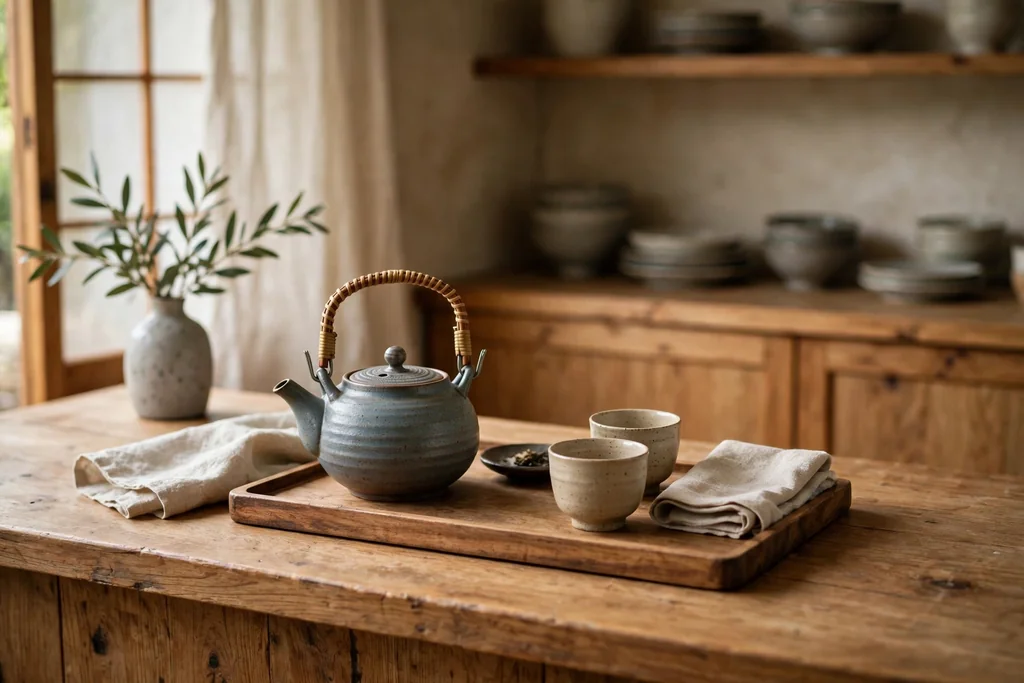
A tea corner gives a Japanese kitchen a slow, daily ritual, with a set place for a kettle, cups, and tea. Use one short counter run, a tray on the counter, or a single open shelf, and keep the teaware to a small set of matching or related pieces. A cast iron or ceramic teapot, two or three cups, and a tin for tea leaves are enough, and the corner stays calm when nothing extra joins it.
Keep the tea corner near the kettle and away from the main prep run, so making tea does not block cooking. Store tea in a closed tin away from heat and strong smells, and wash cups by hand where the maker advises it. A small tray under the cups catches drips and lets you lift the whole corner away for cleaning.
8. Bamboo Details on Shelves and Boards
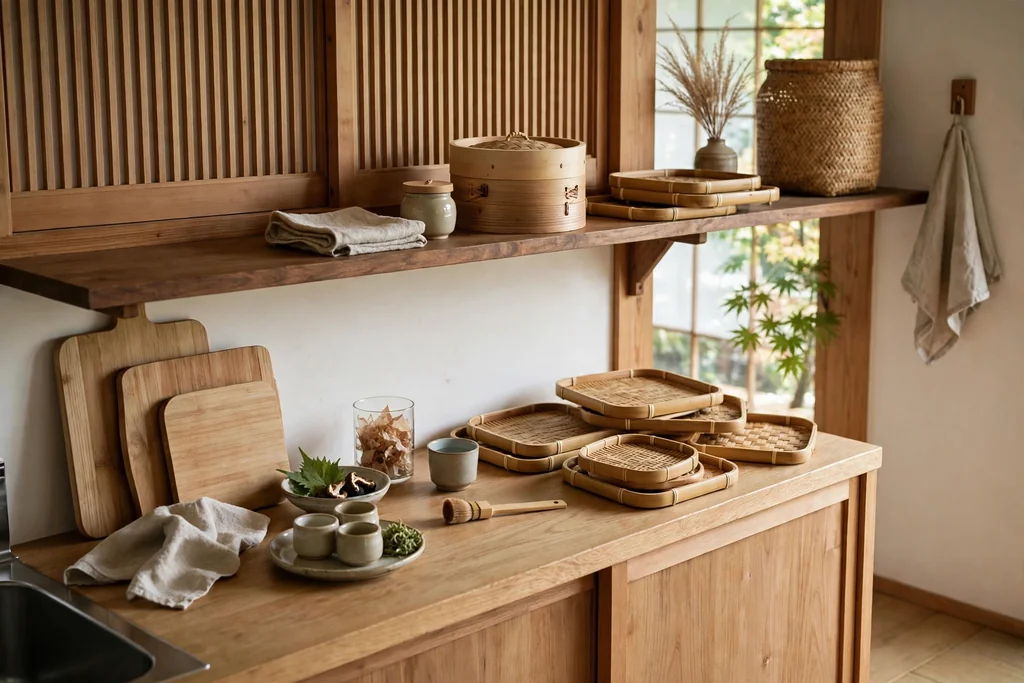
Bamboo adds a light, natural note to a Japanese kitchen without a large change. A bamboo tray, a set of bamboo boards, chopstick rests, or a bamboo mat under a vase each add a fine texture that the eye can rest on. Use two or three bamboo items in the room, rather than one of everything, so the material reads as a thread, not a theme.
Keep bamboo boards for serving and light prep, and dry them well after washing, since bamboo stays damp longer than plastic. Keep bamboo trays clear of the sink splash zone where you can, and oil boards as the maker directs. A bamboo steamer, stored on an open shelf, doubles as useful cookware and as a quiet display piece.
9. Clear Counters with a Tray Rule
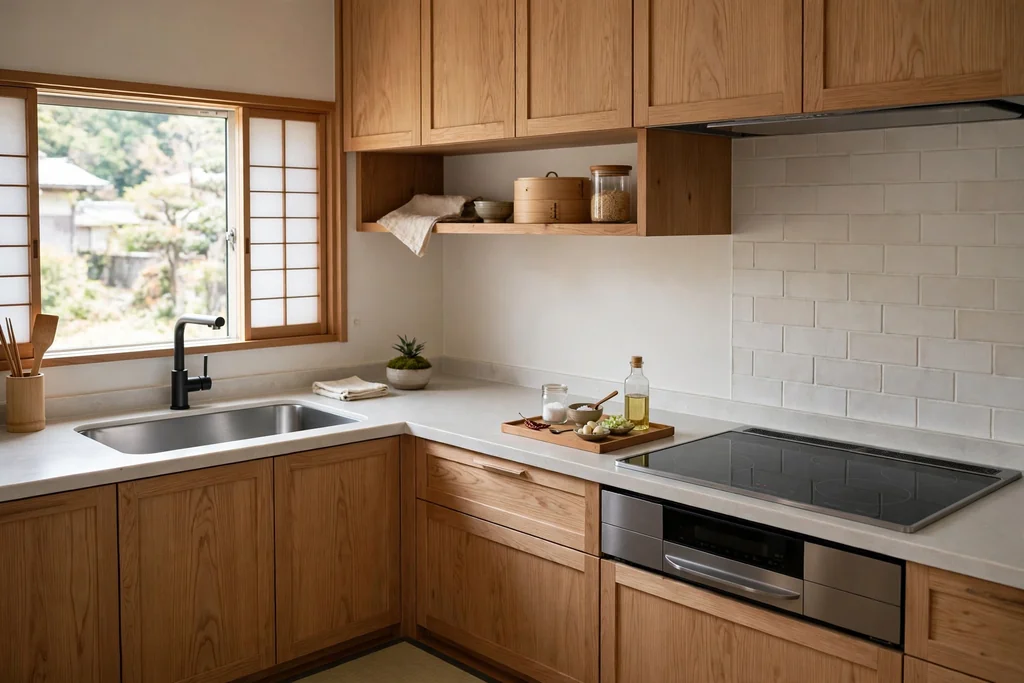
Clear counters give a Japanese kitchen its calm surface, and a tray rule makes the clear counter easy to keep. A small tray for oil, salt, and a spoon rest near the hob, plus a second tray for tea items, is enough for most kitchens. The tray keeps daily tools grouped, so the counter still looks clear even when you are cooking.
Work through one counter run at a time, and give each item you remove a real home: a drawer, a cabinet shelf, or a wall rail. If an item has no home, it will drift back to the counter within a week. For a pared back approach to the whole room, these minimalist modern kitchen ideas share the same flat-front, clear-counter logic. Wipe the tray when you wipe the counter, and keep the tray size small, since a large tray invites extra items to join it.
10. Concealed Storage and Panel-Ready Appliances
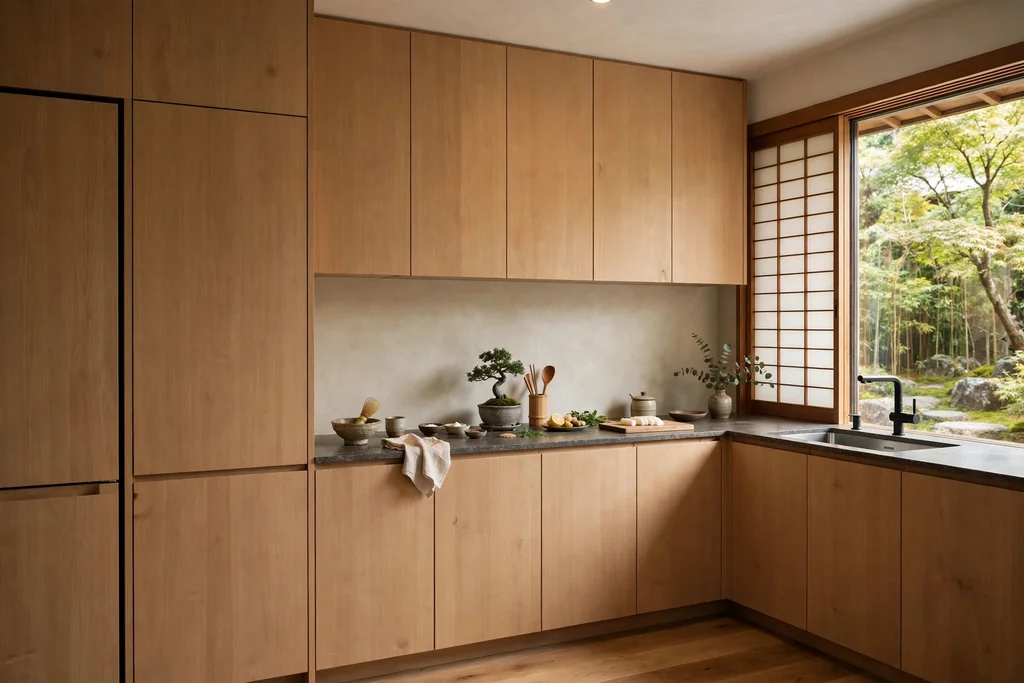
Panel-ready appliances, or tall units that hide the fridge and dishwasher, give a Japanese kitchen long cabinet lines with no steel breaks. When the fridge and dishwasher wear the same fronts as the cabinets, the room reads as furniture rather than a row of machines, which suits an open plan kitchen most, where the kitchen faces the living area. Keep the oven and hob visible if you cook often, since a hidden oven can be less handy.
Check ventilation and door clearance with the maker guidance before ordering panels, since integrated appliances need exact fitting. Hide the largest items first, and put the effort into the fridge and dishwasher before smaller appliances. Add an appliance garage, a cabinet with a lift or tambour door, for a kettle and toaster, so small machines also stay out of sight between uses.
11. A Deep Simple Sink with a Wood Board
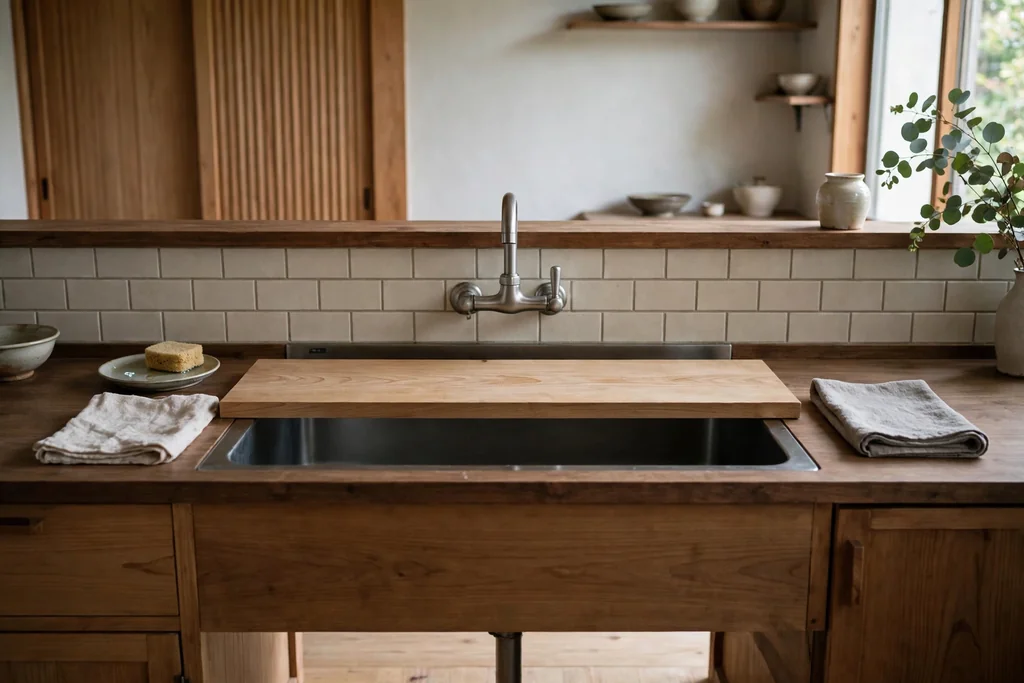
A deep, simple sink suits a Japanese kitchen because it handles large pots and baking trays without fuss, and it keeps the sink wall quiet. Choose a single large basin in stainless steel or ceramic, with a plain tap in black or brushed metal, and skip extra fittings that crowd the wall. A wood board that fits over part of the basin adds prep space in a small kitchen and warms the steel or ceramic.
Keep the area around the sink clear, with a dish rack or a folded linen cloth nearby, and let the sink do its job rather than adding a busy backsplash behind it. Wipe the sink after cooking, and oil the wood board as the maker directs so it keeps an even look. A single large basin suits most cooks better than a split basin in a compact kitchen.
12. A Low Table Dining Nook
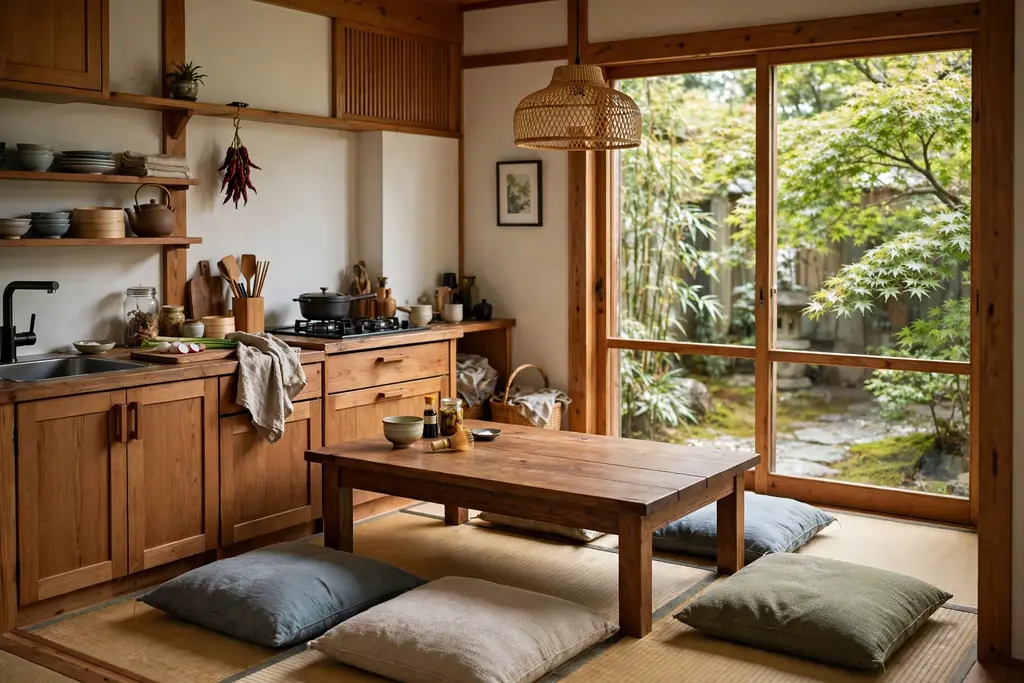
A low table nook gives a Japanese kitchen its comfortable side: a set place for slow meals that does not need a full dining room. A low wood table, floor cushions or a low bench along the wall, and a simple pendant above make the corner inviting, while the bench can hide placemats and table linens underneath. This suits a corner by a window best, where daylight does much of the work.
Choose cushion covers you can remove and wash, since a dining seat gets daily use, and keep the table top wipeable for meals and homework alike. Keep the nook to one material link with the kitchen, such as the same wood as the island, so it reads as part of the room. If floor seating does not suit your household, use a standard height table with low backed chairs in the same wood, and keep the rest of the nook just as simple.
13. One Plant, Well Placed
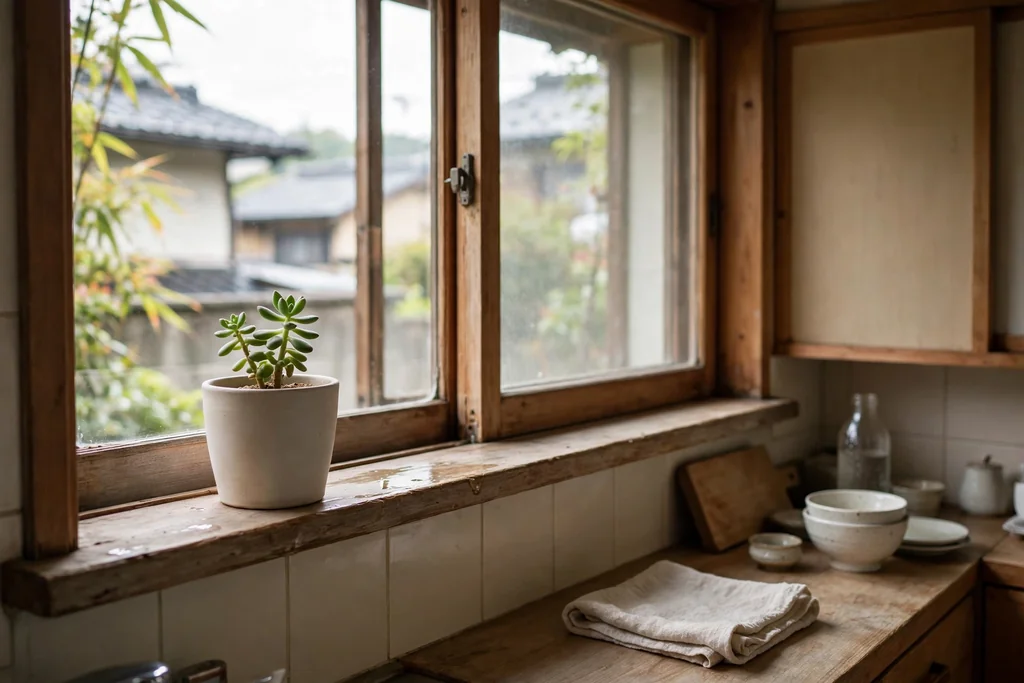
One plant, well placed, brings the natural side of a Japanese kitchen into the room without turning it into a display. A small potted maple on a shelf, a bonsai on the windowsill, or a single stem in a tall vase on the counter each add a living line against pale wood and soft white. Keep the plant in a plain ceramic or stone pot, so the plant, not the pot, carries the interest.
Water plants over the sink, not at the table, and choose a pot with a saucer to protect wood and paint. Keep plants off the main prep counter, except for one small pot that lifts away for cleaning, so work surfaces stay clear. If the windowsill is narrow, use one wall rail with a hanging pot above the sink instead, and keep the plant where it gets the light its type needs.
14. A Soft Neutral Palette with an Indigo Accent
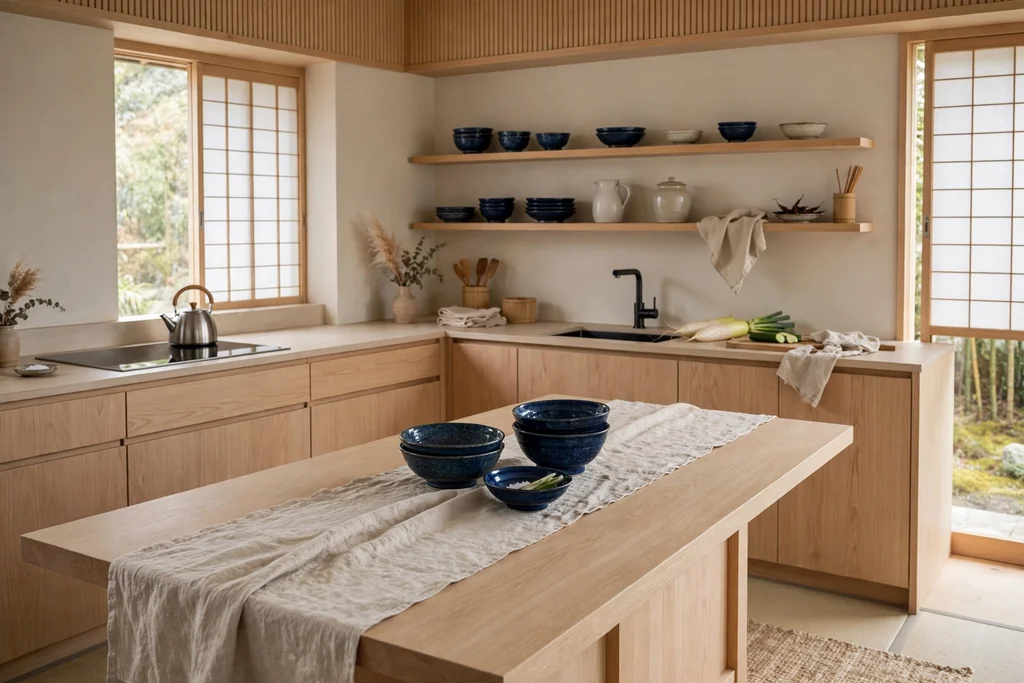
A soft neutral palette, warm white, pale grey, and light wood, keeps a Japanese kitchen calm, and one indigo accent stops it from feeling flat. Use indigo in just two places, such as a linen runner and a set of ceramic bowls, or a single painted stool, so the deep blue reads as a planned note rather than a new theme. Indigo suits wood and white because it echoes traditional Japanese textiles without adding strong pattern.
Test the indigo beside your cabinets and floor in daylight first, since deep blue looks darker on a large area than on a sample. Keep the rest of the room plain, with no competing bright colors, so the accent stays clear. If you want more pattern, use a simple indigo stripe on a linen cloth, and keep walls, counters, and cabinets free of pattern.
15. A Handmade Tile Backsplash in Cream and Grey
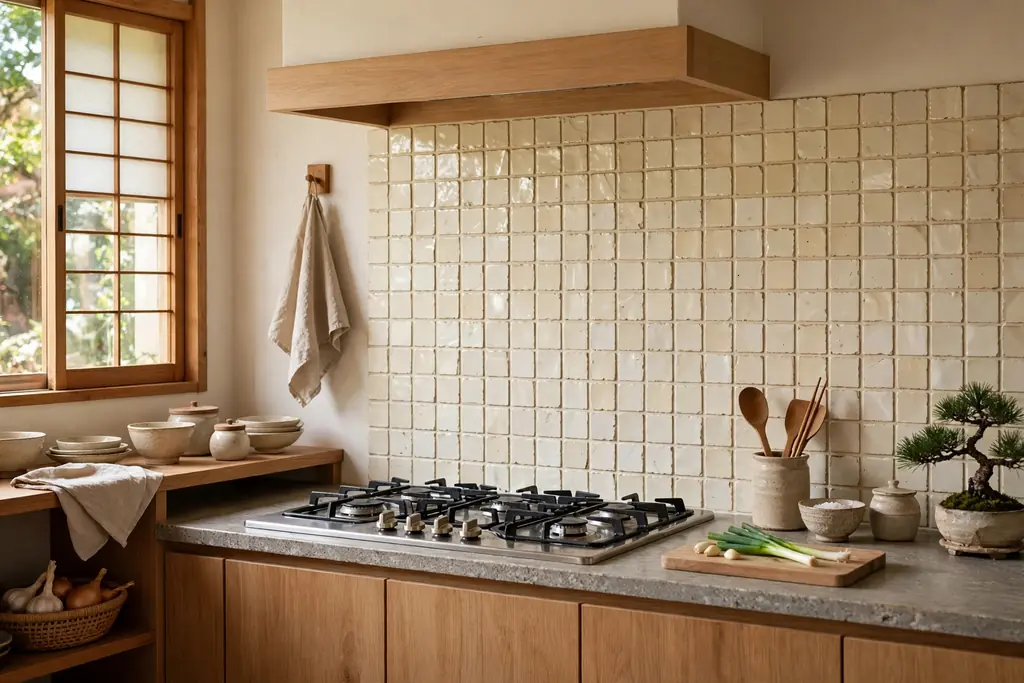
A handmade tile backsplash adds texture to a pale Japanese kitchen without adding strong color. Slight differences in tone and glaze catch light in a way flat tiles cannot, so the wall reads as crafted rather than factory perfect, and cream keeps the room warm where a bright white tile can feel cold. Use the tile on the backsplash only, and keep counters and cabinets plain, so the texture stays the focus.
Order extra tiles, since handmade batches vary and a few spares help if a tile chips later. Seal the grout to keep cooking splashes from staining it, and wipe the surface with a soft cloth during a normal clean. If you want more pattern, lay the tiles in a stacked layout on one wall, and keep the rest of the backsplash simple.
16. A Window Framed as a Garden View
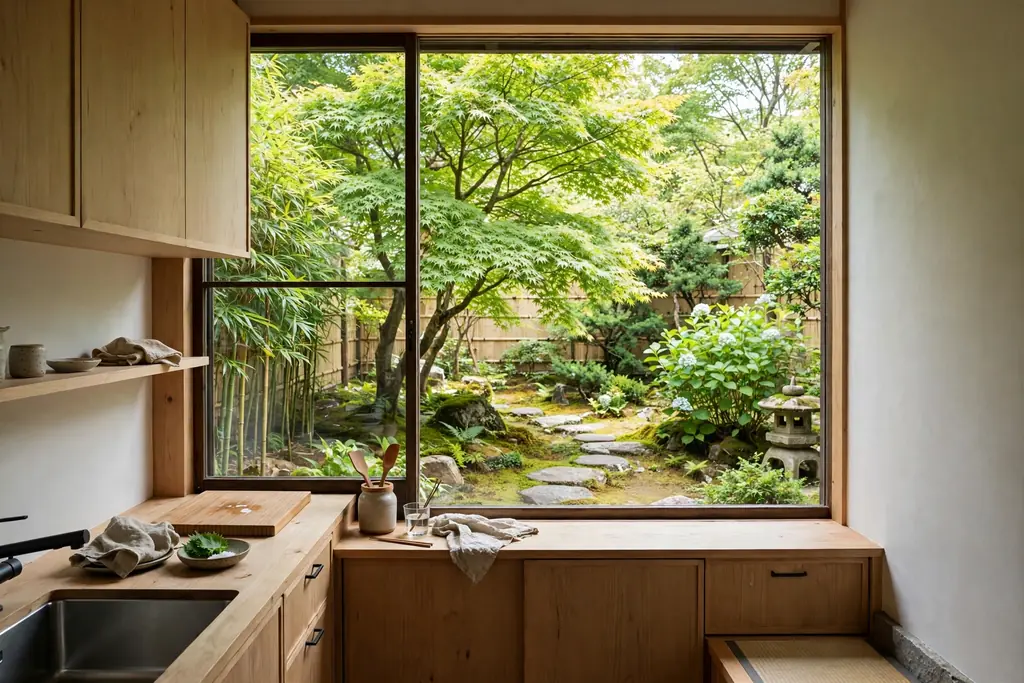
Daylight is the main light source in a Japanese kitchen, so treat the window as a framed view, not an afterthought. Keep the window mostly clear, with a simple roller blind or sheer linen for privacy, so daylight reaches pale cabinets and wood floors. Hang linen high and wide if you use curtains, so the window looks larger and the fabric clears the counter.
Keep the sill to one or two items, such as a small plant or a soap tray, so light stays unblocked and the sill stays easy to wipe. Choose a plain linen in white or oatmeal, and keep fabric well clear of the hob and open flames. If privacy is a concern, add a simple blind inside the frame for evenings, and leave the linen in place for daytime softness.
17. A Compact Galley Layout with Clear Zones
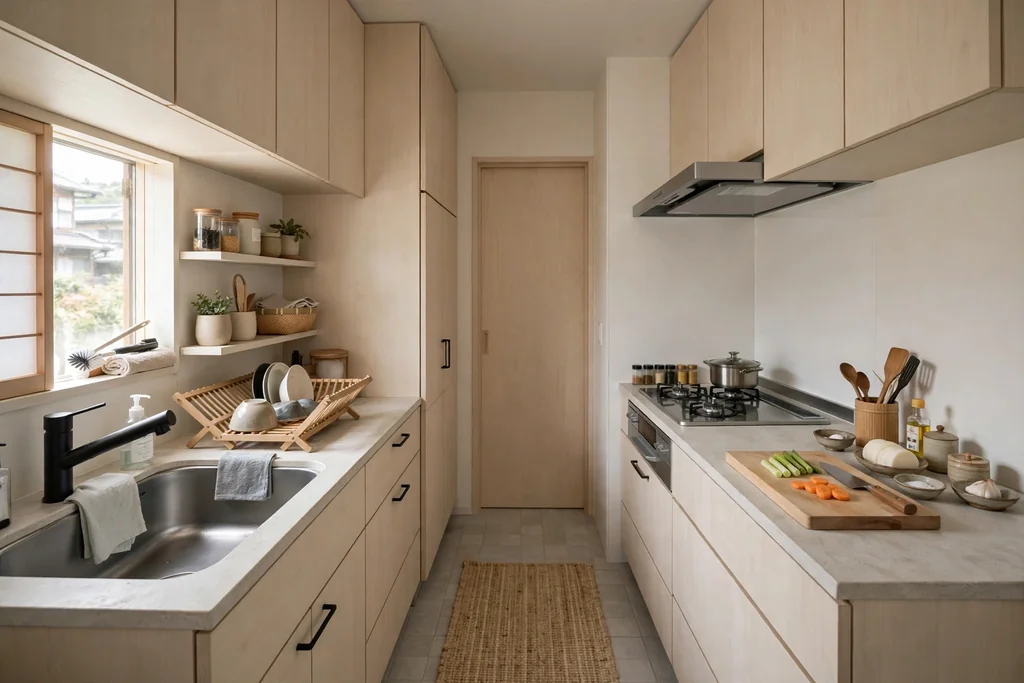
A compact galley layout suits a Japanese kitchen because it keeps cooking, prep, and storage in short, clear zones. Put the sink, hob, and fridge in a simple work line, with prep space between the sink and hob, and keep the walkway clear of stools, bins, and extra furniture. This layout works in a small flat and in a narrow room, where every step should count.
Plan storage by zone: cooking tools near the hob, dishes near the sink or dishwasher, and dry food in one pantry run. Use deep drawers for heavy pans, since you can see and reach the back without unloading the front. Keep one counter run free for serving, so the galley does not fill with items that belong in a cabinet.
18. A Ceramic Display of One Collection
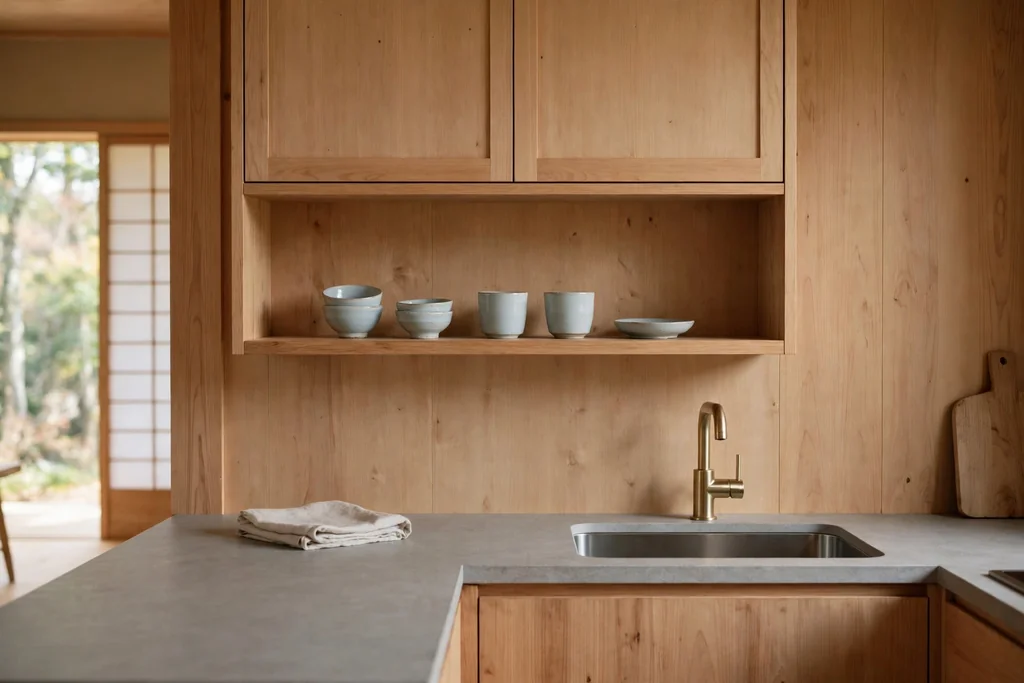
A ceramic display gives a Japanese kitchen character when it shows one collection, not many. Choose one set of bowls, cups, or vases in a small range of colors, and show it on one open shelf or in one glass-front cabinet, with space around each piece. The display reads as calm because the eye sees a group, not a crowd, and the pieces you show are the pieces you use.
Keep what you show to items you use weekly, and leave at least a third of the shelf empty so the cabinet does not look crowded. Put daily items on lower shelves, where they are easy to reach, and add a small light inside the cabinet if you want the display to glow in the evening. If the collection grows, rotate pieces in and out rather than filling every shelf.
19. Woven Textures in Linen, Rattan, and Straw
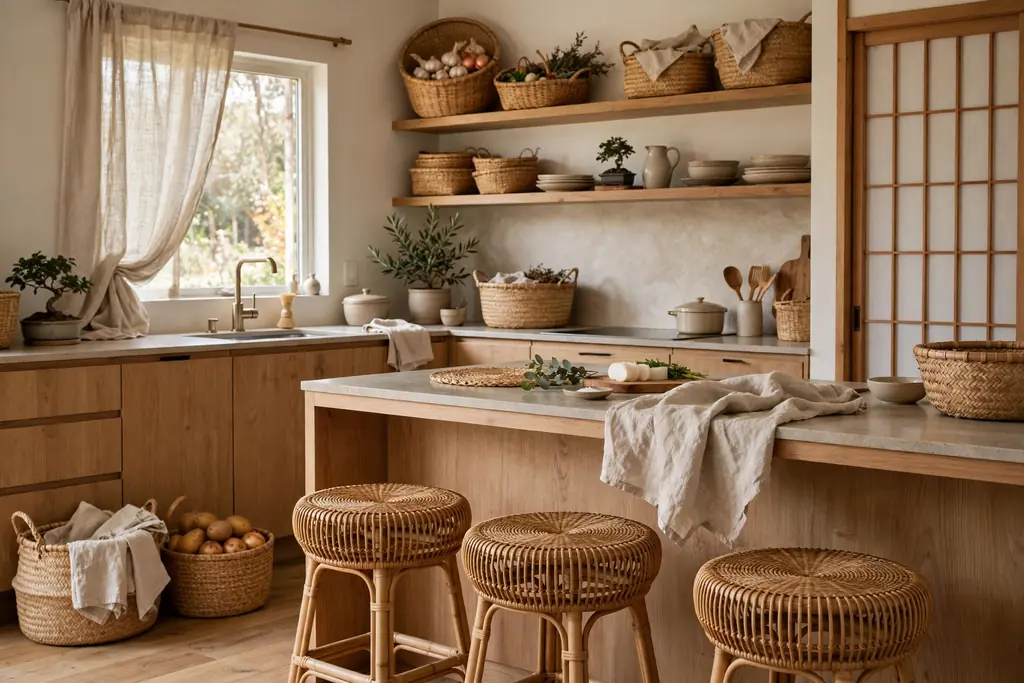
Woven textures stop a pale Japanese kitchen from feeling flat, and they add warmth without color. A linen runner, rattan stool seats, a woven basket for bread or produce, and a straw tray each add a natural pattern that the eye can rest on. Use two or three woven items in the room, rather than one of everything, so the texture reads as a thread, not a theme.
Keep baskets for items you use often, such as bread, onions, or cloths, and sort them by use so they stay tidy. Wipe rattan and straw with a dry cloth, and keep woven items clear of the sink splash zone, since damp softens natural fibers over time. A woven pendant shade over the table repeats the same texture at eye level, if the room needs one more warm note.
20. A Natural Counter Mix of Stone and Wood
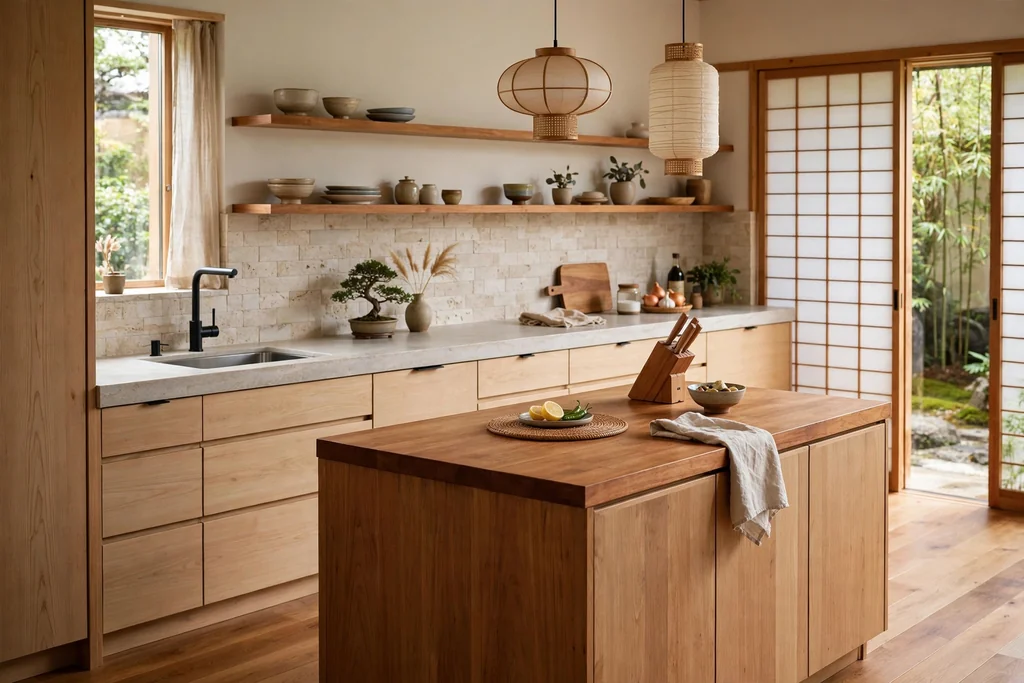
A natural counter mix, pale stone on the main run and warm wood on the island or one section, gives a Japanese kitchen both a hard work surface and a warm touch point. Stone suits the sink and hob runs, where heat and water are daily facts, while wood suits the island, where meals and casual prep happen. The mix keeps the room calm because both materials stay plain in color.
Oil the wood on a regular schedule, wipe spills promptly, and use boards for cutting so the surface keeps an even look. Near the sink, a stone section avoids constant water contact on wood, so the wood stays in good shape longer. Keep the stone tone close to the cabinet color, so the two counter materials read as one planned pair rather than two competing features.
21. A Seasonal Display Alcove Shelf
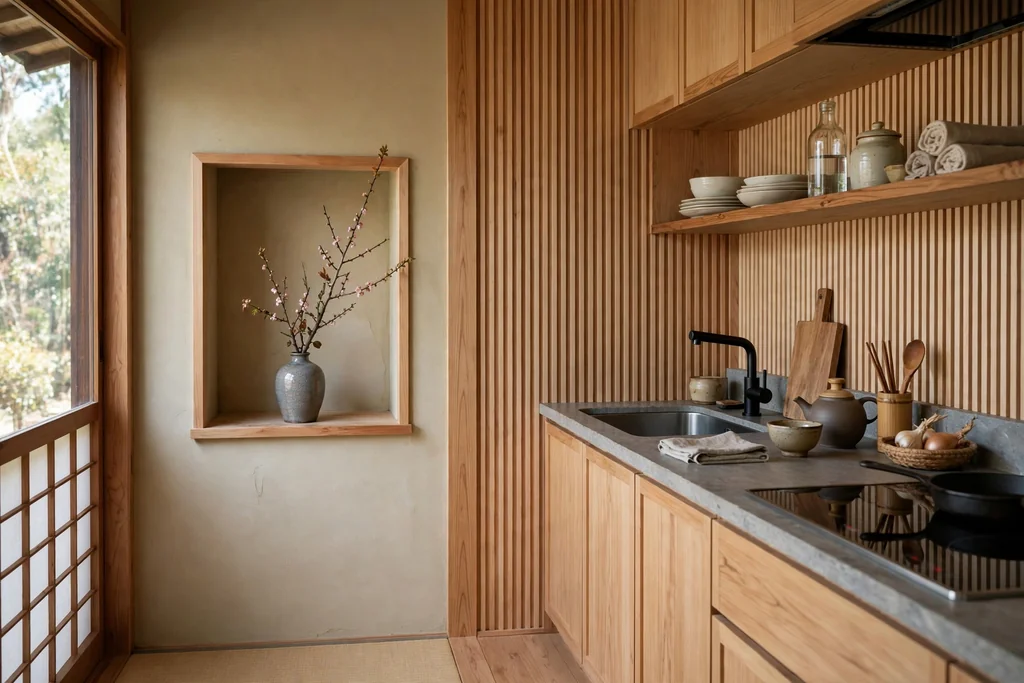
A small display alcove, inspired by a tokonoma shelf, gives a Japanese kitchen a place for one seasonal change. Use a shallow recess, a single shelf at eye level, or a short wall niche, and show one item at a time: a vase with a branch, a small ceramic, or a framed print. Changing the item with the season keeps the kitchen feeling current without buying new decor each month.
Keep the alcove to one item and one small base, such as a plain tray or a linen cloth, so the display stays quiet. Put the alcove away from the hob and sink splash, and keep it at a height where it can be seen but not knocked during cooking. If you have no recess, a single floating shelf in the same wood as the cabinets gives the same effect on a plain wall.
22. Warm Layered Evening Light
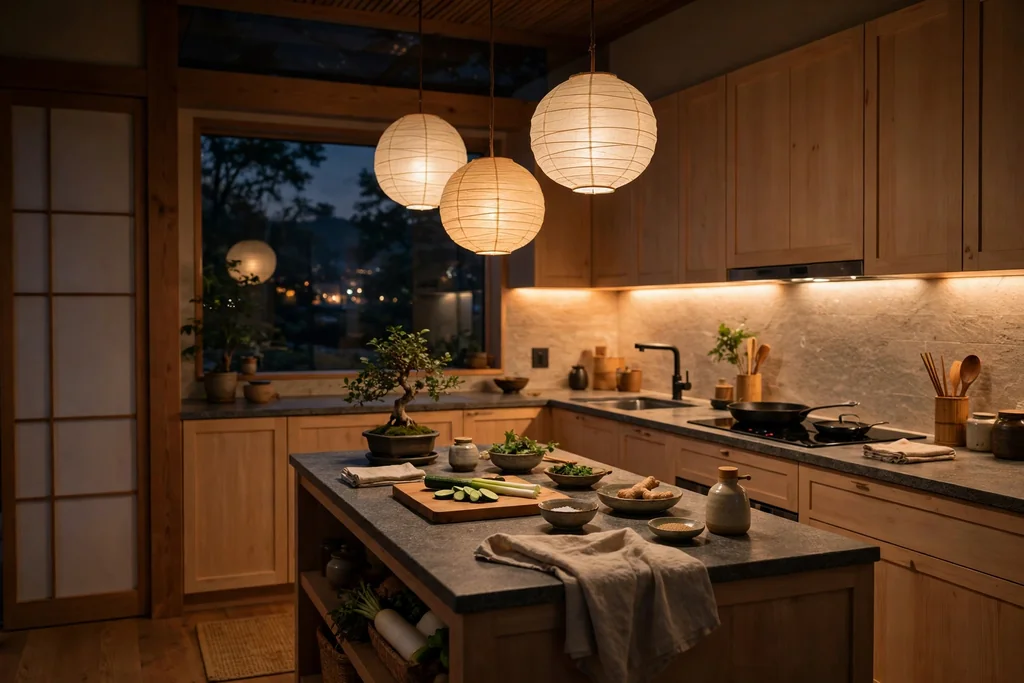
Layered warm light keeps a Japanese kitchen comfortable after dark, when daylight fades. Under-cabinet light does the real work for prep, while one or two paper pendants over the island or table give evening meals a soft focus, and a dimmable ceiling run covers the room as a whole. One fixture style, repeated, keeps the ceiling quiet and the room calm.
Fit under-cabinet lights toward the front of the cabinet, so light falls on the counter rather than on the wall, and choose warm white bulbs so food and wood tones look natural. Hang pendants high enough to see across the table, and keep the lowest point well above the counter. For a pale starting point that pairs well with wood and warm light, these Scandinavian kitchen ideas share the same layered light logic. Wipe shades often, since kitchen air leaves a light film on glass and paper over time.
Conclusion
The best Japanese kitchen is the one that fits the way you cook, eat, and tidy each day. Pale wood, one dark accent, clear counters, and warm layered light will carry most of the look, and a tea corner, a low nook, or a seasonal shelf adds the comfort that makes the room yours. Start with the change that helps you most, such as a clear counter or a better light, and add the next idea only when the first one feels settled. Keep the palette quiet, repeat one or two materials, and let daylight and wood do the warming. Save this list on Pinterest before your next kitchen refresh, and work through it one idea at a time.
FAQs
What defines a Japanese style kitchen?
A Japanese style kitchen uses a quiet palette, natural materials, and clear surfaces: pale wood, soft white, one darker wood tone, ceramics, linen, and warm light. The layout favors short work zones, closed storage for daily items, and one or two features, such as a screen, a tea corner, or a display shelf, rather than many competing details. Comfort comes from materials you touch daily, wood, ceramic, and cloth, not from bold color or heavy pattern.
How can I make a small kitchen feel Japanese without a remodel?
Yes, with small changes. Clear the counters to one tray per work zone, add a linen runner and a wood tray, swap busy hardware for slim pulls where that suits, and change the lighting to warm under-cabinet light plus one paper pendant. A single open shelf for ceramics, a tea tray, and one plant can shift the feel with no cabinet work, and slim stools in wood keep a small room feeling open.
What colors work best in a Japanese kitchen?
A pale base, such as warm white, soft grey, and light wood, works best, with one dark wood tone and one muted accent, such as indigo, for contrast. Keep the palette to two main colors plus wood, and repeat those colors in cabinets, counters, and seating. Strong color can still work as a small accent, such as a set of indigo bowls, but a full wall of strong color will fight the calm look.
Are open shelves practical in a Japanese kitchen?
Open shelves work well when they hold only items you use weekly, in a small range of colors, with at least a third of each shelf empty. They suit dishes, bowls, and cups that get washed often, so dust stays low. Keep the remaining storage closed for items you use less often, dust the shelves weekly, and use open shelves on one wall only, so the kitchen keeps enough closed storage for daily life.
How do I keep a Japanese kitchen from feeling cold or empty?
Mix your pale tones on purpose, and add one or two warm materials, such as wood, linen, or rattan. A wood island top, a warm white cabinet color, soft under-cabinet light, and one plant are usually enough to warm a pale room. Keep the largest surfaces calm and put warmth in items you touch and see daily, such as stools, a tray, a towel, and a tea cup.
Can I mix Japanese style with my existing cabinets?
Yes. Keep your existing cabinets and change the layers around them: add wood boards and trays, a linen runner, a paper pendant, and a small tea corner, and limit the counter to one tray per work zone. If the cabinets are dark, use pale counters, light linen, and warm light to soften them. If the cabinets are white, add one dark wood anchor and one woven texture, so the room reads as warm rather than plain.