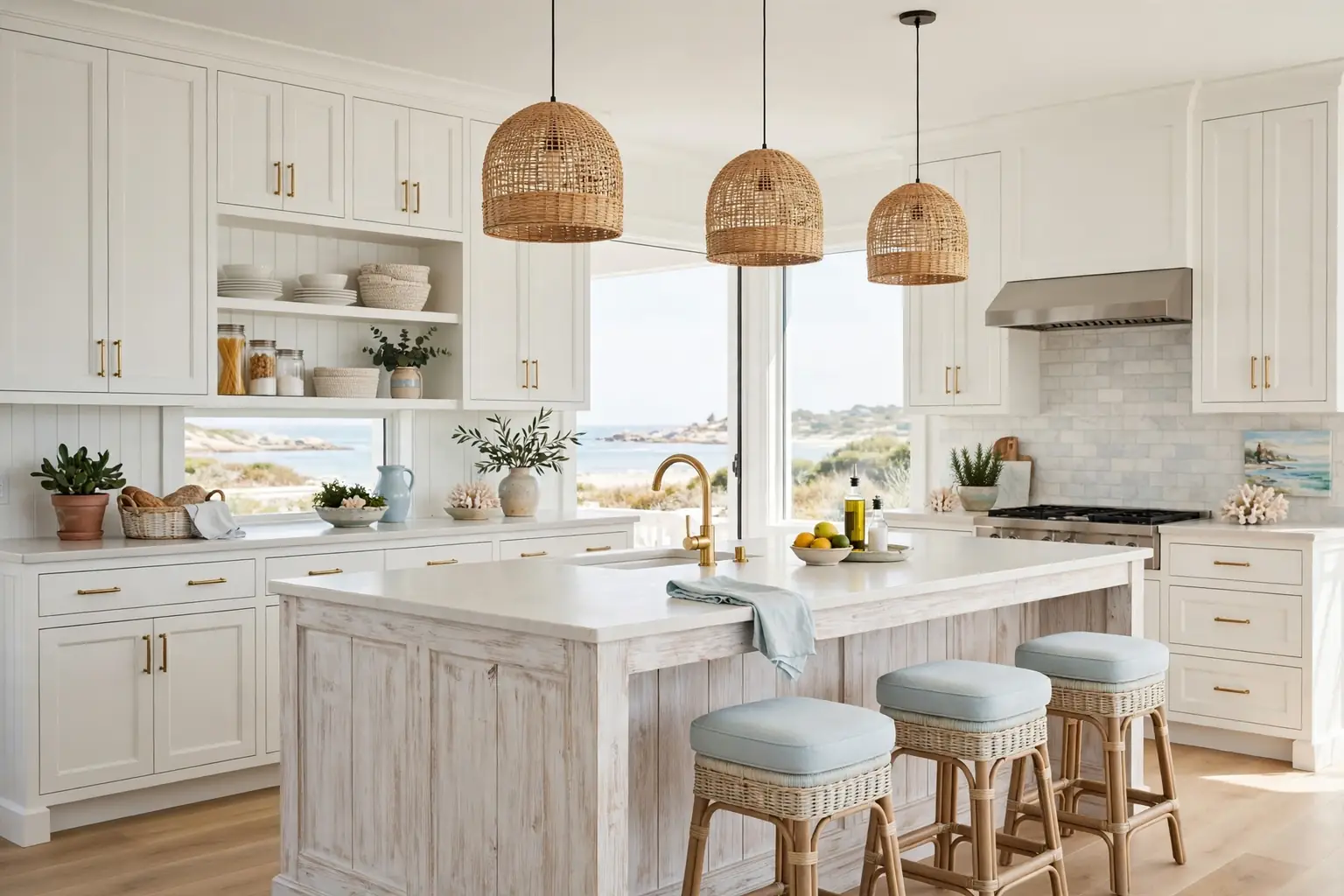
A coastal kitchen should feel like a deep breath: pale walls, natural wood, woven texture, and just enough sea blue to set the mood. Start with a calm palette and one or two natural materials, then add color in layers you can change. These 34 coastal kitchen decor ideas cover cabinets, islands, tile, lighting, seating, storage, and small details. Start with one change, test paint and fabric samples in daylight and evening light, and keep work surfaces clear so cooking stays easy. If you want the same calm palette in the next room, these coastal bedroom ideas show how white, sand, and soft blue work together.
Key Takeaways
- Keep the palette calm: white, warm sand, and one or two sea blues, with natural wood and woven texture for warmth.
- Let one feature lead per area: pale blue cabinets, a whitewashed island, or a tile backsplash, not all three at once.
- Use natural materials in small doses: rattan, jute, weathered wood, and linen add seaside character without clutter.
- Keep light soft and plentiful: sheer or linen window treatments, pale walls, and warm lamps help the kitchen feel bright by day and restful at night.
- Add sea color in layers you can change: cushions, towels, dishes, and art are easier to swap than paint or cabinets.
- Leave breathing room: one coastal feature per wall or corner is enough, and clear counters keep the room calm.
1. Start With a White, Sand, and Sea Blue Palette
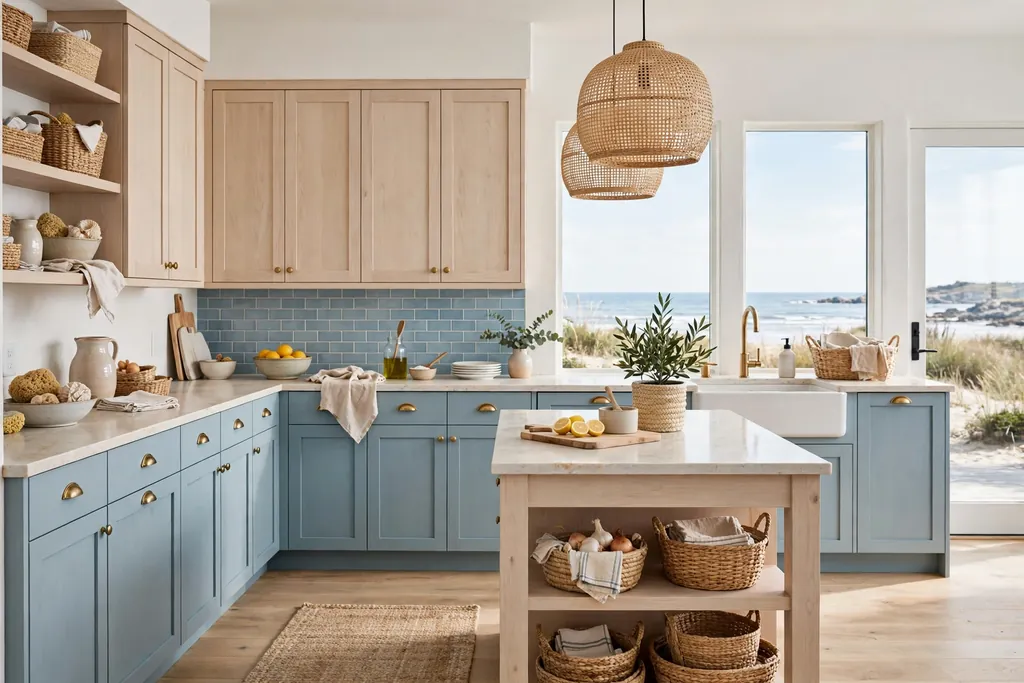
A white, sand, and sea blue palette is the simplest base for a coastal kitchen, because it reads as fresh in daylight and calm at night. Paint the walls white or warm white, keep large furniture pale, and let sand tones appear in wood, rugs, and baskets. Add sea blue only where you want the eye to rest, such as bar stools, a rug, or art, so the room stays light rather than busy.
This suits almost any kitchen, including a small room or a room with no sea view, since the palette does the coastal work. Test white paint beside your floor and cabinets, because white can look grey in cool light or yellow in warm light. If the room starts to feel washed out, add one deeper blue cushion or a mid tone wood piece, and keep the rest of the palette pale so that one darker note has room to stand out.
2. Paint Shaker Cabinets Pale Sea Blue
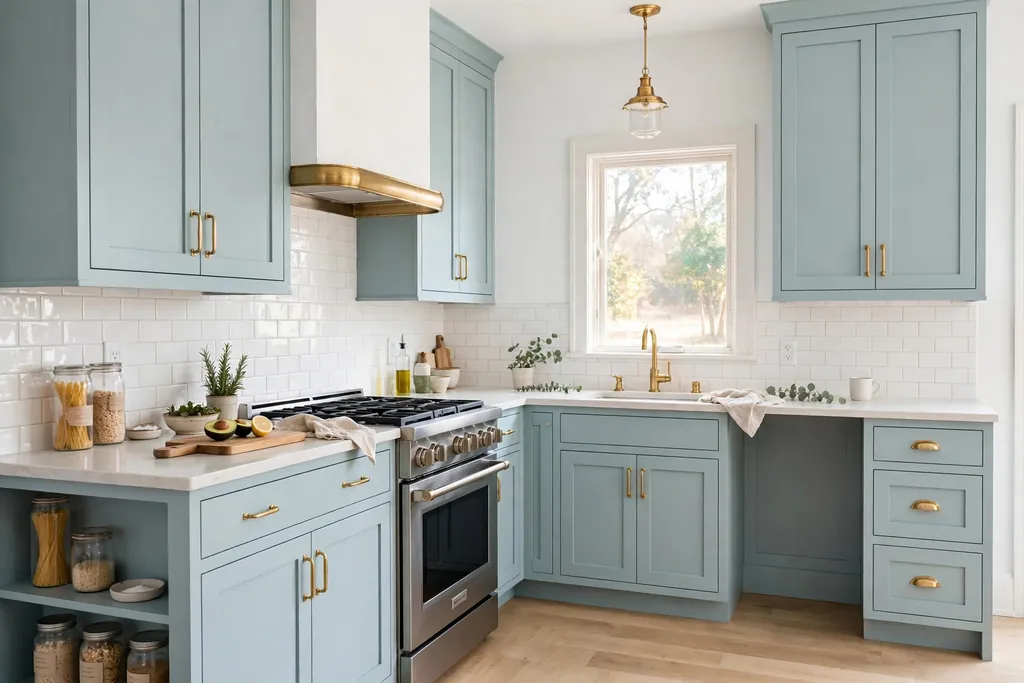
Pale sea blue shaker cabinets give a coastal kitchen a clear color story without a full remodel of the layout. Shaker doors keep the shape simple, and white walls, a pale counter, and a light wood floor stop the blue from feeling heavy. This suits a kitchen with good daylight, where the soft blue reads as a calm neutral rather than a bright color.
Keep handles simple in brushed brass or pale wood, and choose a counter in white or pale grey so the cabinets stay the focus. If you worry about commitment, paint one run of cabinets first and live with it for a week before painting the rest. For help choosing the right undertone for the rest of the room, see these ideas for colors for your kitchen cabinets. Wipe doors near the stove each week, since pale paint shows cooking splashes.
3. Whitewash the Island and Keep Cabinets White
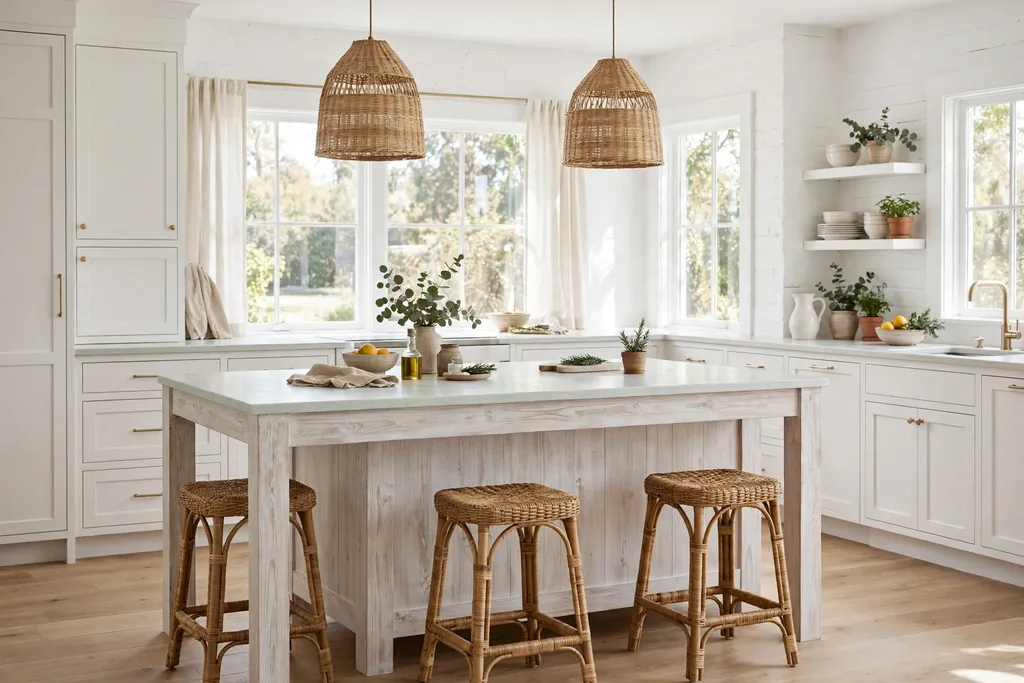
Keep the main cabinets white or pale wood, and whitewash only the island for a beach house note at the center of the room. The washed finish lets the wood grain show through, which keeps the island feeling natural rather than flat white. A whitewashed island suits a white kitchen, while a deeper driftwood wash suits a kitchen with dark wood floors.
Repeat the washed wood tone once more, in stools, a tray, or open shelves, so it looks planned rather than random. Choose a hard wearing counter for the island, since it takes the most daily use. This is a good first step if you like coastal wood but are not ready for painted cabinets everywhere.
4. Add Beadboard Paneling to One Wall
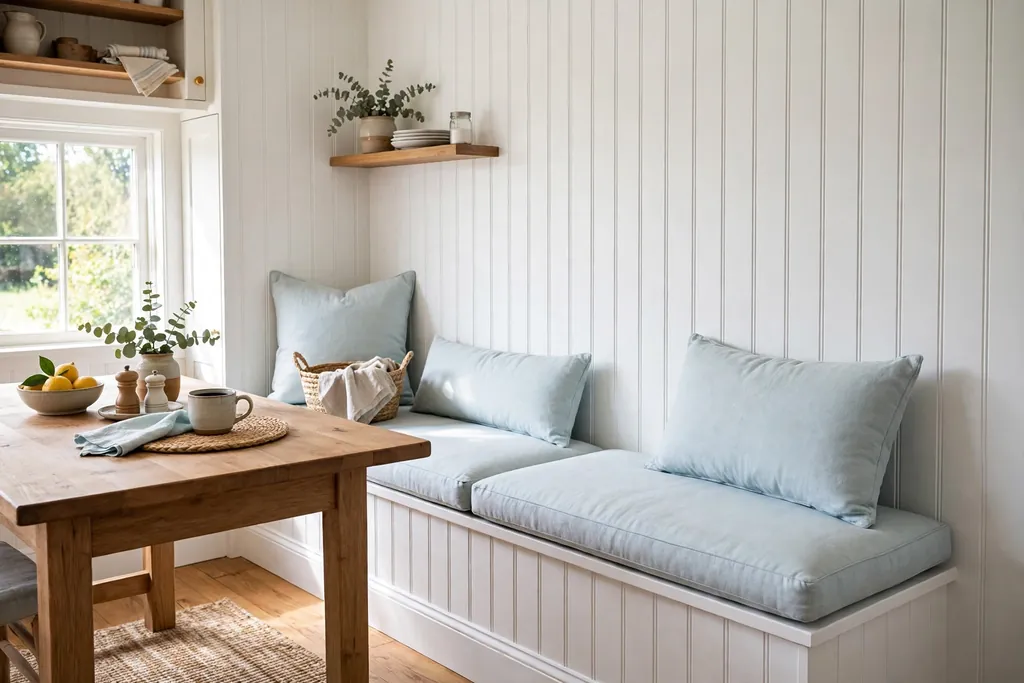
Painted beadboard paneling adds texture to a plain kitchen wall, with narrow vertical grooves that catch light and give flat walls shape. Fit beadboard panels on one wall, such as the dining nook wall or the wall behind a banquette, and paint them white or warm white to match the trim. The vertical lines suit a coastal room because they echo porch and cottage paneling without a themed print.
Keep the rest of the walls plain so the beadboard stays a feature rather than competing with tile or art. Use a wipeable paint finish, since kitchen walls near eating areas pick up marks, and seal the joints so steam does not lift the edges. If you rent, a removable beadboard look panel gives a similar texture without fixed work.
5. Choose a Sea Glass Tile Backsplash
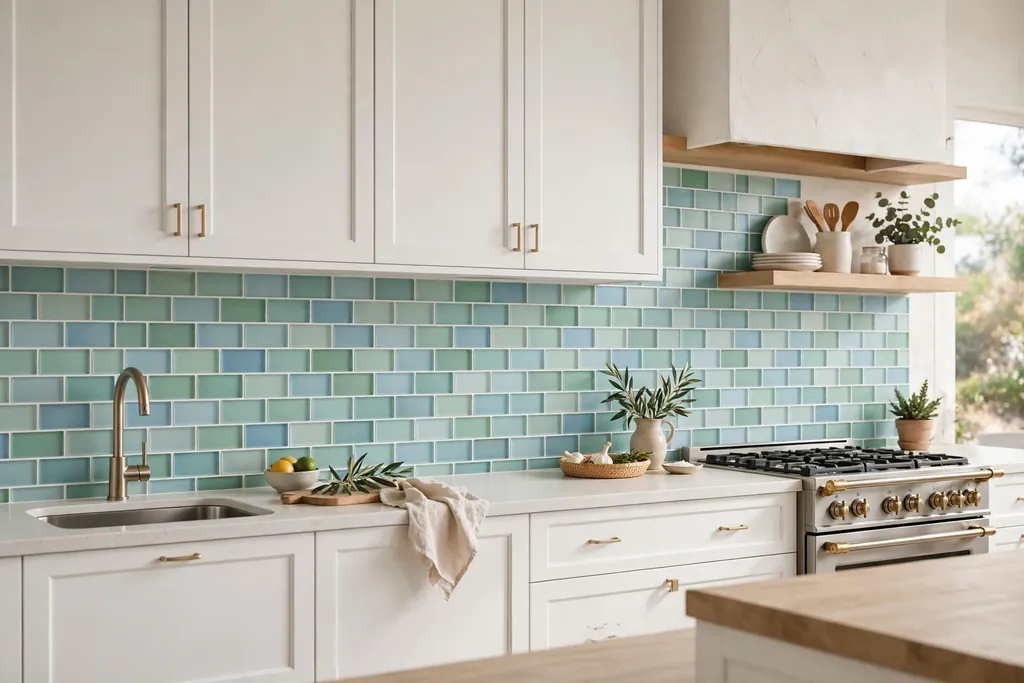
Sea glass tile in soft blue, green, and pale aqua gives a coastal kitchen a backsplash that looks collected from the shore. The frosted, slightly uneven surface catches light in a gentle way, and the mixed tones mean small splashes show less than on a plain white tile. Use sea glass tile on the full backsplash run, or limit it to the range wall and keep the rest of the tile plain.
Pair the tile with white cabinets and a pale counter so the glass tones stay the focus. Seal the grout, since kitchen backsplashes take grease and water, and keep a spare box of tile for repairs. If the budget is tight, use sea glass tile as a single horizontal accent row above plain subway tile for a similar effect at lower cost.
6. Try a Fish Scale Tile Accent Behind the Range
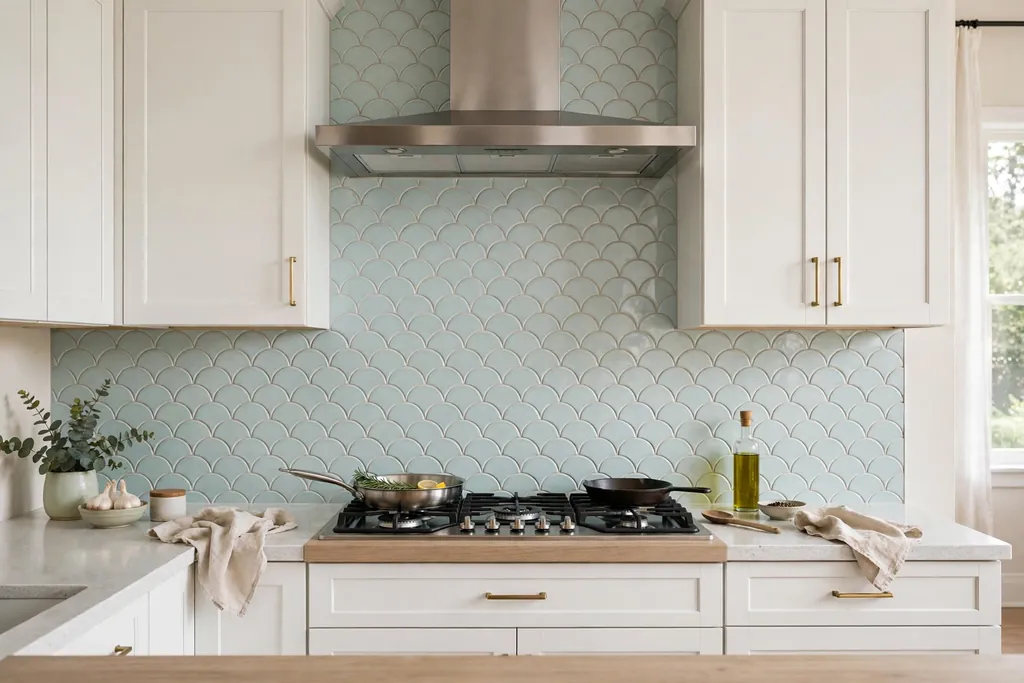
Fish scale tile, also called scallop tile, gives the range wall a clear coastal shape without a single shell or fish motif in the room. The curved rows read as waves from across the kitchen, and a soft blue or pale aqua glaze keeps the effect calm. Limit the fish scale tile to the panel above the range, from counter to hood, and keep the side walls in plain tile so the pattern has room to stand out.
Choose tiles rated for heat and splashes, and seal the grout so cooking splashes wipe off easily. Measure the panel to sit centered over the range, with equal space on each side. If you rent, a framed tile board in a fish scale pattern gives a similar focus without changing the wall.
7. Hang Rattan Pendants Over the Island
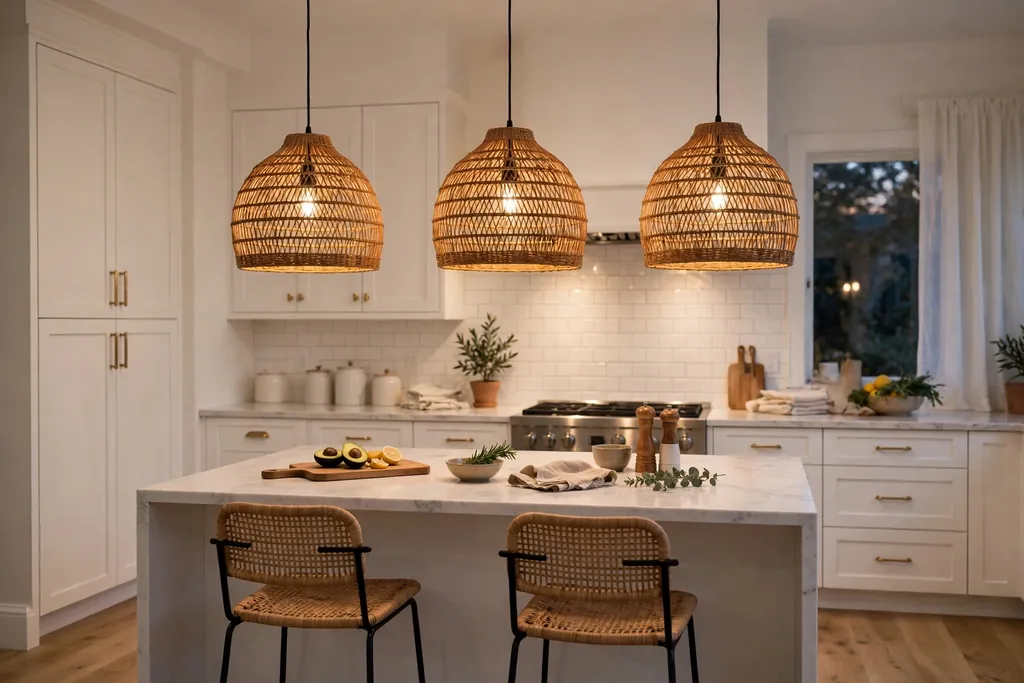
Rattan pendant lights bring woven texture to a coastal kitchen in a way that feels natural and light, because the open weave lets light through. Hang two or three rattan pendants in a row over the island, spaced evenly, with the lowest point well above head height and clear of steam from the hob. A drum or dome shape suits most kitchens, and the warm wood tone pairs well with white cabinets and pale counters.
Match the rattan tone to another woven piece in the room, such as stools or baskets, and keep the rest of the ceiling lights plain. Use warm white bulbs so the light reads warm in the evening, not cold. Dust the shades often, since kitchen pendants collect grease film over time.
8. Seat the Island With Woven Bar Stools
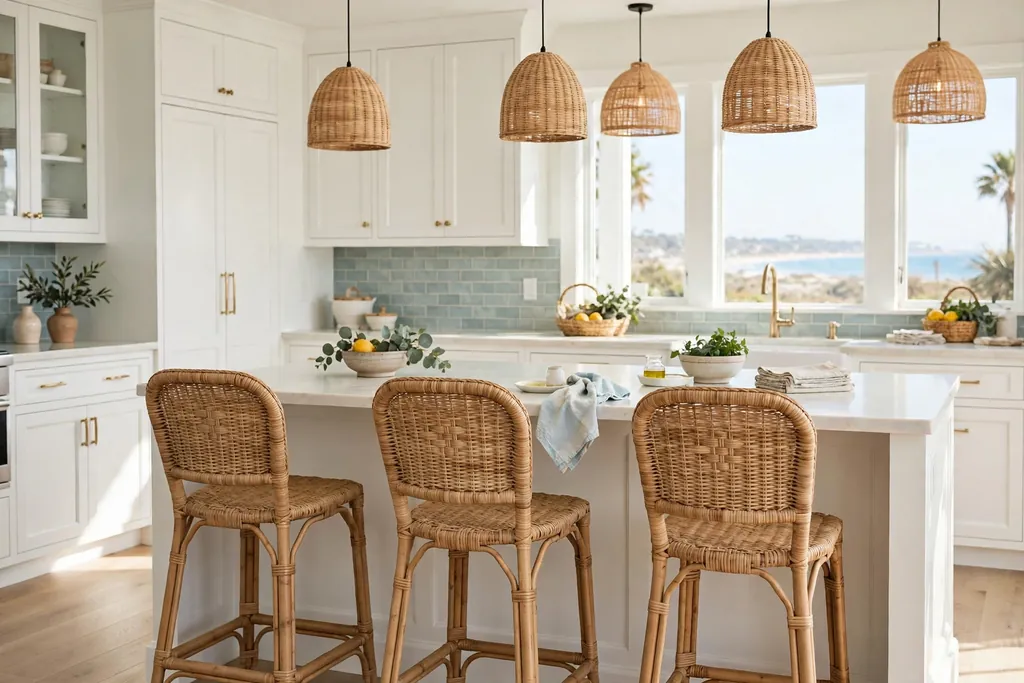
Woven bar stools add seaside texture at seating height, where hands and eyes land every day. Choose stools with a rattan or seagrass seat and a wood or black metal frame, and check the seat height against your counter before you buy. Backless stools tuck fully under the island overhang, which suits a small kitchen, while low back stools suit a longer island where people sit for a full meal.
Keep the stool count to the space you truly have, with room to pull each stool out without bumping its neighbor. Wipe woven seats with a dry cloth, and keep them out of damp corners, since natural fibers can warp. If the room already has a lot of wood, use woven stools in just this one spot, so the texture stays a feature.
9. Fit Driftwood Open Shelves for Everyday Dishes
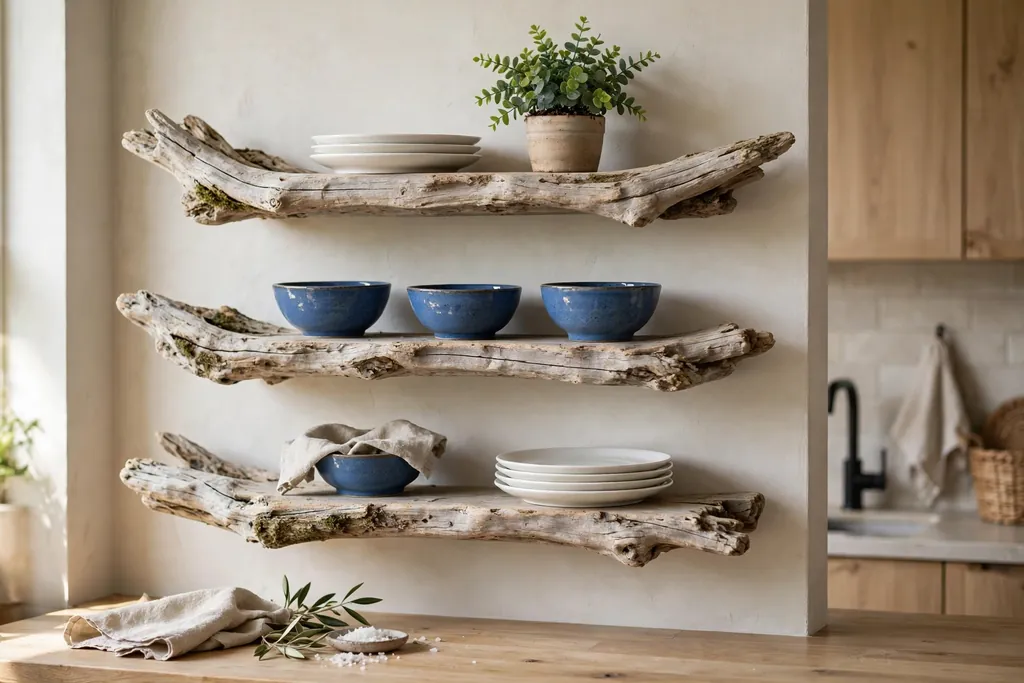
Driftwood or weathered wood open shelves give a coastal kitchen a place for everyday dishes with a greyed, worn finish that reads as seaside without a themed shape. Fix two shelves on one wall, spaced to fit the tallest item you plan to display, and style each shelf with a mix of white plates, blue bowls, and one small plant. Leave breathing room between groups so the shelves read as tidy.
Keep daily dishes on the lowest shelf, where they are easy to reach, and decorative pieces higher up. Dust open shelves weekly, since open storage near cooking collects film, and keep shelves clear of direct stove steam. If the wall is long, leave a gap between shelf groups, rather than running shelves end to end, so the wall keeps some calm space.
10. Swap in Rope Drawer Pulls
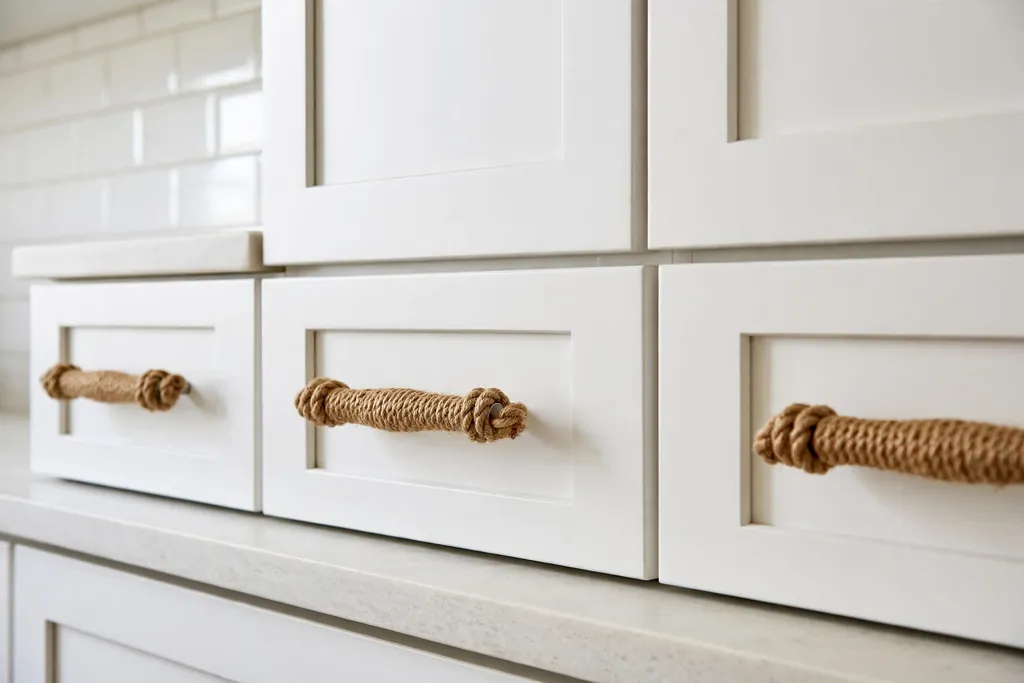
Rope wrapped drawer pulls are a small, reversible coastal detail that works on white, cream, or pale wood cabinets. The rope texture adds a nautical note at hand level, and it lets you test the coastal look before painting. This is a good weekend job, and it costs far less than new cabinets.
Keep all the pulls in the same rope tone and style, so the change looks planned. Save the old hardware in a labelled bag in case you want to swap it back. Check that new pulls match your existing screw spacing, and wipe them often near the stove, since kitchen rope and wood pick up grease.
11. Hang Linen Cafe Curtains on the Lower Half
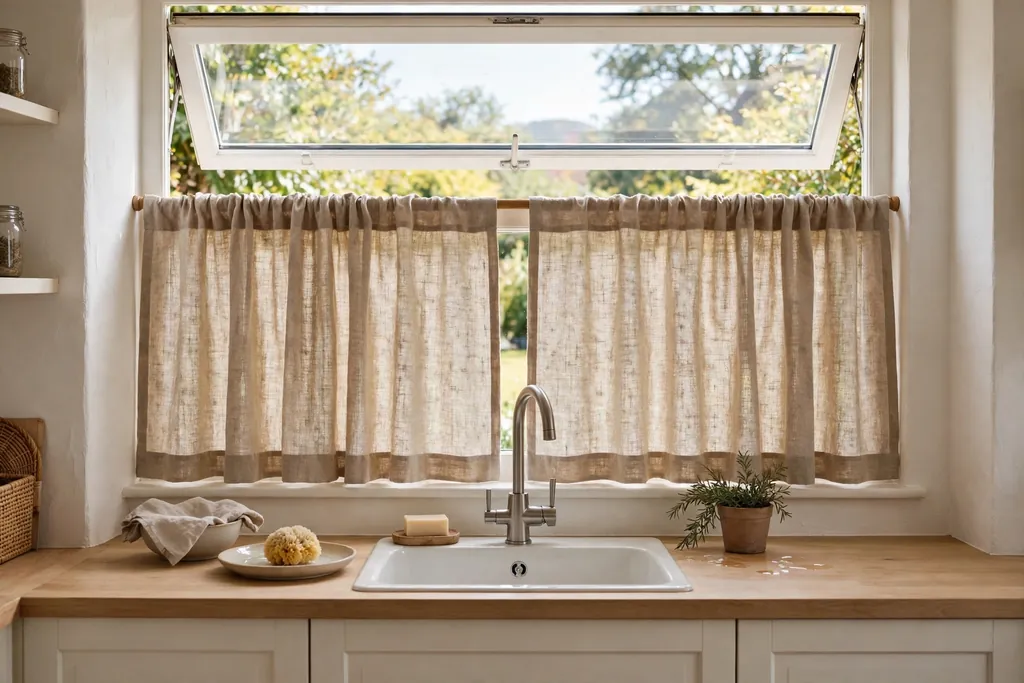
Cafe curtains cover only the lower half of the window, which gives privacy at counter height while the top half stays open for daylight. Natural linen suits a coastal kitchen because it softens the glass without a formal drape, and a plain white or sand color hides light splashes better than bright white. Hang the panels on a slim tension rod inside the frame if you rent, or on a small fixed rod if you own.
Keep the hem just above the sill so fabric does not sit in water near the sink, and choose washable fabric, because kitchen curtains pick up grease film over time. For more window treatments, lengths, and hanging tips, see these kitchen window decor ideas. Keep any fabric well clear of the stove and open flames.
12. Ground the Room With a Natural Jute Runner
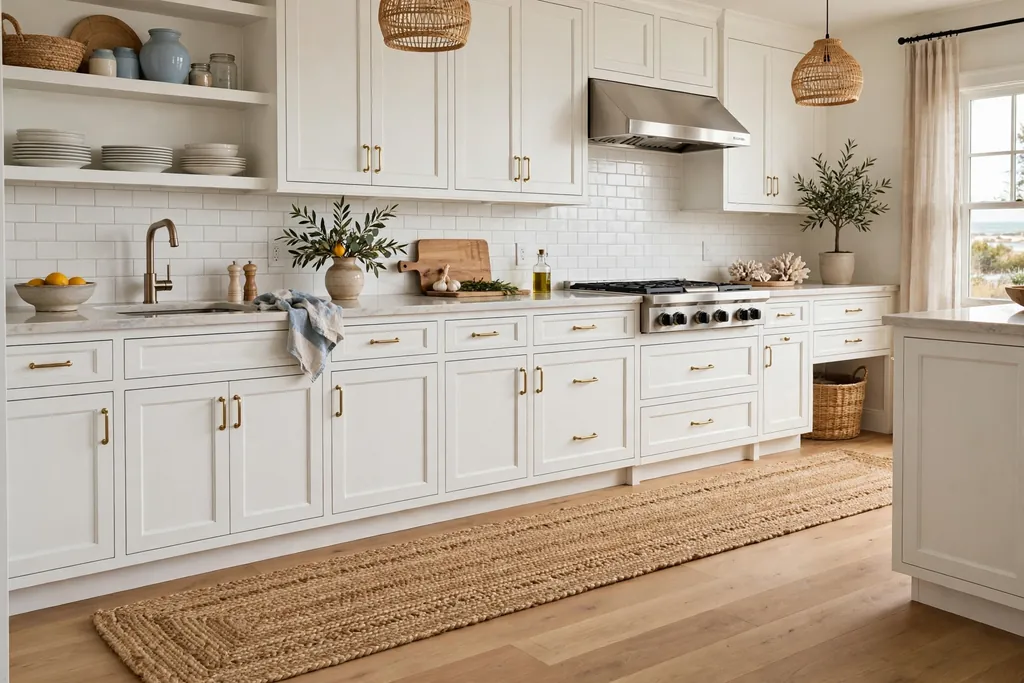
A natural jute runner grounds a coastal kitchen and warms up a hard floor, which matters in a room where white and pale blue could otherwise feel cool. Lay a long jute runner along the main work run, from sink to range, so it extends past the main standing spots. The coarse, natural texture contrasts with smooth counters, and the sand tone links the cabinets to light wood furniture and woven baskets.
This suits a kitchen with wood or tile floors, and it works best when the runner is long enough that your feet land on it at the sink and the stove. Use a rug pad underneath so the runner does not slip, and keep the pile low near the door swing. Vacuum jute with a brush head, since it sheds fibers at first, and blot spills quickly rather than rubbing, so the natural fibers keep an even tone.
13. Layer Blue and White Striped Textiles
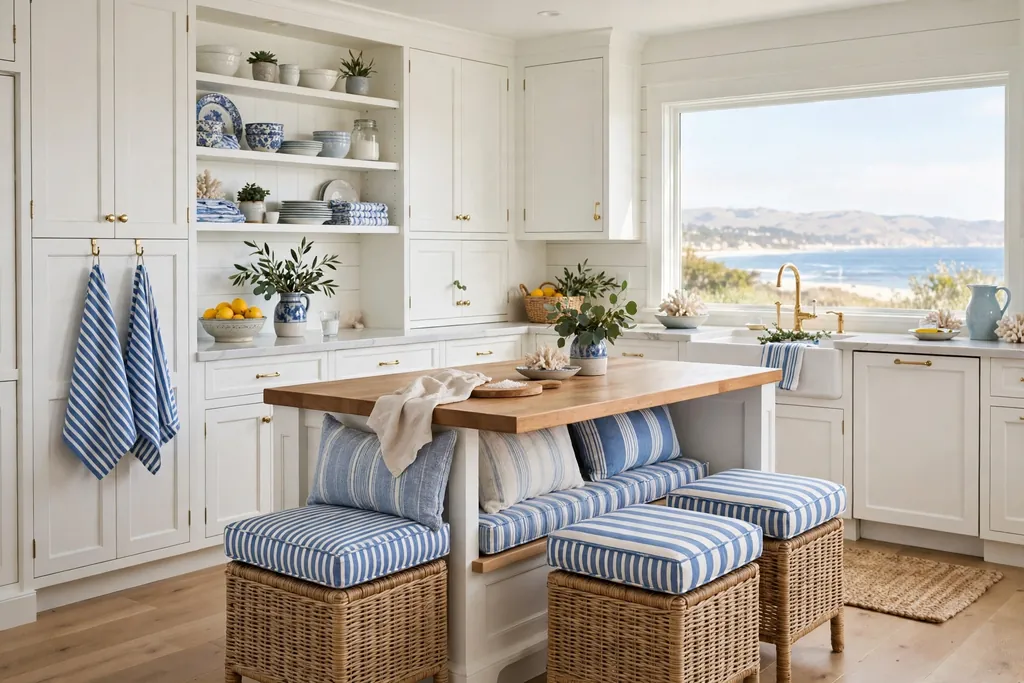
Blue and white striped tea towels, seat cushions, and a table runner give a coastal kitchen a clear pattern that reads as seaside without a themed print. The stripe works best when the rest of the room stays mostly solid, so the pattern can be the one bold note. Use one stripe scale through the room, such as a narrow stripe on towels and a wider stripe on cushions, rather than mixing many stripe widths.
Keep the textiles washable, since kitchen linens need regular washing, and swap the stripe color with the seasons if you want a small change: pale blue in summer, navy in winter. If the room already has patterned tile, keep the textiles plain instead, so the two patterns do not fight.
14. Display Shells and Coral With Restraint
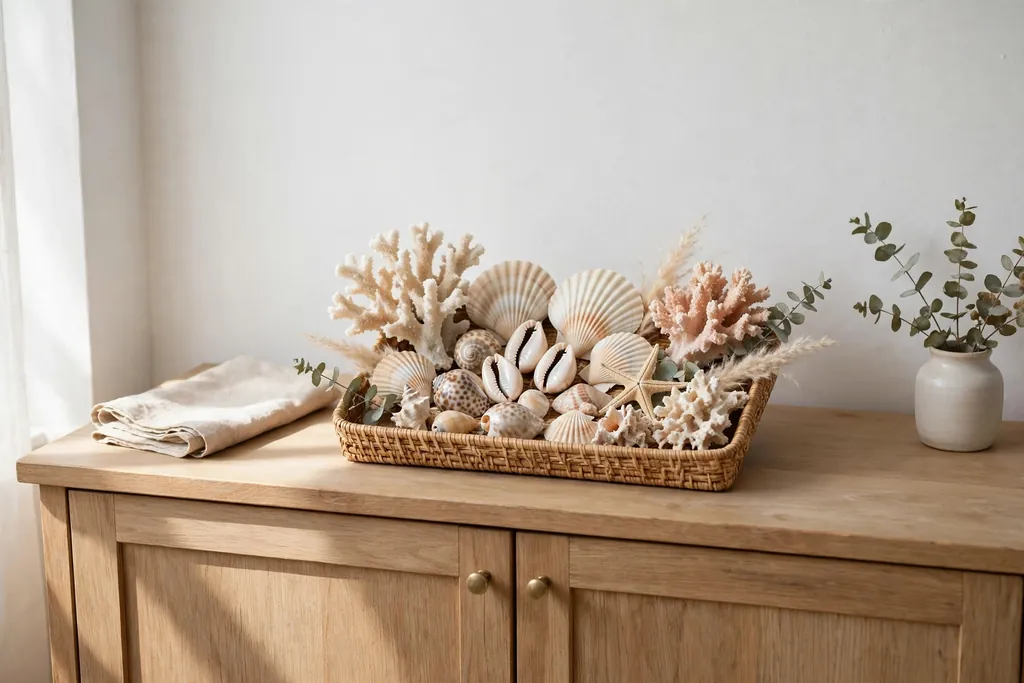
A small shell and coral display adds a true seaside note to a coastal kitchen, but restraint is what keeps it calm. Choose three to five pieces you like, in white, sand, and pale coral, and group them on one tray or one shelf, with clear space around the group. One tray on a sideboard or one shelf above the coffee station is enough for the whole room.
Keep shells out of the cooking splash zone, where steam and grease dull natural surfaces, and dust them with a dry cloth. If the collection grows, rotate pieces by season rather than adding more shelves, so the display stays a detail rather than turning into clutter. Skip painted or glittered shells, which fight the natural palette.
15. Hang a Gallery Wall of Seaside Prints
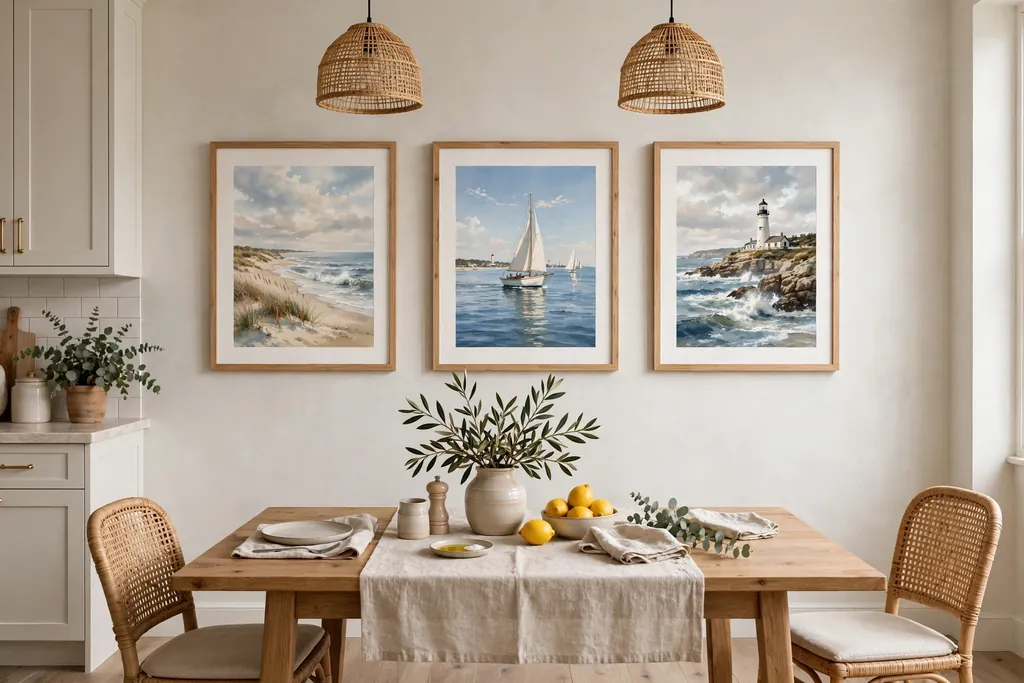
A gallery wall of seaside prints adds personality to a coastal kitchen without adding bold color that fights the scheme. Choose prints of the sea, the shore, boats, or coastal plants in pale blue, white, sand, and soft grey, with simple light wood frames. Hang them in a loose grid on the dining wall or along one blank wall, and keep the spacing even, so the wall feels calm rather than crowded.
Lay the frames on the floor first and plan the spacing, leaving equal gaps between frames, then hang the middle frame at eye level. Use picture hanging strips if you rent, and keep the largest frame near the center so the arrangement feels balanced. Swap one print with the seasons if you want a small change without redecorating the whole room.
16. Choose a Weathered Wood Dining Table
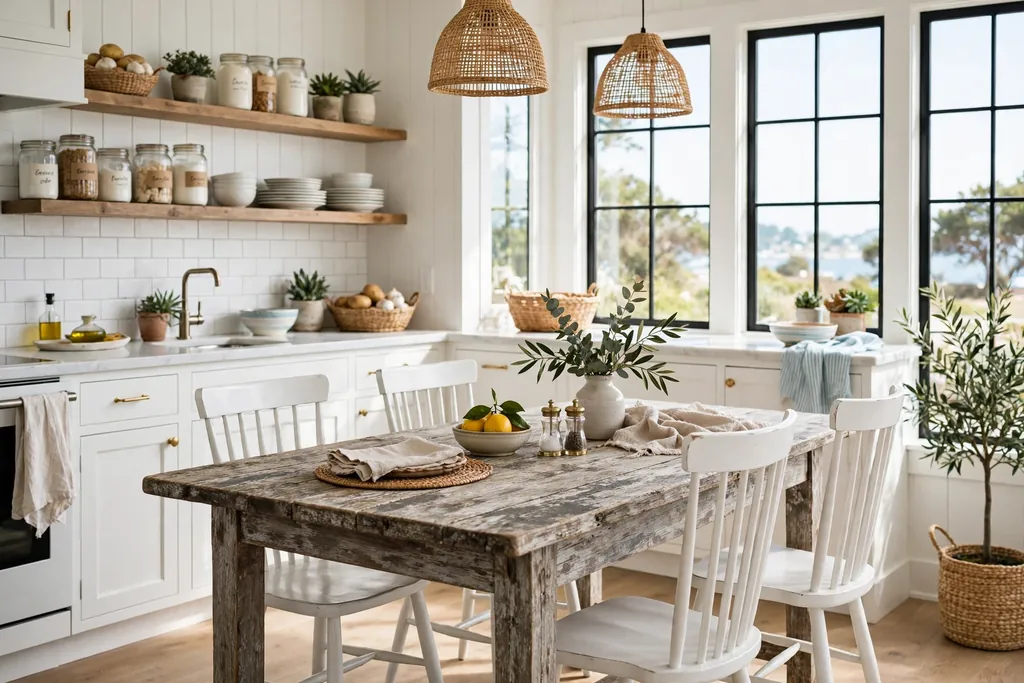
A weathered wood dining table gives a coastal kitchen a warm, lived in center for meals, homework, and morning coffee. The greyed, worn finish pairs well with white chairs, blue cushions, and light wood floors, and it hides small marks better than a dark polished table. Choose a table that leaves room to pull chairs out on all sides, and keep the center mostly clear, with one low centerpiece.
This suits a kitchen with an eating area that currently holds a table that feels too formal or too dark. Wipe the wood with a damp cloth, and use placemats for hot dishes, since weathered finishes still mark under heat. If the table feels too rustic, pair it with simple white chairs and a plain linen runner to lift the look.
17. Use Glass Front Cabinets for Blue and White Dishes
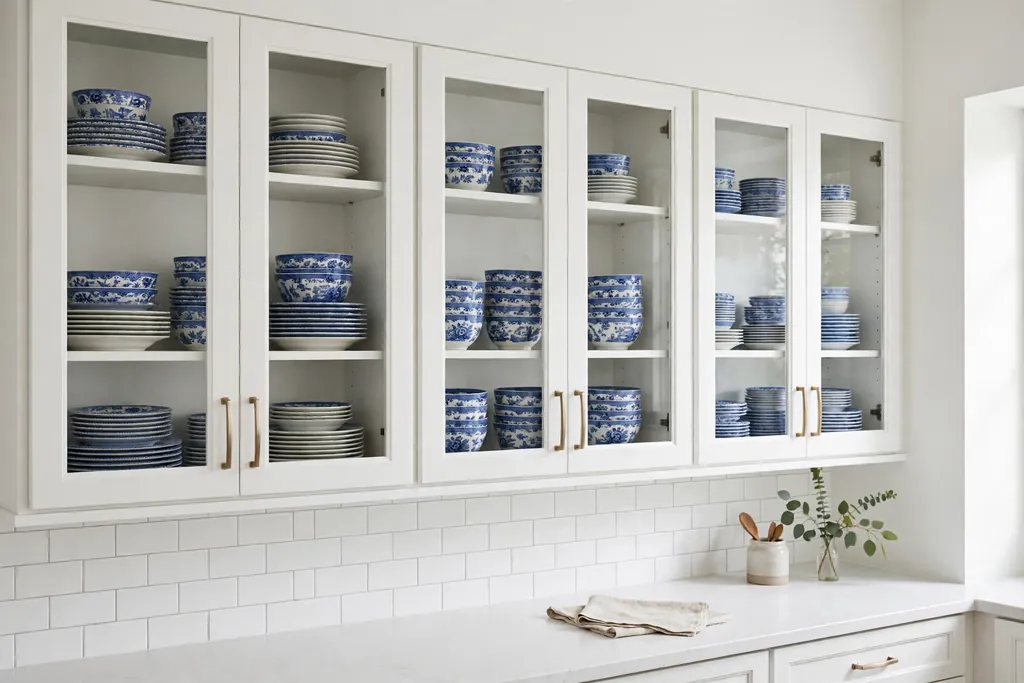
Glass front cabinets turn everyday blue and white dishes into coastal decor, with no extra objects to buy. Replace two solid cabinet doors with glass fronts, or fit one glass front cabinet beside the sink, and fill it with white plates, blue bowls, and clear glasses in neat stacks. The glass keeps the dishes dust free while letting the color show.
Keep the cabinet interior painted white or pale blue, and leave space between stacks so the display reads as tidy. Put daily dishes at eye level and decorative pieces higher up. If glass fronts feel too open, use reeded or frosted glass, which blurs the contents while still letting light through.
18. Pair Navy Lower Cabinets With White Uppers
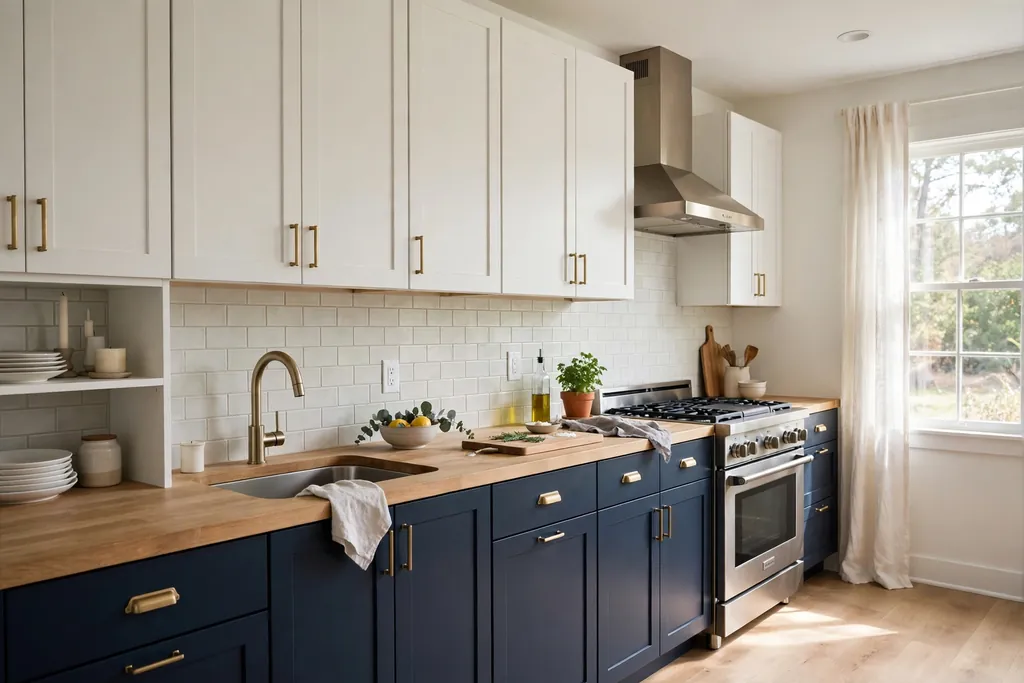
Use navy on the lower cabinets and white on the uppers for a deeper coastal take that still feels light. The white uppers keep the eye moving up and make a small kitchen feel taller, while the navy base grounds the room and hides marks well. This split also makes repainting easier later, since only half the cabinets need a new color.
Pair the scheme with a pale backsplash and a wood or white counter. A brass or black handle on the lower cabinets ties the two tones together. Keep the wall color plain so the two cabinet colors can do the work, and add strong under cabinet lighting, since navy absorbs light at counter level.
19. Keep Counters in White Quartz With Sandy Veining
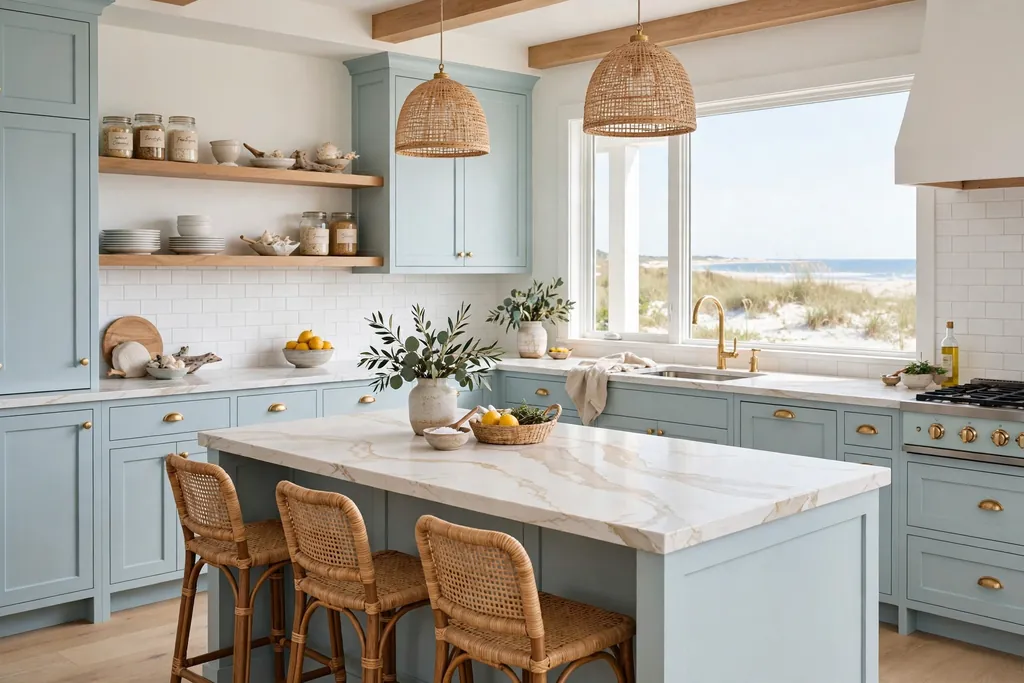
White quartz counters with soft sandy or pale grey veining give a coastal kitchen a bright work surface that still feels warm. The pale stone reflects light, which helps a small kitchen feel larger, and the faint veining links the counter to sand tones elsewhere in the room. Quartz also wipes clean after cooking, which matters beside the sink and range.
Pair white quartz with pale blue or white cabinets and a simple backsplash, so the counter does not fight the tile. Avoid a busy, high contrast veining pattern, which can make a coastal room feel formal rather than relaxed. Use cutting boards for prep and trivets for hot pans, so the surface stays even over time.
20. Repeat Brushed Brass Hardware Through the Room
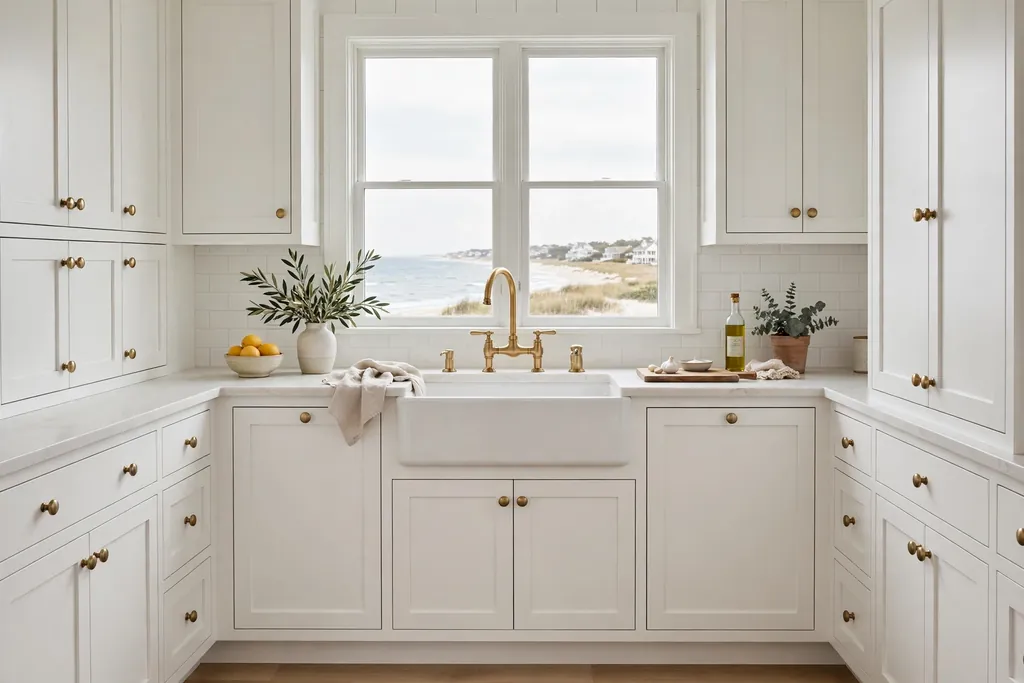
Brushed brass knobs, pulls, and a tap give a coastal kitchen a warm metal that suits sand tones and pale blue alike. Brass reads softer than chrome in a coastal room, and it pairs well with white cabinets, wood shelves, and woven texture. Use one brass finish through the room, and repeat it in at least three places, such as the tap, knobs, and a pendant light, so the metal looks planned.
Keep other strong metals to a minimum, so brass stays the single warm note. Wipe brass near the stove and sink often, since kitchen metals pick up grease and water marks. If you rent, swap only the knobs and pulls, and leave fixed taps and lighting as they are.
21. Line the Sill With Herb Pots in Blue Ceramic
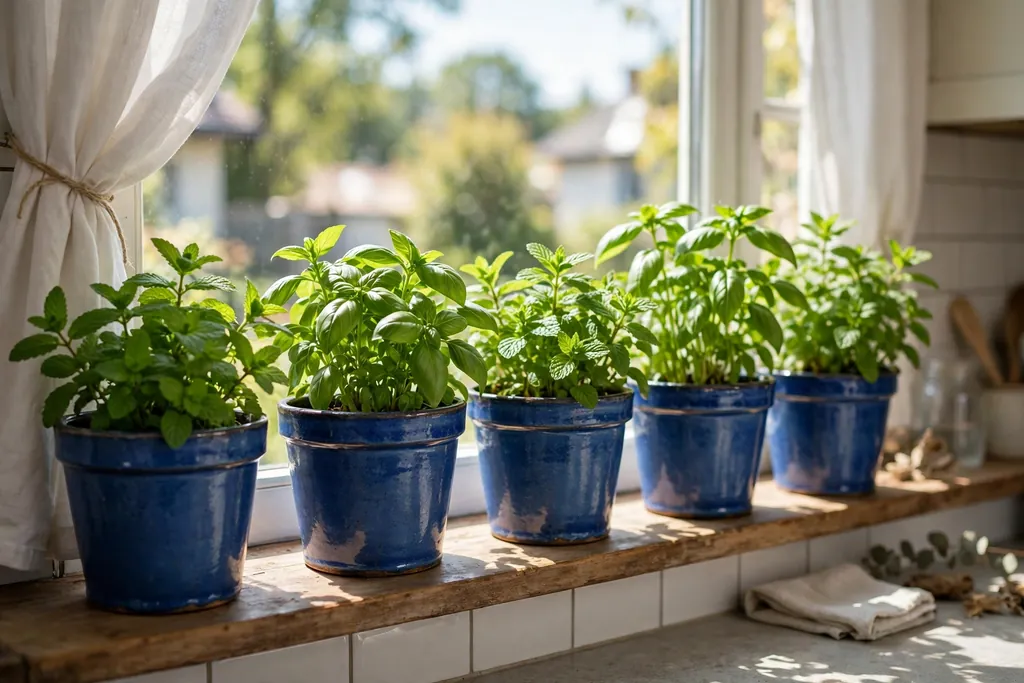
A row of small herb pots is a useful coastal windowsill choice because the plants get strong light and stay within reach while you cook. Use pots of a similar size in blue ceramic or white ceramic with a blue rim, so the row looks calm rather than collected at random. Basil, mint, chives, and parsley are common windowsill herbs, but choose based on the light your window actually gets.
Set the pots on a narrow tray or saucers to protect the sill from water marks. If your sill is too narrow, hang a small rail or use a shelf instead of crowding the counter. Snip herbs often, since regular picking keeps the plants bushy, and wash the pots when you repot, so salt and soil marks do not build up.
22. Set Up a Coastal Coffee Station
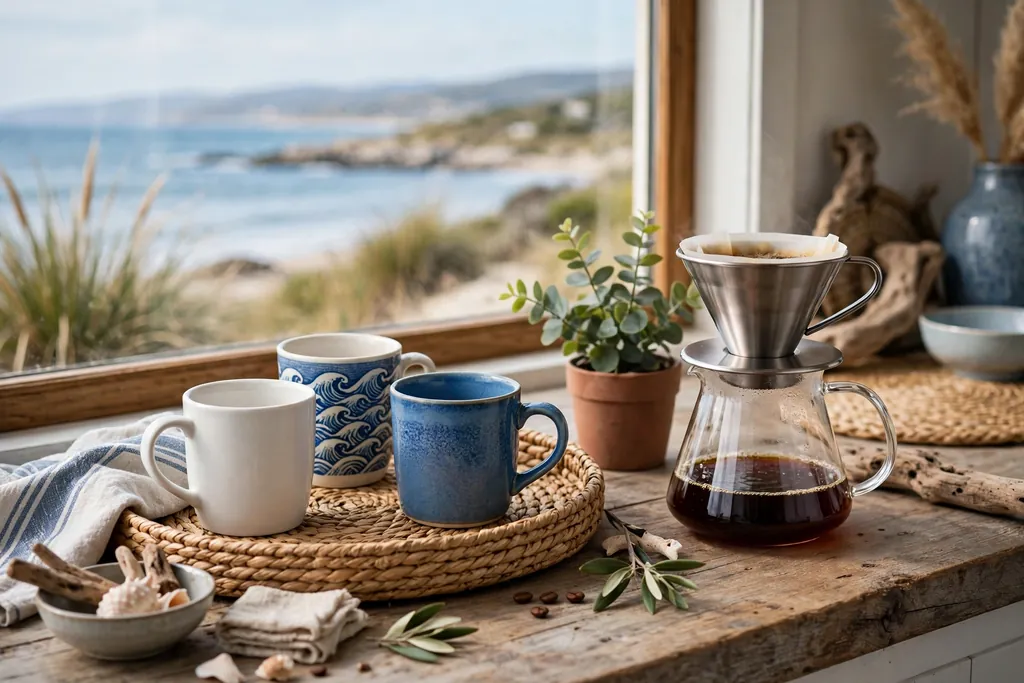
A coastal coffee station groups the coffee maker, mugs, and supplies on one tray or one shelf, so mornings start in one calm corner. Choose a tray in wood or woven seagrass, and set it on a counter away from the main prep run. Add white or blue mugs, a small jar of coffee, and one tiny plant, and keep the rest of the counter clear, so the station reads as styling rather than storage.
This suits a kitchen where coffee items currently spread across the counter. Wipe the tray weekly, since the area near a coffee maker collects drips, and limit the station to the items you use every day, storing spares elsewhere. Swap the mugs by season for a small change with no new furniture.
23. Build a Striped Banquette Breakfast Nook
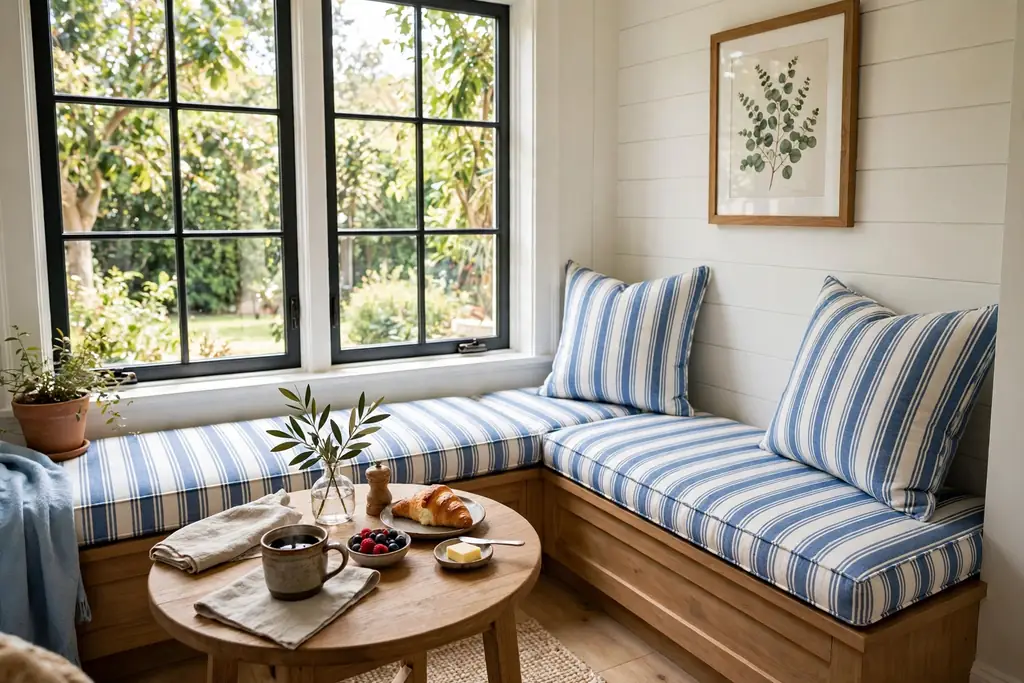
A banquette breakfast nook with blue and white striped cushions gives a coastal kitchen a clear eating corner and a stronger pattern than plain cushions alone. Build or buy a simple bench along one wall, add a small table and two chairs opposite, and keep a soft throw over one end for cooler mornings. The stripe reads as seaside without a themed print, and it works best when the rest of the room stays mostly solid.
Choose a bench deep enough to sit in for a full meal, not a stiff accent bench that looks good but stays empty. Keep the table clear except for the meal you are eating, and add storage inside the bench for placemats and table linens. If the nook sits by a window, keep the cushions washable, since sun and food marks reach them fast.
24. Add a White Shiplap Ceiling
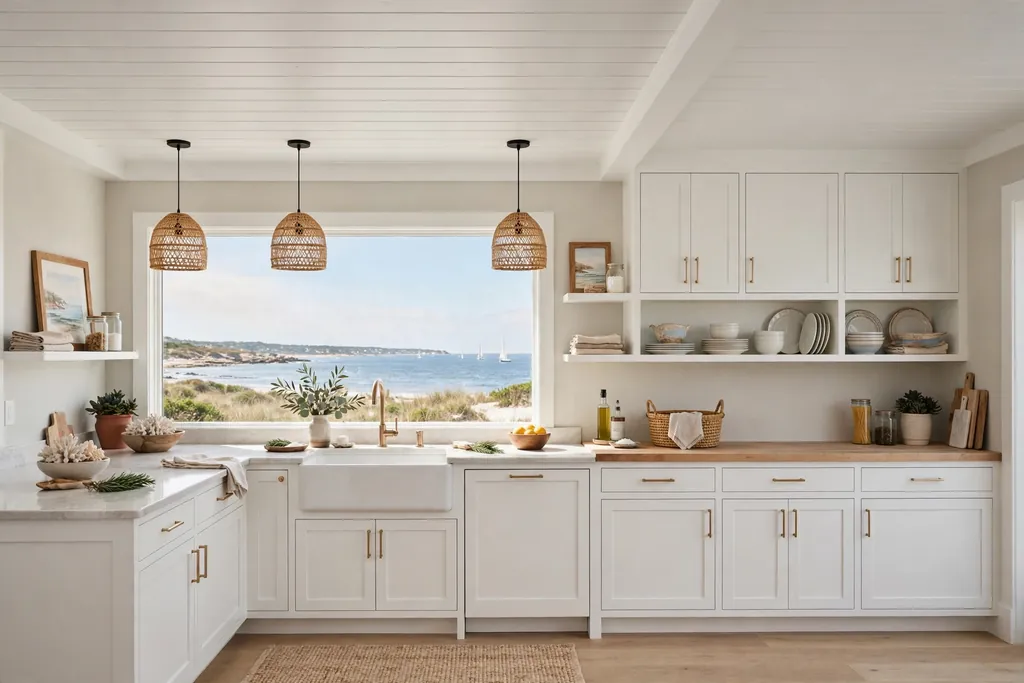
A white shiplap ceiling gives a coastal kitchen a cottage structure overhead, with long boards that draw the eye along the room. Paint the boards white or warm white to match the trim, and keep the walls plain so the ceiling stays a quiet feature rather than competing with tile or art. Shiplap suits a kitchen with a flat, plain ceiling that needs interest but not a feature color.
This is a measure and fit project, so it suits owners rather than renters. Choose boards that match your trim profile, and check that ceiling lights and vents still sit flush after fitting. Dust the grooves with a soft brush during a normal clean, and keep the finish matte, so the boards read as wood rather than gloss.
25. Whitewash Light Wood Floors
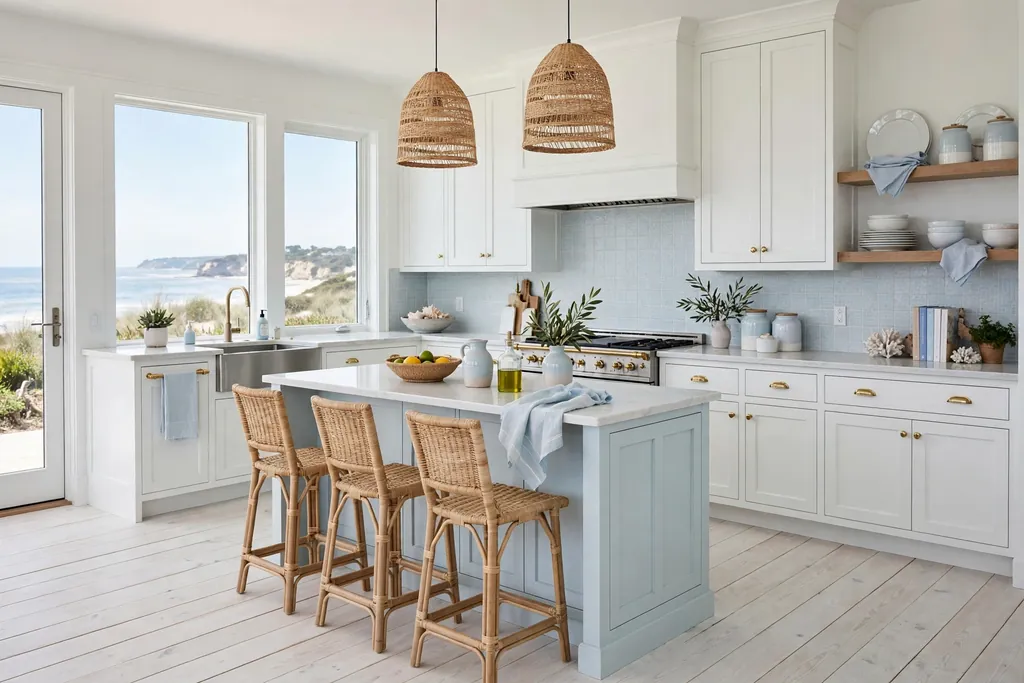
Whitewashed light wood floors give a coastal kitchen a pale, sandy base that lifts white cabinets and pale blue paint. The washed finish lets the wood grain show through, which keeps the floor feeling natural rather than flat white, and it hides light dust better than a dark floor. This suits a kitchen with wood floors that feel too orange or too dark for a coastal palette.
Protect the floor well around the sink and dishwasher, because water marks show on light wood, and use rugs at the sink and stove for extra cover. Sweep often, since pale floors show crumbs, and reseal high traffic paths when the finish starts to wear. If full refinishing is too much, a large pale rug gives a similar lift at lower cost.
26. Hang a Single Pendant Over the Sink
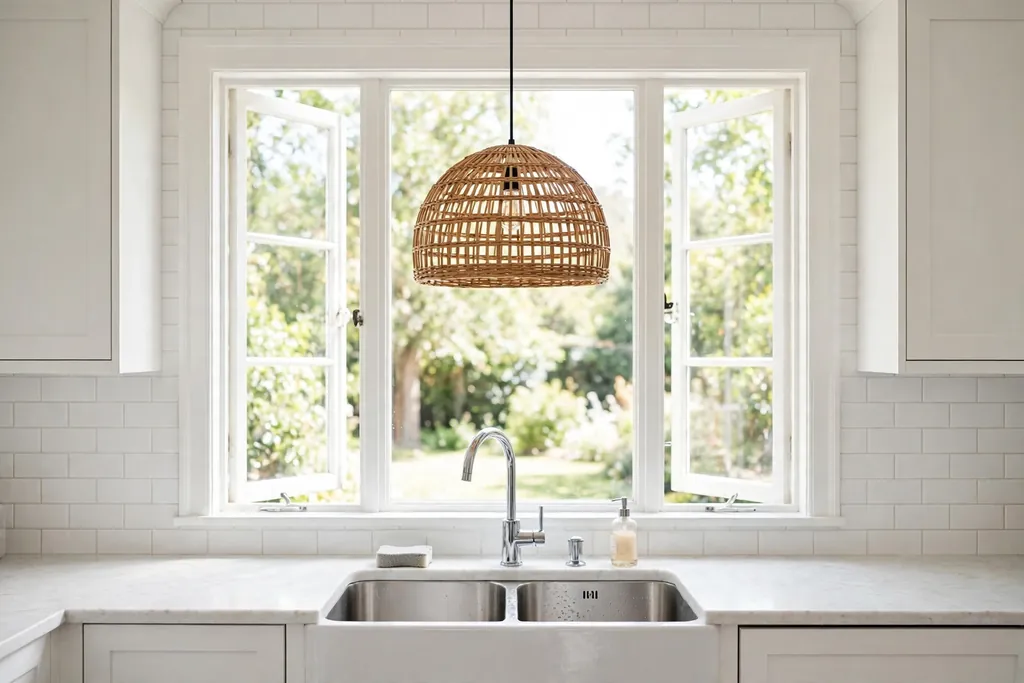
A single pendant over the sink gives a coastal kitchen task light and a small focal point at the brightest work spot. Choose a pendant in rattan, blue glass, or white ceramic, with a shade that throws light down onto the sink without blocking the window. Hang it centered over the sink, high enough to clear the faucet and your head, and keep the cord or rod short and straight.
This suits a kitchen where the sink window currently has no light of its own, since evening washing up then feels dark. Use a warm white bulb, and wipe the shade often, since the sink area collects splashes. If the window already has a shelf or a treatment, choose a slim pendant, so the light does not crowd the glass.
27. Set a Simple Coastal Table for Everyday Meals
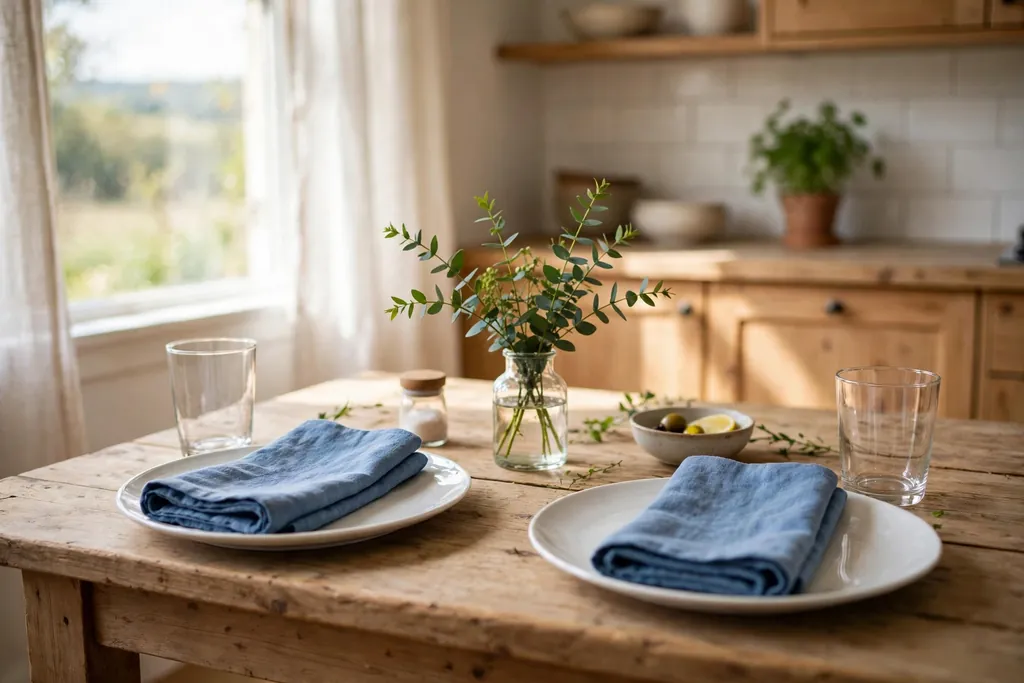
A simple coastal table setting makes daily meals feel considered without a formal tablescape. Use white plates, blue linen napkins, clear glasses, and one low centerpiece, such as a small vase of green stems or a wood tray with a candle. Keep the center low, so people can talk across the table, and leave clear space for serving dishes.
This suits a kitchen dining table that currently stays bare between meals or collects clutter. Set only the places you need, and store spare linens and candles in the banquette or a nearby drawer, so setting the table takes minutes. Wash napkins after a few uses, since kitchen linens pick up food marks fast, and keep the centerpiece away from the stove end of the table.
28. Store Pantry Goods in Woven Baskets
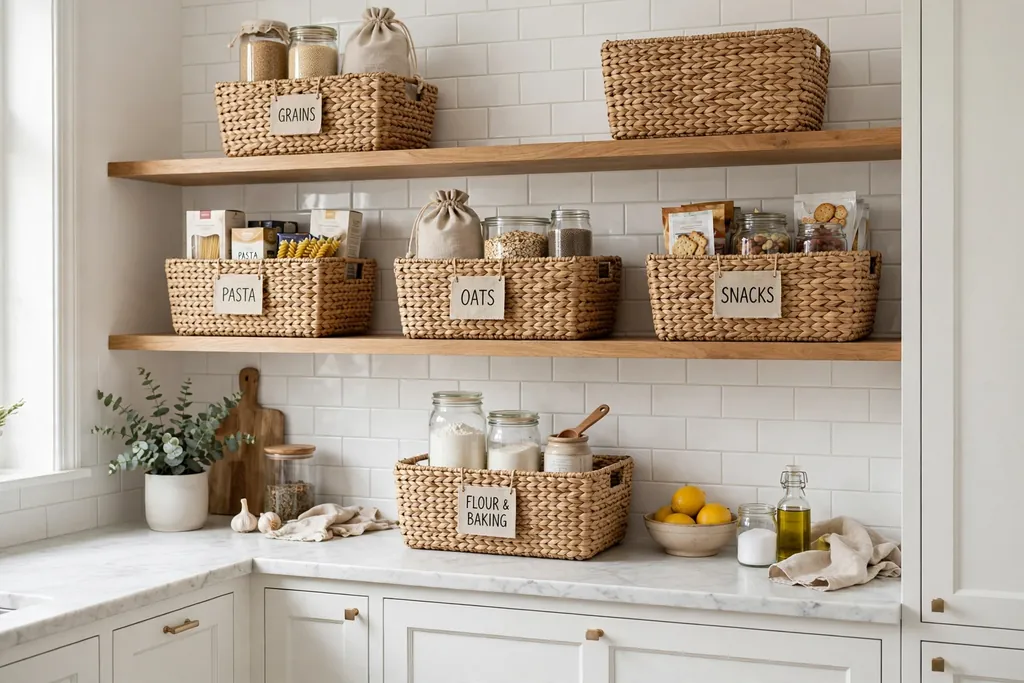
Woven baskets on open shelves or on top of cabinets give a coastal kitchen storage that looks like decor. Choose baskets in seagrass, rattan, or pale wood, in a mix of sizes, and label each one for dry goods, snacks, or linens. The woven texture warms a room full of straight cabinet lines, and the baskets hide mixed packaging behind a calm front.
Keep baskets to the goods you use every week, and store spares elsewhere, so the shelves stay calm rather than crowded. Dust the baskets with a soft brush during a normal clean, and keep them clear of the stove, where heat can dry and weaken natural fibers. If the baskets sit high, keep a small step stool nearby, so reaching them stays safe.
29. Cluster Blue Glass Pendants Over the Table
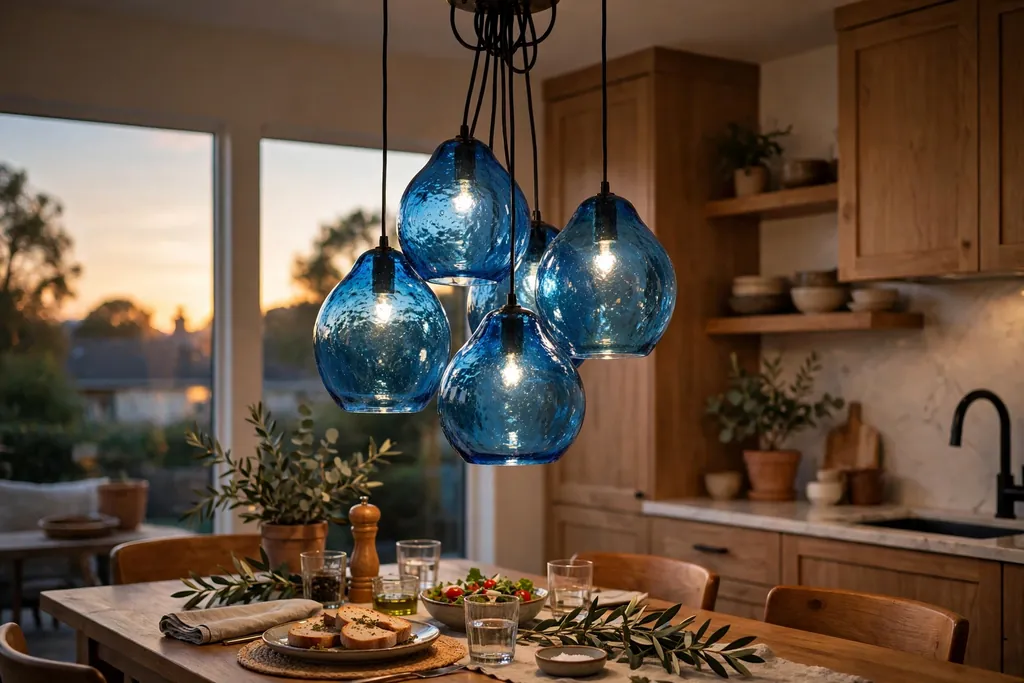
A cluster of blue glass pendants over the dining table gives a coastal kitchen color at eye level and a clear gathering point. Hang three small blue glass pendants at staggered heights, or one row of three at the same height, centered over the table. The glass tints the light softly, and the blue reads as sea color without paint or tile.
Keep the rest of the ceiling lights plain, so the cluster stays the feature, and use warm white bulbs, so the blue glass reads warm in the evening, not cold. Check that the lowest pendant clears the heads of seated diners and the centerpiece. Dust the glass often, since kitchen pendants collect grease film over time.
30. Clad the Range Hood in Driftwood
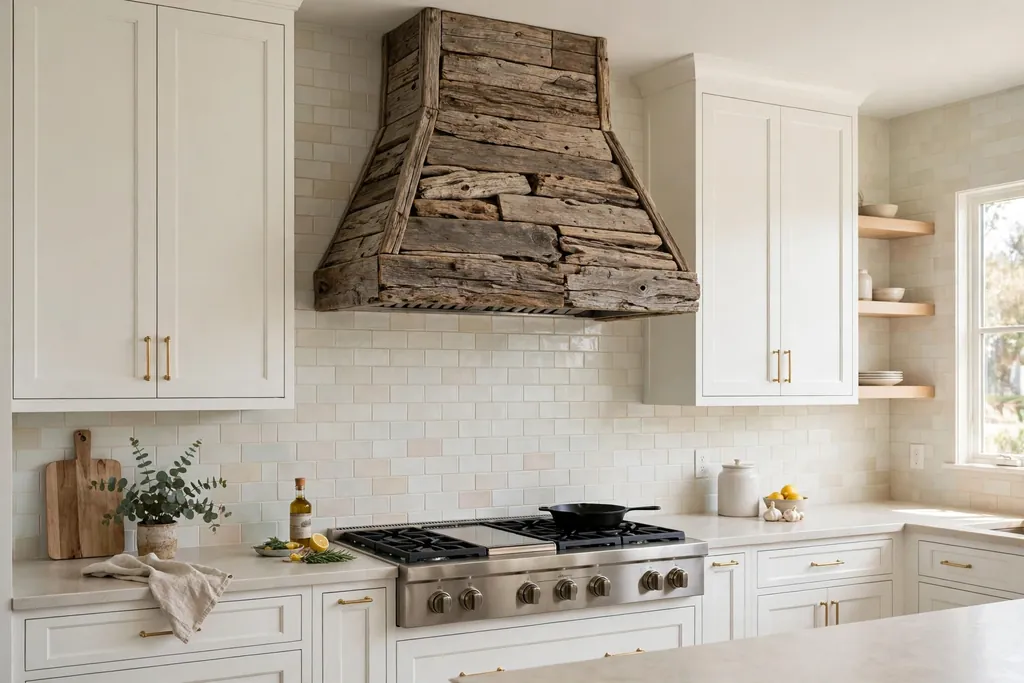
A driftwood clad range hood gives the cooking wall a clear coastal center, without tiling the whole room. Fix weathered wood boards over the hood surround, in horizontal or vertical runs, and keep the tiles around it plain so the wood stands out. A hood that runs from the counter to the ceiling looks planned and finished, and the greyed wood links to other weathered pieces in the room.
Use boards rated for the heat near a range, and keep the wood clear of direct flame and steam vents. Seal the wood so cooking splashes wipe off easily, and check that the hood still vents well after cladding. If you rent, a framed driftwood panel above the range gives a similar focus without changing the hood.
31. Keep a Cookbook and Board Shelf by the Range
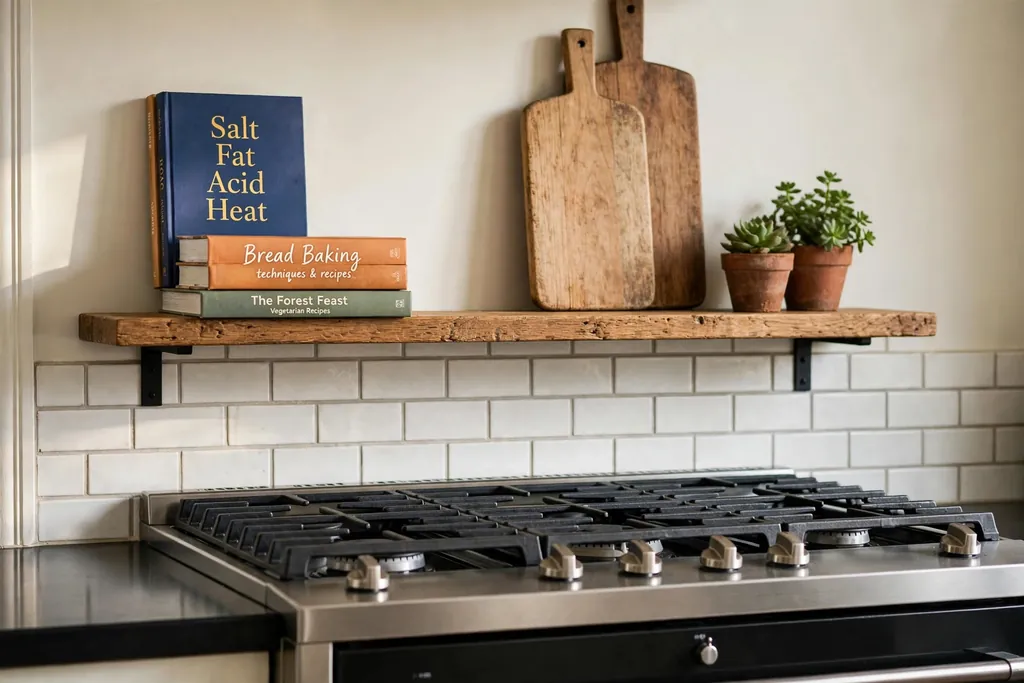
A small shelf by the range for cookbooks and cutting boards turns everyday tools into warm coastal decor. Fix one or two wood shelves beside the range, and style them with a stack of cookbooks lying flat, two or three wood boards leaning upright, and one small plant. The wood tones warm a kitchen with white cabinets or pale tiles, and the boards stay dry and visible between uses.
Use hooks or a rail if the shelf space is short, and let boards dry fully before storing them upright. Sand any rough edges that could snag a cloth, and replace a board once deep cuts make it hard to clean, no matter how good it looks on the shelf. Keep the shelf near the prep counter, so a board is easy to lift down when you start cooking.
32. Style a Window Seat With Striped Cushions
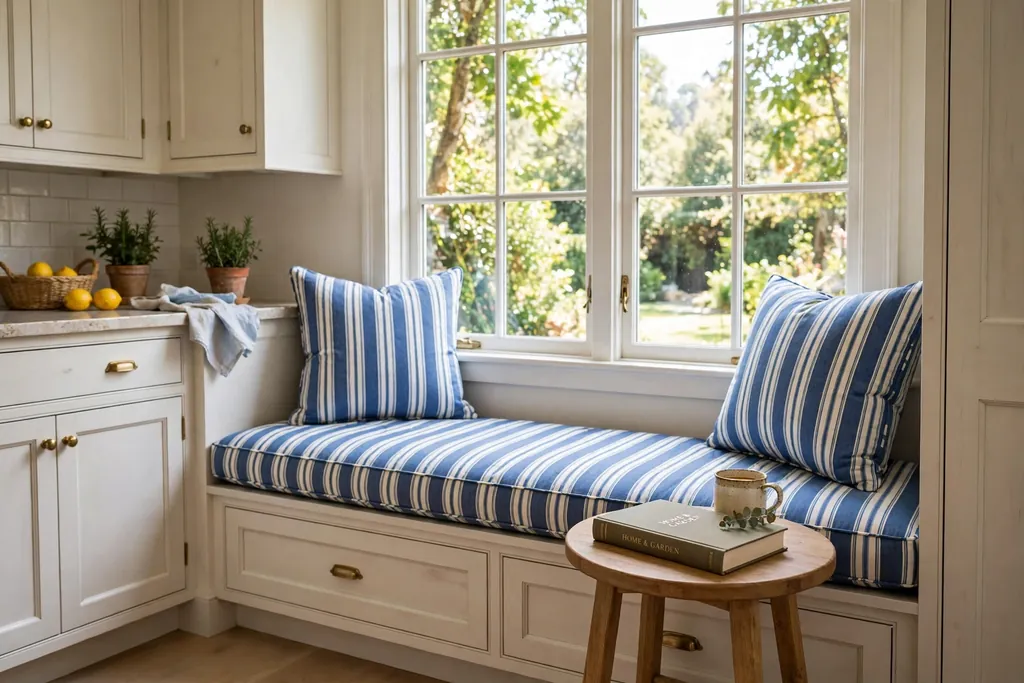
A window seat with blue and white striped cushions gives a coastal kitchen a reading and resting spot that doubles as storage. Fit a bench under a wide window, add a thick seat cushion in a washable stripe, two or three plain cushions in white and pale blue, and a small side table for a book and a drink. The stripe reads as seaside, and it works best when the rest of the room stays mostly solid.
Choose a seat deep enough to sit in for an hour, not a narrow ledge that looks good but stays empty. Keep the seat mostly clear, with one folded throw, so it stays useful rather than turning into a pile of cushions. If strong sun fades the fabric over time, move the cushions indoors at night or choose a fade resistant outdoor fabric.
33. Warm Evenings With Lantern Light
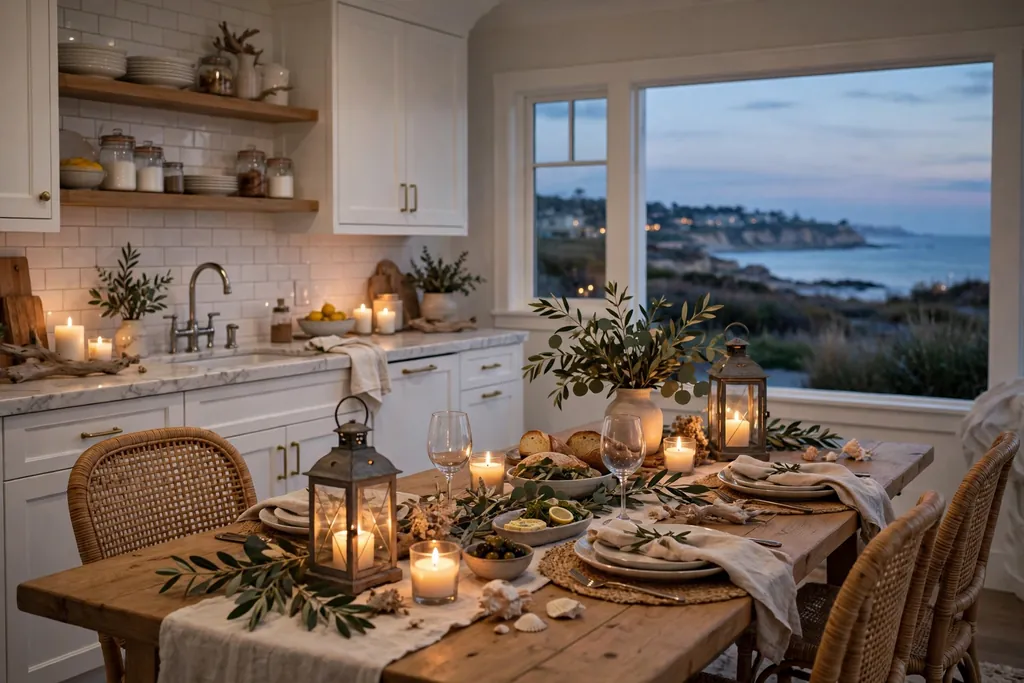
Lanterns with warm candles or battery candles give a coastal kitchen soft evening light that overhead lights cannot match. Place one large lantern on the dining table or the island, and one smaller lantern on a sideboard or window seat, and keep the rest of the room dim. The warm glow suits white walls and wood tones, and it makes an evening meal feel slower and calmer.
Use battery candles if children or pets use the room, or if the lantern sits near curtains or linen. Keep real flames clear of fabric, dried foliage, and open windows, and never leave a lit candle unattended. Swap the lantern glass and wicks as needed, and store spare candles in a nearby drawer, so evening light takes a minute to set up.
34. Paint the Ceiling Pale Sky Blue
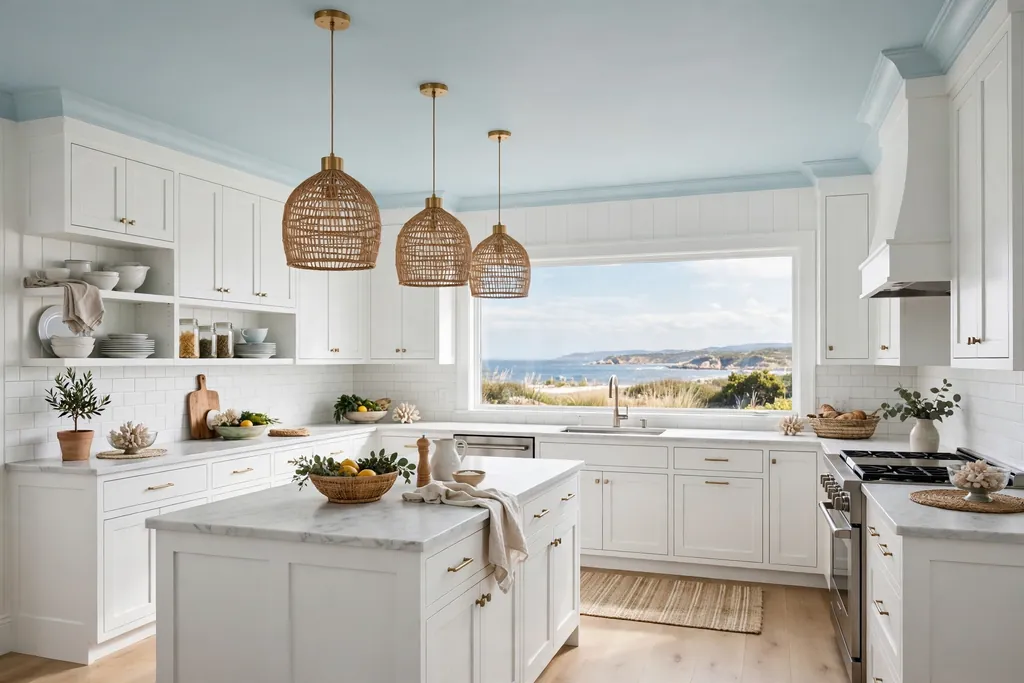
A pale sky blue ceiling, the soft blue long used on porch ceilings, gives a coastal kitchen a gentle wash of color overhead without painting a single wall. The pale blue reads as sky from below, and it pairs well with white walls, white cabinets, and light wood floors. Keep the blue very pale, closer to white than to mid blue, so the ceiling still reflects light.
Test the color on a large board held overhead in daylight and evening light, since ceiling color shifts a lot through the day. Pair the ceiling with white trim and pale walls, so the blue stays a quiet note rather than a feature. If the room feels too blue, paint only the nook or porch ceiling pale blue, and keep the main kitchen ceiling white.
Conclusion
A relaxed, pulled together coastal kitchen comes down to a calm palette, natural texture used with restraint, and color in layers you can change. Start with white, sand, and sea blue, add one wood or woven feature, such as rattan pendants, a whitewashed island, or a jute runner, and keep counters mostly clear, so the room feels bright by day and restful at night. For the walls beyond the cabinets, the same layering of art, shelves, and texture appears in these kitchen wall decor ideas.
Save this list for your next free hour in the kitchen, and work through it in order: palette and cabinets first, then tile and lighting, then seating and storage, and finally the textiles, art, and evening details.
FAQs
What colors work best for a coastal kitchen?
White, warm white, sand, pale sea blue, and one deeper blue work best, because they keep the room light while giving it a clear seaside note. Keep the main palette to white and sand, with blue on cabinets, stools, textiles, or art, and add natural wood and woven texture for warmth. Test paint and fabric samples in daylight and evening light before committing, since white and blue shift a lot through the day.
How can I make a coastal kitchen feel calm, not themed?
Focus on palette and materials first: white walls, sand tones, pale blue paint, rattan, jute, weathered wood, and linen, rather than a large number of themed objects. Limit seaside motifs to one wall or one shelf, and keep surfaces mostly clear, so the room feels restful. One coastal feature per area is enough, and the rest of the room can stay plain and practical.
Can I create a coastal kitchen without a sea view?
Yes. A coastal kitchen is mainly a palette and a set of textures, not a view. White walls, sand tones, pale blue cabinets, linen curtains, and woven baskets give the same light, calm feel in an inland room. If you want a view to look at, a gallery wall of seaside prints on the dining wall gives a coastal focal point without changing the room layout.
What backsplash suits a coastal kitchen best?
Sea glass tile, fish scale tile, and plain white subway tile all suit a coastal kitchen, because each keeps the wall light while adding texture or a soft sea color. Sea glass tile gives a frosted, collected feel, fish scale tile adds a wave shape, and white subway tile is the safest base for a bold cabinet color. Seal the grout in every case, since kitchen backsplashes take grease and water.
What lighting works best in a coastal kitchen?
Rattan pendants over the island, a single pendant over the sink, and warm lantern light in the evening work best, because each adds texture or warmth without darkening the room. Use warm white bulbs, keep shades clear of steam from the hob, and dust pendants often, since kitchen lights collect grease film. Layer the lights, so task light covers the counters and soft light covers the table.
Is a coastal kitchen hard to keep clean?
No, if you choose wipeable finishes near the stove and sink. Painted cabinets in a satin finish, sealed tile grout, quartz counters, and washable linen textiles all wipe clean with routine care. Open shelves and woven pieces need a weekly dust, and jute rugs need quick blotting for spills. Keep the coastal details to spots you can reach easily, and the room stays as practical as any other kitchen.