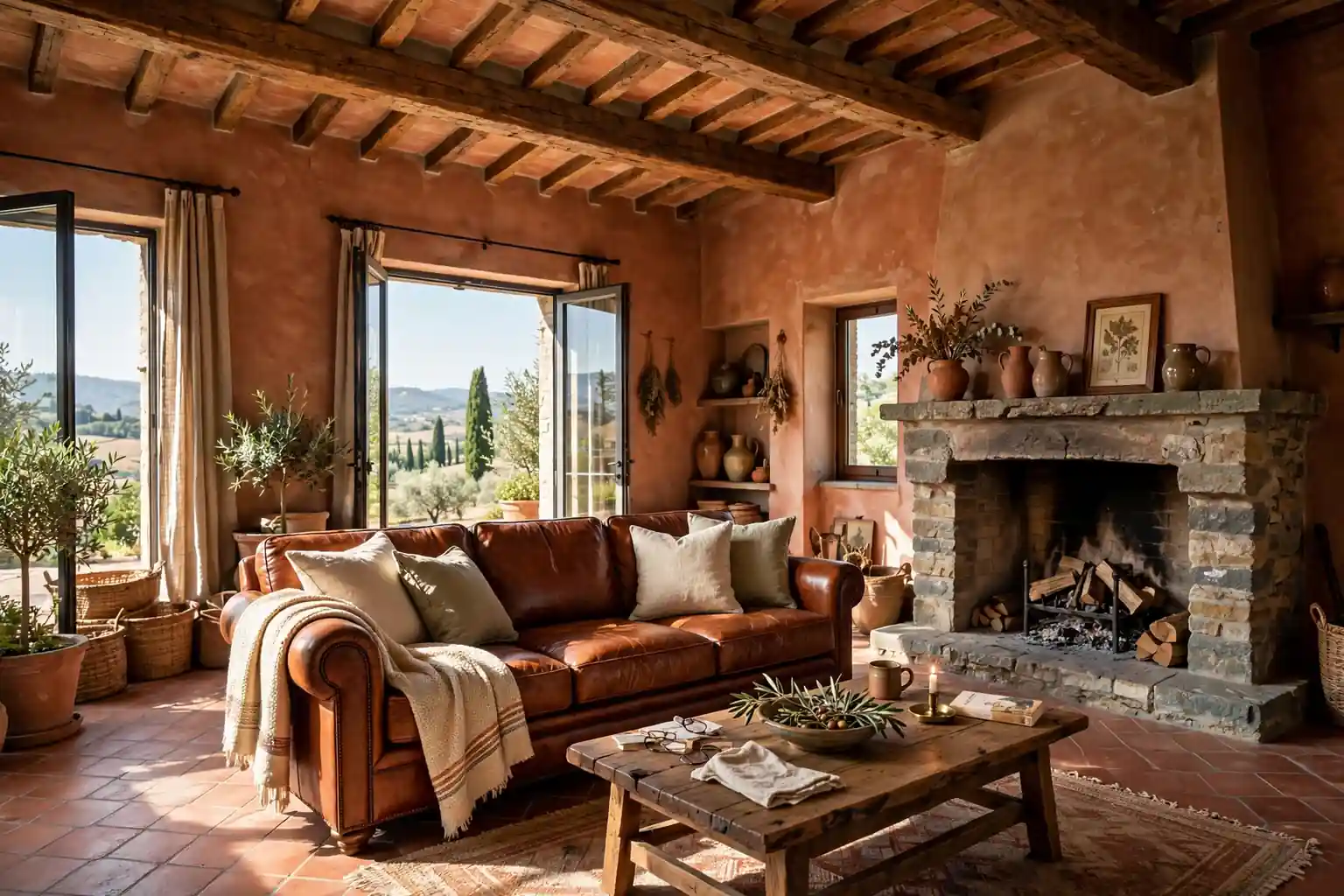
An Italian living room feels welcoming before it feels decorated. Warm plaster walls, worn wood, a stone fireplace, and a table set for people to sit around all point to the same idea: a room made for long conversations, good food, and everyday comfort. These 33 Italian living room ideas cover walls, floors, seating, lighting, and small details, so you can borrow one idea or build a whole room from them. Start with the bones of the room, then add seating and light, and finish with plants and pottery that make it feel lived in.
Key Takeaways
- Start with warm, natural materials: plaster, terracotta, wood, stone, leather, and linen set the Italian tone before any decoration is added.
- Keep one calm palette of warm whites, terracotta, olive, and walnut, and repeat it in the rug, cushions, and pottery.
- Give the room a clear gathering point, such as a fireplace, a coffee table, or a shared table, and arrange seating to face it.
- Mix old and new pieces: a worn wood table or an antique credenza sits well beside a simple modern lamp or a plain linen sofa.
- Use plants, pottery, and candlelight for warmth, and keep surfaces mostly clear so the room stays calm and easy to use.
- Choose pieces that suit daily life first, with washable linen, sturdy wood, and storage that hides clutter.
1. Terracotta Limewash Walls
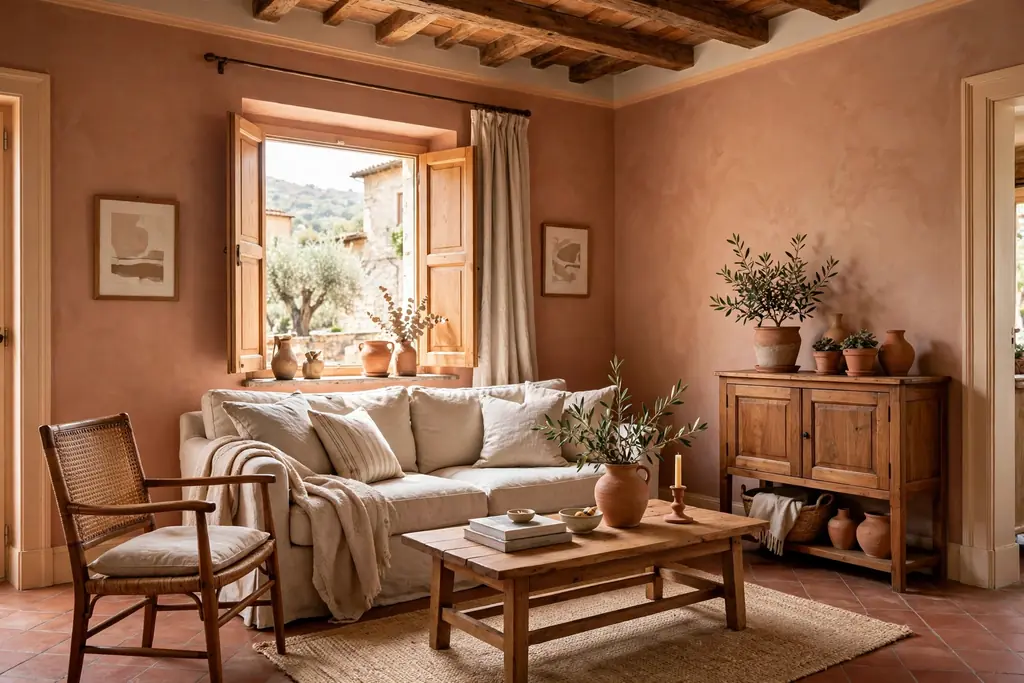
Wash the walls in a soft terracotta limewash to give the room its warm base. Limewash has a cloudy, hand finished look that plain paint rarely gives, and it suits both old houses and newer rooms that feel too flat. Choose a muted terracotta rather than a bright orange, and test a patch in daylight and lamplight before you commit.
Keep the ceiling and trim in warm white so the walls stay the main color, and let wood, leather, and linen carry the rest of the palette. If a full room feels like too much, wash one wall behind the sofa and keep the others in warm white. The effect is still warm, and the room is easier to change later.
2. Stone Fireplace with a Thick Wood Mantel
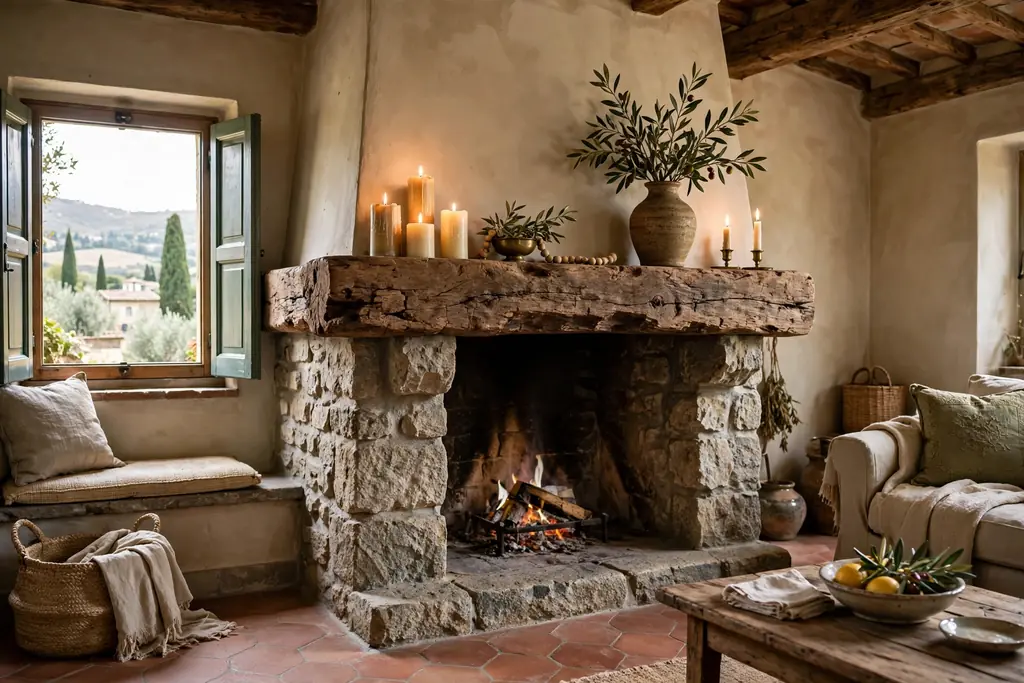
Make a stone fireplace the center of the room, with a thick, rough wood mantel above it. Stone gives weight and age to the room, while the wood mantel softens it and gives you a shelf for candles, a vase, or a framed print. This suits a room where conversation matters more than a television, since chairs naturally turn toward the fire.
Keep the hearth clear and safe, with no rug or fabric too close to the opening, and choose a low pile rug for the seating group in front of it. If your home has no working fireplace, a stone surround around an electric insert, or even a simple stone clad wall, gives a similar focal point without major building work.
3. Arched Wall Niches for Display
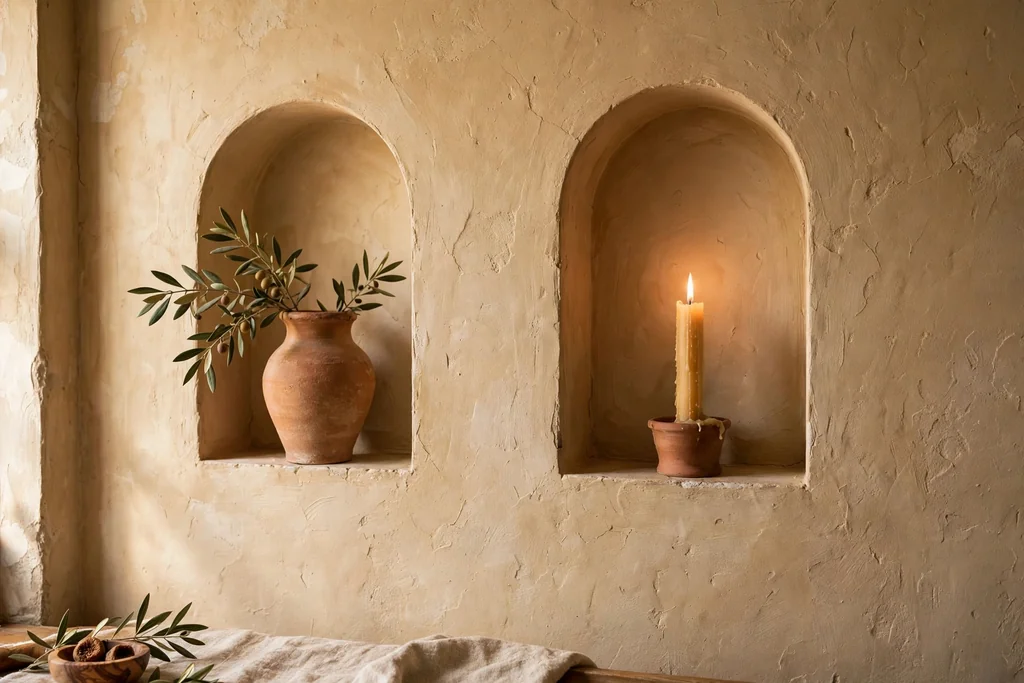
Cut the hard lines of a rectangular room with arched wall niches, or suggest the same shape with arched shelving and arched mirrors. An arch is a classic Italian shape, and a niche gives pottery, a candle, or a small plant a place of its own instead of a crowded shelf. Paint the inside of the niche a shade deeper than the wall so the shape reads clearly.
Use niches sparingly, one or two in a room, so they feel special rather than busy. A single arched niche beside a fireplace, with one terracotta vase and a candle, often works better than a whole wall of small arches. Keep the display simple and leave empty space around each object.
4. Exposed Wood Ceiling Beams
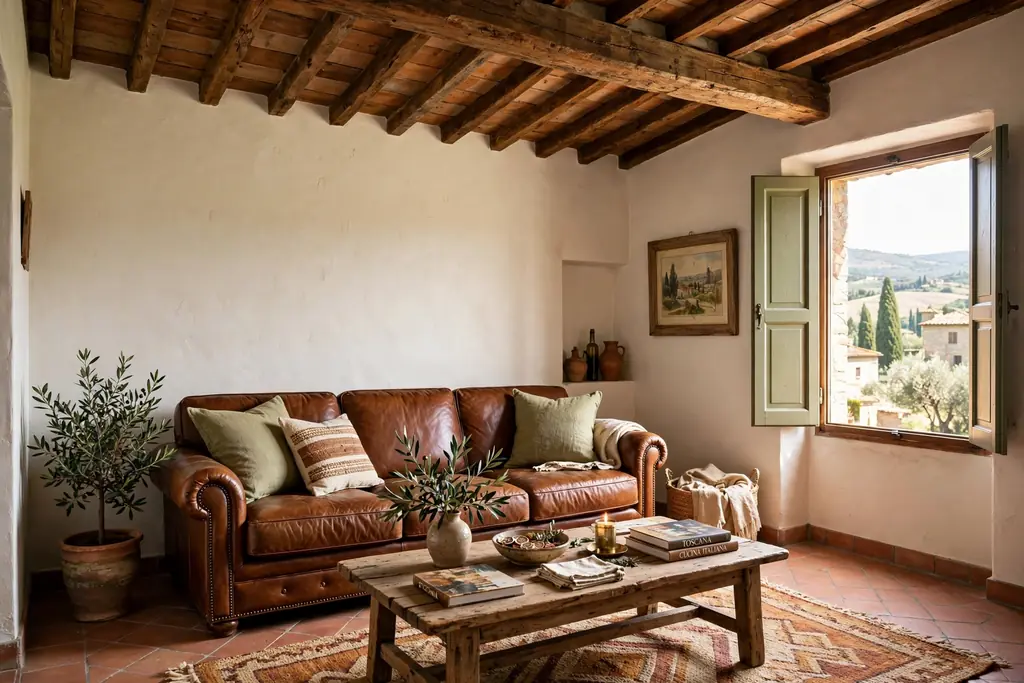
Leave ceiling beams exposed, or add slim wood beams to a plain ceiling, to bring warmth overhead. Dark walnut beams suit a rustic room, while pale oak beams keep a smaller room feeling light. Beams draw the eye up and make a plain ceiling feel like part of the design, not just a surface above it.
Check the ceiling height first, since beams in a very low room can feel heavy. In a low room, use fewer, slimmer beams in a pale wood, and keep the ceiling itself in warm white. Painted beams in a soft cream are another option when dark wood would close the room in.
5. Terracotta Tile Floors Softened with a Wool Rug
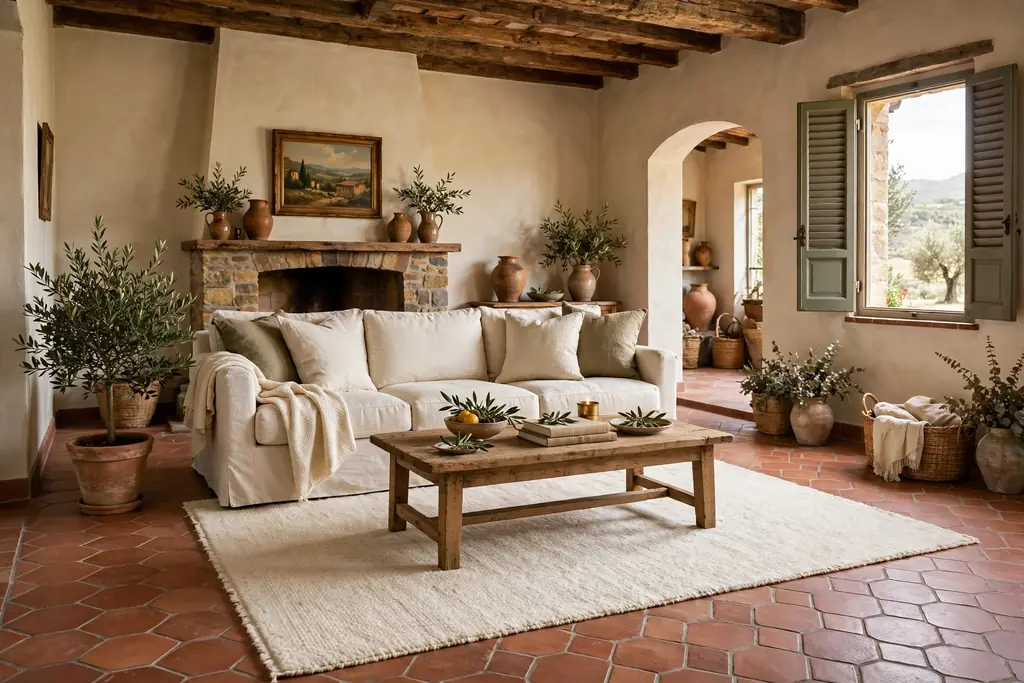
Lay terracotta tiles, or choose a terracotta look tile, for a floor that feels warm underfoot and ages well. Terracotta suits kitchens and living rooms alike, and it pairs naturally with wood furniture and linen upholstery. A large wool rug over the tiles softens the seating area and keeps feet warm in winter.
Size the rug to the seating group, with the front legs of the sofa and chairs resting on it, as explained in these living room rug ideas. Choose a rug in cream, rust, or a muted pattern, and keep a border of tile showing around it so the floor still reads as terracotta. A low pile rug is easier to clean in a busy family room.
6. Majolica Tile Border as a Floor Rug
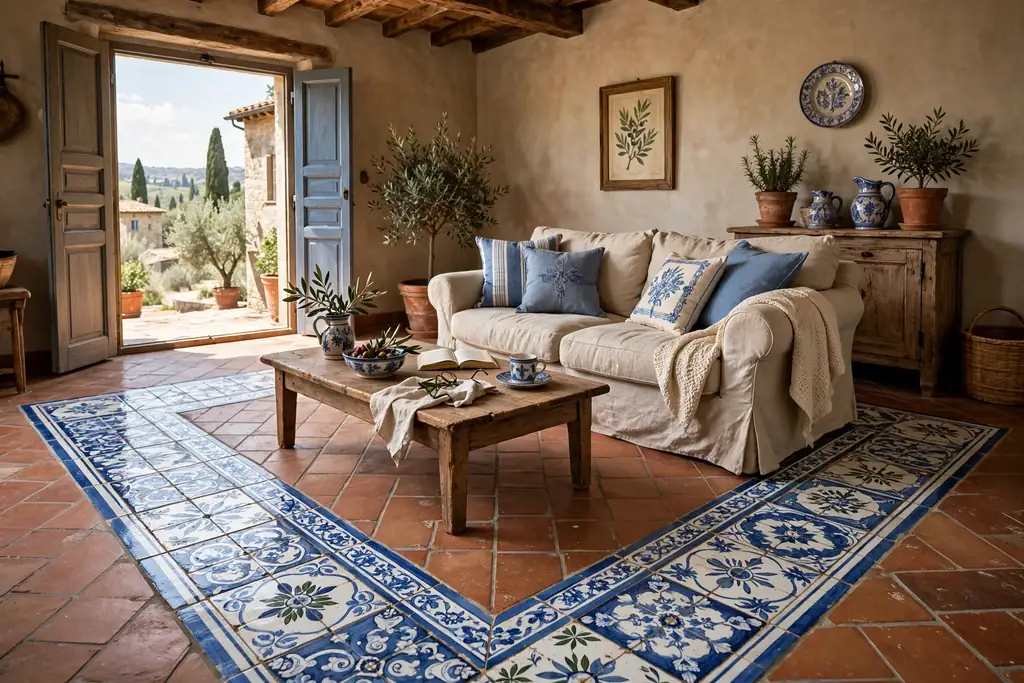
Use a border of hand painted majolica style tiles to mark the seating area, like a rug made of tile. A blue and white or green and cream border around a plain tile or wood floor gives a strong Italian detail without covering the floor. This works well in a room where a rug would slide, stain, or hide a floor worth showing.
Keep the border simple and even, with the same tile repeated around the edge, and let the center stay plain. If real tile work is not practical, a printed tile look rug in a majolica pattern gives a similar effect and can be moved. Either way, keep furniture inside the border so the seating group reads as one zone.
7. Cognac Leather Sofa as the Anchor
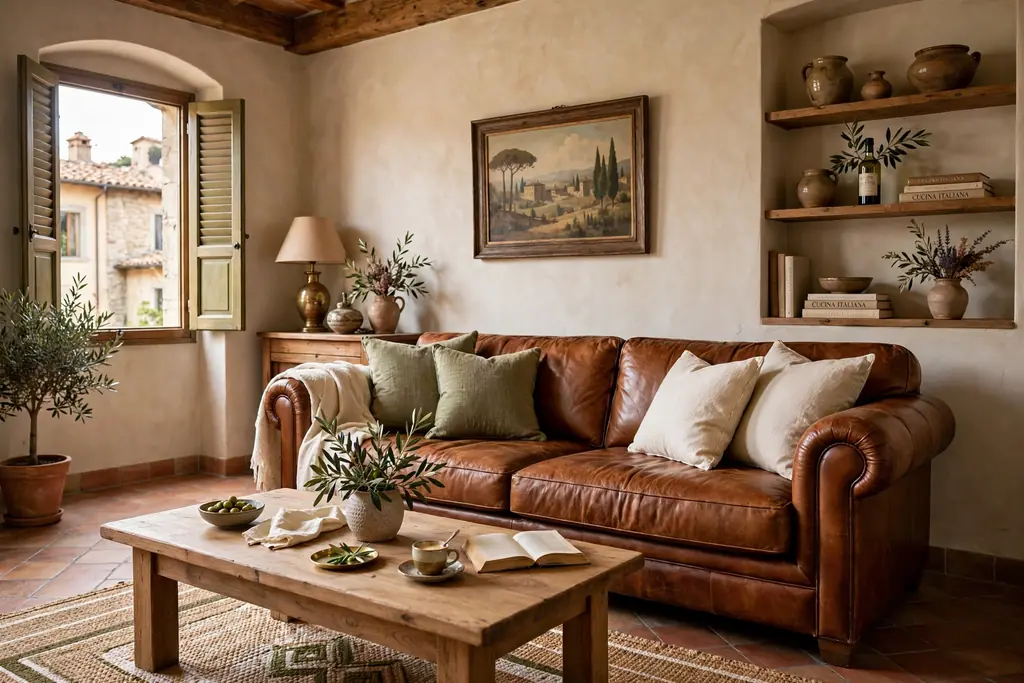
Anchor the room with a cognac leather sofa, a piece that grows more comfortable and better looking with use. Leather suits a family room because spills wipe off, and the warm brown tone sits well with terracotta walls, wood floors, and cream linen. Choose a simple shape with deep seats, since a fussy frame fights the relaxed Italian feel.
Pair the sofa with cushions in olive, cream, and rust, and a wool throw for cooler evenings. Keep the rest of the seating simpler, such as plain wood chairs or a linen armchair, so the leather stays the main statement. Condition the leather as the maker directs, and keep it out of harsh direct sun.
8. Relaxed Linen Slipcovered Sofa
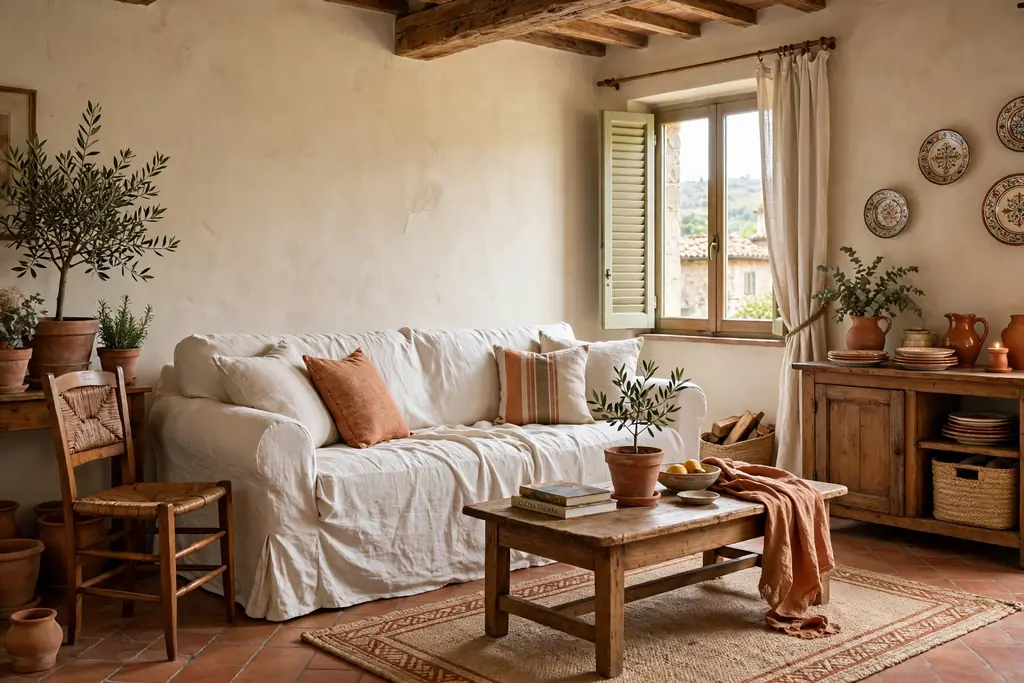
Choose a linen slipcovered sofa for a softer, more casual Italian look. Slipcovers can be removed and washed, which makes linen practical for homes with children, pets, or frequent guests. The slightly wrinkled, relaxed drape is part of the appeal, so do not chase a pressed, formal finish.
Pick a warm white, oatmeal, or pale sage linen, and add cushions in terracotta and olive for color. A slipcovered sofa pairs well with a wood coffee table and a wool rug, and it suits a room where comfort matters more than a sharp tailored line. Keep a spare slipcover if the sofa gets daily use, so one can wash while the other is on.
9. Olive Velvet Armchairs by the Fire
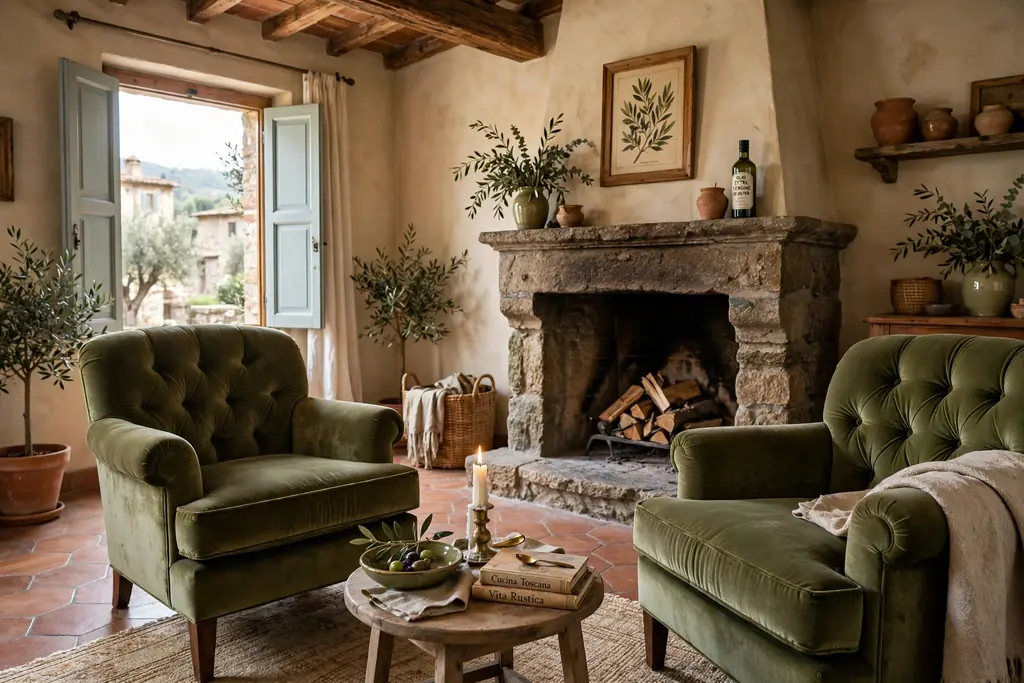
Place a pair of olive velvet armchairs by the fireplace for a seating spot that feels rich without being formal. Velvet catches light in a way linen does not, and olive is a calm green that links the room to plants and to the countryside palette. Two chairs facing each other, or angled toward the fire, invite conversation.
Keep the chair frames simple, in dark wood or brass legs, and add a small side table between them for cups and books. If velvet feels too warm for summer, swap the cushions for linen ones and keep the velvet chairs for the cooler months. A single velvet chair also works in a smaller room beside a reading lamp.
10. Woven Rattan Lounge Chair in a Sunny Corner
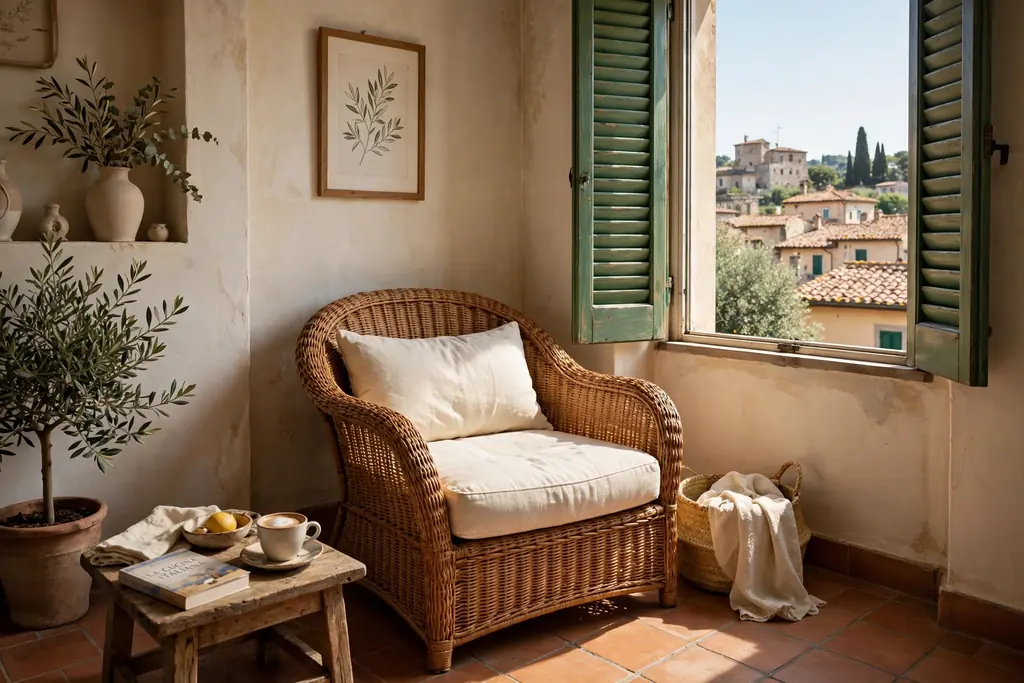
Set a woven rattan lounge chair in the sunniest corner of the room for a light, coastal Italian feel. Rattan suits a room with whitewashed walls, linen curtains, and a terracotta pot, and it reads as relaxed rather than rustic. Add a thick cushion in cream or striped linen so the chair is comfortable for a long sit.
Keep the rattan chair away from damp spots and very harsh sun, which can dry the weave over time. A small side table and a basket for books complete the corner, and the chair can move to a terrace in summer if the weave is suited to outdoor use. Check the maker guidance before leaving it outside.
11. Reclaimed Wood Coffee Table
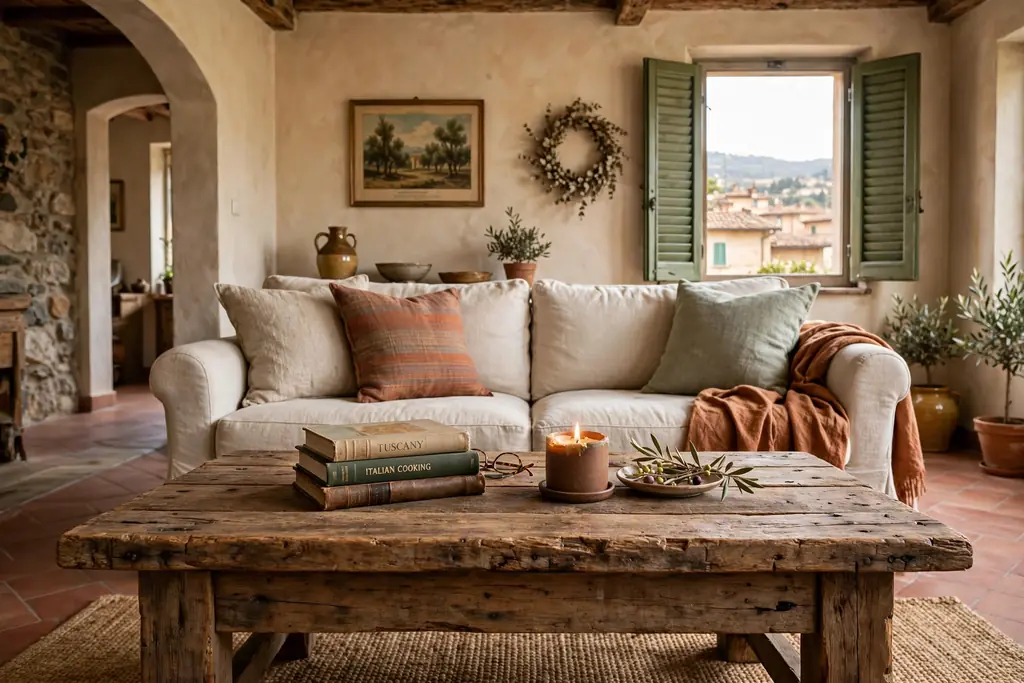
Center the seating group on a reclaimed wood coffee table with visible grain, knots, and a worn edge. A thick plank top on simple legs feels handmade and sturdy, and it gives the room a piece with a past. This table suits both a leather sofa and a linen sofa, since wood links the two styles.
Keep the tabletop mostly clear, with one tray, a candle, and a small stack of books, so it stays useful for cups and plates. Choose a table height that matches the sofa seat, and leave enough room to walk around it easily. If the wood is rough, sand the top smooth and seal it so cups and glasses sit safely.
12. Travertine Side Tables
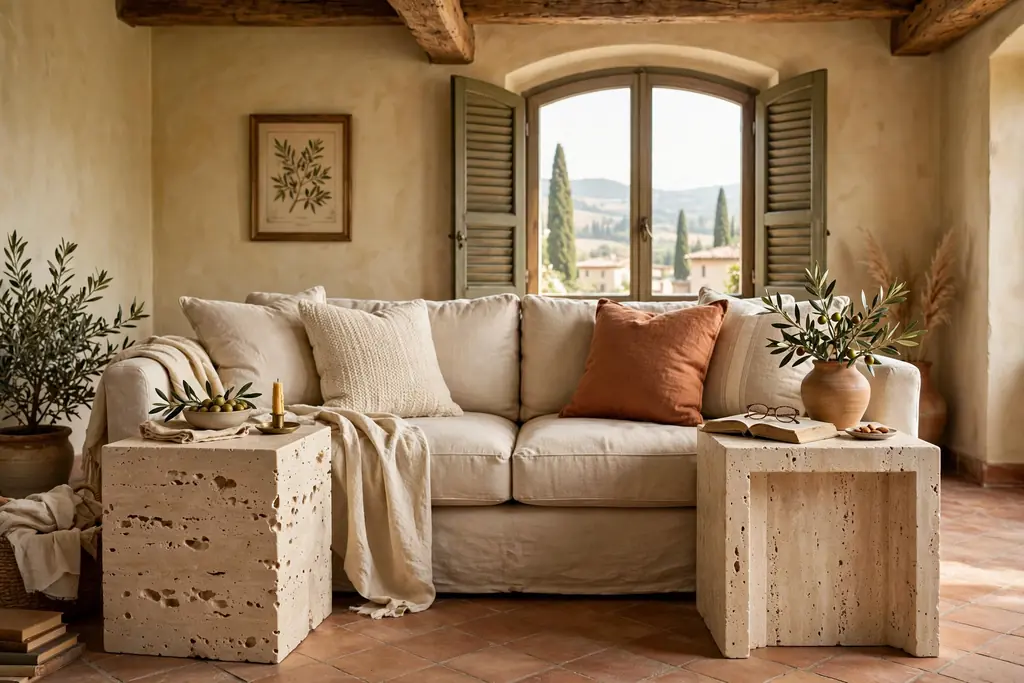
Add travertine side tables beside the sofa and chairs for a stone detail at a smaller scale than a fireplace. Travertine has a soft, pitted surface in warm cream and beige tones, and a small round or square table in this stone feels both natural and refined. It suits a room that already has wood and leather, since stone adds a cool contrast.
Use one travertine table as a lamp stand and another as a cup table, and keep the tops clear except for one object each. Travertine stains more easily than sealed wood, so wipe spills quickly and use coasters for drinks. A sealed finish, applied as the maker directs, helps protect the surface in daily use.
13. Marble Topped Console Behind the Sofa
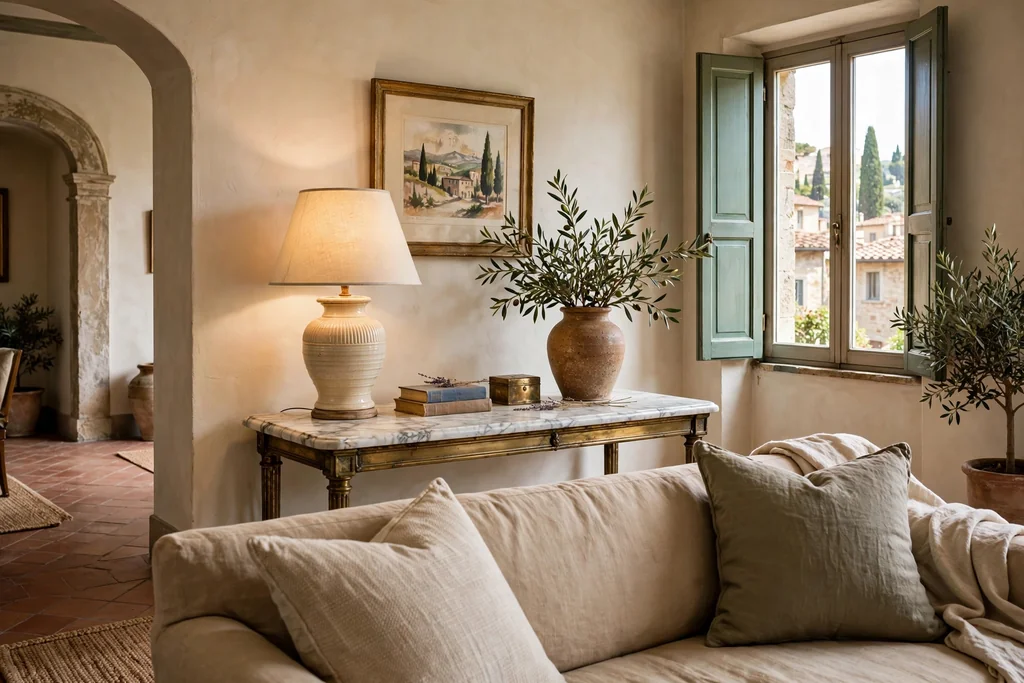
Place a marble topped console behind a sofa that floats in the middle of the room. The console gives the back of the sofa a finished edge, holds a lamp and a few books, and creates a surface for a vase or a framed print. White or cream marble with soft grey veins keeps the look calm, while the wood or iron base below adds warmth.
Keep the console narrow, so it does not eat into the walkway behind the sofa, and anchor it to the wall or floor if children or pets could pull on it. A console in this spot also works as a soft divider in an open plan room, marking where the living zone ends without a wall.
14. Open Wood Shelves for Ceramics and Books
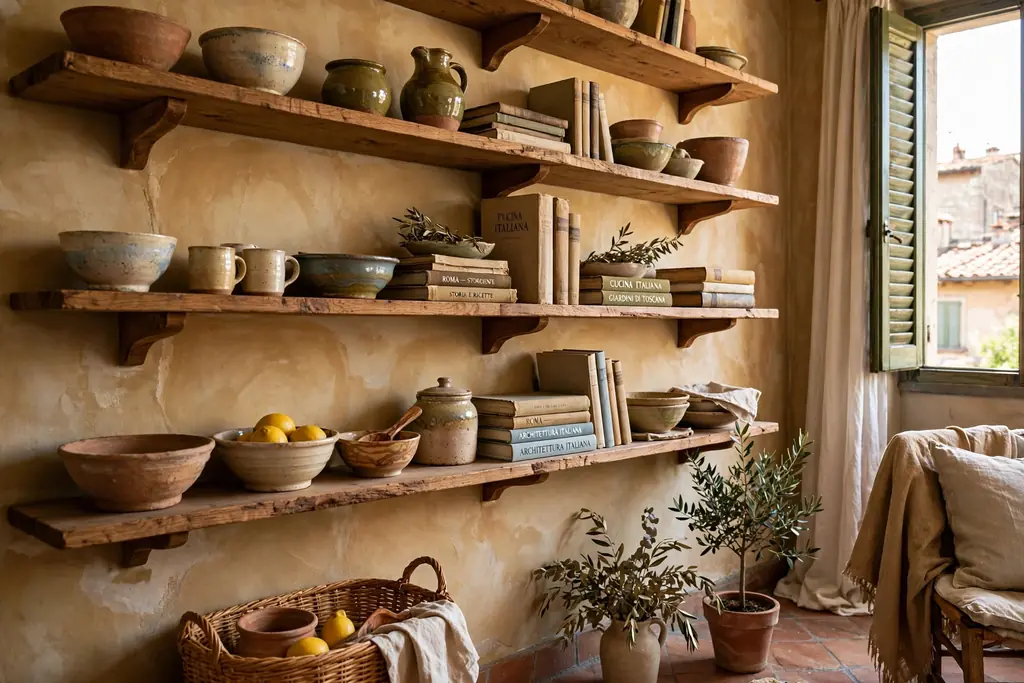
Hang open wood shelves on one wall for ceramics, books, and a few plants, and keep the display loose rather than packed. Open shelves suit an Italian room because they show the handmade pieces that give the room character, such as bowls, jugs, and old books with worn covers. Use thick wood shelves with simple brackets in iron or wood.
Edit the shelves hard: one row of books, a stack of bowls, a plant, and empty space between groups. If the shelves look crowded, remove a third of the objects and see how the wall breathes. Dust open shelves weekly, and keep everyday items low and within reach, with display pieces higher up.
15. Antique Walnut Credenza for Storage
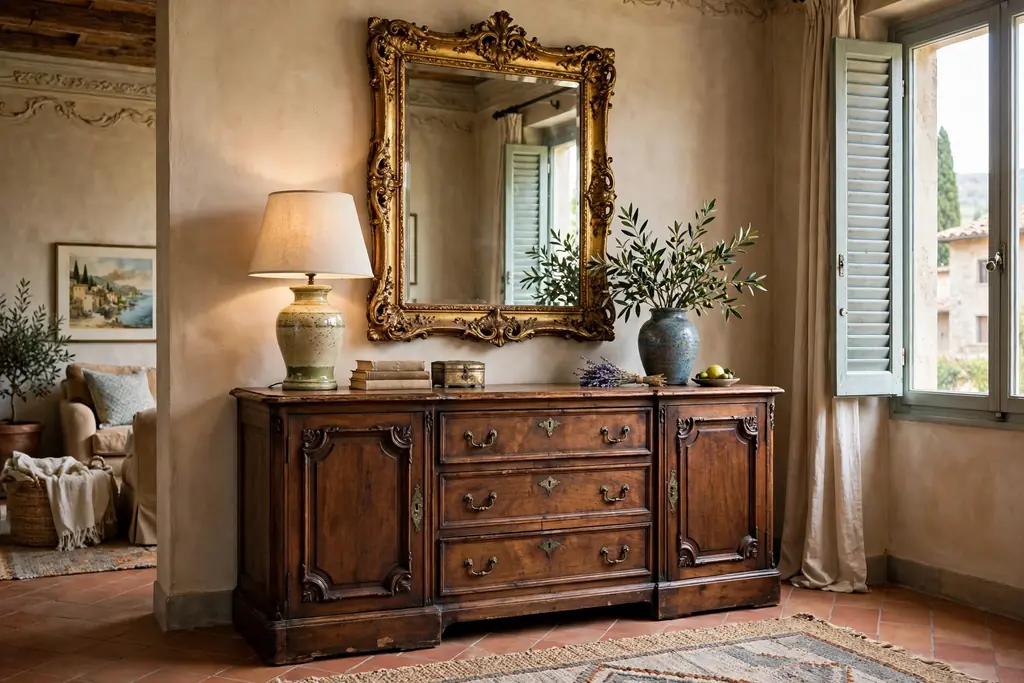
Use an antique or antique style walnut credenza to hide the clutter that open shelves cannot hold. A credenza with doors keeps board games, chargers, and spare throws out of sight, while its wood tone and aged hardware add warmth to the wall. Place it under a mirror or a framed print so it reads as furniture, not just storage.
Keep the top of the credenza mostly clear, with a lamp at one end and a vase or a stack of books at the other. If the credenza is a genuine antique, check that doors and drawers close well and that the piece is stable on your floor. A credenza also serves as a serving surface when guests gather, which suits a room built for hospitality.
16. Glass Front Cabinet for Murano Glass
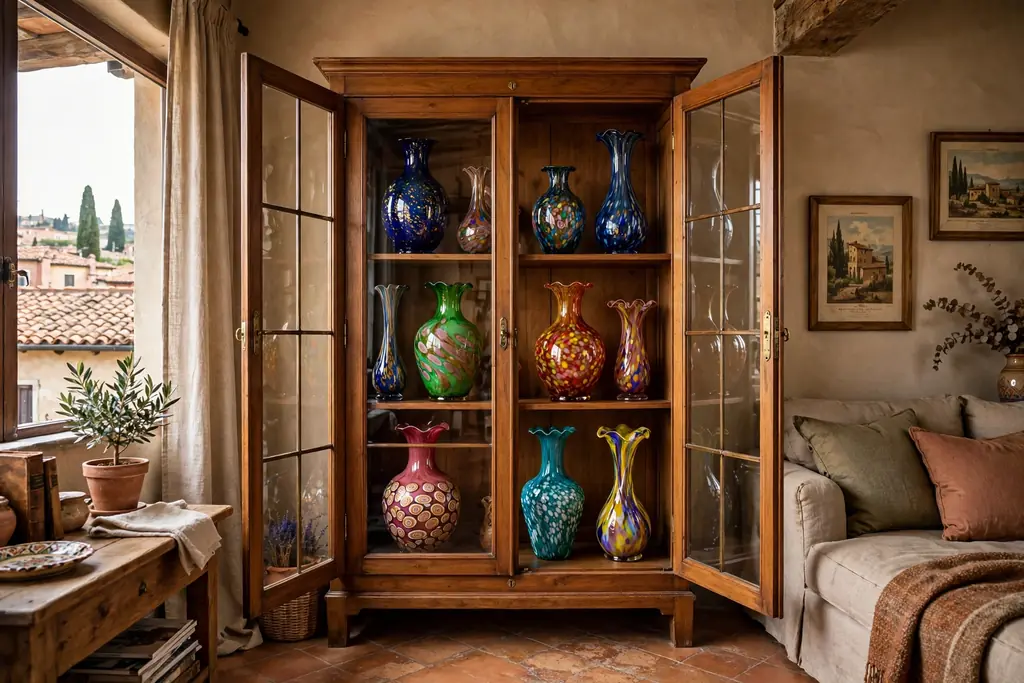
Show Murano glass in a glass front cabinet, where color and light can do their work without dust settling on every piece. A cabinet with wood frames and clear glass doors suits an Italian room far better than a fully open shelf for delicate glass. Place the cabinet where daylight or a lamp can pass through the glass, so the colors glow.
Group the glass by color family, such as blues together and ambers together, and leave space between pieces so each one is visible. Keep the cabinet doors closed in a dusty room, and clean the glass with a soft cloth. One or two strong pieces in the cabinet often look better than a crowded shelf of small ones.
17. Wrought Iron Chandelier over the Seating Area
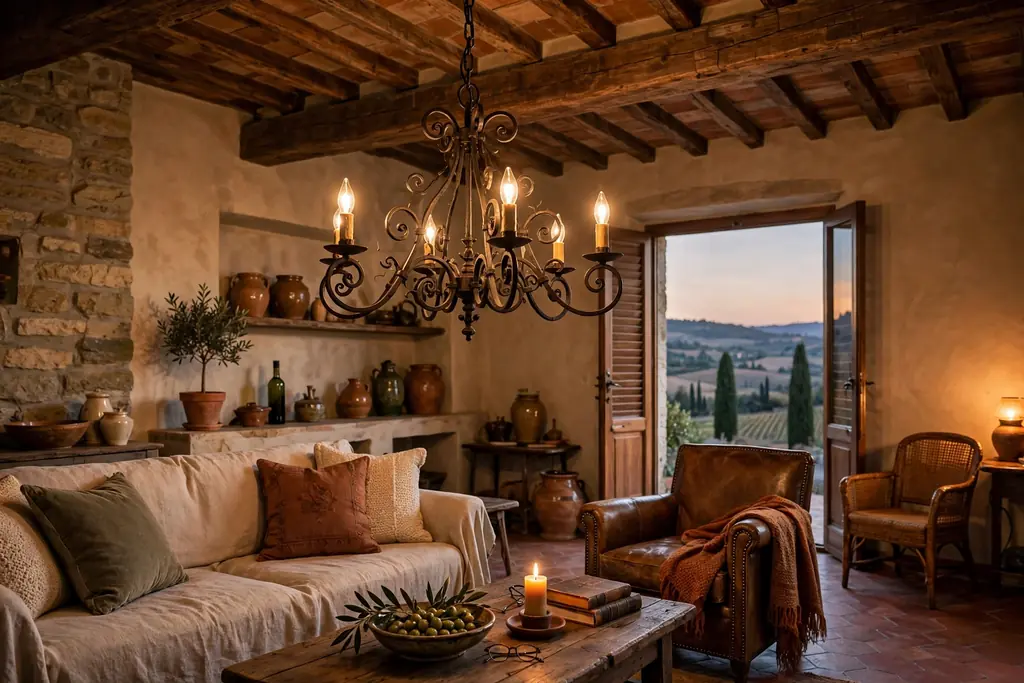
Hang a wrought iron chandelier over the seating area for a fixture that feels handmade and old. Iron suits a room with wood beams, stone, and terracotta, and a simple ring or candle style chandelier gives warm light without a fussy crystal look. Use warm bulbs and a dimmer, where one is already fitted, so the light can shift from bright to soft in the evening.
Hang the chandelier high enough to walk under safely, and center it over the coffee table rather than the middle of the room if the seating group sits off center. If the ceiling is low, choose a flush or semi flush iron fixture in the same style, so the room keeps the iron detail without losing headroom.
18. Murano Glass Table Lamps for Soft Evening Light
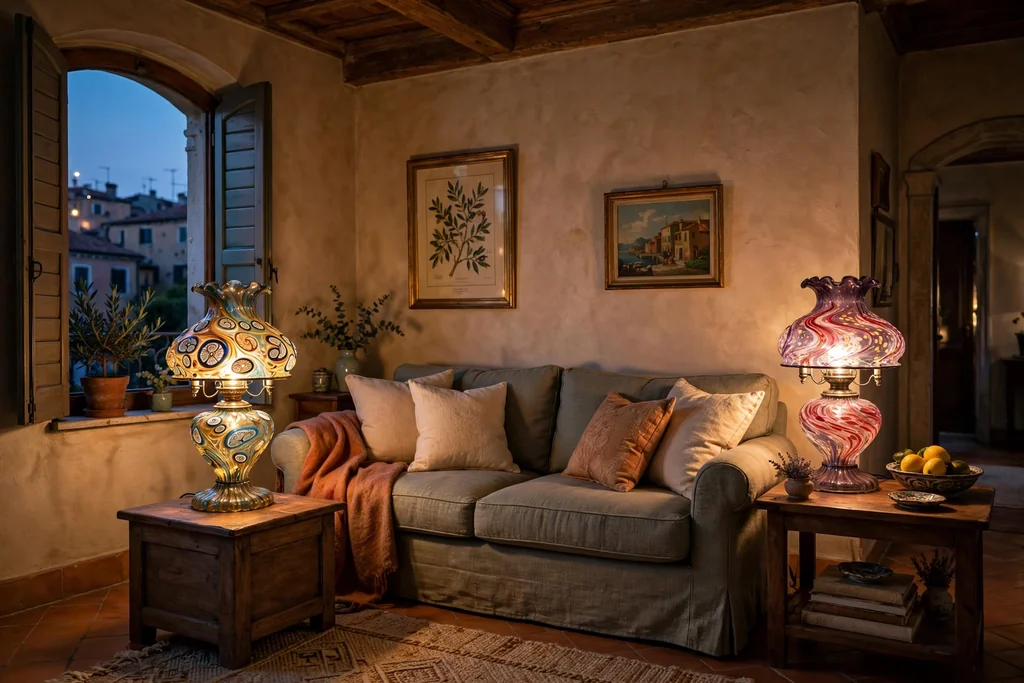
Add Murano glass table lamps on side tables and the console for soft evening light in color. A lamp in amber, green, or soft blue glass glows when lit, and the base itself is a decoration by day. Murano lamps suit a room where the main ceiling light feels too harsh for evenings, since they give pools of warm light at seat height.
Use matching lamps on either side of a sofa for balance, or one strong lamp beside a reading chair. Keep the shade simple, in cream linen, so the glass base stays the focus. Choose a bulb tone that matches the other lamps in the room, so the evening light feels even rather than mixed.
19. Potted Olive Tree in a Terracotta Pot
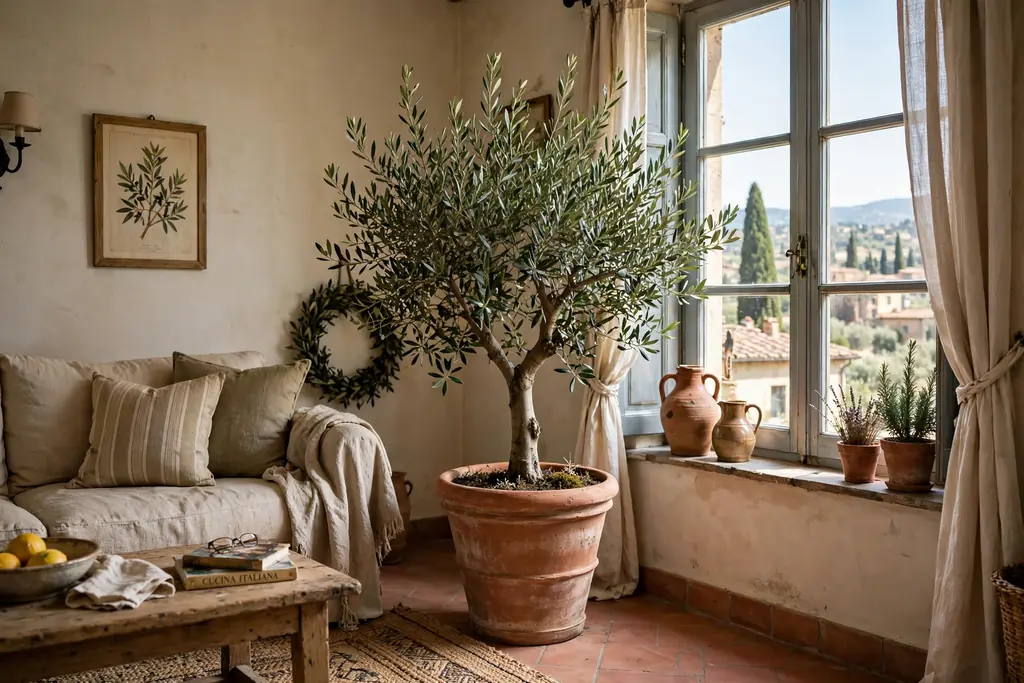
Grow a potted olive tree in a large terracotta pot for the single plant that most clearly says Italy. The silvery green leaves suit warm walls and wood floors, and the terracotta pot links the plant to the floor and to the pottery on the shelves. Place the tree near a bright window, where it gets the light it needs.
Water only when the top soil feels dry, and use a pot with drainage holes so roots do not sit in water. Turn the pot a quarter turn each week so growth stays even, and prune lightly to keep the shape open. In a cold climate, keep the tree indoors through winter and move it to a sheltered terrace only in warm months, following local guidance for your variety.
20. Sunny Windowsill Herb Pots
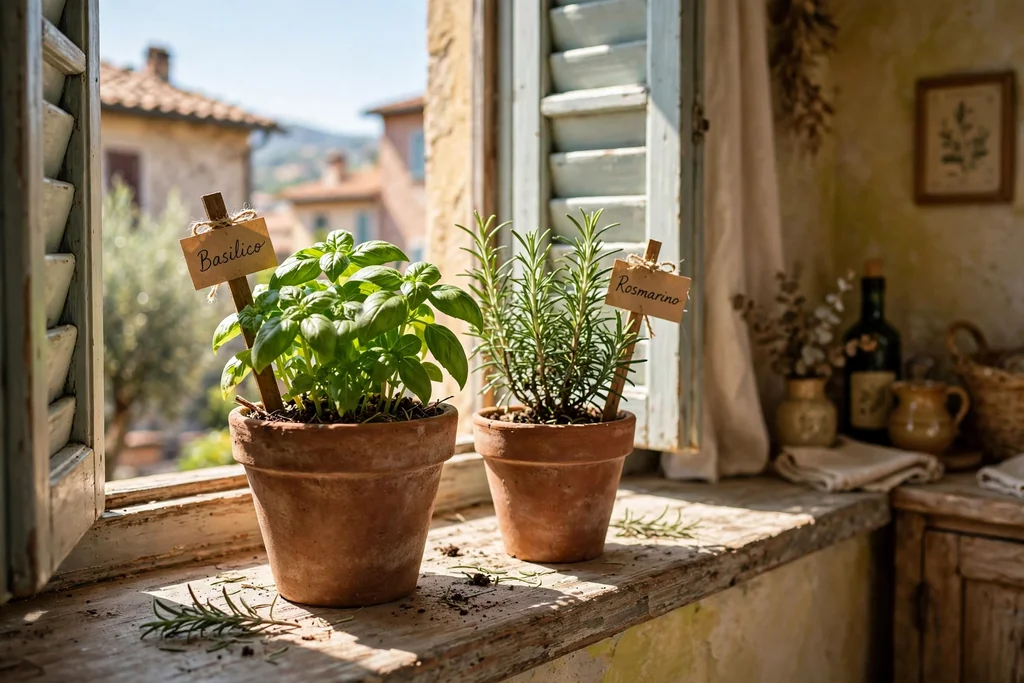
Line a sunny windowsill with small herb pots in terracotta, for a living detail that also serves the kitchen. Basil, rosemary, and parsley grow well on a bright sill, and their scent suits a room used for cooking and eating. Small pots are easier to care for than one large planter, and a single herb can be replaced without disturbing the rest.
Use pots with drainage and saucers to protect the sill, and water each herb as its own needs require, since rosemary likes drier soil than basil. Snip herbs often to keep plants bushy, and rotate pots so all sides get light. If the sill is narrow, use a slim tray to hold the pots together and catch water.
21. Terracotta Pottery Collection on a Low Bench
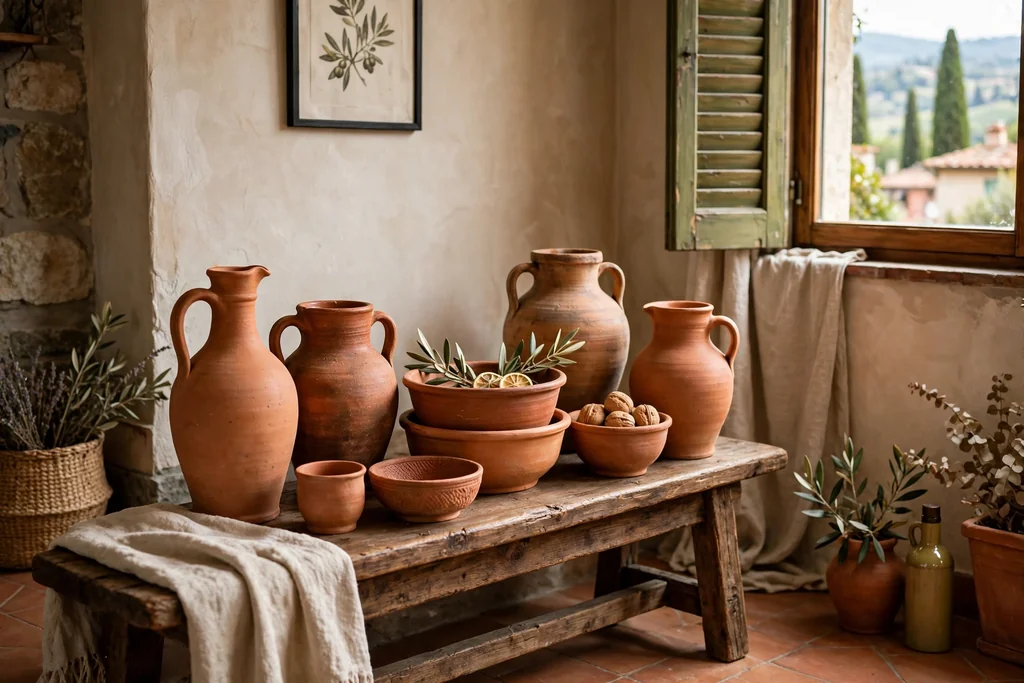
Gather terracotta pottery on a low wood bench, with pots, jugs, and bowls in different sizes but one warm clay tone. A bench keeps the collection at a height where it can be seen and enjoyed, and it works as extra seating or a surface for a tray when guests visit. Group pots in odd numbers, such as three or five, with the tallest at the back.
Leave empty space on the bench so the group does not look like a shop shelf, and vary the shapes: a tall jug, a wide bowl, and a small pot together read as a collection. If the bench sits near a door, keep it clear of the walking route, and anchor it if it could tip. A few pots can hold dried stems, while the rest stay empty to show the clay.
22. Hand Painted Ceramic Plates on the Wall
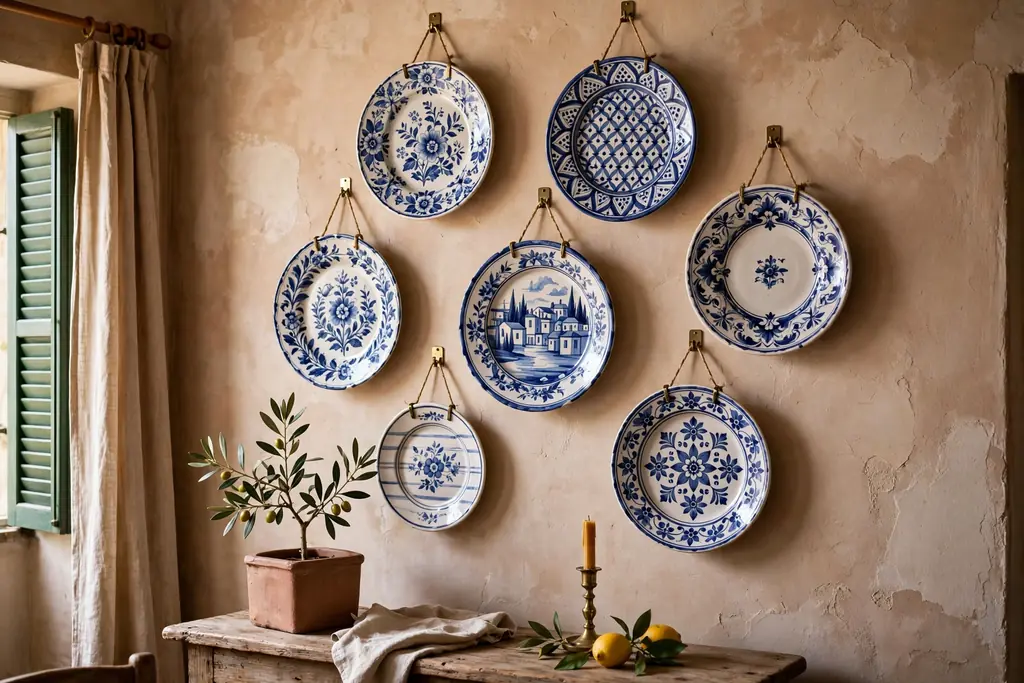
Hang hand painted ceramic plates on one wall as art that also tells a story of place. Plates in blue and white, or in green and ochre, suit a warm plaster wall, and a group of five or seven plates in mixed sizes feels collected rather than matched. Use plate hangers rated for the weight of each plate, and hang the group with even spacing.
Keep the plate wall to one area, such as above a credenza or beside a fireplace, so it stays a feature rather than spreading across the room. If you use plates you also eat from, hang only the ones you are happy to keep on the wall, and keep everyday plates in the kitchen. Photograph the layout on the floor first, then hang from the center outward.
23. Framed Italian Countryside Prints
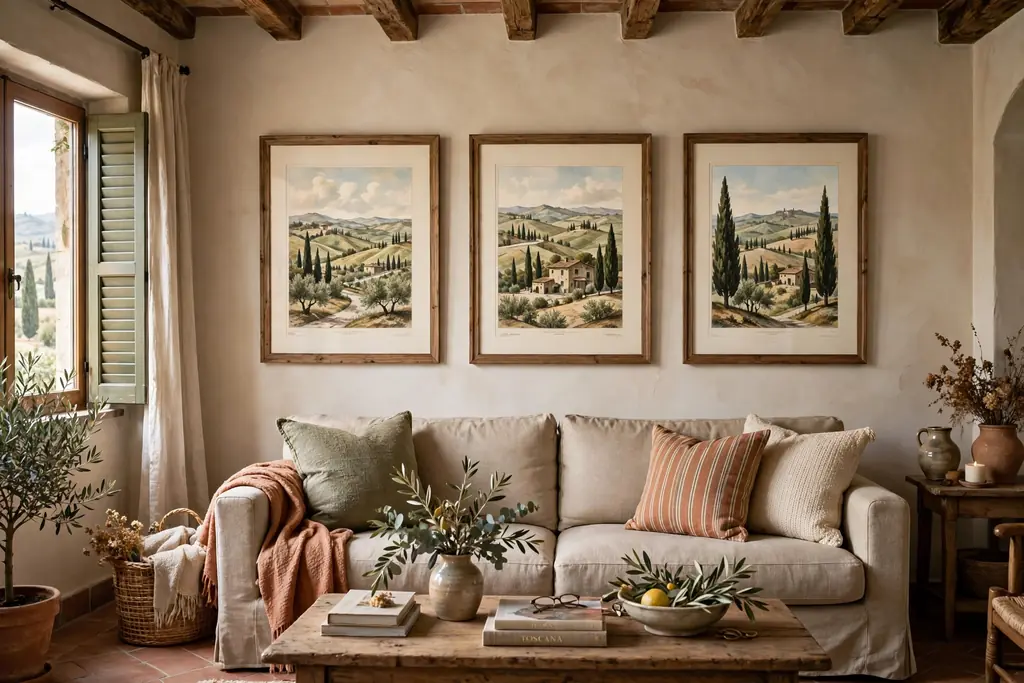
Hang framed Italian countryside prints, such as hills, cypress trees, and stone farmhouses, in simple wood frames. Prints suit a room where real art feels too formal or too costly, and a set of three in a row above a sofa gives the wall a calm rhythm. Choose prints in muted greens, ochres, and warm whites that echo the room palette.
Hang the center of the group at eye level from a standing position, and keep the frame style consistent across the set. If the sofa wall is large, use larger prints or add a fourth frame, rather than hanging small prints that get lost. A single large print above a fireplace also works, with a candle or a vase on the mantel below it.
24. Striped Linen Curtains in Warm Neutrals
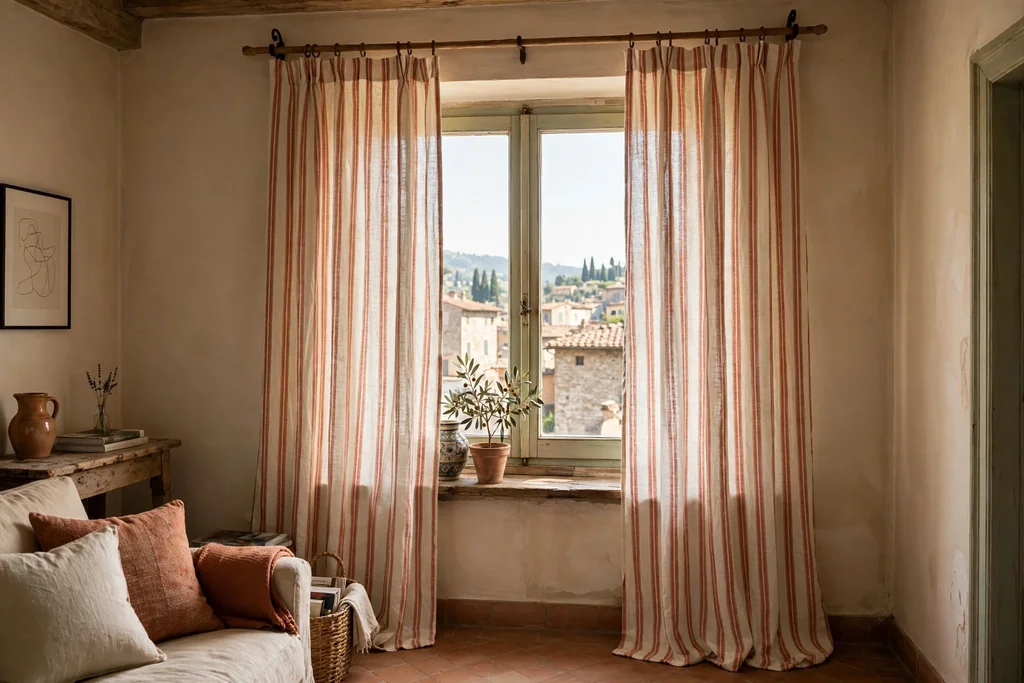
Dress the windows in striped linen curtains in warm neutrals, such as cream with a soft rust or olive stripe. Stripes feel relaxed and coastal, and linen filters light in a way heavy drapes do not. Hang the rod high and wide, so the curtains frame the window and let in as much daylight as possible when open.
Choose a washable linen or linen blend if the curtains will be handled often, and let them fall to just above the floor so they do not pool in dust. A sheer linen panel under the stripe, used alone by day, gives privacy without blocking light. Keep the curtain color tied to the rug or a cushion, so the window treatment feels part of the room.
25. Layered Wool Throws and Woven Cushions
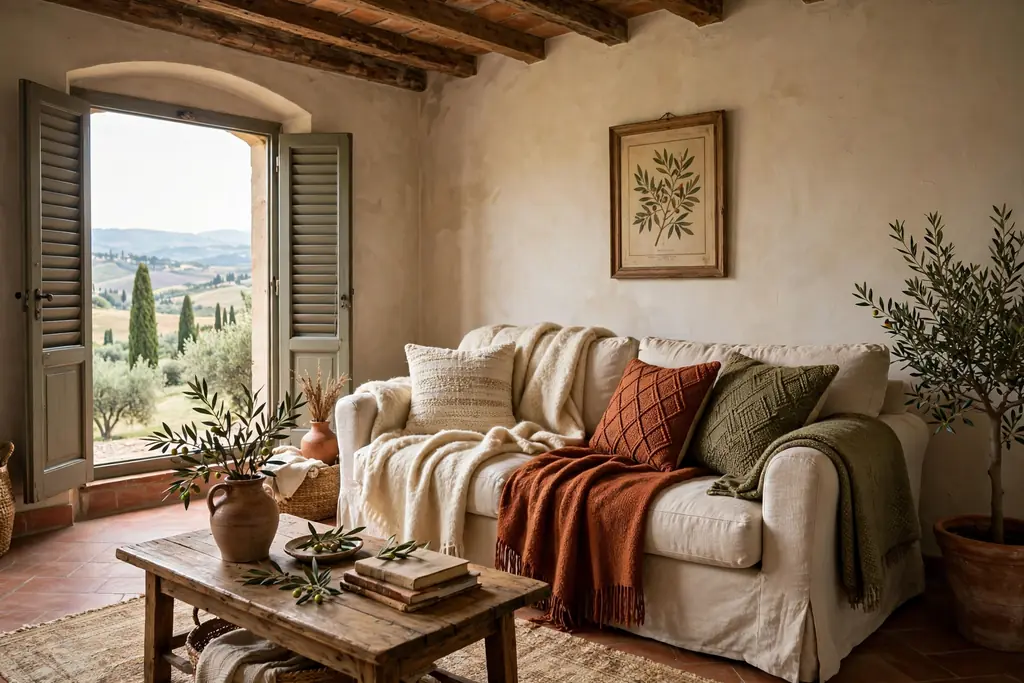
Layer wool throws and woven cushions on the sofa and chairs for warmth you can reach for, not just look at. A chunky wool throw in cream or rust, folded over one sofa arm, plus cushions in woven cotton, linen, and wool, gives the seating a soft, lived in feel. Mix textures rather than patterns: a knit, a weave, and a plain linen together.
Keep the cushion count low, three or four on a standard sofa, so seating stays comfortable and the sofa does not look dressed for display. Choose washable covers where possible, and store a spare throw in a basket nearby for guests. In summer, swap the wool throw for a light cotton one and keep the woven cushions.
26. Conversation Circle Facing the Fireplace
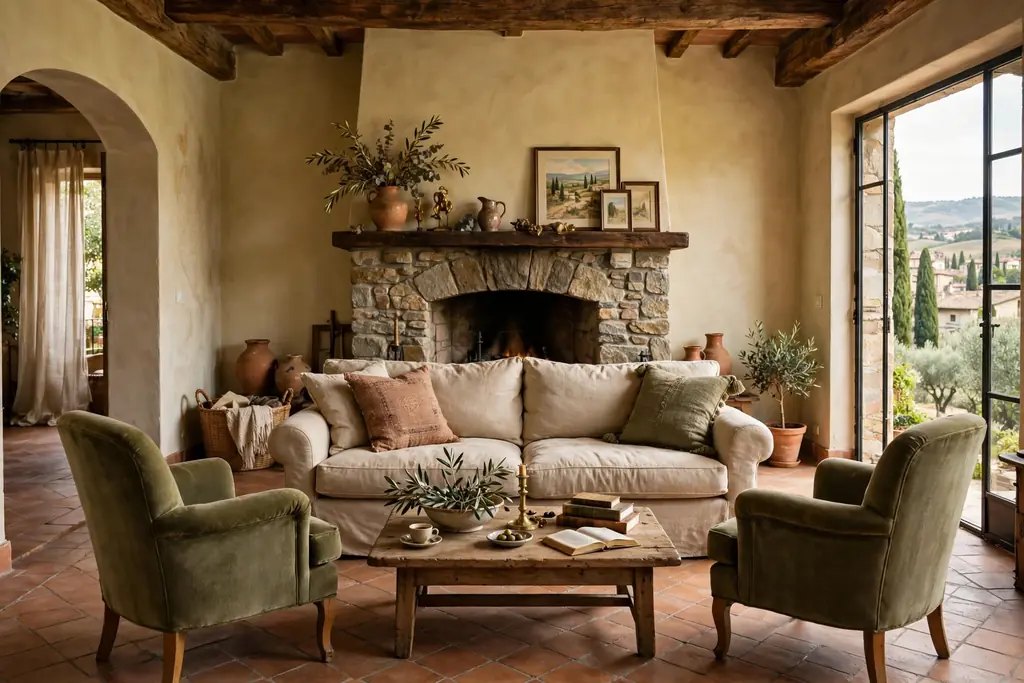
Arrange the seating in a circle or a U shape facing the fireplace, so conversation, not a screen, is the center of the room. Place the sofa opposite the fire, with two chairs angled inward on either side, and the coffee table in the middle. This layout suits a room used for talking, reading, and long evenings with friends.
Leave enough space to walk around the chairs and to pull one out without blocking the route to the door. If the room also holds a television, place it on a side wall or on a stand that can turn, so it does not dominate the fireplace group. A rug under the whole group, as in the rug sizing advice in these living room rug ideas, ties the circle together.
27. Reading Corner with a Floor Lamp and Basket
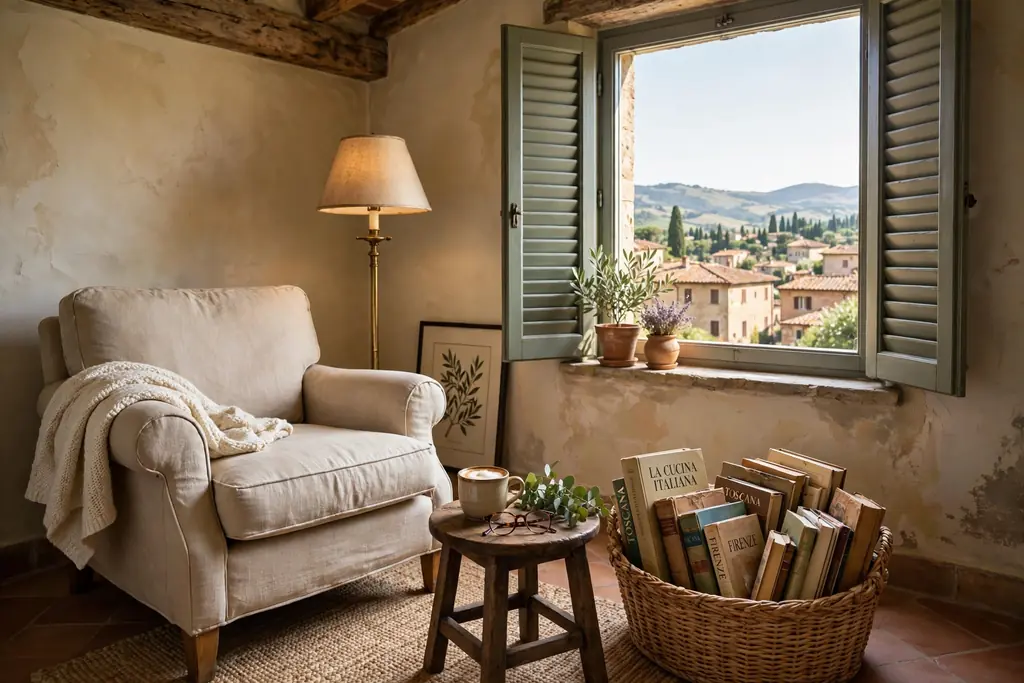
Build a reading corner with one comfortable chair, a floor lamp, and a basket for books and a throw. A corner by a window or beside a bookshelf works well, since daylight serves by day and the lamp serves in the evening. Choose a chair with arms at a height that supports a book, and a lamp that shines over the shoulder, not into the eyes.
Keep the corner simple: a chair, a lamp, a small table for a cup, and a basket. If the basket holds the current books and a throw, the corner stays tidy and inviting. A reading corner also gives a large living room a second use, so one person can read while others talk by the fire.
28. Aperitivo Bar Cart for Evening Gatherings
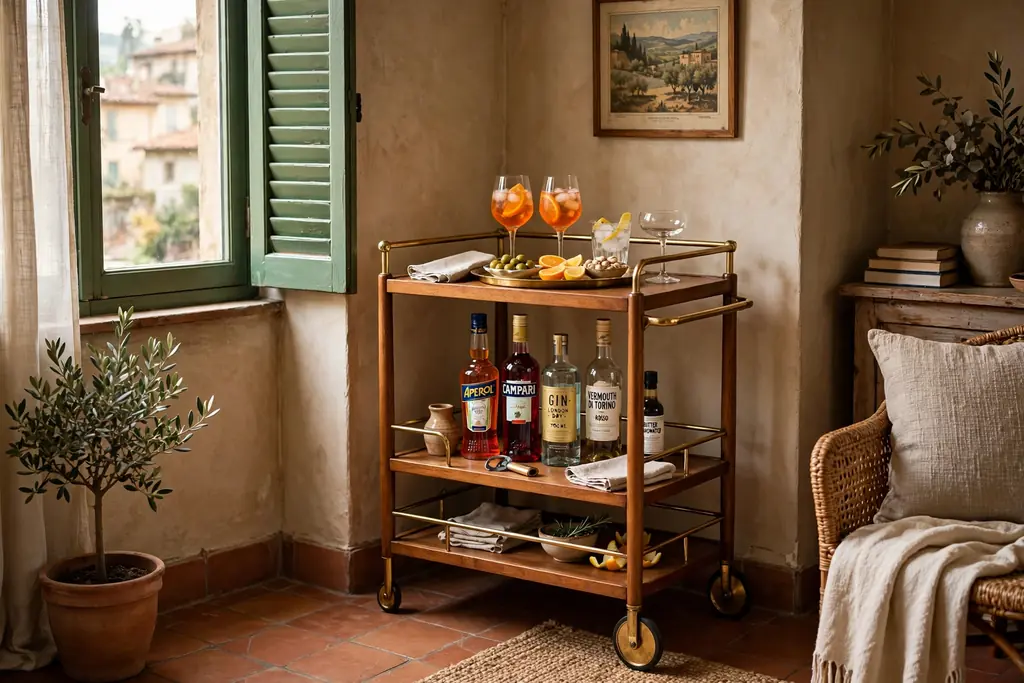
Keep an aperitivo bar cart in a corner of the living room for evening gatherings. A wood or brass cart with two tiers holds glasses, a bottle or two, sparkling water, and small bowls for olives and nuts, and it can roll to the seating group when guests arrive. This suits a room built for hospitality, since drinks stay near the conversation.
Stock the cart lightly, with only what you use, so it does not become a crowded shelf. Keep a tray on the top tier to corral small items, and store extra glasses below. If children use the room, keep the cart in a spot where it can be moved aside, and store bottles out of reach when not in use.
29. Long Shared Table Joining Living and Dining
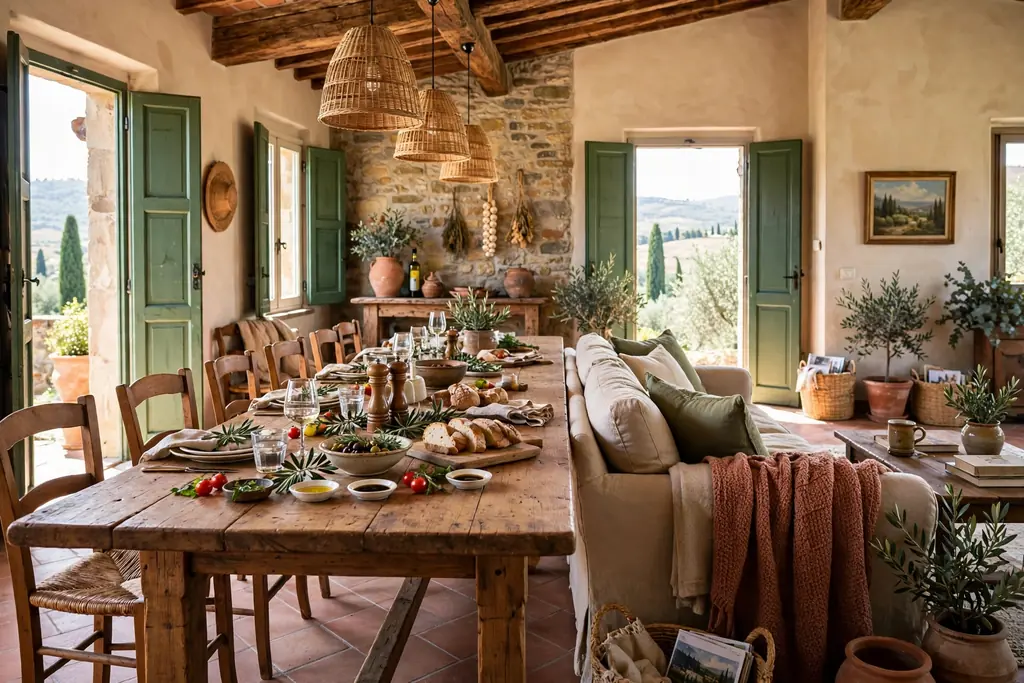
Use a long shared table to join the living and dining zones in an open plan room. A wood farmhouse table, placed where the sofa zone meets the dining zone, serves meals, games, and work, and it gives the room a social center larger than a coffee table. This layout suits a household that eats, talks, and hosts in one space.
Keep the table clear between meals, with only a vase or a candle as a centerpiece, so the room does not feel like a dining room all day. For more layout help in a combined room, see these small living room dining room combo ideas. Choose chairs that tuck under the table, and leave a clear walking route on at least one side.
30. Indoor Outdoor Loggia Opening to a Terrace
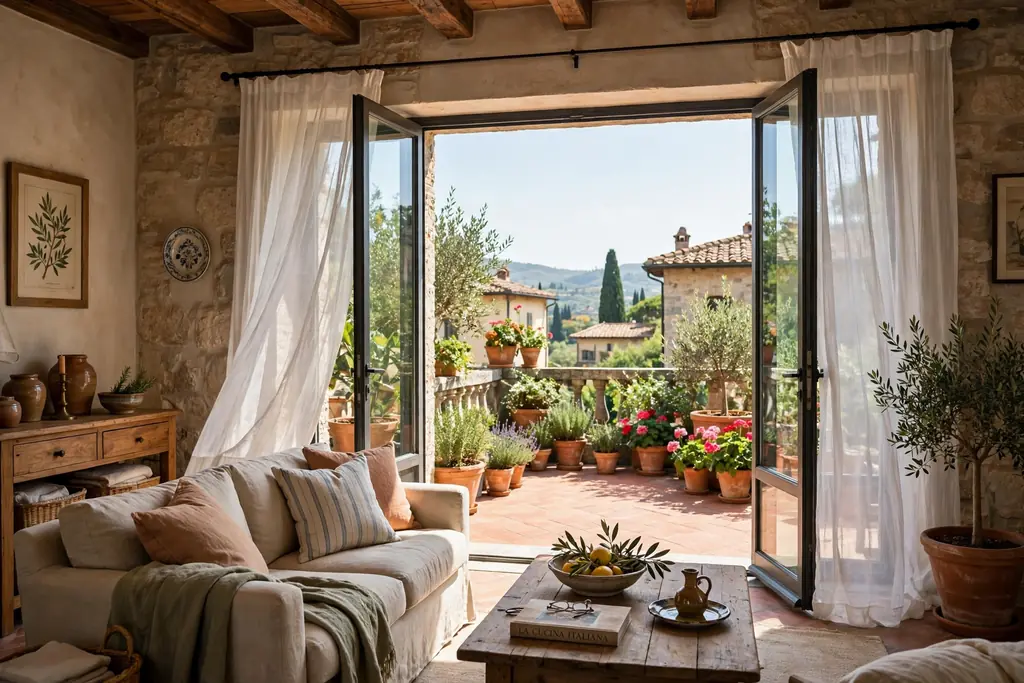
Open the living room to a terrace with wide doors, sheer curtains, and matching materials inside and out, for a loggia feel. Terracotta tiles that run from inside to outside, plus a wood bench and potted plants on both sides of the doors, blur the line between room and terrace. This suits a home with a garden or a balcony, where summer living moves outdoors.
Keep the indoor rug and cushions in materials that handle a little outdoor dust, and use doors that can stay open safely on warm days. A sheer curtain softens the opening and gives privacy without blocking light. If the terrace is small, one chair and a pot outside are enough to suggest the loggia, without crowding the indoor room.
31. Compact Italian Style for a Small Living Room
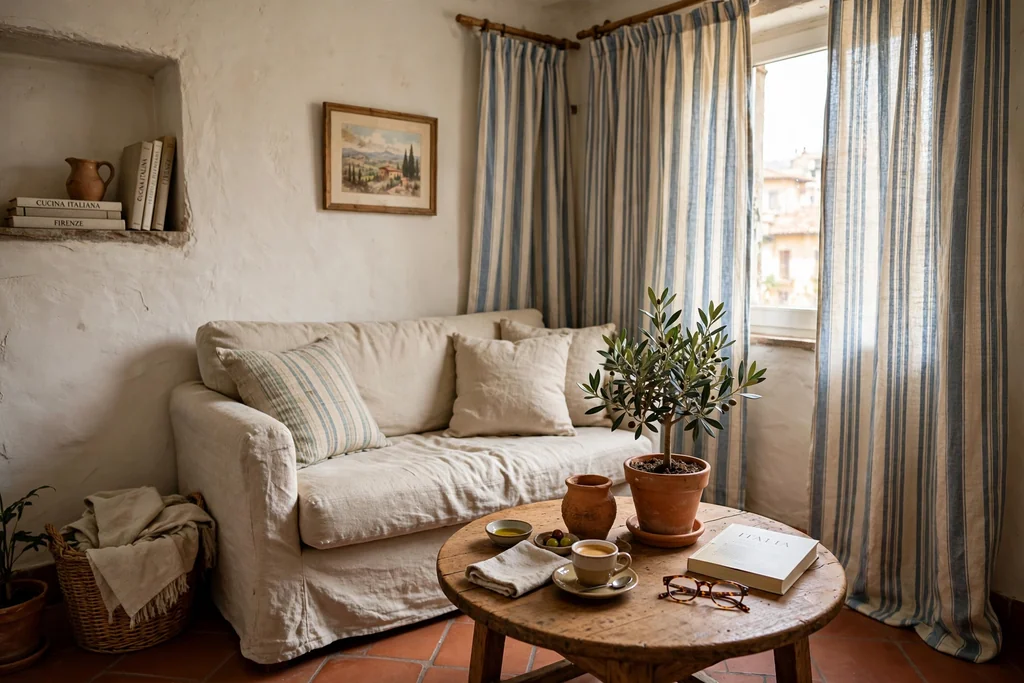
Bring Italian style to a small living room by choosing fewer, better pieces in warm materials. A small linen sofa, a round wood coffee table, one terracotta pot, and a striped curtain can carry the whole look, without filling the floor. Pale plaster walls and a mirror opposite the window help the room feel larger, while warm wood keeps it from feeling bare.
Avoid a large sectional or a heavy credenza in a small room, and use wall shelves instead of floor standing storage. Keep the palette to warm white, one wood tone, and one accent, such as olive or rust, so the small space reads as calm. Measure every piece against the walking routes before you buy, since a small room forgives no wasted inches.
32. Large Family Sectional in Warm Natural Fabric
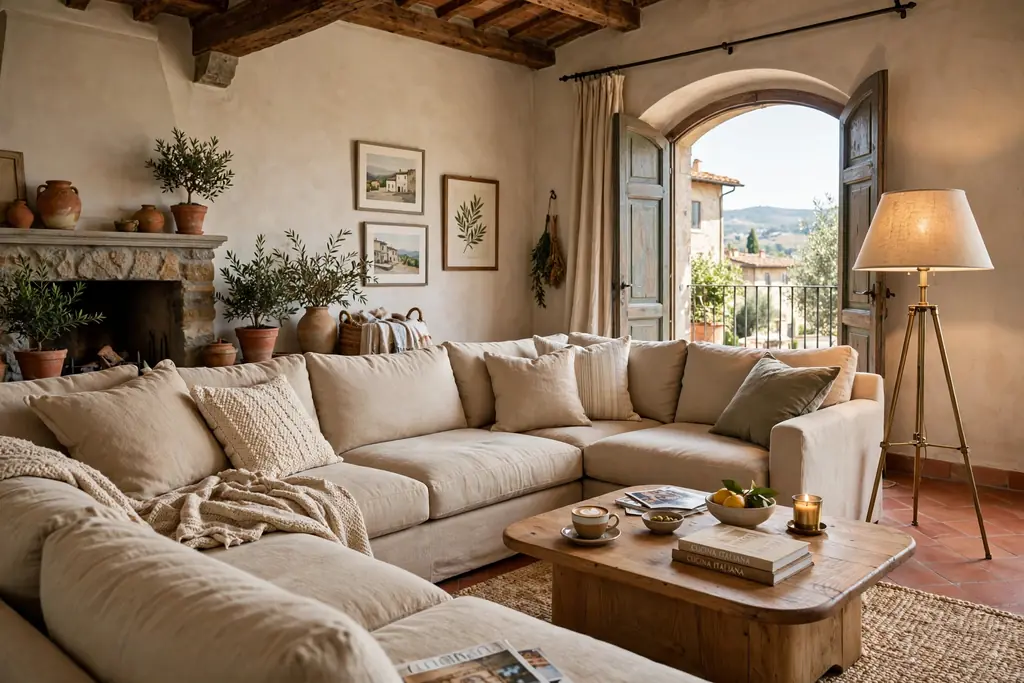
Choose a large family sectional in a warm natural fabric, such as cotton linen in oatmeal or stone, for a household that gathers in one room. A sectional seats more people than a sofa and chairs, and its corner shape suits a room where children, guests, and pets share the seating. Pick a fabric with removable, washable covers, since a family sectional gets daily use.
Place the sectional to face the fireplace or the main window, with the coffee table in the middle and a floor lamp at the open end. Keep cushions in a mix of plain and woven textures, and add a wool throw for cooler evenings. If the room is small, choose a sectional with a chaise on one side only, so the open side keeps a clear walking route.
33. Candlelit Evening Layer with Lanterns and Low Light
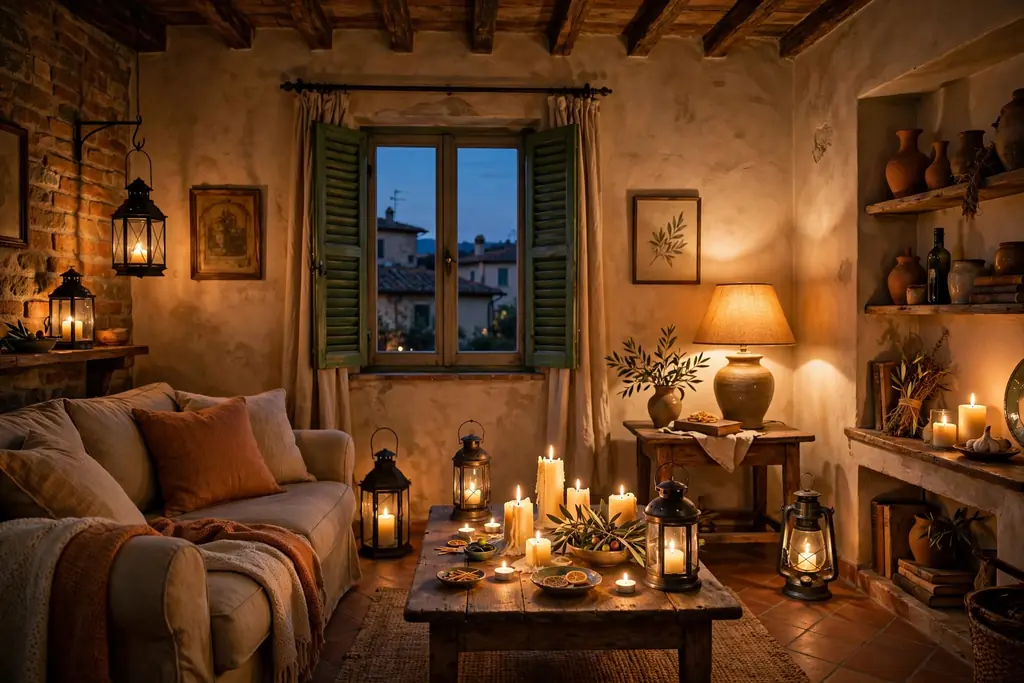
Finish the room with a candlelit evening layer: lanterns on the mantel and floor, candles on the coffee table, and lamps turned low. Candlelight suits an Italian living room because it flatters plaster, wood, and stone, and it signals that the evening is for rest and conversation. Use lanterns with glass panels to shield flames from drafts and curious hands.
Place candles where they will not be knocked over, away from curtains and low throws, and never leave them burning unattended. Battery candles in lanterns give a similar glow in a room with children or pets, and they can stay on longer without worry. Turn the main ceiling light off, let the lamps and candles carry the evening, and the room will feel warmer at once.
Conclusion
An Italian living room works when warm materials, a clear gathering point, and simple, sturdy furniture come together. You do not need every idea on this list to get the feel: start with warm walls or floors, add seating you can sink into, then layer light, plants, and pottery until the room invites people to stay. Keep the palette calm, the surfaces mostly clear, and the layout open to conversation, and the room will feel Italian in spirit, not just in style.
Work through the list one room at a time, and test each change in daylight and lamplight before you commit. For rug sizing in the seating group, revisit these living room rug ideas, and for a room that also holds a dining table, the zoning help in these small living room dining room combo ideas pairs well with the shared table idea above. Save this list, pick the three ideas that fit your room today, and build from there.
FAQs
How do I get an Italian living room look without a full renovation?
Start with the surfaces and textiles you can change easily: warm white or terracotta limewash paint, linen curtains, a wool rug, and cushions in olive and rust. Add a terracotta pot with an olive tree or herbs, a wood coffee table, and warm lamps, and the room will read as Italian even if the walls, floors, and fireplace stay as they are. Save structural changes, such as stone cladding or beams, for later, after you know which palette you love living with.
What colors work best in an Italian living room?
Warm whites, cream, terracotta, olive, walnut brown, and soft ochre form the core palette, with blue and white majolica as an accent. Keep the larger pieces, such as the sofa and rug, in the calmer tones, and use stronger terracotta or olive in cushions, pottery, and art. A calm base with two or three warm accents keeps the room feeling collected, not busy, and it makes seasonal swaps easy.
Can an Italian living room work in a small apartment?
Yes, if you choose fewer pieces and keep the palette calm. A small linen sofa, a round wood table, wall shelves instead of a large credenza, and one terracotta pot can carry the style without crowding the floor. Pale walls, a mirror opposite the window, and curtains hung high and wide help the room feel larger, while warm wood and woven textures keep it from feeling bare.
Is leather or linen better for an Italian style sofa?
Both suit the style, and the choice depends on daily use. Leather, especially cognac leather, wipes clean, ages well, and anchors a room with warmth, which suits families and pets. Linen slipcovers feel softer and more casual, and they can be removed and washed, which suits a relaxed room or a home where covers need frequent cleaning. Many rooms pair one with the other, such as a leather sofa with linen armchairs.
How do I care for terracotta pots and tiles in a living room?
Use pots with drainage holes and saucers, water only when the top soil feels dry, and wipe spills from tiles quickly. Terracotta is porous, so seal tiles and pots as the maker directs if they will see frequent water, and keep pots off wood floors on a tray or a stand. Dust pottery with a soft cloth, and bring tender plants indoors before cold weather, following guidance for your plant variety and local climate.
What lighting suits an Italian living room in the evening?
Layered, warm light suits the style best: a dimmable ceiling fixture or chandelier for general light, table lamps at seat height for reading and conversation, and candles or lanterns for a soft evening glow. Keep the bulb tone warm and consistent across lamps, so the room does not mix cool and warm light. Turn the main light low or off in the evening, and let lamps and candles carry the room, which flatters plaster, wood, and stone.