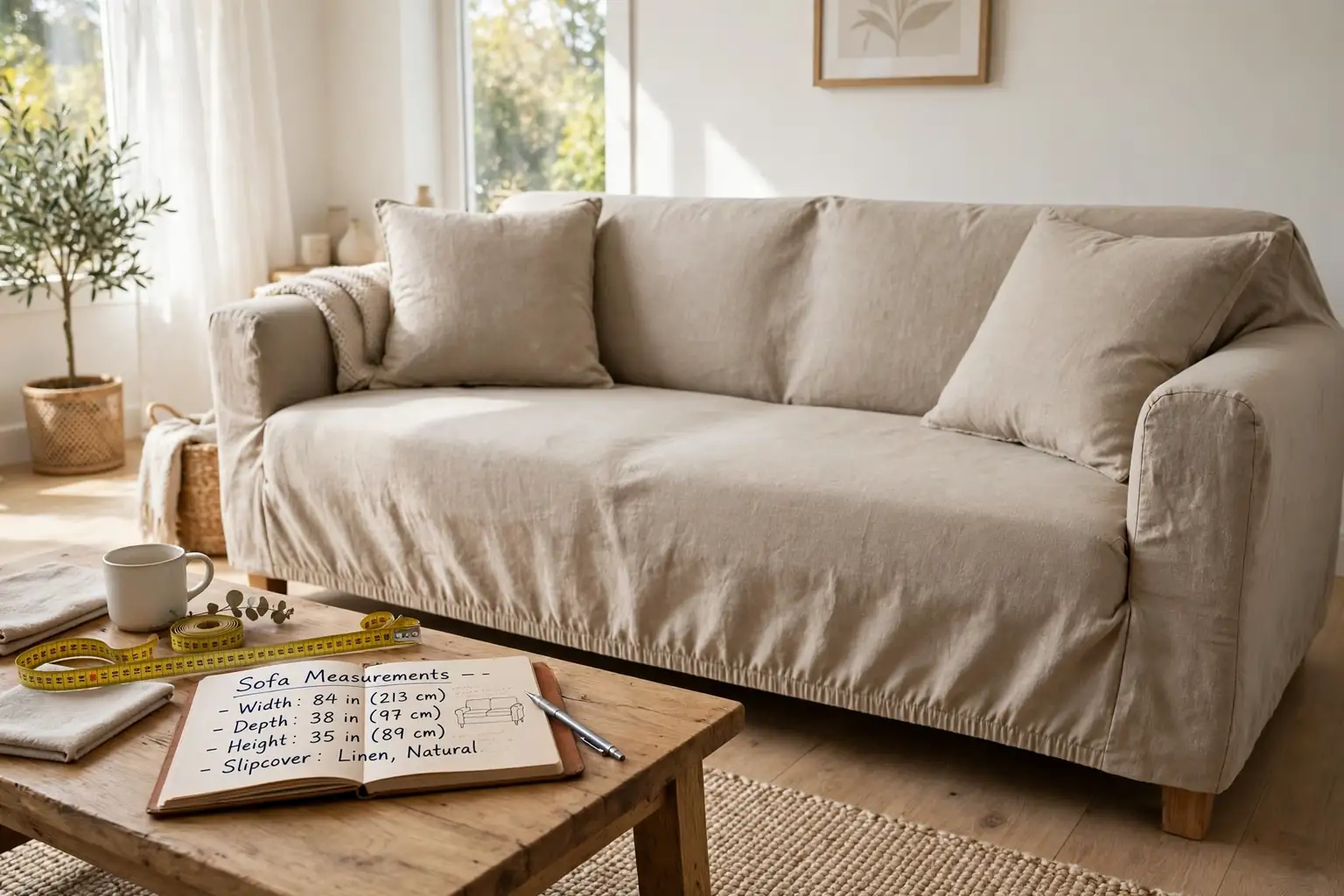
Before ordering custom slipcovers, measure the overall width, depth, and height of each piece, then measure seats, backs, arms, and cushions separately, and note curves, loose parts, and floor clearance. Share those numbers with fabric, fit, and care choices, so the maker can shape a cover that fits your furniture, not a generic size.
A custom slipcover is only as good as the information sent with the order. A ready made cover is made for a size range, so small differences in arm shape or cushion depth matter less. A custom cover is cut for one piece, so a missed measurement, an unnoted curve, or a cushion counted as one piece when it is really two can change the fit. Work through this guide in order, from deciding what the cover must do to a final recheck, and keep one clear record for each piece of furniture.
Key Takeaways
- Measure each piece separately, even when two chairs look alike, since small differences change a custom fit.
- Record overall width, depth, and height first, then seats, backs, arms, cushions, skirt length, and floor clearance.
- Photograph and sketch the piece, and note curves, slopes, tufting, loose cushions, reclining parts, and removable legs.
- Choose fabric for daily use, washing, pets, children, and sunlight, not only for color.
- Decide fit details before ordering, including snug or relaxed fit, separate cushion covers, zippers, ties, piping, and skirt style.
- Recheck every number, confirm the order details in writing, and keep a copy of the measurements for future orders or repairs.
Supplies You May Need
- A flexible measuring tape for curves and a rigid tape for straight overall dimensions
- A notebook or printed measurement sheet, with one page per piece of furniture
- A pencil, a phone camera for clear front, side, back, and detail photos, and a small level or straight edge if the piece has a sloping back
- Masking tape or small paper labels to mark left and right, front and back, and cushion positions while measuring
- Fabric swatches, or a note of the room colors, rug, curtains, and wall color, for color checking in daylight and evening light
1. Decide What the Slipcover Must Do
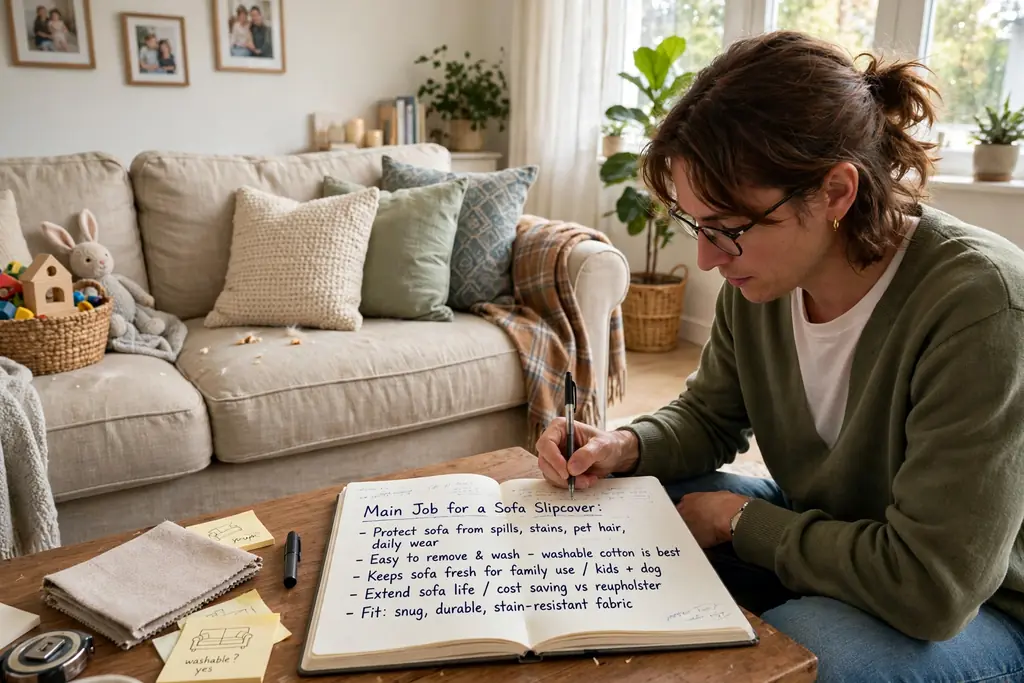
Decide what the slipcover must do before measuring, because the job shapes the fabric and fit choices that follow. A cover meant to protect a sofa from pets and children needs washable fabric and a secure fit that stays in place when someone sits down. A cover meant to change the look of a tired chair can allow a softer drape and a lighter fabric, if daily wear is low. A cover for a room with strong sun needs fabric and color choices that suit that light and use.
Write down the main job in one sentence, then list the secondary jobs, such as hiding worn upholstery, adding a seasonal color, or making a mismatched set look like a set. Note who uses the piece, how often, and whether it is a main seat or an occasional chair. That list will guide the fabric discussion in step 9 and the fit discussion in step 11, and it will help you spot a choice that looks good in a swatch but fails in daily use.
2. Identify the Piece and Its Shape
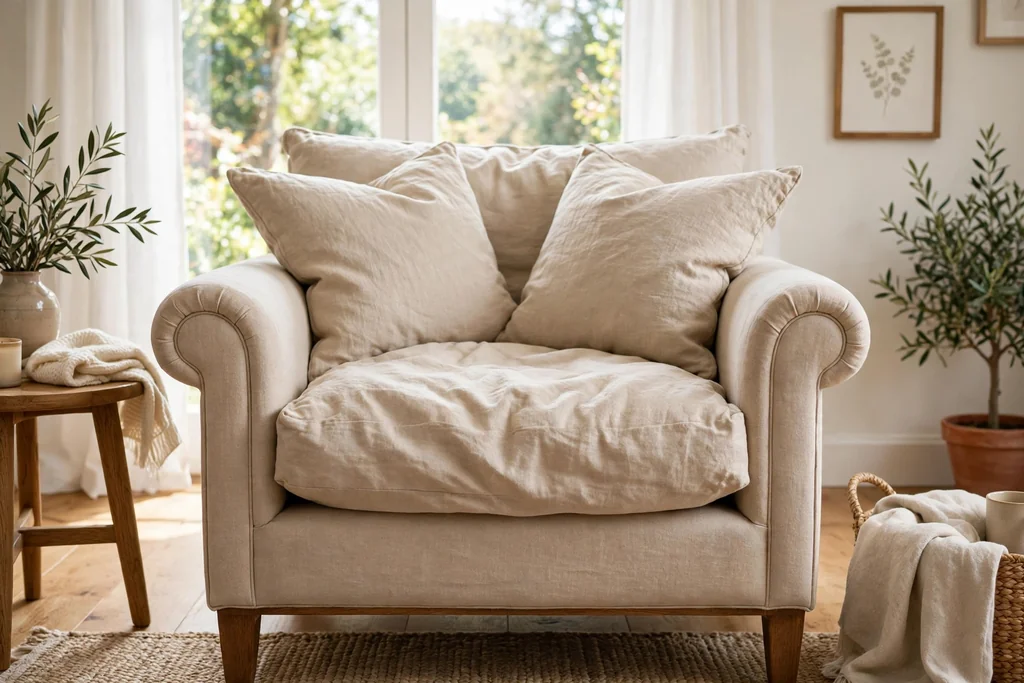
Identify the piece and its shape in plain terms, since a maker cannot cut a good cover from a furniture name alone. Note whether it is a sofa, loveseat, armchair, recliner, chaise, sectional section, dining chair, or ottoman, and whether it has rolled arms, track arms, sloped arms, or no arms at all. Note the back shape too, such as a straight back, a curved back, a camel back, a wing back, or a low back, and whether the back cushions are loose, attached, or part of a single bench cushion.
Check the base as well. Note whether the piece has a skirt, exposed legs, a plinth base, or a reclining footrest, and whether any part moves, folds, or comes off. Count the seat cushions, back cushions, and any bolster or lumbar cushions separately. A clear shape description, paired with photos from step 3, reduces the chance that a maker assumes a standard shape your piece does not have.
3. Gather Tools and Set Up One Record Per Piece
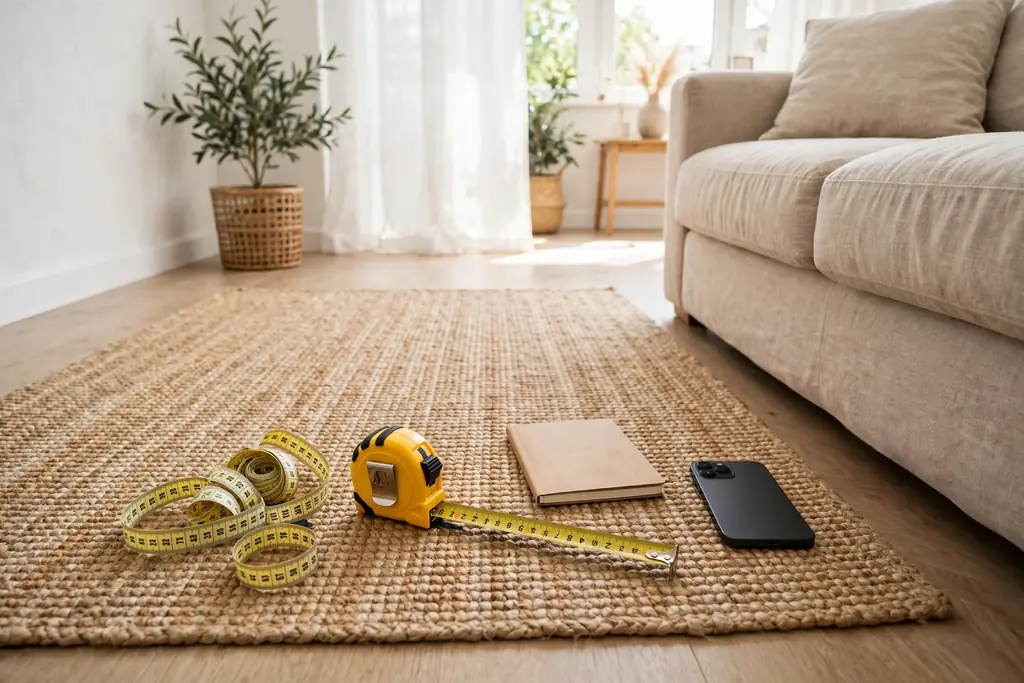
Gather the measuring tools and set up one record per piece before taking a single number. Use a flexible tape for curves, arm rolls, and seat fronts, and a rigid tape for overall width and height, since a flexible tape can sag on a long straight run. Keep a notebook or printed sheet for each piece, with space for overall dimensions, seat and back dimensions, arm dimensions, cushion dimensions, and notes on shape, legs, and moving parts.
Photograph the piece from the front, each side, and the back, plus close views of the arms, back, cushions, skirt, and legs, before you start measuring. Photos taken with cushions in place, and again with cushions removed if they lift out, show a maker how the frame sits under the cover. Label the photos and the measurement sheet with the same piece name, such as living room sofa or bedroom armchair, so nothing is mixed up when several pieces are ordered together.
4. Measure Overall Width, Depth, and Height
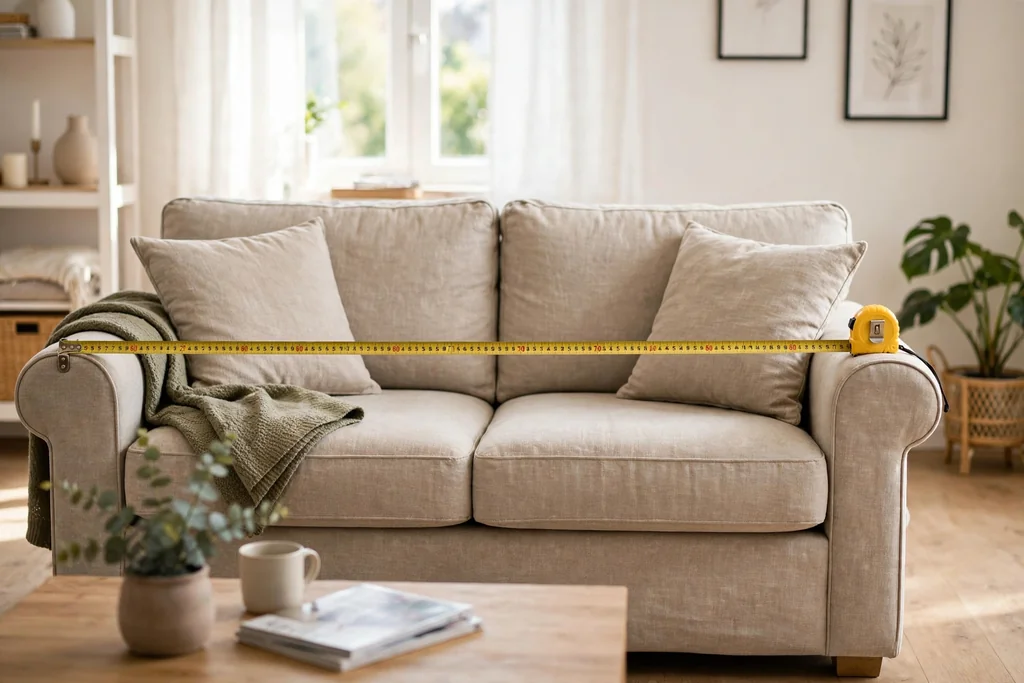
Measure the overall width, depth, and height first, since these three numbers frame every other measurement. For width, measure from the outermost point of one arm to the outermost point of the other arm, at the widest point, and note whether that point is at the arm top, the arm front, or the base. For depth, measure from the front edge of the seat, or the front of the arm if it sticks out further, straight back to the rearmost point of the back.
For height, measure from the floor to the highest point of the back, with the piece standing on its normal floor surface and any casters or glides in place. Measure twice, and write down the unit used, such as inches, on every line of the record. If the piece sits on a rug, note that too, since rug thickness can change the height and the skirt length in step 7. Keep these overall numbers at the top of the record, so they are easy to find when checking the order.
5. Measure the Seat, Back, and Arms Separately
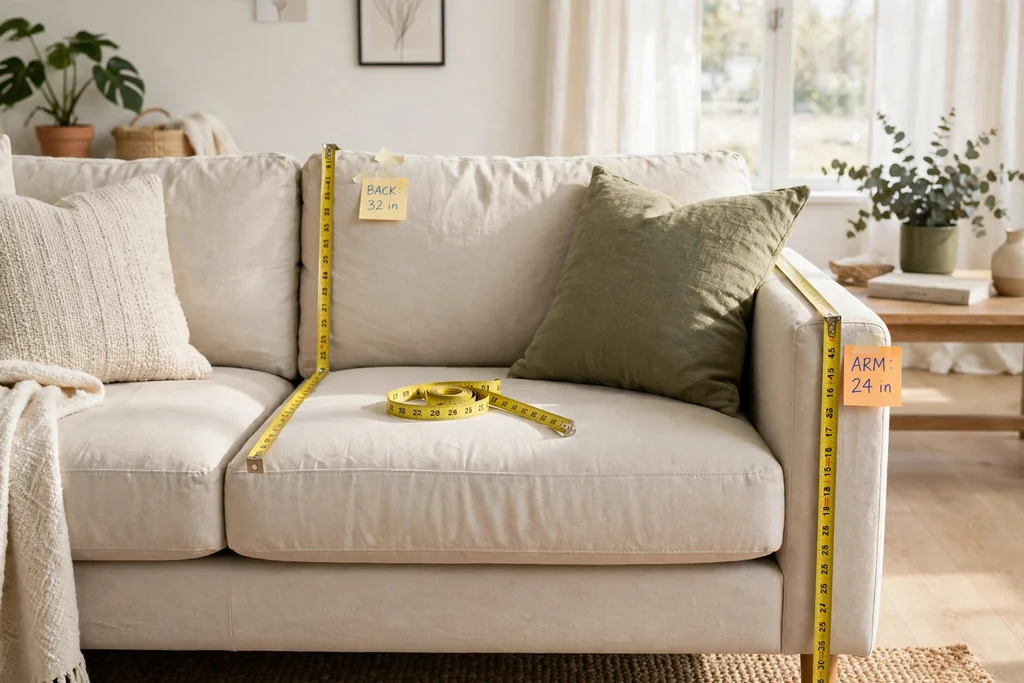
Measure the seat, back, and arms separately, since overall dimensions alone do not describe how a cover must bend around each part. For the seat, measure the width between the arms, the depth from the front edge to the back cushion or back frame, and the height from the floor to the top of the seat cushion. For the back, measure the width between the arms, the height from the seat surface to the top of the back, and the depth of the back at its thickest point.
For each arm, measure the height from the floor to the top of the arm, the width across the top of the arm, and the length from the front of the arm to the back of the arm. Note whether the arm front is flat, rolled, or sloped, and whether the arm top is flat or rounded. These separate numbers let a maker shape the cover around the arms and back, rather than draping one flat panel over a piece with very different parts.
6. Measure Each Cushion on Its Own
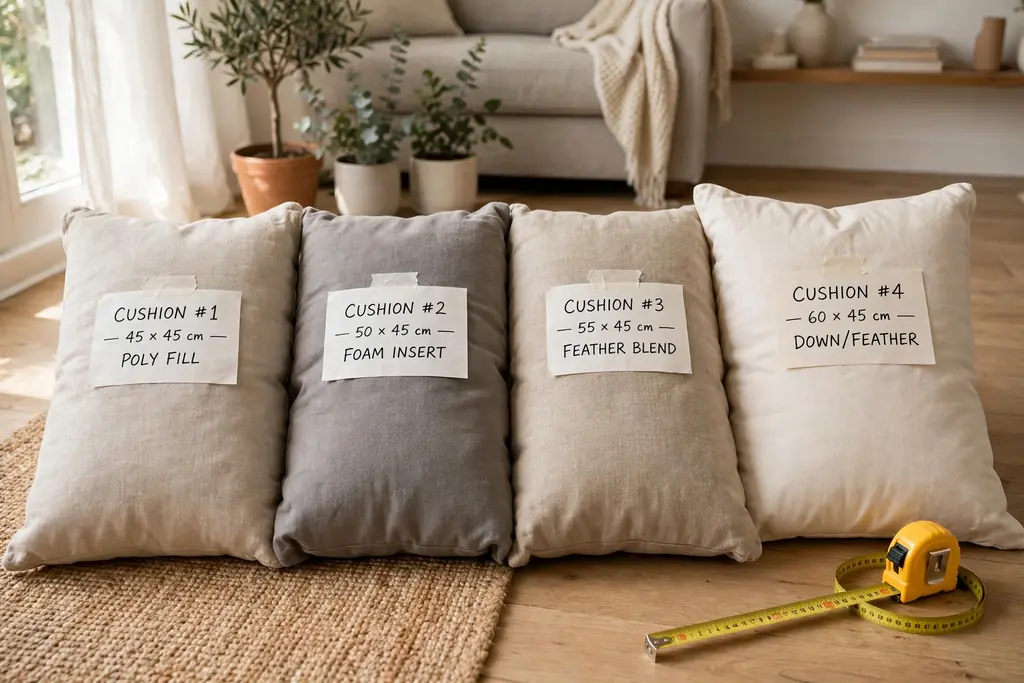
Measure each cushion on its own, since cushions that look alike often differ by a small amount, and a custom cover cut for one cushion may not fit its neighbor. For each seat cushion, measure the width, depth, and thickness at the thickest point, and note whether the front edge is square, rounded, or waterfall style, where the fabric curves over the front. For each back cushion, measure the width, height, and thickness, and note whether the top is square, rounded, or shaped to the back frame.
Number or label each cushion on the record, such as left seat, center seat, and right seat when viewed from the front, and mark the same labels on the cushions themselves with removable tape if they will be sent or photographed separately. Note whether a cushion is reversible, whether it has a zipper, and whether it is filled in a way that keeps its shape or flattens with use. If the slipcover will have separate cushion covers, these numbers are the ones the maker will cut from, so recheck them in step 14.
7. Measure Skirt Length, Legs, and Floor Clearance
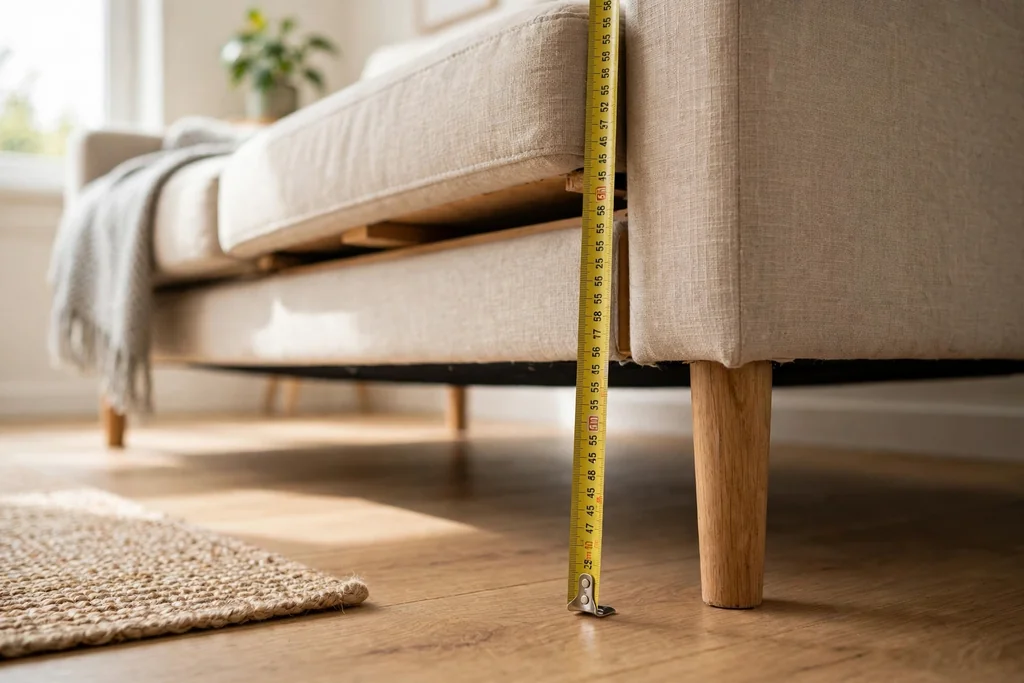
Measure skirt length, legs, and floor clearance, since the bottom of a slipcover is where a good fit is most visible. If the cover will have a skirt, measure from the seat frame or the chosen skirt starting point down to the floor, at the front, sides, and back, since floors are not always level and the piece may sit higher at one end. Decide how the skirt should finish: to the floor, just above the floor, or short enough to show the legs, and write that choice down.
For the legs, measure the height from the floor to the bottom of the frame, the leg shape, and whether the legs unscrew or stay fixed. Note the clearance under the piece and whether the cover must leave room for a reclining footrest, a swivel base, or casters to move. A skirt measured only at the front can hang unevenly at the back, so check all four sides before sending the order.
8. Note Curves, Slopes, Tufting, and Moving Parts
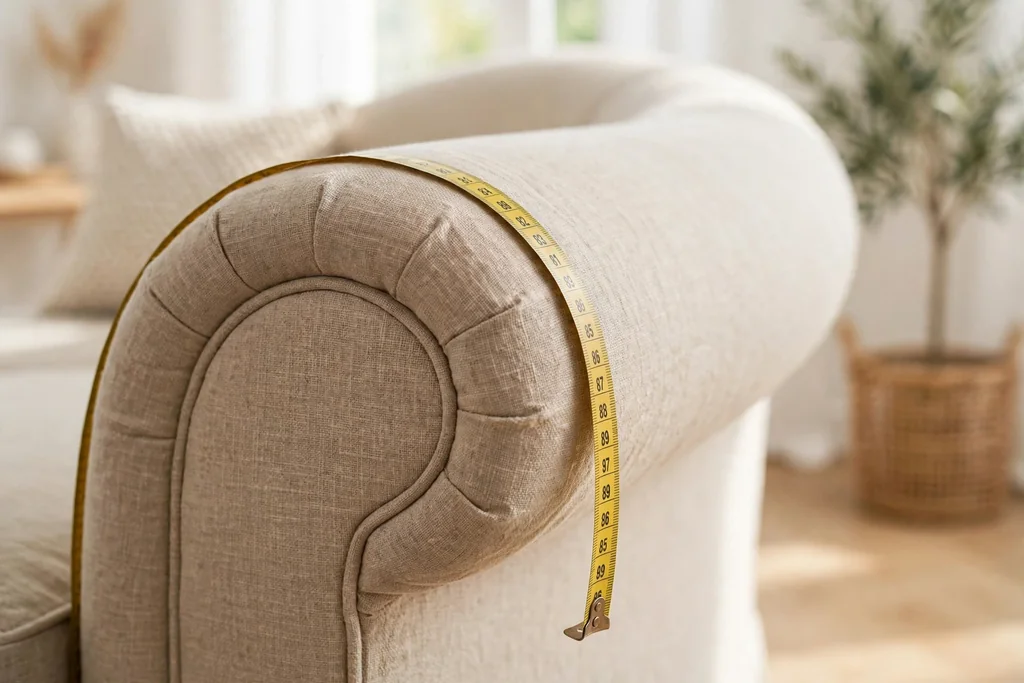
Note curves, slopes, tufting, and moving parts, since these are the details most often missed in a first set of measurements. Use the flexible tape to follow a curved back, a rolled arm, or a sloped seat front, and write down both the straight line distance and the curved distance if they differ. Note any slope in the back, any dip in the seat, and any place where the frame narrows or widens from front to back.
List every moving or removable part, including reclining backs, pull out footrests, swivel bases, folding arms, removable headrests, and loose bolster cushions, and note whether the cover must move with that part or sit clear of it. Note tufting, buttons, piping, nailhead trim, or a seam that the cover must sit over, since a tight cover over deep tufting will read differently from a loose cover over a smooth frame. Photos of these details, taken in step 3, are worth more than a short note alone.
9. Choose Fabric for Daily Use, Washing, and Light
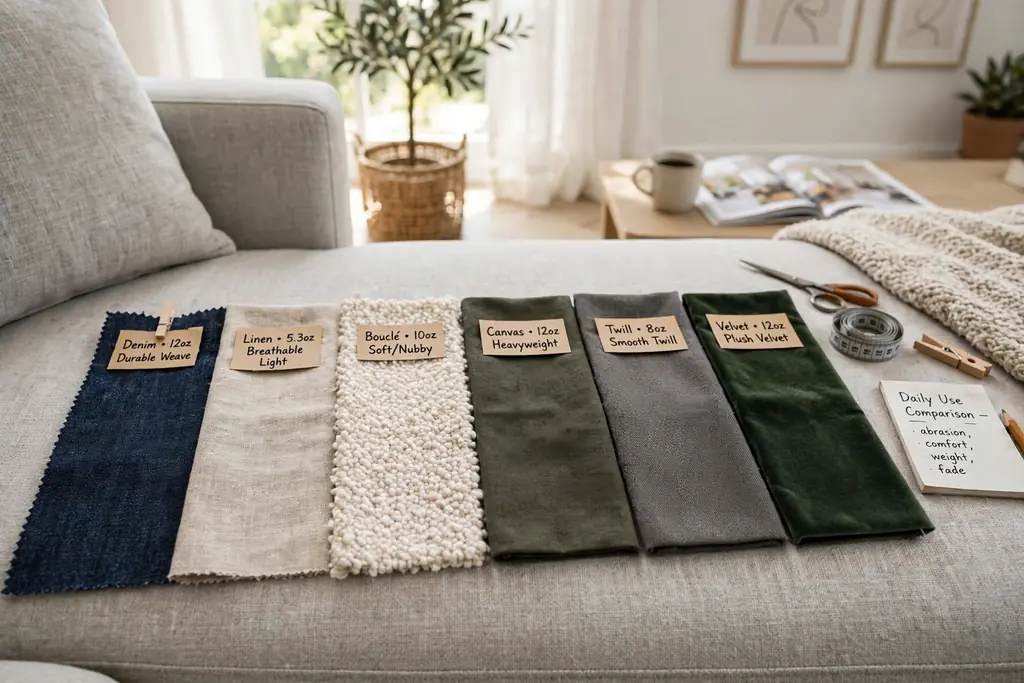
Choose fabric for daily use, washing, and light, not only for how a swatch looks in your hand. Think about who sits on the piece, how often it is used, whether pets or children use it, and whether food and drink are common nearby. A fabric that can be removed and washed on a routine that suits your home will last longer in daily use than a fabric that needs special handling, however good it looks on day one. Check the care instructions for the finished cover, not only for the fabric in general, since construction and linings can change how it should be washed.
Consider sunlight and room conditions too. A piece in strong direct sun, near a radiator, or in a damp room will age fabric differently from a piece in a shaded, dry room. Ask the maker what fabric weights and weaves suit your use, and whether a tighter weave, a heavier weight, or a fabric with some stretch will hold its shape better on your piece. Avoid choosing on color alone at this stage: settle the practical fabric family first, then narrow color in step 10.
10. Choose Color and Pattern and Check Swatches in the Room
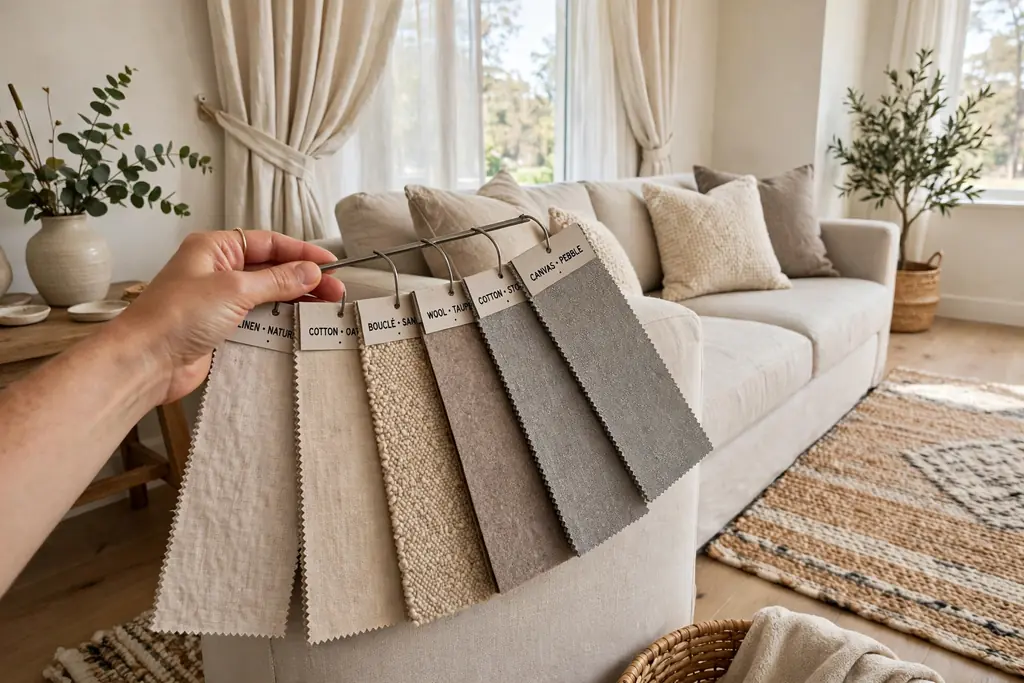
Choose color and pattern after the practical fabric choice, and check swatches in the room, not only under shop lighting. Hold each swatch against the sofa frame, beside the rug, curtains, and wall color, and view it in daylight and again in evening lamplight. A color that looks calm in a small swatch can read much stronger across a whole sofa, and a pattern that looks small on a swatch can dominate a large seat. For help matching the new cover to the rest of the room, see these living room color schemes.
Think about scale and repeat. A large pattern suits a large sofa and a plain room, while a small pattern or a plain fabric suits a small chair or a room that already has patterned curtains or a patterned rug. Note the direction of the pattern, if it has one, and whether it must line up across seat and back cushions. If the room changes with the seasons, a neutral cover with seasonal pillows and throws may be more flexible than a strongly seasonal cover color, as shown in these fall living room decor ideas.
11. Decide Fit Details Before Ordering
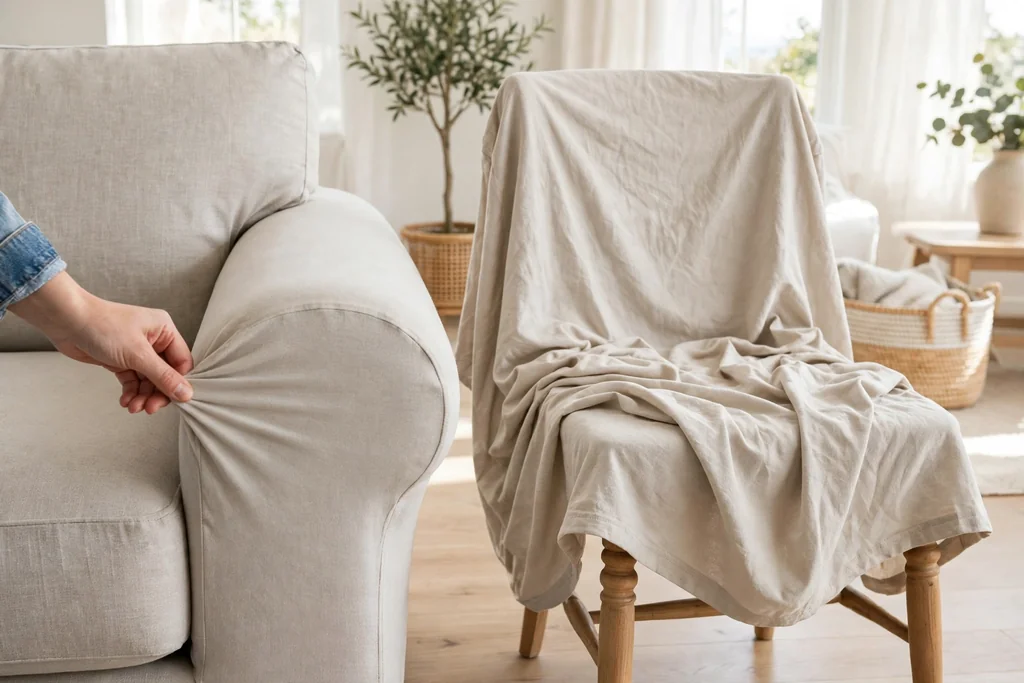
Decide fit details before ordering, since a custom cover can be cut snug, relaxed, or somewhere between, and each choice changes how it looks and sits. A snug fit follows the frame closely and shows the furniture shape, but it needs accurate measurements and may be harder to remove for washing. A relaxed fit drapes more loosely, hides small frame irregularities, and is easier to fit, but it can bag at the seat if the fabric is light. State which fit you want for the body, the arms, and the cushions separately, since one piece may need a snug seat and a relaxed skirt.
Decide the construction details as well: separate cushion covers or one piece cover, zippers or ties for removal, piping along seams or a plain seam, a skirt or a tailored base, and how the cover should close at the back. Note whether ties, zippers, or elastic should be hidden, and whether the cover must stay in place without slipping when someone sits down. These choices are hard to change after cutting, so write them on the order record, not only in a phone call.
12. Decide Care, Removal, and Everyday Use
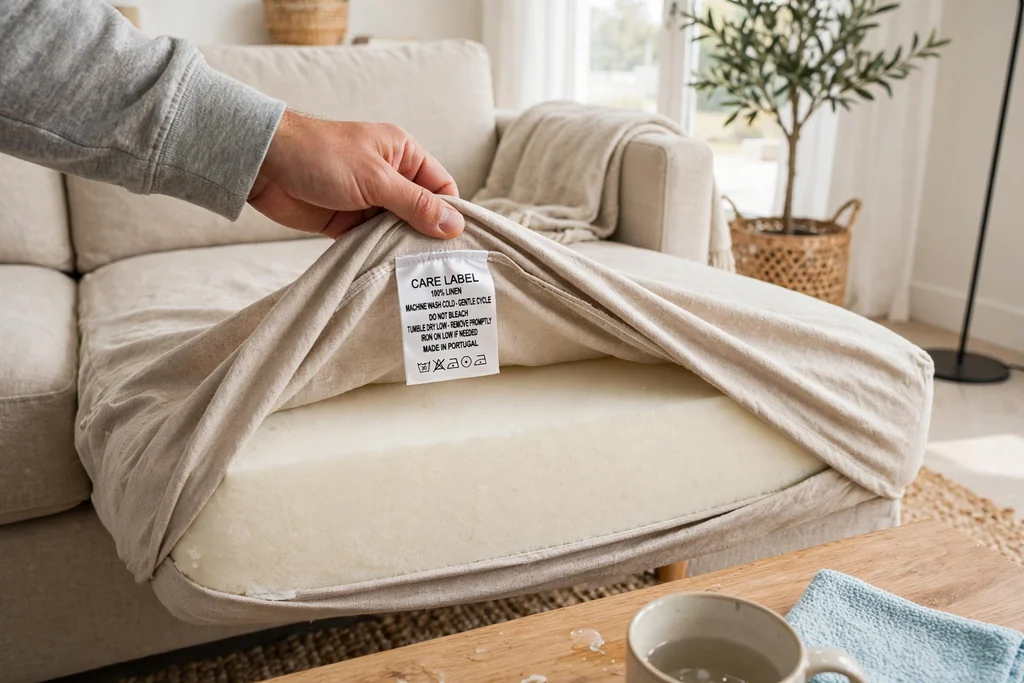
Decide care, removal, and everyday use before ordering, so the finished cover fits your routine as well as your furniture. Ask how the cover comes off, whether it comes off in one piece or in sections, and whether cushion covers come off separately. Note whether the cover can be washed at home, how it should be dried, and whether it should be refitted while slightly damp to smooth wrinkles, following the care instructions given for that cover.
Plan for daily use too. Note whether the piece is used every day, whether pets sleep on it, and whether the cover will be removed often for washing. If removal will be frequent, a cover with clear closures and separate cushion covers will be easier to live with than a single tight cover. Keep a note of the care routine with the measurement record, so anyone else in the home can follow the same routine and the cover is not washed on a setting that harms it.
13. Confirm the Order Details in Writing
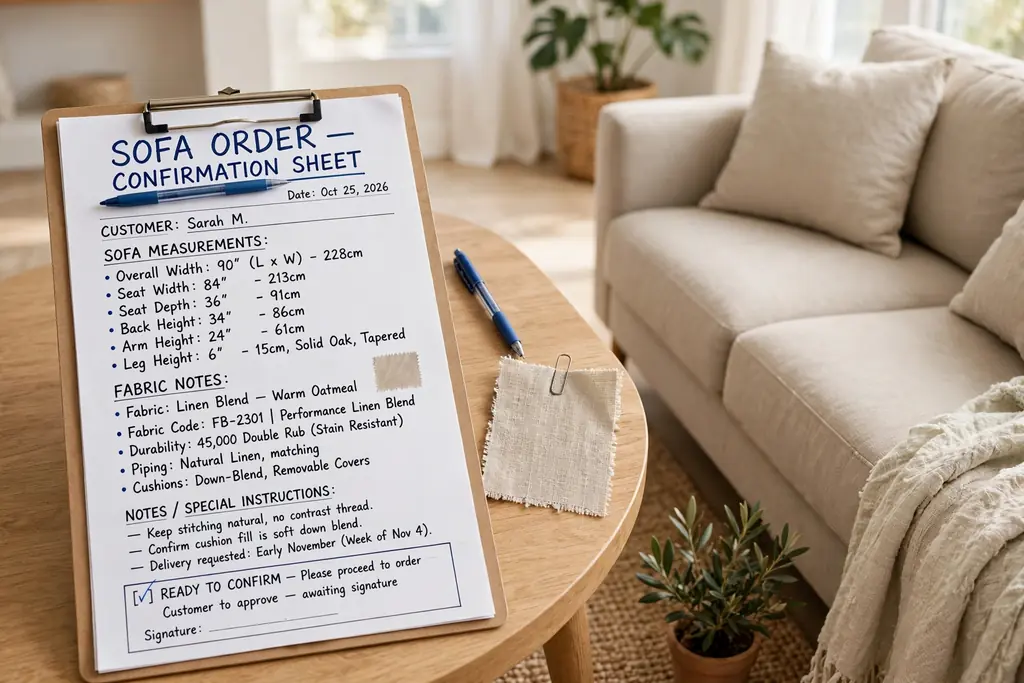
Confirm the order details in writing before the maker starts cutting, since a written record protects both sides if a number is misread. Send the measurement record, the photos, the fabric choice, the color and pattern choice, and the fit and care choices together, and ask the maker to confirm each item back to you. Check that the confirmation lists the correct piece, the correct number of cushions, the correct skirt length, and the correct closures, and query anything that does not match your record.
Ask what the maker needs if a measurement is unclear, and send a new photo or a remeasured number rather than guessing. Note any questions the maker asks about curves, moving parts, or leg clearance, and answer them with a measurement or a photo, not with a general description. Keep the confirmed order, the measurement record, and the photos together, so a later question about fit can be checked against what was actually ordered.
14. Recheck, Label, and Send a Complete Order Pack
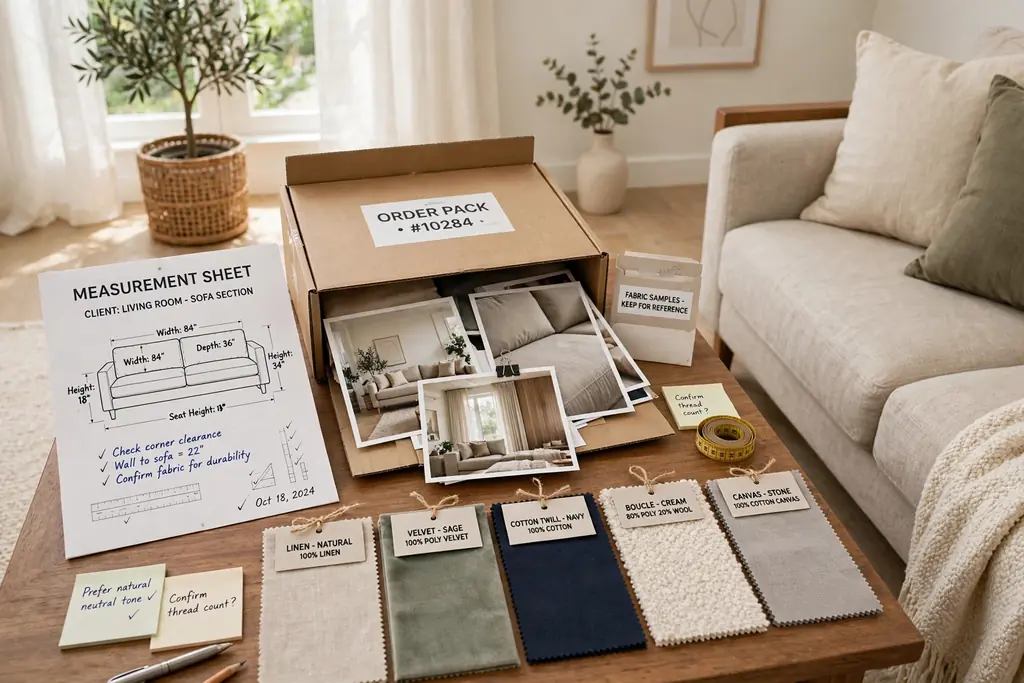
Recheck, label, and send a complete order pack as the last step, not as an afterthought. Remeasure the overall width, depth, and height, and at least one cushion, a second time, and have another person check the numbers if one is available, since a second pair of eyes often catches a transposed digit. Check that left and right labels match the view from the front, that cushion labels match the cushions themselves, and that skirt measurements were taken at all four sides.
Assemble the pack in order: a cover page with the piece name and the main job from step 1, the measurement record, the shape notes from step 8, the fabric, color, and fit choices from steps 9 to 11, the care notes from step 12, and the confirmed order details from step 13, plus the photos. Send the pack as one complete set, keep a copy for yourself, and note the date sent. A complete, rechecked pack is the best way to get a custom slipcover that fits on the first delivery.
Conclusion
Custom slipcovers reward careful preparation. Measure each piece separately, from overall dimensions down to cushions, skirt, and floor clearance, and record curves, slopes, tufting, and moving parts that a flat size range would miss. Choose fabric for daily use and washing, check color in the room, decide fit and care details before cutting, and confirm the order in writing. Recheck the numbers and send one complete pack, and the cover you receive is far more likely to fit the furniture you actually own. For more ideas from Dwell Ovell, browse the home page for home decor guides.
FAQs
How do I measure for custom slipcovers?
Measure the overall width, depth, and height first, then measure the seat, back, and arms separately, and measure each cushion on its own. Add skirt length, leg height, and floor clearance, note curves, slopes, tufting, and moving parts, and photograph the piece from the front, sides, and back, so the maker has a complete record for that one piece.
What measurements does a custom slipcover maker need most?
A custom slipcover maker needs overall width, depth, and height, seat width and depth, back height and width, arm height, width, and length, and the width, depth, and thickness of each cushion. Skirt length, leg details, floor clearance, and notes on curves, reclining parts, and loose cushions complete the set, since those details shape how the cover is cut.
Should I measure a sofa with the cushions on or off?
Measure a sofa both ways when the cushions lift out: with cushions in place for the overall look and seat height, and with cushions removed for the frame width, seat depth, and back shape underneath. Record both sets clearly on the same sheet, and label each cushion, so the maker can tell which numbers describe the frame and which describe the cushion.
What is the difference between custom slipcovers and ready made slipcovers?
Custom slipcovers are cut for one specific piece from its own measurements, shape notes, and fit choices, while ready made slipcovers are made for a size range and a general furniture shape. Custom covers usually fit curves, unusual arms, and separate cushions more closely, but they depend on accurate measurements, while ready made covers are easier to return if the size range does not suit the piece.
How do I choose fabric for custom slipcovers?
Choose fabric for custom slipcovers by daily use first: how often the piece is used, whether pets or children use it, whether it can be removed and washed on a routine you will follow, and whether it sits in strong sun. Settle the practical fabric family, weight, and weave with the maker, then choose color and pattern by checking swatches in the room in daylight and evening light.
Can custom slipcovers fit a recliner or a sectional?
Custom slipcovers can be made for recliners and sectional sections, but they need extra notes on moving parts, since a reclining back, a pull out footrest, or a sectional corner changes how the cover must be cut. Measure each sectional section separately, note which parts move and whether the cover must move with them, and photograph the piece in both its upright and reclined positions when that applies.