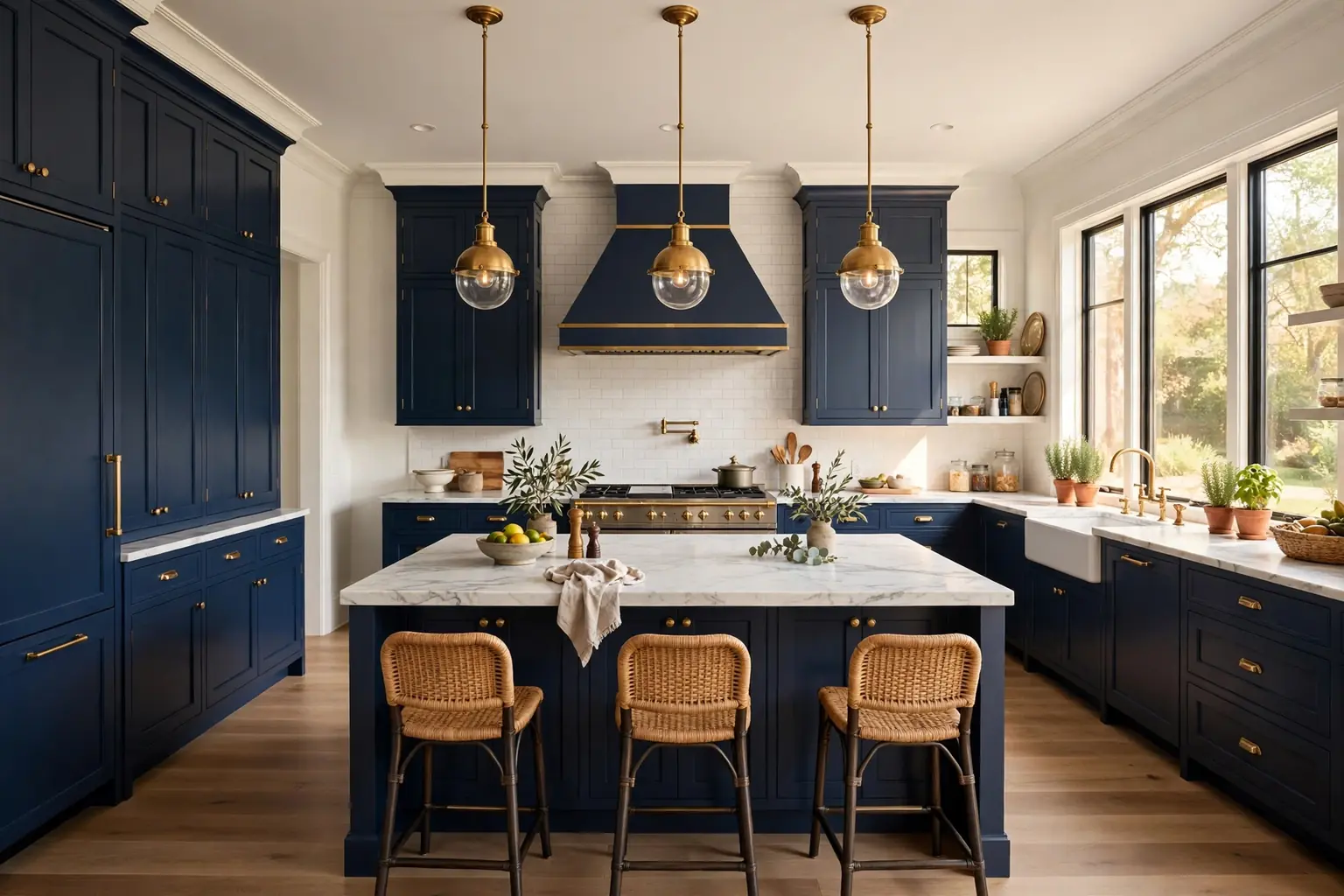
Navy blue kitchen cabinets bring depth and calm to a kitchen without the heaviness of black, and they pair well with white counters, warm wood, and brass. The shade works in small galleys and large open rooms alike, as long as the finish, hardware, and lighting suit the room. These 31 navy blue kitchen cabinet ideas cover finishes, two-tone layouts, islands, pantry walls, and small kitchen plans, with a care note for each choice. Test a large painted sample in your own light before you commit, since navy shifts a lot between morning and evening light.
Key Takeaways
- Finish changes the look more than the exact shade of navy. Matte hides fingerprints better, while gloss bounces light around a small or dim kitchen.
- Pair navy cabinets with pale counters, a light backsplash, or pale uppers so prep areas stay easy to work in.
- Brass warms navy, black hardware keeps it quiet, and nickel suits a cooler, more classic kitchen.
- Lighting is part of the design. Under-cabinet strips, pendants, and a lit glass cabinet keep a navy kitchen practical after dark.
- Two-tone layouts and a navy island give you the depth of navy without covering every wall in a dark color.
- Test a large sample door beside your floor and counters in morning and evening light before ordering paint or cabinets.
1. Matte Navy Shaker Cabinets
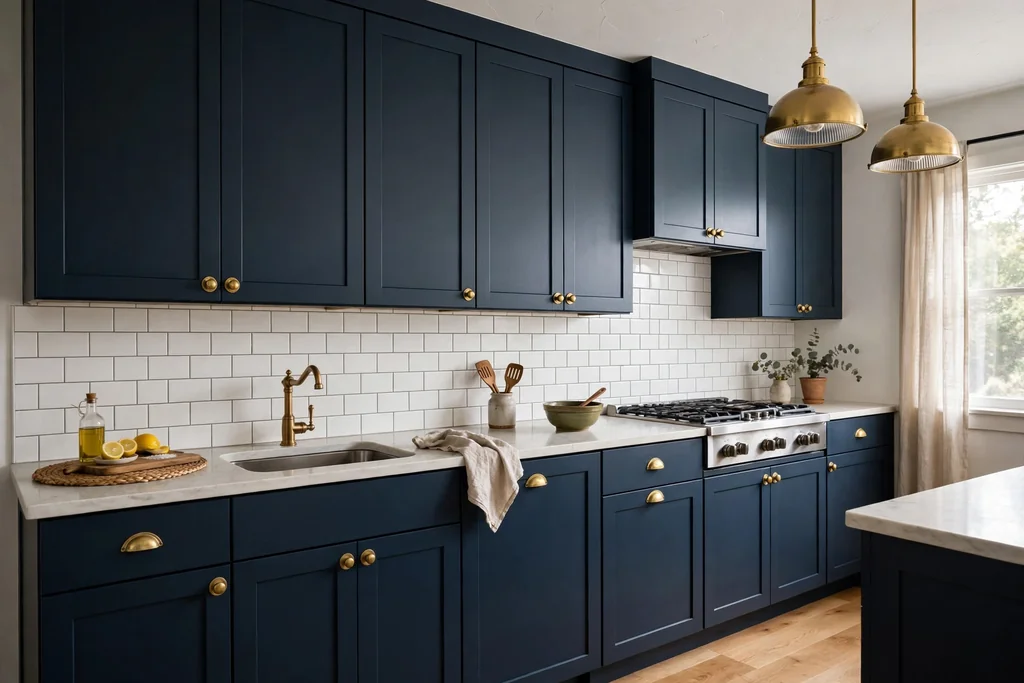
Matte navy Shaker doors are the most forgiving way into navy cabinets. The simple framed panel suits older homes and new builds alike, and the flat finish softens the color so the room does not feel stark. Pair them with white subway tile, pale stone counters, and brass knobs for warmth, or with black bar pulls for a quieter look.
Matte paint hides fingerprints better than gloss, but it shows dust and flour near the prep area, so wipe the doors there once a week with a damp cloth. Keep the rest of the palette calm, since the framed doors already give the kitchen plenty of detail.
2. High-Gloss Navy Flat-Front Cabinets
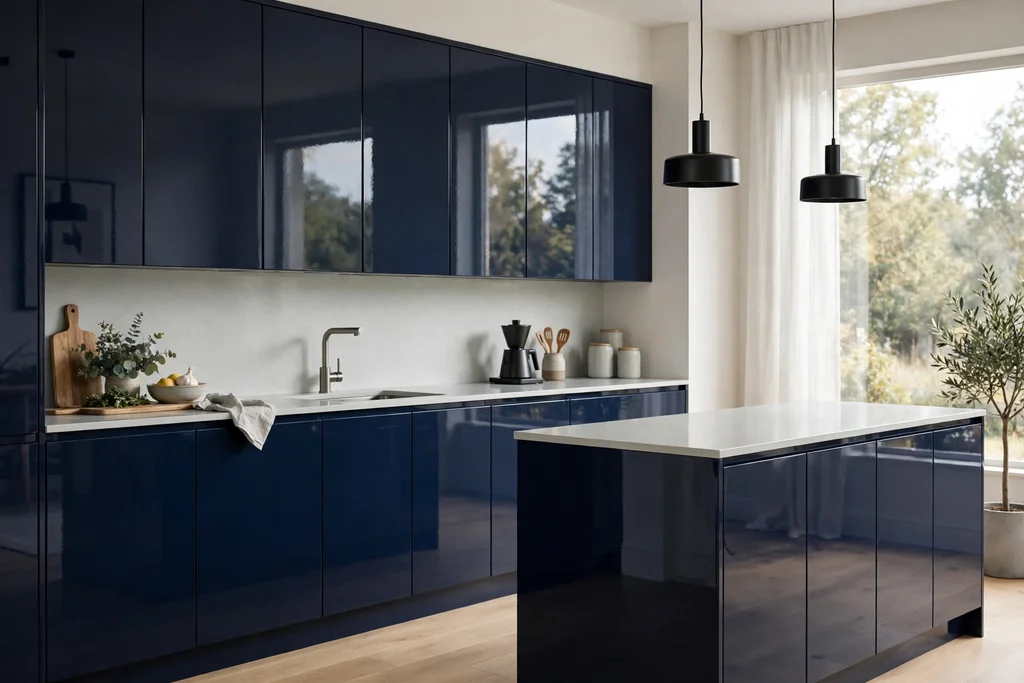
High-gloss flat-front navy cabinets with push-to-open doors give a clean, modern kitchen with no visible hardware to break up the run. The shine reflects light, which helps a small or north-facing room, and the flat fronts are quick to wipe down. Pair gloss navy with pale grey counters, a simple white backsplash, and integrated appliances so nothing interrupts the smooth surfaces.
Gloss shows smudges and fingerprints more than matte, so keep a microfiber cloth handy near the fridge and dishwasher. Gloss also shows every dent and wave in a door, so check the door quality closely before you order.
3. Navy Lower Cabinets With White Upper Cabinets
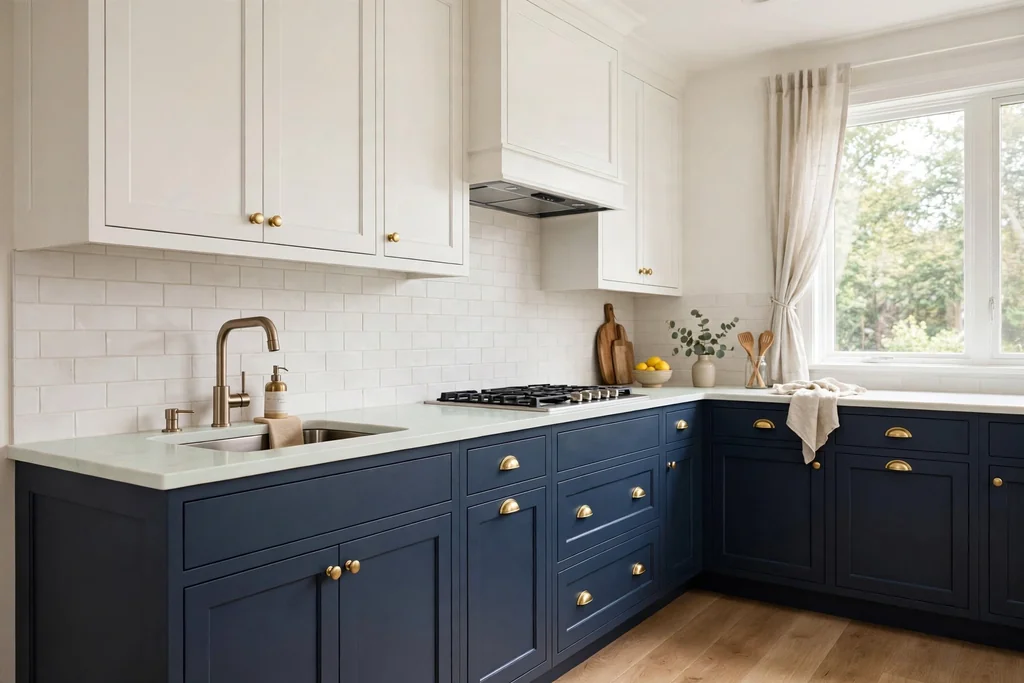
If a full navy kitchen feels too heavy, keep navy on the lower cabinets and use white uppers. The dark base grounds the room and hides scuffs from feet, pets, and the vacuum, while the white uppers keep the wall feeling light. Use one counter material across both runs and repeat the navy in a small detail, such as bar stools or a kettle, so the split looks planned.
This layout suits smaller kitchens well, because the eye reads the pale upper wall first. Keep the hardware the same on both runs, so the two colors read as one kitchen rather than two separate sets of cabinets.
4. Navy Island in a Pale Kitchen
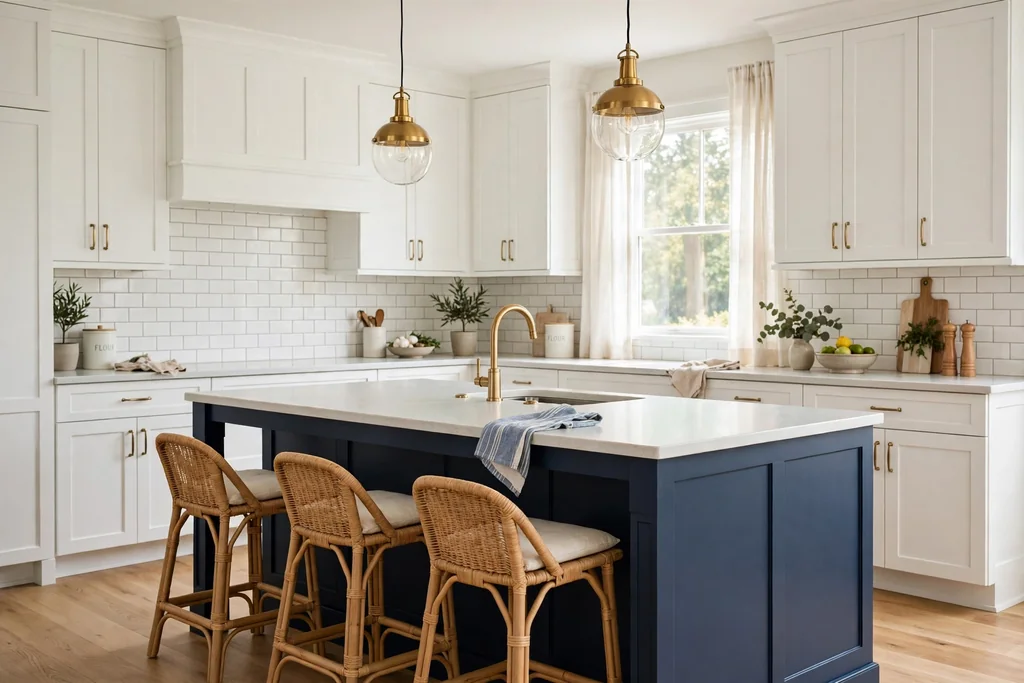
A navy island gives you the depth of navy cabinets without repainting the whole room. The island becomes the work zone and the gathering spot, and a pale perimeter keeps the walls light. Choose a pale counter for the island so chopping, homework, and serving stay visible, and add seating on one side if space allows.
Repeat the navy once more in the room, in pendant lights or stool frames, so the island does not look like a lone dark block. Keep the island counter clear of clutter, since a dark island shows crumbs and paper more than a pale one.
5. Navy Cabinets With Brass Knobs and Pulls
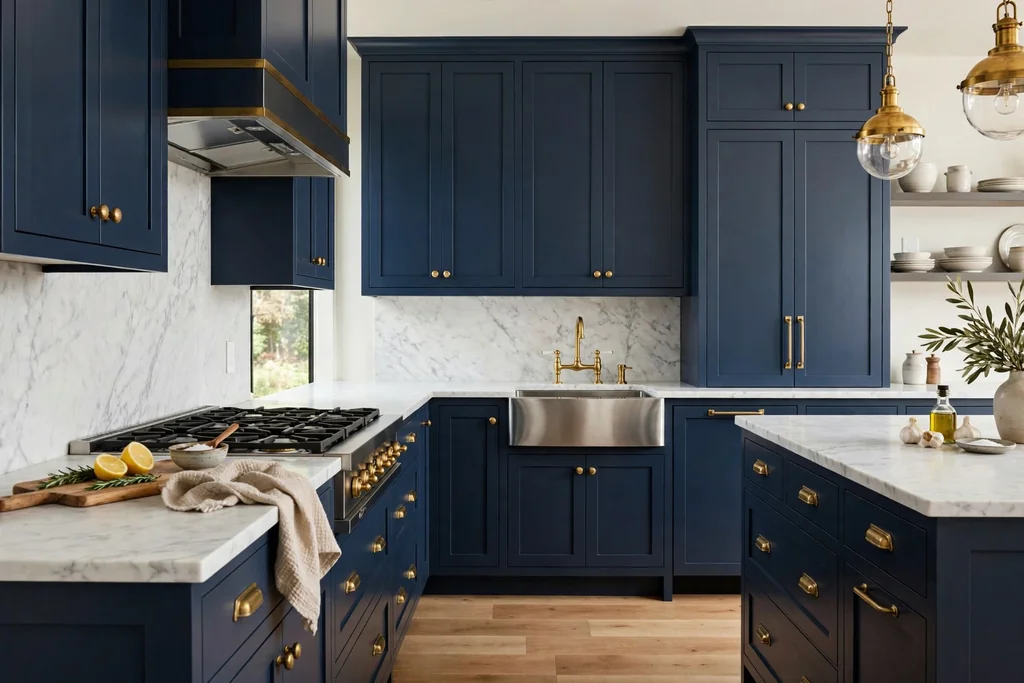
Brass hardware is the classic partner for navy cabinets, because the warm metal lifts the deep blue without adding another color. Use knobs on doors and longer pulls on drawers, and keep the brass finish the same across the kitchen, so mixed gold tones do not fight each other. Brass suits Shaker doors, farmhouse kitchens, and marble counters especially well.
Unlacquered brass will darken and spot with use, which some owners like and others do not, so check the finish before you buy. Wipe brass handles weekly in a busy kitchen, since cooking grease dulls the shine over time.
6. Navy Cabinets With Matte Black Hardware
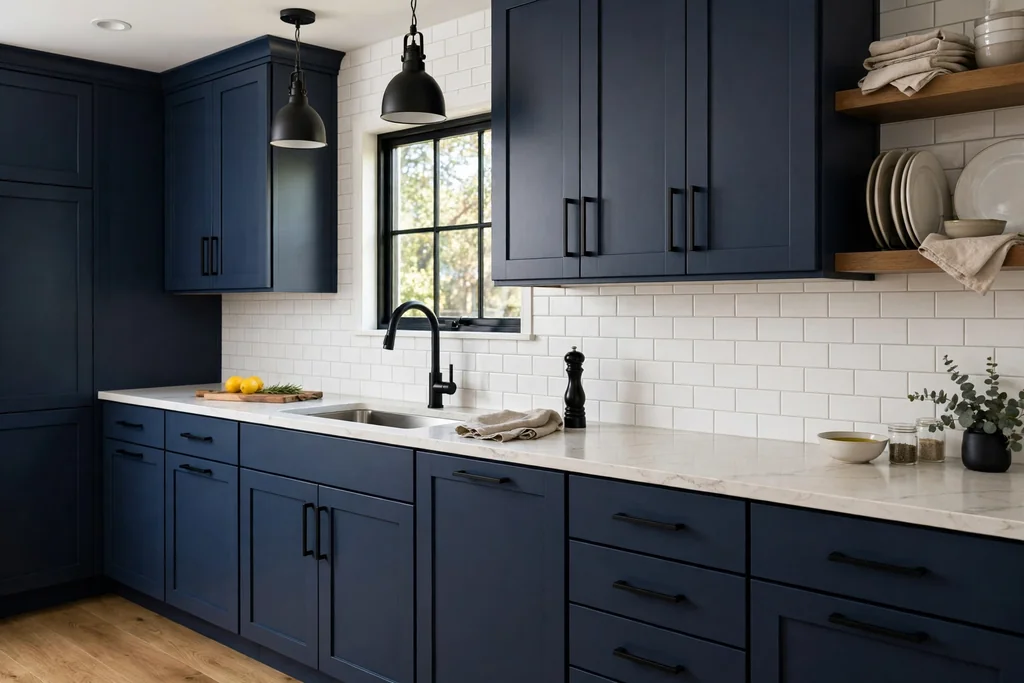
Matte black hardware keeps a navy kitchen quiet and modern, with no warm metal to compete with the blue. Black bar pulls suit flat-front and Shaker doors alike, and they tie in neatly with black taps, black pendant lights, and black stool frames. Use the same black finish on every handle, so the hardware reads as one decision.
Black hardware shows dust and flour less than brass, but it can disappear against navy doors in dim light, so check the pulls under your evening lighting. Keep the pulls long enough to grip easily, since short pulls on deep drawers are awkward with wet hands.
7. Navy Cabinets With White Marble Counters
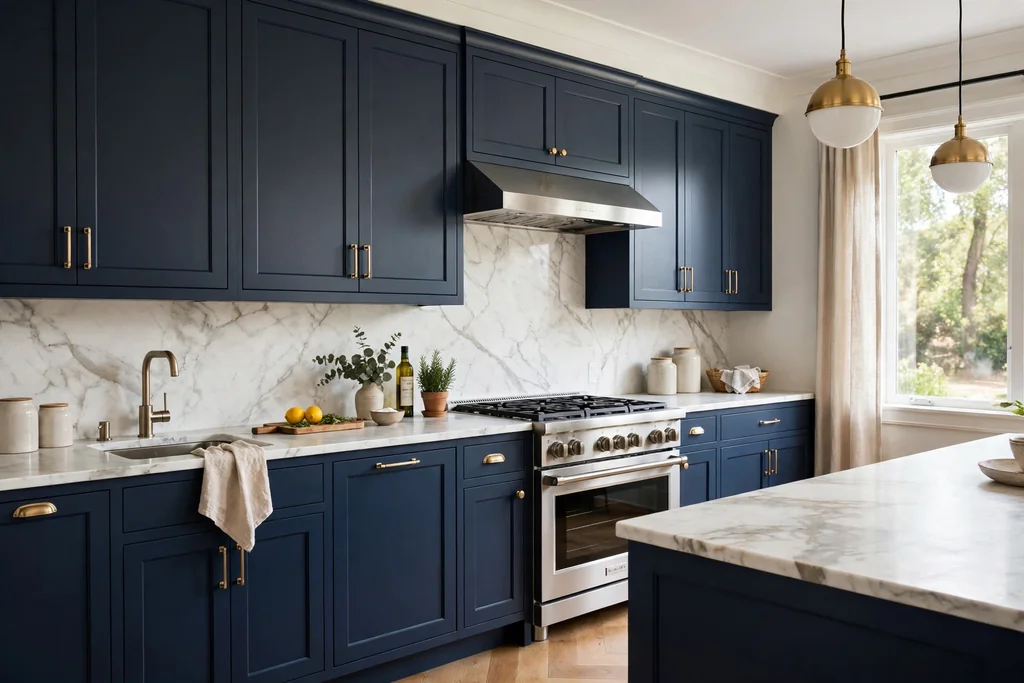
White marble, or a marble-look stone, is the classic partner for navy cabinets, because the pale veined surface keeps the contrast crisp. Use it on counters and carry it up the wall as a backsplash for a calm, continuous look, and add brass or polished nickel hardware to warm or cool the pairing. Marble marks and etches more easily than quartz, so seal it, wipe up acidic spills quickly, and use trivets under hot pans.
If upkeep worries you, a marble-look quartz gives a similar look with less care. Keep the veining quiet rather than dramatic if the cabinets are already a strong color, so the room has one clear focus.
8. Navy Cabinets With Warm Butcher Block Counters
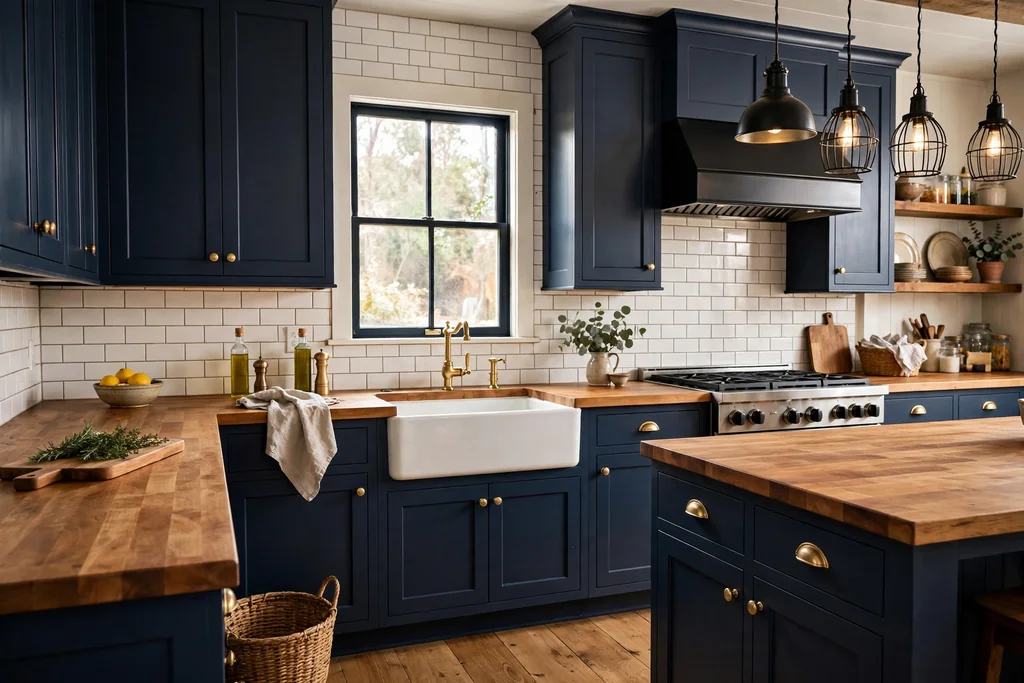
Warm wood counters take the edge off navy cabinets and suit a relaxed, lived-in kitchen. Butcher block pairs well with matte navy Shaker doors, a farmhouse sink, and brass hardware, and it gives a warm surface for rolling dough and serving boards. Wood counters need more care than stone: oil them on a regular schedule, wipe up water promptly, and use boards for cutting.
Keep the backsplash simple, such as white tile, so the wood and the navy stay the focus of the room. A wood counter near the sink needs extra care, so seal the area around the tap well and wipe it dry after washing up.
9. Navy Cabinets With White Subway Tile
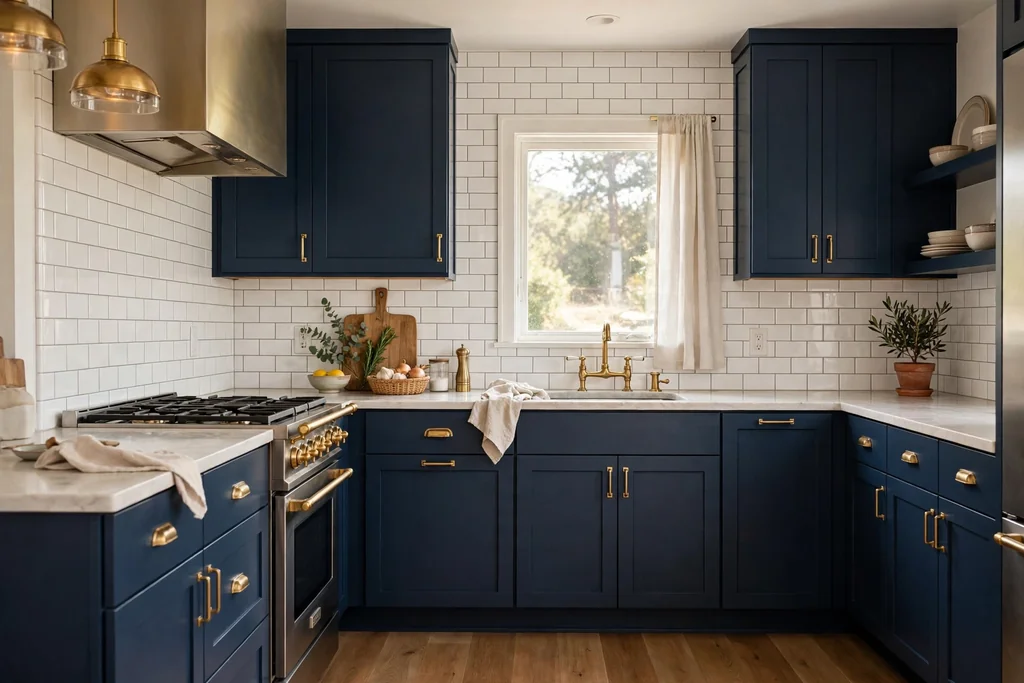
White subway tile is the safest backsplash for navy cabinets, and it works for a reason: the pale, even grid keeps the wall bright and lets the navy carry the color. Use a classic brick pattern for a relaxed kitchen, or a stacked pattern for a more modern feel, and keep the grout light so the tile reads as one calm surface. This pairing suits Shaker doors, farmhouse sinks, and both brass and black hardware.
Wipe the tile behind the range often, since cooking grease shows on white tile, and choose a grout that resists stains in that zone. For the wall above the sink, the storage and lighting choices in these above kitchen sink ideas pair well with a plain tile wall.
10. Navy Cabinets With a Patterned Tile Backsplash
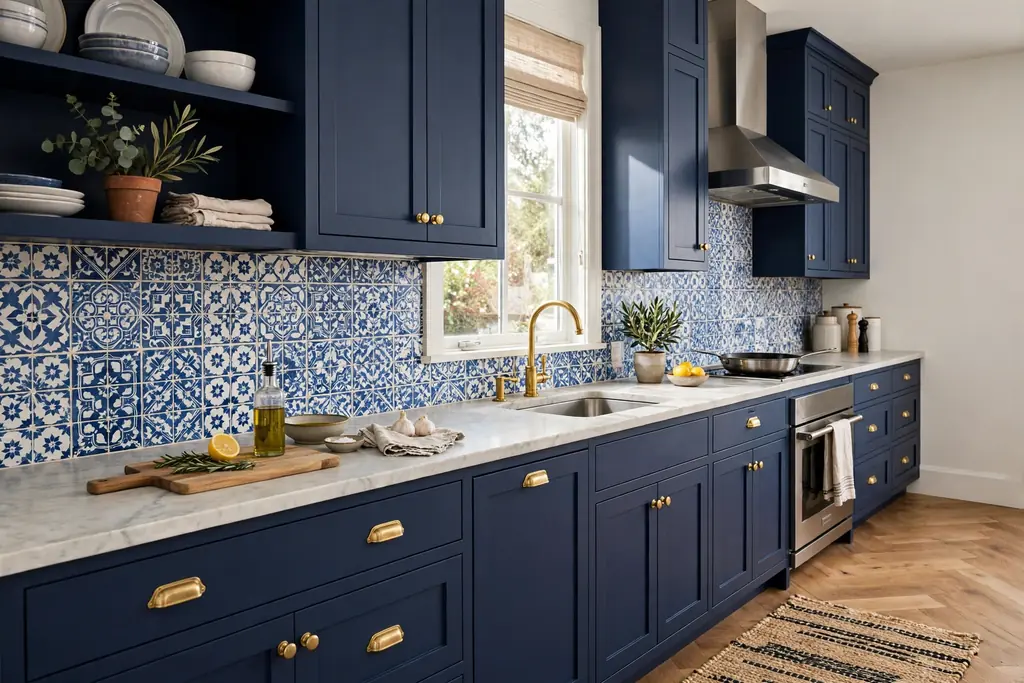
A patterned tile backsplash gives a navy kitchen a focal wall without adding another cabinet color. Blue and white geometric tiles suit a modern room, while hand-painted style tiles suit a softer, collected kitchen. Keep the pattern to the main cooking wall or the sink wall, and use plain tile elsewhere, so the pattern reads as a feature rather than noise.
Patterned tile hides splashes well, but grout lines need a scrub now and then, so choose a grout color that will not show every mark. Pale counters keep the tile as the star, and the rest of the room should stay plain so the pattern has room to breathe.
11. Glass-Front Navy Upper Cabinets
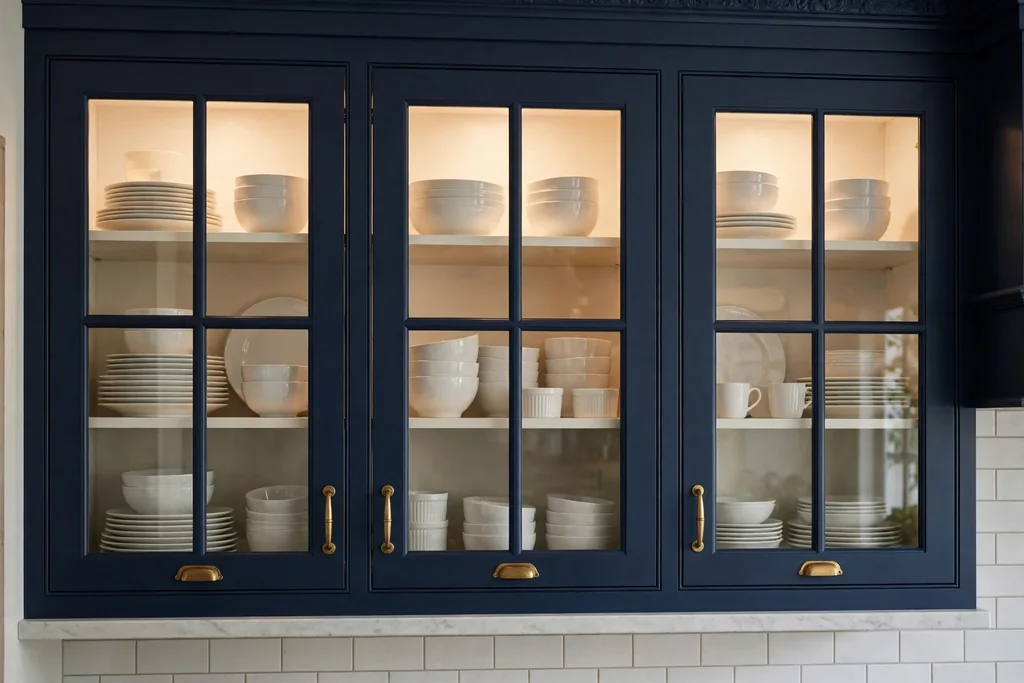
Glass-front navy uppers turn storage into display and break up a long run of solid doors. Use them for everyday glassware, white dishes, or a small collection, and keep the inside tidy, because glass shows everything. Clear glass suits a collected look, while reeded or frosted glass hides clutter and still lets light through.
Add a small light inside each cabinet so the contents glow in the evening. Keep the rest of the uppers solid so the display stays a feature rather than a demand to curate every shelf, and wipe the glass after cooking, since steam leaves marks.
12. Navy Cabinets Paired With Open Wood Shelving
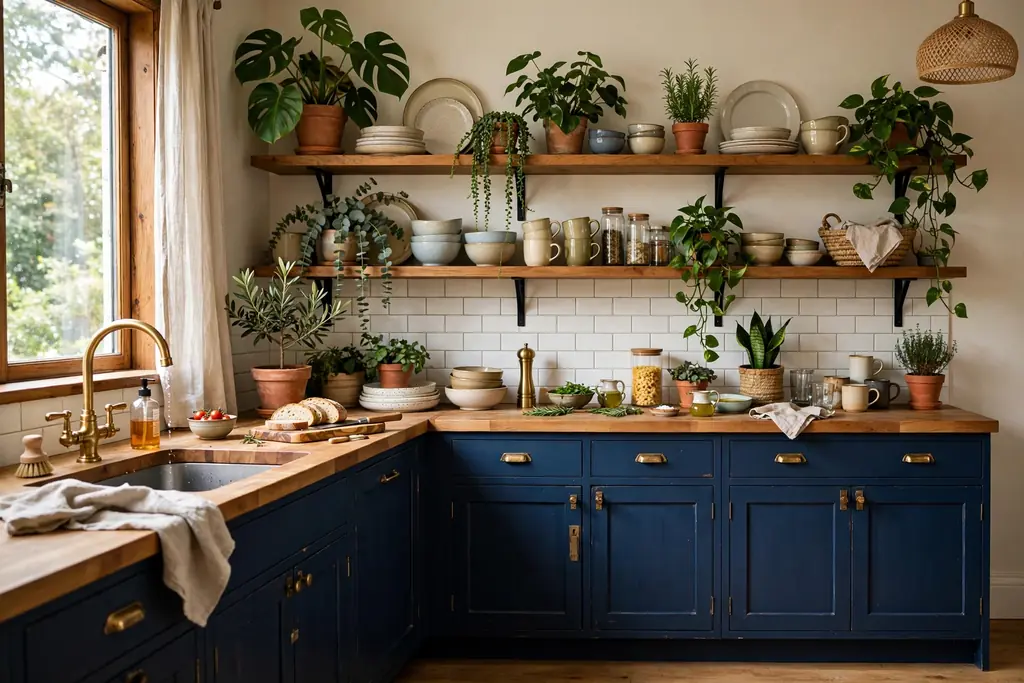
Replacing some uppers with open wood shelves lightens a navy kitchen and gives a spot for daily dishes, plants, and cookbooks. The wood warms the navy, and the open shelves make a small kitchen feel less boxed in. Keep shelves to one or two runs, style them loosely, and leave breathing room between groups so they do not look crowded.
Open shelves collect dust and cooking grease, so put everyday items there and keep rarely used pieces behind closed doors. Fix shelves into studs, since dishes are heavy, and keep the shelf wood tone close to the floor or the counter for a calm match.
13. Floor-to-Ceiling Navy Pantry Wall
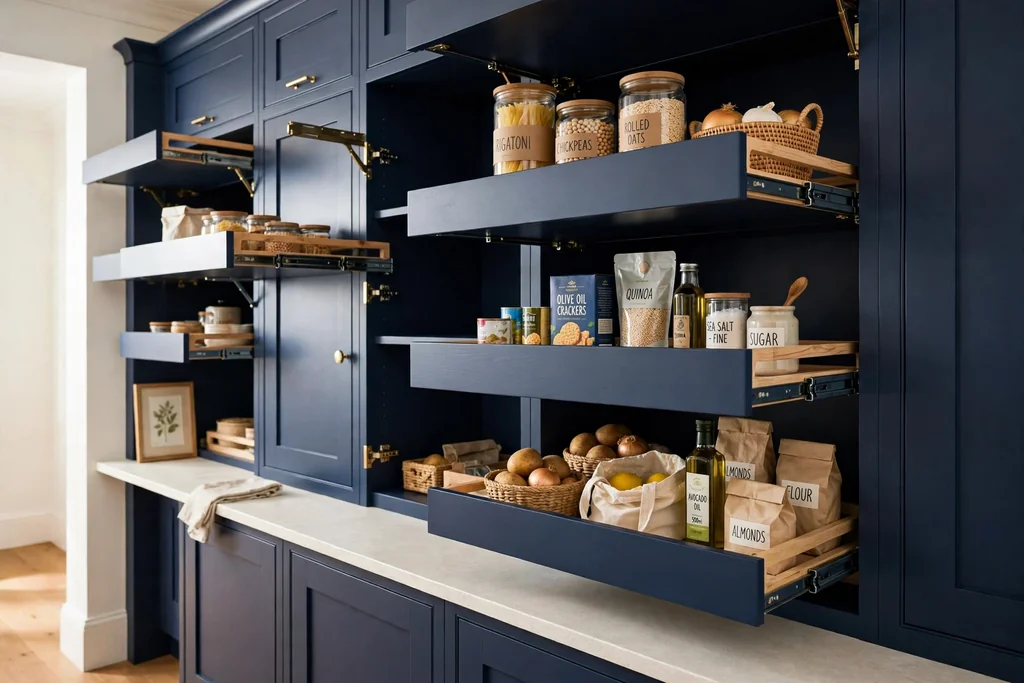
A full wall of tall navy cabinets makes a pantry that hides food, small appliances, and cleaning supplies behind closed doors. Plan a mix inside: deep drawers for heavy items, pull-out shelves for cans and jars, and one tall section for a vacuum or broom. Label the inside of doors or use clear bins so the pantry stays usable rather than a dark cupboard of forgotten food.
A pantry wall suits a kitchen with a spare wall near the fridge, and it frees the main cooking run from tall, bulky storage. Keep a pale counter nearby for unpacking shopping bags, and add a slim step stool in a tall cabinet so the top row stays reachable.
14. Navy Cabinets in a Galley Kitchen
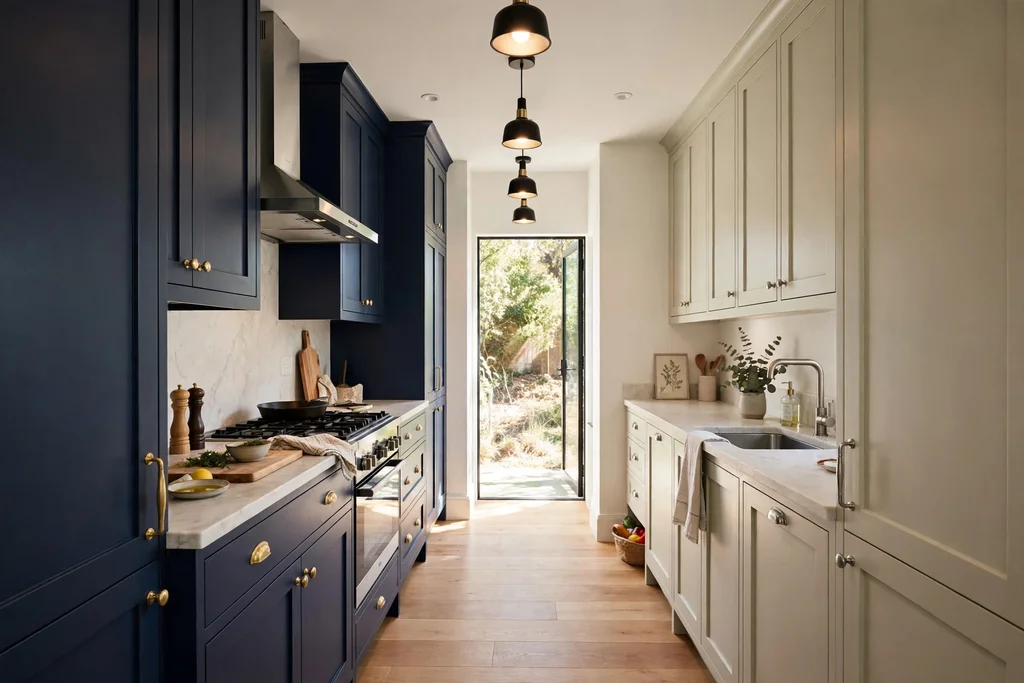
A galley kitchen can carry navy cabinets if you plan the light carefully. Use navy on one run only, keep the opposite run pale, and add a pale counter, a light backsplash, and bright under-cabinet lighting on both sides. A glossy backsplash on one wall bounces light down the narrow room, and a pale floor keeps the passage feeling open.
Avoid dark counters here, because a dark floor, dark cabinets, and dark counters together will close the space in. Keep the passage clear of stools and bins so the galley stays easy to move through, and keep the hardware slim so handles do not catch on clothing in a narrow walkway.
15. Navy Cabinets in a Small Kitchen
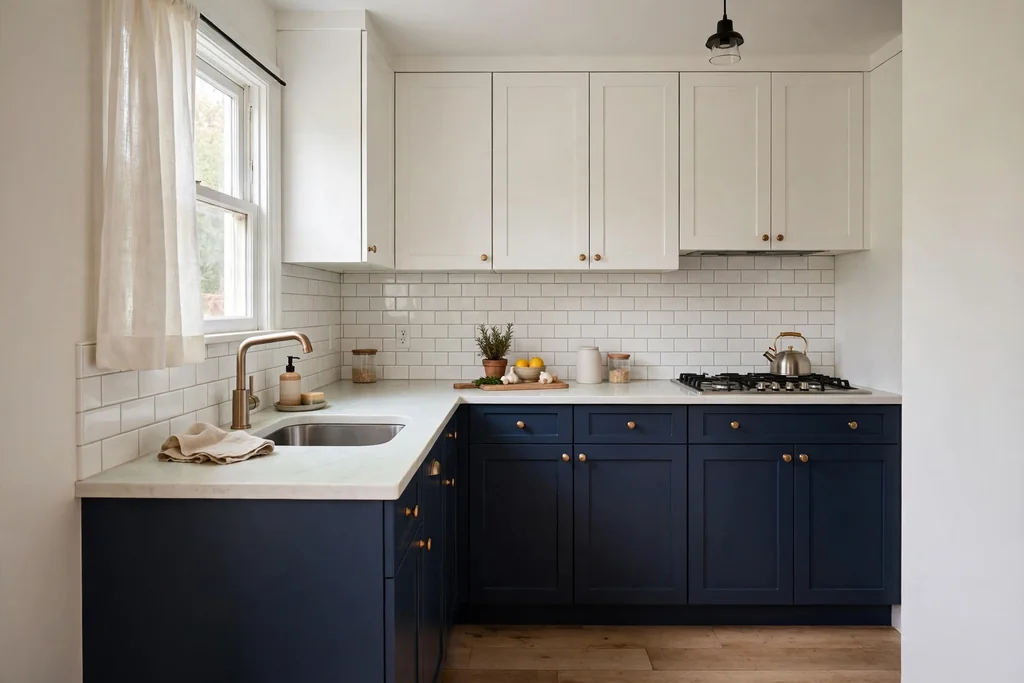
In a small kitchen, navy works best when the rest of the room stays light. Use navy on the lower cabinets or on one run only, with white uppers, a pale counter, a light floor, and a mirror or glossy backsplash to bounce daylight around. Keep the door fronts flat or simply framed, and the hardware minimal, so the small run reads as one calm wall.
Store daily items at waist and eye level, and use the top of tall cabinets only for rarely used pieces. A small kitchen rewards restraint: one navy run, one counter material, and one hardware finish are usually enough, and the room will feel planned rather than crowded.
16. Navy Farmhouse Cabinets With a White Apron Sink
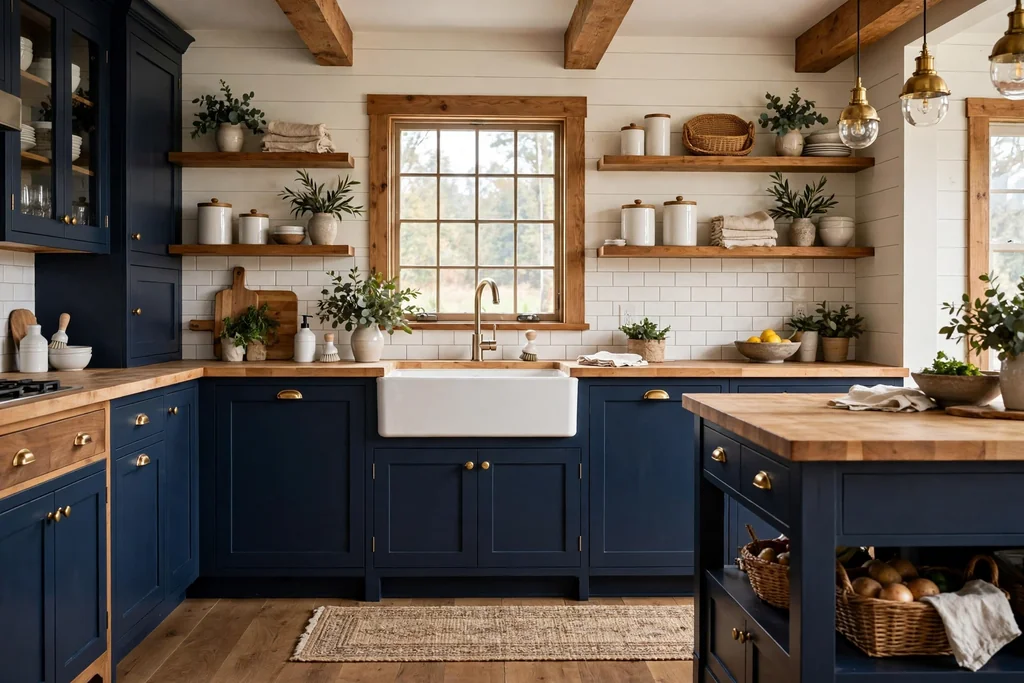
A navy farmhouse kitchen pairs matte navy cabinets with a white apron-front sink, beadboard details, and warm wood accents. The white sink breaks up the dark run and gives a practical, deep basin for large pots and baking trays. Add a wood counter or wood shelf, a simple bridge faucet, and brass hardware to hold the scheme together.
Farmhouse style suits a room with some natural texture, such as a wood floor or a brick chimney breast, which stops the navy from feeling flat. Wipe the sink surround often, because water marks show on navy paint near the tap, and seal the beadboard well in the splash zone.
17. Navy Cabinets Around a Statement Range Hood
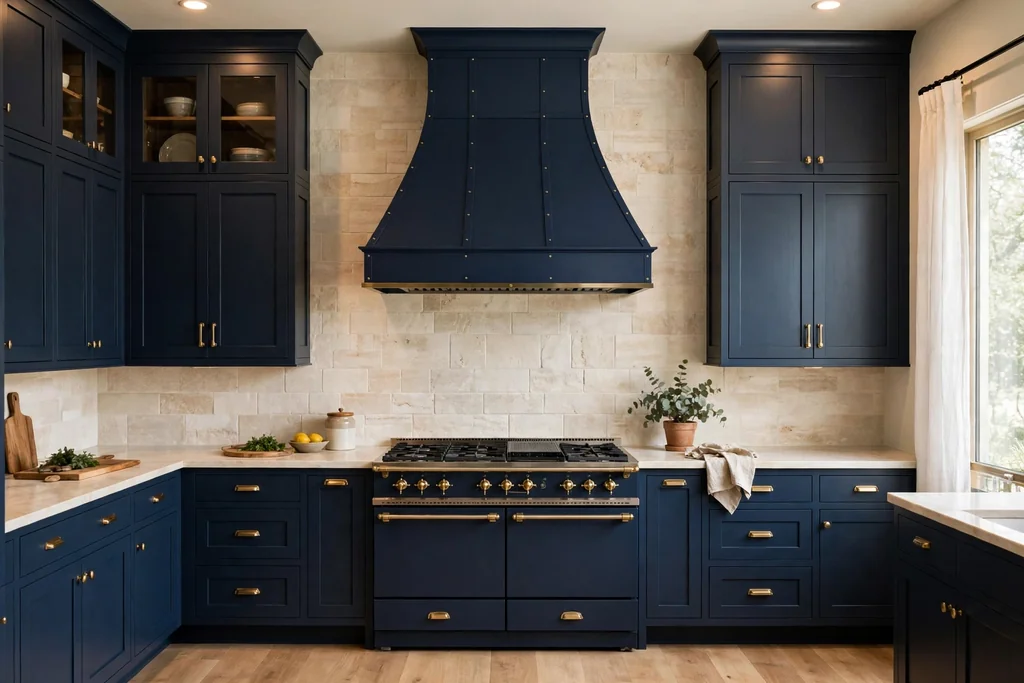
Build the kitchen around a navy range hood wall, with navy cabinets flanking a bold hood in navy metal, brass-trimmed navy, or plaster painted to match. The hood becomes the focal point, so keep the surrounding cabinets simple and the hardware quiet. A pale stone backsplash behind the range keeps the cooking zone readable and easy to clean.
Check the hood size against your range before ordering, and plan ducting early, because a statement hood is hard to resize later. This idea suits a room with a long, uninterrupted cooking wall, where the hood has room to stand out without crowding a window or a tall cabinet.
18. Navy Cabinets With a Breakfast Nook
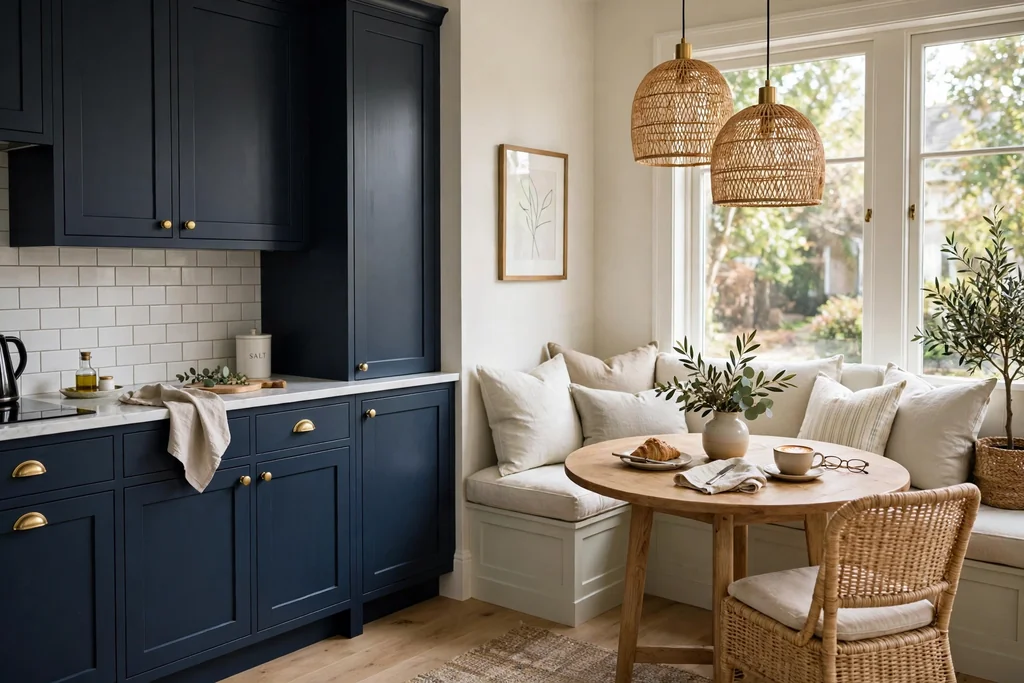
Pair navy cabinets with a breakfast nook and the kitchen gains a soft, social corner that balances the dark cabinetry. A built-in banquette in pale wood or cream upholstery, a small round table, and a pendant light make a spot for morning coffee and homework. Repeat the navy in the table base or the pendant so the nook ties back to the cabinets.
Banquette seating also adds storage underneath for table linens and board games. Keep the nook cushions washable, because a breakfast spot earns crumbs faster than any other seat in the house, and keep the table small enough that the walkway past it stays clear.
19. Navy Beverage Station Built Into Cabinetry
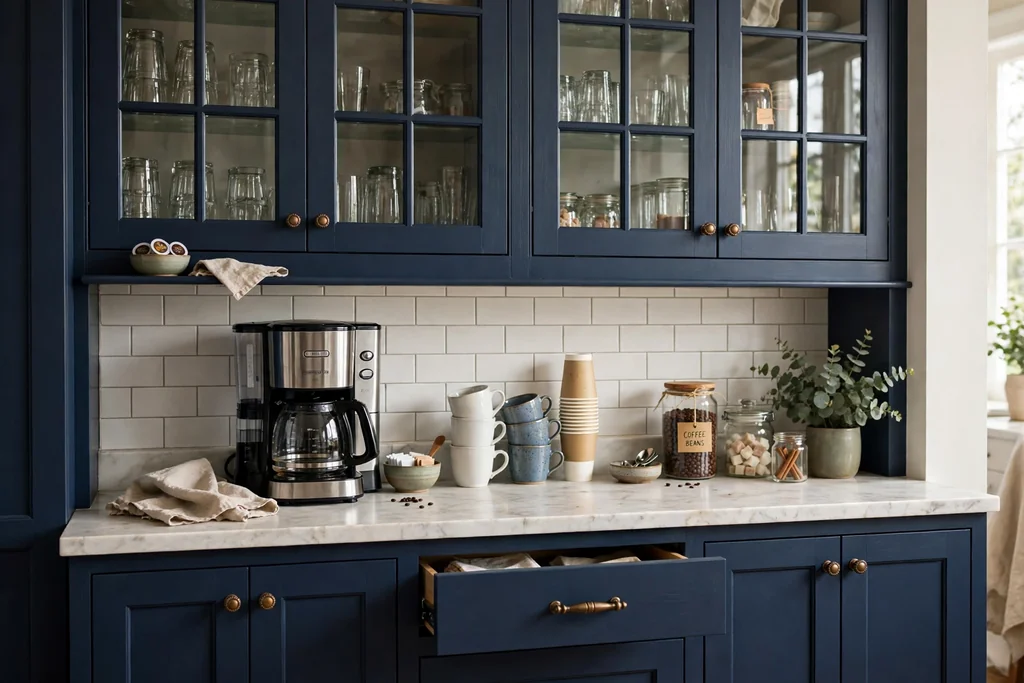
A beverage station turns a stretch of navy cabinets into a coffee bar, tea station, or wine nook. Plan a counter section with a small sink or a water source nearby, open or glass-front uppers for cups and glasses, and drawers for pods, filters, and accessories. A wine fridge or a beverage cooler can sit under the counter if you entertain often.
Keep the station away from the main cooking triangle so morning coffee does not block dinner prep. Wipe the counter often, because coffee and wine marks show quickly on a dark surface near a pale counter edge, and keep mugs to the ones you use weekly so the station stays tidy.
20. Navy Cabinets With a Kitchen Garden Wall
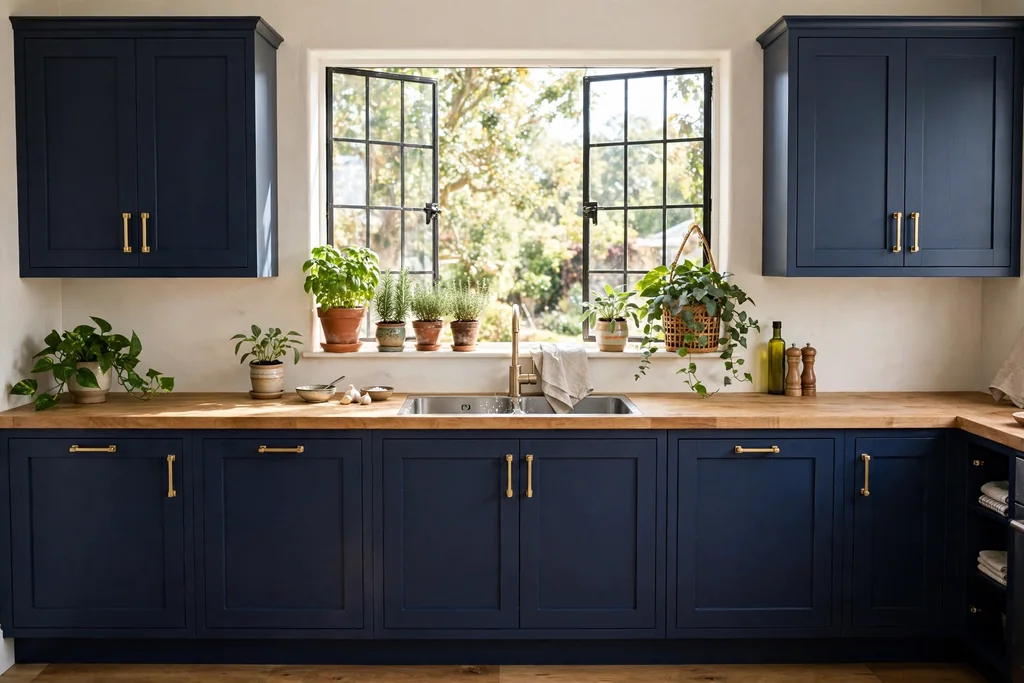
Plants soften navy cabinets more than any other accessory. A row of herbs on a sunny windowsill, trailing plants on top of tall cabinets, or a small wall-mounted herb rail adds green life against the deep blue doors. Choose herbs you cook with, such as basil, parsley, and mint, and keep them near the prep area so they get used.
Plants need light and watering, so place them where you will see them daily and use pots with drainage. If your kitchen window is small, a single large plant on the floor beside the cabinet run can do the same job, and a pale pot keeps the green from getting lost against the navy.
21. Navy Cabinets With Warm Wood Floors
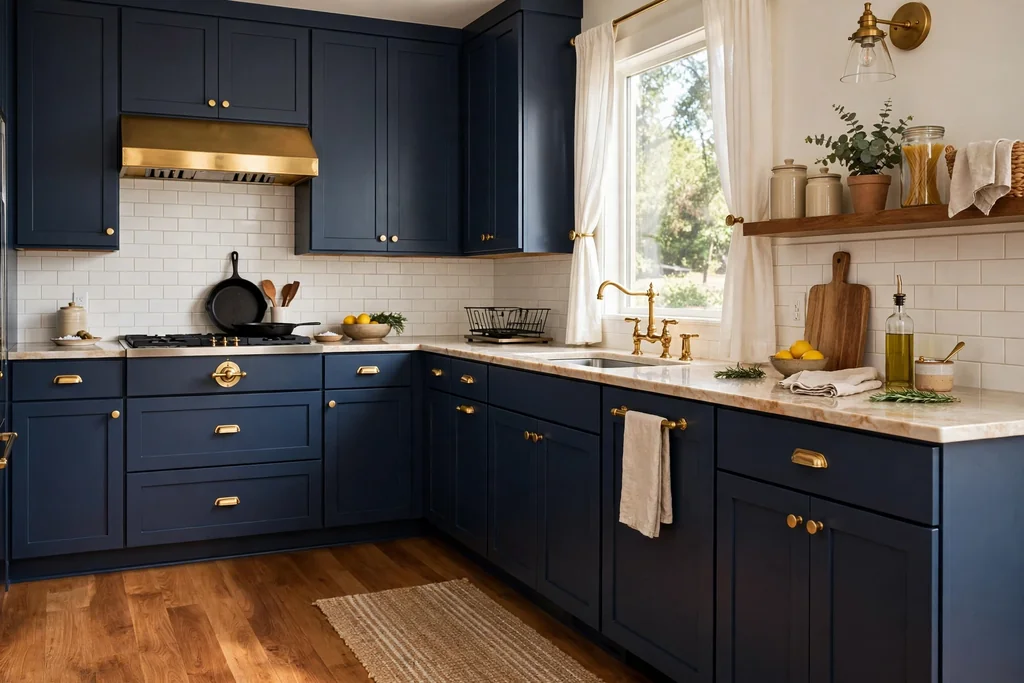
Warm wood floors are one of the easiest ways to keep a navy kitchen from feeling cold. Mid-tone oak or warm walnut underfoot softens the blue, and the same wood tone can return in a shelf, a counter section, or stool seats to tie the room together. This pairing suits Shaker doors, farmhouse sinks, and brass hardware, and it works in both classic and relaxed kitchens.
Keep the floor finish practical for a kitchen, with a seal that resists water near the sink and the dishwasher. Sweep often, since crumbs and dust show on both dark cabinets and wood floors, and use felt pads under stools so the floor stays free of scratches.
22. Navy Cabinets With Concrete-Look Counters
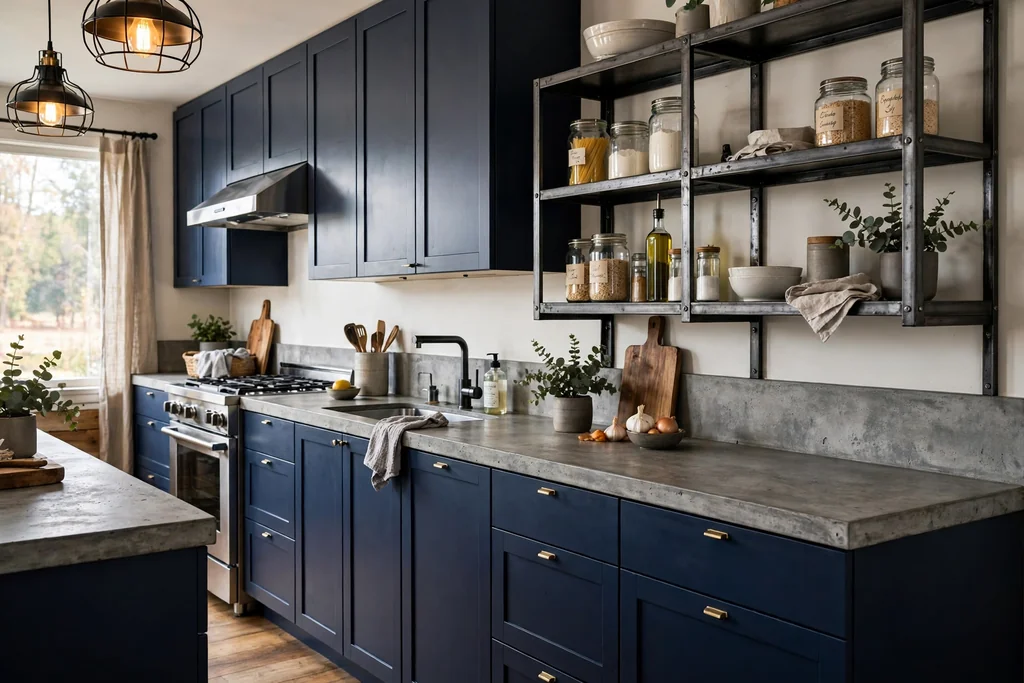
An industrial-leaning kitchen pairs flat-front navy cabinets with concrete-look counters, steel shelving, and simple hardware. The mix of deep blue, grey concrete, and brushed steel feels hard-wearing, and it suits a loft or a modern extension. Concrete-look counters need sealing and prompt wipe-ups, like real stone, so check the care routine before ordering.
Add warm wood in one place, such as stools or a chopping board, so the room does not feel cold. Keep the layout simple and the surfaces clear, because this style depends on strong lines, and keep the backsplash plain so the counter texture stays the focus.
23. Fluted Navy Cabinet Fronts on an Island
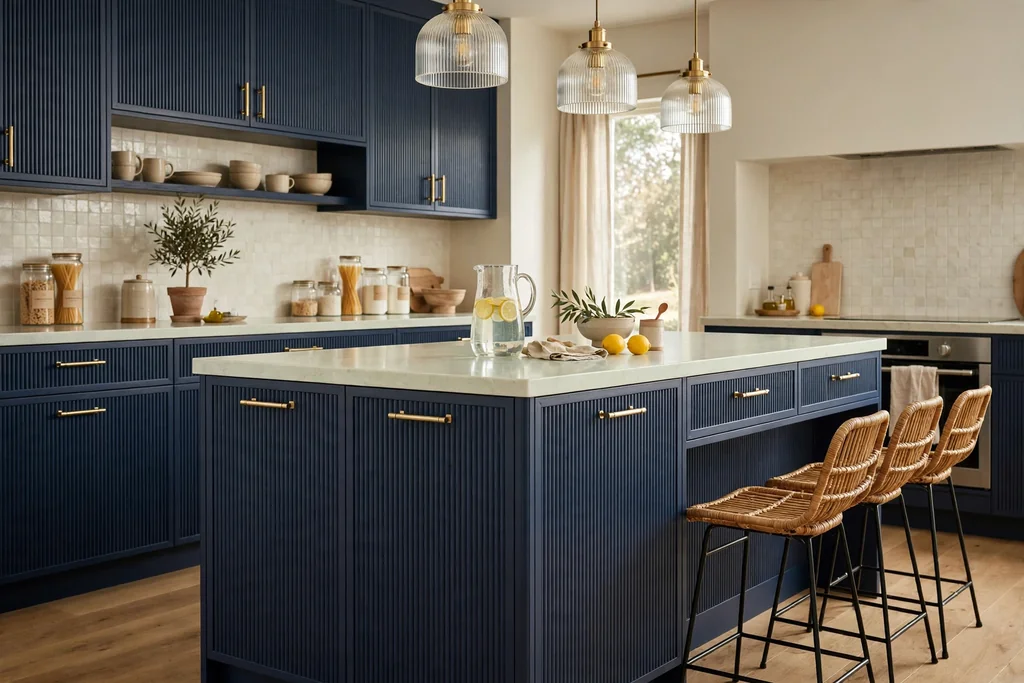
Fluted or reeded door fronts add texture to navy cabinets without adding color. The vertical grooves catch light and shadow, so the doors look richer than flat navy paint, and they suit both modern and classic rooms. Use fluted fronts on an island or a single run as a feature, and keep the remaining cabinets flat so the texture stays special.
Dust can settle in the grooves, so a soft brush or a vacuum brush attachment helps at cleaning time. Pair fluted fronts with simple hardware, because busy handles fight the texture, and keep the island counter pale so the grooves read clearly in daylight.
24. Navy Cabinets With a Window Seat and Storage
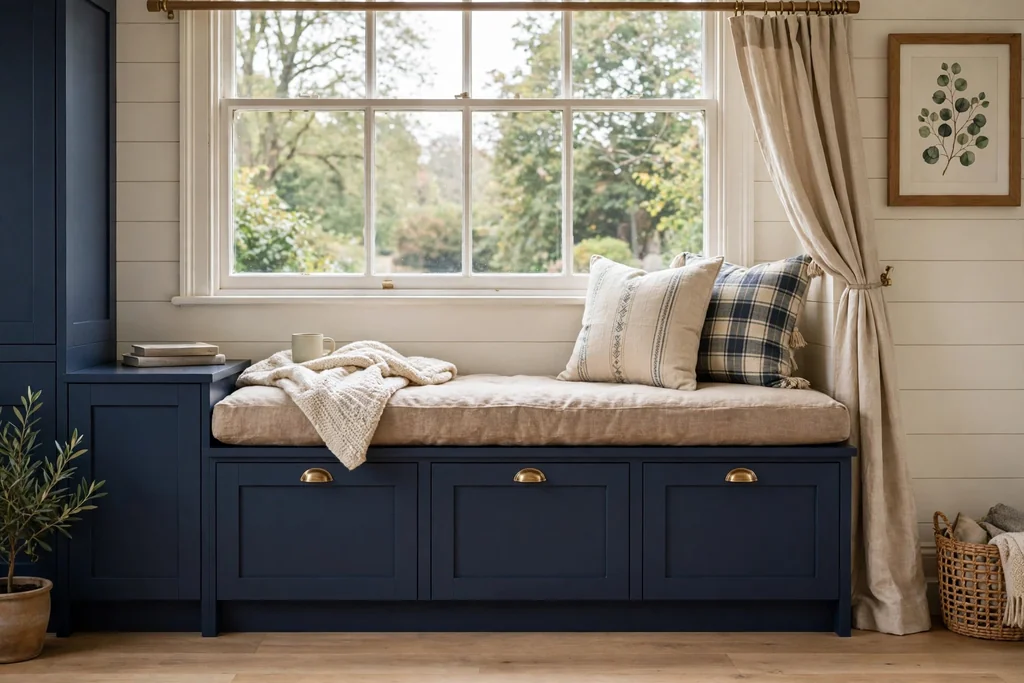
A window seat built from navy base cabinets turns an otherwise empty stretch of wall into a reading spot, a dining bench, or a place to sit while you put on shoes, with storage underneath for shoes, bags, or spare linens. Build it from low cabinets topped with a cushion, rather than a fixed structure, if you rent. A cushion in a washable cover keeps the seat practical beside a window that may collect condensation or dust.
Add a small shelf or a wall hook nearby for a book, a phone, or a cup, so the seat works as a complete spot rather than a bare bench. For the window itself, the treatments and sill ideas in these kitchen window decor ideas help the seat and the glass read as one planned corner.
25. Layered Lighting for Navy Cabinets
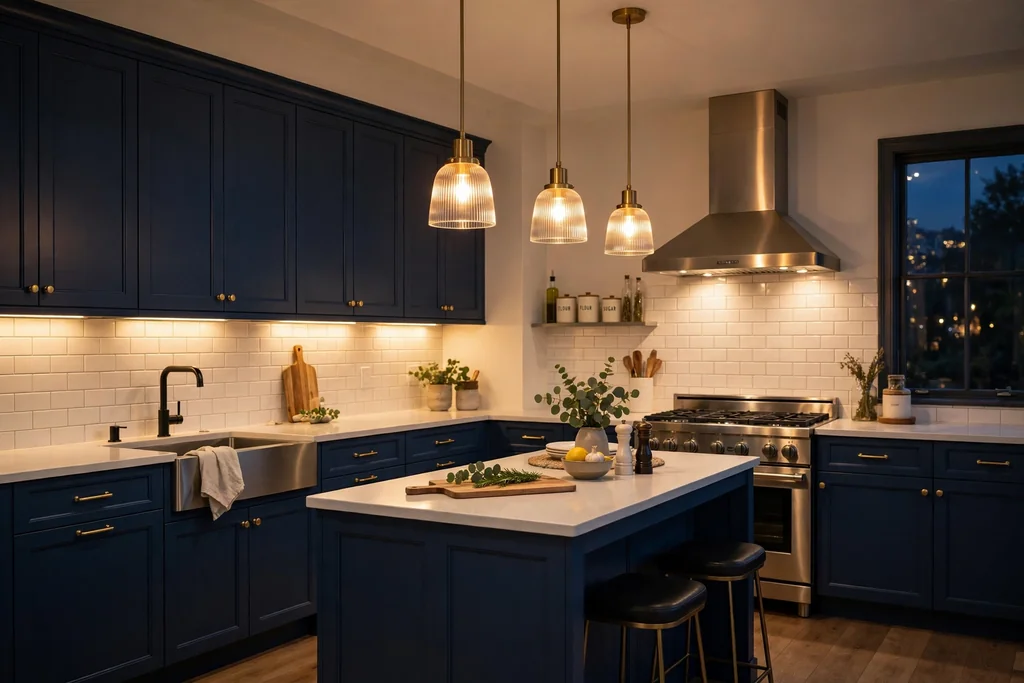
Lighting decides whether navy cabinets feel moody or simply dark. Plan three layers: under-cabinet strips for food prep, pendants over an island or table for evening light, and toe-kick strips that wash the floor and make the cabinets appear to float. Warm white bulbs suit navy cabinets better than cold blue light, which can make the paint look grey.
Put the layers on separate dimmers so you can brighten the room for cooking and soften it for dinner. Check the lighting at night before finalizing paint, because navy changes the most after dark, and keep the inside of at least one glass cabinet lit so the room has a glow after the main lights go low.
26. Pull-Out Organization Inside Navy Cabinets
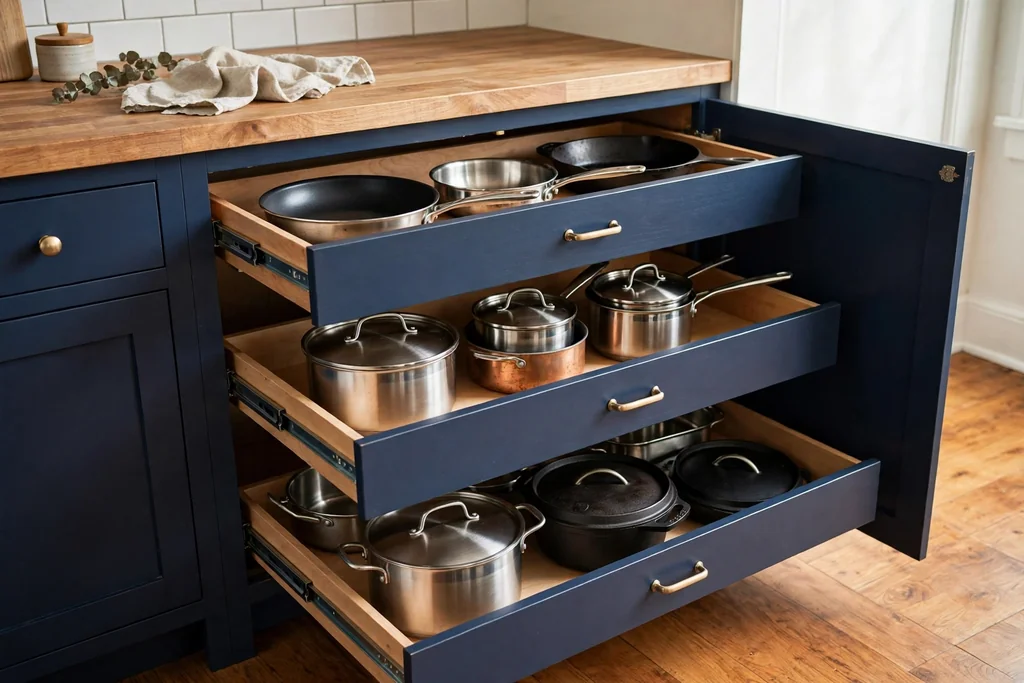
The inside of navy cabinets matters as much as the color, because dark interiors can hide what is stored. Fit pull-out drawers in base cabinets, pull-out shelves in tall cabinets, and narrow pull-outs beside the range for oils and spices, so nothing sits lost at the back. Deep drawers suit pots and pans, while shallow top drawers suit cutlery and tools.
Label the inside of doors or use clear bins in the pantry section, and keep a pale liner on dark shelves so items stand out. Plan the pull-outs before you order doors, since the interior fittings decide the door widths, and keep one drawer near the prep area for the tools you reach for every day.
27. Navy Cabinets With an Appliance Garage
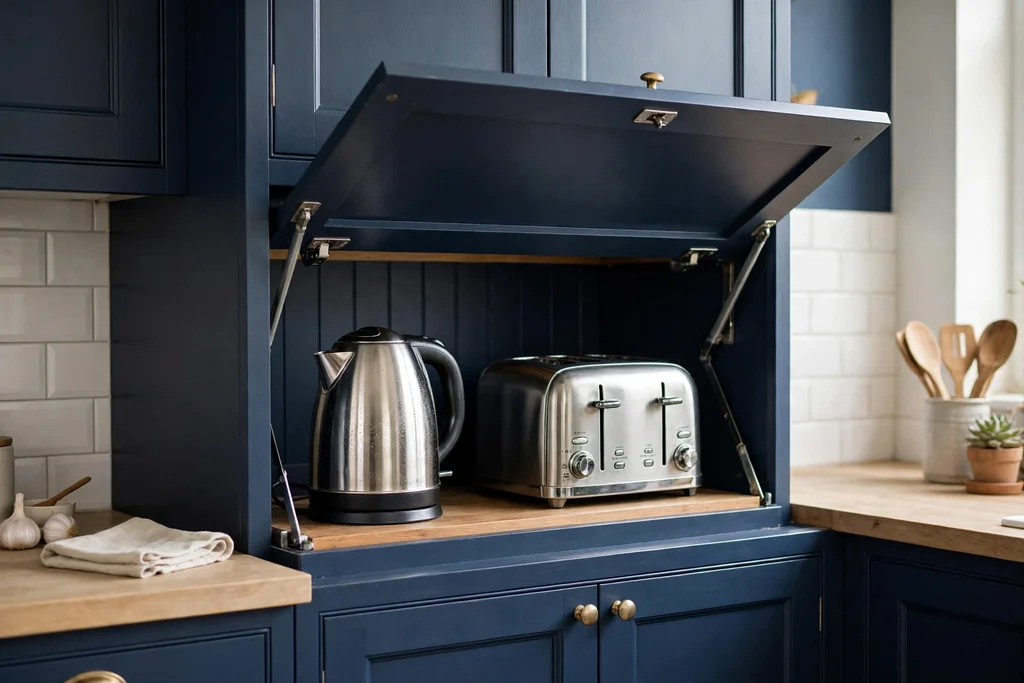
An appliance garage hides small appliances behind a navy door or a lift-up front, so the counter stays clear and the kitchen reads as calm rather than crowded. Plan it beside the prep area, with a socket inside, room for a kettle, toaster, or coffee maker, and a door that opens fully without hitting the tap or a tall cabinet. A tambour door suits a corner garage, while a hinged door suits a straight run.
Keep the garage interior pale and wiped clean, since steam from a kettle marks dark surfaces, and keep only daily appliances inside so the garage does not become a second cupboard. If the garage sits on a corner, check the door swing against the neighboring cabinet before you order.
28. Repainting Existing Cabinets Navy
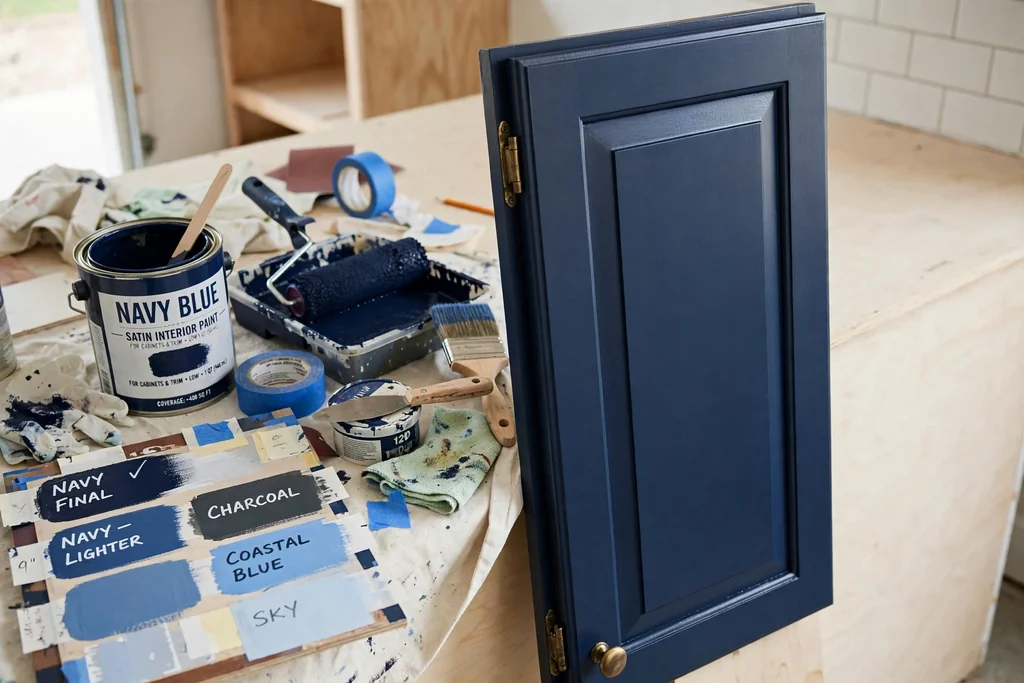
Repainting existing cabinets navy is the lowest cost way to get this look, and it works best when the doors are solid and in good shape. Clean and degrease the doors, sand lightly, prime with a primer suited to the door material, and paint in thin coats with a cabinet paint that resists chips and moisture. Remove the doors and hardware before painting, and label each door so it goes back in the right place.
Paint one door first and live with it for a few days in your own light before painting the whole kitchen. Budget for new hardware too, since old handles can make fresh paint look tired, and keep a small pot of the paint for touch-ups near the sink and the bin, where chips happen first.
29. Navy Cabinets in an Open-Plan Kitchen
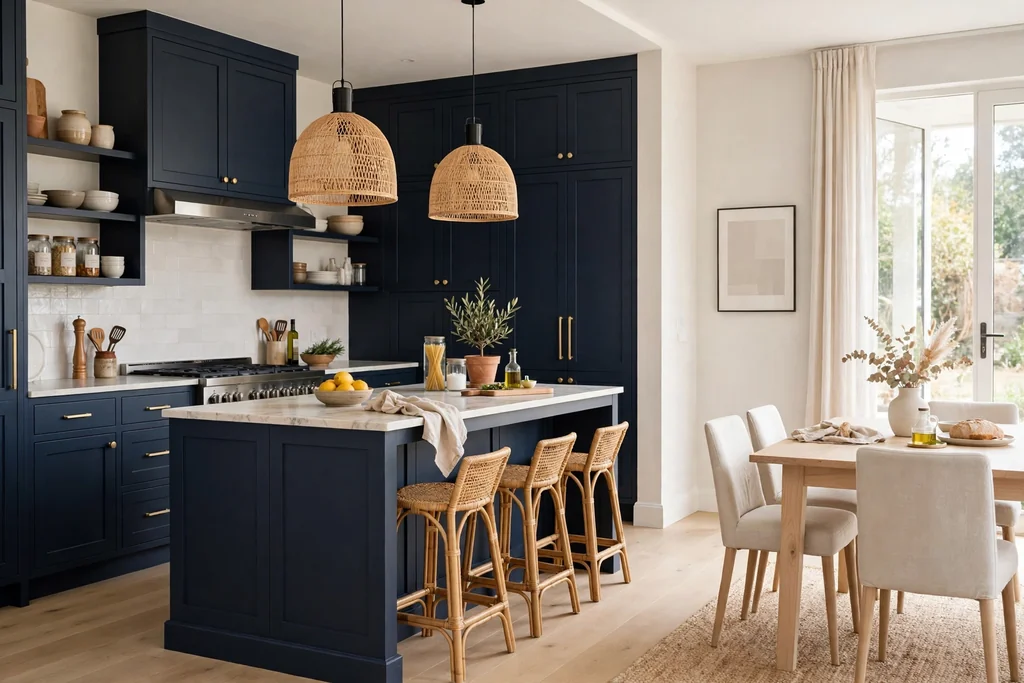
In an open-plan kitchen, navy cabinets give the cooking zone a clear identity without a wall to separate it. Use navy on the kitchen run and the island, and keep the dining and living areas pale, with one repeated navy accent, such as dining chairs or a rug border, to link the zones. A pale counter and a light floor keep the open room feeling generous, even with a dark kitchen run.
Keep the kitchen side tidy, since an open plan means the cabinets are always in view from the sofa. Closed storage, an appliance garage, and a clear island counter matter more here than in a closed kitchen, and the same hardware finish across the kitchen and the dining area keeps the open room calm.
30. Navy Cabinets With a Full-Height Stone Backsplash
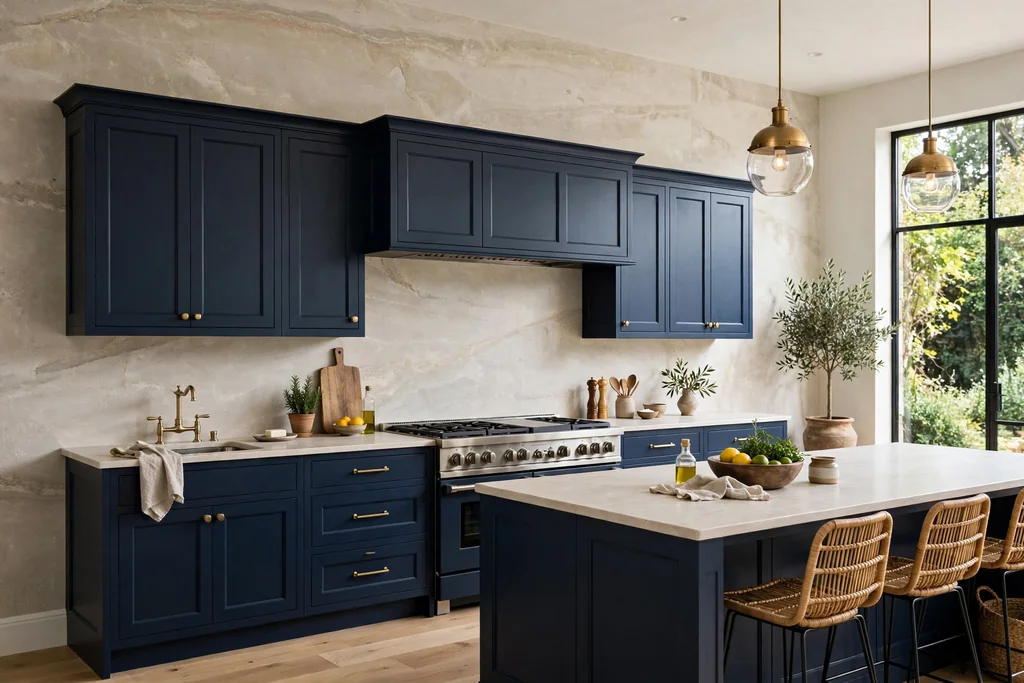
Carrying the counter stone up the wall as a full-height backsplash gives a navy kitchen a calm, continuous look with almost no grout lines to clean. A pale marble-look or quartz slab behind the range and the sink keeps prep areas readable, and the single slab makes the navy cabinets look more settled, since the wall and the counter agree. This suits flat-front and Shaker doors alike, as long as the stone stays quiet.
Measure the slab carefully around sockets, the tap, and the range hood, since a full-height slab is hard to adjust once cut. Wipe the slab after cooking, since grease film shows on pale stone, and keep the rest of the walls plain so the stone wall stays the feature.
31. Navy Cabinets With a Rental-Friendly Refresh
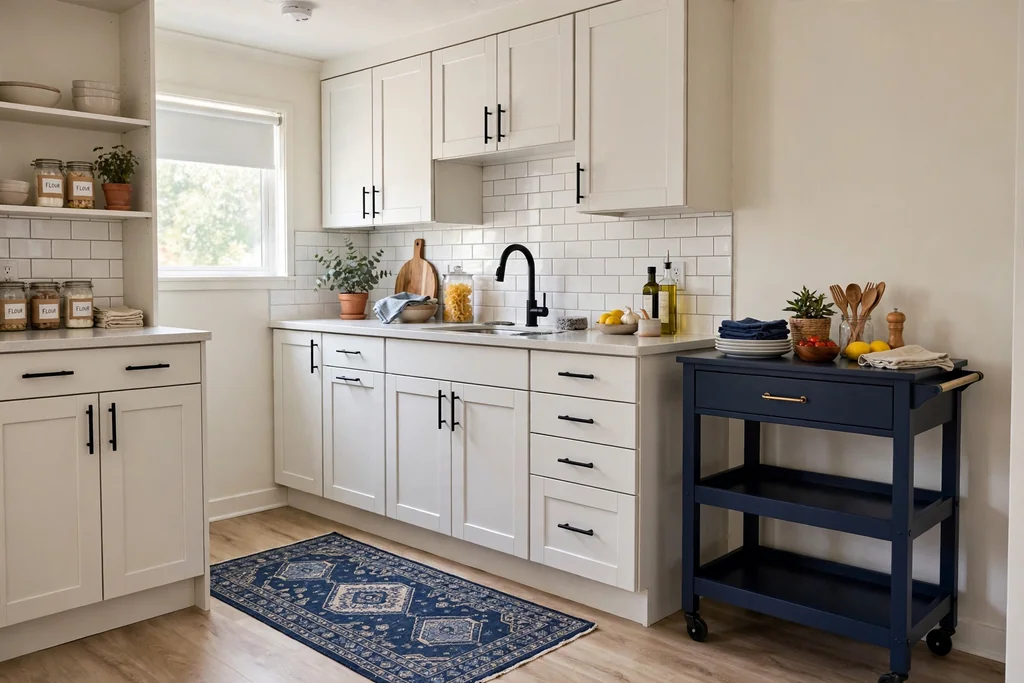
Renters can get the navy look without repainting a whole kitchen. Swap the hardware for brass or black pulls, add a navy freestanding cabinet or a navy kitchen cart, use a removable navy backsplash panel, and bring in navy through a rug, seat cushions, and a curtain. These movable pieces give the color without touching the landlord cabinets, and they move with you.
Check your lease before any fixing, and keep changes to pieces that pack into a few boxes. A navy cart beside the counter adds storage and color at once, and a navy panel behind the range, fixed with removable strips rated for the weight, gives the focal wall without paint. When you move, the hardware swap reverses in an afternoon if you keep the original handles safe.
Conclusion
Navy blue kitchen cabinets work best when the finish, hardware, and lighting are chosen for the room, not just for the color. Start with one clear decision: matte or gloss, brass or black hardware, and pale or wood counters, then carry that decision through the whole kitchen. Two-tone layouts, a navy island, and a pantry wall are good ways to test the color before committing every wall to it, and a large sample door in your own light is worth more than any photo. For a darker comparison, the finish and lighting notes in these black kitchen cabinet ideas and the window treatments in these kitchen window decor ideas pair well with the plans above.
Save this list on Pinterest before your next kitchen refresh, and try one change first: a sample door this week, hardware next week, and a full run when the sample still looks right in evening light.
FAQs
What color counters go best with navy blue kitchen cabinets?
Pale counters work best in most kitchens: white marble, marble-look quartz, pale grey quartz, or a light stone keep prep areas readable against navy. Warm butcher block suits a relaxed or farmhouse kitchen, while concrete-look counters suit a modern or industrial room. Avoid dark counters in a small or dim kitchen, since dark cabinets plus dark counters can close the room in. Test a counter sample beside a navy door in your own light, since both colors shift a lot between day and evening.
Does navy blue make a small kitchen look smaller?
Navy can close a small kitchen in if it covers every wall with dark counters and dim light, but it works well when used on one run or on lower cabinets only, with white uppers, a pale counter, a light floor, and bright under-cabinet lighting. Gloss doors and a glossy or mirrored backsplash bounce light around, which helps more than a pale paint color alone. Keep the hardware slim and the surfaces clear, so the small run reads as one calm wall rather than a crowded one.
What hardware color suits navy kitchen cabinets?
Brass warms navy and suits classic, farmhouse, and marble kitchens. Matte black keeps navy quiet and modern, and ties in with black taps and pendant lights. Polished nickel or chrome suits a cooler, more classic kitchen with pale grey counters. Pick one finish for the whole kitchen, match it to the tap where you can, and check the handles under evening light, since black hardware can disappear against navy doors when the room is dim.
Can I paint my existing cabinets navy blue?
Yes, if the doors are solid and in good shape. Clean and degrease them, sand lightly, prime for the door material, and paint in thin coats with a cabinet paint that resists chips and moisture. Remove the doors and hardware first, label each door, and paint one door as a test before doing the whole kitchen. Budget for new hardware as well, and keep a small pot of paint for touch-ups near the sink and the bin, where chips happen first.
How do I keep navy cabinets looking clean?
Wipe doors weekly with a damp cloth, more often near the prep area and the sink, where dust, flour, and water marks show first. Matte navy shows dust and flour, while gloss navy shows smudges and fingerprints, so pick the finish whose upkeep you will actually keep up with. Keep a microfiber cloth near the fridge and dishwasher for gloss doors, and wipe the sink surround dry after washing up, since water marks show on navy paint near the tap.
What backsplash goes with navy blue kitchen cabinets?
White subway tile is the safest choice, since the pale grid keeps the wall bright and lets the navy carry the color. Patterned blue and white tile suits a focal wall, while a full-height pale stone slab gives a calm, continuous look with few grout lines. Keep the pattern to one wall and plain tile elsewhere, so the backsplash reads as a feature rather than noise, and choose a grout that resists stains behind the range.