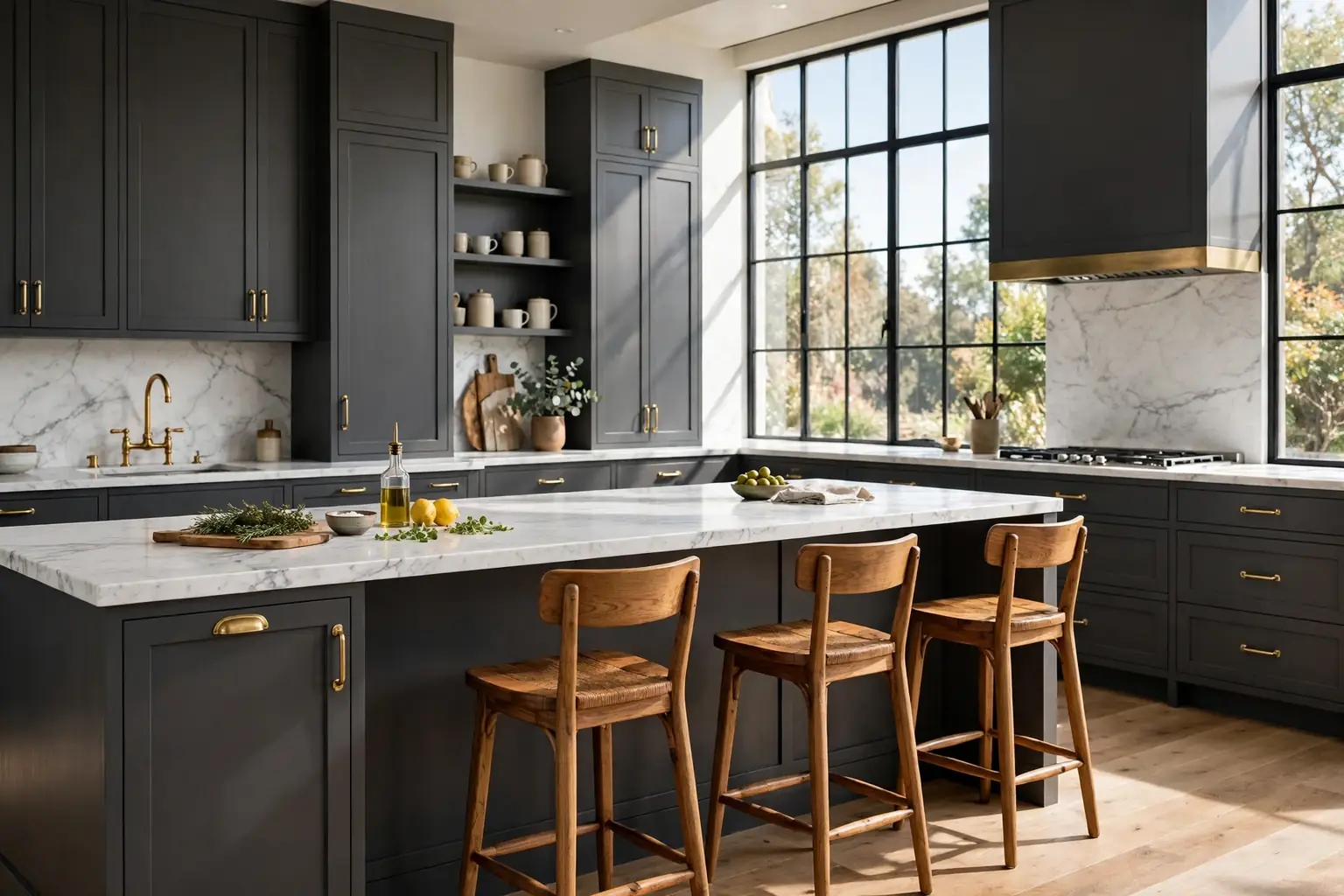
Dark grey sits between black and pale grey, so it gives a kitchen depth without the hard edge of black. It works with wood, marble, brass, white, and green plants, and it hides everyday marks better than a very light cabinet color. The risk is a room that feels flat or dim, and that risk is easy to avoid. Use dark grey in one clear place, keep counters and walls lighter, and add warm light where you work. These 34 dark grey kitchen ideas cover cabinets, islands, backsplashes, lighting, layouts, and small rooms, so you can pick one starting point and build from there.
Key Takeaways
- Put dark grey where it has a job: base cabinets, an island, or one wall, rather than on every surface at once.
- Pair dark grey with a lighter counter, a warm wood, or a pale wall so the room keeps contrast and daylight.
- Use warm under-cabinet light and pendant light over work zones, because dark cabinets absorb more light than white ones.
- Repeat one metal finish, such as brass, black, or copper, so hardware, taps, and lights read as a set.
- Test a paint sample on a door front in morning and evening light before you commit to a full run of cabinets.
- In a small kitchen, keep dark grey low, leave uppers light or open, and use glossy tile or glass to bounce light around.
1. Matte Dark Grey Shaker Cabinets for a Classic Base
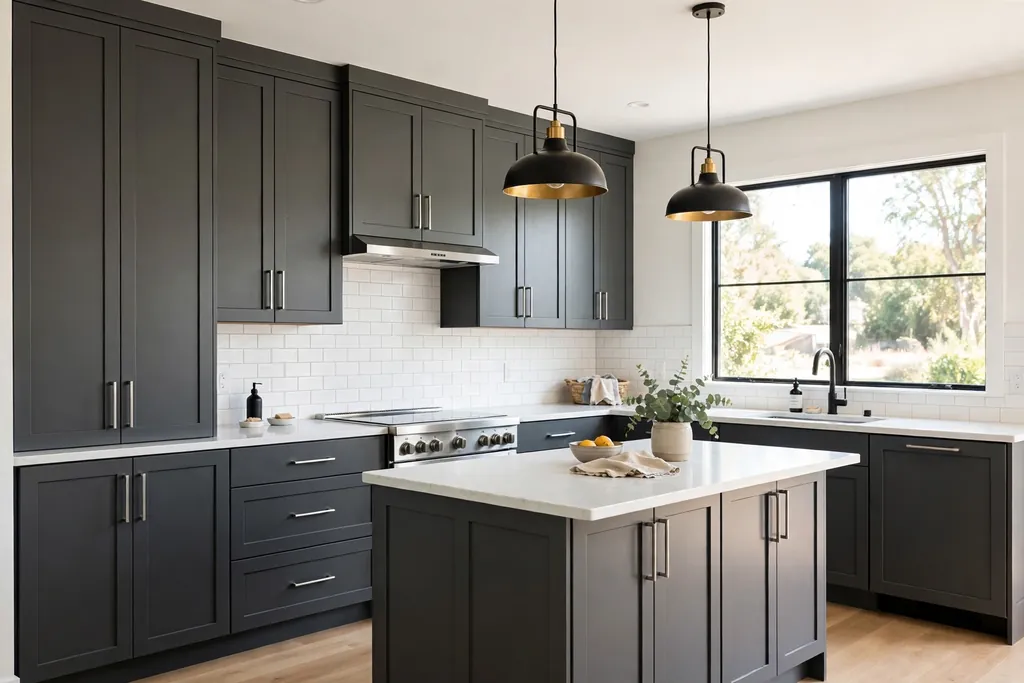
Matte shaker cabinets are a safe starting point for dark grey. The simple frame keeps the color calm, and the matte finish softens reflections and shows fewer fingerprints than gloss. Choose a mid to dark grey with a warm or neutral base, not a blue grey, if your floors and counters are warm. Keep the counters light and the walls pale so the cabinets read as a solid base rather than a dark block.
Paint or order the full run in the same shade, including end panels and the toe kick, so the line looks continuous. Add simple round knobs or bar pulls in one finish. If you are unsure about the shade, paint one door and live with it for a week before you order the rest.
2. Two-Tone Cabinets With Dark Grey Below and White Above
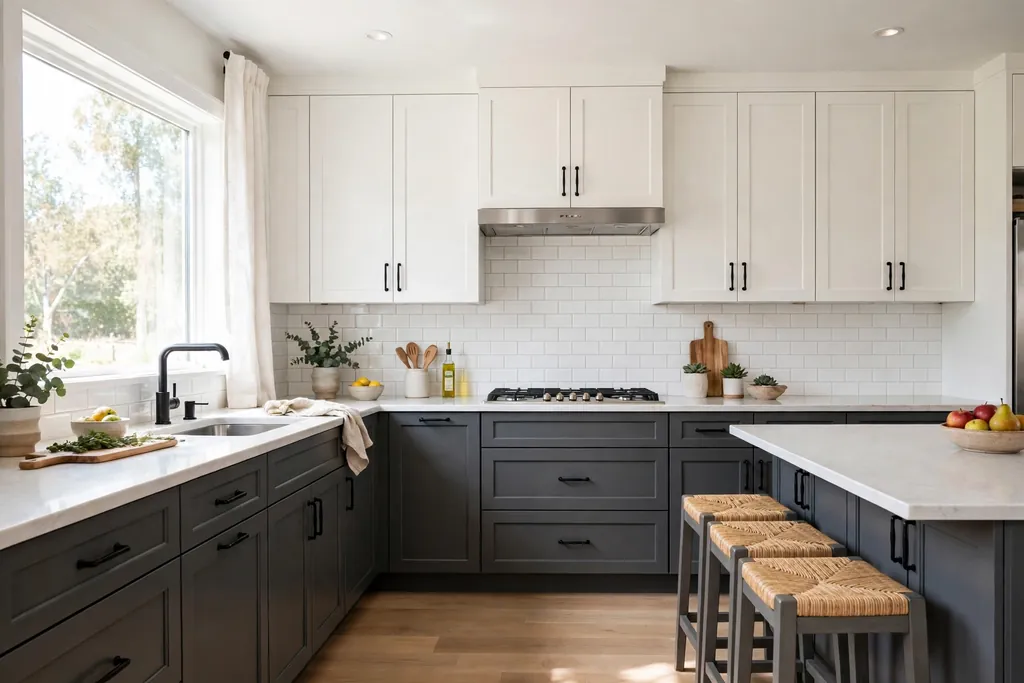
Two-tone cabinets put dark grey where it is most useful and white where light matters most. Dark grey base cabinets ground the room and hide scuffs near the floor, while white uppers keep the wall line bright. This split also suits a kitchen with low ceilings, because the eye reads the upper half as open.
Keep the counter between the two tones in a light stone or pale wood so the change does not look abrupt. Use the same hardware finish on both rows to tie them together. If your kitchen has a tall pantry unit, paint it dark grey to match the base run and let the white uppers stop at the wall cabinets.
3. A Dark Grey Island That Anchors a Light Kitchen
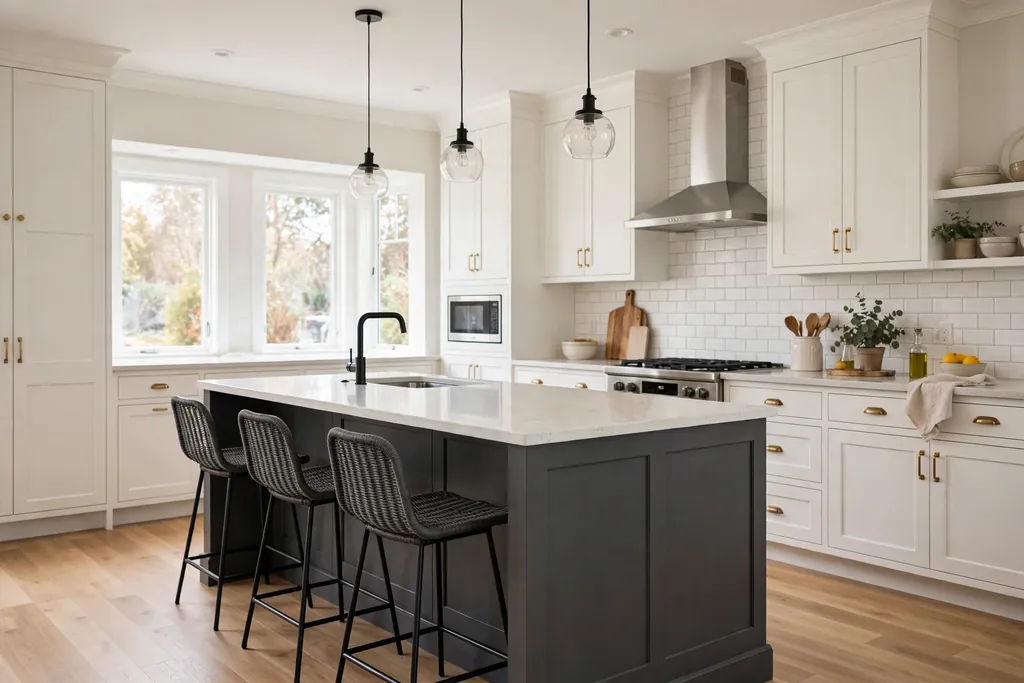
If a full dark grey kitchen feels like too much, paint only the island dark grey. The island becomes the center of the room, while pale perimeter cabinets keep the walls light. This works well in an open plan space, because the island reads as a piece of furniture rather than part of the wall run.
Choose a counter for the island that is lighter than the base, such as white quartz or pale wood, so the top edge is clear. Add two or three stools that repeat a material from elsewhere in the room. Keep the island ends clear of clutter so the dark color stays a clean block, not a backdrop for storage.
4. Dark Grey Cabinets With Warm Oak Open Shelves
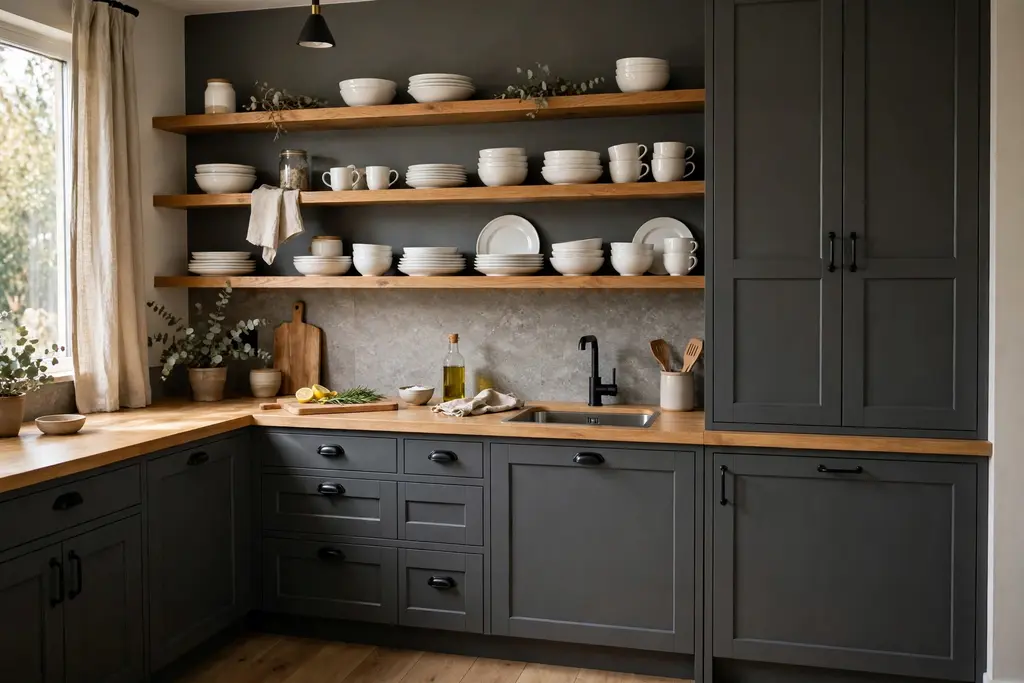
Warm oak shelves soften dark grey cabinets in a direct way. The wood grain adds a natural pattern, and open shelves give you a place for everyday dishes without another row of closed doors. Fit one or two shelves beside a window or above a short counter run, rather than across the whole wall, so the room does not lose storage.
Use oak for the shelf boards and for a chopping board or a tray on the counter to repeat the material. Keep shelf items to one color family, such as white, cream, and pale wood, so the display stays calm against the grey. Leave clear gaps between groups, a rule that also helps in this guide to how to style open shelves.
5. Dark Grey Cabinets With White Marble Counters
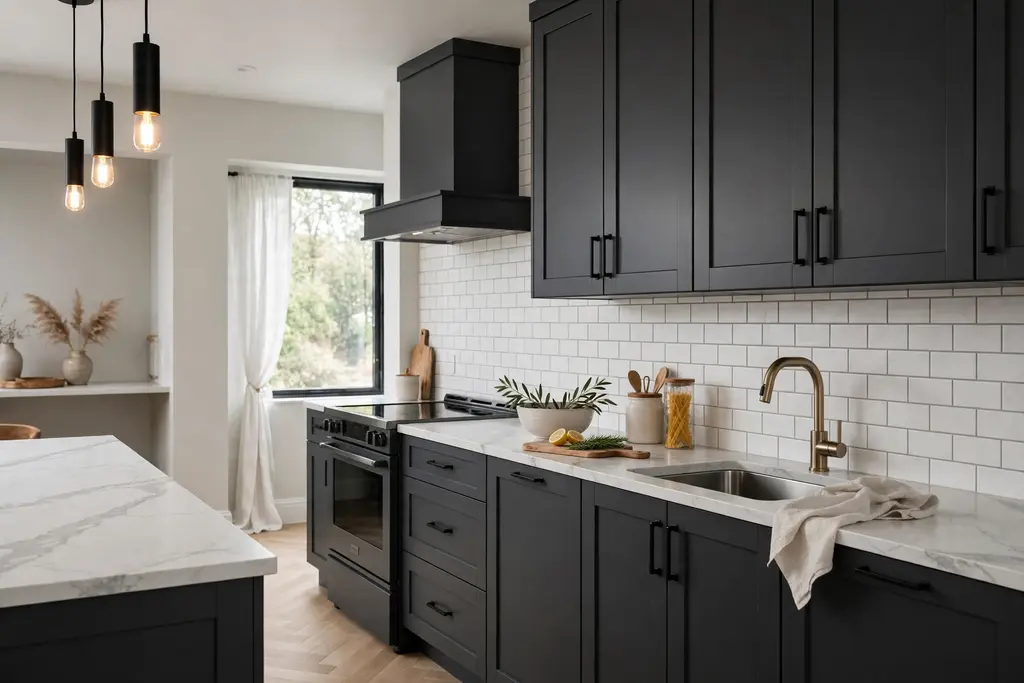
White marble, or a marble look quartz, is the classic partner for dark grey. The pale top gives a sharp edge to the dark base, and the veining adds movement that plain grey lacks. This pairing suits both classic shaker cabinets and flat modern fronts, because the counter does the decorative work.
Choose a marble with soft grey veining so the counter links to the cabinets instead of fighting them. Keep the backsplash simple, such as plain white tile, so the counter pattern stays the focus. Seal natural marble as the maker directs, and wipe spills promptly, or choose quartz if you want the look with less upkeep.
6. Brass Handles and a Brass Faucet on Dark Grey
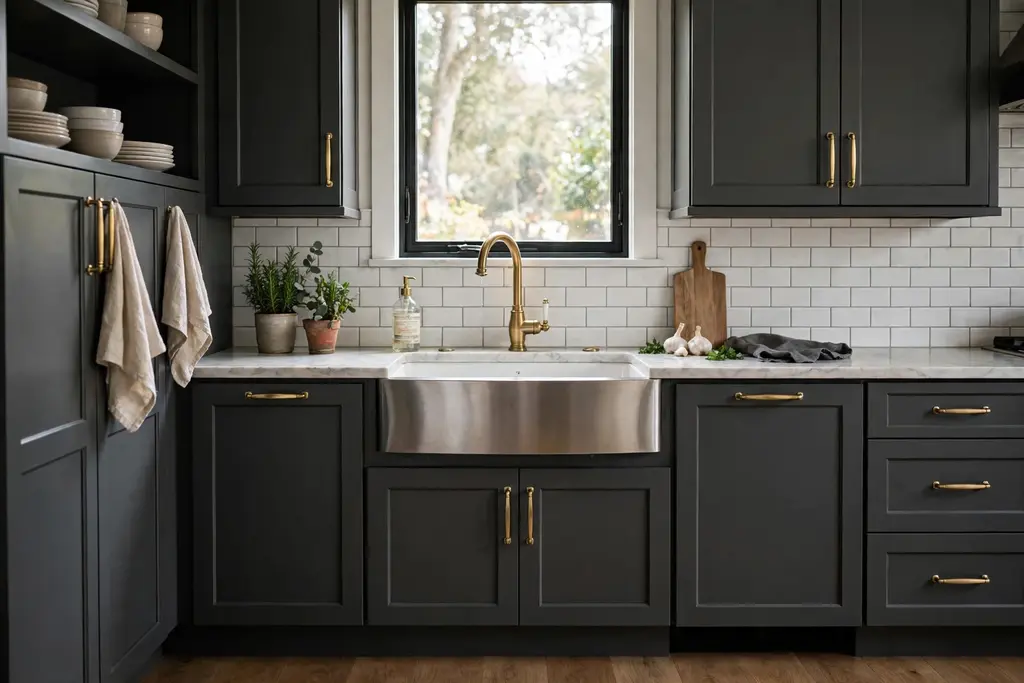
Brass hardware warms dark grey at once. Bar pulls on drawers, knobs on doors, and a brass faucet at the sink create small points of warm metal that stop the grey from feeling cold. Use a brushed or satin brass rather than a high shine finish, which is easier to live with and shows fewer water marks.
Repeat brass in just two or three places, such as handles, faucet, and one pendant light, and keep other metals out of the main view. If your appliances are stainless steel, that is fine, because steel reads as a working material rather than a decorative metal. Clean brass with a soft cloth and avoid harsh pads that strip the finish.
7. Matte Black Hardware for a Quiet Monochrome Look
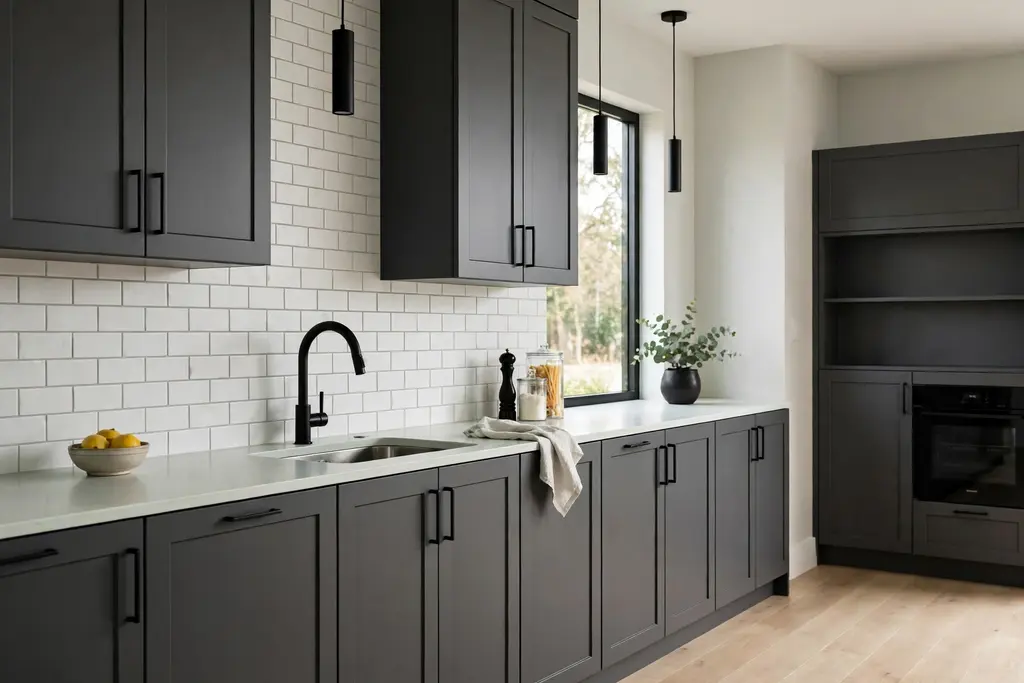
Matte black handles on dark grey cabinets give a calm, single color scheme with texture doing the work instead of contrast. The handles are visible because of their shape and shadow, not because of a bright metal. This suits a modern kitchen where you want the room to feel settled and uncluttered.
Use black for the faucet, cabinet pulls, and light fittings so the scheme stays consistent. Add a pale counter and a white or light grey backsplash, because a fully dark scheme needs a light surface to rest the eye. Wipe matte black handles with a damp cloth, since they can show dust and fingerprints in strong side light.
8. Glass-Front Upper Cabinets to Break Up Dark Grey
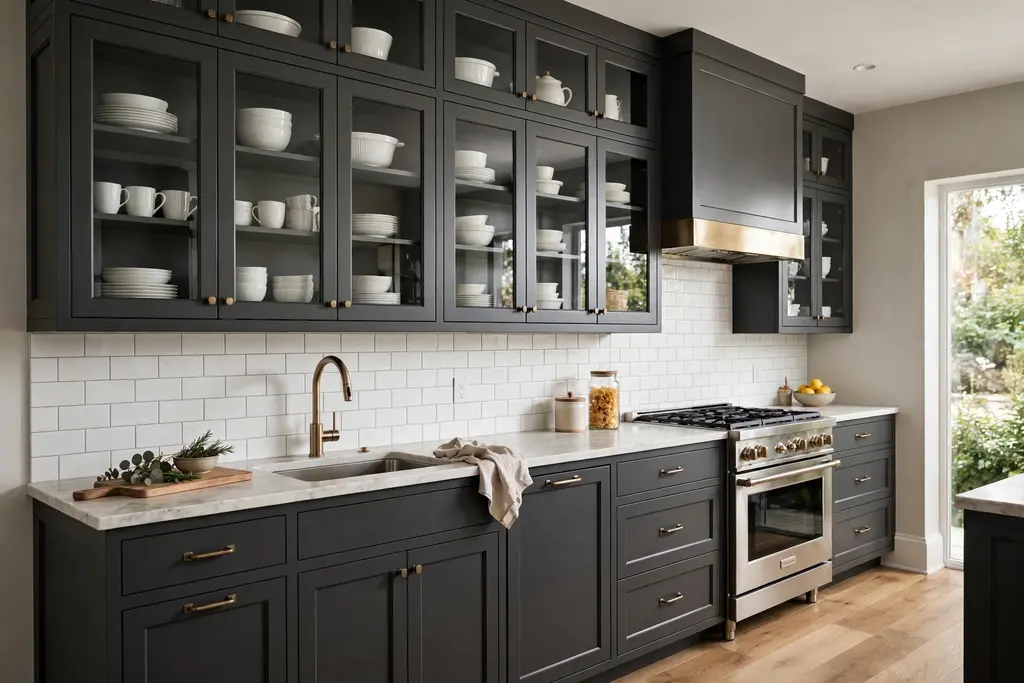
Glass-front upper cabinets lighten a dark grey wall run without removing storage. The glass breaks the solid block of color, and the items inside add pale shapes that lift the whole wall. Use clear glass if your dishes are neat and mostly white, or fluted glass if you want the shapes softened and less exact.
Light the inside of one or two glass cabinets if you want the display to work in the evening. Keep the rest of the uppers solid so the glass section reads as a feature, not as a full wall of display. Store everyday glasses and plates here, and keep rarely used pieces in closed cabinets where dust is less of a job.
9. Flat-Panel Handleless Cabinets for a Modern Finish
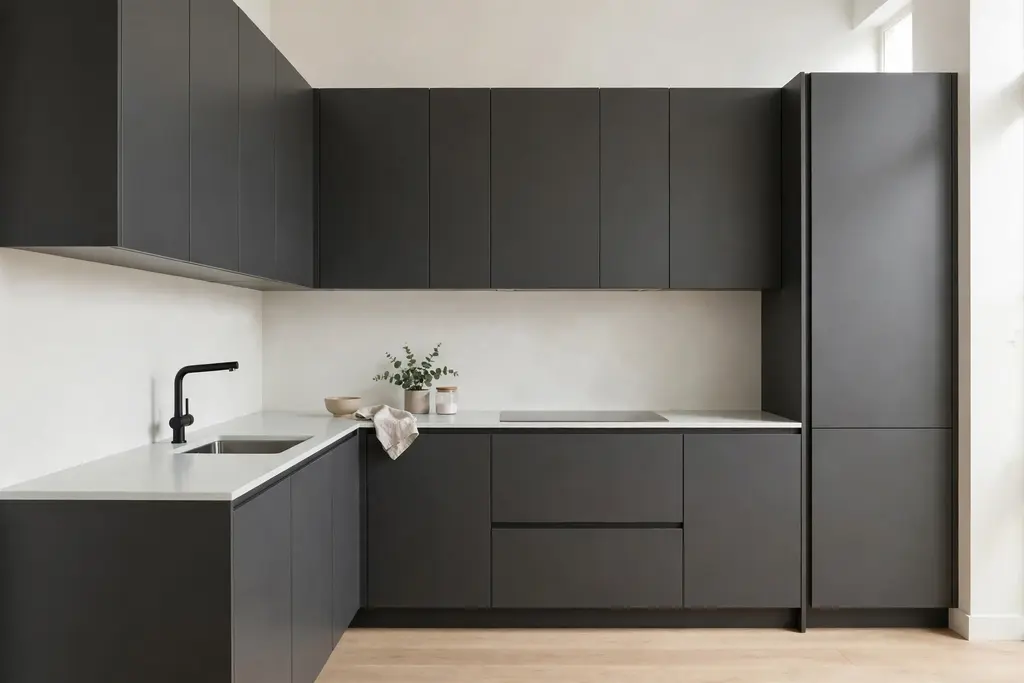
Flat-panel handleless cabinets give dark grey a clean modern line. With no frames or visible handles, the color becomes one smooth surface, which suits a kitchen with simple counters and a plain backsplash. Push-to-open doors or a routed finger pull at the top of each door keep the fronts free of hardware.
This style shows dust and fingerprints more than a framed door, so a matte finish is a practical choice. Keep the layout simple, with long drawer runs and few small doors, so the flat fronts read as panels rather than a patchwork. Pair the cabinets with a pale worktop and one warm material, such as wood stools, to stop the room from feeling stark.
10. White Subway Tile Backsplash Against Dark Grey
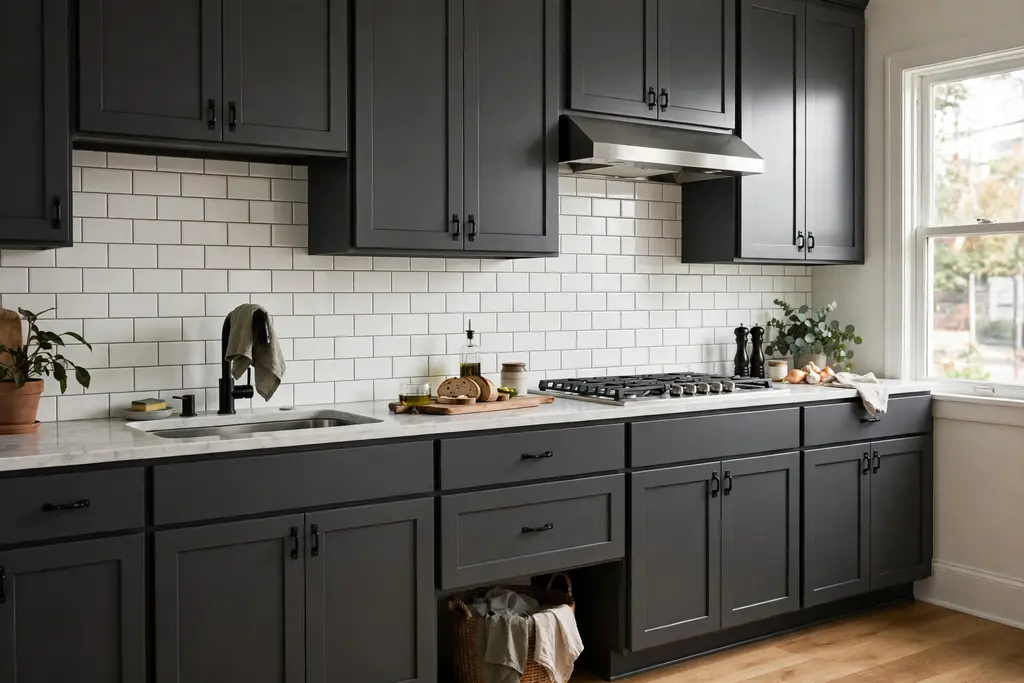
A white subway tile backsplash is a straightforward partner for dark grey cabinets. The small white rectangles add a clear light band between the counter and the upper cabinets, and the grout lines give a regular pattern that suits both classic and modern kitchens. Lay the tiles in a simple brick pattern for a calm result.
Use a light grey grout if you want the tile lines to stay soft, or white grout for the brightest band. Run the tile to the underside of the upper cabinets and around the window, if there is one, so the band is continuous. Keep the counter pale as well, so the backsplash and worktop read as one light zone above the dark base.
11. Herringbone Grey Tile for a Patterned Backsplash
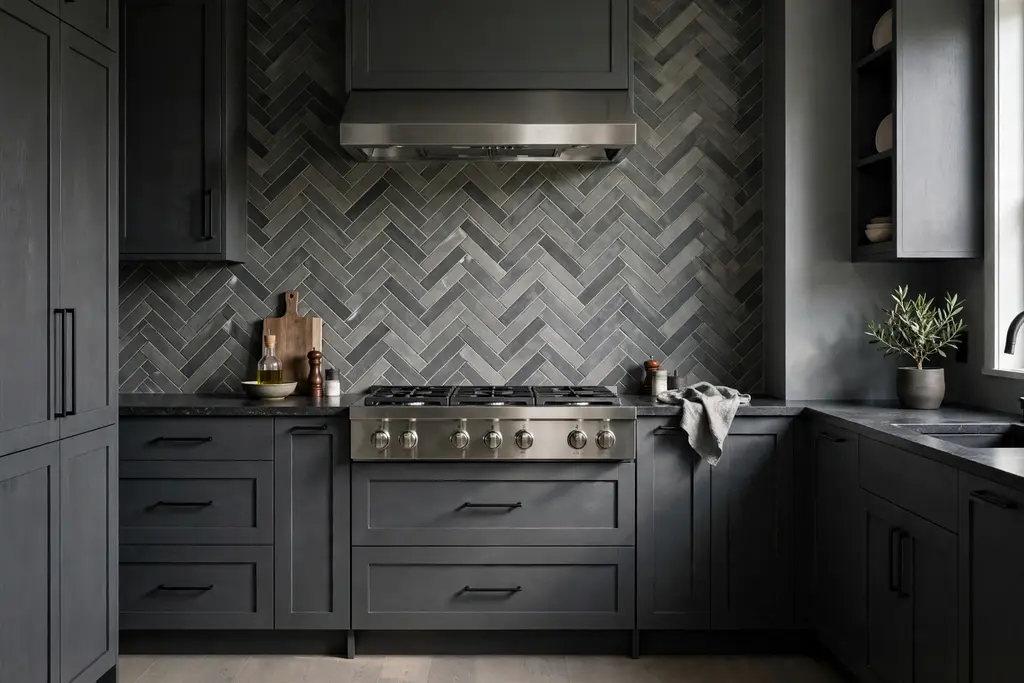
Herringbone tile gives a dark grey kitchen pattern without adding a new color. Lay small grey tiles in a herringbone pattern behind the stove or across the full backsplash, using two close shades of grey for a quiet depth. The angled pattern catches light in a way that flat tile does not, which helps a dark room feel less flat.
Keep the rest of the kitchen plain when you use a patterned backsplash, with simple cabinets and a solid counter, so the pattern has room to stand out. Use a grout color close to the tile shade to keep the pattern soft, or a slightly darker grout if you want the angles to read more clearly. Seal the grout in the stove zone, where splashes are most likely.
12. Open Shelving in Place of Upper Cabinets
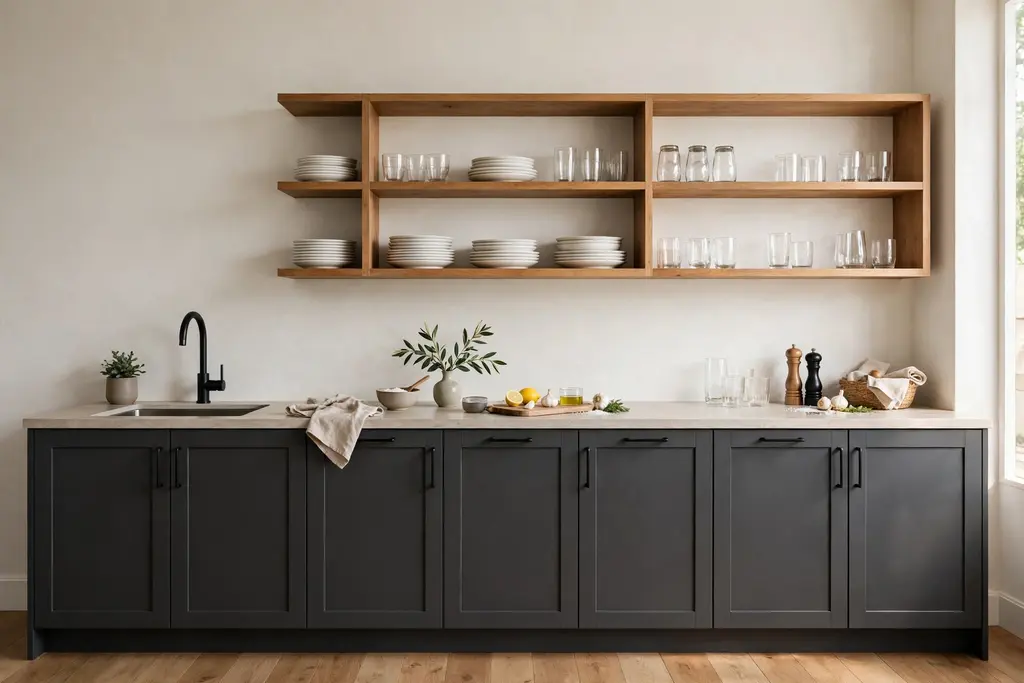
Removing upper cabinets and fitting open shelves is a direct way to lighten dark grey base cabinets. The wall above the counter stays open, daylight reaches further into the room, and the shelves hold the items you use most. This works best on one wall, with closed storage kept on the other walls for items you do not want on show.
Fit two shelves in wood or painted to match the wall, and keep the items on them simple: white plates, plain glasses, and a few bowls. Leave a clear gap between the shelf and the counter so you can work below it. If you cook often, keep the shelves away from the stove, where steam and grease settle fastest.
13. A Full Dark Grey Pantry Wall
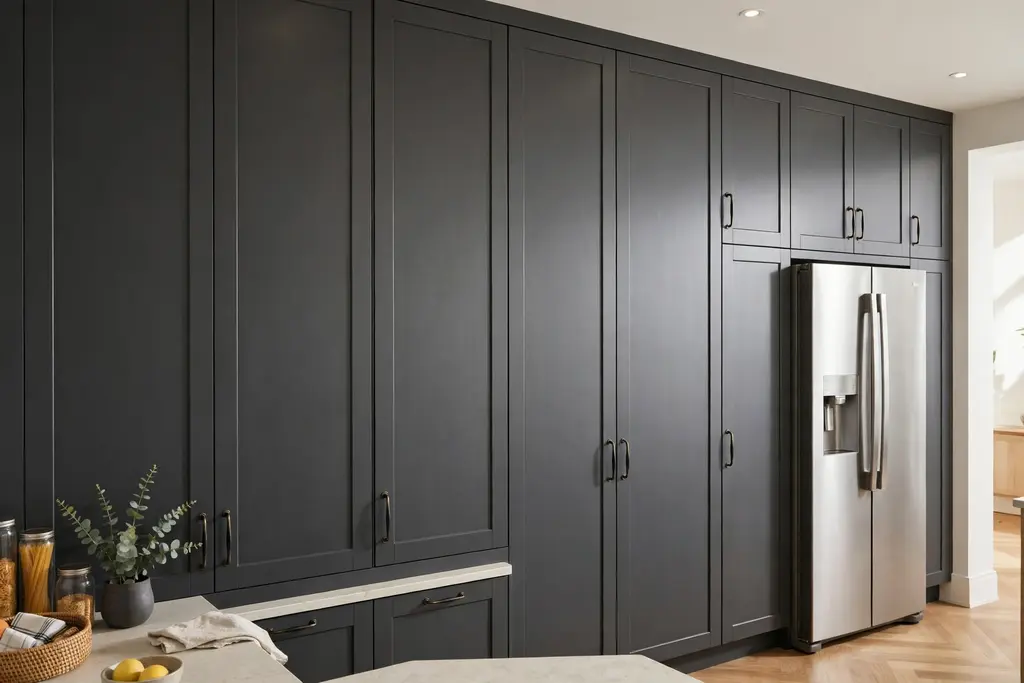
A pantry wall in dark grey turns storage into a feature. Tall units in one shade, from floor to ceiling, give a kitchen a strong vertical line and hide a large amount of food, small appliances, and cleaning items behind closed doors. This suits a kitchen with a blank end wall or a wall beside the fridge.
Use the same door style as the rest of the kitchen so the pantry wall does not look like a separate piece of furniture. Fit pull-out shelves or tall larder units inside, so deep storage stays easy to reach. Keep the floor in front of the pantry clear, and add a light counter or a pale wall beside it so the tall dark block does not close in the room.
14. A White Farmhouse Sink Set Into Dark Grey Cabinets
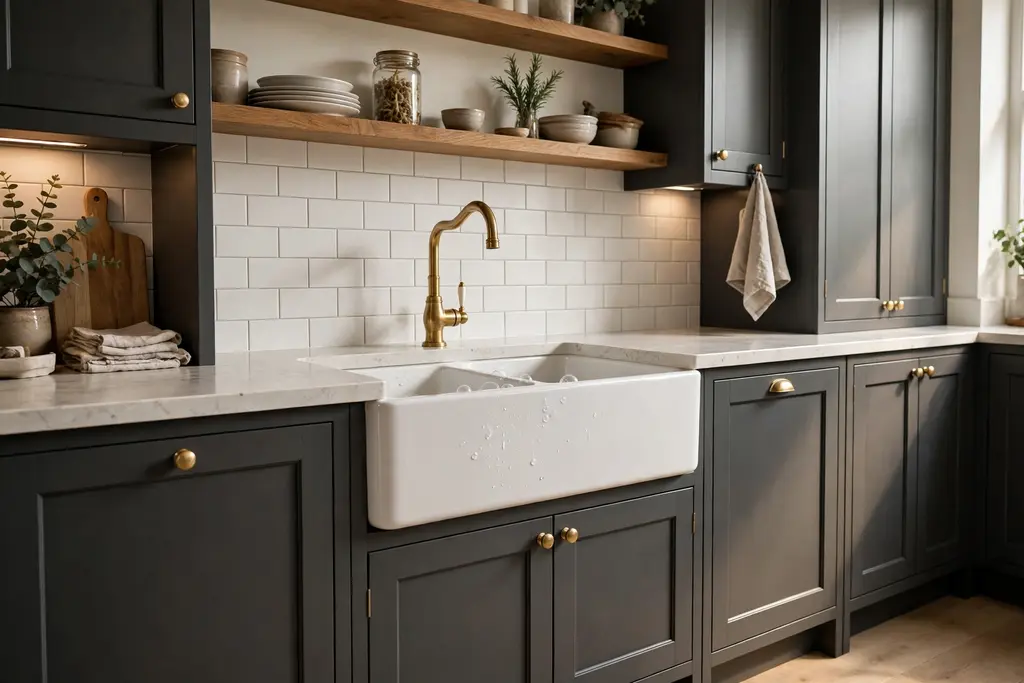
A white farmhouse sink gives a dark grey cabinet run a clear focal point. The wide white front breaks the dark line at the sink, which is the spot you stand at most, and it pairs well with a traditional shaker kitchen. Choose a sink deep enough for large pans, and check the cabinet below can support its weight before you order.
Fit a simple bridge or single lever faucet in brass, black, or chrome to match your hardware. Keep the counter on either side of the sink clear, with a small tray for soap and a brush, so the white front stays visible. A farmhouse sink also suits a kitchen with a window above it, where the white ceramic catches daylight.
15. Warm Wood Flooring Under Dark Grey Cabinets
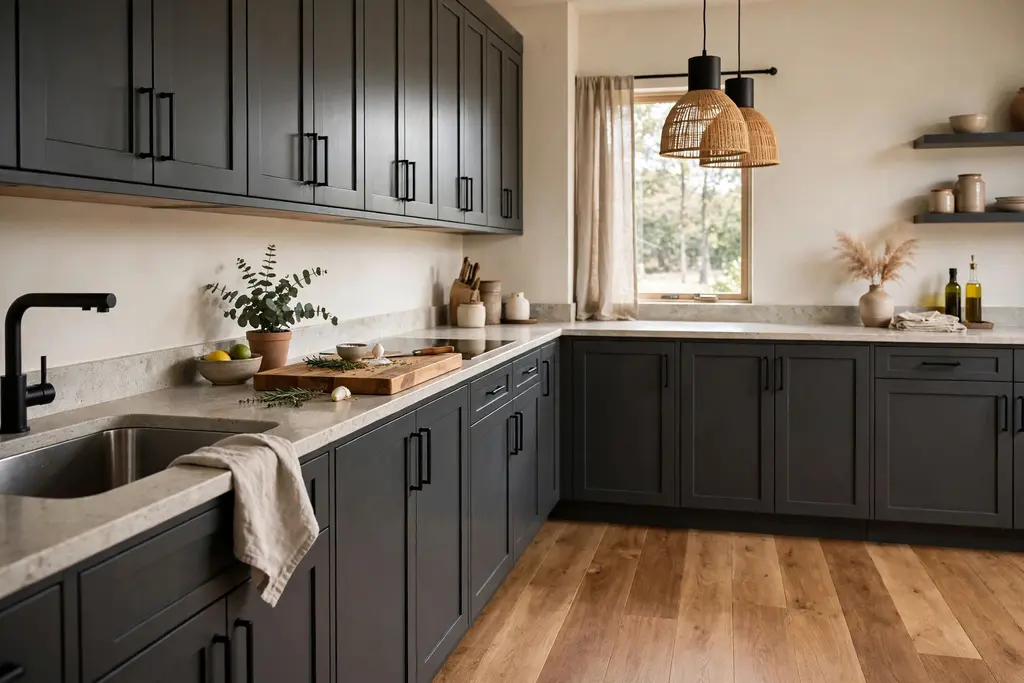
Warm wood flooring is one of the simplest ways to keep a dark grey kitchen from feeling cold. Oak, warm walnut, or a wood look tile adds a natural color underfoot and gives the dark cabinets a warm base to sit on. The contrast is gentle, because wood and grey are both muted, so the room feels calm rather than sharply divided.
Choose a mid tone wood rather than a very dark one, so the floor and the cabinets do not merge into one dark mass. Use the same wood for a stool seat, a chopping board, or a shelf to repeat the tone at counter height. In a busy kitchen, pick a sealed wood or a wood look tile that handles water near the sink.
16. A Dark Grey Painted Wall With Light Cabinets
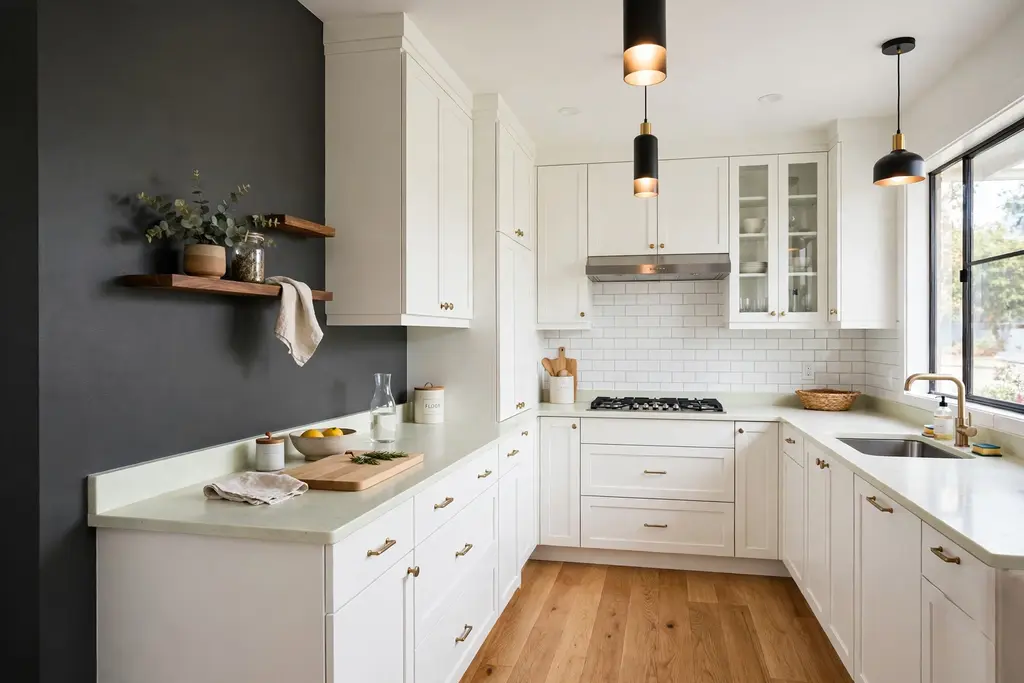
Dark grey does not have to live on the cabinets. Paint one wall dark grey and keep the cabinets white or pale grey, and you get the depth of the color with far less commitment. This suits a kitchen with a dining wall or a blank wall that needs a focal point, and it is easier to repaint than a full set of cabinets.
Keep the dark wall free of upper cabinets so the color reads as a flat panel. Hang one framed print or a simple shelf on it, and keep the rest bare. Use pale counters and a light floor so the dark wall does not dominate. This is also a good test: if you like the wall after a few months, you can extend the shade to the island or the base cabinets.
17. Warm Under-Cabinet Lighting on Dark Grey
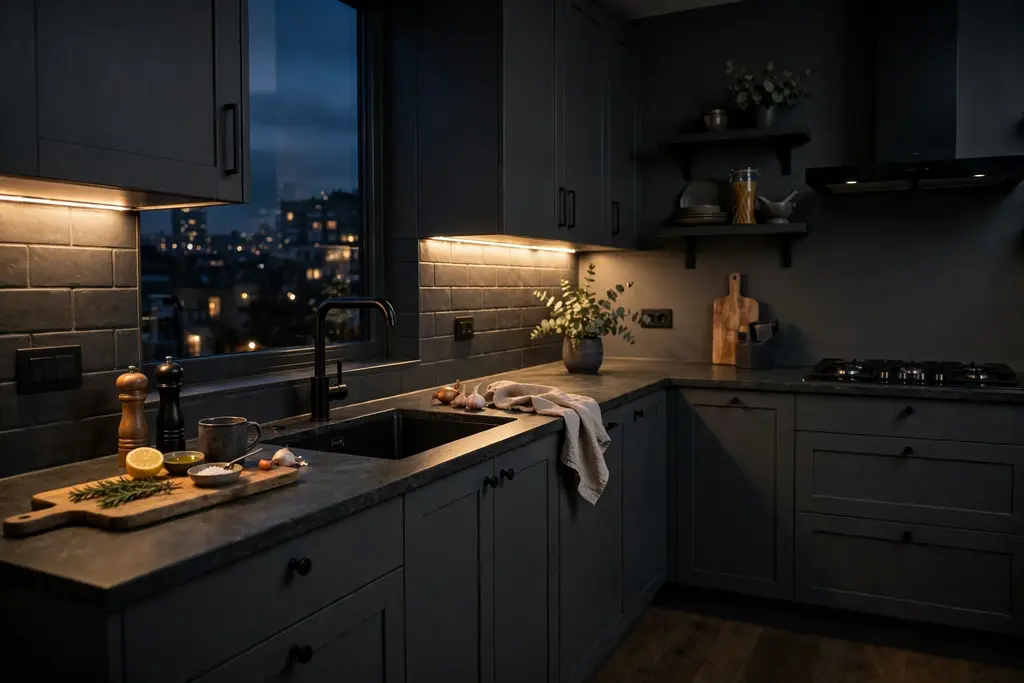
Warm under-cabinet lighting is essential with dark grey, because dark fronts absorb light that white cabinets would reflect. Fit LED strips under the upper cabinets so the counter is lit for prep, and the light washes down over the dark doors below. Choose a warm white, around 2700 to 3000 kelvin, so the grey reads warm rather than cold.
Put the strips on a separate switch or dimmer from the ceiling lights, so you can light the work zone in the evening without lighting the whole room. Hide the strip behind a small lip at the front of the cabinet so you see the light, not the fitting. Check that the strip does not shine directly into your eyes when you stand at the counter.
18. Pendant Lights Over a Dark Grey Island
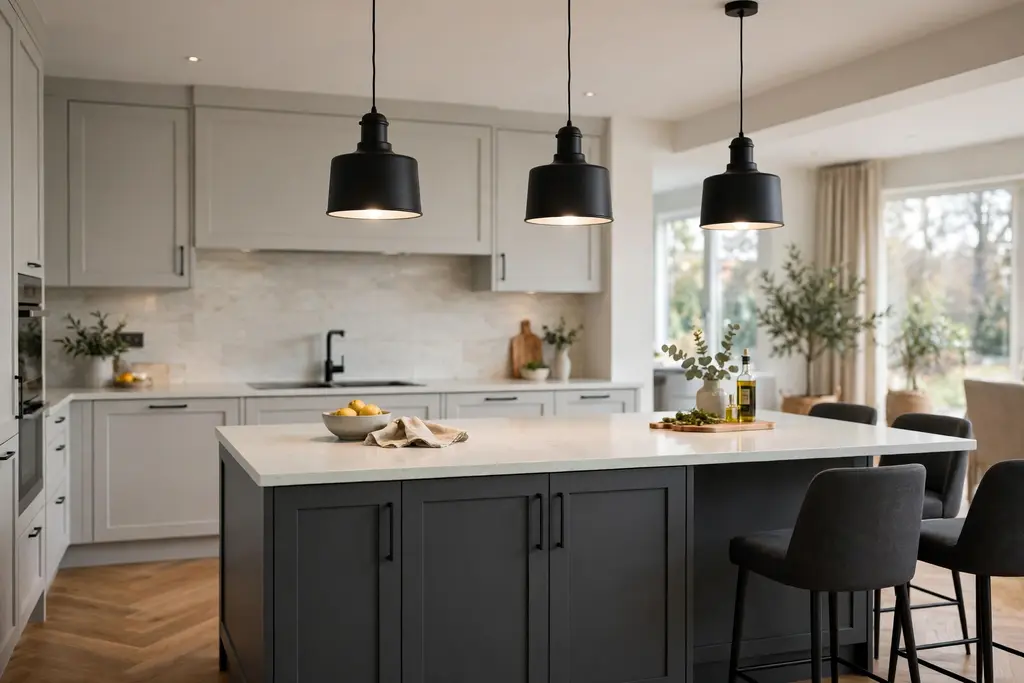
Pendant lights over a dark grey island give the island a clear job in the evening. Hang two or three pendants in a line, spaced evenly, with the bottom of each shade above head height when you stand at the island. Black metal shades suit a monochrome scheme, while brass or glass shades add warm light and a lighter shape.
Use warm bulbs and a dimmer, so the island can be a work surface by day and a gathering spot at night. Keep the pendants simple in shape, because the island itself is already a strong block of color. If your ceiling is low, choose slim pendants or a single long bar light that sits closer to the ceiling.
19. Wood and Leather Stools at a Dark Grey Island
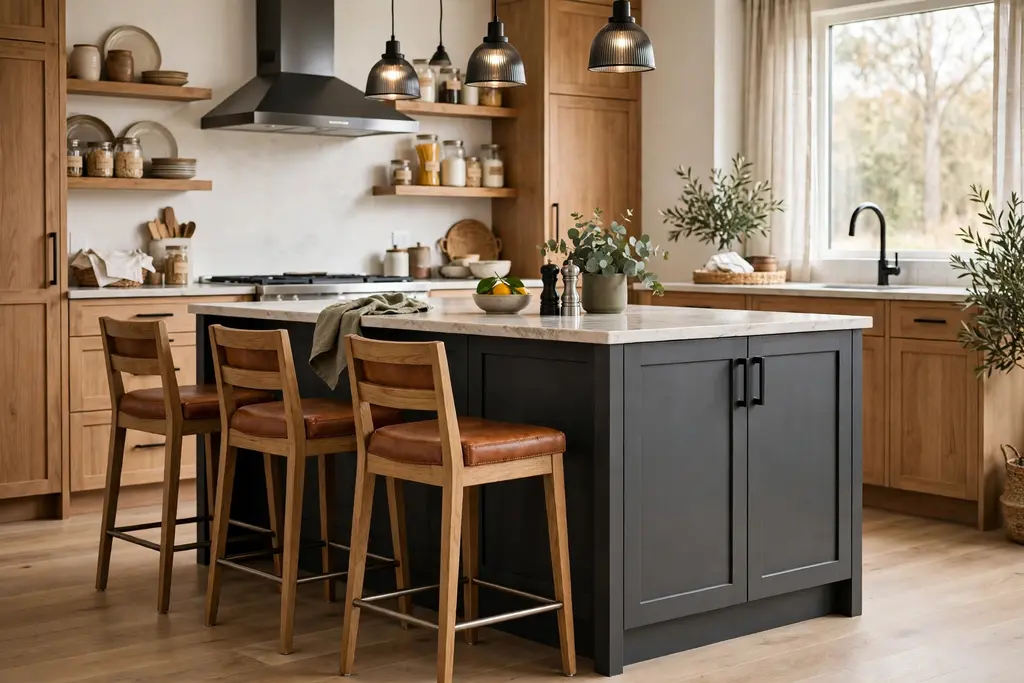
Wood and leather stools soften a dark grey island at seating height. A wood seat adds a warm material where hands and feet land, and a leather or fabric pad adds comfort for longer sits. Choose stools with a footrest, because island seating without one gets tiring fast, and check the seat height against your counter before you buy.
Use three stools for a standard island, spaced so each person has elbow room, and keep the stool backs low or backless if the island faces a living area, so the view stays open. Repeat the wood tone on a shelf or a tray nearby. Wipe leather seats as the maker directs, and keep them away from direct stove heat.
20. A Waterfall Quartz Edge on a Dark Grey Island
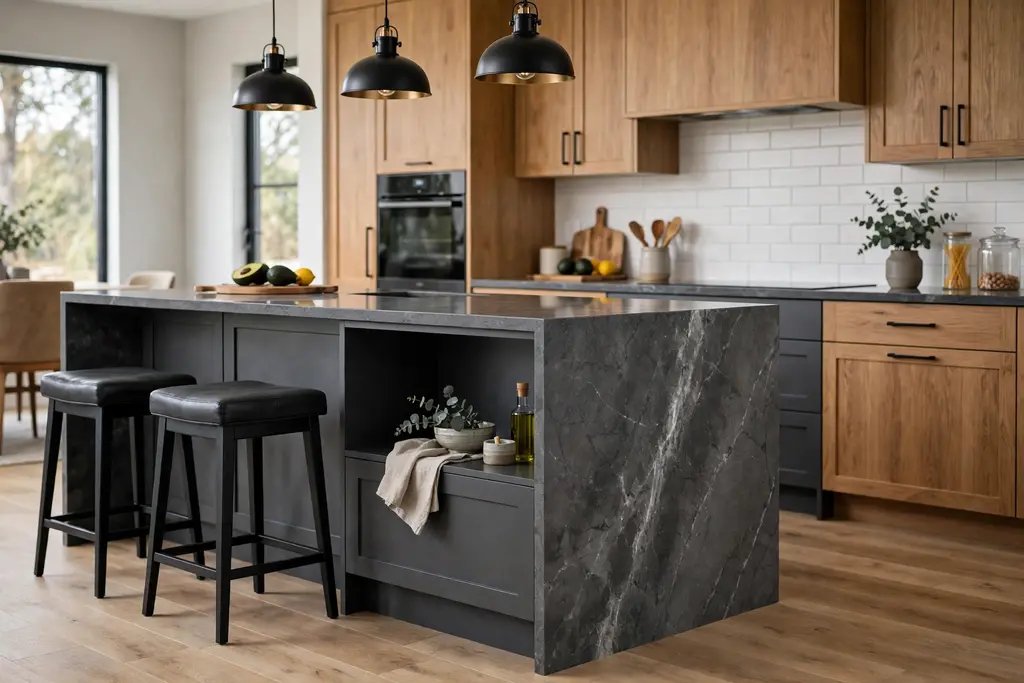
A waterfall edge runs the counter material down the side of the island to the floor, which gives a dark grey island a clean, finished end. White or pale grey quartz works well here, because the light side panel frames the dark front and makes the island read as a designed block. The waterfall edge also protects the island end from kicks and scuffs.
Use this detail on one end of the island, usually the end facing the living area, and keep the other end plain if the budget is tight. Match the quartz veining across the top and the side as far as possible, so the join looks planned. Keep the floor around the waterfall edge clear, since the panel draws the eye and clutter beside it shows up fast.
21. Stainless Steel Appliances Framed by Dark Grey
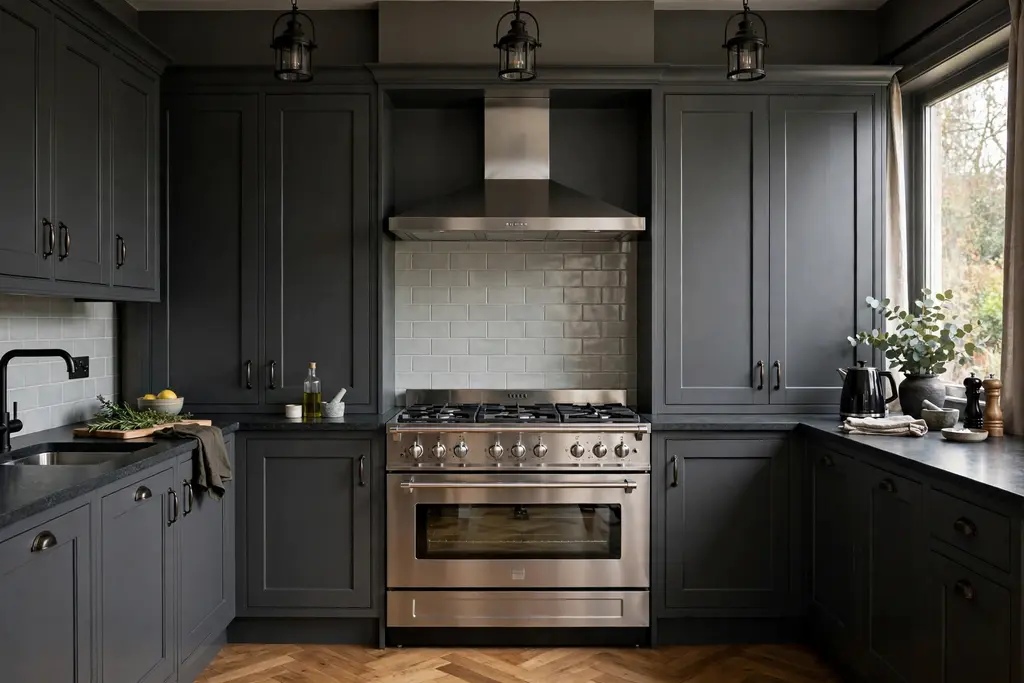
Stainless steel appliances sit well against dark grey because the steel is a working finish, not a bright decoration. A steel oven, fridge, or range cooker gives the dark run a practical center, and the brushed surface reflects enough light to break up the grey. This pairing suits a kitchen where appliances are part of the daily work, not hidden away.
Keep the steel to the large appliances and choose one hardware finish for the cabinets, so the metals do not compete. If you have a steel range, fit a simple steel or dark hood above it and keep the backsplash plain behind the stove. Wipe steel with the grain using a soft cloth, and avoid harsh pads that leave visible scratches.
22. Green Plants and Herbs Against Dark Grey
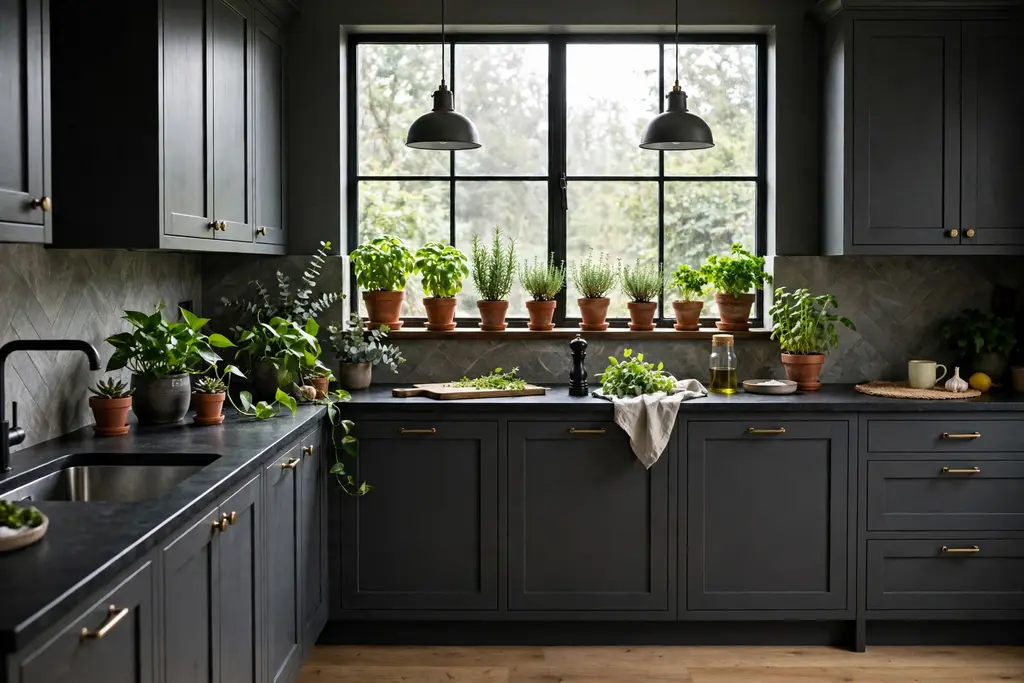
Green plants are the easiest living accent for a dark grey kitchen. The green reads clearly against grey, and the leaf shapes soften the straight lines of cabinets and counters. Place a large pot on the floor beside a tall unit, a trailing plant on top of a wall cabinet, and small herb pots on the windowsill or a shelf near the stove.
Choose plants that suit your light: herbs and leafy plants near a bright window, and tougher plants such as pothos in a darker corner. Use plain pots in white, terracotta, or black so the pots do not add another color scheme. Water over the sink and use saucers, because dark cabinets show water marks if pots leak onto the counter.
23. Daylight From a Large Window Over the Sink
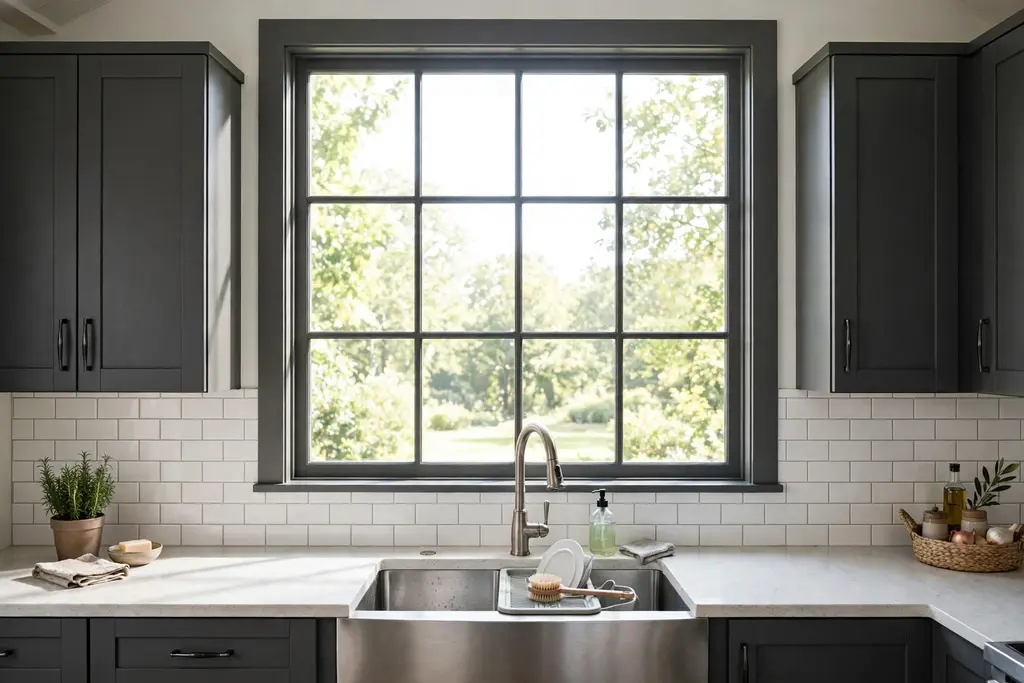
A large window over the sink is the best natural partner for dark grey cabinets. Daylight falls straight onto the work zone, the dark cabinets sit to either side rather than in front of the light, and the view gives the room a pale focal point. If you are planning a layout, put the sink on the window wall before you decide the cabinet color.
Keep the window treatment light: a simple roller blind, a sheer panel, or no treatment at all if privacy allows. Keep the sill clear except for one plant or a soap tray, so the light is not blocked. If the window is small, paint the wall around it white and use a glossy backsplash to help the available light travel further into the room.
24. A Patterned Runner Rug in Front of Dark Grey Cabinets
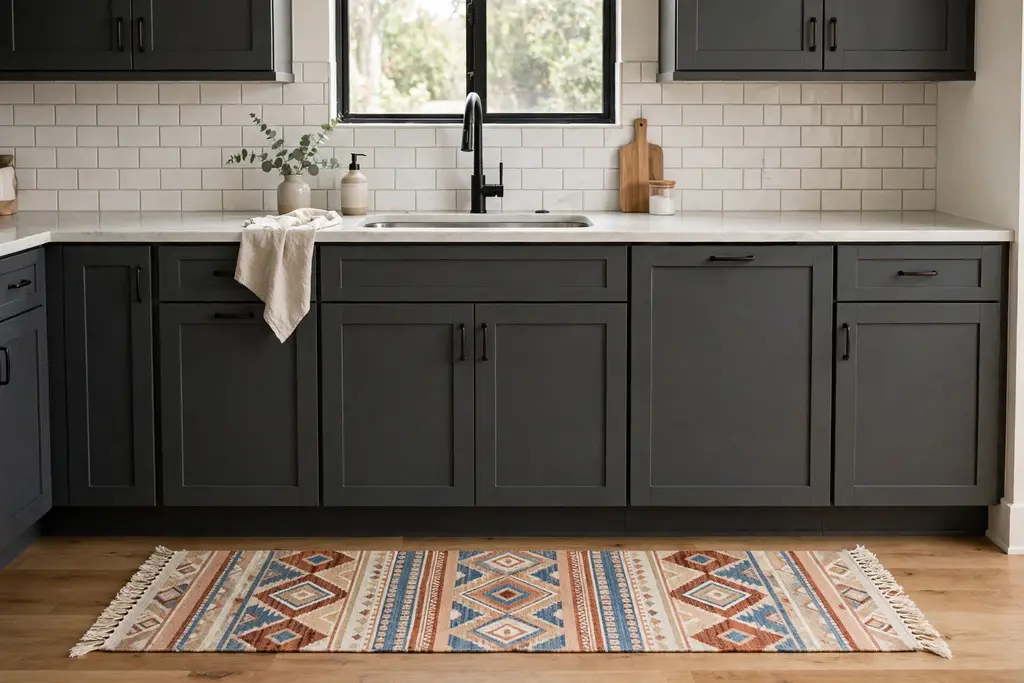
A patterned runner in front of the sink or stove adds color and comfort to a dark grey kitchen floor. The rug gives the work zone a clear strip, softens standing time, and breaks up a large area of dark floor or pale tile. Choose a low pile, washable runner with a nonslip base, because this spot takes water and foot traffic every day.
Pick a pattern with one color that repeats elsewhere in the room, such as brass, rust, or sage, and keep the rest of the pattern muted so it does not fight the cabinets. Measure so cabinet doors and the dishwasher open over the rug. Shake the runner outside regularly and wash it as the maker directs, since kitchen rugs collect crumbs and splashes fast.
25. A Built-In Banquette Nook Beside Dark Grey Cabinets
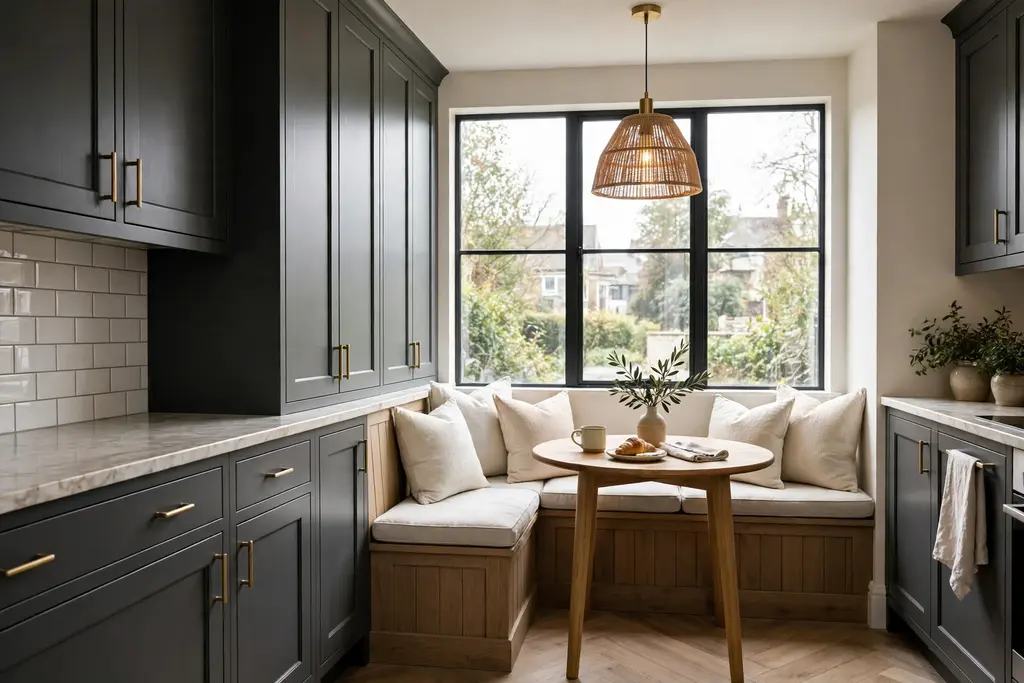
A built-in banquette beside dark grey cabinets turns an awkward corner into a dining spot. A bench along the wall, a small table, and one or two loose chairs seat more people than a freestanding table in the same space, and the bench base adds storage for table linens or rarely used pans. This suits a kitchen with a window corner or a wall at the end of a cabinet run.
Upholster the bench in a plain, wipeable fabric in a pale or warm tone so the nook stays light against the grey. Keep the table small enough to slide in and out of the bench with ease, and hang a simple pendant above it. If the nook is also a homework or laptop spot, add a power point at the bench end.
26. Wood Ceiling Beams Above Dark Grey Cabinets
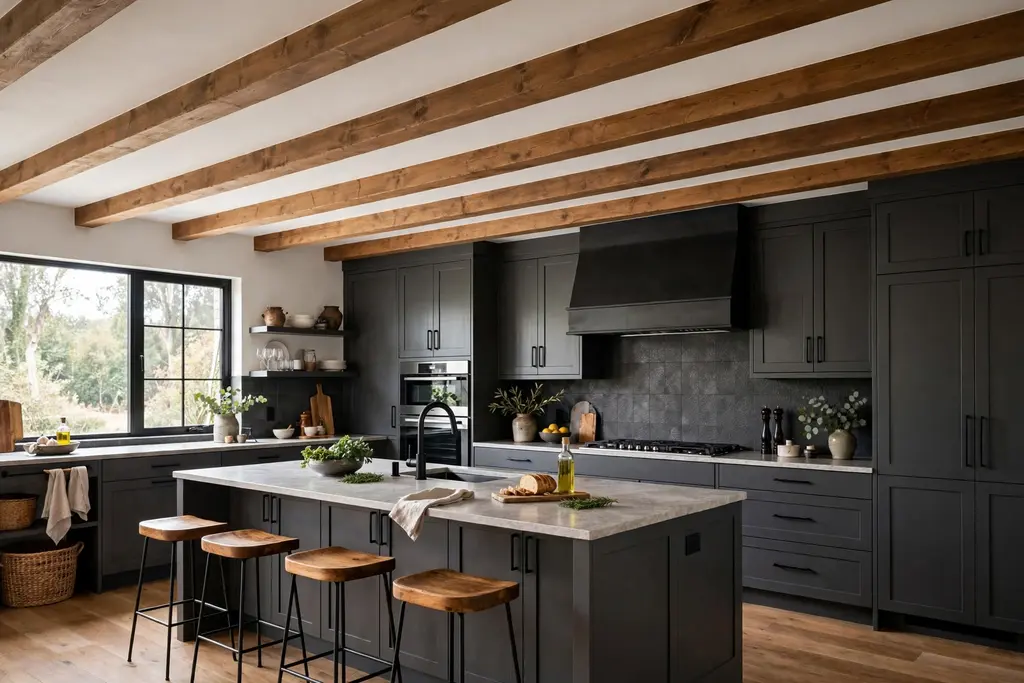
Wood ceiling beams add warmth above dark grey cabinets, especially in a kitchen with a high or sloped ceiling. The beams draw the eye up, give the room a natural material at ceiling height, and balance the dark color below. Real beams suit a house that already has timber structure, while slim box beams in oak or pine give the same look in a standard room.
Keep the beams in a mid warm wood and the ceiling between them white or pale, so the ceiling does not become another dark surface. Run the beams across the room in the same direction as the main cabinet run for a calm line. If your ceiling is low, use slim beams or a single beam over the island, because deep beams can make a low room feel lower.
27. Copper Pans and a Copper Faucet With Dark Grey
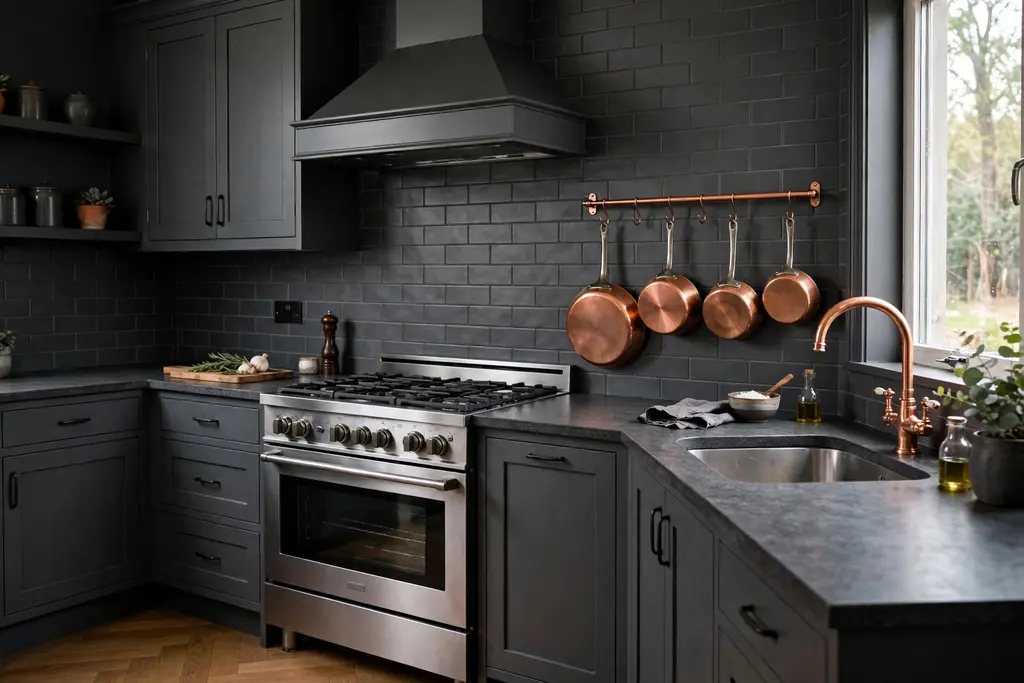
Copper gives dark grey a warm, lived in accent. Hang two or three copper pans on a rail beside the stove, fit a copper faucet at the sink, or use a copper tray on the island. The warm metal stands out against grey without the formality of brass, and it suits a kitchen that is used hard every day.
Use copper in one zone only, such as the stove wall, so it reads as a chosen accent rather than a scattered set. Let the copper develop a soft patina if you like a relaxed look, or polish it if you prefer a bright finish. Keep copper pans within reach of the stove, and check that hanging pans do not block light over the work surface.
28. A Chalkboard Memo Panel on a Dark Grey Wall
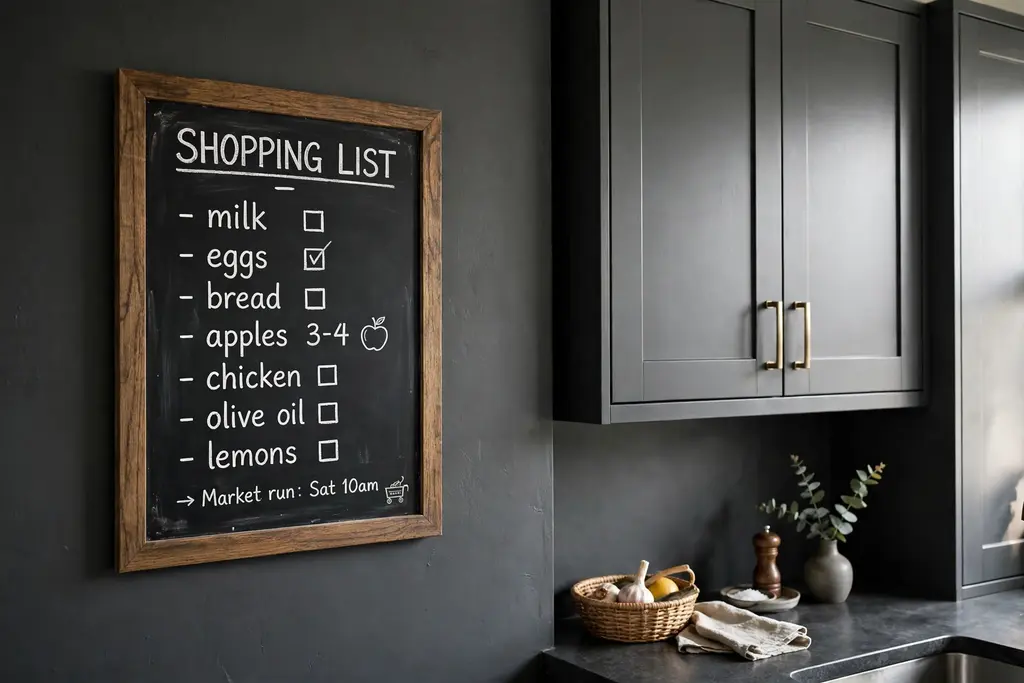
A chalkboard panel on a dark grey wall gives a kitchen a useful message spot that blends with the color scheme. Paint a section of wall, a pantry door, or a framed board with chalkboard paint, and use it for shopping lists, meal plans, and notes. Because the board is already dark, it does not add a new color to the room.
Frame the panel with a simple wood or painted trim so it reads as a planned feature, not as an unfinished patch. Keep chalk and an eraser in a small cup beside it, and wipe the board clean each week so old lists do not build up. If you prefer a tidier look, use a dark magnetic board with small magnets for lists and photos instead.
29. Glossy Grey Tiles That Bounce Light Around
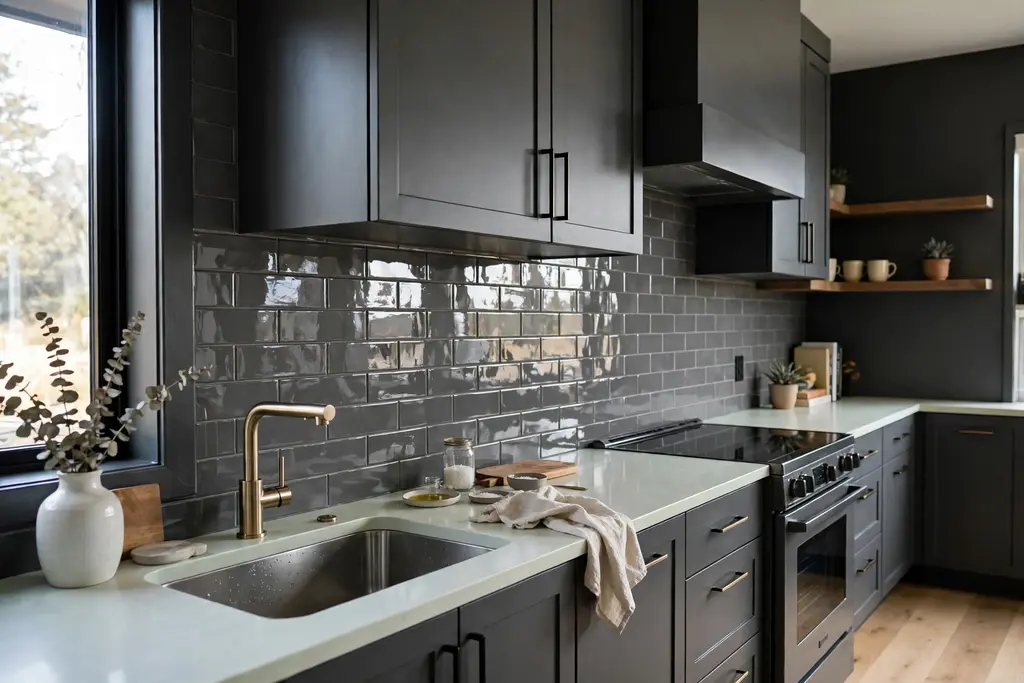
Glossy grey tiles are a practical way to keep a dark grey kitchen bright. Use them on the backsplash, where their shine reflects window light and under-cabinet light back into the room, unlike matte tile which absorbs it. Choose a mid grey gloss tile so the backsplash links to the cabinets without matching them exactly.
Lay the tiles in a simple stack or brick pattern, and use a grout close to the tile color so the shine, not the grout lines, is the main effect. Wipe glossy tiles after cooking, because steam and splashes show up more on a shiny surface. Pair glossy tile with matte cabinets for contrast, so the room has both soft and reflective surfaces.
30. A Single-Wall Galley in Dark Grey for a Small Kitchen
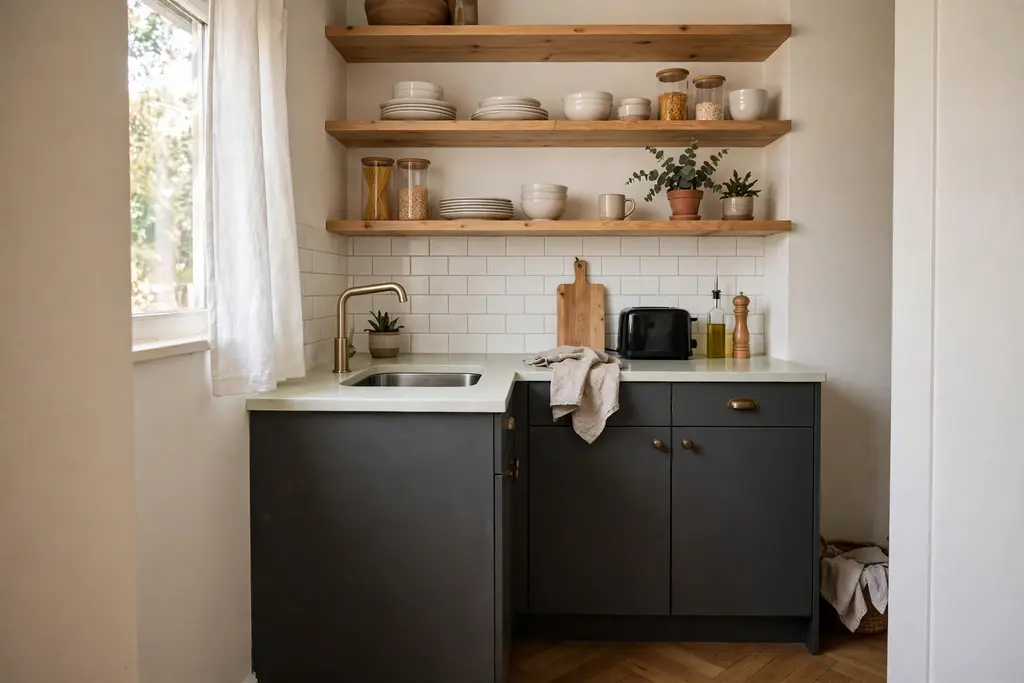
A single-wall galley in dark grey can work in a small kitchen if the dark color stays low and the rest of the room stays light. Put dark grey on the base cabinets only, keep the wall above the counter open or fitted with light shelves, and use a pale counter and a white wall. The dark base grounds the run without closing in the room.
Keep the layout strict: fridge at one end, sink in the middle, stove at the other end, with clear counter between each zone. Use full height storage at one end only, so the run does not become a solid dark wall. Add a light runner rug and warm under-cabinet light, and the small galley will feel planned rather than cramped.
31. An L-Shaped Layout With a Dark Grey Window Sink
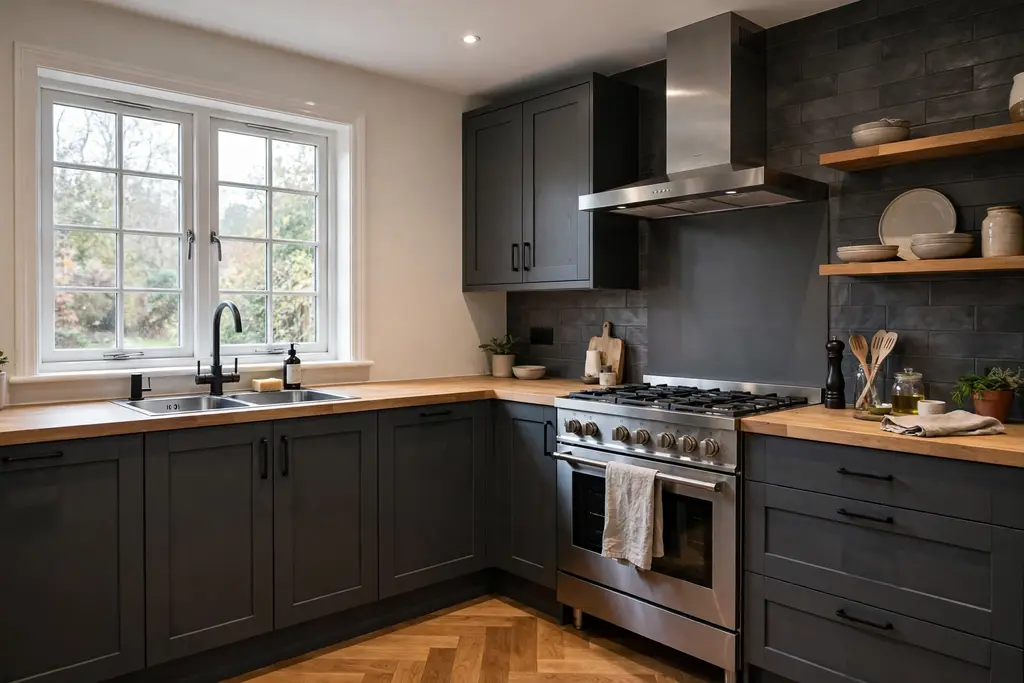
An L-shaped layout with the sink on the window arm gives dark grey cabinets a bright corner. One arm of the L holds the sink and the window, the other holds the stove and tall storage, and the corner between them becomes a useful prep zone. Paint both arms dark grey, or paint the window arm light and the stove arm dark to mark the two zones.
Use the corner for a pull-out unit or a simple corner cabinet with a turntable, so the deep space stays usable. Keep the counter at the corner clear for chopping, and put small appliances on the stove arm rather than beside the sink. A light counter across both arms ties the L together and stops the dark cabinets from splitting the room in two.
32. A U-Shaped Kitchen With Dark Grey on Three Sides
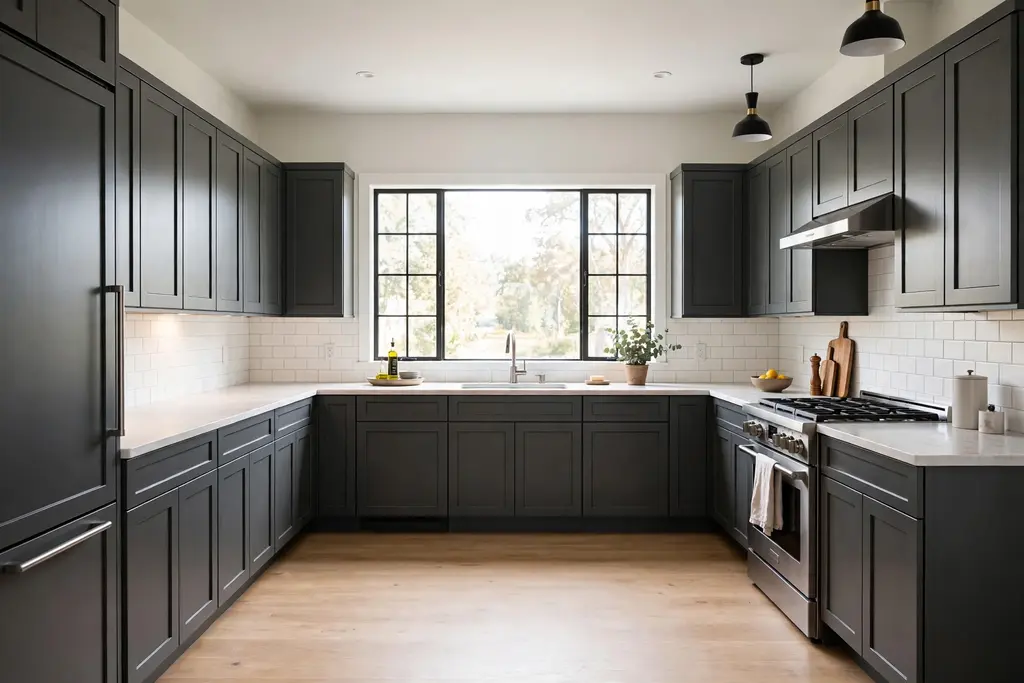
A U-shaped kitchen with dark grey cabinets on three sides gives a large amount of storage and worktop, but it needs light to avoid feeling enclosed. Use dark grey on all three runs only if the room has a window on one arm and a light counter throughout. Leave the center of the U open, with no island, so the room keeps a clear floor area.
Break the dark runs with a pale backsplash, a white sink, and warm under-cabinet light on each arm. Put the stove on the back wall, the sink on a side arm, and tall storage at the open end of the U. If the room feels dark after fitting, swap one arm to glass-front uppers or open shelves, which is a smaller change than repainting a full run.
33. Farmhouse Details: Beadboard and Cup Pulls in Dark Grey
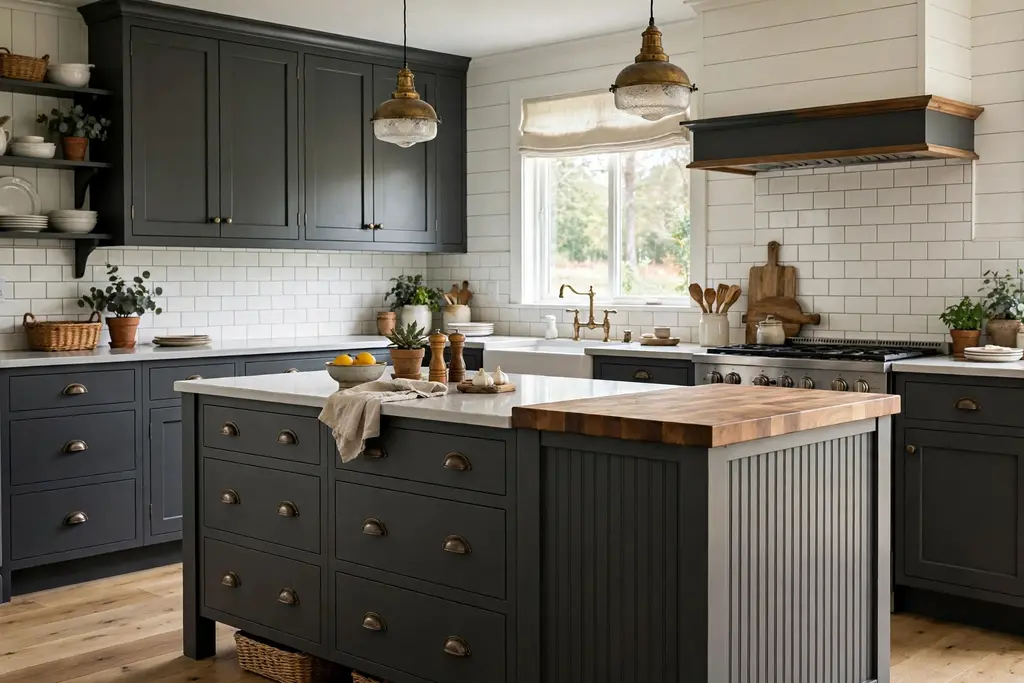
Farmhouse details give dark grey cabinets a softer, traditional character. Beadboard panels on the island ends or on a pantry door add a vertical pattern, and cup pulls on drawers give a classic shape that suits shaker fronts. The dark grey keeps the farmhouse look from feeling too pale or sweet, while the details keep it from feeling stark.
Use beadboard in the same dark grey as the cabinets, not in a contrasting color, so the pattern reads as texture rather than a separate feature. Pair cup pulls with simple knobs on doors, in one finish such as aged brass or matte black. Add a wood counter or a butcher block section to complete the farmhouse feel, and keep the backsplash plain white tile.
34. Seasonal Textiles That Soften Dark Grey Without Repainting
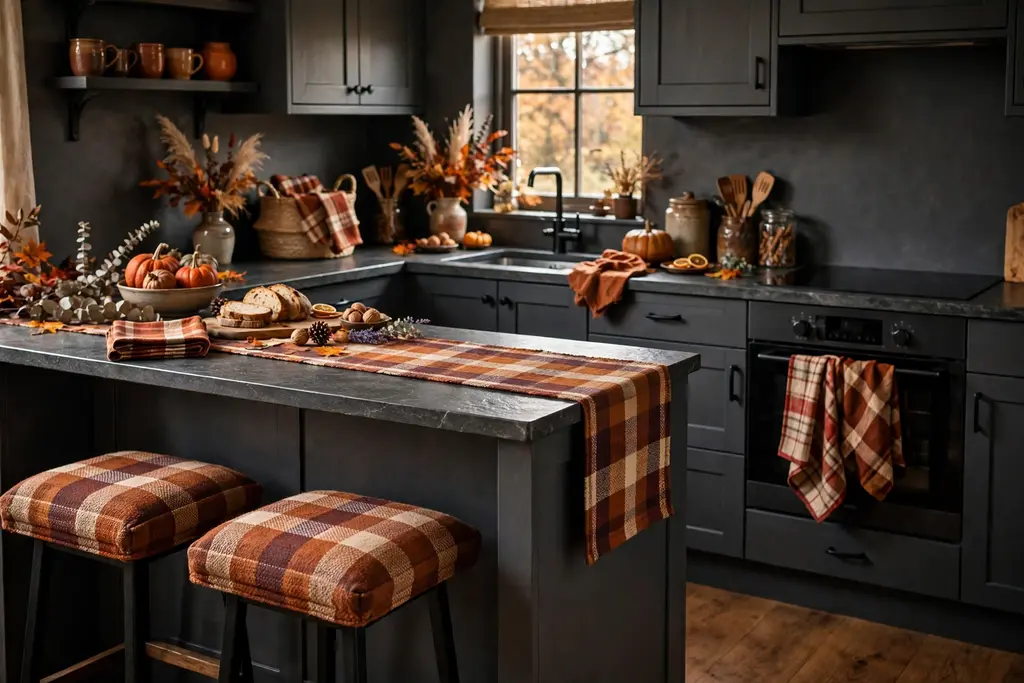
Seasonal textiles are the lowest effort way to change a dark grey kitchen. Swap dish towels, a table runner, stool cushions, and a window blind cover by season, and the dark cabinets become a steady backdrop for each change. In autumn, use rust, ochre, and plaid, a palette that also works in these thanksgiving kitchen decor ideas. In spring, switch to sage, cream, and pale linen.
Keep the textiles to two or three colors at a time, and store the off season set in one labeled box so the swap takes minutes. Choose washable cotton and linen, because kitchen textiles need regular washing. This approach also suits renters, because nothing is painted or fixed, yet the room still changes with the season.
Conclusion
Dark grey works best when it is given a clear role and a lighter partner. Start with one move, such as dark grey base cabinets, a dark island, or one dark wall, and pair it with a pale counter, warm wood, or brass. Add warm light under the cabinets and over the island, because dark surfaces need more light than pale ones to feel welcoming. Test samples in your own daylight, keep hardware to one finish, and let plants, wood, and textiles soften the edges. With those basics in place, dark grey gives a kitchen depth and a calm, lived in feel that still works in a small room and in a busy family kitchen.
Save this list on Pinterest before your next kitchen refresh, and try one idea first: a painted island, a brass hardware swap, or a new runner rug, then live with it for a week before you change the next surface.
FAQs
Does dark grey make a small kitchen look smaller?
It can, if dark grey covers every surface and the room has little light. In a small kitchen, keep dark grey on the base cabinets or the island only, leave the walls and uppers light, and add warm under-cabinet light. A glossy backsplash, a pale counter, and a clear window also help, because they reflect light back into the room. Test a sample door in the room before you commit, and check it in both morning and evening light.
What countertop works best with dark grey cabinets?
White or pale grey quartz, white marble, and light wood all work well, because each gives a clear light edge above the dark base. White marble adds veining and a classic feel, quartz gives the same look with less upkeep, and light wood adds warmth for a farmhouse or relaxed kitchen. Avoid a very dark counter with dark cabinets unless the room has strong daylight and pale walls, because the two dark surfaces can merge into one mass.
What wall color goes with a dark grey kitchen?
Pale warm white, light grey, and soft sage all sit well with dark grey cabinets. Warm white is the safest choice, because it keeps the room bright and lets the cabinets stand out. Light grey works if it is clearly paler than the cabinets, so the wall and the doors do not blend. If you want color, use it on one wall or in textiles, and keep the main walls pale so the kitchen does not lose light.
Should I choose brass or black hardware for dark grey cabinets?
Brass warms dark grey and suits classic, farmhouse, and warm wood kitchens. Matte black gives a quieter, more modern result and suits a monochrome scheme. The key step is to repeat one finish across handles, faucet, and lights, rather than mixing metals across the room. If your appliances are stainless steel, either finish still works, because steel reads as a working material. Order one handle first and check it against the cabinet color in your own light.
How do I keep a dark grey kitchen bright?
Use a pale counter and a light backsplash, add warm under-cabinet lighting, and keep the window as clear as privacy allows. Glossy tile, glass-front cabinets, and open shelves all help light travel further, and green plants add a pale, living accent. Avoid dark floors, dark counters, and dark walls all at once. If the room still feels dim, add a pendant over the island or a light rug, both of which lift the center of the room without repainting.
Can I paint existing cabinets dark grey, or is this only for new kitchens?
You can paint existing cabinets dark grey if the doors are solid and in good condition. Clean and sand the surfaces, use a primer made for cabinets, and apply thin coats of a durable cabinet paint, following the maker directions for drying time. Remove doors and hardware before painting for a neater finish. If the cabinets are damaged, warped, or covered in a peeling laminate, replacement doors or a new run will give a longer lasting result than paint alone.
Appendix: Pinterest Package (Non-Article Appendix, Strip Before HTML Build)
This appendix is not article content. It is a Pinterest package for the post above. Do not publish this section as part of the article.
- Angle: Dark grey cabinets done right
- Pin title: 34 Dark Grey Kitchen Ideas for a Fresh Take on Your Home
- Description: Matte cabinets, two-tone pairings, brass hardware, wood accents, and lighting tips that keep a dark grey kitchen bright. Read all 34 ideas on Dwell Ovell.
- Overlay text: Dark Grey, Done Right
- CTA: Read all 34 ideas
- Visual concept: Wide dark grey kitchen with white marble counters, brass handles, and warm wood stools in daylight.
-
Board suggestion: Kitchen Ideas
-
Angle: Small kitchen in dark grey
- Pin title: Dark Grey Kitchens That Still Feel Bright
- Description: Keep dark grey low, leave uppers light, and add glossy tile and warm under-cabinet light. Small kitchen layouts from the 34 idea guide.
- Overlay text: Small Kitchen, Dark Grey, Still Bright
- CTA: See the small kitchen ideas
- Visual concept: Single-wall galley with dark grey base cabinets, pale counter, and a bright window over the sink.
-
Board suggestion: Small Kitchen Ideas
-
Angle: Brass and wood pairings
- Pin title: What Goes With Dark Grey Kitchen Cabinets?
- Description: Brass handles, oak shelves, white marble, and green plants, four pairings that warm dark grey cabinets without repainting the whole room.
- Overlay text: Brass, Wood, Marble, Green
- CTA: Compare the pairings
- Visual concept: Close view of dark grey cabinets with brass pulls, oak shelf, and a potted herb.
-
Board suggestion: Kitchen Cabinet Ideas
-
Angle: Island focus
- Pin title: Try Dark Grey on the Island First
- Description: A dark grey island anchors a light kitchen with far less commitment than a full cabinet run. Island ideas, stools, pendants, and waterfall edges inside.
- Overlay text: Start With the Island
- CTA: Open the island ideas
- Visual concept: Dark grey island with pale quartz top, wood stools, and pendant lights.
-
Board suggestion: Kitchen Island Ideas
-
Angle: Lighting a dark kitchen
- Pin title: Lighting Tips for a Dark Grey Kitchen
- Description: Warm under-cabinet strips, island pendants, glossy tile, and clear windows that keep dark grey cabinets bright morning and evening.
- Overlay text: Light Up Dark Grey
- CTA: Read the lighting ideas
- Visual concept: Dark grey kitchen in the evening with warm under-cabinet light and glowing pendants over the island.
- Board suggestion: Kitchen Lighting Ideas