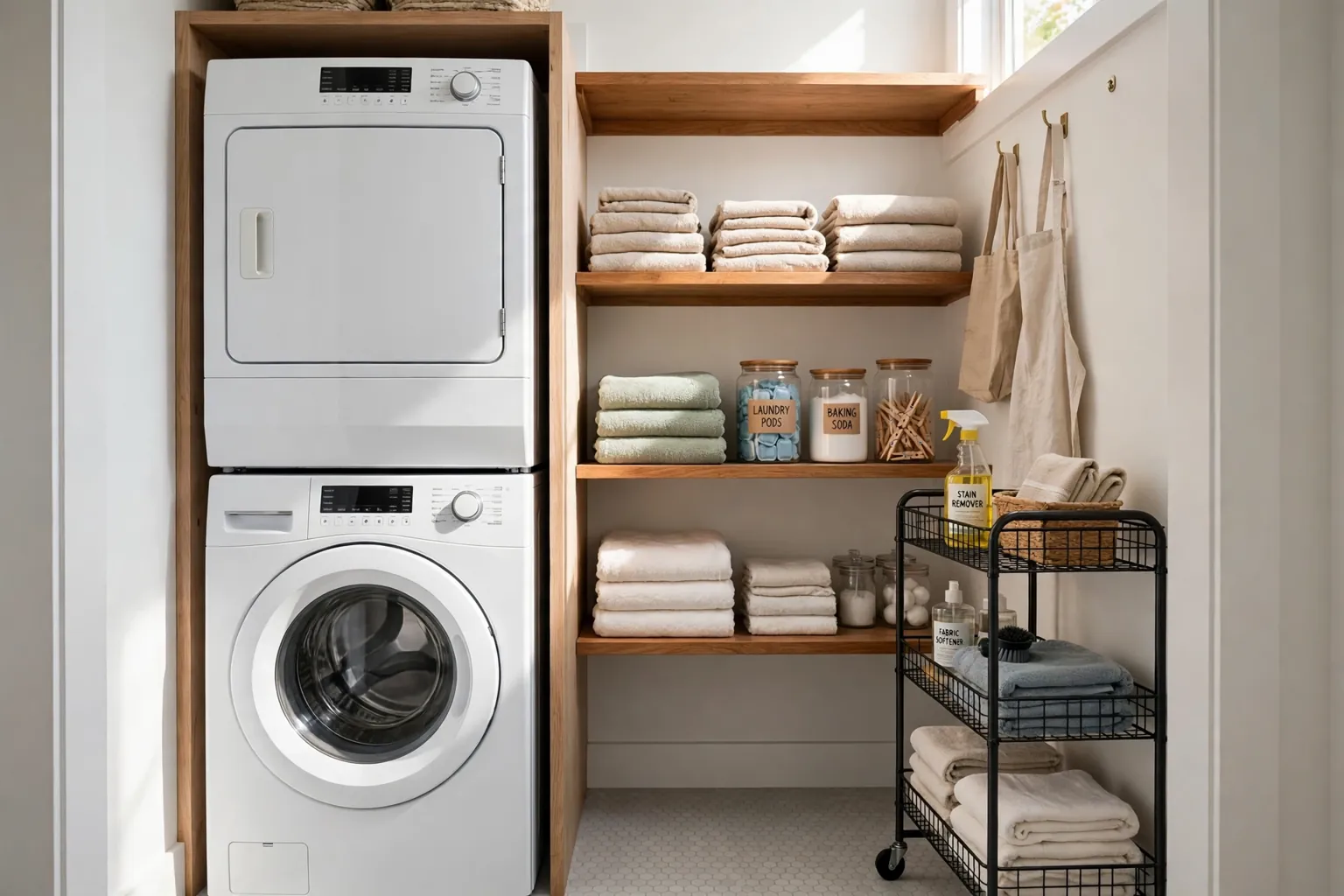
A laundry closet has to do a lot in a small footprint. It holds a washer and a dryer, bottles and boxes, clean clothes and dirty ones, and it still needs room for you to stand, load, and fold. When the closet has no plan, supplies pile on top of the machines and the floor fills with baskets. These 28 small laundry closet ideas give every job a set spot, from stacked machines and open shelves to gap carts, fold-down counters, and door organizers. Start with the change that fixes your biggest daily snag, then add the next idea only where space is still wasted.
Key Takeaways
- Measure first: machine width, door swing, hose clearance, and shelf height decide which ideas will fit your closet.
- Stack machines or add a counter over front loaders, so the space above the machines works instead of sitting empty.
- Use the side gap, the door, and the high shelf for storage, so the floor stays clear for baskets and standing room.
- Sort supplies by job in labeled bins and clear jars, so you can see stock levels and reach daily items without moving a pile.
- Keep drying, ironing, and folding tools on the wall or on a door, so they do not eat counter or floor space.
- Leave airflow and access clear around machines, vents, and hoses, even when shelves and organizers fill the rest of the closet.
1. Stack the Washer and Dryer to Free Floor Space
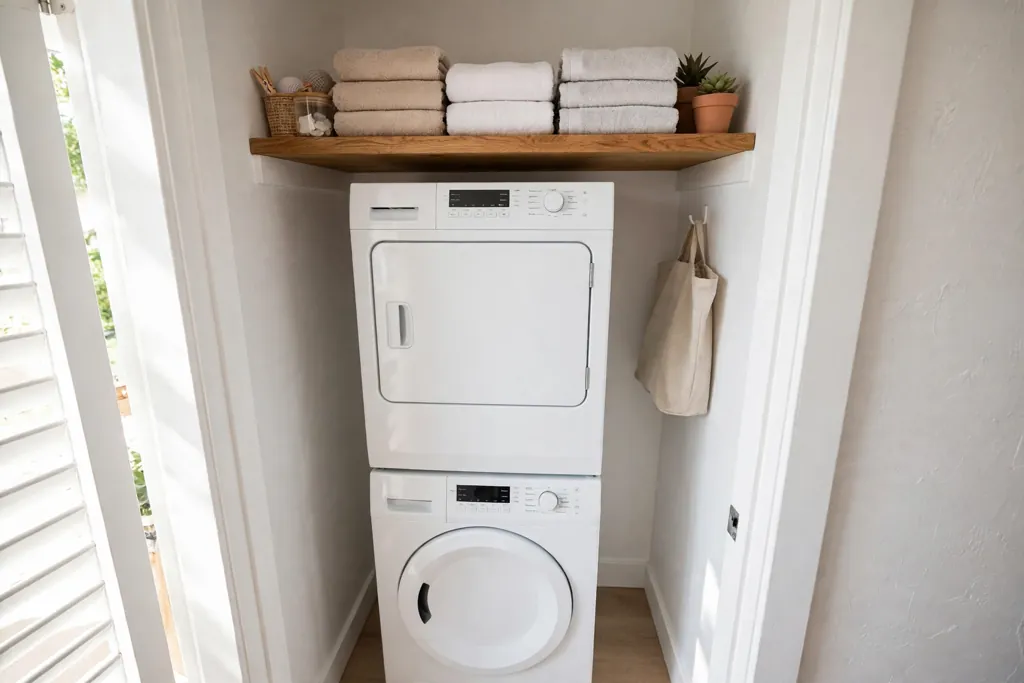
Stacking a washer and dryer frees the floor beside the machines for a hamper, a cart, or standing room. This suits a narrow closet where side by side machines leave no room to turn, and it works best with a stacking kit made for your exact models. Keep the dryer controls within easy reach, and check that the stack still leaves room for the door to close and for vents to run clear.
Once the machines are stacked, use the freed side space for one slim storage piece, not a pile of baskets. A narrow cart or a tall hamper fits the gap well, and it keeps the closet walkway clear. Leave the maker clearance around the stack, and keep a small step stool nearby if the dryer controls or the top shelf sit high.
2. Add Open Shelves Above the Machines
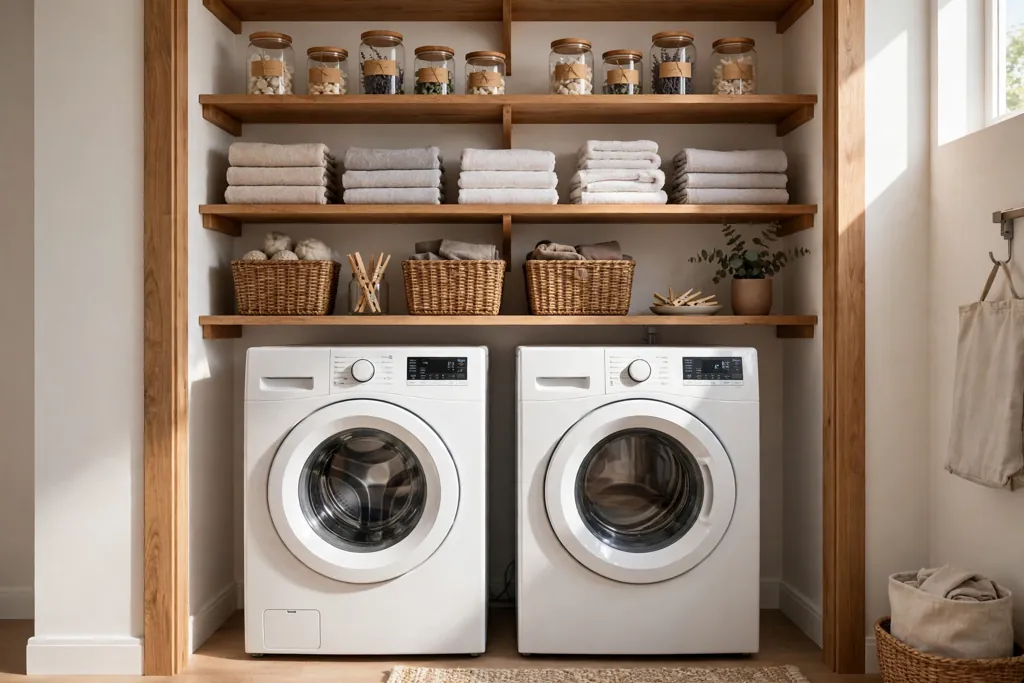
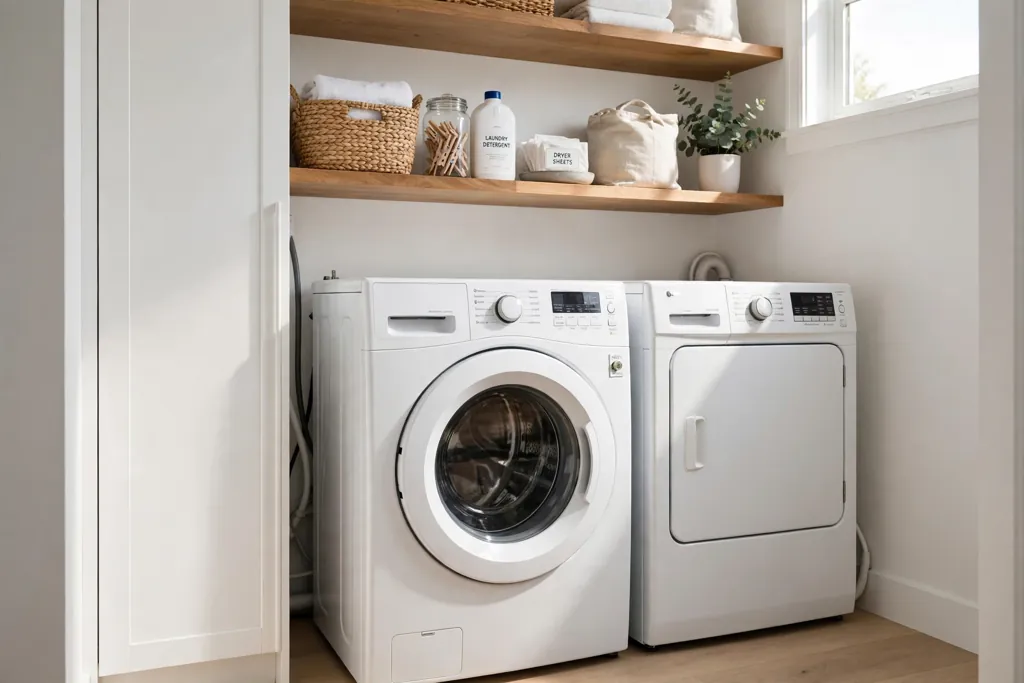
Open shelves above the machines use the wall that is otherwise hard to reach, and they keep daily supplies at eye level or just above. This suits a closet with side by side machines, where a shelf run gives detergent, softener, and cloths a set home. For color and styling ideas that carry over well to a small laundry space, see these laundry room decor ideas.
Fix shelves into studs or use fixings rated for the weight of full bottles, and keep the lowest shelf high enough that you can still open machine lids or reach controls. Group one job per shelf, such as wash supplies on one shelf and stain care on another, and keep heavy bottles low. Leave a small gap between shelf groups, so the wall reads as tidy rather than crowded.
3. Fit a Fold-Down Counter Over Front Loaders
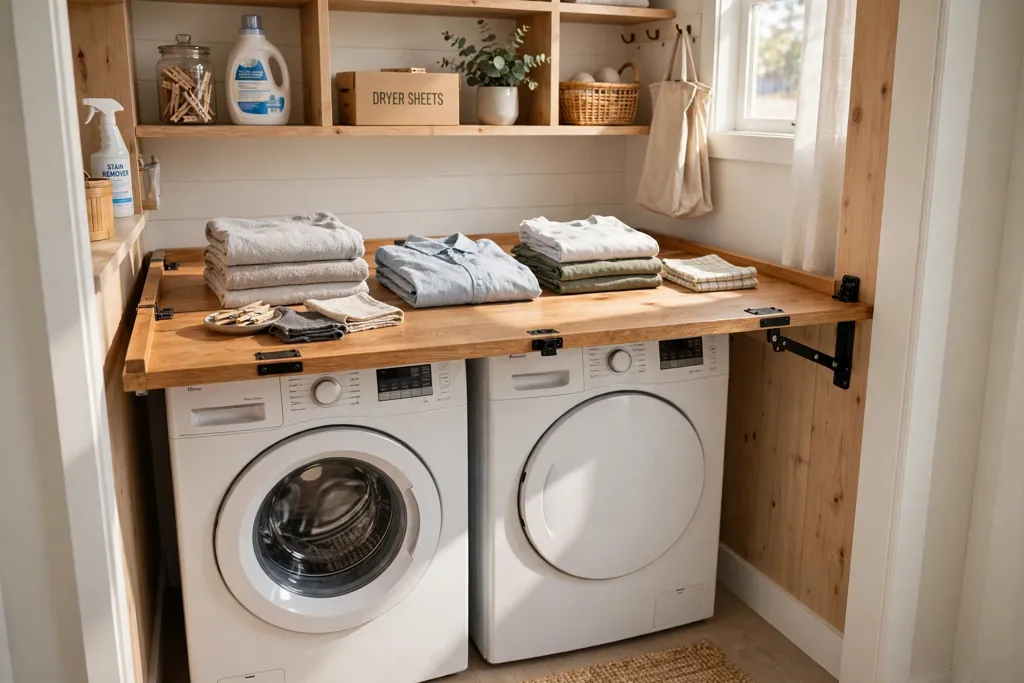
A fold-down counter over front loading machines gives you a folding surface only when you need it, then folds flat against the wall when you do not. This suits a closet with no room for a fixed counter, since the folded panel takes almost no space. Use sturdy hinges and a support arm rated for a basket of folded clothes, and fix the counter into studs or solid wall anchors.
Keep the counter depth shallow enough that it does not block the machine doors when lowered, and store only light items on it while it is up. Clear the counter before you fold it away, so bottles and cloths do not slide off. If a fold-down panel will not fit, a removable board laid across the machines at fold time gives a similar surface with no fixings at all.
4. Slide a Slim Rolling Cart Into the Side Gap
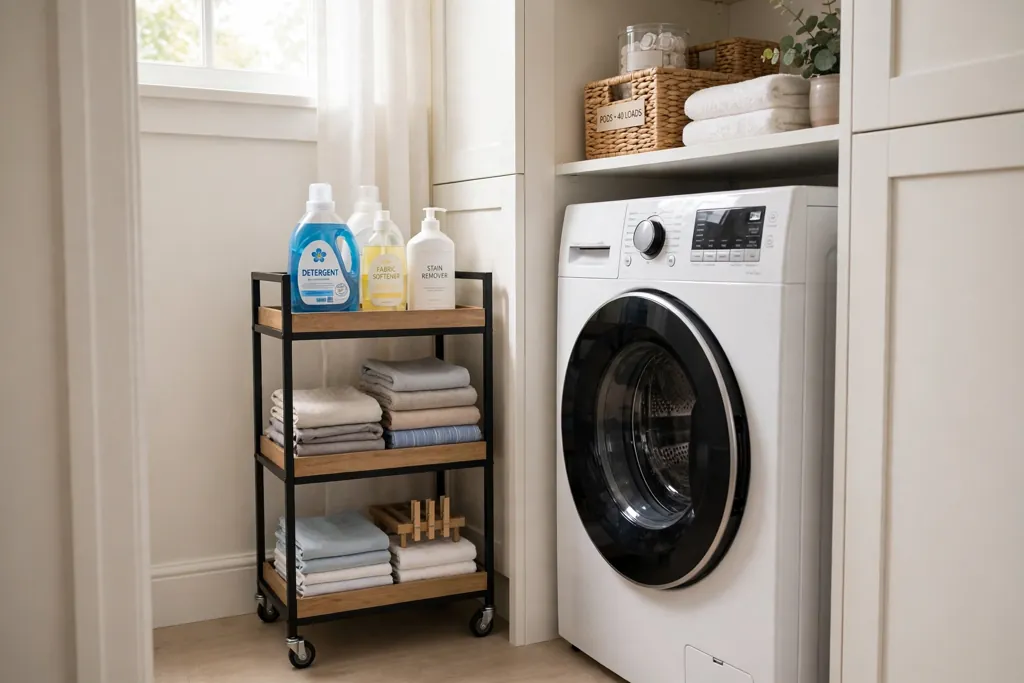
A slim rolling cart turns the gap beside a washer or dryer into three or four shelves of storage that pull out fully. This suits closets where a few centimetres beside a machine sit empty, since the cart holds bottles, cloths, and small supplies upright. Measure the gap at the floor, the middle, and the top, since walls and machines are not always straight.
Choose a cart narrower than the gap, with a handle at the front and shelves that hold bottles upright. Keep tall bottles on the lowest tier, so the cart stays stable when pulled out, and wipe the tiers often, since a cart beside a machine collects lint. Roll it back flush when done, so the closet walkway stays clear and the door still closes.
5. Fit a Pull-Out Tower Beside the Machines
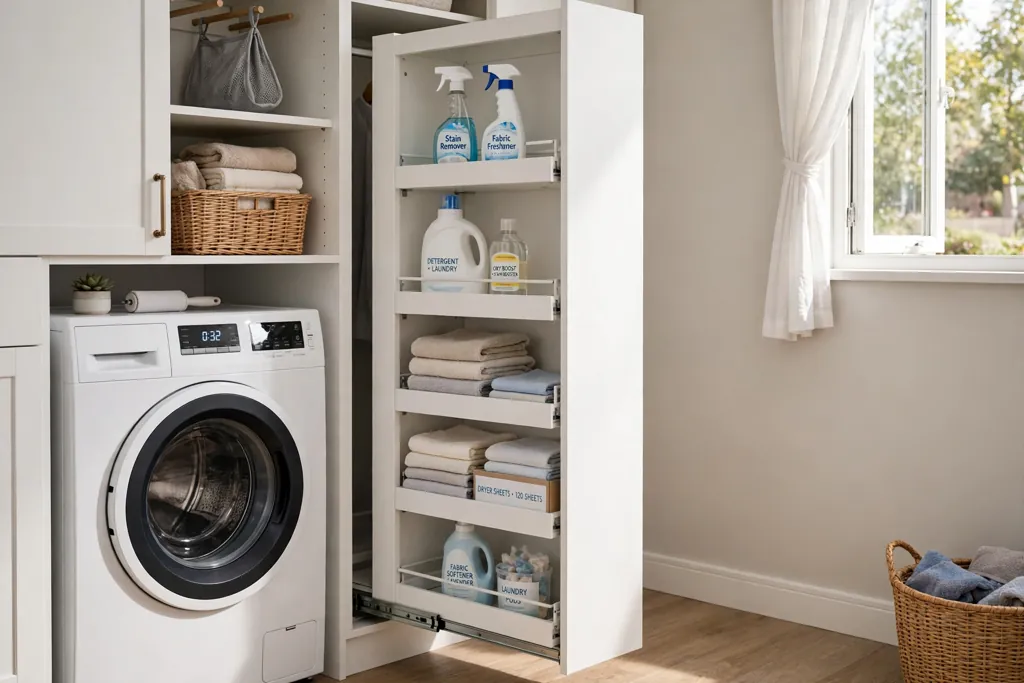
A pull-out tower is a tall, narrow unit on runners that slides out from beside the machines, bringing items from the back to the front. This suits a closet with a slim strip of wall beside a washer or dryer, where a fixed shelf would be hard to reach. Use the tower for bottles, boxes, and cleaning cloths, grouped by job on each tier.
Anchor the tower frame firmly, and keep heavier items low, so it slides smoothly and stays stable when pulled out. Measure the gap twice, including skirting boards and hose bulges, before ordering a unit made for a tight space. Keep the front of the tower plain and labeled, so you can find the right tier without pulling the whole unit out twice.
6. Hang an Over-Door Pocket Organizer
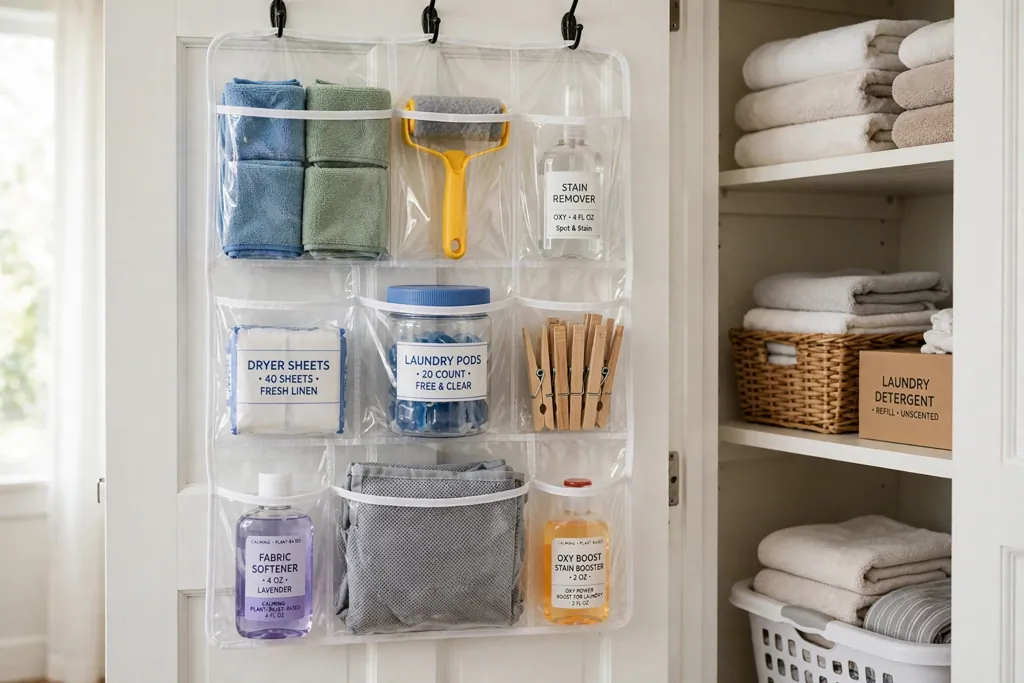
A clear over-door pocket organizer turns the inside of the closet door into storage for small supplies, without screws or shelves. This suits a rented home, since the organizer hooks over the door and comes down in minutes. Use the pockets for stain pens, cloths, pegs, dryer sheets, and small bottles, with heavier items in the lowest pockets.
Label the rows if several people share the laundry, and keep the organizer shallow, so it does not hit the machines when the door closes. Wash the organizer now and then if it holds toiletries or cleaning supplies, and check that the hooks clear the door frame, so the door still latches. Keep daily items in the middle pockets, where they are easiest to reach.
7. Add Hooks Inside the Closet Door
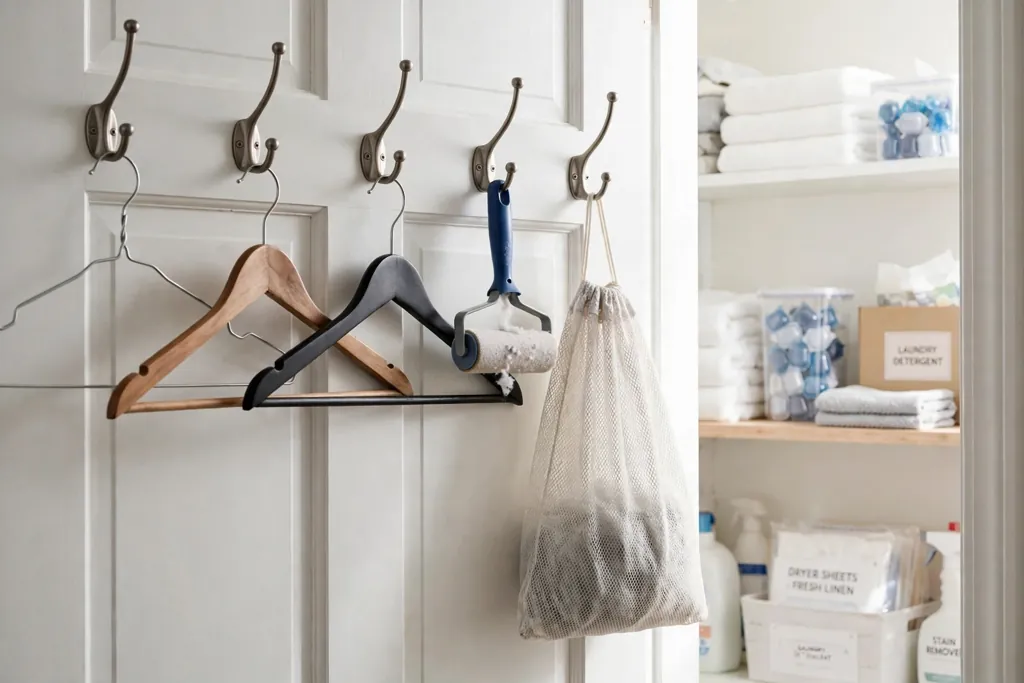
A row of hooks inside the closet door gives hangers, a small dustpan, a lint roller, and a mesh wash bag a set home. This suits a closet where wall space is taken by shelves and machines, since the door is a free surface that moves with the closet. Use sturdy hooks fixed into the door or strong adhesive hooks for light items in a rented home.
Check the clearance before you fit hooks, so items do not hit the machines or shelves when the door closes. Hang one item per hook, and keep heavy items low, so the door still swings freely and does not strain its hinges. Keep the hooks to one row, so the door stays easy to close, and move any item that blocks the door latch to a shelf instead.
8. Fix a Retractable Drying Line Across the Closet
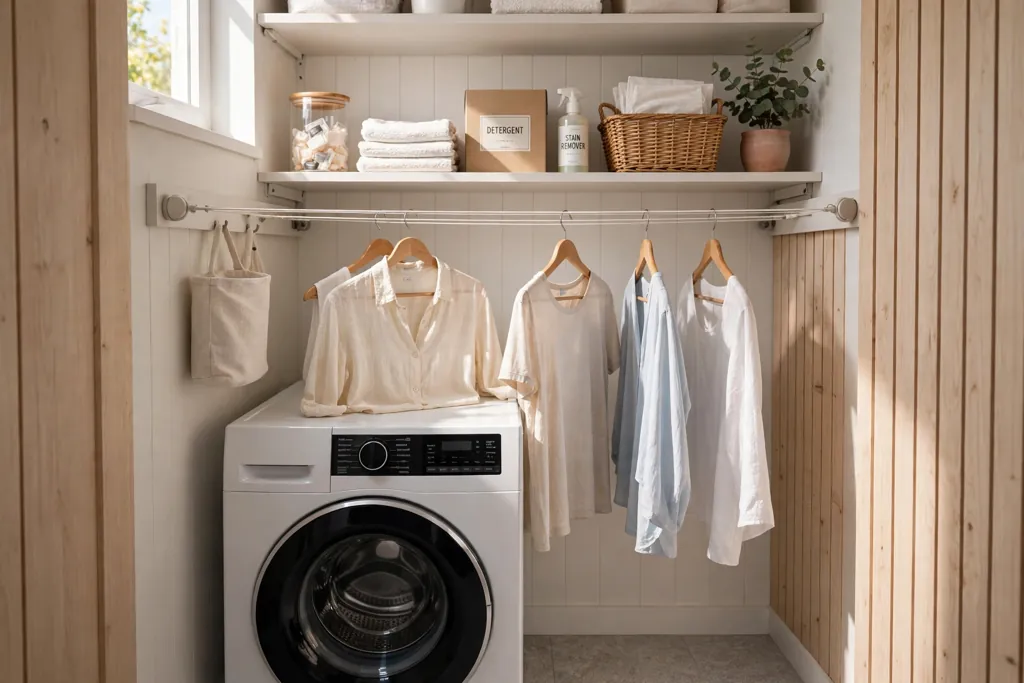
A retractable drying line stretches across the closet for delicates, then winds back into its housing when not in use. This suits a small closet where a floor drying rack would block the walkway, since the line uses only air space. Fix the housing to a stud or solid wall, and fix the receiving hook on the opposite wall at the same height.
Hang light items only, with a small gap between pieces, so air reaches each one and the line stays taut. Keep the line clear of the dryer vent and away from dusty shelf edges, and wipe the housing now and then, since lint settles near machines. Retract the line after each use, so the closet is back to full standing room for the next load.
9. Mount a Wall Rail for Hangers and Air Drying
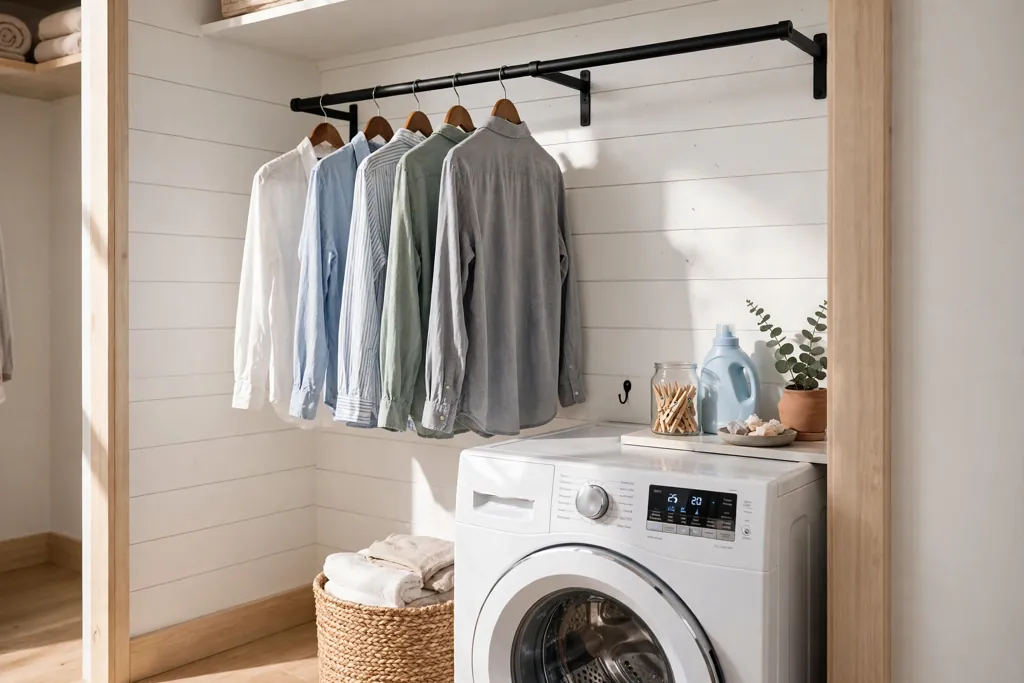
A wall rail on a free wall run gives hangers and air dry clothes a firm home, and it lets you move a whole load to the closet in one trip. This suits a laundry closet with a clear side wall, where shirts on hangers dry faster with air around them. Fix the rail into studs or solid masonry, since a rail full of wet clothes carries real weight.
Leave clearance below for the longest garment, and hang clothes with a small gap between hangers, so air reaches each piece. Keep a few empty hangers on the rail for the next load, and keep the rail clear of the folding counter, so hanging clothes do not drip onto clean laundry. If wall space is tight, a short rail above the machines works for a few hangers at a time.
10. Sort the High Shelf With Labeled Bins
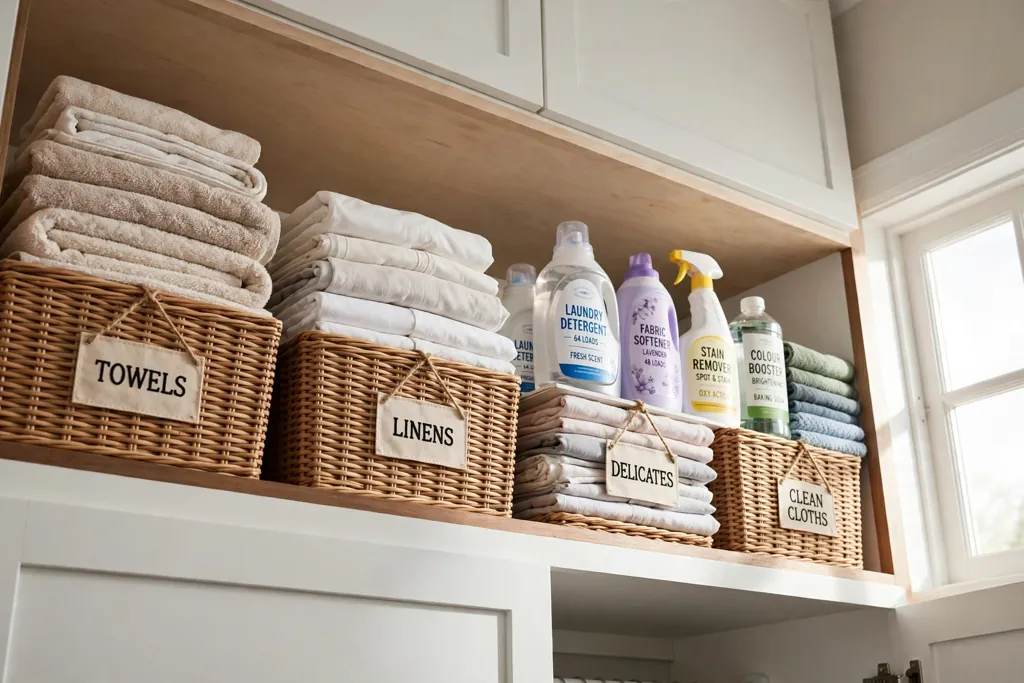
Labeled bins on the high shelf give every supply type its own box, so you stop pulling down three stacks to find one bottle. Use one bin for wash supplies, one for stain care, and one for spare cloths, and label the front of each bin clearly. For more small space storage lessons that pair well with a closet, see these small storage ideas for small spaces.
Choose bins that fit the shelf depth with a little room to spare, so they slide out without catching. Keep the bin you use most at the front or lowest, and move spares and off-season items to the back or highest spot. Wash supplies before they go back in a bin, and check the bins each season, so items you no longer use do not quietly fill the shelf again.
11. Decant Supplies Into Clear Jars on a Shelf
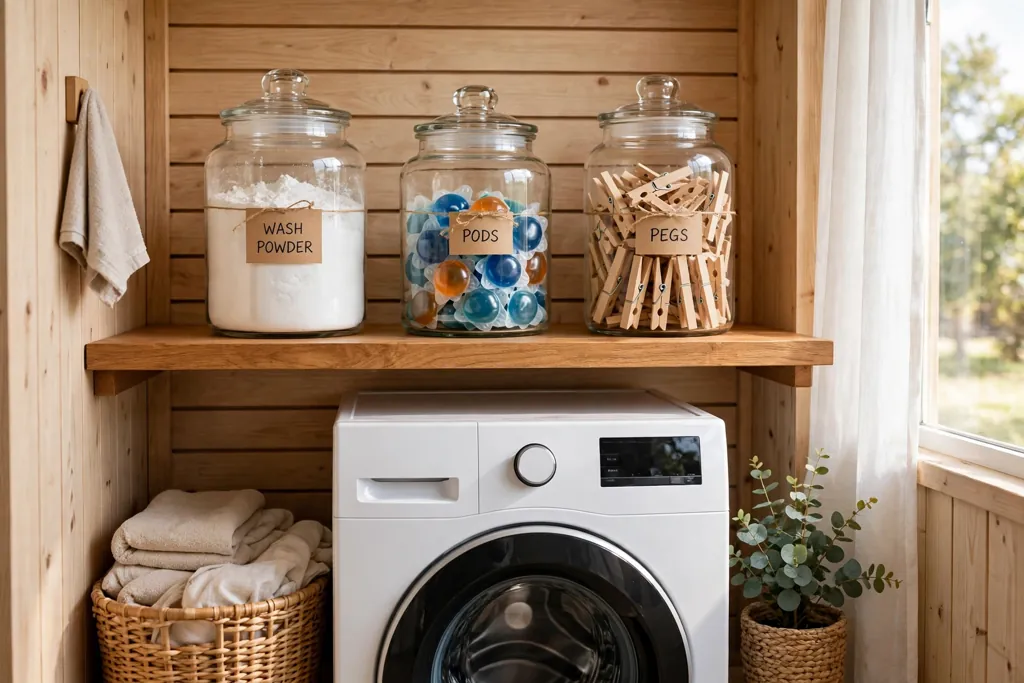
Clear jars on a shelf turn everyday supplies into a tidy group you can read at a glance. Powder, pods, pegs, and cloths show their stock levels through the glass, so you know what is running low before wash day. This suits a closet where mismatched bottles make open shelves look busy, and where you want to see stock without opening every box.
Label each jar in plain words, such as wash powder, stain soak, and pegs, and keep a small scoop in the powder jar. Keep jars out of reach of small children, and never move a product into a jar without keeping its safety notes nearby, since strong cleaners need care. Set the jars on one shelf only, with one or two jars beside them at most, so the display stays a small group rather than a shop shelf.
12. Build a Pegboard on the Side Wall
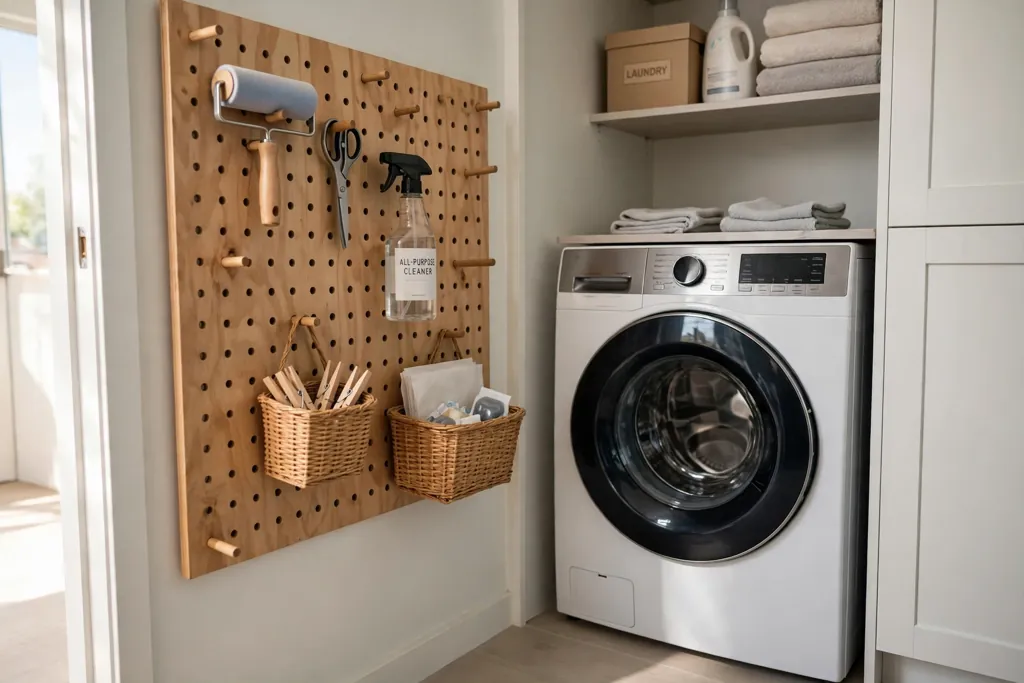
A pegboard on the side wall turns a blank wall into flexible storage, since hooks, bins, and small shelves move whenever your needs change. Use it for a lint roller, scissors, stain pens, small baskets, and a spray bottle, and everything stays visible at a glance. This suits a closet where closed storage hides small items and open shelves cannot adapt.
Mount the pegboard on battens, so there is space behind it for the hooks, and use fixings rated for the wall and the weight you plan to hang. Group items by job, so each hook has a clear purpose, and leave some pegs empty, so new items have a place without a full reorganization. Keep the board to one wall section, so the closet does not feel like a workshop.
13. Hang a Fabric Shelf Unit From the Top Shelf
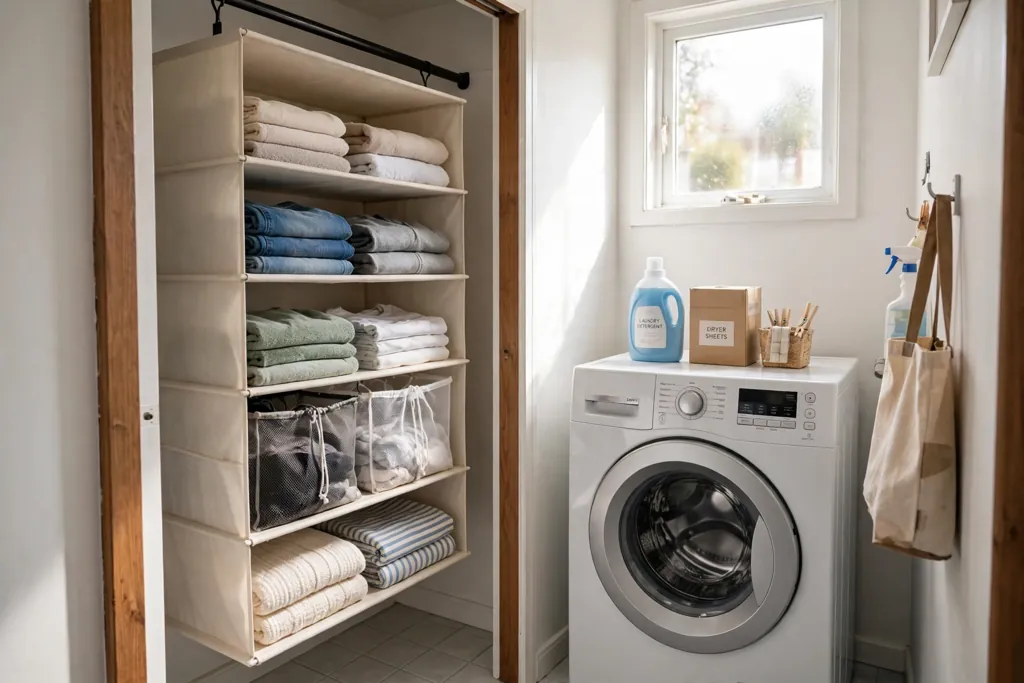
A hanging fabric shelf unit hooks over a top shelf or a rod and adds soft shelves for small laundry items without any building work. This suits a closet where a tall shelf run would be hard to reach, since the fabric shelves fill a gap with folded cloths, mesh bags, and small supply pouches. It also suits a rented home, since the unit comes down in minutes when you move.
Fold cloths to fit each shelf, and keep heavier items on the lowest shelf, so the unit hangs straight and does not swing. Limit each shelf to a few folded items, so the fabric does not sag, and keep the unit away from the door swing. Wash the fabric unit now and then, since closet shelves gather lint, and check the hooks, so the unit stays level as it fills.
14. Stick a Magnetic Caddy to the Side of a Machine
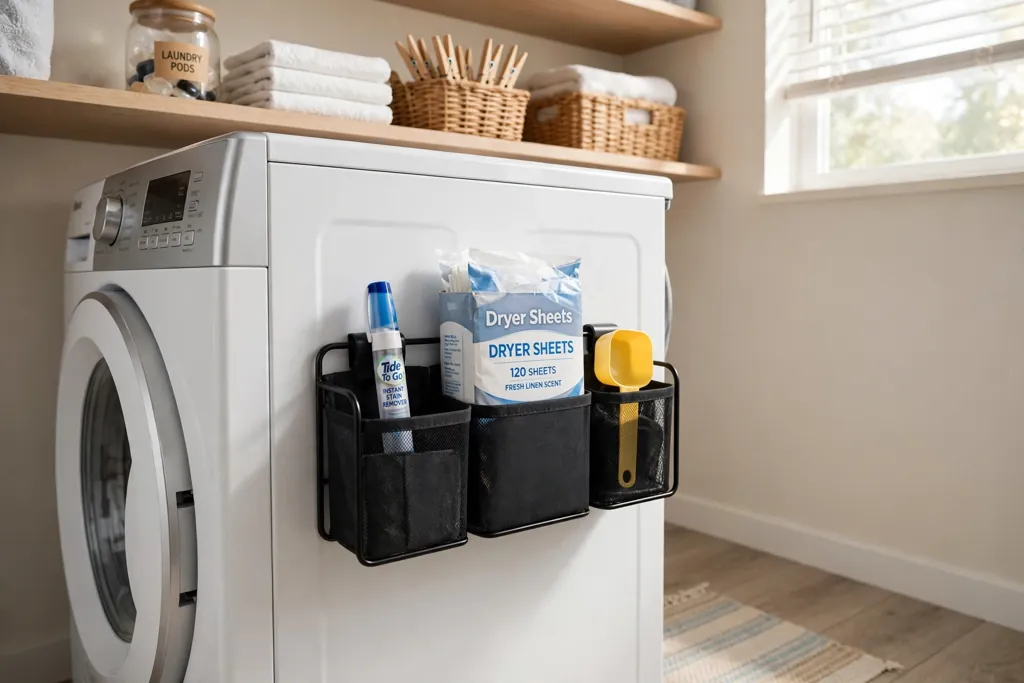
A magnetic caddy sticks to the side of a washer or dryer and holds small items right where you load the machine. This suits a closet with no free wall at hand height, since the machine side is a surface that is already in use. Use the caddy for a stain pen, a lint roller, dryer sheets, and a small scoop, with heavier bottles kept on a shelf instead.
Check that the magnets suit your machine finish, and keep the caddy clear of vents, controls, and door seals. Wipe the caddy and the machine side often, since lint and dust settle there fast. Keep only light, daily items in the caddy, so it stays put when the machine runs, and move it to a shelf if it slides during a spin cycle.
15. Use a Slim Divided Hamper on Wheels
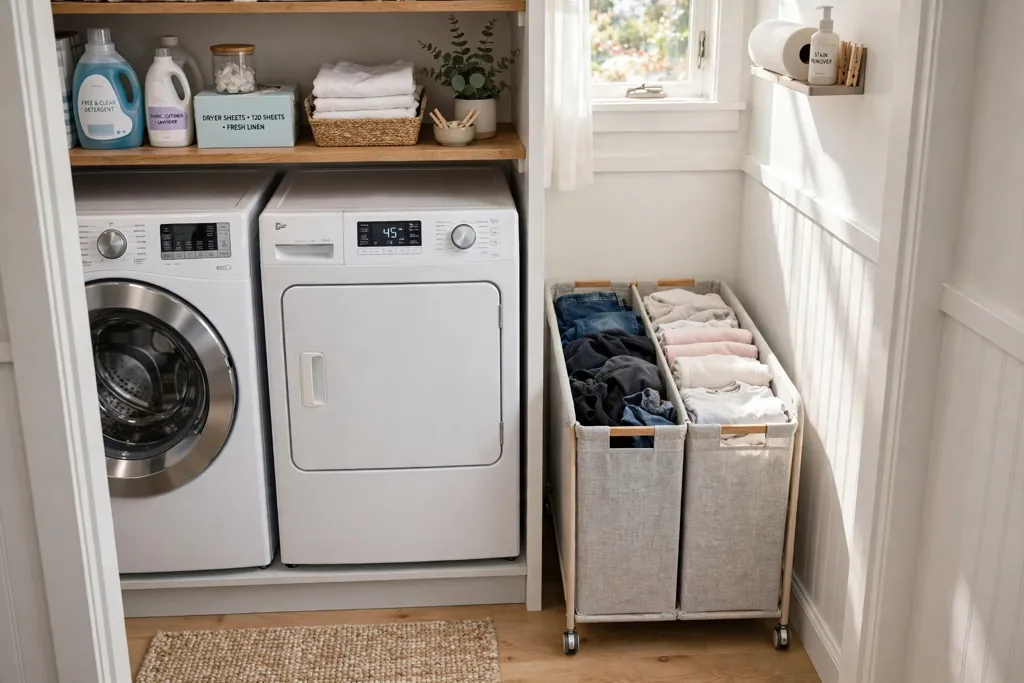
A slim divided hamper on wheels sorts lights and darks in one narrow unit that rolls out for loading. This suits a laundry closet where two separate hampers would block the door, since the divided hamper holds both sorts in the footprint of one. Choose a hamper with washable liners that lift out, so carrying a load to the machines is a single trip.
Keep the hamper near the machines, with enough clearance to lift the liners fully, and roll it back flush when done. Wipe the frame and air the liners out now and then, since damp clothes left too long can leave a smell. If the closet is very narrow, a single slim hamper with a removable divider gives the same sorting in an even smaller width.
16. Add a Tilt-Out Hamper Under the Counter
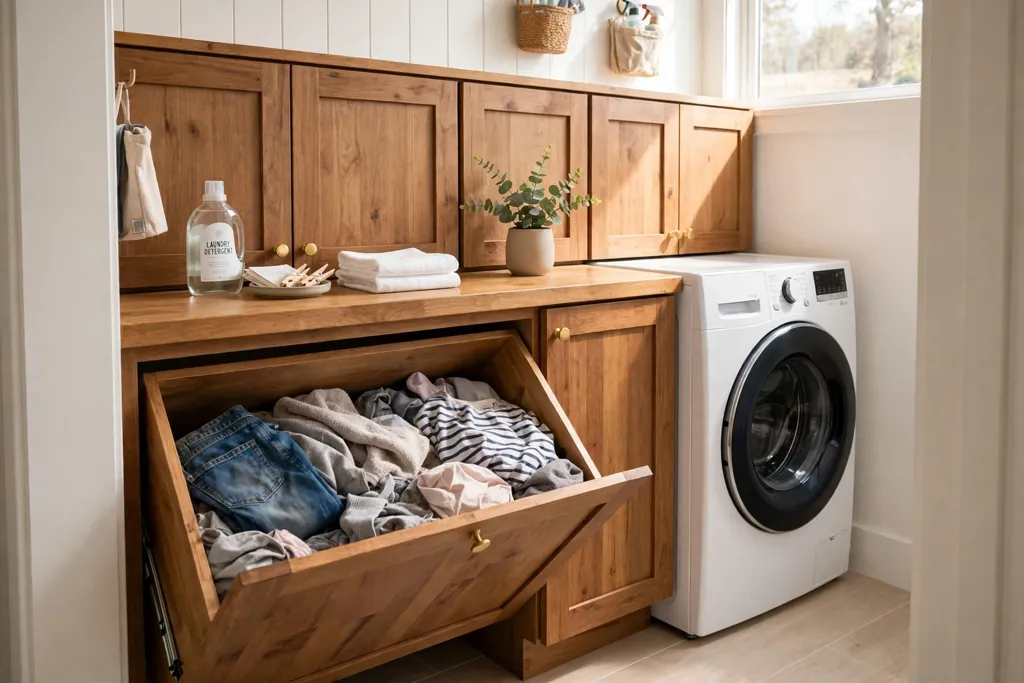
A tilt-out hamper hides dirty laundry behind a cabinet front or under a counter, and it tips forward for loading. This suits a closet with a fixed counter or a low cabinet, since the hamper uses the space below the work surface. The closed front keeps the closet calm between wash days, and the tilt action keeps loading easy without lifting a lid.
Choose a tilt bin sized to the cabinet opening, with a liner that lifts out for carrying to the machines. Keep only dirty laundry in the tilt bin, so clean supplies stay on shelves and in carts. Wipe the bin and liner often, and check the hinges, so the front still closes flush and does not catch on the counter edge.
17. Mount a Fold-Down Ironing Board on the Wall
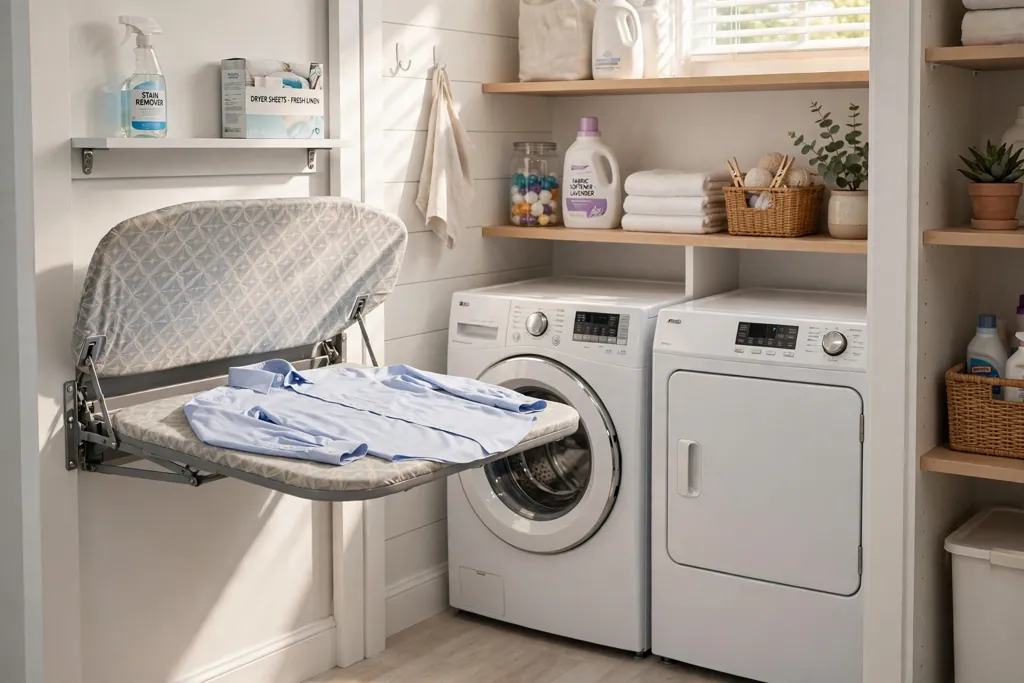
A wall-mounted fold-down ironing board gives you a pressing surface only when you need it, then folds flat against the wall when you do not. This suits a laundry closet where a full ironing board would block the walkway, since the folded board takes almost no space. Fix it into studs or solid wall anchors, and keep the iron and a small spray bottle on a nearby hook or shelf.
Keep the board depth shallow enough that it does not block the machine doors when lowered, and store only light items on it while it is up. Clear the board before you fold it away, and let the board cool fully before closing it, so heat does not mark the wall. If a wall board will not fit, a small tabletop pressing pad on the folding counter works for short jobs.
18. Hang a Foldable Drying Rack on the Door
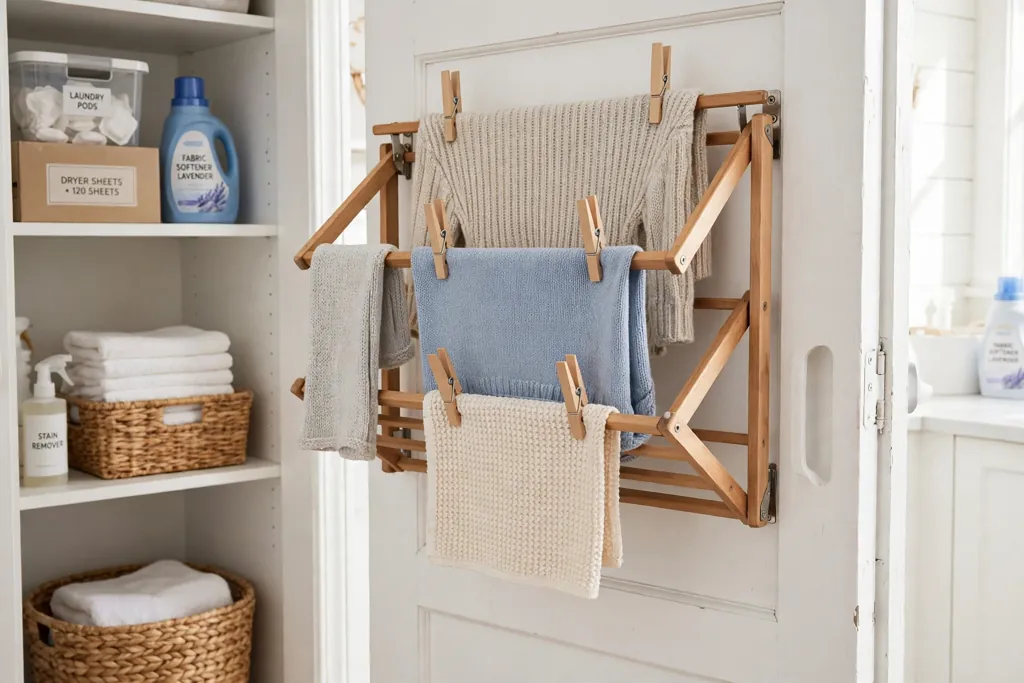
A foldable drying rack that hangs on the closet door gives delicates a flat drying surface without a floor rack. This suits a closet where a retractable line holds only hangers, since the rack holds flat items such as knits and swimwear. Hang the rack on a door you use less often, or on the inside face, so it does not block the main walkway.
Keep the rack shallow, so it does not hit the machines when the door closes, and hang only light items on it, so the door still latches. Wipe the rack rungs after use, since damp items can leave marks, and fold the rack flat when dry, so the door closes fully. Move the rack to a shelf if it rattles when the door moves, and add a small felt pad behind it.
19. Store a Step Stool on a Wall Hook
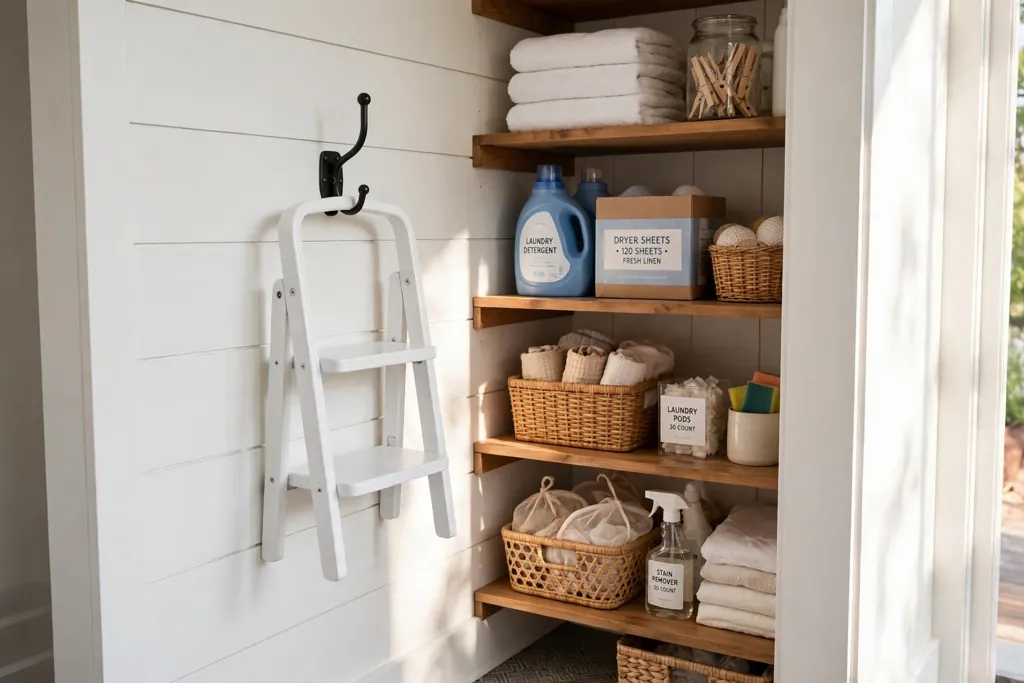
A small step stool on a wall hook keeps high shelves useful, since you can reach the top bin without dragging a chair into the closet. This suits a closet with a high shelf for spares, where the stool would otherwise sit on the floor and block the walkway. Hang the stool by its handle or leg on a sturdy hook fixed into a stud, at a height you can reach easily.
Choose a light, stable stool with non slip feet, and keep it clear of the machine doors and the door swing. Test the hook weight rating before you hang the stool, since a stool is heavier than it looks. Keep the stool in the same spot every time, so you always know where to find it, and check the hook now and then, since daily use can loosen fixings.
20. Run an LED Strip Under a Shelf
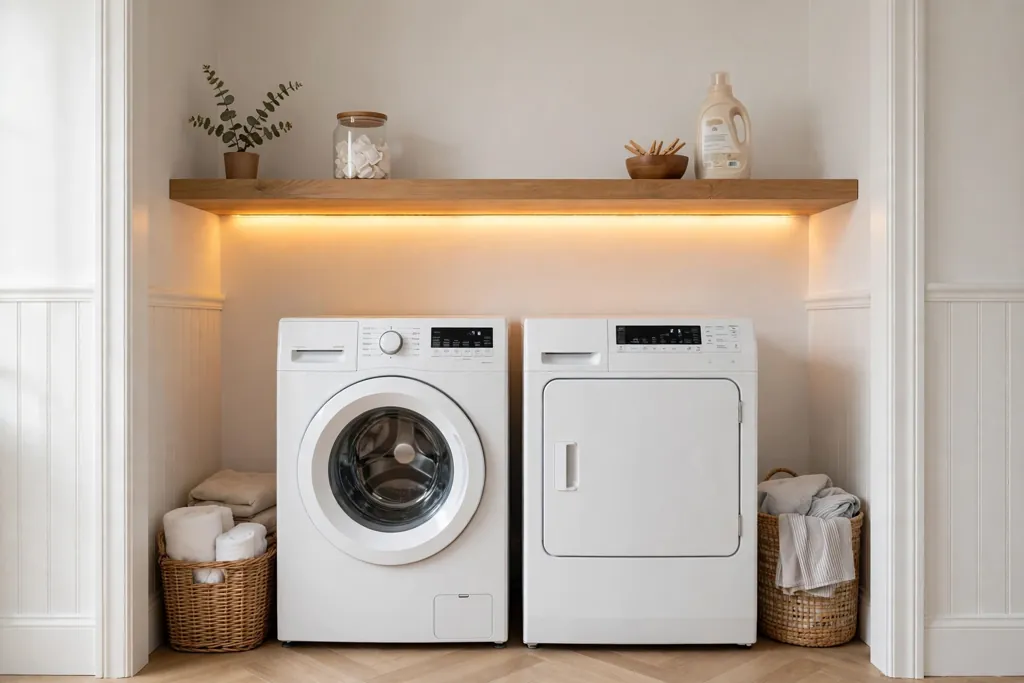
An LED strip under a shelf lights the machines and the folding area without a new ceiling fitting. This suits a closet that sits under a single dim bulb, where the shelf shadows the work surface below. A battery or plug-in strip with a warm white tone gives even light for stain checks and folding, and it makes labels on bins easier to read.
Fix the strip to the underside of the lowest shelf, clear of bottles and steam, and keep the cable tidy with small clips, so it does not dangle into the machines. Use a strip with a switch or a motion sensor, so the light is on only while you work. Wipe the strip now and then, since lint settles on horizontal surfaces near a dryer, and replace batteries promptly, so the closet does not go dim mid-load.
21. Swap Solid Doors for Louvered Doors
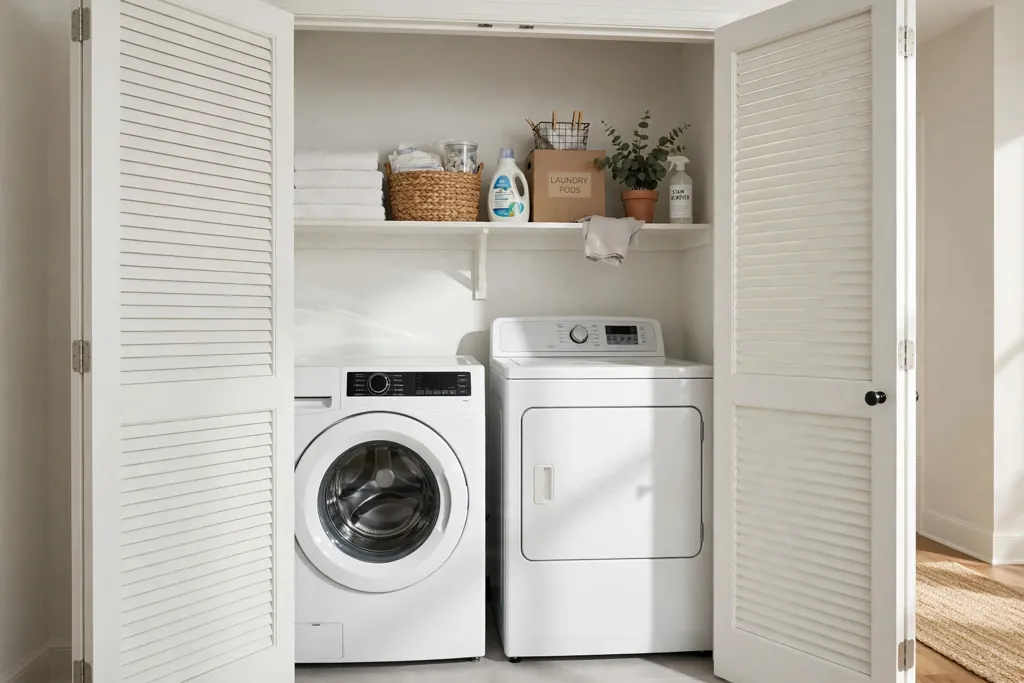
Louvered doors let air move through a laundry closet while still hiding machines and supplies. This suits a closet where solid doors trap heat and damp air, since the slats let the dryer vent and the room breathe. The slatted front also reads lighter than a flat door, which helps a narrow hallway feel less closed in.
Check that the louvered doors clear the machines and the door frame, and keep the slats clean with a dry cloth or a soft brush, since lint settles in the gaps. Keep the doors closed during a cycle for noise control, and open them after a load, so damp air clears. If new doors will not fit, a small vent grille cut into a solid door gives some of the same airflow with less work.
22. Hang a Curtain Front Instead of Doors
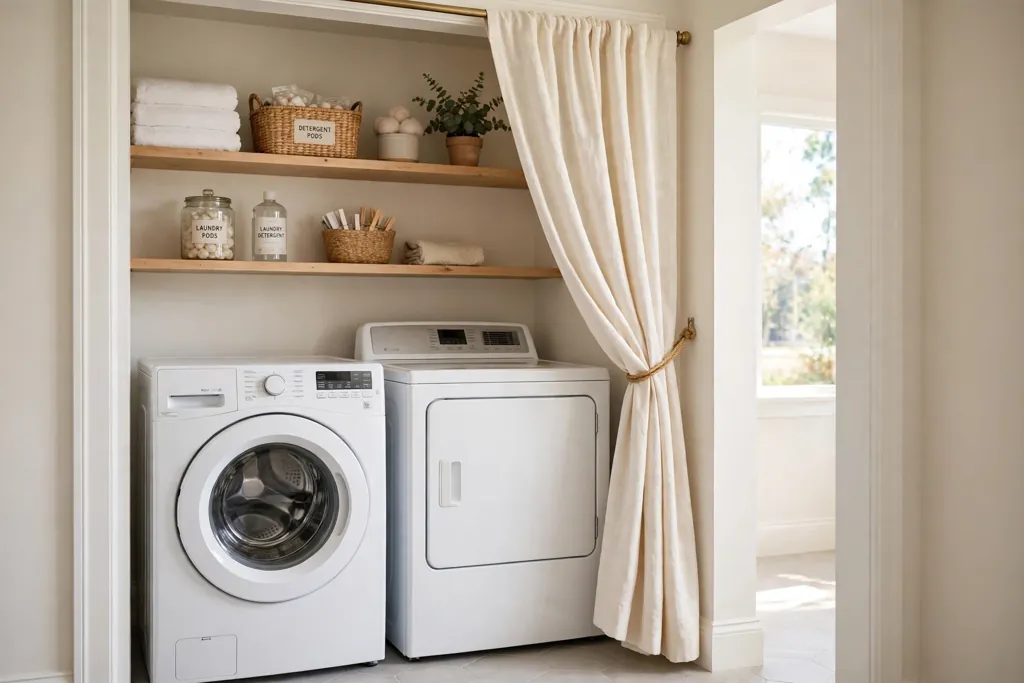
A curtain front replaces closet doors with a washable fabric panel that slides or ties back. This suits a closet where doors swing into a narrow hallway, since a curtain takes no swing space at all. A curtain in a plain, washable fabric also softens a hard hallway wall, and it comes down for washing when lint builds up.
Hang a slim rod or a ceiling track at the top of the opening, and let the curtain fall just past the sill of the opening, so it hides machines without dragging on the floor. Choose a fabric that handles steam and dust, and keep the curtain clear of the dryer vent and hot surfaces. Tie the curtain back while you load, so both hands stay free, and keep a spare panel, so the closet never goes bare on wash day.
23. Paint Light and Add a Peel-and-Stick Backsplash
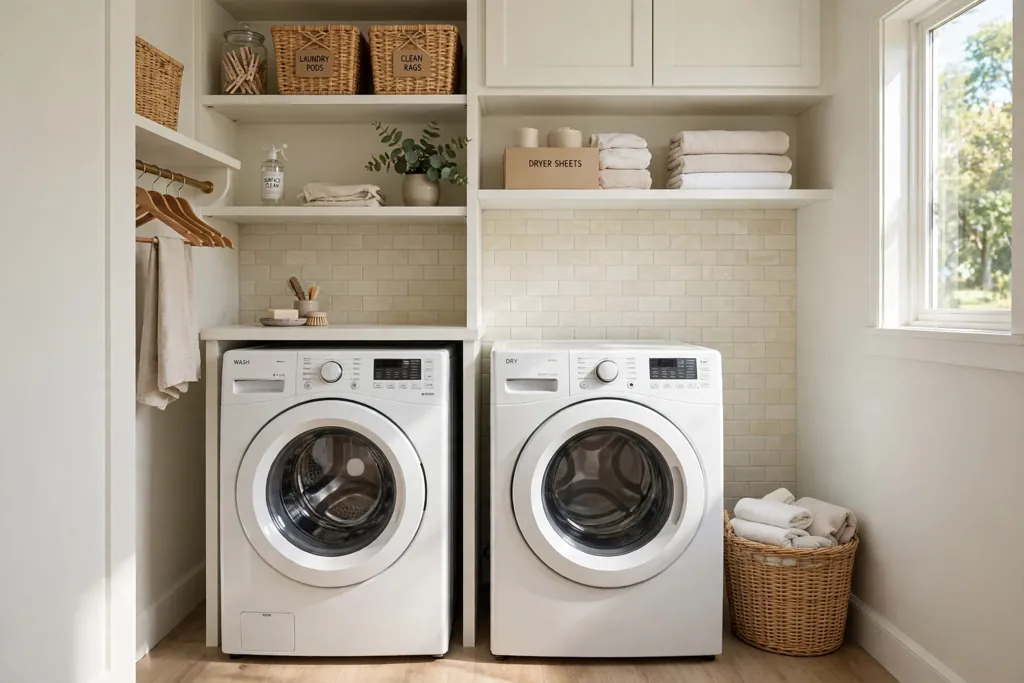
Light paint and a peel-and-stick backsplash behind the machines brighten a dark closet without a remodel. Pale walls reflect the shelf light, and a wipeable backsplash protects the wall behind the machines from splashes and lint. This suits a closet with bare or marked walls, where paint alone has not made the space feel cared for.
Paint the walls in a washable finish, and fit the backsplash panels on the wall behind the machines only, so the pattern stays a feature rather than a pattern everywhere. Press the panels firmly and trim them neatly around outlets and hose points, and keep the panels clear of hot dryer surfaces. For more ideas on making a small wet room feel larger, see these small bathroom space saving design ideas.
24. Slide a Rolling Basket Under the Counter
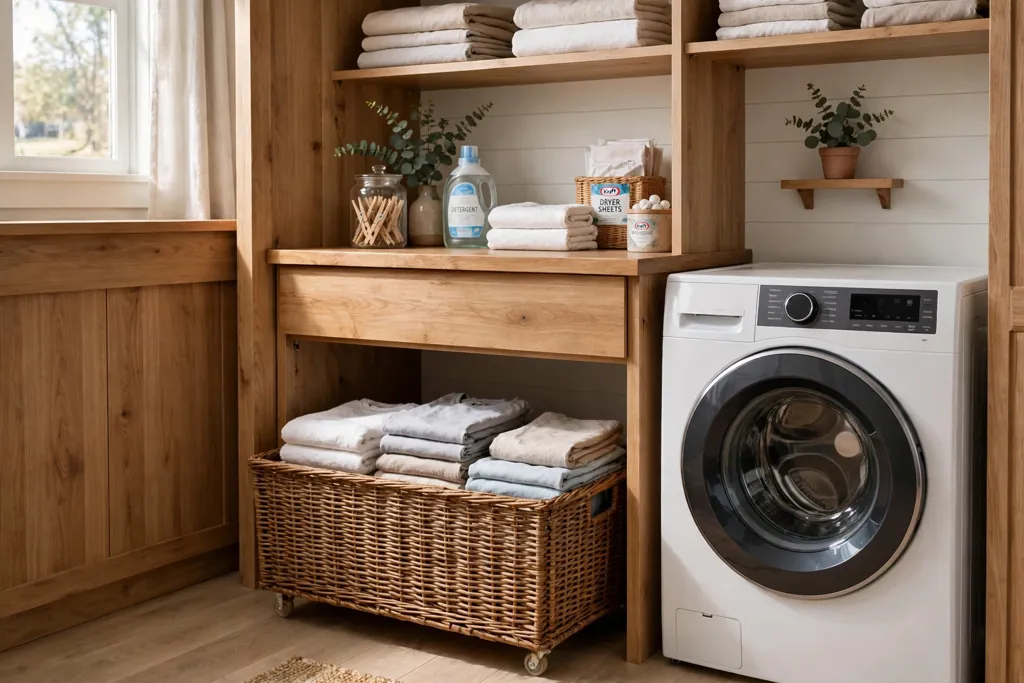
A rolling basket under a counter holds clean clothes ready for folding, and it slides out like a drawer when you need it. This suits a closet with a fixed or fold-down counter, since the basket uses the space below the work surface. Choose a low, wide basket with handles, so you can lift it out to carry folded clothes to the bedroom.
Keep one load in the basket at a time, not a pile, so it stays easy to pull out and easy to put back. Use a basket with a washable liner, so it stays clean between loads, and wipe under the counter often, since a basket under furniture collects lint. If the counter is low, use a flat basket that slides in without catching the counter edge.
25. Add Shelf Risers Inside a Deep Cabinet
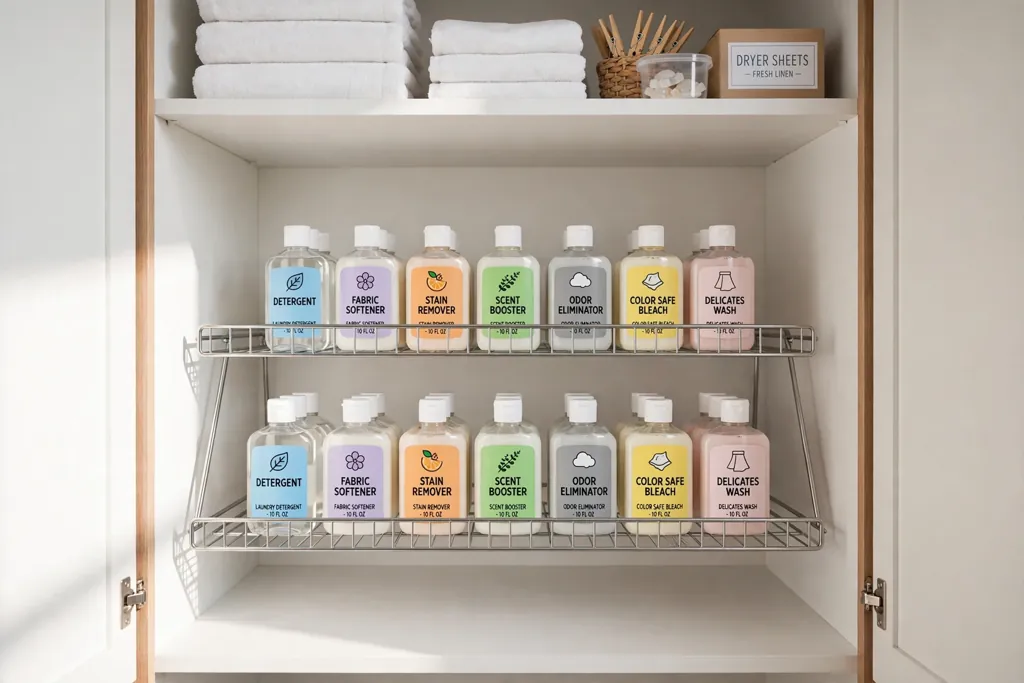
Shelf risers inside a deep cabinet create a second layer, so small bottles sit on the riser and taller bottles sit beside it, instead of hiding behind each other. This suits a closet cabinet with one tall shelf, where small items vanish at the back. A riser in metal or sturdy plastic lifts the back row into view, so you can see every bottle from the front.
Measure the cabinet height before you buy, and choose a riser that leaves room for the tallest bottle on the top layer. Group one job per riser, such as stain care on one riser and softener on another, and keep heavy bottles on the cabinet floor, not on a riser. Wipe the risers often, since a cabinet near machines collects lint, and move any riser that blocks the cabinet door from closing.
26. Fix a Wall-Mounted Dispenser and Spray Caddy
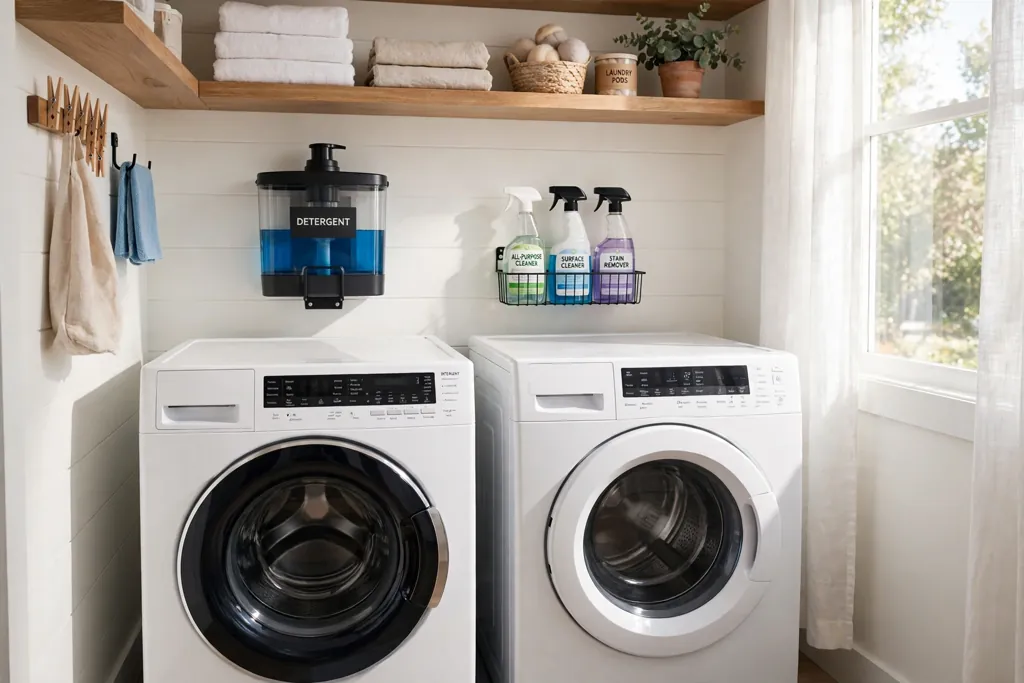
A wall-mounted dispenser for detergent and a small caddy for spray bottles keep daily liquids at hand height without a shelf full of bottles. This suits a closet where shelf space is taken by bins and jars, since the dispenser uses a small wall section beside the machines. Fill the dispenser with one product only, and label it in plain words, so no one mistakes it for another cleaner.
Fix the dispenser into a stud or use fixings rated for a full bottle, and keep the caddy below it for a stain spray and a lint roller. Wipe the dispenser nozzle and the caddy often, since drips gather there fast. Keep strong cleaners out of reach of small children, and keep the maker safety notes nearby, since decanted products need the same care as the original bottles.
27. Set Up a Lost-Sock and Lint Station
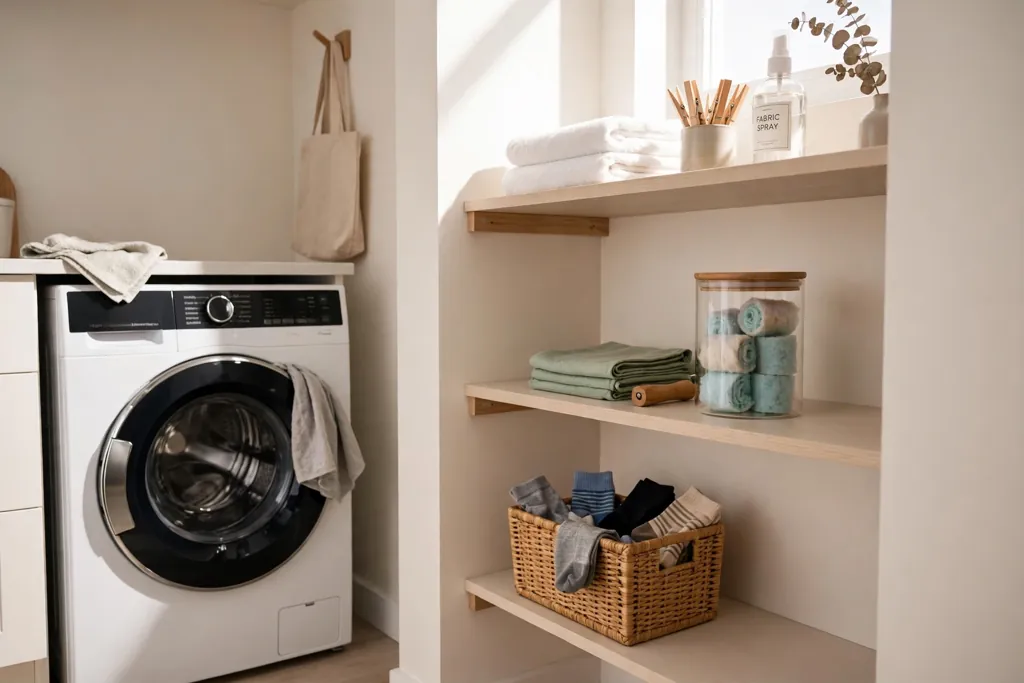
A lost-sock and lint station is a small bin for single socks and a jar for lint roller refills, fixed to a side wall or the inside of the door. This suits a closet where single socks pile on top of the dryer, since the station gives them a set home until a match turns up. A small mesh bag in the station can hold the socks, so they do not scatter.
Keep the station small, with one bin and one jar at most, so it stays a detail rather than clutter. Empty the sock bin each month, and move unmatched socks to a rag bag, so the station does not fill up. Wipe the bin and jar often, since lint settles near machines, and keep the station clear of vents and hot surfaces.
28. Hide Hoses and Cords Behind a Slim Cover
A slim cover panel hides washer hoses, dryer cords, and the vent run behind a neat front, while leaving access points for checks. This suits a closet where hoses and cords show from the doorway, since the cover turns a tangle into a clean wall. Use a removable panel or a hinged cover, not a sealed box, so you can still reach shut-off valves and check for leaks.
Fix the cover with screws or clips you can remove by hand, and leave a small gap at the bottom for air, so heat does not build up behind the panel. Check behind the cover each season for drips, dust, and lint, and keep the cover clear of hot dryer surfaces. Label the shut-off valve position on the outside of the cover, so you can find it fast if a hose ever leaks.
Conclusion
A small laundry closet works best when each job has a set spot and the floor stays clear. Stacked machines or a counter over front loaders free the main space, shelves and bins sort supplies by job, and the door, side gap, and high shelf carry the tools that would otherwise pile on the machines. Start with one change that fixes your biggest daily snag, then add the next idea only where space is still wasted. When every item has a clear home, wash day gets faster, the closet stays tidy, and every corner earns its place. Save this list for your next tidy-up, and try one new idea this week.
FAQs
How do I fit a washer and dryer in a very small laundry closet?
Measure the closet width, depth, door swing, and hose clearance first, then choose a stacked set or a compact side by side pair that leaves the maker clearance on each side. Stacking frees floor space for a cart or hamper, while side by side machines suit a wider closet with room for a counter above. Keep vents, shut-off valves, and controls easy to reach, and do not block airflow to fit an extra shelf.
What is the best way to store laundry supplies in a small closet?
Group supplies by job in labeled bins and clear jars, with daily items at hand height and spares on the high shelf. One bin for wash supplies, one for stain care, and one for cloths keeps the shelf tidy, and clear jars show stock levels at a glance. Keep heavy bottles low, keep strong cleaners out of reach of small children, and keep the maker safety notes nearby for any product you decant.
Can I add shelves above a washer and dryer safely?
Yes, if the shelves are fixed into studs or with fixings rated for the weight of full bottles, and the lowest shelf leaves room to open machine lids and reach controls. Keep heavy bottles on the lowest shelf, keep shelves clear of hot dryer surfaces, and leave a gap for vents and hoses. Check the shelf fixings now and then, since vibration from machines can loosen them over time.
How do I keep a small laundry closet from smelling damp?
Let air move through the closet with louvered doors, a vent grille, or an open door after a load, and wipe up drips promptly. Wash the hamper liners, the curtain, and the fabric shelf unit on a regular cycle, and air the closet out after wash day. Check hoses and the area behind the cover panel for slow leaks, since a small drip left unseen is the most common cause of a damp smell.
What drying options work in a laundry closet with no floor space?
A retractable line, a wall rail for hangers, and a foldable rack on the door all dry clothes without a floor rack. Use the line for light items, the rail for shirts on hangers, and the door rack for flat items such as knits. Hang items with a small gap between them, so air reaches each piece, and retract or fold each tool away after use, so the closet is back to full standing room.
How can renters organize a laundry closet without drilling?
Over-door pocket organizers, hooks with strong adhesive pads, a slim rolling cart, a hanging fabric shelf unit, and a curtain front all work without drilling. A magnetic caddy on a machine side and a rolling basket under a counter also add storage with no fixings. If you do fix a rail or a shelf, use fixings that suit the wall and keep the original fittings, so you can restore the wall when you leave.