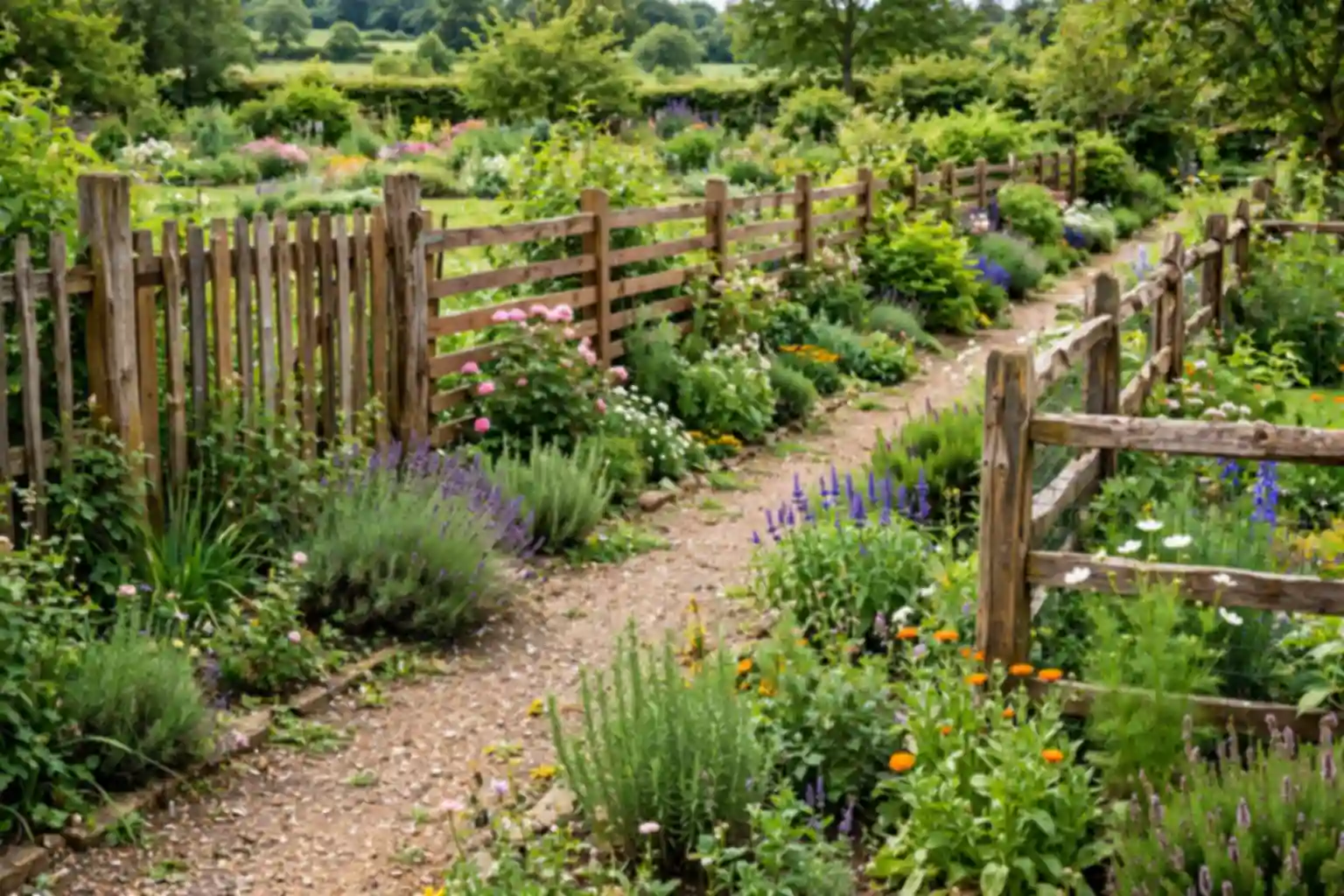
A fence does more than mark where your garden ends. It frames the view from the house, gives plants something to grow against, and decides how private a seating spot feels. The right fence can make a small garden feel settled and a large garden feel cared for, while the wrong one can block light, trap wind, or look out of place beside the house. These 29 garden fence ideas cover wood, metal, stone, bamboo, and living planting, for front gardens, back gardens, slopes, and small plots. Start with the job the fence must do, privacy, safety, a pet boundary, or a simple frame for planting, then pick a material and height that fits that job and your upkeep habits.
Key Takeaways
- Start with the job: privacy, a boundary, wind shelter, or a frame for plants, and let that job set the height and style.
- Check the boundary line, local height rules, and any shared fence agreements before you dig a post hole.
- Match the fence to the house: a cottage suits pickets and willow, a modern home suits horizontal slats and metal panels.
- Leave gaps for air and light where wind is strong, since a solid fence in an exposed spot takes more force than a slatted one.
- Plan planting with the fence, not after it, so climbers, hedges, and pots have room to grow without crowding paths.
- Budget for posts and fixings, not just panels, since strong posts and good drainage at the base decide how long a fence lasts.
1. Classic Vertical Board Fence
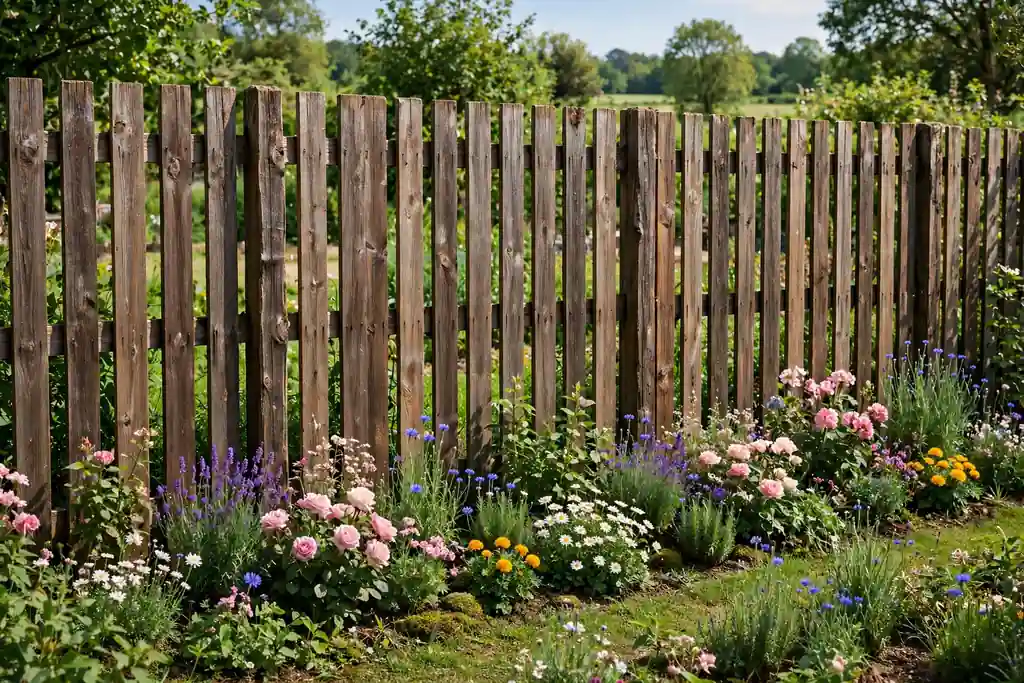
A vertical board fence is the workhorse of back gardens, and it suits almost any house style. Boards fixed upright to horizontal rails give full privacy, block a view of a busy road, and make a plain backdrop for planting. Choose close boards for privacy, or leave a small gap between boards if you want some air to pass through on a windy site.
Set posts in concrete or on gravel footings, keep the bottom board clear of soil, and use treated timber rated for outdoor use. A vertical board fence is easy to repair, since one damaged board can be replaced without taking down a whole panel. Paint or stain it in a color that suits the house, and re-coat it on the schedule the product label gives.
2. Horizontal Slat Fence for a Modern Look
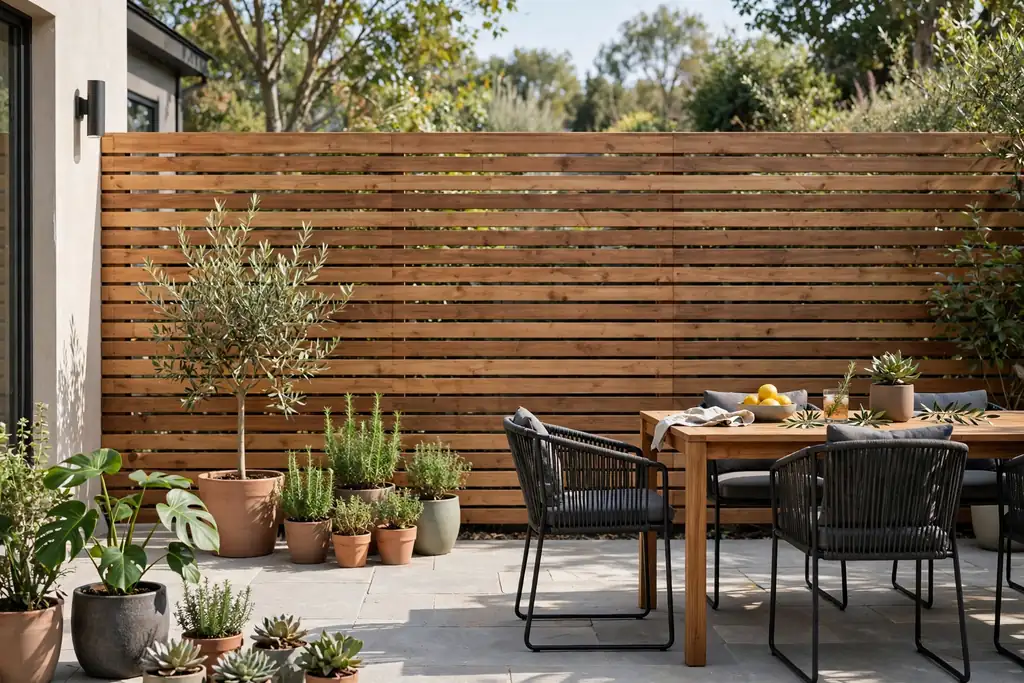
Horizontal slats give a garden a calm, current feel, with long lines that make a narrow garden look wider. Slats fixed to upright posts, with small gaps between them, let light and air through while still screening the view at sitting height. This style suits modern homes, patios, and gardens with clean planting and gravel paths.
Use boards of even width and keep the gaps consistent, since uneven gaps show up quickly on a long run. A darker stain makes the fence recede behind planting, while a pale wash keeps a small garden bright. Fix slats with stainless fixings to avoid rust stains, and plan a cap rail on top to protect the end grain from rain.
3. White Picket Fence for a Front Garden
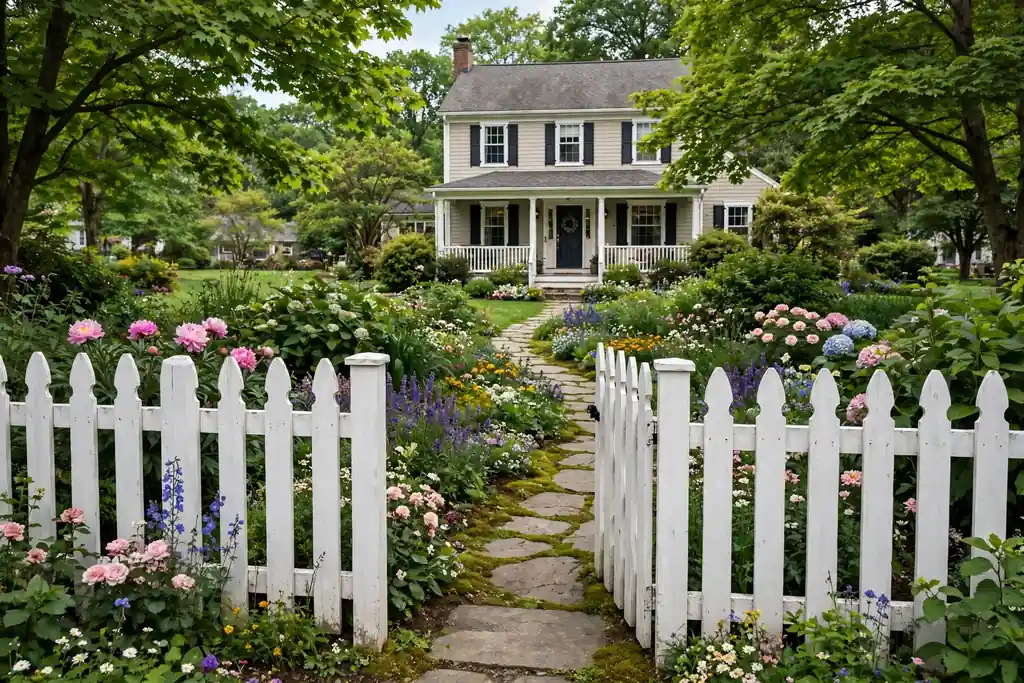
A white picket fence suits a front garden, a cottage, and any home where a friendly, open boundary matters more than full privacy. Short pickets with pointed or rounded tops mark the edge of the garden without hiding the planting behind them, and they frame a path to the front door. Keep the height low, usually around waist height, so the house still reads clearly from the street.
Paint pickets white or a soft cream, and check the paint each spring, since chips show up on white timber. Space pickets evenly and keep the gate in the same style, so the whole front reads as one design. Plant low flowers or a short hedge behind the pickets for color that does not hide the fence itself.
4. Lattice Top Fence for Light and Height
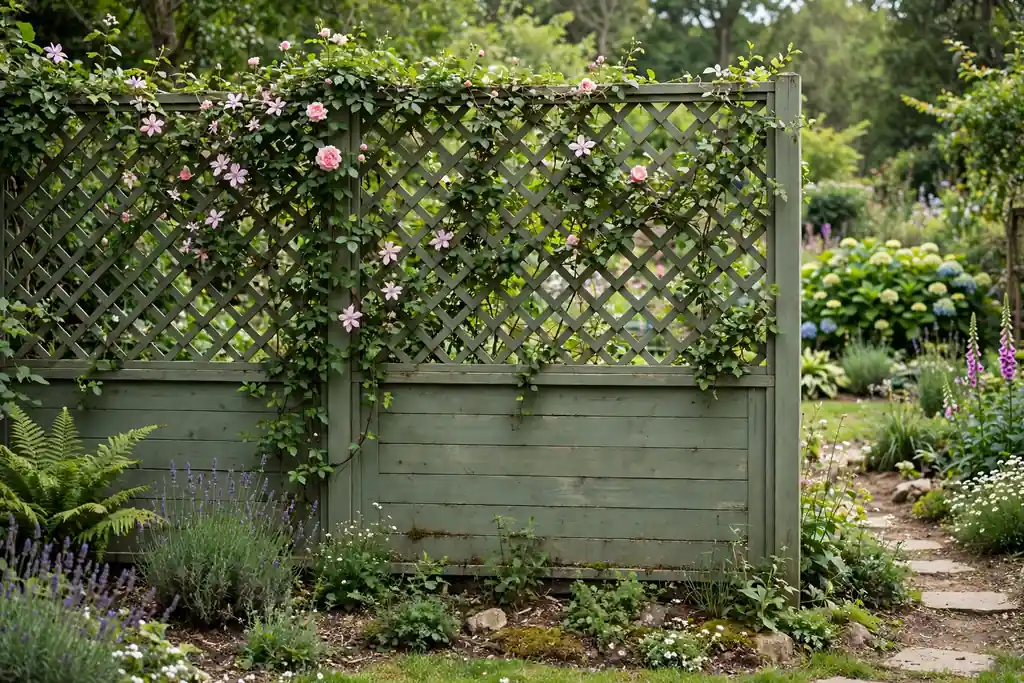
A lattice top adds height to a solid fence without making it feel like a wall. A solid lower section gives privacy at sitting height, while an open lattice section above lets light through and gives climbers a place to grow. This suits gardens where a taller fence is needed for privacy but a full height solid fence would feel heavy.
Train jasmine, clematis, or a light rose through the lattice, and prune it so it does not pull the lattice out of shape. Check local height rules before adding a lattice top, since the total height counts in many areas. A lattice top also suits a fence beside a patio, where extra height blocks a view from a neighboring window.
5. Living Hedge as a Fence
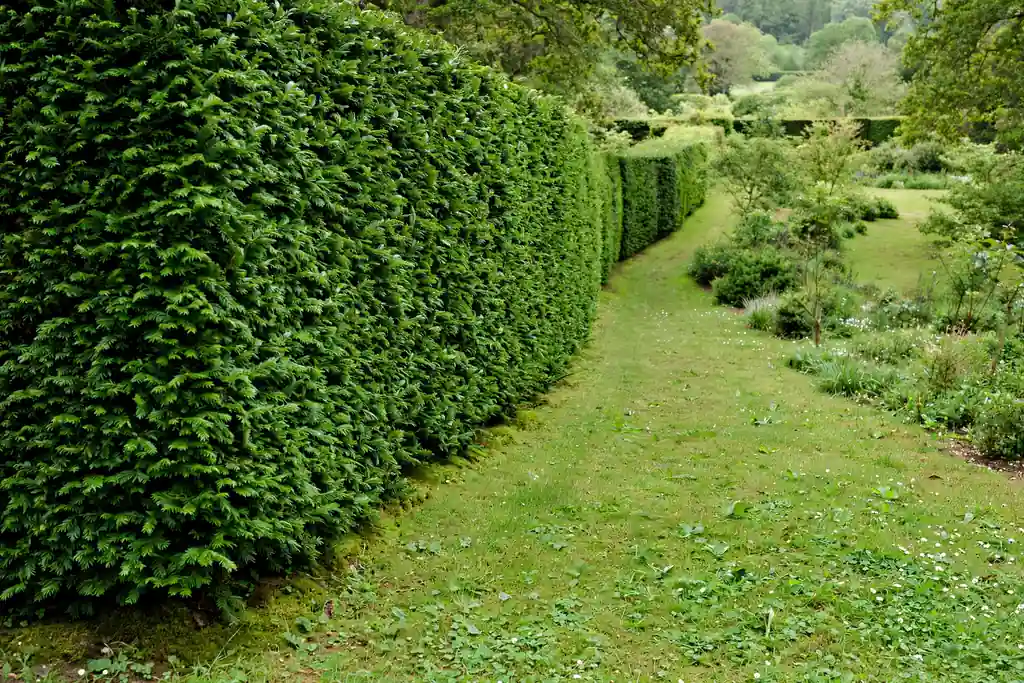
A hedge can do the job of a fence while adding scent, flowers, and food for birds. Evergreen hedges such as yew, privet, or holly give year round screening, while a mixed native hedge gives seasonal color and wildlife value. A hedge suits a garden where a hard fence would look harsh, and where you have room for roots and trimming.
Plant a hedge in a prepared trench with good soil, water it well in its first two years, and trim it little and often to keep it dense. A hedge takes longer to reach full height than a built fence, so use a temporary mesh fence inside the line if you need a boundary right away. Keep the hedge clear of paths and gates so it does not block access as it grows.
6. Woven Willow Hurdle Fence
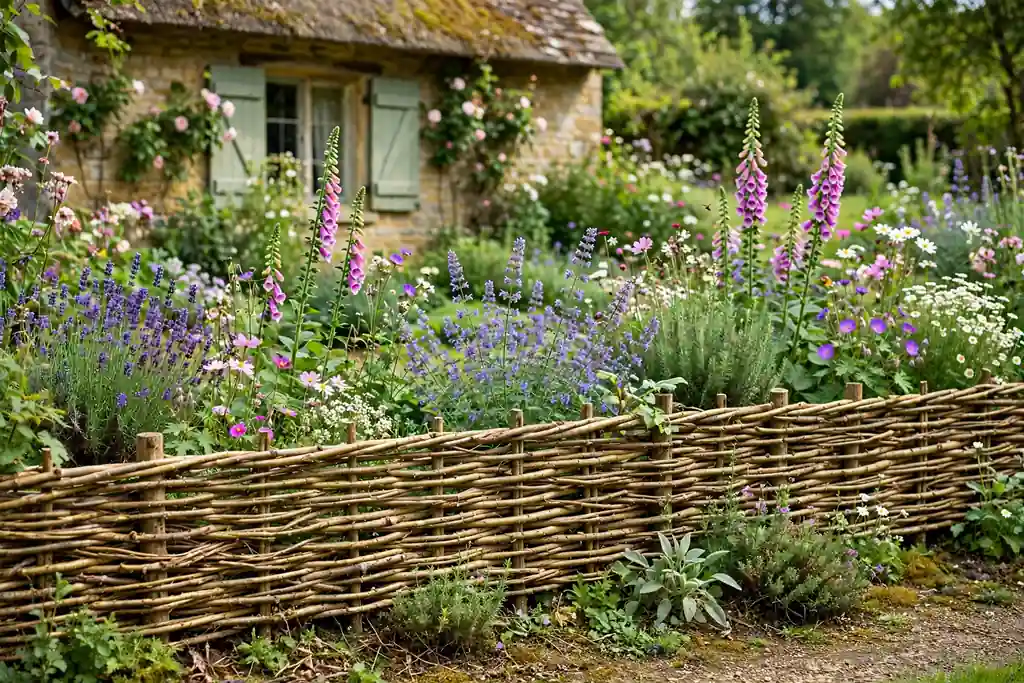
Woven willow hurdles give a garden a soft, rustic edge that suits cottage gardens, vegetable plots, and informal borders. Willow rods woven between uprights make a light, flexible panel that breaks wind without blocking it fully, which helps in exposed gardens. Hurdles are light to handle, so they suit a fence you may want to move or replace as the garden changes.
Fix hurdles to sturdy posts, since willow alone will not hold up in strong wind. Willow weathers to a soft grey, and a hurdle usually lasts several years before it needs replacing, so treat it as a medium term fence rather than a permanent one. Use hurdles to screen a compost area, edge a vegetable garden, or divide a large garden into smaller rooms.
7. Bamboo Fence Panels
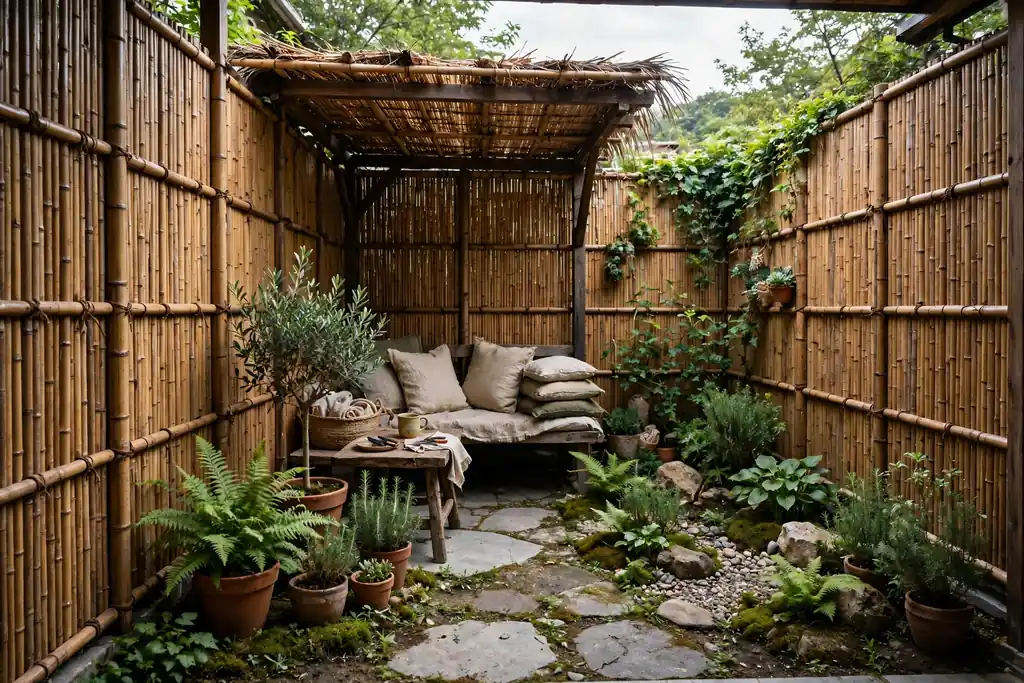
Bamboo panels give quick privacy with a warm, natural look that suits tropical planting, Asian inspired gardens, and sheltered courtyards. Rolled bamboo or framed bamboo panels fix to posts and screen a view in a day, which makes them a good choice for a rented home or a garden that needs a fast change. Bamboo suits a small garden because its fine texture does not feel heavy.
Fix panels to a frame rather than tying them to a single rail, and keep the bottom clear of standing water, since bamboo rots when it stays wet. In a windy spot, use bamboo as a screen inside a stronger frame, not as the only structure. Pair bamboo with ferns, grasses, and a stone path for a calm, planted feel.
8. Corrugated Metal Fence
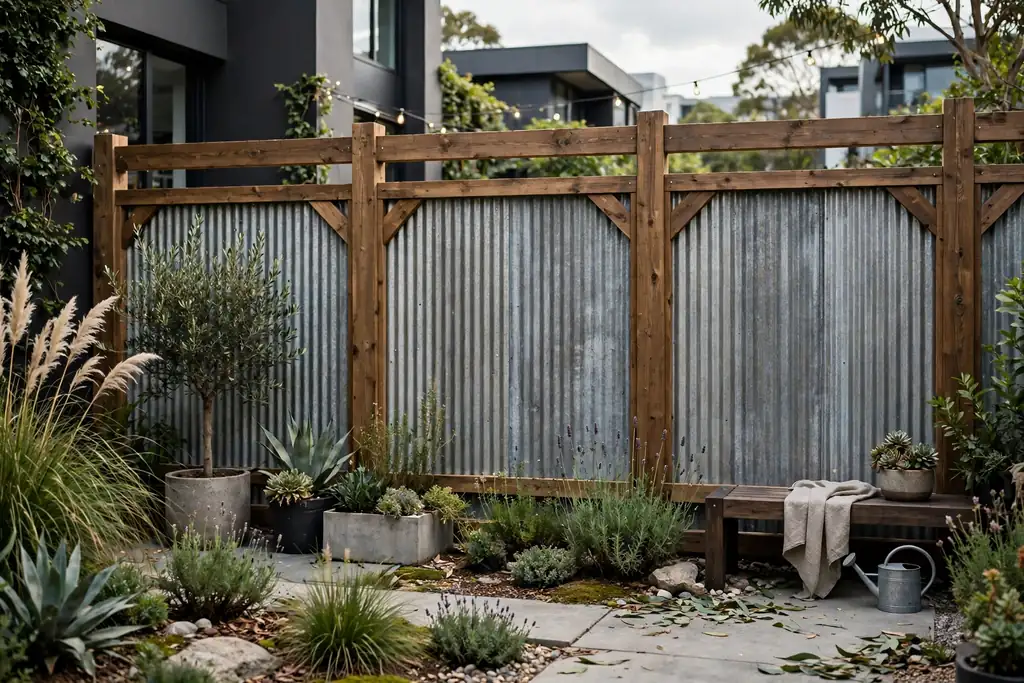
Corrugated metal panels give a strong, low upkeep fence with an industrial edge that suits modern homes and urban gardens. Metal panels need little painting, resist rot, and give full privacy from day one. Use them in a frame of timber or steel posts so the edges stay safe and the panels stay flat in wind.
Choose a color coated panel if you want a softer look, or a plain galvanized finish for a workshop style garden. Keep metal clear of soil at the base to slow rust, and add a timber cap rail to finish the top edge. A corrugated fence also makes a good backdrop for bold planting, since its simple lines do not compete with leaves and flowers.
9. Corten Steel Fence
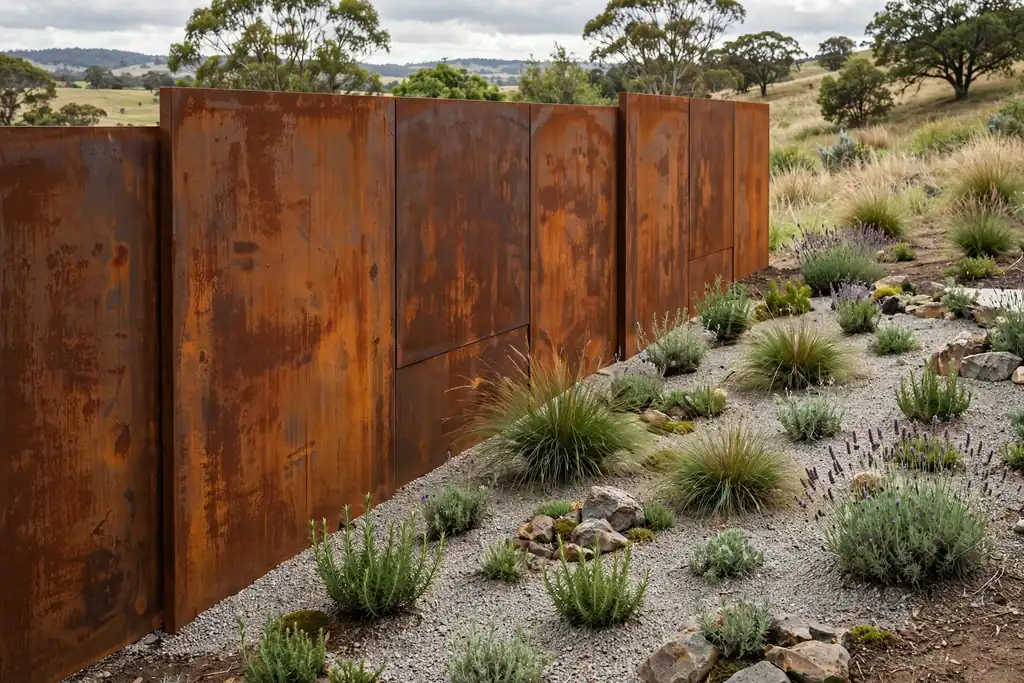
Corten steel, also called weathering steel, forms a rust colored surface that protects the steel beneath it. It suits modern gardens, gravel planting, and homes with brick or stone, where its warm orange brown tone echoes autumn leaves and clay pots. Corten panels give full privacy and need no paint, which keeps upkeep low once the surface has settled.
Allow the steel to weather before planting close beside it, since rust runoff can stain paving in the first months. Use a gravel strip or a stone edging at the base to catch runoff and protect paths. Fix panels to strong posts, and keep the design simple, since the material itself is the feature.
10. Low Stone Wall with a Fence Above
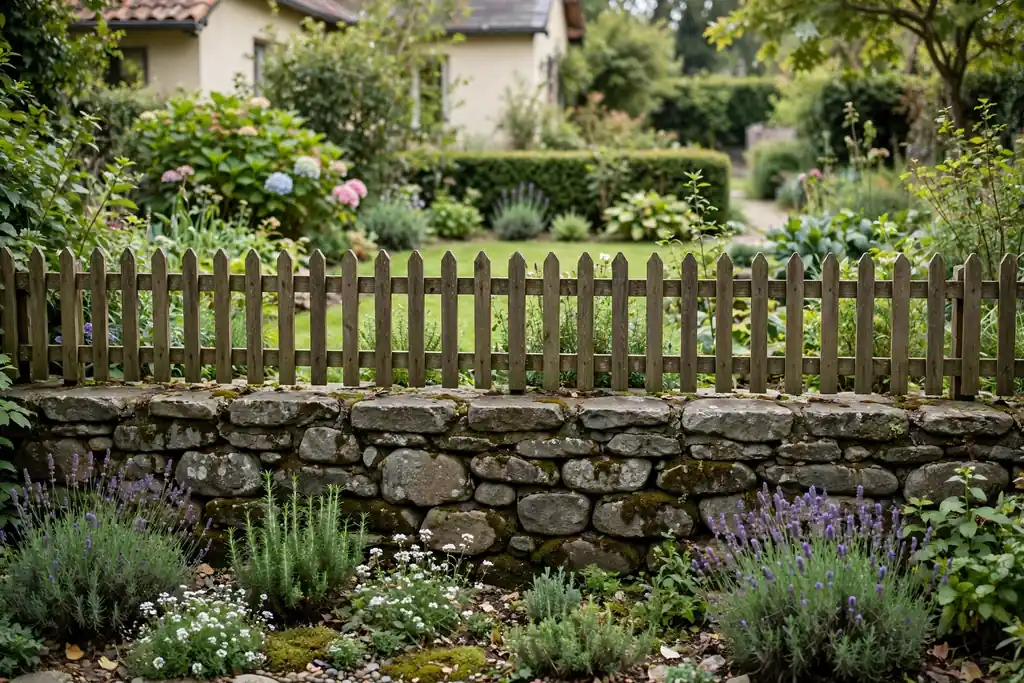
A low stone wall topped with a short fence gives a garden structure at ground level and privacy above, without a tall, heavy wall. Stone suits a front garden, a sloping site, and any home where a solid base already exists. Build the wall to a comfortable sitting or planting height, then fix a timber or metal fence to posts set into the wall or behind it.
Keep the wall footing below frost level where frost is a risk, and leave drainage gaps so water does not build up behind the stone. Plant low shrubs or trailing plants at the base to soften the stone, and use the wall top as a seat or a shelf for pots. For a dedicated seat beside a boundary, these garden bench ideas show how to pick the spot first and match the seat to it. This combination also suits a garden on a slope, where the wall levels the ground and the fence follows the top line.
11. Trellis Fence for Climbing Plants
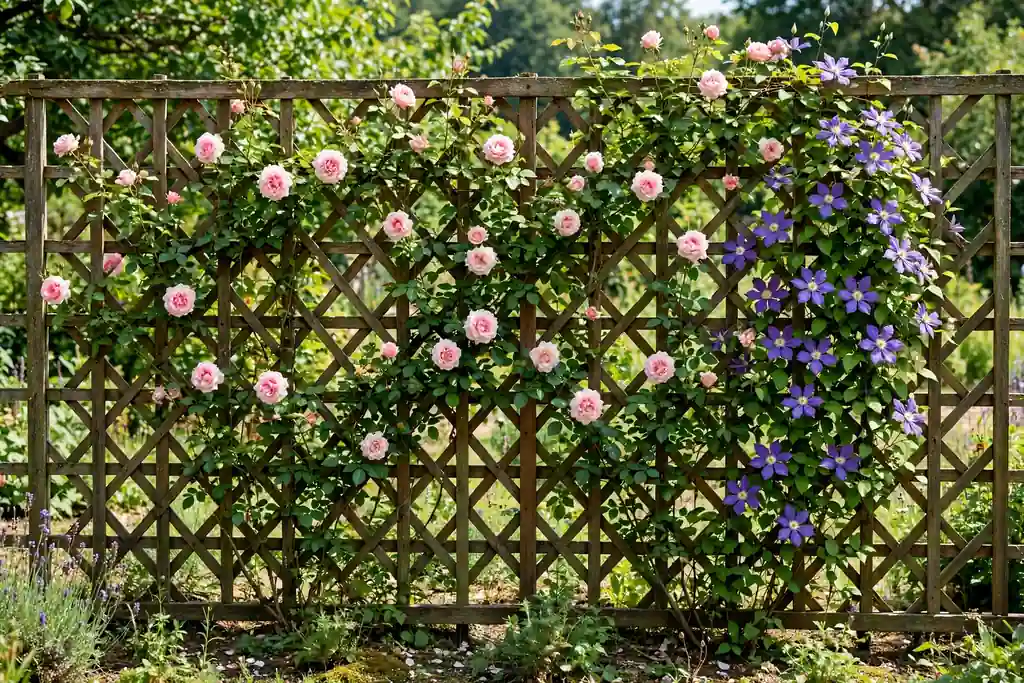
A trellis fence is a frame for planting first and a boundary second. Open trellis panels let light through, give roses, clematis, jasmine, and sweet peas a place to climb, and turn a plain boundary into a green wall in summer. This suits a garden where you want privacy in the growing season but light in winter, when climbers are bare.
Fix trellis to posts with a gap behind it so air can move and the fence can dry. Choose a trellis with a mesh size that suits the climber, small mesh for sweet peas, larger mesh for roses. Tie stems loosely as they grow, prune after flowering as the plant type requires, and keep climbers clear of gates and locks.
12. Espalier Fruit Tree Fence
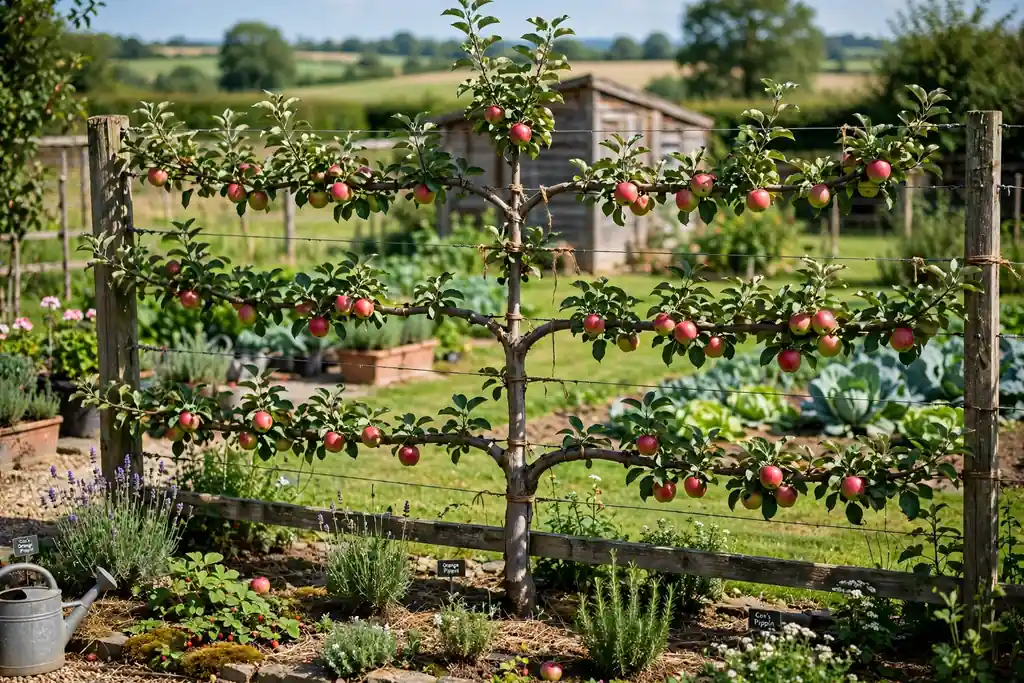
Espalier fruit trees trained along wires or a frame make a living fence that also gives fruit. Apples and pears trained flat against a wire fence suit a sunny boundary, a vegetable garden edge, and a small garden where a tree would take too much room. The flat shape keeps the trees easy to prune, pick, and spray, and it looks neat all year.
Set posts at regular intervals, run wires at the heights you plan to train branches to, and plant one tree per bay. Prune in summer to keep the shape flat and open, and thin fruit so branches do not break under weight. An espalier fence needs sun and good air flow, so avoid a shaded, damp boundary for fruit trees.
13. Gabion Fence Wall
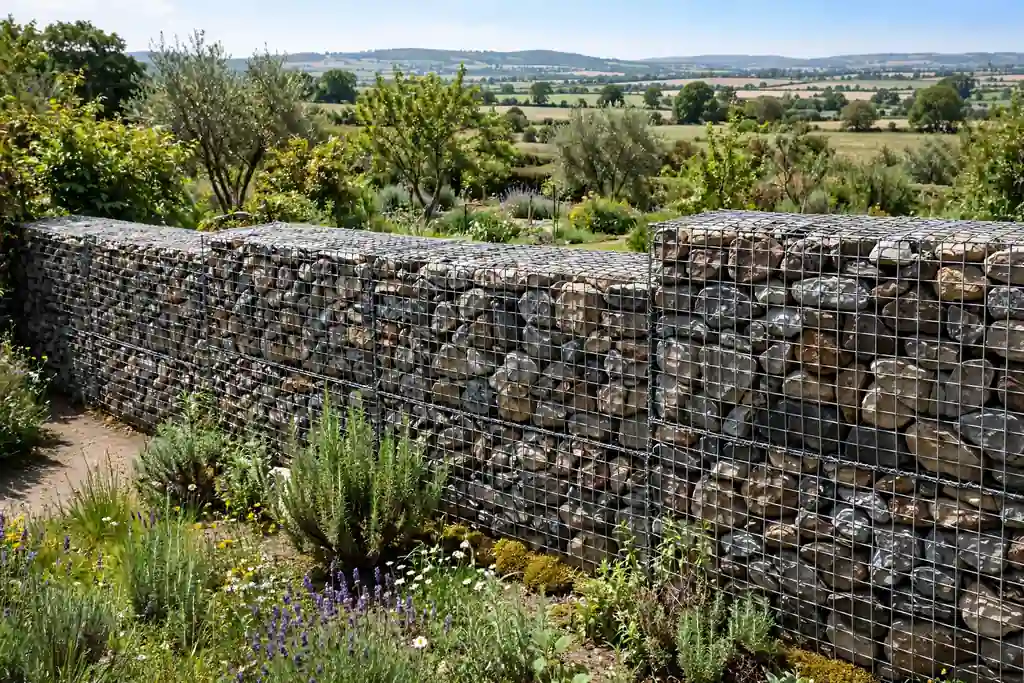
Gabion baskets filled with stone make a strong, free draining fence that suits modern gardens, drive edges, and slopes. Wire baskets packed with stone give full privacy, block sound better than a thin panel, and need little upkeep once filled. Gabions suit a garden where stone is already part of the local landscape, or where a solid wall would need heavy footings.
Fill baskets in layers, packing the face stones neatly so the front looks tidy, and use smaller stone in the middle so the basket stays full. Cap the top with a flat stone or timber board for a finished edge, and wear gloves when handling cut wire. Keep gabions level as you build, since a tilted basket is hard to correct once it is full of stone.
14. Angled Louver Fence for Privacy and Air
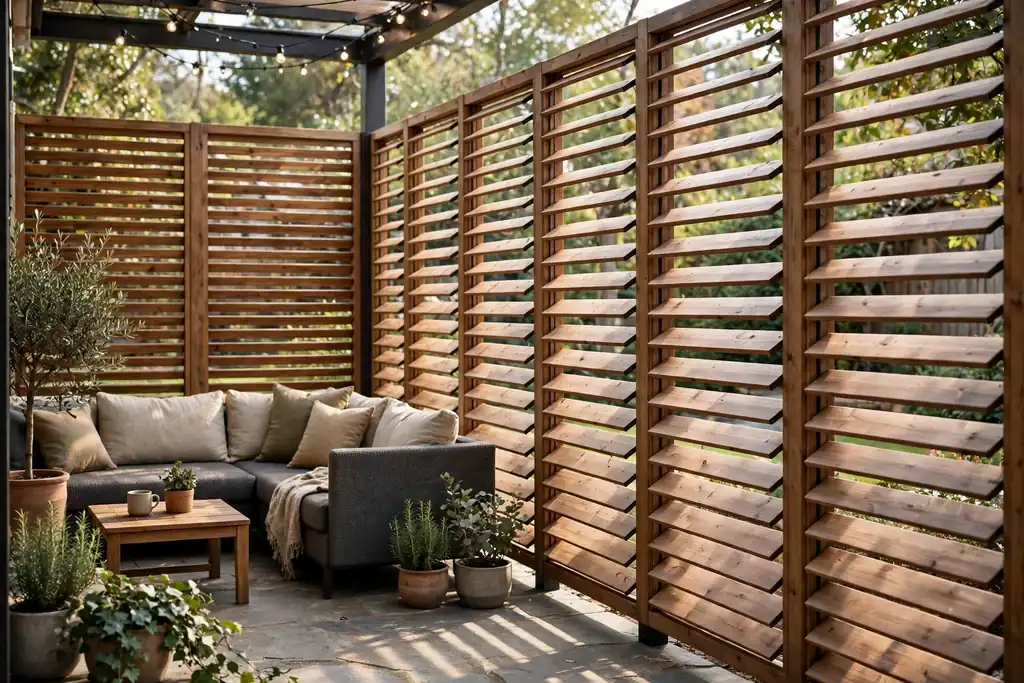
Angled louver boards let air pass through a fence while blocking a direct view, which makes them a smart choice for a windy garden or a patio that needs privacy without still air. Boards fixed at an angle, like a vent, screen the view from ground level and from a neighboring window, while still letting a breeze through. This suits a seating area, a hot courtyard, and a fence beside a path where air flow matters.
Keep the angle and spacing even across the run, since the effect depends on consistency. A louver fence works well in timber or metal, and a darker finish makes the angled boards read as one calm surface. Check the view from both sides before fixing boards, since the angle that blocks a view from one side may open it from the other.
15. Painted Picket Fence in Color
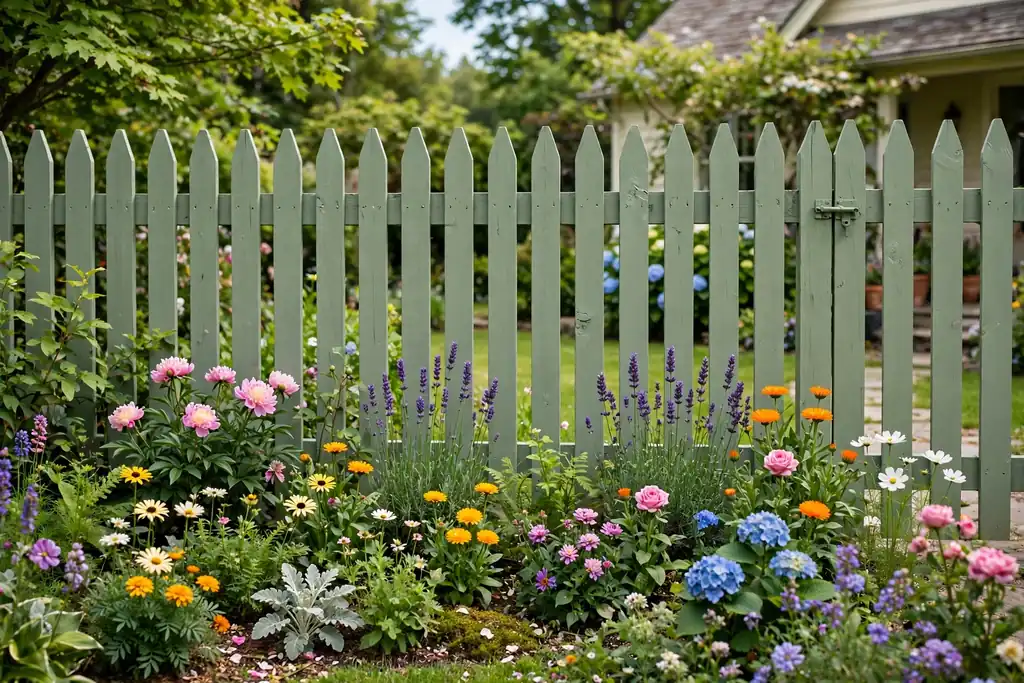
A picket fence does not have to be white. Sage green, soft blue, warm grey, or a muted terracotta can tie a fence to the house color, the front door, or the planting beside it. A colored picket fence suits a front garden that needs personality without a tall, closed boundary, and it photographs well from the street.
Test the color on one picket in daylight before painting the whole run, since colors look darker on a large area than on a sample card. Use exterior paint made for timber, prepare the wood well, and keep a small pot of the same paint for touch ups. Repeat the color once more in the garden, on a gate, a bench, or pots, so the fence feels part of the whole design.
16. Rustic Split Rail Fence
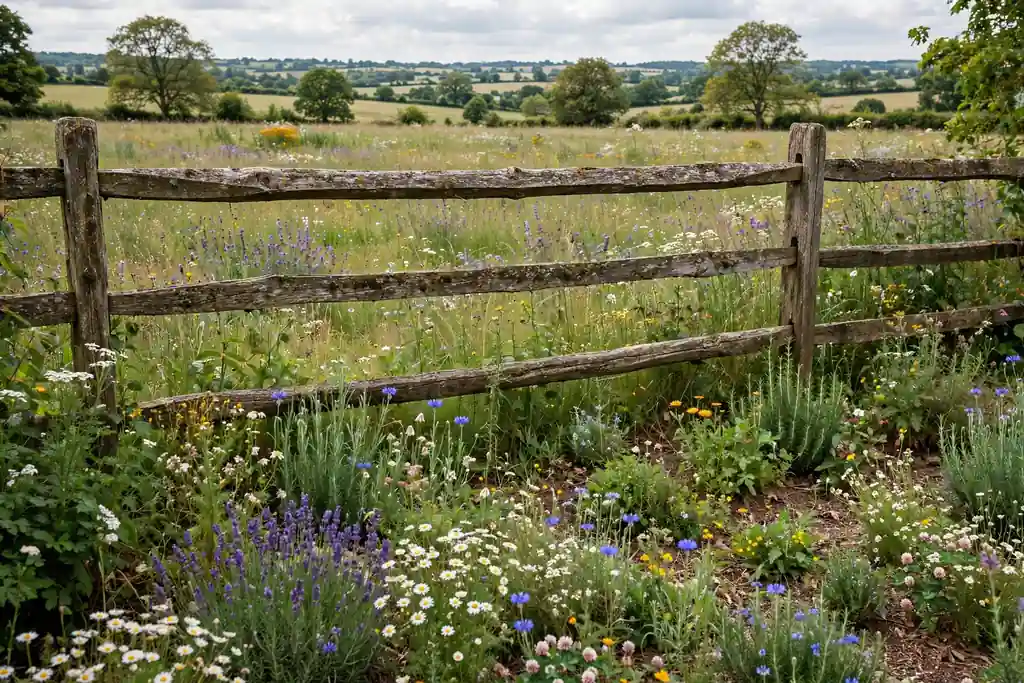
A split rail fence suits a country garden, a large plot, and any boundary where marking the edge matters more than blocking the view. Rough timber rails fixed between posts give an open, informal line that fits meadows, orchards, and vegetable gardens. Split rail fences are quick to build, use simple materials, and leave room for planting to grow through and over them.
Space posts evenly, keep rails level, and use two or three rails per bay depending on the height you need. A split rail fence will not contain small pets or give privacy, so pair it with a hedge or wire mesh if you need either. Let the timber weather naturally, or oil it lightly to slow greying if you prefer a warmer tone.
17. Wood Frame with Wire Mesh
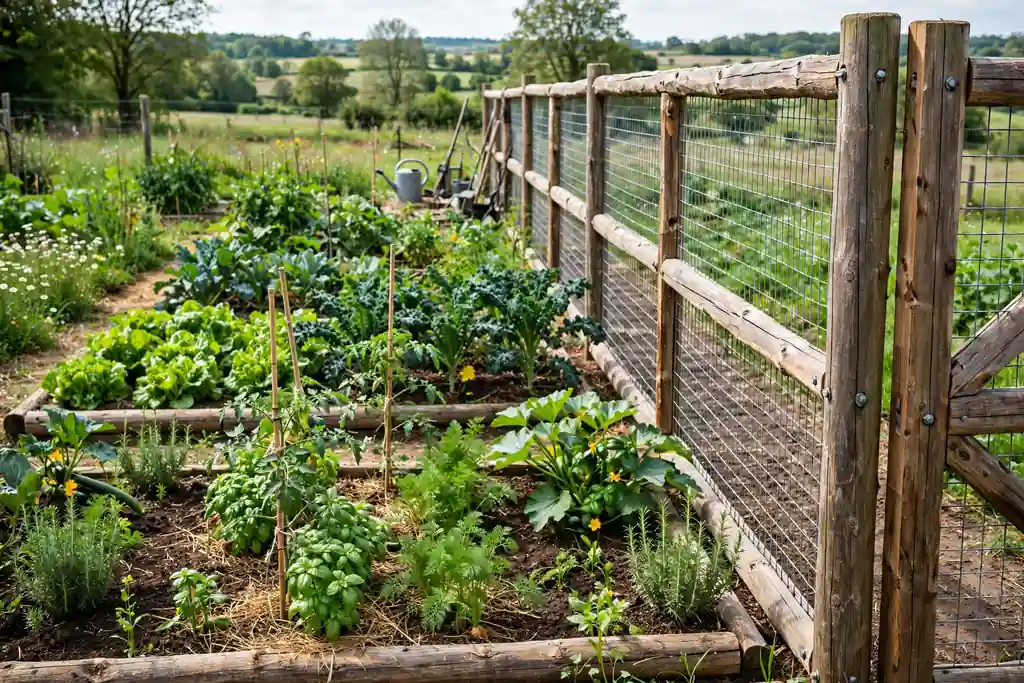
A timber frame filled with wire mesh gives a strong, see through fence that suits vegetable gardens, dog runs, and gardens where a view matters. The frame gives structure and a finished look, while the mesh keeps pets in and rabbits out without blocking light or a view of the landscape beyond. This suits a garden on a slope or at the edge of open land, where a solid fence would hide the view.
Choose mesh with a gauge and opening size that suits the job, smaller openings for small pets, larger openings where you only need a boundary. Fix mesh tightly to the frame and bury the bottom edge or add a board at the base to stop animals digging under it. Paint or stain the frame to match other timber in the garden, and keep climbers off the mesh if you need the fence to stay see through.
18. Reclaimed Wood Fence
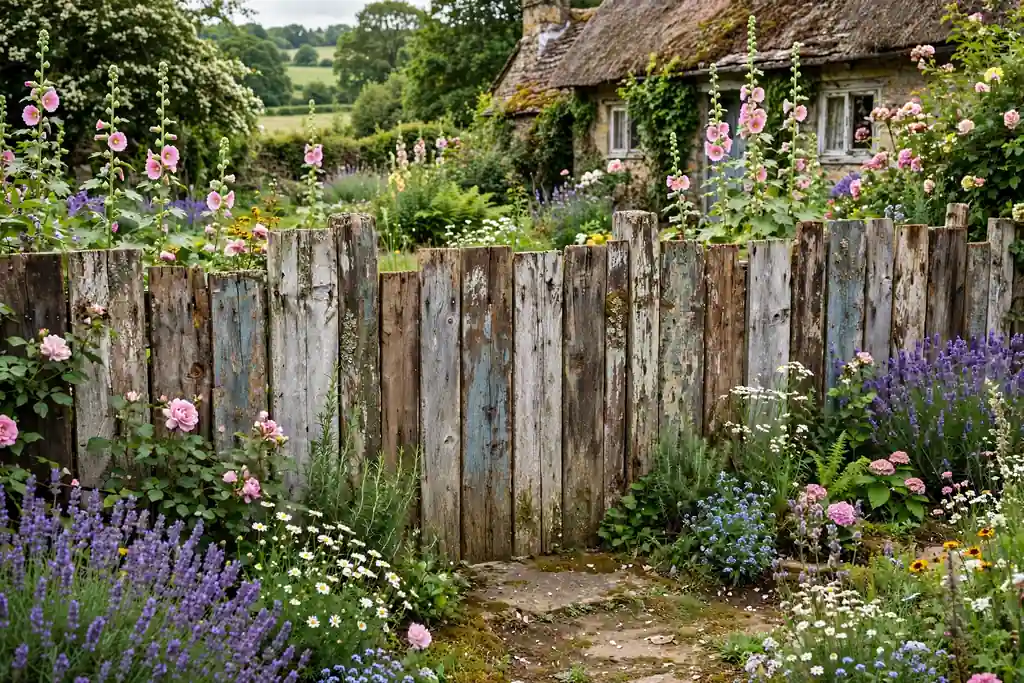
A fence built from reclaimed boards, old doors, or salvaged timber gives a garden character that new timber cannot match. Varied boards, weathered colors, and old nail marks suit a cottage garden, a creative plot, and any garden where a one of a kind boundary is the point. Reclaimed wood also keeps usable timber out of waste, which suits a garden built with reuse in mind.
Check reclaimed boards for rot, old paint, and protruding nails before use, and avoid timber that may have been treated with chemicals you do not want near planting or pets. Mix board widths in a planned pattern rather than at random, so the fence looks deliberate rather than patched. Seal the timber as needed, and plan to replace individual boards as they age, since reclaimed boards will not all last the same time.
19. Fence with Built In Planters
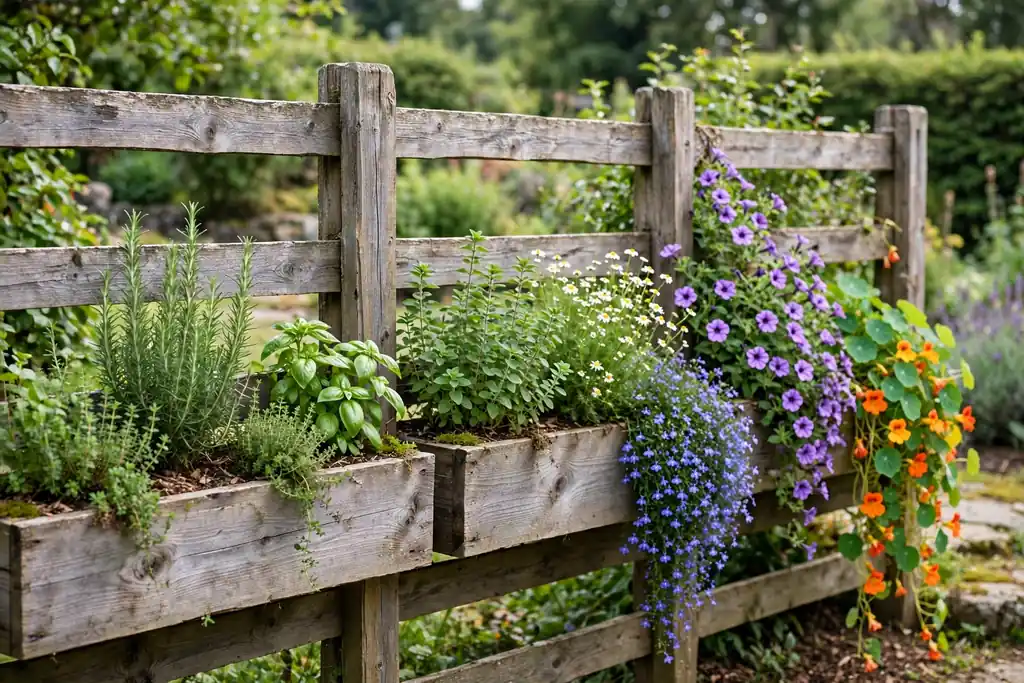
A fence with planters built into its face or top turns a boundary into a growing space. Planter boxes fixed to a fence suit a small garden, a patio, and a rental where beds are limited, since they use vertical space that would otherwise sit empty. Grow herbs, trailing flowers, strawberries, or small salads in fence planters, and change the planting with the seasons.
Fix planters to posts, not just to panels, so the weight of wet soil does not pull the fence out of shape. Line planters, add drainage holes, and water them more often than beds, since small planters dry out fast. Keep planters clear of gates and locks, and avoid planting that will grow into a neighbor’s side without agreement.
20. Arched Gate as a Garden Feature
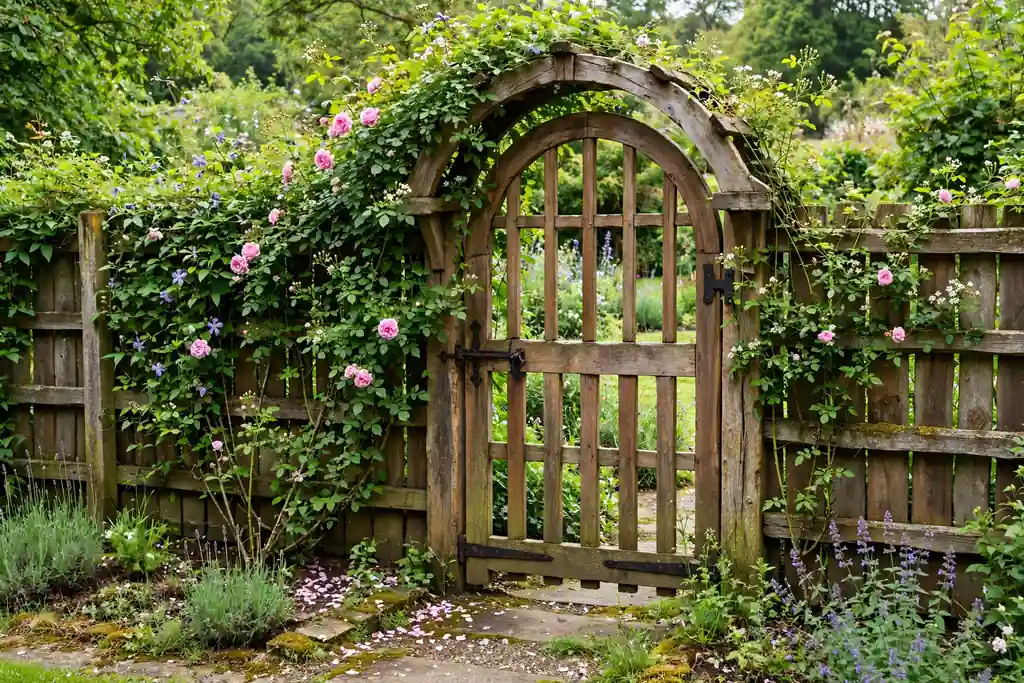
A gate can be the best part of a fence, not just a gap in it. An arched top, a decorative frame, or a gate painted a bold color turns an entry into a feature and gives visitors a clear signal to come in. This suits a front garden, a path between garden rooms, and any fence where the gate is the first thing people see.
Build the gate frame to match the fence, hang it on strong posts with good hinges, and keep the latch easy to use with one hand. Plant climbers on the posts beside the gate, but keep stems clear of hinges and the latch. A gate that swings freely, closes cleanly, and matches the fence makes the whole boundary feel well made.
21. Decorative Iron Fence
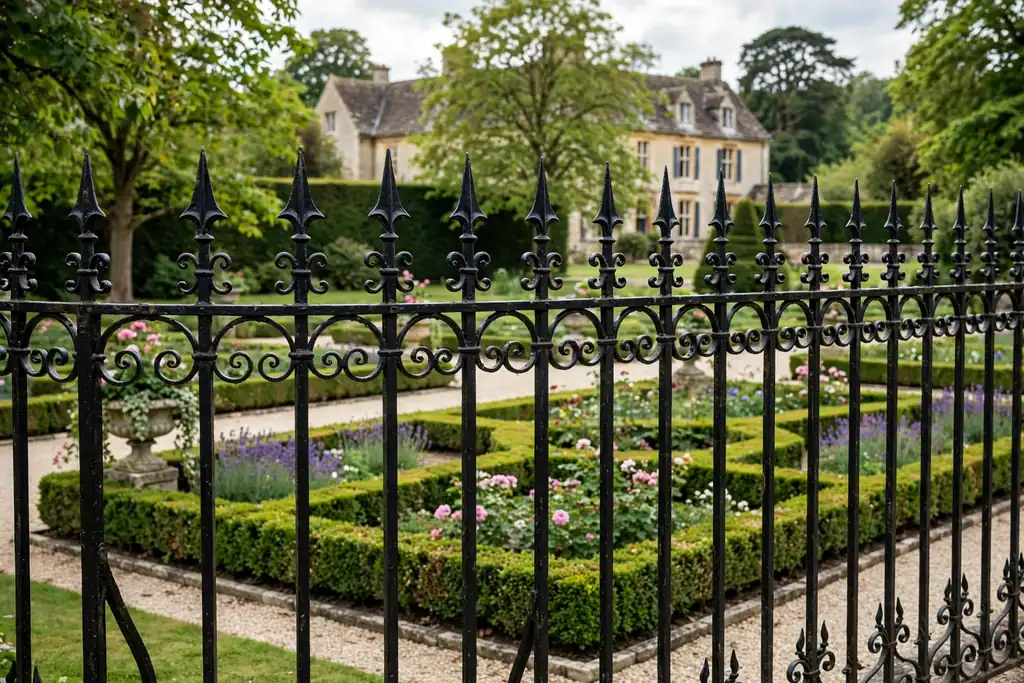
A decorative iron fence suits a formal front garden, a period home, and any boundary where you want to see through the fence rather than hide behind it. Iron railings with finials, scrolls, or a simple spear top give a garden a finished, classic edge, and they last for decades with basic care. Iron suits a front garden because it marks the boundary clearly while keeping the house and planting visible from the street.
Set iron panels on a low wall or on stone piers for a formal look, and paint them in black, dark green, or a color that matches the house trim. Check for rust each spring and touch up paint where it has chipped, since rust spreads fast once it starts. Keep planting clear of the railings so leaves do not trap damp against the metal.
22. Shadowbox Privacy Fence
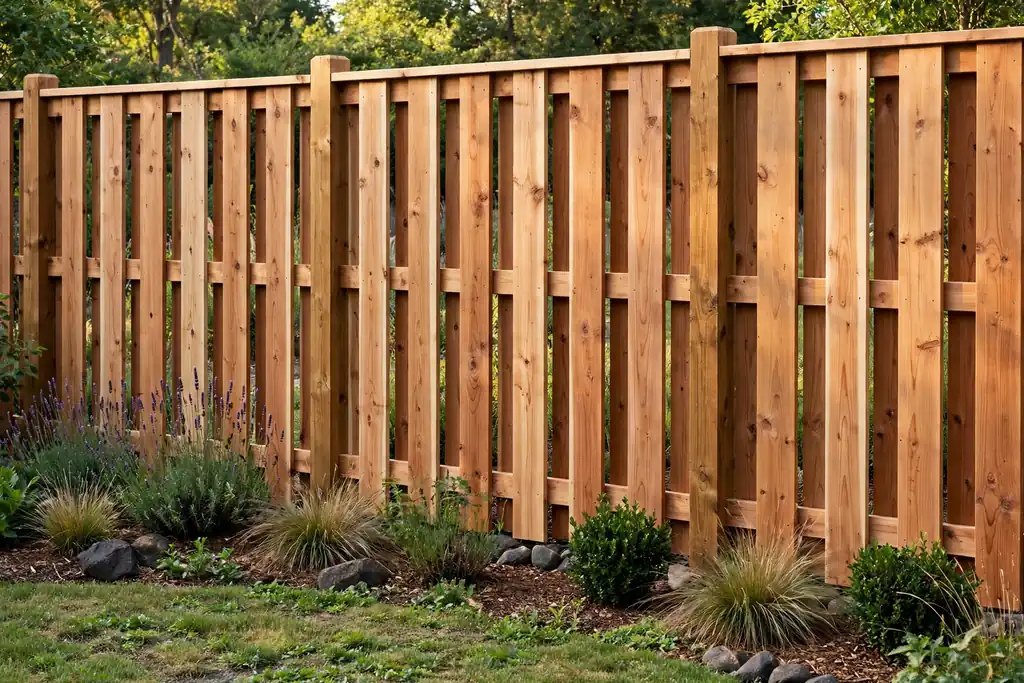
A shadowbox fence, also called a board on board fence, fixes boards on both sides of the rails with a small overlap, so the fence looks finished from either side. This suits a shared boundary, since both neighbors see a neat face, and it gives privacy while still letting some air through the overlaps. A shadowbox fence also hides the rails, which gives it a cleaner look than a standard panel fence.
Use boards of even width and keep the overlap consistent, since gaps show up on a shadowbox fence. A shadowbox fence uses more timber than a single sided fence, so budget for the extra boards and for strong posts that can carry the weight. Stain both sides, or agree a finish with a neighbor if the fence is shared, so both faces weather evenly.
23. Living Wall Panels on a Fence
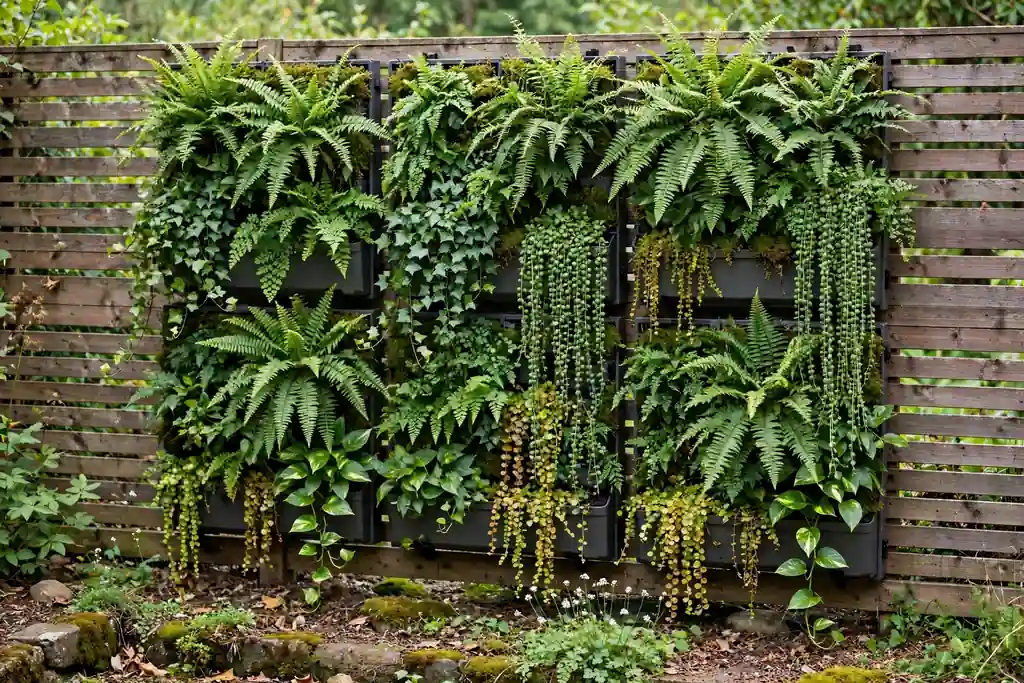
Living wall panels fixed to a fence turn a plain boundary into a planted wall without taking bed space. Panels with pockets or trays suit a small garden, a courtyard, and a fence beside a patio, where every square foot counts. Grow ferns, trailing herbs, small perennials, and seasonal flowers in the panels for color and scent at eye level.
Fix panels to posts and rails that can carry the weight of wet soil, and water from the top so moisture reaches each pocket. Choose plants that suit the light on that fence, sun lovers on a south facing fence, ferns and shade plants on a north facing one. Keep panels away from gates and locks, and leave room to reach plants for trimming and replacing.
24. Fence with Integrated Lighting
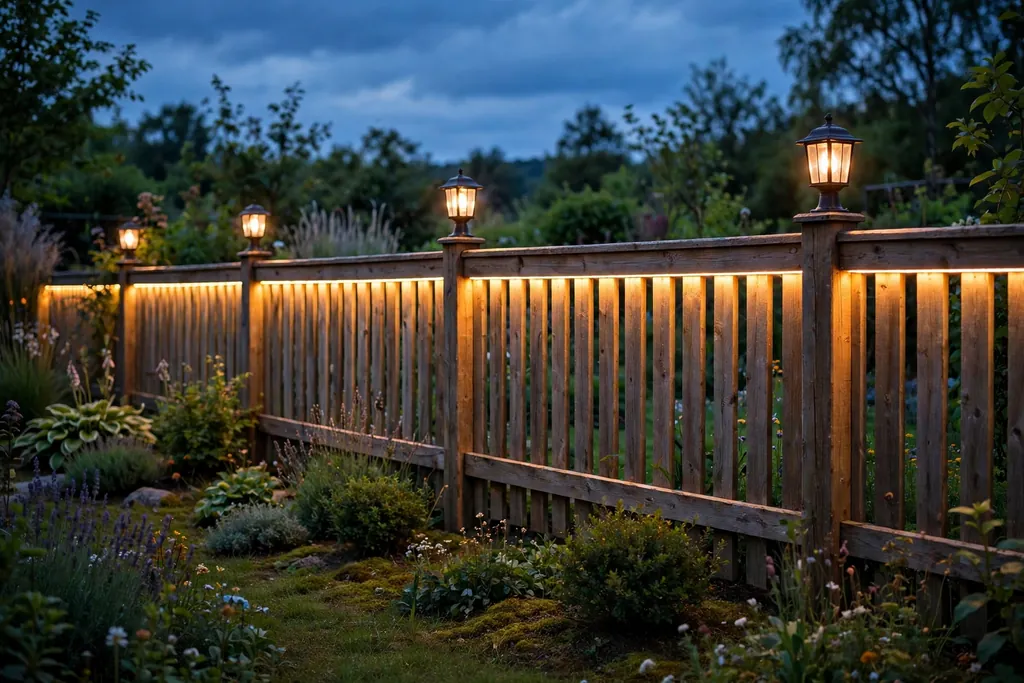
Lights fixed to a fence turn a boundary into a guide after dark and make a garden usable in the evening. Small solar lights on post caps, a light strip under a cap rail, or low wall lights on fence pillars mark paths, gates, and steps without harsh glare. This suits a garden used for evening meals, a path to a back gate, and a front garden where a lit entry feels welcoming.
Use warm white light and keep lights low, so they mark the garden rather than flooding it. Solar lights need sun on their panels during the day, so avoid a fully shaded fence for solar fittings. Keep cables out of walkways, and check that lights do not shine into neighboring windows, since a fence light that glares at a neighbor soon becomes a problem.
25. Horizontal Fence Between Stone Pillars
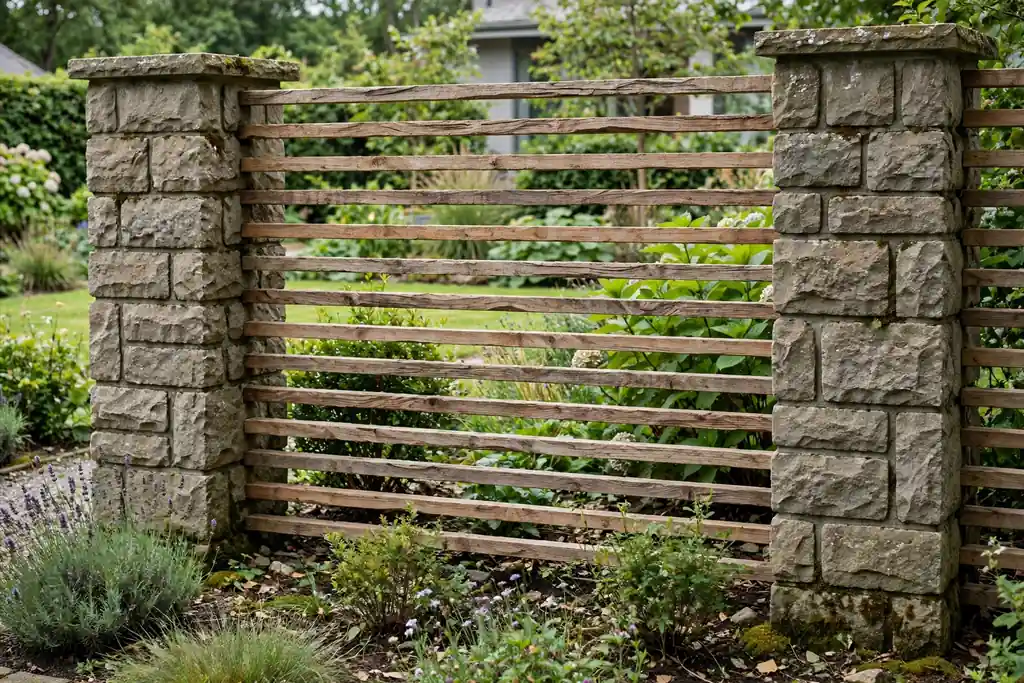
Stone pillars with horizontal timber slats between them give a fence a solid, built feel that suits a front garden, a drive entry, and a modern home with stone details. Pillars mark each bay, give the fence a rhythm, and make a long run feel planned rather than endless. Stone also anchors the fence visually, so the timber between pillars looks lighter by contrast.
Build pillars on proper footings and keep them level, since a leaning pillar shows up at once. Use a cap stone on each pillar to protect it from rain, and fix slats to metal brackets set into the pillars or to posts hidden behind them. Repeat the stone once more in the garden, on a path edge or a low wall, so the pillars feel part of the whole design.
26. Stepped Fence for a Slope
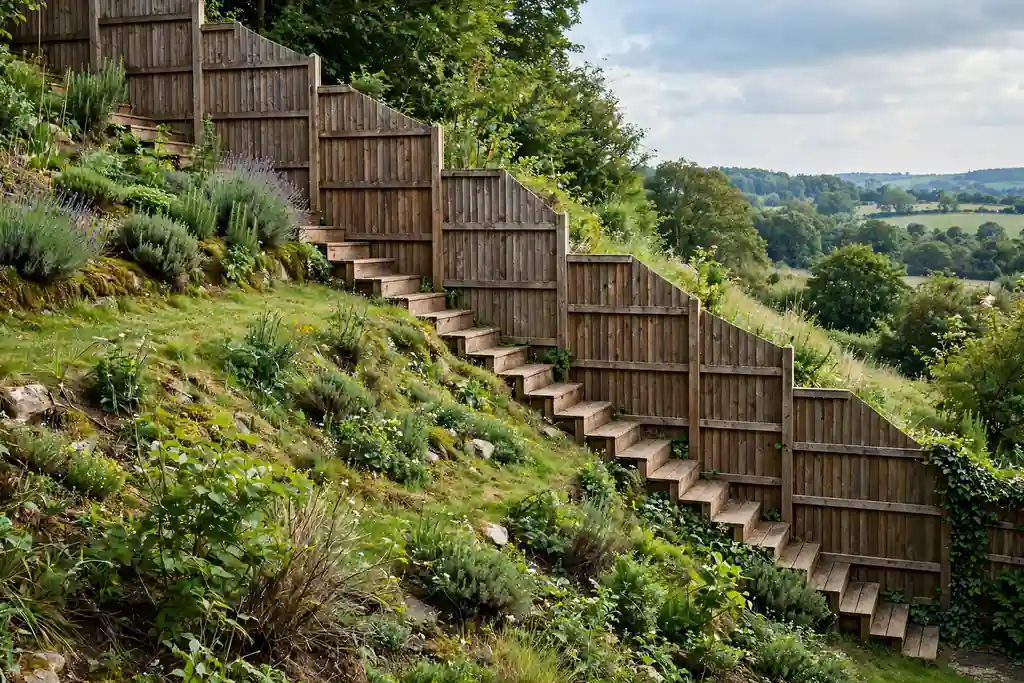
A fence on a slope can step down in panels or follow the slope in a smooth rake, and the choice changes how the garden looks. Stepped panels suit a steep slope, since each panel stays level and the fence reads as a staircase, while a raked fence suits a gentle slope, since it follows the ground without gaps underneath. Both suit gardens where a level fence would leave a gap at the low end or bury boards at the high end.
For stepped panels, set each post to the height of its panel and fill small gaps under panels with a gravel board or planting. For a raked fence, use boards that can run at an angle or panels made for sloping ground. On a steep slope, these tiered garden ideas show how to work with levels in the garden as a whole, so the fence and the planting suit each other.
27. Low Front Fence with a Planting Border
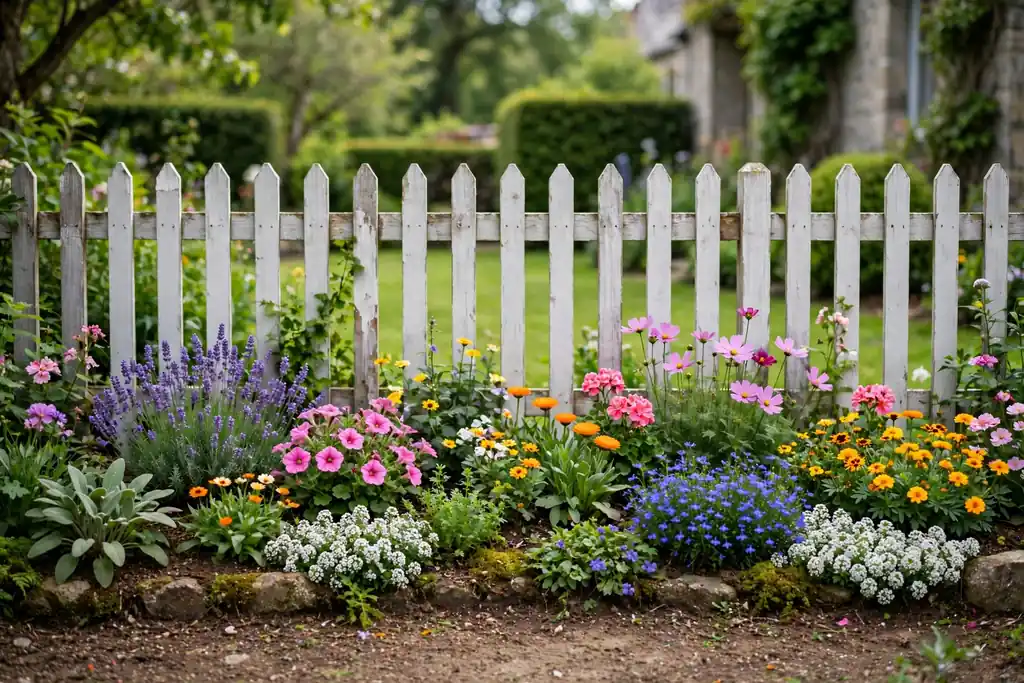
A low fence with a planting border in front of it suits a front garden where you want a boundary that still shows off flowers. A short picket, rail, or metal fence at knee height, with a border of shrubs and perennials in front, gives structure in winter and color in summer. The fence marks the edge, while the planting does the visual work.
Keep the border narrow enough to reach from the path for weeding, and choose plants that will not grow over the fence and block the gate. Repeat one or two plants along the run for a calm look, rather than planting a different flower in every gap. A low fence also suits a garden where a tall fence would hide the house or block light to a front room.
28. Black Painted Fence to Make Planting Pop
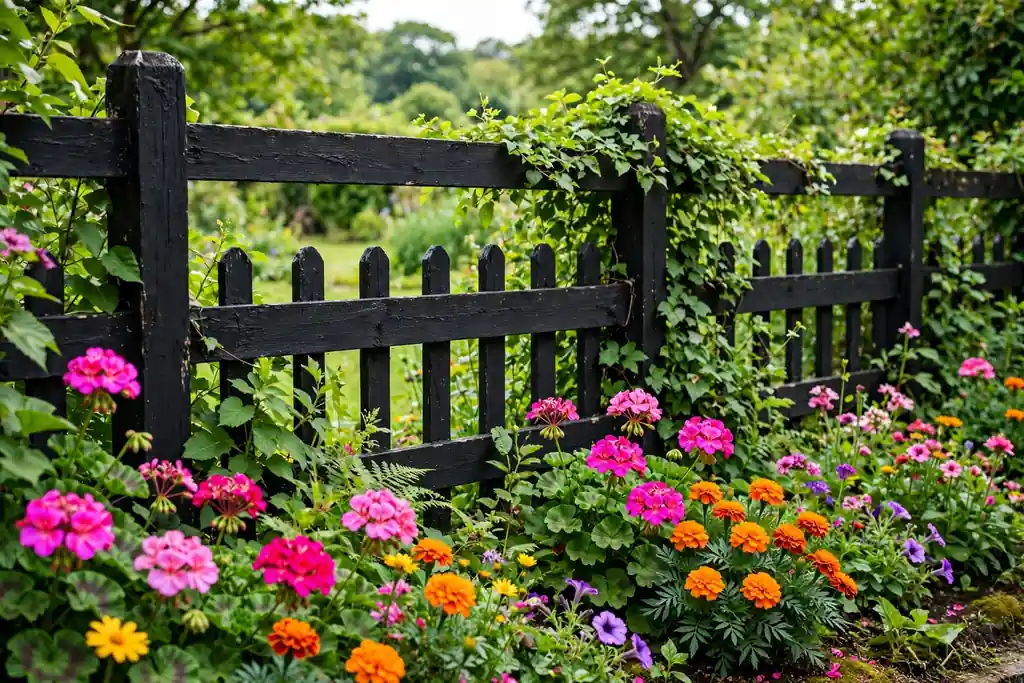
Painting a fence black, or a very dark green, makes green leaves and bright flowers stand out against it, and it makes the fence itself recede into shade. This suits a garden with strong planting, a shaded boundary, and any fence that you want to notice less, not more. Black also suits a modern garden, where a dark backdrop gives planting a gallery feel.
Use exterior paint made for the fence material, prepare the surface well, and expect to touch up scuffs, since dark paint shows marks. A black fence can feel hot in full sun, so avoid dark paint on a fence beside a seating area in a very hot climate, or plant in front of it to shade the surface. Keep the planting in front simple and bold, so it reads clearly against the dark boards.
29. Composite Fence for Low Upkeep
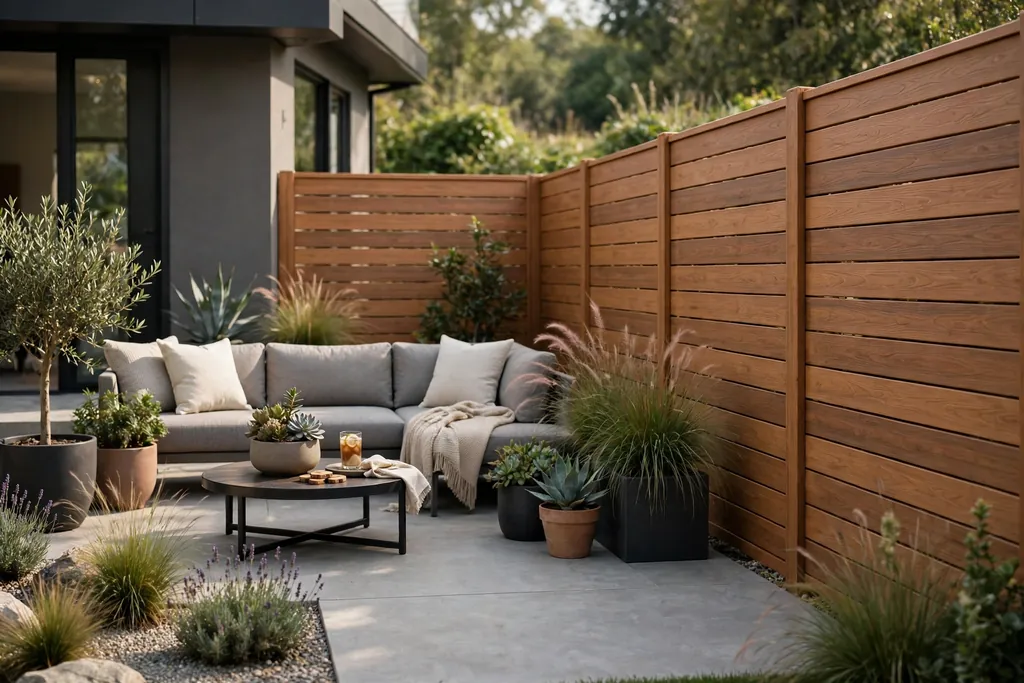
A composite fence, made from recycled wood fiber and plastic, gives the look of timber with far less upkeep. Composite boards resist rot, do not need painting, and keep their color longer than stained timber, which suits a busy household, a rental, and any garden where yearly painting is unlikely. Composite suits a modern garden, a patio boundary, and a fence that must look tidy with little care.
Fix composite boards to the system the maker specifies, since composite expands and contracts with temperature and needs room to move. Use matching posts and caps from the same system for a finished look, and clean the boards with water as the maker directs. A composite fence costs more up front than basic timber, so weigh that cost against the years of painting and repairs it saves.
Conclusion
The best garden fence is the one that fits the job, the house, and the amount of care you will actually give it. A low picket suits a friendly front garden, a solid board fence suits a private back garden, and a living hedge or trellis suits a garden where planting matters most. Walk the boundary, check the rules and the ground, and pick one idea from this list to start with, then add planting, a gate detail, or lighting once the fence itself feels right. A fence built well, with strong posts and room for plants to grow, will frame your garden for years. Save this list on Pinterest before your next garden project, and work through it one boundary at a time.
FAQs
How high should a garden fence be?
It depends on the job and local rules. A front garden fence is often kept low, around waist height, so the house stays visible from the street. A back garden privacy fence is often around 6 feet, but height limits vary by location and by whether the fence faces a road, a neighbor, or open land. Check local rules and any shared fence agreements before you build, and talk to a neighbor if the fence will change their light or view.
What is the cheapest garden fence idea?
A split rail fence, a wire mesh fence on timber posts, and a simple vertical board fence are usually among the lowest cost options, since they use simple materials and few fixings. Cost depends on length, height, timber prices in your area, and whether you build it yourself or hire help. A living hedge can be low cost to plant, but it takes years to reach full height, so factor in the wait as well as the price.
Which garden fence gives the most privacy?
A close board fence, a shadowbox fence, a solid metal panel fence, and a dense evergreen hedge give the most privacy, since they block a direct view at sitting and standing height. For full privacy, check for gaps at gates, at the base, and where the fence meets a wall or a slope, since a small gap can undo a tall fence. A lattice top adds height, but it only gives privacy once climbers cover it.
How long does a wooden garden fence last?
A wooden fence built with treated timber, strong posts, and good drainage at the base often lasts 15 to 20 years, with boards replaced as needed along the way. Posts usually fail first, especially where they sit in wet soil, so keep soil and mulch clear of post bases and use post protectors or gravel footings where the maker advises them. Regular staining or painting, and prompt repair of damaged boards, will add years to a timber fence.
Can I put a fence on a slope?
Yes, and you have two main choices. A stepped fence keeps each panel level and steps down the slope, which suits a steep slope and gives a tidy, stair like line. A raked fence follows the slope in one smooth line, which suits a gentle slope and leaves no gap under the fence. For a garden with a steep slope, work out the levels for the whole garden first, since paths, steps, and planting also need to suit the slope.
Do I need permission to build a garden fence?
Rules vary by location, fence height, and whether the fence faces a public road or a shared boundary. In many areas, a back garden fence below a set height needs no formal permission, while a taller fence, a fence beside a road, or a fence in a protected area may need approval. Check local planning rules, property lines, and any homeowners association rules before you build, and keep a record of what you checked.