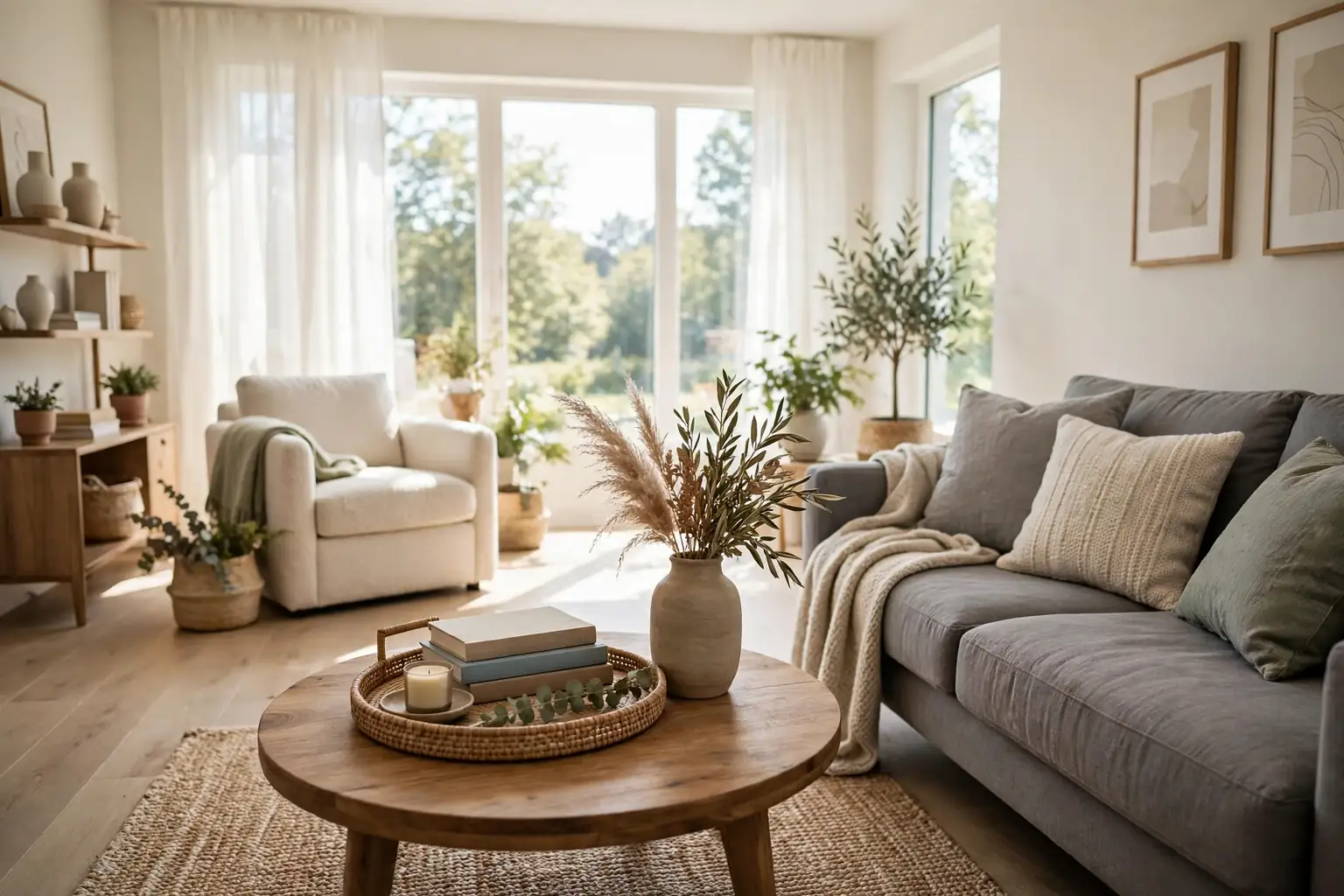
A round coffee table has no corners to fight over, which makes it easy to style and easy to live with. The curve softens a seating group, leaves clear walking space, and gives every seat a fair share of the surface. The challenge is scale: too much on a round top looks crowded fast, while too little can look bare. These 22 round coffee table styling ideas cover trays, books, candles, plants, storage, and setups for coffee, games, reading, and work. Start with one anchor, leave room for a mug, and let the rest support that first choice. For help grounding the whole seating group, see these living room rug ideas.
Key Takeaways
- Start with one anchor, such as a tray, a vase, or a book stack, and keep the rest of the table in support of it.
- On a round top, group items in odd numbers and vary their heights, so the eye moves around the curve instead of stopping at one flat row.
- Leave at least one clear spot for a mug, a book, or a phone, or the table will look good but feel unusable.
- Match the size of the styling to the size of the table: a small table needs one small group, while a large table can hold two groups with space between them.
- Use the lower shelf or the space under the table for storage, so blankets and magazines do not need to live on top.
- Change one small accent by season, such as flowers or a candle color, to refresh the table without restyling it from scratch.
1. Anchor the Table With a Wood Tray
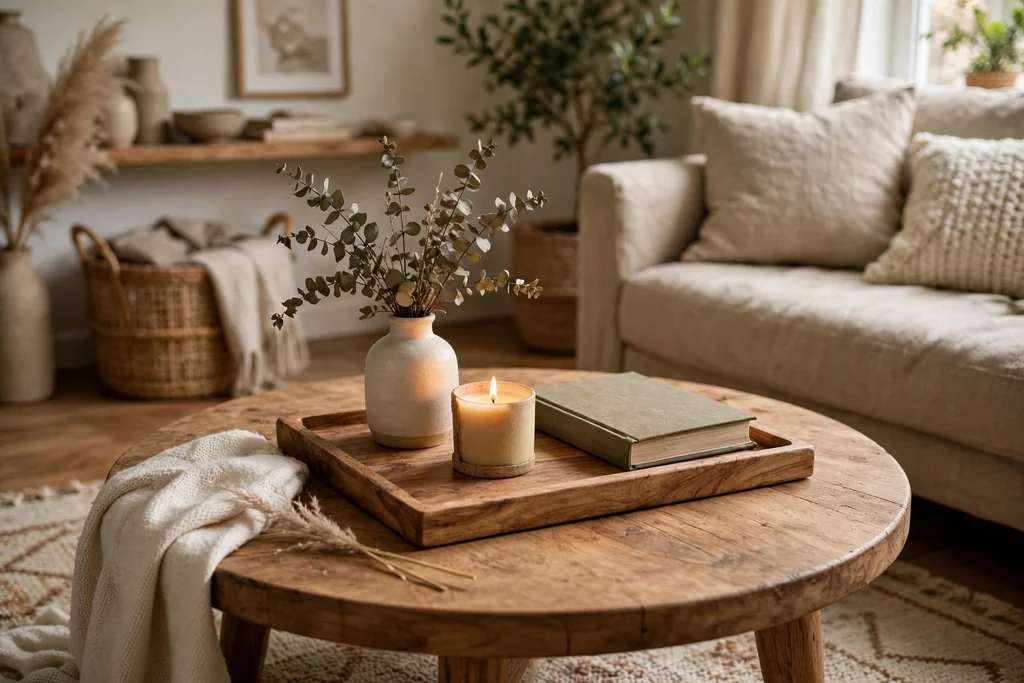
A wood tray is the simplest anchor for a round coffee table, because it turns a loose group of objects into one clear arrangement. Choose a round or oval tray that covers about a third of the tabletop, and set it slightly off center so the curve of the tray echoes the curve of the table. Place a small vase, a candle, and one book inside the tray, and leave the rest of the table clear for daily use.
The tray also makes cleaning easy: lift the whole group at once, wipe the table, and set it back down. A tray with low sides works best, since tall sides can hide small items and make the group look boxed in. If your table is dark wood, try a lighter tray in oak or rattan for contrast, and if the table is pale, a walnut tray adds warmth.
2. Use One Sculptural Vase With Tall Branches
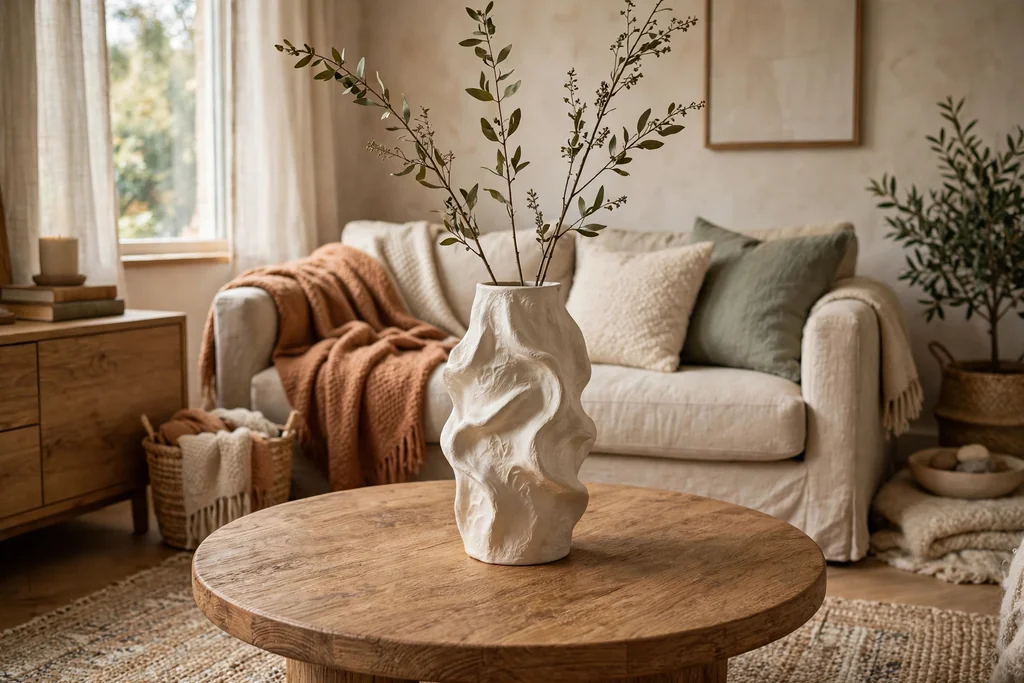
One tall vase with a few branches gives a round table height without filling the surface. This suits a room where the table sits in open space, since the branches draw the eye up and keep the table from looking low and flat. Choose branches that are about one and a half times the height of the vase, and keep the number small, three to five stems, so the shape stays open.
A sculptural vase in ceramic, stone, or textured glass works as the piece itself, so the branches do not need to be elaborate. Dried branches, eucalyptus, or a few long stems from the garden all work, and they need no water if you choose dried stems. Keep the vase toward the back of the table, away from the seat where people reach most, so it is admired rather than bumped.
3. Stack Books and Top Them With a Small Object
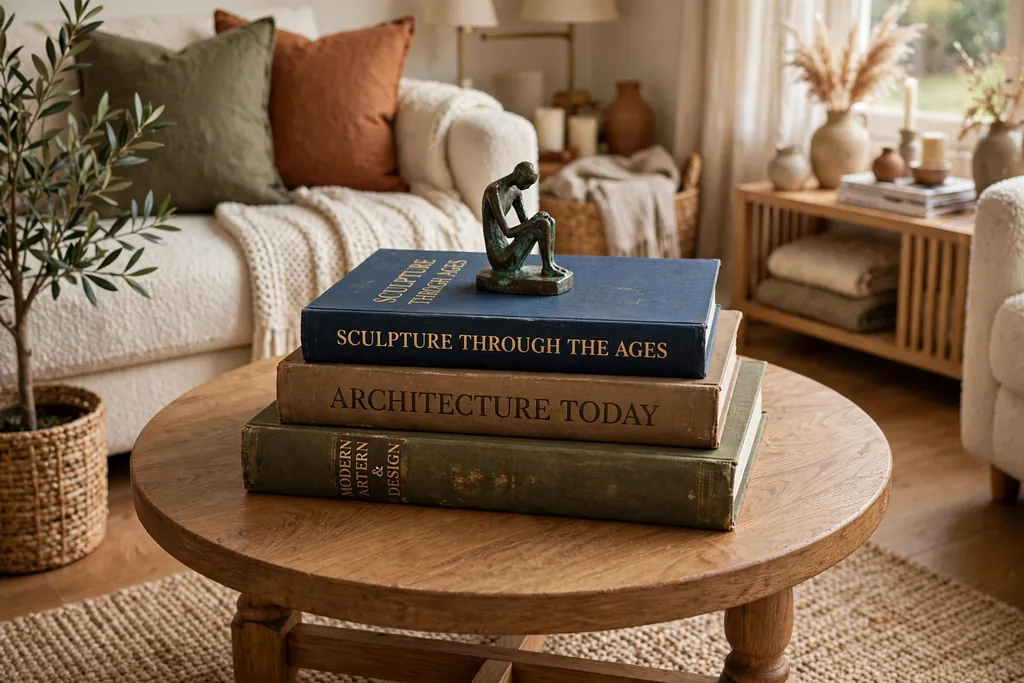
A stack of two or three large books is a classic coffee table base, and a small object on top stops the stack from looking like a pile waiting to be shelved. Choose books with covers you like looking at, in sizes that step down as the stack rises, and place the largest book at the bottom. A small stone, a brass bird, or a short candle on top gives the stack a finished point.
Keep the stack to one side of the table rather than the center, so the other side stays free for mugs. The top book should be one people can actually open, not a fragile display piece, since a coffee table book earns its place by being read. Rotate the top book when you finish it, and the whole table feels refreshed with no new purchase.
4. Group Candles at Three Heights
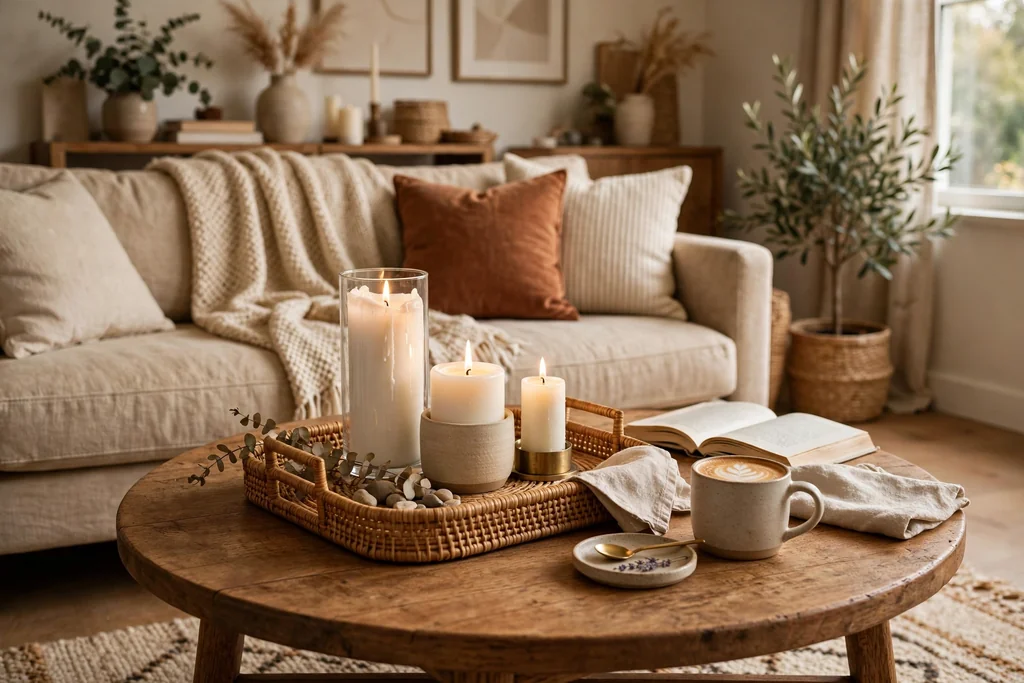
Candles grouped at three heights suit a round table well, because the different levels follow the curve and keep the group from looking like a straight line. Use pillar candles on a flat tray, or mix one tall pillar, one medium jar candle, and one short votive, and keep them close enough to read as one group. In the evening, the low light makes the whole seating group feel warmer.
Safety matters more than symmetry here. Keep candles away from the table edge, away from curtains and throws, and never leave them burning in an empty room. Flameless candles give a similar glow in a home with children or pets, and they let you keep the group out all day. Wipe wax drips promptly, since wax can mark wood and stone tops.
5. Set a Low Wide Bowl as a Catchall
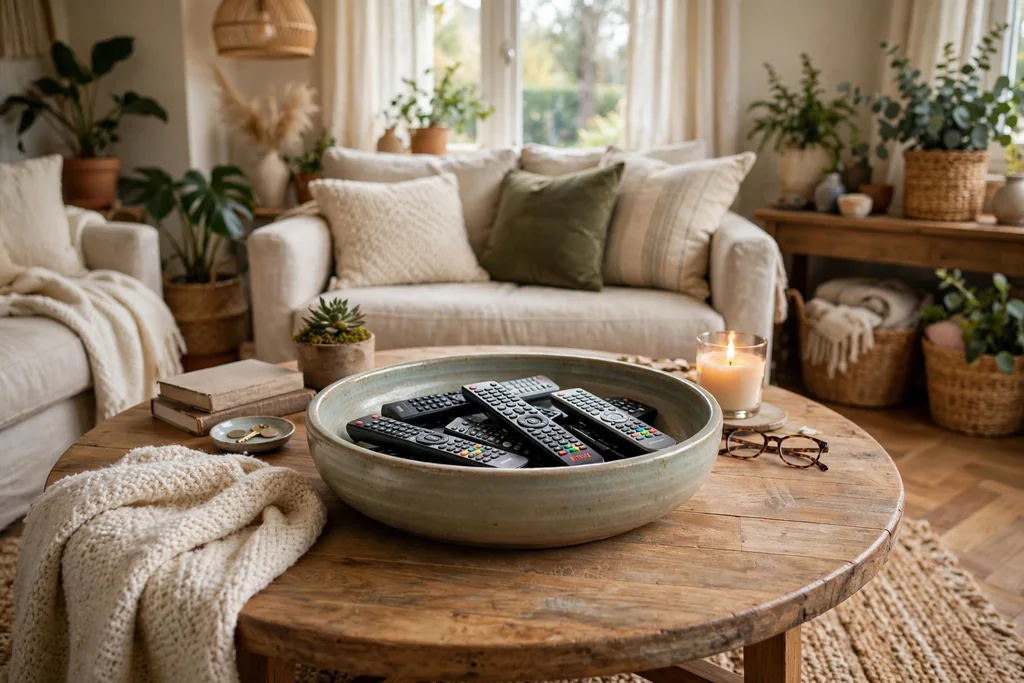
A low, wide bowl gives small daily items a home, which is the difference between a styled table and a cluttered one. Use the bowl for remote controls, keys, or a pair of reading glasses, and choose a bowl wide enough that items sit inside it rather than spilling over the rim. Ceramic, wood, or stone all work, and a shallow bowl keeps the tabletop visible around it.
This idea suits a family room best, where the table must hold real life as well as decor. Empty the bowl once a week, and return anything that does not belong there to its proper place, or the catchall becomes a junk drawer in plain sight. One bowl is enough; a second bowl on the same table usually ends up holding the same kind of clutter twice.
6. Make a Trailing Plant the Centerpiece
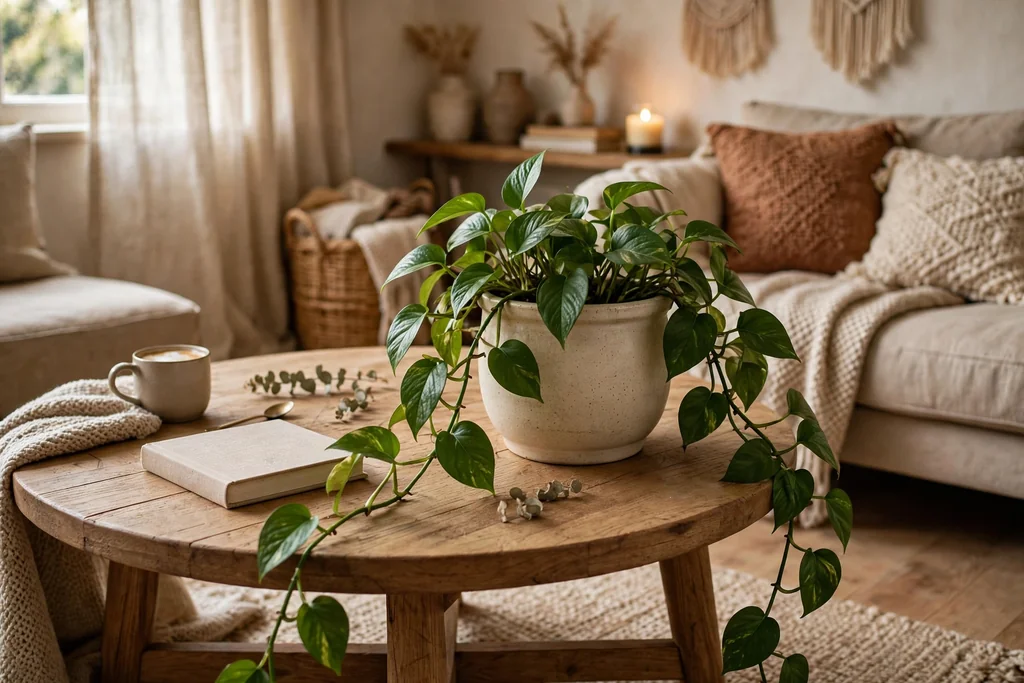
A trailing plant softens a round table in a way no hard object can, since the leaves spill over the edge and break the hard circle of the tabletop. Choose a plant that trails gently, such as pothos or string of hearts, in a pot that fits the table without dominating it. Place a saucer or a cork mat under the pot to protect the table from water marks.
Check the light before you commit: most trailing houseplants need bright indirect light, not a dark corner or harsh midday sun. Water over a sink, let the pot drain, and then return it to the table, so the tabletop never sits in a puddle. Trim the trails when they reach the floor or start to tangle with chair legs, and use the cuttings to start new plants elsewhere in the room.
7. Store Blankets and Magazines in a Basket Below
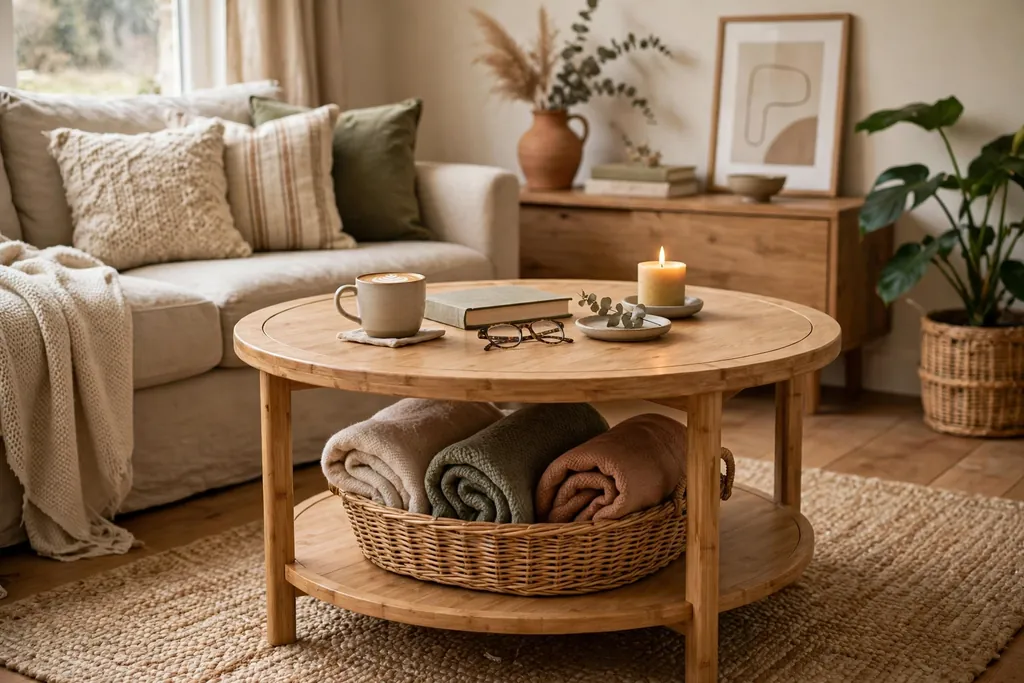
If your round table has a lower shelf or open space underneath, a basket there is the easiest storage upgrade in this list. A woven basket holds folded throws and a few magazines out of sight, while keeping them within reach for an evening on the sofa. Choose a basket that slides under the table without sticking out past the tabletop edge.
This keeps the tabletop free for the styling you actually see, which matters most on a small round table. Fold throws neatly rather than stuffing them in, since a tidy basket reads as part of the styling and a stuffed one reads as clutter. If the table has no shelf, a flat basket beside the table leg does the same job without crowding the walkway.
8. Style Two Tiers: Top and Lower Shelf
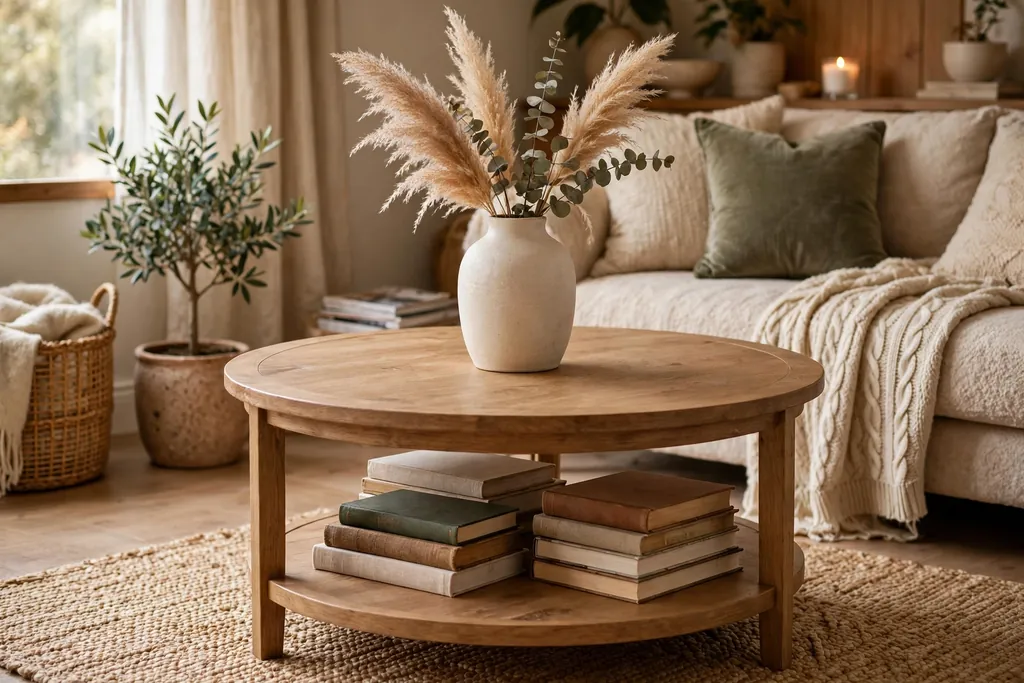
A two tier round table gives you two surfaces to style, and the trick is to treat them as one arrangement, not two separate ones. Keep the top light and open, with a tray or a vase, and use the lower shelf for heavier, quieter items, such as a stack of books or a lidded box. The heavier items below ground the table, while the lighter items above keep it feeling open.
Repeat one material or color between the tiers, such as wood on both levels or the same book color, so the two levels look linked. Avoid filling both tiers to the edge; the eye needs empty space on a lower shelf just as it does on top. Dust the lower shelf when you dust the top, since books and boxes there collect dust out of sight.
9. Set the Table for Coffee
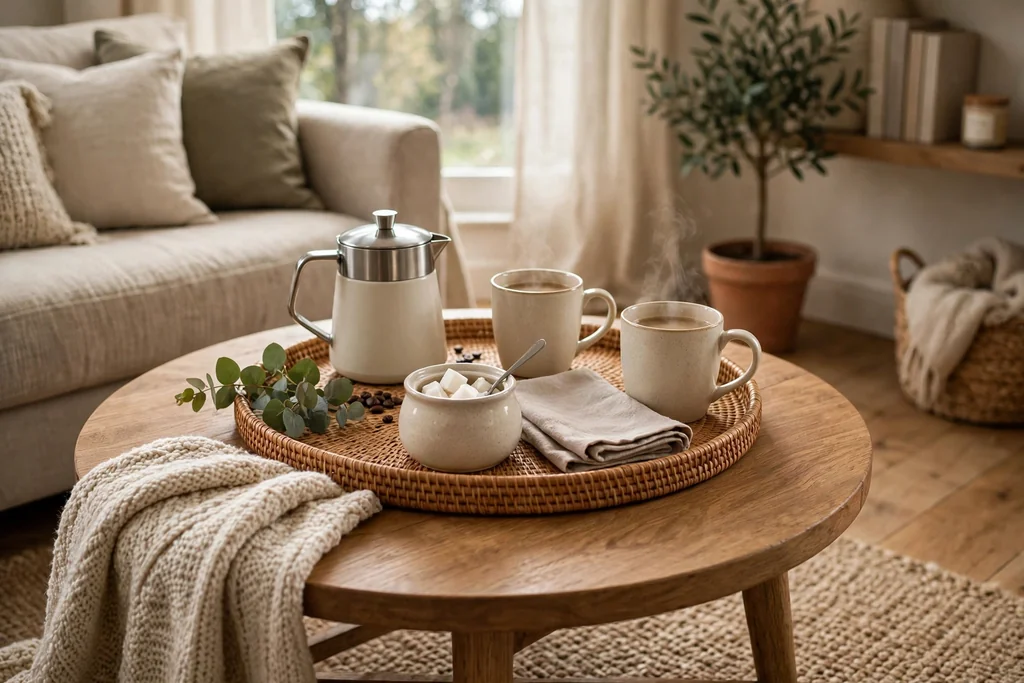
A coffee setup turns a round table into a small serving station, which suits a household that hosts morning coffee or an afternoon break. Group a small coffee pot or French press, two mugs, and a tiny sugar bowl on a tray, and keep the tray to one side so guests can still set down a plate. A linen napkin under the tray protects the tabletop from heat and drips.
This setup works best when it is assembled for the occasion and cleared after, rather than left out all week, since a full coffee set takes up the whole table. Keep the mugs in a matching or close pair, and skip extra pieces such as a large milk jug unless you actually use them. When the coffee is done, the tray lifts away and the table returns to its everyday styling in seconds.
10. Keep a Game Night Setup Ready
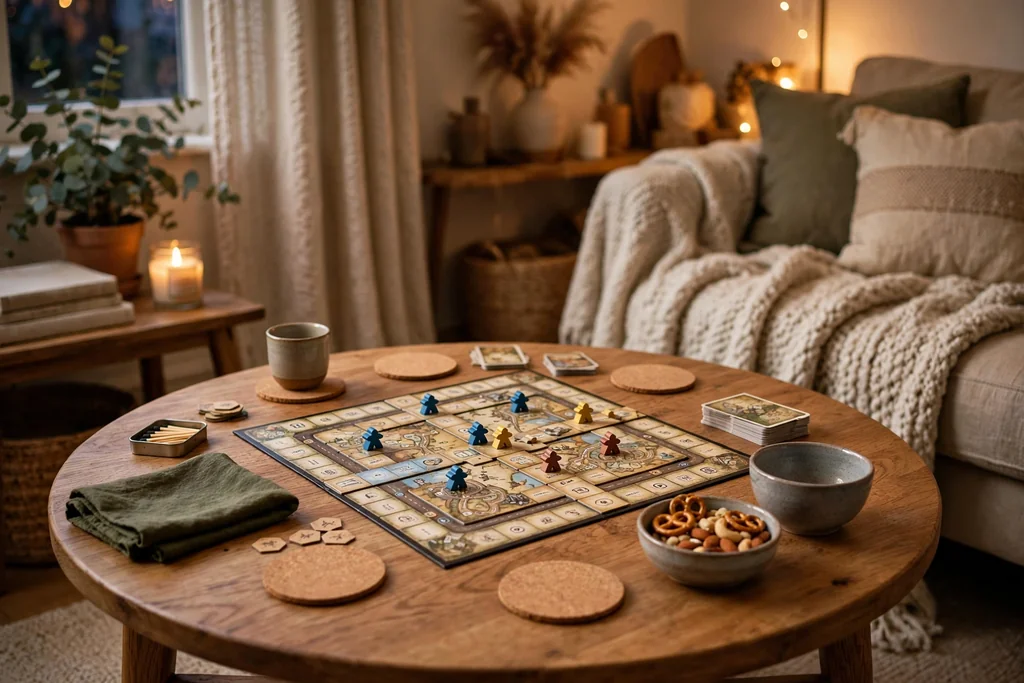
A round table suits board games and card games well, because every player can reach the center without stretching across a corner. Keep a lidded box or a basket under the table with one or two favorite games, a set of coasters, and a small bowl for snacks, so game night starts without a hunt through a closet. On the tabletop itself, keep only a small candle or a plant, which can move aside in seconds.
Choose games that fit the table: a compact card game or a small board suits a round top better than a large board that overhangs the edge. Coasters matter here, since drinks sit close to the game and a ring mark on a board or a card is hard to undo. After the game, return the pieces to the box at once, or the table stays a game table until the next tidy up.
11. Build a Reading Nook Around the Table
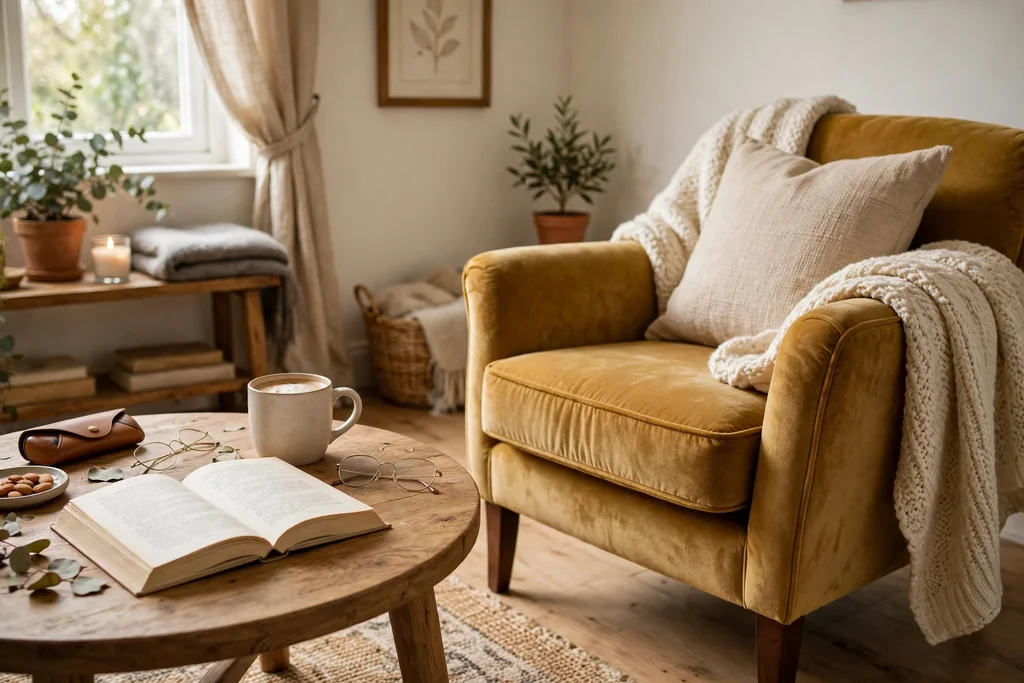
A round table beside a comfortable chair makes a natural reading spot, and the styling can support that use instead of fighting it. Keep one open book or a small stack of books to one side, a pair of reading glasses in a small dish, and a bookmark tucked into the current book. A small lamp on a nearby side table, rather than on the coffee table itself, gives light without taking up surface space.
This setup suits a quiet corner of the living room, where the chair, the table, and the lamp form one small zone. Keep the book stack to books you are actually reading, and move finished books back to a shelf, so the stack stays inviting rather than becoming a pile. If the chair faces a window, the table also holds a mug during a morning read, which is reason enough to keep one side clear.
12. Leave One Side Clear for Work
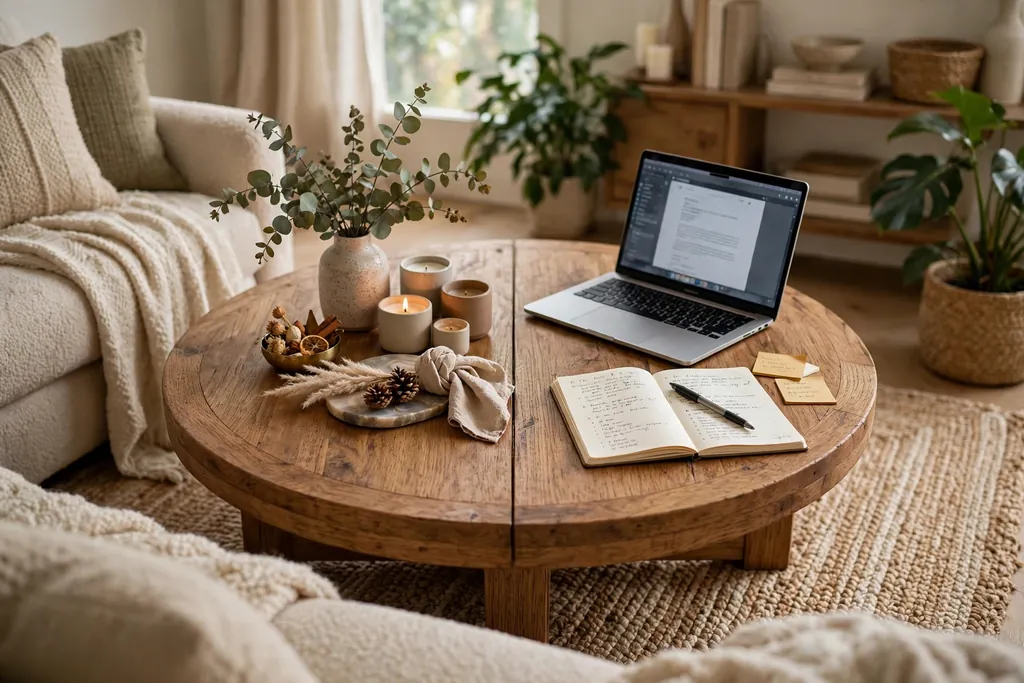
A round table can double as a laptop spot, but only if the styling leaves room for it. Keep all decor grouped on one half of the table, such as a tray with a vase and a candle, and leave the other half empty for a laptop, a notebook, and a pen. A small pen cup or a shallow dish on the decor side keeps pens from rolling across the table.
This split layout works well in a small living room, where one table must serve both relaxing and working, as shown in these small living room dining room combo ideas. When work ends, close the laptop and the table returns to a living room table, with no rearrangement needed. Keep charging cables in a small basket below the table, so they do not snake across the styled half.
13. Place a Symmetrical Pair of Candlesticks
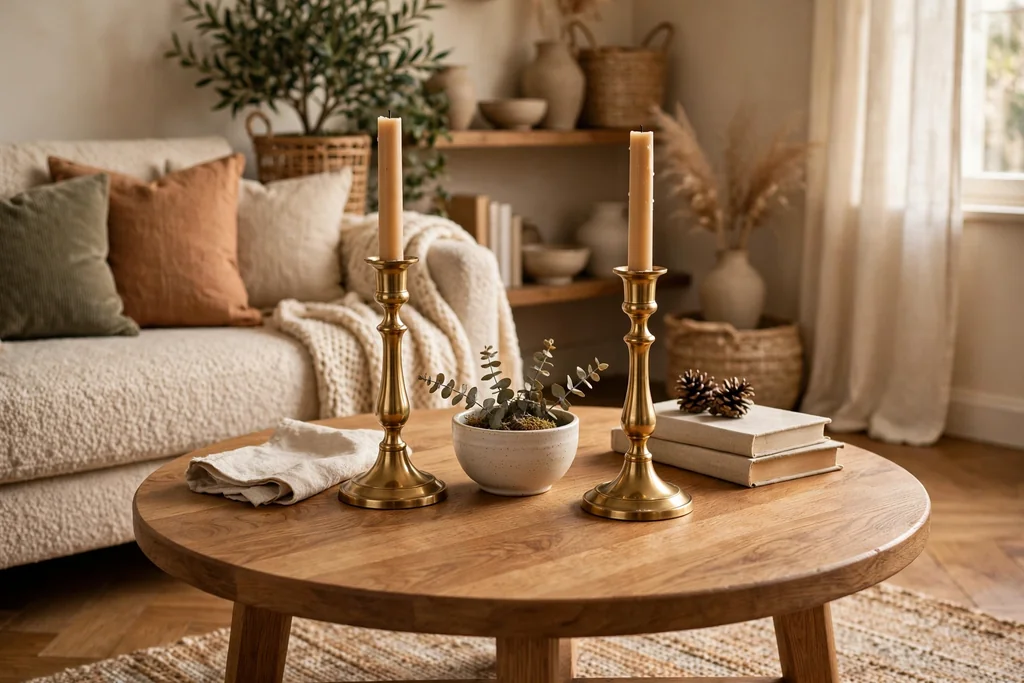
A matching pair of candlesticks brings a formal, balanced feel to a round table, which suits a traditional living room or a room with a fireplace as its focus. Place the two candlesticks a short distance apart, with a small bowl or a short stack of books between them, so the pair frames a center rather than standing alone. Matching candlesticks in brass, wood, or ceramic all work, and the pair should match in height.
Symmetry can feel stiff if it is too exact, so let the center piece break the pattern slightly, with a plant or a book that is a different shape. Keep the candlesticks away from the table edge and from anything flammable, and use dripless candles to protect the tabletop. In a room with a grey sofa, brass candlesticks add a warm note, as shown in these grey couch living room ideas.
14. Try an Off Center Cluster
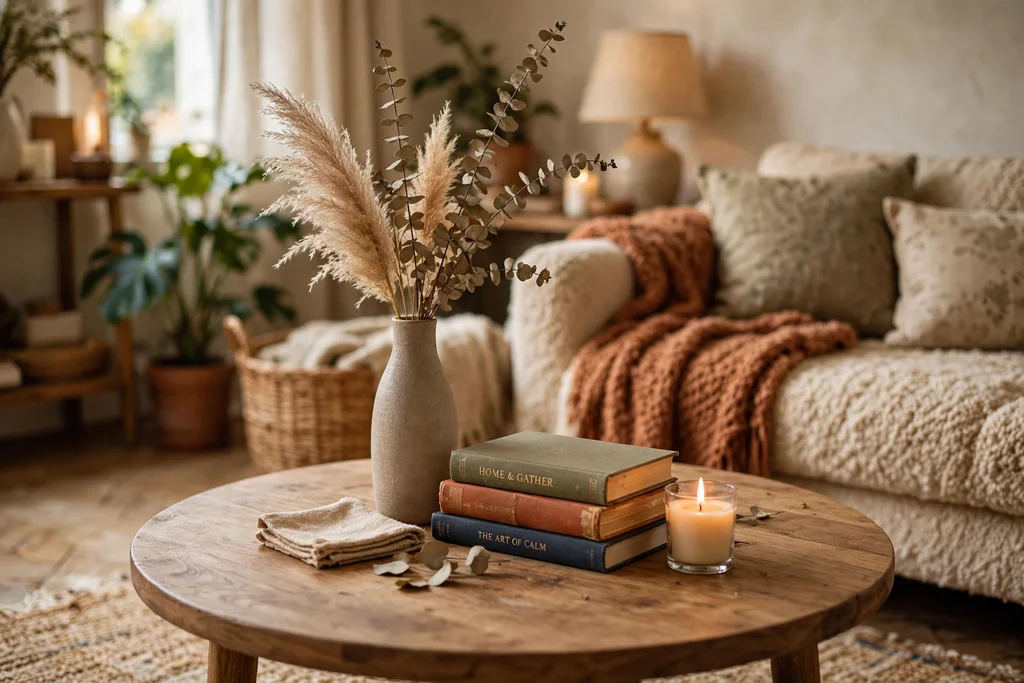
An off center cluster suits a modern room, where a centered arrangement can feel too formal. Group three items of different heights, such as a tall vase, a medium book stack, and a short candle, on one side of the table, and leave the rest of the surface empty. The empty space is part of the design: it gives the eye a place to rest and gives hands a place to set a mug.
This layout works best on a medium or large round table, where the empty side is clearly a choice rather than a gap. Stand back and check the cluster from the main seat and from the doorway, since an off center group should look planned from both angles. If the cluster looks like it slid to one side by accident, pull it a little further off center and add a small item, so the intention is clear.
15. Pair a Marble Top With Brass Accents
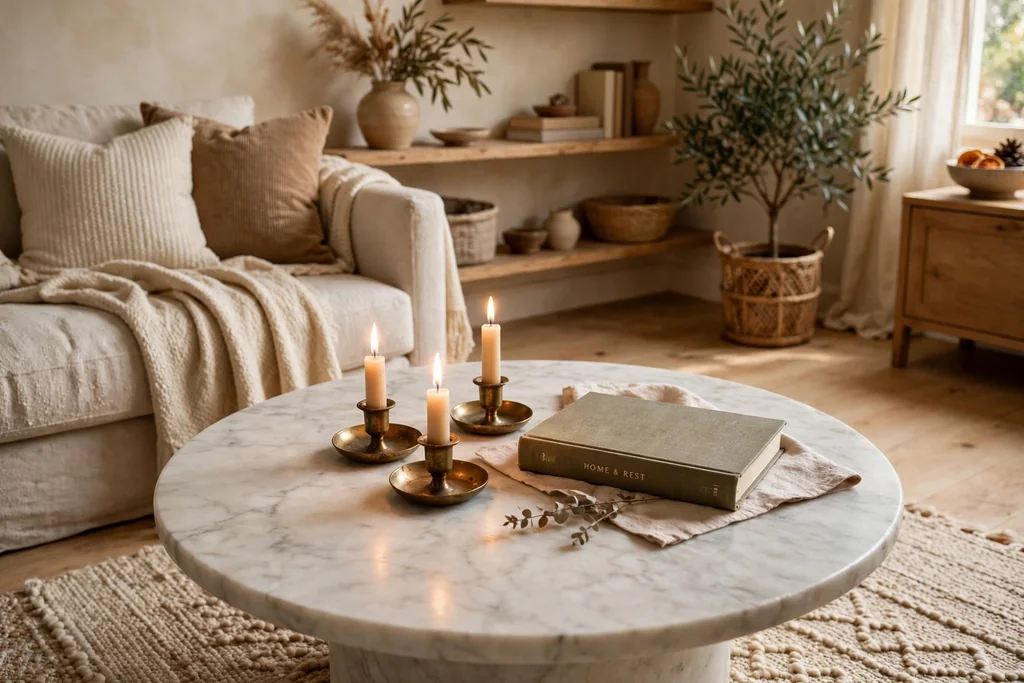
A marble top already carries a lot of visual interest, so brass accents should be few and small: a brass tray edge, a brass candle holder, or a small brass bowl. The warm metal against cool stone is the whole point, and adding more metals, such as chrome or black iron, can make the pairing feel busy. Keep the rest of the styling plain, with one book or one plant, so the stone and brass lead.
Marble needs simple care: wipe spills promptly, use coasters under mugs and glasses, and avoid placing citrus or vinegar directly on the stone. A felt pad under a brass tray stops the metal from scratching the marble when the tray moves. This material pairing suits a room with pale walls and a light sofa, where the table itself is the main detail in the seating group.
16. Layer Rattan and Woven Texture
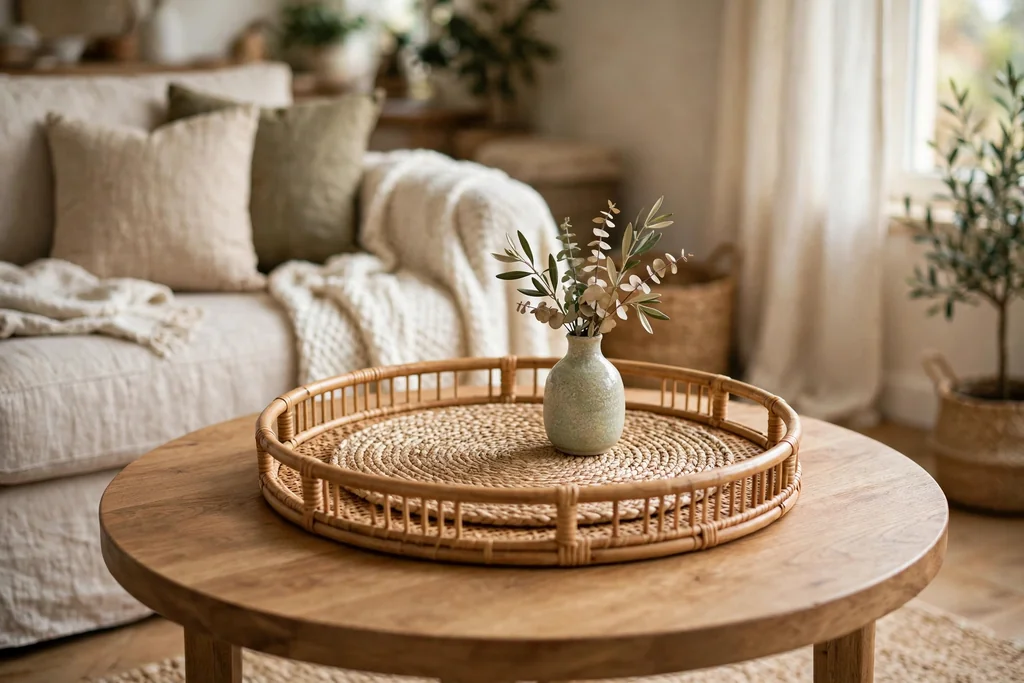
Rattan and woven texture warm up a round table without adding color, which suits a relaxed or coastal style room. Use a woven placemat under a vase or a tray, a rattan tray instead of a wood one, and a small woven basket below the table for throws. The texture does the work, so the objects themselves can stay simple and pale.
Keep the woven pieces to two or three, since a table covered in weave can look like a basket rather than a table. A woven placemat also protects the tabletop from a hot mug or a vase ring, which is a practical bonus. Shake out or vacuum woven pieces outdoors now and then, since weave traps dust and crumbs more than a smooth tray does.
17. Scale Down for a Small Round Table
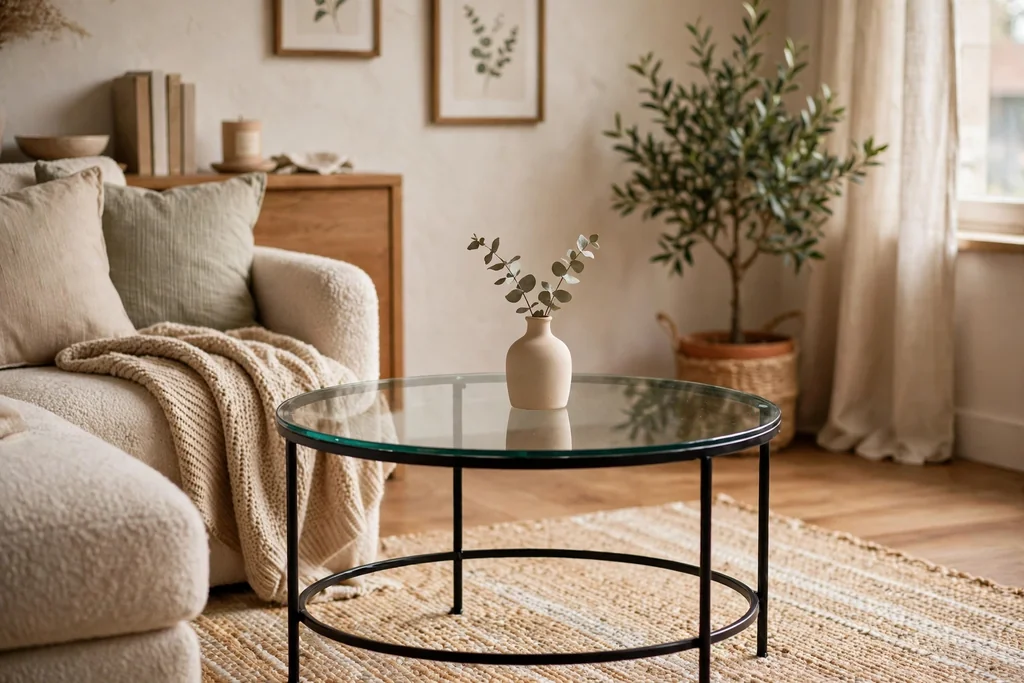
A small round table, under about 24 inches across, needs only one small group, not a full arrangement. Choose a single vase with a short stem, or a small stack of two books with a candle on top, and leave the rest of the surface clear. Every item on a small table is close to the edge, so a single group in the center is safer and calmer than several small groups competing for space.
Measure the table before buying a tray, since a tray that fits a large table can cover a small one completely. A small table also needs a clear walkway around it, so keep the styling low enough that it does not block sight lines across the room. If the table feels bare with one group, add a patterned rug underneath, which gives the area interest without adding items to the tabletop.
18. Swap One Accent With the Seasons
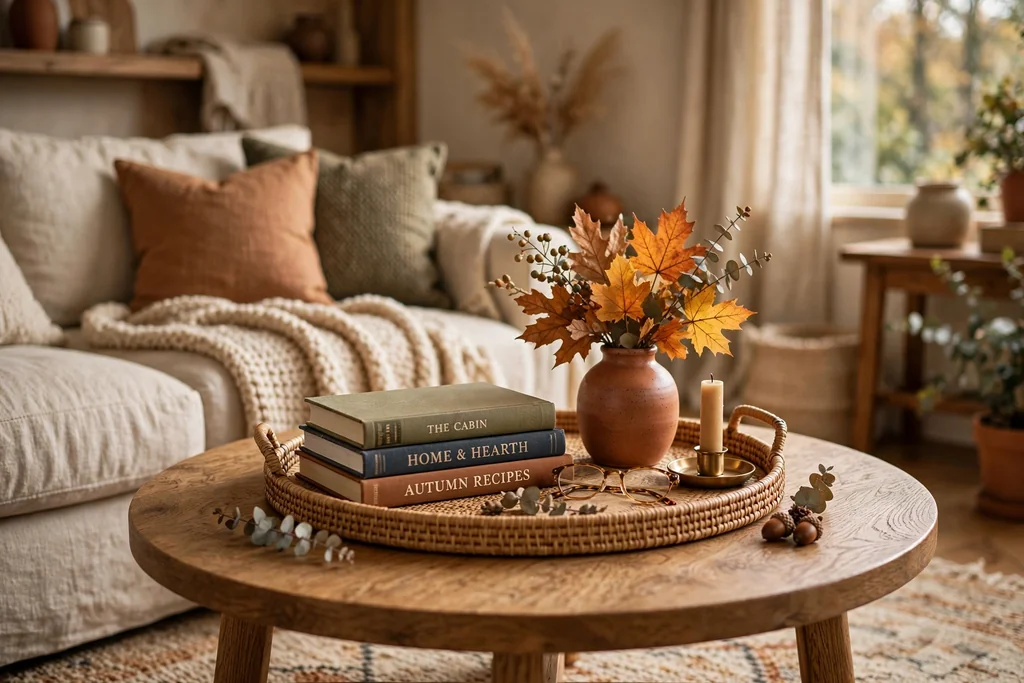
A seasonal swap keeps a round table fresh with almost no effort: keep the same tray, books, and candle holders all year, and change only one accent. In spring, that accent might be a small vase of fresh flowers; in autumn, a bowl of pinecones or a candle in a warmer color; in winter, a sprig of evergreen in the same vase. The base stays the same, so the table never needs a full restyle.
Store the seasonal accents together in one small box, so the swap takes minutes rather than a shopping trip. Choose accents that suit your climate and your household: fresh flowers need water and light, while dried stems and pinecones need only dusting. This idea pairs well with a neutral base, since a calm tray and plain books accept a new accent without clashing.
19. Layer Neutral Textures Without Strong Color
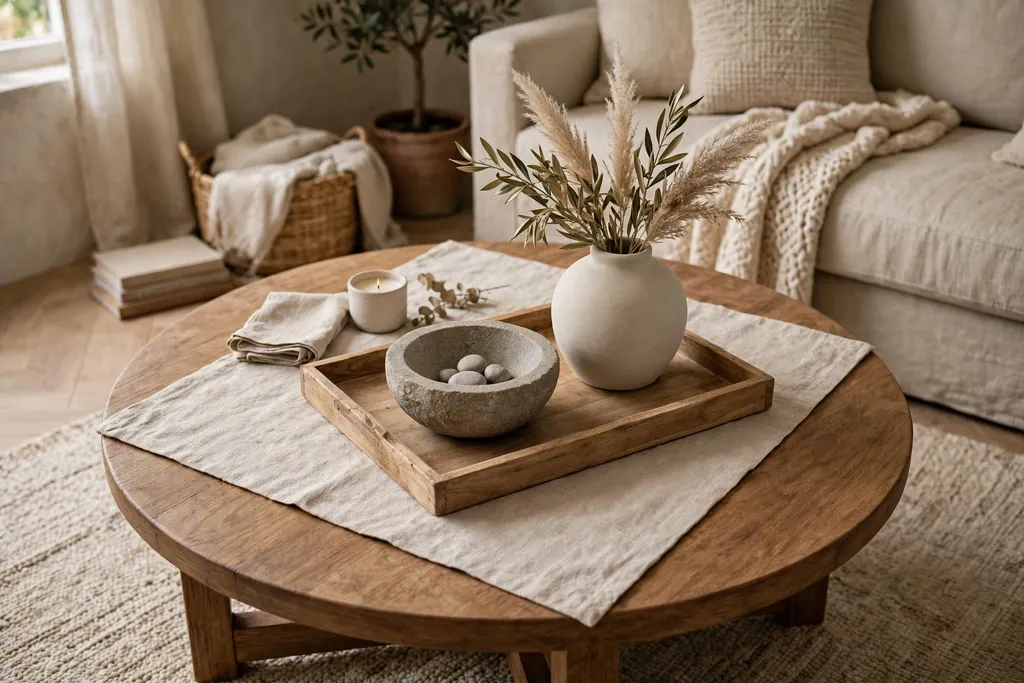
A neutral scheme layers linen, wood, stone, and ceramic in cream, oatmeal, grey, and pale wood, with no single strong color. On a round table, that might mean a linen placemat, a wood tray, a stone bowl, and a ceramic vase, each in a quiet tone. The interest comes from the different surfaces, not from color, so the table feels calm even when it holds several pieces.
This approach suits a room that already has color elsewhere, such as in art or cushions, since the table then rests the eye rather than competing. Vary the textures clearly: if everything is smooth and pale, the group can look flat, so include one rough texture, such as woven linen or unglazed ceramic. Keep one piece slightly darker, such as a walnut tray, to anchor the pale group.
20. Display a Small Travel Collection
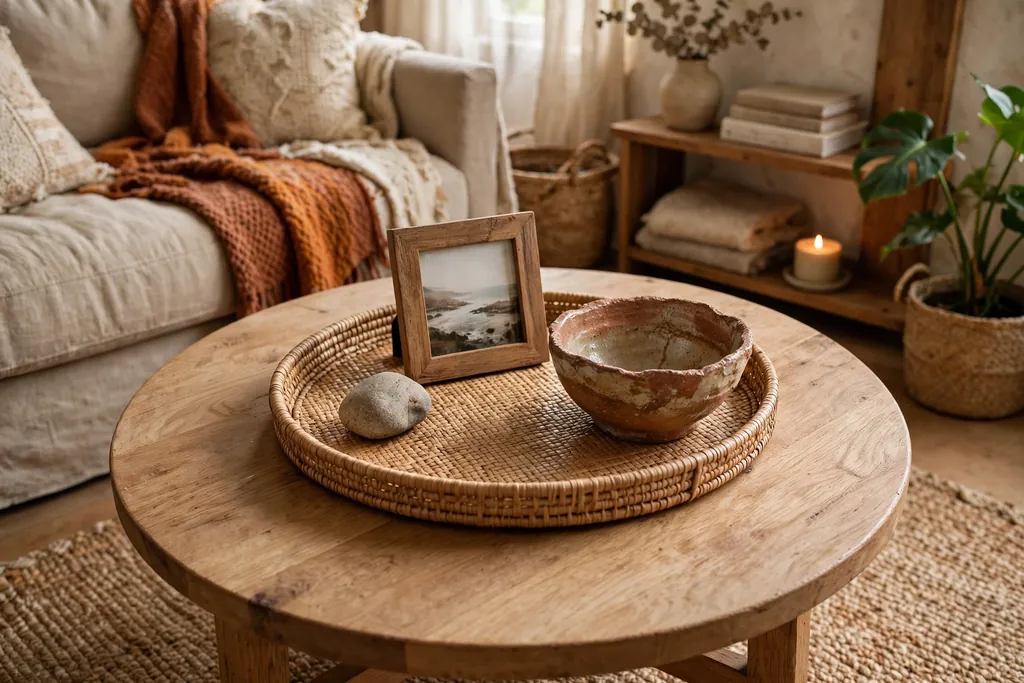
A round table is a good place for a small, personal collection, because guests see it up close from every seat. Choose three or four pieces that mean something to you, such as a small stone from a trip, a framed photo, and a handmade bowl, and group them on a tray so they read as a collection rather than random objects. The tray boundary tells visitors that these pieces belong together.
Edit hard: a collection of three pieces with space around each one looks cared for, while ten pieces crowded together look like a shelf that ran out of room. Dust the pieces when you dust the table, and move anything fragile to a higher shelf if children or pets use the room. Rotate one piece now and then, so the display stays personal without growing larger.
21. Style for a Family Room With Soft, Safe Pieces
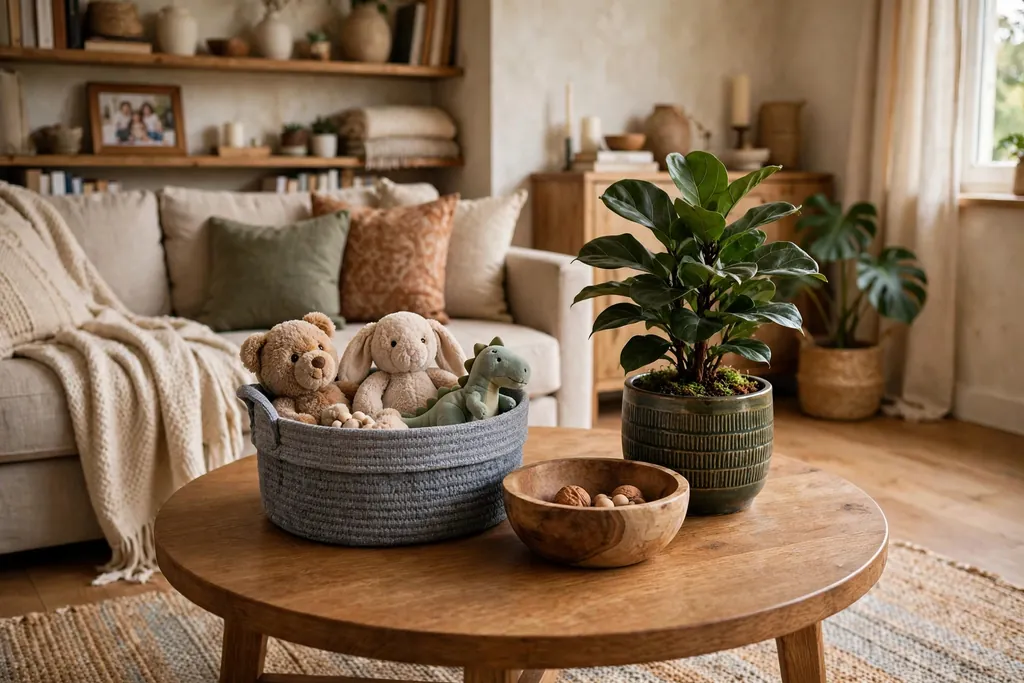
A family room table needs styling that survives daily life: soft edges, unbreakable materials, and nothing precious at toddler height. Use a fabric basket on the table for soft toys or crayons, a wooden bowl instead of glass, and a washable placemat under a small plant in a sturdy pot. Keep candles flameless, and keep small pieces out of reach of very young children.
This is not a lesser version of styling; it is styling for the room as it is actually used. A low basket of books that children can reach encourages reading, and a clear side of the table still leaves room for snacks and homework. Check the table for wobble before styling it, since a stable table is safer for everyone, and keep the floor around it clear so children can move without tripping.
22. Add Evening Glow With a Lantern
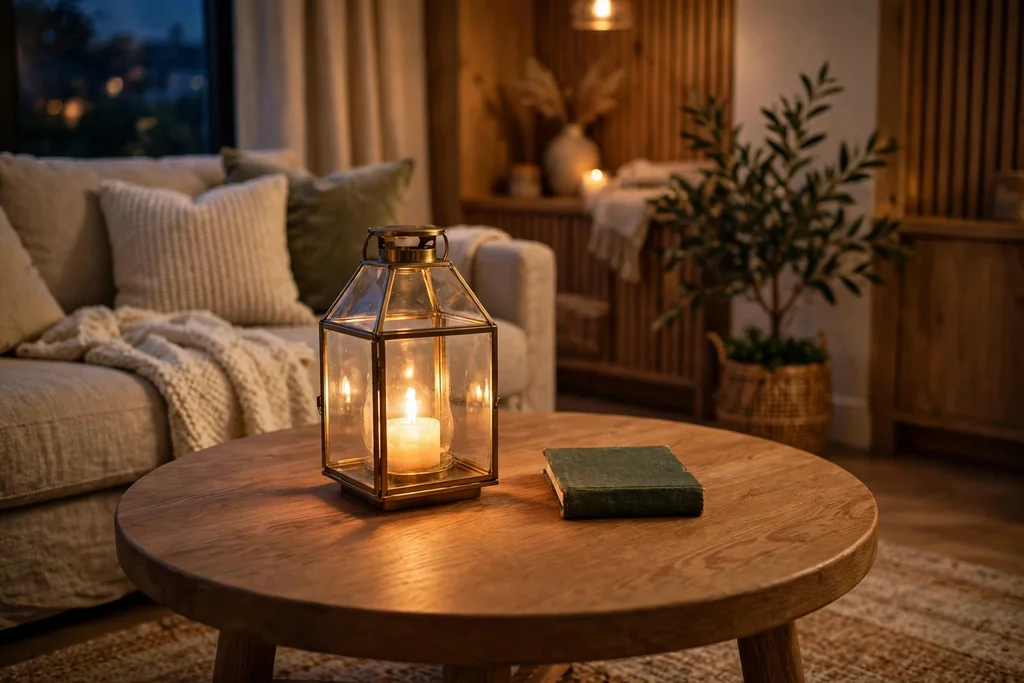
A lantern on a round table gives evening light at a low height, which makes a seating group feel cozy after dark. Choose a lantern with glass sides and a metal or wood frame, sized so it does not block conversation across the table, and place it slightly off center with a small book or a plant beside it. A flameless candle inside gives steady light with no flame near books or throws.
This idea suits a room used most in the evening, where a single ceiling light can feel harsh. Pair the lantern with a floor lamp or a side lamp, so the room has light at more than one height and no single harsh source. In the daytime, the lantern still works as a decorative object, especially if its frame matches another metal in the room, such as a brass tray edge or a black table leg.
Conclusion
A round coffee table looks best when the styling fits the table, not when it copies a photo of a different table. Start with one anchor, add height and texture in small steps, and leave room for the life that happens around the table: coffee, books, games, and conversation. The ideas here give you a starting point for every size and style, from a single vase on a small table to a two tier setup with storage below. Pick one idea, try it for a week, and adjust what does not work. A table that is easy to use will stay styled far longer than a table that only looks good in a photo. For a softer sofa pairing to go with the warm, layered looks here, see these grey couch living room ideas.
FAQs
How many items should I put on a round coffee table?
Three to five items, grouped as one or two clusters, suit most round tables. A small table needs only one group of two or three items, while a large table can hold two groups with clear space between them. Count a tray and its contents as one group, not as separate items, and leave at least one clear spot for a mug or a book.
What size tray fits a round coffee table?
A tray that covers about a third of the tabletop is a good starting point. Measure the table diameter first, then choose a tray about a third of that width, so the tray anchors the styling without covering the whole surface. A round or oval tray echoes the table shape best, and low sides keep small items visible.
Should the centerpiece sit in the center of a round table?
Not always. A centered piece suits a formal room and a small table, while an off center cluster suits a modern room and a larger table. Either way, the group should look planned from the main seat and from the doorway. If the table is used for coffee or games, keep the centerpiece to one side so the working area stays clear.
How do I style a round coffee table in a small living room?
Keep it to one small group, keep the height low, and use the space below the table for storage. A single vase, a small book stack, or a tiny tray is enough, and a patterned rug underneath adds interest without adding items to the tabletop. Leave a clear walkway around the table, since a small room feels crowded fast when the table styling spills into the path.
Can I mix materials on a round coffee table?
Yes, if you keep the mix to two or three materials, such as wood, ceramic, and brass, or rattan, stone, and linen. One material should lead, with the others in support, so the group reads as planned rather than random. Avoid adding a fourth strong material, such as a second metal, unless it appears in only one very small piece.
How often should I change coffee table styling?
Change one accent with the seasons, and restyle fully only when the table stops working for daily life. A seasonal flower, candle color, or small bowl keeps the table fresh with little effort, while the tray, books, and main vase can stay the same all year. If items keep getting moved aside for coffee or work, that is a sign the styling needs fewer pieces, not new ones.