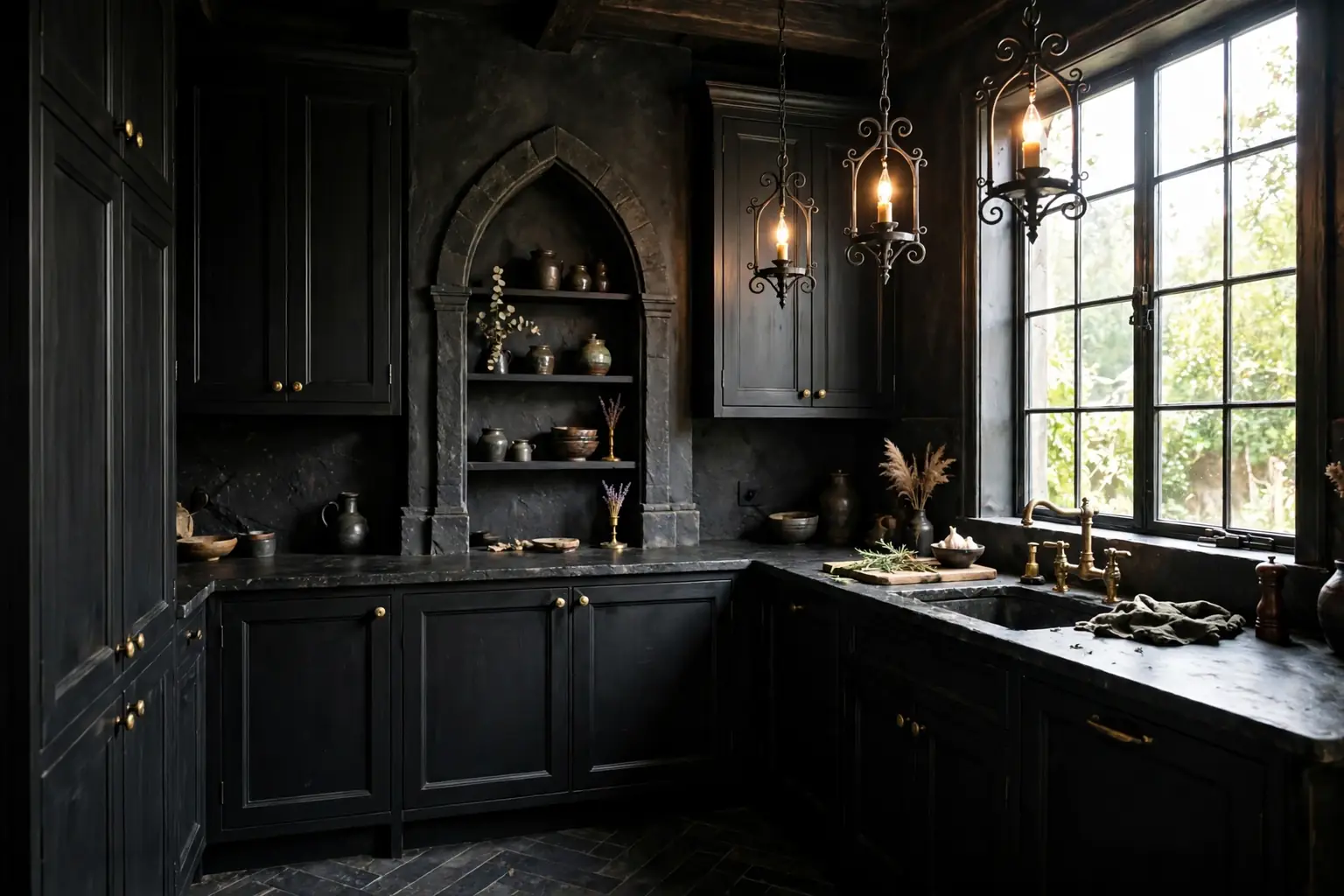
A gothic kitchen does not need a large room or a castle budget. In a small kitchen, the look works best when you pick a few strong details, such as black cabinets, an arched shape, or iron hardware, and let pale counters and good light keep the room feeling open. These 22 gothic kitchen ideas focus on changes that also help a small space work harder, from storage that uses wall space to seating that tucks away. Start with one idea, live with it for a week, and add another only if the room still feels calm and easy to cook in.
Key Takeaways
- Pick two or three gothic details, such as black, arches, and iron, and repeat them. Repeating a small set keeps a small kitchen calm.
- Keep at least one light surface, such as a pale counter, a light wall, or a bright window, so dark colors do not close the room in.
- Use walls and vertical space for storage, so counters stay clear for cooking.
- Choose pieces that do two jobs, such as a rolling island, a bench with storage, or a rail that holds pans.
- Add warm light in layers, with under-cabinet light for work and candle-style light for evenings.
1. Paint the Base Cabinets Matte Black and Add Brass Cup Pulls
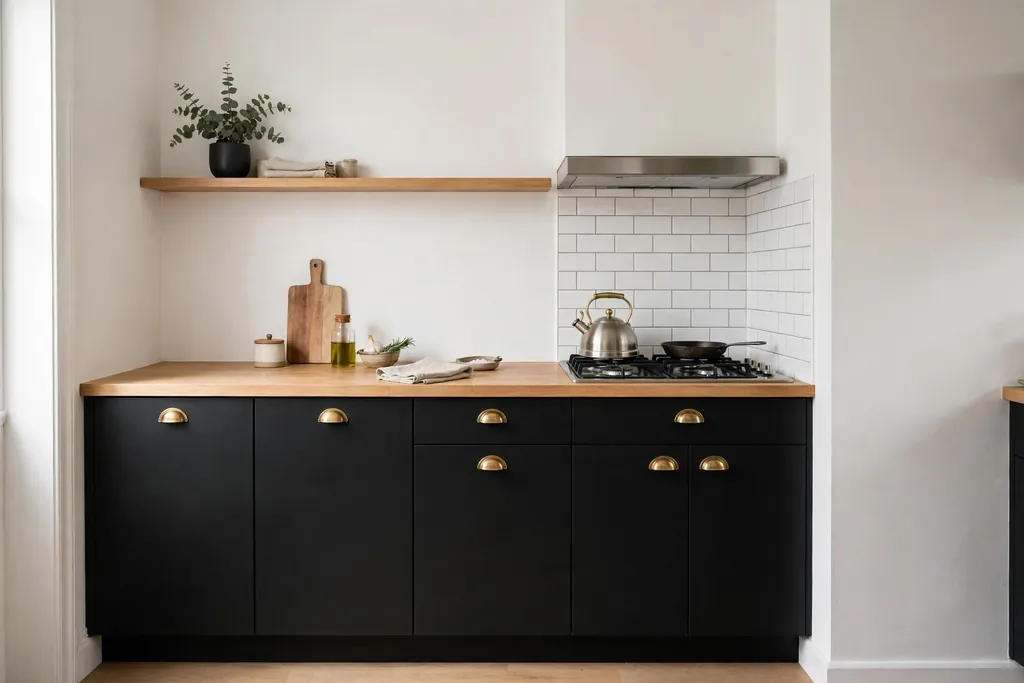
Matte black base cabinets give a small kitchen a clear gothic anchor without changing the layout. Keep the upper cabinets pale, or leave one stretch of wall light, so the dark lower half does not make the room feel low. Brass cup pulls soften the black and make the cabinets easy to open with wet or floury hands.
Paint only after cleaning and lightly sanding the doors, and use a paint made for cabinets so the finish stands up to daily use. Try one door first and check it in daylight and evening light. If black on every base cabinet feels heavy, paint the island or one run only and keep the rest pale.
2. Use Pointed Arch Shapes on Upper Cabinet Doors
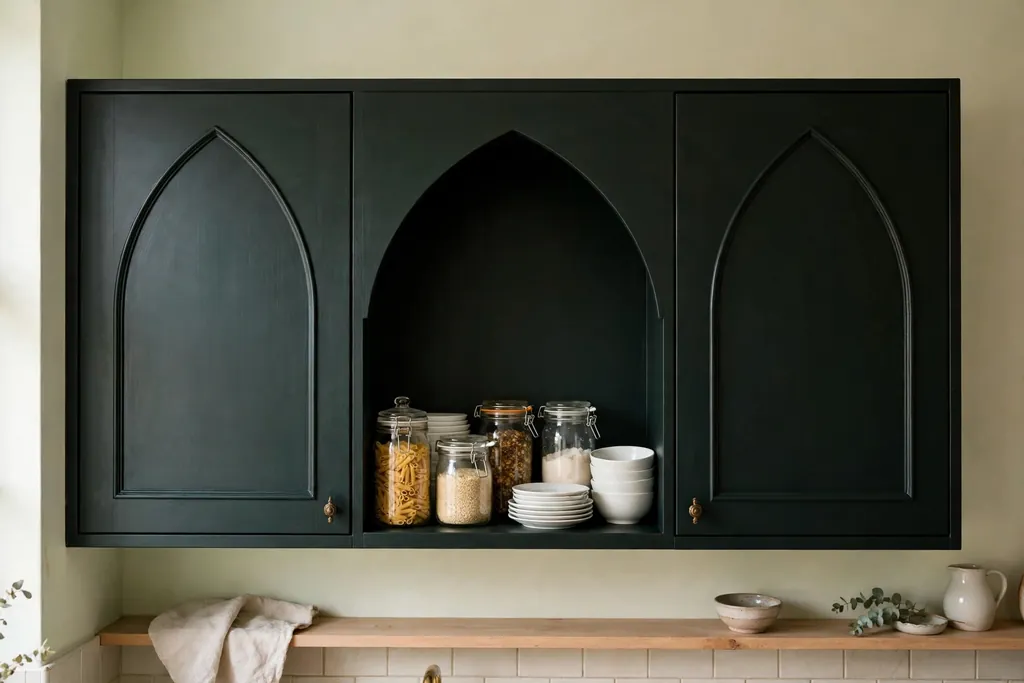
A pointed arch on an upper cabinet door brings the gothic shape into the room at eye level, where you notice it most. You can buy arch-front doors, add a thin applied arch trim to flat doors, or cut an arch niche into one open section. Keep the arch shape the same on each door so the run looks planned.
This idea works well on a short run of cabinets, where one repeated shape has room to stand out. Pair arched doors with plain hardware and a plain backsplash, so the arch stays the main detail. In a very small kitchen, use arches on two or three doors rather than on every cabinet.
3. Paint One Accent Wall Deep Charcoal
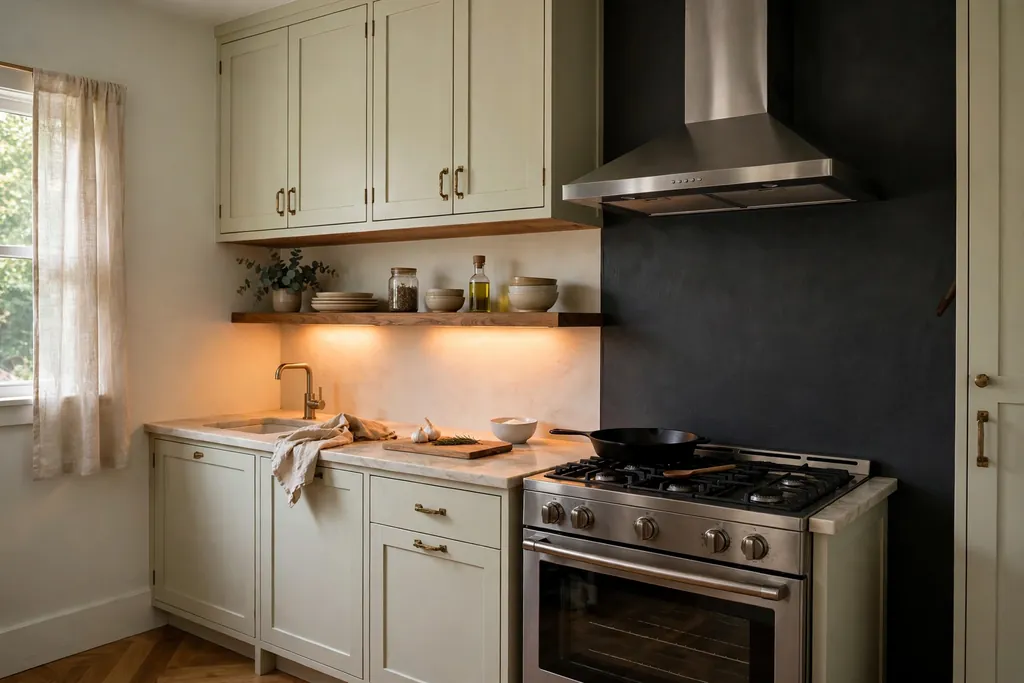
One deep charcoal wall adds drama for the cost of a tin of paint, and it works best on the wall you see first when you walk in. Keep the other walls pale, and add a light counter or light wood shelf on the dark wall so the eye has somewhere to rest. This contrast is what stops the room feeling like a box.
Paint the wall behind open shelves or a small table rather than behind the stove, where grease and steam mark paint faster. Use a washable finish and keep a small amount of paint for touch-ups. If you rent, test a large painted board leaned against the wall first, so you can judge the color before you commit.
4. Fit Black Open Shelves on Wrought Iron Brackets
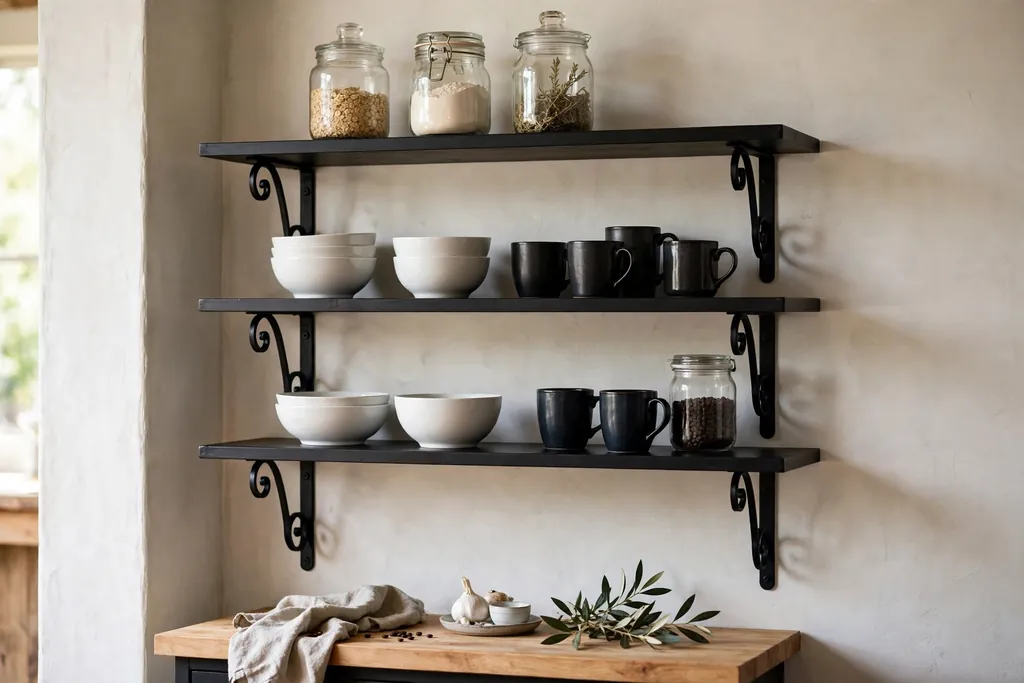
Black open shelves on iron brackets hold daily dishes where you can reach them, and they use wall space that a closed cabinet would make feel heavy. Keep each shelf to one or two groups, such as bowls on one shelf and mugs on another, and leave a gap at each end. Our guide to how to style open shelves shows how to leave that breathing room.
Fix brackets into studs or with fixings rated for the load, and keep heavy stacks low. Limit open shelves to one wall in a small kitchen, so the room still has closed storage for items that look messy. Wipe the shelves weekly, since cooking grease settles on open surfaces.
5. Create a Pointed Arch Tile Panel Behind the Stove
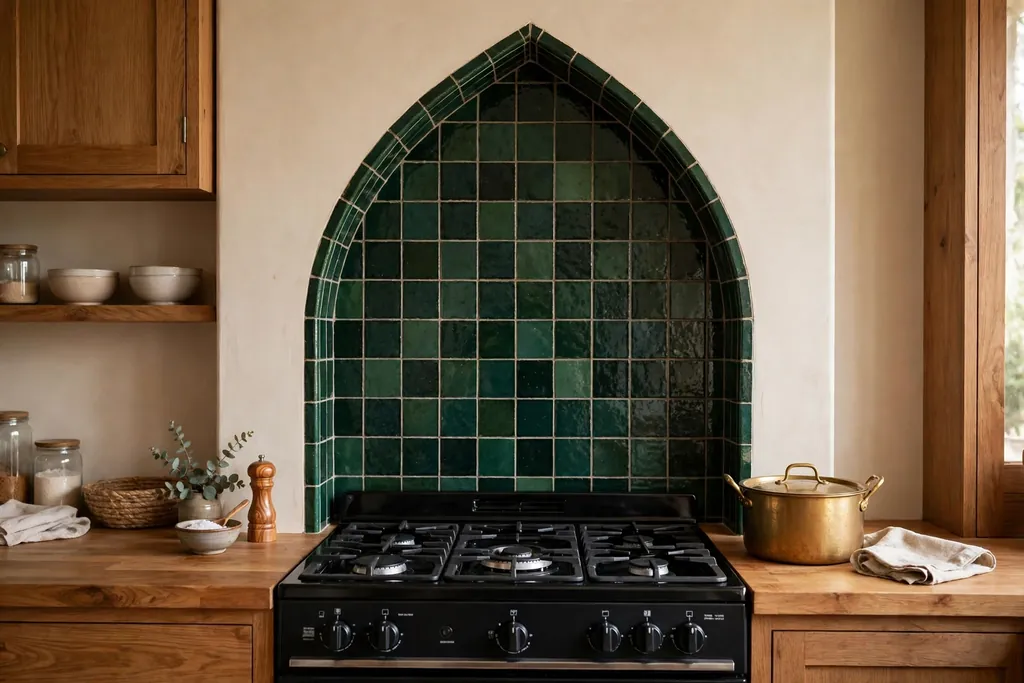
A pointed arch panel of dark green or black tile behind the stove turns a plain cooking wall into a focal point, and it needs only a small area of tile. Mark the arch shape on the wall first, tile inside the line, and keep the rest of the backsplash plain. The arch shape reads as gothic even when the tile color is quiet.
Use tiles that wipe clean and a grout sealer near the stove, since this wall sees steam and splashes. Keep the arch width close to the stove width, so the panel frames the cooking zone rather than spreading across the whole wall. If full tiling feels like too much work, a painted arch outline with a small tiled panel inside gives a similar effect.
6. Add Leaded Glass Inserts to Cabinet Doors
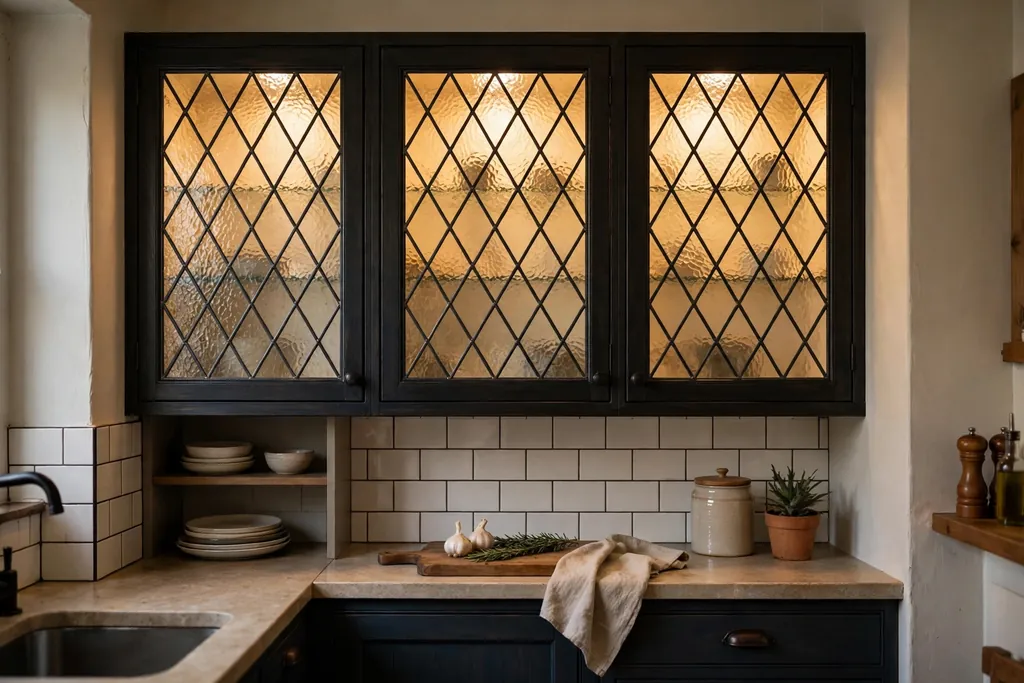
Leaded glass, with its diamond or grid pattern, softens a dark kitchen and hides the contents of a cabinet just enough to look tidy. You can fit real leaded panels, use textured glass, or apply a leaded-look film to existing glass doors. The pattern catches light and adds detail without a new color.
Use leaded inserts on one or two upper cabinets, such as the pair beside the sink, and keep the rest of the doors solid. This keeps the pattern special and limits cleaning, since textured glass shows dust more than flat glass. Check that the doors still close well after the change, and keep fragile glass out of cabinets that children open often.
7. Hang Pans From a Wrought Iron Rail
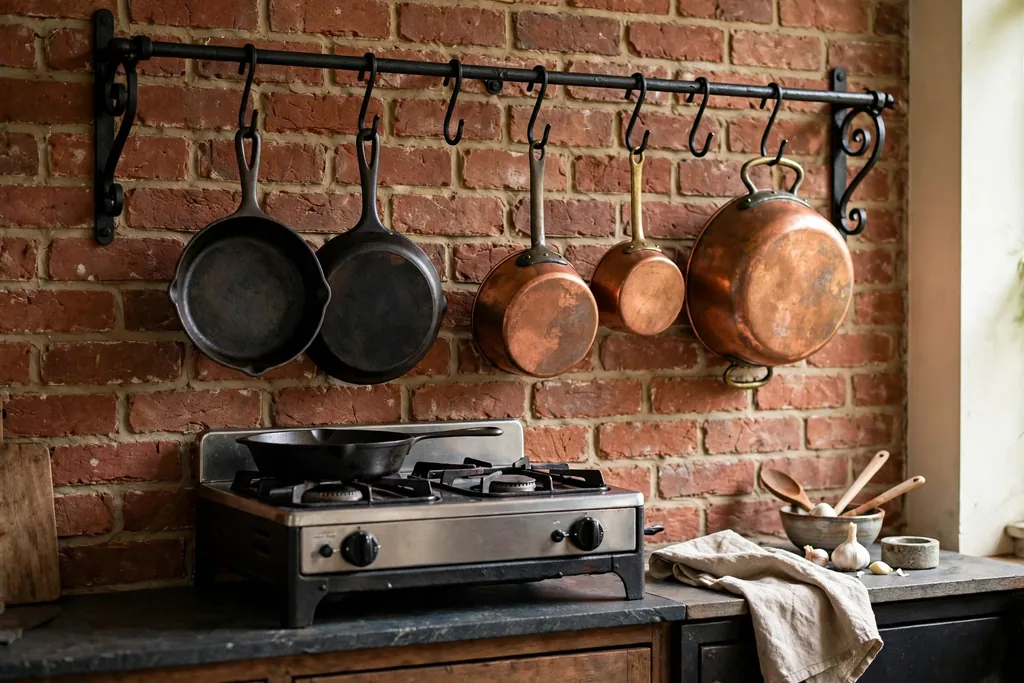
A wrought iron rail with hooks frees a whole cabinet shelf and puts pans where you grab them while cooking. Fix the rail into studs, hang the heaviest pan nearest a bracket, and leave space between pans so you can lift one off without knocking the next. Keep lids in a separate spot, since lids hung with pans tangle.
This idea suits a wall beside the stove or a short stretch above a counter, but keep pans clear of the main walkway so no one brushes against a handle. The same iron-and-black pairing in these black and gold kitchen ideas shows how dark metal can sit with warm brass without looking busy. Wipe the rail often, since steam leaves a film on iron near a stove.
8. Hang Candle-Style Pendant Lights Over a Counter or Table
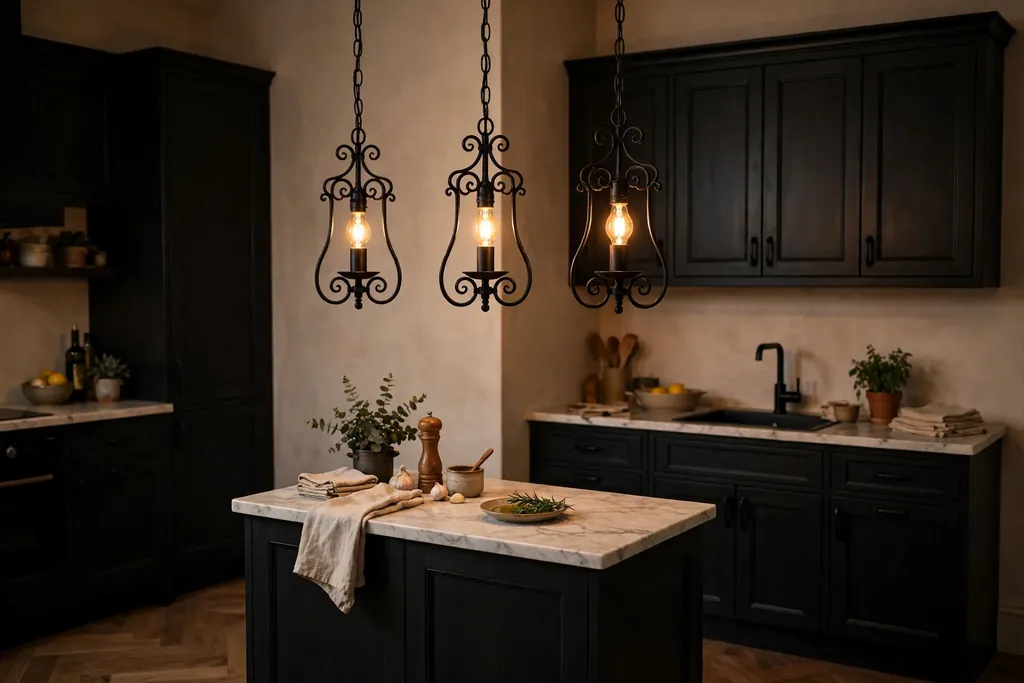
Pendant lights shaped like candle holders give evening light a gothic feel without real flames near curtains or paper. Use warm bulbs on a dimmer, and hang two small pendants over a counter or one over a small table, rather than a large fitting that crowds a low ceiling. Keep the pendants high enough that you can see across the table.
Choose a simple iron or black metal fitting so the light, not the shade, does the work. If you cook under the pendants, add under-cabinet light for the work surface, since candle-style bulbs alone are too dim for safe chopping. Keep spare bulbs in a drawer, since warm candle-style bulbs can be harder to find than standard bulbs.
9. Choose a Dark Stone-Look Countertop With Pale Veining
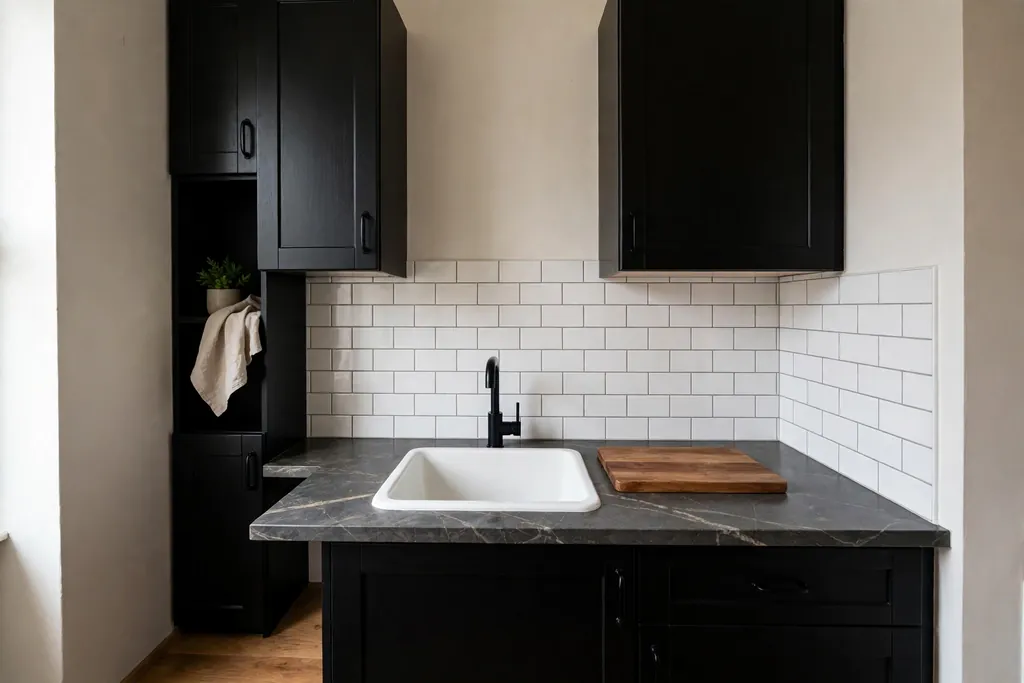
A dark grey countertop with pale veining gives a gothic kitchen a solid work surface that still shows crumbs and spills less than a plain black top. The pale lines break up the dark surface and link it to a light sink, light dishes, or a pale wall. Keep the counter depth standard, so a dark top does not eat into a small work area.
Wipe the top daily and use boards for cutting, since dark surfaces show scratches in bright light. Pair the top with one warm detail, such as wood boards or brass handles, so the kitchen does not feel cold. If a full new countertop is out of reach, a dark stone-look worktop cover on one run gives a similar look for less work.
10. Paint the Range Hood Black and Add an Arched Trim
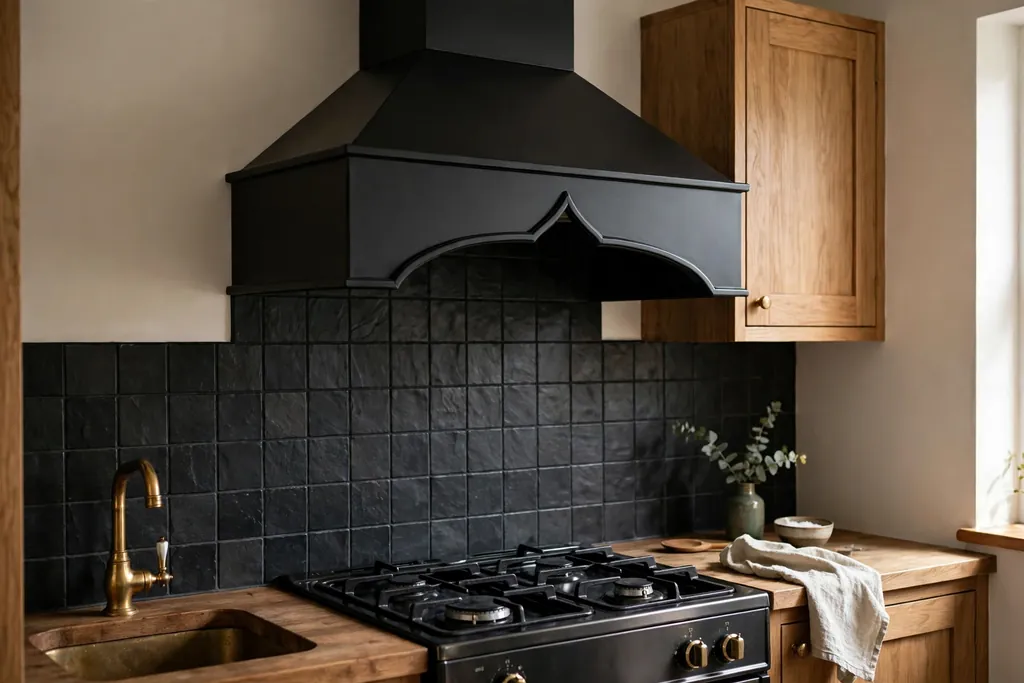
A black range hood with a simple arched trim turns the stove wall into a focal point and ties the hood to arched doors or an arched tile panel elsewhere. Keep the trim to one arch line or a small cornice, so the hood still looks like a working appliance. Use heat-resistant paint made for the hood material, and never paint filters or fan parts.
Check the hood height and venting before you paint, and clean off grease first so the paint holds. This idea works best when the rest of the stove wall stays plain, with no busy tile competing with the arch. For more seasonal dark-kitchen styling, these Halloween kitchen decor ideas show how to add dark accents without changing fixed features.
11. Hang a Pointed Arch Mirror Over the Sink
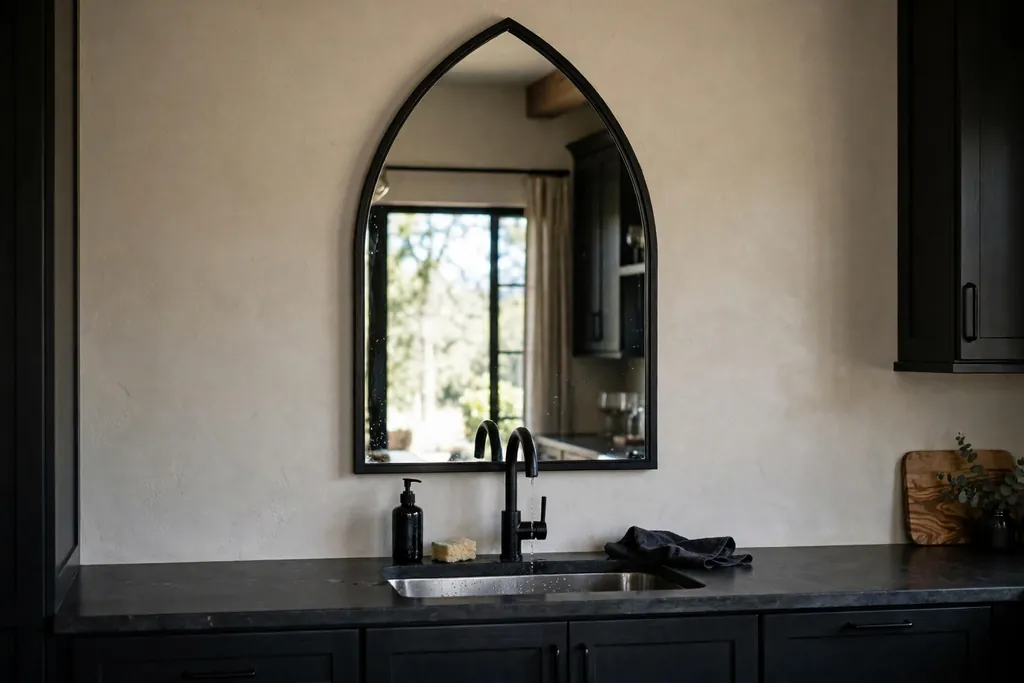
A tall pointed arch mirror over the sink reflects window light back into a small kitchen and adds the gothic shape without taking any counter space. Choose a mirror sized to the sink wall, with a thin black frame, and hang it high enough that splashes do not spot it constantly. The mirror works best opposite or beside a window, where it has light to reflect.
Fix the mirror with fixings rated for its weight, and keep it clear of the faucet swing. If a mirror over a sink feels odd, hang it on the wall you face while cooking, where it still bounces light around the room. Wipe it with a dry cloth after steamy cooking, so water marks do not build up.
12. Use a Rolling Butcher Block Island That Tucks Away
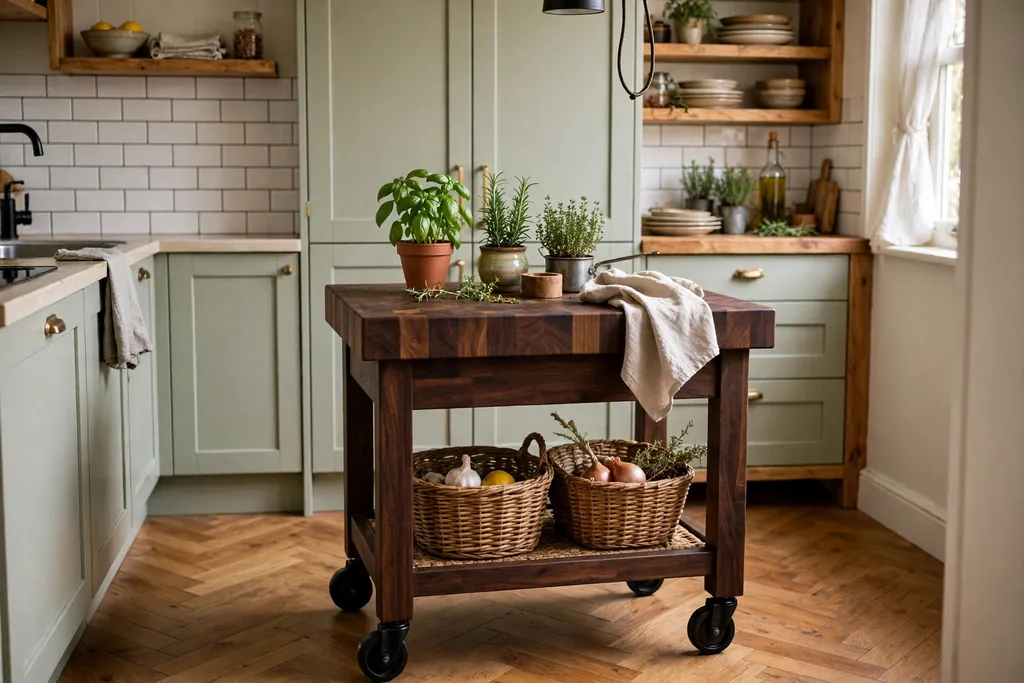
A butcher block island on casters adds prep space when you need it and rolls to the wall when you do not, which is ideal for a small kitchen. Choose a size that leaves a clear walkway on both sides when it is in use, and lock the casters before chopping. A shelf below holds a basket for towels or a small set of bowls.
Keep the top oiled and use it as a second prep zone, not as permanent storage for clutter. When guests come, roll it to the wall as a serving table, then roll it back for cooking. Measure doorways and the gap beside the fridge before you buy, so the island can actually move where you plan to store it.
13. Lay a Black and White Checkerboard Floor in a Small Kitchen
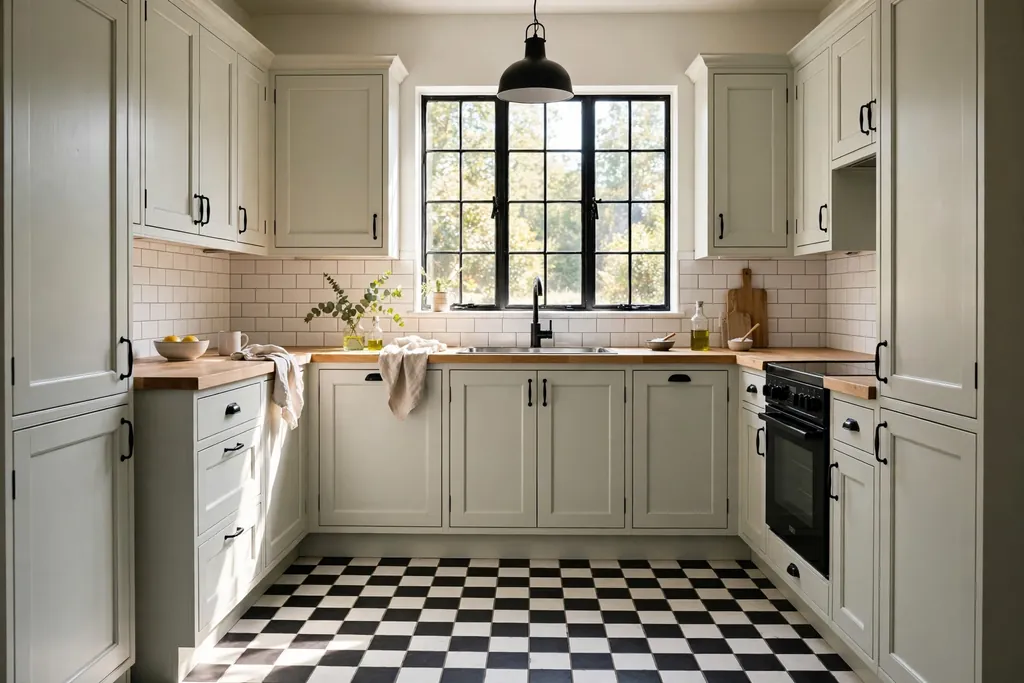
A black and white checkerboard floor adds a classic gothic pattern underfoot and helps a small kitchen feel planned rather than plain. Small tiles suit a compact room, since large tiles can make the pattern feel out of scale. Keep the walls and cabinets quiet, so the floor carries the pattern on its own.
Use tiles that suit a kitchen floor, with grout sealed against spills, and keep a spare box of tiles for repairs. If new tiling is too much work, peel-and-stick checkerboard tiles on a sound existing floor give a similar look and can be removed later. Test one tile in daylight, since black tiles can look blue or brown under some lights.
14. Pair Dark Cabinets With Black Leather and Iron Bar Stools
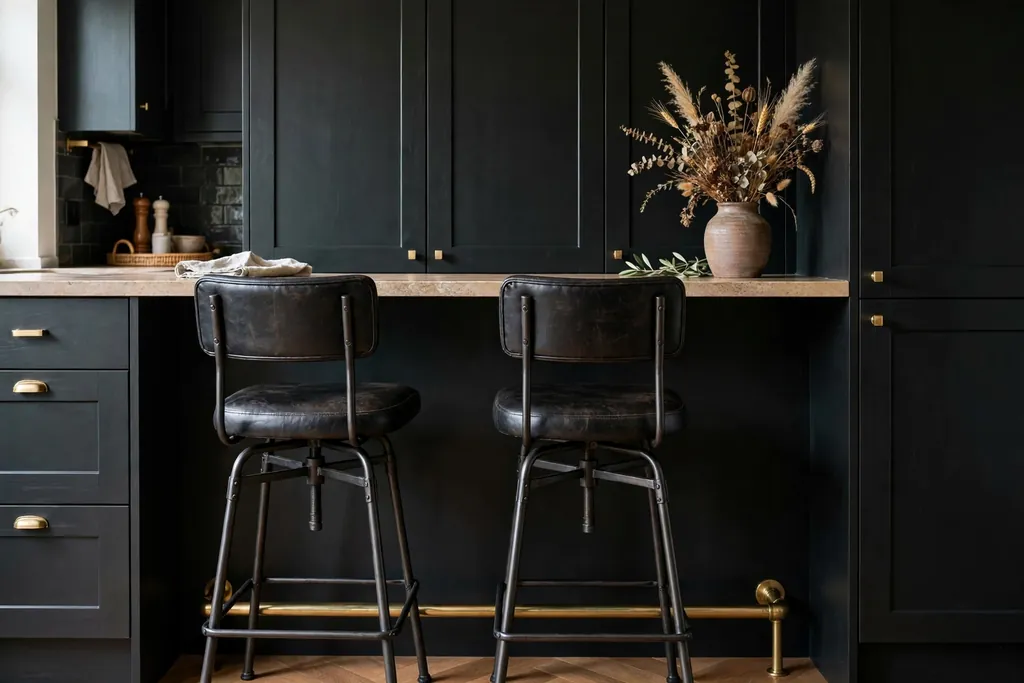
Black leather and iron bar stools suit a gothic counter and stand up to daily use better than fabric seats in a kitchen. Choose stools with a footrest, a back if the counter is used for meals, and a seat height that leaves room to slide in without hitting the counter edge. Two stools suit most small counters, and a third only if the counter is long enough.
Wipe leather seats with a damp cloth and keep them away from direct stove heat. If leather feels too heavy, black metal stools with a wood seat give a similar look and are lighter to move. Store a stool under the counter overhang when it is not in use, so the walkway stays clear.
15. Frame the Pantry With a Pointed Arch Opening
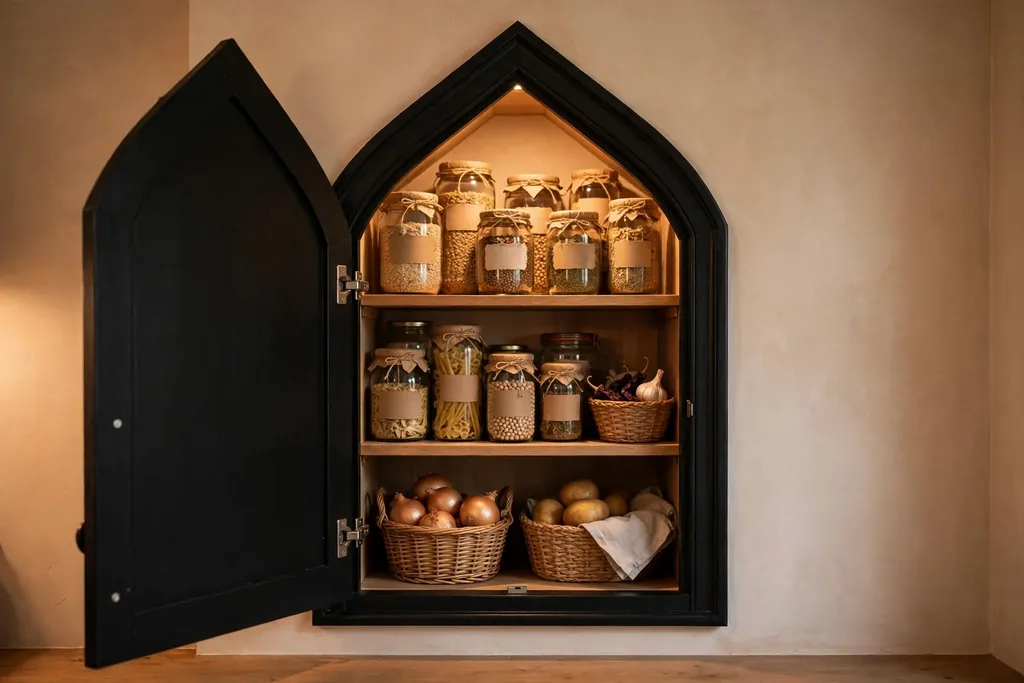
A pantry with a pointed arch frame feels like a small gothic doorway, even when the pantry itself is just a cupboard. You can add arch trim around an existing pantry door, fit an arch-top door, or leave the pantry open with an arch frame and baskets inside. Keep the arch shape matching any arched cabinet doors nearby.
Inside the pantry, use clear jars and one basket per shelf, so the open arch still looks tidy. If the pantry is in a corner, the ideas in our guide to corner kitchen cabinet ideas help you use the awkward space behind the arch. Label jars on the front, so you can find things without pulling every jar out.
16. Add Stained Glass Color to the Kitchen Window
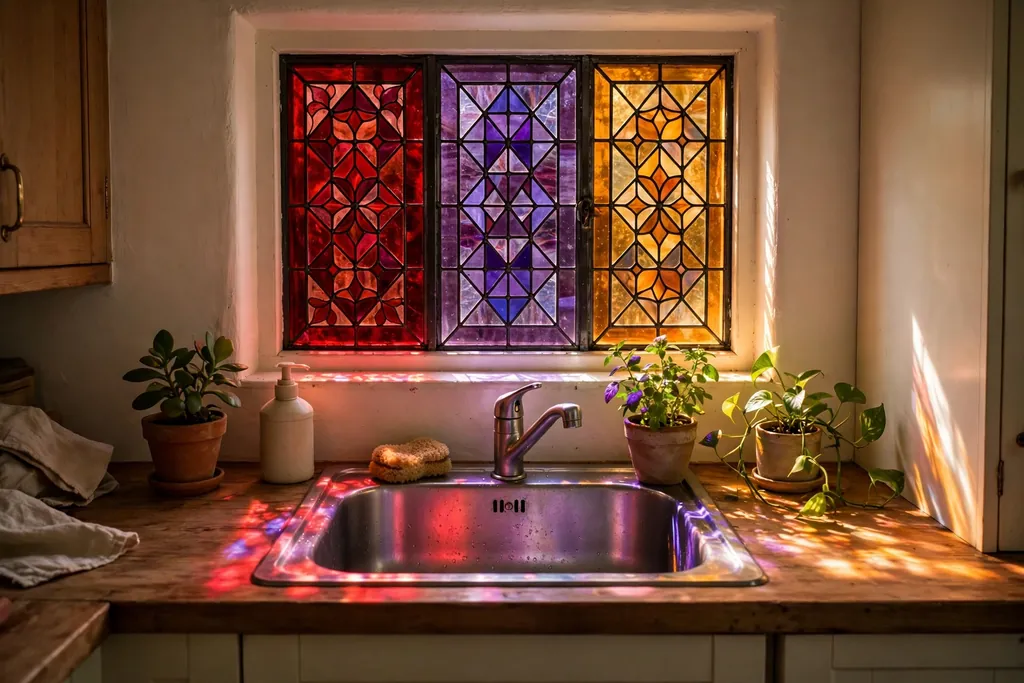
Stained glass color on a kitchen window adds red, purple, and amber light to a dark kitchen without blocking daylight completely. A stained glass film is the simplest route: it sticks to the glass, peels off later, and costs far less than a real stained glass panel. Apply it to the upper half of the window first, so the lower half stays clear for looking out.
Our guide to kitchen window decor ideas covers other ways to dress a kitchen window without losing light. Clean the glass well before applying film, smooth out bubbles from the center outward, and keep plants clear of the film edge so watering does not lift it. If you use real stained glass, hang it inside the window frame so it can be removed for cleaning.
17. Swap to a Matte Black Faucet and Matching Hardware
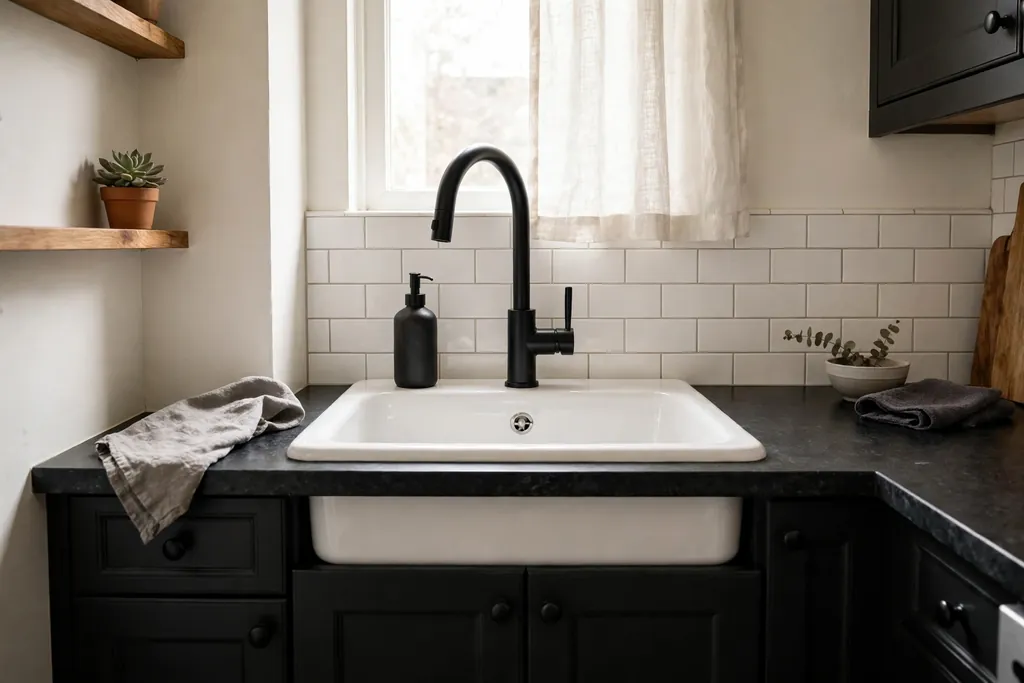
A matte black faucet, with matching knobs and pulls, is a low-cost way to link dark cabinets, an iron rail, and a black hood into one scheme. Swap the faucet and hardware together, so the finishes match, and keep the sink and counter pale so the black details stand out. This change needs no new cabinets and takes an afternoon for most kitchens.
Check that the faucet suits your sink holes and water pressure before you buy, and keep the old hardware in a bag in case you move. Black finishes show water marks, so wipe the faucet dry after use and avoid harsh cleaners that can dull the coating. If your water is hard, a black faucet near a window, where marks show less, is a safer spot.
18. Store Dry Goods in Apothecary Jars on One Shelf
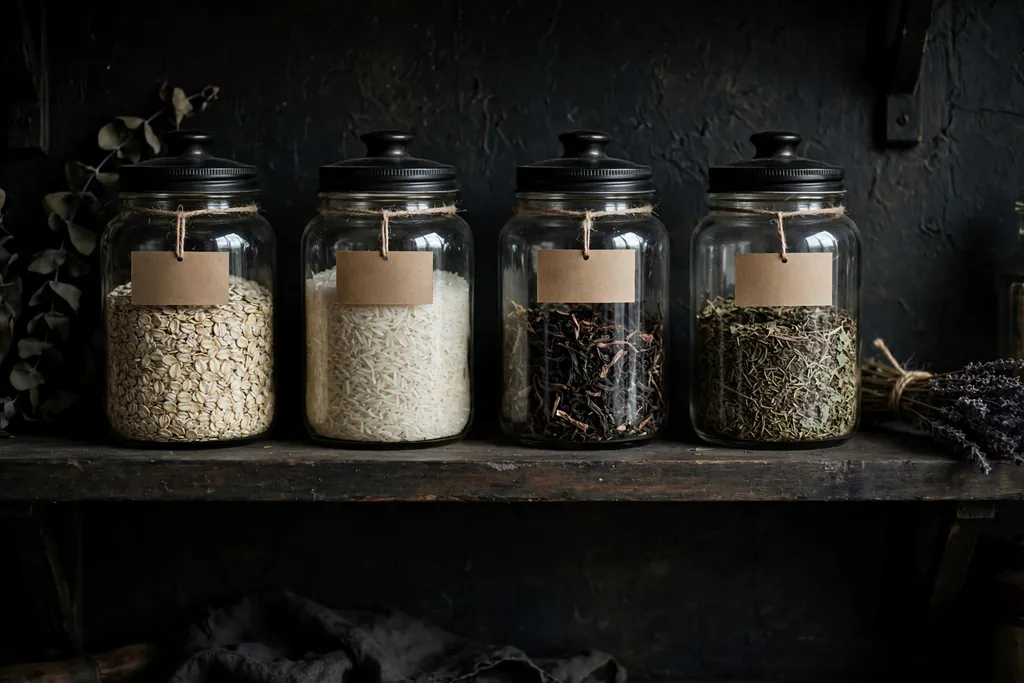
Apothecary jars with black lids turn rice, oats, tea, and dried herbs into a gothic display that also helps with shopping, since you can see levels at a glance. Use jars of one or two sizes, label each jar on the front, and keep them on one shelf rather than spreading them across the kitchen. This limit keeps the display calm and the shelf easy to clean.
Refill jars from bulk packs kept in a cabinet, and wash a jar fully before filling it with a different food. Keep the shelf away from stove steam, which can soften dry goods, and check dates twice a year. A shelf of eight to twelve jars suits most small kitchens, and more than that starts to look like a shop display.
19. Place One Tall Black Vase With Dried Stems on the Counter End
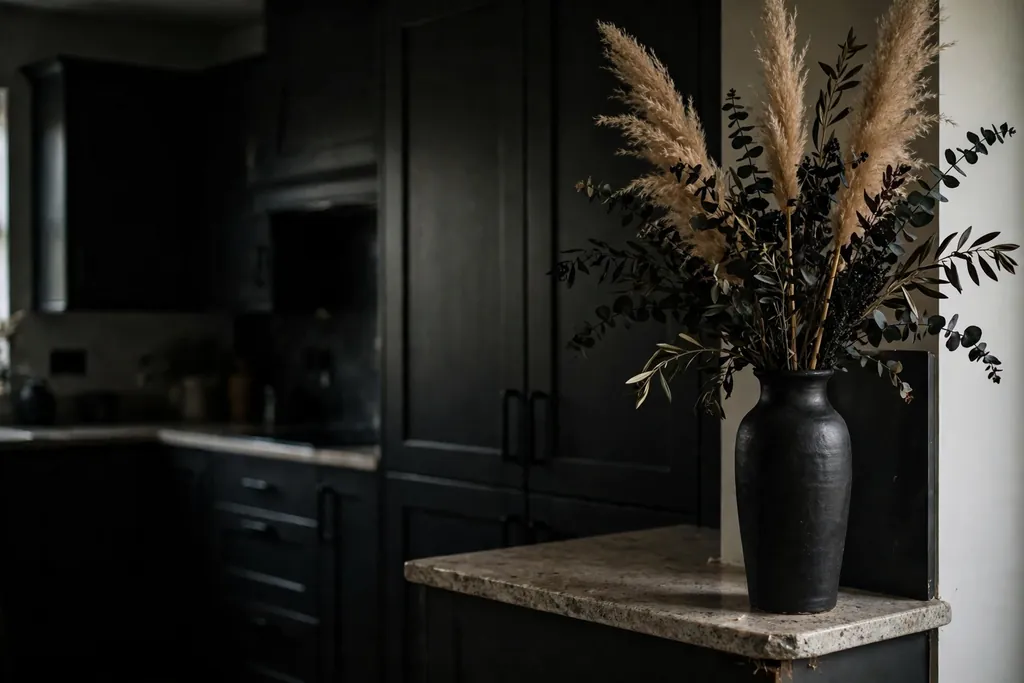
One tall black vase with dried stems adds height and a gothic note to a counter end, without taking the work space in the middle. Choose dried stems that suit the vase height, keep the arrangement narrow so it does not block a walkway, and place it where it will not be knocked by a cabinet door. Pampas stems, dark foliage, and dried seed heads all hold their shape well.
Keep dried stems away from the stove and any open flame, since dried plants catch fire easily. Dust the arrangement with a soft brush, and replace stems once they start to shed. If counter space is very tight, move the vase to a windowsill or the top of a tall cabinet, where it still adds height without using prep space.
20. Hang Framed Black and White Architectural Prints
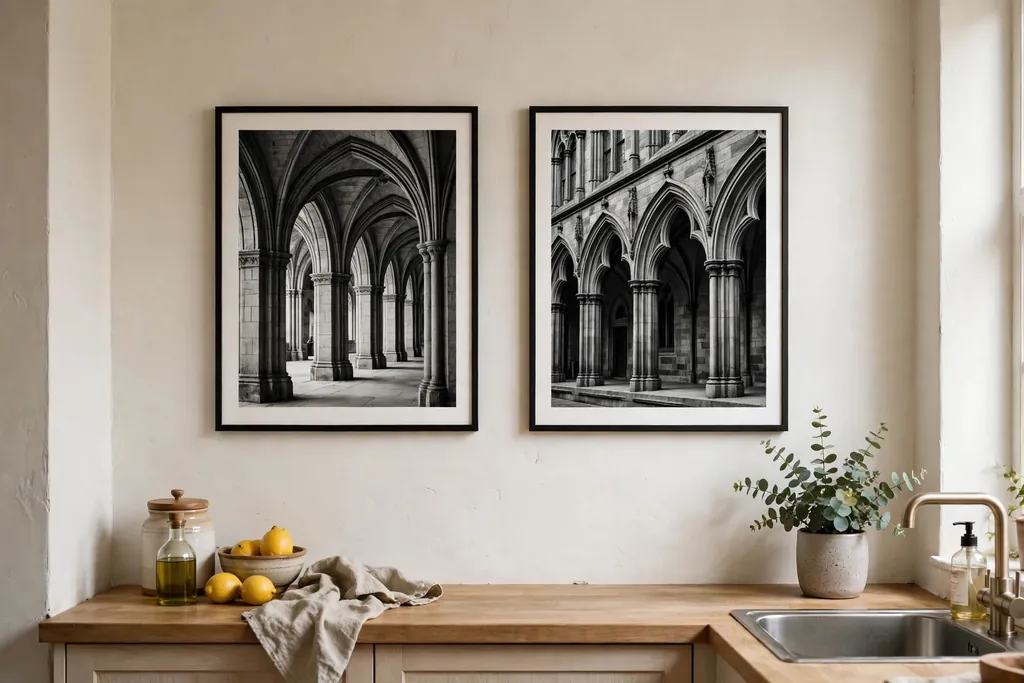
Framed black and white prints of gothic arches, windows, or doorways add the style to a wall that cannot take shelves or tiles. Use thin black frames, two or three prints in a row, and hang them where steam will not reach, such as the wall beside a table or above a bench. Black and white keeps the prints calm next to dark cabinets.
Hang prints at eye level and use fixings suited to the wall type, since framed glass is heavier than it looks. If you rent, use picture hanging strips rated for the frame weight, and check the weight limit before hanging glass. Swap prints seasonally if you like, but keep the frames the same, so the wall still reads as one planned group.
21. Build a Breakfast Nook With Bench Storage in a Corner
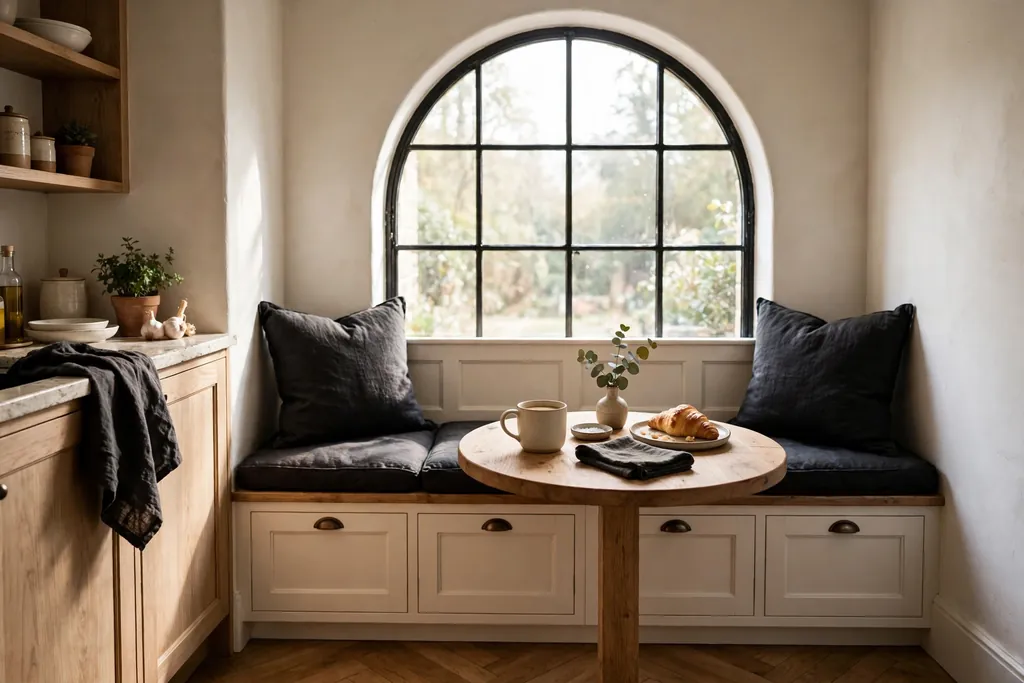
A corner breakfast nook with a bench turns dead corner space into seating and storage, which is a strong gain in a small kitchen. Build or buy a bench with lift-up seats or drawers below, add a small round table that seats two or three, and keep the bench cushions dark with a washable cover. The bench seats more people than chairs in the same footprint, since no chair legs take up floor space.
Measure the corner carefully, and leave room to slide onto the bench without moving the table. Store rarely used items in the bench, such as tablecloths or a picnic set, and keep daily items in the kitchen itself. For table styling once the nook is built, see our ideas for everyday dining table decor.
22. Set a Candelabra on the Table and Layer the Evening Light
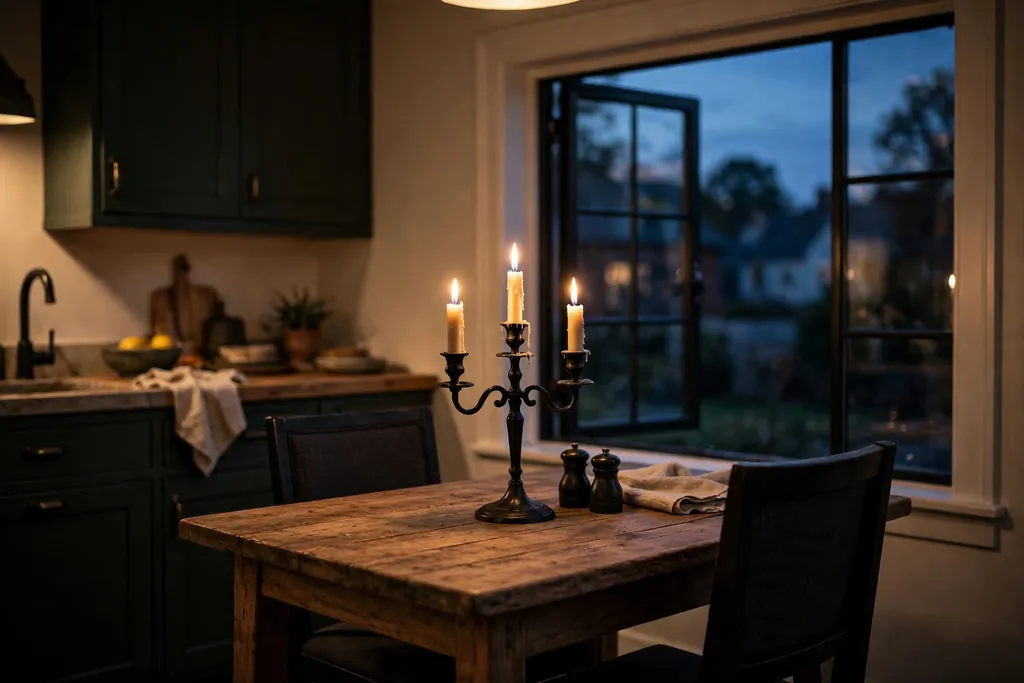
A black iron candelabra on the table, used with real candles for a meal or flameless candles for everyday evenings, gives a gothic dining corner its finishing detail. Keep the candelabra low enough to see across the table, place it on a heatproof mat, and never leave real candles burning in an empty room. Layer the light: dim the main light, use under-cabinet light in the kitchen, and let the table light stay warm and low.
This idea works best as the last step, after the cabinets, shelves, and seating are set, since candlelight shows off dark finishes well. Store the candelabra in a cabinet when it is not in use, so the table stays clear for cooking prep. If you have children or pets, use flameless candles in the candelabra and keep real candles for adult-only meals.
Conclusion
A small gothic kitchen works when dark colors, arches, and iron are used with restraint and each change also helps the room work better. Start with the change that solves a daily problem, such as a rail for pans, a rolling island for prep space, or a bench that adds storage. Keep one light surface, repeat a small set of details, and add warm light in layers. With those limits in place, black cabinets, an arch tile panel, or a candelabra on the table can give a compact kitchen a clear gothic character without crowding it.
FAQs
How do I make a small kitchen look gothic without making it feel dark?
Use dark colors on one area, such as base cabinets or one wall, and keep counters, upper cabinets, or a window wall light. Add warm light in layers, use a mirror or light floor to bounce light, and repeat only two or three gothic details. Step back to the doorway and check the room in daylight and evening light before adding more dark pieces.
What is the cheapest way to try a gothic kitchen look?
Paint is the cheapest route: one accent wall, painted base cabinets, or a black faucet and hardware swap can change the room for little cost. Stained glass film on a window, apothecary jars on one shelf, and a tall black vase with dried stems are also low-cost changes. Start with one change, live with it for a week, and add the next only if the room still feels calm.
Can I use black cabinets in a very small kitchen?
Yes, if you balance them with light. Keep upper cabinets pale or open, use a light countertop, and make sure the room has good task lighting for cooking. Matte black shows fewer fingerprints than gloss black, and brass or wood details keep the room from feeling cold. If the kitchen has no window, keep black to the base cabinets and one dark accent, not the whole room.
How do I keep a gothic kitchen from looking like Halloween decor all year?
Keep the gothic details architectural, such as arches, iron, leaded glass, and dark wood, rather than seasonal props. Use the style year round with plain dishes, wood boards, and plants, and save pumpkins, bats, and other seasonal items for autumn. A checkerboard floor, black cabinets, and brass hardware read as gothic in any season.
Is a gothic kitchen hard to keep clean?
Dark surfaces show dust, water marks, and crumbs more than pale ones, so wipe counters and faucets daily and shelves weekly. Choose washable paint, sealed grout, and a countertop that hides marks, such as dark stone with pale veining. Open shelves need more cleaning than closed cabinets, so limit open storage to one wall and keep the rest closed.
What lighting works best in a dark gothic kitchen?
Layer three types of light: bright under-cabinet light for cooking, a main ceiling light on a dimmer for general use, and warm low light, such as candle-style pendants or a candelabra, for evenings. Keep work areas bright for safety, even when the dining corner is dim. Warm bulbs suit dark cabinets better than cool white bulbs, which can make black look grey.