
Living room Christmas decor ideas work best when you layer greenery, warm light, and soft textiles around one clear focal point, usually the tree or the mantel. Start with lights and garland, add stockings and a wreath, then finish with cushions, throws, and a simple coffee table centerpiece for a welcoming holiday space.
Pick a palette first, such as cream, green, and muted red, or cream, gold, and soft brown, and repeat it from the mantel to the sofa so the room reads as one settled scheme. Keep everyday furniture in place and change only the layers: textiles, greenery, lights, and a few ornaments. For the wider room behind the seasonal layers, see the farmhouse decor guide, and for more seasonal ideas, browse the Dwell Ovell decor ideas index.
Key Takeaways
- Choose one focal point, the tree or the mantel, and keep the rest of the room calmer.
- Hold the palette to two or three colors plus natural green and warm wood.
- Layer in this order: lights, greenery, large pieces, then small ornaments and textiles.
- Repeat one material, such as pine, plaid, or brass, in at least three spots for a linked look.
- Keep walkways, seating, and the television view clear when you place trees, lanterns, and baskets.
- Swap only textiles, greenery, and small decor after the season, so the room returns to normal with little work.
1. A Classic Green Garland on the Mantel

Drape a full green garland across the mantel, letting it dip gently in the middle and at each end rather than pulling it straight. Pine, fir, or mixed evergreen garland gives the fireplace an instant holiday frame, and it pairs well with stockings, candles, and a wreath above. Keep the garland deep enough to read from across the room, but shallow enough that it does not hide the mantel shelf.
Add warm white lights woven through the garland before you hang stockings or ornaments, so the glow sits inside the greenery. Tuck small pinecones or dried orange slices into the garland for texture, and step back to check that both ends hang at the same length. Keep garland clear of open flames, and use battery lights if no outlet sits near the mantel.
2. Stockings Hung on the Mantel

Hang one stocking per person on the mantel, spaced evenly and hung from sturdy hooks rather than from the garland itself. Knit, felt, or linen stockings in the room palette add a personal note, and a row of matching stockings looks calm even when each one holds a different initial or small charm. Hang stockings high enough that they clear the firebox opening.
Use hooks that clamp to the mantel shelf or screw-free holders weighted for the stocking size, and test each hook with a small weight before filling stockings. If the mantel is short, hang stockings in a gentle arc, with the middle stocking slightly lower, rather than crowding them. Keep stockings away from a lit fire, and move them to a side table on nights when the fire is in use.
3. A Wreath Above the Mantel Mirror

Hang a plain evergreen wreath centered above the mantel mirror, or in place of a picture, so the fireplace wall has one clear holiday mark. A wreath with pinecones, red berries, or a simple bow suits most living rooms, and its round shape softens the straight lines of the mantel and mirror. Choose a wreath sized to the mirror, roughly two thirds of its width, so neither piece crowds the other.
Hang the wreath from a ribbon loop over a small hook or a suction hook on the mirror frame, and check it from the sofa before fixing it in place. If the mirror is large, use one medium wreath rather than two small ones, which can look scattered. Take the wreath down by its frame, not by loose branches, so it keeps its shape for another year.
4. A Tree in the Corner by the Window

Place the main tree in a living room corner near a window, where daylight shows the greenery by day and lights show through the glass at night. A corner spot keeps the tree out of walkways and leaves the sofa and fireplace clear, while still giving the tree a full view from the seating area. Measure the corner first, allowing room to walk around the tree for decorating and watering.
Angle the tree so its fullest side faces the room, and place the stand on a waterproof tray to protect the floor. String lights from the inside of the branches outward, then add garland and ornaments, checking the tree from the sofa after each layer. Keep the tree clear of radiators, curtains, and open flames, and water a real tree daily.
5. A Slim Tree for a Small Living Room

Choose a slim or pencil tree when floor space is tight, since it gives the height and light of a full tree with a much smaller footprint. Slim trees suit corners, narrow walls, and rooms where a wide tree would block a door or a walkway, and they still hold lights, garland, and a good number of ornaments. Pick a height that leaves at least a foot between the topper and the ceiling.
Decorate a slim tree with smaller ornaments and one narrow garland, so branches do not sag under weight. Place larger ornaments lower down, where branches are stronger, and keep the base simple with a slim skirt or a tall basket. If the room is very small, try a half tree against a wall, which reads as full from the front and takes almost no floor depth.
6. Window Candles in Every Window
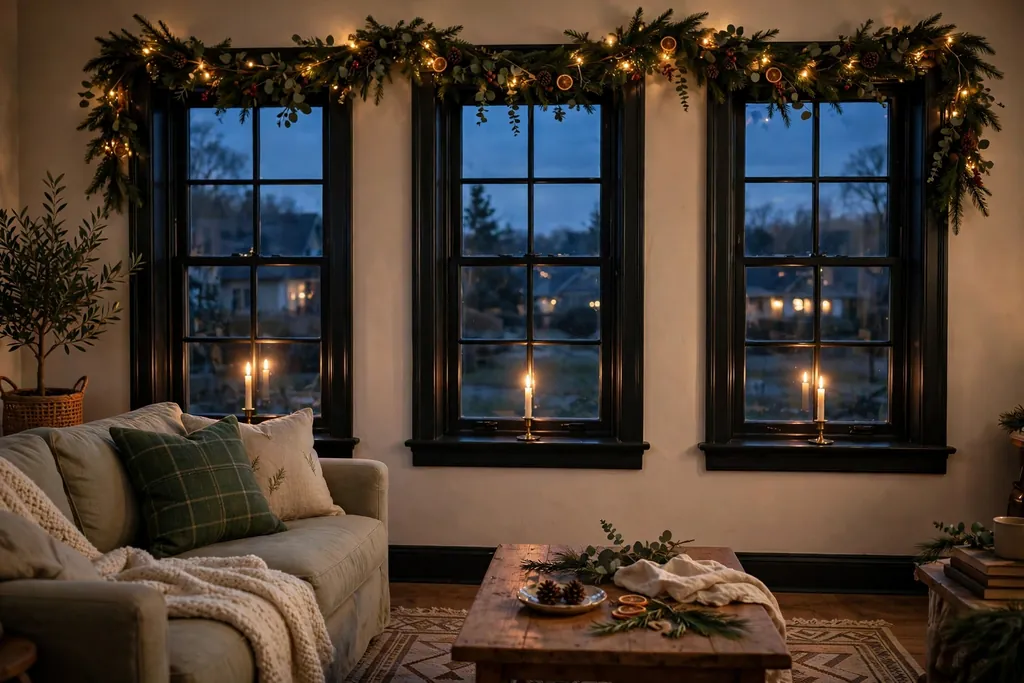
Set one simple candle in each living room window, either a real candle in a safe holder or a battery candle with a timer, for a calm, even glow after dark. Window candles are a classic holiday signal from the street, and inside the room they add soft light at eye level without cluttering tables. Use the same candle style in every window so the row reads as one idea.
Place candles centered on the sill, clear of curtains and blinds, and set battery candles to switch on at dusk. If you use real candles, never leave them burning unattended, and keep them in steady holders that cannot tip. Wipe sills before placing candles, since dust and old wax show up in window light.
7. Mini Wreaths on the Windows
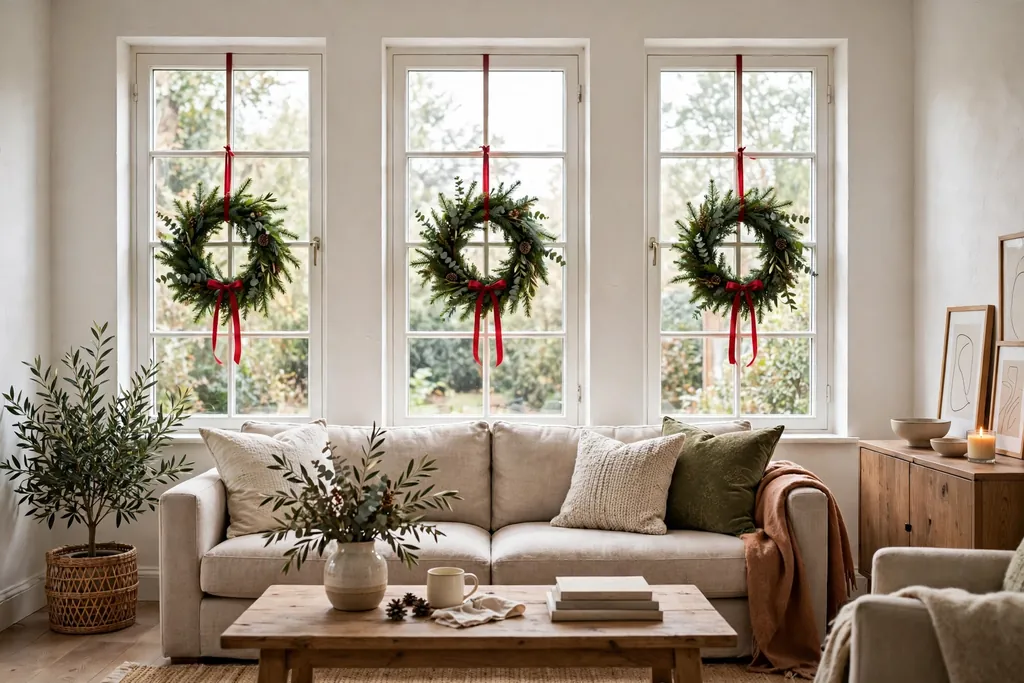
Hang a small evergreen wreath on each living room window, centered on the glass and tied with a ribbon loop from a small hook above the frame. Mini wreaths repeat the mantel wreath at a smaller scale and give the room a linked feel from every seat, especially when the same ribbon color appears on the tree and the mantel. Keep wreaths small enough that they do not block daylight.
Use a suction hook or a ribbon over the top of the frame for rented rooms, so no holes are needed. Hang all wreaths at the same height and with the same ribbon length, and check them from outside as well as inside, since windows show both ways. Take wreaths down before closing heavy curtains over them, which can crush branches.
8. A Coffee Table Tray Centerpiece

Build the coffee table centerpiece on one tray, with a cluster of candles, a small pine sprig, and one or two ornaments grouped in the middle. A tray keeps the display contained and easy to lift when the table is needed for drinks or games, and it stops small pieces from drifting across the table. Choose a tray that leaves room on each side for cups and books.
Use candles of different heights in steady holders, and keep flames clear of pine sprigs and paper. Add one seasonal color, such as red berries or gold ornaments, and keep the rest of the tray in wood, glass, and green. Change the sprigs weekly if they are fresh, and keep the tray clear of remote controls and mail so the centerpiece stays the focus.
9. Lanterns Beside the Fireplace Hearth
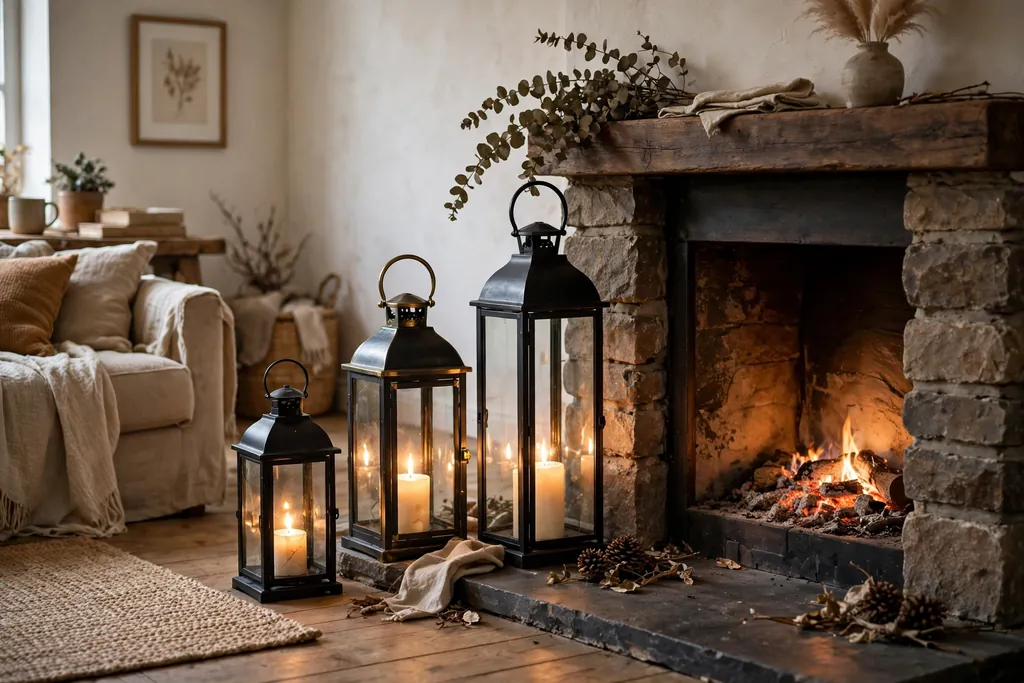
Set two or three lanterns of different heights beside the fireplace hearth, each holding a pillar candle or a battery candle, for a soft glow at floor level. Lanterns suit rooms with or without a working fire, since they give the hearth a lit feel even when the fireplace is not in use. Black metal, wood, or brass lanterns each set a different tone, so pick one finish and repeat it.
Place the tallest lantern at the back and shorter ones in front, clear of the firebox and of foot traffic. Use battery candles inside lanterns near curtains or throws, and real candles only where they can be watched. Wipe glass panels before the season starts, since soot and dust dull the light, and store spare candles in the lantern base or nearby.
10. A Basket of Rolled Throws by the Sofa
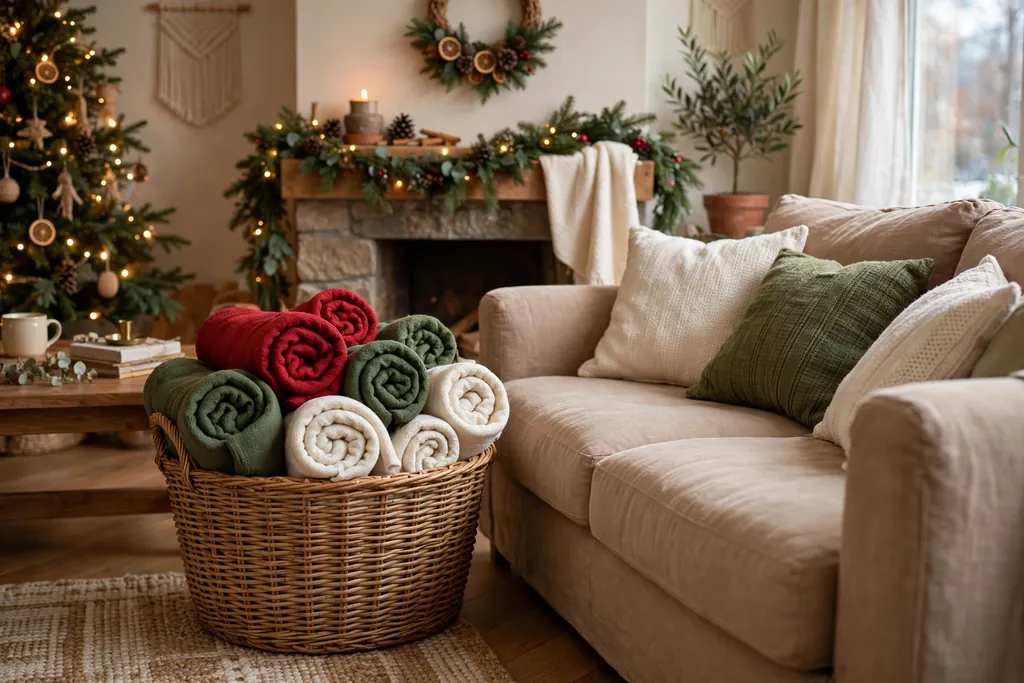
Keep a large basket beside the sofa filled with rolled throws in the room palette, so extra warmth is at hand and the basket itself reads as decor. Rolled throws look tidier than folded piles, and a basket in seagrass, wicker, or wood adds natural texture beside upholstery. Choose throws in two or three colors, such as cream, red, and green, rather than a mixed pile.
Roll each throw to a similar size and stand rolls upright so colors show at the top. Keep the basket within arm’s reach of the sofa, but clear of walkways and radiator heat. Wash throws before the season and again after it, and fold spare throws flat in storage so the basket starts fresh each year.
11. Seasonal Cushion Covers on the Sofa

Swap sofa cushion covers for seasonal ones in plaid, plain red, deep green, or cream with a simple holiday motif, and keep the sofa itself unchanged. Cushion covers are one of the quickest living room Christmas changes, since they need no new furniture and can be stored flat after the season. Use two or three seasonal covers mixed with plain covers already in the room.
Keep the pattern scale mixed, one larger check with one smaller pattern or plain cover, so cushions do not compete. Choose covers with zips for easy washing, and wash them before first use to check for color transfer. After the season, store covers clean and dry, and return the plain covers so the sofa resets in minutes.
12. A Plaid Throw Over the Sofa Arm

Drape a plaid throw over one sofa arm or across the back corner, with one end folded neatly and the other hanging to seat level. Plaid in red and cream, green and cream, or navy and cream adds holiday color in a single piece, and a throw that is actually used feels more welcoming than decor that must not be touched. Keep the throw to one sofa, not every seat, so the room stays calm.
Fold the throw in thirds lengthwise before draping, so it sits as a neat band rather than a loose pile. Pair a bold plaid with plain cushions, and a quiet plaid with one patterned cushion, so the sofa does not carry two strong patterns at once. Wash the throw on a gentle cycle and dry it flat if it is wool, to keep the check straight.
13. Garland Draped Over a Doorway

Run a green garland over the living room doorway, fixed at each side and allowed to dip in the middle, so guests pass under greenery as they enter the room. A doorway garland links the living room to the hall and makes the holiday scheme feel larger than one wall, without adding floor pieces. Use a light garland for a doorway, since a heavy one can pull fixings loose.
Fix the garland with removable hooks on the frame, not nails, and check the dip clears head height for tall guests. Add lights only if a safe cable route exists, and keep the garland clear of the door swing. Step back from the hall to check both sides hang evenly, and take the garland down before it dries out if it is fresh.
14. String Lights on a Bookshelf
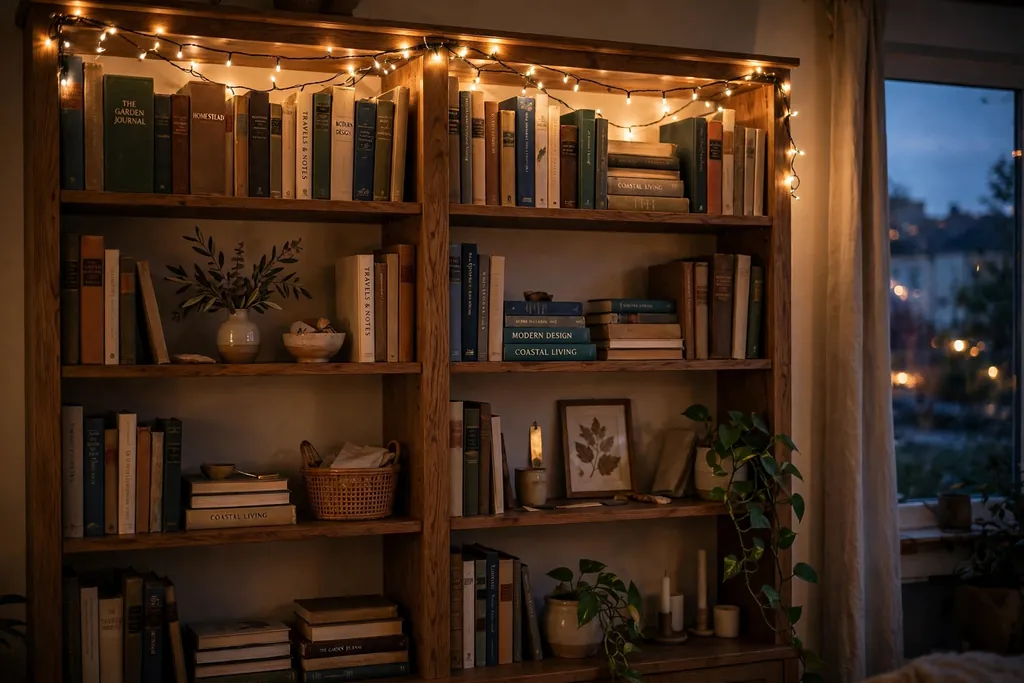
Weave warm white string lights along the top edge of a bookshelf, tucked behind books and objects so the glow outlines the shelf without hiding titles. Bookshelf lights add holiday warmth to a wall that often stays plain, and they make the shelf a soft evening feature even when the tree lights are off. Use one string per shelf unit, not one per shelf, to keep cables tidy.
Run the cable along the back edge and fix it with small clear clips, keeping the plug route hidden behind the unit. Keep lights clear of paper, dried flowers, and fabric, and use LED strings, which run cooler than older bulbs. Turn shelf lights off when the room is empty, and check the string for damaged bulbs before first use each year.
15. Mini Trees on a Bookshelf or Console

Place two or three mini trees on a bookshelf or console table, in different heights and in matching pots, for a small scale tree display that needs no floor space. Mini trees in plain terracotta, wood, or ceramic pots suit shelves, sideboards, and window sills, and they let a room carry the tree theme beyond the main tree. Keep mini trees to one shelf or one table, grouped together, rather than scattered.
Decorate mini trees simply, with a few tiny ornaments and one short string of lights each, so they read as a group. Place the tallest mini tree at the back and shorter ones in front, and keep them clear of book spines and picture frames. After the season, store mini trees upright in their pots with tissue around branches to stop breakage.
16. A Christmas Village on a Console Table
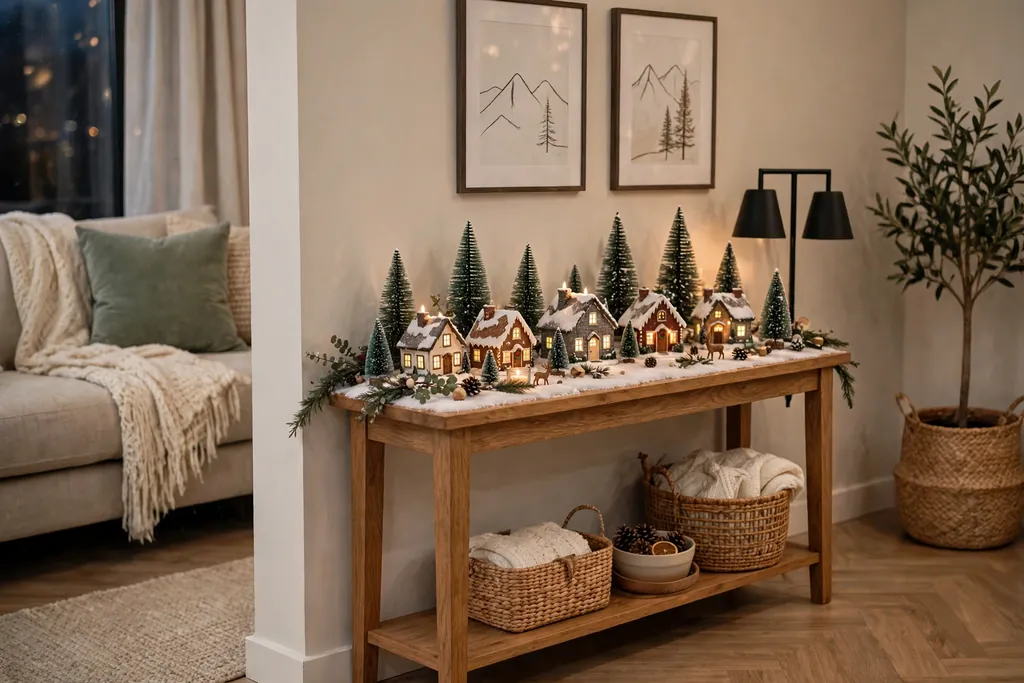
Arrange a small Christmas village on a console table, with houses, a church or shop, tiny trees, and a dusting of fake snow on a white cloth base. A village gives the living room a storybook corner that children and guests notice, and a console table keeps it at eye level without taking sofa or coffee table space. Start with three or four buildings, since a crowded village is hard to dust and view.
Place the largest building at the back and smaller ones in front, with paths of snow cloth between them. Add battery lights inside one or two buildings for evening glow, and keep the display clear of drinks and keys. Cover the village with a light cloth when not in use for a few days, to keep dust off roofs and windows.
17. A Pinecone and Dried Orange Bowl

Fill a wide, shallow bowl with pinecones, dried orange slices, and a few cinnamon sticks, and set it on the coffee table or a side table as a natural centerpiece. The bowl adds scent, color, and texture in one piece, and it costs little if pinecones are gathered and cleaned at home. Use a bowl wide enough that pieces sit in one layer, not piled high.
Mix large pinecones at the base with smaller cones and orange slices on top, and add a sprig of pine for green. Keep the bowl clear of candle flames, and replace dried slices that darken or bend. Dust the bowl weekly, since pinecones hold dust in their scales, and store pieces dry after the season so they can be reused.
18. A Felt Advent Calendar on the Wall
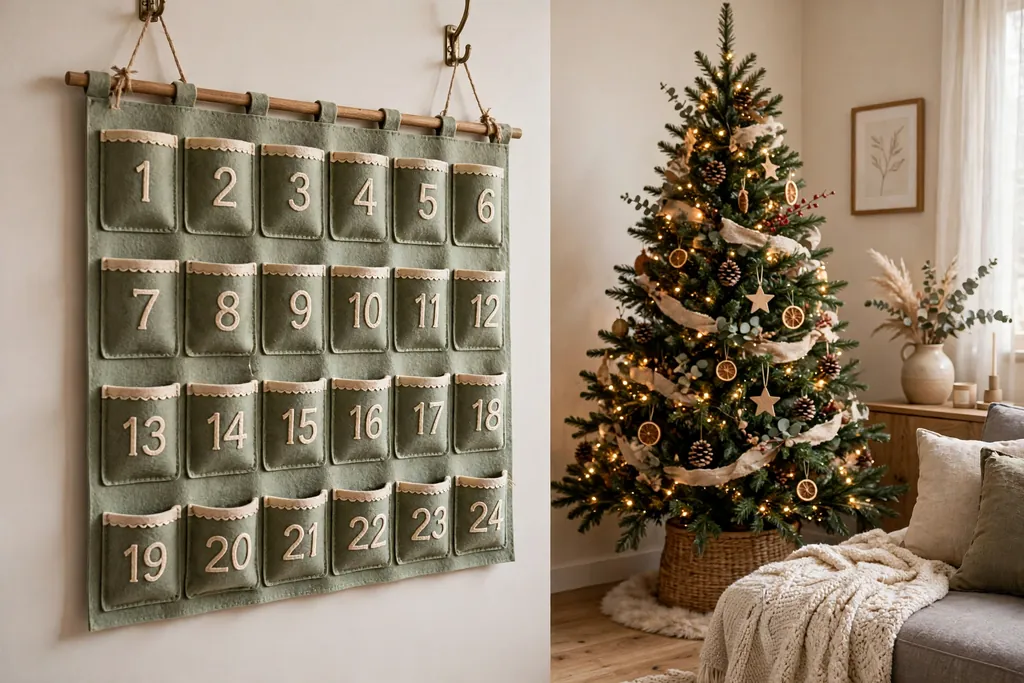
Hang a felt advent calendar on a living room wall, with numbered pockets holding small treats or notes, for a countdown display the whole household can use. A felt calendar adds color and a daily ritual to the room, and it suits a wall near the tree or the sofa where pockets are easy to reach. Choose a calendar sized to the wall, so pockets stay readable from a few steps away.
Hang the calendar flat from two hooks, so pockets do not sag, and fill pockets with small items that fit without bulging. If children use the calendar, hang it low enough for small hands and check pocket stitching before the season. After Christmas, empty pockets, brush off dust, and roll the calendar rather than folding it, to protect pocket shapes.
19. Oversized Ornaments in a Bowl on a Side Table

Fill a large glass or ceramic bowl with oversized baubles in the room palette, and set it on a side table or a hearth ledge as a bold, simple display. Oversized ornaments give strong color with almost no arranging, and a bowl display suits tables too small for a full centerpiece. Use one bowl, not several, so the display stays a single focal point.
Choose baubles in two finishes, such as matte and shiny, in the same color family, and mix sizes so the bowl looks full without stacking. Keep the bowl away from table edges where it could be knocked, and place a small cloth under a glass bowl to stop slipping. After the season, wrap baubles in tissue and store the bowl separately to avoid chips.
20. Ribbon Bows on Picture Frames
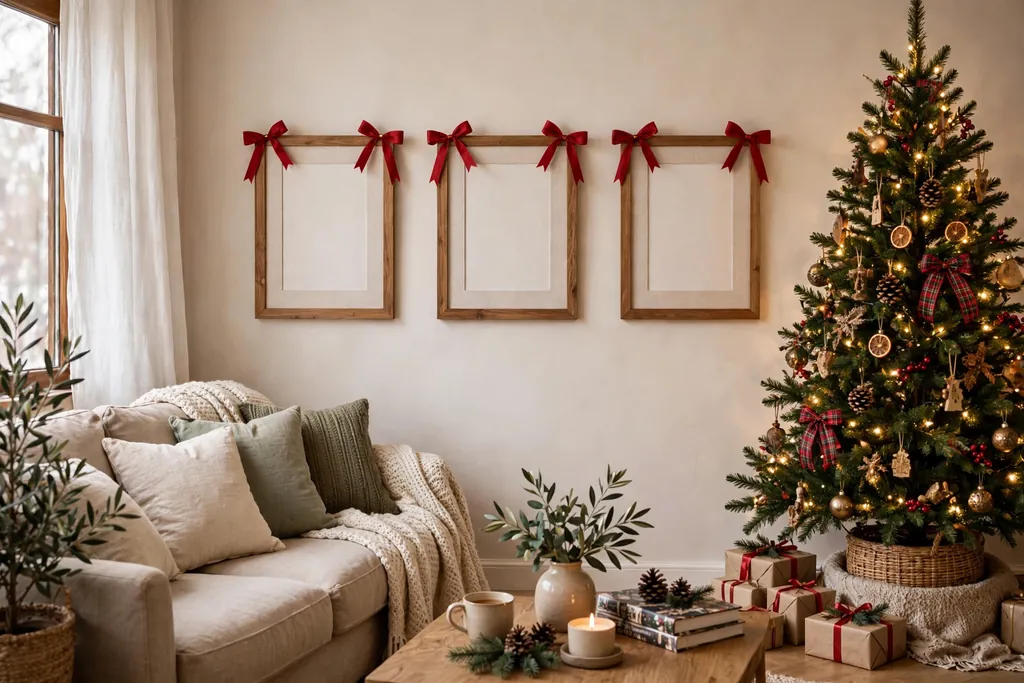
Tie a simple ribbon bow to the top corner of one or two living room picture frames, using ribbon in the room palette, for a light holiday mark that needs no new wall pieces. Bows on frames link existing wall art to the seasonal scheme, and they are easy to remove after Christmas without touching the art. Keep bows to frames near the tree or mantel, not every frame in the room.
Use wired ribbon if you want bows that hold their shape, and plain ribbon for a softer drape. Tie bows to the frame, not to the glass or the picture, and trim tails to the same length on each frame. Check that bows do not cover faces or key details in photos, and store ribbon rolled, not folded, to avoid creases next year.
21. A Candle Cluster on a Side Table
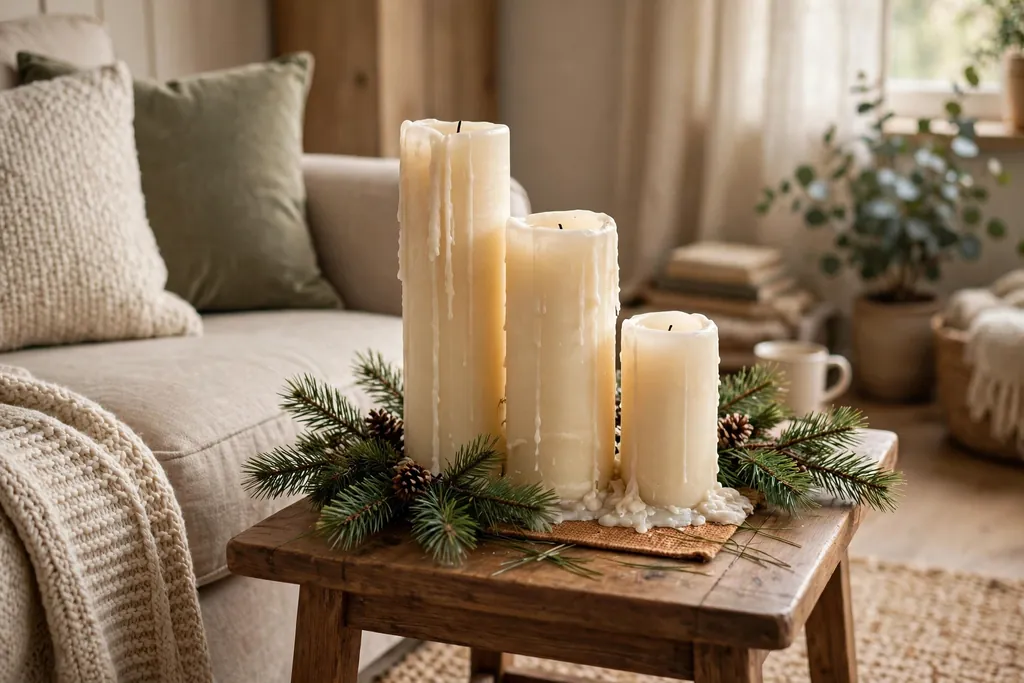
Group three candles of different heights on a side table, on a small tray or a wood slice base, with a pine sprig laid beside them. A candle cluster gives the sofa corner a warm evening glow and a simple centerpiece, without the size of a mantel display. Use pillar candles in steady holders, in cream or the room accent color.
Place the tallest candle at the back and shorter ones in front, and keep the cluster clear of curtains, throws, and books. Light candles only when someone is in the room, and trim wicks before lighting so flames stay even. Replace sprigs when they dry, and keep matches or a lighter in a nearby drawer, not on the table.
22. A Garland Along the Stair Rail

Run a green garland along the stair rail that opens into the living room, fixed with ribbon ties at each newel post and allowed to sag gently between posts. A stair garland carries the living room scheme into the hall and frames the view from the sofa toward the stairs, without adding floor pieces. Use a light garland with small ornaments, since a heavy garland can slip on a smooth rail.
Tie the garland to the rail with ribbon, not wire, so the rail finish is not marked, and keep ties evenly spaced. Add lights only with a safe cable route that does not cross a step, and keep the garland clear of handrails where hands grip. Check ties weekly, since garland settles and can slide toward the lower post.
23. A Tree Skirt or Basket Base

Finish the tree base with one clear treatment, a fabric tree skirt, a woven basket, or a wood crate collar, rather than stacking all three. A skirt in plaid, plain linen, or felt hides the stand and gives gifts a soft base, while a basket or crate gives a tidier, more structured look. Choose the base to match the room style, soft fabric for a relaxed room, basket or crate for a rustic room.
Lay a skirt flat with even folds around the stand, and tuck the inner edge under the stand so no metal shows. For a basket, check the tree stand fits inside before decorating, and steady the tree with the basket rim, not with loose packing. Keep the base clear of candle flames and heater vents, and shake or wash a fabric skirt after the season before storing it.
24. A Window Garland Swag

Hang a single swag of greenery at the top of the living room window, draped in a shallow curve and tied at each side with ribbon. A window swag frames daylight and gives the window a holiday shape without covering the glass, unlike a full wreath or a curtain change. Use fresh or faux pine, fir, or eucalyptus, with a few berries or pinecones for color.
Fix the swag with removable hooks on the frame, and check the curve hangs evenly from inside and outside. Keep the swag clear of curtain tracks and blind cords, and use battery lights only if the cable can run neatly to a sill outlet. Take a fresh swag down when needles start to drop, and compost it if local rules allow.
25. A Layered Rug Under the Coffee Table

Layer a smaller seasonal rug over the main living room rug under the coffee table, in a pattern or color that echoes the holiday palette, for a quick floor level change. A layered rug adds warmth underfoot and marks the seating area as the holiday gathering spot, without moving furniture. Choose a flat weave top rug, so chairs and table legs sit steady on it.
Keep the top rug smaller than the main rug on all sides, and use a rug grip pad underneath to stop slipping. Pick a pattern that shares one color with cushions or throws, so the floor links to the seating, and avoid deep pile on top of deep pile, which feels uneven. Vacuum both rugs weekly during the season, since pine needles and glitter travel to the floor.
26. Fresh Pine Branches in Vases

Place fresh pine, fir, or cedar branches in tall vases on a sideboard, mantel end, or window sill, for greenery and scent in spots where a garland would not fit. Branches in vases suit rooms that already have a tree, since they repeat the evergreen theme at a smaller scale, and they work well beside a mirror, where the green doubles in reflection. Use branches cut to the vase height, with stems trimmed at an angle.
Fill vases with fresh water and change it every few days, trimming stems each time to keep branches drinking. Keep branches clear of heat sources and candle flames, and remove branches that drop many needles. After the season, compost fresh branches where local rules allow, and wash vases before storing them.
27. A Simple Scented Simmer Display
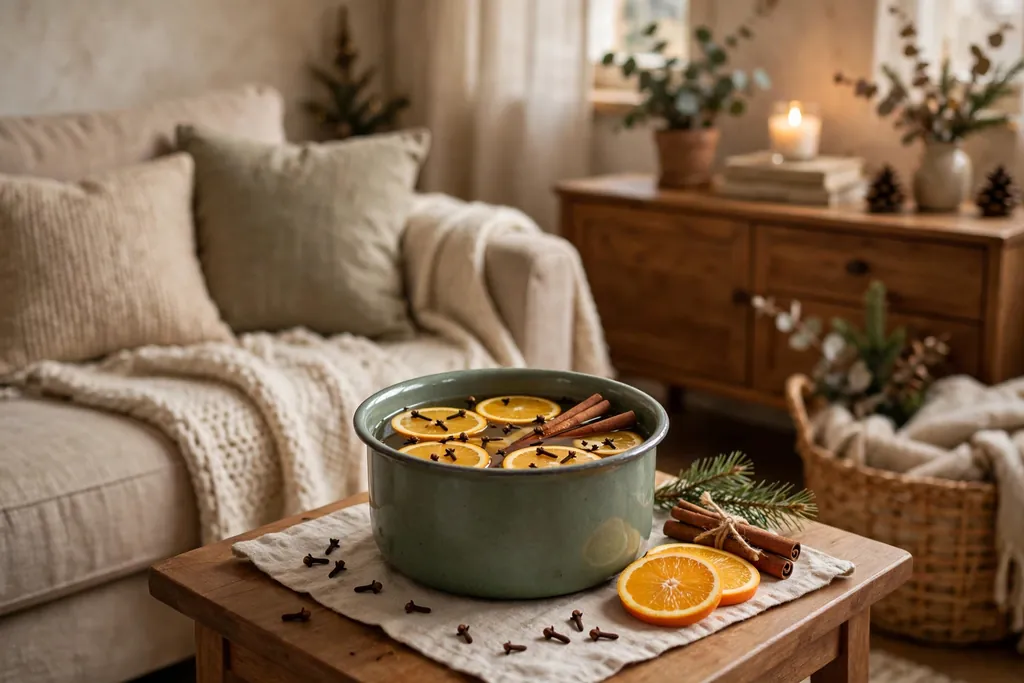
Set a small simmer display on a side table or a kitchen pass-through near the living room, with a pot or bowl of water, orange slices, cinnamon sticks, and cloves, warmed gently for short periods. A simmer display adds holiday scent without sprays or plug-in devices, and it suits rooms where candles are not practical. Keep the display small and simple, with one pot, not a row of pots.
Warm the pot only while someone is nearby, and top up water before it runs low, since a dry pot can scorch. Keep the display clear of children, pets, and table edges, and use a trivet under a warm pot to protect wood. After use, discard the contents and wash the pot, since simmered fruit does not keep for reuse.
Conclusion
A welcoming living room at Christmas comes from a few well placed layers, not from decorating every surface. Start with the tree or the mantel, add lights and greenery, then finish with textiles, a simple centerpiece, and one or two personal pieces such as stockings or a village. Keep the palette small, keep walkways clear, and let the room stay usable for everyday living through the season.
Work through the 27 ideas one at a time, and keep only the ones that suit your room, your budget, and your household. A slim tree, a mantel garland, and a basket of throws can carry the whole scheme in a small room, while a larger room can hold a village, a stair garland, and a layered rug as well. Put the season away in the same order, textiles first, then small decor, then greenery, so the room resets calmly in January.
FAQs
How do I decorate a living room for Christmas without clutter?
Start with one focal point, the tree or the mantel, and limit the rest of the room to lights, one garland, and seasonal textiles. Keep every surface with one display, not several, and leave seating, walkways, and the television view clear. Remove a few everyday objects before adding holiday pieces, so the room gains decor without gaining crowding.
What colors work best for living room Christmas decor?
Cream, green, and muted red suit most living rooms, while cream, gold, and soft brown give a quieter, warmer look. Pick two or three colors plus natural green and wood, and repeat them from the mantel to the sofa. A small palette keeps a room with many ideas feeling settled, while too many colors can make the same room feel busy.
How can I decorate a small living room for Christmas?
Use a slim or half tree, a mantel garland, window candles, and seasonal cushion covers, all of which add holiday feel without floor space. Keep large displays off the floor, on shelves, mantels, and window sills, and choose one basket of throws rather than several floor pieces. A small room needs fewer ideas, done well, rather than every idea at once.
Where should the Christmas tree go in a living room?
Place the tree in a corner near a window or beside the fireplace, where it is visible from the sofa but clear of walkways, doors, and heat sources. Angle the fullest side toward the seating, and leave room to walk around the tree for decorating and watering. Avoid placing a tree where it blocks the television, a radiator, or the main path through the room.
How do I make a living room feel cozy at Christmas?
Layer warm white lights, soft throws, and seasonal cushions over the room you already have, and add greenery and candlelight at mantel and table height. Keep lighting low in the evening, with tree lights and lanterns doing most of the work, and keep throws within reach of the sofa. Scent from fresh pine or a short simmer display adds warmth without extra decor.
When should I put up living room Christmas decor?
Many households decorate in late November or early December, which gives time to enjoy the display without rushing the setup. Put lights and greenery up first, then ornaments and textiles, and plan a full day for a large tree or a village display. Take fresh greenery down when needles drop heavily, and store ornaments and textiles clean and dry for next year.