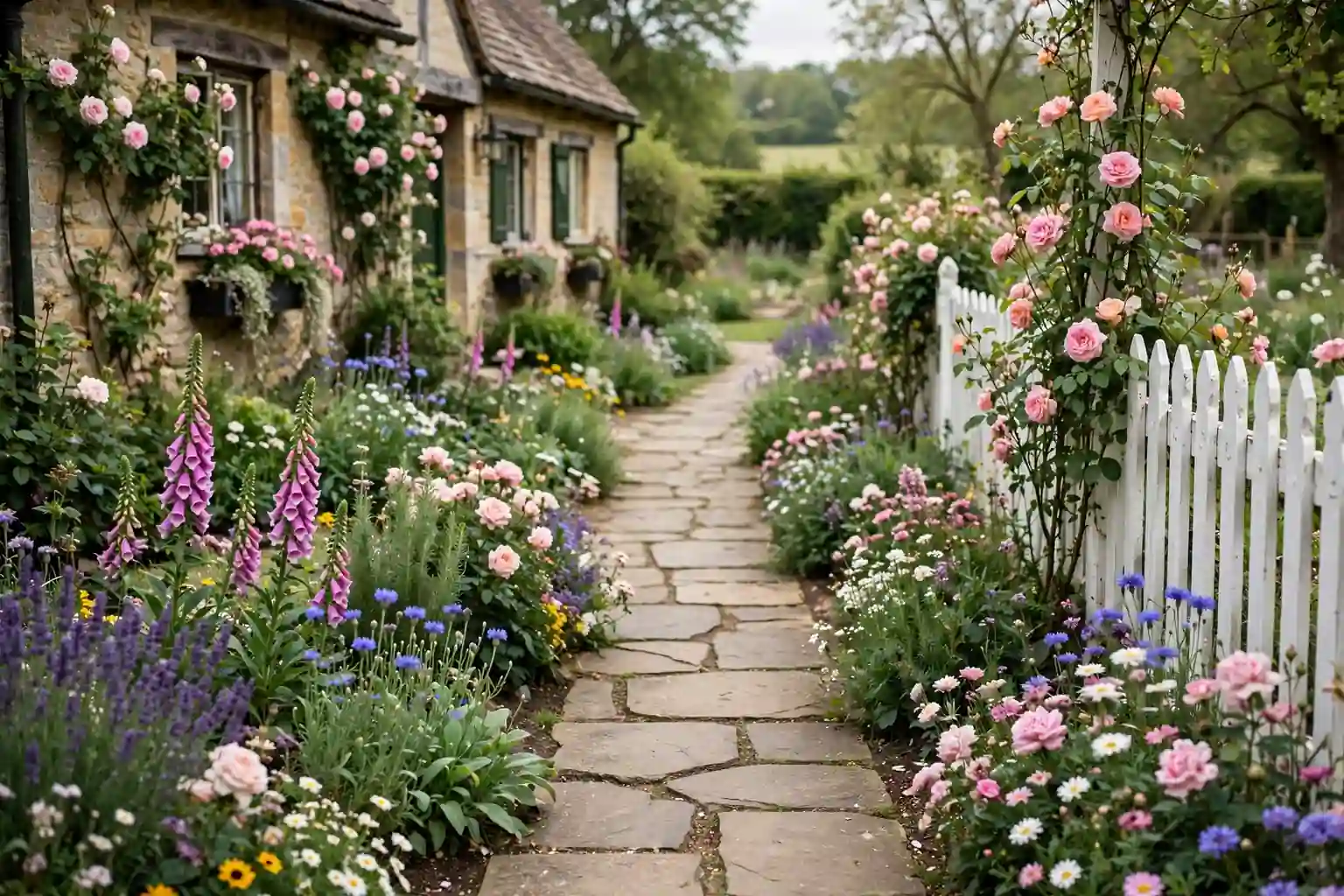
A cottage garden is less about strict lines and more about generous planting, soft edges, and places to stop and enjoy it. Roses spill over fences, herbs grow by the door, and paths curve instead of running straight, yet the best cottage gardens still have a clear structure underneath the abundance. These 31 cottage garden ideas cover borders, paths, seating, containers, and wildlife-friendly corners, so you can start with one bed or one arch and build from there. Pick the ideas that fit your light, your soil, and the time you actually have for care, and let the planting fill in around them.
Key Takeaways
- Start with structure first: a path, a fence, an arch, or a seating spot, then let soft planting fill around it.
- Plant in groups and layers, with tall plants at the back, mid-height flowers in the middle, and low edging at the front.
- Repeat two or three favorite plants through the garden so beds read as one design rather than a collection of singles.
- Put herbs and cutting flowers near the door and the kitchen, where you will reach them daily.
- Leave room for wildlife with a water bowl, a wildflower corner, and plants that feed bees through the season.
- Choose plants for your sun, soil, and local climate, and check the label before you buy.
1. Rose-Covered Picket Fence Front Garden
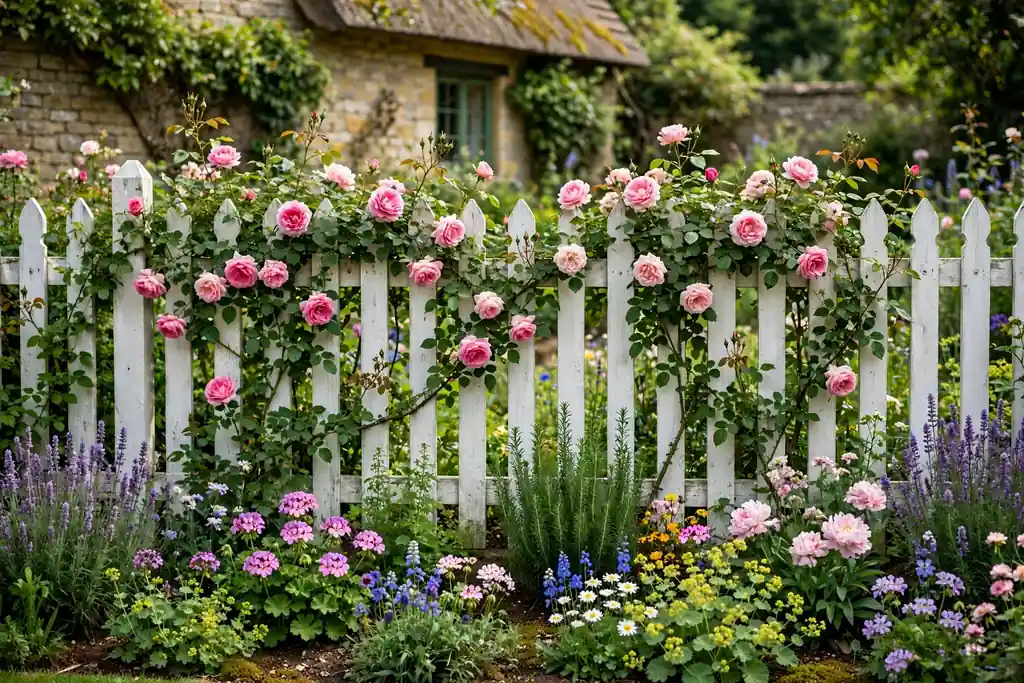
A white picket fence with roses growing through it is the classic cottage front garden, and it works because the fence gives the planting a clear frame. Plant shrub or climbing roses along the fence line, spacing them as the label directs, and train the stems along the rails as they grow. Shorter flowers in front, such as hardy geraniums or catmint, hide bare lower stems and keep the bed looking full from the street.
Keep the gate clear and the path wide enough to walk through without brushing thorns, and prune roses after flowering as their type requires. A fence in a pale color shows flower color well, but a natural wood fence suits a more rustic cottage. For color pairings along a fence, these pink flower garden ideas show how to group pink in drifts rather than scattering single plants.
2. Stone Path with Thyme Between the Joints
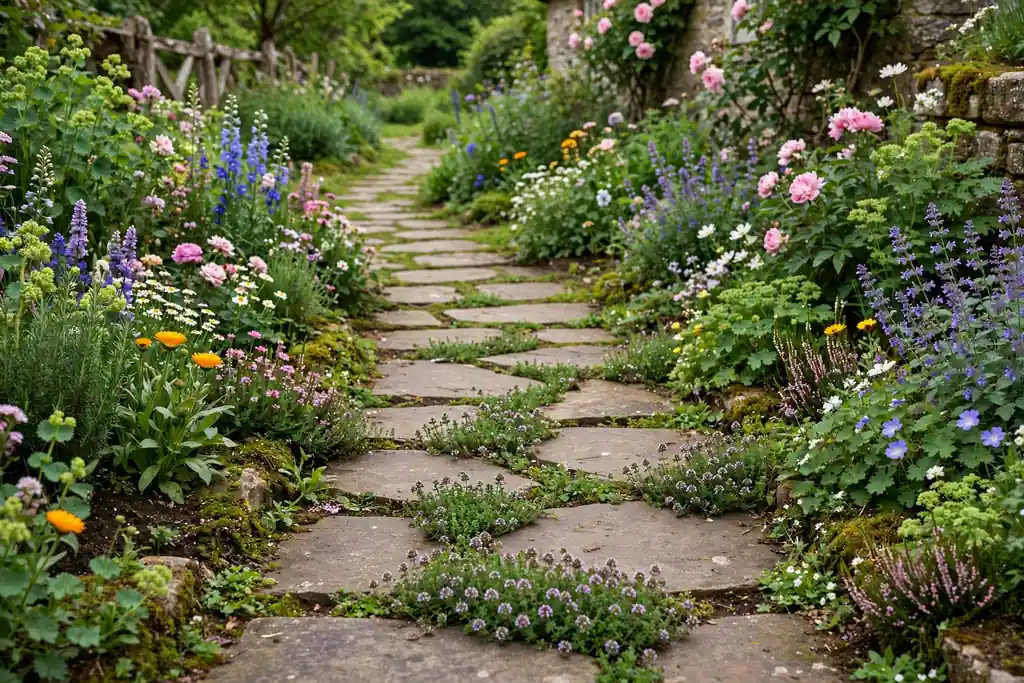
A stone path with creeping thyme growing between the slabs gives a cottage garden its soft, worn-in feel underfoot. Lay flat stones with gaps of a few centimeters, fill the joints with gritty soil, and plant small thyme plugs into the gaps. Thyme copes with light foot traffic, releases scent when stepped on, and flowers in early summer, which draws bees to the path edge.
Set each stone level so the path stays safe to walk on, and keep the route wide enough for a wheelbarrow if the path serves beds beyond it. Thyme needs sun and soil that drains freely, so it suits a sunny path far better than a shaded, damp one. In shade, moss or a low ground cover that tolerates damp will give a similar soft-jointed look.
3. Climbing Roses Over the Front Door Arch
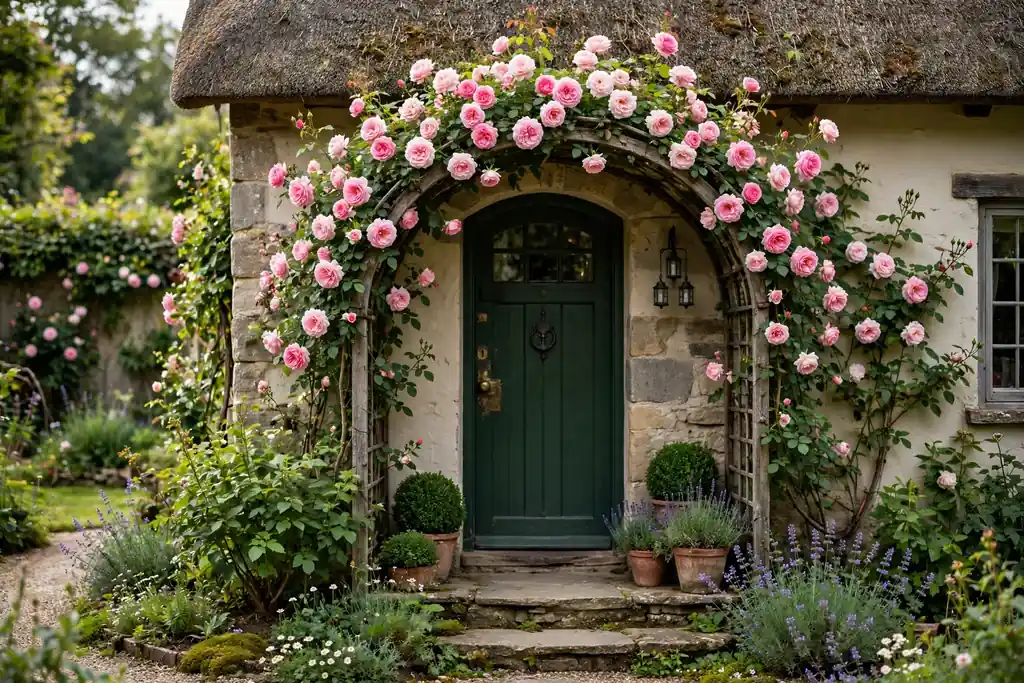
An arch of climbing roses over the front door turns an ordinary entrance into the focal point of the house. Fix a sturdy arch that clears the door swing, plant one rose on each side, and tie the young stems to the frame in a fan shape so flowers spread across the top rather than clustering at one side. Choose a repeat-flowering type if you want color through summer rather than one spring flush.
Prune lightly after each flush and keep stems tied away from the door handle and the path. Scented roses suit this spot best, since you pass under them every day. If the doorway faces shade for most of the day, a shade-tolerant climber such as clematis or honeysuckle will flower more reliably than a rose.
4. Layered Mixed Border in Three Heights
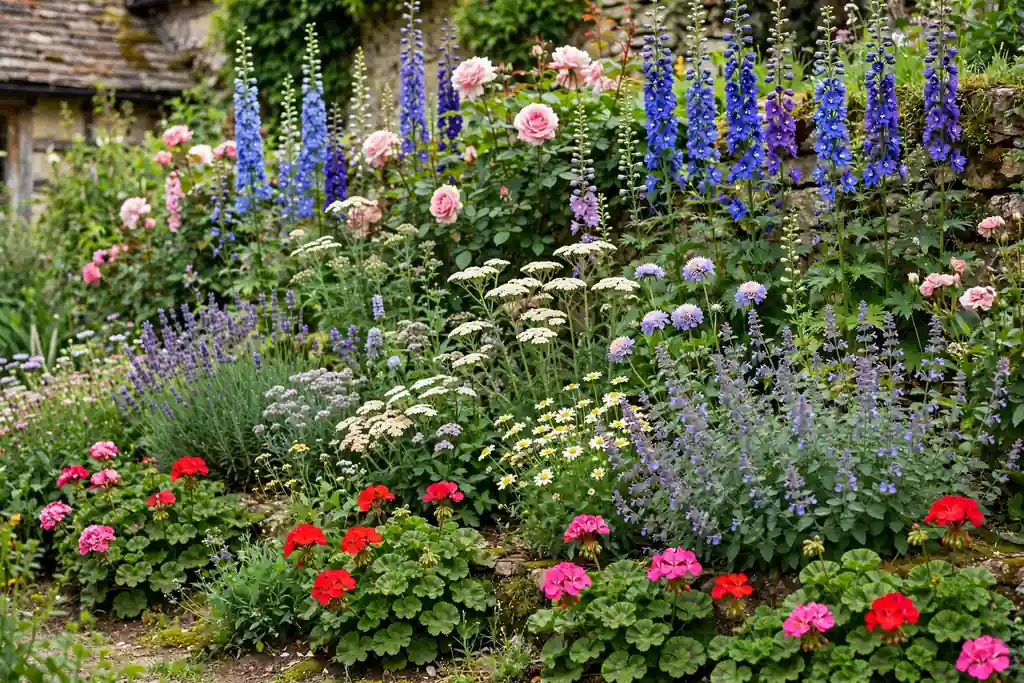
A cottage border looks abundant because it is planted in layers, not in single rows. Put tall plants such as delphiniums or hollyhocks at the back, mid-height flowers such as roses, peonies, and salvias in the middle, and low plants such as geraniums, catmint, and alchemilla at the front edge. The layers hide bare stems, keep the bed full from spring to autumn, and make the border read as one planting rather than a row of specimens.
Plan the border on paper first, noting each plant’s mature height and spread, and leave room for plants to grow into each other without crowding. Repeat two or three plants along the length of the border so the eye travels along it. A border at least a meter deep gives enough room for three layers; a narrow strip will only hold two, and that is fine if you choose plants to suit it.
5. Herb Garden Beside the Kitchen Door
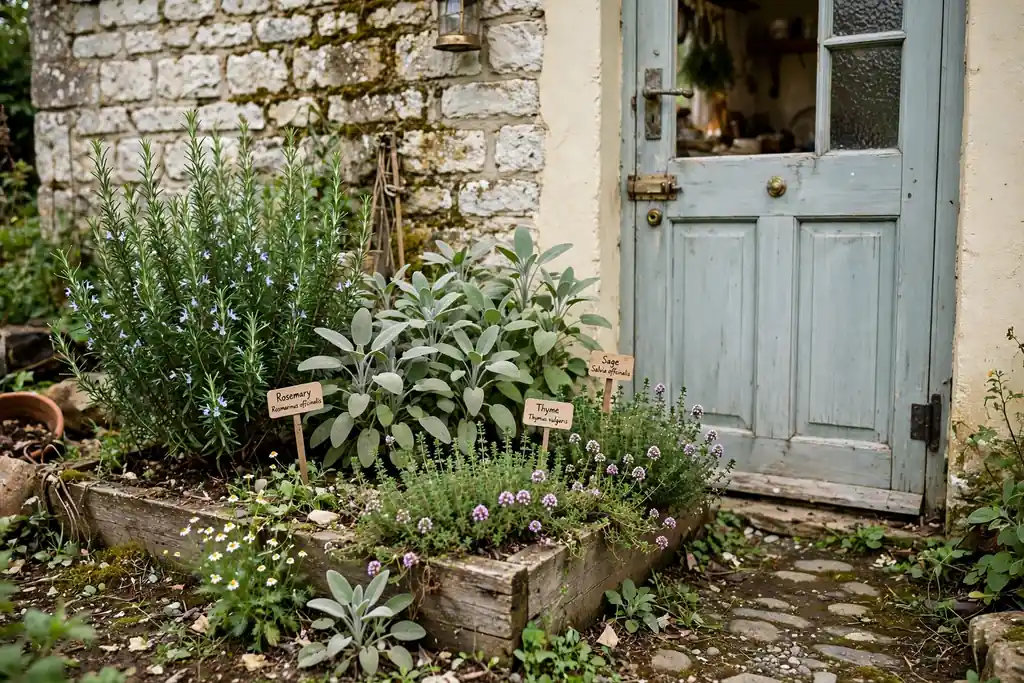
A herb garden beside the kitchen door is the most used corner of a cottage garden, because you pick from it while cooking. Plant rosemary, thyme, sage, chives, and parsley in a sunny bed or a raised box near the door, keeping mint in its own pot since it spreads fast. Herbs give year-round structure, with grey-green leaves that sit well beside flowers, and their scent greets you every time you step outside.
Water herbs at the base and pick little and often, which keeps plants bushy and productive. Most culinary herbs need sun and soil that drains well, so a raised bed helps on heavy clay. If the kitchen door opens onto shade, grow parsley, chives, and mint there and keep sun-loving rosemary and thyme in a sunny pot nearby.
6. Wildflower Corner for a Relaxed Edge
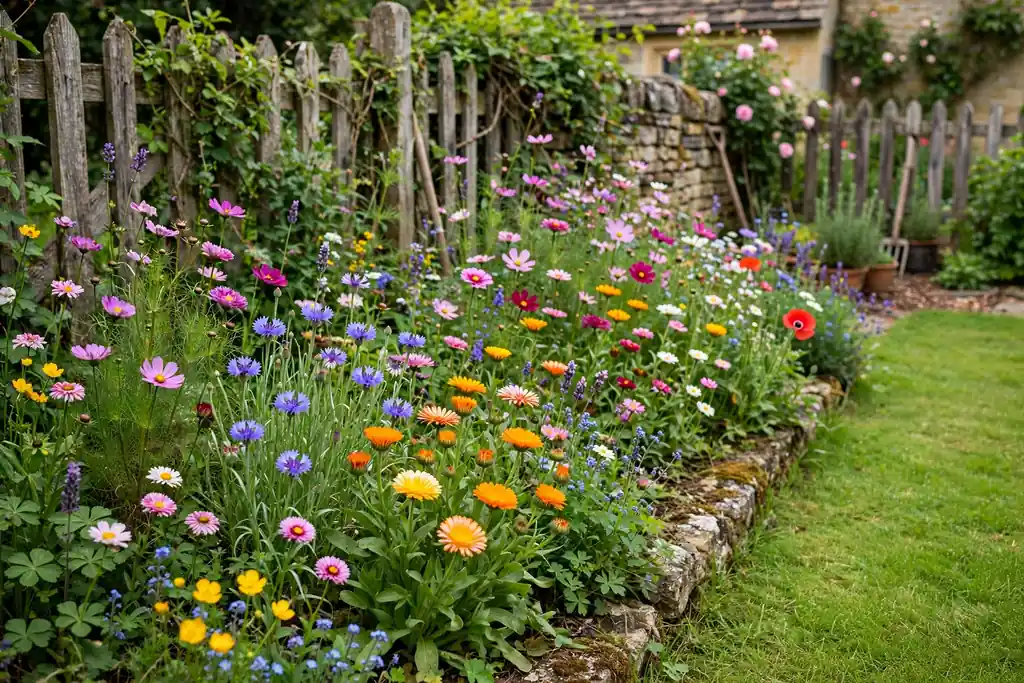
A wildflower corner gives a cottage garden its loose, natural edge without taking over the whole yard. Clear one sunny patch of weeds, sow a seed mix suited to your region on bare, raked soil, and leave the patch mostly alone while plants establish. The mix of heights and colors suits the cottage style, and it feeds bees and butterflies through summer.
Edge the patch with a mown strip or a gravel line so it reads as a choice rather than neglect. Leave the patch uncut until late in the season so plants self-seed for next year. If a full patch feels too wild for your front garden, start with a narrow strip along a fence and widen it next season. These hippie garden ideas show a similar loose planting approach for a relaxed yard.
7. Whitewashed Porch Dressed with Pots
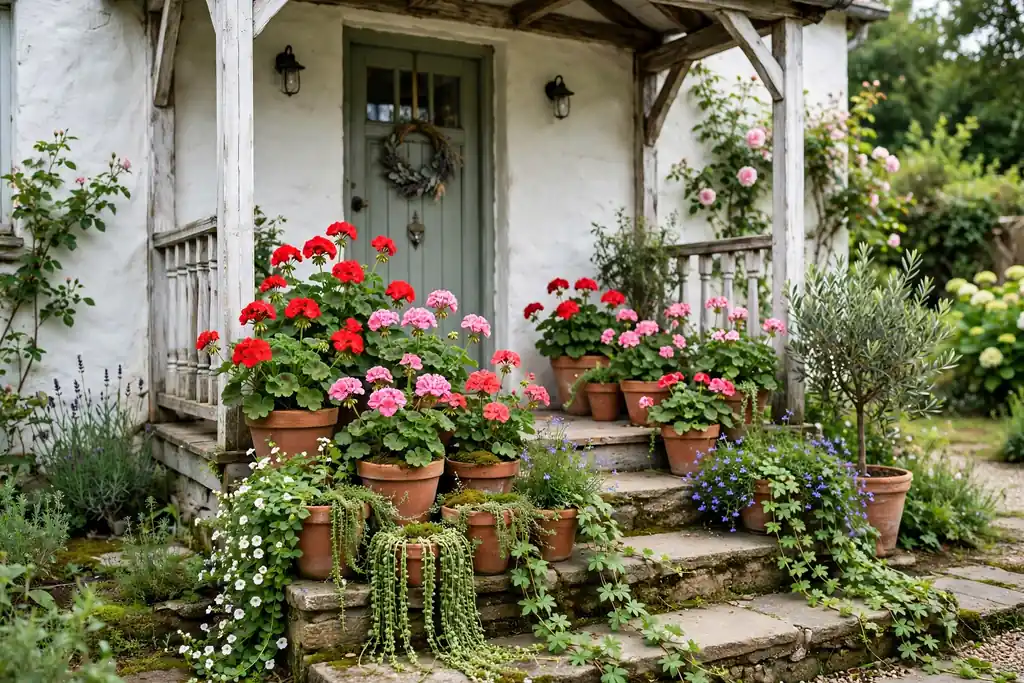
A whitewashed porch with pots on the steps and beside the door frames a cottage entrance without any building work. Group pots in threes, mixing heights and sizes, and fill them with a blend of upright and trailing plants so the group looks full from the street. Geraniums, trailing lobelia, and a small shrub such as a dwarf rose give color from spring into autumn.
Pots dry out fast in sun and wind, so check the soil daily in hot weather and feed container plants through the season. Choose pots with drainage holes and saucers on painted wood, and move the group as the light changes so plants stay in their best spot. One large pot beside the door anchors the display better than several small ones scattered along the porch.
8. Gravel Courtyard Planted with Lavender
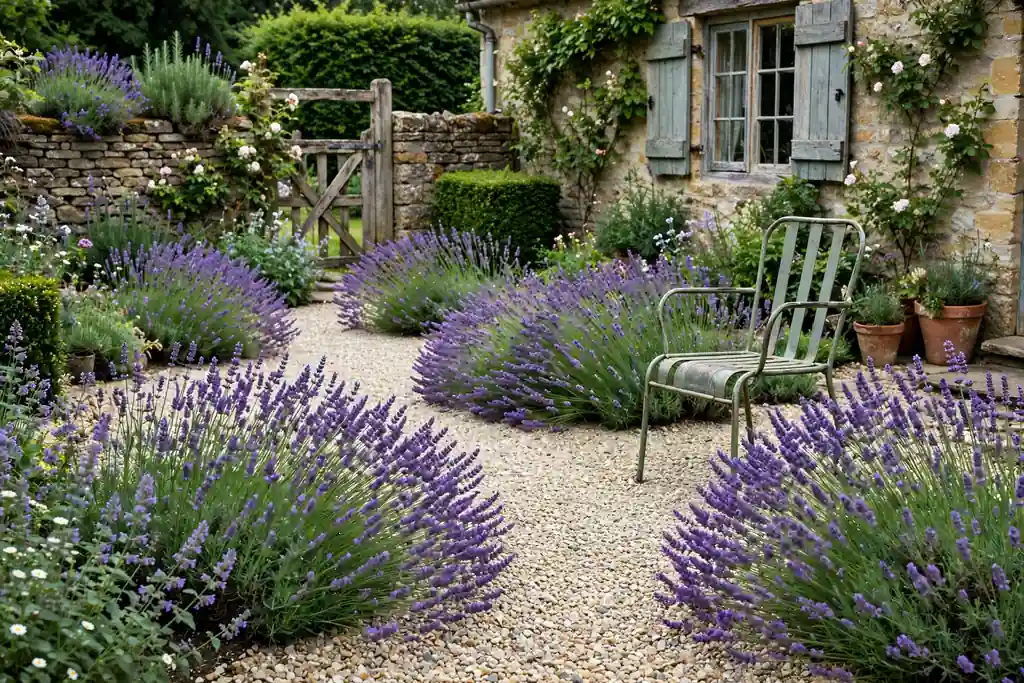
A gravel courtyard planted with lavender suits a cottage garden where a lawn would be hard to keep or where you want a dry, sunny sitting area. Lay a weed-suppressing layer and gravel over firm ground, then plant lavender in drifts along the edges, leaving the middle open for a chair and a small table. Lavender gives scent, structure, and summer color, and it copes with dry soil once established.
Keep the gravel level raked and clear of fallen leaves, and cut lavender back lightly after flowering to keep the plants compact. Lavender needs full sun and sharp drainage, so it is a poor choice for a damp, shaded courtyard. In that case, ferns and hostas in pots around the edges give a lush courtyard feel without the need for sun.
9. Cottage Vegetable Patch with Flower Rows
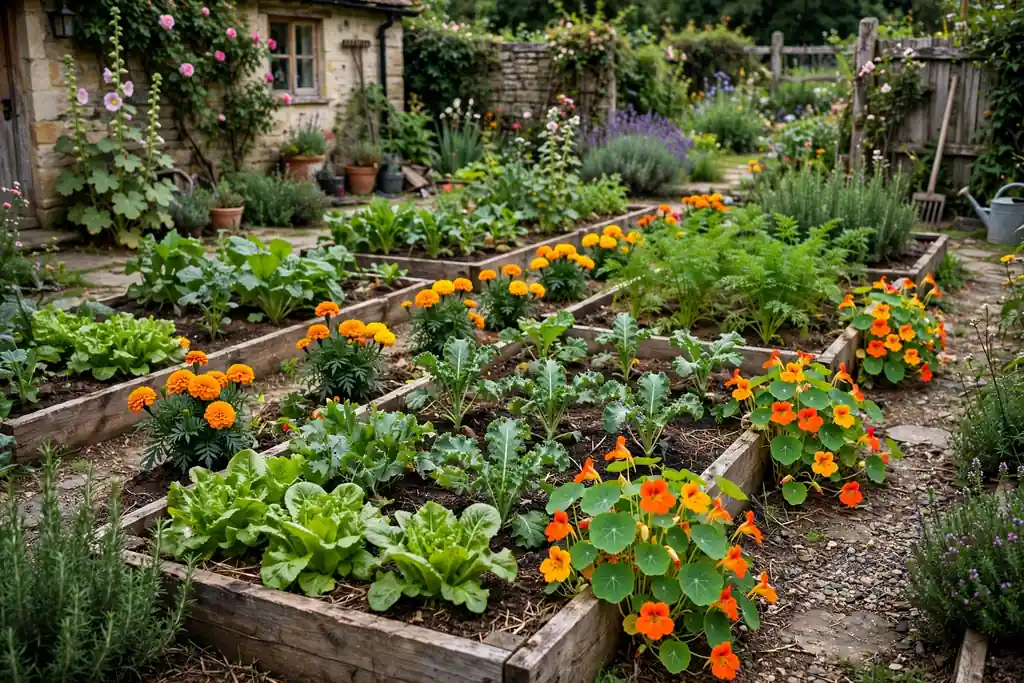
A cottage vegetable patch mixes flowers into the rows, so it looks good as well as feeding the kitchen. Grow vegetables in rows or small blocks, and tuck in marigolds, nasturtiums, calendula, and sweet peas between them. The flowers draw pollinators to the vegetables, break up the rows visually, and give you cutting flowers from the same beds.
Keep the beds narrow enough to reach the middle from both sides without stepping on the soil, and rotate crops each year so the same family does not grow in the same spot. A simple wooden or brick edge marks the patch and keeps paths clear. Pick flowers often, since regular cutting keeps nasturtiums and calendula flowering and stops them from seeding over the vegetables.
10. Clematis Climbing a Wall Trellis
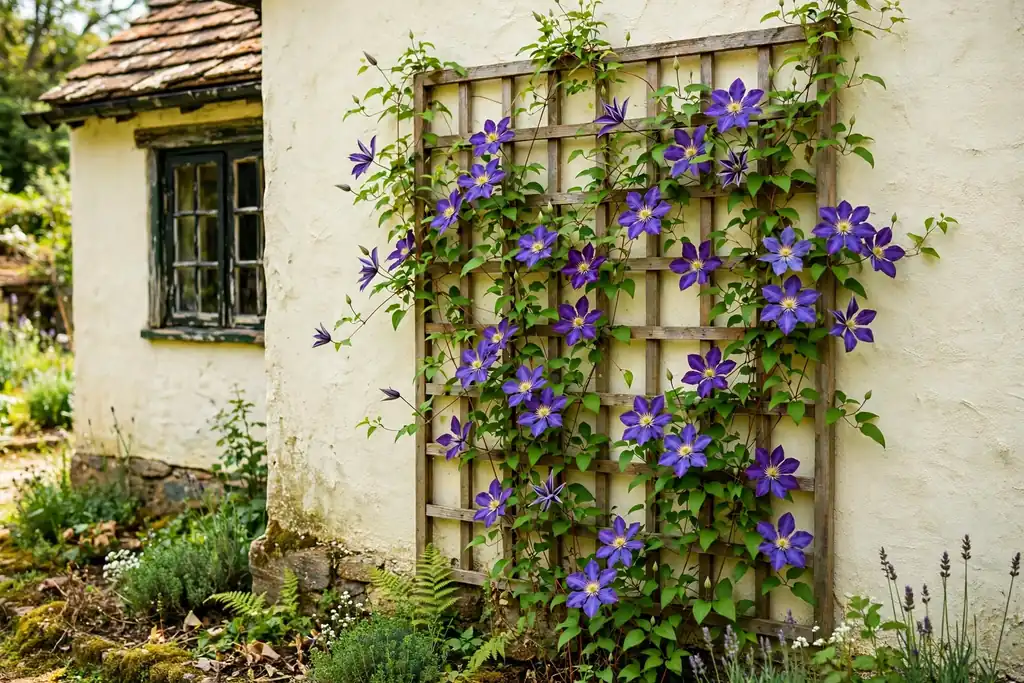
A clematis on a wall trellis adds height and color to a cottage wall without taking bed space. Fix a trellis a few centimeters off the wall so air moves behind it, plant the clematis with its roots shaded by a low plant or a tile, and train the stems across the trellis as they grow. Different clematis types flower from spring to autumn, so you can pick one for the season when your wall looks bare.
Prune as the type requires, since clematis groups are pruned differently, and check the label before you cut. Keep the trellis clear of gutters and windows so stems do not block them. A clematis in a soft color against a brick or stone wall suits the cottage look better than a harsh contrast, and it pairs well with a climbing rose on the same wall.
11. Rustic Wooden Gate Under a Flower Arch
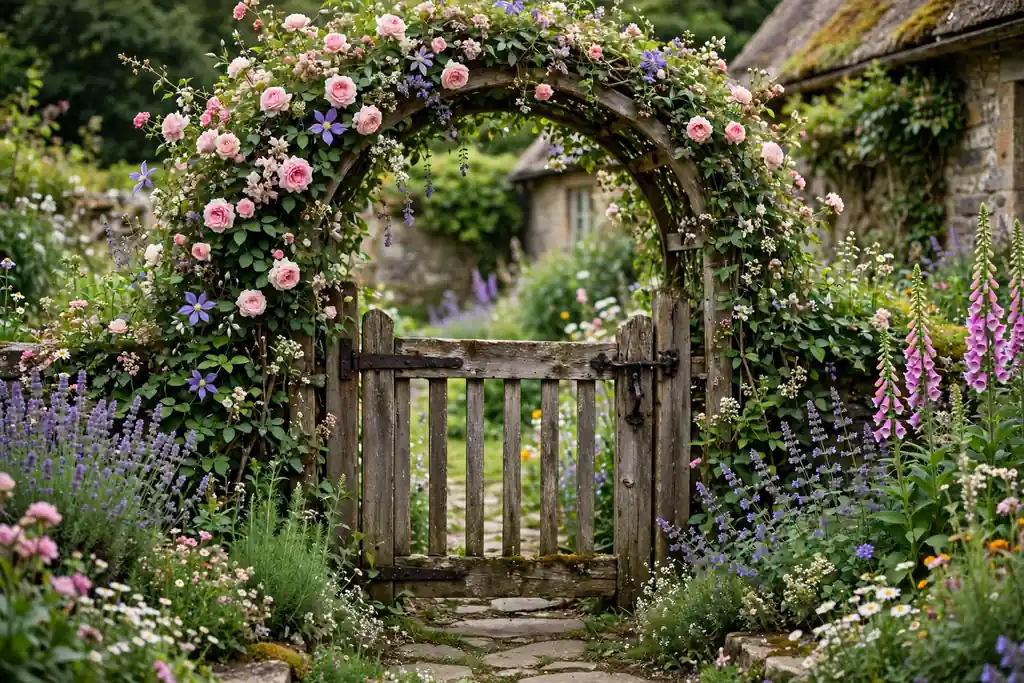
A rustic wooden gate under a flower arch marks the entry to a cottage garden and sets the tone for everything beyond it. Use a simple wooden gate, either painted or left natural, and grow a climber such as a rose, honeysuckle, or jasmine over an arch above it. The arch frames the view into the garden, and the gate itself gives the garden a sense of arrival.
Hang the gate so it swings freely and latches well, and keep climbers tied away from the hinges and the latch. A gate that sticks or drags spoils the welcome, so check it after wet weather when wood swells. If the entrance is narrow, a single arch with a narrow gate suits it better than a wide double gate that eats into the planting.
12. Window Boxes Filled to Overflowing
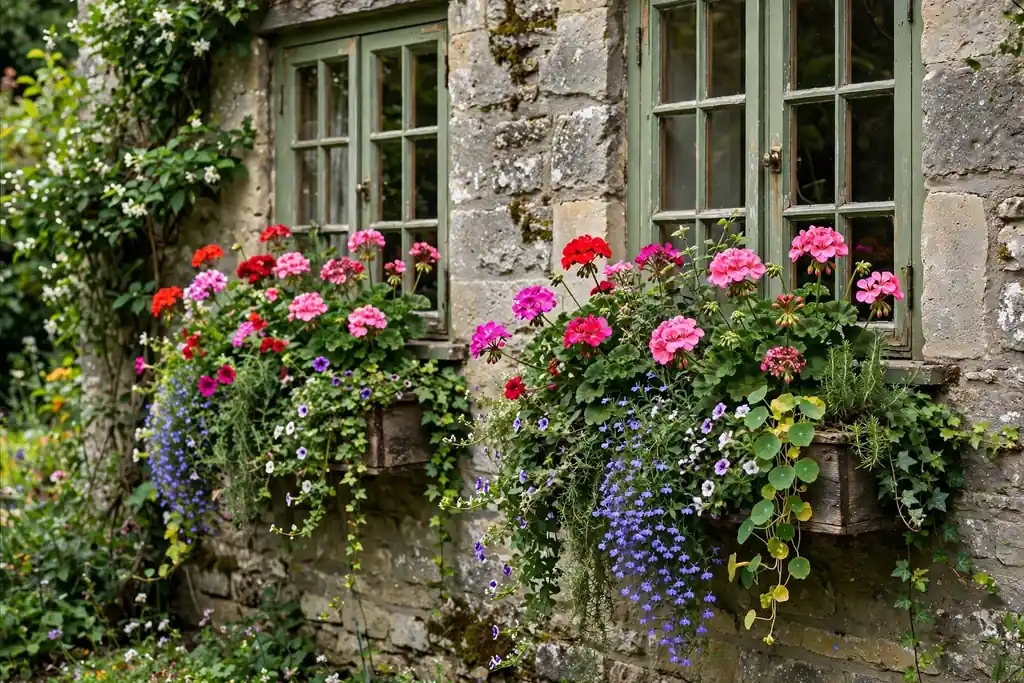
Window boxes filled to overflowing give a cottage instant charm, even before the beds are planted. Use a box with drainage holes, fill it with fresh potting mix, and combine one upright plant, such as geraniums, with trailing plants, such as trailing lobelia or ivy-leaf geraniums, so the box spills over the front. Plant the box densely, since cottage style favors fullness over spacing.
Boxes dry out quickly in sun and wind, so expect to water daily in hot weather and feed lightly through the season. Secure the box firmly to the wall or sill, since a watered box is heavy. Refresh the planting each spring, and swap tired plants out in summer so the boxes never sit empty during the main display season.
13. Old Stone Wall Softened with Trailing Plants
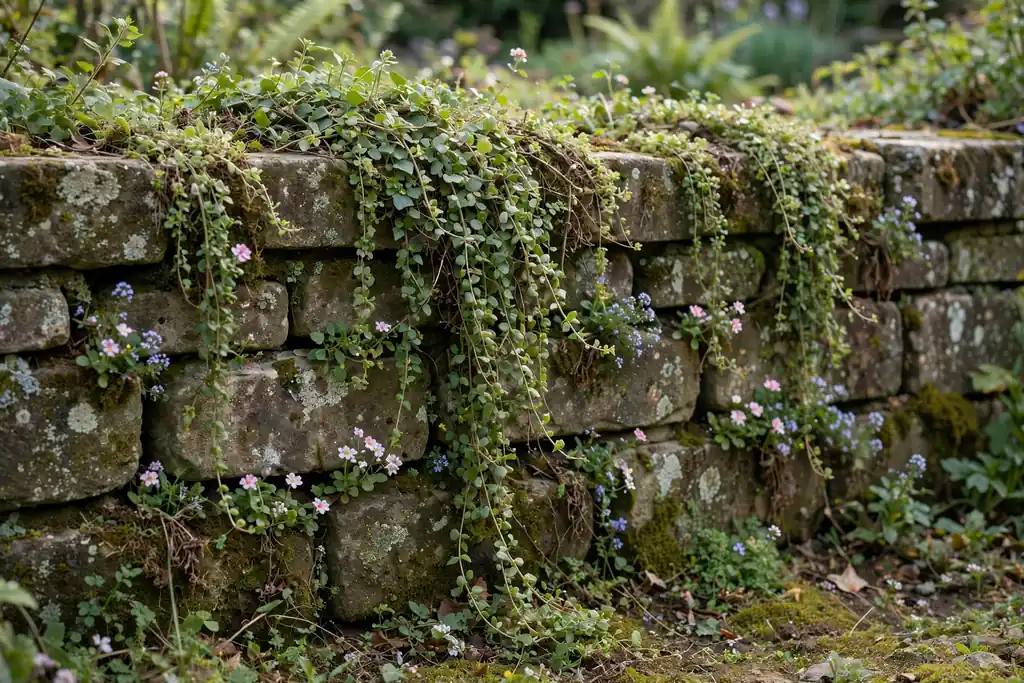
An old stone wall softened with trailing plants turns a hard boundary into part of the planting. Let ivy, creeping jenny, or trailing rosemary spill over the top, and tuck small plants such as aubrieta, saxifrage, or creeping thyme into gaps in the stone. The plants soften the wall line and give the garden a settled, long-established feel.
Check the wall is sound before planting into it, and keep vigorous ivy cut back from gutters, roofs, and windows. Plants in wall gaps need little soil but do need water while they establish, so water them in dry spells during the first season. A stone wall in shade suits ferns and small shade plants in its gaps better than sun-loving aubrieta.
14. Seating Nook Tucked into the Border
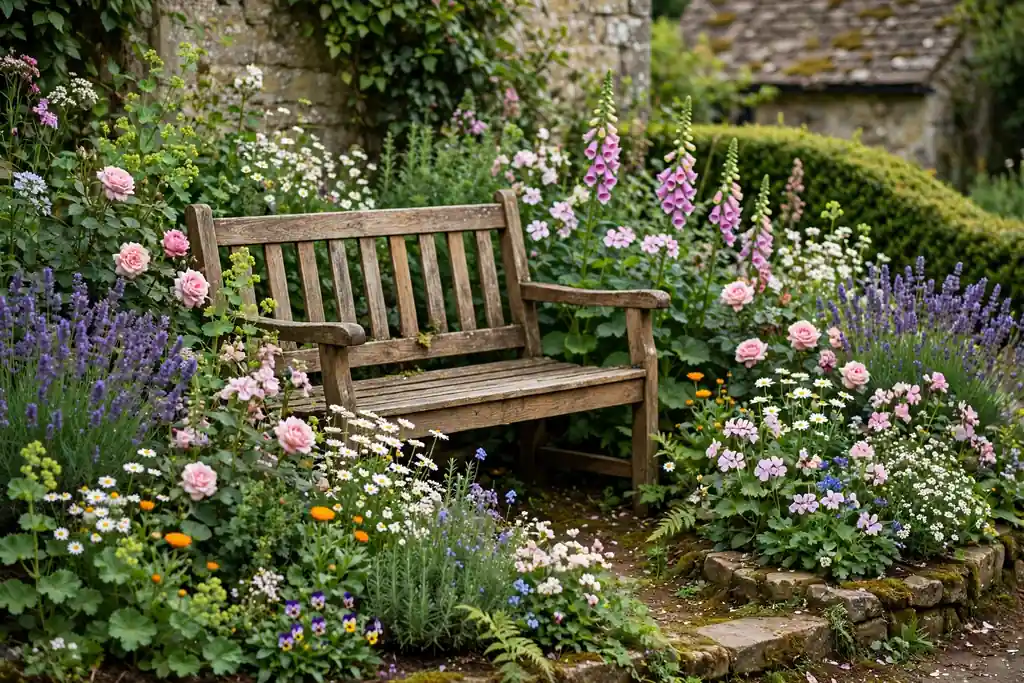
A seating nook tucked into the border gives a cottage garden a destination, not just a view from the house. Set a small bench or two chairs on a firm patch of paving or gravel inside a curve of the border, with taller planting behind and scented plants nearby. The planting shelters the seat from wind and view, so it feels private even in a small garden.
Keep the path to the nook clear and dry, and leave room to stand up comfortably without stepping into the bed. A side table or a flat stone beside the seat holds a cup and a book, which makes the nook get used rather than admired. For seat styles and placement, these garden bench ideas cover wood, stone, and metal options for a cottage path.
15. Cluster of Terracotta Pots by the Door
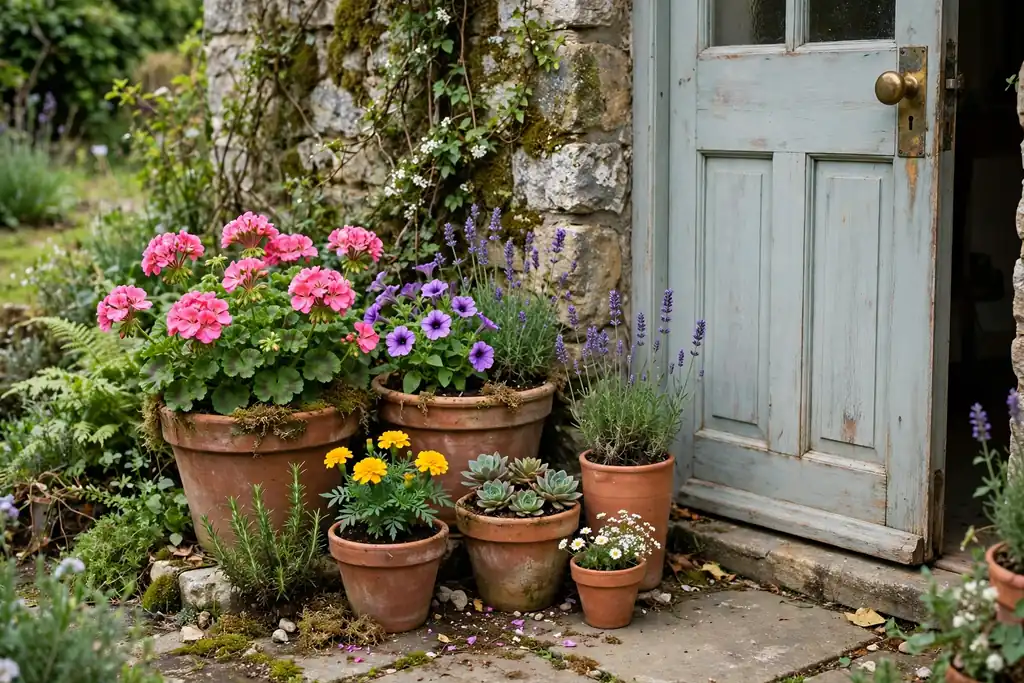
A cluster of terracotta pots by the door is the fastest cottage garden idea to finish, and it works where there is no bed at all. Group three or five pots in different sizes, plant them with a mix of herbs, geraniums, and trailing plants, and repeat at least one plant or color across the group so it reads as one display. Terracotta suits the cottage look and warms in the sun.
Terracotta dries out faster than plastic, so check the soil with a finger before watering, and choose pots with drainage holes. Move the group to follow the sun through the season, or to frame the door for a gathering. In cold areas, bring tender pot plants under cover before hard frost, and raise pots on feet over winter so they drain freely.
16. Foxgloves and Hollyhocks for Height
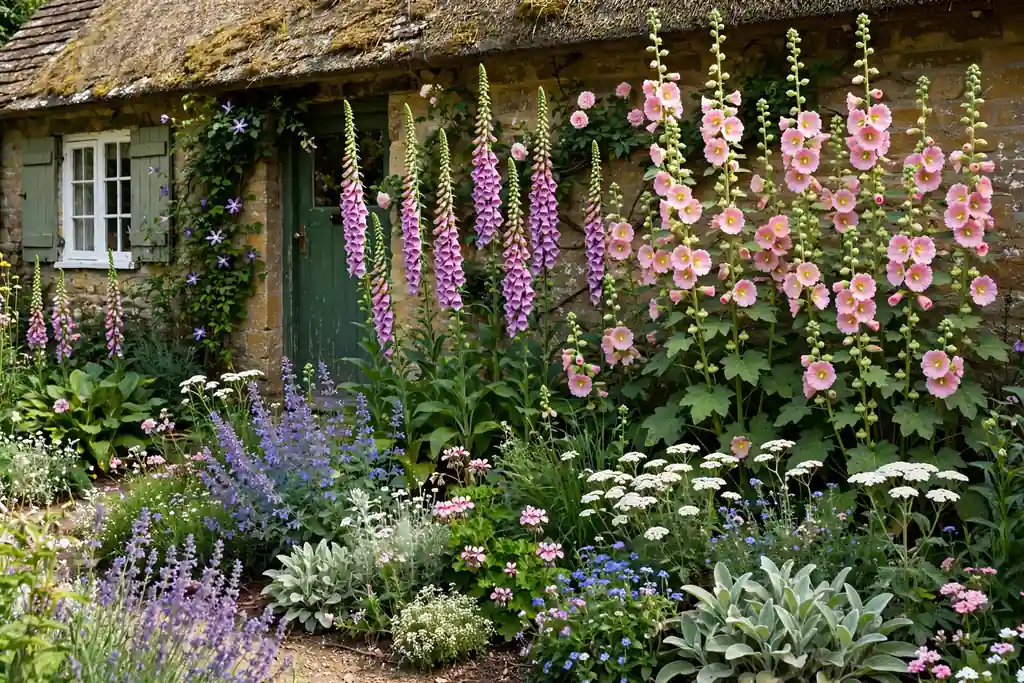
Foxgloves and hollyhocks give a cottage border its tall spires and its relaxed, old-garden feel. Plant them toward the back of the border, with lower flowers such as hardy geraniums in front to cover their bare lower stems. Both plants often self-seed, so once they settle you may get new plants each year without buying more, though the colors can shift over time.
Stake hollyhocks in windy gardens before the stems grow heavy, and note that foxgloves are usually biennial, flowering in their second year. Keep foxgloves away from areas where small children or pets might eat the leaves, since the plant is toxic if eaten. Sow a fresh batch each year so there are always plants coming into flower.
17. Small Pond Bowl for Birds and Bees
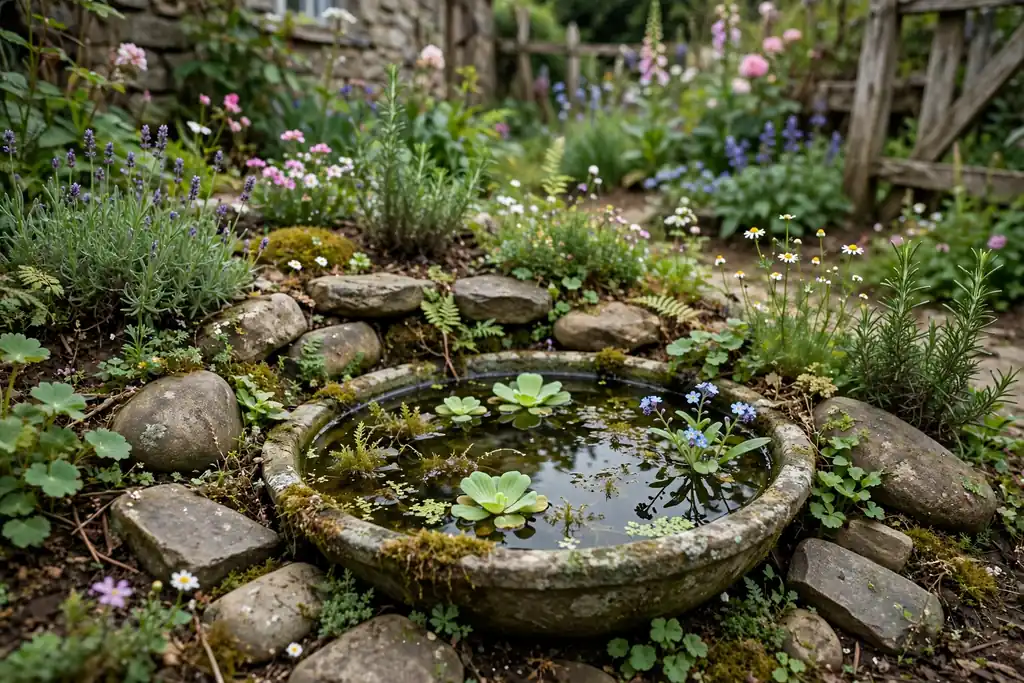
A small pond bowl brings water, wildlife, and a still, reflective surface into a cottage garden without the work of a full pond. Set a wide, watertight bowl or a half barrel into a shady corner, fill it with water and one or two water plants, and add stones that slope into the water so small animals can climb out. Birds will visit to drink and bathe, and bees will use the shallow edge.
Refresh the water often, especially in hot weather, and use a small solar fountain if mosquitoes are a problem in your area, since moving water discourages them. Keep the bowl where you can see it from a seat, and away from overhanging trees that drop leaves into it. If young children visit, choose a shallow bowl and site it where it can be watched.
18. Apple Tree Underplanted with Spring Bulbs
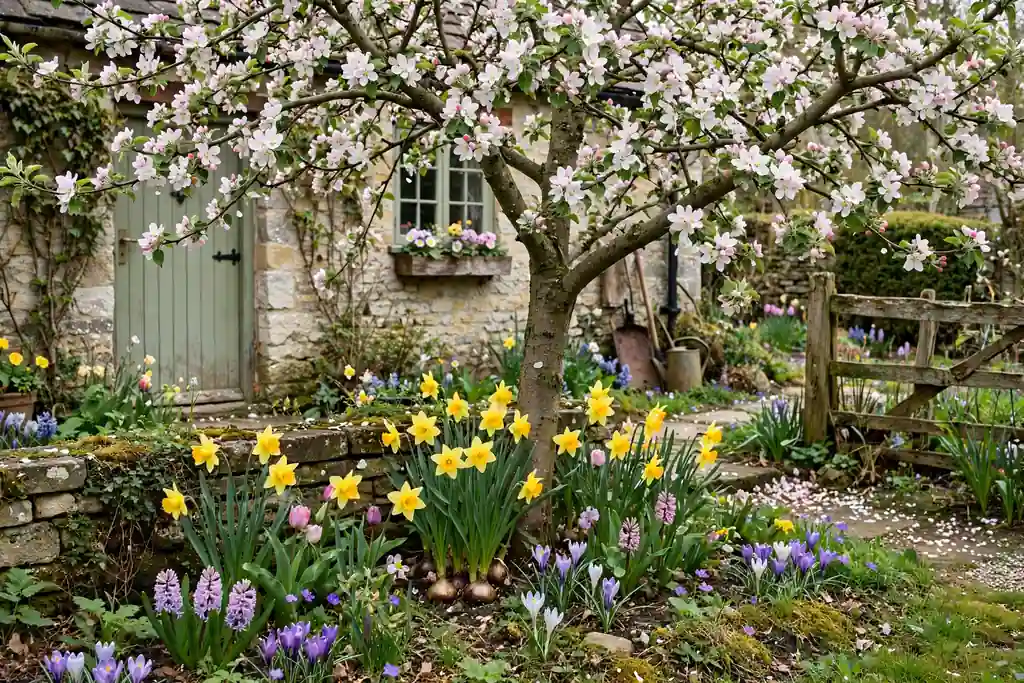
An apple tree underplanted with spring bulbs gives a cottage garden two seasons from one spot: blossom and bulbs in spring, then fruit in late summer. Plant a tree sized for your garden, since mature spread varies a lot between types, and plant bulbs such as daffodils, crocuses, and snowdrops in drifts under the canopy in autumn. The bulbs finish before the tree leafs out fully, so they do not compete for light.
Water the tree well through its first dry seasons while roots establish, and prune as the tree type requires. Keep the ground under the tree clear of long grass while bulbs are growing, and let the grass grow or mulch after the bulb foliage dies back. Fruit trees also suit a small garden trained as an espalier along a fence.
19. Brick-Edged Beds Framed with Boxwood
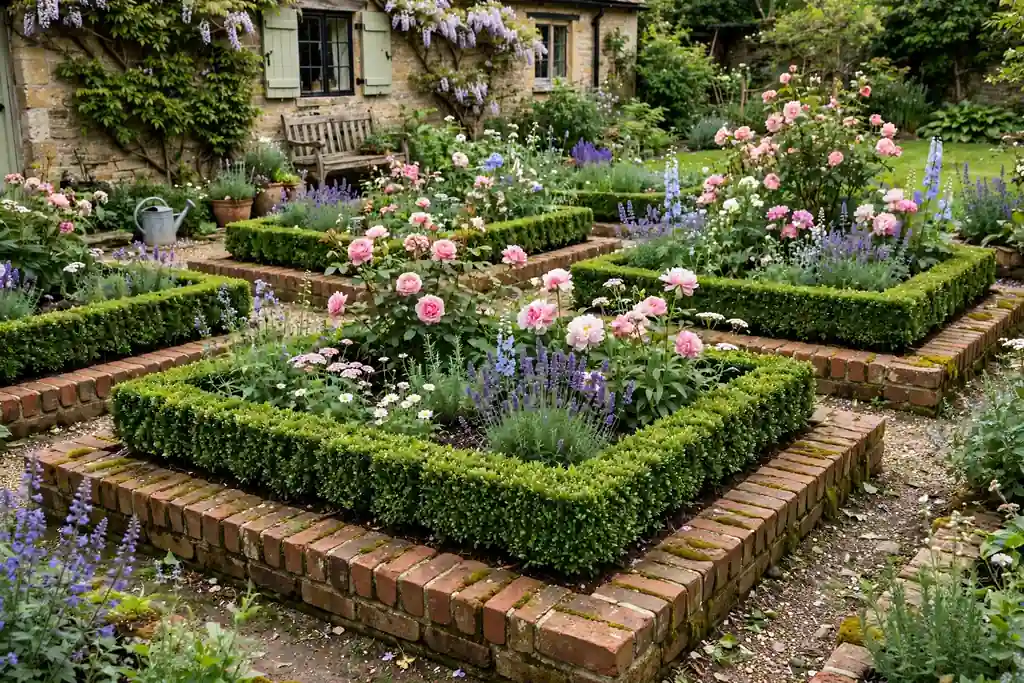
Brick-edged beds framed with low boxwood give a cottage garden a tidy skeleton that holds the loose planting together. Lay bricks on edge or flat along the bed line, and plant small boxwood balls or a low boxwood hedge inside the edge to mark the bed shape. The brick and boxwood stay through winter, so the garden keeps its shape when flowers are gone.
Clip boxwood once or twice a year to keep it dense, and check plants for box blight or caterpillar damage, acting early if you spot it. If boxwood struggles in your area, low lavender, germander, or a dwarf shrub gives a similar clipped edge. Keep the edging low, so it frames the bed without hiding the flowers behind it.
20. Cutting Garden for Kitchen Table Bouquets
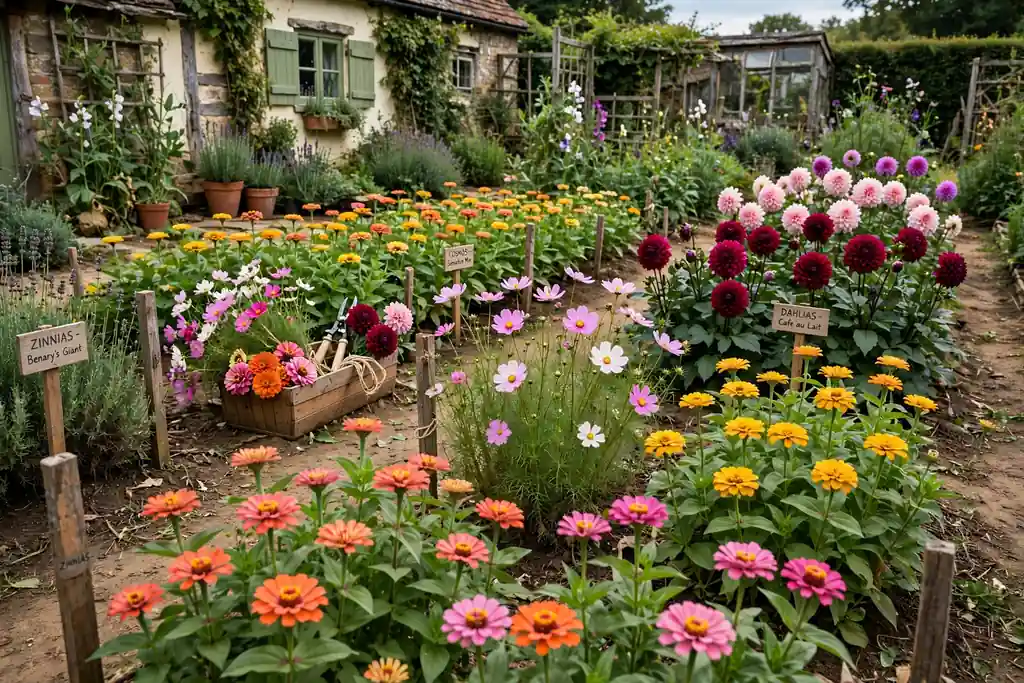
A cutting garden gives you flowers for the house without stripping the display borders. Set aside a narrow bed or a row along a fence, and grow rows of zinnias, cosmos, dahlias, sweet peas, and coneflowers spaced for picking rather than for looks. Cut in the morning into a bucket of water, and bring the stems inside the same day for the longest vase life.
Keep the cutting bed watered and fed more than the display borders, and re-sow fast annuals such as cosmos if gaps appear by midsummer. Pick often, since regular cutting keeps most cutting flowers producing new buds. A cutting bed near the vegetable patch shares watering and weeding trips, which makes it easier to keep up.
21. Shaded Fern Corner Against a North Wall
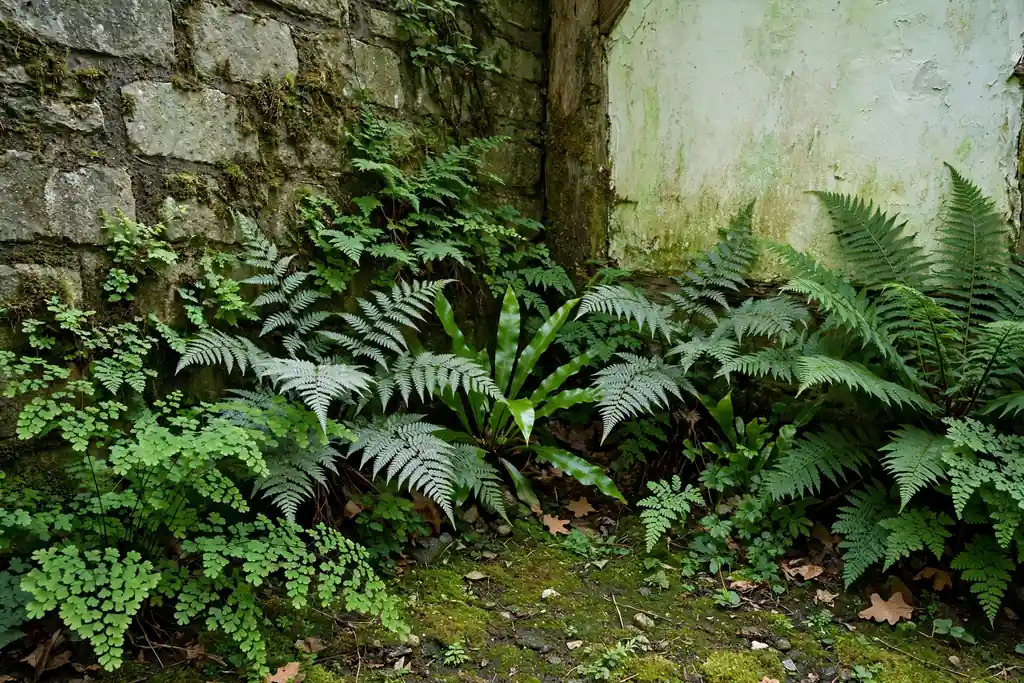
A shaded fern corner turns the hardest spot in a cottage garden, a north-facing wall, into a lush feature. Plant ferns of different heights and leaf shapes, such as hart’s tongue, lady fern, and a taller ostrich fern at the back, and mulch the soil to hold moisture. Ferns need little care beyond water in dry spells and a tidy-up of dead fronds in spring.
Keep the soil moist but not waterlogged, and add leaf mold or compost when planting to mimic the woodland floor ferns prefer. Pair ferns with hostas, brunnera, or shade-tolerant bulbs for spring color before the fern fronds fully open. A fern corner also suits a damp spot by a water butt or a shaded side passage.
22. Winding Stepping Stone Path Through Beds
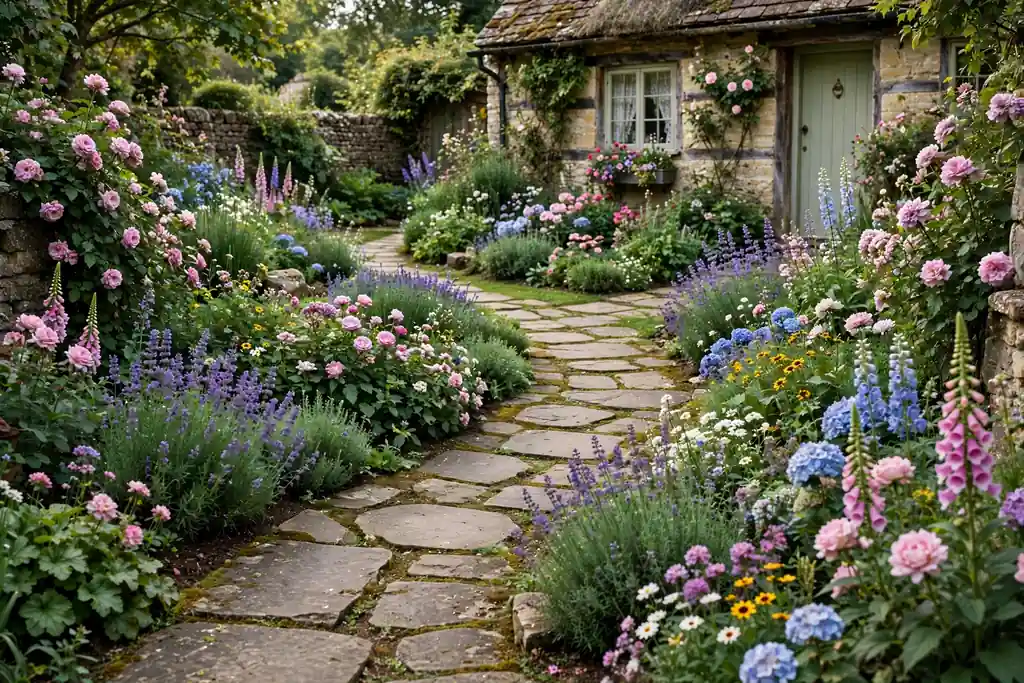
A winding stepping stone path through the beds slows the walk through a cottage garden and shows off each planting as you pass. Set flat stones in a gentle curve, sinking each one so its top sits level with the ground, and leave grass or low ground cover to grow between them. Space the stones at a comfortable stride and test them before the soil settles.
A curve suits the cottage style better than a straight run, but keep the curve gentle so the path still leads somewhere clear, such as a seat or a gate. Avoid loose gravel on the main route if you walk outside at night, and keep the stones clear of moss in damp shade, where they can turn slippery. Edge the path with low plants that do not spill across the stones.
23. Bird Bath Set Among the Flowers
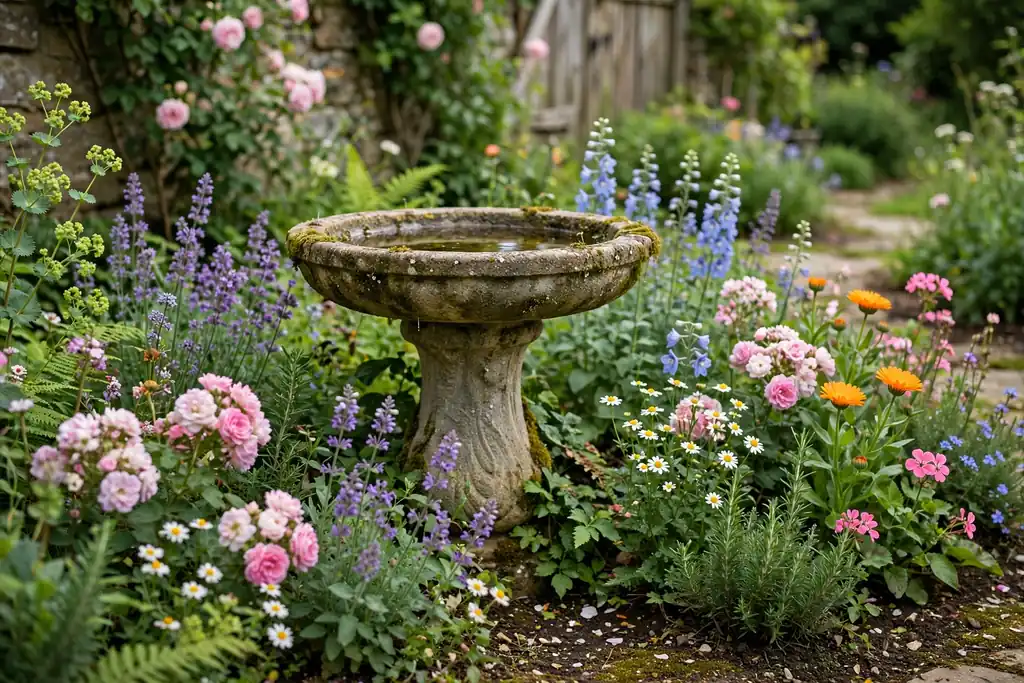
A bird bath set among the flowers gives a cottage garden a focal point and a daily visit from birds. Place a bath or a shallow dish on a stand in view of your seating, near shrubs where birds can perch before and after bathing. Fill it with clean water a few centimeters deep and refresh it often, especially in hot weather, and scrub it weekly to keep algae down.
Site the bath where cats cannot hide close by, with open ground around it so birds can see approaching danger. In freezing weather, empty a ceramic bath so ice does not crack it, or use a dish you can bring inside at night. A simple stone or terracotta bath suits the cottage look better than a brightly painted one.
24. Sweet Peas on a Bamboo Wigwam
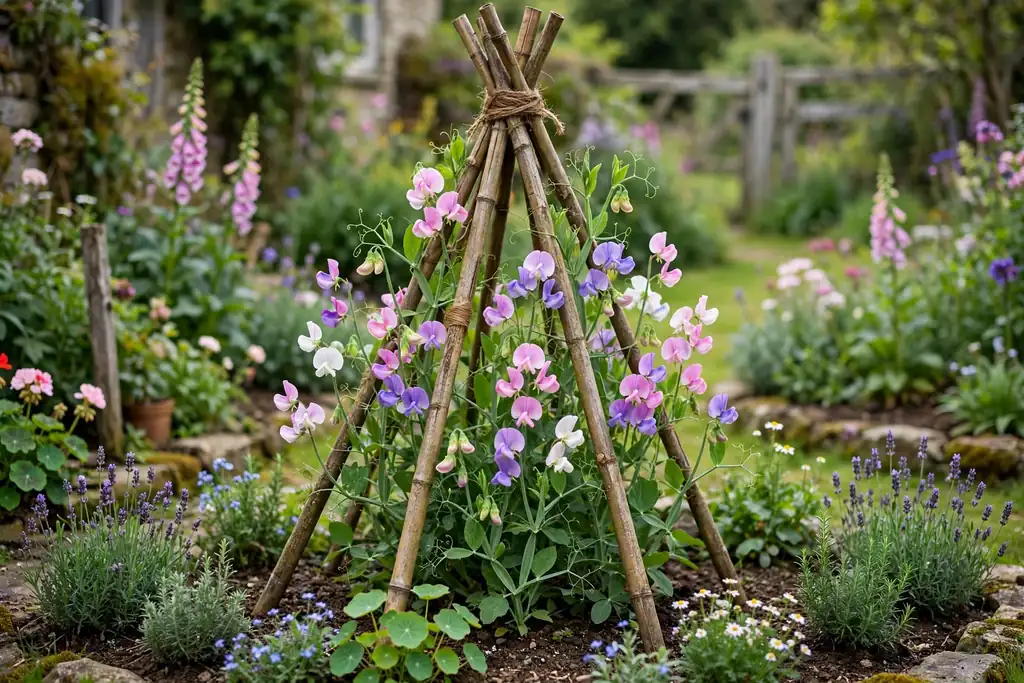
Sweet peas on a bamboo wigwam bring scent and height to a small footprint, since the plants grow upward rather than outward. Push five or six tall canes into the soil in a circle, tie them together at the top, and sow or plant sweet peas at the base of each cane. Tie young stems in loosely as they grow, water at the base, and pick the flowers every few days, because regular picking keeps more buds coming.
A wigwam in a large pot works on a patio if you have no bed, and a wigwam in a border can mark the end of a row or the corner of a vegetable patch. Stop picking late in the season if you want to save seed for next year. Sweet peas need sun and rich soil, so feed the plants through the season for the best flowering.
25. Rose Arch Walkway Between Garden Rooms
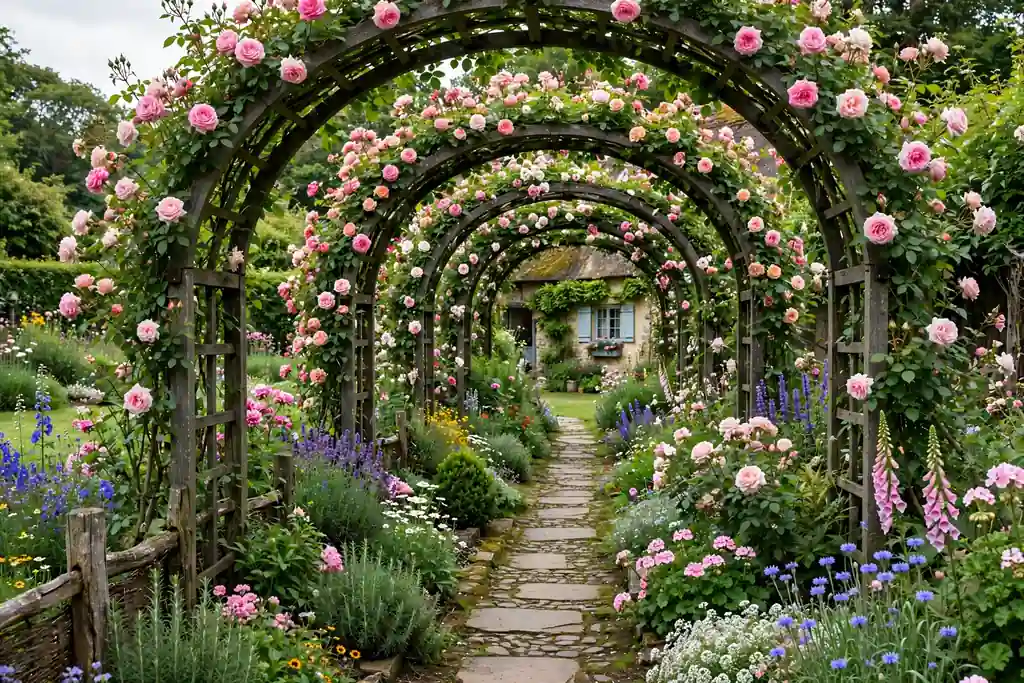
A rose arch walkway divides a cottage garden into rooms, so each area feels like a discovery rather than one open space. Set two or three arches along a straight or gently curving path, plant a climbing rose at each arch, and train the stems across the top so the walkway becomes a tunnel of flowers in summer. The arches also give the garden height in winter, when the planting is low.
Anchor each arch firmly so it does not lean as the planting grows heavier, and keep the path beneath clear of low stems that catch walkers. Prune roses after flowering as their type requires, and tie new stems in before they grow long and unruly. If a full rose tunnel is too much upkeep, alternate a rose arch with a plain wooden arch planted with clematis.
26. Cottage Planting in Containers on a Patio
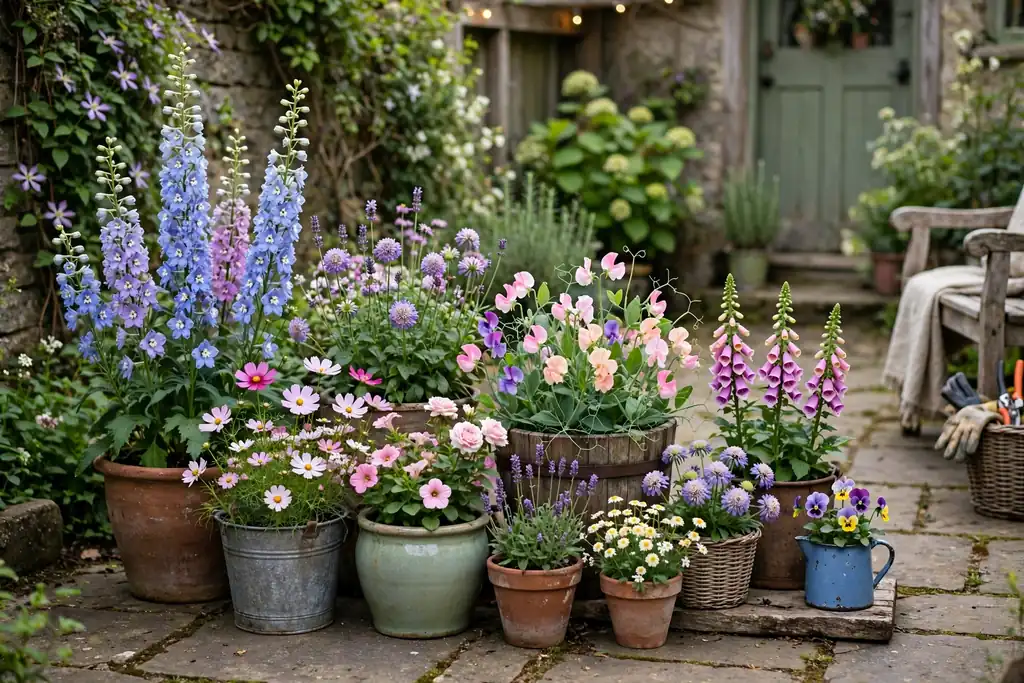
Cottage planting in containers lets you build a cottage garden on a patio, a balcony, or a yard with no soil beds. Use large pots, troughs, and half barrels, and plant them as small borders: a tall plant at the back, mid-height flowers in the middle, and trailing plants at the front edge. Group containers of different sizes together, rather than spacing them in a line, so the group reads as one garden.
Water containers daily in hot weather, since pots dry out far faster than beds, and feed through the season. Choose containers large enough that roots have room, and raise them on feet so they drain freely. A patio planted this way can hold herbs, cutting flowers, and even a small climbing rose on a trellis against the wall.
27. Evening Corner with Night-Scented Flowers
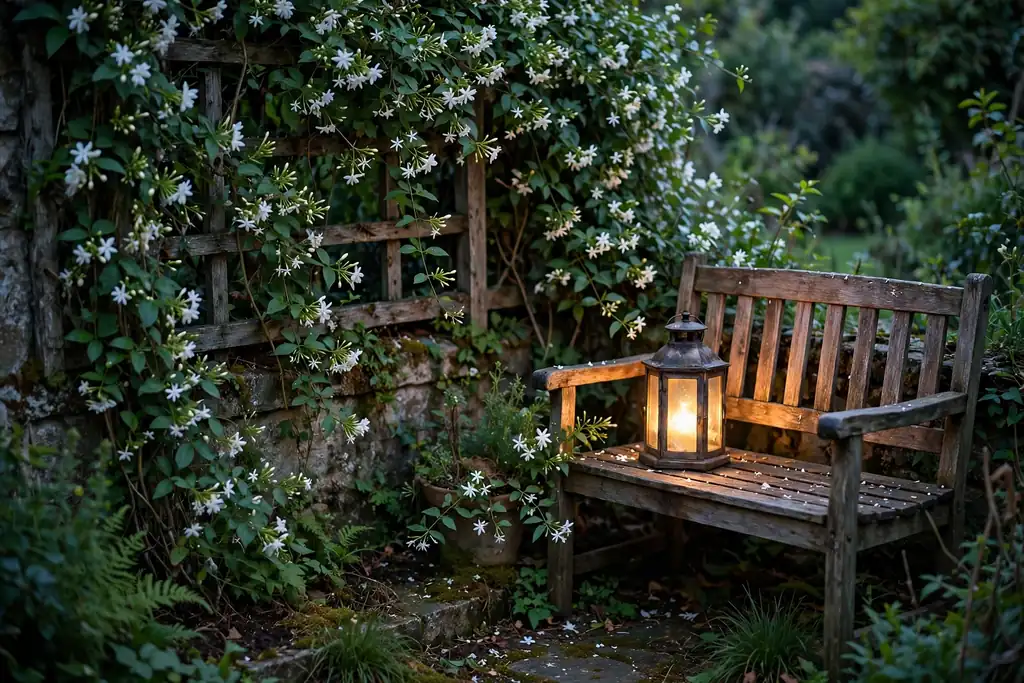
An evening corner with night-scented flowers makes a cottage garden worth visiting after dark. Plant night-scented stock, jasmine, honeysuckle, and evening primrose near a seat or a path you use in the evening, where their scent carries on warm air. These plants often look modest by day, so pair them with showy daytime flowers that hold the corner visually.
Place the evening corner where it catches the last sun and is sheltered from wind, since scent carries best in still, warm air. Add a solar lantern or a small light so the seat stays usable after sunset, and keep the path to it clear. An evening corner near a bedroom window lets the scent drift inside on summer nights.
28. Pollinator Patch with Bee-Friendly Plants
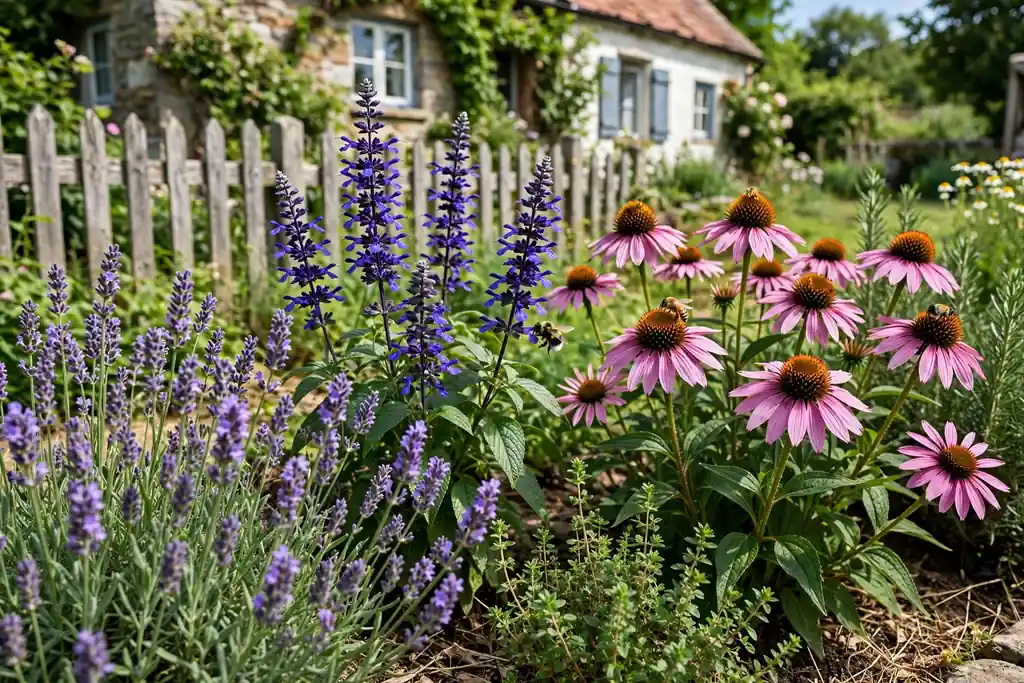
A pollinator patch gives a cottage garden a clear job beyond looks: feeding bees, butterflies, and other insects through the season. Plant a sunny bed with a mix of lavender, salvia, coneflowers, borage, and single-flowered dahlias, choosing plants that flower in succession from spring to autumn. Single flowers suit pollinators better than double blooms, which often hide their nectar.
Leave some seed heads standing in autumn for birds and winter shape, and avoid spraying the patch, since even products sold for garden pests can harm pollinators. A pollinator patch can sit inside a cottage border, along a fence, or as its own bed, and it still looks abundant and cottage-like. Leave a small patch of bare soil nearby for ground-nesting bees if you have room.
29. Garden Shed Dressed with Climbers
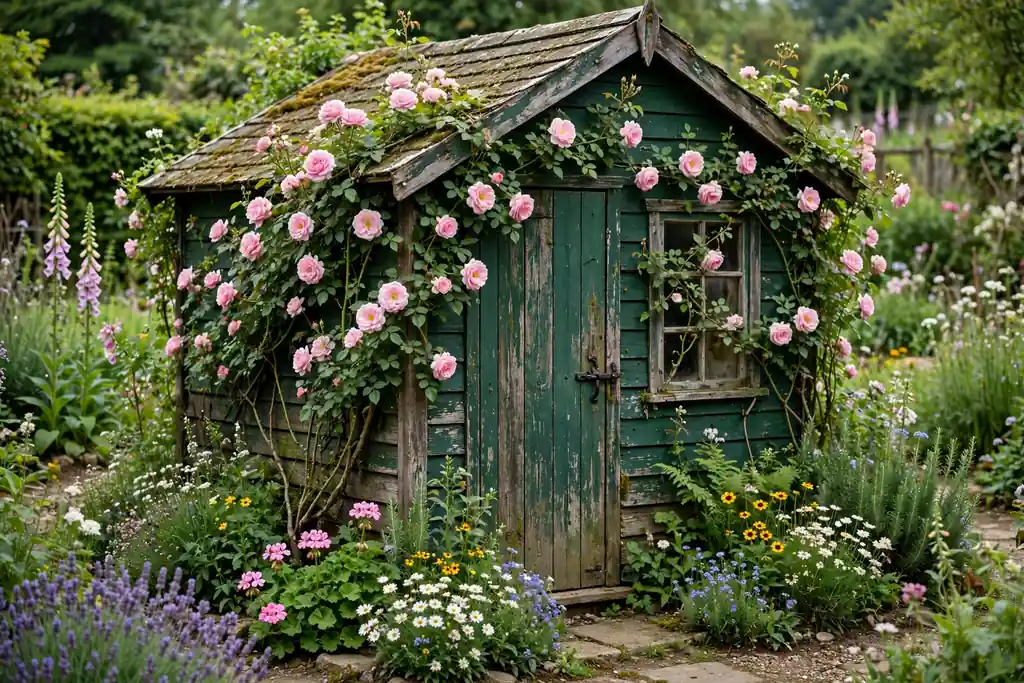
A garden shed dressed with climbers stops being a storage box and becomes part of the cottage garden. Train a climbing rose, clematis, or honeysuckle up the shed walls on wires or a trellis, plant low flowers along its base, and paint the shed a soft color that sits well with the planting. The climbers hide plain walls and give the shed a settled look within a season or two.
Fix supports with a gap behind them so air moves and the shed walls can dry, and keep climbers cut back from the roof and the door. Check the shed roof and walls stay accessible for repairs, since dense climbers can hide damage. A shed with a small porch or a lean-to for tools gives you a potting spot as well as storage.
30. Layered Bulbs for Spring Through Summer
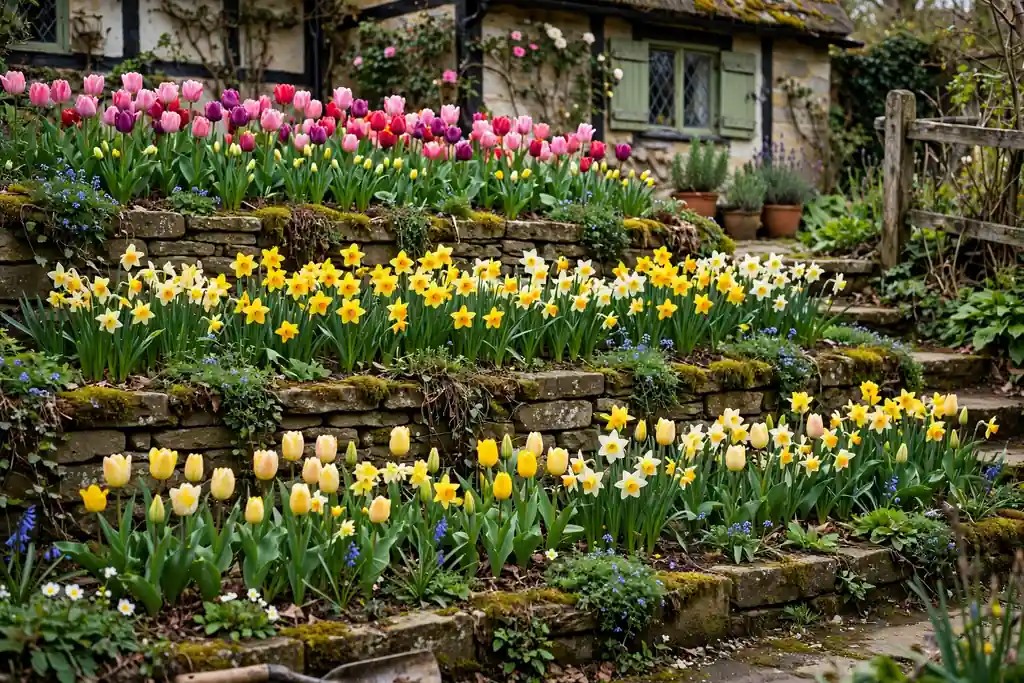
Layered bulbs, planted in tiers in one pot or bed, give a cottage garden months of flowers from a single planting session. In autumn, plant late bulbs such as tulips deepest, mid-season bulbs such as daffodils above them, and early bulbs such as crocuses near the surface, in a pot or a bed edge. The layers flower in turn, so the same spot gives color from early spring into early summer.
Use fresh potting mix and a pot with drainage holes for container layering, and water sparingly over winter until growth shows. In beds, plant bulbs between perennials so their fading foliage is hidden as later plants grow. Let bulb foliage die back naturally after flowering, since it feeds the bulb for next year, and mark the spot so you do not dig into it by accident.
31. Low-Care Front Garden with a Cottage Feel
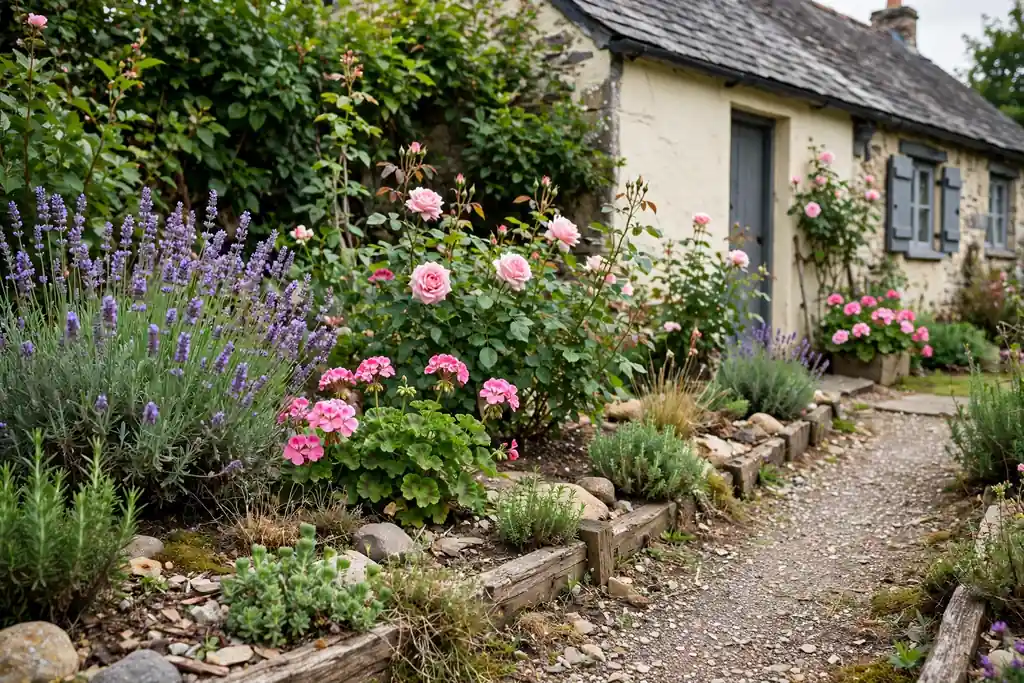
A low-care front garden with a cottage feel keeps the look without daily work, by choosing plants that mostly care for themselves. Use shrubs such as roses and lavender for structure, hardy geraniums and catmint for ground cover, and self-seeding foxgloves and calendula for seasonal color. Mulch the beds to hold moisture and keep weeds down, and edge the beds with stone or brick so mowing stays simple.
Water new plants well in their first season, then let established plants cope with normal rainfall in most climates. Cut back perennials once a year, prune shrubs as their type requires, and accept a looser look than a formal front garden. The result still reads as a cottage garden, because the planting is generous and mixed, even though the upkeep is light.
Conclusion
A cottage garden does not need every idea on this list. Start with one structure, such as a path, an arch, or a seating nook, then add two or three supporting pieces, such as pots by the door, a herb bed, and a layered border. Repeat a few favorite plants through the garden so the beds read as one design, and spread the flowering across spring, summer, and late season so the color does not arrive and leave in one month. Work through it one area at a time, and let the garden fill in around the bones you set first.
Save this list on Pinterest before your next nursery trip, and begin with the area you see most often, whether that is the front path, the kitchen door, or the seat where you take your morning tea.
FAQs
What is a cottage garden?
A cottage garden is a relaxed, densely planted garden style with mixed flowers, herbs, and vegetables, soft edges, and simple structures such as picket fences, arches, and stone paths. It favors abundance and scent over formal shapes, and it suits small gardens well, since plants are grouped closely and beds are filled rather than spaced out.
Which plants are essential for a cottage garden?
Roses, lavender, foxgloves, hollyhocks, hardy geraniums, catmint, and sweet peas are the backbone of most cottage gardens. Add herbs such as rosemary and thyme near the door, and spring bulbs for early color. Choose varieties suited to your sun, soil, and climate, and repeat a few favorites through the garden rather than buying one of everything.
How do I start a cottage garden in a small space?
Start with one bed or one structure, such as a path, an arch, or a seating nook, and plant it densely in layers. Use containers and window boxes where there is no bed, grow climbers upward on walls and fences, and put herbs and cutting flowers near the door. A small cottage garden works best when every plant earns its place and the planting is full rather than sparse.
How much work does a cottage garden need?
A cottage garden needs regular but simple care: watering new plants, deadheading flowers, cutting back perennials once a year, and pruning shrubs and roses as their type requires. Mulch keeps weeds down, and self-seeding plants fill gaps without replanting. A low-care version using hardy shrubs, geraniums, and catmint needs far less work than a garden full of tender annuals.
Can I make a cottage garden on a patio with no soil beds?
Yes. Large pots, troughs, and half barrels planted as small layered borders give a full cottage look on a patio. Grow climbers on a wall trellis, add window boxes, and group containers of different sizes together. Containers need more watering and feeding than beds, so check the soil daily in hot weather and refresh the potting mix each spring.
Does a cottage garden suit shade?
Parts of it do. Ferns, hostas, foxgloves, and shade-tolerant bulbs suit a north-facing wall or a shaded corner, while roses, lavender, and most cottage flowers need sun to flower well. In a mostly shaded garden, build the design around shade plants and use pots in the sunniest spots for the sun-lovers, rather than forcing roses into deep shade.